




Abstract

Introduction
The COVID-19 pandemic initially raised concerns about increased suicides, particularly due to stressors such as unemployment, financial strain, and social disconnectedness, however data from the earliest months of the pandemic generally showed no increases, including in three Canadian provinces (Alberta, British Columbia, Manitoba) (see Supplemental file).1,2
Experts have recommended cautious media reporting about the pandemic's potential effects on suicides, 3 as suicide-related media discussions can influence population-level behavior. 4 Specifically, reporters have been advised against presenting unbalanced, pessimistic statements about the pandemic's impact on suicides, as such messages may increase suicide risk. 3 In contrast, stories of hope and recovery that present suicide as preventable may be protective.3,4
The current study aimed to investigate whether reports of the pandemic's effect on suicides were presented in a cautious and responsible manner by major Canadian media organizations both nationally and in the three provinces for which suicide data was available during study planning.
Methods
The two most circulated Canadian national print publications, two most circulated online publications, and the single most circulated print and online publications for the provinces of Alberta, British Columbia, and Manitoba were identified through a media tracking company (Meltwater; see Supplemental File). A standardized search string was used to retrieve potentially relevant articles from the ProQuest database (see Supplementary File). If ProQuest did not catalogue a publication, manual keyword searches were conducted on the publication website. Articles describing a relationship between the pandemic and suicide trends published from 1 March to 31 July 2020, the intrapandemic period for which suicide data was available during study planning, were the main focus of the study. Articles discussing the association between the pandemic and other nonfatal, suicide-related outcomes were also captured. A coding scheme was used to abstract specific article themes and media portrayals, focusing on the nature of discussed suicide trends in order to compare media reports with actual observations (Table 1). Two coders (M.G and N.J) reviewed each article and resolved discrepancies with input from the senior investigator (M.S.).
General and Suicide-Specific Characteristics of the Most Circulated Print and Online News Articles Describing the Relationship Between the COVID-19 Pandemic and Suicide and/or Mental Health for Canada (National) (1 March 1-31 July 2020).
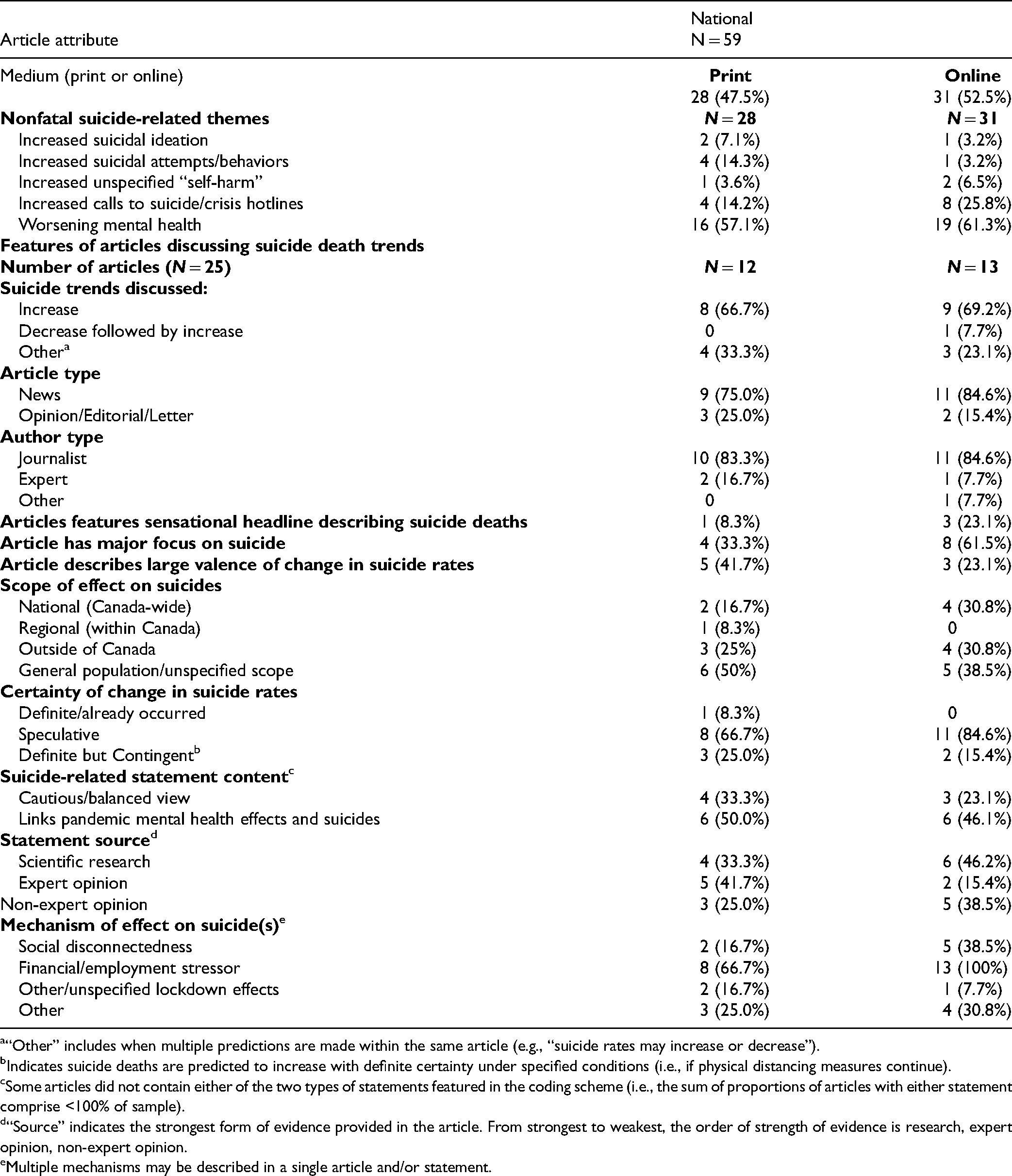
“Other” includes when multiple predictions are made within the same article (e.g., “suicide rates may increase or decrease”).
Indicates suicide deaths are predicted to increase with definite certainty under specified conditions (i.e., if physical distancing measures continue).
Some articles did not contain either of the two types of statements featured in the coding scheme (i.e., the sum of proportions of articles with either statement comprise <100% of sample).
“Source” indicates the strongest form of evidence provided in the article. From strongest to weakest, the order of strength of evidence is research, expert opinion, non-expert opinion.
Multiple mechanisms may be described in a single article and/or statement.
Results
We retrieved 123 articles meeting study criteria, with 46 (37.4%) discussing pandemic-related suicide trends (national: Table 1; provincial: Supplemental Table 1). Of these, 18 (39.1%) had a major focus on suicide. Most articles were categorized as news reports and were written by journalists, and 32 (69.6%) referenced scientific research and/or expert opinions regarding pandemic-related suicides.
Pandemic-related suicide increases were the most commonly discussed trend, being featured in 35 articles (76%). While most reports refrained from making definitive claims, some described definite outcomes contingent on specific conditions, such as prolonged public health restrictions. Unemployment and financial stressors were the most commonly described contributors to potential pandemic-related suicides, followed by mental health and social disconnectedness. The most discussed non-suicide theme was worsening mental health, featured in 90 articles (73.2% of the total).
Discussion
Our study found a substantial number of media articles from the pandemic's initial months discussing suicide and related themes. Most reports suggested that the pandemic would result in increased suicides, including some predicting large magnitude increases, although a minority did present a more nuanced view. Additionally, statements attributing suicide to worsening societal problems (e.g., employment/financial stressors), which have also positively correlated with suicides, 4 were frequently observed. These findings are concerning given that media reports highlighting pessimistic epidemiological data can influence subsequent suicides, 4 although whether this has actually occurred remains unknown due to the lack of long-term, region-specific analyses of Canadian intra-pandemic suicides. Canadian data ultimately showed no change or decreases in suicides during these initial months of the pandemic, 2 whereas the frequent discussion of pandemic-related worsening mental health was consistent with population-based survey findings. 5
A limitation of this study is that data describing the reporting of themes potentially protective against suicide was not collected. Additionally, available data did not allow for estimations of media reports' potential influences on suicide counts. Further research examining these factors over the pandemic's long-term duration would contextualize the current findings.
The unprecedented, evolving situation of the COVID-19 pandemic poses challenges to media professionals and scientists providing commentary. Our study demonstrates a need for further efforts to encourage careful, nuanced reporting on suicide and for experts to be cautious when making predictions. This may be particularly important at the outset of events like the pandemic when reporting drives the public narrative of events, in this case, inaccurately. The incongruence between early pandemic observations of increased self-reported mental health problems and decreased/unchanged suicides is also notable. It is a key lesson that increasing mental distress across a population does not necessarily mean that more suicides will occur. Journalists and the experts who advise them should be aware of this fact and should be advised not to suggest that one will inevitably lead to the other. Overall, journalists should be encouraged to emphasize potentially protective elements, such as depictions of overcoming adversity,3,4 when reporting on large catastrophic events such as the pandemic.
Supplemental Material
sj-docx-1-cpa-10.1177_07067437221125316 - Supplemental material for An Observational Study of Suicide-Related Media Reports During the Early Months of the Coronavirus Disease 2019 Pandemic in Canada
Supplemental material, sj-docx-1-cpa-10.1177_07067437221125316 for An Observational Study of Suicide-Related Media Reports During the Early Months of the Coronavirus Disease 2019 Pandemic in Canada by Madeleine Gordon, Navitha Jayakumar, Dalia Schaffer, Mathavan Vije, Ayal Schaffer, Thomas Niederkrotenthaler, Jane Pirkis and Mark Sinyor in The Canadian Journal of Psychiatry
Supplemental Material
sj-xlsx-2-cpa-10.1177_07067437221125316 - Supplemental material for An Observational Study of Suicide-Related Media Reports During the Early Months of the Coronavirus Disease 2019 Pandemic in Canada
Supplemental material, sj-xlsx-2-cpa-10.1177_07067437221125316 for An Observational Study of Suicide-Related Media Reports During the Early Months of the Coronavirus Disease 2019 Pandemic in Canada by Madeleine Gordon, Navitha Jayakumar, Dalia Schaffer, Mathavan Vije, Ayal Schaffer, Thomas Niederkrotenthaler, Jane Pirkis and Mark Sinyor in The Canadian Journal of Psychiatry
Footnotes
Declaration of Conflicting Interests
The author(s) declared no potential conflicts of interest with respect to the research, authorship, and/or publication of this article.
Funding
The author(s) disclosed receipt of the following financial support for the research, authorship, and/or publication of this article: This study was funded in part by grants from the American Foundation for Suicide Prevention (SRG-0-152-19) and Telus. MS also receives salary support through Academic Scholars Awards (MS) from the Departments of Psychiatry at the University of Toronto and Sunnybrook Health Sciences Centre.

Supplemental Material
Supplemental material for this article is available online.
References
Supplementary Material
Please find the following supplemental material available below.
For Open Access articles published under a Creative Commons License, all supplemental material carries the same license as the article it is associated with.
For non-Open Access articles published, all supplemental material carries a non-exclusive license, and permission requests for re-use of supplemental material or any part of supplemental material shall be sent directly to the copyright owner as specified in the copyright notice associated with the article.
