




Abstract
Introduction
Novel coronavirus disease 2019 (COVID-19) has been declared as a pandemic by WHO. 1 With high transmission efficiency and infectivity, quarantine for suspected COVID-19 patients is considered a powerful preventive measure to control the spread of this disease. 1 Quarantined patients are more likely to have feelings of depression, anxiety, and anger. 2 A previous study found that an intervention based on cognitive behavioral therapy was effective in reducing similar mental health symptoms during the Ebola outbreak. 3 Video messaging using smartphones was shown to be effective in improving knowledge, attitudes, and behaviors during the Ebola outbreak. 4 This article describes a study on suspected COVID-19 patients during quarantine using WeChat-based individual counseling in a tertiary care teaching hospital in China to explore the feasibility and to evaluate the potential effectiveness of the intervention on psychological well-being of suspected COVID-19 patients.
Materials and Methods
We obtained approval from the Institutional Research Ethics Board prior to study commencement. Participants were recruited after written consent was obtained in quarantine wards in a tertiary hospital in Guangdong, China, between February 2 and April 7, 2020. Eligible patients were (1) at least 18 years of age, (2) suspected COVID-19 cases, (3) able to access a smartphone with WeChat, and (4) without preexisting mental health disorders. Patients with preexisting mental disorders may need different treatment. As a result, we did not include these patients in our study. Ineligible patients were those (1) with cognitive impairment preventing informed consent or completion of questionnaires and (2) with psychosis, dementia, or severe communication difficulties.
All participants received usual psychological nursing care and were administered the Hospital Anxiety and Depression Scale (HADS). HADS consists of 2 subscales, each with 7 items measuring anxiety (HADS-A) and depression (HADS-D). Each item is scored 0 to 3, generating a total score between 0 and 21 for each subscale, with a score of 8 or more suggesting significant anxiety or depression. 5
For patients with HADS scores of 8 or higher on either scale, WeChat-based individual consultation was provided. Following enrollment, a face-to-face meeting was arranged, during which in-charge nurses explained the intervention and established a WeChat connection with the patient. Two 10-minute WeChat consultation sessions were scheduled daily during quarantine. The intervention was based on individual patient’s need, and the process was an interactive one. The in-charge nurse first listened to the patients and then tried to help them through positive dialogues and emotional and material supports. The in-charge nurse also provided accurate, comprehensive, and timely information about COVID-19 and successful stories of other quarantined patients. We measured their anxiety and depression symptoms using the HADS again at discharge (about 2 weeks after the initial intervention). A paired t test was used to compare pre- and post-intervention HADS scores.
A qualitative study using semi-structured interviews was also conducted at admission and discharge. Qualitative data were analyzed thematically. Texts from the transcribed interviews with participants were coded separately by 2 researchers and sorted by theme. Any differences in interpretation were resolved by consensus. A summary of the results was sent to participants by WeChat for respondent validation. Participants confirmed that the results accurately reflected their experiences.
Results
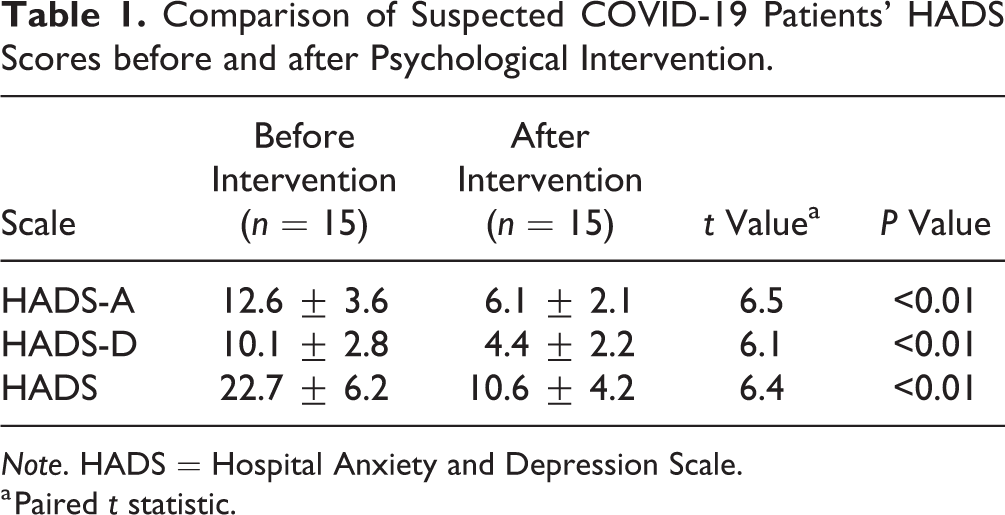
Sixty-three suspected COVID-19 patients (33 women and 30 men, mean age 33.9 years) were administered the HADS, with 15 (23.8%) patients registering a score of 8 or higher on HADS-A and/or HADS-D. A significant decrease in scores for the 15 patients subject to intervention was noted for HADS-A (P < 0.01) and HADS-D (P < 0.01), as well as for the total HADS score (P < 0.01) following the intervention (Table 1).
Comparison of Suspected COVID-19 Patients’ HADS Scores before and after Psychological Intervention.
Note. HADS = Hospital Anxiety and Depression Scale.
a Paired t statistic.
Thematic analysis of patient interviews demonstrated that patients had more requests for information and emotional and material supports during their quarantine. They felt relieved and took COVID-19 more seriously after the intervention.
Discussion
The results of this preliminary study showed that a considerable proportion of suspected COVID-19 patients had symptoms of anxiety and depression during hospital quarantine. WeChat-based individual counseling appeared to improve patient mood during this critical period. To our knowledge, this is the first study to evaluate the effectiveness of WeChat-based psychological intervention in suspected COVID-19 patients. Patient interviews allowed for exploration of patient concerns, needs, and views and facilitated understanding of patient feelings during quarantine. Building on the preliminary results reported here, it would be useful to conduct larger studies to investigate factors affecting the mental health of suspected COVID-19 patients, both in China and in other countries. Such studies would help in establishing the generalizability of our finding that simple, and cost-effective interventions based on WeChat or other readily available social media platforms such as Facebook or Snapchat may reduce stress and anxiety in suspected COVID-19 patients or patients with other conditions during quarantine.
Footnotes
Authors’ Note
The original data of this study are available from the corresponding authors after appropriate ethics and confidentiality clearances.
Acknowledgments
The authors thank patients and healthcare providers in Nanhai Hospital for their supports of this study.
Declaration of Conflicting Interests
The author(s) declared no potential conflicts of interest with respect to the research, authorship, and/or publication of this article.
Funding
The author(s) disclosed receipt of the following financial support for the research, authorship, and/or publication of this article: This study was supported in part by grants from the Canadian Institutes for Health Research (FND-148438), Clinical Research Startup Program of Southern Medical University by High-level University Construction Funding of Guangdong Provincial Department of Education (LC2019ZD019), and Foshan Special Project of Emergency Science and Technology Response to COVID-19 (2020001000376).
