



Abstract
Objective:
The objective of the current study was to determine the frequency and severity of symptoms of posttraumatic stress disorder (PTSD) in journalists covering conflict.
Methods:
PTSD data (Impact of Event Scale–Revised) collected over an 18-year period from 684 conflict journalists were analyzed retrospectively for frequency and severity of reexperiencing, avoidance, and arousal symptoms. Conflicts covered were civil wars in the Balkans (n = 140 journalists), 9/11 attack in New York City (n = 46), Iraq war (n = 84), Mexico drug wars (n = 104), civil war in Syria (n = 59), Kenya election violence/Al-Shabab terror (n = 57), state-sanctioned media intimidation in Iran (n = 114), and the current migration crisis in Europe (n = 80).
Results:
The mean age of the sample was 38.59 (SD = 8.35) years, 461 (67%) journalists were men, and the mean duration of conflict work was 13.42 (SD = 7.74) years. The 5 most frequently endorsed symptoms were in the reexperiencing/intrusion category. Mean intrusion (1.31, SD = 0.97), avoidance (1.08, SD = 0.89), and arousal (1.07, SD = 0.96) scores for the entire sample were in the mild range. Being female and less educated independently predicted PTSD symptoms.
Conclusions:
PTSD phenomenology in a group of conflict journalists with well over a decade of frontline experience is dominated by reexperiencing symptoms. While symptom severity is for the most part mild, group means can obscure those individuals with significantly more severe difficulties.
Conflict journalists fulfill an important civic function. In an era of increasing globalization, they keep us informed of war, revolutions, political unrest, and natural and man-made disasters often far from our shores that now have the potential to affect us directly. Our understanding of the origins of the 9/11 attacks or the current mass migration of millions of people to Europe, to give but two notable examples, owes much to journalists confronting grave risks that frequently come with this work. These risks are underscored by statistics gathered by the Committee to Protect Journalists revealing that the yearly mortality in the profession since 1998, the year before we began collecting data, has generally increased, the exception being 2002. 1 In addition, witnessing the death and the suffering of others and confronting dangers that increasingly include kidnapping for ransom and staged executions can prove emotionally challenging, leaving journalists vulnerable to psychiatric illnesses like posttraumatic stress disorder (PTSD) and major depression. 2 Data from a systematic review of journalists in general, and not those exclusively focused on conflict, also speak to higher rates of PTSD than in the general population. 3 Taken collectively, the current literature points toward a profession at risk for trauma-related psychopathology.
PTSD is a disorder that can arise in individuals exposed to overwhelming threat. In the DSM-5, PTSD comprises 4 categories, namely those related to symptoms of intrusion, avoidance, negative cognitions, and altered arousal. The vulnerability to this condition is further explored in the present study by a retrospective analysis of PTSD data collected over an 18-year period from journalists who have covered conflict across 4 continents.
Methods
A retrospective analysis was undertaken of 8 behavioral datasets of frontline journalists accumulated by one research center between 1999 and 2017. During this period, data were collected from 684 journalists covering the following conflicts: Civil wars in the Balkans (n = 140)
2
9/11 attack in New York City (n = 46)
4
2003 Iraq war (n = 84)
5
Drug conflict in Mexico (n = 104)
6
Civil war in Syria (n = 59)
7
Kenya (election violence/Westgate Mall terror attack by Al-Shabab) (n = 57)
8
Iran (state-sanctioned intimidation (n = 114)
9
Migration crisis in Europe (n = 80).
10
We included this group because the refugees were fleeing war zones in Syria and Afghanistan. While we recognize that covering the refugees was not associated with physical danger for the journalists, the distress of the migrants was viewed as a potential stressor that could in some individuals contribute to the development of PTSD-type symptoms.
Data were collected in the same manner for each group. This entailed establishing a secure website for each study. All participants were given a unique identifying number and a password with which to access the site. In the cases of Mexico and Iran, the study was offered in Spanish and Farsi, respectively. Data on demographics and symptoms of PTSD were collected:
Basic Demographic Information
The information included the participants’ age, sex, marital status, years of education, and number of years worked as a journalist.
Symptoms of PTSD
Symptoms of PTSD were recorded with the revised Impact of Events Scale (IES-R), which contains 22 questions that closely follow the DSM-IV criteria for PTSD. Spanish 11 and Farsi (Persian) 12 versions of the IES-R have been validated and used previously. Subjects were asked to indicate symptoms that had occurred during the past 7 days only and related to traumatic events that had taken place in their line of work. Three subscales examine intrusive (reexperiencing), avoidance, and hyperarousal phenomena. There is a choice of 5 responses for each question, which are scored 0 = Not at all, 1 = A little bit, 2 = Moderately, 3 = Quite a bit, and 4 = Extremely. Each total subscale score is divided by the number of questions in the subscale to give a mean score that equates with the individual ratings as described above. Cronbach’s alpha for the cumulative intrusive, avoidance, and arousal scales across the 8 studies was 0.917, 0.879, and 0.870, respectively. The following correlations between subscales were found: intrusion and avoidance, r = 0.76 (P < 0.001); intrusion and arousal, r = 0.83 (P < 0.001); and avoidance and arousal, r = 0.76 (P < 0.001).
Ethics
All studies received approval from the Research and Ethics Board fully affiliated with the University of Toronto. Informed consent was received from all participants.
Results
Demographics
Of the 684 journalists, 461 (67%) were men and 338 (49%), 273 (40%), and 73 (11%) were married, single, and divorced, respectively. The mean age of the sample was 38.59 (SD = 8.35) years, and the mean number of years worked as a journalist was 13.42 (SD = 7.74). A breakdown of the demographic data by conflict is shown in Table 1.
Breakdown of Journalists’ Demographic Data by Conflict.
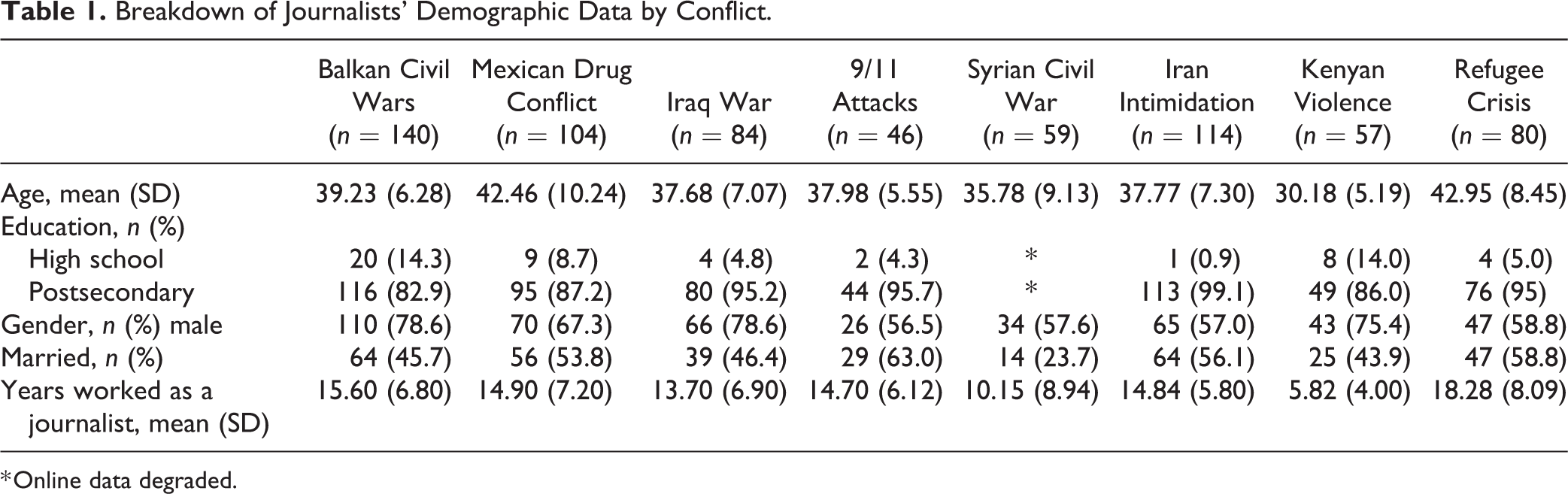
* Online data degraded.
Behavioral Data
The mean intrusion, avoidance, and arousal subscale scores for the entire sample were 1.31 (SD = 0.97), 1.08 (SD = 0.89), and 1.07 (SD = 0.96), respectively. A breakdown of the individual scores for each of the 8 conflicts is shown in Figure 1. Although the mean scores on IES-R subscales for the individual conflicts as a whole were close to the “a little bit” severity rating, Iran apart, the mean scores for the top quartile of each group generally fell in the “moderately” to “quite a bit” range (Figure 1).
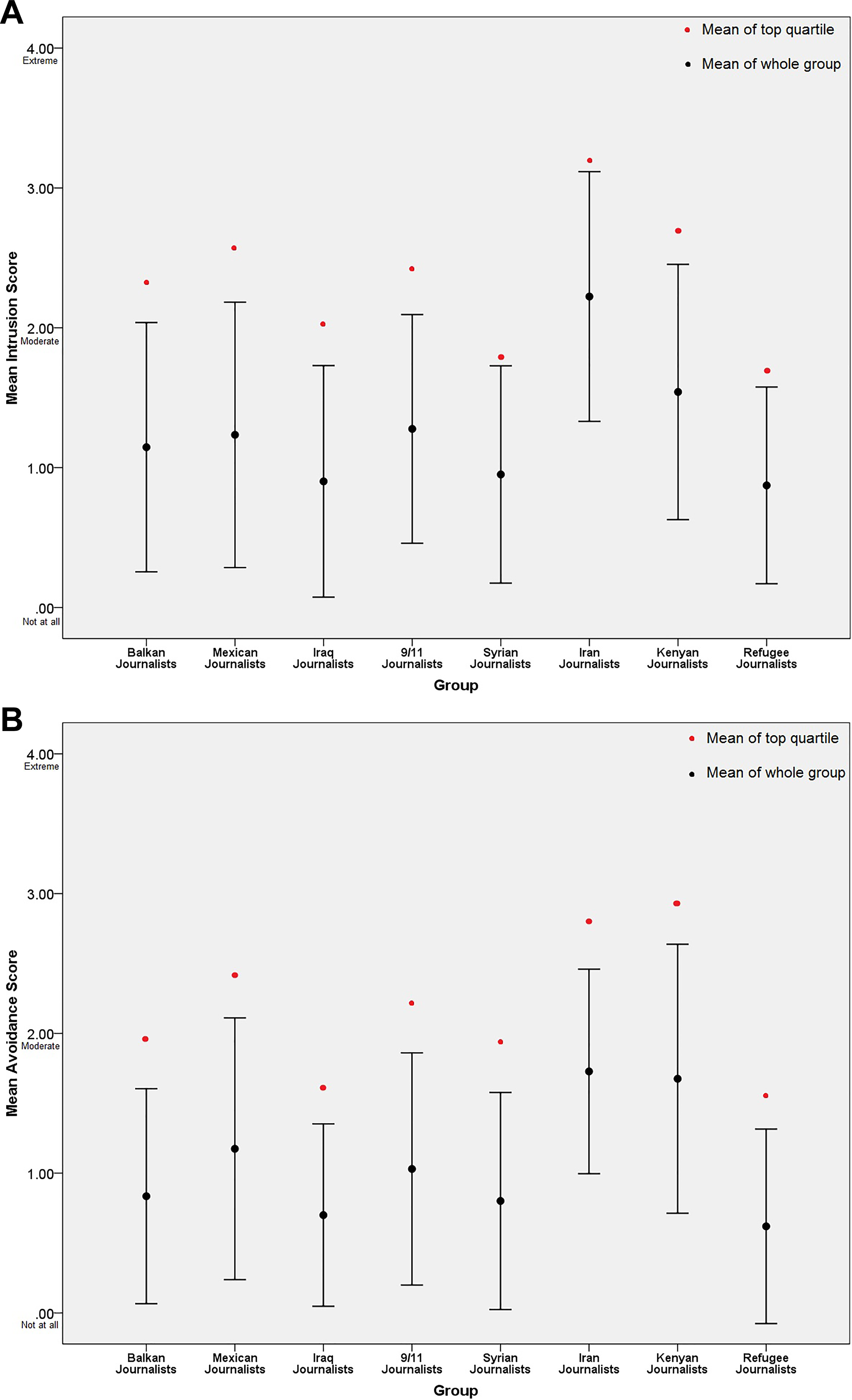
Mean (A) intrusion scores, (B) avoidance scores, and (C) arousal scores from the Impact of Event Scale–Revised by conflict.
The rank frequency of the 22 items of the IES-R is shown in Table 2 and reveals that all of the first 5 items are reexperiencing/intrusion symptoms. Similarly, the ranking of symptom severity shown in Table 3 reveals that the top 5 highest mean scores are for the same 5 reexperiencing/intrusion symptoms, albeit in a different order.
Rank Frequency of the 22 Items of the Impact of Event Scale–Revised.

Rank of Mean Scores of the 22 items of the Impact of Event Scale–Revised.

Predictors of PTSD Symptoms
Linear regression analyses were undertaken to determine whether demographic factors (age, sex, education, and marital status) were linked to PTSD symptoms. With all 4 factors included in the model, female sex emerged as a significant predictor for all IES-R subscales (intrusion: B = 0.38, t = 4.31, P < 0.001, adjusted R2 = 0.033; avoidance: B = 0.38, t = 4.72, P < 0.001, adjusted R2 = 0.041; arousal: B = 0.38, t = 4.27, P < 0.001, adjusted R2 = 0.030) and lower education as a significant predictor for intrusion (B = –0.14, t = –2.22, P = 0.027, adjusted R2 = 0.033) and arousal (B = –0.13, t = –2.03, P = 0.043, adjusted R2 = 0.041). Analysis of variance revealed no significant differences between a 4-factor linear regression model and a 2-factor linear regression model including only sex and education (intrusion: F2,577 = 1.50, P = 0.23; avoidance: F2,577 = 2.42, P = 0.09; arousal: F2,577 = 0.64, P = 0.53). The 2-factor linear regression model revealed both sex (intrusion: B = 0.35, t = 4.12, P < 0.001, adjusted R2 = 0.032; avoidance: B = 0.39, t = 4.92, P < 0.001, adjusted R2 = 0.039; arousal: B = 0.36, t = 4.29, P < 0.001, adjusted R2 = 0.033) and education (intrusion: B = –0.18, t = –2.75, P = 0.006, adjusted R2 = 0.032; avoidance: B = –0.12, t = –2.10, P = 0.036, adjusted R2 = 0.039; arousal: B = –0.16, t = –2.54, P = 0.011, adjusted R2 = 0.033) as significant predictors for all IES subscales.
Discussion
Data collected over a prolonged period bring into focus the demographic profile of the conflict journalist: under 40 years of age, predominantly male, highly educated, and with considerable exposure to conflict work. Of the demographic characteristics examined, two are very modest predictors of PTSD symptoms, namely female sex and lower education. The increased vulnerability among women to PTSD-type symptoms seen in frontline journalists is consistent with the PTSD data from the general population, 13 and the same holds true for lower levels of education. 14,15
The most notable behavioral finding was the relatively low level of PTSD symptoms endorsed by the group as a whole. While intrusive difficulties were endorsed most often, all 3 symptom clusters fell closest to the IES-R “a little bit” severity rating. The tendency for the journalists to endorse intrusive symptoms more frequently and at a higher severity level may be attributed to the degree to which frontline journalists confront stressors that could have led to their death. In a study of Western journalists covering the onset of war in Iraq in 2003, this exposure to potentially lethal events was quantified with the Trauma History Questionnaire and revealed a lifetime mean of 22 (SD = 13) such events. 5 In short, there is not a frontline journalist who does not have in his or her memory a repository of numerous, extremely hazardous events that could have brought about his or her own death or led to the witnessed death of others. These memories, while unwanted and at times intrusive, are not necessarily associated with attempts to avoid them. Furthermore, with the passage of time, which in the journalists studied here is a decade or more, a degree of habituation may also take place drawing the emotional sting from recollection, thereby diminishing any associated arousal-type difficulties. This “real world” situation for conflict journalists may in some ways be analogous to exposure therapy used effectively to treat people with PTSD. Data show that the use of image habituation in therapy can bring about symptom reduction. 16 Conversely, failure of habituation, manifested for example by a persistent acute startle response, has been identified as a cardinal feature of PTSD. 17
A second notable feature of the IES-R data involved the higher scores elicited from Mexican, Kenyan, and Iranian journalists relative to their European and North American colleagues covering conflicts elsewhere. If one excluded these 3 conflicts from the analysis, then the overall group mean intrusive, avoidance, and arousal scores fall well below a score of 1.0 (“a little bit”) indicative of very little emotional distress. Having made this point, it is important to emphasize that caution is needed when comparing IES-R scores across conflicts and cultures. While it is reasonable to conclude that exposure to grave danger is a significant common denominator linking 7 of the 8 studies, the exception being the migration crisis, conflict-specific stressors will still have differed qualitatively between the other sample studies. Telling examples of this are certain factors that set the Mexican and Iranian data, in particular, apart. These findings were collected from local journalists working within their own countries where they, and on occasion their family members by association, were attacked and intimidated. For these journalists, unlike their colleagues covering foreign wars, there was no option to escape the danger by traveling to a safe place for a temporary respite.
Another factor that must be considered when interpreting data across such a large spectrum is the well-replicated finding of culture as a determinant of symptom expression following traumatic events. 18 –22 This was clearly illustrated after the 9/11 attack in Manhattan, where PTSD-type responses among New Yorkers exposed to the attack were not homogenous. Despite a similar exposure to the traumatic event, Hispanic Americans were found to display more prominent symptoms. 23,24
The importance of culture as a determinant of trauma-related responses calls into question the validity of the IES-R as the psychometric scale of choice. Daniel Weiss, who devised the IES-R, has demonstrated persuasively that the instrument can be used effectively across cultures. 22 Indeed, there is now a large multinational literature on the IES-R that has been translated into at least 18 languages. 25 The robust Cronbach’s alpha and subscale correlation coefficients in our study lend support to this conclusion. As such, use of the IES-R in the present series of studies seems justified, more so as we have shied away from undertaking statistical comparisons between the 8 separate studies collated here. Instead, our data should essentially be viewed as descriptive with the added caveat that such an approach still allowed us to conclude that symptom severity across the studies generally fell in the mild range.
At first glance, these findings may come as comfort to the profession of conflict journalism and the news organizations that send their journalists into harm’s way. Such an anodyne conclusion does not, however, capture the full picture. While the majority of journalists covering conflict do not display prominent PTSD symptoms at any one moment in time, 3 additional points must be considered. First, symptoms of PTSD as elicited by the IES-R are not synonymous with the diagnosis of PTSD. To obtain the latter, structured face-to-face interviews are required. Second, mean scores obscure important subgroups at greater risk. For example, the mean IES-R scores in the top quartile indicated symptom severity in at least the “moderately” to “quite a bit” range on all 3 subscales. Third, the current data capture a point prevalence of PTSD symptoms. Frontline journalists, however, spend well over a decade of their careers covering conflict, as our data across the studies consistently show. When one therefore looks at a lifetime prevalence rate and does so with a structured interview, the rates of the full PTSD syndrome can approach those seen in combat veterans. 2
In conclusion, notwithstanding a multiplicity of factors that would have influenced PTSD symptom endorsement across a diverse group of conflicts, the most striking feature to emerge is one of uniformity, namely a PTSD phenomenology dominated by intrusive symptoms albeit with symptoms generally in the mild range. Our study is essentially descriptive and as such we lack the method to definitively explain these findings. While further research is necessary, it is nevertheless reasonable to suppose that low levels of PTSD symptoms reflect a degree of psychological resilience among the conflict journalists studied. We are conscious of the fact that group data obscure important individual differences. The relatively low levels of PTSD symptoms should therefore not lull news organizations into complacency when it comes to a moral duty of care. Conflict journalism is extremely dangerous work. Potential resilience is not synonymous with immunity. Embedded among these data are those from journalists who are hurting and whose distress must not be missed.
Footnotes
Data Access Statement
We do not have ethical approval to share the data.
Declaration of Conflicting Interests
The author(s) declared no potential conflicts of interest with respect to the research, authorship, and/or publication of this article.
Funding
The author(s) disclosed receipt of the following financial support for the research, authorship, and/or publication of this article: This research received grant support from Freedom Forum, UNESCO, and the International News Safety Institute.