




Abstract
This paper has been substantially revised by the Canadian Psychiatric Association’s Research Committee and approved for republication by the CPA’s Board of Directors on May 3, 2017. The original policy paper1 was developed by the Scientific and Research Affairs Standing Committee and approved by the Board of Directors on November 10, 2008.
Summary
A substantial body of research suggests that media reports about people who have died by suicide, as well as the topic of suicide in general, can influence vulnerable people and is associated with higher subsequent rates of suicide. Emerging evidence also suggests that reports about people overcoming suicidal crises may lower suicide rates. The original 2009 Canadian Psychiatric Association (CPA) policy paper on media reporting of suicide 1 led to meaningful discussion between mental health professionals and journalists in Canada. This second iteration of the policy paper reviews the most up-to-date evidence relating to media reporting and suicide, and updates recommendations with more direct engagement and input from the journalism community. Recommendations are meant as a guide for all relevant stakeholders, including journalists, editors, producers, journalism educators, researchers, policy makers, mental health professionals, and social media platforms. The paper suggests a framework for approaching suicide-related coverage and outlines potentially harmful and helpful aspects of reporting that should be avoided and included, respectively. Recommendations include using appropriate language, trying to reduce the stigma around mental disorders, and providing information about alternatives to suicide. Pertinent resources for people contemplating suicide, such as crisis services, should also be provided and can be directly linked to reports that appear online. Simplistic or glorified depictions of suicide should be avoided, and suicide should not be presented as a way of solving problems. Reports should avoid details of suicide methods, particularly if they are novel or unusual. Recommendations also include that, where possible, suicide should be covered by or with the input of health reporters who are best positioned to contextualize suicide within the broader topic of mental health. The paper also makes preliminary recommendations for social media and suggests collaboration with online platforms to help establish organizational standards concerning the dissemination of information about suicide.
Introduction
Scientific evidence from numerous natural experiments worldwide demonstrates that media reporting of suicide can sometimes result in contagion, with increased suicide rates across a population. 2 –12 The association has satisfied the criteria of consistency, strength, temporality, specificity, and coherence required to conclude that there is a causal relationship. 13–14 The research evidence indicates that, in general, more suicide deaths occur following repetitive reporting of suicide. 5–6 This relationship is widely known as the Werther Effect, a reference to a 1774 novella published by Goethe describing the death by suicide of a young man who was rejected by the young woman he loved. 2 This suicide contagion effect is thought to be mediated by social learning, whereby a vulnerable person identifies with people depicted in the media and may be more apt to copy their suicidal behaviour and subsequently die by suicide. 5 –7,15–16 The effect may be particularly pronounced for youth, a group that can be more susceptible to social learning, 17 –22 and in cases where the media report relates to a celebrity, whose behaviour people may be more prone to emulate. 4,12,16,23 –27 In contrast, the effect does not seem to occur if the person who died by suicide was a criminal. 16 Although the best evidence in this area comes from large, population-based, natural experiments, where it is challenging to prove exposure to media reports, findings from psychological autopsy studies, reviews of suicide notes, and interviews with people who have attempted suicide show that many have or were exposed to suicide-related media content, which influenced suicidal behaviour. 8,28 –34 More recently, Niederkrotenthaler et al. postulated a corollary effect to the Werther Effect called the Papageno Effect, whereby media reporting emphasizing a positive outcome of a suicidal crisis may be associated with lower subsequent suicide rates. 5 This was based on a latent class analysis examining media and suicide reporting in Austria. The authors found that articles stressing “mastery of crisis,” in which people contemplating suicide employed adaptive coping strategies rather than suicidal behaviour, were associated with a subsequent decrease in the rates of suicide. 5 The “active ingredients” of reporting that mediate contagion of suicide and adaptive behaviour are not fully understood; however, there is general consensus on putatively harmful and protective aspects of media reporting, and these form the basis for media guidelines.
Guidelines for responsible media reporting of suicide have been developed across numerous countries and jurisdictions worldwide. 35 –38 Several guidelines have been produced in Canada, including those from the Canadian Psychiatric Association, 1 the Canadian Association for Suicide Prevention (CASP), 39 and the Mindset guidelines developed by journalists themselves. 40 Media guidelines have demonstrable impact on the quality of reporting on suicide 41 –44 and, in some cases, have been associated with lower suicide rates. 42,45 It is estimated that guidelines can prevent more than 1% of suicide deaths; such a reduction in Canada would translate to the prevention of more than 40 deaths per year across the country. 46–47 Canadian studies examining media reporting—in general and per the guidelines above—are limited. A recent study examining adherence to Mindset’s 14 specific recommendations in the aftermath of a celebrity suicide found that most recommendations were followed (range of adherence was 65% to 99% of articles), except for the recommendation to tell people considering suicide how they can get help (present in only 27% of articles). 48
The original CPA position paper on media reporting and suicide 1 garnered controversy from some who expressed scepticism about the evidence base for suicide contagion, 49 and argued that perceived efforts to suppress suicide-related stories are counter-productive. 50 In the interim, there has been increased engagement between mental health professionals and the media via informal dialogue surrounding specific reports, through symposia at the CPA annual meeting, and during and after Canada’s first media forum for suicide prevention, held in Toronto in November, 2015. 49 In part due to a greater public desire for information about mental health, journalists are increasingly interested in covering issues related to mental health, including suicide, in a respectful and destigmatizing manner. 49 Most suicide deaths are not newsworthy and the media are sensitive to concerns about contagion; however, deciding when and how to cover suicide is a delicate balancing act. 49 Rather than telling journalists how to do their jobs, consensus is that the mental health community needs to work collaboratively with the media and provide them with the best available information to make those difficult decisions, and to provide context and help mitigate risks of contagion when the decision is to proceed with a report. 36,39,49
One relatively new aspect to this discussion is the proliferation of social media and the implications for media guidelines on reporting suicide. 51–52 There are significant concerns about pro-suicide content, which accounts for a substantial proportion of suicide related-information online, 53–54 and that users may use social media to learn about suicide, 55–56 disseminate suicide methods, 57–58 normalize and desensitize people to self-injurious behaviour, 59 and publish suicide notes. 60–61 Social media sites also provide opportunities for prevention through learning about alternatives to suicide, resources for getting help, and for access to peers who have mastered suicidal crises. 52,62 Some platforms have developed built-in responses in which, for example, queries about suicide prompt the display of prevention resources or where users can report concerns about people who may be expressing suicidal ideation. 52,62 –64 It has been suggested that, in the age of the internet, media guidelines may be impractical or irrelevant given the difficulty inherent in trying to constrain or regulate billions of comments and postings. 65 However, there is general agreement that social media sites should facilitate access to health information and resources for people contemplating suicide. 65–66 Furthermore, studies show that the traditional media commonly uses social networking sites like Facebook and Twitter to inform their coverage and, likewise, their coverage can influence social media. 51 This bidirectional relationship suggests that the approach of the traditional media to covering suicide is likely to have some impact on how it is depicted in social media.
The goals of this updated policy paper are 1) to increase engagement with the journalism community and to adjust previous recommendations collaboratively with journalists; 2) where possible, to achieve consistency between CPA recommendations and recent Canadian and international guidelines; and 3) to address the challenging issue of recommendations in the context of new online and social media. The recommendations below stem from a careful review of the available literature and of Canadian and international guidelines, as well as discussion with journalists and mental health professionals.
Recommendations for Traditional Media Coverage
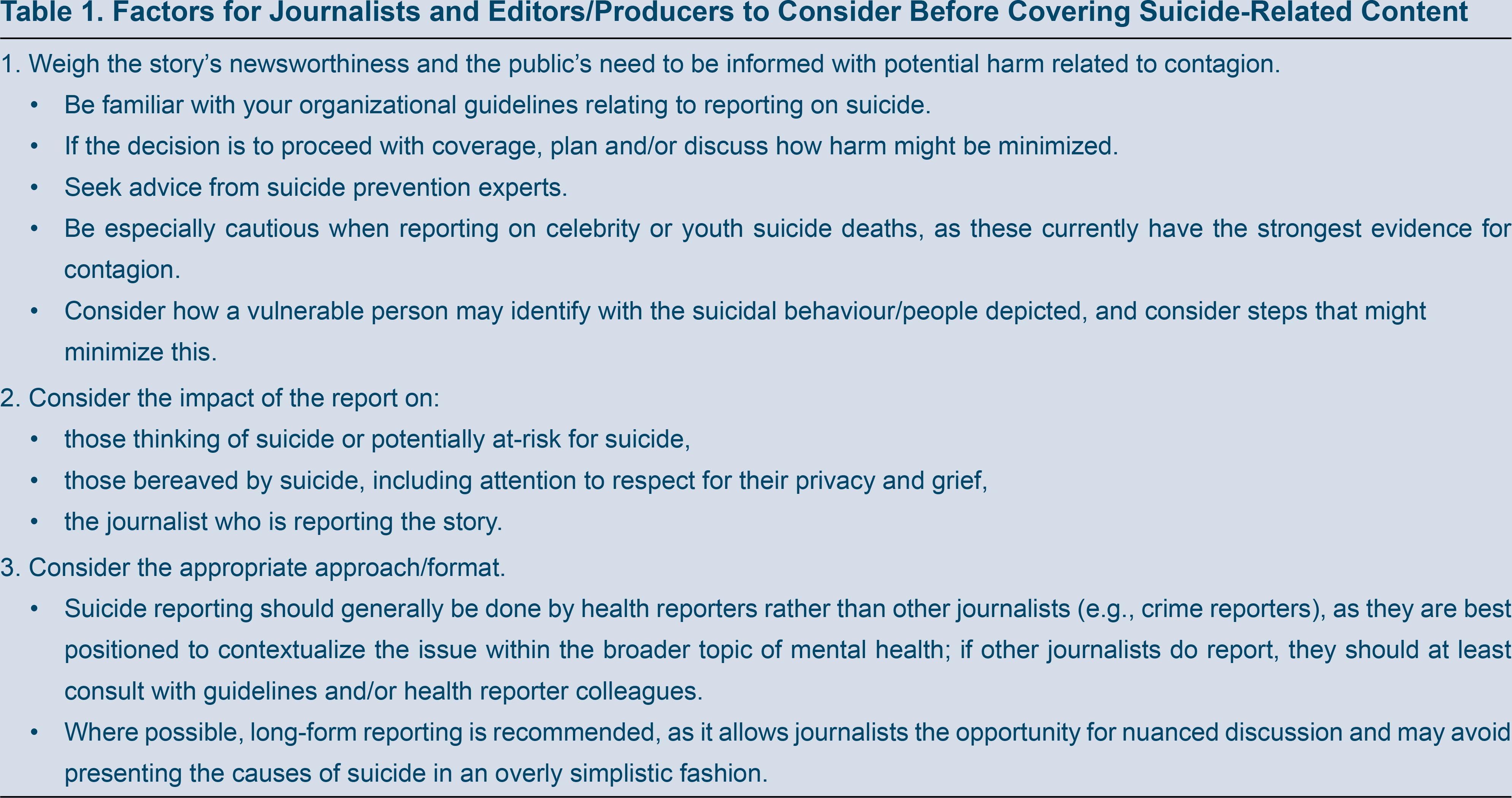
Table 1 outlines in detail the recommended approach to developing a suicide-related report. Table 2 describes specific elements to be avoided and included, respectively, in media reports. We highlight 3 of these recommendations for special attention:
Factors for Journalists and Editors/Producers to Consider Before Covering Suicide-Related Content
Recommendations for Potentially Harmful Elements of Media Reporting that Should Be Avoided and Potentially Helpful Elements to Include
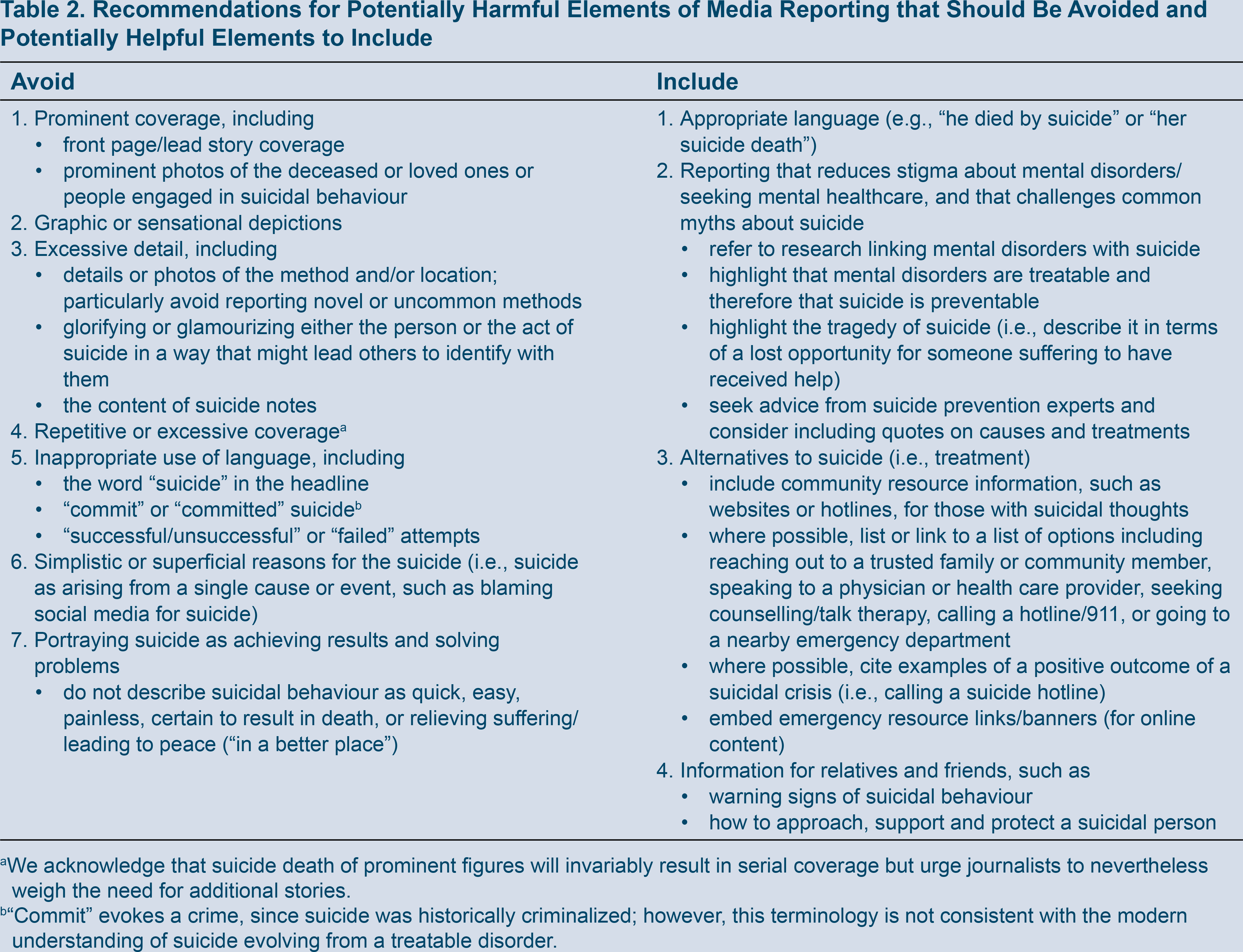
aWe acknowledge that suicide death of prominent figures will invariably result in serial coverage but urge journalists to nevertheless weigh the need for additional stories.
b”Commit” evokes a crime, since suicide was historically criminalized; however, this terminology is not consistent with the modern understanding of suicide evolving from a treatable disorder.
A key element of these recommendations is that, as much as possible, suicide be covered by health reporters rather than crime reporters or other journalists. The notion that suicide is a crime rather than the result of a mental disorder is archaic. Crime reporting often includes graphic details of the suicide to make reports more exciting and sensationalistic. Such detailed reporting for suicide coverage is inappropriate and may promote contagion. Health journalists have the greatest awareness of the complex issues surrounding suicide reporting and are therefore best positioned to cover the topic. We acknowledge that there may be situations where other journalists, such as sports, entertainment, or financial reporters, may want to cover suicide deaths in their areas; however, we recommend that they do so cautiously, paying attention to these guidelines, and we suggest they consult with their health reporter colleagues about suicide-related content.
There is growing evidence that media reporting on novel methods of suicide has led to dramatic increases in suicide deaths by these methods and in overall suicide rates in various areas of the world.
67
–70
Whereas media reports should generally avoid details of suicide methods, as these can lead to contagion effects, such an effect may be particularly pronounced when unusual or novel methods of suicide are involved. Therefore, publicizing these details should be avoided.
Guidelines universally advise the media to provide resources, such as crisis lines, to people contemplating suicide. Online platforms afford an opportunity to go a step further. Reports themselves can be accompanied by embedded links to crisis services to facilitate access, thereby decreasing barriers to help-seeking.
Recommendations for Social Media
As described, this is largely uncharted territory in Canada and throughout the world. The recommendations below are meant to be a starting point, with the intention that future iterations of the CPA policy paper will refine and expand on them with input from social media organizations.
We recommend: A novel collaboration between Canadian mental health professionals and social media organizations. Just as journalists are the experts in their area and must take a leadership role in responsible reporting of suicide, those best positioned to address suicide on social media are the designers of the social media sites themselves. In replicating efforts that have been successful with the traditional media, the CPA and mental health professionals should organize meetings, symposia, and forums to address the topic of suicide collaboratively with social media stakeholders. Social media organizations consider the degree to which they might be used as a platform for suicide prevention. Specific efforts may include 1) providing information and resources to people who make suicide-related queries or posts, 2) including “panic buttons” that allow for rapid access to crisis services/hotlines, 3) providing mechanisms for users to report if they are concerned about someone with the possibility for rapid intervention, and 4) moderating forums that frequently include suicide-related postings and making sure to remove inappropriate posts.
Recommendations for Dissemination of Guidelines
Evidence from other countries suggests that media guidelines work best when there is ongoing collaboration between suicide prevention experts, journalists, journalism schools, and public health policy experts. 39
We recommend: Ongoing collaboration between journalists and mental health professionals, acknowledging scientific evidence and the autonomy of journalists. All journalism schools include teaching of how to report responsibly and respectfully on the topic of suicide, including attention to issues related to ethics and social justice. Media training for mental health professionals who are likely to be called on to comment on suicide in the press. Education for policy-makers and other prominent figures who may be asked to comment publicly on the topic of suicide.
Conclusions & Future Directions
These recommendations mainly rely on data from large, natural experiments, which must be interpreted with a note of caution. Nevertheless, the weight of evidence suggests that certain types of media reporting, particularly those that glamourize suicide or a person who has died by suicide, can and do influence some people to die by suicide. Similarly, reporting that describes people overcoming suicidal crises and finding other solutions may encourage help seeking and more adaptive coping strategies. Further high-quality research is needed to identify which putatively harmful and protective elements of media reports mediate risk and confer benefit, respectively. More studies on the influence of media reporting in Canada and the impact of social media on suicide are also needed. The Canadian Psychiatric Association and mental health professionals across Canada are committed to helping the media make informed decisions about when and how to report on suicide. These efforts will ideally involve collaborative partnerships among all stakeholders, including mental health professionals, members of the media, individuals with lived experience, and all those touched by suicide. These ongoing collaborations, and future efforts that also include social media platforms, will provide the best opportunity to address this important issue.