




Abstract
Objective:
The not criminally responsible on account of mental disorder (NCRMD) designation remains widely misunderstood by the public. Such misunderstandings may also be reflected in the media. As such, the aim of this study is to conduct a preliminary examination of the tone and content of recent Canadian newspaper articles where NCRMD is a major theme, comparing these to generic articles about mental illness.
Methods:
Articles about mental illness were gathered from major Canadian newspapers. These were then divided into two categories: 1) articles where NCRMD was a major theme and 2) articles where NCRMD was not a major theme. Articles were then coded for the presence or absence of 1) a negative tone, 2) stigmatising tone/content, 3) recovery/rehabilitation as a theme, and 4) shortage of resources/poor quality of care as a theme.
Results:
The retrieval strategy resulted in 940 articles. Fourteen percent (n = 131) of all articles had NCRMD as a major theme. In comparison to generic articles about mental illness, articles with NCRMD as a major theme were significantly more likely to have a negative tone (P < 0.001) and stigmatising tone/content (P < 0.001) and significantly less likely to have recovery/rehabilitation (P < 0.001) or shortage of resources/poor quality of care as a theme (P < 0.001).
Conclusions:
Articles with NCRMD as a theme were overwhelmingly negative and almost never focused on recovery or rehabilitation, in stark comparison to generic articles about mental illness.
Early 2017 saw the media ablaze with reports of the absolute discharge of Vincent Li from forensic mental health care. Li killed a man on a bus in 2008, but his actions were attributed by a Manitoba court to delusions stemming from schizophrenia. 1 Hence, he was found not criminally responsible on account of mental disorder (NCRMD).
NCRMD is a designation under Section 16 of the Criminal Code of Canada, which states the following: No person is criminally responsible for an act committed or an omission made while suffering from a mental disorder that rendered the person incapable of appreciating the nature and quality of the act or omission or of knowing that it was wrong.
2
Many NCRMD cases lead to major media coverage. 7 Mental health advocates have long been concerned about media coverage of mental disorder. This is based on studies suggesting that news articles of mental illness often contain stigmatising language and inaccurate content. 8 –10
The Mental Health Commission of Canada (MHCC) has invested much time and resources into changing media portrayals of mental illness. 11 This includes the production of widely distributed media best practice guidelines, known as ‘Mindset’, in 2014. 12 Mindset gives consistent advice to journalists throughout—namely, to avoid stigmatising language and raise awareness of recovery, treatment options, and resources.
Mindset may be having a positive impact, as recent studies suggest that the Canadian media have improved their coverage of mental illness in general, frequently adhering to the new guidelines and reducing stigmatising and inaccurate language. 13,14
One exception to these findings may be media coverage of NCRMD. The NCRMD designation remains widely misunderstood by the public. 15 Such misunderstandings may be reflected in the media. Indeed, studies from the United Kingdom and New Zealand indicate that homicides committed by people with mental illness are considered highly newsworthy by the media, who often report such homicides in a sensational manner. 7,16
Indeed, the ‘Mindset’ guidelines recognise the potential for such misunderstanding by including a chapter entitled ‘Mental Health and the Law’ (Chapter 5). This includes generic advice on reporting mental illness, as well as 7 specific guidelines for reporting on NCRMD review board hearings, listed in Table 1.
‘Mindset’ NCRMD Review Board Hearing Best Practice Checklist.
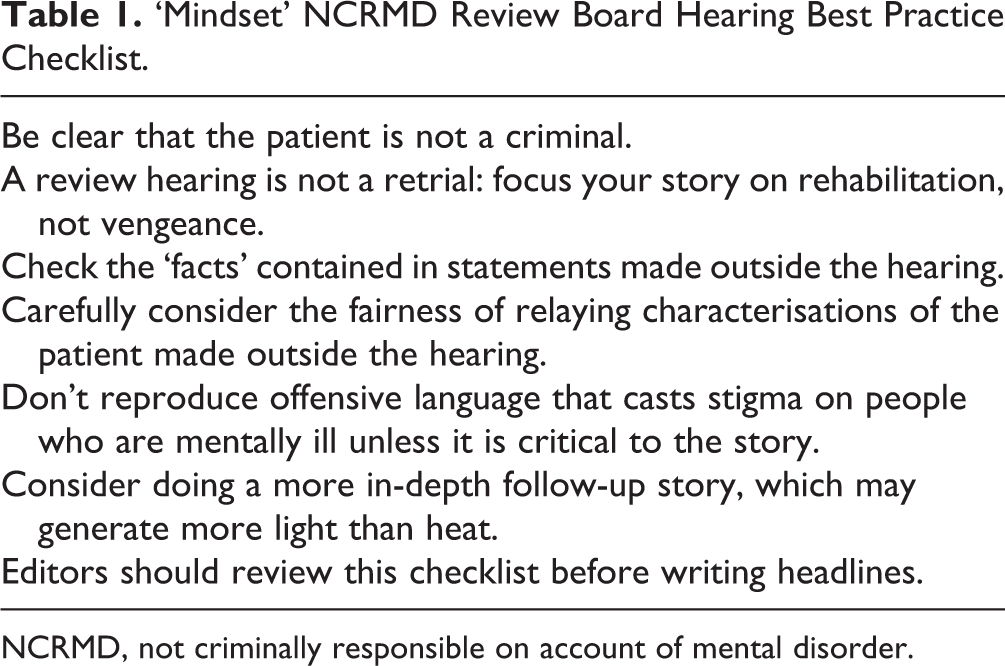
NCRMD, not criminally responsible on account of mental disorder.
To our knowledge, no study has systematically examined media representations of articles related to NCRMD in Canada. Thus, the aim of this study is to offer a preliminary examination of the tone and content of recent Canadian newspaper articles where NCRMD is a major theme, comparing these to generic articles about mental illness.
Methods
This article is nested within a wider 10-year study assessing media portrayals of mental illness in general, with detailed methodology published elsewhere. 14,17 For the present article, we separated 4 months of daily newspaper articles (September 1, 2015, to December 31, 2015) from the wider project for a new focused analysis of media representations of NCRMD. This time frame was chosen as the ‘Mindset’ guidelines were distributed from mid-2014 onwards, allowing us to provide a preliminary assessment of fidelity to these guidelines in articles where NCRMD was a theme.
Newspaper article retrieval and coding followed processes analogous to those used in similar studies discussed earlier. 7,16 Articles mentioning any of the following terms—mentally ill, mental illness, schizophrenic, and schizophrenia—were retrieved from over 20 Canadian newspapers (e.g., Globe and Mail, National Post, Toronto Star) using systematic media retrieval software.
All articles were read by a highly trained and closely supervised research assistant (the last author). This involved a 1-month intense training period using dummy articles that were double-coded with the principal investigator (the first author) to assess for calibration and reliability. The research assistant was also provided with a workbook written by the principal investigator with coding guidelines and examples. The principal investigator met with the research assistant at least once per week to discuss codes and monitor progress.
The research assistant assigned each article a series of codes based on answers to 5 questions. The first question was as follows: 1. Is NCRMD a major theme? (yes/no)
This question allowed us to create a binary exposure variable for the analysis. The next 4 questions were as follows: 2. Is the overall tone optimistic/positive about mental health? (yes, no, neutral) 3. Is the story stigmatising in tone and/or content? (yes, no) 4. Is recovery/rehabilitation a major theme? (yes, no) 5. Is shortage of resources or poor quality of care a theme? (yes, no)
Answers to these questions were used as outcome variables. These questions were chosen as they allow us to assess core advice repeated throughout the Mindset guidelines, as well as the underlying message of the ‘Mental Health and the Law’ chapter (e.g., focus on rehabilitation; don’t cast stigma). This approach was preferable than using the 7 items from Table 1 as outcome variables. This is because many articles had NCRMD as a major theme but did not refer to a review board hearing, thus rendering much of the checklist irrelevant for those articles.
Codes were entered into Excel (Microsoft, Redmond, WA) for data storage and then exported to SPSS 19.0 (SPSS, Inc., an IBM Company, Chicago, IL) for statistical analysis. Frequency counts and proportions were produced for outcome variables by type of article (NCRMD vs. non-NCRMD). Chi-square tests were conducted to compare differences between the 2 types of articles. Significance levels were set as P < 0.05 with 2 tails.
Results
The retrieval strategy resulted in 940 newspaper articles mentioning 1 of the 4 search terms. Fourteen percent (n = 131) of all articles had NCRMD as a major theme.
As seen in Table 2, articles with NCRMD as a theme were overwhelmingly negative in tone, and almost half used stigmatising language or content. Only 1 in 10 had shortage of resources or poor quality of care as a theme, and a negligible amount (1.5%) had recovery/rehabilitation as a theme. Extracts of articles considered negative and stigmatising are given in Table 3.
Comparisons of Outcome Variables by Type of Article.
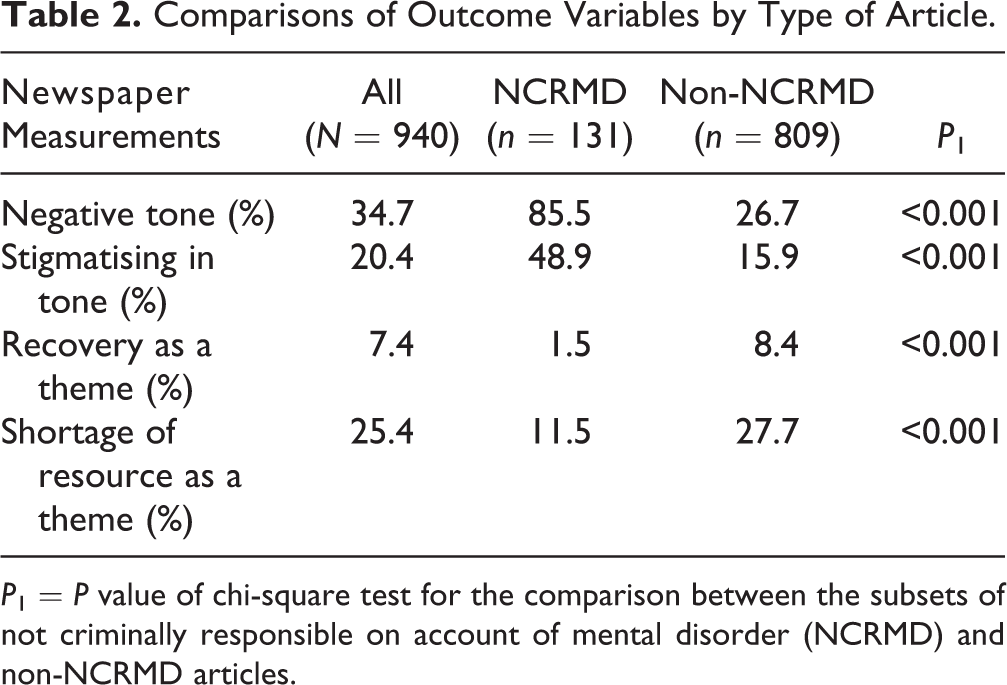
P 1 = P value of chi-square test for the comparison between the subsets of not criminally responsible on account of mental disorder (NCRMD) and non-NCRMD articles.
Extracts of News Media Articles Coded as Negative/Stigmatising.
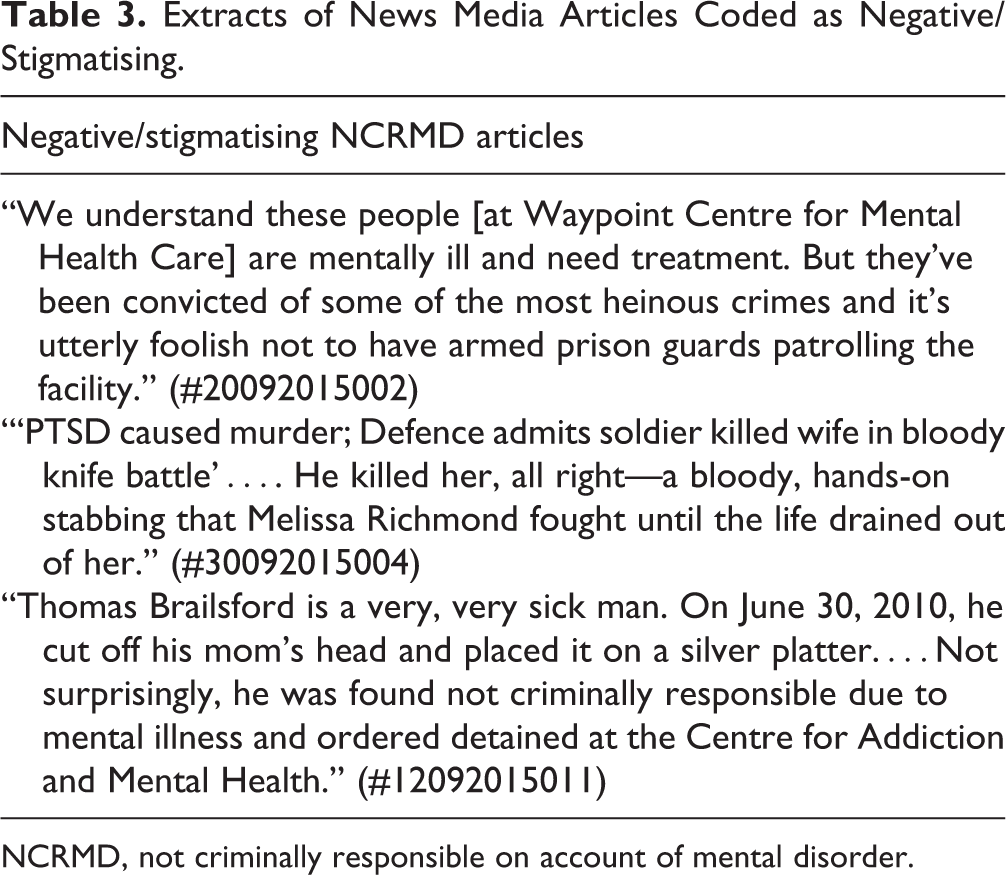
NCRMD, not criminally responsible on account of mental disorder.
In comparison to generic articles about mental illness, articles with NCRMD as a major theme were significantly more likely to have a negative tone (P < 0.001) and stigmatising tone/content (P < 0.001) and significantly less likely to have recovery/rehabilitation (P < 0.001) or shortage of resources/poor quality of care as a theme (P < 0.001).
Discussion
The key finding is that articles with NCRMD as a major theme are overwhelmingly negative, with almost half having stigmatising tone or content. Very few articles about NCRMD mention recovery, rehabilitation, shortage of resources, or poor quality of care. This suggests that the Mindset guidelines, distributed in 2014, are infrequently followed when NCRMD is a theme.
These results should be interpreted in light of research discussed earlier, which indicates that newspaper reporting of mental illness in Canada is improving. 13,14 However, substantial proportions of articles about mental illness still tend to be negative and stigmatising.
The present study suggests that articles about NCRMD may be accounting for a large proportion of the negative and stigmatising articles found in these other studies, which do not differentiate between NCRMD and non-NCRMD articles. Thus, a preponderance of articles about NCRMD may skew readers’ understandings of mental illness in general. Individual readers may conflate the characteristics of mental illness per se with characteristics found in high-profile NCRMD outliers such as that of Vincent Li. Such media coverage may foster a climate of rejection and misunderstanding for all people with mental illness. This may undo the beneficial impact of a growing number of positive and recovery-oriented media articles about mental illness. 14
Indeed, a repeated diet of negative and stigmatising articles about NCRMD may also create inaccurate stereotypes about the NCRMD population among readers. For example, much research indicates that this is a heterogeneous group committing heterogeneous crimes, with relatively low rates of recidivism (less than 10% in Ontario) and high rates of recovery. 15 However, this information is rarely present in NCRMD articles.
There are some limitations to this study. We only sampled 4 months of data. This provides a credible snapshot of media coverage, but a broader sample may be less influenced by unusual cases or repeated stories about the same case. A wider time frame may give more robust results and is encouraged in future research. Likewise, we did not engage in formal interrater reliability testing, following the lead of similar studies from the United Kingdom and New Zealand, which also eschewed this approach. 7,16 Instead, we ensured there was only 1 coder, who was closely and personally supervised by the principal investigator. Finally, we did not stratify the NCRMD and non-NCRMD categories by diagnosis; NCRMD cases may contain more instances of highly stigmatised disorders (e.g., schizophrenia) in comparison to generic articles, which may focus on less stigmatised disorders (e.g., anxiety). This may confound the results.
Footnotes
Acknowledgements
We thank the Mental Health Commission of Canada and especially Mike Pietrus and Romie Christie for invaluable support throughout.
Declaration of Conflicting Interests
The author(s) declared no potential conflicts of interest with respect to the research, authorship, and/or publication of this article.
Funding
The author(s) received the following financial support for the research, authorship, and/or publication of this article: The study was funded by the Mental Health Commission of Canada, which is funded by Health Canada.