




Abstract
Objective:
Adolescent participation in risky and addictive behaviours, such as smoking, substance use, and gambling has the potential to lead to many serious problems. The presence of conduct problems (CPs) and early initiation into risky and addictive behaviours have been independently shown to be associated with adolescent and young adult smoking, drinking, and gambling. Nevertheless, the relation between early initiation into risky and addictive behaviours and CPs remains to be explored among pre-adolescents. Our study aims to examine the prospective relation between CPs in early primary school and pre-adolescent initiation into smoking, alcohol use, and gambling.
Method:
Our study used data from participants in an ongoing prospective, longitudinal study at the Université de Sherbrooke to examine cigarette, alcohol, and gambling initiation among primary school-aged boys and girls with CPs. Children were recruited between the ages of 6 and 9 years from several low socioeconomic status public schools in diverse geographical regions of Quebec. Initiation into cigarettes, alcohol, and gambling was measured 1 year later.
Results:
Children with CPs were found to be at greater risk for early initiation into smoking, alcohol, and gambling. These effects remained even once other known risk factors, such as poor parental supervision and child effortful control, were controlled for.
Conclusions:
These results suggest that CPs present in early elementary school can predict early initiation in to potentially addictive behaviours among boys and girls. Implications for targeted preventive intervention are discussed.
Adolescent participation in risky and addictive behaviours is a common phenomenon. Epidemiological research reveals that about 1 in 10 early adolescents and close to one-half of older adolescents report regular use of alcohol. 1 Regarding heavy episodic drinking, findings demonstrate that over one-quarter of students aged 15 to 17 years indicate having consumed 5 or more drinks in a row in the past month. 2 Data also suggest that about 3% to 11% report daily use of cigarettes. 3 Further, prevalence research reveals approximately 9% to 19% of adolescents gamble for money on a frequent basis. 4 –6
While for many adolescents, participation in risk or addictive behaviours does not result in serious negative consequences, those who are initiated into these behaviours at young ages are at elevated risk for alcohol-related problems in adolescence, 7 –10 as well as nicotine dependence, 11 problematic alcohol consumption, 12 and at-risk gambling status 13 in young adulthood. The fact that early onset of risk and addictive behaviours is related to various problematic outcomes draws attention to the importance of identifying the precursors to the acquisition and development of these behaviours among children and pre-adolescents. A better understanding of these precursors will ultimately assist in the development of preventive interventions aimed at problems before they occur. 14,15
Among the individual and familial risk factors identified in the literature as associated with youth addictive behaviours, a number are described as nonspecific 14 given that they predict a wide range of youth maladaptive behaviours. Conduct problems (CPs) among children is widely recognized as an important nonspecific individual-level risk factor for addiction. 16 Before examining predictors of early initiation into risky and addictive behaviours, we will explore the relation between CPs and addictive behaviours.
Childhood Conduct Problems and Risk or Addictive Behaviours
CPs refers to conduct disorder (CD) and oppositional defiant disorder (ODD), which are described in the Diagnostic and Statistical Manual of Mental Disorders (DSM) Fifth Editon, 17 and are 2 mental health disorders that can co-occur. 18,19 These mental disorders are manifested in behaviours that violate the rights of others, and (or) behaviours that bring a person into conflict with societal norms. These disorders, as well as subclinical manifestations of these problems, will be referred to as CPs.
In a study designed to examine the relations between CPs, attention-deficit hyperactivity disorder (ADHD), and internalizing disorders at age 11 and substance use at age 14, King et al 20 observed that CPs were significantly associated with increased risk for regular use of alcohol and nicotine in early adolescence. King et al 20 found that CD and ODD increased the odds of regular use of nicotine and alcohol, while ADHD was not prospectively linked to regular use of alcohol. Another study 21 revealed that elevations in the number of CP symptoms in early adolescence was prospectively associated with greater risk for membership in the early heavy drinking trajectory, which is characterized by an early onset and high frequency of binge drinking.
CPs have also been reported to be prospectively associated with the development of substance use disorders (SUDs) in young adulthood. A small number of longitudinal studies have found that CPs in adolescence significantly increase the risk for abuse of alcohol or dependence to tobacco in later adolescence and early adulthood. 22 –24 Conversly, attentional problems or ADHD are observed to be unrelated to increased risks of later alcohol abuse or nicotine dependence when CPs are controlled for. 22,23
A cross-sectional study 25 examining links between problem gambling and CD among adolescents and young adults reported a strong postive relation between the 2 problems. The relation was much stronger for those with an earlier age of onset of gambling problems (that is, age of onset of 14 years or younger) than those with a later age of onset (that is, age of onset of 15 years or older). Another investigation found that CD had one of the strongest associations with youth problem gambling, even after other concurrent problem behaviours (alcohol or marijuana problems or tobacco dependence) were taken into account. 26 However, no studies have examined prospective links between childhood CPs and pre-adolescent initiation into gambling.
Other Predictors of Pre-adolescent Initiation to Risk Taking and Addictive Behaviours
There has been little research attention devoted to the identification of childhood individual and familial risk factors that contribute to pre-adolescent smoking, alcohol use, and gambling initiation. Within the extant literature, being male has been observed as a prospective predictor of smoking initiation during late childhood, 27,28 as well as a prospective predictor of substance use initiation in general. 29 In addition, higher levels of impulsivity in kindergarten are shown to be predictive of self-reported gambling behaviour in late elementary school. 30,31 Although not among pre-adolescents, there is also evidence for the developmental role of impulsivity as a risk factor for nicotine dependence, 22 and gambling problems in adolescence. 32 –34 The related concept of low behavioural self-control has been identified to play a predictive role in cigarette smoking 35 and heavy drinking 36 in adolescence. Behavioural control is a component of the temperamental factor of effortful control, but effortful control also includes attentional control and the child’s perceptual sensitivity. 37 Children with slower rates of increase of effortful control were more likely to use alcohol and other drugs in adolescence. 38
Data also reveal that familial characteristics play a significant role in the development of pre-adolescent risk and addictive behaviours. Parental use of tobacco is observed to be a robust antecedant risk factor for pre-adolescent smoking initiation. 27,28,35,39 Likewise, parental alcohol use is shown to be a risk factor for pre-adolescent use of alcohol. 10,40 Moreover, low levels of parental monitoring are reported to be a risk factor for general substance use initiation in pre-adolescence. 41 –43
Our Study
Although early initiation and CPs have both been identified as independent risk factors for adolescent and young adult smoking, drinking, and gambling, the relation between these 2 risk variables remains unexplored. Few studies have investigated whether there are common or shared developmental antecedents for early initiation of gambling behaviour and other potentially addictive behaviours (smoking or alcohol consumption) among pre-adolescents. Our study aimed to evaluate the prospective association of childhood CPs and initiation of smoking, alcohol use, and gambling among pre-adolescent boys and girls, while controlling for the effects of other potential predictors.
Method
Participants
Participants were drawn from an ongoing longitudinal project from the Université de Sherbrooke in Quebec, on boys and girls referred to elementary school-based services for CPs. This project began in 2007-2008. Children in the study were French-speaking and were between the ages of 6.3 and 9.9 years at study inception (N = 523), with a mean age of 8.5 years. At time 2, children had a mean age of 9.5 years (n = 501, 4.2% attrition).
Participants were recruited from 8 public school boards in Quebec. The children with CPs were selected based on 2 criteria: obtain a score above the threshold of elevated risk on the DSM-Oriented Scales for CPs or for oppositional defiant problems (ODPs) of the Achenbach System of Empirically Based Assessment (ASEBA) 44 based on parent or teacher report (see the section on Predictor Variables), and were actively receiving specialized services for CPs in their school. All girls and an equal number of randomly selected boys who were less than 10 years of age and who met criteria were invited to participate. Children with an intellectual or physical disability or pervasive developmental disorder were excluded, as were children who were not living with at least one biological parent. The participation rate of families of children with CPs was 75.1%. Participants did not differ from nonparticipants in the proportion of girls, grade level, and the deprivation index of the school that the child attended. Children in the control group were selected from schools with a high deprivation index. The Ministry of Education of Quebec assigns schools a deprivation index that is established based on the family revenue, the education of the parents, and the employment status of the parents in the particular geographical region that the school serves. 45 The selection of the control group within schools with a high deprivation index was done to reduce school and residential neighborhood disparities with children in the CP group. Children in the control group had no CPs according to the teacher and parent-reported ASEBA, and did not receive any specialized services for CPs in their schools.
Our sample is comprised of participants who completed all questionnaires included in this study (at both times 1 and 2). In total, the sample included 176 boys with CPs, 116 girls with CPs, 98 matched control boys, and 100 matched control girls (n = 490).
Outcome Measures: Initiation into Smoking, Alcohol, and Gambling
A questionnaire from the National Longitudinal Survey of Children and Youth 46,47 was used at time 2 to measure child smoking, alcohol, and gambling. Children were asked if they had ever tried: cigarettes (yes or no); drinking more than a few sips of alcohol (yes or no); and, gambling or betting on games of chance to gain money or other goods (yes or no). Overall, 35 children said that they had previously tried smoking, 131 had tried alcohol, and 53 had tried gambling at least once.
Predictor Variables
Conduct Problems
The presence of CPs was established using the DSM-Oriented Scales for CPs and ODPs of the parent and teacher report forms of ASEBA. 44 The DSM-Oriented Scales included items rated by a panel of experts as very consistent with symptoms of CD and ODD listed in the DSM-IV. 48 Items were scored on a 3-point scale ranging from 0 (not true) to 2 (very true or often true).
Family Poverty
Parents were asked to provide their family income. An income cutoff of Can$25 000 was used to create this dichotomous variable. 49
Lack of Parental Supervision
A subscale of the Alabama Parenting Questionnaire 50 was used to measure parental monitoring. The scale consists of 10 items rated on a 5-point frequency scale ranging from 1 (never) to 5 (always).
Parental Antisocial Traits
A subscale of the Millon Clinical Multiaxial Inventory–III, 51 constructed based on the DSM-IV 48 definition of antisocial personality disorder, is composed of 17 self-reported true or false items.
Parental Substance Abuse Problem
Parents were asked if either of the child’s parents or parent’s current romantic partners had a problem with alcohol consumption or with drug use since the birth of the child.
Effortful Control
Effortful control was measured using 4 subscales of the Children’s Behavior Questionnaire–Short Form. 52 The subscales, comprised of 26 items rated on 7-point scales ranging from 1 (extremely untrue) to 7 (extremely true), assessed attentional focusing, inhibitory control, low intensity pleasure, and perceptual sensitivity.
Procedure
Parents were presented with a full description of the study and signed a consent form, approved by the Institutional Ethics Board, for participation in the study and to obtain information about the child’s behaviour from teachers. Child verbal assent was also obtained. Parents and children, accompanied by research assistants, completed questionnaires separately in their home. The teacher report was obtained by telephone. Parents, children, and teachers received financial compensation for participating. Interviews were performed by graduate-level research assistants, all of whom underwent a formal 3-day training session.
Statistical Analysis
To address the research goal of our study, logistic regression was selected as the data analytic method given that the outcome variable was dichotomous (previous initiation into smoking, alcohol use, or gambling, compared with no previous initiation) and that the distributions of the independent and control variables (CPs, poverty, and parental antisocial behaviour) were not likely to satisfy the assumptions of normality. 53 The logistic regression was undertaken to evaluate the contribution of each predictor while controlling for the effects of the other predictor variables. 53 Once all main effects were examined, further regression analyses were carried out examining interactions between CPs and each of the predictors. All were found nonsignificant in the prediction of any of the outcomes.
Results
Correlations between predictor variables and outcomes are shown in Table 1.
Correlations between predictor variables and outcome variables.
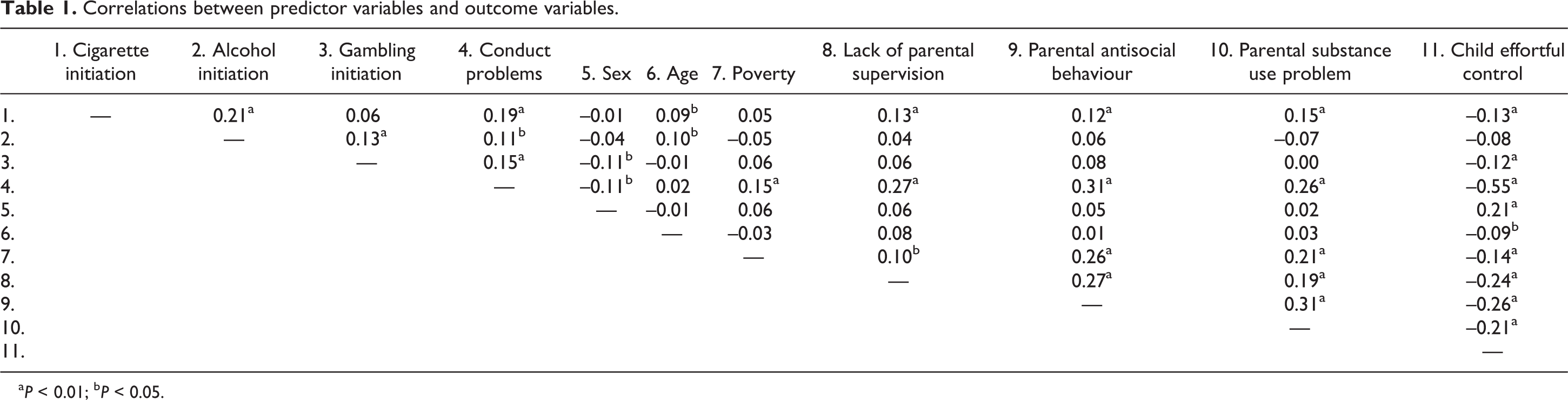
a P < 0.01; b P < 0.05.
Predicting Early Initiation into Cigarette Use
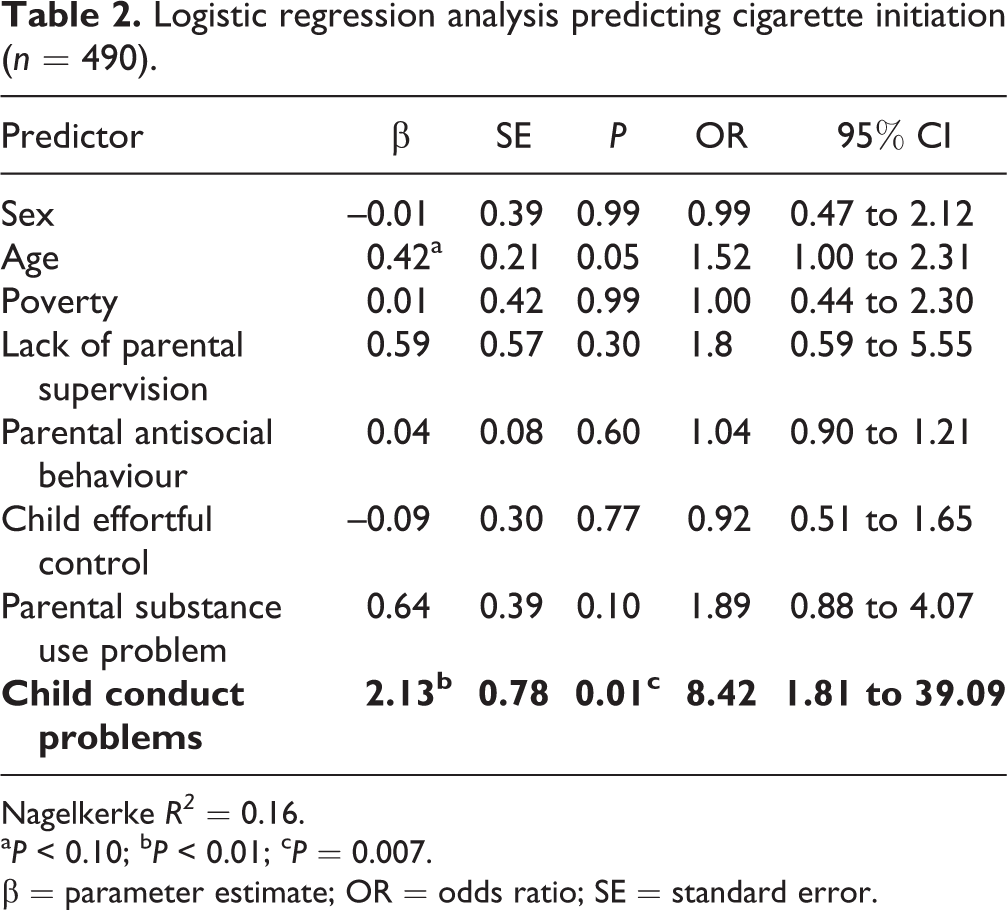
A logistic regression analysis was performed to determine whether the presence of CPs in childhood predicted early initiation into cigarette use. A test of the model against the intercept-only model was statistically significant (χ2 = 33.50, df = 8, P < 0.001). Overall, the regression equation accounted for 16% of the variance in cigarette initiation among children in our sample.
The contribution of each of the individual predictors on cigarette initiation, while controlling for the other variables in the model, is summarized in Table 2. The presence of a child with CPs substantially increased the likelihood of initiation into cigarettes (β = 2.13, P < 0.01). Children with CPs were found to be over 8 times more likely to have tried cigarettes by about age 9 than their counterparts without CPs. This effect was present after the effects of sex, age, poverty, lack of parental supervision, parental antisocial behaviour and substance use problems, and child effortful control were accounted for. None of the control variables were significant predictors of cigarette initiation once the effects of CPs were accounted for.
Logistic regression analysis predicting cigarette initiation (n = 490).
Nagelkerke R2 = 0.16.
a P < 0.10; b P < 0.01; c P = 0.007.
β = parameter estimate; OR = odds ratio; SE = standard error.
Predicting Early Initiation into Alcohol Use
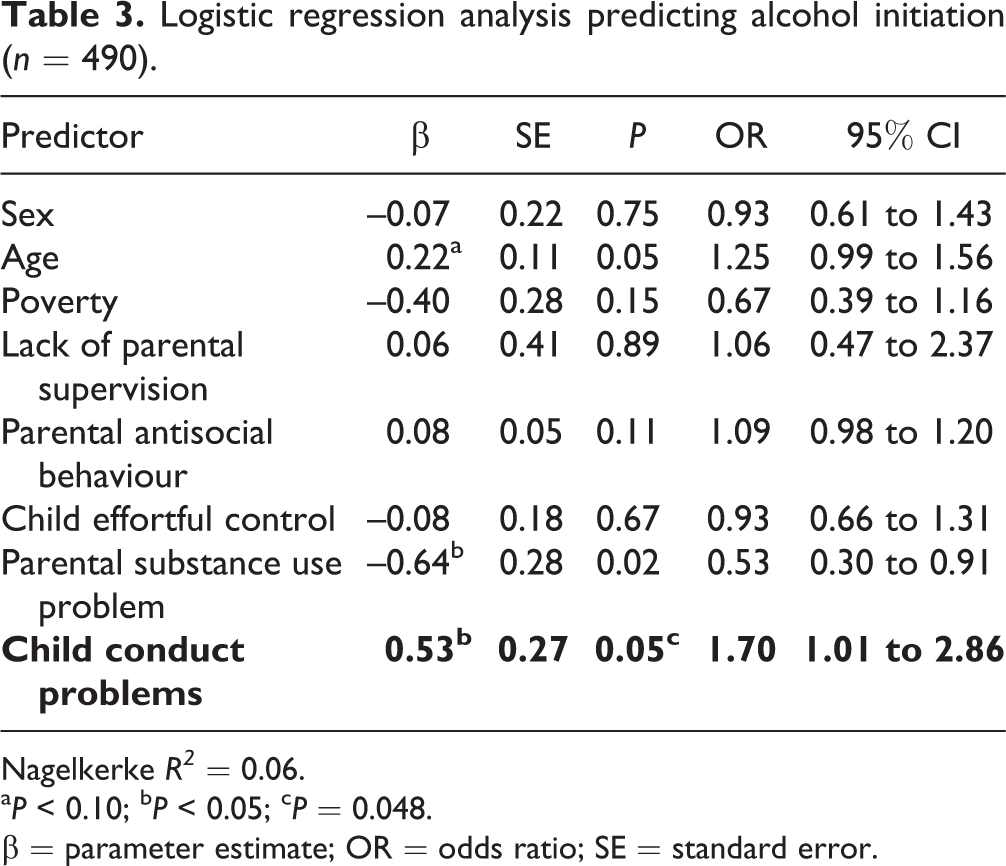
A logistic regression analysis was performed to determine whether the presence of CPs in childhood predicted early initiation into alcohol consumption. A test of the model against the intercept-only model was statistically significant (χ2 = 19.81, df = 8, P < 0.01). Overall, the model accounted for 6% of the variance in alcohol initiation among children in our sample.
The contribution of each of the individual predictors on alcohol initiation, while controlling for the other variables in the model, is summarized in Table 3. The presence of a CP was found to be a significant predictor of early initiation into alcohol consumption (β = 0.53, P < 0.05), with children with CPs being 1.7 times more likely to have been initiated into alcohol use than their peers without CPs.
Logistic regression analysis predicting alcohol initiation (n = 490).
Nagelkerke R2 = 0.06.
a P < 0.10; b P < 0.05; c P = 0.048.
β = parameter estimate; OR = odds ratio; SE = standard error.
The presence of substance abuse problems in at least one parent was found to be a significant negative predictor of alcohol initiation for children (β = –0.64, P < 0.05), suggesting that those with at least one parent with a substance abuse problem were less likely to have tried alcohol than those without parents with substance abuse problems.
Predicting Early Gambling Involvement
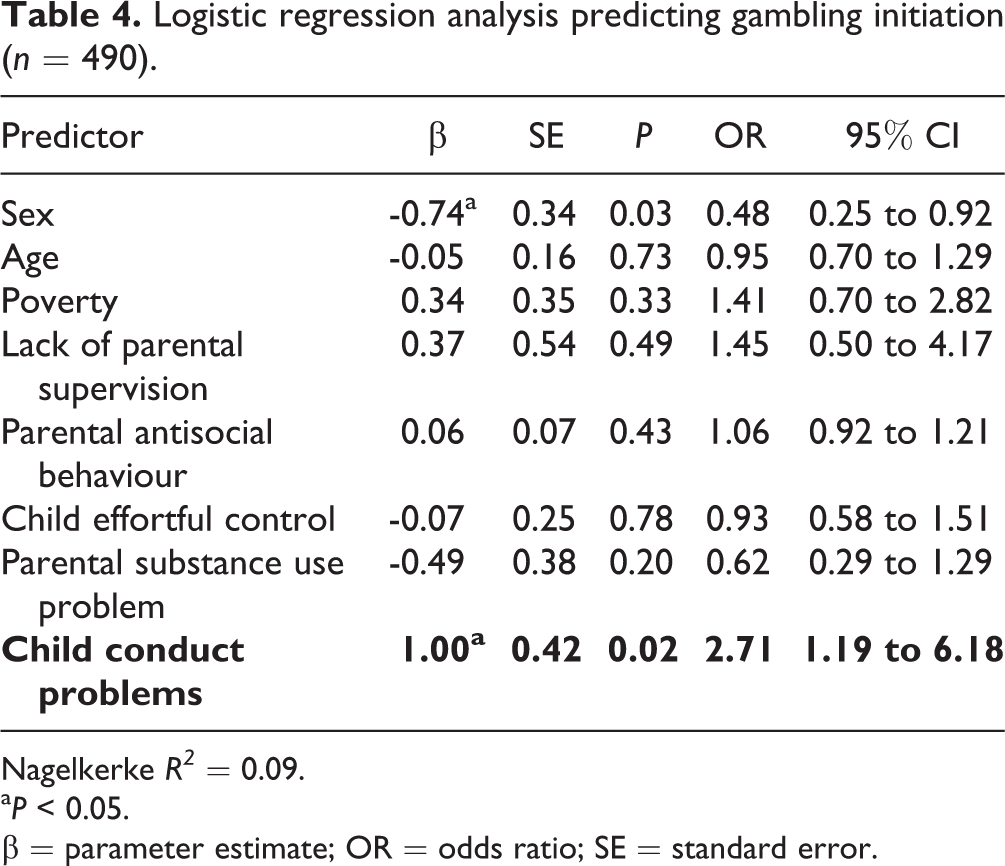
A logistic regression analysis was performed to determine whether the presence of CPs in childhood predicted early initiation into gambling. A test of the model against the intercept-only model was statistically significant (χ2 = 21.12, df = 8, P < 0.01). Overall, the model accounted for 9% of the variance in gambling initiation among children in our sample.
The contribution of each of the individual predictors on gambling initiation, while controlling for the other variables in the model, is summarized in Table 4. Consistent with other literature, sex emerged as a statistically significant predictor, with the odds of a girl having been initiated into gambling being about one-half that of boys (β = –0.74, P < 0.05). In addition, having CPs was directly predictive of gambling initiation among our child participants, even when the effects of sex, poverty, poor parental supervision, parental antisocial, and substance use problems were accounted for (β = 1.00, P < 0.05). None of the control variables were statistically significant predictors of gambling initiation once the effects of sex and presence of CPs were accounted for.
Logistic regression analysis predicting gambling initiation (n = 490).
Nagelkerke R2 = 0.09.
a P < 0.05.
β = parameter estimate; OR = odds ratio; SE = standard error.
Discussion
These results suggest that even at about 9.5 years of age, children with CPs were over 1.5 times more likely to have been initiated into alcohol use, over twice as likely to have been initiated into gambling, and over 8 times more likely to have been initiated into cigarette use than their peers without CPs. Further, these effects were present even after controlling for sex and age, as well as other variables, such as parental monitoring and child effortful control.
Our study found a lack of predictive significance of child effortful control on early initiation into cigarettes, alcohol, and gambling. Although childhood impulsivity and low behavioural control have been shown to be a risk factor for early initiation into addictive behaviours, 30 no study has yet to examine the effects of childhood effortful control and CPs simultaneously in the prediction of initiation into cigarettes, alcohol, and gambling in middle elementary school. We believe that childhood effortful control is a more complete measure of a child’s self-regulation, as it includes not only behavioural control, but also attentional control.
It appears from our findings that, at least among the young disadvantaged sample used in our study, having CPs is a more robust predictor of very early initiation to cigarettes, alcohol, and gambling, than is child effortful control. Although the reason for the predictive ability of childhood CPs over and above effortful control cannot be ascertained given the current methodology, these results are in line with previous research 20,22,23 suggesting that CPs might be more strongly associated with initiation into risky and addictive behaviours, than ADHD. One possible reason could be that with respect to very early initiation into substances and gambling, early experimentation has more to do with social milieus and rule breaking, than with a lack of effortful control.
Research 38,54 –59 has previously demonstrated the heightened risk for alcohol abuse and alcohol-related problems among adolescent children of alcoholics. However, the results of our study suggest a negative relation between parental substance abuse problems and child early initiation into alcohol. Specifically, children with biological parents who suffer from substance abuse problems were almost one-half as likely to have been initiated into alcohol as their peers whose parents did not have substance use problems. While this finding may initially seem inconsistent with the literature, most previous research has focused on alcohol consumption and alcohol problems among adolescents, and not early initiation among elementary school-aged children. It is important to note that the variable was also recoded and tested to reflect only those children who currently lived with the parent with the substance abuse problem. Regardless of whether the child lived with the parent with the substance abuse problem or not, the negative relation between parental SUD and child early initiation remained the same. This suggests that the negative relation is not due to the absence of the parent with the substance abuse problem, leaving the child with the other, unaffected parent.
There are several possible explanations to this finding. First, it is possible that young children who have alcoholic parents might have more experience with the negative aspects of alcohol misuse and therefore may be less interested in trying it for themselves in these early years. Second, when one biological parent suffers from a SUD, the other parent might be more vigilant about not allowing children access to alcohol at early ages. Whatever the reason for this negative relation, it is evident from past studies that, somewhere between childhood and early-to mid-adolescence, parental substance problems become a significant and positive predictor of adolescent substance misuse and problems. The timing and mechanisms of the change in the direction of the relation between parental substance abuse problems and child or adolescent substance use or misuse are unclear; however, continued follow-up of this cohort of young children with CPs may help shed some light on the associated processes in coming years.
Strengths and Limitations
Longitudinal designs employ a prospective approach instead of relying on retrospective data, which is subject to recall bias. Causal inferences can be drawn more credibly in prospective longitudinal studies because of the establishment of time sequencing in the prediction of outcomes. However, in this case as in most cases, conclusions remain speculative as a function of the methodology, which is correlational. Replication of results across studies, using different samples is a necessary step in confirming the generality of longitudinal results. 60
Another strength of our design lies in the very young age of respondents. The goal of our study was to investigate very early initiation into potentially addictive behaviours, such as cigarette and alcohol use and gambling among children. However, given the young age at which the outcome data was collected, there was only about 12 months of time elapsed between the collection of the predictors and the outcomes. Replication of results in future years with these children will help clarify the picture in terms of the development of addictive behaviours.
While the effect size of the presence of CPs on cigarette initiation was substantial, the effect sizes in the prediction of alcohol and gambling initiation were modest. Nevertheless, considering the very young age of participants at the time of outcome data collection, the results offer new information as to the early predictors of substance use and gambling initiation, as well as suggesting possible avenues for preventative intervention in childhood.
Conclusions
Knowing how to identify and help children in elementary school who might be at high risk for early initiation into risky and addictive behaviours might help mitigate a host of negative long-term consequences. The fact that some of the children with CPs are at an increased risk for becoming initiated into cigarettes and gambling at very early ages, even after controlling for sex, poor parental supervision, and other risk factors, has significant implications for prevention. These results suggest that the elementary school years may be an appropriate time to engage in prevention programs for substance use and gambling among children with CPs. Further, given that these children are at heightened risk for early initiation into gambling also suggests that prevention of gambling should be considered alongside prevention of other risky and addictive behaviours when designing comprehensive prevention programs for children with CPs.
Footnotes
Acknowledgements
The authors thank France Girard, Annie Lemieux, and the entire Université de Sherbrooke Longitudinal Project team for their assistance in data collection and analysis. Finally, we are most indebted to the participants of the study.
Declaration of Conflicting Interests
The author(s) declare no potential conflicts of interest regarding the research, authorship, and (or) publication of this article.
Funding
The author(s) declared receipt of the following financial support for the research, authorship, and/or publication of this article: This research was partially supported by grants from the Canadian Institutes for Health Research (funding reference number 82694), the Social Sciences and Humanities Research Council (grant 37890), and the Fonds québécois de la recherche sur la société et la culture (funding reference number 2013–NP–165564).