




Abstract
I compute and investigate wage differentials in Belgium between individuals born in the country and five major groups of non-native workers. I find that foreigners, except for those from EU15 countries, earn on average less than natives, with the size of the wage gap varying importantly across the different groups. Applying the Oaxaca-Blinder decomposition to the wage differentials, I find that skills and characteristics only account for a portion of the gaps. Complementarily, a part of the wage differentials remains persistently unexplained, especially for non-European workers. Additional information on industry affiliation and occupation decreases this unexplained part, but it also shows the existence of industrial and especially occupational segregation. Detailed heterogeneity analysis reveals also a prominent role of the time spent in the country in decreasing wage gaps and evidence of glass ceilings rather than sticky floors.
Introduction
The number of migrants in the labour force worldwide has tripled in the past decade (Global Migration Indicators, 2021). Due to proximity to emigration areas and a policy framework that allows free movement of people among member states, the European Union experienced a significant reshaping of its labour force composition. This touched primarily the EU15 countries, 1 where the study of wage disparities between native-born citizens and immigrants has garnered the attention of both academic research and policymakers.
In fact, wage inequality between natives and immigrants has important macroeconomic implications, particularly in ageing economies reliant on migration to sustain their labour force (OECD, 2023). Wage disparities may also affect public finances if lower earnings among immigrants result in smaller tax contributions and greater reliance on social transfers (Dustmann & Frattini, 2014). At the individual level, wage gaps limit immigrants’ economic mobility and increase the risk of poverty and exclusion (Heath & Sin Yi, 2007).
Belgium underwent among the most sizeable immigration waves, ranking among the top countries by foreign-born population (5th and 10th among EU and OECD countries, respectively). On January 1st, 2022, the share of non-Belgians was almost 13%, compared to 10.6% in 2012 and 8.2% in 2002. In addition, more than 20% of the population were Belgian with a foreign background (source: Statbel). Although the increase was less pronounced than in the neighbouring countries, 2 the International Labour Organization (2020) Report shows that, from 2015 to 2020, the migrant pay gap in Belgium has risen from 10% to 13%. These disparities are not fully explained by differences in education, language skills, or work experience, and are partly driven by discrimination, lower returns to human capital, and occupational segregation. On the side of firms, Fays et al. (2021) demonstrate that foreign-born workers are less likely to be employed in upstream, higher value-added segments of global value chains – a pattern that helps explain their relatively lower wages.
In this paper, I document the existence of a gap between the wage that individuals born in Belgium earn and the one that it is earned by those who were born abroad. In addition, given the wide variety of countries from where immigrants in Belgium come from, I try to answer to three main research questions: first, what group of foreigners suffers or benefits from the largest gap; second, what wage differentials are due to; and third, whether results hold within specific categories of the population. To address these questions, I compute wage gaps between individuals born in Belgium and five major groups of foreign-born workers: EU15, EU13, 3 Other Europe, 4 North Africa and Middle East, and Sub-Saharan Africa. Then, I decompose the wage differentials using the Oaxaca-Blinder methodology with three specifications (without industry and occupation fixed effects, with only industry fixed effects, and with both). In addition, I replicate the decomposition within genders, levels of education, industries, occupations, and years spent in the country.
I find that all foreigners (but those from EU15 countries) earn, on average, significantly less than natives, with the actual size of the average wage gap between the Belgian and non-Belgian-born that varies importantly according to the geographical area of origin. Additionally, I find that skills 5 and characteristics explain only a portion of this gap, which is mainly attributable to differences in years of work experience (on average, more in the sample of Belgians) and in the share of individuals working in elementary occupations (on average, larger among immigrants). Complementarily, a part of the wage differentials, which is particularly large for non-European workers (Africans and Middle-Easterners), remains persistently unexplained. Further information on industry affiliation and occupation decreases this unexplained part, but it also shows the existence of industrial and occupational segregation. I investigate this evidence replicating the decomposition within specific industries and occupations, besides genders, levels of education, and the time spent in the country. In fact, I find that, while sorting into industries does not contribute sizeably to the explanation of the wage differentials, the unexplained wage gap shrinks remarkably in occupations with large shares of foreign workers. Likewise, among low educated individuals (where all groups of foreigners except for those from the EU15 are overrepresented) and those who have been living in Belgium for more than 10 years, the wage differentials are almost fully explained by differences in the characteristics, besides being notably very small.
This paper speaks to several lines of research. First, it contributes to the literature on wage determinants and wage gaps. Since Mincer’s seminal paper (Mincer, 1974), a wide literature developed in the attempt of identifying the main determinants of earnings and wages. While there is broad consensus upon the role of a number of explanatory variables in impacting returns on the labour market, 6 persistent gaps remain unexplained even when controlling for these characteristics. The identification and the quantification of such gaps were pioneered by Oaxaca (1973) and Blinder (1973), whose methodology (Oaxaca-Blinder decomposition) stands now as a cornerstone for this kind of analyses. After (and along the same line of) the two seminal papers (Oaxaca, 1973; Blinder, 1973), many studies using this methodology were carried out worldwide to assess wage differentials between male and female workers.
A more recent strand of research, to which this paper is more closely related to, uses the Oaxaca-Blinder decomposition to quantify existing wage gaps between native and foreign workers. This has been generally applied to countries with long immigration histories, like the United States (Chaikwaeng, 2017), Germany (Lehmer & Ludsteck, 2011; Aldashev et al., 2012; Brunow & Jost, 2019, 2020; Schmid, 2022), and Portugal (Cabral and Duarte, 2013), although some exceptions exist also for those with a more recent one (e.g. Strzelecki, 2018 for Poland). Also in this case, findings tend to be similar across countries, that is, while, on average, Western immigrants earn as much as (occasionally even more than) the natives, other categories of immigrants (e.g. from Latin America in the United States or from Turkey in Germany) earn systematically less. In addition, this wage gap is often partially unexplained.
The use of the Oaxaca-Blinder decomposition to analyse wage gaps between native and foreign workers in Belgium is broadly limited to the application of Pineda-Hernández et al. (2025). In particular, they delve into the natives-foreigners wage gap with a focus on intergenerational differences among immigrants from developing countries. In fact, they find that whereas there is no evidence of a wage gap for second-generation immigrants, first-generation immigrants still experience a sizeable wage gap (2.7%). Besides using a different type of data, this paper complements their study in two main respects. First, it expands the immigrants’ spectrum also to developed countries; second, it explores a much wider range of characteristics for heterogeneity analysis (e.g. the time spent in the country). More generally, this detailed sensitivity analysis makes an important contribution to the existing literature, as each of the moderators explored reflects mechanisms that are central to understanding the persistence of wage gaps. For example, Dostie (2023) have recently shown that immigrants are much more likely to find jobs in low-wage firms, concentrated in certain industries and occupations, and that a sizeable part of the catch-up in wage levels over time is due to immigrants moving from low-wage to high-wage firms. Similarly, this study incorporates the time spent in Belgium, which is a key proxy for labour market integration and human capital transferability (Chiswick, 1978; Duleep & Regets, 1999).
As a Western developed economy that has experienced several massive and diverse waves of immigration, 7 Belgium presents a case study with high external validity. Furthermore, with the employment of an extremely large survey data set, the present study overcomes the usual trade-off faced in the related literature. That is, the use of high coverage census or employment register data, with limited access to individual characteristics and labour market outcomes, versus survey data, where these variables are normally available but where the number of observations is much smaller. Besides providing more robust results in the overall decomposition, the heterogeneity of the database used in this paper allows for further decompositions by a number of categories that are rarely investigated in such detail. In particular, I study the role of gender, industry, occupation, education, and the time spent in the country.
The remainder of the paper is organised as follow. In Section 2, I present the data employed in this study, with a number of descriptive statistics characterising my sample. In Section 3, I illustrate the identification strategy of my empirical analysis. The main results provided by the three specifications of the threefold Oaxaca-Blinder decomposition are summarised in Section 4. Section 5 concludes.
Data and Descriptive Statistics
The European Union Labour Force Survey (EU LFS) is a large household sample survey on labour participation of people aged 15 and over and on people outside the labour force. It focuses on individual socio-demographic characteristics and conditions of employment, unemployment, and inactivity. 8 In this paper, I use the Eurostat version of the LFS data for Belgium for the years 2011–2019, 9 restricted to employed wage earners. Overall, the data consists of a merged repeated cross sectional data set counting 257,170 observations, each with its weight expressing the individual’s representativeness within the population.
Foreigners are distinguished from natives on the basis of the country in which they were born (different from Belgium). Therefore, an individual born abroad remains labelled as a foreigner in my sample, even if he or she obtained the Belgian citizenship. On the one hand, this allows to capture the impact of the individuals’ background (language, culture, etc.) and labour market frictions for foreign workers (e.g. higher job searching costs), which linger even after the eventual acquisition of the host country’s citizenship. On the other, this also means that immigrants’ children who were born in Belgium classify as natives, which could create some bias in the context of potential ethnic discrimination. In fact, while it is true that Belgian-born children do not face all their parents’ hurdles when they enter the labour market (e.g. knowledge of the language or absence of a recognised diploma), they could still suffer from discrimination based on observable ethnic characteristics (e.g. skin colour or foreign-sounding names).
The country of birth variable is categorised into major geographical areas (see Table A1, Online Appendixes). 10 Only the five most represented areas are considered for this study: EU15, EU13, Other Europe, North Africa and Middle East, and Sub-Saharan Africa. 11 The eventual sample results into 252,538 observations. In the remainder of this section, I present the most relevant descriptive statistics from my sample to the understanding of the results in Section 4. Additional figures are relegated to Appendix A of the Online Appendices.
Country of Birth, Gender, and Average Income Decile
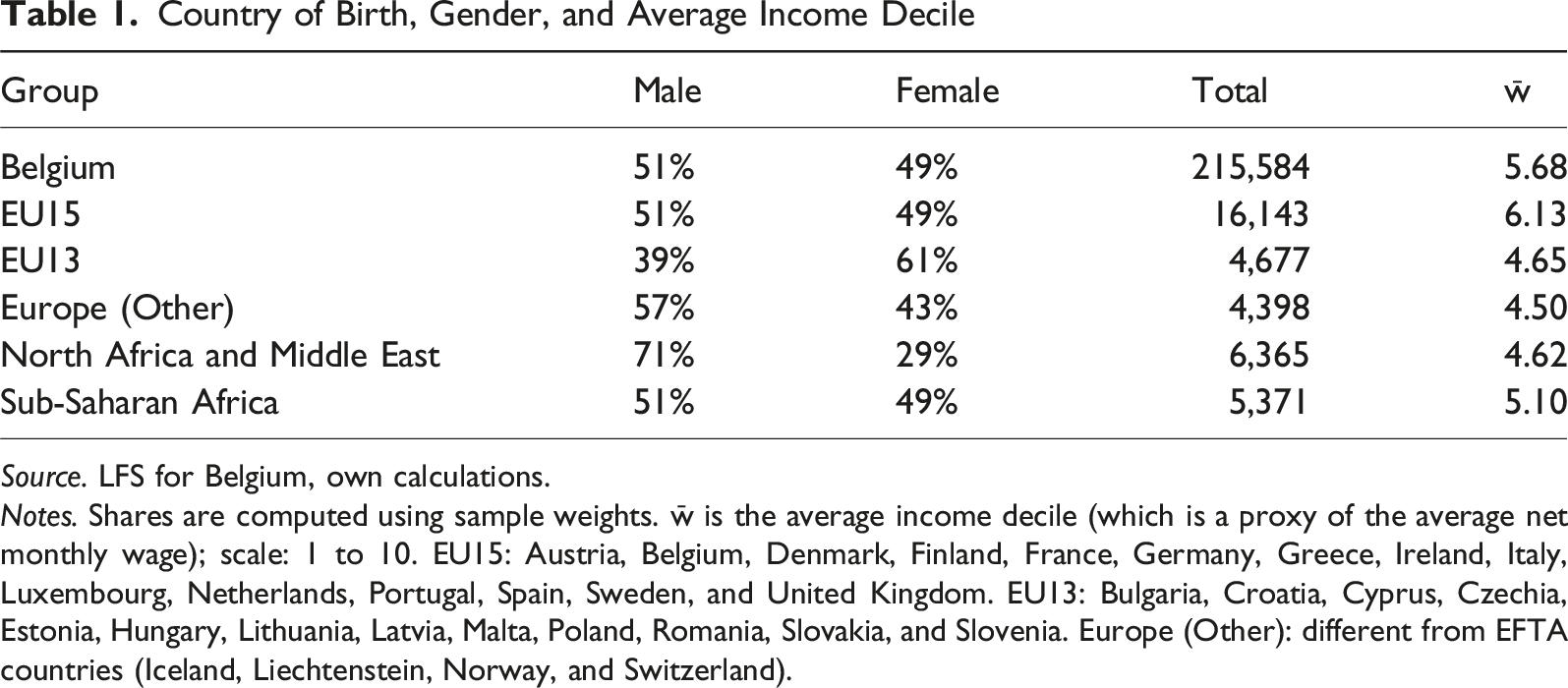
Source. LFS for Belgium, own calculations.
Notes. Shares are computed using sample weights. w̄ is the average income decile (which is a proxy of the average net monthly wage); scale: 1 to 10. EU15: Austria, Belgium, Denmark, Finland, France, Germany, Greece, Ireland, Italy, Luxembourg, Netherlands, Portugal, Spain, Sweden, and United Kingdom. EU13: Bulgaria, Croatia, Cyprus, Czechia, Estonia, Hungary, Lithuania, Latvia, Malta, Poland, Romania, Slovakia, and Slovenia. Europe (Other): different from EFTA countries (Iceland, Liechtenstein, Norway, and Switzerland).
Country of Birth and Education
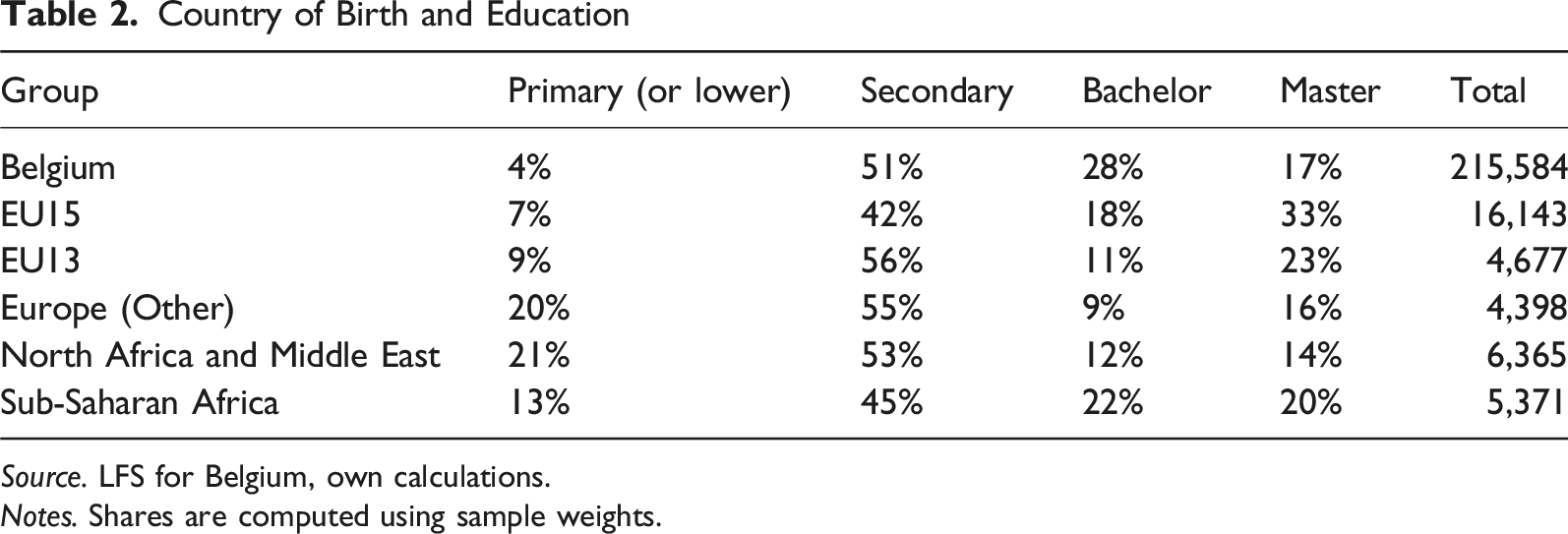
Source. LFS for Belgium, own calculations.
Notes. Shares are computed using sample weights.
Table 2 depicts the breakdown of my sample according to the country of birth and the level of education. EU15 countries (including Belgium) present analogous figures: very low shares of individuals with at most primary education and roughly half of the workers who have attained tertiary education (bachelor or master). Conversely, large shares of individuals from non-EU countries are still very low educated. However, Sub-Saharan Africa stands out for having also a sizeable share of workers (42%) holding a bachelor or a master.
Country of Birth and Industry Affiliation
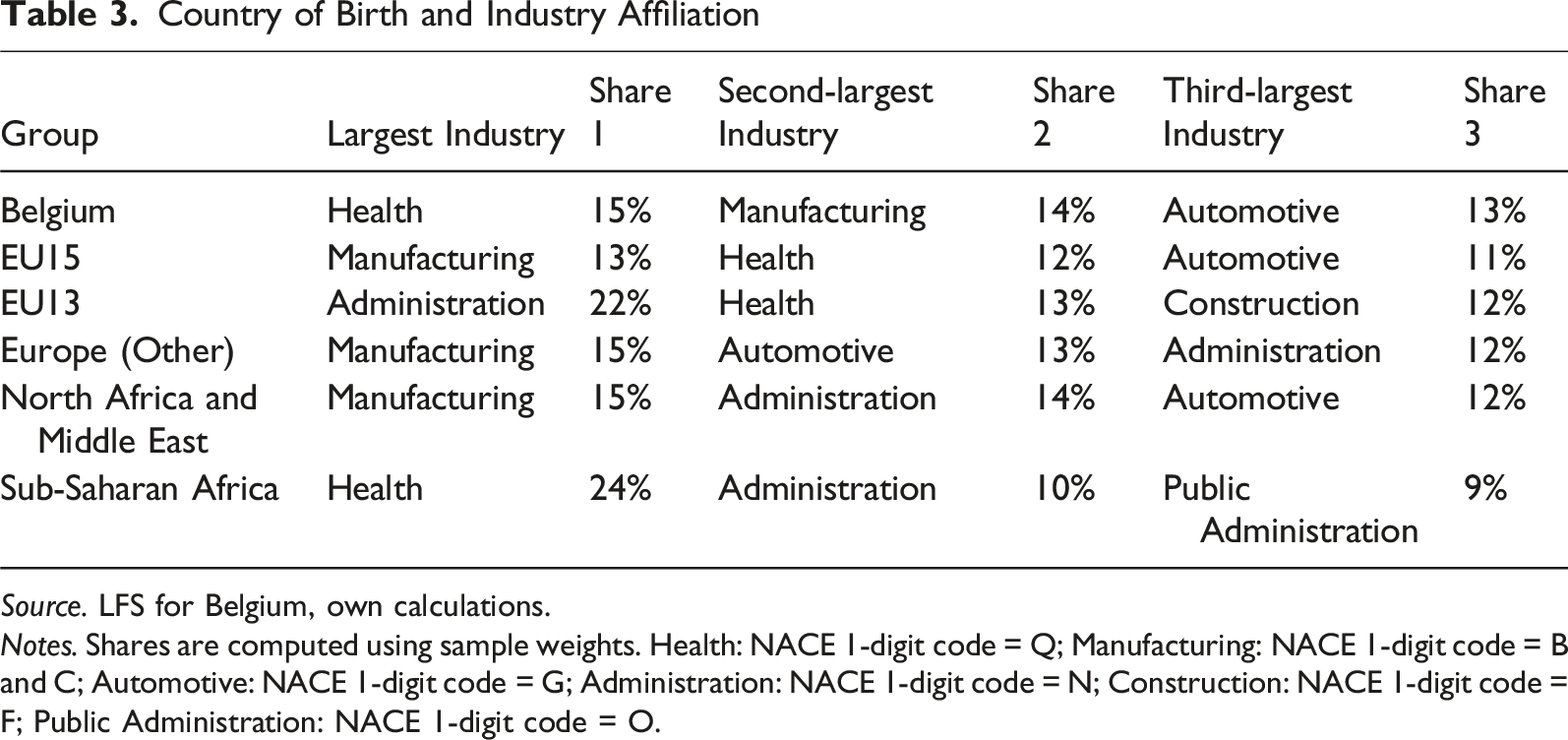
Source. LFS for Belgium, own calculations.
Notes. Shares are computed using sample weights. Health: NACE 1-digit code = Q; Manufacturing: NACE 1-digit code = B and C; Automotive: NACE 1-digit code = G; Administration: NACE 1-digit code = N; Construction: NACE 1-digit code = F; Public Administration: NACE 1-digit code = O.
Country of Birth and Occupation
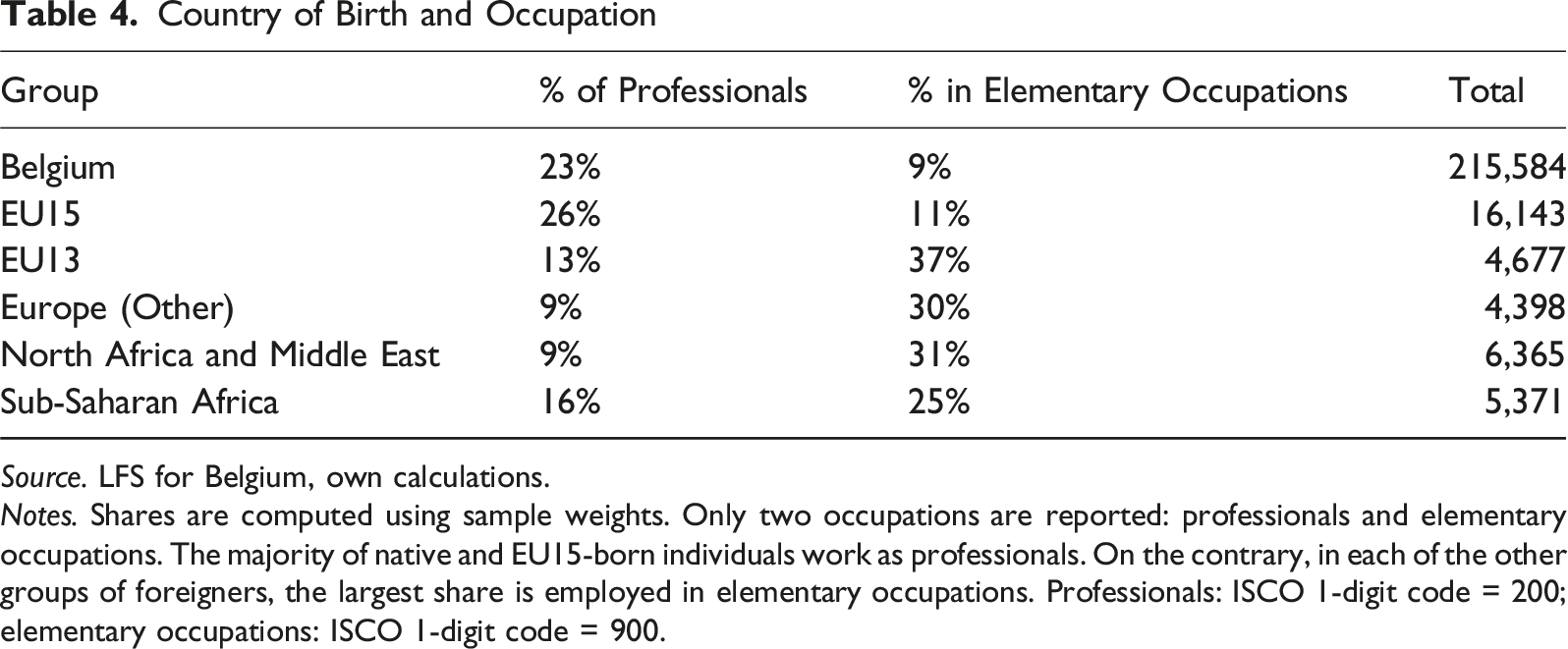
Source. LFS for Belgium, own calculations.
Notes. Shares are computed using sample weights. Only two occupations are reported: professionals and elementary occupations. The majority of native and EU15-born individuals work as professionals. On the contrary, in each of the other groups of foreigners, the largest share is employed in elementary occupations. Professionals: ISCO 1-digit code = 200; elementary occupations: ISCO 1-digit code = 900.
Methodology
The descriptive figures presented in Section 2 reveal marked differences in the skills and characteristics of natives and immigrants. To analyse thoroughly the existing wage gaps between natives and the various groups of foreigners living in Belgium, I decompose the wage differentials using the methodology developed by Oaxaca (1973) and Blinder (1973). More specifically, I employ the threefold Oaxaca-Blinder decomposition.
The first step of the decomposition is the estimation of the wage equation for the two groups g ∈{B,F}, where B is the sample of Belgium-born workers and F is, in turn, one of the five groups of foreigners (i.e. F ∈ {EU15, EU13, Other Europe, North Africa and Middle East, and Sub-Saharan Africa}). As the Oaxaca-Blinder decomposition builds on linear models, given
From 1. 2. Rearranging the terms of the equation:


Factoring out the common factors, I obtain that, ∀F, the average wage gap between Belgian and foreign workers is given by:
Equation (1) is the threefold decomposition according to the Oaxaca-Blinder methodology. The threefold decomposition divides the difference in mean wages into: a portion that is explained by differences in the explanatory variables (characteristics or endowments term); a part that remains unexplained, as it is due to group differences in the coefficients (coefficients term); and a part that accounts for the fact that cross-group differences in the explanatory variables and in the coefficients can occur at the same time (interaction term). In other words, the characteristics effect represents the wage difference that is purely due to differences in characteristics and skills (e.g. higher education and longer work experience). Contrarily, the coefficients effect has to do with how skills are remunerated. That is, different coefficients of the same explanatory variable across natives and foreigners mean that the skills and characteristics have different returns for Belgians and immigrants. In a hypothetical situation, where foreigners’ skills and characteristics are remunerated in the same way as those of natives (i.e.
Variables Employed in the Threefold Decomposition
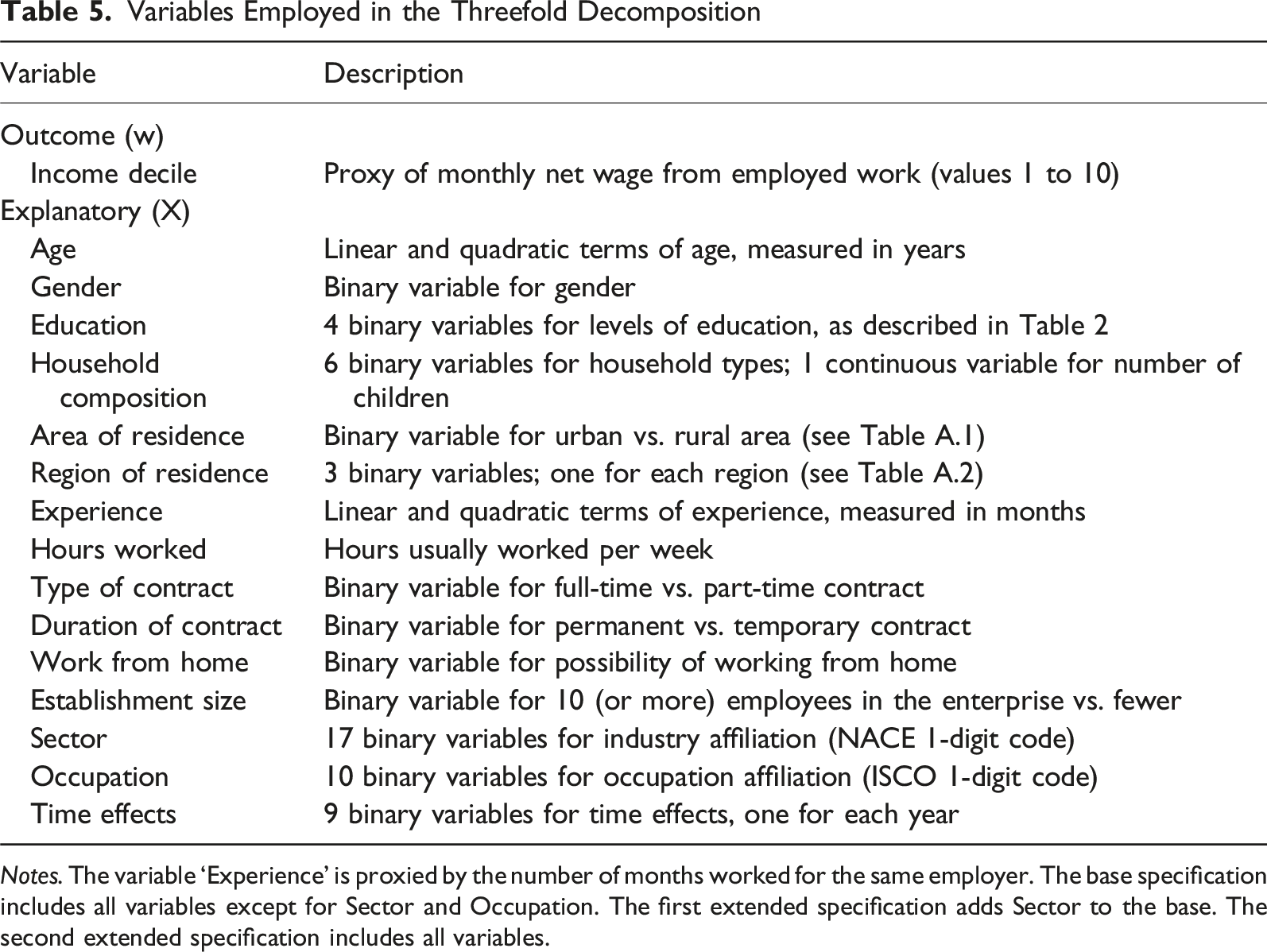
Notes. The variable ‘Experience’ is proxied by the number of months worked for the same employer. The base specification includes all variables except for Sector and Occupation. The first extended specification adds Sector to the base. The second extended specification includes all variables.
Wages are measured by income deciles (calculated from actual wages, i.e. no other source of income is included), as made available in the LFS data. 18
Results
Overall Decomposition
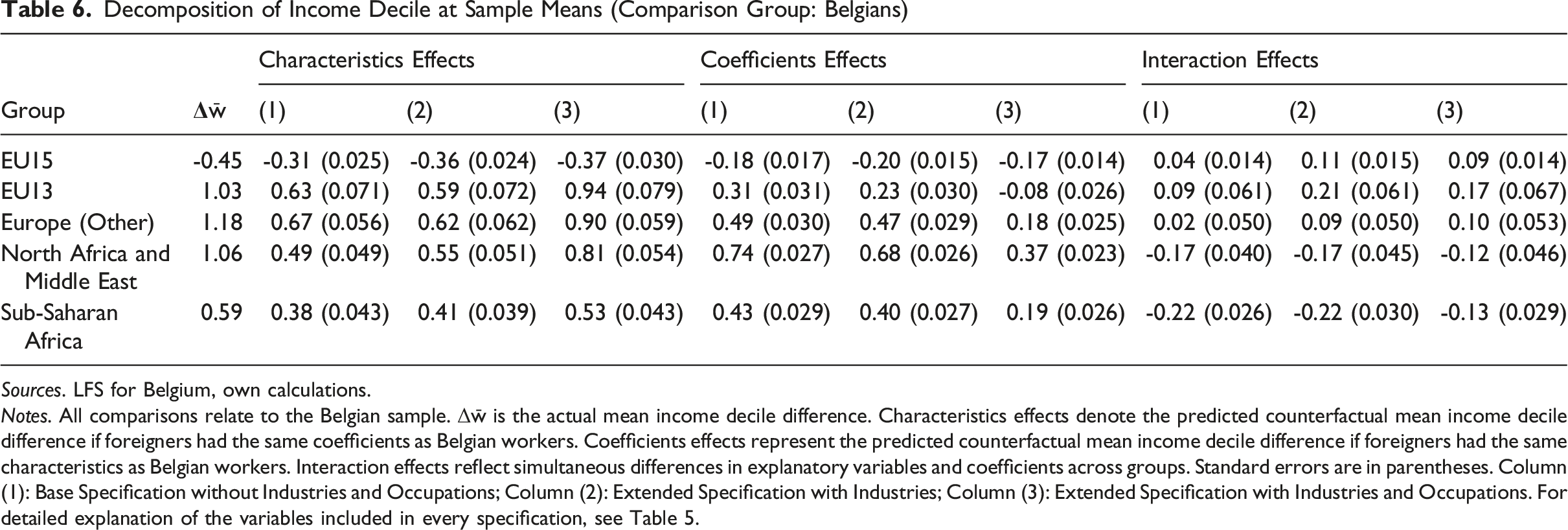
Decomposition of Income Decile at Sample Means (Comparison Group: Belgians)
Sources. LFS for Belgium, own calculations.
Notes. All comparisons relate to the Belgian sample. Δw̄ is the actual mean income decile difference. Characteristics effects denote the predicted counterfactual mean income decile difference if foreigners had the same coefficients as Belgian workers. Coefficients effects represent the predicted counterfactual mean income decile difference if foreigners had the same characteristics as Belgian workers. Interaction effects reflect simultaneous differences in explanatory variables and coefficients across groups. Standard errors are in parentheses. Column (1): Base Specification without Industries and Occupations; Column (2): Extended Specification with Industries; Column (3): Extended Specification with Industries and Occupations. For detailed explanation of the variables included in every specification, see Table 5.
The descriptive figures in Table 3 are confirmed. Namely, the share of the characteristics (coefficients) effects in the explanation of the whole wage gap does not sizeably increase (decrease) with the introduction of the controls for industry affiliation (from Column (1) to Column (2)). Instead, occupational segregation accounts for an important share of the unexplained differential, which shrinks accordingly with the introduction of the dummies for the occupation (from Column (2) to Column (3)). For foreigners from EU13 and other non-EU European countries, in the full specification with industries and occupations (Column (3)), the wage gap is almost totally explained by differences in the endowment term (91% and 76%, respectively). For the remaining groups of foreigners, however, the unexplained portion of the wage differentials remains remarkable: 38% for EU15 countries, 35% for North Africa and Middle East, 32% for Sub-Saharan Africa. While there is not a certain interpretation to these relatively large coefficient terms, it is likely that it is however not the same for the different geographical areas.
The negative unexplained wage gap between Belgian and EU15 immigrants (i.e. EU15 workers earn higher wages) is probably due to the unobservable bias generated by the international institutions (European Commission, European Parliament, etc.) settled in Brussels. According to the most recent figures, 56% of the total employment in the European Commission comes from EU15 countries (European Commission, 2022). 19 As such institutions pay, on average, much higher wages (than, for example, the private sector) this is likely to create a wage gap with peers working elsewhere. In turn, this gap is unobservable because, while I can control for the occupation, I cannot observe in my data where this occupation is held. For example, the majority of both Belgian and EU15 workers are professionals. However, I cannot distinguish a professional working in the private sector from one working in an international institution. Yet, the latter is likely to earn a higher salary. To elaborate this interpretation more thoroughly, I perform an additional decomposition of the wage gap between natives and EU15 immigrants (only of Specification 3, the most detailed one with industries and occupations, see Table 6, Column (3)), excluding individuals residing in Brussels from my sample. Results of such robustness check are reported in Table B3, Appendix B, Online Appendices. In fact, I find that the hypothesis that the international institutions settled in Brussels generate a wage gap between EU15 and Belgian workers is corroborated. That is, when I remove the people living in Brussels from my sample, this wage gap almost vanishes (see Table B3, Appendix B, Online Appendices). This suggests that, for the same characteristics, workers from EU15 countries are treated by the labour demand as substitutes to natives and they are, in turn, similarly remunerated. Therefore, when a wage difference arises (see Table 6), this is rather the effect of the concentration of EU15 workers into the more remunerative international institutions industry.
Another possible evidence generating unobservable wage differentials between natives and immigrants from EU15 countries concerns the most qualified individuals (which constitute 51% of the total EU15 employment, see Table 2). In fact, to attract foreign high-skilled individuals, many employers often offer a larger remuneration to compensate their relocation to Belgium from their current home country.
These two main channels likely contributing to the negative unexplained wage gap between Belgian and EU15 immigrants, however, cannot explain similarly the positive unexplained wage gap between Belgian and migrants from Africa and the Middle East, for two main reasons. First, positions within EU institutions are mostly reserved to EU citizens. 20 Second, non-European immigrants, especially from North Africa and the Middle East are, on average, very low qualified (see Table 2). Therefore, the interpretation of the unexplained wage gap between natives and individuals from Africa and the Middle East is more subtle and much less evident. The related literature often treats it as discrimination towards foreigners coming from Arab and African countries. 21 Although it could be, at least partially, true, the absence of direct causality gives to other unobservables the possibility to also play a role. For example, I cannot observe language skills, neither if education (when attained) was completed in Belgium or in the country of origin. As shown by Aldashev et al. (2012), this latter is an important component of economic integration of immigrants, and degrees obtained abroad are valued less. In addition, it is very peculiar to non-European immigrants, as within Europe (and particularly the EU) full cross-country recognition of education diplomas was achieved. In fact, besides the still potential discrimination channel, this would also explain why, on the other hand, the unexplained part of the wage gap is so small for workers from European (non-EU15) countries.
Within each wage gap between Belgians and each group of foreigners, I can look at the role of the variables in explaining the differences in the characteristics, and I can identify the major differences in the coefficients that generate the unexplained fraction of the wage differentials. I carry out this analysis only for Specification 3, the most detailed one with industries and occupations (see Table 6, Column (3)) and I relegate to Appendix C of the Online Appendices the full set of graphs where the detailed decompositions are plotted. Few common trends in the role of some variables and coefficients in accounting for the wage differentials can be identified. First, the explained wage gap (differences in the characteristics) between natives and immigrants (except those from EU15 countries) is mostly driven by differences in: years of work experience (higher for Belgians); and the proportion of individuals working in elementary occupations (higher for foreigners). This latter has also a prominent role in the unexplained wage gap (differences in the coefficients) between natives and European workers (EU15 countries being excluded). For African and Middle Eastern individuals, instead, this is highly attributable to differences in the coefficients of age. Precisely, the difference in the age coefficient (representing the wage return to an additional year of age) between these groups and Belgians is roughly 6 percentage points.
In the next five subsections, I exploit the heterogeneity of my sample to replicate and compare the decomposition of the wage differentials within sub-groups of workers: men vs. women (Section 4.2); low educated vs. high educated (Section 4.3); manufacturing industry vs. administration vs. health industry (Section 4.4); professional occupations vs. elementary occupations (Section 4.5); immigrants residing in the country for less than 5 years vs. between 5 and 10 years vs. more than 10 years (Section 4.6). The main objective of such deeper investigation is to see whether (and where) the coefficients effects decrease, therefore providing hints of possible factors accounting for the unexplained portion of the wage gaps. All replications are performed using Specification 3, the most detailed one with industries and occupations. 22 All tables are relegated to Appendix D of the Online Appendices; additional replications (urban area vs. rural area and Flanders vs. Brussels vs. Wallonia) are relegated to Appendix E (Online Appendices).
Gender
In the related literature, a trade-off is often faced when it comes to insert restrictions to the sample: limiting it only to men (e.g. Lehmer & Ludsteck, 2011; Schmid, 2022) or including also women (e.g. Cabral & Duarte, 2013; Chaikwaeng, 2017; Brunow & Jost, 2019). The first option usually guarantees more homogeneity in the sample, as labour market outcomes for foreign women change profoundly depending on the country and culture of origin, and they are often not easily comparable with natives’. On the other hand, the second option, which is the one adopted in the present study, better represents the overall labour force. I document the existence of different labour outcomes across female individuals coming from different geographical areas in my sample. For example, Table 1 shows that not even 30% of the employed workforce from North Africa and Middle East are women. For this reason, I also delve into wage differentials between natives and foreigners breaking down my sample into men and women, as illustrated in Table D1.
A first detectable evidence is that in geographical areas where women are outnumbered, that is, North Africa and Middle East, and Europe (Other), the overall wage gap is much larger in the women sample than in the one for men. 23 Therefore, women from North Africa, the Middle East and non-EU European countries work, on average, in less remunerative jobs (regardless of the fact that only a small share does work). At the same time, the unexplained portion is relatively less important, letting the largest part of the gap be explained by differences in the characteristics. This would suggest that the reason why they hold less remunerative positions is that they are less qualified compared to native women, rather because of unobservable factors.
The unexplained wage gap is notably very low also for Sub-Saharan African women (although, in this case, the overall gap is smaller than for men). Altogether, this result confirms another finding already documented in the literature. 24 That is, Arab and African men suffer from a much larger coefficient term than their female peers.
Level of Education
In their study of the immigrant wage gap in Germany, Lehmer and Ludsteck (2011) run a quantile decomposition and find the existence of sticky floors, rather than glass ceilings. According to the literature (Arulampalam et al., 2007), higher unexplained wage differentials at the bottom of the wage distribution provide evidence of sticky floors. Reversely, when the unexplained part of the wage gaps increases with the wage it is referred to as glass ceilings. In other words, sticky floors describe a situation where individuals are ‘stuck’ in lower-paying or lower-skilled jobs, highlighting the persistence of inequality at the lower levels of an organisation or industry. On the other hand, glass ceilings are considered to be a set of barriers (e.g. discriminatory practices, stereotypes, or biases) that prevents certain groups of people from advancing to higher positions or leadership roles within an organisation or profession. The term implies that, while these individuals may have the qualifications and skills necessary for advancement, they are hindered to progress beyond a certain point.
Given that my outcome variable is the income decile, I cannot run a quantile decomposition. However, I can replicate the Oaxaca-Blinder decomposition (as specified in Table 6, Column 3) at the lower and upper ends of the education distribution. This is not a particular loss of generality as, according to the human capital theory, education is the best predictor of earnings on the labour market. In addition, as shown in Table 2, foreigners are profoundly clustered according to the education level.
Table D2 presents the result of the Oaxaca-Blinder decomposition for both the lowest (workers with at most primary education) and the highest educated (individuals with a bachelor or a higher degree). Hence, I find opposite results to those of Lehmer and Ludsteck (2011), as my sample seems governed by glass ceilings. In fact, in the sample of the low educated, the coefficient term in the overall wage gap is very small across most of groups of foreigners. 25 On the contrary, it is quite large in the sample of high educated. Controls for the field of education make sure that this is not the effect of the otherwise unobserved content of the corresponding degree. 26 Rather, this would suggest that high educated foreign workers lag behind native workers with the same characteristics, and their qualifications are not equally remunerated.
One interesting exception is the case of EU13 highly educated individuals. In fact, compared to their overall (small) positive wage gap with native workers (i.e. Belgians earn higher wages), they present a negative coefficient term. That is, the unexplained fraction of the gap is ‘in favour’ of the foreigners. While this does not lead to any straightforward economic interpretation, it is likely that what said about the unexplained wage gap between EU15 and Belgian workers reported in Table 6 also applies to EU13 high-qualified individuals. Namely, such sub-samples of EU13 immigrants are also likely to work for EU institutions and, when not, they could also receive higher compensations to move to Belgium.
Industry Affiliation
Clustering of foreigners into specific industries and/or occupations is a phenomenon that has always existed (Toussaint-Comeau, 2016; Kerr & Mandorff, 2023). The reasons for this are manifold, including certainly social and human capital (networks and skills), as well as demand and supply factors. Belgium itself presents one of the best examples in recent history, with thousands of Italians and Turks that, after the Second World War, moved to the country to work as miners in the coal extraction industry.
Notwithstanding both the descriptive evidence and the general decomposition results in Table 6 have proven that my sample of foreigners is not particularly affected by industrial segregation, in this subsection I look thoroughly at the wage gaps within specific industries. Specifically, I investigate whether the unexplained fraction of the wage differentials decreases in the top industries (in terms of share) where foreigners work, which are (as summarised in Table 3): manufacturing, administration and health.
Results, presented in Table D3, reveal that the coefficient term decreases sizeably (getting occasionally roughly null) in the administration and health sector, while it maintains a significant relative importance in the manufacturing industry. This is not particularly surprising if we look at shares of foreign workers across these three industries. While manufacturing is the top industry for three groups of foreigners (EU15, Europe (Other), and North Africa and Middle East), in none of them the relative share is beyond 15%, and for Belgians, it is however the second-largest industry, with 14% of workers employed. Contrarily, 35% and 34% of EU13 and Sub-Saharan African workers work, respectively, in the administration or health sector, which suggests that these are industries into which the foreign workforce truly sorts itself (or into which it is sorted) and where, consequently, the unexplained wage gap tend to be of lesser importance. That said, it is worth noting that while the administration seems dominated by foreigners, the health industry is also the top industry for Belgians (15%). A possible explanation for the coefficient term remaining low (at times null) in the health industry could relate with its semi-public nature, with consequent higher care for inclusion and better implementation of policies that promote diversity and contrast discrimination in the workplace.
In conclusion, although industrial segregation does not seem to affect the overall unexplained portion of the wage gap between native and foreign workers, there are still few industries into which some group of immigrants tend to sort themselves. Here, the impact of the coefficient term fades away, suggesting that, within these specific industries, the characteristics of the industry play a role in reducing the unexplained term.
Occupation
As I find strong evidence that occupations do explain the natives-foreigners wage gap (i.e. the coefficients term shrinks with the introduction of the dummy variables for the occupation, in Specification 3), in this subsection (see Table D4), I further investigate the role of the unexplained wage gap within occupations with both high (elementary occupations) and low (professional occupations) shares of immigrants (see Table 4).
A first main finding is that the overall gap is much lower among individuals employed in elementary occupation. Even more, it turns to the opposite sign (with respect to the general decomposition in Table 6) for four out of five groups of foreigners (the sole exception is EU13 group). In turn, the coefficient term loses most of its importance (it gets even null for North African and Middle Eastern workers).
Contrarily, among professionals the unexplained part of the gap remains large, at times prominent compared to the explained one. Nevertheless, even here the overall gap presents the opposite sign (with respect to the general decomposition in Table 6) for EU13, Sub-Saharan Africa, and (although roughly null) North Africa and Middle East, clearly due to differences in the characteristics.
Overall, the implications of these findings are noteworthy. On the one hand, immigrants (apart from those from EU15 countries) in the Belgian labour market are evidently affected by occupational segregation: whether as a personal choice or because of unobservable mechanisms from the demand side, they find themselves mainly sorted into elementary occupations. On the other hand, within these occupations they experience no unequal treatment with respect to natives, as the unexplained fraction of the wage gap tends to zero (and, for certain groups, the overall average wage is even higher than the one of Belgians). Given the positive correlation between occupation level and wage, this also corroborates the existence of glass ceilings. A possible explanation to these results is that, as in elementary occupations natives are outnumbered, it is actually the mass of foreign workers that determines the equilibrium wage for the individuals employed in these jobs. Wage levels in these occupations might be shaped by overall supply and demand dynamics within the foreign workforce, rather than by direct competition with native workers.
Time Residing in the Country
Pineda-Hernández et al. (2025) find that, contrarily to their first-generation peers, second-generation immigrants do not suffer from any difference in wages with respect to native workers. In the present study, I do not investigate this evidence, as I look only at people who were not born in Belgium. However, I can exploit the information about how long they have been living in the country. In fact, while time does not break all the barriers that first-generation immigrants face, compared to second-generation ones (e.g. place of education attainment), it does so for at least some of them (e.g. language skills). Specifically, in this section, the usual five groups of foreigners are split into three sub-groups according to the time that they have spent in the country: less than 5 years; between 5 and 10 years; more than 10 years.
Table D5 summarises the main results. For what concerns the overall wage gap, a remarkable drop in
As for the breakdown of the wage gaps, I find that, except for few isolated cases, in all three categories (<5, 5–10, and >10 years) and across all groups of countries, the role of the coefficients effects is marginal, suggesting that (at least a portion of) the unexplained part in the overall decomposition is due to unobservable characteristics linked to time (e.g. language skills and acquisition of local habits). Interestingly, however, unlike the overall gap, differences in the coefficients do not decrease considerably with time. Since a small but stable share remains unexplained over the years, there might be a set of unobservable characteristics that cannot be acquired with time, regardless of its duration.
Conclusions
Using the Labour Force Survey data, I document the existing wage gaps between individuals born in Belgium and five major groups of immigrant workers. Using the Oaxaca-Blinder methodology, I centre around the decomposition of the wage differentials, and on the role of variables (skills, characteristics, demographics, and work-related variables) in explaining them.
My main analysis delivers four primary results. My first result is that only workers from EU15 countries present an average income decile (6.13) that is higher than Belgians’ (5.7). On the contrary, the average income decile of the remaining groups of foreigners is lower than natives and, except for Sub-Sahara Africa (with 5.10), below the 50th percentile. My second result concerns the decomposition of the wage differentials between native and foreign workers. Namely, I find a more prominent role of occupations, rather than industries, in explaining the existing wage gaps. Hence, I find evidence that occupational segregation among foreigners accounts for an important share of the unexplained differential. My third result is that for some immigrants, even when I fully account for industry affiliation and occupation, the unexplained portion of the wage differentials is sizeable (38% for EU15 countries, 35% for North Africa and Middle East, and 32% for Sub-Saharan Africa). The study of the role of the variables and the coefficients in the explained and the unexplained fractions of the wage differentials, respectively, delivers my fourth main result (Appendix C, Online Appendices). Most notably, I find that the wage payoff of an additional year of age is greater for Belgian workers by roughly 6 pp.
The replication of my empirical exercise restricted to sub-groups of workers delivers several additional insights on the role of gender, education, industry, occupation and the time spent in the country. Remarkably, wage gaps shrink to very low level for immigrants that are low educated, employed in elementary occupations, and for those who have been living in the country for more than ten years.
With its large share of immigrants from many countries of origin and very different backgrounds, Belgium proves to be an optimal ground for this kind of research. Room for future research building up on the findings of the present study, as well as replicating it to similar contexts, remains wide.
Supplemental Material
Supplemental Material - Country of Birth and Wage Differentials: Evidence from Belgium
Supplemental Material for Country of Birth and Wage Differentials: Evidence from Belgium by David Joseph Sonewald in The American Economist.
Footnotes

Funding
This work was made possible thorugh the support of the Innoviris Prospective Research for Brussels programme (Project 2019-PRB-108).
Declaration of Conflicting Interests
The authors declared no potential conflicts of interest with respect to the research, authorship, and/or publication of this article.
Supplemental Material
Supplemental material for this article is available online.
Notes
Author Biography
References
Supplementary Material
Please find the following supplemental material available below.
For Open Access articles published under a Creative Commons License, all supplemental material carries the same license as the article it is associated with.
For non-Open Access articles published, all supplemental material carries a non-exclusive license, and permission requests for re-use of supplemental material or any part of supplemental material shall be sent directly to the copyright owner as specified in the copyright notice associated with the article.
