



Abstract
This paper advocates for the reinstatement of the Francis A. Walker Medal, arguing for its critical role in complementing the Nobel Prize in Economics by recognizing a broader and more diverse spectrum of contributions within the field. By revisiting the legacies of eminent economists such as Jacob Viner, Frank Knight, and Wesley Clair Mitchell, the paper illustrates the depth and diversity of economic scholarship that the Walker Medal honored in the past. The paper argues that reinstating the Walker Medal would introduce a healthy competitive element in the landscape of economic recognition, offering an alternative yet complementary platform to the Nobel Prize. Further, the paper highlights the historical context of Francis A. Walker, whose foundational role in the AEA and contributions to economics set the standard for the Medal.
Keywords
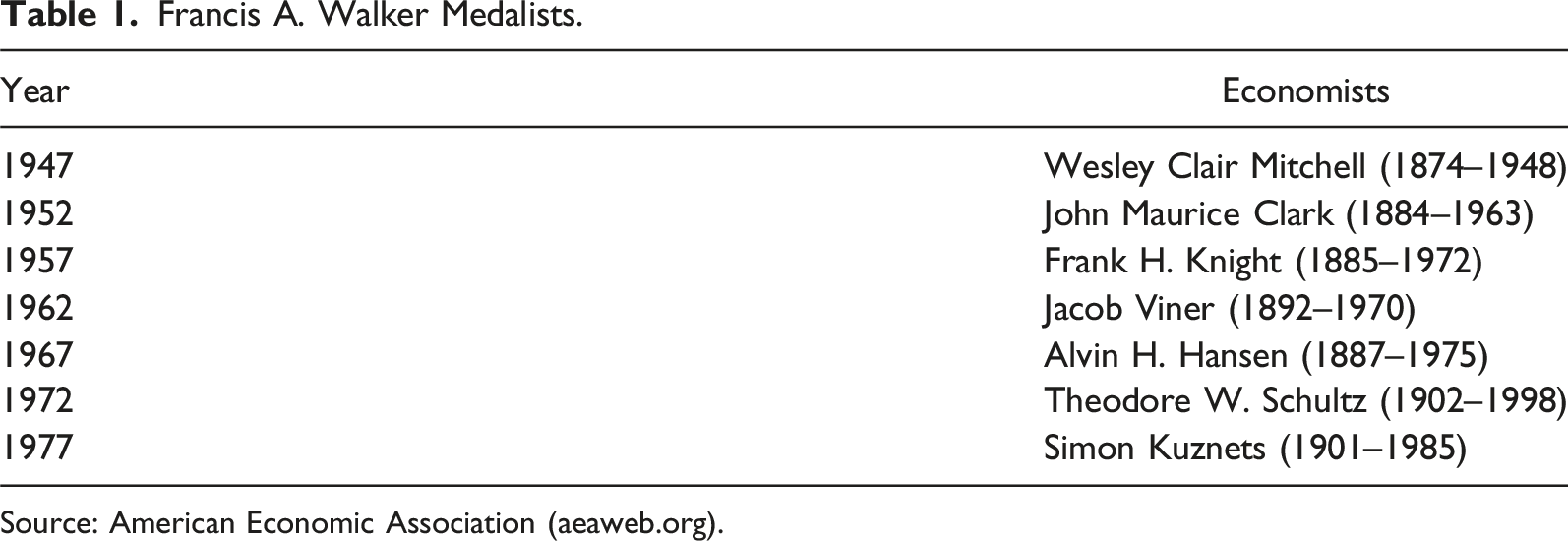
Few within the academic and non-academic realms of economics may still retain knowledge of, or have come across, the Francis A. Walker Medal. This prestigious award derives its name from Francis Amasa Walker, who served as the inaugural president of the American Economic Association (AEA). The medal was instituted by the AEA in 1947 and was bestowed only once every five years, with the objective of recognizing “the living American economist who in the judgement of the awarding body has during his career made the greatest contribution to economics 1 ”. The criteria for the award emphasized contributions to the core body of economic theory and knowledge, explicitly excluding considerations related to excellence in teaching, administration, or public service. Specialized branches of economics were only considered if their contributions significantly enriched general economic doctrine and knowledge (American Economic Review, 1963, p. 686). Consequently, the Walker Medal held the distinction of being the highest honor conferred by the Association.
Francis A. Walker Medalists.
Introducing the Walker Medal
An examination of the introduction of the Walker Medal is valuable as it offers insights into the process of introducing and deliberating new awards and recognitions within the field of economics. This historical account also aids in understanding the distinctions between the introduction of the Walker Medal and other prominent accolades, such as the Nobel Memorial Prize.
In 1945, John S. Davis, the President of the American Economic Association (AEA), took the initiative to establish an Exploratory Committee on Honors and Awards (American Economic Review, 1948). This committee was comprised of notable figures in the field, including Sumner Huber Slichter as the chairman, alongside Edwin Griswold Nourse, Frederick Cecil Mills, and James Washington Bell.
In their initial report (American Economic Review, 1945), the Committee elucidated their specific mandate (p. 494): 1. To inquire into the types, purposes, and effects of systems of honors and awards maintained by various American scientific, engineering, and professional societies. 2. To explore the possible desirability of instituting some specific scheme in the American Economic Association. 3. To report to the Executive Committee with positive or negative recommendations
The Committee initiated correspondence with numerous scientific and professional societies, seeking their collaboration in providing valuable insights. The primary objective was to gather information that would enhance the Committee’s understanding of these organizations’ historical encounters with honors and awards, with particular emphasis on addressing the following inquiries (p. 494): 1. Does your society confer honors or awards upon men who have made distinguished contributions to science? 2. If so, what procedures are followed in selecting recipients of honors and awards? 3. What are the criteria used in selecting recipients of honors and awards? 4. Have the methods of selecting candidates for honors and awards resulted in choices which have met widespread approval in the profession? 5. Is there evidence that the granting of awards or the conferring of honorary distinctions have had any definite effect in stimulating distinguished work? 6. Have honorary distinctions been granted in such numbers as to lose distinctive significance, or because of extreme limitation in numbers or dissatisfaction with the basis of selection, have awards caused friction or dissatisfaction with the whole system?
Based on the feedback received the Committee concluded that the following types of awards might be considered by the AEA (pp. 498–499): 1. For long, faithful, and useful service to the American Economic Association. 2. For the best paper contributed to the Proceedings at a given annual meeting—perhaps with some description of the yardstick to be used in defining “best.” 3. For distinguished contributions to the development of the science of economics (without attempting to specify what the contribution was or any specific period during which it was made). 4. For noteworthy contributions to the advancement of the science of economics in a specified period—say the last year or the last 5 years. 5. For unique and original contributions to the development of the methodology of economics—with a specific period specified or not specified.
Nevertheless, the Committee expressed reservations on certain matters. For instance, it deemed it inadvisable to establish an award recognizing long-standing, devoted, and valuable services to the Association, as such recognition typically results from the efforts of the Secretary and the Editor. Additionally, the Committee raised concerns regarding the feasibility of instituting an award for the best paper presented at a particular annual meeting of the Proceedings. They articulated that, “The need for speed of action, the short time prospective, and the subjective character of value judgments make such an award difficult in the extreme to administer satisfactory. There is not likely to be unanimity of judgment concerning the paper most deserving the award” (p. 499).
With respect to the three other proposed award categories, the Committee underscored that “the difficulties encountered are that judgments concerning the value of contributions are likely to differ in important respects. What appears to be ‘heresies’ of today may be judged important and notable contributions ten, twenty, or thirty years hence” (p. 499). Nevertheless, they concluded that “the objective of stimulating or rewarding distinguished work in economics is a worthy one” (p. 500).
In the subsequent year, the Committee underscored that the assessment of other associations experiences provides no unequivocal proof that honors and awards have unequivocally catalyzed distinguished contributions. Nevertheless, it is conceivable that they wield some influence. The Committee contended that a distinct award could potentially serve a valuable purpose within the American Economic Association, offering the Association a means of bestowing a prestigious distinction upon an individual without imposing upon them the responsibilities of the Association’s presidency (American Economic Review, 1946, p. 909). Their recommendations, outlined on pages 909–910, were as follows: 1. The award shall be made for distinguished and significant contributions to economics. By this is meant that the award shall not be made in recognition of outstanding teaching or of exceptional service in administrative positions either public or private. The award shall be known as the “Distinguished Contribution Award.” 2. Consideration of candidates for the award shall be made annually, but the award should not ordinarily be made more frequently than once every three or five years. It is important, in the view of the Committee, that the award should be kept one of high distinction. For that reason, the Committee believes that the award should be made only for work which has high excellence and appears to have lasting importance. 3. Nomination for the award shall be made by the regular nominating committee of the Association. Selection shall be made by the same “Electoral College” which selects the nominee for President. Suggestions for persons to receive the award should be received with the ballots as is now the case in the selection of the President. 4. The selection will ordinarily be made in March or April at the same time that the President of the Association is selected. 5. If the recipient of the award agrees to accept it, he shall prepare a special address for presentation at the next annual meeting of the Association. This address shall be given at the session of the Association at which the award is made and shall be published in the American Economic Review together with the President’s address. 6. Persons who have been president of the American Economic Association prior to the institution of the award shall not be eligible to receive it. Persons who are elected president after the institution of the award, however, shall not be barred from consideration. Nor shall receipt of the award bar a person from being selected president of the Association.
Following thorough deliberation, the Executive Committee of the Association resolved to introduce the Francis A. Walker Medal and the John Bates Clark Medal. These awards were presented during the Association’s dinner meeting in Chicago on December 28, 1947. The Selection Committee, comprising Frederick C. Mills from Columbia University (Chairman), Raymond T. Bye from the University of Pennsylvania, Calvin B. Hoover from Duke University, Frederic B. Garver from the University of Minnesota, Theodore W. Schultz from the University of Chicago, and Stuart Daggett from the University of California, initially compiled an extensive list of candidates. Subsequently, this list was narrowed to three to five nominees for each award. These finalists were presented to the electoral college, consisting of 18 members from the Committee on Honors and Awards and the Executive Committee, who reaches a decision following a comparable decision to that used in electing the President of the AEA. The President Paul H. Douglas conferred the honours of the Francis A. Walker Medal to Wesley Clair Mitchell with the following words (American Economic Review, 1948): The Francis A. Walker medal is being awarded to the world’s foremost student of business cycles whose massive work on this subject a third of a century ago opened up a new world for investigation in which he has continued to be the foremost explorer; patient and untiring scholar and master of the inductive method who operates with the objectivity of a physical scientist; born on the banks of the Illinois, educated in this city; teacher on the western and eastern shores of the continent. It is my pleasure to confer the greatest honor in American economics upon Wesley Clair Mitchell of Columbia University.
The John Bates Clark Medal was given to Paul A. Samuelson: It is now my happy privilege to confer the John Bates Clark medal upon a brilliant economist who mastered at an early age both mathematics and economic theory; has made extraordinarily penetrating contributions to the theory of employment, production, distribution, and value; and whose recent book stamps him as one of the masters of our craft. With an amazing production record behind him, he faces the future with even greater achievements before him. … Paul A. Samuelson, of the Massachusetts Institute of Technology, the university which Francis A. Walker loved and of which he was President. I feel that from somewhere in Valhalla that mighty figure is beaming with happiness.
In the early 1980s, under the leadership of Daniel McFadden, the Honors and Awards Committee proposed discontinuing the Francis A. Walker Medal. This recommendation was subsequently approved through a vote (American Economic Review, 1982). The American Economic Association notes that the Walker Medal was discontinued following the creation of the Nobel Memorial Prize in Economic Sciences 2 .
In contrast, the John Bates Clark Medal was retained despite challenges regarding its relevance in its first decade, such as the debate between theory versus empirical research and the neglect of specific fields of inquiry (American Economic Review, 1960; Cherrier, 2015; Cherrier & Svorenčík, 2020). At the meeting on April 4–5, 1958, after voting to continue the John Bates Clark Medal, an exploratory committee was appointed to examine the desirability of establishing additional means of recognizing the scientific achievements of younger scholars and the need for more awards. The Committee on Additional Awards to Younger Economists emphasized the necessity of creating a balanced system of awards within the Association, stating, “it should be quite generally agreed – perhaps by all save those who oppose awards as such – that there is urgent need to make the Association’s system of awards a reasonable balanced one” (American Economic Review, 1960, p. 715). The committee suggested introducing a new series of awards to cover forms and fields not adequately addressed by the John Bates Clark Medal. The proposal was to introduce the Wesley Clair Mitchell Medal. However, this suggestion was ultimately not adopted (for a detailed discussion, see Cherrier, 2015).
Now, over 40 years since the termination of the Walker Medal, this paper aims to explore the rationale and potential benefits of its reinstatement.
Economics of Awards
Awards significantly impact society, and academia is no exception. As highlighted in the emerging field of the economics of awards (Frey & Gallus, 2017a), awards offer numerous benefits. They enhance the subjective well-being of recipients and those associated with them, such as affiliated institutions or collaborating co-authors. Moreover, awards might even positively affect health (Chan et al., 2022; Rablen & Oswald, 2008). They can affect productivity in a positive or negative way, can increase cognitive mobility, and can increase a scientist’ social status and recognition (Azoulay et al., 2014; Borjas & Doran, 2015; Chan et al., 2014). Stigler (1985, p. 89) astutely observes: “The main effect of the prize is to endow the recipients with a large measure of prestige among non-scientists. In this respect the award has been a phenomenal success. The annual ceremonies give the Swedish community a publicity that must be the envy of every advertising executive. For the average educated citizen there is no possibility of understanding the work that won the prize or of tracing any connection between that work and contemporary well-being. Even the uneducated citizen knows that the laureate is a Life Baron in science… The public has good reasons for what it does, and it is the task of the social scientist to discover them, even though many find it irresistibly attractive to instead ridicule the public’s behaviour. My conjecture is that the public wishes to admire superior performance in every legitimate calling, athletic and military (for example) as well as scientific.”
While the degree to which scientists value external validity varies, Samuelson’s (2004, p. 60) remarks offer a witty insight into their inner motivations: “Scientists are as avaricious and competitive as Smithian businessmen. The coin they seek is not apples, nuts, and yachts; nor is it the coin itself, or power as that term is ordinarily used. Scholars seek fame. The fame they seek … is fame with their peers – the other scientists whom they respect and whose respect they strive for. The sociologist Robert K. Merton has documented what I call this dirty little secret in his book The Sociology of Science. I am no exception. Abraham Lincoln’s law partner and biographer William Herndon observed that there was always a little clock of ambition ticking in the bosom of honest and whimsical Abe. No celebrity as a Newsweek columnist, no millions of clever-begotten speculative gains, no power as the Svengali or Rasputin to the prince and president could count as a pennyweight in my balance of worth against the prospect of recognition for having contributed to the empire of science.” This perspective humorously underscores that scientists, in their pursuit of peer recognition and respect, are also subject to the very human traits of ambition and desire.
As an economist, a pertinent question arises regarding the optimal number of awards. In their comprehensive review of the economics of awards, Frey and Gallus (2017b) suggest that determining this optimal number for various activities and fields is a promising endeavor. Hansen and Weisbrod (1972) had previously noted that: “the economics profession provides only limited recognition for the outstanding achievements of its members. In addition to offices in the AEA, the only formal awards are the John Bates Clark Award and the Francis A. Walker Award, and since 1965 the Distinguished Fellow Award” (p. 422). Thus, they stress that “it seems probable that the profession is ‘producing’ awards at a suboptimal rate, for marginal benefits are surely positive” (p. 423). The adjustment in the frequency of the John Bates Clark Medal—from biennial to annual in 2009—underscores this point. This change may also reflect the substantial growth of the field and its members since the award’s inception in 1947. Samuelson (2004) on the question whether “‘[n]et, are prizes and gold medals good things?’ The answer must be Gödel-esque: A Scotch Verdict of ‘Unprovable’. Is the joy of the universe outweighed by the Weltschmerz of those who do not win? October can be a sombre month in the Senior Common Room: many are called, few are chosen. On the other hand, science, scholarship, and human welfare are bigger than the passing mob of researchers who struggle with them. A more egalitarian society, with no differential payoff to effort and ability, however acquired, might well be a more serene society. One must weigh against this how actual humans have evolved under the realistic Darwinian and cultural conditions of the past: perhaps cumulative progress might then result to be the less? Is there not some realistic tradeoff between more equality and more cumulative progress?”
Despite the introduction of prestigious awards like the biennial Yrjö Jahnsson Award since Hansen and Weisbrod’s (1972) assessment, there still may be a case for the need for additional major awards in economics. The intense pressure associated with the Nobel Prize in Economic Sciences is evident from anecdotal accounts. For instance, Becker (2004, p. 268) recounts the growing pressure in the late 1980s due to frequent speculation about his potential Nobel Prize win: “A betting pool organized by some American economists had me listed as their favourite (i.e., the lowest odds person) for three or four years running before I got the prize. And so individuals and reporters had begun asking me with some regularity: ‘When will you get the prize?’ or, once the prize was announced each year, ‘Why didn’t you get it this year?’ Of course this bothered me.” Becker further admits his desire for the award, not just for its prestige and financial benefits, but also to validate his and his students’ research, which often ventured outside traditional economic topics. He explains: “I wanted myself and others to get the validation that the Nobel Prize would provide – that the economic approach to human behaviour is acceptable work and that we are doing real economics. Yet in 1992, my work continued to be controversial, especially in Western Europe, and I began to wonder whether I would ever receive the prize” (p. 269). He vividly describes the moment he received the Nobel Prize call: “My wife, who had been up grading papers, answered the phone when it rang that morning, worried that it might interfere with my sleep. She was a bit nasty, she said to me later, but the caller said this was an important phone call for Professor Becker. My wife did not think it was the Nobel Prize, at least not for me. She went and woke me up and I kept saying, ‘I want to sleep, I haven’t slept so well for a long time’. ‘No, it’s a call from Sweden’, she said, and that was the magic word. A call from Sweden! I did not know that the prize was announced. But when I heard ‘a call from Sweden’, I figured, ‘well, maybe’ and picked up the phone. My wife subsequently said that she was sitting there as I was saying, ‘yes, yes’ with no expression on my face, and she figured that they had called for my input on somebody else who was being considered. Finally, she hears me say ‘Thank you very much; tell the committee what a great honour it is that you have conferred on me’. This of course was the call telling me I had been awarded the prize. The first thing Guity did was to let out a yell and the first thing I said was ‘I’m glad that monkey is off my back’” (pp. 269–270).
Simon (1996, pp. 319, 323) also recounts: “October 15, 1978, was a Sunday. A week or two earlier, my name had been printed in a Swedish business magazine as one of the short-list candidates for the 1978 Nobel Prize, and I opened my newspaper each morning that week to search for the verdict there. On Sunday afternoon, I received a phone call from my friend and former student Sven-Ivan Sundquist, who had arranged my Stockholm visit in 1969. Sven reported that he had met a member of the Nobel Committee on the street that day who told him he would not be disappointed by that year’s award. After considering what that might mean, he decided that I would be the winner and called to alert me. Needless to say, I found myself a bit tense and exhilarated during the rest of the afternoon, and made plans to arise early the next morning in case a phone call came from Stockholm after the academy meeting that was to end there about noon, Stockholm time. When the call came, at 6:00 A.M. on Monday, I was already up and dressed.”
But many are less fortunate. Zuckerman (1996, pp. 209–210) shares a poignant story told by a Nobel laureate biochemist about a colleague who experienced profound disappointment due to not receiving a Nobel Prize: “[Baker, a pseudonym] was just over seventy when I went to his laboratory. A whole group went to his home, and Mrs. Baker showed us all of his medals, and there was something she said that made me realize that she was disappointed. It was undoubtedly a reflection of her husband’s own feelings of disappointment that he had not been recognized by a Nobel award. Driving home with my wife, we got to talking about this and I said, ‘I am never going to worry or have a goal in mind of any prize, even a Nobel award. I refuse to die disappointed if I don’t get it’. You put your happiness into the hands of some committee, which can be capricious. You’ve got to work for the fun of it. Men of equal accomplishment don’t get it and then they have to rationalize for the rest of their lives. But don’t get me wrong, I’m not sorry I got it.” Thus, the limited number of Nobel Prizes implies that there are equally eminent scientists who have made comparable contributions to science but have not been recognized with this prestigious award (Cole & Cole, 1967). The nomination process in economics, as detailed by Lindbeck (2007), reveals a substantial pool of potential candidates. Each year, the Academy receives approximately 200–300 nominations, representing around 100 nominees. This volume of nominations suggests that there is ample scope for another comparable award, making the Walker Medal a potentially suitable candidate for reinstatement.
The selection process at the Academy involves a committee of five to eight members who commission expert studies on the most notable candidates. This leads to a detailed report, an extensive survey of the main candidates, which is then presented to the Social Science Class of the Academy (Class IX). Based on this material, the final laureates are recommended by the Class. By discontinuing the Walker Medal, the AEA has forfeited its direct influence in recognizing and defining noteworthy contributions in economics. Although criteria such as originality, importance, and impact guide the judgment process, and some AEA members partake in consulting for these expert studies and the nominations, the absence of the Walker Medal limits the AEA’s role in this regard.
Introducing competition with the reintroduction of the Walker Medal could be beneficial, especially considering the inherent subjectivity and value judgments involved in selecting awardees. Selection often transcends mere academic merit, as committees must navigate through a myriad of capable candidates. Lindbeck (2007), for example, admits that there are unavoidable subjectivity and arbitrariness in the choices. Additionally, he highlights the use of dominant criteria such as the “adhere to a pluralist view of economic research, by shifting over the years between candidates in different fields, using different methods of analysis, and reflecting different views of the world” (p. 26). The adoption of such criteria itself embodies a specific set of values.
Historically, the inception of the Walker Medal was relatively straightforward compared to the complex and ambiguous origins of the Prize in Economic Science in Memory of Alfred Nobel. Economics was notably absent from Alfred Nobel’s original will, and he reportedly harbored a strong disdain for business, as noted in a letter (Offer & Söderberg, 2016, p. 1). The Prize in Economic Science was established to commemorate the tercentenary of the Bank of Sweden (Coats, 1997; Offer & Söderberg, 2016). In 1968, despite some reservations, the natural scientists in the Swedish Academy agreed to the establishment of the prize, although it did encounter resistance within the Academy. The consent of the Nobel family was essential, leading to a visit with the family’s oldest living member, who advocated for a distinct naming of the new prize. This was intended to set it apart from the traditional Nobel Prizes. As Offer and Söderberg (2016, p. 100) observe, this led to an “awkward title that has continued to tarnish the award ever since.” Furthermore, they mention that according to Peter Nobel, a descendant of the benefactor’s brother and a critic of the prize who likened it to a ‘cuckoo’s egg in the Nobel nest’, there were speculations that the foundation might have received incentives to collaborate with the Riksbank, possibly concerning its tax-free status or investment choices.
Throughout its history, the Prize has been known by various names such as the Prize in Economic Science dedicated to the memory of Alfred Nobel, the Bank of Sweden Prize in Economic Science in Memory of Alfred Nobel, Prize in Economic Science(s), and the Sveriges Riksbank Prize in Economic Sciences in Memory of Alfred Nobel, as detailed by Sanderson and Siegfried (2019). In a notable event, a member of the Swedish Academy suggested suspending the Prize in October 2015, according to Offer and Söderberg (2016, p. 100). Despite this episode, the Prize is highly respected in the academic field, seen as the most prestigious award in economics. The award follows the same principles and nomination procedures as the other Nobel Prizes.
The criteria for the award in economics differ somewhat from the original intent of the Nobel Prize. Originally, the Nobel Prize was intended to recognize individuals “who have during the previous year rendered the greatest service to mankind” (e.g., Karier, 2010, p. 2). However, in practice, the Prize in Economics has been awarded for various reasons: specific contributions (e.g., Friedman and Modigliani), lifetime achievements (e.g., Samuelson, Kuznets, and Allais), and particular themes (Leontief), with lifetime contributions often dominating, as Lindbeck (2007) observes. While the Committee in Economics generally adheres to the same principles as those applied in the natural sciences—aiming to award specific contributions—the level of specificity varies greatly. This ranges from high specificity (Leontief) to lesser specificity (Samuelson, Friedman, Hayek, Myrdal, or Sen), as noted by Lindbeck (2007). Additionally, there was initially a significant backlog of candidates whose major work dated back several decades, even to the 1930s in some cases, such as Frisch, Tinbergen, Hicks, Ohlin, and Kantorovich. This delayed recognition emphasized by Lindbeck (2007) contrasts with other Nobel fields. Chan and Torgler (2013) report that, based on data from 1901 to 2000, the average lag between Nobel-prizewinning work and the awarding of the Prize ranges from 5 years in Physics to 11 years in Physiology or Medicine. Lindbeck (2007) points out that in economics, it often takes longer than in the natural sciences to assess whether a contribution is robust, sufficiently general, and relevant, given the need for scrutiny, criticism, and repeated quality testing.
In general, reintroduction of the Walker Medal alongside the Nobel Prize in Economic Sciences could bring significant benefits to the field of economics, particularly through the introduction of healthy competition among major awards offering multiple avenues for recognition while still maintain uniqueness in a situation where we seemed to have a suboptimal number of major awards. Other awards have aimed to address potential gaps by reducing the risk of narrowness or orthodoxy, thereby helping to mitigate disciplinary boundaries. A notable example is the Veblen-Commons Award, named after the founders of institutional economics, Thorstein Veblen and John R. Commons. This award is the highest honor given annually by the Association for Evolutionary Economics (AFEE) for outstanding contributions to institutional economics in the tradition of Veblen and Commons. The award has been bestowed upon numerous notable scholars, including Morris A. Copeland, Gunnar Myrdal, John K. Galbraith, Robert Heilbroner, Hyman P. Minsky, Paul Sweezy, Richard Nelson, and Samuel Bowles.
In addition to broadly focused awards, there are also specialized awards recognizing specific areas of economic research. The Leontief Prize for Advancing the Frontiers of Economic Thought is one such award, honoring outstanding contributions to economic theory. Since its introduction in 2000, distinguished recipients have included John K. Galbraith, Amartya Sen, Dani Rodrik, Richard Nelson, Samuel Bowles, Albert O. Hirschman, and Angus Deaton.
In terms of motivation, having a large enough set of major awards creates additional targets for aspiring economists and the possibility of a wider range of economic contributions to be recognized. This also encourages economists to delve into innovative or less explored areas of research, knowing that there are multiple prestigious platforms that might acknowledge their work. The existence of multiple awards can also help mitigate a little bit the risk of biases inherent in any selection process. With different committees and potentially diverse perspectives on what constitutes a significant contribution to economics, the awards collectively can offer a more balanced and comprehensive recognition of excellence in the field. This not only broadens the scope of recognition within the field but also introduces a dynamic element of competition that can spur further advancements and a richer diversity in economic research and scholarship. Moreover, the competition between these awards can enhance the visibility and prestige of the economics discipline. As each award strives to maintain its relevance and status, there is a natural drive to identify and honor truly groundbreaking and influential work. This not only elevates the recipients but also draws academic and public attention to important economic issues and advancements. On the other hand, the presence of awards always carries the risk of a winner-take-all effect, where the pursuit of the perceived highest accolade becomes paramount. Therefore, the reintroduction of the Francis A. Walker Medal might not provide genuine competition to the Bank of Sweden Prize but rather risk being seen as a consolation prize or a second-best award. For example, when the AEA discussed the potential of introducing additional awards for young economists, some scholars expressed concern that a new award might be perceived as a second-class honor or diminish the significance of the John Bates Clark Medal (American Economic Review, 1960, p. 711).
A compelling aspect of sustaining an award over time is its capacity to reinvigorate interest in the past accomplishments of its recipients. The regular mention of awardees, particularly those recognized long ago, helps keep their scholarly contributions in the collective memory of the profession. This is especially important for the younger generation of economists, who may not be as familiar with these earlier figures and their work. Given this context, it becomes intriguing to consider that scholars who were awarded the Walker Medal in the past might still offer valuable insights today. Their work, when revisited, can reveal enduring lessons or inspire new lines of scientific inquiry. Therefore, in the latter part of the paper, there will be an exploration of the legacies of three of the seven Walker Medal winners.
Before delving into the accomplishments of some of the Walker Medal recipients, it is essential to first understand the figure after whom the award is named: Francis Amasa Walker. His background and achievements not only set the context for the award but also serve as a benchmark for the kind of scholarly excellence the Walker Medal seeks to honor. By starting with a short exploration of Walker’s life and work, we may be able to better appreciate the significance of the medal and the achievements of those who have been honored with it. This approach ensures that the discussion of the Walker Medalists is anchored in a deep understanding of the award’s historical roots and the ideals it represents within the economics profession.
Francis Amasa Walker
Francis Amasa Walker (1840–1897) led a career so remarkable and multifaceted that, as Dunbar (1897) put it, “Walker was endowed by nature with peculiar gifts for a career of distinction” (p. 448). Born into a prominent Boston family on July 2, 1840, his father, Amasa Walker, was a notable political figure and lecturer on political economy, whose work Science of Wealth acknowledged his son’s significant assistance (Dunbar, 1897).
Francis Amasa Walker was a man of many talents and achievements, significantly impacting various fields during his lifetime. He served not only as the inaugural president of the American Economic Association (AEA) from 1885 to 1892 but also held prestigious positions as President of the American Statistical Association and Vice-President of the National Academy of Sciences. Additionally, Walker was the third president of the Massachusetts Institute of Technology (MIT), a position he held from 1881 until his death in 1897, marking his return to his native Boston.
Walker’s primary identity was as an economist, though internationally he was more renowned as a statistician. His expertise in statistics and a deep understanding of history were instrumental in shaping his approach to economics, lending him unique insights and perspectives (Wright, 1897). Coats (2008) recognizes him as a “moderate critic of the ruling classical laissez-faire orthodoxy,” noting his sympathetic response to the emerging generation of German-trained American economists which made him an ideal and somewhat obvious choice for the first president of the AEA (p. 1). Walker was recognized as both a theorist and an observer, a framer of distribution theory, and a diligent student of history (Dunbar, 1897, p. 445). Walker’s approach to economics and political science was notably holistic, incorporating a range of human experiences and ethical considerations. Billings (1902) captures the essence of Walker’s perspective, noting that he accounted for “the emotional and altruistic side of human nature, as well as the purely intellectual and selfish side” (pp. 212–213). Walker placed significant emphasis on the ethical relationships among people across different countries and times, understanding that these relationships greatly influenced economic decisions. He recognized that the moral obligations of individuals varied depending on their class, occupation, and interests, and these factors played a critical role in shaping his views on economic issues. Unlike some of his contemporaries, Walker did not let abstract mathematical models dictate his understanding of economic phenomena, instead focusing on what was wise and right in specific, concrete situations. Tyler (1897) further highlights that “[t]o his temperament it was impossible to reduce economics to the metaphysical formalism of those who had made it a ‘dismal science.’ The ‘economic man’ was to him not merely a vague abstraction, but a mischievous device for making the unreal have the semblance of the true” (p. 66). Walker’s work in economics was characterized by a breadth and depth that went beyond the limitations of narrow definitions and theoretical models. He was committed to establishing principles and drawing deductions that were firmly rooted in facts and logical reasoning, as Wright (1897, p. 257) points out.
Walker’s entry into the field of economics came at a pivotal time in American history, a fact noted by Dunbar (1897). He started his career when economics in the United States was undergoing a significant transformation, largely fueled by the Civil War and the subsequent period of rapid material development and change. This era marked a shift in economic thought, with established theories being revisited and revised. Walker embraced these changes and actively participated in the debates and controversies that arose, whether initiated by him or others, displaying a keen interest and enthusiasm. Despite this engagement with emerging ideas, Walker’s own approach leaned toward rational conservatism, maintaining an intellectual lineage influenced by notable French and English economists, which might have made him appear as a severe critic to some observers (p. 444).
His commitment to every role he undertook was complete and passionate. Wright (1897) comments on his dedication: “Whatever he was called to do, either as a student or as a soldier, or as a publicist, or, greater than all, as an educator, he did with his whole strength and with the devotion of his great, ardent soul” (p. 246). Despite lacking natural eloquence, Walker was a compelling and influential speaker, backed by exceptional executive abilities and a profound understanding of people. Walker’s influence as an educator and leader was profoundly felt at MIT, where he once addressed a graduating class with words that encapsulate his inspirational approach: I cannot sufficiently congratulate you that you have taken the morning of life, while the heart is buoyant within, the limbs stout and active, and the air around fresh and fragrant, and the sun is yet low in the heavens, to make so strong and stalwart a beginning of your journey. I cannot believe that, as you pause on this eminence, here on your graduation day, and look back and down upon the camps of those who have not yet girded themselves for the march, but are still resting in the comfortable belief that it will do as well to begin life in earnest at twenty-one or twenty-five, you are at all dis posed to regret your own early start and the manful exertions to which you have given the dewy hours of morning. (Tyler, 1897, p. 55)
Wright (1897) underscores the significance of Walker’s public addresses, noting that they “would constitute a valuable collection of material for the use of students, for he took as much pains in preparing them as in producing his more voluminous works” (p. 253). This remark highlights Walker’s meticulous approach to his public engagements. He treated these opportunities with the same rigor and dedication that he applied to his more extensive scholarly works, ensuring that his speeches were not only informative but also thoroughly researched and well-crafted.
His innovative thinking and leadership ensured the success of his projects, and he had a knack for casting new light on any subject he discussed, as observed by Laughlin (1897, p. 228). Walker’s multifaceted career and contributions to economics, statistics, and education reflect a legacy of intellectual versatility and influential leadership. His varied experiences and wide acquaintances made him, in many ways, a man of affairs (p. 446). Described by Coats (2008) as an “open-minded man, forthright in expression but fair in controversy” (p. 1), Walker’s brilliance shone in many fields. Billings (1902, pp. 211–212) attributes that his “career was a brilliant one in many fields of labour, and in most of them it was his peculiar ability as an organizer and administrator which gave him preëminence. He was a born leader – bold, frank, sincere, and entirely devoted to his work – and in the public offices which he held and as chief of a great educational institution his subordinates and assistants became, almost without exception, his loyal and devoted friends.”
Under Walker’s leadership, MIT underwent a significant transformation. Before his tenure, the institute was in dire need of a dynamic, confident administrator to realize its potential; it struggled with limited resources and declining student numbers. Walker’s arrival marked a revival of the school, characterized by secured funding, new buildings, and renewed public confidence (Dunbar, 1897, pp. 446–447). Tyler (1897) acknowledged that “[n]o man could state the needs of the school or its value to community and commonwealth more effectively, none was less capable of securing funds by appealing to the lower motives of vanity and self-interest” (p. 61).
Before his influential tenure at MIT, Walker had already carved out a distinguished career path (Dunbar, 1897). He was a professor of political economy and history at Yale University’s Sheffield Scientific School from 1873 to 1881. His expertise and reputation in these fields led to his appointment as a commissioner representing the United States at the International Monetary Conference in Paris, showcasing his growing influence in the international economic arena. Prior to his academic role at Yale, Walker had already embarked on a series of significant public service roles, all achieved before he turned 30. He served as Chief of the U.S. Bureau of Statistics and as Superintendent of the Ninth Census (1870–1872), and later the Tenth Census (1879–1881). Additionally, he held the position of Commissioner of Indian Affairs from 1871 to 1872. Tyler (1897) notes that his tenure as Commissioner of Indian Affairs was “difficult at best, was rendered doubly irksome by political conditions hostile to its efficiency” (p. 56). In these positions, Walker demonstrated remarkable capability and resilience. When he joined the Bureau of Statistics, the organization had lost some of its credibility. However, Walker’s expertise and leadership skills enabled him to effectively reorganize the Bureau and restore its reputation. His work in these roles, especially with the U.S. Census, laid the groundwork for his later achievements and solidified his status as a skilled administrator and a respected figure in both statistics and economics.
Walker’s tenure as Superintendent of the U.S. Census was particularly notable for the groundbreaking work he did in the censuses of 1870 and 1880. The 1870 Census, as observed by Dunbar (1897), was regarded as the most significant and intriguing census since 1790, primarily because it was the first conducted after the Civil War. Walker’s work in these censuses was instrumental in establishing his reputation as a preeminent statistician. In these roles, Walker ambitiously sought to expand and refine the scope and methodology of the census. As Billings (1902) notes, his work was crucial in offering a comprehensive view of the United States at the end of its first century (p. 213). Wright (1897, p. 216) elaborates on Walker’s vision for the 1870 Census. He aimed to make it encyclopedic, capturing the full spectrum of the nation’s social and economic conditions. Walker’s intent was to depict not just the demographic characteristics of the population but also the nature and structure of industries, transportation systems, wealth accumulation, and various sociological elements, essentially encapsulating all aspects that constitute a dynamic and growing nation (p. 261). The 1870 Census, however, was limited by the scope defined in the 1850 law, which only authorized the collection of data on population, vital statistics, wealth, and industry. Walker’s aspirations were more fully realized in the Tenth Census, which spanned 22 volumes and a compendium. This work brought the census much closer to what Walker had envisioned in 1870. He continued to supervise this expansive project until the last volume was published in 1888, even after assuming the presidency of MIT in 1881.
Walker’s contributions to the field of statistics were transformative. Laughlin (1897) acknowledges his profound impact, stating, “Walker’s executive and organizing ability practically revolutionized our statistical methods; indeed, it may be said that until his time we had had no scientific and trustworthy statistics of any extent” (p. 229). His innovative approaches and organizational skills not only enhanced the quality and reliability of statistical data in the United States but also set new standards for statistical methods and data collection.
Walker’s early achievements were remarkable not only in their substance but also in the rapidity with which he accomplished them. As Tyler (1897) vividly describes, “But little over thirty, he had done in a single decade work of the highest responsibility, that might well have taxed the mature powers of a strong man” (p. 58). This period of intense activity and achievement set the stage for a phase of reflection and consolidation in Walker’s career. With the most demanding responsibilities behind him, Walker entered a phase where he could afford the leisure necessary for deep scientific work. As Tyler notes, this period allowed him to “classify and co-ordinate the acquisitions of former years, filling in gaps, strengthening weak points and developing strong ones, and in general enriching his mind with the abundant stores upon which he should later draw so freely” (p. 58). This time of intellectual consolidation was crucial for Walker, enabling him to synthesize his vast experiences and knowledge, thereby further enhancing his contributions to the fields of economics, statistics, and public policy. Thus, at Yale, Walker had an active scholarly period. As Laughlin (1897) highlights, Walker’s scholarly reputation was largely built upon his economic writings, where he was known for being “fearless and uncompromising in his beliefs,” and his stance on the crucial questions of political economy was clear and definitive (p. 230). During this period, Walker authored an array of influential works. His publications included not only numerous essays and addresses but also texts like The Indian Question 3 (1874) and The Great Statistical Atlas of the United States (1874). The latter, based on the 1870 census data, was recognized for its innovative use of graphic representation and was described as “a monumental record of economic phenomena” (Laughlin, 1897, p. 229). He also authored The Wages Question (1876), provided Judges’ Reports of the Centennial Exhibition at Philadelphia (1877–78), and wrote extensively on monetary topics with Money (1878) and Money in its Relations to Trade and Industry (1879).
Walker’s scholarly output continued with notable works such as Land and its Rent (1883), History of the Second Army Corps (1886), and First Lessons in Political Economy (1889). He also penned biographical works like Life of Gen. W. S. Hancock (1894) and later delved into national and international economic topics with The Making of the Nation (1896) and International Bimetallism (1896), as recorded by Wright (1897).
His literary style was particularly noteworthy. Laughlin (1897) remarks on Walker’s ability to present complex subjects with apparent simplicity, yet without losing their essence, stating that “he wrote much, and wrote easily” (p. 228). This clarity and accessibility in his writings made his work influential not only among academics but also accessible to a broader audience, further cementing his status as a key figure in the field of economics. His unique skill in addressing both scientific and popular aspects of economics is underscored by Wright (1897), who noted that Walker had a “rare faculty of treating matters” in a way that resonated with both the academic community and the general public. His work was not confined to the ivory towers of academia; it reached and was admired by a diverse audience, a testament to his ability to bridge the gap between rigorous scientific analysis and broader public understanding (pp. 258–259). These reflections paint a picture of Walker not just as an economist of great intellect but also as a communicator who could engage a wide range of audiences, from fellow scholars to the layperson. His contributions to the field of economics were thus not only significant in their intellectual rigor but also in their widespread influence and accessibility. MIT houses a comprehensive collection Walker’s correspondence, speeches, and writings, particularly those pertaining to his presidency at the institution 4 . This collection is a treasure trove of information, offering insights into a wide array of subjects that Walker addressed during his illustrious career. The topics covered in this archive are diverse, including labor issues, capital, the silver standard, technical education, student workload, and his experiences during the Civil War, as well as his observations on New England and the South in the post-war era. The breadth and depth of this collection underscore Walker’s wide-ranging interests and expertise. His works are not confined to mere academic discussions; they also delve into practical and societal issues, reflecting his engagement with real-world economic and social challenges. This collection at MIT, thus, not only serves as a testament to Walker’s intellectual legacy but also provides a rich resource for students and scholars interested in a range of topics from economic theory to the practicalities of technical education and the historical context of his times. Walker’s contributions, preserved in these documents, continue to offer valuable insights and inspiration to current and future generations 5 .
Walker’s extraordinary intellectual capabilities and accomplishments were recognized by the academic community through an unprecedented number of degrees awarded to him. He distinguished himself by receiving more degrees from academic institutions than any other American living at that time (Wright, 1897). This recognition by numerous prestigious institutions underscored the broad impact and respect he commanded in the academic world and beyond, a testament to his influential role as a scholar, educator, and leader. Walker’s stature in the academic and intellectual community was recognized globally. His contributions and influence were acknowledged through various prestigious honors and memberships. In 1889, Walker was appointed an officer of the French Legion of Honor, a significant accolade reflecting his international standing. His reputation in the United Kingdom was also notable; he was made an honorary member of the Literary and Philosophical Society of Manchester in 1892, and of the Royal Statistical Society of England. Further, in 1893, he became a correspondent of the Institute of France and a corresponding member of the British Association for the Advancement of Science (Wright, 1897). These honors from esteemed international organizations underscore Walker’s wide-ranging impact and respect in the academic world. They reflect not only his contributions to economic and statistical theory but also his ability to engage and influence a global audience. Walker’s legacy, therefore, resides not only in his written work but also in his mentorship, leadership, and the international recognition he garnered throughout his career.
Walker’s experiences during the Civil War add another dimension to his multifaceted career. He served as a staff officer with the Army of the Potomac, where his leadership skills and valor earned him the rank of a brevet brigadier general. His military service was marked by significant hardship and bravery: in 1863, Walker was severely wounded, and in 1864, he was captured and spent 6 weeks in the notorious Libby Prison, as detailed by Billings (1902) and Wright (1897).
Dunbar’s (1897) description of Walker vividly captures the essence of his character and the impact he had on those around him: “In any company of men he instantly drew attention by his solid, erect form and dignified presence, by his deep and glowing eye, and by his dark features, cheerful, often mirthful, always alive. His instant command of his intellectual resources gave him the confidence needed for a leading place; and his friendly bearing, strong judgement, and easy optimism made others welcome his leadership” (p. 448). This portrayal highlights not only Walker’s physical presence and intellectual prowess but also his ability to inspire and lead others with ease and optimism. His experiences during the Civil War, coupled with his substantial achievements in academia and public service, paint the picture of a man who was not only respected for his intellect but also admired for his character and leadership qualities. Billings (1902, p. 213) highlighted Walker’s personal qualities, describing him as “a warm-hearted man, full of vitality and sympathy,” traits that imbued his writings with clarity and relatability, making them accessible and engaging to a broad audience, not just those well-versed in the technical aspects of economics. This ability to communicate complex economic concepts in an understandable manner broadened the appeal and impact of his work.
Billings (1902) emphasizes a crucial aspect of Walker’s legacy that extends beyond his published works. He notes, “The most important part of his work is not so much in his writings, interesting and valuable as many of them are, as in the influence which he exerted upon his assistants, associates, and pupils, and which appears in the character and amount of the work which they have been and are still doing” (p. 214). This statement highlights the profound impact Walker had as a mentor and leader. His influence shaped the careers and intellectual paths of those he worked with, leaving a lasting imprint on the field of economics and statistics through the work of his proteges.
Tyler (1897, p. 70) offers a comprehensive and eloquent summary of Walker’s multifaceted success. He describes Walker as “aggressive, but not intolerant,” demonstrating a fierce drive yet maintaining an open-mindedness toward differing views. His ability to express “magnificent indignation” without lapsing into discourtesy highlights a balance of passion and respect. Tyler notes Walker’s resolute nature in his opinions while still valuing the perspectives of others, a trait that points to his strong convictions tempered by an appreciation for diversity of thought. Walker’s diverse experiences shaped his dynamic character. His military service imbued him with maturity and command, his administrative roles provided a vast understanding of people and affairs, and his dedication to liberalizing education underscored his lifelong commitment to learning and growth. As the head of MIT, Walker demonstrated a remarkable ability to grasp and assimilate general principles of various technical fields, despite their complexity and novelty to him. Tyler also commends Walker’s skill in garnering cooperation and recognizing the best qualities in people of diverse temperaments, an essential trait for effective leadership.
Wright (1897, p. 247) further extols Walker’s leadership, likening it to a harmonious musical performance. He metaphorically describes Walker’s life and career as a grand symphony, with each phase resembling a different musical movement. The allegro of his soldiering days, the adagio of his professorial work, and the andante of his later life each contributed to the overall symphony of his existence. Wright’s portrayal captures the essence of Walker’s life as one of balance, progression, and harmony, marked by moments of vigor, grace, and steady advancement. This musical analogy beautifully encapsulates the richness and depth of Walker’s character and achievements, painting his life as a masterful symphony that continues to resonate and inspire (p. 247).
Walker Medal Winners
Having delved deeply into the life and legacy of Francis Amasa Walker, the paper will next turn its focus to three of the first four distinguished recipients of the Walker Medal.
Wesley Clair Mitchell (1874–1948)
The paper, having explored the significance of Francis Amasa Walker, will next examine the legacy of the inaugural recipient of the Walker Medal, Wesley Clair Mitchell, who passed away a year after receiving this prestigious honor. Mitchell’s impact on the field of economics is underscored by the reflections of his students and contemporaries.
Kuznets (1949), one of Mitchell’s students, highlighted the enduring nature of his contributions, stating, “[h]is contributions to our knowledge of social phenomena, to the data on the basis of which more intelligent policy decisions are possible, to the training of a large group of scholars in the field, will stand” (p. 131). This recognition points to Mitchell’s significant role in enriching the understanding of social phenomena and shaping the future of economic policy and academic scholarship. Berle (1953) further articulated the lasting influence of a scholar like Mitchell, asserting that “the immortality of a scholar is the influence his thinking exerts on generations yet to come” (p. 169). This sentiment captures the essence of Mitchell’s legacy, emphasizing the enduring impact of his intellectual contributions on future generations of economists and scholars.
Schumpeter (1950, p. 139) offered a more personal reflection on Mitchell, describing him as a character of “singular purity,” a colleague of strong convictions, and a teacher devoted to duty. He was portrayed as an “incorruptible servant of truth,” immune to temptations and a leader who led by example. Schumpeter emphasized the profound influence Mitchell had on those around him, noting the difficulty in articulating the breadth of his interests and the depth of his service to various causes. Mitchell’s personality, characterized by a blend of seriousness and a humorous demeanor, left a lasting impression on all who interacted with him.
Mitchell, initially trained in the orthodox classical tradition at the University of Chicago under J. L. Laughlin, underwent a significant intellectual transformation influenced by the likes of Thorstein Veblen 6 , John Dewey, and the German Historical School. This shift in perspective propelled him toward developing what came to be known as the “Institutionalist” School of Economics. After joining Columbia University in 1914, Mitchell not only contributed to academic thought but also played a pivotal role in shaping economic policies during President Roosevelt’s tenure in the 1930s, as noted by Hayek (1948).
Mitchell’s approach to economics was marked by his exceptional skills in observation and data collection, a trait highlighted by Friedman (2018). Kuznets (1949) provided a comprehensive insight into Wesley Clair Mitchell’s approach to economic analysis, emphasizing the dynamic interplay of analysis, data collection, and efforts to enhance the quality of information available to both scholars and the informed public. He observed that Mitchell consistently aimed to apply measurable facts to fundamental economic issues, emphasizing the critical scrutiny and evaluation of data provided by public agencies. This approach was a hallmark of Mitchell’s career, as Kuznets noted: “This concern with bringing measurable facts to bear upon basic economic problems and with the need for critical scrutiny and evaluation of data made available by public agencies persisted throughout Dr Mitchell’s life” (p. 127). Berle (1953) highlighted Mitchell’s pioneering role in economics, particularly in his methodological contributions. Mitchell’s work involved isolating identifiable economic factors, defining phenomena analytically, developing methods for precise measurement and ongoing observation, and verifying relationships or establishing the likelihood of cause and effect between various economic phenomena. Berle noted, “It remained for Mitchell to pioneer the job of isolating identifiable economic factors, determining analytic definitions of phenomena, working out methods of accurate measurement and continuing observation, verifying relationships or at least establishing probability of a relationship of cause and effect between phenomena” (p. 170).
His work was characterized by a remarkable unity, which Schumpeter (1950) admired, noting the rare ability Mitchell possessed in integrating broad visions with meticulous attention to detail. Schumpeter elaborates, “Many men have had comprehensive visions. Many men have had a passion for detail. But he was one of the few to whom it is given to harness their visions into the service of their work on detail, and their passion for detail into the service of their vision” (p. 151).
Throughout his career, Mitchell’s focus evolved from examining prices to exploring business cycles and, ultimately, to studying economic change at large (Kuznets, 1949). His bibliography, which began with The Quantity Theory of the Value of Money (1896) and concluded with What Happens during Business Cycles: A Progress Report (1951), showcases this trajectory. During his decade at the University of California at Berkeley, starting in 1902, Mitchell dedicated most of his efforts to studying economic fluctuations (Friedman, 2018). Hayek (1948) highlighted Wesley Clair Mitchell’s significant contributions at the intersection of economics and statistics, particularly his seminal work on business cycles. In 1913, Mitchell published his monumental work, Business Cycles, which was later recognized in the announcement of the Walker Medal. This work was acclaimed for being “the most comprehensive survey of the subject of economic fluctuations of the time” (Friedman, 2018, p. 166), described by Friedman (2018) as a “massive empirical and historical study” (p. 172). Schumpeter (1950) also lauded it as “a landmark in the history of American economics – though its influence upon scholars spread far beyond the United States – and cannot be praised too highly” (p. 147). Hayek (1948) acknowledged that Business Cycles had become a classic in the field, influencing its development for decades.
However, as Schumpeter (1950) pointed out, Mitchell’s work was not solely focused on cyclical phenomena. Instead, it aimed toward establishing a new economic theory, inspired by ideas developed in the study of business fluctuations, as elaborated in his book Business Cycles: The Problem and its Setting (1927, p. 148). Mitchell’s approach to economics was pioneering in its integration of statistical analysis with economic theory, shaping the discipline in profound and lasting ways. His work laid the groundwork for subsequent generations of economists to understand and analyze the complexities of economic cycles and fluctuations.
Mitchell’s influence extended well beyond academia into the realms of economic research and policy. In 1920, he co-founded the National Bureau of Economic Research (NBER) in New York, an institution that remains highly influential in economics to this day. Serving as its research director until 1946, Mitchell was described by Schumpeter (1950) as “the moving spirit, the kindly leader who led but never drove, who inspired but never crushed the initiative of his associates” (p. 152). That same year, Mitchell, alongside James Harvey Robinson and Alvin Johnson, also co-founded the New School for Social Research. This initiative was partly a response to his lifelong protest against restrictions on freedom of speech in academia, as noted by Berle (1953, p. 171). The New School represented a commitment to intellectual freedom and interdisciplinary study, principles that were central to Mitchell’s own academic philosophy.
Kuznets (1949) reflects on the profound impact of Mitchell’s experiences during World War I, which led him to believe that neither universities nor government agencies were sufficient as the sole venues for objective economic study. He envisioned the NBER as a research institution that would bridge the gap between academic and governmental research, combining theoretical interests and a realistic approach to quantitative data (pp. 127–128). According to Kuznets, it was Mitchell’s work on business cycles, conceived as a pattern of change in the entire economy that provided the central theme for the NBER’s work for nearly three decades. This work led to seminal publications such as Business Cycles: The Problem and Its Setting (1927) and Measuring Business Cycles (1946) (p. 128).
Even toward the end of his life, Mitchell remained dedicated to studying business cycles, humbly acknowledging that he had not yet solved the problem. Schumpeter (1950, p. 155) lauds Mitchell’s approach: “Work of this kind has no natural end and of necessity always points further ahead into an indefinite future.” Schumpeter highlights Mitchell’s unique position in modern economics as a scholar who acknowledged the limits of his knowledge, who worked tirelessly without seeking fanfare, and who exemplified, through his actions, the ideal qualities of a scholar. This reflection underscores Mitchell’s lasting legacy as an economist who combined a deep sympathy for humanity with a rigorous, unending pursuit of understanding economic phenomena.
Hayek (1948) offers a broader perspective on Wesley Clair Mitchell’s intellectual pursuits, suggesting that his legacy extends well beyond his specific contributions to the field of economics. Hayek observes, “although he will probably be mainly remembered for his path-breaking work in a special field, his interests and general outlook were almost as much that of a philosopher as of a specialist” (p. 255). This remark highlights Mitchell’s philosophical approach to social sciences, indicating his deep engagement with questions about the nature and role of these disciplines in society. His interest in the broader implications and functions of social sciences was as significant to him as his work in pioneering new techniques in his specialized area of study.
Kuznets (1949) also sheds light on Mitchell’s fundamental ideas, particularly his belief in the presence of an underlying order amid the constant change and variability of economic phenomena. Mitchell was driven by the conviction that the systematic accumulation of quantifiable data, coupled with the careful and critical application of theories as hypotheses, could unearth the constant elements within the economic flux. Kuznets notes, “It is this idea that illuminated Dr Mitchell’s work with a steady glow, that served as a powerful magnet around which the detailed findings in his treatises arranged themselves in a comprehensible pattern” (p. 130). This perspective underscores Mitchell’s methodological approach, characterized by patience, rigor, and a cautious yet innovative use of theoretical frameworks. His work was not just about gathering data or testing theories in isolation; it was about integrating these elements to reveal the fundamental patterns and principles governing economic behavior and change. Mitchell’s contributions, therefore, are seen not just as advancements in specific areas of economics, but as part of a larger, philosophical quest to understand and explain the dynamics of economic systems.
Schumpeter (1950) offers a vivid metaphorical analysis of Mitchell’s intellectual journey and methodology, suggesting that it represents the intersection of his environment and his personal inclinations. Schumpeter notes, “The curve on which Mitchell’s own work was to move can, I believe, be readily interpreted as the intersection of two surfaces: one which represents these environmental conditions and another which represents the propensities of his own mind” (pp. 141–142). This intersection led to Mitchell’s dissatisfaction with the prevailing state of economic analysis and his pursuit of a broader exploration of social facts. Schumpeter highlights Mitchell’s skepticism toward logical rigidity and his wariness of ideological biases masquerading as methodological conveniences. Mitchell’s approach was exploratory and expansive, shunning narrow confines for a more comprehensive engagement with economic realities.
Kuznets (1949) emphasizes the challenges and demands of studying society through statistical and empirical evidence. He acknowledges the difficulty inherent in grappling with the complexity and variability of economic life and the often-imperfect data available. Kuznets admires the “courage, patience, and sheer moral stamina required in this struggle” and the “unusual capacities for organization, analysis, and synthesis needed to bring order out of chaos” (p. 129). He recognizes that Mitchell was remarkably equipped with these qualities, although the reasons for this—whether hereditary or environmental—are less important than acknowledging the leading ideas and broad attitudes that guided Mitchell throughout his career.
Frank H. Knight (1885–1972)
In December 1957, at the meeting of the American Economic Association in Philadelphia, the esteemed Francis A. Walker Medal was presented to Frank H. Knight. The presentation was accompanied by remarks from George W. Stocking, the chairman of the Committee on Honors and Awards in 1957 and the Association’s president in 1958. Stocking’s speech highlighted Knight’s extraordinary contributions to economics and social philosophy, emphasizing the depth and breadth of his intellectual pursuits. He stated: “The medal this year is being awarded to a social philosopher the depth and breadth of whose thinking has few parallels in the history of the social sciences. All economists have lasting indebtedness to him for his classic study of the role of the entrepreneur in economic activity, Risk, Uncertainty and Profit. Social philosophers everywhere are indebted to him for his continuing and penetrating analysis of the relationship between ethics and economics. Distinguished scholar, beloved teacher, and profound student, Frank H. Knight has won an enduring place in the economists’ Pantheon” (American Economic Review, 1958, p. 254).
Frank H. Knight, a pivotal figure in the field of economics, had a background as diverse and rich as his academic pursuits. Raised on a farm in Illinois, the eldest of eleven children, Knight’s early life and educational journey were marked by a breadth of interests and studies. His academic path was eclectic, initially delving into subjects like chemistry, philosophy, and German drama, where he wrote a master’s essay on “Gerhard Hauptmann” focusing on idealism.
Knight’s diverse academic background eventually led him to economics, culminating in a doctorate from Cornell University in 1916. This period of study laid the foundation for his seminal work, Risk, Uncertainty, and Profit, published in 1921. This book, originating from his doctoral dissertation, quickly became a classic in the field of economics. Its impact was profound and far-reaching, earning the distinction of being “one of the most influential doctoral dissertations in the history of American economics” (American Economic Review, 1973, p. 1047).
Knight’s tenure at the University of Chicago, beginning in 1928, marked a significant phase in his career and in the evolution of economic thought. He became a central figure in the formation of the original, pre-Friedman ‘Chicago School’ of economics, following his earlier academic roles at Cornell and the University of Iowa (Buchanan, 1982, pp. ix–x). Stigler (1973), reflecting on his time as a student at the University of Chicago, recognized Knight as “the dominant intellectual force of the Economics Department during my student days” and noted that “no serious student of economics left the University without bearing some marks of Knight. In some respect, a more improbable Moses, if Knight could ever forgive the figure, could not be designed” (p. 518). This statement underscores Knight’s profound influence on generations of economists. Buchanan (1982) humorously quoted an old University of Chicago saying: “there is no God, but Frank Knight is his prophet” (p. xi). This saying, along with Stigler’s comment that “Knight would not hesitate to tell Gabriel if his horn-needed tuning” (1973, p. 518), reflects Knight’s reputation for intellectual rigor and his willingness to challenge conventional wisdom.
Knight was highly revered for his unwavering commitment to intellectual inquiry, a trait that was prominently reflected in his academic work. Stigler (1973) lauded the “purity of his devotion to the pursuit of knowledge” (p. 518), emphasizing Knight’s relentless pursuit of truth. Knight approached his work with a unique blend of honesty, sincerity, and integrity. He was unafraid to challenge established norms and ideas, boldly carving out his intellectual and moral stance without fear of censure from his peers or reverence to traditional wisdom (Buchanan, 1982, p. x).
In the classroom, Knight’s presence was marked by his personal integrity, intellectual curiosity, humility, and wide-ranging interests. Patinkin (1973) described him as an engaging figure who stimulated intellectual curiosity and encouraged a broad spectrum of inquiry among his students (p. 788). Buchanan (2004) provided further insights into Knight’s teaching style, portraying him as a thinker always in search of ideas and deeply critical of unquestioned assumptions. Knight was known for his ability to delve into principles ranging from the straightforward to the complex, consistently questioning and challenging the arrogance of conventional wisdom. He instilled in his students the belief that all knowledge was open to question, that much of what was accepted as truth was debatable, and that a true scholar’s hallmark was the courage to navigate through the fog of intellectual complacency. Buchanan described Knight as “an inveterate puzzler,” whose depth of thought reached levels often unperceived by others in the field (p. 140). Patinkin’s (1973) experience in Knight’s classroom was one of initial confusion and bewilderment, reflective of Knight’s unconventional teaching style. Knight did not follow a systematic approach to introducing and developing subjects, nor did he make traditional pedagogical efforts to motivate student understanding. Instead, he taught economic theory in a style that was more akin to a loose, literary, and philosophical discourse. Patinkin described Knight’s lectures as “like a general-equilibrium system,” which required students to familiarize themselves with Knight’s body of work to understand the interrelationships in his lectures and thereby transform the unknowns into knowns. Patinkin recalled the satisfaction he felt when he began to grasp the overall system of Knight’s thought, as the various elements started to make sense and fall into place (p. 789).
Knight was dedicated to enhancing the usefulness and logical clarity of core concepts in economics. Leigh (1974) noted that Knight’s efforts were directed toward getting to the fundamentals of the discipline, constructing firm foundations that were relevant to the real world, and setting economic theory on a path toward discovery and elucidation rather than obfuscation of truth (pp. 584–585). Stigler (2004) recognized the profound influence Knight had on his students, asserting that “almost all the students were much influenced by him” (p. 81). Stigler highlighted Knight’s belief in intellectual inquiry as a sacred calling, a pursuit that was incredibly challenging and demanded complete fidelity to truth and evidence. This approach communicated to students the seriousness and rigor of scholarly work (p. 81).
Knight’s intellectual independence and commitment to reason were central to his identity as a scholar and thinker. Stigler (1973, p. 519) poignantly captures this aspect of Knight, noting his “unswerving devotion to knowledge,” which was as much a part of his way of life as it was of his academic pursuit. Knight was not one to seek validation or engagement outside the academic realm; he didn’t serve as a consultant, partake in the lecture circuit, or seek fame in the popular press. Instead, he approached his academic career with the belief that the pursuit of knowledge was a worthy, full-time occupation for a first-class mind.
Knight’s role as a co-editor of the Journal of Political Economy, alongside Jacob Viner, and his eventual acceptance of the presidency of the American Economic Association in 1950 after initially declining nominations, demonstrate his influence and respect in the field. However, as Buchanan (1982) observed, Knight’s primary “social function” was that of a critic. He was committed to exposing fallacies, nonsense, and absurdities in scientific discourse, emphasizing the need for a more critical attitude (p. xi).
Knight’s intellectual rigor led him to question and often reject traditionally accepted economic categories such as land, labor, capital, profit, interest, production, consumption, cost, value, competition, or risk. This inclination for critical examination was reflected in his fondness for Josh Billings’ aphorism, as recalled by Buchanan (1982): “It ain’t what we don’t know that hurts us. It’s knowing so darned much that ain’t so” (pp. xi–xii).
Gordon (1974) described Knight as a multifaceted thinker: a liberal yet conservative, an idealist and an empiricist, a romantic and a utilitarian, and a critic of all these perspectives. Gordon observed that Knight’s mental constitution prevented him from the “monocular fixation” necessary for widespread fame or founding a particular school of thought (p. 577). This multi-dimensional thinking contributed to Knight’s unique position in economic thought. Stigler (1973) acknowledged Knight’s ability to focus on the significant issues of economic and social life, highlighting his role as one of the “last great general economic theorists to rely entirely upon nonmathematical exposition” (Leigh, 1974, p. 584). Knight’s emphasis on nonmathematical exposition in a period when economics was increasingly embracing mathematical methods further underscores his distinct approach to economic theory and analysis.
Philosophy held a special place in Knight’s intellectual pursuits, being his first intellectual love as noted by Wick (1973). An interesting anecdote about Knight’s academic journey is recounted by Alvin Johnson in his autobiography Pioneer’s Progress, also referenced in the American Economic Review (1973, p. 1047). During his time at Cornell, Knight majored in philosophy under the guidance of James Edwin Creighton and Frank Thilly, while minoring in economics under Johnson. Johnson regarded Knight as an exceptionally keen student of theory, one who was not only capable of competently attacking Johnson’s positions but also enjoyed doing so. This intellectual vigor and willingness to challenge ideas were qualities that Johnson appreciated. However, Creighton had a contrasting view of Knight. He perceived Knight’s ingrained skepticism as detrimental, believing it to undermine the values of philosophy, destroy its true spirit (wherever he touches it), and mislead others (leading blindly the blind into pitfalls). Creighton’s perspective led to a significant turning point in Knight’s academic path. When Johnson suggested that Knight should major in economics instead, Creighton responded dismissively, indicating that the philosophy department would prefer to disassociate from Knight: “Do as you please. We in philosophy will have nothing to do with him.” This shift marked a critical transition in Knight’s academic focus, moving him more firmly into the field of economics.
Interestingly, later in his career, from 1945 onward, Knight held the title of professor of philosophy as well as social science, which indicates a return to his philosophical roots and an acknowledgment of his deep and enduring connection to philosophical thought. This dual appointment underscores the interdisciplinary nature of Knight’s intellectual endeavors, blending his foundational love for philosophy with his significant contributions to economics and social science. Wick (1973) provides a profound insight into Knight’s philosophical orientation, depicting him as a philosopher in the most classical sense. This characterization aligns with the ancient concept of philosophy as a continual, open-ended pursuit, one that does not culminate in definitive doctrines but critically examines the purposes, relationships, limitations, and inherent biases of all doctrines. Wick’s perspective resonates with Immanuel Kant’s description of the “cosmical” concept of philosophy, which is seen as “the science of the relation of all knowledge to the essential ends of human reason” (p. 513). This philosophical stance underscores a humility and critical self-awareness, recognizing that to call oneself a philosopher in this grand sense might be overly ambitious, as it is an ideal more than an attainable reality.
Wick (1973, p. 513) believed that Knight also viewed philosophy as the “ultimate” concern of a university, essential for giving clarity and purpose to all other academic endeavors. Without this philosophical foundation, he argued, the other activities of a university risk becoming muddled and diminished. In the early 1930s, Knight’s focus began to shift more significantly from economic theory to social philosophy, as noted by the American Economic Review (1973). This transition reflects his deepening engagement with broader philosophical questions and issues, moving beyond the confines of economic theory to address more fundamental questions about society, values, and human reason.
The reflections on Knight reveal a scholar deeply invested in exploring the fundamental values underpinning social unity and division. Schultz (1973) described him as a “profound scholar,” singularly focused on understanding the key to social unity, living a life marked by simplicity and introspection (p. 516). Schultz particularly admired one of Knight’s “Laws of Talk” which stated, “The more intelligent people are, the more certain they are to disagree on matters of social principle and policy, and the more acute will be the disagreement” (p. 516).
Knight’s influence extended significantly to his students, allowing them to see things in their way while guiding their thinking for years (Patinkin, 1973). Schultz (1973) further notes that Knight was comfortable both with eminent figures (“the Giants of the Earth”) and in solitary contemplation, always examining the origins of human values and recognizing the limitations of the moral code of liberal humanism in reconciling conflicting ideologies (p. 517). Stigler (2004) provides a personal account of his experience writing his dissertation under Knight’s supervision. He describes Knight as exceptionally kind and generous, but also acknowledges the challenge of developing his independent analytical perspective after years of being profoundly influenced by Knight’s critical and strong-minded approach. Stigler admits to never having revisited his dissertation, Production and Distribution Theories: The Formative Period, due to apprehension about confronting its “Knightian excesses” and its immaturity (p. 83).
The testimonials about Knight from renowned economists capture the profound respect and admiration Knight commanded among his peers and students. Stigler (1973) openly acknowledged the intellectual gap between Knight and his contemporaries, admitting that “none of us believed that we were capable of dealing with his range of problems at his level, and we were surely right” (p. 519). Buchanan (1982) shared a conversation with Coase that further illustrates Knight’s exceptional status. Coase expressed that while he could envision attaining the fame of most well-known economists with enough luck, persistence, and effort, he simply couldn’t imagine himself reaching the intellectual stature of Knight. Coase further remarks: “I guess that amounts to saying that Knight is a genius” (pp. xiii–xiv).
Schultz’s (1973) reflections expand on Knight’s influence beyond the field of economics. Schultz emphasized that Knight’s contributions were not limited to a particular academic discipline, institution, or nation. Knight’s insights transcended geographical, cultural, and social boundaries. He shed light on the fragile nature of the moral code underpinning liberalism and the ever-present risk of regressing to a more regressive era (p. 517). This global and timeless relevance of Knight’s work signifies his impact on a broader understanding of human society and its values.
Stigler’s closing remark, “We shall continue to be the students of Professor Knight” (1973, p. 520), encapsulates the enduring legacy of Knight as a thinker and educator. Even years after his passing, Knight’s ideas, insights, and method of inquiry could continue to influence and guide more younger economists, scholars, and intellectuals who have forgotten his extraordinary contributions to the academic world.
Jacob Viner (1892–1970)
Jacob Viner, a notable figure in the field of economics, had a distinguished academic journey that began in Montreal, Canada. After completing his undergraduate studies at McGill University, Viner pursued graduate work at Harvard University. His PhD thesis, titled Canada’s Balance of International Indebtedness, was supervised by Frank Taussig and played a crucial role in establishing his reputation as a first-rate economic theorist.
In 1916, Viner joined the faculty of the University of Chicago, where he made significant contributions to the field of economics until 1946. During his tenure at the University of Chicago, Viner’s role as an editor and co-editor of the Journal of Political Economy from 1928 to 1946 significantly contributed to its development and prestige. Samuelson (1972) highlights Viner’s impact on the journal, noting his valuable editorial improvements and suggestions. Viner’s editorial stewardship played a crucial role in enhancing the quality and stature of the Journal of Political Economy, making it a significant outlet in the field of economics. Samuelson’s remark, “It is enough to mention here that the Journal of Political Economy was a great Chicago contribution to the development of economics” (1972, p. 10), underscores the importance of Viner’s work with the journal.
Following his tenure at Chicago, Viner moved to Princeton University, where he continued his illustrious academic career, retiring from teaching in 1960. At Princeton, he taught two graduate-level classes: one on the theory of international trade and another on the history of economic doctrines which was regarded as a tour de force in the field, reflecting Viner’s profound knowledge and expertise (Baumol, 1972). Viner remained intellectually active even after his retirement, serving as a permanent member of the Institute for Advanced Study. Baumol (1972) reflected on the impact of Viner’s lectures, noting, “one derived from these lectures a sense of the meaning of scholarship, its requisite patience and careful workmanship, its standards of integrity, and its appreciation of knowledge as an end in itself” (p. 13).
Samuelson’s (1972) recollections of his time as a student under Jacob Viner at the University of Chicago provide a vivid portrayal of Viner’s unique teaching style and personality. Samuelson described Viner as “short and intense, like a bantam cock,” with an appearance and demeanor that left a lasting impression (1972, p. 6). Viner’s graduate course in economic theory, referred to as “301,” was regarded by Samuelson as probably the best of its kind in the United States at the time. Samuelson, like many other top students, found Viner’s teaching techniques to be incredibly stimulating. Samuelson recalled being particularly fascinated by Viner’s first lecture, where he used the analogy of a well-balanced aquarium to elucidate the nature of continuing equilibrium (p. 7). Viner’s approach to teaching also placed considerable emphasis on the historical development of economic subjects, highlighting the evolution of economic thought and theory.
Samuelson (1972) compared Viner’s pedagogical style to that of Frank Taussig, Viner’s mentor, who was known for his adept use of the Socratic method 7 . However, Viner introduced one further element, namely “terror” into his seminars, creating an intense and high-stakes atmosphere. Samuelson described how seminar participants would sit tensely, waiting to see who would be called upon to speak. The pressure was significant, with students potentially facing dismissal from the course—and thus their graduate studies—if they failed to meet Viner’s rigorous standards: “I remember an able graduate student who, having failed to give an acceptable answer on two previous occasions, was told by Viner: ‘Mr I am afraid you are not equal to yourself or this class’. This man barely managed to retrieve his position at the final moment. If a graduate student was refused admittance to 301, the basic course in theory, he had no choice but to drop out or to transfer to the slums of political science or sociology” (p. 6). This approach, while formidable, was according to Samuelson effective in maintaining a high level of academic excellence and rigor in the course.
Baumol’s (1972) recollection of his time at Princeton offers another perspective on Jacob Viner’s approach to teaching and examining. Baumol describes the apprehension many graduate students felt about having Viner on their oral examination committee, primarily due to his reputation for asking the most challenging questions. This fear was a testament to Viner’s intellectual rigor and the high standards he set for his students (p. 12). However, Baumol reveals a less known aspect of Viner’s character. Despite his reputation for being a tough examiner, Viner often advocated for more lenient grading once the examination was over. Baumol recounts an incident where a colleague questioned Viner on his recommendation for a generous grade, despite the student’s inability to answer many of his questions. Viner’s response, accompanied by a “flash of his mischievous smile,” was telling: “Surely, it would be unreasonable to expect anyone to be able to answer those questions” (p. 12).
The American Economic Association elected him president in 1939 and in 1962 he was awarded the Francis A. Walker Medal. Machlup acknowledged: “He represents the greatest combination of theoretical keenness (with no need for fancy techniques), alertness to policy issues, and historical scholarship in both economic institutions and economic ideas. In all the fields to which he has contributed, including his specialty, international economics, his name will survive brightly as a deflator of pretentious nonsense as well as an original creator. What we all might learn from him is intellectual honesty and fearlessness, a willingness to stand firm on the unpopular side of any issue, theoretical or practical, whether that side be ‘radical’ or ‘conservative,’ ‘new- fangled’ or ‘old-fashioned.’ There is no need to recite here the titles of his past contributions to economics; they are well known to the student of economics. But we may reveal that the medalist of 1962, though retired from his teaching duties, has by no means retired from scholarly research. We look forward to more products of his scholarship and we do so with most pleasant anticipations. Perhaps I may finally say how happy it makes me that it is my immediate predecessor in the academic position I hold whom we are honoring today. Speaking for the Committee on Honors and Awards, I present, on behalf of the American Economic Association, the Francis A. Walker medal to Jacob Viner, Walker Professor Emeritus of Princeton University” (American Economic Review, 1963, p. 686).
Viner’s career extended beyond academia into significant roles in public affairs, demonstrating his influence in both economic theory and policy. From 1934 to 1939, he served as an assistant to the Secretary of the Treasury and as a special adviser to the US Tariff Commission and US Shipping Board during World War I. His involvement in public service continued with his role as a consultant to the Department of State between 1943 and 1952. Additionally, Viner offered his expertise to the Board of Governors of the Federal Reserve System and was a member of the Board of Directors of the National Bureau of Economic Research. Samuelson (1972, p. 10) reflected on Viner’s public service engagement: “Viner himself enjoyed a certain satisfaction from knowing that he had served his times” (p. 10). Samuelson also marveled at Viner’s ability to balance his scholarly work with his frequent trips to Washington for public service: “I have to shudder at the thought of how a great treatise like the Studies could have been written in the same years that frequent trips to Washington were being undertaken. And I now realize why, when I used to go to his office for help and discussion, he would open the door a crack and stand there puffing on his pipe, conversing through the few degrees of angle of that door. It powerfully shortens idle conversation to conduct tutorials on the hoof” (pp. 10–11).
Viner’s standing in the world of economics and related fields was one of high esteem and recognition. Machlup (1972a) characterized him as “one of the most honored scholars in economics and cognate fields” (p. 1), highlighting the widespread respect Viner commanded across various academic disciplines. Samuelson (1972) expressed profound admiration for Viner’s contributions to neoclassical economics, declaring, “there has never been a greater neoclassical economist than Jacob Viner” (p. 9). Samuelson also appreciated Viner’s eclectic approach, recognizing the value of his wide-ranging intellectual curiosity and ability to draw from multiple fields of thought (p. 11). Baumol (1972) noted that Viner particularly cherished his intellectual independence, a trait that defined his approach to scholarship and inquiry. Viner’s colleagues at Princeton regarded him as a meticulous scholar with a profound depth and range of intellect. Beyond his academic prowess, they also admired him for his personal qualities, describing him as a person with a gift for friendship, warmth, and humanity (Machlup, 1972a, p. 4).
Viner’s scholarly influence was extensive, spanning from price theory to the history of economic thought, and including studies in political economy, such as the balance of power. However, his most significant impact was in the field of international trade, where he combined his deep interest in economic history with theoretical analysis. The American Economic Review (1971) acknowledged this, emphasizing his combination of international trade with the history of economic thought. Samuelson particularly lauded Viner’s “colossal contributions to the modern theory of international trade” (1972, p. 10). He pointed to Viner’s 1937 work, Studies in the Theory of International Trade, as unparalleled in its comprehensive review and evaluation of existing literature. Samuelson also noted that this work contained material that presciently anticipated later models in international trade by economists like Lerner and Leontief, as well as Hicks’s general equilibrium model (p. 10).
Jacob Viner’s scholarly breadth and intellectual curiosity were truly remarkable, as illustrated by anecdotes from his colleagues. Baumol’s (1972) story about Viner’s extensive reading habits offers a glimpse into the depth of his intellectual pursuits. Members of Princeton’s Departments of History and English, who specialized in periods that interested Viner, found that he had previously borrowed almost every book they took out from the library in their respective fields, as indicated by his name on the library cards (p. 13). This anecdote not only shows Viner’s wide-ranging interests but also his thorough approach to research. Baumol also recalled Viner’s later years, noting that he dedicated much of his time to delving deeper into the history of ideas. Viner’s regular visits to the library were well-known, and he was often seen engaged in animated discussions with graduate students (p. 14). This interaction with students underscores Viner’s commitment to scholarship and his role as a mentor and educator.
Samuelson (1972) also acknowledged Viner as a “prodigious worker” (p. 10). He left behind a substantial body of unpublished work, evidencing his relentless work ethic and dedication to academic inquiry. This includes over 2000 pages of manuscripts and notes for a book titled Religious Thought and Economic Society, lectures on various topics such as The Role of Providence in the Social Order (the Jayne Lectures), Economics and Freedom (the Wabash Lectures), and British Social Thought from the Restoration to the American Revolution (the Bryn Mawr Lectures), as well as manuscripts on Eighteenth-Century Thought in Britain (Machlup, 1972b).
Baumol’s reflections on Viner paint a picture of a man who was not only a distinguished scholar but also a compassionate and supportive colleague. Baumol (1972) described Viner as “kindly, warm, witty, and above all, willing to give his energy and time unsparingly to help others in their work” (p. 12). This description emphasizes Viner’s generosity and commitment to fostering the intellectual growth of others, particularly his younger colleagues and students. Baumol also highlighted that Viner’s greatest contribution to Princeton may not have been his scholarship or teaching per se, but rather his readiness to assist other scholars. Viner was known for his prompt and thorough feedback on manuscripts, offering constructive suggestions and kind yet critical remarks. He was a go-to resource for information on a wide range of economic and non-economic subjects, always available to those who sought his knowledge and insight (pp. 14–15).
Samuelson’s (1972) reflection on Jacob Viner’s career indeed combines personal insight with a touch of wit, illustrating the journey of Viner’s academic life in a metaphorical and engaging manner. Samuelson likened Viner’s career shift from the University of Chicago to Princeton University to a biblical journey, drawing a parallel with the story of Moses. Samuelson mused, “It was a tragedy of Moses that he was never to be permitted to enter into the Promised Land. I have always thought it was the good fortune of Jacob Viner that, after a creative and sometimes stormy passage at Chicago, he was able while at the very prime of his powers to move into the serene harbor of Princeton. Where he and his wife Frances did live happily ever after” (p. 12).
Conclusions
The establishment and awarding of prestigious medals such as the Francis A. Walker is a significant acknowledgment in the field of economics, highlighting the profound contributions of distinguished economists. This honor, bestowed by the American Economic Association, served not just as recognitions of individual achievements but also as reflections of the strong American landscape of economic thought despite its short survival. The careers of medal recipients like Jacob Viner, Frank Knight, and Wesley Clair Mitchell illustrate the profound impact individuals can have on economics. These economists personify virtues such as intellectual bravery and independence, eclecticism, depth and breadth of intellectual pursuit, and a commitment to academic rigor. Their roles as educators and mentors further emphasize the significant influence economists have in shaping future scholars and contributing to the intellectual richness of the field.
In revisiting the legacy of Francis A. Walker himself, we gain a deeper understanding of the Medal’s symbolic significance. Walker’s role as an inaugural figure in the American Economic Association and his contributions to economics set the foundational values and standards that the Medal aims to uphold. The reinstatement of this award could offer a renewed platform to acknowledge lifetime achievements and foster a richer appreciation of economic scholarship.
While the Nobel Prize in Economics is undoubtedly the most prestigious accolade in the field, reintroducing the Walker Medal could provide a complementary platform to honor economists whose contributions might be different in nature or scope but are equally significant to the advancement of economic thought. The Walker Medal, with its focus on lifetime achievements, offers an opportunity to celebrate economists who have dedicated their careers to shaping the discipline, much like the renowned figures we have discussed. Furthermore, the presence of multiple prestigious awards in economics can foster a healthy competitive environment in the academic community. This competition is not just about winning accolades but about encouraging diversity in research and thought. Just as Viner, Knight, and Mitchell as discussed left indelible marks on economics, the Walker Medal and the American Economic Association in general could continue to honor those who shape the field’s past, present, and future. The idea of competition with the Nobel Prize should be seen not as rivalry but as a complementary system to recognize and celebrate the rich tapestry of economic scholarship.
Footnotes
Acknowledgments
For very helpful comments and suggestions thanks are due to an anonymous reviewer.
Declaration of Conflicting Interests
The author(s) declared no potential conflicts of interest with respect to the research, authorship, and/or publication of this article.
Funding
The author(s) received no financial support for the research, authorship, and/or publication of this article.
