




Abstract
Students often choose to major in economics after being introduced to the discipline through principles courses. Most of these courses cover the same general material, with an emphasis on theories and models. We offer general education courses that introduce economic thinking without emphasizing economic models or theories. Instead, these courses focus on critical thinking, social and economic issues, and ideologies. We find evidence that exposure to a first-year critical-thinking course taught by a member of the Department of Economics and Finance increases the probability that a student will choose to major in economics.
Introduction
Many researchers have examined the various approaches to teaching economics in hopes of finding the ideal avenue for assisting students in learning economic concepts and helping them develop an interest in economics. Perhaps a more fruitful line of inquiry is to ask the question, “What encourages students to want to learn economics?” In this study, we examine a novel approach to introducing economic concepts to college students who may not have considered economics as a major. By imbedding applications of economic logic into sections of a required first-year critical-thinking class, we can introduce the interesting insights economic thinking provides to issues that engage students who are just starting their college adventures. We find that those students who take a first-year critical-thinking course offered by the Department of Economics and Finance are more likely to either choose economics as a major if they have not yet declared a major, or to switch from their chosen major to economics compared to students who take any other first-year critical-thinking course.
When elementary school music teachers want to entice students to start learning an instrument, they do not explain to fourth and fifth graders the theory behind playing different instruments. Nor do they present the technical difficulties in mastering the instruments. Instead, they play music on various instruments, they let students hold the instruments, and they encourage students to imagine what they will do once they learn how to play those instruments. They present the possibilities rather than the hurdles. Economics programs tend to do the opposite. Students are introduced to economics by way of fairly standard principles classes. 1 Rather than approaching the discipline with an eagerness borne of seeing all the insights economic reasoning has to offer, students are asked to navigate an obstacle course of mathematical models and theorems before they are allowed to play.
Understanding what motivates students is key to solving two problems departments and universities face. From the perspective of the department, it is important to attract majors to demonstrate viability. In lean times, universities face pressure to discontinue underperforming and low-enrollment programs. At the university level, ensuring that students matriculate in a timely fashion is paramount. If we better understand the factors that influence students to select a major that they will see to completion, we can address both issues head on. The Baccalaureate and Beyond (2016) study of the National Center for Education Statistics reports that 31.84% of all students switch majors at some point in their college career. Information that can help sort students into appropriate majors can help reduce time to completion and increase student satisfaction with their educational experiences. In a survey of students, Malgwi et al. (2005) found that the students reported interest in the subject matter to be the most important factor when choosing a major. Our results suggest that a first-year experience that introduces students to applications of economics can give some students a head start.
Our study is organized thusly: Prior to reviewing what other researchers have uncovered about why students choose to major in economics, we describe the first-year critical-thinking course at the heart of our investigation. After summarizing the literature, we offer a description of the data we employ and the models we use to analyze them. We then discuss our results. Finally, we conclude with some implications that stem from our findings.
Course Description and Literature Review
As a public liberal arts university, our institution attempts to replicate an educational environment similar to a traditional private liberal arts university. Included in that effort, we require first-year students to take a three-hour critical-thinking course, called GC1Y. The course is not housed in any individual department. Each department is aggressively encouraged, but not required, to offer sections taught from unique disciplinary and multidisciplinary perspectives as long as the section fulfills the basic requirements of the course. The primary desired student outcome for all GC1Ys is, “Students will be able to explain multiple intellectual approaches that clarify or respond to problems, topics, themes, and/or issues.” New GC1Y course approvals go through a university-level committee to ensure they meet all basic requirements. These requirements are provided in Appendix A (GC1Y rubric).
The following is from our course catalog on GC1Y classes: “Prerequisite: Freshman status. This introductory-level course focuses on the development of critical-thinking skills within various disciplinary, multidisciplinary, or interdisciplinary contexts. Course materials will emphasize multiple intellectual approaches to issues, topics, and/or themes; the evaluation of evidence to form appropriate conclusions; the development of effective oral and/or written communication skills. The course will provide appropriate opportunities to engage in learning beyond the classroom. Course topics and themes will vary” (“GC1Y 1000,” n.d.). A wide variety of GC1Y courses are offered each semester, including ones focusing on religion, music, film, technology, and healthcare. 2
It should be noted that these courses are distinct from one-hour onboarding first-year seminars, which are now common at many institutions (including our own). GC1Y courses are one way we distinguish our core curriculum from other colleges in our university system; however, the requirement of such courses is not unique to our campus. For example, Appalachian State University requires a three-hour first-year general education seminar, which is functionally equivalent to our GC1Y courses (“General Education Requirements,” 2023). Like us, they offer a wide variety of courses meant to teach critical thinking from various perspectives (“First-year seminar: Course offerings,” 2023). Some private liberal arts colleges, such as Drake University, also have similar critical-thinking requirements and a variety of course offerings to fulfill that requirement (“FYS Student Homepage,” 2023).
The Department of Economics and Finance has elected to offer three sections of the critical-thinking course: Freakonomics; Sex, Drugs, and Economics; and Swansonomics. The first two sections focus on analysis of social issues. The third focuses on analysis of ideology and economic systems and is based (loosely) on the wisdom of the character Ron Swanson from the television show “Parks and Recreation.” Freakonomics is always taught in spring semesters by the same professor. The Swansonomics and the Sex, Drugs, and Economics sections are always taught in the fall semester by the same professor. Like all the critical-thinking course sections, the sections we offer are not discipline-specific. They emphasize analytical writing and classroom discussion of interesting topics, as do other sections, but from the perspective of an economist. In Sex, Drugs, and Economics, students write scaffolded argumentative papers and engage in formal debates on pre-assigned topics. The course requires students to use peer-reviewed research from a variety of disciplines to support their arguments, avoid fallacies, and pick out fallacies in their opponents' arguments. Students in the Swansonomics class write scaffolded policy memos on approved topics of their choosing. They also use peer-reviewed research from a variety of disciplines to support their arguments, avoid fallacies, and present their policy memos to the class. Presentations and debates have time devoted to questions from the instructor and other students. Freakonomics students produce a memo that describes how a current event impacts markets. Each student also presents an oral discussion of the link between an economic concept from one of the reading assignments and a current event.
We cannot restrict enrollment to particular majors. As such, these courses generally cover a range of topics that can be applied in a wide range of scenarios without a particularly deep understanding of more complex economic concepts. Topics such as opportunity cost, preferences, incentives, unintended consequences, supply and demand, taxation, macroeconomic indicators (such as Gross Domestic Product) and the role of government are often discussed and applied in these courses. Appendix B provides a brief description of the topics covered in each of the three sections. Detailed descriptions are available in Conaway and Clark (2015) and Clark et al. (2016). While these courses do not typically dedicate time to the full range of introductory-level economic material, they are quite rigorous. Since these courses were first introduced in 2011, only 15.8% of students have earned an A in these courses and 19% earned a D or worse. First-year students submit course preference forms prior to registration; they are not allowed to independently register for their first semester courses. Academic advisors create schedules for all incoming students based on course availability, incoming major, and core curriculum requirements. Students are not guaranteed to get their preferred classes, instructors, or times. In fact, once an advisor has created an incoming student’s schedule, the university does not accommodate schedule changes based on personal preferences (“POUNCE Registration,” 2023). Because all first-year students are required to take a critical-thinking section, most sections fill very quickly, and few students can be selective about which section they take. Selection into the various sections is not entirely random, but selection opportunities are inordinately constrained.
Because the decision to devote resources to the critical-thinking sections can have high opportunity costs (in our case, tenured professors teach the sections, which takes them away from other upper-level courses within the department), it behooves us to investigate whether there are internal benefits to offering the sections. Anecdotal evidence from graduating seniors tells us that a proportion of our students choose economics as a major because of their early exposure to the sections we offer. This encouraged the following investigation of whether these sections systematically influence students’ major choices.
Economists, as anyone within the discipline would expect, have already exerted significant effort in modeling the process by which students choose economics as a major. The following is a thumb-nail sketch of some of the findings to date.
Discouraged Business Major/Encouraged Economics Major
In one of the first empirical investigations of the source of economics majors, Salemi and Eubanks (1996) examine the motivation of students at the University of North Carolina at Chapel Hill. They motivate their study with the observation that the number of economics majors fluctuated dramatically during the mid-1970s through mid-1990s. Their work uncovers evidence that a significant portion of the students who chose economics as their major would have rather earned a degree in a business-specific discipline but were denied admission into the business school. They dub these students “discouraged business majors.” While the results offer little insight into how to proactively encourage students to major in economics, they do suggest that economics departments could monitor increases or decreases in demand for business classes in general as a leading indicator of demand for economics classes.
Asarta and Butters (2012) find some evidence that some students who fail to matriculate into a business program choose economics as an alternative pathway to graduation. But they also find some students switch to economics because they found some success in their early economics classes and improved their academic standing as they proceed through the major. In contrast to Salemi and Eubanks’s (1996) label, they dub these students “encouraged economics majors.” Not only do Asarta and Butters (2012) paint a picture of a hopeful rather than discouraged student who seeks a more fulfilling degree, they also highlight the importance of the economics degree offering a broader educational experience than a tightly prescribed business degree.
Does Well in Principles
While Asarta and Butters (2012) suggest students may be looking for the breadth an economics curriculum typically offers when selecting a major, others have suggested that students may be a bit more practical. They contend, other things being equal, students will gravitate toward those majors in which they believe they have some facility. One indication a student might be cut out for economics is their performance in a principles class. In an examination of the 1999 Baccalaureate and Beyond study of undergraduate transcripts conducted by the U.S. Department of Education’s National Center for Education Statistics, Bosshardt and Watts (2008) find that doing well in a principles of economics class plays a positive role in determining who takes additional upper-level economics courses. While they do not tie the completion of upper-level economics courses to deciding to switch to economics as a major, at least the students are getting additional exposure to the economic way of thinking.
Mumford and Ohland (2011) make use of the multi-institutional database for investigating engineering longitudinal development (MIDFIELD) study to examine characteristics of students who switch majors into and out of economics. They find that performance in the principles class is indicative of later performance in Intermediate Microeconomics. They note, however, that the students they observe are less likely to switch to economics because they performed well in their principles coursework than they are to switch because they are underperforming in their previously declared major.
Building on this study, Emerson and McGoldrick (2019) show that many students who switch their major to economics from another major improve their overall grade point average by the time they graduate. That is, they appear to make rational assessments of their abilities when they switch. This does not mean, however, that their performance in their principles class was the deciding factor.
Emerson and McGoldrick (2019) show that students who switch to economics from a business major or from an unspecified group of other degree programs earned higher grades in their Principles of Economics class than the students who remained in those majors. But students who switched to economics from engineering degree programs tended to earn lower grades in their Principles of Economics classes. Also, students who declared economics as their major before taking a principles class perform worse than any other group. Therefore, students look at more than just their grade in principles when determining whether they will elect to major in economics. In fact, Fournier and Sass (2000) warn against putting too much emphasis on wooing students via the principles classes. They find that within their sample, most students have fixed ideas about what major they intend to pursue by the time they complete the traditional Principles of Micro-Macro sequence.
Female/Minority Mentor
One of the persistent observations from the literature is the failure of the discipline to attract a proportionate share of females and under-represented minorities. One explanation is that women and minorities find few mentors who share their gender or ethnicity experiences. Rask and Bailey (2002) offer one of the few papers that find empirical evidence linking the gender and the ethnicity of the instructor to student major choices. But, consistent with most other papers, they warn other effects, particularly the effects of success in lower-level classes and precollege measures of human capital, tend to dominate major selection.
Dee (2005) offers some insight into this effect by examining the National Education Longitudinal Study of 1988. He concludes, “the racial, ethnic, and gender dynamics between students and teachers have consistently large effects on teacher perceptions of student performance.” (p. 163) While this may partially translate to student perception of ability within a discipline, it is important to note that the data used were high school students, and his conclusions may not apply at the college level. Furthermore, relying on increased staffing of female and minority economists as a measure to attract similar majors poses a “chicken and egg” problem—from where will these professors come?
Issues-Oriented Approach
Finally, some economists have suggested we go about introducing students to economics all wrong. In 1963, George Stigler argued that the typical Principles of Economics course had become unnecessarily encyclopedic and had ceased to teach students how to think like an economist. His suggestion was to put more emphasis on the application of economics to real problems. Economists would come to call this alternative way of teaching economics the “issues-oriented approach.”
The traditional approach to introducing students to college-level economics is heavy on theory and tool development and light on practical application. Bartlett (1995) suggests that the traditional approach acts as a barrier against all but the most determined student to continue with additional economics courses. One of the earliest textbooks to reflect Stigler’s advice was Leftwich and Sharp’s (1974) Economics of Social Issues. The book is now in its 21st edition, authored by Register and Grimes (2016). It attempts to draw students into economic thinking through interesting examples. In an assessment of an earlier edition, Grimes and Nelson (1998) find the book to be a reasonable alternative in terms of subject matter retention to a typical Principles of Macroeconomics text.
Stock (2023) offers a summary of past assessments of the trade-offs presented when considering using the issues-oriented approach. Many, but not all, of the authors she cites find the issues-oriented approach does at least as well as the more traditional approach at teaching basic economic concepts. But some important advantages of the issues-oriented approach emerge. Grimes and Nelson (1998) find that students are more likely to persist in an issues-oriented course than a traditional principles level economics course. Gilleskie and Salemi (2012), Benjamin et al. (2020), and Bowles and Carlin (2020) all find students who take an issues-oriented course do at least as well, if not better in upper-level economics and statistics courses as compared to students who take a traditional principles of economics course.
Finally, Owen and Hagstrom (2021) find that communicating the social applications of economics and demonstrating these applications empirically at the introductory-level results in more majors from both over- and under-represented groups. Although few textbooks that are meant to replace the traditional principles textbooks have emerged, many authors have penned ancillary books and materials that provide links from economic theory to the real world. The list of authors includes Landsburg (2012), Hamermesh (2014), Miller et al. (2017), Miller and Benjamin (2017), and Levitt and Dubner (2020) just to name a few of the better-known contributors. So, while the economics profession has not fully embraced the issues-oriented approach to teaching economics despite its merits, there is considerable interest in providing content that would make such a shift possible.
How Our Study Differs
Rather than examining the impact of an economics class on a student’s major choice, we examine the impact of an introduction to economic ideas that focuses on economic thinking applied to interesting topics while relying less on theory and models. The critical-thinking course does not count toward any major. To use the music analogy in the introduction, we are playing a tune with economics before teaching the workings of the instrument. We believe that if students are motivated with an idea of why they want to learn economics before they are asked to master the theory, they might be able to persist through the more difficult parts of a principles sequence once they are in those classes.
Data
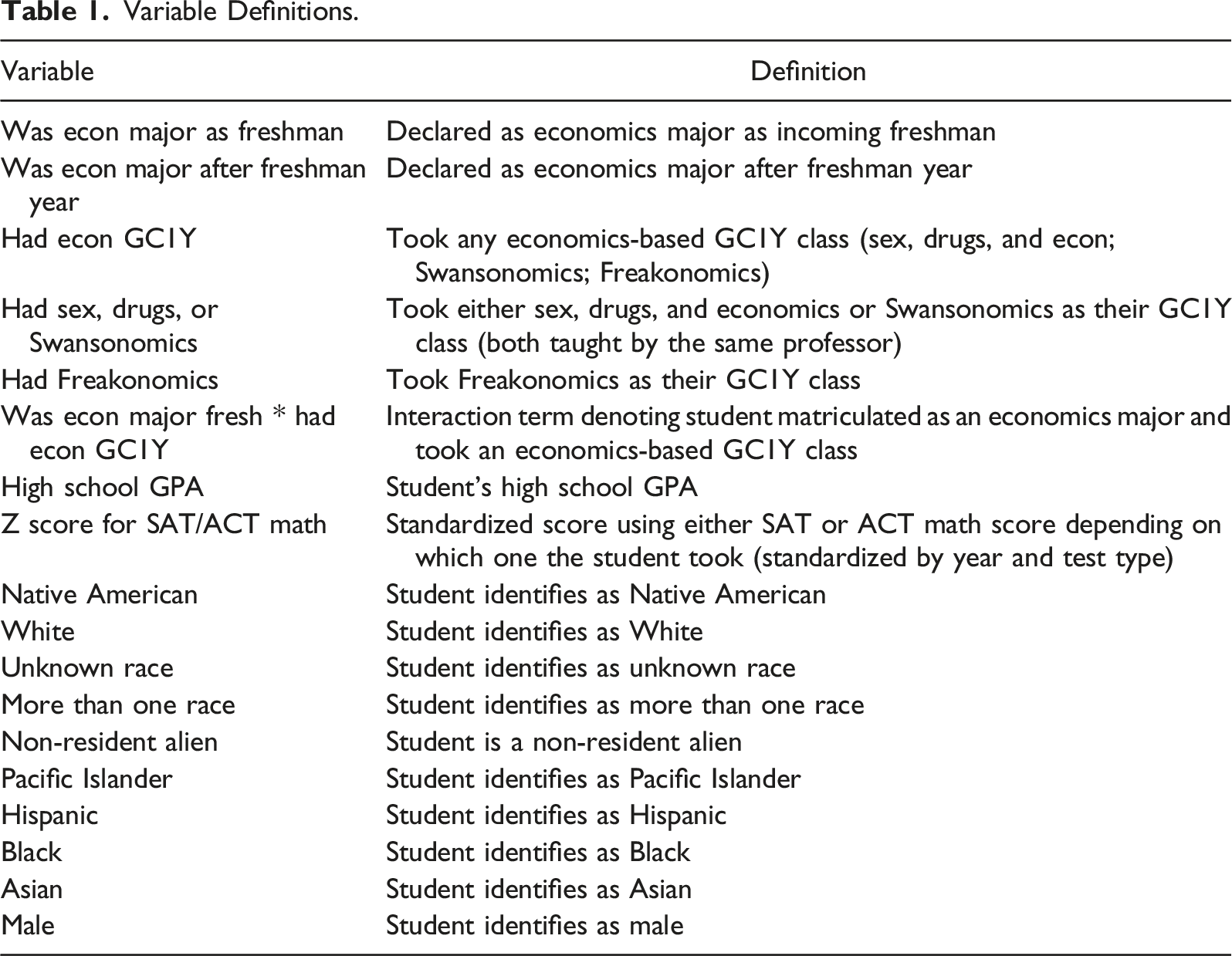
Variable Definitions.
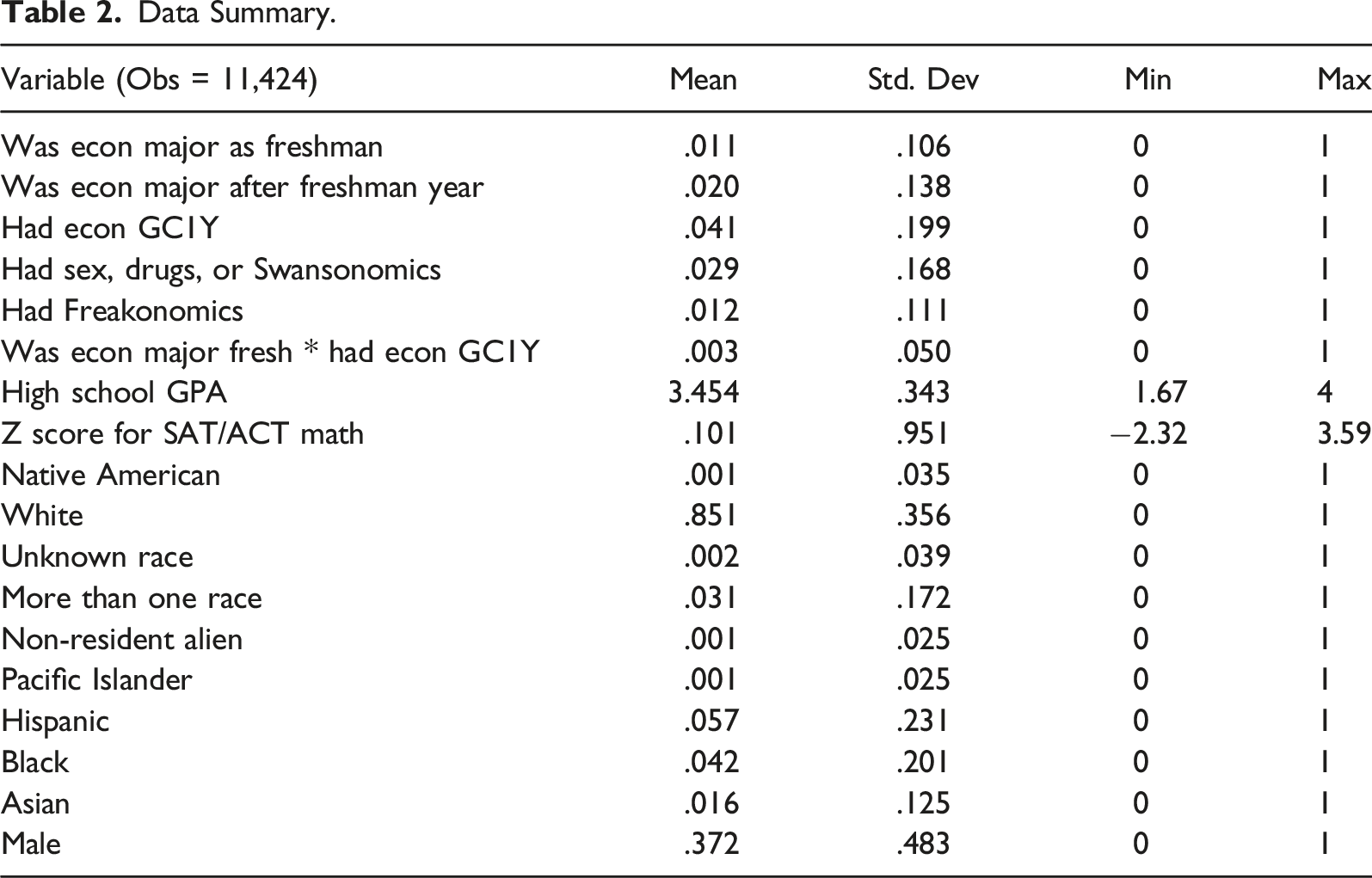
Data Summary.
Model
We present three empirical models that estimate the likelihood a student will choose to major in economics at some point in his or her college career. In the first, we model the likelihood of a student selecting economics as a major after his or her first year (EconMajAfterFresh) as a function of a constant (β
0
), whether or not the student had one of the critical-thinking sections offered by the Department of Economics and Finance (HadEconGC1Y), whether or not the student had declared economics as a major upon matriculation (WasEconFresh), and a vector of personal characteristics and measurements of initial human capital (λ) such as gender, race/ethnicity, high school GPA, and z-scores of SAT or ACT math scores. There is extensive literature on the expected impact of the various personal characteristics we use. For example, based on past research (such as Rask & Bailey, 2002), we expect higher math z-scores to increase the likelihood of choosing economics as a major. Like Emerson and McGoldrick (2019) and Owen and Hagstrom (2021), we anticipate that females will be less likely to select economics as a major. And, similar to Fournier and Sass (2000) and Emerson, McGoldrick, and Sass (2012), we expect non-white ethnic minorities to be under-represented among economics majors. It is reasonable to expect that students who have selected economics as their major upon entering college are likely to continue to be economics majors at least into their second year. But we do not know, a priori, the impact of the critical-thinking courses we offer on subsequent choices to either select or switch majors.

Finally, in our third model, we replace the indicator variable for declaring as an economics major upon matriculating with a vector of indicator variables for all declared majors (δ) to test if students of some majors are more or less likely to switch to economics than others.
Kasper (2008) reports a wide variety of correlations between the rate of change of economics majors and the rate of change of other majors. He concludes some majors serve as logical substitutes, while others appear to complement each other.
Results
Regression Results.
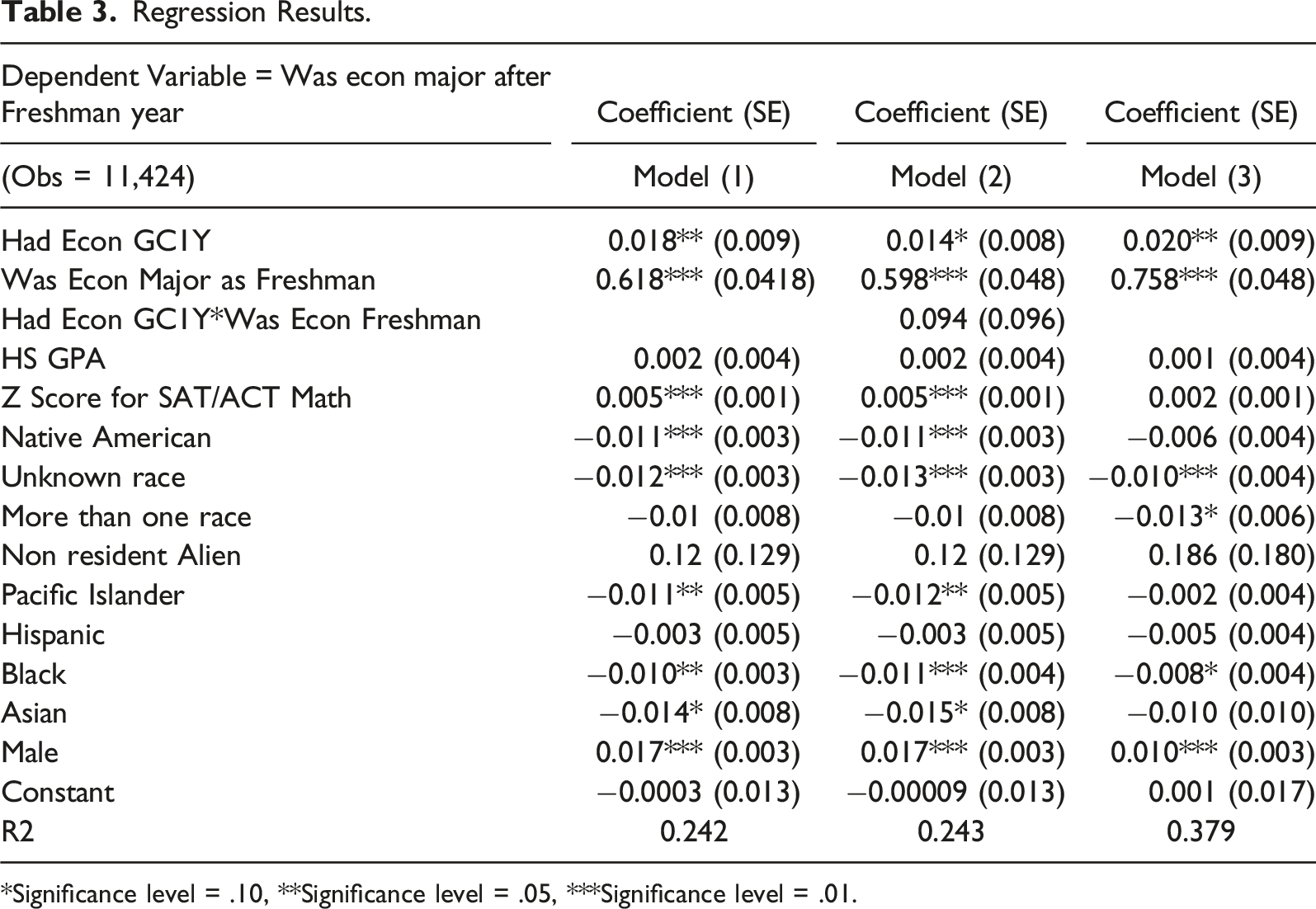
*Significance level = .10, **Significance level = .05, ***Significance level = .01.
First, some general observations. Our findings corroborate findings from previous research concerning the vector of personal characteristics and human capital variables. Males are more likely than females to select economics as a major, at least at some time after their first year. No racial or ethnic minority group is more likely to choose to major in economics than Caucasians, and a few are statistically less likely to choose economics as a major. Students with better math skills as measured by SAT or ACT math z-scores are more likely to be drawn to economics. High school GPA, on the other hand, appears to have no discernable influence on students’ likelihood of choosing economics as a major. In the second regression, we see the coefficient for the interaction term of starting as an economics major and taking one of the first-year critical-thinking courses offered by the Department of Economics and Finance is not a statistically significant determinant of the likelihood to remain an economics major after the first year.
As for the variable of interest, in all three models, the act of taking one of the three critical-thinking sections offered by faculty members of the Department of Economics and Finance does increase the likelihood that a student will select economics as a major at some point after the first year. While Emerson and McGoldrick (2019) note that roughly two percent of students choose to major in economics, the results of our three models suggest that we can add 1.2 to 2.0 percentage points to that number with appropriate exposure to economic thinking without the hurdles of models and theories that will become necessary to master the discipline.
Finally, a note about the inclusion of all declared majors for incoming students in Model 3: A summary of the coefficients and standard errors for estimates of the impact of first-year declared majors can be found in Appendix C. Of note are three results: First, students who declare economics as their intended major when they enter are 75.8 percentage points more likely to be economics majors at some point after the first year than anthropology majors (the omitted category), as might be expected, given that they are already economics majors. This coefficient represents a measure of persistence for students who declare economics as their major in their first year. Second, students who declare mathematics as their intended major are 7.4% more likely to switch to economics at some point. This result is both statistically greater than zero at the 10% level of confidence and represents the group of majors outside of economics most likely to choose to become an economics major. Finally, Geographical Information Science (GIS) students are the only group of students who are significantly less likely than anthropology majors (−2.1 percentage points) to switch to economics at any point in their college careers.
Concluding Comments
In this study, we examine the impact of offering a critical-thinking course from the Department of Economics and Finance as part of the University’s requirement that all first-year students take one critical-thinking course. While the department is not required to offer resources to support the effort, we strive to be good university citizens. But, as it turns out, our efforts appear to be rewarded in a significant way. By introducing students to economic ideas in a context where they do not have to demonstrate mastery of the typical milestones in one of the principles of economics courses, we can develop an interest, perhaps even a passion, for economics that motivates students to work through the principles courses once they take them. Through these first-year sections, we have roughly doubled the probability that students who are exposed to the sections will major in economics at some point.
It would be reasonable to wonder if the results are generalizable to Principles of Microeconomics, Principles of Macroeconomics, or survey courses in economics. Not all institutions afford their faculty the opportunity to teach a three-hour course that serves as an advertisement to various majors without counting against the credit hours in the major. We believe the evidence presented here in conjunction with Stock’s (2023) assessment of the success of issues-oriented teaching of economics suggests that if interested instructors were to integrate some of the examples described in Appendix B to either augment or replace some of their examples, they would be likely to encourage more interest in the economics major at their institution. While we are afforded an uncommon opening to reach students before they are settled into their majors, most principles level economics courses occur early enough in students’ education to have a similar effect provided they catch the students’ attention.
These results, however, are the tip of the iceberg. As of yet, the data are insufficient to give us a clear picture of the impact the first-year critical-thinking sections have on the likelihood of students persisting within the major all the way through to graduation. We also do not know if our observations concerning our own major are mirrored in other departments. Finally, if the first-year critical-thinking sections are helping sort students into majors, do they also reduce expected times to completion? We hope that future additions to our data will help us provide answers to these questions.
But what we do know is that by allowing students to see how economic thinking can help them interpret and understand their world they are more likely to be drawn to the major. We see the probability of selecting economics as a major more than double if a student takes one of the three critical-thinking sections offered by the Department of Economics and Finance. By heeding Stigler’s now 60-year-old admonition, we can reach more students than we would if we remained reliant solely on our principles classes to attract majors.
Supplemental Material
Supplemental Material - Recruiting via the Core: A Nontraditional Introduction to Economic Thinking
Supplemental Material for Recruiting via the Core: A Nontraditional Introduction to Economic Thinking by John R Swinton, Brooke Conaway, and Christopher Clark in The American Economist.
Footnotes
Declaration of Conflicting Interests
The author(s) declared no potential conflicts of interest with respect to the research, authorship, and/or publication of this article.
Funding
The author(s) received no financial support for the research, authorship, and/or publication of this article.

Supplemental Material
Supplemental material for this article is available online.
Notes
Author Biographies
References
Supplementary Material
Please find the following supplemental material available below.
For Open Access articles published under a Creative Commons License, all supplemental material carries the same license as the article it is associated with.
For non-Open Access articles published, all supplemental material carries a non-exclusive license, and permission requests for re-use of supplemental material or any part of supplemental material shall be sent directly to the copyright owner as specified in the copyright notice associated with the article.
