




Abstract
This study presents the archaeological and archaeobotanical findings based on data recorded during excavations at Khapura, a multicultural site in the Ambedkar Nagar district of Uttar Pradesh, India. The ceramic assemblage and other cultural materials, including structural remains, have revealed four distinct cultural periods, namely pre-Northern Black Polished Ware (NBPW), NBPW, Sunga-Kushana, and Gupta, dating back to 1100–200 bce. The carbonised plant remains recovered from the pre-NBPW and NBPW periods suggest a double-cropping pattern, represented by both winter and summer season crops. The identified field crops are represented by grains and seeds such as Hordeum vulgare (barley), Triticum aestivum (wheat), Oryza sativa (rice), Setaria italica (foxtail millet), Vigna sp. (green/black gram), Macrotyloma uniflorum (horse gram), Luffa sp. (sponge gourd), Linum usitatissimum (linseed). Few weeds and wild taxa, like Ziziphus sp. (jujube), Vicia sp. (common vetch), Chenopodium sp. (goosefoot), Polygonum sp. (smart weed/knot weed), were also identified in the recovered plant assemblage. These plant remains have been discussed and compared with the archaeobotanical data from other neighbouring sites in the region.
INTRODUCTION
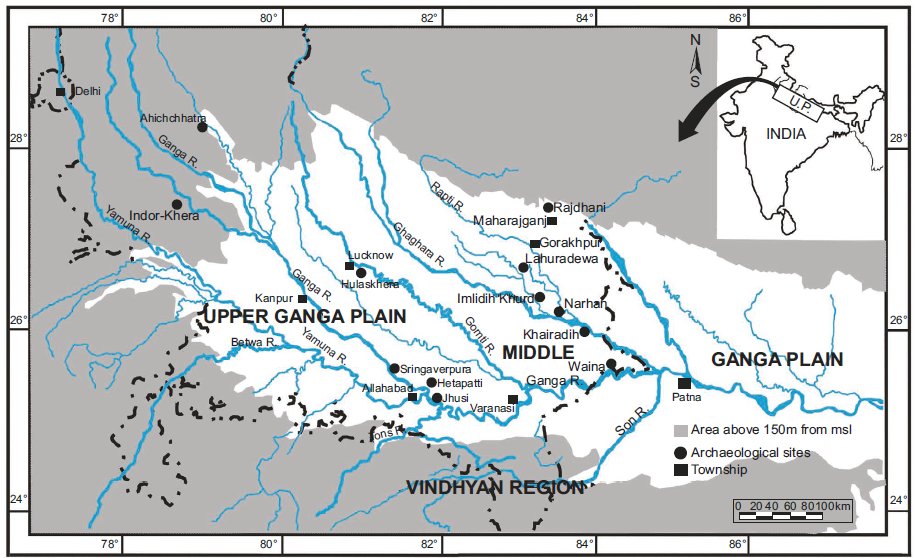
The Ganga Plain, one of the largest alluvial tracts of the country, is a densely inhabited, fertile terrain. This region is archaeologically rich and has a pronounced position in India. The Ganga Plain is mainly divided into three main parts: (a) the upper Ganga Plain, (b) the middle Ganga Plain and (c) the lower Ganga Plain (Singh & Singh, 1996). It is an important region for archaeobotanical studies as it houses numerous archaeological sites, and was the region where the second urbanism emerged in India. A large number of Palaeolithic, Mesolithic, Neolithic, Chalcolithic, Iron-Age, Early Historic and Medieval sites have been reported in this region. The region has been constantly under human occupation right from the advent of the sedentary lifestyle, most likely since the beginning of the Holocene (Singh, 1971). Archaeological research in this region has added substantially to the knowledge of the evolution of cultures during the Late Pleistocene to the beginning of the Holocene (Sharma, 1985; Singh, 1971). However, very few sites such as Hastinapur (Lal, 1954), Kausambi (Sharma, 1969), Lal Quila (Gaur, 1973), Koldihwa (Sharma et al., 1980), Mahagara (Sharma et al., 1980), Atranjikhera (Gaur, 1983), Sringaverapura (IAR, 1984, 1985, 1986), Khairadih (Singh, 1989), Narhan (Singh, 1994), Imlidih-khurd (Singh, 1994; Singh et al., 1992), Waina (Singh & Singh, 1996), Jhusi (Misra et al., 1996, 1999, 2003), Hulaskhera (Tewari et al., 1996) Lahuradewa (Tewari et al., 2002, 2003), Hetapatti (Pal & Gupta, 2005), Indor-Khera (Menon et al., 2008), Agaibir (Singh et al., 2018) and Sarethi (Singh et al., 2019), mostly multi-cultural, have been excavated and attempted for multidisciplinary studies (Figure 1).
Map displaying the locations of archaeological sites in the Ganga Plain region, as discussed in the text (modified after Tewari, 2004).
The archaeobotanical investigations (Pokharia, 2008, 2011; Pokharia et al., 2009, 2017, 2019) from different archaeological archives of this region have provided a precious database concerning the plant-based subsistence economy and cultivation approaches during different cultural periods. In addition, the studied botanical remains have also unfolded the timing of the dissemination of crops from one region to another in relation to cultural shifts (Pokharia et al., 2017; Saraswat, 2005). Here, we present the results pertaining to the cultural history and crop economy based on systematic excavations at the archaeological site of Khapura. The analysis focuses on botanical remains (grains and seeds) recovered from the pre-Northern Black Polished Ware (NBPW) and NBPW periods, interpreted in relation to crop-economy data from the broader region of the Ganga Plain. Our study sheds light on the agricultural practices and subsistence strategies of the inhabitants of Khapura during the pre-NBPW and NBPW periods.
Regional climate and vegetation
The region of the Ganga plain experiences a humid climate, largely influenced by the southwest monsoon and exhibits distinct seasons: spring, summer, rainy, and winter. The average annual rainfall recorded for the region is 1020–1150 mm (Chauhan et al., 2015). The vegetation in this region is characterised by groves of forest interspersed with herbaceous plants, dominated by grasses and sedges (Champion & Seth, 1968). Flora such as Adhatoda vasica, Carissa caranda, Cassia sp., Ipomoea sp., Nyctanthes arbor-tritis, Parkinsonia aculeata, Ziziphus mauritiana, Z. nummularia, Z. oenoplia sparsely distributed in the scrub forests. Trees of Holoptelea integrifolia, Syzygium cumini, Bombax ceiba, Melia azedarach, Dalbergia sissoo occur in open areas. The herbaceous plants along the margin of lakes, ponds and ditches and in wet places comprise Cyperus rotandus, Polygonum sp., Rumex dentatus, Scirpus sp., etc. The Oryza sativa (rice) in summer and Triticum aestivum (wheat) in winter are primary crops. Other crops include pulses, oil-seeds, fibre crops, jowar, bajra, maize, and sugarcane. The main source of precipitation is the southwest monsoon, sufficient for agricultural practices. The major perennial rivers flowing from the Himalayas, along with their tributaries, also provide water for irrigation (Anonymous, 2006).
ARCHAEOLOGICAL SITE AND ITS CULTURAL CHRONOLOGY
The mound of Khapura Shah Salimpur (82°38’31“ E; 26°26’48” N) is located on the Akbarpur-Azamgarh road in district of Ambedkar Nagar, at a distance of 10 km west of Akbarpur and 50 km west of Ayodhya. River Tons (or Tamsa) flows very close to the ancient mound of Khapura (Figure 2A–2C). According to local tradition, this is the place where King Dashrath of Ayodhya mistakenly shot Shravankumar, and it is known as Shravan-Kshetra. The ashram of Sage Shringi is also situated here. The terai landscape of the region is still covered with patches of dense forest. The alluvial soil around Khapura is highly fertile and suitable for the cultivation of all kinds of cereals. The mound of Khapura was once extensive; however, a significant portion has now been converted into agricultural land. The explorations brought to light a cluster of ancient settlements around Khapura, ranging from pre-NBPW period to the medieval period.
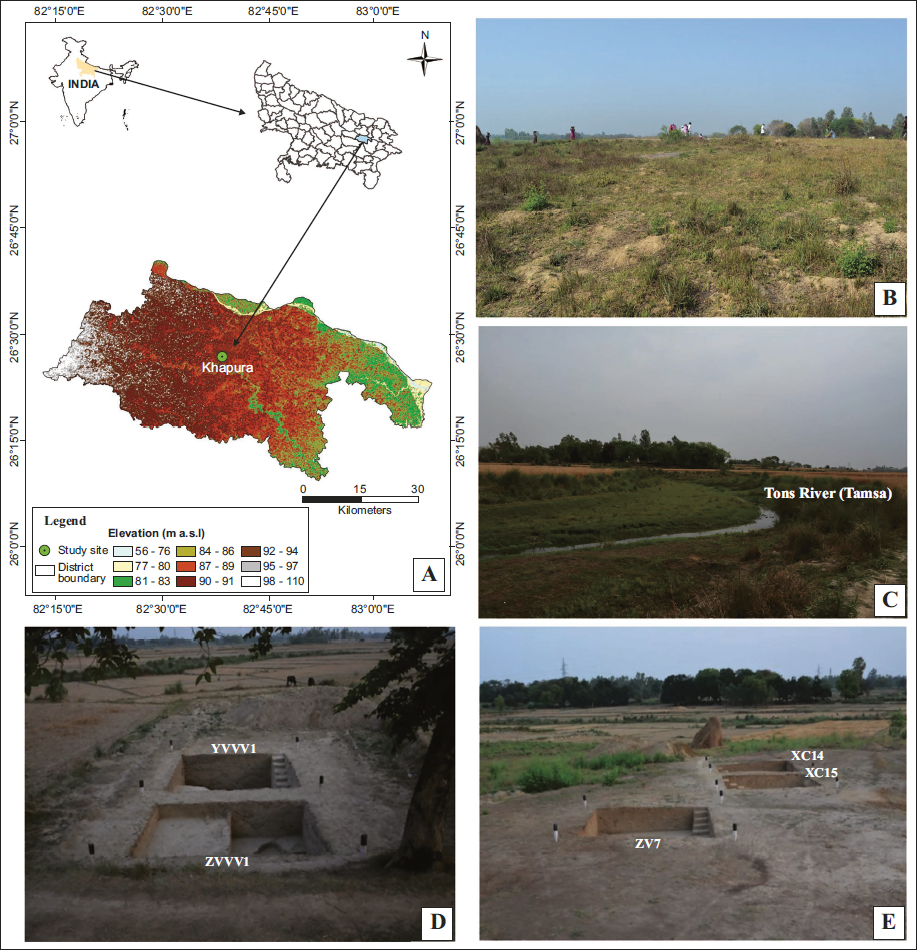
The site of Khapura was excavated during the years 2017–2018, 2018–2019 and 2019–2020 under the direction of Pushp Lata Singh, Department of Ancient Indian History, Culture and Archaeology, Banaras Hindu University, Varanasi, along with her team. The ancient mound of Khapura extends across an area of 600 m north-south × 800 m east-west and rises approximately 4.0 m above the surrounding ground level. Trenches (Figure 2D and 2E) were laid across different locations in north, north-eastern, central, and north-western parts of mound, brought to light more than 2.0 m thick cultural deposit, datable circa 1100
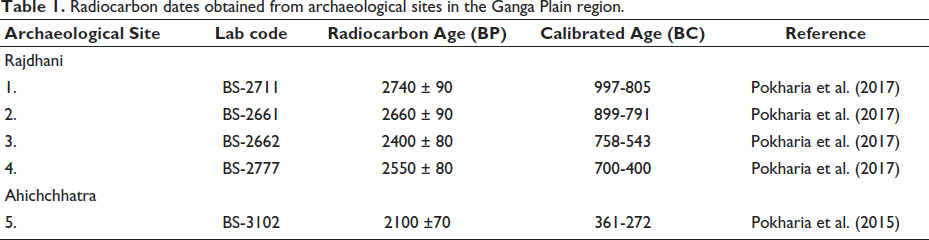
Radiocarbon dates obtained from archaeological sites in the Ganga Plain region.
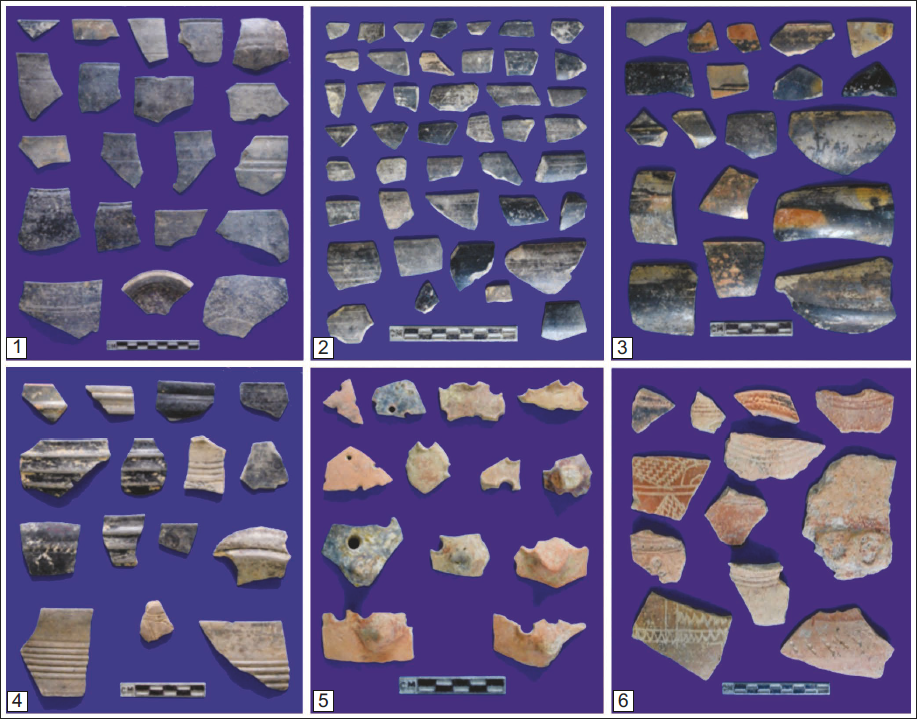
Period I: Pre-NBPW culture with iron is represented by a 60–150 cm thick cultural deposit found in various trenches of the mound. The pre-NBPW layers are composed of dark yellow compact to light yellow loose earth. Ceramic assemblage of Period I consists of Black Slipped Ware (BSW), Red Ware (RW) and Black-and-Red Ware (BRW). Although cultural deposit is dominated by Black Slipped Ware of an early variety. Burnishing is also evident on Black-and-Red Ware, though in small quantities. The Burnished Black-and Red Ware was similar to that of Chalcolithic period found from the other sites of trans-Ghaghara/Saryupar region and Vindhya–Ganga plain. The Black Slipped Ware was found in large quantities, made of medium to fine fabric. Pottery assemblage exhibits variety in shapes, among them bowls and dishes appear to be the most popular types, along with miniature bowls and vases. However, Black-and-Red Ware was found in a small proportion and was shapeless. The principal pottery types in Red Ware are bowls, perforated and legged bowls, dishes, vases, knife-edged bowls, dishes with incurved rim, lipped basins, tumblers, miniature vases, basins, storage jars, and bowls on stands. Some of the Red Ware is decorated with cord impressed designs, thumb impressed designs, matt impressed, rope and nail patterns on exterior surface. Other noteworthy finds of this period include bone points and arrowheads, terracotta wheels, beads, stoppers, discs, stone pestles, semi-precious stone beads, and a solitary piece of iron nail. The occurrence of burnt clay lumps with reed or split bamboo impression clearly suggests that the inhabitants of this period used to construct their houses with reed and bamboo, etc. The screen walls of these thatched houses used to be plastered with a clay solution.
Period II: NBPW Culture at the site is represented by a 92–122 cm thick cultural deposit found in various trenches. This period is distinguished by the appearance of NBPW and associated wares, including Black Slipped Ware, Plain and slipped Red Ware, Grey Ware and Black and Red Ware. NBPW sherds were monochrome (blue, black, golden, and chocolate colour) and bi-chrome varieties. Similar sherds were also found from the NBPW period at the sites, Rajghat, Khairadih, Raipura, Latif Shah, Agiabir, Sravasti, along with the sites of trans-Ghaghara/Saryupar and Vindhyan-Ganga plains. Although their frequency is very restricted at Khapura. The dominant shapes of NBPW are flanged bowls, deep bowls, convex-sided dishes. The Red Ware assemblage was also found in large quantities. The common shapes in Black Slipped Ware and Grey Ware were straight-sided corrugated flanged bowls, dishes with vertical featureless rim and an incurved featureless rim, lipped basins, carinated handis, different types of vases, bowls with sharpened rim. In Red Ware, the main shapes were tumblers, basins including lipped basins, medium and small size vases with concave neck, vases with carinated neck, carinated handis, storage jars, perforated and legged bowls, storage jars, bowl on stand, dishes. The Black Slipped Ware and Red Ware were made of medium to fine fabric. The rusticated wares, cord impressed designs, thumb impressed appliqué designs, rope pattern and nail pattern designs of the preceding period were continued in this period. Some painted Red Ware sherds bear paintings with intersecting designs. Graffiti marks were also noticed on some of the Black Slipped Ware and Red Ware. The Black-and-Red Ware sherds were found in limited numbers. A few sherds of burnished BRW were also reported from Period II.
Period III: The Sunga–Kushana period is represented by a 30–70 cm thick occupational deposit. The potsherds from this period mainly comprise Red Ware, though Black Slipped Ware and Grey Ware are also represented, as bowls and dishes. The noteworthy shapes of Red Ware include bowls with flaring sides, spouted vessels, knobbed and inkpot type lids along with different types of vases, including concave neck. A few Red Ware sherds are decorated with a tortoise shell impressed design. The vases of Black Slipped Ware also occurred in a limited quantity. Some of the pots are decorated either by incised, stamped or impressed appliqué designs. The antiquities include a solitary specimen of carnelian stone bead, terracotta pestles and stoppers, bangles, fragments of a human figurines, glass beads, discs, balls, stone pestles, and bangles, etc. A circular copper coin, along with some iron and copper objects, was also recorded. Remains of a few animal bones were also encountered from this period.
Period IV: The cultural remains of the Gupta period include circular-shaped pillars made up of brick bats found in trenches ZRR6 and ZHH3, might have been used to support wattle and daub houses. The structural remains of floors and walls of fired bricks were also recovered, indicating a house complex with two rooms and a verandah. The potsherds from this period include flared bowls (parai), platters (shallow), lids, miniature pots, spouts, and different types of vases. Some of the pots are decorated either by incised, stamped or impressed, applique designs. The recovered material remains include terracotta stoppers, beads, discs, balls, stone pestles and beads along with iron and copper objects. Remains of a few animal bones were also encountered from this period.
MATERIALS AND METHODS
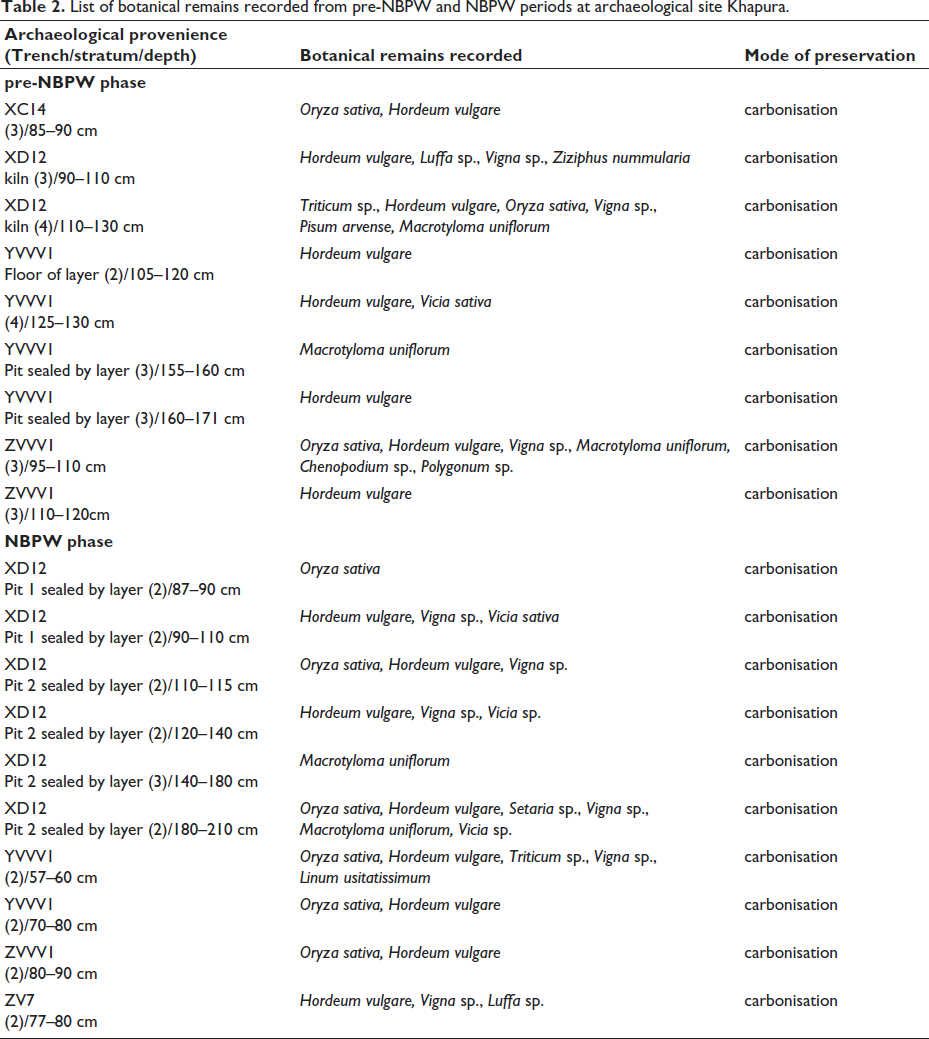
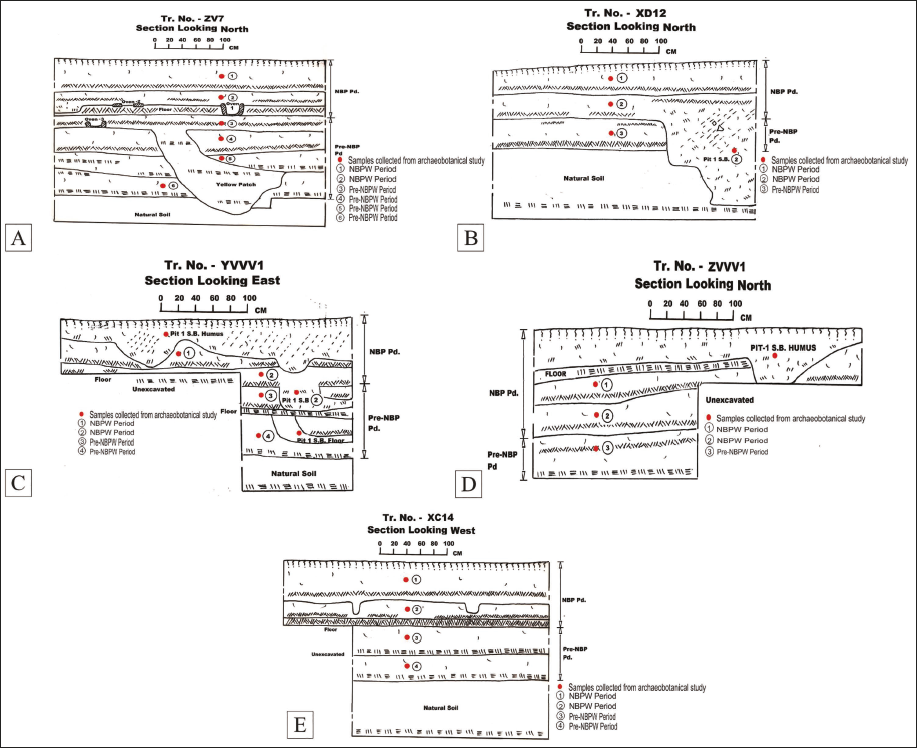
A total of 22 (n = 22) samples were collected for macrobotanical analysis from both the pre-NBPW and NBPW periods (Table 2). Soil samples were collected during excavation from key activity areas (such as floor level, cultural stratified layers, kiln area, and pits) and washed for carbonised archaeobotanical remains using a wet-sieving (water flotation) technique with a 30 mesh (0.5 mm) sieve (Figure 3A–3E). This water floatation technique utilises the principle of density difference between inorganic and organic material (Pearsall, 2000). After drying, the carbonised samples were stored in zip lock bags and transported to the laboratory for further analysis.
List of botanical remains recorded from pre-NBPW and NBPW periods at archaeological site Khapura.
Section drawings of the excavated trenches (A–E), showing cultural periods and locations of samples collected for the archaeobotanical study (indicated by red dots).
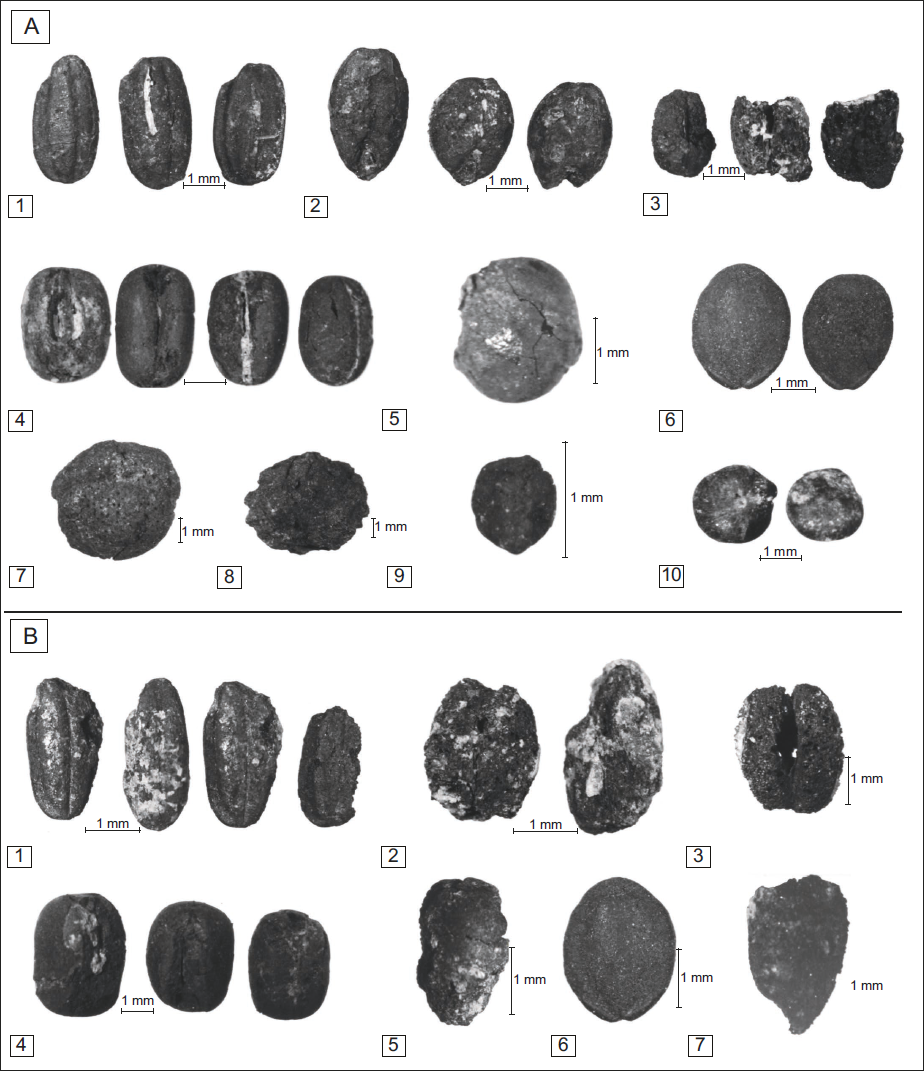
In the laboratory, collected carbonised botanical remains (grains/seeds/fruits) were sorted under stereo-binocular (Leica Z6 APO) and photo-documented. These botanical remains were then identified taxonomically (Plate 2) on the basis of comparison with modern reference material as well as published seed illustrations (Pokharia et al., 2009, 2016; Saraswat & Sharma, 1985). The carbonised remains likely result from human activities. Limitations in the data are inevitable due to preservation biases, as many plant taxa never contacted fire and therefore failed to appear in the archaeobotanical record. Consequently, the recovered remains represent a small fraction of the plant resources once utilised by ancient settlers.
ARCHAEOBOTANICAL FINDINGS
The identified botanical remains from the pre-NBPW and NBPW periods are represented by cereals such as Hordeum vulgare (barley), Triticum aestivum (wheat), Oryza sativa (rice), Setaria italica (foxtail millet); pulses such as Pisum arvense (field pea), Vigna sp. (green/black gram), Macrotyloma uniflorum (horse gram); vegetable - Luffa sp. (sponge gourd); oil-seed - Linum usitatissimum (linseed) (Plate 2). Few weeds and wild taxa like Ziziphus sp. (jujube), Vicia sp. (common vetch), Chenopodium sp. (goosefoot), Polygonum sp. (knot weed) were also identified in the recovered plant assemblage (Plate 2). The morphological description of the identified grains/seeds/fruits is as follows:
Categorisation and morpho-taxonomy of the plant remains
Cereals
Hordeum vulgare (Barley)
The grains were highly deformed due to burning. Only a few grains were recovered and measured 4.00–5.90 mm in length, 2.00–3.45 mm in breadth. Disparity in the shape and size of grains was conspicuously apparent. The grains were elongate in shape with a flattened dorsal side and a furrow on the ventral side, gradually becoming shallow and widened towards the upper end.
Triticum aestivum (Wheat)
The complete grains measuring 4.00–5.50 mm in length, 3.00–3.50 mm in breadth, and 2.00–3.00 mm in thickness, were narrower towards both ends and broadest almost in the middle. Dorsal side was slightly raised, and the cheeks to the deep ventral furrow were round. Pericarp of some grains has been partially rubbed off during their preservation in carbonised condition. On the basis of shape and other morphological features, the grains compare with those of bread wheat (Triticum aestivum).
Oryza sativa (Rice)
The grains were elongate to oblong in shape, laterally flattened and prominently ribbed, measuring 3.30–5.30 mm in length, 2.00–2.70 mm in breadth and 1.50–2.00 mm in thickness.
Setaria sp. (Foxtail millet/Italian millet)
The grains were oval to somewhat elliptical, thickest about midway and sloping towards the apical side and base. The grains in all morphological aspects compare with those of Setaria.
Pulses
Macrotyloma uniflorum (Horse gram/kulthi)
Seeds were ellipsoidal and somewhat kidney-shaped, laterally flattened. Only a few complete seeds were recorded, measuring 3.00–4.75 mm in length, 2.00–3.00 mm in breadth and 1.00–1.25 mm in thickness. The small elliptical hilum measures about 0.50–1.00 mm.
Vigna sp. (Green gram/urd). Only a few cotyledons have been encountered. The carbonised cotyledons morphologically similar to those of green/black gram (Vigna radiata/mungo). The seeds surface was characterised by the occurrence of faint wavy ridges. Presence of these so-called ridges in the form of fine wavy lines in carbonised seeds led to refer the Vigna seeds.
Pisum arvense (Field-pea/matar)
A single cotyledon was found. It is somewhat hemispherical in shape, measuring about 3.50 mm in diameter. Seed coat was blurred due to carbonisation.
Vegetable crop
Luffa sp. (Sponge gourd/torai)
Three seeds 10–12 mm long, ovoid, compressed and having two oblique tubercles were recorded from both the phases and identified as Luffa L. sp.
Oleiferous crop
Linum usitatissimum (Linseed/Alsi)
An elongated seed, relatively narrower and hooked at one end, got broken during handling was comparable to linseed.
Weeds and wild taxa
Ziziphus nummularia (Jujube/ber)
Stone showing tubercled surface and measuring 6.00 mm in diameter has been found comparable to Ziziphus nummularia, a wild, prickly shrub of common occurrence throughout the region.
Chenopodium sp. (Goosefoot/bathua)
The seeds were circular to lenticular in shape, with rounded margins and a smooth surface. They measure 1.00–1.25 mm in diameter. In all morphological respects, they compare with those of Chenopodium album, growing as a common weed in the crop fields of wheat and barley.
Polygonum sp. (Smartweed/Knotweed)
The sedge grows in wet places or along the ponds and canal beds.
Vicia sp. (Common vetch)
Seeds were globular in shape. Ovate to wedge-shaped hilum was raised along the median groove. Known as a leguminous weed, grows with winter pulses.
DISCUSSION
Antiquity of human settlement and agricultural economy in the Ganga plain
The Ganga Plain has sustained continuous human occupation since the advent of sedentary civilisation, most likely beginning with the early Holocene following the termination of the harsh Great Ice Age, that is, Pleistocene (Singh & Singh, 1996). Despite being a flood-prone terrain, this region has been under intensive agricultural practice so as to cope with the constantly escalating populace. The archaeological and archaeobotanical studies carried out so far from the Ganga plain have provided a significant database concerning the cultural succession and contemporaneous subsistence adopted by dwellers in time and space. The information from Lahuradewa in the eastern Uttar Pradesh, a prime settlement site, narrating the cultural history and onset of agrarian activity in the Ganga Plain since Early Neolithic-Chalcolithic times (Pokharia, 2011; Tewari et al., 2006). The archaeobotanical reconnaissance undertaken across this region has provided a valuable dataset on early agricultural systems, detailing crop economies and cultivation approaches across different cultural settlements and the major crops used in subsistence. Investigations of archaeological sites such as Narhan (Saraswat & Sharma, 1985), Hulaskhera (Chanchala, 1992), Khairadih, Waina, Imlidih-khurd (Saraswat, 2005), Jhusi (Pokharia et al., 2009), Ahichchhatra (Pokharia et al., 2015), Hetapatti and Rajdhani (Pokharia et al., 2017), Indor-khera, (Pokharia et al., 2020), Sarethi (Pokharia et al., 2019), spanning the Neolithic–Early historic period (6000
Cultivated plants taxa recorded from archaeological sites in the Ganga Plain region.
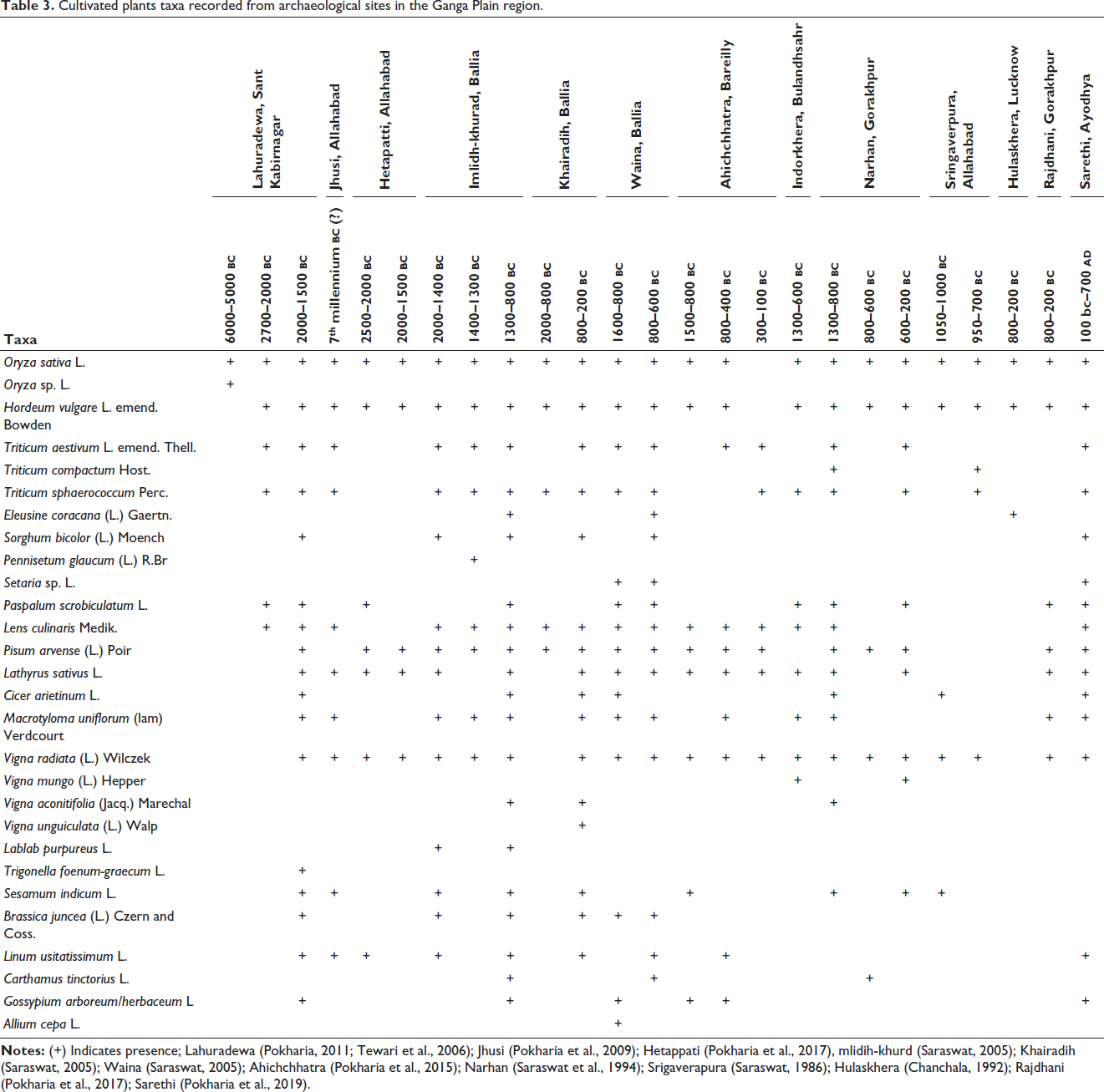
Rice has been the primary staple crop of the Ganga Plain since the Neolithic period (Saraswat, 2005; Tewari et al., 2006). Its cultivation can be traced back to 8,259 year BP, as established by AMS dating of glumes recovered from the Lahuradewa site. As a species native to the wild‑rice habitats of this zone, rice was pivotal to the emergence and evolution of agriculture across the Ganga Plain. The appearance of prominent Harappan crops in the Ganga Plain around ~2700–2000
Presence of barley, wheat, field pea, and linseed in Ganga Plain is worthwhile to draw meaningful conclusions regarding cultural contacts between communities practising the cultivation of these crops. Direct AMS dates of barley from the sites of Lahuradewa, Damdama, Mahagara, and Senuwar in the Ganga Plain and Vindhyan region indicate the adoption of crop between 2400 and 1800
The botanical evidence recovered from the archaeological sites reveals that successive ancient cultures such as Black Slipped Ware, Painted Grey Ware, NBPW followed by dynasties of Sunga-Kushana (200
Socio-economic and agricultural development at Khapura
The excavations at the site Khapura revealed stratified cultural deposits that span the chronological range from the pre-NBPW period through to the Gupta period. This temporal framework is authenticated by the analysis of ceramic assemblages and associated cultural materials (Singh et al., 2019), establishing a cultural evolution and facilitating the reconstruction of agricultural and subsistence strategies across periods. The material culture recovered from the excavations reveals the socio-economic developmental pattern of Khapura settlement, reflecting a gradual transitional from early agrarian communities in the pre-NBPW (Period I) to a more organised urban lifestyle of Gupta period (Period IV). The archaeobotanical analysis from the pre-NBPW and NBPW periods indicates the cultivation of variety of crops, including cereals (barley, bread-wheat, rice, and foxtail-millet), legumes (field pea, horse gram, and green/black-gram), vegetables (sponge gourd) and oleiferous crops (linseed) (Plate 2).
During pre-NBPW period, the impression of reed and bamboo in house construction, along with simple handmade pottery (Black Slipped Ware, Red Ware, Black-and-Red Ware), bone tools, and limited iron use, indicates a developing sedentary agrarian society with craft specialisation practices. During this period, Hordeum vulgare emerges as the dominant crop, representing 42% of the crop assemblage, followed by Oryza sativa at 27%, and legumes such as Vigna sp. (16%) and Macrotyloma (7%) (Figure 4). However, the small proportion of Triticum aestivum, Setaria italica, and Luffa sp. (2% each) indicates crop diversification. The presence of both winter (44%) and summer (56%) crops illustrates the exploitation of favourable agro-ecological conditions in both seasons to cultivate a variety of crops. The successive NBPW period (Period II) at the settlement shows an extension and diversification of material culture, as reflected in the mono- and bi-chromatic pottery sherds, along with a varied ceramic shapes and designs. Continued use of previous pottery forms along with NBPW and graffiti marks, as well as iron, shows ongoing craft traditions, pointing to evolving urban life. The recovered crops from the NBPW period show a notable shift, showcasing Oryza sativa (34%) as the principal crop, overtaking Hordeum (23%) and Triticum (8%) (Figure 4). Legumes like Vigna sp. (17%) and Macrotyloma (9%) played a significant role as a protein source, while Setaria, Linum, and Luffa (3% each) show the diversity in the agricultural system (Figure 4). Interestingly, a reversal in seasonal cropping preference is evident in this period, with winter crops standing at 66%, indicating a possible shift in favourable environmental conditions and adaptation strategies.
Relative abundance of crop taxa recovered from the study site Khapura.
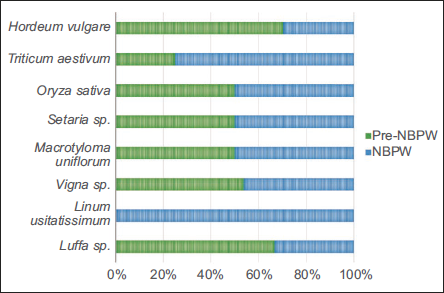
The agricultural assemblage from both periods at Khapura reflects a double-cropping strategy (Figure 4) used by farmers during the pre-NBPW and NBPW periods to sustain a growing population and ensuring year-round food availability. A similar cropping strategy has also been evidenced from other sites in the Ganga Plain (Table 3) and Vindhyan regions (Harvey & Fuller, 2005; Mehra, 1997; Saraswat, 1992, 2004, 2005; Pokharia, 2011; Pokharia et al., 2009, 2017, 2018, 2019; Vishnu-Mittre, 1972; Yadav et al., 2024). In addition, thick cultural deposits from the pre-NBPW and NBPW periods at the settlement indicate that the area was well-suited for human habitation and agricultural practices, due to the availability of water, fertile alluvial soil, and favourable climatic conditions, corroborating archaeobotanical results. The expansion of the occupational area, measuring 600 m north–south and 800 m east–west, further suggests demographic growth at Khapura, potentially facilitated by a reliable agricultural practice. Further, the Sunga–Kushana period (Period III) reveals greater economic complexity with widespread Red Ware, decorated vessels, coins, iron and copper objects, terracotta figurines, and carnelian and glass beads, indicating trade and artisans’ activities. Besides, limited structural remains indicate architectural development. In Gupta period (Period IV), presence of brick structures, roomed house complexes, and refined ceramics reflects settled, organised urban habitation. Continued use of iron, copper, and decorative pottery suggests sustained technological and economic advancement. Overall, the site shows a transition from rural, self-sufficient communities of pre-NBPW period to more urban and economically diverse settlements in Gupta period.
Ceramic assemblage recovered from the study site Khapura: 1–2. Black Slipped Ware; 3. Black Slipped Ware and Grey Ware bowls; 4. Northern Black Polished Ware and Black Slipped Ware; 5. Shreds of perforated legged bowls/basins; 6. Decorated shreds of Red Ware.
Carbonised plant remains recorded from archaeological site Khapura. A. pre-NBPW period: 1. Oryza sativa (rice); 2. Hordeum vulgare (barley); 3. Triticum aestivum (wheat); 4. Vigna sp. (green/black gram); 5. Macrotyloma uniflorum (horse gram); 6. Luffa sp. (sponge gourd); 7. Pisum arvense (field pea); 8. Ziziphus nummularia (jujube); 9. Polygonum sp. (knot weed); 10. Chenopodium album (goosefoot). B. NBPW period: 1. Oryza sativa (rice); 2. Hordeum vulgare (barley); 3. Triticum aestivum (wheat); 4. Vigna sp. (green/black gram); 5. Macrotyloma uniflorum (horse gram); 6. Luffa sp. (sponge gourd); 7. Linum usitatissimum (linseed).
CONCLUSIONS
The occupational layers at Khapura have yielded a variety of carbonised grains and seeds, indicating that the economy of its inhabitants was primarily based on cultivation of crops. The study of the plant remains from this site affirms continuity of agriculture in the Ganga Plain since Neolithic times. The adoption of a double-cropping strategy was likely influenced by favourable ecological conditions, including significant winter precipitation and summer rainfall. These climatic factors and local ecological conditions played a crucial role in shaping the socio-economic, cultural and technological advancements of the ancient settlers of Khapura. Although the crop assemblage retrieved from Khapura represents only a small fraction of the regional botanical wealth, it contributes valuable information on the plant-based economy of the Ganga Plain between 1100 and 200
Footnotes
Acknowledgements
We are thankful to the Director, BSIP, Lucknow and Director (Excavation and Exploration), Archaeological Survey of India, New Delhi for granting permission for this collaboration and to excavate the archaeological site, respectively. Thanks, are also due to all the team members of excavation camp for rendering technical help during course of samples collection. We are also thankful to the Chief Editor Prof. Mukund Sharma for inviting us to contribute research work for the special issue of the journal of The Palaeontological Society of India and anonymous reviewers for their valuable suggestions which helped to improve the manuscript.
Declaration of Conflicting Interests
The authors declared no potential conflicts of interest with respect to the research, authorship and/or publication of this article.
Funding
The authors disclosed receipt of the following financial support for the research, authorship and/or publication of this article: This work was carried out with the support of Trans disciplinary Project, Institute of Eminence (IoE), Banaras Hindu University, Varanasi.
