




Abstract
A well-diversified assemblage of plant megafossils has been recovered from the Lower Kamthi sediments of Madhupur Village in the Talcher Basin, Odisha, India. The collection includes representatives from Sphenophyllales (Trizygia speciosa), Filicales (Neomariopteris hughesii), Equisetales (Schizoneura gondwanensis and equisetaceous stems), Ginkgoales (Rhipidopsis gondwanensis) and Glossopteridales. The Glossopteridales are particularly abundant, comprising Glossopteris (45 species), Palaeovittaria kurzii, scale leaves, fructifications and stem casts. While a previous publication has addressed the other plant groups, this study focuses on the scale leaves and fertile parts. A total of 268 fossil impressions of Glossopterid fertile parts have been documented from the Lower Kamthi sediments. The assemblage includes 10 genera and 14 species, including Denkania indica, Dictyopteridium feistmanteli, Eretmonia emarginata, E. hinjridaensis, E. ovata, E. utkalensis, Glossotheca immanis, G. orissiana, Jambadostrobus pretiosus, Partha spathulata, Plumsteadiostrobus pretiosus, Scirroma ventilebra, Scutum sahnii and Venustostrobus indicus. This study examines the taxonomy, morphology and stratigraphic distribution of these fertile parts across various Indian Gondwana formations, focusing on their morpho-taxonomic characteristics and occurrence within the Permian strata of the Indian subcontinent. Biostratigraphic significance, palaeoclimate and palaeovegetation have also been discussed briefly.
INTRODUCTION
Scale leaves are vegetative leaves of Glossopteris and are thought to serve as protectors for the exposed seed, which supports the gymnosperm-like characteristics of Glossopterid plants. Their small size and delicate features make them prone to detaching from the host plant. Their preservation is also poor due to various taphonomic factors. Reconstructing plants with scale leaves and other fertile parts is challenging because they are rarely found attached to their parent structures. The classification of scale leaves into distinct genera remains contentious because they show minimal differences in shape, size, apex, base and the arrangement of seed scars on the receptacle.
The venation of scale leaves is somewhat similar to that of Glossopteris leaves, with reticulated lateral veins but typically without a midrib. Instead, the midrib is replaced by several strong, persistent medial veins that run straight to the apex, branching into secondary veins, particularly in the expanded apical area. The lateral veins in scale leaves often display unique patterns forming meshes, such as anastomosing or dichotomous arrangements. Scales that bear male or female reproductive elements are referred to as fertile scales or fructifications. This article represents various scale leaves and other fertile parts from the Lower Kamthi Formation of Madhupur Village, Talcher Basin in Indian Gondwana.
The description of 45 species of Glossopteris leaves, Trizygia speciosa, Neomariopteris hughesii, Rhipidopsis gondwanensis, Schizoneura gondwanensis and equisetaceous stems of this collection has already been published (Patel & Goswami, 2025). Systematic descriptions of 14 taxa of fertile parts are provided in this article.
GEOLOGICAL SETTING
The Talcher Basin, located between latitudes 20°53’N–21°12’N and longitudes 84°20’E–85°23’E (Figure 1), exhibits a structural configuration characterised by a northwestward-plunging syncline that terminates towards the east. The progressive westward exposure of younger geological formations suggests a homoclinal arrangement, as evidenced by the increasing dip of strata and the presence of multiple coal seams in the northern region. The northern margin of the basin is delineated by WNW–ESE trending faults, which create a distinct boundary between the Precambrian and Permian sequences. In contrast, the southern boundary is marked by an unconformity with no significant faulting. Three prominent fault systems within the basin—aligned in E-W, NE-SW and WNW-ESE orientations—contribute to its structural complexity. Although the region is predominantly characterised by gentle dips, the inclination of rock layers becomes steeper near fault zones. The Permian-Triassic sedimentary strata in the basin generally follow an E-W regional strike, though they can also trend ENE-WSW or ESE-WNW (Goswami & Singh, 2013; Manjrekar et al., 2006, Raja Rao, 1982).
Geological map of Talcher Basin showing the investigated fossil localities (modified after Manjrekar et al., 2006; Pal et al., 1991; Raja Rao, 1982).
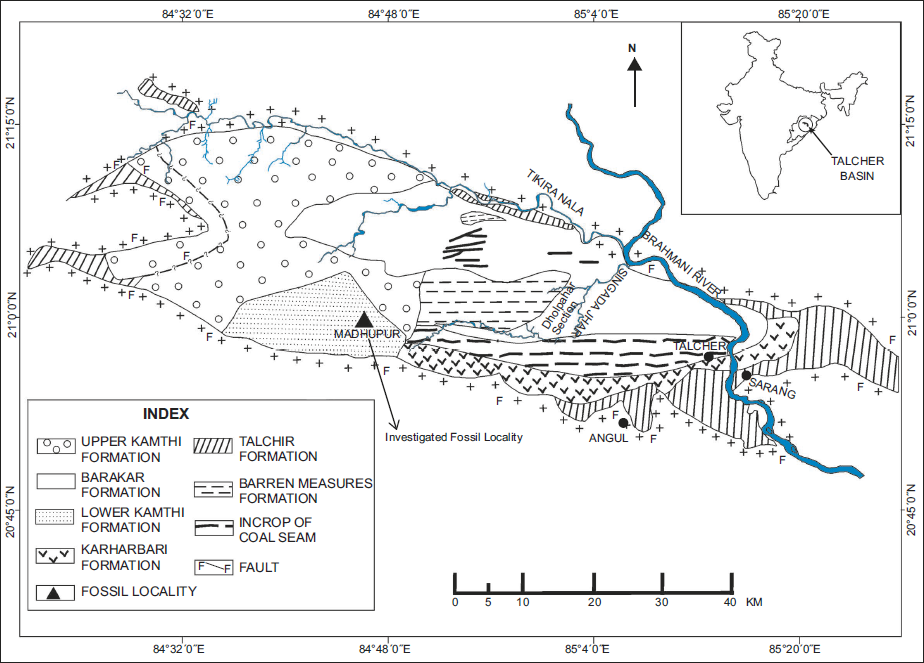
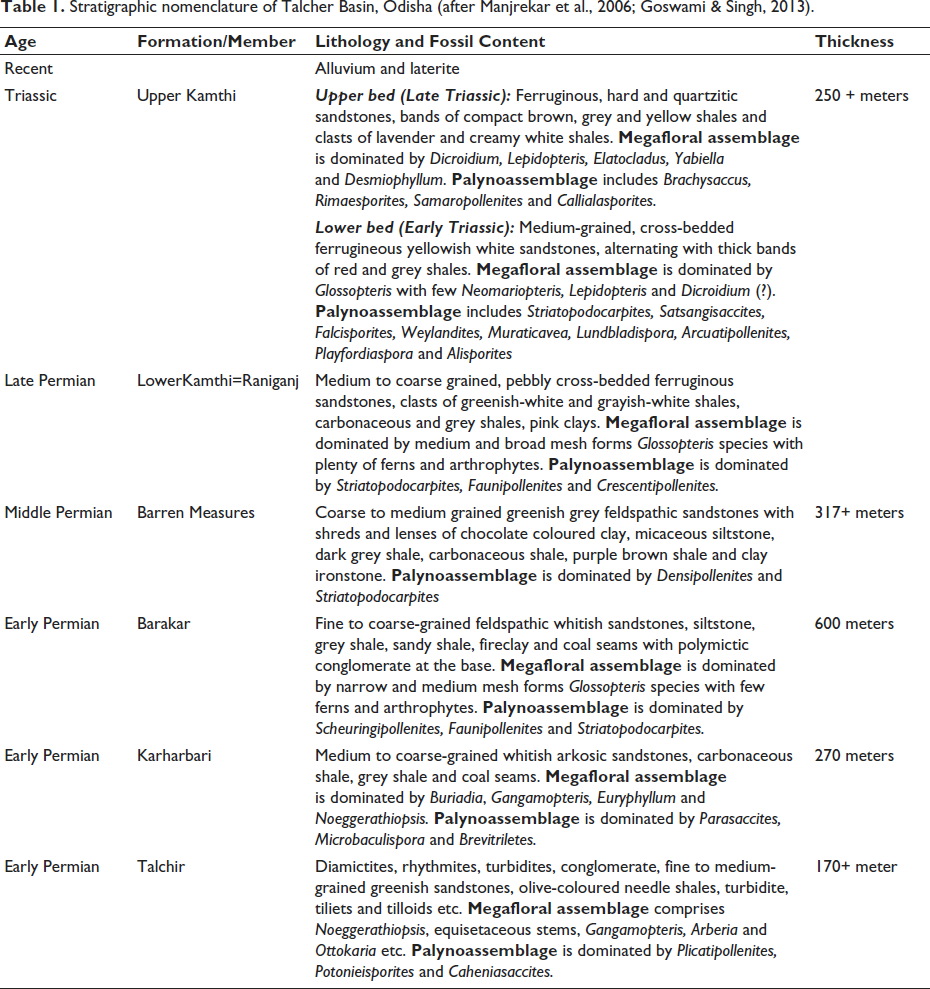
The sedimentary rocks in the Talcher Basin span the Permian to Triassic Periods. They are part of several formations: Upper Kamthi (Induan to Olenekian), Lower Kamthi (Wuchiapingian to Changhsingian), Raniganj (Wordian to Capitanian), Barren Measures (Rodian), Barakar (Late Artinskian to Kungurian), Karharbari (Late Sakmarian to Early Artinskian) and Talchir (Asselian to Early Sakmarian) (Bhattacharya et al., 2002; Goswami, 2008; Goswami & Singh, 2013; Manjrekar et al., 2006; Singh et al., 2007; Sastry et al., 1977) (Table 1).
Stratigraphic nomenclature of Talcher Basin, Odisha (after Manjrekar et al., 2006; Goswami & Singh, 2013).
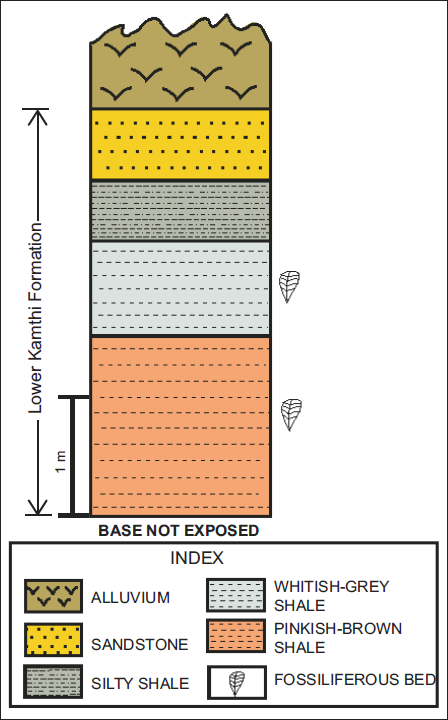
Glossopterid fertile parts have been reported from fossiliferous beds located 1 km southeast of Madhupur Village (N20°58’52” Latitude, E84°47’9” Longitude) (Figure 1). The region comprises diverse lithological units, including sandstone, silty shale, whitish-grey shale, pinkish-brown fine-grained shale and alluvial deposits. Fossil specimens are primarily embedded within the whitish-grey and pinkish-brown fine-grained shales, as illustrated in Figure 2.
Geological section of the studied fossil locality near Madhupur Village.
MATERIALS AND METHODS
The fossiliferous beds from the investigated area near Madhupur Village were initially broken into large chunks in the field using shovels and large hammers. These chunks were then further fragmented into smaller pieces and carefully split into thin bands in the laboratory using chisels and hammers. Each specimen was meticulously examined under a stereo-zoom Olympus low-power microscope and identified based on its morphology. General characteristics such as shape, size, apex, base and venation pattern were considered when identifying scale leaves and fertile parts. The studied specimens are identified following the relevant literature (Chandra & Surange, 1977a, 1977b, 1977c; Surange & Maheshwari, 1970; Surange & Chandra, 1973a, 1973b, 1974a, 1974b; Tewari, 1996). These specimens are symbolised as MP and numbered sequentially. The fertile impressions were photographed using a Nikon D-3500 camera (Plates 1 to 2). The specimens described in this study are registered in the Repository of the Department of Earth Sciences, Sambalpur University, Odisha.
DESCRIPTION OF FERTILE PARTS
DIVISION GYMNOSPERMOPHYTA
CLASS DICTYOPTERIDIOPSIDA
ORDER GLOSSOPTERIDALES
Denkania indica Surange & Chandra, 1973a
(Plate 1, Figure 5)
PLATE 1. Scale leaves recoverd from Madhupur Village (Scale bar is 10 mm for all the specimens) 1. Eretmonia utkalensis, MP 179.5, 2. Glossotheca orissiana, MP 133.9, 3. Scirroma ventilebra, MP 149.8, 4. Dictyopteridium feistmantelli, MP 174.4, 5. Denkania indica, MP 113.3, 6. Partha spatulata, MP 173.2, 7. Eretmonia hinjrijdaensis, MP 25.7, 8. Venustostrobus indicus, MP 15.2, 9. Plumsteadiostrobus pretiosus, MP 160.6, 10. Eretmonia ovata, MP 2.6, 11. Glossotheca immanis, MP 178.2, 12. Eretmonia imarginata, MP 220.11.
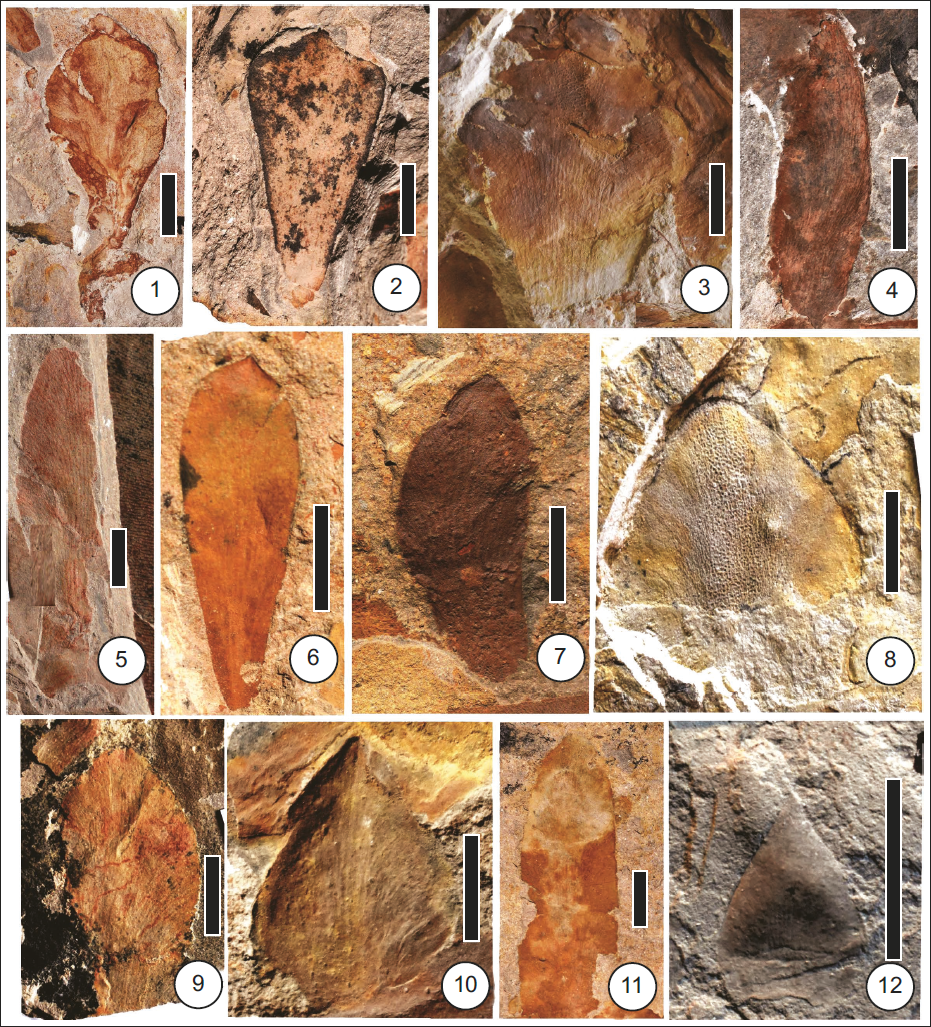
Description: The present collection includes four specimens of scale leaves. These leaves have a narrow-linear shape with a broad, acute tip. The midrib is prominent and extends to the apex. The veins run parallel to the midrib. The length of the leaves ranges from 2.6 to 5.5 cm, while the width varies between 0.7 and 1.3 cm.
Horizon: Lower Kamthi Formation.
Distribution: Barakar, Lower Kamthi (Raniganj) and Hingir Formations of Indian Gondwana.
Dictyopteridium feistmanteli Chandra & Surange, 1976
(Plate 1, Figure 4; Plate 2, Figure 5)
PLATE 2. Fructifications recoverd from Madhupur Village (Scale bar is 10 mm for all the specimens) 1. Venustostrobus indicus, MP 244.7, 2. Jambadostrobus pretiosus, MP 206.15, 3. Jambadostrobus pretiosus, MP 13.8, 4. Scutum sahnii, MP 167.3, 5. Dictyopteridium feistmantelli, MP 232.9, 6. Scutum sahnii, MP 222.11, 7. Venustostrobus indicus, MP 183.2, 8. Jambadostrobus pretiosus, MP 232.11.
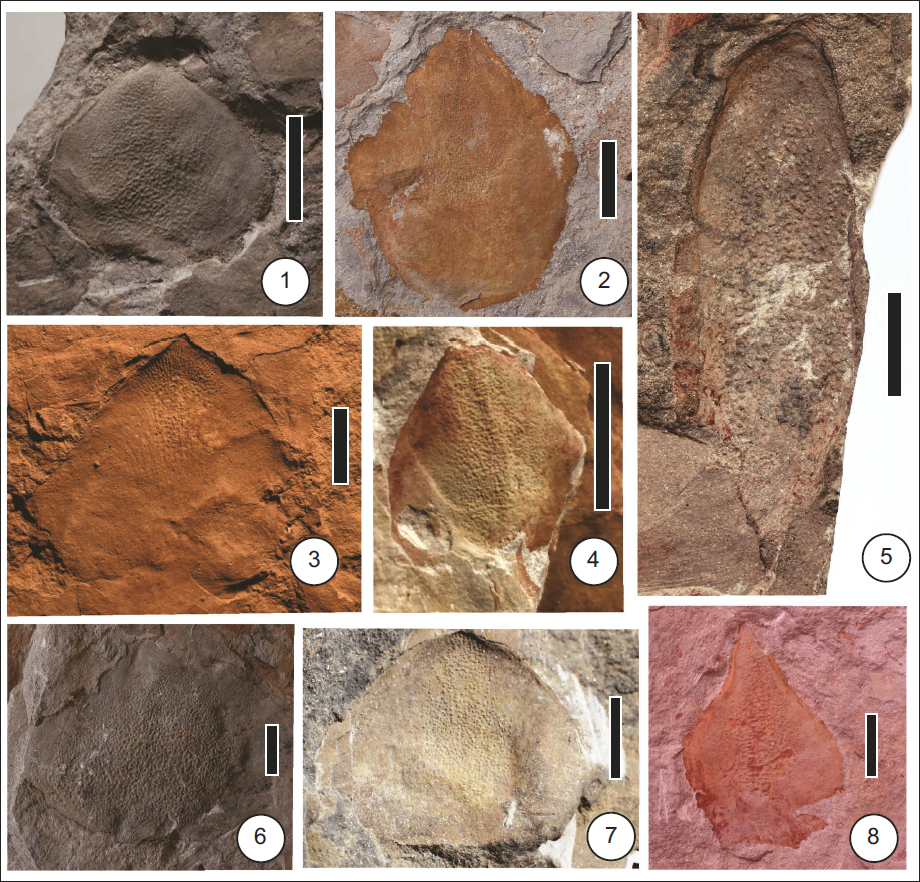
Description: The collection includes four detached scale leaves and five other fertile specimens. The scale leaves have a lanceolate, narrow lamina, with a length ranging from 1.6 to 3.6 cm and a width between 0.5 and 1.1 cm. The fructification (other fertile) specimens consist of a seed-bearing receptacle in the axil of a stalked fertile bract, enveloping it like a protective spathe. The receptacle is covered with small, round seed-cushions.
Horizon: Lower Kamthi Formation.
Distribution: Lower Kamthi (Raniganj) Formation of Indian Gondwana.
Eretmonia emarginata Chandra & Surange, 1977a
(Plate 1, Figure 12)
Description: The present collection includes four specimens of scale leaves. The leaves are lanceolate in shape, with central veins running straight upward and only branching in the apical region. The side veins arch out toward the margin, branching and fusing as they extend. The basal meshes are broad. All the specimens lack stalks, except one with a partially preserved stalk. The length of the scale leaves ranges from 1 to 3.6 cm, and the width varies from 0.7 to 1.4 cm.
Horizon: Lower Kamthi Formation.
Distribution: Barakar, Lower Kamthi (Raniganj) and Panchhwara formations of Indian Gondwana.
Eretmonia hinjridaensis Surange & Maheshwari, 1970
(Plate 1, Figure 7)
Description: The present collection includes two specimens of scale leaves. The leaves are spathulate in shape, with an acute apex. Seven to eight veins originate from the base and run straight upward. The length of the leaves ranges from 2.4 to 3.1 cm, while the width varies from 1.1 to 1.4 cm.
Horizon: Lower Kamthi Formation.
Distribution: Lower Kamthi (Raniganj) and Hingir Formations of Indian Gondwana.
Eretmonia ovata Surange & Chandra, 1974a
(Plate 1, Figure 10)
Description: The present collection includes eight specimens of scale leaves. These leaves are ovate with acute apices. The lamina of the scale leaves is relatively large, and in some cases, the long apex resembles a pointed thorn. The length of the leaves ranges from 1.3 to 2.6 cm, while the width varies from 1.2 to 1.9 cm.
Horizon: Lower Kamthi Formation.
Distribution: Barakar, Lower Kamthi (Raniganj) and Panchhwara Formations of Indian Gondwana.
Eretmonia utkalensis Surange & Maheshwari, 1970
(Plate 1, Figure 1)
Description: The present collection includes two specimens of scale leaves. The leaves are rhomboid in shape with an acute apex. Their length ranges from 4.5 to 5.2 cm, while their width varies from 1.8 to 2.5 cm. The venation is well-defined, forming meshes without a midrib.
Horizon: Lower Kamthi Formation.
Distribution: Barakar, Lower Kamthi (Raniganj) and Hingir Formations of Indian Gondwana.
Glossotheca immanis Chandra & Surange, 1977a
(Plate 1, Figure 11)
Description: The present collection includes four specimens of scale leaves. The length of the leaves ranges from 4 to 5.6 cm, and the width varies from 1.8 to 2.8 cm.
Horizon: Lower Kamthi Formation.
Distribution: Lower Kamthi (Raniganj) and Hingir Formations of Indian Gondwana.
Glossotheca orissiana Surange & Chandra, 1974b
(Plate 1, Figure 2)
Description: The present collection includes six specimens of scale leaves. The leaves are rhomboid in shape. The veins originate at the base, run straight for a distance, and then diverge towards the margin. The length of the leaves ranges from 3.9 to 4.6 cm, while the width varies from 1.9 to 2.1 cm.
Horizon: Lower Kamthi Formation.
Distribution: Barakar, Lower Kamthi (Raniganj) and Hingir Formations of Indian Gondwana.
Jambadostrobus pretiosus Chandra & Surange, 1977c
(Plate 2, Figures 2, 3 and 8)
Description: The present collection includes six fertile parts. The length of the specimens ranges from 2.5 to 3 cm, and the width varies from 1 to 2 cm. The margin is relatively broad. These are ovuliferous fructifications, featuring an elliptical to narrowly ovate, dorsiventrally flattened receptacle. The apex is acute or slightly attenuate, while the base is rounded.
Horizon: Lower Kamthi Formation.
Distribution: Barakar and Lower Kamthi (Raniganj) Formations of Indian Gondwana.
Partha spathulata Surange & Chandra, 1973b
(Plate 1, Figure 6)
Description: The present collection includes thirty-eight specimens of scale leaves. These leaves are spathulate in shape with a rounded apex, and the basal portion tapers into a petiole. The length of the leaves ranges from 3.4 to 5.2 cm, while the width varies from 1.1 to 1.6 cm. The central veins are strong and persist up to the apex, without a midrib. Secondary veins bifurcate, but anastomosing is unclear, absent, or rare.
Horizon: Lower Kamthi Formation.
Distribution: Karharbari, Barakar, Lower Kamthi (Raniganj) and Panchhwara formations of Indian Gondwana.
Plumsteadiostrobus pretiosus Chandra & Surange, (1974)
(Plate 1, Figure 9)
Description: The present collection includes seven specimens of scale leaves. These leaves have an obtuse apex, a contracted-truncated base, dichotomous veins and narrow-elongate meshes. The length of the leaves ranges from 2.7 to 3.8 cm, and the width varies from 1.1 to 2 cm.
Horizon: Lower Kamthi Formation.
Distribution: Barakar and Lower Kamthi (Raniganj) Formations of Indian Gondwana.
Scirroma ventilebra Chandra & Surange, 1977b
(Plate 1, Figure 3)
Description: The present collection includes three specimens of scale leaves. These scale leaves are relatively large and broad in shape. The length ranges from 4 to 4.5 cm, and the width varies from 3 to 3.5 cm. The veins are prominent, with a few central veins running straight upward, while the side veins diverge toward the margin, forming meshes.
Horizon: Lower Kamthi Formation.
Distribution: Barakar and Lower Kamthi (Raniganj) formations of Indian Gondwana.
Scutum sahnii Surange & Chandra, 1974c
(Plate 2, Figures 4 and 6)
Description: The present collection includes fifty-two fertile specimens. The fructification appears to be a bilaterally symmetrical organ, almost round or oval. It has a short stalk and is concave in the middle, or saucer-shaped. The central head displays oval impressions that likely represent the seeds and some irregular cavities where seeds have been removed. This central head can be identified as the receptacle. The swollen, seed-bearing head is distinguishable from other species of Scutum through comparison.
Horizon: Lower Kamthi Formation.
Distribution: Lower Kamthi (Raniganj) Formation of the Indian Gondwana.
Venustostrobus indicus Chandra & Surange, 1977d
(Plate 1, Figure 8; Plate 2, Figures 1 and 7)
Description: This species is represented by fifty-three scale leaves and seventy other fertile parts (fructification) specimens in the present collection. The lamina is orbicular or fan-shaped, and the protective bract has strong veins that form short, broad meshes. There is no midrib present. The length of the specimens ranges from 1.5 to 2.4 cm, while the width varies from 1.8 to 2.9 cm.
Horizon: Lower Kamthi Formation.
Distribution: Barakar and Lower Kamthi (Raniganj) Formations of the Indian Gondwana
DISCUSSION AND CONCLUSIONS
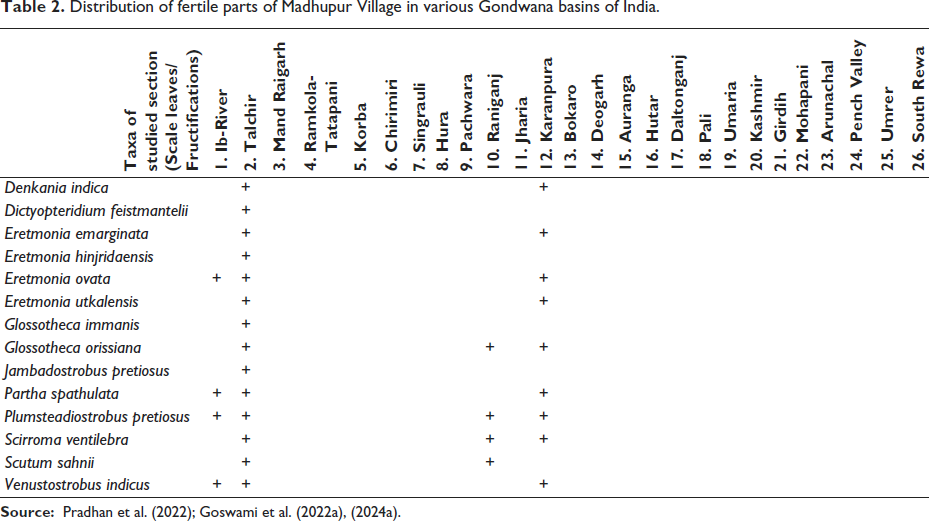
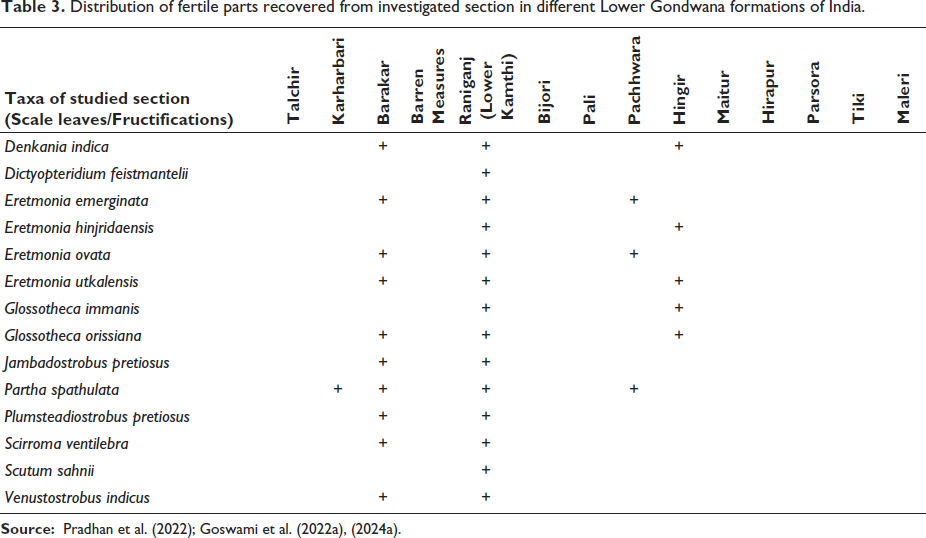
The study of plant megafossils from the Lower Kamthi sediments near Madhupur Village, Odisha, reveals a rich and diverse assemblage, including 10 genera and 14 species of fertile parts, along with various gymnosperms and pteridophytes. Fertile parts reported from the Lower Kamthi sediments of the Madhupur Village are preserved as impressions in whitish-grey and pinkish-brown fine-grained shales. Key species include Denkania indica, Dictyopteridium feistmanteli, Eretmonia emarginata, E. hinjridaensis, E. ovata, E. utkalensis, Glossotheca immanis, G. orissiana, Jambadostrobus pretiosus, Partha spathulata, Plumsteadiostrobus pretiosus, Scirroma ventilebra, Scutum sahnii and Venustostrobus indicus. The scale leaves are typically associated with reproductive organs in the Glossopteris flora (Banerjee, 1979; Lacey et al., 1975; McLoughlin, 2011; Surange & Chandra, 1975). They are found isolated and detached in this collection, suggesting that they were sterile and likely served as protective scales for the reproductive buds rather than as direct reproductive structures (Goswami et al., 2022a, 2024a; Pant, 1958; Pant & Chauhan, 2000; Pradhan et al., 2022). The distributions of recovered scale leaves and other fertile parts in different Gondwana basins and Lower Gondwana formations of India are presented in Tables 2 and 3, respectively.
Distribution of fertile parts of Madhupur Village in various Gondwana basins of India.
Distribution of fertile parts recovered from investigated section in different Lower Gondwana formations of India.
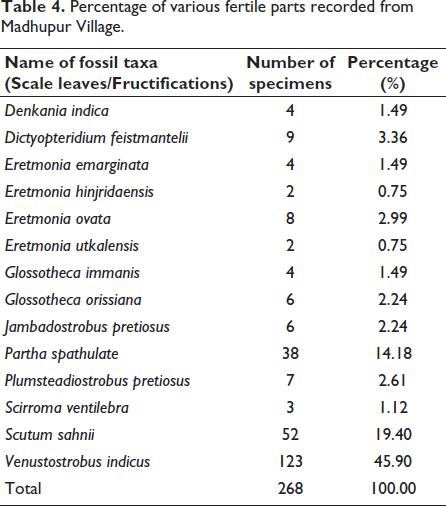
The description of other plant groups of this collection has already been published (Patel & Goswami, 2025). The total megafloral assemblage includes representatives of both pteridophytes and gymnosperms. Among the pteridophytes, three groups are found: Filicales, represented by Neomariopteris hughesii; Sphenophyllales, represented by Trizygia speciosa; and Equisetales, represented by Schizoneura gondwanensis and equisetaceous stem fragments. Gymnosperms are represented by two major groups: Ginkgoales, with species such as Rhipidopsis gondwanensis, and Glossopteridales, which include around 45 species of Glossopteris along with Palaeovittaria kurzii (Patel & Goswami, 2025). This assemblage also includes fertile parts discussed in this study (Table 4).
Percentage of various fertile parts recorded from Madhupur Village.
Based on the lithological characteristics and fossil assemblage, the studied beds at Madhupur Village in the Talcher Basin are assigned to the Lower Kamthi Formation, dated to the Wuchiapingian to Changhsingian ages of the Late Permian (Patel & Goswami, 2025). This interpretation is supported by the presence of broad- and medium-meshed petiolate Glossopteris leaves, along with Schizoneura, Trizygia, and Neomariopteris, and the absence of typical Triassic elements such as Dicroidium. These features collectively confirm the Permian age and stratigraphic position of the fossiliferous beds (Patel & Goswami, 2025).
The megaflora from Madhupur indicates lush, swampy forests dominated by arborescent Glossopteris in low-lying, marshy river valleys, accompanied by Equisetales, Sphenophyllales, Filicales, Ginkgoales and understory plants like Schizoneura, Trizygia and Neomariopteris, which formed dense forests indicating the coexistence of marshy and terrestrial habitats. A wide range of Glossopteris species, from small to large leaves, reflects a diverse plant community thriving in a warm, humid, temperate climate with notable seasonal changes and moderate wind activity, as inferred from the presence of petiolate leaves (Aggarwal & Goswami, 2024; Dash et al, 2025; Gautam et al., 2013, 2014, 2016; Goswami, 2002, 2004, 2006, 2007a, 2007b; 2014; Goswami et al., 2006a, 2010, 2018a, 2018b, 2022a, 2022b, 2022c; 2024a, 2024b; Goswami & Singh, 2010; Meena & Goswami, 2004; Nanda & Goswami, 2023; Nanda et al., 2024, 2025).
Though oxidising conditions and fine-grained pinkish-brown shales limited coal development in the Lower Kamthi sediments, the forests contributed organic matter to peat formation. The intact preservation of large leaves in fine sediments suggests minimal transport and deposition close to the growth site, likely in calm, still waters of lakes or slow-moving streams (Aggarwal et al., 2022a, 2022b; Goswami et al., 2006b, 2006c, 2018b; Patel et al., 2021, 2022a, 2022b; Pillai & Goswami, 2020; Pillai et al., 2020.; Pradhan et al., 2023a, 2023b, 2024a, 2024b; Sahoo et al., 2020a, 2020b, 2024).
Thus, this fossilised flora reveals that the low-lying marshes and lakes were home to a diverse array of plant species, both large and small, growing beneath the canopy of larger trees (Saxena et al., 2014, 2019; Singh et al., 2005, 2006a, 2006b, 2006c, 2011, 2012, 2016; Swain et al., 2020; Tripathy et al., 2019, 2021; Tripathy & Goswami, 2022). This diverse ecosystem, similar to that found in other parts of Gondwana, reflects the complex landscapes during the late Permian Period, offering significant insights into ancient India’s palaeoecology and floristic diversity.
Footnotes
Acknowledgements
The authors thank the Vice-Chancellors of Utkal University, Bhubaneswar and Sambalpur University, Sambalpur, for providing necessary research facilities. RP thanks the DST, Government of India, for the research grant. SG also thanks the Science and Technology Department, Government of Odisha, for a research grant.
Declaration of Conflicting Interests
The authors declared no potential conflicts of interest with respect to the research, authorship and/or publication of this article.
Funding
The authors received no financial support for the research, authorship and/or publication of this article.
