



Abstract
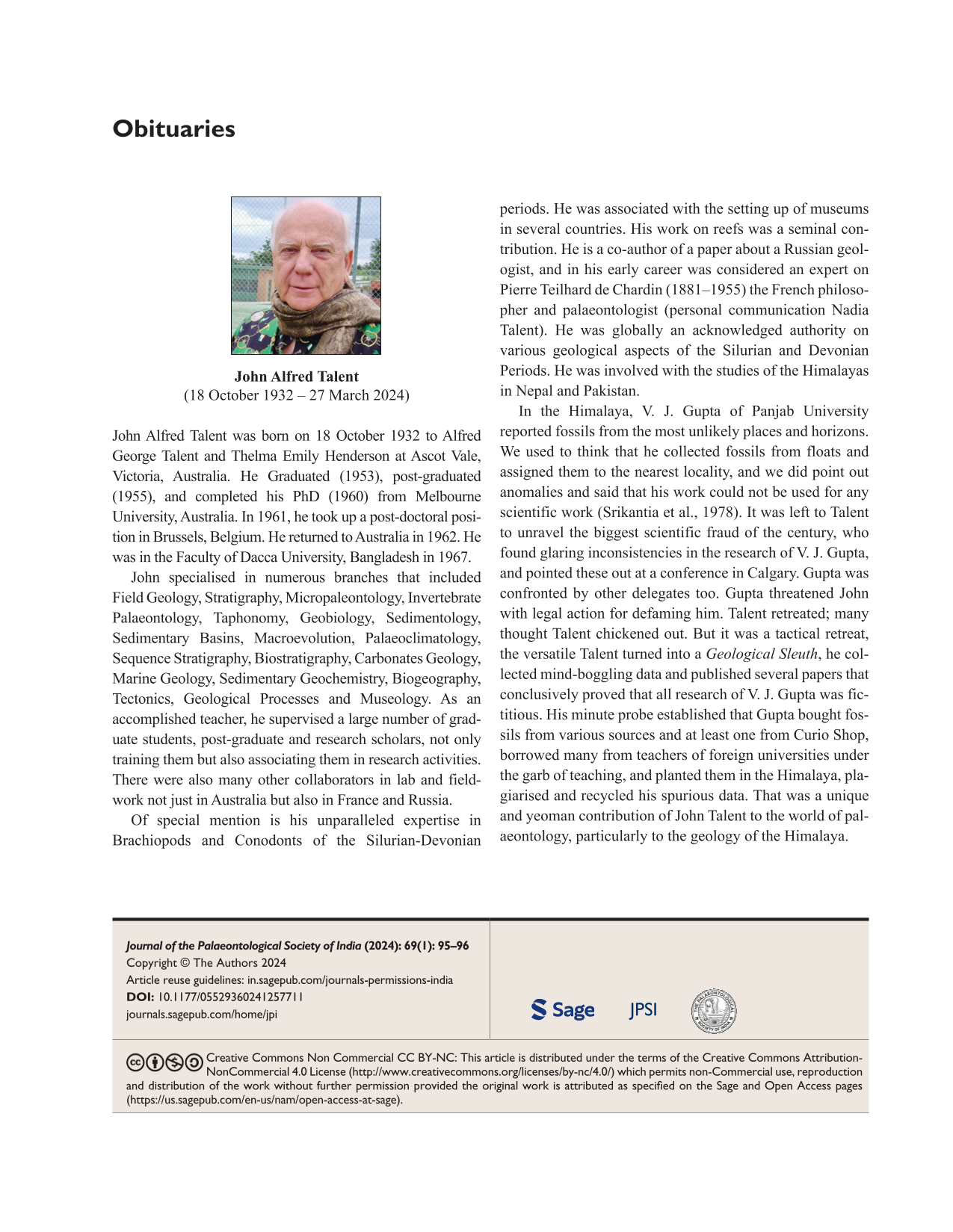
John Alfred Talent was born on 18 October 1932 to Alfred George Talent and Thelma Emily Henderson at Ascot Vale, Victoria, Australia. He Graduated (1953), post-graduated (1955), and completed his PhD (1960) from Melbourne University, Australia. In 1961, he took up a post-doctoral position in Brussels, Belgium. He returned to Australia in 1962. He was in the Faculty of Dacca University, Bangladesh in 1967.
John specialised in numerous branches that included Field Geology, Stratigraphy, Micropaleontology, Invertebrate Palaeontology, Taphonomy, Geobiology, Sedimentology, Sedimentary Basins, Macroevolution, Palaeoclimatology, Sequence Stratigraphy, Biostratigraphy, Carbonates Geology, Marine Geology, Sedimentary Geochemistry, Biogeography, Tectonics, Geological Processes and Museology. As an accomplished teacher, he supervised a large number of graduate students, post-graduate and research scholars, not only training them but also associating them in research activities. There were also many other collaborators in lab and fieldwork not just in Australia but also in France and Russia.
Of special mention is his unparalleled expertise in Brachiopods and Conodonts of the Silurian-Devonian periods. He was associated with the setting up of museums in several countries. His work on reefs was a seminal contribution. He is a co-author of a paper about a Russian geologist, and in his early career was considered an expert on Pierre Teilhard de Chardin (1881–1955) the French philosopher and palaeontologist (personal communication Nadia Talent). He was globally an acknowledged authority on various geological aspects of the Silurian and Devonian Periods. He was involved with the studies of the Himalayas in Nepal and Pakistan.
In the Himalaya, V. J. Gupta of Panjab University reported fossils from the most unlikely places and horizons. We used to think that he collected fossils from floats and assigned them to the nearest locality, and we did point out anomalies and said that his work could not be used for any scientific work (Srikantia et al., 1978). It was left to Talent to unravel the biggest scientific fraud of the century, who found glaring inconsistencies in the research of V. J. Gupta, and pointed these out at a conference in Calgary. Gupta was confronted by other delegates too. Gupta threatened John with legal action for defaming him. Talent retreated; many thought Talent chickened out. But it was a tactical retreat, the versatile Talent turned into a Geological Sleuth, he collected mind-boggling data and published several papers that conclusively proved that all research of V. J. Gupta was fictitious. His minute probe established that Gupta bought fossils from various sources and at least one from Curio Shop, borrowed many from teachers of foreign universities under the garb of teaching, and planted them in the Himalaya, plagiarised and recycled his spurious data. That was a unique and yeoman contribution of John Talent to the world of palaeontology, particularly to the geology of the Himalaya.
In the scientific world, not many may know John as a man. I found him to be one of the finest human beings in this wide crafty world, always willing to help as a scientist and also as a friend. He had a facile pen and an exceptional control of language. I had the benefit of getting several of my manuscripts edited by him. I witnessed his philosophical facet in many letters to me after the death of his son Ross. With so many traits and expertise, I am tempted to coin the term, ‘Omnigeologist’ to describe John.
Persons like John Alfred Talent never die; his contributions to geology have made him immortal. Nevertheless, the world of palaeontology and stratigraphy is poorer, and he will be missed by his friends and numerous admirers, many of whom reside in India.
May his soul attain Moksha (Salvation).