



Abstract
Stakeholder theory is a growing body of scholarly literature at the crossroads of business ethics and strategic management. This literature encompasses two distinct levels of inquiry, the levels of the firm and of the capitalistic system as a whole. At the firm level, stakeholder theory provides insight into the roots of the firm-level competitive advantage, whereas at the system level, it explores how capitalistic business can act as a social institution serving moral goals. Until now, the firm-level and system-level perspectives in stakeholder theory have not been effectively integrated. Drawing on the classical institutional economics of John Commons, the present paper elaborates the distinction between the firm and system levels of stakeholder collaboration and examines how they are interconnected. Stakeholder collaboration is shown to be shaped by larger institutions, such as habits, customs, public purposes, and prevailing perceptions of reasonableness. Whereas the system-level perspective in stakeholder theory focuses on the evolution of these larger institutions, the firm-level perspective explores how these institutions contribute to the emergence of the firm-level competitive advantage, thereby generating evolutionary forces that adjust the larger institutions.
Introduction
Stakeholder theory is an influential and rapidly growing body of scholarly literature at the crossroads of business ethics and strategic management. In terms of business ethics, stakeholder theory questions the prevailing shareholder-centric view of business, advocating for a broader conception of corporate responsibility. Challenging the notion of profit maximization as the sole objective of corporations, it urges corporate leaders to consider the interests of a diverse array of stakeholders, encompassing not only shareholders but also employees, customers, suppliers, and communities (cf. Freeman, 1984; Freeman et al., 2023). In terms of strategic management, stakeholder theory recognizes the intricate web of relationships in which corporations are embedded (cf. Phillips et al., 2019). It underscores the importance of managing these relationships to create sustainable value, particularly amid the dynamic forces of globalization, technological innovation, and evolving societal expectations (Freeman et al., 2010: 3). Both the business ethics and strategic management dimensions of stakeholder theory converge toward establishing it as ‘an abrupt departure from the usual understanding of business as a vehicle to maximize returns to the owners of capital’, and as an alternative to the mainstream view of neoliberal shareholder capitalism (Freeman et al., 2010: xxv; cf. Rutar, 2023).
A key ongoing debate within stakeholder theory revolves around the interplay between the firm level and system level of inquiry. Stakeholder theory is widely acknowledged for its firm-level managerial focus, offering guidance to managers on fostering ethical stakeholder relationships to achieve business success (cf. Donaldson and Preston, 1995; Phillips et al., 2019). Concurrently, stakeholder theory encompasses system-level dimensions relevant to understanding the capitalist system as a whole. Notably, R. Edward Freeman, a prominent advocate of stakeholder theory, has long championed the concept of stakeholder capitalism (Freeman et al., 2010: 280). For Freeman, stakeholder capitalism represents a new narrative of capitalism prioritizing collaboration over competition, underpinned by principles such as stakeholder cooperation, complexity, continuous creation, and emergent competition (Freeman, 2023: 750 et seq.). While Freeman (2023: 749) traces these system-level principles back to the challenges faced by corporate managers, other stakeholder scholars perceive the relationship between firm and system levels of inquiry in stakeholder theory as more contentious.
For example, Johnson-Cramer et al. (2022: 1112) write of ‘the stakeholder-system divide’, that is, ‘disconnection between the firm- and system level’ of inquiry in stakeholder theory. According to the authors, most of stakeholder scholarship has been focused on the firm level which however does not go far enough in taking account of the broad significance of stakeholder management within the economic system of capitalism (Berman and Johnson-Cramer, 2019; Bevan et al., 2019). A number of stakeholder scholars acknowledge that stakeholder theory could be and has been subject to overly firm-centric interpretations which do not do justice to the large-scale nature of many managerial challenges, especially those linked to sustainable development (e.g. Bevan et al., 2019; Roulet and Bothello, 2022; Waddock and Kuenkel, 2020). More than that, Weitzner and Deutsch (2019: 695) convincingly argued that the firm-level focus of stakeholder theory on competitive advantage might be principally at odds with the theory’s system-level task ‘of relating ethics to capitalism’ and making capitalism more collaborative. The ongoing nature and wider implications of this debate underscore stakeholder theory’s persistent challenge in delineating the firm and system levels of stakeholder interaction and understanding how these levels are interconnected.
The present paper will explore the interplay between the firm and system levels of stakeholder interaction by drawing on an unconventional lens of the economic teachings of John R. Commons (1862–1945), one of the founders of the school of economic thought known under the names of original institutionalism and classical or American institutional economics (cf. Hodgson, 2004; Rutherford, 1999, 2011; Tool, 2001). The significance of classical institutional economics for stakeholder theory has been recently discussed by Valentinov (2023) who pointed out some of their obvious parallels, such as the grounding in philosophical pragmatism and the commitment to what Freeman et al. (2010: 7) called the integration thesis (cf. Valentinov, 2024). In the context of the present paper, the remarkable aspect of the Commonsian institutional economics is its combination of the firm and system levels of analysis. At the firm level, Commons (1919) developed the concept of ‘industrial goodwill’ which closely anticipates the main ideas of today’s instrumental stakeholder theory (Bridoux and Stoelhorst, 2022). At the system level, Commons (2009: 123) emphasized the capacity of American capitalism for ‘self-recovery’ and ‘stabilization [. . .] through custom’ (Commons, 2009: 130). Importantly, Commons not only distinguished between these levels but also analyzed their reciprocal relationship. He showed that achieving industrial goodwill at the firm level can lead to positive outcomes for capitalist society as a whole. The present paper will draw inspiration from his work to elaborate the distinction between the firm- and system-level perspectives in today’s stakeholder theory and explore how these levels interact.
Exploring the implications of the Commonsian institutionalism for the stakeholder theory debate on the relationship between the firm- and system-level perspectives is vital for advancing our understanding of how stakeholder management aligns with the capitalist economic system (cf. Valentinov et al., 2021). As argued by Weitzner and Deutsch (2019), the potential contribution of stakeholder management to the moral enhancement of capitalism fundamentally depends on this alignment. However, fully understanding this alignment requires a deeper dialogue between stakeholder theory and the economic discipline. While this dialogue has primarily focused on mainstream neoclassical and new institutional economic paradigms (cf. Valentinov, 2023; 2024), this article takes a different approach by adopting a Commonsian institutionalist lens. This lens effectively foregrounds the interplay between firm-level corporate dynamics and the broader system-level institutional environment.
The remainder of the article unfolds as follows: The next section reviews a recent debate within stakeholder theory, along with the theory’s external critique, to underscore the pressing need for a system-level perspective, one that can be inspired by Commonsian institutional economics. The subsequent section provides an overview of key concepts within Commonsian institutional economics, presented in a condensed manner tailored to the stakeholder theory issue at hand. Building upon this foundation, the subsequent section will develop a Commonsian perspective on stakeholder theory by delineating the firm and system levels of stakeholder interaction. We will then examine how this Commonsian perspective succeeds in bridging what has been termed ‘the stakeholder-system divide’ (Johnson-Cramer et al., 2022) and fortifying the institutional economics foundations of stakeholder theory.
Setting the stage for a system-level perspective in stakeholder theory
The ‘stakeholder-system divide’, as identified by Johnson-Cramer et al. (2022: 1112), reveals a critical gap in how stakeholder theory conceptualizes the broader role of business within society. This divide is especially evident in a recent debate concerning the ability of stakeholder theory to position business as a social institution that serves a variety of moral goals – goals that extend beyond the mere maximization of wealth for shareholders (Harrison et al., 2019; Jones et al., 2018; Weitzner and Deutsch, 2019). Central to this debate is the question of how successful stakeholder management can contribute to sustainable competitive advantage, and whether such practices can be scaled across firms to reshape the capitalist system as a whole. Drawing on the resource-based view of the firm (e.g. Barney, 1991), Jones et al. (2018) argue that stakeholder management can indeed provide a sustainable competitive advantage by developing ‘close relationship capabilities’ – capabilities that are rare, inimitable, and non-substitutable. These characteristics explain why firms that engage in moral stakeholder management may maintain a competitive edge that is not easily replicable by other firms that treat stakeholders with less regard (Jones et al., 2018). However, Weitzner and Deutsch (2019) raise a profound concern about the systemic implications of this argument. If the capabilities necessary for moral stakeholder management are, by definition, rare and difficult to imitate, then this practice must be confined to a select minority of elite firms, thereby undermining the potential for widespread adoption (Weitzner and Deutsch, 2019). From a system-level perspective, this realization is troubling, as it runs counter to stakeholder theory’s original ambition: to demonstrate how the practice of moral stakeholder management can be institutionalized on a larger systemic scale, thus providing substance to the view of capitalistic business as a social and moral institution (Weitzner and Deutsch, 2019).
Weitzner and Deutsch (2019) argue that unless stakeholder theory can demonstrate the potential for moral stakeholder management to become a widespread practice, it risks undermining its own foundational goals. In response, Harrison et al. (2019: 699) offer a nuanced counterpoint. They suggest that the rarity, inimitability, and non-substitutability of close relationship capabilities should not be viewed in continuous rather than categorical terms. In this view, while the development of these capabilities may be challenging, many firms could still be motivated to pursue them despite uncertain prospects for success. However, as Harrison et al. (2019) acknowledge, while this potential for firms to gradually develop these capabilities is plausible, it remains unclear whether this process is sufficient to drive the systemic change that stakeholder theory ultimately envisions – namely, transforming the way managers conceptualize the purpose of business: moving from a narrow focus on shareholder wealth to a broader, morally grounded approach that benefits all stakeholders (Harrison et al., 2019: 694). Therefore, the challenge remains: can stakeholder theory, in its current form, catalyze this transformation at a system-wide level?
The controversial exchange among the authors mentioned above reveals a broader implication: stakeholder theory continues to face challenges in developing compelling strategies for conceptualizing business as a social institution that serves moral goals. This struggle affirms Johnson-Cramer et al.’s (2022) diagnosis of the persistent ‘stakeholder-system divide’ – a gap that could be closed through the adoption of a system-level perspective. Such a perspective would demonstrate not only how stakeholder management aligns with the broader institutions of capitalism but also how it holds the potential to transform these institutions from within, in accordance with societal expectations and moral ideals. This debate in stakeholder theory illustrates that at least some strands of stakeholder theorizing remain relatively disconnected from a system-level perspective (Weitzner and Deutsch, 2019), prioritizing firm-level analysis instead. While stakeholder scholars are generally interested in both firm-level (e.g. Jones et al., 2018) and system-level perspectives (Freeman et al., 2007; Weitzner and Deutsch, 2019), the course of the debate has shown that the conceptual distinction between them has not yet been explicitly introduced and theorized, often at the expense of a deeper examination of how stakeholder management can drive systemic change.
The call for a system-level perspective, as highlighted in the aforementioned debate, reflects the essence of Freeman’s long-standing vision for developing a broader narrative of stakeholder capitalism (cf. Freeman, 2023; Freeman et al., 2007). Such a perspective must critically examine how stakeholder theory can challenge traditional narratives of capitalism, which often rely on assumptions of competition, limited resources, and a winner-take-all mentality (Freeman et al., 2007: 303). Since these narratives are deeply rooted in mainstream economic theory, advancing a system-level perspective for stakeholder theory necessitates critical engagement with these economic foundations. Regarding these foundations, Freeman et al. (2010: xv) recognized early on that stakeholder theory represents an ‘abrupt departure’ from the conventional view of business as a means to maximize returns for the owners of capital – a view entrenched in mainstream economic thought. Similarly, Bridoux and Stoelhorst (2022: 798) frame stakeholder theory as a viable alternative to mainstream economics, particularly in its critique of agency theory, which prioritizes the maximization of financial market value. Bridoux and Stoelhorst argue that stakeholder theory better accounts for the complexity of human behavior, recognizing that individuals are not driven solely by rational self-interest but by a more complex array of motives (Bridoux and Stoelhorst, 2022: 798). Building on these critiques, Valentinov (2023: 75) highlights that mainstream economic theorizing often overlooks deeper ethical questions about the meaning of value creation, the ethics of capitalism, and the long-term societal implications of prevailing managerial mindsets. Thus, to develop a robust system-level perspective, stakeholder theory must engage with these larger questions, positioning itself as a framework capable of addressing both the economic realities of capitalism and the moral responsibilities that businesses have toward society.
While Valentinov (2023) may be correct in highlighting the limitations of mainstream economic theorizing, we propose that this body of thought also lends itself, in principle, to a philosophical analysis that seeks to articulate mainstream economics’ answers to these larger ethical questions. One prominent representative of such an analysis is Joseph Heath’s (2014) market failures approach to business ethics, which not only explores the ethical dimensions of core economic concepts – such as efficiency, competition, and profit – but also serves as a significant critical perspective on stakeholder theory. Heath’s (2014: 5)
major claim is that the market is essentially a staged competition, designed to promote Pareto efficiency, and in cases where the explicit rules governing the competition are insufficient to secure the class of favored outcomes, economic actors should respect the spirit of these rules and refrain from pursuing strategies that run contrary to the point of the competition.
This claim leads Heath to advocate for a ‘division of moral labor’ within capitalist institutions, whereby markets are primarily tasked with promoting efficiency while being embedded within a welfare state that complements markets with redistributive and market-correcting policies (Heath, 2014: 10). In this way, Heath’s market failures approach aims to make ‘peace with capitalism’ (Heath, 2014: 7), particularly through an acknowledgment of the value of the profit motive in achieving Pareto efficiency, which he interprets as a general prohibition on waste (Heath, 2014: 10).
By emphasizing the moral significance of profit, competition, and efficiency, Heath’s market failures approach is likely to remain unconcerned with the potential system-level challenges associated with achieving sustainable competitive advantage through stakeholder management, as highlighted by Weitzner and Deutsch (2019). However, Heath goes further and criticizes stakeholder theory itself for its failure to reconcile with capitalism, particularly in light of the economic linkage between profit orientation and shareholder primacy (Heath, 2014: 7). According to his interpretation, stakeholder theory suggests that managers hold fiduciary obligations to multiple stakeholders, which, in his view, opens the door to ‘extraordinary agency risks’ (Weitzner and Deutsch, 2019: 81). By requiring managers to balance the interests of diverse stakeholder groups, stakeholder theory grants them excessive discretion, making it difficult – if not impossible – to evaluate their performance (Weitzner and Deutsch, 2019). Heath argues that this effectively leaves managers unaccountable, forcing firms and stakeholders to rely on managers’ claims when they assert they are acting in the best interests of all involved (Weitzner and Deutsch, 2019). From this standpoint, stakeholder theory lacks clear guidance on how managers should prioritize or balance conflicting stakeholder interests. Moreover, Heath critiques stakeholder theory for introducing ethical goals that, in his view, risk undermining competition and economic efficiency. By expanding the scope of business ethics to include social and moral considerations, stakeholder theory, according to Heath, blurs the line between the appropriate domain of business and that of politics or charity. For Heath, the ethical obligations of businesses should be limited to operating within market regulations, with broader societal responsibilities falling to government institutions.
Heath’s market failures approach provides a useful backdrop for understanding why stakeholder theory necessitates a system-level perspective, as envisioned in Freeman’s broader concept of stakeholder capitalism. This concept suggests that while Heath’s idea of a ‘division of moral labor’ (2014: 10) serves as a valuable analytical tool, this division becomes increasingly difficult to maintain in a world where businesses are deeply embedded in society and continually confronted with social and environmental responsibilities. For Freeman, businesses are not merely economic entities; they are social institutions that must engage with the ethical complexities inherent in their relationships with a wide range of stakeholders. From a stakeholder theory standpoint, business ethics cannot be reduced to mere efficiency; rather, ethics and business are fundamentally inseparable.
These insights from stakeholder theory are grounded in the interdependence between business organizations and their environments. As highlighted in sociological scholarship, organizational environments are not solely defined by material-resource factors; they also encompass institutional features that shape the regulative, normative, and cultural-cognitive foundations of organizational structures and processes (Scott, 2003: 149). Several prominent concepts in organizational theory provide useful perspectives on this interaction, including Thompson’s (1967) task environment, DiMaggio and Powell’s (1983) organizational field, and Crozier and Friedberg’s (1980) ‘environnement pertinent’. Thompson’s task environment focuses on the external factors – such as competitors, regulators, and suppliers – that directly affect a firm’s ability to achieve its goals. DiMaggio and Powell’s concept of the organizational field broadens this view by referring to the array of institutions and organizations that create isomorphic pressures – whether coercive, mimetic, or normative – that compel firms to conform to institutional norms. Meanwhile, Crozier and Friedberg’s (1980) ‘environnement pertinent’ emphasizes that organizations selectively define their relevant environment, concentrating on the specific external forces or institutions they deem important in their strategic decision-making. While these frameworks offer valuable insights into how organizations interact with their environments, it is essential to recognize that they are primarily descriptive rather than normative, depicting firms as responsive to external pressures without providing guidance on how firms should ethically engage with these forces.
In our present context, these sociological frameworks are distinctive in two important ways: terminologically and substantively. Terminologically, they adopt the more conventional designation of ‘organizational environments’ for what we consider to be the system level of analysis, while their concept of ‘the system’ corresponds more closely to what we identify as the firm level. Substantively, these sociological frameworks do not aim to provide a normative framework for guiding the moral responsibilities of firms, which is an aspiration of stakeholder theory. We propose that stakeholder theory can build on these sociological frameworks to reinforce the argument that the interdependence of business firms and their societal environments makes it increasingly difficult to uphold Heath’s (2014: 10) notion of a ‘division of moral labor’ between the state and the market. From a stakeholder theory’s perspective, however, this interdependence highlights the inherently moral dimension of business – a feature that distinguishes stakeholder theory from these more descriptive frameworks and justifies its adherence to unconventional terminology that distinguishes between the firm level and the system level of analysis (cf. Johnson-Cramer et al., 2022), even though this deviates from conventional sociological usage. In other words, we see this terminological distinction not merely as rhetorical; it underscores stakeholder theory’s unique interest in both describing the broader concept of stakeholder capitalism and developing its moral meaning. In doing so, it seeks to address ‘larger questions about the meaning of value creation and trade, the ethics of capitalism, and the long-term societal implications of prevalent managerial mindsets’ (Valentinov, 2023: 75). We view the development of this moral meaning as a crucial component of the system-level perspective in stakeholder theory, and it is this emphasis on moral inquiry that justifies its departure from the more conventional sociological distinction between system and environment.
In sum, the stakeholder theory debate concerning the problematic system-level implications of sustainable competitive advantage underscores the critical need for a system-level perspective that highlights the significance of stakeholder management within the framework of capitalism. Heath’s (2014) market failures approach provides a sophisticated system-level perspective on the moral meaning of business within capitalism, but Heath’s system-level perspective is rooted in a ‘division of moral labor’ that is fundamentally critical of stakeholder theory and conflicts with the theory’s aspirations for systemic change (Johnson-Cramer et al., 2022; Weitzner and Deutsch, 2019). Heath’s (2014: 10) concept of the ‘division of moral labor’ reflects what Freeman et al. (2010: 6) have termed the ‘separation fallacy’ – the assumption that business decisions and ethical decisions can be treated as conceptually distinct. Freeman (1999) has long argued that this fallacy continues to resurface in debates about the relationship between the normative, descriptive, and instrumental dimensions of stakeholder theory. Stakeholder theory accordingly requires a system-level perspective that explicitly rejects the separation fallacy while still engaging with Heath’s (2014: 7) goal of making ‘peace with capitalism’. We suggest that developing this system-level perspective necessitates solid conceptual foundations, potentially drawing on the classical institutional economics of John R. Commons, who sought to understand capitalism through an intertwining of perspectives from economics, jurisprudence, and ethics (cf. Commons, 1936).
The institutional economics of John Commons: key relevant concepts
John Commons is widely considered to be one of the two founding fathers of classical institutional economics, with the other one being Thorstein Veblen (1857–1929). Both thinkers shared the pragmatist vision of the economy as an evolving open system through which human society is provisioning itself with the material means of life (Adkisson, 2009; Gruchy, 1987; Tool, 2001). This provisioning boils down to a social problem-solving process which is facilitated by the dynamic accumulation of community knowledge and potentially hindered by rigid institutional structures which do not keep pace with the advance of new knowledge, tools, and technologies. This vision presents a radical contrast with neoclassical economics which sees economy as a closed system aimed to maximize social welfare through the market exchange of goods and services. Veblen (1898) famously criticized neoclassical economics for its static character and a lacking appreciation of how societal self-provisioning is hindered by pecuniary institutions which tend to disrupt the coordination of large-scale industrial processes. Commons shared a critical assessment of neoclassical economics, but, contrary to Veblen, believed in the possibility of institutional reforms that solve conflicts and make capitalism reasonable. As he wrote in his autobiography, ‘I was trying to save Capitalism by making it good’ (Commons, 1934: 143), a concern that is widely shared in today’s scholarly communities of business ethics and stakeholder theory.
Given the sharp departure of Commons’ thought from the mainstream neoclassical economics, it is remarkable that he shared the neoclassical belief in the scarcity of resources. But contrary to his neoclassical colleagues, he saw the chief effect of scarcity not in the idea of optimal allocation, but rather in the pervasiveness of conflicts which require resolution (Commons, 2005; Ramstad, 1990; Van de Ven, 1993). According to Commons, conflicts are resolved by collective action which takes numerous institutional forms, such as working rules and property rights. Collective action is seen by Commons as an interaction of ‘purposeful individuals whose wills conflict and whose actions are interdependent under conditions of scarcity. Accordingly, a central problem of collective action is control of the differential powers of participants to exercise their individual wills on others’ (Van de Ven, 1993: 140; Van de Ven and Lifschitz, 2009). Thus, collective action ‘incorporates the unique element of human purpose which Commons calls “willingness”’ (Gruchy, 1940: 826). For this reason, Commons (1924, 2005) characterized his institutional economics as ‘volitional economics’.
A ‘volitional conception of economic life’ (Ramstad, 1990: 54) reflects the unique Commonsian approach to visualizing the inextricable entanglement of business and ethics. While it is definitely not the only possible approach to doing so, it accentuates the important idea that the operation of numerous economic institutions can be traced back to the prominence of moral values and ideals of powerful groups which control the sovereign power. As Ramstad (1990: 72) helpfully explains,
whenever new rules expressing the private purposes of individuals are approved by the ruling authority, those private purposes are ipso facto public purposes [. . .]. One momentous consequence of this perspective should not be overlooked. Since, if they are to survive, working rules must embody, or at least not contradict, the social philosophy or ideals of the sovereign power, transactional outcomes conforming to these rules [. . .] are not so much the consequence of [. . .] ‘free choice’, as a materialization of the underlying purposes – the ‘ruling ideals’ – embraced, or at least not opposed, by the sovereign.
If so, then ‘costs of production – that is prices – are simply the pecuniary consequences of adhering to the specific practices mandated or authorized by the controlling working rules’ (Ramstad, 1990: 76). Another commentator on Commons concurred that ‘it is the structure and nature of the working rules of going concerns that determine the results of transactions’ (Atkinson, 1983: 1061).
Tracing the entanglement of business and values back to the moral ideas and ideals authorized by the sovereign power, Commons developed an original approach to the possibility of their moral evaluation. True to the open-ended and processual pragmatist spirit, Commons supposed that this evaluation should occur by those individual participants of business life who experience their practical consequences, such as conflicts. The criterion of this evaluation is reasonableness, which may be broadly defined as freedom from duress and coercion, as expressed in concrete transactional relationships (cf. Whalen, 2022). As Commons (1970: 25) explained, ‘reasonableness is best ascertained in practice when representatives of conflicting organized economic interests, instead of politicians and lawyers, agree voluntarily on the working rules of their collective action in control of individual action’. The practical test of reasonableness is whether any of the transactional participants ‘is giving up a larger share, and the other is therefore receiving a larger share of the social output than is “reasonable”’ (Commons, 2005: 333). Problems of reasonableness systematically emerge when a specific social group, such as workers, is disadvantaged and exploited by other groups, such as corporate management. In this case, the working rules of their transactional relationships can be redefined in a way that would be reasonable to both of them, with the understanding that individual perceptions of reasonableness are shaped by the prevailing customs and habits. Classical institutional economists consider Commons’ interpretation of reasonableness to underpin one normative paradigm of this school of economic thought, namely the paradigm of reasonable value (Ramstad, 1990; Rutherford, 1999). Even though this paradigm is not accepted by every classical institutional economist (cf. the critique by Tool, 1986), it offers a crucial opportunity for reflection on the moral parameters of business life.
In the ‘volitional conception of economic life’ (Ramstad, 1990: 54), this sort of moral reflection is important because it gives the basis for individual actors to decide whether or not to withhold their productive contributions to the going concerns in which they may potentially participate. If individual actors perceive some transactional parameters to be unreasonable, they may abstain from these relationships and withhold the inputs that could have been made. For Commons, the capacity of individual actors to withhold what others need, but do not own, underlies the significance of the phenomenon of goodwill, which is analyzed by Commons in several distinct contexts. As Chasse (2018) explains, in Commons’ thought, ‘goodwill’ can mean intangible property arising from well-functioning customer relations, such as trademarks; and it can also mean a management strategy seeking to gain employee loyalty. Commons elaborated the second meaning in the seminal 1919 book, titled Industrial Goodwill. In this book, Commons noted that some employers treat workers as a variety of commodity or machinery; in the former case, labor policies are dictated by market circumstances; in the latter case, employers try to steer workers’ behavior with the help of instruments such as ‘piece work payment, merit pay, and bonuses’ (Chasse, 2018). Other employers, in contrast, seek to develop ‘industrial goodwill’ that envisions treating workers in the same way as customers, and trying to win their loyalty by engaging them in workforce governance (Chasse, 2018). According to Kaufman (2003: 8), industrial goodwill encompasses ‘working rules to foster a cooperative unity of interest, provides superior wages and employment conditions, emphasizes justice and fair dealing, replaces fear and coercion with goodwill and persuasion as motivators, and promotes voluntarism in industrial relations’.
Commons (1919) explains that employers achieving industrial goodwill derive economic advantages, such as higher worker productivity and lower turnover costs (cf. Chasse, 2018). These advantages make clear that the two understandings of goodwill – as intangible property and as a management strategy – are interlinked, such that the development of industrial goodwill results in a higher market valuation of the firm. Evidently, investing in goodwill as a management strategy makes sense not only in the case of workers. As Black (1994: 361) argued,
the value of a firm – and its implied value to society – depends on the expectation of ongoing customer relations from which it can expect future revenues to meet future obligations. These customer relations have goodwill value which depends first on fair competition, which the courts must protect, and second on ethical behavior, which the firm must provide.
This ethical behavior may be exercised toward workers, customers, and a whole range of other stakeholders, which are thereby motivated not to withhold their productive inputs creating the economic advantages for the firm.
The phenomenon of industrial goodwill has important evolutionary implications. As Commons elaborates, employers achieving it may set industry standards which require enforcement by the state. If the state succeeds in enforcing the new progressive standards, their benefits are diffused throughout the industry (cf. Chasse, 2018), thus resulting in the ongoing adjustment of working rules of employment. The evolutionary view of industrial goodwill generalizes to the broader issue of economic evolution in Commons’ work. Evolution of working rules is guided by the prevailing perceptions of reasonable value which, according to Commons (1970: 25), ‘may not be ideal, and it is not logical, neither is it revolutionary. It is the discovery, through investigation and negotiation, of what is the best reasonable thing to do under the actual circumstances of conflicting economic interests’. Just as industrial goodwill is developed through ‘the discovery [. . .] of what is the best reasonable thing to do under the actual circumstances’, so do working rules generally evolve through the ongoing process of the resolution of conflicts, which keep arising continually simply because ‘changing circumstances beget new types of disputes’ (Ramstad, 1990: 58). As the case of industrial goodwill makes clear, reasonable conflict resolution is predicated on the willingness of conflict participants to resolve conflict and to be governed by improved working rules. To take account of the factor of willingness, Commons (1970, 2005) preferred to see economic evolution as a variety of ‘artificial’ rather than ‘natural’ selection (cf. Ramstad, 1990).
Toward a Commonsian view of stakeholder theory
Deeply interested in understanding how the character of corporate life is shaped by broader economic, political, and cultural institutions, Commons emphasized that the feasibility of industrial goodwill is based on the reasonableness of underlying working rules and property rights, which reflect in turn the collective action aspect of business activity. The Commonsian connection between goodwill and working rules may form the basis for contemporary stakeholder theorists to conceptualize stakeholder interaction occurring at two distinct yet interconnected levels: the firm level and the system level, as illustrated in Figure 1.
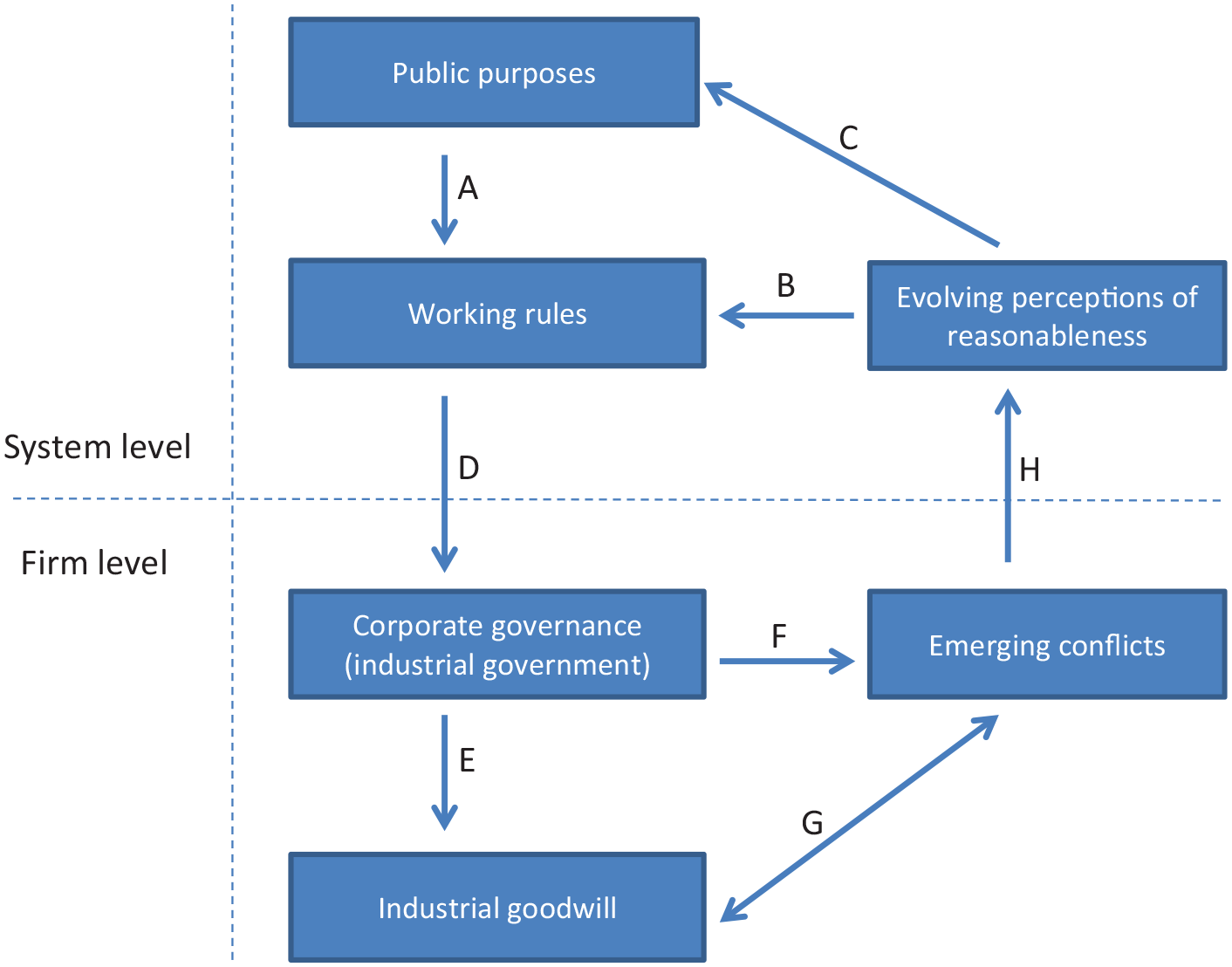
The firm and system levels of stakeholder interaction in a Commonsian view of stakeholder theory.
The system-level perspective
The point of departure of the system-level perspective on stakeholder theory is the Commonsian idea that any concrete dynamics of economic happenings, such as market outcomes, presents ‘pecuniary consequences of adhering to the specific practices mandated or authorized by the controlling working rules’ (Ramstad, 1990: 76). Moreover, the working rules themselves ‘must embody, or at least not contradict, the social philosophy or ideals of the sovereign power’ (Ramstad, 1990: 72). Insofar as sovereignty means ‘the extraction of violence from private transactions and its monopolization by a concern we call the state’ (Commons, 1934: 684), it is clear ‘the actual source of property rights is the will of the sovereign power’ (Ramstad, 1990: 62). To Commons, the will of the sovereign power resides in the promotion of public purposes which are determined through the actual political process. Thus, he argued that at various stages of the evolution of Western society, public purposes were associated with the interests of specific classes, such as priestly class and business class (Commons, 1924: 323). However, at the stage of American capitalism that he was witnessing, public purposes increasingly came to be associated with the interests of the workers (Commons, 1924: 323).
Given that the definition of public purposes remains forever politically contestable, he saw little justification for moral contrasts between private and public purposes:
The question always is not, What is a private purpose over against a public purpose? but, Is the private purpose also a public purpose, or merely a private purpose? Will the behavior of the persons benefited prove to be, in the direction of that benefit, also a public benefit? Are they a limiting factor, at that point, in multiplying the total welfare of the nation, and should their field of action be enlarged by restricting the field of others? Are they valued as a part of the public respecting that particular transaction, or are they valued as instruments to carry out the will of private persons? (Commons, 1924: 326–327)
In Figure 1, arrow A reflects the influence of the current public purposes on the character of working rules, whereas arrows B and C make clear that the ongoing definition of public purposes and working rules remain subject to the incessant political struggles which ultimately subject public purposes and working rules to tests for reasonableness. These struggles may or may not result in public purposes and working rules actually being reasonable. But even if reasonableness is achieved, it remains tentative and short-lived, for at least two reasons. First, there is the continual emergence of new disputes as circumstances keep changing (Ramstad, 1990: 58); second, for all it is worth, the practically realized reasonable value may not be fully free of class biases. According to McIntyre and Ramstad’s (2002: 295) interpretation of Commons, even though
‘reasonableness’ was the dominant purpose ‘implanted’ into Anglo-American market processes, [. . .] the class bias of judges, who in the Anglo-American case have dominated the process of authoritative dispute resolution, had resulted in the working rules patterning modern-day market activities favoring employers and owners of capital to the detriment of workers.
The ongoing process of aligning of public purposes and working rules with the prevalent perceptions of reasonableness constitutes the primary mechanism of what Commons (2009: 123) called ‘the self-recovery of capitalism’, or ‘stabilization of capitalism through custom’ (Commons, 2009: 130). This stabilization is achieved through the
conscious activity of the collective wills of business men, of workingmen, of farmers, of the judiciary, of legislatures, and of public boards and commissions, endeavoring to adapt their customs, their rules and regulations, to the new industrial conditions by eliminating such practices as secrecy, extortion, discrimination, instability, and substituting such practices as publicity, security, and what in general may be known as the common-law concepts of reasonable value and reasonable practice. (Commons, 2009: 133)
Whereas Valentinov (2023: 81) sees this ‘conscious activity’ as a premier arena of stakeholder management, we prefer to add a specification that this management occurs at the system level rather than the firm level. The object of the system-level stakeholder management is the ongoing attainment and redefinition of reasonable value, for example, through the legal system, that is, the evolution of court decisions which resolve specific economic disputes; or through the ongoing advancement of best management practices, which in Commons’ (2005: 860) words, constitute ‘the upper practicable limit of idealism’ (cf. Kitagawa, 2017).
In Industrial Goodwill, Commons (1919) argued at length that best practices play an important role in shaping the parameters of reasonableness in capital-labor relations. According to Commons, progressive management practices may become industry standards if their institutionalization is supported by the state. Provided that the state support is effective, the evolution of best management practices serves to raise the overall ‘plane of competition’ (Kaufman, 1997: 38; Kitagawa, 2017), whereas otherwise competition ‘tends to bring the advanced employers down to the level of the backward’ and ‘ends in the despotism of powerful individuals’ (Commons, 1919: 37). Today, the Commonsian concerns about the deleterious effects of competition translate into the awareness of potentially dysfunctional consequences of shareholder wealth maximization paradigm. Clearly, these consequences affect not only employees but also a much broader and indeed an open-ended range of stakeholders.
Thus, the need for improvement of industry standards and the raising of the plane of competition continues to exist today, and is addressed through modifications in hard and soft law, with a prominent example of the latter being multistakeholder initiatives, such as the Roundtable for Sustainable Palm Oil, the Marine Stewardship Council, or the Forest Stewardship Council (De Bakker et al., 2019: 343). A particularly prominent example of such an initiative is the Business Roundtable, whose seminal 2019 statement redefined the purpose of the corporation away from shareholder primacy, and toward promoting ‘the benefit of all stakeholders – customers, employees, suppliers, communities and shareholders’ (Business Roundtable, 2019). A practical example of the system-level improvement of working rules, such as industry standards, has been likewise described by Kline and McDermott’s (2019: 283) ‘evolutionary stakeholder theory’ which showcased the effects of stakeholder interaction on court cases and statutory law in the field of public utility regulation. But the most definitive acknowledgment of the system level of stakeholder can be arguably found in Freeman and Evan’s (1990) analysis of how the US corporate law evolved to improve the relative status of a broad range of stakeholders with a view to protecting them against the dysfunctional consequences of shareholder primacy.
The firm-level perspective
The evolution of working rules at the system level unfolds its practical implications at the firm level where a broad range of stakeholders are engaged in joint value-creating activities. In Figure 1, this unfolding is illustrated by arrow D which shows how system-level working rules translate into firm-level working rules. In the current stakeholder scholarship, the effect of the system level of stakeholder interaction on the firm level tends to be seen as ‘organizational governance adaptation’ occurring in response to changes in the external institutional environment (Klein et al., 2019), with a key form of organizational governance being corporate governance which may be broadly understood as a set of rules for the allocation of property rights within the firm (Stoelhorst and Vishwanathan, 2024). Commons himself did not use the term corporate governance; instead, he referred to ‘industrial government’ (2001) and ‘constitutional government in industry’ (Commons, 1919), in line with his argument that ‘each kind of collective action is a government, differing in the kind of “sanctions”’ employed to bring the individual into conformity with the rules (Commons, 1970: 40). As Kaufman (2000: 196) explains, these concepts clearly foreshadow Williamson’s (1996) view of the firm as a governance structure and the underlying understanding of the irreducibility of the firm to a production function.
But whereas Williamson’s analysis of governance structures was focused on the contribution of governance to combatting opportunistic behaviors, the Commonsian concepts are concerned with bringing into the industrial sphere basic democratic practices enjoyed by workers in the political sphere, such as a written agreement or constitution to ensure that ‘rule of law’ replaces ‘rule by men’, opportunities for participation and representation (or ‘voice’) in the determination and enforcement of workplace rules, and the protection of due process in the resolution of disputes and administration of justice (Kaufman, 2003: 5). For Commons, the key practical mechanism for strengthening the workers’ democratic standing in business was improving public regulation of employment standards and protecting ‘workers’ security through social insurance programs’, including the introduction of
minimum wages, maximum hours, a ban on child labor, elimination of peonage (servitude to a creditor), minimum safety and health conditions, public employment offices, counter-cyclical public works programs, accident insurance (workmen’s compensation), unemployment insurance, and old age and health insurance. (Kaufman, 2003: 8)
In Klein et al.’s (2019) terminology, these changes may be characterized as enfranchisement of workers as well as redistribution to their benefit.
Economically, the Commonsian conception of industrial government rests on the insight that ‘productivity depends on labor’s goodwill’ and that the obvious ‘payoff to be gained by replacing adversarial relations with cooperative relations [resides in] the benefits of eliciting employee commitment and participation’ (Kaufman, 2003: 13). In Figure 1, this argument is depicted by arrow E. Whereas today’s stakeholder theorists would likely see the Commonsian predominant concern with the interests of workers as overly one-sided, they would be more likely to agree with the argument that corporate governance (which may or may not called industrial government) plays a vital role in promoting industrial goodwill. This argument not only foreshadows the main thrust of instrumental stakeholder theory but also adds an importance nuance to today’s stakeholder scholarship on corporate governance. Taking issue with agency theory, Stoelhorst and Vishwanathan (2024) see ‘the central problem of [corporate governance in] the collective action problems inherent in team production and team innovation’; the authors make clear that the latter problems take the form of a variety of possible opportunistic behaviors. Now, there is room to argue that the practical tasks of minimizing opportunistic behavior and eliciting industrial goodwill are not completely equivalent. Strictly speaking, a suppression of opportunistic behavior by effective governance instruments may or may not elicit industrial goodwill understood as the willingness of stakeholders to exert maximum work effort while giving full consideration to other stakeholders’ interests. But it is arguably this willingness that most crucially determines the firm-level business success and competitive advantage; a point that seems to be underscored by stakeholder scholarship on the significance of justice, fairness, and reciprocity (e.g. Bosse et al., 2009; Harrison et al., 2010).
The Commonsian argument that industrial government (which we interpret as corporate governance) may give a boost to industrial goodwill is of course subject to the evolutionary qualification that any given regime of working rules or property rights will overtime engender new conflicts in view of the evolving circumstances (Ramstad, 1990: 58). In Figure 1, this possibility is depicted by arrow F. In part, the emerging conflicts (which may present a potential point of entry for opportunistic behaviors) may be resolved by drawing on the extant industrial goodwill (Commons, 1919). But it might be expected that if a sufficiently long time elapses and circumstances undergo radical changes, then the firm-level industrial government will become obsolete, and industrial goodwill may be impaired. In Figure 1, arrow G is drawn double-sided to take account of this evolutionary open-endedness. Arrow H makes clear that the unresolved conflicts persisting at the firm level will contribute to the evolution of public perceptions of reasonableness. Insofar as these perceptions change, they may result in the redefinition of various types of system-level working rules as well as in the renewed contestation around the understanding of public purposes.
Discussion
The central tenet of the proposed Commonsian perspective on stakeholder theory is the mutual shaping of the firm- and system-level interactions, which gives rise to open-ended evolutionary pathways within capitalist societies. This reciprocal relationship between the two levels foregrounds the system-level dimension of stakeholder theory and thus contributes to overcoming what Johnson-Cramer et al. (2022: 1112) identified as the persistent ‘stakeholder-system divide’. Two key Commonsian concepts – reasonable value and industrial goodwill – are particularly instrumental in bridging this divide.
While the importance of reasonable value is anchored within the system level, its concrete parameters are continually reinforced or challenged at the firm level where industrial goodwill is operating. Moreover, the suggested relationship between the two levels of stakeholder interaction implies that reasonable value is primarily a matter of evolving cultural norms and ‘institutional expectations’ (Tashman and Raelin, 2013) which do not automatically, immediately, and perfectly translate into formal rules and regulations. It is precisely because this translation is not automatic, immediate, or perfect, that reasonable value presents a possible benchmark for a moral evaluation of capitalistic institutions while remaining an arena of ongoing political contestation. The concept of industrial goodwill adds the insight that possible conflicts among stakeholders can serve as a catalyst for identifying new parameters of reasonable value. This notion may sensitize managers to the risks inherent in approaching their stakeholders in terms of the reductionist ‘commodity’ and ‘machinery’ views which inevitably provoke conflict (cf. Commons, 1919). To reject these views and effectively resolve conflicts, firms must engage with goodwill, which thus emerges as a crucial ingredient of successful stakeholder management at the firm level.
The significance of reasonable value and industrial goodwill becomes clearer when we consider how these concepts enrich the debate about whether successful stakeholder management can lead to sustainable competitive advantage (Harrison et al., 2019; Jones et al., 2018; Weitzner and Deutsch, 2019), as referenced earlier. While this debate has highlighted stakeholder theory’s ongoing struggle to conceptualize business as a social institution that serves moral goals, the introduction of reasonable value and industrial goodwill offers a potential solution. Reasonable value reflects a firm’s receptivity to societal expectations regarding ethical and responsible business practices. Meanwhile, industrial goodwill suggests that firms that successfully meet these expectations through effective stakeholder management not only improve their economic performance but also ensure the economic sustainability of corporate strategies that align with societal demands. This alignment positions stakeholder management with both moral and economic imperatives, demonstrating that firms can pursue ethical goals without sacrificing competitiveness. However, the concept of industrial goodwill extends even further, implying that firms particularly adept at meeting societal expectations can directly contribute to raising the overall ‘plane of competition’ (Kaufman, 1997: 38; Kitagawa, 2017). In doing so, these firms use their stakeholder management practices to promote the wider institutionalization of best practices, thereby influencing the competitive landscape beyond their individual operations. This ability to elevate competition creates a pathway for institutionalizing stakeholder management on a broader, systemic scale, fulfilling Weitzner and Deutsch’s (2019) vision of capitalistic business as a social and moral institution.
Ultimately, the interplay between reasonable value and industrial goodwill establishes an evolutionary pathway for the ongoing moral improvement of capitalism. This mirrors Commons’ (2009: 123) assertion of American capitalism’s capacity for ‘self-recovery’ and ‘stabilization [. . .] through custom’ (Commons, 2009: 130), suggesting that stakeholder management can drive the moral development of capitalism through the institutionalization of ethical business practices. Envisioning this evolutionary possibility sheds new light on Heath’s market failures approach and its critique of stakeholder theory. As firms increasingly respond to and proactively anticipate evolving societal perceptions of reasonableness, it becomes difficult to sustain Heath’s (2014: 10) thesis of a ‘division of moral labor’, which confines the role of firms to primarily responding to economic incentives. Although Heath acknowledges that transactions within the firm are often collaborative rather than adversarial (cf. Heath, 2014: 108), Commonsian institutional economics takes this collaborativeness a step further by explicitly linking it to the satisfaction of societal expectations of reasonableness – namely, the community standards of morality – in contrast to Heath’s insistence on the division between market-driven behavior and broader ethical concerns.
More fundamentally, while Heath (2014: 5) views the market mechanism as ‘a staged competition, designed to promote Pareto efficiency’, Commons sees markets as artifacts of collective action, with efficiency being one purpose that collective action might support – but not the only one. In this sense, the Commonsian perspective aligns with and supports Cohen and Peterson’s (2019) critique of Heath’s market failures approach, which argues that business ethics should not be confined to the ‘consequentialist ethical benefit of economic activity’ (Cohen and Peterson, 2019: 75) or to ‘the constraints needed to protect the market’s ability to efficiently satisfy consumer preferences’ (Cohen and Peterson, 2019), as Heath suggests. Instead, collective action encompasses business ethics in its diverse manifestations and approaches, recognizing that the ethical responsibilities of firms extend beyond market constraints and into the broader moral landscape of society.
It is notable that Commonsian institutional economics offers a strong defense of stakeholder theory against Heath’s claim that it is vague regarding how businesses should balance conflicting stakeholder interests. Commons provides a pragmatic solution through the concept of reasonableness – a flexible, context-sensitive ethical standard that enables firms to resolve conflicts among stakeholders. Reasonableness allows businesses to balance multiple stakeholder interests by drawing on their understanding of public purpose and its influence on the working rules of society. Similarly, Valentinov (2023: 82) suggests that managers may be inclined to pursue ‘reasonable parameters of stakeholder interaction’, thereby resolving trade-offs between conflicting stakeholder interests based on a shared sense of what is ethically appropriate. The concept of industrial goodwill further counters Heath’s argument that considering stakeholder interests might interfere with the economic logic of competitiveness and profitability. Industrial goodwill demonstrates that the ethical treatment of stakeholders generates tangible economic benefits. In fact, stakeholder theory broadens Commons’ concept of goodwill by acknowledging that when businesses cultivate industrial goodwill with employees, customers, and communities, they may experience lower turnover, higher productivity, and increased brand loyalty – all of which contribute to long-term success.
There is room to argue that for stakeholder theory to fully realize its potential, a critical engagement with Heath’s (2014) market failures approach is particularly crucial in addressing the tensions often attributed to it by proponents of mainstream economics and strategic management (cf. Freeman et al., 2020). As Freeman et al. (2020: 216) note, ‘most of the apparent tensions in stakeholder theory are the result of the detour into a narrow form of economic theorizing that occurred in business strategy and continues into the present’. In general, applying economic theory to stakeholder theory is key to demonstrating that it is fundamentally compatible with capitalism, contrary to Heath’s concerns. However, what Freeman et al. (2020: 216) describe as a ‘narrow form of theorizing’ could be more accurately characterized as mainstream economic theorizing, grounded in neoclassical and new institutional economics. As Valentinov (2023) reminds us, the field of economics is much broader, encompassing several alternative schools of thought, including classical institutional economics, which may offer valuable insights for stakeholder theory. We suggest that these alternative perspectives can aid in developing the system-level perspective necessary for stakeholder theory to support a broader narrative of stakeholder capitalism. For example, a key implication of the Commonsian system-level perspective proposed in this article is its understanding of capitalism as an evolving system with the capacity for moral progress. For Commons, capitalism is not static; it adapts through the continuous evolution of working rules, public purposes, and perceptions of reasonableness. In contrast, Heath’s critique of stakeholder theory assumes an essentially static regulatory framework, where firms are expected to comply with fixed rules designed to prevent market failures. Stakeholder theory positions firms not merely as rule-followers within a static regulatory environment, but as active participants in the evolution of capitalism, helping to shape moral norms and drive moral progress. In this role, firms bear a responsibility for the ongoing moral and social evolution of the capitalist system as a whole.
The key limitation of the proposed system-level perspective in stakeholder theory is that, by differentiating itself from the firm-level perspective, it places less emphasis on the managerial focus that has traditionally been central to stakeholder theory (Phillips et al., 2019). Consequently, this broader perspective may be less suited to generating specific managerial recommendations. Similarly, John Commons’ institutional economics, while concerned with the evolution of capitalism, is not directly focused on offering concrete advice for managers. However, there is still room to argue that a greater awareness of the Commonsian system-level perspective among managers could facilitate their moral behavior. A crucial insight that managers might derive from this perspective is that capitalism is inherently receptive to moral ideas and societal expectations; however, these ethical standards must be institutionalized within the established rules of society to be truly effective. If managers embrace this insight, they will become more cognizant of their role in integrating moral principles into the fabric of capitalistic institutions. Moreover, the impact of the system-level perspective extends even beyond this, indicating that once ethical behavior is formally institutionalized – through mechanisms such as tax incentives or industry standards – it can catalyze cultural change toward a culture of accountability. In such a culture, stakeholders come to expect businesses to uphold values like fairness, equity, and environmental responsibility. As this culture spreads, it motivates firms to align their behavior with societal expectations, as exemplified by multistakeholder initiatives such as the Forest Stewardship Council and the Roundtable on Sustainable Palm Oil. These initiatives demonstrate how raising awareness about ethical practices (such as responsible sourcing) can prompt firms to establish institutional incentives that align with sustainability standards.
A profound understanding of the connection between ethics and institutions can encourage managers to institutionalize stakeholder engagement by developing formal governance structures dedicated to integrating ethical considerations into business strategy. Examples of such structures could include stakeholder councils, ethics committees, and sustainability departments, all of which help embed ethical principles into the firm’s decision-making processes. Part of this institutionalization could involve developing internal training programs aimed at educating employees and management on the principles of reasonableness and industrial goodwill. If these training programs are effective, they can foster the organizational capacity needed to embed ethical principles within the firm’s governance structures, ensuring that stakeholder interests are consistently integrated into day-to-day decision-making. For instance, implementing employee participation programs – such as having employee representatives on the board – or adopting codes of conduct that align with systemic ethical standards (such as environmental sustainability) can further institutionalize stakeholder interests within the firm’s governance. In this way, ethical decision-making, attuned to considerations of goodwill, reasonableness, and public purpose, could become a routine aspect of business operations rather than an isolated consideration.
In terms of implications for further research, Commonsian institutional economics offers a valuable foundation for exploring how managers can practically identify and attain reasonable solutions to the conflicts they encounter in stakeholder management (cf. Kemp, 2022). The concepts of reasonable value and industrial goodwill provide important starting points for reflecting on the types of advice that can be offered to managers. For example, the notion of reasonable value may illuminate further work into the nature of decision-making by managers seeking to take account of the distinct and potentially conflicting stakeholder interests. Stakeholder theorists have long known that managers seeking to take account of stakeholder interests are not likely to benefit from the neoclassical idea of single-valued corporate objective function (cf. Jones and Harrison, 2019); instead, they must pay attention to the multidimensional nature of social welfare and engage in ‘holistic decision-making’ (Mitchell et al., 2016) as they try to ensure ‘the simultaneous consideration of different kinds of value’ (Van der Linden and Freeman, 2017). It is likely that the notion of reasonable value provides a fresh and yet unexplored perspective on how managers practically reconcile distinct and potentially conflicting stakeholder demands. To unfold this perspective, further research is called upon to figure out the prerequisites and components of reasonableness in specific models of stakeholder interaction.
The notion of industrial goodwill may prove pivotal in exploring the essence of ‘stakeholder mindsets’, which are the fundamental ways of thinking underlying the effective implementation of stakeholder management strategies (Freeman et al., 2010: 24). In the words of Freeman et al. (2007: 11),
our current way of thinking about business and management simply asks the wrong question. It asks how we should distribute the burdens and benefits among stakeholders. The managing for stakeholders mindset asks how we can create as much value as possible for all of our stakeholders.
However, Freeman et al. (2010: 24) acknowledge the inherent challenge in viewing stakeholder interests as aligned rather than conflicting, as it is often difficult to accommodate all stakeholder interests without trade-offs. Freeman et al.’s (2010) arguments underscore that developing stakeholder mindsets is a major practical task without clear-cut solutions. It is therefore plausible that the notion of industrial goodwill, as theorized by Commons (1919), could offer valuable insights into how stakeholder mindsets practically enable managers to mitigate conflicts and navigate trade-offs, particularly by leveraging the crucial relationship between industrial goodwill and reasonable value.
Finally, an important stakeholder theory concept that may receive additional scrutiny in the light of the Commonsian institutional economics and the proposed system-level perspective is turbulence (cf. Valentinov et al., 2021). Freeman et al. (2010: 3) see turbulence of business environment as a driving force of the growing popularity of stakeholder management. Jones et al. (2018: 381) suggest that the key ingredients of turbulence are environmental dynamism, high knowledge intensity of specific business activities, and significant task and outcome interdependence. But on a Commonsian view, turbulence may have an even more fundamental meaning, namely the lack of security of expectations, induced by the persistence of stakeholder conflicts. Put differently, turbulence may mean that collective action, in the Commonsian understanding, has not yet been successful in creating ‘out of conflict of interests, a workable mutuality and orderly expectation of property and liberty’ (Commons, 2005: 92). If the proposed Commonsian interpretation of turbulence is valid, it invites further research efforts to define specific parameters of turbulence, and to see how it undermines the security of expectations emphasized by Commons, thus engendering the need for the establishment of order in the evolving stakeholder relationships.
Conclusion
Until now, stakeholder scholarship has encompassed the firm- and system-level perspectives which however have not been sufficiently integrated in a unified conceptual framework. As a result, the unquestionable managerial relevance of stakeholder theory (Donaldson and Preston, 1995; Phillips et al., 2019) has been achieved partly at the cost of privileging the firm-level perspective which is not ideally suited for explaining how stakeholder management promotes the moral improvement of the capitalistic system as a whole. The present paper draws on the classical institutional economics approach of John Commons as a theoretical platform for strengthening the system-level perspective in stakeholder theory and elaborating its relationship with the firm-level perspective. The Commonsian view supports stakeholder theory’s ambition to develop a broader narrative of stakeholder capitalism (cf. Freeman, 2023; Freeman et al., 2007), particularly by addressing the limitations of mainstream economic frameworks in accommodating how stakeholder management fits within and influences the evolution of capitalist institutions.
Commons understood business life as collective action whose primary task is the resolution of conflicts and the mobilization of human volition required for sustaining collaborative relationships. Based on this understanding, stakeholder collaboration presents itself as a morally laden endeavor shaped by larger institutions, such as habits, customs, public purposes, and prevailing perceptions of reasonableness. Whereas the system-level perspective in stakeholder theory focuses attention on the evolution of these larger institutions, the firm-level perspective explores how these institutions generate, or fail to generate, competitive advantage. The larger institutions at the system level are thereby shown to engender firm-level outcomes, the dynamics of which result in the adjustment of the larger institutions. Highlighting the interrelationship between the firm- and system-level perspectives lends credence to the stakeholder theory argument about the social and moral nature of business while untangling the conceptual structure of its open-ended evolutionary pathways.
Footnotes
Acknowledgements
The authors are grateful to several reviewers for their invaluable comments.
Funding
The author(s) received no financial support for the research, authorship, and/or publication of this article.
