




Abstract
With this article, I present a novel conceptual analysis of trust. The analysis is interdisciplinary, as it acknowledges and combines influential conceptualizations from political science, psychology, and sociology. I emphasize diverging conceptual aspects as complementary and develop an argument for how they relate within different forms of trust. Concretely, I employ Sartori’s conceptual guidelines to systematically develop the concept along the ladder of abstraction. As I descend the ladder, I move from a universal conceptual definition into the development of increasingly concrete subtypes within the realms of interpersonal and institutional trust. The resulting framework centrally exists beyond any particular school of thought, and thereby represents an important move toward multidisciplinary consensus around the meaning of this fundamentally important concept.
Introduction
The conceptual literature on trust is extensive and cuts across multiple disciplines in the social sciences, particularly psychology, sociology, and political science. As a result, there exists no common definition of the concept, and scholarly debates about its nature and attributes are long-standing (Bauer and Freitag, 2018; Hardin, 2002; Nannestad, 2008; Uslaner, 2002). Trust is acknowledged as a meaningful and central concept within all disciplines, but its underlying assumptions significantly diverge depending on the school of thought. The political scientist will highlight its rational and evaluative nature (Hardin, 2002), the psychologist will highlight its traits in personality (Jones, 1996), and the sociologist will highlight its embeddedness in social relations (Misztal, 1996). What they do agree on, though, is that trust is complex, trust is multifaceted, and trust is often times misunderstood. Thus, efforts to combine diverging understandings of trust into a single, conceptual framework are limited, making it difficult to reach scholarly consensus on the meaning of this multidisciplinary concept (Wuthnow, 2004).
In this article, I tackle the issue by presenting a conceptual analysis of trust. Employing the conceptual guidelines of Giovanni Sartori (1970, 1984), the highly prominent scholar in the study of social science concepts (Collier and Gerring, 2009), I develop the concept of trust systematically along the ladder of abstraction. This enables me to acknowledge different and influential definitions from the multidisciplinary literature and combine them into a hierarchical conceptual framework. At descending levels of abstraction, I then identify increasingly concrete subtypes of the concept by adding more defining characteristics (Sartori, 1970). Ultimately, I reach a complete conceptualization of trust.
I conclude by discussing how the disciplines of political science, psychology, and sociology interact within the structure of my overarching framework. In particular, I emphasize sociology as a bridging discipline, advocating for the complementarity of a rational and a psychological approach in the conceptualization of trust. According to the influential sociological scholars Lewis and Weigert (1985), Misztal (1996) and Sztompka (1997, 1999), all kinds of trust contain rational and psychological aspects, but their comparative strength varies. I build on this idea by arguing that the comparative strength of the two aspects can be linked to the hierarchical nature of my conceptual framework overall.
Sartori’s guidelines for conceptual analysis
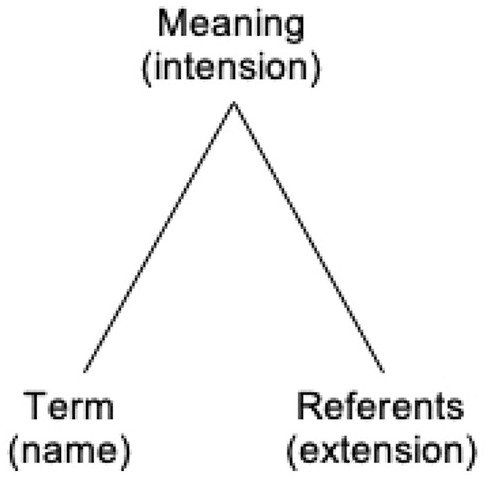
As the basic scheme for any conceptual analysis, Sartori (1984) introduced an amended version of the Ogden and Richards (1946) triangle, emphasizing the following three basic components: (1) the term used to denote the concept, (2) the meaning of the concept, and (3) its empirical referents. Defining concepts as the basic units of thinking, the starting point for Sartori’s approach is thus that ‘a concept has a meaning, needs a term, and, if empirical, points to referents’ (Sartori, 1984: 27). Figure 1 illustrates the triangular relationship.
Sartori’s (1984) basic scheme for conceptual analysis.
The meaning, also called the intension, consists of all defining characteristics or attributes of the concept. As the first analytical step, it can essentially be viewed as a reconstruction of the concept from the literature. Specifically, it is achieved by collecting a set of representative definitions, extracting relevant characteristics, and organizing them in a meaningful way (Sartori, 1984). According to a study by Patrick (1984), where the author applies Sartori’s guidelines, representative definitions should be assessed based on their originality and scholarly influence. The intension is juxtaposed to the extension, that is, the empirical referents. The extension is the collection of objects or entities to which the concept refers, that is, the ‘real-world counterpart’ to the concept in our heads (Sartori, 1984: 24).
The relation between meaning and referents in Figure 1 indicates that the set of defining characteristics should be able to bind the concept empirically, thus clearly distinguishing between objects that belong inside and outside of these boundaries. If this is not achieved, it will introduce vagueness into the analysis, such that the meaning-to-referent relation becomes fuzzy and unclear. Finally, the relation between meaning and term, that is, the other side of Figure 1, indicates that the conceptualization should be free of ambiguity. Ideally, the term should thus univocally represent the meaning of the concept. According to Sartori (1984), this is achieved by relating the term to its semantic field, that is, to associated, neighboring words, clearly establishing their similarities and, more importantly, their differences. In combination, the overall goal of the three components of the analysis is to reach a conceptualization that is both adequate and parsimonious (Sartori, 1984).
The ladder of abstraction
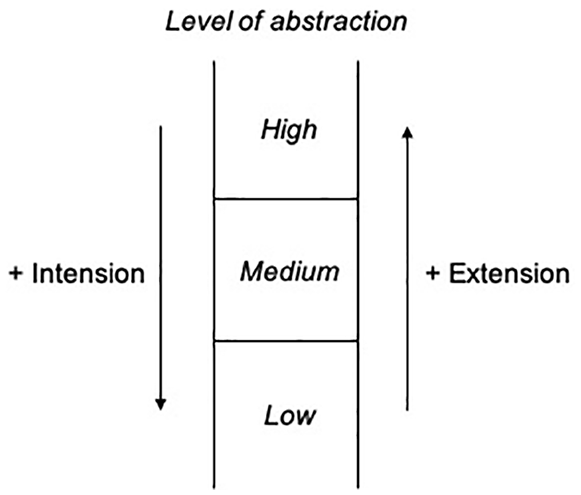
Overall, the relationship between the meaning and the referents, that is, between the intension and the extension, is inverse. 1 As such, the number of empirical referents increases as the number of defining characteristics decreases. Within Sartori’s (1970, 1984) approach, a concept is therefore vertically, or hierarchically, organized along a ladder of abstraction. At each step of the ladder, the intension-to-extension ratio is different, starting with the smallest intension and the largest extension at the top, and then inversing this relationship as the ladder is descended. Figure 2 illustrates the ladder of abstraction graphically.
The ladder of abstraction (Sartori, 1970, 1984). A greater intension descends the ladder, while a greater extension climbs the ladder.
From the logic of the ladder, it follows that when the concept is at its highest level of abstraction, the intension consists only of the very core characteristics, such that it refers to the largest possible collection of objects. It is universal. The ladder is descended by adding characteristics, that is, increasing the intension, thereby decreasing the number of objects to which the concept can refer. Specifically, additional characteristics thus lead to the development of more concrete subtypes. According to Sartori (1970: 1041), this involves at least two additional analytical steps, that is, the descend to a medium and to a low level of abstraction. At the medium level, categorizations ‘fall short of universality’ (Sartori, 1970: 1041) enabling the development of general subtypes or classes. At the low level of abstraction, the extension is at its most specific, often situated within a concrete context. Here, the corresponding subtypes are consequently as concrete and differentiated as possible (Sartori, 1970).
As a final methodological point, the rigidity of balancing the intension and extension along the ladder of abstraction is central to avoiding the pitfall of conceptual stretching. Sartori (1970: 1041) defined conceptual stretching as ‘an attempt to augment the extension without diminishing the intension’, and he coined this to be a key issue in the social science discipline. In general terms, any movement along the ladder must involve a change in both characteristics and empirical referents, thus steering clear of vagueness and generalities that are not conceptually sound. In an oft-cited paper by Radaelli (2002), the author exemplifies the issue of conceptual stretching for the concept of Europeanization. Applying Sartori’s guidelines, Radaelli (2002: 4) argues that studies of Europeanization tend to ‘privilege extension’, such that scholarly definitions include an increasing amount of empirical observations, spanning changes in culture, identity, policy, and administration. However, if this is done without a clear reduction in the intension, it becomes difficult to identify the conceptual boundaries. As such, in his article, Radaelli (2002) stresses the need to restore conceptual clarity by ensuring balance between intension and extension at the desired level of abstraction.
Building the concept of trust
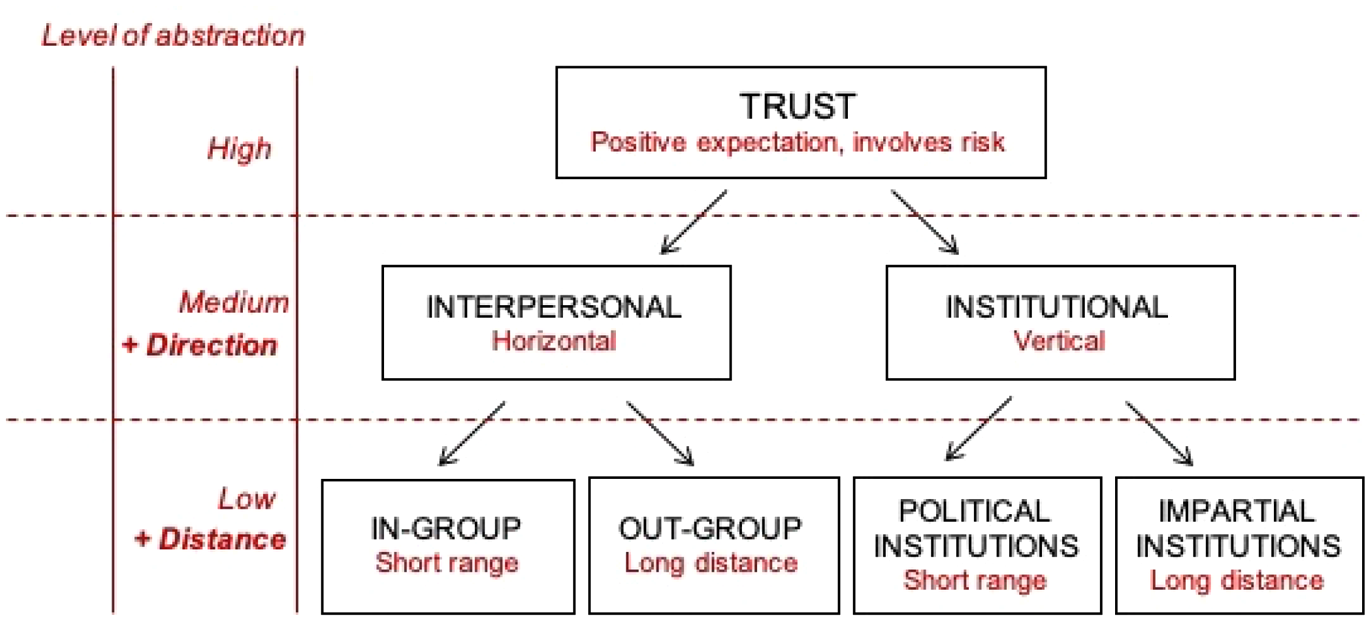
Having introduced Sartori’s conceptual guidelines, I will now apply them to the concept of trust. The analysis will center around the three levels of abstraction, increasing the intension with additional characteristics at each step. At the highest level, I discuss relevant definitions of trust across multiple disciplines in the social sciences, which I use to identify and extract the most universal, common characteristics of the concept. At the medium level, I develop a general distinction between interpersonal and institutional trust, achieved by introducing the additional characteristic of direction. At the low level, both interpersonal and institutional trust are further split into two distinct subtypes, achieved by introducing the additional characteristic of distance. The result is a systematic conceptual framework, which is hierarchically organized and ultimately describes the concept of trust in its entirety.
I start off this section by displaying the complete conceptual framework graphically with Figure 3. I conduct the conceptual analysis below, developing the concept at each level of abstraction in turn and using Figure 3 as my point of reference.
The conceptual framework for trust.
High abstraction: Trust as a universal concept
As influentially stated by sociologist Robert Wuthnow (2004), diverging conceptualizations of trust across the multidisciplinary literature represent a core conceptual challenge: ‘The diversity of ways in which trust has been conceptualized has meant that scholars sometimes seem to be writing about different things, or at least could benefit by an effort to bring their various perspectives closer together’ (p. 147). With the conceptual analysis conducted here, I set out to tackle this challenge. In particular, I aim to define trust in a way that can travel across disciplines and establish common conceptual ground. Overall, I argue that past efforts to achieve this are mainly found within sociology. During the 1990s, sociologists Misztal (1996) and Sztompka (1999) both published comprehensive and influential studies of trust, generally stressing that trust entered the sociological scene later than it did other disciplines. Their conceptualizations therefore sprung from political and psychological writings and included both a calculative aspect, emphasizing the trustworthiness of others, and a personal aspect, emphasizing the trustfulness of oneself (Misztal, 1996; Sztompka, 1999). In line with a general notion raised by Lewis and Weigert (1985), the mix of the aspects is likely to differ for different types of trust. I elaborate on this point at the end of the analysis, as I discuss how the disciplines interact within the structure of the conceptual framework overall.
At the highest level of abstraction, I am therefore looking for common and ‘neutral’ characteristics within the range of multidisciplinary scholarly definitions. Overall, I have identified two such characteristics, which I argue define trust at its core. First, trust is defined as a positive expectation about the intentions and behavior of others (Rousseau et al., 1998). Second, trust involves risk. Once extended, one does not engage in monitoring activities, but instead accepts a certain vulnerability for the chance of building efficient and beneficial relationships (Offe, 1999). Across the literature, the idea of trust as a positive expectation, or relatedly, an anticipation or a belief, permeates the conceptualizations of central scholars, notably those of Fukuyama (1995), Offe (1999) and Rousseau et al. (1998), in addition to those of Misztal (1996) and Sztompka (1999). The same holds true for the intimate relationship between trust and risk. As such, I argue that these two characteristics always define the concept, regardless of the school of thought. Appearing as the most recurring defining attributes in the literature, they comprise the intension of trust at the highest level of abstraction.
Furthermore, in an oft-cited study from 1994, Yamagishi and Yamagishi argued that for trust to exist, there must be social uncertainty, where one cannot completely predict the actions of others, who, in turn, might have an incentive to act dishonestly. Social uncertainty can thus be viewed as the underlying assumption for any kind of trust to arise in the first place. If social relations could be characterized by total certainty or commitment, it would no longer be necessary to take the leap of faith, or the bet, of extending trust to others in society (Stolle, 2002; Sztompka, 1999). In fact, Yamagishi and Yamagishi (1994) take this notion one step further by arguing that ‘trust provides a solution to the problems caused by social uncertainty’ (p. 131). Specifically, it makes it possible to step out of committed relations and engage with opportunities in society as a whole, without incurring significant transaction costs in the process (Yamagishi and Yamagishi, 1994).
A wider theme in the study by Yamagishi and Yamagishi (1994), which holds true for the literature of trust overall, has been a generally positive portrayal of the concept. Trust is desirable. Closely intertwined with scholarly accounts of democracy, trust has been described as an ‘efficient and money-saving’ tool (Offe, 1999), a ‘social lubricant’ (Yamagishi and Yamagishi, 1994), which ‘makes democracy work’ (Putnam, 1993). The positive notion of trust resonates most clearly with social capital theory, greatly advanced by Putnam (1993, 2000). Social capital theory specifically argues for the importance of trust toward fellow citizens in general, which, through formal and informal social networks, enables the cooperative behavior necessary for a well-functioning democratic society. As such, the presence (or absence) of trust arguably plays a central role in all of our relationships, not just in the private sphere, but also in our interactions within wider society and the political system as a whole. It encourages tolerance, breeds cooperation, and lessens the general need to enforce compliance, thereby freeing up public resources for other activities (Putnam, 1993; Tocqueville, 2002; Uslaner, 2002).
While the benefits of trust are well-established in general, the unequivocal need for trust in democracies has been challenged by another scholarly tradition, which centrally emphasizes the ‘dark side’ of trust (Norris, 2022: 4). Here, scholars argue for a paradoxical relationship between trust and democracy, stressing the need for both trust and distrust (Norris, 2022; Sztompka, 1997, 2010; Warren, 1999, 2017). Specifically, the positive consequences of trust are acknowledged at the level of civil society. A democracy flourishes in the presence of a ‘culture of trust’; that is, where citizens interact with openness, spontaneity, and optimism as a result of mutual trust (Sztompka, 1997). Concurrently, however, there must exist an ‘institutionalized distrust’, which enables citizens to hold political leaders accountable for their actions, and ensures the alignment of interests between the governed and those in power (Warren, 2017). As such, at the institutional level, democracies call for skeptical citizens. In this context, low trust can be just as valuable as high trust among citizens, merely reflecting their assessment and monitoring of current political institutions (Wu and Wilkes, 2018).
So far, I have defined trust as a positive expectation that will always involve an element of risk. Related, I have introduced social uncertainty as a necessary condition for trust to occur. I have further specified that, despite a dominant narrative, the concept should neither be portrayed as fundamentally ‘good’ nor ‘bad’. While still keeping the conceptualization multidisciplinary, I wish to emphasize a unique feature about the origin of trust, which holds true for the concept universally. The feature was made prominent by sociologist Misztal (1996), who, building on the work of Elster (1993), described trust as a ‘social mechanism’ that is, as an explanation for people’s actions, based on their motivations and beliefs. Elster (1993) further defined a social mechanism as ‘a specific causal pattern that can be recognized after the event but rarely foreseen’ (p. 3), which, in this regard, would suggest that trust can only be achieved indirectly: bluntly telling someone to trust you will likely make them question your intentions, thereby creating distrust toward you instead. As such, trust does not come from a simple decision to do so, but rather as the result, or the ‘by-product’ (Elster, 2015) of otherwise desirable behavior. This perspective has also been seconded in the accounts of sociologist Offe (1999, 2004), who centrally stressed that trust cannot be created for the ‘sake of its consequences’ (Offe, 2004: 12). Instead, it must originate indirectly from sources that are unrelated to its potentially beneficial effects.
Semantic field
I conclude this section with a brief discussion of trustworthiness, which I view as the closest concept within the semantic field of trust. The difference between the two concepts was a central aspect of Hardin’s (1993, 2002) theoretical writings. Specifically, the author emphasized that ‘many discussions of trust run trust and trustworthiness together, with claims about trust that might well apply to trustworthiness but that seem off the mark for trust’ (Hardin, 1993: 512).
As such, Hardin identified a problematic tendency in the literature, where accounts of trust largely addressed the neighboring concept of trustworthiness, without specifying or even discussing that the two concepts are distinct. The issue remains relevant, playing a central role both in the early work of Yamagishi and Yamagishi (1994), in the work of Sztompka (1999), and in the recent work of Norris (2022). Examining the authors’ conceptual definitions of the two terms, a common theme is that they generally view trust as a broader concept than trustworthiness. Specifically, both Yamagishi and Yamagishi (1994) and Sztompka (1999) emphasize a close link between trustworthiness and reputation, which essentially makes the assessed trustworthiness of others one possible explanation for why individuals extend their trust. Specifically, trustworthiness then becomes a part of the rational explanations of trust, representing the result of strategic assessments of the reputation, performance or appearance of potential trustees (Sztompka, 1999).
More generally, I have argued that a universal conceptualization of trust exists above any particular school of thought. This centrally implies that trust is neither a fully rational nor a fully psychological concept, but instead that both of these dimensions will always be present in all forms of trust. As such, since trustworthiness appears in the literature as an intrinsic part of rational theories, it must logically not be as universal a concept as trust itself. To exemplify this, I argue that trust, in different forms, can resemble either more of an individual quality, that is, that one is generally high or low trusting, or a feature of a relationship, that is, a concrete assessment of others’ behavior or intentions. By contrast, trustworthiness falls entirely in the latter category (Norris, 2022).
In the next sections, I introduce the subtypes of trust at the medium and low levels of abstraction. I do this by sequentially adding more defining characteristics, thereby gradually increasing the intension of the concept.
Medium abstraction: Interpersonal and institutional trust
In line with Sartori’s (1984) conceptual guidelines, the medium level of abstraction typically establishes general subtypes of the concept, which fall short of universality. Here, I establish the subtypes by introducing an additional characteristic, which clarifies the direction of trust (Offe, 2004; Sztompka, 2010).
If trust is horizontal, it occurs between people. It is symmetrical, such that the actors on both sides of the trusting relationship are on equal terms. As a general subtype, this is called interpersonal trust, and its extension covers any kind of trust you extend to others in society (Freitag and Traunmüller, 2009; Rotter, 1980). It thereby includes both the specific kind of trust shared between family members, friends, or acquaintances, and the general kind of trust shared between strangers (Zmerli and Newton, 2017).
If trust is vertical, however, it occurs between citizens and power holders. Consequently, it is asymmetrical, such that the actors of the trusting relationship are at different levels of authority. The extension of this subtype covers the trust you extend to all parts of the political system, that is, to a wide range of public institutions. As such, it is called institutional trust (Rothstein and Stolle, 2008). It includes both a more specific and partisan trust toward political institutions, such as the incumbent government and parliament, and a more general and neutral trust toward impartial institutions, such as the justice system or the armed forces (Rothstein and Stolle, 2008).
With the introduction of institutional trust specifically, it becomes necessary to further define what is meant by ‘institutions’ in a conceptual framework of trust. Following the work of the prominent scholar North (1990), ‘institutions are the rules of the game in society, or, more formally, are the humanly devised constraints that shape human interaction’ (p. 3). North (1990) distinguished between formal institutions with established and binding rules for society, and informal institutions characterized by unsystematic, yet generally agreed upon, codes of behavior. Within the framework of trust, I limit the definition of institutions to formally established rules. As such, I am referring to institutions that provide well-defined structure to society overall, be it through the partisan rules of the political institutions, or through the neutral rules of the impartial institutions.
Overall, interpersonal and institutional trust were developed by increasing the intension of trust to include a horizontal and vertical direction, thereby decreasing the extension of the two subtypes respectively. They are thus placed at the medium level of abstraction, as depicted graphically in Figure 3. Throughout the literature, interpersonal and institutional trust continues to represent the most general conceptual distinction of trust, albeit discussed under somewhat diverging terms (Luhmann, 1979; Offe, 1999; Putnam, 2000; Sztompka, 1999, 2010; Zmerli and Newton, 2017). Luhmann (1979) influentially argued that personal trust and system trust rest on different bases. Putnam (2000) and Zmerli and Newton (2017) prominently discussed the relationship between social trust and political trust. Finally, Offe (1999) and Sztompka (1999, 2010) centrally distinguished between interpersonal and institutional trust, emphasizing their horizontal and vertical natures as a key conceptual point.
In a topical overview by Algan (2018: 291), the author concludes that institutional trust is at ‘an earlier stage of both theoretical and empirical development than that of interpersonal trust’. Thus, scholarly consensus on both the intension and the extension of institutional trust is lacking, as compared to interpersonal trust. With the next section, I tackle this issue by developing the two subtypes in parallel. I thereby make their intension and extension at the lowest level of abstraction systematically comparable.
Low abstraction: The concrete subtypes of trust
I descend the ladder of abstraction one last step by introducing an additional characteristic, which clarifies the distance of trust (Freitag and Traunmüller, 2009; Offe, 2004). I argue that just by specifying this one characteristic, I am able to define the concrete subtypes of both interpersonal and institutional trust, present at the lowest level of abstraction. Furthermore, the characteristic of distance highlights the relational nature of trust, as it describes the figurative length between the actors in the trusting relationship (Offe, 2004).
In the short range, trust is concrete and particularistic (Offe, 2004). It reflects actual experiences and knowledge about the intention and behavior of others. More specifically, trust in close proximity is thus reserved for situations with a stronger emotional component, repeated interactions, or known information about the incentive structure of other actors (Putnam, 2000; Yamagishi and Yamagishi, 1994). As such, regardless of whether trust in the short range occurs within interpersonal or institutional contexts, it refers to situations where the other actors in the trusting relationship are personalized. 2 In that sense, it can be described as exclusive, limited only to those about whom one can acquire concrete knowledge (Offe, 2004).
At a long distance, however, trust is generalized. Removed from ‘particularistic markers of trustworthiness’ (Offe, 2004: 6), trust at a long distance rather reflects an optimistic worldview, that is, an assumption that other actors generally share your fundamental values (Freitag and Traunmüller, 2009; Uslaner, 2002). Thus, it refers to situations where the other actors in the trusting relationship are impersonalized, making them figuratively (and likely also literally) distant. 3 Without actor-specific knowledge, trust at a long distance can be described as inclusive (Offe, 2004). The decision no longer depends on, and is limited to, specific actors, but rather reflects a general decision to extend your ‘radius of trust’ beyond immediate familiarity.
Subtypes of interpersonal trust
Within the literature, the distance-based distinction is usually reserved for trust within the interpersonal realm (Freitag and Traunmüller, 2009). The ‘radius of trust’ thesis, formulated by Fukuyama (1995), specifically suggests that interpersonal trust is expected to vary by distance. It remains a central part of theoretical and empirical research on the topic, notably with theoretical discussions by Putnam (2000) and Offe (2004), with an empirical analysis by Freitag and Traunmüller (2009) on the ‘spheres of trust’, and most recently with Norris’ (2022) broad empirical study of trust and skepticism.
In the interpersonal context, trust in the short range refers to trust within your daily surroundings, such as that shared with family, friends, or acquaintances. This is usually referred to as in-group trust (Norris, 2022). It has been argued to be the most robust type of trust, since, in the words of Uslaner (1999), ‘everyone must trust someone’ (p. 123). As such, at the very least, individuals are expected to trust those in their smallest social radius. In a study by Newton and Zmerli (2011: 183), they found empirical evidence for this claim in a wide range of democratic countries, where only 0.1% of thousands of surveyed individuals reported no in-group trust whatsoever. This type of trust is comparable to Putnam’s (2000: 22) ‘bonding social capital’, and Granovetter (1973: 1360) ‘strong ties’, both of which described the nature of different kinds of social relations. Thus, in-group trust is thick, it is exclusive, and it usually emerges in closed-knit interactions with people of similar backgrounds (Freitag and Traunmüller, 2009; Granovetter, 1973; Putnam, 2000).
In direct contrast, interpersonal trust at a long distance resembles Putnam’s (2000: 22) ‘bridging social capital’ and is characterized by the ‘weak ties’ that emerge in socially distant interactions among people of various backgrounds (Granovetter, 1973: 1360). As such, it refers to trust in people in general, that is, those about whom one has no prior knowledge. This is usually referred to as out-group trust (Norris, 2022). It is thin and inclusive in nature (Putnam, 2000). The ability of out-group trust to build social relations across different groups, such as social classes, religions, ethnicities, or nationalities, makes it a powerful phenomenon both in civil society and in the political sphere (OECD, 2017; Putnam, 1993; Yamagishi and Yamagishi, 1994). As part of his contributions to social capital theory, Putnam (1993) famously argued that out-group trust vitally enables cooperative behavior in society at large. Furthermore, Yamagishi and Yamagishi (1994) argued that out-group trust allows individuals to move beyond closed-knit social relations, thereby enabling them to partake in beneficial opportunities in society overall. Both Putnam (1993) and Yamagishi and Yamagishi (1994) stand out as early and central theorists of the importance of out-group trust, and they remain oft-cited in later theoretical and empirical studies on the topic (Freitag and Traunmüller, 2009; Nannestad, 2008; Norris, 2022; OECD, 2017).
Overall, I argue that the characteristic of distance is a powerful tool for distinguishing the subtypes of both interpersonal and institutional trust conceptually. It is, however, important to note that proximity in itself does not necessarily breed trust. Ethnographic studies conducted within African societies, particularly Morocco and Cameroon, have found evidence that certain social contexts are likely to connect proximity to mistrust instead (Carey, 2017; Geschiere, 2013, 2019). Defined as ‘a general sense of unreliability of a person or a thing’, Carey (2017: 8) argues that mistrust should not simply be viewed as low levels of trust, but rather as a related, yet distinct, concept on its own. According to the ethnographic accounts by Carey (2017) and Geschiere (2013), social and cultural factors present in the African societies examined were creating a deep-seated mistrust within close relationships, rather than a familiar sense of trust. As a result, betrayal was viewed as an expected interpersonal feature. The findings of Carey (2017) and Geschiere (2013) thereby add an important contextual perspective to the understanding of how and where interpersonal trust is likely to arise. As their studies show, contextual factors can largely diminish this concept from close relationships. However, with the conceptual framework developed in this article, I do not apply or discuss the characteristic of distance as a driver of interpersonal trust. Instead, distance is simply viewed as a helpful, conceptual tool to distinguish between the concrete subtypes, in-group, and out-group trust.
Subtypes of institutional trust
As previously mentioned, the subtypes of interpersonal trust are generally more well-established than those of institutional trust. Most concretely, the lack of scholarly consensus surrounds the number and specificity of possible subtypes in the institutional realm (Bauer and Freitag, 2018; Marien, 2017). Extending the distance-based distinction to this context therefore enables me to contribute to a strand of the trust literature that currently lacks conceptual clarity. More specifically, I use the distinction to systematically conceptualize institutional trust, while also ensuring symmetry in my conceptual framework overall. My approach builds on the work of Offe (2004), who made the general argument that trust in the short range and trust at a large distance both can operate at the interpersonal and the institutional level. As such, my conceptual framework includes two subtypes of institutional trust. Just as for interpersonal trust, the subtypes can be distinguished by the characteristic of distance and are placed at the lowest level of abstraction (as depicted in Figure 3).
Institutional trust in the short range refers to trust in political officials, or groups of officials, about whom you can acquire concrete knowledge. It is therefore particularistic of nature (Offe, 2004). The recipients of this kind of trust are personalized and include political parties, the government, and the parliament. Thus, it covers the representational part of the political system, it is rooted in partisanship, and it can therefore be considered to be volatile (Rothstein and Stolle, 2008). Following the influential study of institutional trust conducted by Rothstein and Stolle (2008), I simply label this subtype ‘trust in political institutions’. Figuratively within a short range, this subtype of trust is likely to be updated frequently, as individuals acquire new knowledge about, or discover new experiences with, current political officials (Rothstein and Stolle, 2008).
By contrast, institutional trust at a long distance refers to trust in the neutral, or impartial, parts of the political system (Offe, 2004). The recipients of this kind of trust are impersonalized and include the courts, the armed forces, and the police in its entirety. As institutions characterized by implementation rather than representation, this type of trust is rooted in impartiality, and consequently labeled ‘trust in impartial institutions’ (Rothstein and Stolle, 2008). As such, by removing partisan aspects, particularly conflict and diverse political interests, it is the direct counterpart to trust in political institutions, and it can therefore be considered to be more stable overall (Rothstein and Stolle. 2008). In order to trust impartial institutions, one does not need to actively participate and check whether current political interests align, but can rely on general expectations about the fairness of the political system (Rothstein and Stolle, 2008). As a result, it is generalized in nature (Offe, 2004). The aspect of impartiality indicates that the institutions are figuratively further away from individuals, compared to the political and partisan institutions of its conceptual counterpart.
In sum, the distinction between partisanship and impartiality in institutional trust gained scholarly ground with the work of Rothstein and Stolle (2008). Though it is still somewhat debated (Zmerli and Newton, 2017), I advocate for its usefulness in trust research more broadly, by developing it in a systematic way and as a central part of my conceptual framework. With this discussion, I conclude the development of the conceptual framework, as depicted graphically in its totality in Figure 3.
Combining the disciplines
With the conceptual analysis, I have now established trust at the three levels of abstraction. In addition to the universal concept at the highest level, I have introduced two subtypes at the medium level, and four subtypes at the lowest level of abstraction. The framework has been developed above any particular discipline, since scholars within political science, psychology, and sociology tend to emphasize different aspects of trust in their definition. As such, the framework aims to connect and acknowledge the multiple, diverging conceptualizations of this increasingly popular concept in the literature.
In this section, I reintroduce the disciplines. Overall, I argue that the multidisciplinary conceptual debate can broadly be summarized by two contrasting perspectives, reflecting either a psychological or a rational approach to the conceptualization of trust (Norris, 2022; Uslaner, 2018). Here, I combine these different approaches, as I build an argument for how their comparative strength varies at the different levels of abstraction in my conceptual framework. I thereby build on the work of sociologists Lewis and Weigert (1985), and later Sztompka (1997, 1999), who concretely argued that aspects of rationality and psychology are present in all types of trust. What further distinguishes the types, then, is their variation in the strength and importance of these different aspects (Lewis and Weigert, 1985: 972).
The rational approach prevails within the political science literature (Hardin, 2002; van Elsas, 2015). Here, trust is defined as a calculation, a rational choice that is directly rooted in an assessment of the trustworthiness of others (Coleman, 1990; Hardin, 2002). It thereby reflects concrete knowledge and experiences and plays a central role for trust in the short range. By extending your trust, you have evaluated the person or institution in question, and made the rational decision that it is in their interest to be trustworthy. From a purely rational standpoint, it follows that trust is volatile. As a primarily evaluative decision, it is naturally much more specific in nature, targeted directly to the situation at hand (van Elsas, 2015). Rationality is not sufficient for trust on its own though. As argued by Lewis and Weigert (1985), ‘no matter how much additional knowledge of an object we may gain, however, such knowledge can never cause us to trust’ (p. 170).
In addition, we therefore need to consider the psychological aspect of trust. Within the psychological literature, trust is prominently defined as a personality trait, a predisposition, which is either innate or developed through early childhood socialization (Jones, 1996; Uslaner, 2002). It is thereby based primarily on one’s own configuration of values, and on the fundamental assumption that others share those same values with you. As a trusting person, you will thus be characterized by having an optimistic worldview, and by generally believing in the goodwill of others (Stolle, 2002; Uslaner, 2002). Consequently, from a purely psychological standpoint, trust is stable. When defined as a personality trait, it should not vary significantly across different situations. Instead, it reflects your predisposed, or general, sense of trust, which is consistent and largely independent of the context (Freitag and Traunmüller, 2009). Thus, it plays a central role for trust at a long distance.
Sociology as the bridging discipline
Crucially, rather than reducing trust to an entirely cognitive concept, sociological scholars have presented trust as an ‘irreducible and multidimensional social reality’ (Lewis and Weigert, 1985: 967, based on the accounts of Barber (1983) and Luhmann (1979). Simply put, each person trusts based on the assumption that others also trust (Lewis and Weigert, 1985: 970). As such, sociologists view trust as an intrinsic part of social relationships (Misztal, 1996). It is neither fully rational nor fully psychological, but rather a mix of these two aspects within an environment of social relations and interactions. As stated in general terms by Misztal (1996), ‘a sociological approach, which focuses on the way in which individuals and society interact, generally argues that social relations and interactions are the points of origin of motivations and beliefs’ (p. 19).
This arguably holds true for trust. Defined most generally as a positive expectation, or belief, social relations and interactions can be viewed as the points of origin. Thus, by viewing sociology as the bridging discipline between political science and psychology, I argue that trust matters because we engage in various and wide-reaching relationships. Within this arena, trust can then either be driven by a more rational, or by a more psychological aspect, depending on the context.
Rationality and psychology in my conceptual framework
As the final contribution of my conceptual analysis, I therefore develop a systematic argument for how the rational and psychological aspects interact across the entirety of my conceptual framework. Thus, based on the bridging conceptual strategy from sociology, my starting point is that all forms of trust, at all levels of abstraction, contain aspects of rationality and psychology with varying comparative strength. I then concretely propose to connect their comparative strength to the hierarchical structure of my framework. Specifically, I draw a direct parallel between the intension-to-extension ratio of my conceptual approach, and the rationality-to-psychology ratio of the concept itself.
As previously established, the intension and extension of any concept are inversely related, such that the smallest number of defining characteristics, the intension, refers to the largest number of empirical referents, the extension (Sartori, 1984). Just as the dynamic of this relationship was organized along the ladder of abstraction, I argue that the same ladder can be used to describe the relationship between rationality and psychology in the different forms of trust.
At the highest level of abstraction, trust is defined by its core characteristics only. Situated at the top of the ladder, no specifications have been made about the nature of the trusting relationship, neither in terms of the direction, nor in terms of the distance. Trust at this level is thereby non-situational, which, I argue, implies that it must be predominantly psychological. Without any further information about the context, trust is primarily based on the trustfulness of oneself, that is, one’s psychological propensity to trust in general. As previously outlined, trust is viewed as a personality trait within the psychological literature (Jones, 1996). When making trust decisions, this implies that the concrete situation matters much less than one’s predisposed, or general, level of trust. No concrete situation is defined at the highest level of abstraction, which must make the psychological aspect of the concept dominant.
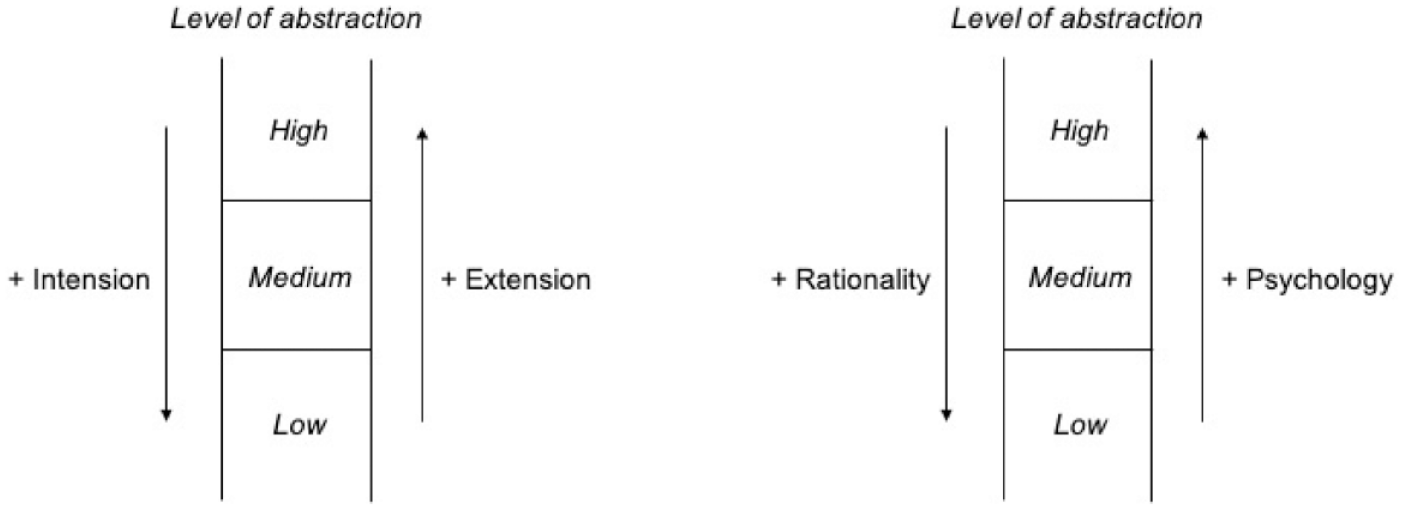
By descending the ladder of abstraction, the trusting relationship becomes increasingly specific. In the development of my conceptual framework, I enlarged the intension by adding more defining characteristics until four concrete subtypes of trust were identified. It follows that these four subtypes are, indeed, situational. At the lowest level of abstraction, the trusting relationships are fully defined, which means that there now exists a range of concrete information to base one’s trust decisions on. I argue that this enables the rational aspect to be much more prominent. A rational trust decision requires knowledge about, and experiences with, the actor or institution in question. By construction of my conceptual framework, this only exists for trust at the lower levels of abstraction. I depict this idea graphically in Figure 4, showing the ladder of abstraction as the focal point first, for Sartori’s methodological relationship between the intension and extension, and second, for the relationship between rationality and psychology in my conceptual framework for trust.
Left side: The ladder of abstraction as shown in Figure 2. Right side: An extension, showing how the same ladder can be used to combine rational and psychological aspects of trust.
Combining the arguments made at each end of the ladder of abstraction, it follows that the psychological and rational aspects of trust are inversely related. While still maintaining their shared presence within all forms of trust, I argue that their comparative strength can be directly linked to the hierarchical nature of my conceptualization, as shown graphically with Figure 4. Compared to the current literature, the general argument represents a different take on how these two aspects of trust interact.
Specifically, with the relationship between rationality and psychology developed here, I argue that their comparative strength can be mapped out in a vertical space, just like the concept of trust itself. By contrast, in previous scholarly debates, the relationship has only been mapped out in a horizontal space, focusing on their interplay among concrete subtypes of trust. Thus, with my argument, I suggest that the discussion should not be limited to the lowest level of abstraction. Trust is a hierarchical concept, and if all forms of trust contain both a rational and psychological aspect, this relationship also needs to be understood in the context of the hierarchical structure of the concept as a whole.
Rationality and psychology at the lowest level of abstraction
By emphasizing the vertical nature of trust, I am not, however, dismissing the horizontal scholarly argument in its entirety. Crucially, I acknowledge that even at the lowest level of abstraction, the comparative strength of psychology and rationality can – and does – still differ quite significantly.
In the final stage of the development of my conceptual framework, I introduced the additional characteristic of distance, which allowed me to descend the ladder of abstraction to the lowest step. Concretely, I distinguished between trust in the short range, and trust at a long distance, which undeniably differ in their combination of rationality and psychology. As such, when trusting relationships are defined within a short range, they are particularistic and personalized (Offe, 2004). This naturally strengthens the comparative aspect of rationality. Referring back to Figure 3, the two subtypes characterized by this attribute were in-group trust and trust in political institutions. In both cases, the conditions for making rational assessments of the trustworthiness of others are arguably at their most optimal, as concrete information and experiences about the actor (e.g. friends or family) or institution (e.g. the government or parliament) in question are widely accessible.
However, when trusting relationships are defined at a long distance, they are generalized and impersonalized (Offe, 2004). This naturally strengthens the comparative aspect of psychology. Reflecting the subtypes of out-group trust and trust in impartial institutions, as shown on Figure 3, the level of concrete information or experiences required for a rational trust assessment is limited. When trust is defined with an impersonalized recipient in mind, be it strangers or neutral institutions in their entirety (e.g. the justice system), it follows that the trust decision must be driven more strongly by one’s psychological predisposition to trust. The comparative strength of psychology is thereby more prominent for trust at a long distance, while the opposite holds true for trust in the short range.
Central to my argument, then, is that although the concrete subtypes of trust display varying combinations of rationality and psychology, they are all placed at a level of abstraction where the rational aspect is comparatively stronger than the psychological aspect overall. For all four subtypes, the trusting relationship is fully defined. I know whether the form of trust is interpersonal or institutional, and I know whether the form of trust is occurring within close proximity or at a longer distance. There is fundamentally more information available at the lowest level of abstraction, and even for the subtypes where this is less tangible, it nonetheless defines the context of the trust decision. Thus, while the conditions for making rational assessments of trust can be more or less optimal among these four subtypes of trust, they are still strictly better than for trust at the highest level of abstraction. Given that trust at the highest level of abstraction necessarily covers all possible trusting relationships, it must have a stronger psychological aspect than any form of trust that is less abstract.
With the development of this vertical argument, I have thus made a systematic connection between my overarching conceptual framework, and the two central, yet diverging, aspects of trust that have arisen from the multidisciplinary literature. Representing a different take on the relationship between rationality and psychology for different forms of trust, my argument nuances current conceptual debates on the topic, particularly by expanding the discussion to trust at different abstraction levels.
Concluding remarks
In summary, with this article, I have conducted a conceptual analysis of trust, which includes and combines aspects from multiple disciplines of the social sciences. Applying Sartori’s (1970, 1984) guidelines for conceptual analysis, I have developed the concept of trust along the ladder of abstraction, resulting in a systematic conceptual framework of trust in its entirety. As such, the framework was initially developed above any particular school of thought, acknowledging diverging and influential conceptualizations from the literature as a whole. As a result, I centrally argued that trust is neither fully rational nor fully psychological, but rather that both aspects will be present in all types of trust with varying comparative strength (Lewis and Weigert, 1985; Sztompka, 1999). By connecting their comparative strength to the hierarchical nature of the concept, I have provided a new and extended perspective on a conceptual debate that usually occurs at the lowest level of abstraction only.
As a multidisciplinary concept, I emphasized sociology as a bridging discipline, building on theories from political science and psychology in combination. Specifically, I argued that trust, in all accounts, arises due to an underlying assumption of ‘social uncertainty’ (Yamagishi and Yamagishi, 1994), and functions as a ‘social mechanism’ (Elster, 1993). Within this setting, trust can develop in different ways, focusing, to various extents, on either the trustfulness of oneself, or the trustworthiness of others.
The resulting framework defined a positive expectation and risk as the core characteristics of trust universally. Descending the ladder of abstraction in two steps, I then first added the characteristic of direction, and second, the characteristic of distance, ultimately developing four concrete subtypes: in-group and out-group trust, and trust in political and impartial institutions. Thus, in its entirety, the framework spans both interpersonal and institutional contexts with all subtypes developed systematically and in parallel.
Footnotes
Funding
The author(s) disclosed receipt of the following financial support for the research, authorship, and/or publication of this articleThe research leading to these results received funding from Hertie School, Berlin, Germany (PhD stipend).
