



Abstract
This article discusses how, in today’s world of disruptive and dramatic social change, non-sports related coaching, which includes a wide range of services such as life coaching, career coaching, executive coaching, and team coaching, can inadvertently fuel undesirable social dynamics. There is little or no awareness of this risk among coaches and coachees. The global, fast-growing, multi-billion-dollar industry aimed at supporting people and organizations to perform better and increase wellbeing while managing and adapting to change has been developed with limited sociological input. The article is based on 15 years of social constructionist-informed reflective practice by a sociologist-turned-coach, and uses a multi-layered theory-driven autoethnographic account to argue for a sociologically informed paradigm shift in coaching, as well as relevant sociological knowledge, learning sciences, and action research methodology in coaches’ education. It presents the rationale and key features of a new coaching approach that places dramatic social change-relevant sociological concepts at the heart of the process, helps people develop psycho-sociological awareness, and uses a learning-to-develop through research design. A new definition of coaching to address dramatic social change is derived. Coaching practitioners will find dramatic social change-relevant sociological concepts, critical reflections, coaching questions, and procedures to expand coaching effectiveness. Interdisciplinary research topics are proposed, combining coaching sociology – which must be developed to make coaching a well-founded profession – and coaching psychology, which currently dominates the knowledge production in the field. Implications for workplace strategies to attract, motivate, and retain employees in search of meaning or purpose in life are also suggested.
When people look back [. . .], they might be asking what were coaches doing when the planet was burning? Maybe the answer is . . . actually, coaches were just simply helping their clients to make the fire glow hotter. We’re focusing on amplifying individual and organizational performance, and those might be important issues, but what about the meta or hard to understand issues beyond those?
Introduction
Non-sports related coaching is now a global, fast-growing, multi-billion-dollar industry (ICF, 2020), encompassing a wide range of services known as life coaching, career coaching, business coaching, executive coaching, team coaching, and so on. In this article, ‘coaching’ refers to all of them. The professional providing such a service is called a ‘coach’, and the individual or group with whom the coach is working is called a ‘coachee’. The article places coaching within the context of contemporary disruptive and dramatic social change (DSC) – which has not been specifically done before – and proposes out-of-the-box thinking about the process and its consequences. It highlights important limitations of ‘classic’ (i.e. typically used and respected) approaches and models in DSC contexts, argues for a DSC-relevant sociologically informed paradigm shift in coaching practice and research, and presents the rationale and key features of a new definition of coaching and a new approach and model to address DSC. It provides coaching practitioners, who rarely have a consistent sociological background, with basic sociological concepts relevant to DSC, explained in simple terms. Furthermore, it makes the case for appropriate sociological knowledge, learning science, and research methodology to be included in the education of coaches. It also points to interdisciplinary research topics combining coaching sociology – which must be developed to make coaching a well-founded profession – and coaching psychology, which currently dominates the knowledge production in the field. Implications for workplace strategies to attract, motivate, and retain employees in search of meaning or purpose in life are suggested.
There is no single agreed-upon definition of coaching. It is usually considered one of the ‘helping by talking interventions’ (Tee and Passmore, 2022), with similarities and differences to counseling, consultancy, psychotherapy, training, teaching, mentoring, or mediation (Rosha, 2014). It has long been understood as an ideologically neutral tool for ‘unlocking a person’s potential to maximize their own performance’ (Whitmore, 2009: 9–10), a ‘collaborative solution-focused, result-oriented, systematic process in which the coach facilitates the enhancement of the life experience and goal-attainment in the personal and/or professional life of normal, non-clinical clients’ (Grant, 2003: 254), and a set of ‘technologies of the self’ in a Foucauldian sense:
specific techniques that human beings use to understand themselves [. . .] which permit individuals to effect by their own means or with the help of others a certain number of operations on their own bodies and souls, thoughts, conduct, and way of being, so as to transform themselves in order to attain a certain state of happiness, purity, wisdom, perfection, or immortality. (Foucault, 1988: 18)
The field has long been developed with very limited sociological input and there is a lack of research on how it relates to societal issues such as macroeconomic development, power dynamics and democratic governance, social stratification and inequality, social mobility, corruption, crime, and so on. Although in sports coaching many have noticed that sociology is ‘the invisible ingredient in coaches’ knowledge’ (Potrac and Jones, 2019 [1999]: 55–59; emphasis added) and suggested a wider range of sociological concepts to better inform the practice (Cushion, 2018; Jones et al., 2011; Lee and Corsby, 2021), non-sports coaching has largely evolved either with no consistent theoretical foundation or under the guidance of coaching psychology. In the aftermath of the Great Recession of 2007–2009 (Duignan, 2023), a growing body of critical literature (Chiu, 2022; Gannon, 2021; Shoukry and Cox, 2018) has emphasized the need to analyze coaching as a social process and ‘an enabler for [desired social] change’ (Shoukry, 2017). Several social change-oriented frameworks have been proposed (see summary in Shoukry, 2017) and the International Coaching Federation (ICF, 2019b) has released ‘tips for Incorporating Coaching for Social Change into Your [Coaches’] Work’. While recognizing the progress that has been made, it is important to explore the limitations of these analyses, frameworks and guidelines in order to identify directions for improvement.
Change today, globally, is increasingly disruptive and dramatic. De la Sablonnière (2017) defines DSC as ‘a situation where a rapid event leads to a profound societal transformation and produces a rupture in the equilibrium of the social and normative structures and changes/threatens the cultural identity of group members’ (p. 12). Triggered by various events such as political upheavals, economic and legal reforms, technological innovation, booms of artificial intelligence, violent and powerful protests of large masses, massive migrations, wars, climate change, and other unsettling social or natural phenomena, DSC is now ‘the new normal’ (de la Sablonnière, 2017: 12) affecting millions of people worldwide. Examples of nondisruptive innovation giving us hope that ‘growth fueled by nondisruptive creation occurs without incurring any industrial and social disruption and pain, thus helping to bridge the gap between economic and social good’ (Kim and Mauborgne, 2023: 19) are still few and far between. This is the new context in which coaching must operate. However, the above-mentioned analyses, frameworks, and guidelines did not take into account the DSC concept and did not question the relevance of the ‘classic’ approaches and models in today’s DSC world, overlooking the fact that ‘classics’ were developed in comparatively more stable natural, economic, political, and social contexts. The sociological perspectives they use do not address the nature and complexity of DSC. Thus, they define social change in a normative manner, as development or progress, focusing on social justice, inclusion, and emancipation. They specifically target ‘fringe’ groups such as the oppressed people and the change-makers, and their possible allies. Coaches are encouraged to adopt militant non-neutrality to help these people challenge and transform existing oppressive power structures; to help them cope with the consequences of crises and adapt to changes; and to provide pro-bono services for impoverished people. These all are necessary and important. Nevertheless, the DSC nature implies more than just coping, adapting, increasing or at least maintaining well-being, and challenging and transforming established power structures. It also implies that people naturally and unavoidably co-participate in the ongoing construction of the emergent social and normative structures and socio-cultural identities/selves.
Therefore, directions for new developments arise to avoid having coaches and coachees work as unaware agents of unwanted or unsustainable individual, organizational, and societal dynamics. First, to appropriately address DSC, relevant sociological approaches must be developed. Second, different models, frameworks, and tools must be developed based on these new sociological approaches. Third, in DSC contexts, the middle of the socio-economic hierarchy must receive due attention because these people are massively affected by DSC-yielded identity breakdowns, facing risks such as a radical change in socio-economic position and nature of work, unexpected unemployment and impoverishment, a significant decrease in quality of life, silent or violent resistance to change, casual solutions that break the rules (i.e. undesired participation in growing criminality), or depression. Moreover, they account for the majority of people involved in the organizations’, communities’, and societies’ reconstruction precipitated by DSC. Supporting the reconstruction of their socio-cultural identities in line with the reconstruction of better social worlds is therefore important and, along with education, coaching is in a unique position to help.
Method and structure
The article uses a layered autoethnographic account – which ‘focus[es] on the author’s experience alongside data, abstract analysis and relevant literature’ (Ellis et al., 2011: 278) – to reveal how a new way of practicing coaching (hereafter referred to as ‘approach’ and ‘model’) emerged organically through 15 years of social constructionist-informed ethnographic observation and reflective practice by a sociologist-turned-coach. The new approach and model meet the aforementioned development directions by (1) placing a DSC-relevant sociological approach at the core of the process and consistently building on it, (2) helping every coachee develop psycho-sociological awareness and social change-oriented mind set and skills, and (3) using a learning-to-develop through research (LDR) design. This article does not intend to explore or provide evidence on the effectiveness of the new model, which shall be discussed in subsequent research articles.
Coaching researchers, most of whom come from coaching psychology, and, more generally, researchers who are fond of statistics and experiments, might be skeptical about autoethnography, considering that it is not a strong enough evidence-based method. However, over the past 30 years, this qualitative method has gained credibility as a growing number of users have argued for and illustrated its advantages over statistics and experiments, while remaining aware of its limitations (Anderson, 2006; Chang, 2016; Méndez, 2013; Poerwandari, 2021). The skepticism is mainly fueled by the common understanding of autoethnography as ‘the study of the self’, ‘a research perspective in that the researcher is the subject of the study’ (Hughes and Pennington, 2017: 5), working especially with so-called ‘self-data’. I use the method in a different way, which I refer to as theory-driven autoethnography, because it is both grounded in and oriented toward the production of concepts with a certain degree of generality. It differs in many aspects from evocative autoethnography and is closer to analytic autoethnography, described by Anderson (2006: 378) in the following five key features: ‘(1) complete member researcher (CMS) status, (2) analytic reflexivity, (3) narrative visibility of the researcher’s self, (4) dialogue with informants beyond the self, and (5) commitment to theoretical analysis’. I combine self-data with external data (collected through participant observation, in-depth conversations facilitated by coaching sessions and coaches’ meetings, and semi-structured questionnaires completed by coachees), with conceptually led analysis that ‘seeks connection to broader social science theory’ (Anderson, 2006: 378), and with relevant multidisciplinary literature. Coachees have consented to the use of anonymized data for research purposes.
I begin the study with some questions that refer to myself: How do I experience this scene of action (in this article, the coaching practice)? What do I feel? What do I think about it? I believe every researcher approaches their work in this way, whether they are aware of it or not, and irrespective of the method they choose. Autoethnography allows me, as a researcher, to become highly aware of my subjectivity and some of its socio-cultural sources, through deeper self-reflection: Why do I feel and think this and not that? What are the mental models of reality that guide and limit my perceptions, my thoughts, the questions I ask, the hypotheses I make, and so on? How did I possibly acquire them? How might they help or interfere with data collection, processing, and interpretation? These questions are constantly asked throughout the research process. However, the object of the study is not me, but rather the whole scene of the given social practice which I am part of: What is happening here? How is it described and justified (‘explained’) by different social actors? How do they construct their explanations? What resources (material, human, social, societal) are being used? How did the social actors possibly acquire them? What are the mental models of reality that guide and limit their perceptions, their thoughts, the questions they ask, and so on? What are the future dynamics (possible and most probable) I can foresee? How can we, coachee and coach, be part of the problem or opportunity the coachee sees here? How can we, coachee and coach, be part of a solution or further action? As Poulos (2021) wrote,
Autoethnography [. . .] analyzes or interprets the lived experience of the author and connects [emphasis added] researcher insights to self-identity, cultural rules and resources, communication practices, traditions, premises, symbols, rules, shared meanings, emotions, values, and larger social, cultural, and political issues. [. . .] Grounded in active self-reflexivity, which ‘refers to the careful consideration of the ways in which researchers’ past experiences, points of view, and roles impact these same researchers’ interactions with, and interpretations of, the research scene’ (Tracy, 2020 [2013]: 2), autoethnography is a method that attempts to recenter the researcher’s experience as vital in and to the research process. (pp. 3–4; emphases added)
Self-reflection is a way to better understand the whole context, and my place and role within it, both as a practitioner and as a researcher. It is also a way to remain aware of the problematic objectivity of the external data I collect, of my data processing, and of my interpretation. Beyond its potential to deepen understanding, when used as a method of scientific research, autoethnography highlights the principles of contemporary constructivist and constructionist epistemologies (Crotty, 1998; Patton, 2002) more than any other research method. I suggest that it is particularly appropriate in coaching, both as a research method for a practitioner–researcher to study the coaching process, and as a tool for coaches to develop their professional knowledge, skills, approach, and model of practice to better partner their coachees. My main argument is that self-reflection and self-awareness, which are constitutive of autoethnography, are also constitutive of effective coaching: ‘it is crucial that coaches are highly self-aware in order to be effective in facilitating the development of self-awareness in their clients’ (Carden et al., 2023: 40). The following sections of this article illustrate how I use the theory-driven autoethnography. In the final section before the conclusions, the organic connection between coaching and qualitative research will be further discussed.
DSCs have specific manifestations as they are triggered by different types of events and occur in different socio-cultural contexts. This article is based on observations made in the context of the DSC triggered by the fall of the Romanian communist regime in December 1989. However, Romanian society has experienced a long chain of DSCs in little more than a century, triggered by various events in historically close succession: the creation of the independent modern nation-state; the First World War, followed immediately by the creation of the unitary state; the Second World War, shortly followed by the establishment of the communist regime; ultra-rapid communist industrialization and urbanization; the fall of the communist regime and the abrupt opening up to Western ideologies, capitals, and technologies; the current massive East-West/South-North international migration; the global AI explosion; and the increasingly frequent, vigorous and sustained mass protests. As a result, it offers the methodological convenience of a complex and accentuated case of DSC, allowing an experienced observer to notice what may be present elsewhere only in nuce – and therefore difficult to observe. I believe the concepts proposed below may be paradigmatic and instrumental in other DSC contexts. A famous example of such a paradigmatic convenience case is the mental asylum, which allowed sociologist Erving Goffman (1961) to observe, in a democratic society, how a ‘total institution’ functions – some of the resulting concepts have proved relevant worldwide, in non-democratic societies.
The next section introduces the core theoretical assumptions. Thereafter, the basic sociological concepts relevant to DSC are briefly explained. Then, the article elaborates on the ontological non-neutrality of coaching, illustrating the following: how coaching in DSC contexts participates in the joint social reconstruction, or reproduction, of self and cultures–ideologies–structures; how this occurs invariably and naturally, whether or not the process is intentionally conceived as ‘an enabler for change’; and how coaches and coachees in the DSC contexts can unknowingly contribute to unwanted social dynamics. Consequently, psycho-sociological awareness and a social change-oriented mind set emerge as the quintessence of coaching to address DSC. The rationale for a learning-to-develop through research (LDR) model of coaching is then discussed, and a related framework is proposed. Along the way, several common coaching assumptions and questions are challenged, elucidating why sociological knowledge and research methodology are needed in coaches’ education. Finally, a broader definition of coaching to address DSC is derived, the main limitations of the article are highlighted, and suggestions are made for future interdisciplinary research directions.
A ‘stranger’ in the coaching field: out-of-the-box core theoretical assumptions
I entered the field in 2009 with the mind set of a qualitative sociologist having worked on the (re)socialization and identity (re)construction processes in DSC contexts triggered by the post-Second World War establishment of the communist regime in Romania and the fall of it in 1989. I naturally adopted an ethnographic learner–participant–observer stance, with no initial intention of doing systematic research, regularly immersing myself in coach meetings (sales introductions and demos, peer coaching, workshops, conferences, and networking events) and initiating exploratory conversations with coaches, individuals who had received coaching, and potential clients. I met hundreds of individuals and listened, observed, and talked to dozens.
The leading sensitizing concepts of my observations (Bowen, 2006) were based on the seminal theories of the social construction of reality (Berger and Luckmann, 1967 [1966]) and of structuration (Giddens, 1984). Specifically, the following argument by Peter L. Berger and Thomas Luckmann (Figure 1) seemed appropriate to the DSC context of the ‘transitional’ Romanian post-communist society:
Social order exists only as a product of human activity. No other ontological status may be ascribed to it without hopelessly obfuscating its empirical manifestations. Both in its genesis (social order is the result of past human activity) and its existence in any instant of time (social order exists only and insofar as human activity continues to produce it) it is a human product (70). Society is a human product. Society is an objective reality. Man is a social product. (79; emphasis in original; here, ‘man’ is used as a gender-neutral term, meaning ‘human being’). By playing roles, the individual participates in a social world. By internalizing these roles, the same world becomes subjectively real to him. (91; emphases added)
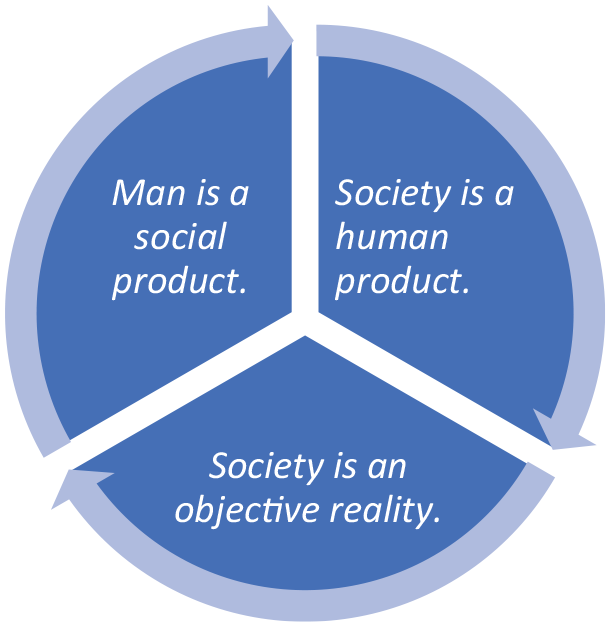
Assumption of the mutual construction between the individual and society – based on Berger and Luckmann (1967).
Berger and Luckmann’s argument has been refined by Anthony Giddens (1984), who conceptualized structure as relentlessly emergent and emphasizes the structural-reproductive nature of human action:
The basic domain of study of the social sciences, according to the theory of structuration, is neither the experience of the individual actor, nor the existence of any form of societal totality, but social practices ordered across space and time [emphasis added]. Human social activities, like some self-reproducing items in nature, are recursive. That is to say, they are not brought into being by social actors but continually recreated [emphasis added] by them via the very means whereby they express themselves as actors [emphasis in original]. In and through their activities, agents reproduce [emphasis added] the conditions that make these activities possible (2).
The above theoretical premises have implications for terms typically used in coaching, such as ‘potential’ (inner knowledge, structures, and processes), ‘goals’, ‘objectives’, ‘actions’, ‘non-actions’, ‘performance’, ‘authenticity’, ‘well-being’, ‘development’, and ‘flourishing’. They imply that none of these are determined either inside or outside of the individual. All are built in a lifelong socially constructed relationship to the social practices of which individuals are constitutive parts, and in the social (re)production to which individuals co-participate through their everyday roles and (re)socialization processes. This is not to ignore the facts that people are born with ‘considerable core knowledge, a rich set of universal assumptions about the environment’ and ‘brain circuits are well organised at birth’ (Dehaene, 2020: 119). However, we do not yet have conclusive evidence on whether there is any innate structure or concept that remains completely unchanged by social experiences, as stated by essentialist theories. Current knowledge indicates that all human innate structures and concepts are more or less reshaped by spontaneous and deliberate learning (everyday experiences and education), while every human being is able to ‘recycle’ in creative combinations the brain’s resources (Dehaene, 2020), that is, both innate and learnt internal resources, and naturally co-participates in the simultaneous social reproduction or construction of their self and social worlds.
Consequently, I inferred that the motto of the coaching process in DSC contexts such as the post-communist ‘transitional’ Romanian society should have been:
Let us, coach and coachee, be open and curious to explore what you can build better in yourself, your social worlds (e.g. families, friendships, fellowships, networks, organizations, local communities, insofar as they function as universes of discourse – see Clarke and Star, 2008), and your society.
In tandem, these questions must have been answered, among others: ‘What are you building in yourself, your social worlds, and your society through this self-conversation/outer conversation/real-life action?’ ‘What does that social world/ society you want to participate in building look like?’ ‘What would X (the coachee’s name) who can participate in building that world look like?’ ‘Who can that person build that world with?’
In contrast, the main theoretical assumption of coaches has been ‘the inner game’ (Gallwey, 2008 [1974]) – referring to the coachee’s inner conversation that involves two selves, the ‘authentic’ and the social, the latter inhibiting the former from reaching its ‘full potential’. This simple and seductive theory of the mind-performance connection has been uncritically transferred from sports coaching to life, executive and team coaching, with no adequate, consistent integration of the social game in life coaching and only a very limited integration in executive and team coaching. It has led to an oversimplified overuse of individualistic psychological concepts such as ‘authentic self’, ‘your dream’, ‘how you feel’, ‘what you think’, ‘what you like’, ‘what you gain/lose’, ‘your free choice’ ‘confidence in yourself’, ‘your self-esteem’, and ‘love for yourself’ – as opposed to allegedly ever-limiting social interference. I call this over-psychologization.
As other scholars have observed in other contexts (Carden et al., 2023; Grant et al., 2010; Jones, 2020), the common understanding of coaching was, and for many still is, a simple, structured or free-flowing, non-expert, neutral, non-directive, inspiring, and motivating conversation aimed at facilitating people to achieve SMART (specific, measurable, ambitious, realistic, and time-bound) goals, focused on individual or organizational performance, profit, well-being, and flourishing. Many highly valued their and their coachee’s common-experiential or esoteric intuition, which contrasted with intuition grounded in competence and expertise (Sheldon, 2018), and would have refuted Kahneman et al.’s (2021: 146) warning: ‘When you trust your gut because of an internal signal, not because of anything you really know, you are in denial of your objective ignorance’ – that is, of the ‘intractable uncertainty (what cannot possibly be known)’ (Kahneman et al., 2021: 140).
Following the teachings of Western trainers and mentors, my new colleagues were genuinely enthusiastic about their role in helping individuals and teams to, in coaching jargon, ‘unleash their full potential’ to reach specific one-off targets and their ‘best version’. Positive consequences that would undoubtedly follow for society were inferred, without questioning the validity of such an inference. Immediate positive feedback from coachees and return on investment (ROI) were claimed to be necessary and sufficient evidence of the quality of the coaching process, and conditions for becoming a ‘successful’ coach, that is, being chosen and ‘bought’ by many clients.
I wondered and worried about how coaching, as understood and delivered, might have played its part in the problematic ongoing project of constructing different, desired social worlds and society after the fall of the communist regime. My main concern was related to the significant risk of coaching inadvertently contributing to the reproduction and even exacerbation of undesired socio-cultural structures, the very ones it was intended to change, or to the creation of new undesirable structures. This must be a matter of concern in any DSC context.
I also pondered the meaning of ‘unleashing the full potential’: when could the potential be considered fully unleashed? For both individuals and groups/teams, the activation of some internal and external resources is always context-dependent and implies the inhibition of other resources. Moreover, each new experience enriches the potential. These imply that the potential can never be ‘fully’ unleashed in any specific situation. I had a similar question on ‘best version’ and its difference from ‘doing one’s best’: when could one consider having reached their ‘best version’? The ever-evolving nature of human beings, depending on the contexts, implies that nobody ever knows what their best version could be. Both phrases are either built on essentialist or strongly normative beliefs or have no empirical or theoretical basis. The same can be argued for other concepts, assumptions, and questions widely used in coaching, as I will point out in the following sections.
After about a year of participant observation and documentation, I realized that most coaches, practitioners whose job was to challenge others’ beliefs, were reluctant to fundamentally challenging their own beliefs. No one is a prophet in their own country, especially in a ‘periphery’ DSC context where people are looking for different models carried by different reference groups and significant others. My credibility was far lower than that of our coaches’ Western significant others (trainers, mentors, supervisors, authors, speakers). I saw myself in the situation of a Simmelian ‘stranger’, with the inevitable discomfort of marginality and benefits that usually come with it:
his position in this group is determined, essentially, by the fact [. . .] that he imports qualities into it, which do not and cannot stem from the group itself. [. . .] His position as a full-fledged member involves both being outside it and confronting it. [. . .] He is not radically committed to the unique ingredients and peculiar tendencies of the group, and therefore approaches them with the specific attitude of ‘objectivity’ [. . .]. Objectivity may also be defined as freedom: the objective individual is bound by no commitments which could prejudice his perception, understanding, and evaluation of the given. (Simmel, 1950 [1908]: 402–404)
While continuing to attend practitioner meetings as a ‘stranger’, I took the risk of developing a different coaching practice, persistently overcoming the resistance of coachees used to the established approaches and models, as well as the open skepticism and criticism of some internationally certified coaches. Over the past 15 years, I have worked as an independent professional with several hundreds of people, both individually and in groups. A few were students and the majority were employees, managers, and small- and medium-sized business owners in IT, law, health, education, banking, sales, marketing, administration, and the arts. The youngest was 16 years old and the oldest was 56. About two-thirds were middle-class, university-educated Romanian Orthodox women aged 25–50 years, some living in Romania and some in the European diaspora. All adults were people in social mobility; I define the concept in the next section. Most initiated the process themselves and paid for it, in full or in part; some asked for and received financial support from their organizations; for some, their managers or parents initiated the process and made the financial arrangements.
Basic generative sociological concepts for coaching to address dramatic social change
I refer to the concepts that inform coaching models and practice as ‘generative’ because all the resources that coaches bring to the conversation (e.g. summaries, questions, rephrasing, reframing, shared emotions, feedback, stories, alternative mental models of realities and experiences, explanations, or silences) stem, consciously or unconsciously, from them. We are talking about different approaches precisely in that each approach is unique in the range of core generative concepts it offers to the practitioner. A clear awareness of their generative concepts enables coaches to avoid misleading and dangerous interventions and give structure to the conversation, and the professionalization of coaching requires coaches to learn how to make deliberate use of the generative concepts. Hence, I briefly explain some of the basic concepts of the sociological approach I propose in this article.
In addition to the core theoretical assumptions mentioned earlier, the unavoidable key concepts for coaching to address DSC are indicated by its characteristics: ‘rapid pace of change, rupture in social structure, rupture in normative structure, and threat to cultural identity’ (de la Sablonnière, 2017: 12).
Socio-cultural identity refers to the memberships and ways of being that underpin the answers to the question, ‘Who am I in relation to other people, individuals and groups?’ It is context-dependent and is (re)constructed over the course of a lifetime through socialization and resocialization processes, during which people incorporate, naturally or willingly, social and normative structures (Burke and Stets, 2009; Mead, 1934). The self-made identity, a central concept in most coaching processes, especially in life coaching, therefore involves several issues linked to ‘the paradoxical nature of the desire for self-creation’ (Pagis, 2016: 1).
Social structure is rarely used consciously as a generative concept in coaching, although it appears in coaches’ vocabulary when asking about roles, power, and relationship patterns. It has various meanings in sociological literature. In the context of this article, I use a classic understanding that refers to large human collectivities or groups and their patterns – that is, relatively stable, taken-for-granted, and routinely reproducible ways – of relating to each other, in terms of positioning, roles, power, and, ultimately, life-chances, more or less regulated by institutions (Weber, 1978 [1922]). Social structures operate as strata and hierarchies – sometimes the terms social structure, social stratification, and social hierarchy are used interchangeably. They can be represented as ‘maps’ of positions that indicate legitimate ‘territories’, ‘boundaries’, and ‘pathways’ for individual and collective access to key social resources.
People socio-cognitively and historically construct various and dynamic social structures on the basis of different criteria such as age, gender, place of residence, education, employment, occupation, income, nationality, ethnicity, and religion, taken separately or in various combinations. Socio-cultural identities are built on the basis of such socio-cognitive and historical constructions, so we speak of age- and gender-based identities, occupational and professional identities, ethnic and national identities, and so on. Consequently, human collectivities/groups to which ‘social structure’ refers may be bounded by a specific physical space (e.g. nation-states and local communities), or may have no spatial boundaries (e.g. people having the same age, gender, religion, education, profession, or income level).
Institutions are inextricably linked to social structure and are sometimes equated with social structure. However, they are only instruments that people create, maintain, and change in order to meet the interests and needs of large groups of people. They consist in social definitions of specific status-roles and procedures, that is, the mutual expectations that people can legitimately have of each other within and between social collectivities, and for the respect or violation of which they can be held accountable and formally or informally rewarded or punished. Once established, institutions serve as instruments of social power determining the likelihood that individuals from some social groups will impose their will on the feelings, thoughts, and actions of individuals from other social groups, by various means and even against all resistance (Weber, 1978 [1922]).
Life-chances (Dahrendorf, 1980; Weber, 1978 [1922]) refer to people’s right and opportunity to access key social resources and to use them effectively and efficiently to stay alive, meet their human needs, and continuously improve their quality of life to the best possible level in their social worlds and societies. Life-chances encompass
Everything from the chance to stay alive during the first year after birth to the chance to view fine art, the chance to remain healthy and grow tall, and if sick to get well again quickly, the chance to avoid becoming a juvenile delinquent – and very crucially, the chance to complete an intermediary or higher educational grade [. . .]. (Gerth and Mills, 1953: 313)
In modern societies, life-chances also include the possibility for individuals belonging to different groups to change their place in the social structure. This process is called social mobility. It can be upward, downward or sideways, either compared to parents’ place (intergenerational mobility) or over the course of a lifetime (intragenerational mobility). This is particularly important for coaching in DSC contexts, as most of the coachees are people in social mobility.
Normative structure refers to the collectively accepted ‘musts’, a set of principles, values, norms, rules, and rituals that guide people in using the social ‘map’ provided by the social structure, legitimately enabling or prohibiting and facilitating or hindering individuals belonging to different collectivities/groups from accessing key social resources. In today’s societies, three types of normative structures coexist, mutually endorsing or conflicting with each other: formal written structures (laws or equivalents and organizational rules, adopted and implemented using modern bureaucratic institutions); informal unwritten structures (sets of shared values, norms, and rituals of interactions, which regulate people’s behavior by cultural/traditional institutions); and intellectual structures (scientific and philosophical ideas produced and supported by knowledge institutions such as universities and research centers, and disseminated more or less accurately through media such as educational programs, books, journals, blogs, conferences, podcasts, and journalistic interviews with experts). Typically, intellectual products are not seen as normative structures. However, in the contemporary ‘knowledge society’ (Giddens, 1990), when people – experts or non-experts – assert, practice, or oppose a set of intellectual ideas, others may identify them as members of a particular social group or social world. Thus, shared knowledge facilitates or hinders people’s admission into a group and access to its social resources, functioning as effective group norms.
The above normative structural pluralism is even more complex and contradictory because, throughout history, normative structures of the powerful have been imposed or imported into powerless societies where they now coexist and intertwine with the local ones. Conversely, critical masses of people have migrated within more developed countries, bringing their social and normative structures and making them a matter of concern for the receiving community/society. Current global dynamics are moving toward growing complexity of social and normative structures.
Social and normative structures are established, reinforced, and maintained largely by the symbolic power of ideology. Ideology refers to ‘cultural beliefs that justify particular social arrangements, including patterns of inequality’ (Macionis, 2010: 257; emphasis added) and a corresponding body of symbols and repetitive spoken or written ideas that express the ways of living, thinking, speaking, and writing of a particular social group.
I condense the aforementioned ideas into ‘culture-ideology-structure’ (CIS) and assume that the most useful concept to understand for human life today is the individual/group seeking to achieve their own projects in a specific and dynamic pluralism of CISs (Stănciulescu, 2002: 59–70).
Everyone’s life-chances are determined by their awareness of the CISs in use and their ability to play by socially accepted values-principles-norms-rules-ideas. This is difficult to do in our contemporary societies because real contexts are very complex and ambiguous, being ruled by more than one CIS, some of which may not be evident. In addition, as defined above, DSC implies ruptures in the CISs, precipitating painful threats and ‘earthquakes’ to socio-cultural identities, and in-depth (re)production of both CISs and selves. Coaches should help people become aware of and navigate through such a complex, ambiguous, and rapidly changing CIS pluralism. This can only be achieved if they have the necessary sociological knowledge, otherwise coaching may inadvertently become an instrument of unwanted dynamics. More than ever, ‘socio-cultural identity/ self’, ‘life-chances’, ‘social structure’, ‘social mobility’, ‘normative structure’, ‘ideology’, ‘culture-ideology-structure (CIS)’, ‘CIS pluralism’, and ‘CIS (re)production’ should be basic generative concepts in coaching.
No coachee or coach enters the coaching process simply as an individual. Instead, each interacts with the other as a specific exemplar of multiple social worlds, that is, as a specific mosaic of pieces coming from all those collectivities. The very opportunity to access a coaching process, the choice to use that opportunity, and the ability to make it effective in one direction or another depend on both the CISs the coachee has incorporated and the CISs they are currently operating in. The same applies to the coach’s opportunity to become a coach, to choose one approach/model or another, and to be successful as a professional.
Every coaching conversation expresses, and often obscures, specific CISs that have been incorporated during successive (re)socialization processes of both coachee and coach, and the CIS pluralism within which they currently operate. CISs, incorporated and present, work for individuals and groups as pools of both resources and constraints, with agency – that is, individual and collective awareness and effective activation of them as resources – making a difference. However, many people, including many coaches, believe that structure only means coercion, limitation, lack of freedom and authenticity, and overlook or even resist structural resources, thereby unconsciously limiting their life-chances. Or embrace the fashionable slogan ‘No limits/rules’ and overlook structural constraints, unwittingly limiting the life-chances of others and exposing themselves to avoidable social sanctions. Coaching should help people understand the true nature of their choices and actions, which are always socially circumscribed, the ambivalent nature of CISs (pools of both resources and constraints), as well as their own interest, power, and responsibility to use them appropriately as resources and to consciously participate in the reconstruction of the desired CIS.
Furthermore, every social group has its specific CIS through which it tries to define and maintain its internal structure, as well as its own positioning in relation to others. Social positioning and power relations (hierarchy, authority, domination, influence) are predominantly played as CISs ‘games’, wherein individuals and groups use symbolic tools to make others accept and reproduce the situation described by their specific CIS. These games are played in all social fields and interactions. Usually, one of the CISs wins the game, prevailing over the others either by the number and loyalty of its adepts and/or by the persuasiveness of its symbolic means, and becoming legitimate or dominant for a period of time. Different (sub)groups of coaches play their own games within the field: ‘coaching has a dynamic, complex, and diffused network of power relations’ (Cushion, 2018: 83). And ‘different aspects of the coaching industry act – consciously or inadvertently – as ideological devices’ (Shoukry and Cox, 2018: 414). Every coachee and coach plays their own positioning and power games during the coaching process: when the coachee creates narratives about what and why they or others want, say or do – and do not want, say or do – and the coach chooses to help in a way or another, any cultural product can be recycled and used, consciously or unconsciously, in an ideological manner.
I further elaborate on how the above concepts impact the coaching process by referring to my reflective practice as a sociologist-turned-coach in the post-communist Romanian society, which I propose as an accentuated case of DSC globally present in various stages and manifestations.
The ontological non-neutrality of coaching
In Romanian society, traditional local and modern Western-inspired CISs have long coexisted, altering each other, with the former winning over the latter in daily practices (Ralea, 1943; Stahl, 1939). The totalitarian CIS made this mix more complex. Behind organizational or legal rules, people reinforced the outside-the-rules ‘underlife’ (Goffman, 1961) as the normal way to live – in a sociological sense, ‘normality’ refers to ‘a collective representation perpetuated in interactional rituals’ (Misztal, 2015: 1), a behavior that is familiar and taken for granted by many, who consider it necessary and acceptable, or at least tolerable. They developed a ‘demonstrative complicity’ in deceptively ‘juggling the rules’, just pretending to follow the rules and collectively manipulating appearances to ensure that officials and possible snitches or gossips could not see, or prove, that the rules had been broken (Stănciulescu, 2002: 93–147). The post-communist opening allowed additional Western and Asian CIS components to enter the highly heterogeneous mix, precipitating an exceptionally complex amalgam of CISs, with no clear contours. None of the CISs managed to gain relatively stable authority – that is, accepted power – over a majority, a situation called ‘legitimacy crisis’. This crisis of legitimacy has been fueled by and has itself fueled the ‘underlife’ parallel to or against the official rules/laws and the ‘demonstrative complicity’ in deceptively ‘juggling the rules’, which remain sociologically normal components of the post-communist social life (Stănciulescu, 2002: 71–92; Stoica, 2012), and could provide a deeper explanation for the endemic corruption, in addition to the previously formulated ones (Tanasoiu and Racovita, 2012).
In contexts ruled by such a CIS pluralism, individuals and groups do not have clear ‘maps’ of which social resources can sustainably increase life-chances and which are the right ways to obtain them. For almost any goal, means, and action/ inaction, they can find convincing pros and cons in one or more CISs, along with social pressure and social support or social sanctions. Hence, they have a high probability of losing their path even when they are sure of being on the right track or vice versa. All people except those with radical beliefs unconsciously construct their desires, goals, narratives, and reasons for acting/not acting as an open and unstable mosaic (open kaleidoscope) comprising heterogeneous and often contradictory pieces from different CISs. The more networks, information, and experience vary, the more people can ‘juggle’ their pros and cons, becoming unstable and unpredictable in their choices and engagements. The high degree of CIS pluralism’s complexity, ambiguity, and volatility leads to a high degree of disorientation, high instability and unpredictability of choices, and inconsistent, ‘slippery’ memberships – both in and out and, at the same time, neither in nor out ‘to the full measure’. I termed this both-and, neither-nor or, in short, both-neither action/identity/self (Stănciulescu, 2002: 9).
No coachee is ‘the expert – of the issue at stake and of the systems they operate in’ (De Dominicis and Stelter, 2023: 25) in DSC contexts, as many coaches still assume. Some, if not most, of one’s inner resources, shaped by past experiences, are outdated. In contrast, new reference groups and significant others are often perceived unrealistically, based on appearances, and followed uncritically, paving the way for a high vulnerability to deception and manipulation. The following examples illustrate this concern.
A middle manager wondered whether she should change her job and whether a new job abroad would better address her needs. She confessed to feeling uncomfortable regarding the recurring changes in her company, which apparently prevented her from developing a respected professional identity. Changing top managers within 3 years seemed excessively frequent to her need for stability and security. In the ongoing global Volatile, Uncertain, Complex, and Ambiguous (VUCA) context (Bennett and Lemoine, 2014), this revealed an obsolete and unrealistic mental model of reality that could jeopardize her life-chances. In addition, she expected that her recognition would follow her silent achievements without her actively making her work known to the new managers. ‘Let others praise you, not you thyself’ was a traditional moral principle, adopted and reinforced by the totalitarian CIS, and it still works today as a ‘moral’ tool to reproduce, unconsciously or deliberately, the inequality in life-chances. During the coaching program, she developed a better understanding of today’s DSC context and decided to stay with her employer, balancing her need for stability with her need for development. She has trained herself to act purposefully to build the respected professional identity she wanted, balancing her modesty with the necessary assertiveness, and still asks for coaching when she needs it.
A young employee was seeking a different ‘good career and life’. He was confused by competing social messages – his parents’ traditional ‘this is a good job, you have a secure monthly salary’ and the rapidly growing CI of ‘do what you like, if not, you will not be happy’, endorsed by numerous coaches; the meritocratic ideology of ‘study and work hard’ and the new CI of ‘learn what you like’, again endorsed by numerous coaches. I asked, ‘Give me the names of three people who have a good career and life, stating they only did what they liked when they were your age, and had socio-economic, cultural, and educational backgrounds similar to yours’. He discovered that ‘do/ learn what you like’ benefits people belonging to privileged socio-economic categories – they could afford to do/learn what they liked because they either benefited from their family or local community resources and/or had accumulated significant internal and external resources by doing/learning what they did not necessarily like before doing/learning what they liked. However, he decided to play the fashionable ‘do what you like’ game. After about 10 years, he realized that he had made, in his words, ‘the wrong choice’ and asked for a new program.
A lawyer specifically asked for ‘tips and tricks’ on how to manipulate her colleagues to vote in her favor in a competition for a prominent position; she assumed that, as a sociologist, I would be competent to support her project. I explained that my values firmly prevent me from helping with manipulation, and that coaching is not simply about teaching tips and tricks. ‘Are there any rules?’ I asked. ‘You know, rules are made to be broken’, she answered, using a common saying. ‘Would you be open to exploring the values behind those rules and how they might be consistent with your identity and the world you want to live in?’ I asked again. ‘I have never thought of these rules in this way’, she confessed, and accepted the challenge of a coaching program that could help her increase her chances of fair success. She was not elected and has not yet asked me to coach her again.
If the coach had embraced the assumption of the coachee-expert, the coaching process, which is designed to help individuals become future-oriented and realistically ambitious, would have run a high risk of allowing them to be entrapped by catchy illusions, or of unthinkingly keeping them stuck in the past CIS, which they wanted to and should leave behind. Coaches are neither experts who provide ready-made solutions nor are they old-fashioned teachers who only convey knowledge. Besides, in DSC contexts, they share the same high level of objective ignorance of their coachees. However, they must have sufficient knowledge regarding social complexity and dynamics to help the coachees understand that (1) they combine different frames of reference that fit different CISs; (2) through their choices of goals, ways, and means, they effectively reinforce one CIS or another, and may participate in the social construction of desirable or undesirable CISs dynamics, which may enhance or jeopardize their life-chances in the long run. Without sociological knowledge, one deludes themselves into thinking that a ‘good question’ is being asked.
For instance, when the coaches ask supposedly ‘neutral’ and ‘non-directive’ questions, such as ‘What do you like/want?’ or ‘What is your intuition telling you?’ they make the coachees momentarily happy by inducing a deceptive and transient sense of power. Yet, if the coachees do not belong to an advantaged social category, such questions may unconsciously make coaching a tool for reproducing and increasing social inequality. This is because likes, dreams, goals, values, beliefs, intuition, languages, and willingness to act or abstain from acting are not generated, as many coaches assume, simply by the coachee’s uniqueness, authenticity, free choice, and willpower, or special natural or supernatural gifts; nor are they simple manifestations of a presumed-neutral ‘cultural self’. Rather, they are deeply rooted in the CIS conditions of their biographies and the actual conditions of their actions. The analyses of the French sociologist Pierre Bourdieu (1987 [1979]) revealed these CIS roots even in the case of likes and dislikes commonly deemed just ‘personal’ or ‘cultural’, such as aesthetic ‘good taste’. Perfect socially free will is no more than an illusion. People cannot choose to let themselves either be influenced by others or, on the contrary, act according to their ‘authentic self’, as many coaches and coachees believe. At best, they can only be aware of and choose which others, carrying which CISs, influence them.
Similarly, if coaches asked, ‘What did you do in similar situations in the past?’ or ‘What is your intuition telling you?’ to people who used to think that the out-of-rule/law ‘underlife’ and the ‘demonstrative complicity’ in deceptively ‘juggling the rules’ are ‘normal’, they would make those coachees feel respected and help them find an efficient solution. However, such coaching would reinforce the perceived-normal violation of rules/laws, thus unintendingly feeding criminality, endemic corruption, or endless social unrest/conflict.
The above developments are in line with previous studies suggesting that coaching should not be a simple neutral questioning (Gannon, 2021; Shoukry and Cox, 2018; Shoukry and Fatien, 2023). However, they pinpoint that non-neutral coaching should be understood not only in a militant-normative sense but primarily in an ontological sense. Irrespective of what the coaches do, their interventions and coachees’ narratives and answers are deeply rooted in a CIS pluralism, instead of neutral cultures, and contribute to the strengthening and reproduction of one CIS or another. The presumed ‘neutrality’ and ‘non-directiveness’ of the coach are asociological assumptions. Not suggesting ready-made solutions and being ‘neutral’ and ‘non-directive’ are different concepts. Indeed, the more the coaches claim to be ‘neutral’ and ‘non-directive’, the more they act ideologically because being unaware of something does not mean that it does not exist and exert any effect; instead, it has an uncontrollable effect. If I am not aware of my CIS biases and do not help the coachee view theirs, both of us may be unconsciously co-manipulated because we inevitably learn from each other, and we cannot detect the hidden CISs embedded in my presumed ‘neutral and non-directive’ interventions and their answers. If I am aware of my biases and help the coachee become aware of theirs, we can be vigilant and better protect ourselves. Thus, both of us could train ourselves in critical thinking during coaching sessions, which would be more ethical than a naive ‘neutrality’.
Developing psycho-sociological awareness and social change-oriented mind set
For coaches to provide effective interventions and coachees to generate life-chances increasing solutions, both must develop: (1) psycho-sociological awareness – that is, learning how to explore and discover the CISs embedded in their and others’ ways of thinking and acting, and thinking critically about these issues; and (2) a social change-oriented mind set – that is, understanding that they co-participate in CISs reproduction or reconstruction, and learning how to make choices and act consistently to improve life-chances in a sustainable way. The following examples clarify and introduce new generative concepts relevant to coaching in DSC contexts.
Another female manager wanted to gain trust and recognition at work while adhering to a feminist ideology and ensuring that her ‘true, authentic self’ was ‘modest, not wanting to upset anyone’. The conversation’s turning point, which she appreciated as likely to open the door for increased life-chances, arrived when she became aware of the three CISs that she was holding simultaneously (traditional, modern-feminist, and neoliberal-managerial). What she thought of as her ‘true self’ was only one part of a multiple, heterogeneous, and contradictory self (Elster, 1987; Hermans, 2001; Lowery, 2023). She understood that both being ‘modest’ and being ‘efficient’ have CIS significance and discovered how to resist her and others’ judgments and nurture a new self, able to co-participate in building the social world she wanted to live in.
An ‘egalitarian’ husband honestly sought to improve the quality of his family life. He resisted his wife’s desire to become financially independent and invoked ‘practical reasons’ for him to make all the payments. Insofar as they remained in the psychologically informed ‘my perspective–your perspective’ approach, they deepened the conflict. The conversation’s turning point arrived when he understood the embodied contradictory CISs behind his narrative. He decided to support his wife’s autonomy. However, he said that he would make deliberate situational choices about acting as a ‘traditional man’ or an ‘egalitarian man’ outside the family. His social memberships, wherein different masculinity patterns were valued and likely to nurture functional relationships facilitating access to specific resources, required a flexible ‘scene’-dependent self (Lahire, 1998).
A university professor complained that the head of her department frequently imposed administrative work on her, ‘like a dictator’, thus leaving her with less time-energy for teaching preparation and research responsibilities, which she liked doing. She made causal imputations based on personal traits and intentions – a well-known attribution error, exacerbated by previous totalitarian experiences – and saw no solution but to resign, though she wanted to retain her job. ‘It is such a relief to understand that it is not a question of individuals’ characters and intentions, but of different incorporated social worlds’, she confessed after understanding that her need for professional fulfillment and autonomy and his need for status-based power and control had been developed in different social worlds with different CISs. From this point, which I conceptualized as de-subjectivation or objectivation of the problem, she worked to rebuild their relationship and performed better at her job with less stress.
None of the people I coached manifested a natural, innate, stable, coherent, unambiguous ‘authentic’ self, as many coaches consciously or unconsciously expect when asking ‘Who are you (for real)?’ Each of them revealed a multiple ‘dialogical self’ (Hermans, 2001), a composite of parts speaking on behalf of different and conflicting CISs, which worked as relatively predictable ‘scene’-dependent self or unpredictable both-neither, ‘slippery’ self. This multiple, heterogeneous, often conflicting, and unstable self seems to constitute the human authenticity in today’s DSC contexts. At the same time, an important number of coachees confessed to experiencing inauthenticity, wrongness, abnormality, guilt, and shame, stemming from the over-psychologized concept of an ‘authentic’ self, which is assumed to be by default highly coherent and stable. Most of their impasses and failures were caused by the unconscious and inappropriate transfer of definitions of their socio-cultural identity and ways of thinking, managing emotions, and acting from one social world and type of society (CIS) to another, where different mental models, values, and corresponding behaviors were in use. Their primary needs were as follows: (1) to understand why the answer to the question ‘Who am I?’ could not be simple and ‘untwisted’, and why their multiple, situational, and ‘slippery’ selves were neither immoral nor pathological, nor simple effects of the too easily blamed bad parenting, but rather products of very complex socio-cultural dynamics; (2) to allow each part of their multiple-self to speak loudly and to make their multiple-self-conversations move from fogginess to clarity. Thereafter, they needed to become aware of (3) which part of their multiple-self was speaking on behalf of which CIS; (4) the fact that, through their choices, they were effectively participating in social dynamics, feeding either their desired or undesired CISs; (5) the fact that they had to choose a social world and a corresponding self, rather than just a practical, neutral solution to their problem/goal – they benefited from answering questions such as What are you building in yourself, your social worlds, and your society through this self-conversation/outer conversation/real-life action?; Is this construction of self, social world, and society the one you want to consciously participate in?; Is that what you really want and plan to do?.
In DSC contexts, the challenge for coaches is to help people better understand what is really at stake beyond the narrow and short-term personal and/or organizational goals. It is not just about punctual solutions and performances, and coping with or adapting to change. It is about participation in co-constructing ongoing social and cultural change or reproduction. The coach’s role is not to decide what is desirable or undesirable for the coachee but instead to ensure that both do not (inter)act as blind accomplices to unwanted, as each of them sees it, CISs dynamics.
I suggest that in today’s DSC world, it would be useful to develop cognitive models of social-human reality and models of social intervention, including coaching, based on the concept of multiple, heterogeneous, scene-dependent, and ‘slippery’ self to replace the currently overused concept of highly stable ‘authentic self’. Self-awareness, that is, the ability to see which pieces of the inner puzzle are working effectively here and now, is becoming more relevant than self-knowledge, that is, knowledge of the so-called ‘general traits’ of the person – which may or may not be activated in a specific and rapidly changing context. In this vein, I suggest that a theory of character intelligence would be worth developing, although it will be difficult to reconcile with current modélisations and technicalities in psychology – as is the theory of emotional intelligence, which has, however, proved to be quite useful for individuals and organizations in a wide range of social fields; ‘All models are wrong, but some are useful’ is a well-known saying credited to the British statistician George E.P. Box. At the time of this writing, I would define character intelligence as a set of mental models of social-human reality, capabilities and skills that help individuals to understand the complexity of human ‘authenticity’, likes and dislikes, desires and resistances, to identify the CIS-dependent assumptions and values embedded in one’s own and others’ daily sayings and action, to have granularity in labeling them, to ponder them against a large array of consequences, including on CISs (re)production, to make better-informed choices among assumptions and values belonging to different CISs, to nurture their determination for acting consistently in line with their informed choices, and to rebound as quickly as possible when they inevitably ‘slip’. This definition reconsiders the usual philosophical and psychological understanding of ‘character’ by placing it in the context of the contemporary CIS pluralism and dramatic change. Such an interdisciplinary, psycho-sociological construction of the concept seems to me imperative, since character is perhaps the most social context-dependent dimension of human beings. The above definition is also more comprehensive than Paul Dawson’s understanding in his attempt to operationalize the concept (Dawson, 2016) – 5 years after I first coined the term in Romanian (Stănciulescu, 2011).
Learning-to-develop through research design
Before becoming a coach, I was a professional primary school teacher, a high school teacher, and a university professor. Given this background, I have assumed that any change in the coachee’s way of thinking, feeling, and acting – essential for creating and implementing sustainable alternative solutions and achieving ambitious goals – is intrinsically and critically dependent on the coachee’s learning and development. I have argued that coaches should be experts in supporting learning and development processes – without acting as experts in the specific topics of interest to the coachees; this distinguishes them from teachers, trainers, and mentors. I was called a ‘professor’ and a ‘theorist’, that is, ‘not a true coach’. At that time, Griffiths and Campbell wrote, ‘although learning is inherently recognized in the process of coaching, the process of learning in coaching is little understood and learning theory makes up only a small part of the evidence-based coaching literature’ (Griffiths and Campbell, 2009: 16). Their first sentence was overly positive: when ‘adult learning’ and ‘adult development’ are presented as distinct approaches to coaching among many others (Ives, 2008), not all coaching is seen as a learning process or leading to some development; the separation of coaching and personal development as two different occupations suggests the same idea. Neither the best-known coaching models nor the education of coaches have included systematic knowledge and training in how to guide learning processes. Coaching authors often looked to research and practice in psychotherapy, counseling, mentoring, management and leadership for inspiration, but rarely referred to learning theories (Brockbank, 2008) and empirical research on successful learning.
The last 15 years have brought significant changes in this regard. Many authors have analyzed coaching as a process of adult learning and development (see synopses in Bennett and Campone, 2017; Hurlow, 2022; Lawrence, 2017). Bachkirova et al. (2014: xxxiv) explicitly stated that learning ‘underpins all coaching practice’ rather than being a standalone approach. However, both literature and practice reveal a contradiction between what is said and what is done. When coaching is defined as a ‘role and process used to help people learn, grow, and change’ (Boyatzis et al., 2024: 21) and when it is presented as a more effective learning practice when compared to conventional teaching (Coumans and Wark, 2024; Passmore and Rehman, 2012), coaching approaches and models are expected to explicitly incorporate not only principles from learning theories but also findings of empirical research on successful learning. Following the same logic, the education of coaches is expected to incorporate systematic knowledge from sciences of learning and corresponding training. Little is being done in this regard, and some of the most common assumptions and practices run counter to important findings of recent learning research that prioritizes long-term retention and large-scale transfer of knowledge and skills. For example, coaches focus on ‘facilitating learning’, whereas learning researchers recommend the opposite: ‘Making Things Hard [. . .], But in a Good Way: Creating Desirable Difficulties to Enhance Learning’ (Bjork and Bjork, 2011). Similarly, when coaches encourage coachees to choose coaches on the basis of ‘I have (or don’t have) chemistry with this person’, and when they do the same for choosing allies who can stimulate their own learning, the principle of desirable difficulty is ignored. ‘Facilitation’ and ‘chemistry’ can lead to psychological comfort, short-term results, a rapid sense of achievement for both coachee and coach, and more clients for the latter. However, they can prevent in-depth learning, as well as large-scale and long-term learning benefits, because
We can also be misled by our current performance. Conditions of learning that make performance improve rapidly often fail to support long-term retention and transfer, whereas conditions that create challenges and slow the rate of apparent learning often optimize long-term retention and transfer. (Bjork and Bjork, 2011: 57)
Furthermore, as Chiu (2022: 42) has argued, ‘chemistry’ and ‘facilitation’ actually keep the coachees in their comfort zones, thus violating the primary reason for coaching, which is to stimulate action and learning beyond the comfort zones; they also foster social injustice, again contradicting one of the main principles of coaching:
By seeking someone who ‘is like them’, the coachee is looking to minimize the risk of taking on the emotional and mental load should the coach be unfamiliar or uncomfortable with an aspect of their identity. [. . .] However, remaining in these comfort zones perpetuates systemic and epistemic injustice by continuing our collective state of hermeneutical darkness. Put simply, we will continue not to know what we don’t know.
I have subsumed my coaching under the ‘learning-to-develop social activities’ category, at the intersection of adults self-directed learning (Knowles, 1975), experiential learning (Kolb, 2015), critical pedagogy (recently referred to as a source of coaching in Shoukry, 2017), transformative learning (Mezirow, 1991), and expansive learning (Engeström, 2015 [1987]). Findings of recent research on learning (Benjamin, 2011; Bjork et al., 2013; Brown et al., 2014; Dehaene, 2020) have also been systematically integrated into my coaching model and practice.
Learning-to-develop refers to deliberate learning directed toward a desired, intended development – meaning consistent, sustainable changes in general worldview and specific ways of thinking, feeling, and acting – whether at the individual, organizational, community, or societal level. I prefer ‘learning-to-develop’ to the usual ‘learning and development’ (L&D) because ‘and’ suggests separate processes, whereas ‘to’ emphasizes that learning is a precondition for development; moreover, desired development requires the deliberate action of social actors, and the verb ‘to develop’ rather than the noun ‘development’ emphasizes their agency.
Below, I argue for a learning-to-develop through research (LDR) model of coaching, based on the assumption that, in DSC contexts, there is no expert in the coach–coachee partnership on the specific topic of interest to the coachee; however, the coach must be an expert in guiding successful learning-to-develop processes. As ‘classic’ approaches assume, the coach is not an expert on the specific topic – unlike a counselor, a mentor, or a professor. But neither is the coachee. Relevant knowledge must be co-constructed during the coaching process. This means that the coaching process is actually a collaborative research process. Research does not merely provide findings to inform the professional practice; it is the very essence of our practice.
My first argument is that objective ignorance is higher than ever in today’s DSC contexts. As elucidated above, the coachee’s knowledge, experience, and self-awareness may no longer be as useful, rewarding, and empowering as in more stable contexts. People now inevitably discover more of their ‘weaknesses’ than ‘strengths’. No one, except perhaps individuals in isolated communities, can accurately predict what their social worlds and roles-identities-selves will be like in a few years or even months, and what appears to be a ‘strength’ today may prove a ‘weakness’ in the near future. Individuals’ identities, values, goals, objectives, effective solutions, and means are no longer ‘facts [to be acquired] from within’ (Whitmore, 2009: 9–10). They are, instead, works in progress, much like the CISs. Thorough self-reconstruction, intertwined with societal, organizational, and group reconstruction, are unavoidable pillars for the coaching process to act as an ‘enabler for [desirable social] change’.
In DSC contexts, the key assets are as follows: (1) the acceptance of DSC as normal – it is now a pervasive and persistent reality and no longer a temporary ‘crisis’; (2) an expanded growth mind set (Dweck, 2017 [2006]) that can be condensed into ‘let us explore and discover what we can become better at, and how much better at, whatever it is we want or need to be’; (3) emotional courage, that is, the de-pathologizing of the so-called ‘negative emotions’, which should be placed at the heart of emotional intelligence theories and programs (‘If You Are Willing to Feel Everything, You Can Do Anything’; Bregman, 2018); this does not mean to accept abuse and violence, it means not to naively believe that all ‘negative emotions’ could and should be avoided, and not to so easily label any more intense and persistent suffering or stress as cataclysmic ‘trauma’; (4) an evidence-based learner mind set of an explorer in an unfamiliar territory, who has initiative, ownership, and autonomy; curiously and carefully observes things; produces hypotheses regarding the consequences of their actions in the given context; document, tests, and retests hypotheses against facts; capitalizes upon the experience; and expands upon what they have capitalized by incorporating it into a larger and open-to-change picture; and (5) a spirit of determination, creative freedom, and cooperation similar to those taking action, for instance, to build a more functional and beautiful city after a disaster (Figure 2).
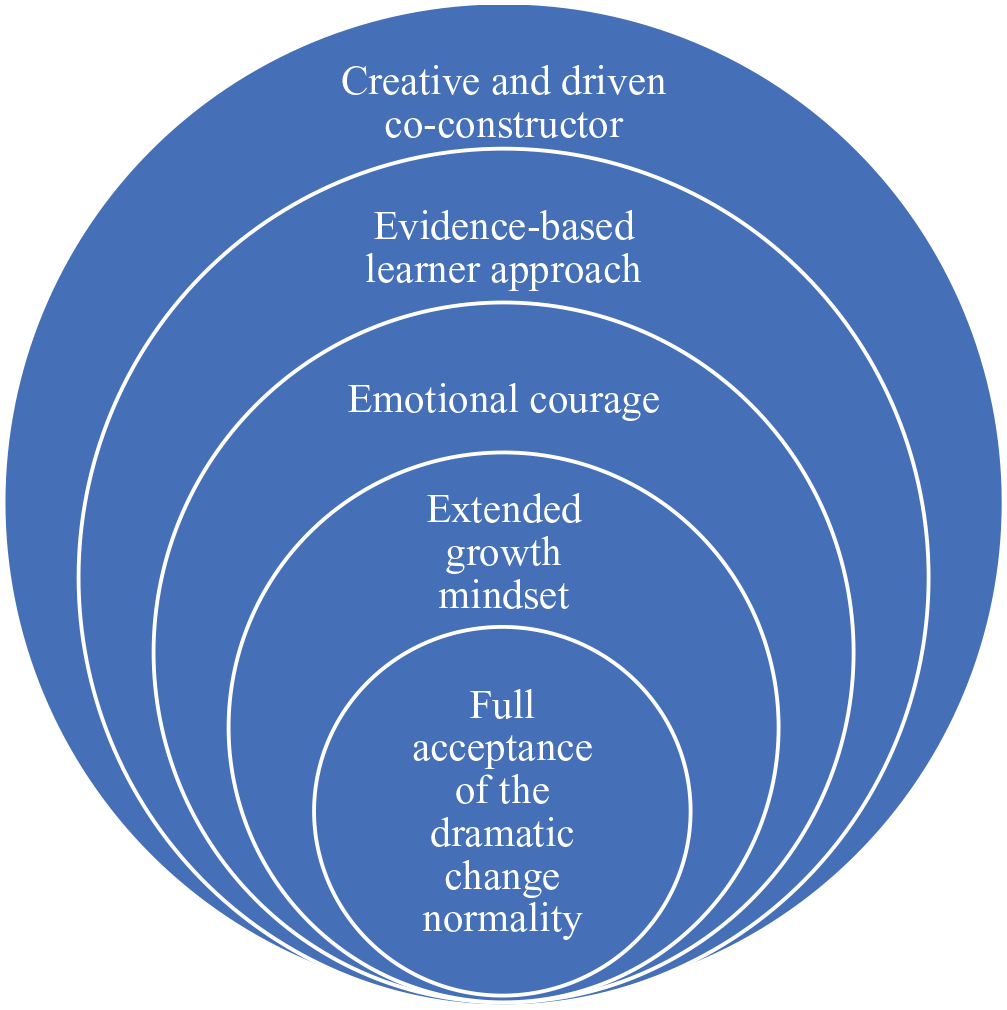
Key mind set in the DSC context.
The second argument points to Socrates’ maieutic, which is often referred to by coaches defining coaching as ‘a Socratic based future focused dialogue between a facilitator (coach) and a participant (coachee/client), where the facilitator uses open questions, summarizes and reflections which are aimed at stimulating the self-awareness and personal responsibility of the participant’ (Dromantaite and Passmore, 2020).
According to Plato (1992), Socrates used the metaphor of a midwife giving birth to a child to explain his dialogic process. This is misleading if one ignores the fact that it may have been Socrates’ self-defense against the allegations that led to his execution, and if one does not explore how the conversation actually takes place in ‘Dialogues’, for example, in ‘Charmides’ (Plato, 2019), which is most relevant to coaching. As illustrated in this dialogue, the maieutic is not simply a process of giving birth to knowledge ‘from within’ as if it were already there but rather a collaborative search-research-construction process, stemming from an agreed-upon question and the answers expressed by Socrates’ interlocutor (‘the coachee’). Socrates (‘the coach’) had a clear symbolic authority (i.e. recognized power based on his reputation). However, he exerted it using three key tools. First, he encouraged a non-formal relationship of mutual strengths-recognition, admiration, trust, and respect with ‘the coachee’ and repeatedly fed this relationship. Second, he nurtured an assumption of equal ignorance of all the interlocutors regarding the answer being sought. Third, he took any answer as a hypothesis to be questioned. The dialogue progressed through persistent open-ended questioning, repeated reminders of the ignorance assumption, and progressive meaning-making, with both participants co-constructing hypothetical answers and exploring whether they are internally consistent, consistent with the other’s views, and consistent with the facts. ‘The coachee’ contributed personal queries, beliefs, knowledge, and reflections. ‘The coach’ contributed paraphrases, questions, summaries and, with the coachee’s permission, personal reflections, beliefs, experiences, and knowledge. They develop cooperation without consensus: they generate shared language and listen attentively to understand each other’s perspective, but no one tries to impose a truth, and everyone respects their right to make their own choices. De Dominicis and Stelter (2023: 25) suggest that Third Generation coaches are moving toward this way of working: ‘coach and coachee are collaborative partners in the dialogue as it naturally unfolds, and share their experiences, considerations, and reflections in a symmetrical and resonating partnership’.
The third argument is that the best Socratic conversation is a necessary yet not sufficient condition for coaching effectiveness. Defining coaching simply as a dialogue or conversation between a coach and a coachee overlooks two facts. First, significant change is not primarily driven by the external conversation, but rather by the coachee’s internal multiple-self-conversation – as explained earlier, a very complex body-mind ‘inner game’ that involves not two selves, the ‘authentic’ and the social (presumably ‘the enemy’), but multiple, heterogeneous and often conflicting facets and layers of the person, all equally authentic and socially constructed, and equally resource- and obstacle-bearing. The external conversation merely catalyzes, makes explicit, clarifies, enriches, deepens, organizes, and makes more energetic and proactive the internal multiple-self conversation by eliciting the coachee’s resources and resistances. Second, coaching comprises both meaning-making and mental transformation of the experience and testing the new meanings against real-life contexts. Effective coaching combines both conversational and practical real-life-action-by-the-coachee phases iteratively. Focusing on the external conversation between a coachee and a coach, as many definitions and models do, while overlooking the complexity of internal multiple-self conversation and the real-life-action-by-the-coachee phase, may significantly reduce coaching effectiveness.
The fourth argument is that what is regarded as ‘competencies’ required to become a coach (Association for Coaching, 2012; ICF, 2019a; Passmore, 2020) have naturally – and seemingly without awareness – moved toward incorporating some of the attitudes, capabilities, skills, and work tasks common to qualitative research: a genuinely curious attitude; building and maintaining trust; a respectful relationship; confidentiality and informed consent; an empathic, non-judgmental, and encouraging presence; non-violent communication; managing life-story sequences; silence; mindful listening and observation; open-ended questions; summaries, rewording, reframing, affirmations, and reflections; discerning between perceptions/opinions and facts; evaluating beliefs and interpretations against facts; scaling; identifying patterns; taking notes; and engaging in reflective practice. Toyota Kata, developed synchronously with LDR coaching, explicitly states, ‘Scientific thinking may be the best way we have of navigating through unpredictable territory to achieve challenging goals’ (Rother, 2018: 1; emphasis added). However, coaches do not systematically learn scientific thinking in their training programs. They are advised to incorporate research findings into their practice (Grant et al., 2010; Jones, 2020), which is different from having a clear awareness of the similarity between coaching and research as processes, and between coaches’ and researchers’ competencies.
As Boyatzis et al. (2024) recently highlighted, we need competency models that are not only derived from the opinions of coaches or coachees, but rather from evidence-based research. Therefore, I suggest that further research on competencies in today’s DSC contexts also considers and tests the researcher’s mind set, scientific thinking and relevant research methodology, with a focus on action research and autoethnography (the coachee and the coach acting together as theory-driven autoethnographers). A research toolkit for coaches must be developed, carefully learned in training, mentoring and supervision, and tested as part of the certification process. The greatest advantage of coaching and its clear difference from psychotherapy, counseling, mentorship, training, and teaching is that any program can and, at least in today’s DSC contexts, should be designed as a tailor-made, evidence-based, action research process. Coaching differs from standard research in that its main purpose is not to necessarily produce generalizable knowledge, rather to elicit the knowledge that is necessary and sufficient for deliberate learning, leading to the achievement of the coachee’s specific goals and the development they desire in themselves, their social worlds, and their societies. Compared to standard evidence-based experiments, this is a ‘loose’ understanding of evidence-based research. However, ‘loose’ evidence-based research is better than no or inappropriate research. For the coachee’s goals to be selected and achieved in a DSC context, optimal, standardized evidence-based research remains important. Yet, this is not primarily because of its findings’ validity and reliability, as they have a high probability of being proven invalid in the case of a coachee’s specific goal in a specific and fluid DSC context. Instead, it is important because it provides (1) the most appropriate mind set for both the coach and the coachee (the ignorance assumption combined with gnoseological optimism, the explorer’s curiosity and sense of presence, persistent inquiry resulting in hypotheses, and testing-retesting hypotheses against facts); (2) methodological principles, steps, tools, and skills for the process; and (3) certain findings that both the coach and coachee must regard just as possible pieces for the jigsaw puzzle that the coachee creates and tests-retests.
As it has evolved over my 15 years of reflective practice, the LDR model of coaching works as an expanding spiral of iterative cycles in four flexibly sequenced phases (DARE; Figure 3):
the future itself is challenged, and thereby recreated. [. . .] the exploration of possible (the full range of agency and imagination), probable (likely given historical structures) and preferred (where we seek to go) futures. [. . .] As important as the social construction of the future is the ownership of the future created. [. . .] It is not just liberation from conventional and used futures but also from the intellect that creates this questioning. (Inayatullah, 2006: 657–659)
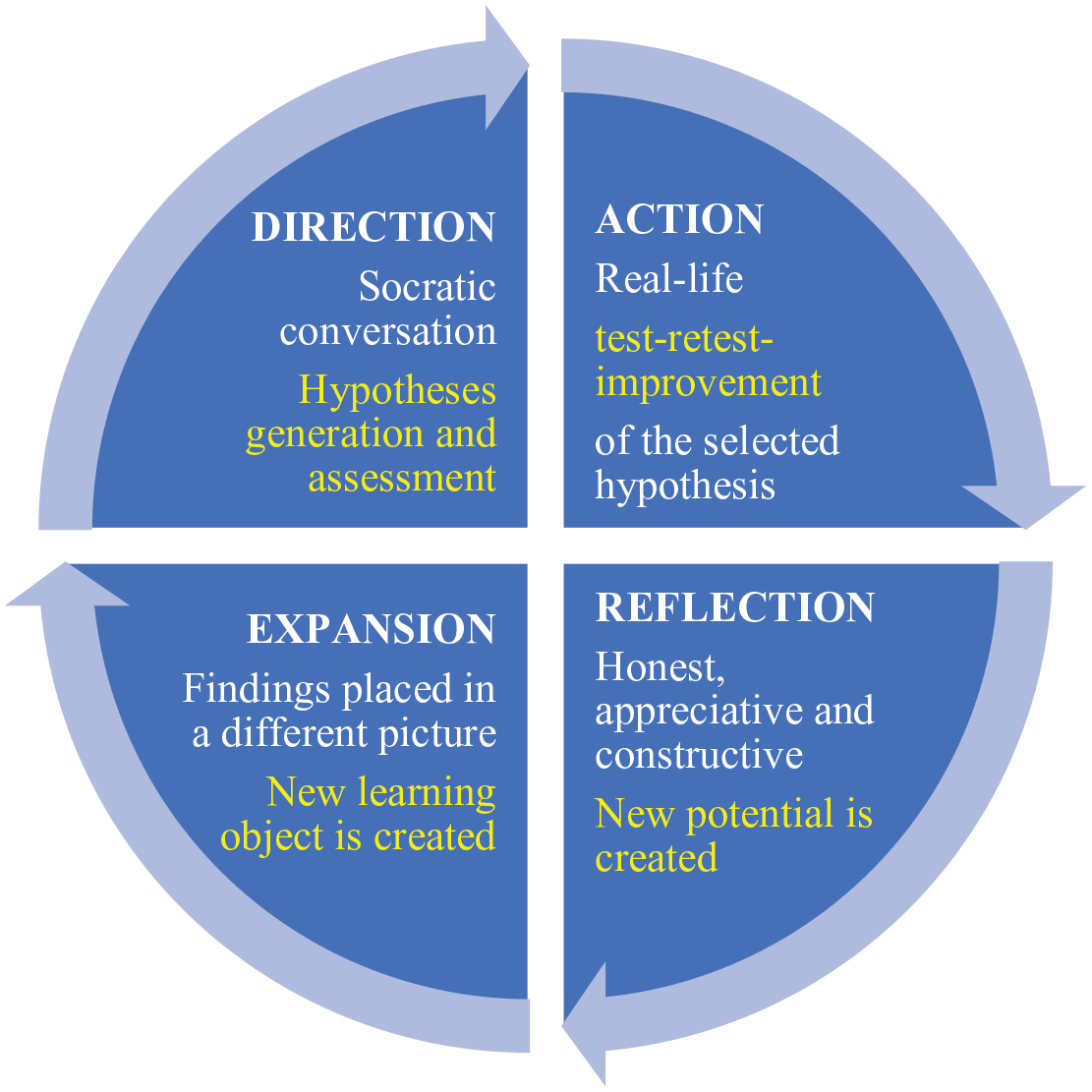
DARE cycle (expansive spiral) of LDR coaching.
The idea of developing hypotheses, integrating and testing them into the coachee’s ordinary agenda at their own choice and pace, observing the consequences, performing reflections, and creating new open and dynamic mosaics/kaleidoscopes of action helps overcome resistance and fear of failure, unleash creativity, increase confidence and motivation, and move toward the desired and sustainable results. Therefore, it is highly and realistically empowering.
The first three phases create a new potential for the coachee and for the social world in which they are primarily pursuing their goals. In the fourth phase, a new learning object (model of action) is created, trained, and expanded to other relevant social worlds. The process differs from the typical coaching process which follows SMART objectives, explicitly agreed upon by coach and coachee (and sponsor, if applicable). In contrast, LDR coaching – which works according to this principle: ‘Let us, coach and coachee, be open and curious to explore what you can build better in yourself, your social worlds, and your society’ – seeks desirable results that cannot be thought, contracted, and planned at the beginning. Such results are more realistic or often more ambitious than the goals the coachees can imagine when entering the process, because they are consistent with the characteristics of today’s DSC context. The coachee’s initial desires and goals are still important, but they only provide the entry into the process, the main field of research and learning, and tangible short-term accountability. Individual flourishing, an outcome sought in some types of coaching, develops progressively as a natural consequence rather than being a goal in itself.
The coach assumes a quasi-researcher role and guides the coachee to do the following: articulate, clarify, and organize their wishes, perceptions, interpretations, emotions, and knowledge; distinguish between knowledge and beliefs and between data/descriptions and interpretation/judgment; evaluate everything against facts; identify the needs to be fulfilled and articulate appropriate and sustainable solutions; become aware of moments and sources of doubt, discouragement, and resistance; and discover and activate the available internal and external resources to proceed further. Moreover, the coach works as a participant-observer during the conversation, honestly sharing their observations and providing alternative mental models of reality (not definitive solutions) as possible pieces for the open kaleidoscope being created by the coachee. The process remains facilitative instead of authoritarian: coachees consciously decide whether and how to integrate the jigsaw pieces provided by the quasi-researcher coach into their multiple-self-conversations and real-life actions, taking responsibility for their actions and inactions and the corresponding consequences. They also work to clarify their specific needs and desires; outline their goals and outcomes; seek their own alternative actions and test–retest the selected ones in their real-life contexts; train themselves to act as quasi-autoethnographic participant observers, collecting the raw field data needed to build grounded evaluations and improved solutions; evaluate the results; and exercise power at each stage of the process.
The program usually lasts a year, with 12–15 sessions at increasingly spaced intervals, which can be changed according to the coachee’s goals, needs, and choices. After program completion, a minimum of two feedforward sessions per year are recommended, and beneficiaries who regularly request them achieve long-lasting and increasingly better results. A typical program explores the coachee’s feelings and desires in six interrelated areas of life: self (health, awareness, and management); family (parents and siblings, couple, and children); work, money, and hobbies; social capital (effective networks of relations) and community capital (nature, culture, services, and institutions); social involvement-responsibility; and deliberate learning. This holistic, integrated approach prevents the coaching process from being hijacked by ‘hidden agendas’ and facilitates the aggregation of a wide range of resources to support the coachee’s goals. It also prevents progress in one area alone leading to rampant imbalances in other areas. Three core values and work directions are discussed and agreed upon: competency-based performance, integrity, and balance. The assessment of effectiveness addresses the coachee’s specific goals and the areas and values specified above. This assessment is carried out using the following procedures and tools: (1) direct feedback from the beneficiary at the end of each session; (2) the coach’ extensive reflection on their own practice, based on specific ‘field notes’ and the study of relevant literature after each session; (3) a semi-structured follow-up questionnaire completed by the coachee 3 days after each session; (4) three monitoring sessions – after 3, 6, and 12 months from the start of the program; and (5) a semi-structured questionnaire using subjective and objective measures that helps the coachee summarize the positive and negative changes in the six areas of life, their causal attributions in relation to the program, their focus forward, and suggestions for the coach to increase the program’s effectiveness. Writing these documents is recommended as a learning tool to increase awareness, storage and retrieval of information (Bjork and Bjork, 2011), confidence, and motivation and gain further direction, and many coachees send them to me. A wide range of valued outcomes in all six areas of life have been reported, as well as some undesired effects, but this topic is beyond the scope of this article.
Conclusion: New mission and definition for coaching to address dramatic social change
This article argues that the potential and complexity of coaching and the social responsibility of coaches are far greater than generally assumed. It shows that professional coaching needs to be much more than a craft within the reach of anyone gifted, enthusiastic and persistent enough to attend a series of short training courses, accumulate a number of hours of practice, mentoring and supervision, and obtain a certificate on this basis. In fact, it is one of the most necessary, promising, and complex emerging professions, requiring considerable interdisciplinary knowledge and skills, and maturity in understanding social-human life.
The article reveals how coaching in DSC contexts naturally and inevitably participates in the joint reconstruction of the self, social worlds, and society and how, by ignoring this, coaches can make coaching a tool for undesirable social dynamics. It proposes new directions for developing coaching approaches and models to address DSC. Specifically, it argues that coaching is not just about helping people perform better or cope with and adapt to change – issues also addressed in counseling, psychotherapy, training, and mentoring. Rather, it is about helping them to realize their own projects by consciously participating in the ongoing construction of change in their social worlds, societies and their corresponding roles-identities-selves. Thus, coaching and coaches have a clear, legitimate, and up-to-date place and social role that can no longer be confused with those of other related occupations and professionals. A new definition of coaching can be inferred from the observations and analyses elucidated here. It has two dimensions: social activity and process.
First, I define coaching as a deliberate, tailor-made, multi-, and interdisciplinary learning-to-develop social activity. Its purpose is to make the problematic relationship between individuals and their complex and dramatically changing worlds more competent and sustainable. Thus, it helps individuals better understand their social worlds’ complexity and dynamics, discover the corresponding complexity and dynamics of their multiple and changing social roles-identities-selves in this context, understand the participation of their daily practices in the simultaneous construction or reproduction of their roles-identities-selves and social worlds, make better-informed choices regarding specific goals, solutions, and means to sustainably increase life-chances, and act more efficiently and sustainably in pursuing their respective plans. The value of coaching as a learning-to-develop social activity is optimally revealed both by its short-term results and, especially, by the future it opens up for the individual, its relevant social worlds, and society.
Second, I define coaching as an open-anticipative LDR process that comprises four expansive spiral iterative phases: (1) Socratic conversations between a beneficiary (coachee) and a professional (coach), that uncover, reframe, enrich, and organize the coachee’s multiple-self-conversations and generate and assess hypothetical answers; (2) the coachee’s real-life actions for testing-retesting their selected hypothetical answers; (3) guided reflections to capitalize upon the experiences to highlight the new potential; and (4) the expansion of what has been capitalized to create new learning objects and make learning effective.
The article makes clear that there is a self-serving bias in Grant et al.’s (2010: 125) advocacy of coaching psychology: ‘While psychologists’ training would appear to ideally equip them for the delivery of coaching services, psychologists have not been seen as uniquely qualified coaching practitioners; either within the coaching industry or by the purchasers of coaching services’ (emphasis added). Psychologists are not ideally equipped for coaching in today’s world of DSC, except when it is used as ‘a substitute for counselling or psychotherapy as some clients find coaching more attractive’ (Palmer and Whybrow, 2008: 136) or as ‘an intervention to address subclinical issues’ (Dromantaite and Passmore, 2020: 561). Moreover, no other single-disciplinary professionals are ‘ideally equipped’ for coaching to address DSC.
A pressing need exists to change the paradigm and create, test, and promote new ecological, multi-, and interdisciplinary coaching approaches and models that begin with the big picture of human society in its natural environment rather than merely attaching particular sociological conceptualizations to the existing individual- or organization-centered models. Certainly, there is a wealth of pre-existing puzzle pieces that can be ‘recycled’, and coaching psychology and other existing approaches and models are great pools of resources for the new approaches and models. If properly developed and adopted by a significant number of coaches, such approaches and models may better ‘bridge the human gap’, which was first defined in 1979 as
dichotomy between a growing complexity of our own making and a lagging development of our own capacities. [. . .] it is not only our capacity to cope with which is in question but also our ability or willingness to perceive, understand, and take action on present issues as well as to foresee, avert, and take responsibility for future ones. (Botkin et al., 2014 [1979]: 6–7; emphasis added)
Recent research shows that a broader purpose-driven organization and leadership has a positive impact on employee motivation and engagement (van Tuin et al., 2020). I suggest, therefore, that a workplace coaching practice that helps both executives and employees to become aware of their inevitable, mostly unconscious, daily participation in the (re)production of desired or undesired CISs in their social worlds – including their jobs, teams, and organizations – and societies, and then helps them to consciously contribute to the desired change, rather than simply coping and adapting to jobs and changes that are taken for granted, may open up and foster the best way of thinking today about strategies for attracting, motivating, and retaining employees in search of meaning or purpose in life.
The rationale and key features of a psycho-sociological approach leading to an LDR model have been described earlier. From a psychological viewpoint, it uses an eclectic human needs-based emotional-cognitive-behavioral approach; the closest ‘relative’ in coaching psychology is SPACE (Edgerton and Palmer, 2022 [2005]). I consider it a very challenging work-in-progress subject to further criticism, enrichment, and transformation.
Questions can be raised about the specifics of how it works, how it relates to self-directed, experiential, critical, transformative, and expansive learning, and how it integrates recent research on successful learning. Systematic research on the effectiveness of the model is needed. These are limits of this article and also topics for future work. Furthermore, exploring and developing ways to methodically integrate autoethnography into the coaching process could lead to significant improvements. In addition, action research is necessary to see how the proposed approach and model could be taught/learned and made effective when provided by others, in different socio-cultural contexts. This work is currently underway. Six people based in Romania, Italy, and Spain are in training and have recently started providing LDR coaching under my guidance and supervision.
Other emerging directions for interdisciplinary research are also worth highlighting. First, there is a growing need for empirical research on how coaching – beyond good intentions and, sometimes, naive assumptions and questions – relates to societal and global issues such as manipulation, social stratification and inequality, social mobility, social responsibility, corruption, criminality, depletion of natural resources, and climate change. In this respect, coaching could draw inspiration from sociological research in education, which has a relevant history stretching back almost a century. Second, there is a need for research on coach competencies relevant to contemporary DSC contexts. Such research should consider and test the professional knowledge and skills related to learning processes, as well as the researcher’s mind set, scientific thinking, and action research methodology as potentially crucial competencies. Third, a sensitive research topic concerns the hyper-psychologization of coaching practices, which could narrow individuals’ cognitive focus, perceptions, and interpretations; encourage egocentric, voluntaristic expectations and behaviors; weaken social bonds; increase alienation and vulnerability; and contribute to undesirable social dynamics. This concept has only been proposed and lightly drawn; if adopted as a research subject, it would need proper operationalization. Fourth, research on whether and how pro-bono coaching could realistically increase the agency, autonomy, and social responsibility of coachees should be conducted. Fifth, the observations about the multiple dialogical selves suggest that contemporary DSC contexts may challenge the current research on the consistency, stability and changeability of personality traits (Bleidorn et al., 2022; Wright and Jackson, 2023). Sixth, the both-neither action/identity/self and the character intelligence deserve to be conceptually developed and tested as explanatory hypotheses for and generative concepts of social interventions to deal with low/high engagement and motivation, and the fact that ‘the biggest challenge that organizations are facing today [internationally] is not only managing these [human] resources but also retaining them’ (Bidisha and Mukulesh, 2013: 8).
Some additional implications of this article are important. Variation in coaching approaches and models is now so widely accepted that Tee and Passmore (2022) write, ‘master practitioners [. . .] expected [. . .] to have a unique approach based upon their own critical evaluation of existing models’ (p. 6; emphasis added). However, instead of the scientifically driven creativity – that defines a profession and a professional and distinguishes them from other social activities and people – we often hear or read about practical innovations with little or no scientific support. Furthermore, very little is known about original approaches and models developed with meticulous scientific support in non-Western socio-cultural spaces, especially in post-communist and ‘underdeveloped’ countries (my enterprise could be the first of the kind). Instead of a constructive dialogue between different approaches and models, we often witness mutual tolerance and uncritical contagion between variations, and distortions, of approaches and models borrowed from Western-based formation programs and literature. The main concept guiding the dialogue is ‘resonance’ – ‘I resonate/not resonate with this’ – a common-sense communication concept, rather than ‘scientifically driven critical thinking’, the concept that usually guides professional communication. Therefore, I propose this article also as a plea for those who aspire to work as professional coaches to learn how to constructively question and scientifically document the content they receive in training, supervision, mentoring, conferences, and reading as well as their own assumptions and practice – being aware of their own and their significant others’ possible cognitive biases and limitations, and of the fact that reflective practice, including supervision, ‘can actually serve to reinforce rather than challenge existing beliefs and assumptions’ (Cushion, 2018: 84). It is equally a plea for coaches to learn how to remain open to deeply understanding more complex out-of-the-box ideas that challenge their own – being aware that, when they experience cognitive dissonance or cognitive discomfort and say ‘I do not resonate with this’ they may be falling into a belief bias, a confirmation/disconfirmation bias, a cognitive ease effect, an illusory truth effect, a backfire effect, or other cognitive biases.
Footnotes
Acknowledgements
The author is first and foremost grateful to her coachees who trusted the new approach and model of coaching she developed, even though it was in many ways in tension with mainstream approaches and models. She is particularly grateful to the six of them who have chosen to become coaches and to learn and work with her approach and model: Claudia Clicinschi, Diana Alexandru, Lavinia Dieac, Mihaela Anghel, Natalia Țetcu, and Ramona Chivu. They provided meaning and emotional support for the writing of this paper, critically reviewed the manuscript, and helped to better document some ideas. Her gratitude also goes to Professor Mihai Dinu Gheorghiu from Alexandru Ioan Cuza University Iași, Romania, who accepted to read an early version of the manuscript and gave useful feedback.
Funding
The author(s) received no financial support for the research, authorship, and/or publication of this article.

Data availability statement
It is not possible to share the qualitative data used in writing this paper for ethical reasons (they are not anonymous).