




Abstract
Analytical sociology is a sociological approach whose advocates share two methodological doctrines: sociology should be a rigorous discipline and focus on action-based explanations of social processes. This article analyzes some recent methodological innovations of analytical sociology: (1) it is proposed to abandon general theories, in particular rational choice theory. We raise several objections against this claim. The major argument for applying general theories is that an empirical comparison with middle range theories implies conditions for their modification and at the same time tests the general theory. Another flaw of the critique of rational choice theory is that the target is not a wide ‘bounded rationality’ version that is increasingly applied in the social sciences. Instead, an outdated narrow version is attacked; (2) a new demand is to give up explanations with mental states such as goals and beliefs and focus on situational factors. It is argued that this leads to false explanations because the impact of situational factors on action depends on mental states. Omitting mental states thus leads to invalid explanations; (3) a major unresolved issue is the thesis that mechanism explanations are a special kind of explanation that do not need to apply theories. It is shown why this demand is mistaken.
Introduction
This article discusses new developments and old unresolved problems of analytical sociology (AS). This is the label for a sociological school that is based on programmatic work by Hedström and Swedberg (1996, 1998) and Hedström (2005). The expression ‘Analytical Sociology’ has been used before (see the references in Hedström, 2005: 6). For example, there is already a book by Pearce with the title Analytical Sociology from 1994 (Pearce, 1994). The present state of AS is well documented in two recent handbooks edited by Manzo (2021a) and Gërxhani et al. (2022). 1 Reviews of the present state and its antecedents are provided by Manzo (2022), Raub (2021b), Raub et al. (2022), and Brüderl (2022).
Although there are different versions of AS, there are two methodological demands that all proponents share.These are to pursue a rigorous sociology and action-based explanations of social processes, also called mechanism explanations. The latter refer to explanations of social processes with macro phenomena or macro relationships; these are to be explained by referring to the actions of individuals, that is, the micro level. This is the procedure of methodological individualism or micro–macro modeling. As Hedström (2005) puts it: AS ‘is an approach that seeks precise, abstract, realistic and action-based explanations for various social phenomena’ (p. 1).
AS has become a scientific school in the sense that a network of advocates has developed: there is an International Network of Analytical Sociology (INAS) that organizes yearly conferences and gives an annual Robert K. Merton Award for the best paper in AS. There is further an Institute for Analytical Sociology at Linköping University (Sweden) that organizes regular talks. One might call this group the Swedish School of AS.
There is another group of scholars who call themselves also ‘analytical’ or ‘analytical-empirical’ sociologists. Since 1999 the Department IV of the Institute of Sociology at the University of Munich has organized a yearly conference ‘Rational Choice Sociology: Theoretical Contributions and Empirical Applications’ at the Venice International University. In 2017/2018 the name was changed to ‘Analytical Sociology: Theory and Empirical Applications’. This name signifies the removal of the theoretical restriction to rational choice theory (RCT). However, many participants of this conference still apply RCT. Closely connected with this conference is the German ‘Akademie für Soziologie’ (Academy of Sociology), founded in 2017. Perhaps one could call the positions associated with participants of this conference and the German ‘Akademie’ the Venice School of Analytical Sociology.
This article discusses some new developments of AS that are associated with the Swedish School and that seem highly problematic. The claims analyzed are to abandon general theories, to apply middle range theories ad hoc on a case-by-case basis, and to reject mental explanations. A controversial issue that is still not settled and will be discussed again is whether mechanism explanations differ from normal explanations. Finally, we ask whether it is justified to discard analytic philosophy and critical rationalism as the methodological basis of AS.
The recent abandonment of general theories in analytical sociology
This section addresses several arguments against dismissing general theories. The conclusion will be that the recent turn to renounce the application of general theories is highly problematic.
The turn: From supporting to rejecting the application of general theories
It is a common procedure in sociology to apply a theory, that is, a set of general conditional statements, if social phenomena are explained. Theories point to general explanatory factors and, thus, give guidelines for selecting the causally relevant explanatory factors in a specific situation. In 1996, RCT had a central place as a general behavioral theory in AS: Rational choice theory provides an action theory that is useful in many branches of sociology and, perhaps even more importantly, rational choice theory represents a type of theorizing that deserves to be emulated more widely in sociology. This type of theorizing is analytical; it is founded upon the principle of methodological individualism; and it seeks to provide causal cum intentional explanations of observed phenomena. (Hedström and Swedberg, 1996: 127–128, emphasis added)
There is no distinction between different versions of RCT. 2 Actually, there are two different versions. Common assumptions are that preferences (or, equivalently, aims, goals, or desires) and constraints (such as one’s income or the behavior of others) influence behavior, and that actors maximize (or optimize) their utility. This means that the action is chosen that best realizes the goals (or preferences) of the actors.
The two versions of RCT differ regarding the kinds of preferences, constraints, and utility maximization that are addressed. A narrow version, often applied in neo-classical economics, assumes that one major preference exists: egoism; the constraints are assumed to be correctly perceived and are material (such as monetary constraints). There is correct and full information. It is further assumed that people do what is objectively, from the perspective of an omniscient observer, best for them. The other wide version (also called broad or thick version) is based on the idea of bounded rationality (e.g. Simon, 1997 [1945]: 118–139). It is assumed that there is no restriction on the kinds of preferences and beliefs (i.e. perceived constraints). The social psychological value expectancy theory (e.g. Feather, 1990; Nagengast et al., 2011) is such a version. Possible preferences are to increase the well-being of others (i.e. altruism) or to follow norms. This implies that the theory is not limited to instrumental utility, meaning that only non-normative goals (such as increasing one’s income) can be addressed. Goals may be to follow norms and to avoid the intrinsic costs of norm violation, that is, shame and a bad conscience. ‘Instrumentalism’ has also other meanings. For example, Nieswandt (2024) defines an action as rational and instrumental, if and only if ‘it is an adequate means to an adequate end’ (p. 47). If ‘adequate’ refers to the perspective of an omniscient scientist, then the wide version of RCT does not assume instrumentality. But if ‘instrumentality’ means that individuals’ behavior is in general goal directed (i.e. adequate from their own perspective), then instrumentality is assumed. Thus, whether the theory implies instrumentality depends on how this concept is defined.
Possible constraints are all kinds of beliefs such as expected private sanctions. Beliefs may be biased and incomplete. It is further assumed that people do what they think is best for them in the specific situation. There is thus a subjective and not an objective utility maximization.
Researchers apply the (relatively simple) theory to explain complex social phenomena. These explanations are called models that refer to specific situations such as explaining the rise of the Western world or protest cycles (see our example below). The models are often formalized, either by applying mathematics or computer simulations such as agent-based modeling. RCT is the theory that suggests the explanatory factors. For example, to explain a protest cycle in an authoritarian regime an explanation could be formulated by using a multi-agent model with a computer simulation that shows how exactly individual protests change under varying types of repressive regimes.
Hedström and Swedberg (1996) do not explicitly distinguish between different versions of RCT, but their exposition leans clearly toward a wide version. Their version is based on the perspective of actors by focusing on their ‘interests’ and ‘beliefs’. The latter refer to ‘possible action opportunities and their effects’. Information need not be perfect (Hedström and Swedberg, 1996: 128). The authors further employ RCT as a micro foundation of a micro–macro model (Hedström and Swedberg, 1996: 129, Figure 3): macro states have causal effects on interests, beliefs, and opportunities. The figure is a version of the Coleman (1990) boat. The authors do not mention altruistic preferences and preferences for adherence to norms, but these preferences can be subsumed under ‘interests’ of actors.
In 2014 came a major turn regarding the acceptance of RCT: now RCT is no longer the theory that is to be applied in sociology. On the contrary, Rational choice explanations are ‘unacceptable, as they are built upon implausible psychological and sociological assumptions. Empirically false assumptions about human motivation, cognitive processes, access to information, or social relations cannot bear the explanatory burden in a mechanism-based explanation. (Hedström and Ylikoski, 2014: 67, emphasis added)
There are no arguments for this change. An explanation might be that in both articles (Hedström and Swedberg, 1996; Hedström and Ylikoski, 2014) the authors refer to different versions of RCT. This explanation is supported when Hedström in 2005 describes as ‘rational choice theory’ a version that comes close to what was called the narrow version (Hedström, 2005: 60–66). Hedström (2005) argued that to act rationally imposes considerable demands on an actor. [. . .] actions based on beliefs that are not well founded in the available evidence cannot be considered rational. Furthermore, the amount of information a rational actor needs to gather before deciding what to do should also be optimal given the actor’s preference and prior beliefs. (p. 61)
Acting ‘rational’ thus means to act according to a narrow version of RCT.
Hedström (2005: 38–59) suggests an alternative theory to this version which he calls the DBO theory (‘D’ for ‘desires’, ‘B’ for ‘beliefs’, and ‘O’ for ‘opportunities’). These are the variables of a wide version of RCT (see the detailed analysis in Opp, 2013: 341–344; see also Diekmann, 2010). However, from the perspective of the wide version of RCT the DBO theory is flawed for two reasons. One is that there is no decision rule such as utility maximization. Thus, people have certain goals and beliefs, but it is not specified how they act. The second reason is that it is not clear what kinds of beliefs are related to what kinds of behavior. Table I summarizes the differences between the DBO theory and the wide version of RCT. It thus seems that a modified version of the DBO theory that remedies these weaknesses meets all the recent criticism raised against ‘rational choice theory’. It is therefore difficult to understand that the DBO theory is entirely dismissed as a valid theory. 3
A comparison of the variables and hypotheses of a wide version of rational choice theory (RCT) and DBO theory.
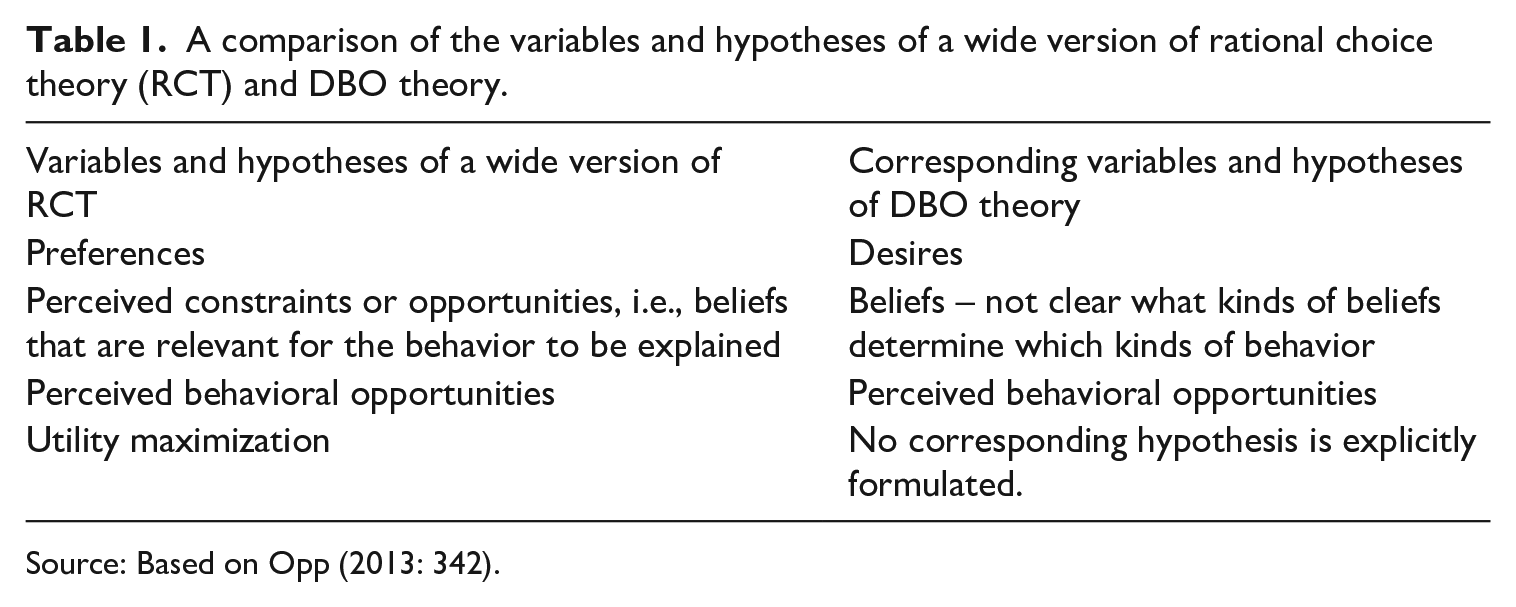
Source: Based on Opp (2013: 342).
The major argument for applying general theories
The alternative to applying a general theory is to ‘adopt a view of sociological theory as a toolbox of social mechanisms’. These are ‘sometimes-true’ theories. Such a theory ‘should not be evaluated in terms of whether it is true or false in general, but whether it applies to the specific situation at hand’ (Hedström, 2021: 493). The alternative thus seems to be to apply what has been called theories of the middle range (TMR). This program has been discussed for a long time (Boudon, 1991; Bouvier, 2023; Cartwright, 2020; Hedström and Udéhn, 2009; Lee, 2021; Merton, 1967; Opp, 1970, 2013) and is still pursued by a great number – perhaps by most – advocates of the Swedish School (and by many other sociologists as well). However, the program of concentrating on TMR and ignoring general theories has a major flaw: it abandons a possibility for achieving theoretical progress by finding weaknesses of the TMR as well as of the general theories.
There is a large body of evidence for this thesis. The possibility to advance our knowledge by applying general behavioral theories has already been shown by Homans (1967) and Malewski (1962, 1964, 2017). A recent example that illustrates the theoretical merits of applying general theories is the falsification of the criminological self-control theory (Gottfredson and Hirschi, 1990). It is very well confirmed by numerous empirical studies (e.g. Britt and Gottfredson, 2003; Goode, 2008; Gottfredson, 2017: 2, 2018: 353–355; see also the meta-analyses by Pratt and Cooper, 2009; Vazsonyi and Ksinan, 2017; see also the discussion in Opp, 2020b). The theory reads as follows.
Self-control theory: If there is low self-control, criminal behavior is likely Tibbetts and Myers (1999) analyzed whether this theory is still valid when it is compared with a wide version of RCT. A dependent variable was ‘caught for cheating on previous exams’. Low self-control was measured with a scale in a survey. Variables from a wide version of RCT were measured as well (such as anticipated shame, perceived pleasure of a behavior, morals, and perceived formal and informal sanctions). Five control variables were included. In a regression analysis low self-control alone had a significant beta of 0.32. It thus seemed that there was another confirmation of the theory. However, in a multivariate analysis with low self-control and the other variables self-control becomes insignificant with a beta of 0.008 and a t-value of 0.64. The R2 is 0.56. This example illustrates the importance of comparative theory tests that include general theories.
The previous example is a comparative test of micro hypotheses. As has been said before, AS aims at explaining action-based explanations of social processes or, in other words, proposes micro–macro models. The fruitfulness of applying a wide RCT to explain micro–macro processes is illustrated with the following example. Assume that there are protests against a government decision and that the state uses repression to crush the protests. This is a macro hypothesis. One would assume that increasing repression has a deterrence effect, that is, protests decrease. However, research has found the following (see De Mesquita and Schadmehr, 2023; Francisco, 1995; Opp, 1994, 2022: chapter 2.2). If repression is low and increases, there is often first a backlash (i.e. radicalization effect): protest increases. Then, if repression further increases, a deterrence effect can be observed. This is the inverted u-curve (see Figure 1). A recent example are the protests in Iran in September 2022: ‘Protests in Iran surge as crackdown escalates’ (The New York Times, 2022). Meanwhile, it seems, protests decrease. Another example are the protests in Hong Kong that first exploded and then were terminated by the Chinese regime.
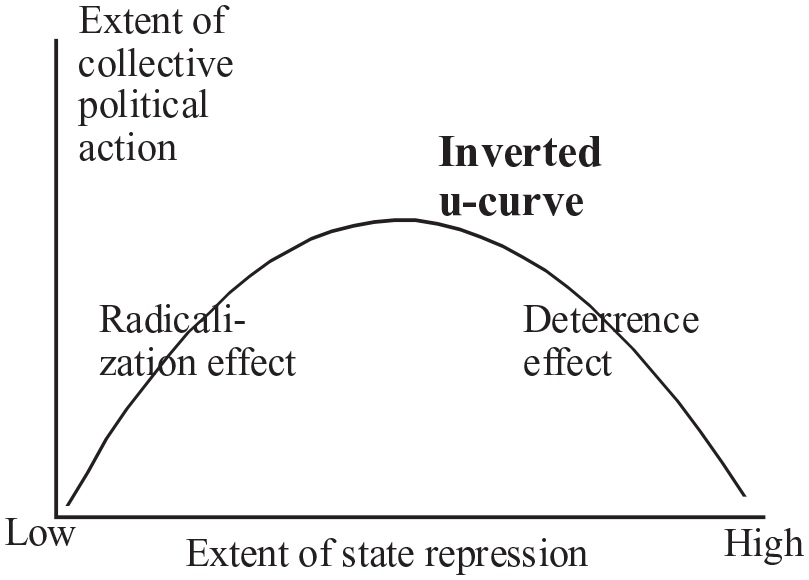
Repression and collective action: the inverted u-curve.
Social scientists are normally not satisfied with macro relationships as the inverted u-curve. In the present example one would like to know how the inverted u-curve can be explained, and whether there are cases where it does not hold. To answer this question, it is plausible to assume that repression (a macro factor) has an impact on individual motivations to act; these actions (such as protesting) then aggregate to collective action. What could these individual motivations be? If repression is low and increases, individuals’ discontent could increase and activate a norm that one should protest. If then the costs of protesting become relatively high, the benefits of protest decrease so that individuals protest less frequently (which aggregates to a decrease of macro political action).
In this example the application of a cost–benefit account provides clear suggestions about the kind of factors which might be relevant for the explanandum. Furthermore, the theory specifies the conditions for the validity of the inverted u-curve. For example, discontent due to repression might increase, but individuals might consider their personal influence to change the actions of the government so low that from the very beginning protests are largely absent and do not increase.
These two examples illustrate the fruitfulness of applying RCT. There are numerous other studies about specific macro explananda scattered in the literature that are theoretical comparisons of RCT and other theories. Examples are the comparison of market institutions and central planning institutions (e.g. Brus and Laski, 1989) and the analysis of competing explanations for explaining economic growth (Acemoglu et al., 2005; Acemoglu and Robinson, 2012).
These examples illustrate that only applying TMR such as the u-curve hypothesis forgoes the opportunity to achieve theoretical progress by finding weaknesses of the TMR as well of the general theory. In both cases the applied general theory could have been falsified.
The procedure of empirical theory comparison is summarized in Figure 2. One starts with a theoretical analysis. The first step is to explore to what extent a TMR can be derived (in its original or modified form) from a general theory such as RCT (see arrow 1 in Figure 2). Let the result be that the TMR can only be derived if certain conditions are added that follow from the general theory. Then the derived hypotheses must be tested empirically (arrows 2a and 2b). If the modified theory is falsified, the general theory is falsified as well. If there is a confirmation of the modified TMR, the general theory is confirmed as well.
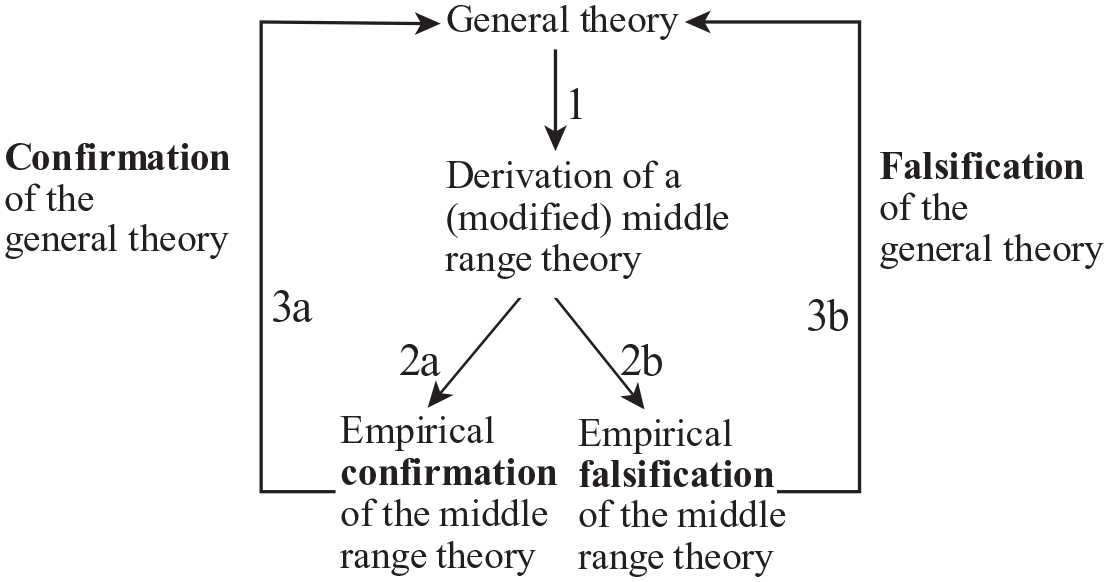
The relationship of a general theory and theories of the middle range.
It could happen that TMR are derived without modifications. In this case an empirical confirmation supports both theories, a falsification would disconfirm both theories. 4
We conclude that applying general theories is a possible strategy of achieving theoretical progress in the sense that we find weaknesses of the applied theories – the TMR as well as the general theories. Another consequence is that we achieve an integration of theories: we get to know how theories are related.
It is important to note that the focus on TMR and the neglect of general theories is not a contradiction. It is only a missed opportunity for new tests of the applied TMR and the general theory alike. In Figure 2 only the lowest part would be left, namely isolated tests of TMR.
The program of empirical theory comparison is also compatible with an insight of the philosophy of science: a theory may be well confirmed in isolated tests. But a comparative test may falsify the theory (e.g. Lakatos, 1970: 119). This is the general methodological background for the program of comparative theory testing.
Can RCT predict future events?
There is another turn in 2021: DBO theory is rejected not because it is wrong but because of its ‘failure to predict the future behavior of individuals’ (Hedström, 2021: 500). This charge raises two questions. (1) One is whether DBO theory and, thus, the wide RCT are incapable of predictions. A detailed analysis of this alleged failure is missing. (2) Assuming that RCT cannot predict behavior: should this be sufficient to reject the theory, or should its validity be the major criterion for further applying and improving a theory?
To answer these questions, I start with an example. A central hypothesis in Institutional Economics (e.g. Ménard and Shirley, 2022) is that economic institutions (i.e. systems of norms) such as markets have a causal impact on individual incentives (i.e. costs or benefits) for economic action. This, then, aggregates to economic growth on the macro level (see, e.g. Acemoglu and Robinson, 2012). The entire process takes time: subjects must become aware of the incentives and then organize economic actions. For example, if new institutional arrangements allow to found firms, actors need to organize the resources for setting up a firm. This takes time. The incentives of a market order are largely absent in systems of central planning (e.g. Brus and Laski, 1989). Therefore, economic growth is expected to be lower in centrally planned economies. The following deductive argument – consisting of a theory T, the respective initial conditions C, and the explanandum E – presents this argument more formally. Applying T can explain why economic growth differed in the two societies. T includes general conditions for economic growth, C refers to specific societies that differ regarding economic systems; T and C explain E (i.e. E follows logically from T and C). The explanation can be summarized by stating that differential growth of the two societies is due to the different institutional systems, and they influence economic growth in general (as T states).
Can economic growth also be predicted by applying T? 5 Assume that shortly after World War II in 1949 West Germany introduces a market economy, whereas in East Germany central planning is implemented. T and C logically imply that there will be different economic growth (which has been empirically confirmed). The example thus clearly falsifies the allegation that RCT is incapable of predictions.
Theory T: In market societies economic growth is higher than in centrally planned economies. Initial conditions C: West Germany in 2010 was a market society, the communist East Germany was a centrally planned economy. _______________________________________________________________________________________________________________ Explanandum E: In West Germany economic growth in 2010 was higher than in East Germany.
There are situations in which a prediction fails. For example, let the different economic systems be implemented in both societies. Then, before economic activities can unfold to bring about differential economic growth, the adjacent Soviet Union invades West Germany, destroys the existing economic market institutions, and imposes central planning. The prediction of differential economic growth that was made at the time of the establishment of the different institutions is thus thwarted by unforeseen changes in initial conditions. The reason for the failure of the prediction was that information about the invasion of the Soviet Union was not available. Otherwise, the prediction had been correct.
The example illustrates a general condition for the possibility of prediction: knowledge of the change of initial conditions. RCT implies that those conditions are costs and benefits of a behavior. A prediction thus holds ceteris paribus, that is, if other costs and benefits don’t change. These are the scope conditions for the validity of a prediction. These relevant conditions are often not known in open societies: we can never be sure that we can predict changes of all possible causes.
The important implication of this argument is that the incapability of predictions is not a ‘sure sign that something is seriously wrong with the proposed explanation’, as Hedström (2021: 498) argues.
It is ironic that this argument also holds for the alternative to apply RCT that Hedström proposes, namely, to model interaction structures and their impact on behavior (see below). Predictions from interaction structures can also be invalidated by unforeseen events. Assume, a certain network structure has developed, and it is predicted that there will be a high extent of cooperation. If suddenly a natural catastrophe occurs or an invasion of another country that destroys the network structure, the prediction will not hold true.
The conclusion is that RCT can be applied to make predictions. The condition is, as for every other theory, that relevant initial conditions can be controlled by the researcher.
Predictability as a criterion for accepting theories
The demand to abolish a theory if it cannot predict future events implies that valid theories which offer numerous fruitful explanations of social phenomena must be discarded. This consequence holds not only for DBO theory and RCT. It holds for Darwin’s evolutionary theory as well that does not allow predictions (Scriven, 1959; for an introduction to the theory see Dunbar, 2020). If a species has found some niche to develop certain capabilities of survival, numerous events may happen that change the course of evolution. These events which cannot be anticipated may be natural catastrophes, interventions by humans, or immigration of other species.
Numerous middle range theories must be abandoned as well if they do not allow predictions. For example, theories about social movements are not capable of predictions of protest because, for example, protests can always be crushed by government actions that are difficult to predict.
To conclude, a major goal of scientists is to provide valid explanations of social phenomena. Even if this goal is achieved, prediction may be thwarted by conditions that the researcher cannot control. Deciding to make the predictive capability of a theory the only criterion for its evaluation implies to forgo theories that enable us to make valid and informative explanations of social phenomena. There will be hardly a scientist who will accept this consequence.
The instrumentalist view of applying RCT and the ‘realism’ of assumptions
Hedström and Swedberg (1996) discuss a ‘standard sociological critique of rational choice theory’ that ‘focuses on the realism of its assumptions’: The choice between the infinitely many analytical models that can be used for describing and analysing a given social situation can never be guided by their truth value, because all models by their very nature distort the reality they are intended to describe. The choice must instead be guided by how useful the various analytical models are likely to be for the purpose at hand. (p. 130)
In support of this argument the authors cite Friedman (1953) who proposes the instrumentalist view of theories: theories need not be true; they must be instruments that logically imply correct conclusions. To illustrate, data show that the number of smokers decreased in Germany between 2000 and 2020. 6 Let this be the explanandum which is a valid descriptive hypothesis. According to the instrumentalist view of theories, to explain the explanandum we need some assumptions (i.e. premises) that logically imply it as a conclusion. If, thus, the premises are a theory and imply a true conclusion, then the theory is useful.
The following axiomatic system (see below) illustrates that the instrumentalist view is highly problematic. The first premise is a theoretical proposition about green men; the second premise is a singular statement. All the empirical evidence suggests that there are no green men on Mars so that there are no commands by them given to humans. So, the two premises are false. However, this is irrelevant for the instrumentalist view. It only requires that the conclusion is true and follows logically from the false premises (symbolized by the line). Indeed, the two premises logically imply the true conclusion.
Obviously, nobody would regard this ‘explanation’ as satisfactory. When we explain a phenomenon, we want to know the factors that are the correct determinants of the explanandum. Only this yields valid explanations. We thus need empirically true premises. This is the realist view of theories (e.g. Nagel, 1961: 141–152).
In general, the example clearly demonstrates that the ‘realism’ of assumptions should be a requirement for a valid explanation. Again, the reason is that the premises contain the explanatory factors that bring about the explanandum (i.e. conclusion). False premises thus mean that the explanation of the explanandum is false as well.
Premise 1: Humans always follow the commands of the green men on Mars (false).
Premise 2: Green men from Mars have selected an increasing number of humans from 2000 to 2020 in Germany and told them to stop smoking (false).
_______________________________________________________________________________________________________________________________
Conclusion 1: The number of smokers decreased between 2000 and 2020 in Germany (true).
For those who are not familiar with formal logic, it might be astonishing that wrong premises can logically imply true conclusions (see any textbook of formal logic such as Copi et al., 2014: 24–31). One must distinguish between the truth (or falsity) of the statements in a deductive argument and the validity of the inference.
Now assume – as in the instrumentalist view – that the premises are false. As the previous example shows, true conclusions can be logically derived. However, the possibility is that also false conclusions can be derived. This means that adopting the instrumentalist view one may always arrive at wrong conclusions. In other words, if one wants valid explanations – which is the goal of empirical sciences – one needs true premises. The reason is that true premises always imply true conclusions. The instrumentalist view is thus highly problematic. 7
It is not clear whether Hedström and Swedberg (1996: 130) really subscribe to an instrumentalist view of theories. Perhaps they criticize the lack of realism of assumptions of many models that apply RCT when they write that many explanations with RCT ‘ignore empirical facts about the behavior of individuals’ (Hedström, 2021: 498). Objections against unrealistic assumptions in economics have been raised a long time ago. One of the major authors is Hans Albert who called the practice of formulating such models (e.g. models about perfect markets) ‘model platonism’ (see Albert, 1963; Albert et al., 2012; see also Albert, 2022; Nagel, 1963).
For limitations of space, this discussion cannot be presented here. Only the following points are important for judging the previous critique: (1) assumptions are scope conditions under which a model is supposed to hold true; (2) this implies that assumptions can be more or less realistic. The model of a perfect market describes a situation that does not exist. However, many models (as in public choice theory) apply to specific real situations. For example, one might assume that in explanations of protest state repression is absent. This situation holds in democracies. The repression assumption will be dropped if protests in autocracies is explained; (3) the previous examples illustrate that RCT can be used to formulate models with more or less realistic assumptions. Making unrealistic assumptions is thus not a built-in weakness of RCT.
The different ‘logics’ of action: Should theories be applied on a ‘case-by-case basis’?
Another suggestion by Hedström (2021: 493) is to apply ‘sometimes-true’ theories. This suggests that the truth of theories is irrelevant or largely irrelevant for explaining social phenomena. Applying ‘sometimes-true’ theories implies to apply ‘sometimes-wrong’ theories so that, it seems, validity of a theory is not important. This position is not compatible with a program of severe comparative empirical theory testing aimed at finding the best theory. Manzo (2021b: 32, see also Manzo, 2014: 21–27) holds a similar position. There is a variety of logics of action 8 which ‘are in principle all equally legitimate when specifying the micro-level component of a model of a given mechanism; the conditions under which it is more realistic to assume this or that logic should be assessed on a case-by-case basis’.
The question that is not answered is what exactly the criterion for the selection of a theory is. Assume, for example, the protests in Western Europe after the Russian invasion of the Ukraine in February 2022 should be explained. There are numerous theories such as deprivation, resource mobilization, political opportunities, identity, and collective action theory. Which theory will be selected? The goal will be to come up with a valid explanation. This suggests that one will select those theories that are valid (i.e. empirically best confirmed). If there has not been any comparative theory testing, one will choose the most plausible theory. But this selection is based on the purely subjective intuition of the scientist. We know from the history of sciences how often intuition fails. For example, in social movements research the first most plausible and widely accepted theory until the beginning of the 1970s was the deprivation theory: those who are most frustrated protest most frequently. However, this theory has been clearly falsified by numerous studies (see Opp, 2022). This example illustrates that applying a ‘sometimes-true’ theory is not desirable. This would imply to apply deprivation theory – it is ‘sometimes true’ if the other relevant conditions are given (i.e. if there is an omitted variable bias). To find valid explanations of specific social phenomena theory competition and comparative theory testing are necessary. Otherwise, theory selections are largely arbitrary and based on the ad hoc intuitions of scientists.
Explanations without mental states
It is common in sociology and other social sciences to include mental states as explanatory variables. An illustration is the work of Max Weber: Protestantism is a belief system that is regarded as a causal factor for many social phenomena. The action frame of reference of Talcott Parsons (1949 [1937]) includes actors’ beliefs and preferences as explanatory variables. Internalized norms are another standard factor in sociological explanations. Following Hedström (2021), all those factors should be abandoned: [. . .] we should avoid intentional explanations in all but the rare cases where we have access to reliable information on the mental states of the acting individuals. Instead, we should concentrate our explanatory efforts on interaction structures and the macro patterns they give rise to. (p. 490)
The argument thus is: (1) explanations without mental states provide valid explanations; (2) mental states can normally not be measured reliably; (3) the alternative to explanations with mental states is to deal with ‘interaction structures and the macro patterns they give rise to’. Are these convincing arguments?
Mental states can be neglected if they are intervening variables between the situation and action. This is Hedström’s (2021: 497) explicitly formulated model

‘S’ symbolizes the situation referring to ‘various observable social characteristics of the individual and the individual’s social environment likely to affect the individual’s mental states and actions’. ‘M’ are the mental states ‘relevant at [. . .] the time of acting’. ‘A’ are the actions of an individual. The intentional explanation is explicitly formulated by Hedström (2021) as

If the first model (S → M → A) is correct, then the logical implication is

Explanations with S as independent and A as dependent factors are thus valid.
However, ‘S → A’ is false. It is generally accepted that the causal impact of a given situation on individual behavior depends on mental states of the individual. This is illustrated with the previous example of the inverted u-curve: the pre-existing preferences (such as the extent of discontent) and given beliefs (perceived personal political influence) determine the impact of repression on protest. This means that there is an interaction effect of S and M (symbolized with a dot operator) on A. The correct model thus is

This is the model that is accepted by most sociologists (and other social scientists): there is a situational determination of the impact of mental states and, thus, an interaction of situations and mental states. In this model S → A does not follow logically from the model (S
The major argument for ignoring M is an alleged measurement problem: it is argued that there are in general no valid measurements for psychic states. Measuring mental states is not without problems, but there is an extensive inventory of diverse methods (including unobtrusive methods) for measuring psychic variables reliably. One example is the measurement of sensitive phenomena (e.g. Tourangeau and Yan, 2007), referring to past sexual victimization experiences (see Leitgöb and Leitgöb-Guzy, 2024). Another example is the possibility to get valid answers in online surveys (Höglinger et al., 2016). A third example is implicit measurements of psychic phenomena such as priming (e.g. Fazio and Olson, 2003). These examples illustrate that a general claim that we cannot measure psychic states reliably is not correct.
But assume we accept the measurement argument. This should not lead to abandon propositions with mental states. The goal is to formulate true theories. To reach this goal we should not reject theories that could be true because there are measurement problems. Nobody would accept a completely wrong theory only because the variables can be measured reliably. If there are measurement problems of plausible theories, we should invest resources to improve our measurements – which happens in social research – and not give up theories.
It is surprising that the measurement argument has been another turn in AS: the fruitfulness of making assumptions of mental states is granted in one of the first statements of AS (Hedström and Swedberg, 1998: 13): ‘[. . .] the social sciences routinely postulate the existence of unobserved explanatory mechanisms. Assumptions of intentions, discounting, and preferences have proven to be extremely useful analytical devices even though they never have been observed’. This implies that theories with mental states are fruitful and should not be given up. The arguments for the recent turn to abandon explanations with mental states are unknown.
Omitting mental states leads to another problem. RCT is often criticized for not focusing on explaining preferences and beliefs. The claim that psychic phenomena are to be excluded from explanations means that an extension of the explananda of RCT becomes impossible.
The abandonment of critical rationalism and analytic philosophy in analytical sociology
A major problem of the recent turn in AS is the increasing critique of critical rationalism and, in general, of analytic philosophy. Their proponents share a commitment to the values of conceptual clarity, argumentative rigor and analytical precision’ (Little, 2021: 64, see also 65–69, 75; in general, see Albert, 1985; Schurz, 2014). This philosophy is particularly well suited as the methodological basis for AS. It is thus not surprising that in previous work of AS we find positive assessments of this philosophical school. For example, Hedström (2005: 1) writes that AS ‘uses explanatory strategies more often found in analytical philosophy [. . .]. It is an approach that seeks precise, abstract, realistic, and action-based explanations for various social phenomena’ (p. 1). A similar assessment can be found in a later article by Hedström (2009). Already in 1996 Hedström and Swedberg (p. 127) mention ‘important ideas of Karl Popper’ (a proponent of critical rationalism that is a variant of analytic philosophy) that are a part of their approach.
This orientation is largely abandoned. In the Research Handbook on Analytical Sociology (Manzo, 2021a) ‘critical rationalism’ is only mentioned by one of the contributing social scientists, namely, in Werner Raub’s (2021a) contribution. In Hedström’s (2021) Coda the earlier advocacy of analytic philosophy is gone. An explicit critique of the merits of critical rationalism and analytic philosophy for AS is provided by Little (2021: 70). Hedström (2021: 495) seems to favor pragmatism.
Furthermore, some doctrines in the recent turn of AS discussed before are not in line with analytic philosophy. This holds for the claim that a theory should not ‘be evaluated in terms of whether it is true or false’ (Hedström, 2021: 493). Critical rationalism assumes that all knowledge is fallible and that we can only make progress when all statements undergo severe criticism. Empirical theory comparison is a severe form of criticism that is given up. The reasons for the methodological turn are not known.
Our recommendation is to retain analytic philosophy and critical rationalism as the methodological foundation of AS until there are detailed arguments for their abandonment.
Mechanism explanations without theories? The old ignored issue
A lingering problem and a suggested solution are ignored by advocates of the Swedish School. The problem is the assumption that covering-law, statistical, and mechanism explanations are different types of explanations (Hedström, 2005: 12–33). The characteristic of mechanism explanations is that they do not need theories. This position is repeated later: mechanism explanations are not ‘wedded to the idea that an explanation is a deductive argument’ (Hedström and Ylikoski, 2010: 55). There is a detailed discussion and rejection of this argument (see most recently Di Iorio and Di Nuoscio, 2022; see further Norkus, 2005; Opp, 2005, 2013). This discussion is not addressed. In his Coda, Hedström (2021: 491, referring to Manzo, 2014), writes that a mechanism explanation consists of an explanandum referring to social processes in which individuals are the basic entities and in which relationships between individuals are important. There is no reference to the application of a theory. Manzo deals in detail with mechanism explanations in a programmatic article about AS (Manzo, 2021b). He summarizes its ‘explanatory strategy’ (Manzo, 2021b: 4, referring to Hedström and Bearman, 2009: 16) and writes that ‘the opposition between mechanism-based explanations and the covering-law model of explanation were regarded as unconvincing’ (citing Norkus, 2005; Opp, 2005). However, he does not discuss the objections in detail. In his seven postulates of AS (ibid., 5) theories are not mentioned either. The reasons for ignoring fundamental objections to applying theories are unclear. In Manzo’s (2010) position there is also a turn: in an earlier publication he writes that ‘AS is perfectly open to the use of ‘social laws’’ (Manzo, 2010: 142–143).
The major argument for applying theories in mechanism explanations is that the theories provide guidelines for selecting causal factors, as has been said before. Mechanisms are ‘chains of events’ (Manzo, 2021b: 2). Regarding the application of theories, the question is how chains of events can be specified without applying theories. Again, theories inform about the kinds of relevant events that cause other events. We illustrated this with the example of the inverted u-curve. Let us extend this example and assume we find that repression raises individual incentives to protest, and the individual protests aggregate to an increase in macro protests (via individual protests). The macro protests lead to incentives for members of the government to increase repression which, then, terminates the protests (see Figure 3). This is an example of a protest cycle. A cost–benefit model seems particularly fruitful to explain the behavior of the protesters and the behavior of the members of the government as well. The example can be modified: the repression might be too low to stop the protests so that protests further increase.
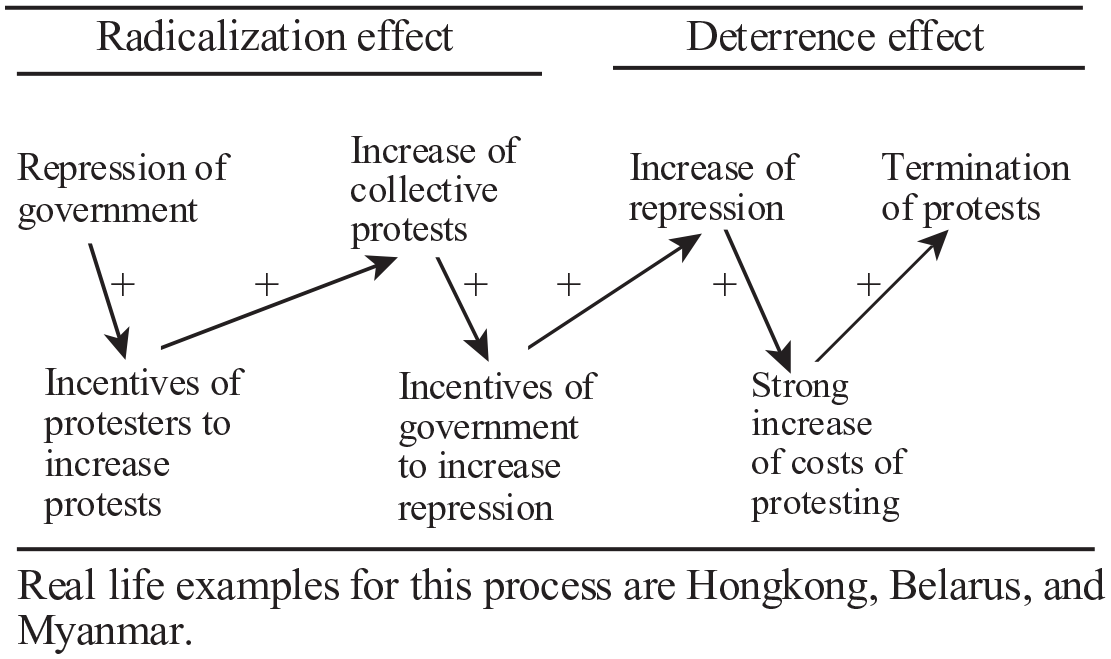
An example of a protest cycle: from backlash to defeat.
It is striking that the arguments for applying theories in mechanism explanations are implicitly accepted by Manzo (2021b: 2). When he writes that mechanisms are ‘chains of events’ he argues that they are specified ‘by connecting actors’ opportunities, desires, and beliefs to the social context in which actors are embedded, dynamically led to (associations of) events at a higher level of abstraction’. Desires, beliefs, and opportunities are the variables of DBO theory and, thus, of the wide version of RCT (see the previous discussion). One can only understand this argument as an implicit plea to apply a wide version of RCT to explain mechanisms.
The following example further illustrates that applying general theories is an opportunity for theoretical progress. This opportunity is missed in recent research by Cowan and Baldassarri (2018). Both authors are advocates of the Swedish School: Cowan received a Merton Award from the INAS (of the Swedish School), and Baldassarri was a member of the prize committee. The question of their research is under which conditions people report what kind of preferences to what kind of others. There is what they call a ‘mechanism of selective disclosure’: individuals will communicate their views (e.g. about abortion) only to specific others. A major finding is (Cowan and Baldassarri, 2018: 4): ‘Individuals are less likely to disclose their opinion to those with whom they disagree than those with whom they agree’.
A first question is why this hypothesis is called a ‘mechanism’: it refers only to a two-stage causal model consisting of causes and effects and not to a social process that is normally understood by a mechanism (e.g. Manzo, 2010; Opp, 2005). A second question is why the authors do not even consider the application of a general theory. This is surprising because the possibility to apply a general theory is so obvious: the ‘mechanism’ refers to behavioral alternatives (e.g. not communicating, communicating to persons A, B, etc.), behavioral consequences (e.g. avoid conflicts), their utilities (e.g. the goal to avoid conflict), and subjective probabilities (e.g. the degree to which one expects certain reactions of others to revealing one’s preferences). This is a perfect situation for applying VET (see Feather, 1990; Nagengast et al., 2011). To put it briefly, the theory states that a person chooses an action from perceived behavioral alternatives by considering the utilities (referring to the extent to which the perceived consequences are goals or desires) and subjective probabilities (expectations). For each behavioral consequence the utility and subjective probability have a multiplicative effect.
The ‘selective’ exposure refers to perceived behavioral alternatives – such as not revealing one’s preferences or revealing them to persons one agrees with. There are consequences for the different behavioral alternatives. For example, letting a conversation partner know that one will vote for Trump will lead to approval or disapproval, and these consequences are expected with some subjective probability. Furthermore, the behavior is dependent on how the person values a consequence. The authors mention ‘avoiding conflicts’ as a behavioral consequence. VET suggests looking at the utility of this consequence: having conflict with a close friend will be more costly than having conflict with a person one dislikes. There is one consequence that the authors do not mention: to bring about a change in the opinion of others. This is a major motive of many individuals who are politically active and who want to spread their political views. Perhaps one could have analyzed subgroups in the sample consisting of individuals who do not reveal their views to people they agree with. The activists’ ‘selective exposure’ is to communicate with persons who they do not agree with. The behavioral consequences of this behavior should then be explored.
The authors find that ‘Americans are more likely to share their opinions with friends and family rather than co-workers’ (Cowan and Baldassarri, 2018: 1). VET can explain such results, and the explanations can be tested. One could speculate that the expected rewards from close friends are valued relatively positively. An implication is that socially isolated individuals might get higher approval from co-workers and, thus, will more likely share their opinions with co-workers. Perhaps that could have been tested with the data.
These short reflections suggest that the application of VET and perhaps other general theories (such as balance or dissonance theory) could have been fruitful: new hypotheses could have been found, and conditions could have been specified for the validity of the authors’ propositions. The neglect of applying a general theory is thus a missed opportunity for finding new hypotheses and for testing implications of the general theory and, thus, its validity.
Discussion
This article discusses some recent developments of AS, put forward by members of the Swedish School of AS. The major new doctrines are to abandon general theories and to discard explanations with mental states. An old issue and its suggested solution are not addressed, namely, that mechanism explanations differ from other kinds of explanations (such as explanations with laws). It is shown in detail why these new doctrines are unacceptable and why mechanism explanations are not a special type of explanations in the sense that no theories are needed.
The question is to what extent these developments are only programmatic claims or whether advocates of AS have adopted them in their research. Perhaps the criticism of this article is implicitly adopted in AS so that the program is not describing what adherents of AS practice? To find agreements between the program of AS and substantive work of adherents of AS, Manzo (2021b: 7–38) analyzed 11 articles that received the Robert K. Merton Award (or an honorable mention of it) of the INAS between 2013 and 2020. Manzo’s (2021b) goal is ‘to evaluate analytical sociology at work’ (p. 8).
For the present context – the acceptance of the recent turn of AS – several facts are worth mentioning. The distribution of the prizes depends on the methodological orientations of the members of the prize committees (see table I). This is a group of renowned scholars who seem to share mainly one feature: advocacy of a rigorous sociology. Their theoretical orientation ranges from rational choice scholars to empirical researchers focusing on middle range theories. It is highly implausible that the turn discussed before is generally accepted. The same holds for the receivers of the prize. They cover the entire spectrum of rigorous sociology with empirical–theoretical research. RCT is among the theoretical orientations. One of the papers even received a prize in the ‘Rationality and society section’ of the American Sociological Association (see table I).
Manzo analyzes explicit references in the articles to concepts such as ‘analytical sociology’ or ‘mechanisms’. This is an acceptable procedure. However, it is possible that an article does not mention such expressions but nevertheless applies a theory (such as RCT) by analyzing mechanisms. Manzo (2021) considers this possibility when he writes that ‘only a minority of articles explicitly explicated the extent to which the micro level part of the proposed mechanism fits into rational action theories’ (p. 42). This is plausible because RCT has not a high reputation among advocates of AS. It is therefore a beneficial – in the sense of RCT – strategy not to mention the name of a controversial theory but apply it if it is regarded as fruitful. This is apparently done by most authors of the awarded articles that ‘uniformly adopted weak forms of rationality and/or various forms of heuristic-based behaviors’ (Manzo, 2021b: 42). Assuming that the members of the prize committees are not blind regarding implicit methodological orientations, one might speculate that they also accept methodologies that are rejected in the recent turn.
If this is correct, then authors of the awarded papers apply RCT, intentional explanations, and theoretical propositions when mechanisms are explained. It thus seems that the new turn of AS is so far not generally accepted by advocates of the Swedish AS.
We could apply RCT to explore its predictive capability by speculating to what extent the new turn will spread across advocates of AS. The new demands of AS can be modeled as cognitive elements (such as ‘renounce the application of general theories’, or ‘abandon intentional explanations’). These are strongly opposed to existing practices (such as ‘apply general theories’). As the social psychological dissonance and balance theories suggest (e.g. Harmon-Jones, 2019; Rawlings, 2020), being exposed to such opposing views is costly (or, equivalently, dissonant or unbalanced). One cognitive strategy to avoid those costs is to keep the existing cognitive structure intact and thus not to accept the new views. This seems also at present the position of most adherents of the Swedish AS. Conforming to the majority (which includes prestigious scholars) is another benefit of not changing one’s convictions. The prediction thus is that the new turn will not spread.
Footnotes
Acknowledgements
The author is grateful for the excellent comments of an anonymous reviewer of Social Science Information.
Funding
The author(s) received no financial support for the research, authorship, and/or publication of this article.
Notes
Author biography
 .
.