




Abstract
Self-tracking is becoming a prominent and ubiquitous feature in contemporary practices of health and wellness management. Over the last few years, we have witnessed a rapid development in digital tracking devices, apps and platforms, together with the emergence of health movements such as the Quantified Self. As the world is becoming increasingly ruled by metrics and data, we are becoming ever more reliant on technologies of tracking and measurement to manage and evaluate various spheres of our lives including work, leisure, performance, and health. In this article, I begin by briefly outlining some of the key theoretical approaches that have been informing the scholarly debates on the rise of self-tracking. I then move on to discuss at length the findings of an international survey study I conducted with users of self-tracking technologies to discuss the ways in which they perceive and experience these practices, and the various rationales behind their adoption of self-tracking in the first place. The article also addresses participants’ attitudes towards issues of privacy and data sharing and protection. These attitudes seem to be dominated by a lack of concern regarding the use and sharing of self-tracking data with third parties. Some of the overarching sentiments vis-à-vis these issues can be roughly categorized according to feelings of ‘trust’ towards companies and how they handle data, a sense of ‘resignation’ in the face of what is perceived as an all-encompassing and ubiquitous data use, feelings of ‘self-insignificance’ which translates into the belief that one’s data is of no value to others, and the familiar expression of ‘the innocent have nothing to hide’. Overall, this article highlights the benefits and risks of self-tracking practices as experienced and articulated by the participants, while providing a critical reflection on the rise of personal metrics and the culture of measurement and quantification.
Introduction
We live in an age of intense measurement where metrics, data and quantification have become routine aspects of everyday life. As the world is becoming increasingly ruled by metrics and data, we are becoming ever more reliant on metric technologies and tracking practices to manage and evaluate various spheres of our lives including work, leisure, performance, and health. Over the last few years, we have witnessed a rapid development in digital tracking devices, apps and platforms, together with the emergence of health movements, such as the Quantified Self, and the promotion of data-driven forms of self-monitoring and analysis. Every day, millions of people around the world are routinely recording their activity levels, calorie intake, sleep patterns and a myriad of other physical and emotional variables, all with the aim to gain insights into their habits and behaviors, and improve their fitness, health, and life as a whole.
At the heart of this ‘metric culture’ (Ajana, 2018) of self-tracking is the philosophy of ‘self-knowledge through numbers’; a form of ‘wisdom’ espoused by the Quantified Self community and one that encourages the gathering and analysis of data about the body and its vital aspects, and extracting meaningful insights for the purpose of self-improvement. Founded in 2007 by Wired magazine editors, Kevin Kelly and Gary Wolf, the Quantified Self initially started as a small gathering of 28 people in Kelly’s home in San Francisco to discuss self-experimentation and analysis using sensor technology. Since then, it has become a global phenomenon with currently over 200 meetup groups in different countries around the world, and the term itself is now used to describe almost any form of self-tracking. However, not everyone who self-tracks necessarily self-identifies as a member of the Quantified Self. The growing metric culture of self-tracking goes beyond and above the confines of the Quantified Self community.
Moreover, the idea of monitoring the body and its activities is not completely new, nor is the use of metrics to chart progress and goal attainment. As Alexandra Carmichael (2010) reminds us ‘[p]eople have been recording their lives in analog format ever since they started drawing on cave walls’. For instance, back in the 17th century, Santorio Santorio, a Venice-based physician, famously devised a weighing chair to monitor his weight changes through food ingestion and discharges (Sysling, 2019: 6). A century later and on the other side of the Atlantic, Benjamin Franklin, who was influenced by Santorio, developed a system where his sins were tabulated and quantified in order to monitor his moral behavior. In China, a similar system was in place in the 16th and 17th centuries where individuals recorded their daily good and bad deeds on The Ledgers of Merit and Demerit (Brokow, 1991) and counted their individual worth, accordingly. Also, the idea of the first pedometer goes all the way back to Leonardo da Vinci and a wheeled device he designed to count the daily steps made by marching Roman soldiers.
As such, people have long reflected on the state of their bodies and selves for centuries using analogues devices and diaries. Nevertheless, developments in digital technologies and sensors have certainly made it easier than ever to automate the process of self-tracking and quantification, embedding this practice into everyday products such as mobile phones and watches. Techniques and technologies that were traditionally confined to the expert professional sphere are increasingly made accessible to the everyday general user. There are now over 318,000 health apps on the markets (Mobius, 2019) and a wide range of wearable devices such as Fitbit Charge, Garmin Vivosport, Amazfit Bip and Apple Watch, all of which are designed to record various biometric data and fitness indicators, and provide feedback on activity and health in the form of illustrations and graphs.
It is often reported that the use of wearable tracking devices or apps has a positive impact on users’ health and wellbeing, especially in terms of providing motivation and promoting behavioral change. The belief is that metric modes of self-analysis offer a much more reliable and efficient path towards self-knowledge and improvement, compared to traditional methods of self-reflection and introspection. ‘Unless something can be measured, it cannot be improved’ (Kelly in Takahashi, 2012) is seemingly the founding principle of the Quantified Self and a statement that symbolizes the underlying ideology of self-tracking culture, its positivistic tendency, and its zealous dependence on numbers and quantification.
Unsurprisingly, the techno-social phenomenon of self-tracking has been receiving much attention recently, as evidenced in the mass media coverage of this trend and in the rapidly developing body of literature from medical researchers, cognitive and behavioral psychologists, as well as social scientists and humanities scholars. As of the literature from the latter, there has been a series of studies and critiques informed by the Foucauldian twin concepts of anatomopolitics and biopolitics. On the one hand, anatomopolitics refers to modes of (self-) discipline directed at the body of the individual with the intention to maximize its usefulness, capacities, and efficiency (Foucault, 1979: 139). Biopolitics, on the other hand, refers to the management of life and the living en masse by targeting the body of the population through aggregated processes of governance and statistical norms (Foucault, 1979). The literature informed by these concepts looks at the ways in which self-tracking practices can be seen as a form of biopower designed to subject the body and the self to normalizing regimes of health and socially established beauty standards (anatomopolitics) (see for instance, Sanders, 2017; Ajana, 2017; Elias & Gill, 2017; Charitsis et al., 2019; Kent, 2018). At the same time, this body of literature is also interested in the ways in which the big data emerging from the use of mobile apps and wearable devices contribute to producing knowledge about the population for governance and health management purposes at the macro level (biopolitics) (Neff & Nafus, 2016; Neff, 2017; Ajana, 2018).
Other studies have drawn on the post-phenomenological approach, focusing on individual experience and perception, and on the relationship between the human subject and technology (see Van Den Eede, 2015; Kristensen & Ruckenstein, 2018; Kristensen & Prigge, 2018). This approach derives its main concepts from the work of philosophers such as Peter-Paul Verbeek (2005, 2008, 2011, 2015) and Don Ihde (1993, 2001) who developed useful typologies of human/technology constellations. These include ‘embodiment relations’ to analyze how self-tracking technologies affect bodily experiences and remediate users’ relation to their health; ‘hermeneutic relations’ to analyze how users make sense of and interpret the data they generate; ‘alterity relations’ to analyze Quantified Self meetings and the communal aspect of self-tracking; and ‘background relations’ to analyze how self-tracking technologies are increasingly forming the backdrop of health experience and automating data generation and processing.
A related approach that has been recently adopted within the literature on self-tracking is that of new materialism which also resonates with the Actor-Network Theory. The focus here is on the ‘material dimensions of human-data assemblages’ (Lupton, 2017: 1). In this approach, the data deriving from self-tracking practices is seen as radically embodied and material, as opposed to the discourses found in some data science literature. The emphasis is placed on both human and non-human actors in a way that seeks to highlight the hybrid agency and co-constitutive, co-creative nature of human-technology relations (Fox, 2017; Esmonde, 2019; Esmonde & Jette, 2018; Lupton, 2019). As such, a new materialist approach to self-tracking seeks to understand various aspects of user-technology interactions including the meanings ascribed to self-tracking data by users and other entities, how self-tracking practices shape understandings of health and fitness, and the forms of power and agency emerging out of the enactment of these practices.
Some theorists have explored the phenomenon of self-tracking from a Marxist standpoint (e.g. Pitts, Jean & Clarke, 2019) looking, for instance, at the ways in which the calculative rationale of self-tracking plays out at the workplace (Till, 2016, 2019; Moore, Piwek & Roper, 2018; Charitsis, 2019) and feeds into the increasing precarity of the working conditions worldwide. Moore and Robinson (2016) invoke the example of Amazon and Tesco warehouses which, they argue, ‘monitor every minute zero-hour contracted workers spend on the performance console using arm-mounted terminals’. They link this to Gilles Deleuze’s notion of ‘society of control’, which is marked by modulations of power that are dispersed rather than centralized and where individuals are reduced to data and numbers, and subordinated to the capitalist logic of the neoliberal market.
The field of surveillance studies has also contributed to the theorization of self-tracking practices, particularly with regard to their capacity to intensify forms of dataveillance (Whitson, 2013; Sanders, 2017; Lupton; 2016; Timan & Albrechtslund, 2018; Ruckenstein & Granroth, 2020; Charitsis, 2019) and the emerging strategies of resistance to datafication (Goodyear et al., 2019; Esmonde, 2020). These studies have drawn attention to the privacy issues raised by such developments as well as the extractionist and, at times, exploitative aspects of self-tracking data use by companies and the intersection of data-driven surveillance and socio-economic inequalities.
These are but some of the many approaches that have been animating the academic discussions on self-tracking in recent years. This article seeks to contribute to existing debates by drawing on the findings of an empirical study I conducted on users’ experiences of self-tracking and their perception of the broader political and ethical issues pertaining to this practice. Some of the findings illustrate some of the theoretical approaches outlined above while others bring out new insights and further concerns. The study centers on an international online survey with 24 questions (both multiple-choice and fill-in-text based) regarding the use of self-tracking devices and apps. This online methodology was chosen due to a number of reasons, including the ability to:
Reach a wide sample of participants in different countries;
Cross-post the survey link to different platforms while gathering results in one source location;
Motivate participation from users who would not otherwise be willing to spend much time being interviewed face-to-face or via email;
Secure participants’ privacy by default, by not collecting names or email addresses throughout the process.
The survey was shared across different platforms, forums and relevant communities including Fitbit Forum, MyFitnessPal online platform, Quantified Self meetup groups, Twitter, and relevant Facebook pages. Participants consented to taking part in the survey and having their anonymized answers included in subsequent publications. In addition to general demographic questions, the survey asked various questions around the relationship between the use of self-tracking techniques and self-knowledge, participation in corporate wellness schemes, data sharing practices, and the level of participants’ awareness of the regulations relating to data use and sharing, privacy and surveillance. In what follows I will be analyzing and discussing the answers to these questions and reflecting on the overall findings.
General profile of the survey participants
A total of 505 participants have completed the survey and the greatest interest was received from participants in the United States (US) and the United Kingdom (UK). 68.5% of participants identified as female, 30.9% identified as male and 0.8% identified as ‘other’. In terms of participants’ age, 33.9% fell within the 26–35 age category, 26.7% within 36–45 category, 10.2% within 18–25 category, and 29.5% of participants were over 45.
Self-tracking devices and frequency of use
Participants were asked which self-tracking devices or apps they use. Fitbit devices were the most used which concurs with previous reports about the popularity of Fitbit products within the general fitness-tracking market. For instance, in 2016, the International Data Corporation (IDC) stated that ‘Fitbit’s dominance remains unchallenged for now as the company’s name is synonymous with fitness bands’ (in Williams, 2016). More recently, a report by TechRadar ranked Fitbit Charge 3 as the best all-round fitness tracker one can buy at the moment (Peckham, 2020). Other popular brands used by the survey participants include Garmin, Apple Watch, and Nike +. Fitness apps such as Strava, RunKeeper, Apple Health and Endomondo were also popular among the participants, with MyFitnessPal being the most used app.
Participants were asked how long they have been using their self-tracking device/app. The categories (of length of use) were largely similar in size, as shown in the graph (Figure 1). In terms of frequency of use, 59.7% of users reported that they use their tracking devices/apps on a daily basis, both during daytime and at night, while 17% of participants reported that they only use them when exercising (Figure 2). This suggests that the survey was completed by the most active users of the devices/apps, which indicates the high representativeness of this group within the survey sample.
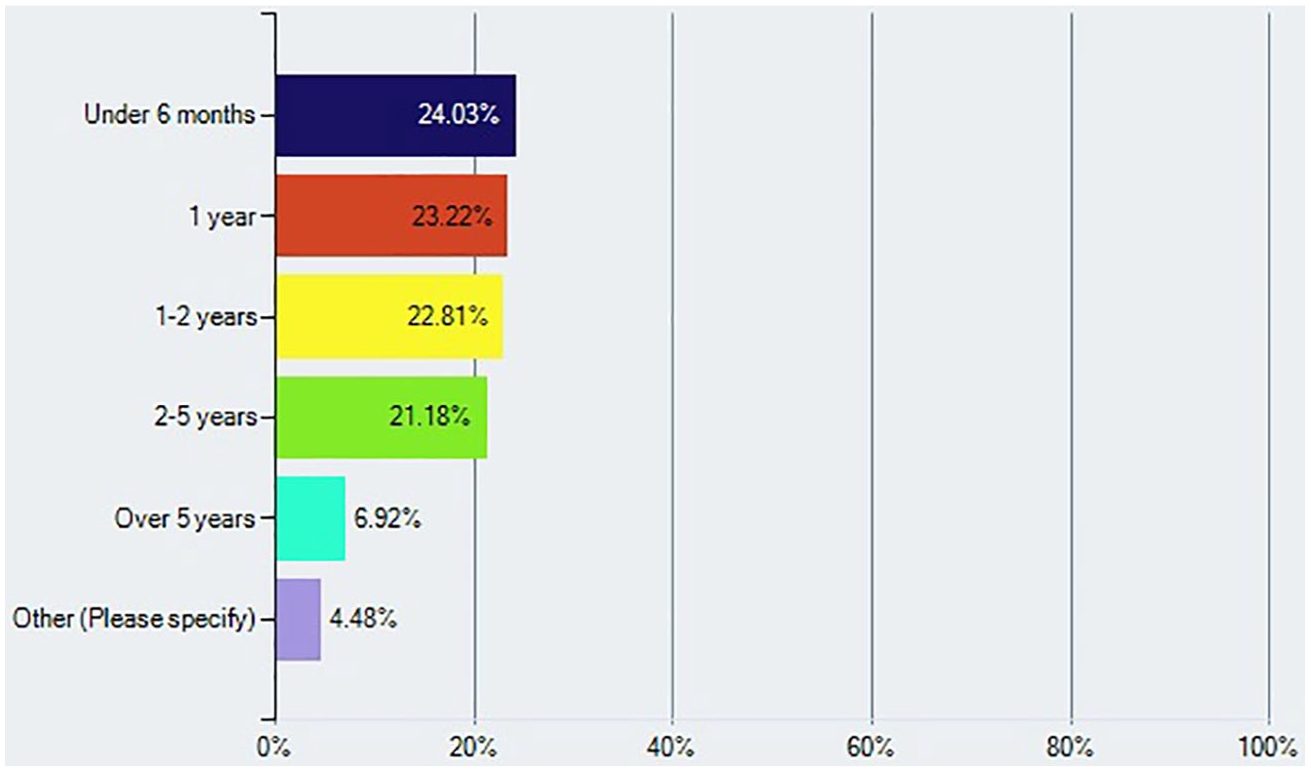
Length of use.
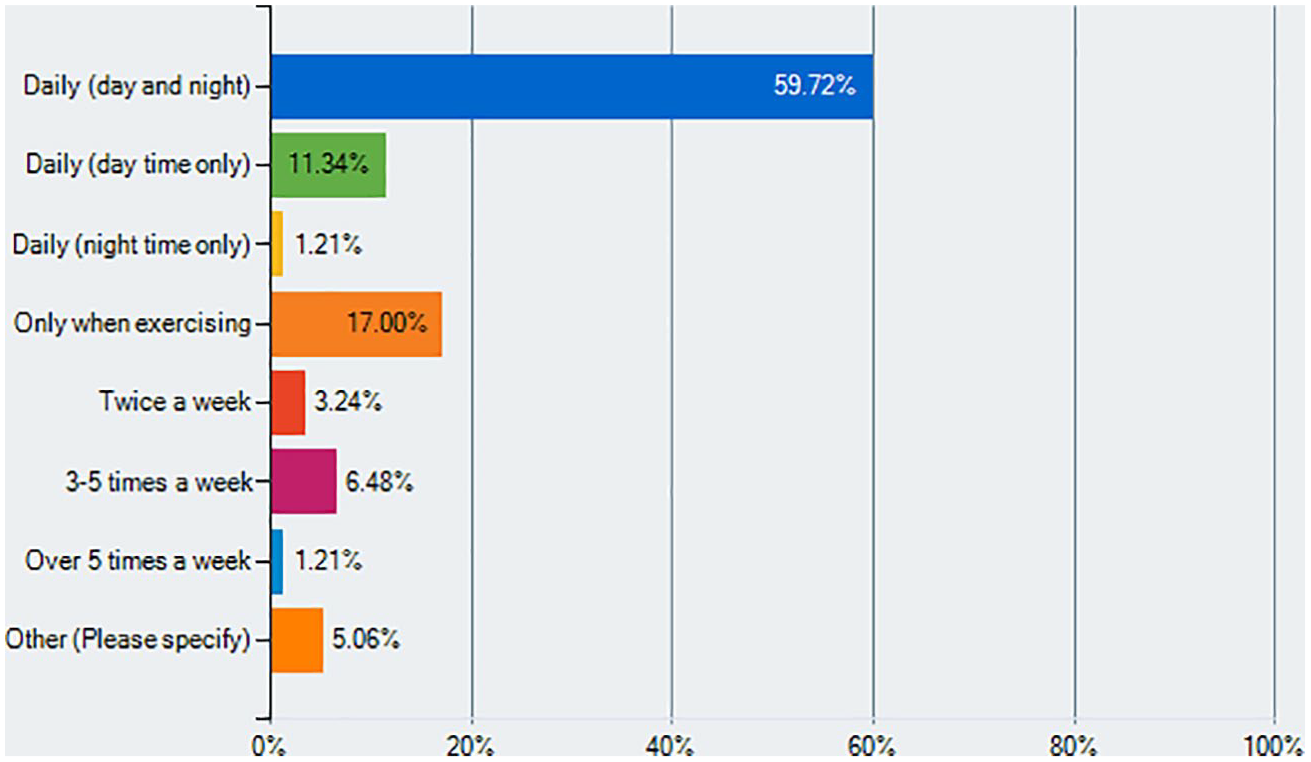
Frequency of use.
What do users track and why?
Various biometric features and activity-related metrics can be captured and monitored through self-tracking devices and apps. Counting steps and the distance walked or run were the most tracked aspects among the survey participants (Figure 3). These results confirm earlier reports suggesting that, despite the advanced developments in wearable sensors and biometric devices which enable the tracking of a wide array of bodily movements and biological signs (heart rate, blood sugar levels, blood pressure, and so on), step counting remains the most common aspect of self-tracking activity and the majority of fitness trackers are designed to act as pedometers primarily (Brown, 2016).
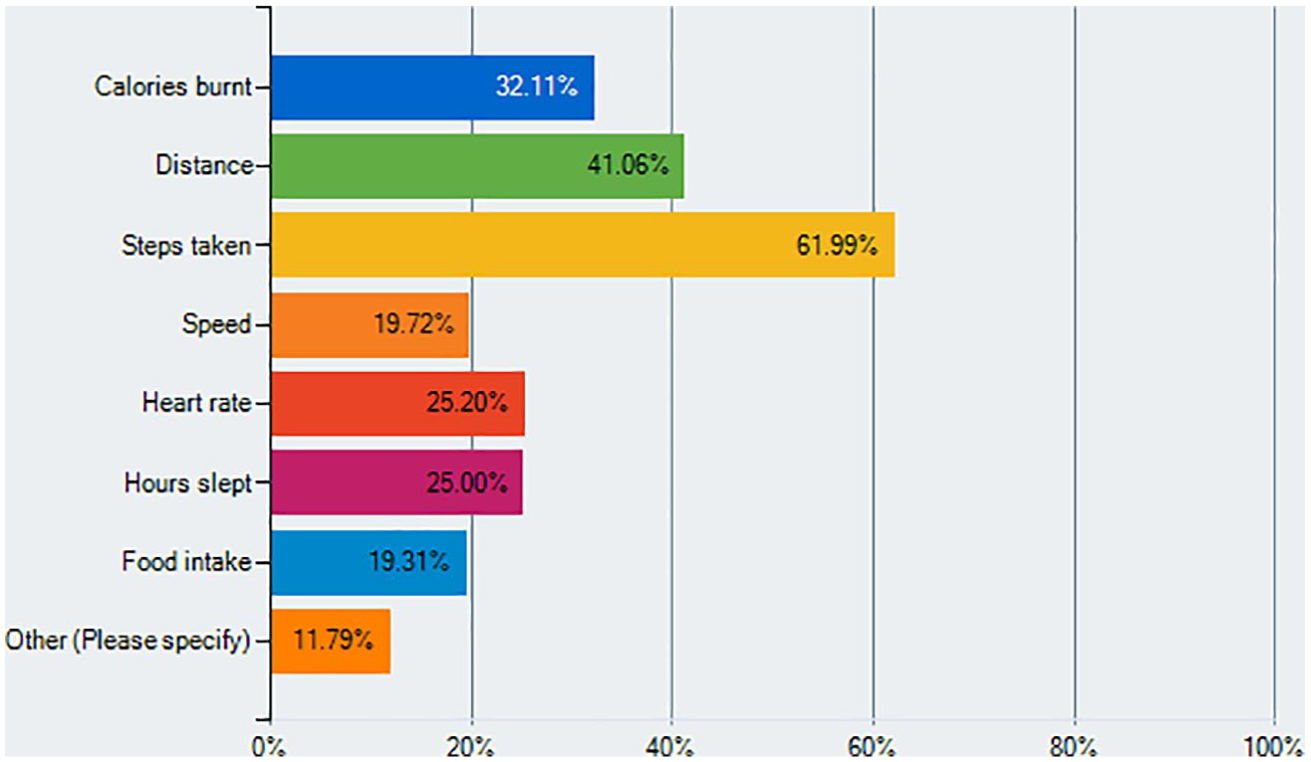
What do you monitor?
Reasons vary as to why people tend to track their activity and behavior. The findings of this survey study suggest that the desire to increase motivation, monitor progress and collect data is the major driver behind the adoption of self-tracking practices (Figure 4).
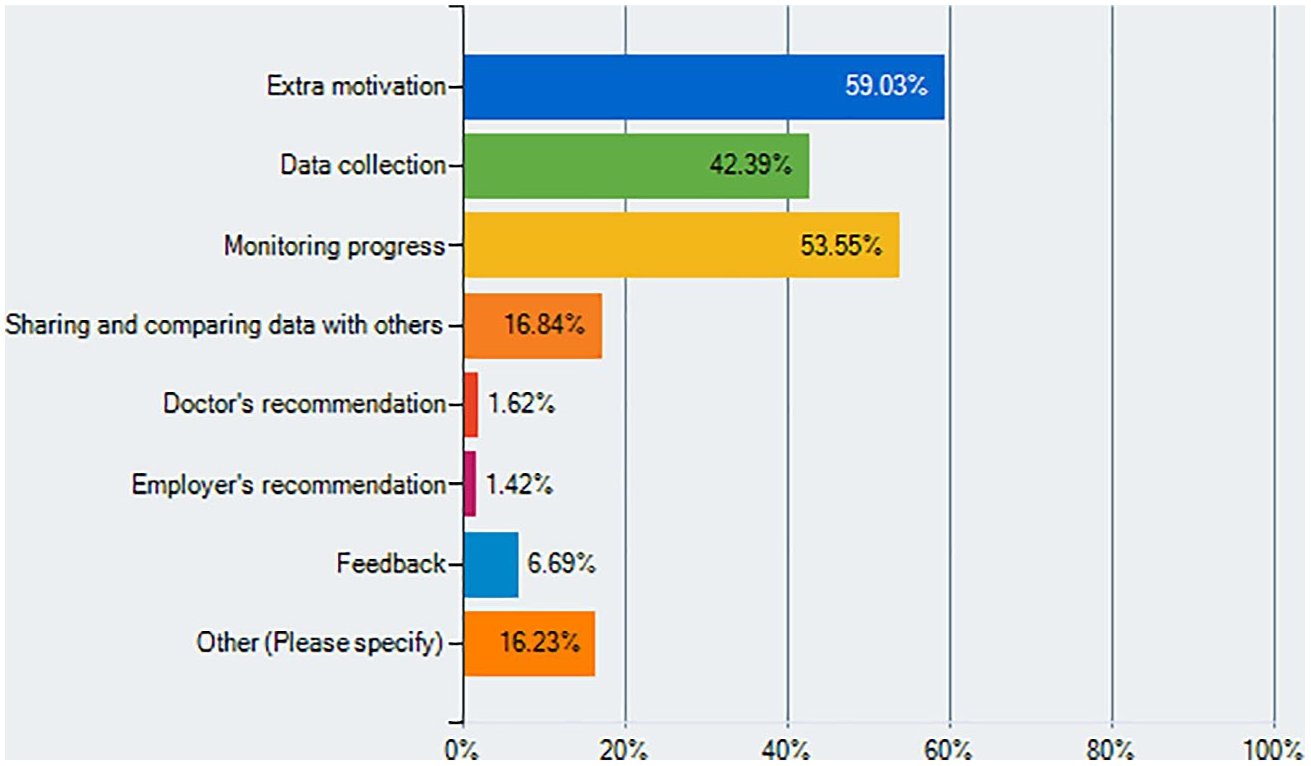
Why track?
Other studies (GfK, 2016; Shin & Jarrahi, 2014) have also shown that much of the allure of self-tracking technologies and practices comes from the way they enable users to set daily goals, monitor habits and identify actions that can improve their fitness and overall health. The underlying belief is that when users are motivated by the rewarding feeling of achieving certain goals and making regular progress, they are likely to engage in more exercise or keep a healthy diet. Self-tracking devices and apps do act as, what Foucault (1997: 224–225) terms, ‘technologies of the self’, that is to say, the instruments which ‘permit individuals to effect by their own means or with the help of others a certain number of operations on their own bodies and souls, thoughts, conduct, and way of being, so as to transform themselves in order to attain a certain state of happiness, purity, wisdom, [and] perfection’. In this sense, self-examination through activity tracking and the monitoring of body, habits, moods, and behavior becomes a means of improving these aspects and enabling the attainment of an ‘ideal’ version of the self. This is facilitated all the more through the ‘gamified’ aspect of self-tracking technologies. Gamification refers to the process of applying game-based techniques and elements like digital points, badges, and leader-boards in non-game contexts. It is becoming a popular means of increasing motivation, instituting competition and rewarding performance. Technologies of self-tracking carry within them the promise of making physical activity more enjoyable and manageable through the gamification of health and the instrumentalization of exercise. Maturo and Setiffi (2016) argue that while quantification provides the ‘rational’ basis for exercise and dietary regimes, gamification provides the ‘emotional support’ needed to maintain motivation. As such, self-tracking technologies are increasingly designed to combine both quantification and gamification so as to promote ‘numerical living’ that can be ‘fun and engaging’ (Ruckenstein, 2014). For instance, Strava, an activity-tracking website and app popular among cyclists and runners, uses quantification and gamification to motivate users by awarding titles, like ‘King of the Mountain’, for the shortest time spent cycling up a particular hill. Many of the survey participants have indeed reported that using self-tracking devices or apps turns fitness and exercise into ‘a fun game and adds joy to the experience’ (female participant, age range: 36–45). The self-tracking device itself is treated as ‘a new toy that is fun to play with’ (male participant, age range: over 45), reaffirming the gamified and gamifying aspects of such technologies.
In her article, ‘Gaming the quantified self’, Jennifer Whitson (2013) argues that gamification encourages playful subjectivities and drives behavioral change to acquire new conducts. This is evident in the ‘nudging’ aspect of self-tracking devices which also function as triggers, reminding users to exercise regularly. For example, Fitbit’s indicator lights up as an alarm when the device senses that the user has been sitting for too long. Apps like Aqualert and Plant Nanny act as a ‘hydration reminder’ encouraging the user to increase her water consumption. As one participant puts it, ‘[my device] reminds me to go out for walks, go to the gym, to be fitter. I’m always trying to raise my heart rate into the different zones and my FitBit challenges me to do that’ (female participant, age range: 18–25). These are examples of what Natasha Singer (2015) calls ‘the nurselike application of technology’, whereby devices ‘prod’ the user to take action rather than just collect data. By playing the role of a ‘friend’ who knows the user well or the role of an authority such as a nurse or a doctor, self-tracking devices and apps aim to enhance the persuasive effect on one’s behavior. As Brian Jeffrey Fogg (2002) argues, ‘computing technology that assumes roles of authority will have enhanced powers of persuasion’. Such technology can influence users’ attitudes and lead to changes in habits and daily activities. As the following quotes from the survey participants testify: I consider it [self-tracking technology] life changing. I have changed from a couch potato, to a fit active person. I rarely use my car. I have become familiar with my locality and its beauty. (Female participant, age range: over 45) It’s made me more aware of my lifestyle and helps me be more active everyday, I try to reach a step goal of 10k steps per day and can get higher when I’m in a challenge on Fitbit. (Female participant, age range: 26–35) I used to be a couch potato now I do a minimum 10,000 steps a day. (Female participant, age range: 26–35) It has made me aware of how sedentary life styles are. I know how much effort it takes to get 10k steps, and makes me see why others are not active and the impact it has on their health. It means I encourage those around me to get Fitbit (or similar), including my kids, who then influence their peer group and teaching staff. It’s amazing how many people around us have them now. It also makes me walk every day, rain or shine, which must be having an effect on the depression I have had all my life. (Female participant, age range: over 45) It motivates me to get moving, to eat right, to get to bed on time. I like knowing how much I can eat based on how much I burn. I've been working on losing weight for almost 3 years and have lost about 75 lbs. I would probably have given up long ago without the Fitbit and MyFitnessPal. (Female participant, age range: over 45) It is ridiculously motivating! Since retiring, my life style was very sedentary. I now walk 10k plus steps daily, all weathers. Without Fitbit, I would have made multiple excuses not to walk. I consider it to be life changing. I am fitter, healthier and stronger. (Female participant, age range: over 45)
The persuasive, gamifying and nudging functions of self-tracking technologies are often seen as positive motivational aspects that incite users to adopt ‘healthier’ lifestyle. As articulated in the above quotes, participants internalized the norms of self-tracking culture (such as walking 10,000 steps a day and dieting), ‘regulating’ their physical activity, food intake and other habits, accordingly. Parenthetically, the norm of 10,000 steps a day originated in Japan in the early 1960s through research led by Yoshiro Hatano. The research estimated that walking 10,000 steps would be enough to burn around 20% of our calorie intake (Cooper, 2013). Currently, across all health platforms and self-tracking devices, the 10,000 steps norm is set as the baseline that needs to be met by users if they are to be deemed as healthy and active citizens. In internalizing such norms, the self-tracker ends up conforming to a pre-given standard of health and fitness and being (self-) assessed according to an idealized ‘numeric identity’ (Rowse, 2015). For this reason, Whitson (2013) regards self-tracking and its gamifying dimension as deeply rooted in self-surveillance practices which often align with institutionalized understandings and standards of health and wellbeing. This argument resonates with Foucault’s notion of anatomopolitics, mentioned earlier, whereby the human body is made amenable to normative practices of (self-) discipline and control. In the case of the present study, even when users were ill or injured, they still maintained a sense of self-discipline, tracking their recovery and progress: I have been using my Fitbit to track my recovery from a broken ankle since the summer, I am now up to 7000 steps a day and allowed to train in the gym, my physiotherapist has been impressed at how quickly I have come on and I credit that at least partially to the motivation of my Fitbit and using it to earn bounty points [. . .] yes, I am much more aware of days where I do very little, my overall activity had more than doubled in the 5 months from buying the Fitbit to breaking my ankle. Tracking improvements in my rehab was great too. (Female participant, age range: 26–35)
While the persuasive function of self-tracking technologies and their regime of self-discipline have certainly contributed to increasing participants’ motivation, bodily awareness and overall level of activity, they have also led, in some cases, to feelings of anxiety and obsession over one’s performance and progress. One female participant described her experience in the following way: Occasionally I become preoccupied with my GPS that I stop enjoying my run because I feel like a bad run is a failure instead of just another run, good or bad. I become so obsessed with data that I sometimes cry if my pace run isn’t to target or if I can’t make it to the end of my long run without walking. (Female participant, age range: 26–35).
This illustrates the kind of pressure that is, sometimes, inflicted on the self as a result of processes of self-tracking and quantification, which in turn risks taking the pleasure out of physical activity itself due to excessive self-monitoring and self-imposed targets. As another participant stated, ‘it is easy to focus too much on making a certain pace or burning a certain amount of calories instead of enjoying the activities and your surroundings’ (female participant, age range: 26–35). Some participants also reported that without tracking they feel as though their activity or exercise does not ‘count’. As these quotes from various participants indicate, My Fitbit recently broke down and although I continued to walk, I did feel as if it wasn’t worthwhile!! (Female participant, age range: over 45) I think there is a risk that people start doing these activities not because they are inherently good or valuable, but because it gives them more points or a better ‘score’, which in turn translates to better self-esteem. (Male participant, age range: 18–25) These trackers could make some users too fanatical and obsessive when achieving goals or when competing. Some users do get very very stressed when the device or servers fail. (Male participant, age range: over 45) It has been a bit of a stumbling block in some ways, especially food intake tracking because I tend to get a little hung up when eating food prepared by someone else that doesn’t do things ‘my way’ (eg. weigh ingredients and total servings, etc.). I have been known to refuse to eat a food for which I did not know the specific gram weight. I can get a bit obsessive; I try to catch it as soon as I notice it or it is pointed out to me, and ‘forcefully relax’ my standards. (Female participant, age range: 36–45) Some people may be exercising not for themselves but for the app. (Male participant, age range: 26–35) I’ve thought a lot about peoples’ ‘obsession’ with quantifying their lives and sharing that information. I’m hoping I’ll never reach the point when not tracking my run will make it less enjoyable for me. That would be just sad. (Male participant, age range: 26–35)
The anxiety around performance and the potentially obsessive streak of self-tracking becomes, indeed, more pronounced in the case of participants who share their self-tracking data with others. As one participant admits, ‘sometimes, if I know I am going to share data on social media I feel I need to go harder which stops me enjoying the exercise’ (female participant, age range: 26–35). Balancing between the ability to enjoy exercise and the need to perform adequately in front of the watchful gaze of an audience (on social media and other platforms) remains a challenging task for most users, as activity and self-representation become constructed and moderated in consideration of the imagined judgments of others. Here, feelings of accountability towards and competition with other users emerge, leading to an internalization of self-discipline and striving for self-improvement.
Sharing in the self-tracking culture
The results of the survey indicate that 59.8% of participants tend to share their self-tracking data on social media, such as Facebook and Instagram, and other relevant platforms like Fitbit’s and Strava’s online forums. The chief reason being the sense of competition and pride, and the feeling of motivation that come part and parcel of sharing self-tracking data, goals and achievements with others: ‘[I share] to push myself. So my friends can see what I’ve done and go out and push it a little more. Which in turn pushes me. . . And to be honest, to show off some times. :)’ (male participant, age range: over 45); ‘You suddenly realize how competitive you are, even against yourself’ (female participant, age range: over 45); ‘I found inspiration by checking other people’s food diaries. Sometimes challenges with people on my friends list motivate me to move more’ (female participant, age range: 26–35). Accountability to oneself and to others thus becomes an inherent part in the performative sharing ritual of self-tracking data and experience. The belief is that social responses in the form of encouragement and acknowledgment as well as the fear of losing or visibly not meeting the set targets can be effective motivators for users to consistently engage in physical activity, pursue a healthy lifestyle and achieve their set goals: ‘I take part in challenges with others in teams. Team accountability motivates me’ (female participant, age range: over 45).
Another key rationale found in the participants’ responses relates to the sense of belonging that is instilled through acts of sharing. Many stated that the sharing of self-tracking data and experience reinforces the feeling of belonging to a community with shared objectives and interests. This resonates with Deborah Lupton’s (2015: 12) claim that data-sharing in the self-tracking culture tends to appeal to a deeply felt desire to be part of a community and a need to create social bonds and a sense of belonging. It is, indeed, this desire that the Quantified Self movement seeks to fulfill by offering a ‘community of practice’ that brings together individuals and groups who self-identify as Quantified Selfers or self-trackers. As Etienne and Beverly Wenger-Trayner (2015: 2) argue, a community of practice is not only a community of those who share common interests but also groups who have a shared practice and a shared repertoire of resources including tools, stories, experiences and ways of tackling issues and problems. This definition chimes with the way the Quantified Self community encourages and facilitates the sharing of self-tracking experiments, data and stories for the purpose of learning, receiving feedback and exchanging relevant tips and information. According to Gary Wolf (2010), the co-founder of the Quantified Self, ‘[p]ersonal data are ideally suited to a social life of sharing. You might not always have something to say, but you always have a number to report’. The process of sharing within Quantified Self groups is performed through both online and face-to-face channels; through a dedicated website and forums, conferences and public symposiums and, most importantly, through the ‘Show and tell’ presentations which tend to be very candid exposition of personal experiences and difficulties encountered throughout the tracking journey. This social trend of participating in Quantified Self communities, established for the purpose of sharing health related information and experience, echoes Paul Rabinow’s (1996) concept of ‘biosociality’. This is a type of connection between individuals, which is centered on biologically based forms of socialization. It gestures towards the interface between developments in biotechnologies, life sciences, social practices and individual and collective subjectivities (Valle & Gibbon, 2015). Olivia Banner (2014: 199) points out the intrinsic link between biosociality and the Foucauldian notion of anatomopolitics where the individual learns to discipline and control her body according to the terms delimited by her biosocial community. She goes on to argue that, by fostering the belief that the individual user can learn from other members, biosociality joins ‘the individual practices associated with anatomopolitics to a biopolitics of the biosocial community’ (2014: 199), as is the case with the Quantified Self.
Interestingly, though, not many participants in the survey recognized the Quantified Self. The majority of respondents never heard of the term before coming across it in the survey question, which indicates that this is still a niche movement, after all, despite the fact that self-tracking itself, as a practice, has become a widely spread and mainstream activity. So, the process of sharing self-tracking data and experiences is not bound by the confines of particular biosocial communities or groups but takes place through the multitude of networks, online platforms and offline interactions.
Some participants indicated that they share their data for monetary incentives. This is the case of some of the 10.50% of participants who took part in corporate wellness schemes organized by their employers. In such cases, ‘bonuses were offered to staff who walked 10,000 steps/day using company-issued pedometers’ (female participant, age range: 36–45). Some employers tracked the weekly exercise of their employees and entered those with top scores into a raffle (female participant, age range: 18–25). Other employers provided prizes such as Apple devices and other electronics to those who walked the greatest number of steps over a period of time. In addition to step tracking, weight monitoring was also part of some the corporate wellness programs. As this quote indicates: It was an 8 week ‘wellness’ challenge. There was a weigh-in week prior and a weigh-out week after the 8 weeks. You get 2 points for 30 min of cardio, 3 points for 30 min of resistance throughout the challenge. At weight-outs, relative to weigh-ins: 5 points per pound lost, 10 pts for inch lost (bust, waist, hip, thigh), 25 pts for 1% body fat lost. #1 team of 6 people wins $800 each, #2 team of 6 people wins $650 each. (Female participant, age range: 26–35)
Over the last few years, there has been indeed a growing interest in instituting wellness schemes at the workplace through the use of fitness tracking devices and apps. For instance, companies such as Target, BP, Bloomberg, Barclays, and Google have been running wellness programs for their employees with the aim to encourage healthier and more active lifestyles. Some self-tracking devices are even designed specifically and exclusively for corporate wellness schemes. For example, Fitbit recently introduced a new activity and sleep tracker called, Fitbit Inspire, which is only available through corporate wellness schemes and health plans (Farr, 2019). Workplace wellness is now an $8 billion industry (Wadyka, 2020) and health itself has become ‘a corporate concern’, as Chris Till (2016) puts it. This is a development that is embedded in the double imperative of ‘better health outcomes’ and ‘lower health costs’ (Lupton, 2013: 3).
As such, the key rationale behind these schemes is to reduce healthcare and insurance costs while improving the productive capacity of employees. Based on a study of 36 corporate wellness schemes, a report from Harvard Business School found that for every dollar spent on wellness programs, medical expenses fell by $3.27 and employee absenteeism expenses fell by $2.73 (in Oppenheim, 2019). Another report from the Rand Corporation (2013) showed that corporate wellness schemes contribute to reducing stress, boosting productivity, and increasing employees’ engagement. In a sense, corporate wellness schemes can be regarded as an example of what Luc Boltanski and Ève Chiapello (2005) term the ‘new spirit’ of capitalism whereby labor and organizational culture start to take on new qualities and ethos rooted in concepts of engagement, meaningfulness of work, and opportunities for self-development at and through work. As Dominique Genelot (in Boltanski & Chiapello, 2005: 63) argues, organizations must now be ‘a site for creating meaning, for shared goals, where everyone can simultaneously develop their personal autonomy and contribute to the collective project’. So, in addition to their utilitarian aspect of cost reduction and increased productivity, corporate wellness schemes also appeal to the new spirit of capitalism in organizational culture which seek to give work a ‘more human orientation’ (Moore, 2018: 57) by providing employees with opportunities for self-improvement and instilling certain norms of health and team values. In doing so, these schemes also adhere to an ‘economy of convention’ (Botlanski & Thévenot, 2006; Diaz-Bone, 2018) in which the actors involved (employees, managers, team members, etc.) have to achieve a common goal by undertaking activities based on established beliefs (e.g. exercise is good; teamwork is good) and frames of action that are mediated through established metrics and tracking technologies.
Despite the putative benefits of wellness programs, there is a sense in which they can be seen as a ‘colonization’ of employees’ private lives as leisure activities, including exercise, are becoming integrated more and more into the sphere of labor as well. One does not leave work when leaving the workplace but carries the demands of the employer into other personal spheres that are not necessarily work related (Holten, 2017). A female participant in the survey expressed a similar point in the following way: ‘I have strongly rejected to participate, since I will not let my employer be a part of my life that for me is very private’ (age range: 26–35). And as another respondent (age range: 26–35) puts it: ‘I would not like my employer to know how I exercise (why should they? and one more noisy observation to be judged by)’. In his theory of communicative action, Jürgen Habermas (1987) raises this issue of colonization by suggesting that the extreme ‘mediatization of the lifeworld turns into its colonization’ (Habermas, 1987: 318). That is to say, when media forms become the lens through which the world is ‘enframed’, in the Heideggerian sense, and life itself is experienced and lived, the protective boundaries surrounding the private sphere diminish and become absorbed into the media’s capitalist logic, leading to system colonization of lifeworld. Self-tracking technologies and the corporate wellness programs within which they became embedded take on this colonizing aspect by defining what constitutes health and wellbeing in the first place and infiltrating almost every sphere of everyday life (from tracking sleep, weight and work performance to measuring sexual activity, fertility and other intimate aspects).
Moreover, linking the sharing of self-tracking data to financial incentives such as bonuses and discounts on insurance blurs the boundaries between what is voluntary and what is not. As attorney Dara Smith (in Wadyka, 2020) argues, ‘[i]f the penalty for not participating is that your health insurance premiums will be higher, employees may feel like they have to share their health information in order to save money’. This can lead to coercive forms of self-tracking dressed up as voluntary participation in wellness schemes. Lupton (2014: 5–10) developed a useful typology to differentiate between the various types of self-tracking, one of which she calls ‘pushed self-tracking’, an incentive-based form of self-monitoring that may be taken up voluntarily, but in response to external encouragement from other actors, as in health promotion initiatives. Another type of self-tracking is ‘imposed self-tracking’ which involves the use of tracking devices to monitor employees’ productivity and health. The line between these two forms of tracking is very fine, according to Lupton, and one can argue that the above-mentioned examples from participants oscillate between these two types of tracking. Added to that the potential repurposing of the shared data for commercial benefits and for building customer profiles to use in targeted marketing and advertising. This is what Lupton refers to as ‘exploited self-tracking’ in which the commodification of personal data is a major feature.
Increasingly, various actors other than users themselves are interested in harvesting the self-tracking data. These range from public health institutions and private insurance companies to researchers and product developers. In the healthcare sector, self-tracking practices are looked up to as a means of realizing the aspirations of participatory, preventative and personalized healthcare models. This is insofar as these practices can enable the capturing of quantifiable health data that can feed into decision-making vis-à-vis one’s lifestyle, diet options, exercise activities, performance and habits. Both the public and the private health sectors are interested in how self-tracking data generated by individuals can feed into a larger big data ecosystem. The belief is that when ensembles of individuals’ data are combined, a collective social picture will emerge, that of the population, its health, finances and productivity (Ajana, 2017).
To this end, self-trackers are encouraged to embrace data sharing and donation as a way of enacting good bio-citizenship (see the example of Patients Like Me and its Data For Good campaign 1 ). There is, in fact, a certain moral economy at work, which underpins data sharing practices and prescribes these as a form of altruism and civic duty, often packaged under the rubric of ‘data philanthropy’ (Ajana, 2017). But there remains a great tension between the notion of data philanthropy and issues of data commercialization. While many users of self-tracking technologies operate under the assumption that the data they generate belong to them, the reality is that companies providing the technology often own the data. Service providers often leave users with no choice as to whether to save the data on the company’s server or on their own devices. As such, users have hardly any control over how their data is stored and processed (Mulder, 2019). The technically savvy members of the Quantified Self community tend to circumvent such issues by building their own tracking tools so that their data remains their own property. But that is not the case with the majority of everyday self-trackers who rely on commercial devices and apps to track their activities. There is, indeed, a delicate dance between commercial goals and the aim of ‘self-knowledge through numbers’ (Fotopoulou, 2018: 3).
The monetization of data sharing is an issue that has been taken up by various scholars, recently, leading to the questioning of the essence of the term ‘sharing’ itself. For instance, and taking cue from the work of Georges Bataille and Jean-Luc Nancy, Wolfgang Sützl (2016) distinguishes between the notion of ‘exchange’ and the notion of ‘sharing’. He argues that sharing, as practiced by the likes of Uber and Airbnb, is more about capitalist notions of ‘exchange’ as a systemized infrastructure. He explains that, unlike exchange, sharing is primarily about being and only secondarily about having. So, whereas exchange is a rational and functional operation that is based on an economy of ‘having’ and ‘possessing’, sharing is an intimate experience of being which subsumes the meaning and the inner relationship one has towards that which is being shared and with whom it is shared. As such, Sützl warns that ‘as economic exchange expands, it eliminates sharing by turning the commons into a commodity’, which in turn leads to ‘pseudo-sharing’, a business relationship masquerading as communal sharing (Belk, 2014). Pseudo-sharing benefits from the association of commonality and sociability that comes with the word itself, thereby masking the economic rationality at work. Russell Belk argues that the ubiquitous ‘share’ button on social networking sites and online platforms can be regarded as a nicely packaged invitation to provide content to sustain these sites, encourage more participants, and, in so doing, provide information that can be sold to advertisers, marketers, and research firms. This ‘sharing’ framing mystifies the profitable transactions that exploit information (Belk, 2014). It can therefore be argued that, by generating data and information, self-trackers end up unwittingly contributing to the expansion of capital and the intensification of exchange.
Attitudes towards privacy and data protection
The generation, collection and ‘sharing’ of data have various implications vis-à-vis privacy issues, some of which might evade the awareness of self-trackers. The survey, as such, asked the participants whether they were familiar with the privacy statements and data regulations surrounding self-tracking, and whether they had any concerns about what happened to their data and who had access to it. 50% of participants reported that they were not familiar with the regulations concerning the data they generated through their use of self-tracking devices and apps. And strikingly, the majority of respondents noted that they were not concerned about the exposure or use of their data by others. Some did not even see why self-tracking data should be private (‘I’ve never given it a second thought. I can’t easily come up with a reason for keeping such information private, either’ (female participant, age range: 26–35); ‘I think those concerns are overrated and somewhat paranoid’ (female participant, age range: 26–35)), trusting that companies would not share their data: ‘I have a decent amount of trust in tracking companies not to release information. More so, I don’t feel there is any particularly damaging information that would be released anyway’ (male participant, age range: over 45); ‘I trust the large corporations (Garmin, Google, etc.) 100% in keeping my data safe, and use it for good purpose. I worry about the public getting to this information, so that bad persons (e.g. thieves) can use the information to their advantage and my disadvantage (steal from me when they know I’m not home). But I trust that the large corporations keep my data safe, and won’t share it with the wrong people’ (male participant, age range: 18–25). Others think that their ‘details are boring’ (female participant, age range: 36–45) or not significant enough to raise concern, as articulated in the following quotes: I’m but one in seven billion people on the rock called earth, about half have access to the internet, and probably less than a handful have any interest in me or my whereabouts, I’m not planning to run for president or a similar occupation that would bring me to the limelight, but sure, I would prefer my information stay private, but in today’s society, it comes with the cost of convenience. (Male participant, age range: 18–25) I don’t care – I’m not interesting enough to get monitored. (Female participant, age range: over 45) Nope. I’ve never really been bothered by who’s watching me or ‘spying’ on me. I consider myself quite boring and don’t imagine anyone using my data for anything other than averages and understanding what to sell me online. (Female participant, age range: 18–25) If people find out my weight or what I eat it’s not the end of the world. (Female participant, age range: 36–45) I don’t think any of the information they have will be of any use. (Female participant, age range: 26–35) I’ve got nothing to hide. But would be annoyed if they added ads. (Female participant, age range: 36–35) Had not thought that my data would be of any interest to anyone. (Female participant, age range: over 45) There’s nothing worth worrying about in how many steps / calories / floors etc – that data is of no benefit to anyone other than myself. (Female participant, age range: 26–35) No, I don’t think I’m important enough that anyone would look for my data specifically. If my data is being used for research purposes without my knowledge, I would be annoyed, but I don’t fear it because it doesn’t really impact me. I would probably volunteer my data for research if asked. (Female participant, age range: 18–25) No because really what can they learn from what I eat? I don’t mind if they share what I do as long as they don’t hack my bank account. If it helps research and knowledge then all the better. (Female participant, age range: 26–35)
Some participants have resigned to the fact that their data is hardly secure and inevitably shared all the time, believing that the benefits often outweigh privacy concerns and that using data for medical research and knowledge advancement is a legitimate reason for data repurposing: None of my data is safe and secure. Big companies lose data every day, I am tracked everywhere I go, every website, every app, purchase and so on. I just assume that any data I store with someone is possibly going to be stolen or used to sell me something. (Male participant, age range: 26–35) There is an extent to which we can’t escape such data collection these days unless we completely go off the grid. I don’t like this, but convenience often leads me to just accept it. If this data is being used to help improve the health of future generations, then I am fine with it being collected, but if it is being used to sell me or others something, that really bothers me. (Male participant, age range: 26–35) My concerns are small and speculative versus the tangible benefits I receive each day. (Male participant, age range: 26–35) I think the more the data is shared the more we can learn. (Male participant, age range: 18–25) I always assume it’s being used by somebody for something. (Female participant, age range: 26–35) I think that the more we know about what keeps people healthy the better; more data, more understanding is the hope. (Female participant, age range: over 45) At this point, I am just going to assume any data I provide to anyone is going to be used to either advertise towards me or to put me on a government watch list, but living off the grid is too hard, so I might as well lean all the way in. (Female participant, age range: 26–35) Google and Facebook have more data on me then I have on myself. (Male participant, age range: 26–35)
Nevertheless, some participants, especially from the US, expressed their concern regarding the interest of insurance companies in the data and how data could be used against them in certain circumstances. As indicated in the following statements: Yes, I wouldn’t want anyone to have access to my data, this is personal and because we don’t know how it will affect us in the future I would rather not have this recorded anywhere, just in case one day someone somewhere would make it count on health/life insurance policy. (Female participant, age range: 26–35) Sometimes when tracking food and alcohol consumption as it could be used against insurance policies although in the up side the exercise and diet part is a good sign. (Female participant, age range: over 45) Yes. That medical or health care insurance companies might see how much or how little I sleep, eat, and exercise. (Male participant, age range: 36–45) I know this is valuable information for health insurances, potential employers, etc. I hope that the data will not be abused, but to be honest, I have been too lazy to check what the privacy regulations are. (Female participant, age range: 26–35) Yes. I fear health insurance companies may get hold of this info and negatively use it in determining insurability or coverage. (Female participant, age range: 36–45) Yes – considering insurance companies and the like and whether they would ever use them to predict premiums in an area, but also the GPS tracking side. If someone wanted too, it wouldn’t be hard to spot my habits near work and home. (Female participant: 26–35) I might be paranoid but I think that eventually there’ll be huge societal pressure to exercise regularly (if there isn’t already) and that those who don’t might eventually be ineligible for free healthcare etc. If / when the UK has privately owned healthcare, your digital fitness record could end up affecting your premiums. (Male participant, age range: 26–35)
Since the survey was conducted prior to the implementation of The General Data Protection Regulation (GDPR) in May 2018, it did not ask participants about their understanding of the GDPR rules and the effects they have had on data sharing and privacy issues. This, I believe, would be a topic worthy of further research. Some scholars have recently started examining the implications and assessing the effectiveness of the GDPR with regard to the landscape of self-tracking culture. For example, a very recent study conducted by the legal scholar Trix Mulder (2019) examined the privacy policies of various heath apps, including apps designed specifically for the medical sector as well as general self-tracking apps, such as Fitbit, Strava and Nike Running, and she compared these to the GDPR provisions. The findings of the study suggest that even where companies provide privacy statements, it is impossible to get a complete picture of what the app providers do with the personal data they collect, as the language these companies use tends to be vague and leaves the reader with many questions. The study even found that almost 50% of the analyzed apps used privacy as a positive marketing statement leading you to believe that ‘your’ privacy is important even when this is not reflected in the companies’ privacy policies.
Also, the GDPR foregrounds the issue of consent, that is, the requirement for companies to obtain permission from data subjects before processing and sharing their data. The regulation defines consent as ‘any freely given, specific, informed and unambiguous indication of the data subject’s wishes by which he or she, by a statement or by a clear affirmative action, signifies agreement to the processing of personal data relating to him or her’ (Article 4 (11) GDPR). Companies responded to the introduction of the GDPR by including privacy pop-up windows on their platforms giving users the choice to accept or reject the use of technologies such as ‘cookies’ to track their online activities and collect data about them. As can be seen in Figure 5 and Figure 6, ‘Accept’ tend to be the default setting while ‘Show purposes’, which provides users with further information on the types of data being collected and to what ends, tends to come in very small fonts in comparison with ‘Accept’. In fact, and as Frederike Kaltheuner (2018) from Privacy International points out, Quantcast, a US-based advertising company that also sells ‘consent solutions’ to websites and publishers as in Figure 5 and Figure 6, prides itself for its (deceptive) design which is able to achieve 90% consent rate. In a way, users are also complicit in this as they tend to see the warning page about privacy and data collection as an irritant and quickly click ‘Accept all’ to make it disappear (Lynskey, 2019). As such, users tend to formally consent to privacy policies without knowing what happens to their personal data and often without even reading the privacy statements (Kon, n.d.).
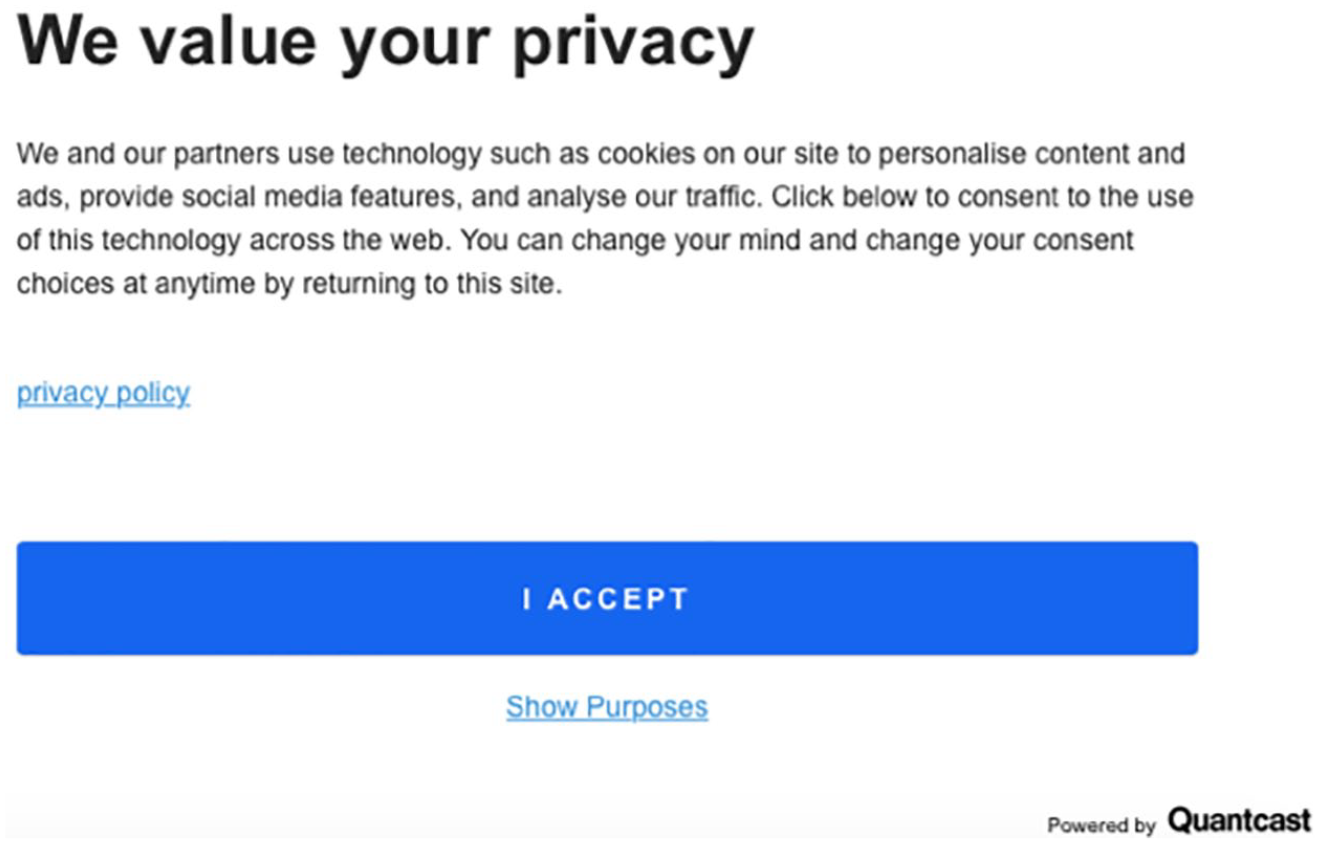
Privacy notice by Quantcast.
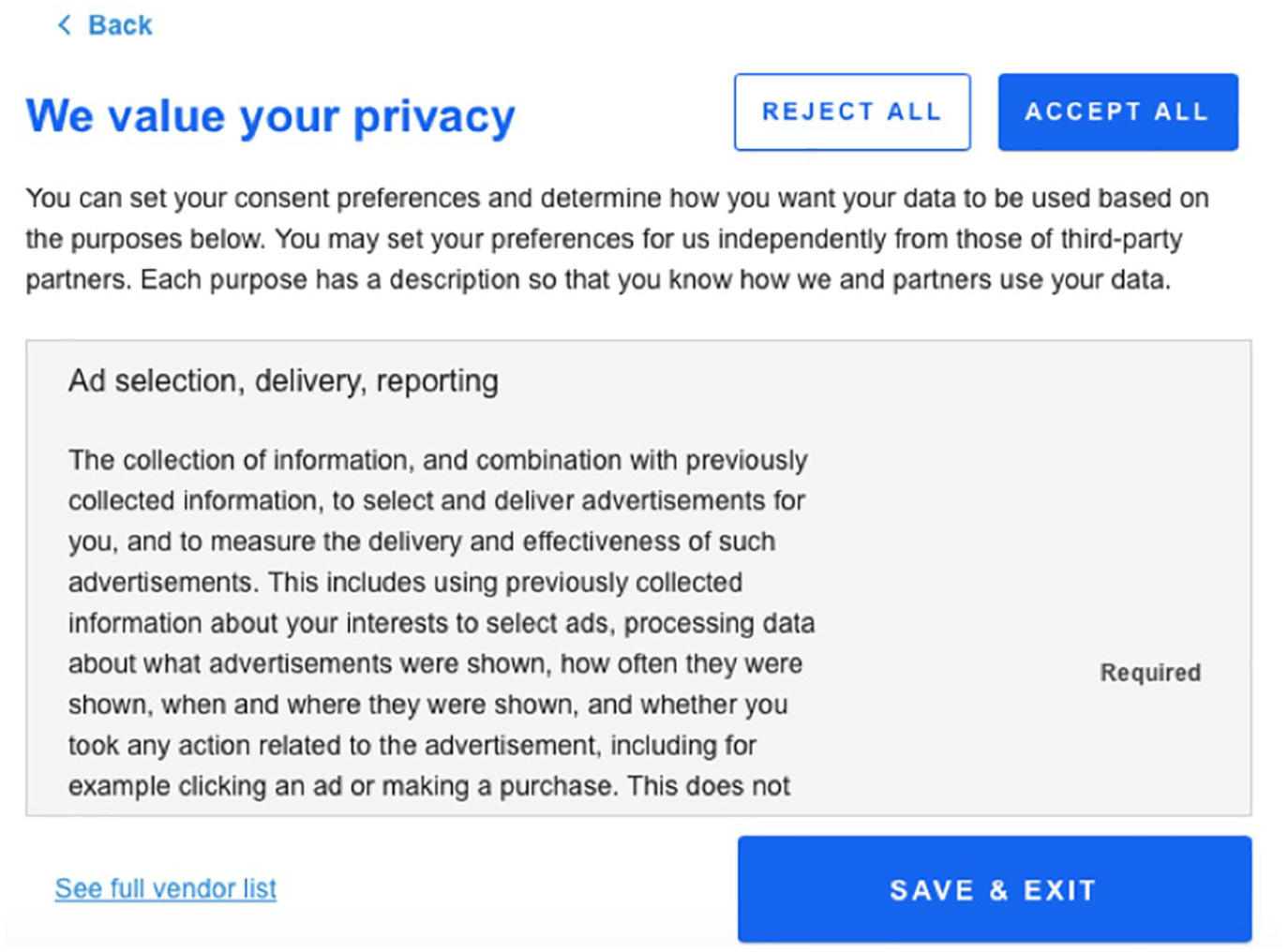
Privacy options by Quantcast.
Conclusions
In this article, I drew on the results of an international survey involving users of self-tracking technologies to examine experiences and perceptions of self-tracking practices and attitudes towards privacy and data regulations. As the findings of the study demonstrate, self-tracking carries many benefits to the user, particularly with regard to increasing motivation and encouraging a healthier and more active lifestyle. Nevertheless, the data-driven and quantifying aspects of self-tracking can sometimes lead to excessive forms of self-monitoring which can increase the pressure on the user to perform according to certain standards of health, resulting in feelings of inadequacy, at times, and inability to enjoy the exercise activities themselves. Participants’ attitudes towards privacy and data protection are seemingly dominated by a lack of concern regarding the use and sharing of self-tracking data with third parties. Some of the overarching sentiments vis-à-vis these issues can be roughly categorized according to feelings of ‘trust’ towards companies and how they handle data, a sense of ‘resignation’ in the face of what is perceived as an all-encompassing and ubiquitous data use, feelings of ‘self-insignificance’ which translates into the belief that one’s data is of no value to others, and the familiar expression of ‘the innocent have nothing to hide’. Whether the implementation of the GDPR has changed users’ attitudes towards issues of privacy, consent and data protection is a question that warrants further research. Overall, more multidisciplinary studies are needed to explore the ways in which the proliferation of self-tracking technologies in everyday life is impacting people’s understanding of their health and bodies, and shaping the wider socio-technical ecosystem within which we live.
Footnotes
Funding
This work was supported by a Marie Curie Fellowship (COFUND) at Aarhus Institute of Advanced Studies, part of the European Union’s Seventh Framework Programme for research, technological development and demonstration under grant agreement no 609033.
