



Abstract
We address the issue of persistent uneven development from a Marxist perspective. First, we show the conceptual problems in applying the unmodified law of value to the international setting. Second, we propose a generalization of the global law of value by introducing an additional level of abstraction into the global valorization process—national abstract labor. Third, we examine broad cases of internationalization caused by deviations in productivity differences across industries from the average productivity differences across countries. We discover an endogenous national and international dynamic push toward specialization that perpetuates uneven development. The benefits of such specialization are skewed in favor of more developed countries, and the potential for technological improvement created by the global division of labor blocks technological progress in less developed countries.
1. Introduction
The main objective of the article is to provide a theoretical basis for the concept of international value, from the perspective of the value-form approach. While mainstream economics has abandoned the distinction between price and value (by abandoning the concept of value), this distinction remains a fundamental feature of classical and Marxian economics, not only because value reveals the social relations and processes that lie behind the facade of phenomenal forms of prices, profits, and wages, but also because value dynamics, unlike price dynamics, can offer a theoretical explanation for the dynamic processes characteristic of the capitalist mode of production, especially those processes that have a functional logic based on the intertwining of the aggregate social dimension and the concrete individual functioning within the production process.
The main feature of the law of value in contrast to the Ricardian labor theory of value is its social character, captured by the conceptualization of abstract—socially necessary—labor time. This social character not only captures the essence of the competitive process at the microeconomic level, the dynamic process of technological improvement and creative destruction, and in this sense represents one of the first endogenous conceptualizations of economic growth under capitalism, but also captures the social character of the production process, the division of labor, and ultimately the distribution of the social product between classes.
However, attempting to apply the theory of value directly into the global setting also requires conceptual changes. We reject the unequal exchange approach that defines value with concrete national labor time. However, we show in section 3 that fundamental problems remain with alternative unmodified implementations of the law of value to the international framework. The main problem arises in cases where the international division of labor is uneven and takes the form of specialization. In these cases, the simple application of the unmodified theory of value contradicts the value-form assumptions and does not capture the actual dynamic process in the national and international economy.
For this reason, we expand the value-form approach and apply it to the international setting by introducing a generalized law of value that contributes to the understanding of the simultaneous functioning of national and international competition, the international division of labor, and uneven development. We define a new level of abstraction in the valorization process—national average abstract labor time. In the proposed generalized law of value, concrete labor does not transform directly into abstract labor in international markets, but first forms an intermediate abstraction in national markets (national average abstract labor time) and only enters global exchange as part of national average abstract labor. With this extension, we ensure that both the national laws of competition and dynamic equilibrium and the international laws of competition operate simultaneously. Average productivity differences across countries reflect differences in the average national abstract labor time required to produce a global unit of value.
The dynamics generated by such a generalized theory of global value endogenously drive not only technological progress but also the international division of labor, which is sector- and task-specific when sectors and tasks have unequal potential for productivity gains and technological improvements. The main results of endogenous international specialization driven by generalized global theory of value are that sectors and tasks that have lower potential for productivity gains tend to be produced in less developed regions and, conversely, sectors and tasks with high potential for productivity gains are mainly produced in developed regions. Moreover, the benefits of international trade are very unevenly distributed.
The article is organized as follows. In section 2, we briefly review the related discussions, research, and theoretical issues. In section 3, we discuss the value-form framework and its role in conceptualizing understanding of the law of value in the international setting. In section 4, we present the main conceptual problems in applying the unmodified law of value to the international setting. In section 5, we present the generalized law of global value. In section 6, we use the proposed generalized law of global value to study the static and dynamic functioning of the capitalist mode of production in the international setting. We use it to examine the determinants of one of the most important theoretical issues of uneven development—the choice of techniques and the global division of labor and their effects on the perpetuation of uneven development.
2. Background
Since Marx’s formulation of the law of value (Marx 1992), there have been numerous discussions on the application of this law to the international level and to the study of uneven development. Early classical Marxist authors focused on the conceptualization of imperialism and the inherent tendency of the capitalist mode of production to expand geographically (Hilferding 2007; Lenin 1969; Luxemburg 2003).
The first attempt to formulate a Marxist theory of international trade was made by Grossman (1992), who believed that all the necessary elements of such a theory were already present in Marx’s own work. One of the seminal contributions that followed Grossman’s approach to conceptualizing value and value transfers on a global scale is Emmanuel’s (1972) unequal exchange theory, which sparked extensive discussion. Emmanuel’s main argument was based on the assumption that capital is mobile and creates a uniform rate of profit across countries and industries, while labor is assumed to be immobile, which is a prerequisite for country-specific wage levels. According to Emmanuel, under such conditions, there are two types of nonequivalence in the application of Marx’s law of value and the transformation of values into prices: transfers of value due to the unevenly distributed organic composition of capital, and transfers of value due to differences in wage levels.
The theory of unequal exchange has been strongly criticized at various levels. Andersson (1976) pointed out that the transfers of value and unequal relations between countries derived by Emmanuel do not even depend on the existence of trade but exist because of the unequal development of productive forces and differences in productivity. Bettelheim criticized Emmanuel’s focus on unequal exchange at three levels. According to him, the weakness of Emmanuel’s derivation lies in the focus on the sphere of circulation as opposed to production, in the assumption that wages are independent and exogenous variables, and in the uncritical application of the law of value to the world market, wrongly assuming that the law of value functions internationally in the same way as it does in a closed economy (Bettelheim 1972). The assumption of the exogeneity of wages and their treatment as a fixed minimum necessary for worker reproduction (Amin 1979; Emmanuel 1972) as opposed to a historically dynamic variable is a common misinterpretation of Marx’s notion of the value of labor power (Baumol 1983; Bettelheim 1972; Evans 1980). Moreover, the concept of exploitation, which is used to explain the social relations between classes that result from relations of production, cannot be used to explain the relations between countries and nations that extend beyond the distribution between classes. Even if there are relations of exploitation between classes of different countries, the exploitation is conceptually necessarily derived from the relations of production and not from the relations of exchange. In this sense, the transfer of surplus value between the working classes of differently developed countries cannot be understood as exploitation because the workers are not in a direct production relationship with each other.
The second tradition of application of the law of value on the international setting is presented by the work of Dashkovskij (1927a, 1927b). He claims that the international law of value is determined by the socially necessary labor time and that relative productivities determined by various factors (relative intensities of labor, differences in skill composition and technology) can lead to different concrete national labor amounts to yield different international values. Matsui (1970) employed similar arguments. Mandel (1999) similarly rejects the main assumptions of the unequal exchange approach—international equalization of profits and transfers between industries—and focuses on the difference between concrete labor (individual value) and social value, which arises because of differences in productivity.
According to such conceptualizations, the individual transfers of concrete labor (between sectors, between more or less productive firms, between countries) are an inherent part of the functioning of the capitalist competition. However, transfers of concrete labor do not automatically comprise value transfers, as shown by Houston and Paus (1987). Accordingly, the unmodified law of value can consequently be applied on the world scale and uniform international price simply reflects the functioning of the basic unmodified law of value.
Shaikh’s critique of unequal exchange approach anchors him in the second tradition. Both nationally and internationally, competition leads to unequal transfers of concrete labor, but these “transfers of value and the theories of unequal exchange which rely on them emerge as secondary phenomena, not primary causes, of underdevelopment” (Shaikh 1980: 57). The object of the study of unequal exchange theories thus only reflects the functioning of the competitive system (Shaikh 2006).
3. Value-Form in the International Setting
In this article, we use the conceptual approach of the value form to review existing problems in applying value theory to the international setting and address them with the conceptual extension we propose (Backhaus 1980, 2005; Bonefeld 2016; Milios 2009; Rubin 1973). The central value-form analysis is concerned with the rigorous interpretation of the form of value and money in the commodity economy. In particular, it emphasizes that the process of valorization of a commodity takes place retrospectively, when the commodity is actually sold in the market (Heinrich 2012, 2021). Thus, value—socially necessary labor time—is a dynamic variable that depends on market realization—valorization. 1 There can be no valorization without monetization, and at the same time, the monetary realization of commodities is the phenomenal form of valorization. While the conceptual apparatus of the understanding of the form of value in Marx’s analysis of capitalism has mostly been carried out within the framework of the abstract analysis of the capitalist mode of production as a homogeneous national economy, we still lack a consistent study of the form of value and the process of value formation in the international framework.
The process of valorization at the international level is not subject to the same constraints as the process of valorization in an abstract homogeneous economy. The main reason for this is that productivity differentials in the same industry within a homogeneous economy tend to decrease as the competitive mechanism of valorization rewards more productive and technologically advanced capitalists and vice versa. In contrast, productivity and technology differences between differently developed countries persist, and international competitive mechanism does not lead to their reduction or elimination. Competitive mechanism in homogeneous national markets leads to production cost equalization and elimination of less productive techniques, whereas international competitive mechanism leads to asymmetric and unequal division of labor with persistent differences in production costs and productivity. Less productive techniques are not eliminated internationally if they coexist with persistently lower wages. The main reason for the difference in the functioning of the competitive mechanisms on the national and international level are differences in the extent of national and cross-border mobility of labor.
There is a broad consensus in both mainstream and nonmainstream theories of economic growth and development that the long-term development gaps between differentially developed countries cannot be explained by differences in capital investment or labor power skills (Comin and Hobijn 2004; Fagerberg and Verspagen 2002; Von Tunzelmann 1995; Zeira 1998). This residual productivity gap, often attributed to technological differences, is the main source of problems in applying value theory to the international setting, especially in the case of specialization.
Based on the conceptual differences in the way these cross-national residual productivity differences are accounted for, we can distinguish between two main approaches to the application of value theory at the international level in the Marxian tradition. The first tradition, based on Emmanuel’s theory of unequal exchange, neglects the residual productivity difference in conceptualizing the valorization process (Amin 1974; Emmanuel 1972). It assumes that concrete labor in different countries creates the same value regardless of residual productivity differences, and value transfers are derived from wage differentials. Because this approach focuses on the analysis of the transfers of concrete labor, which represents the basis for its concept of value, it is conceptually incompatible with our approach. The “values” calculated by the tradition of unequal exchange are not the values that are realized on the international market, since they have no counterpart in the phenomenal process of international valorization, not even on average. In fact, the “transfers of value" described by the unequal exchange tradition are transfers of concrete labor, not of abstract value-creating labor. Therefore, we reject the unequal exchange approach and, more generally, all approaches that assume value is produced by homogeneous labor in the international environment and disregard residual productivity differences.
The second approach assumes that value is internationally determined and that there are global differences in the international value produced per unit of labor by differently developed countries precisely because of the residual productivity gap (Dashkovskij 1927a, 1927b; Mandel 1999; Matsui 1970). Bryan (1995) argued that cross-national differences in the productivities and intensities of labor are a fundamental aspect of international value formation. This approach relies on the following observation by Marx: But the law of value is yet more modified in its international application by the fact that, on the world market, national labor, which is more productive also counts as more intensive, as long as the more productive nation is not compelled by competition to lower the selling price of its commodities to the level of their value. In proportion as capitalist production is developed in a country, so, in the same proportion, do the national intensity and productivity of labor there rise above the international level. The different quantities of commodities of the same kind, produced in different countries in the same working time, have, therefore, unequal international values, which are expressed in different prices, i.e., in sums of money varying according to international values. (1992: 630)
In international markets, productivity differences play a role in the process of valorization of goods produced by differently productive countries. Let us consider an example of a commodity produced by differentially productive countries. Exchange value for the seller implies use value for the buyer. The use value of a commodity can be roughly approximated to be proportional to its nominal size—twice the quantity of the same commodity generally equals twice the potential use value for the buyer. Thus, valorization—the effective utilization of the commodity in international markets—depends to a large extent on relative productivity. Assuming a single international price for the produced commodity, twice the residual productivity in the production of the same commodity means that twice the value is obtained for the same labor input.
This is precisely the logic of the second approach, which postulates that valorization in the international markets follows Marx’s law of value and that the consequences of productivity differences are captured by the internal functioning of the law of value. In this approach, there is only one global socially necessary labor time for the production of a commodity. In our example, continuing to assume that the level of employment in the industry producing the commodity is the same in both the more productive and the less productive country, the global socially necessary labor time is the average of the two production techniques. This means that 1 hour of concrete labor input in a less productive country contributes on average less than 1 hour of the global socially necessary labor time required to produce the commodity, and conversely, 1 hour of concrete labor input in a more productive country contributes more than 1 hour of the global socially necessary labor time. International valorization rewards twice as productive labor with twice as much value realized in international markets, and the process of international valorization and the law of value should be consistent.
We proceed to further study the international valorization as framed by this second approach, which postulates global socially necessary labor time as the central determinant of the international price system.
4. Specialization Problem with the Unmodified Global Law of Value
In this section we intend to show that even the direct application of the law of value as proposed by Dashkovskij (1927a, 1927b), Mandel (1999), and Matsui (1970) does not reflect the actual valorization process in internationalized capitalist production. We base our claim on two core arguments, one theoretical and one empirical. First, in this section we present the theoretical inconsistencies that arise when specialization is studied, and the unmodified law of value is applied. The core of our argument is that valorization, as conceptualized by the unmodified global law of value, produces dynamic patterns that are not empirically observable in the actual valorization process and also contradict it theoretically at the conceptual level, by contradicting the basic logic of the functioning of national markets. This issue was detected but left unresolved by de Janvry and Kramer (1979: 8–9). Second, in the following section, we present the empirical evidence that the rate of surplus value tends to be similar in regions with different levels of development and is much more stable than the actual development differences and residual productivity differences, which gives us insight into the specific nature of the valorization process and its interaction between the national and international levels.
We begin our presentation with a stylized example that we gradually generalize to explore the conceptual issues of the unmodified global law of value. We start with two countries
Let us first assume that the second country has twice as high labor productivity in each industry as the first country and that the same amount of labor is allocated to each industry in both countries:

The application of the unmodified global law of value leads to the following results. The global value of commodity i can be expressed by productivity:

Finally, the total value produced per unit of labor in country 1 and 2 can be expressed accordingly:

The last two expressions represent the value produced by 1 unit of concrete labor in each country. One hour of concrete labor spent on production in country 1 corresponds on average to only the 40 minutes (2/3 of an hour) of global socially necessary time. Conversely, 1 hour of concrete labor spent on production in country 2 corresponds on average to 80 minutes (4/3 of an hour) of socially necessary labor time. The total global value produced by the two countries is in the same proportion as the 2:1 productivity ratio, despite the equality of concrete labor time spent on production. Thus, the quantity of goods produced by labor and consumed (personally or productively) by both classes in each of the countries is in the same ratio 2:1. This equilibrium is stable and does not presuppose the amount of trade, which may be limited or substantial. In any case, the amount of trade does not affect the ratios of quantity and value produced and consumed in each country. The relations between countries are not determined by trade and circulation, but by production, because of the different productive forces in the two countries.
So far, everything is coherent. However, if we introduce some trade specialization into the example, problems arise. Suppose that all branches


The valorization of the branches


We see that the value produced by one unit of average concrete labor in each country in the fully specialized industry is equal to the unit of global socially necessary labor time required for production. This follows from the functional logic of the unmodified law of value. When production is shared between the two countries, relative productivities affect the contribution of each concrete labor effort, so that less productive labor is worth less than more productive labor. Under full specialization, relative productivities no longer affect the valorization process under the unmodified global law of value, since relative productivities exist only within each industry and not across industries. Despite the fact that relative productivity differences exist in all industries, valorization under the unmodified global value law cannot account for these differences in the case of full specialization and leads to unintuitive results that are inconsistent with the actual valorization process in national and international markets. Let us take a closer look at the contradictions in our example.
First, the valorization process, as it results from the unmodified global law of value, is not stable in each of the national markets. In a less developed country, in all industries i ∈ (1, N − 2), 1 hour of average concrete labor is equivalent to only 40 minutes of global socially necessary labor time, producing only 2/3 of the value. However, in an industry characterized by full specialization, 1 hour of average concrete labor corresponds to 1 hour of global socially necessary labor time, producing a full unit of value. There are three main reasons why this leads to a major contradiction: one purely theoretical, one empirical, and one related to the dynamic consequences of the unmodified law of value. First, such above-average valorization is unstable in the national market and cannot be the average long-term valorization, since by definition it must translate into either above-average profits or above-average wages relative to all other industries. If an hour of concrete labor produces an average of 40 minutes of global value, these 40 minutes represent the actual valorization, which is then further allocated to wages and profits according to the local rate of surplus value and the organic composition of capital. Given the local rate of surplus value and organic composition, it is only the extent of specialization that leads to an additional deviation of valorization from the national equilibrium. The fact that international specialization would raise the average valuation of a unit of concrete labor from a less developed country from 40 minutes to 1 hour would require either above-average profits in the long run, which would violate the assumption about the locally uniform rate of surplus value and profit rate, or above-average wages in the long run. Neither is sustainable in the long run, since either local capital or labor would flow into the industry with the above-average overall valorization per unit of labor. The same logic applies to the more developed region. Second, the empirical evidence, discussed in detail in the next section, shows that the value of output per worker in industries that are fully specialized is not significantly different from industries that share output across countries. In fact, the value of output per unit of labor is a distribution that is quite stable across industries in each country, while it varies substantially across countries that are differentially developed. Third, the specialization process captured by the application of the unmodified law of value is an absolute advantage for the less developed country and an absolute disadvantage for the more developed country. The absurdity of such an assertion has nothing to do with the actual process of valorization in national and international markets. In the extreme case of complete specialization in all industries, if the unmodified global law of value were to govern international valorization, the two countries would make a completely symmetrical, equal exchange of 1 for 1 concrete unit of labor and would have the same consumption, regardless of assumed productivity differences in all industries. Thus, theoretically, there would never be international specialization, since it would be contrary to the interests of the most developed countries.
From this discussion we can conclude that the application of the unmodified law of value works well in a special case of symmetrically shared production between two countries, but cannot explain the valorization process in the case of specialization, since an unstable artifact is created in national markets, which does not correspond either to the international valorization process or to the functioning of national markets.
Up to this point, we have shown a concrete example in which the unmodified law of value leads to internal contradictions and results incompatible with the empirical reality of the valorization process. To extend our point, in the next steps we abandon some of the limiting assumptions in our example in order to generalize our critique of the unmodified global law of value. First, we drop the limiting assumptions about fixed and equal relative productivities across industries and replace them with a more general and realistic assumption of an average relative productivity differential. Second, we show that the same problems arise not only in the case of full specialization, but also in the case of partial specialization, which prevent the unmodified value law from serving as a basis for explaining the international valorization process.
Instead of our initial restrictive assumption
Moreover, we can show that the problem presented is not only a problem of the presented example of full specialization, which is only a special case, but also concerns intermediate cases of partial specialization to an extent proportional to the extent of specialization. Instead of assuming full specialization, we assume partial specialization with


In this more general case, the value of the output in branches


We can see that in this more general case, the previous two examples are only the extreme cases of the general case where



With this derivation we have shown that there is a persistent deviation of the magnitude R of the average valorization of a unit of concrete labor from the national average, which depends directly only on the degree of specialization r. This shows that the problem of specialization confronting the implementation of the unmodified law of value at the international level is more than a problem of an extreme case, but a problem of practically any realistic composition of trade or commodity chain production division. We can conclude that the problem arising from the operation of the unmodified global law of value is that it conceptually creates permanent imbalances in national markets that persist and are not offset or compensated for by the operation of competition in national markets. Regarded independently, such imbalances are considered unstable in the long run, and there are well-known mechanisms of competition described by Marx that counteract them at the structural level (Marx 1992, 1993a, 1993b). Thus, the unmodified application of the law of value creates artifacts purely due to structural features of the conceptualization of the valorization process that contradict the basic premises of the valorization process itself.
5. Generalized Global Law of Value—Role of Average National Abstract Labor Time
Mandel (1999: 71–74) has attempted to find a solution to the specialization problem by defining value as the global socially necessary time that would hypothetically be required to produce the good globally, even if it is produced in only one country. However, such a solution is inconsistent and indeterminate on many levels and cannot be formulated mathematically. How hypothetical labor (that would never materialize) would be accounted, how much of it, and what would be its labor productivity are all questions that remained unanswered in his descriptive solution.
The problem requires a different conceptual and consistent numerical solution. To enable a Marxian analysis of international trade and specialization, the first prerequisite is a well-functioning international law of value, which should be closely related to the actual process of exploitation and the functioning of both national and international markets.
At the conceptual level, we contend that there is an essential level of abstraction that is missing from current attempts to formulate a theory of value for the international setting. As we have discussed in our examples, valorization must be consistent with both the global relationships behind cross-national differences in productive forces and the functioning of national markets. Direct application of the unchanged law of value to the international setting postulates that all individual concrete labor collides in international markets and becomes abstract only at the international level, independently of the operation of national markets and the laws of competition there.
Our proposed solution is to conceptually incorporate the operation of competition in both national and international markets by postulating that individual concrete labor first forms the national average abstract labor, which only then penetrates global markets. With this postulate, we aim to modify the law of value in such a way that its operation does not produce imbalances in the national or international valorization process that would arise simply by the construction of the law. Thus, within the framework of the theory of value, we propose an additional intermediate level of abstraction of labor at the national level, corresponding to the operation of competition at the national level.
We claim that concrete labor does not enter directly into global value formation as concrete labor, but only as part of the national average abstract labor. We define national average abstract labor as a share of average national labor required to produce a global unit of value. We call it average abstract national labor time because it is a relation between average national labor and global socially necessary labor. It is abstract in the sense that its international validation is mediated by the functioning of the national market, since national average differences in residual productivity are its main determinants. In our two-country example, 1 hour of average national abstract labor time in a less developed country was 40 minutes and 1 hour of average national abstract labor time in a more developed country was 80 minutes. This simply reflects that the average concrete labor in these countries produces such value. However, with specialization, the simultaneous interaction of concrete labor from two differently productive countries, reflecting these productivity differences, is replaced by the 1:1 conversion of concrete labor from only one of the countries into abstract labor, which is the source of all the problems discussed in the previous section. Thus, by postulating that all concrete labor affects global value only as part of national average abstract labor, we extend the logic of the actual valorization process to the case of specialization, as well as creating long-term stable valorization in national and international markets.
On this basis, we operationalize this intermediate level of abstraction at the national level by modifying the law of value as follows.
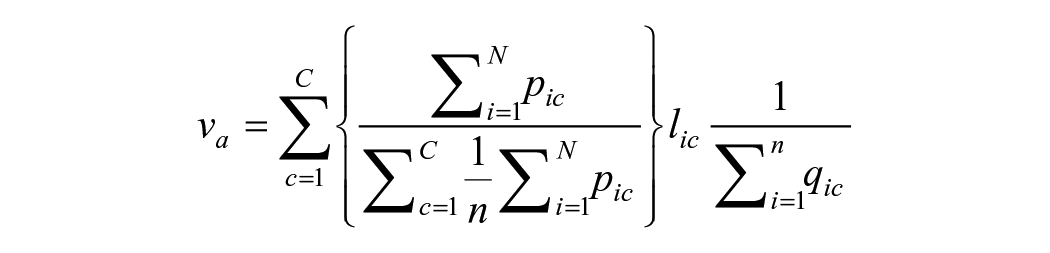
We define the generalized global value of a commodity as the global socially necessary labor time required to produce it, weighted by the country-specific average national abstract labor time, which is the ratio between average national and global productivity. The modified global socially necessary labor time is thus no longer conceptualized as a simple average of the concrete individual labor expended for production, since each concrete labor affects the global valorization process as part of the national average abstract labor. With this new level of abstraction, equilibrium in national markets is ensured regardless of the degree of specialization, while the competitive dynamics due to productivity deviations of concrete labor representing technological progress remain unchanged, as in the classical law of value.
Let us examine how our proposed generalized global law of value works in our previous 2-country example of partial specialization. We can use our most general assumption that the second country is on average twice as productive



We can see that our formulation and modification of the global law of value makes valorization independent of the extent of specialization, which was our goal. Consequently, the results of applying our proposed modified law of value are stable in both domestic and international markets and better reflect the valorization patterns in the international economy.
This proposed formulation is consistent with a generalized version of the theory of value. It represents a generalized law of value, because if we apply it to the homogeneous capitalist mode of production without national subdivision, it reduces to the classical law of value. All the dynamic and static results of the analysis carried out by Marx in his late works are thus preserved by this generalization, most fundamentally the difference between the value of labor power and the value of labor, while the basic relationship between the phenomenal form of profit and exploitation in production through the appropriation of surplus value is preserved. Thus, our generalized formulation encompasses some of the basic propositions of classical Marxist theory.
Moreover, it not only offers an explanation of the international and national price levels, but also allows for both static and dynamic analyses of the international division of labor and its operation, enabling an explanation of uneven development from the perspective of relations of production as opposed to unequal relations of exchange or Ricardian transfers of concrete embodied labor.
6. Distributional Dimension—The Rate of Surplus Value and Marxian Wage Theory
Before addressing the new insights that can be gained from the proposed generalized global law of value, we need to further discuss the distributional dimension of the international valorization. Up to this point, we have only examined the valorization process itself, but have made no assumptions about the distribution between wages and profits.
Marx’s wage theory is an essential part of the historical materialist understanding of the economy and an integral part of the theory of exploitation, since it forms the central distinction between the value of labor power and the value produced by labor. By defining the value of labor power by the time required to produce a historically and culturally specific minimum necessary for the reproduction of labor power, wage theory satisfies only this central primary purpose of its formulation. However, such an account clearly does not aim to offer a concrete theory that examines the cross-national differentiation of the real wage, since the differentiation is primarily captured by the relatively vague and undefined cultural and historical minimum and differences in reproduction costs. There is a broad consensus in the Marxian tradition that defining a fixed absolute minimum wage for all workers linked only to the costs of reproduction of their skill and labor power would not provide a tangible analysis that corresponds to the realities of the valorization of wages, and that this minimum must be treated as a variable that assigns to each historically and geographically specific society a concrete set of use values that are deemed socially necessary for its reproduction and allocated to the working class in the form of wages (Baumol 1983; Starosta and Fitzsimons 2018) Yet even such a broad understanding of wage theory provides us with only a limited explanation for determining actual real wages—the use values acquired by the working class in different countries.
Thus, instead of approaching the distributional question from a wage perspective, we should examine it from the perspective of cross-national differences in the rate of surplus value that comprises the central distributive class relation. Machover and Farjoun (1983) were the first to show empirically that the rate of surplus value is surprisingly more stable than profit rates and organic composition. In their analysis of the capitalist economy, they use key Marxian concepts, which they transform into random variables and probability densities. In their study of the probability distributions of wages, profits, and organic composition, they theoretically derive the long-run stable equilibrium at a stable rate of surplus value of 1, with very limited deviations (Machover and Farjoun 1983).
We complement this discovery with additional empirical evidence on cross-country differences in the rate of surplus value and cross-country differences in productivity. We use the PENN world table data set to construct a panel data set consisting of the average rate of surplus value for each country and year. We are looking for a relationship between real productivity (physical output per worker) and a rate of surplus value, which is estimated based on the national accounts as the profit share divided by the wage share. 3 As shown in figure 1 and table 1, there is only a very weak relationship between the rate of surplus value and differences in real productivity, which empirically supports Farjoun and Machover’s (1983) derivation that the rate of surplus value is stable in the long run, fairly independent of development and sectoral differences, and close to the value 1. More so, the weak relationship correlates the slightly above-average rate of surplus value with more developed regions, which contradicts the derivation of uneven development based on higher rates of exploitation in peripheral regions (Amin 1976, 2010).
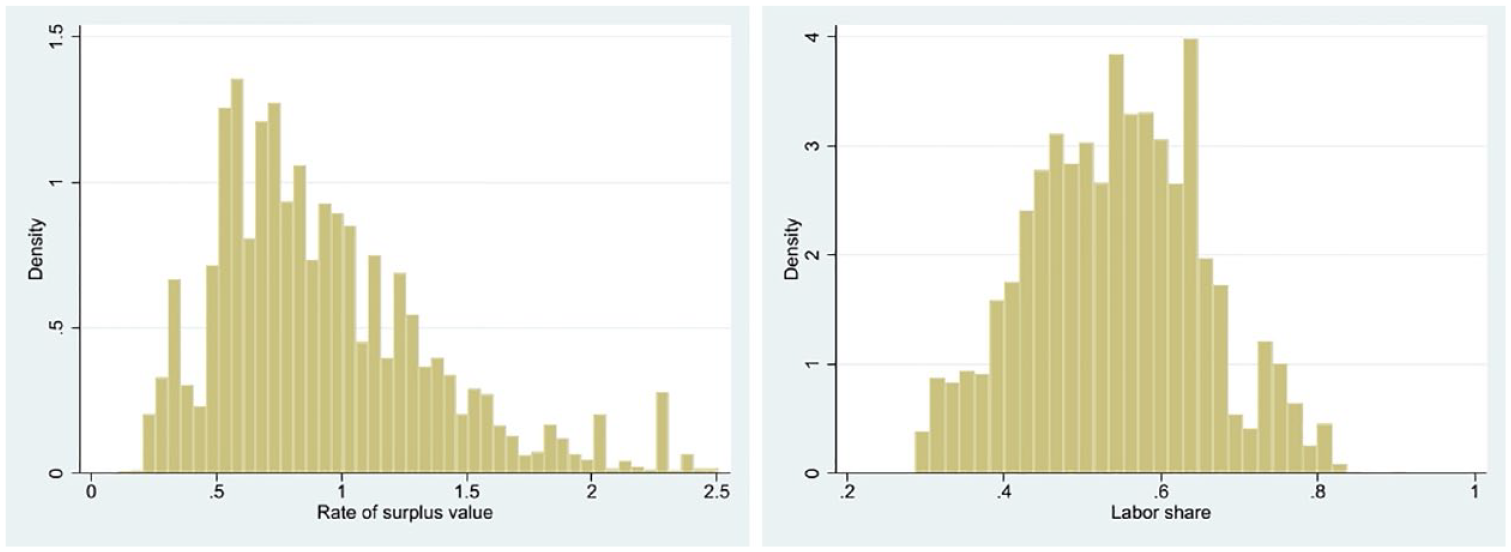
Histograms of the rate of surplus value (rsv) and labor share (labsh) across countries and time.
Panel Regression Random-Effects GLS Results With Rate of Surplus Value as Independent Variable and Nationwide Productivity as Dependent Variable.
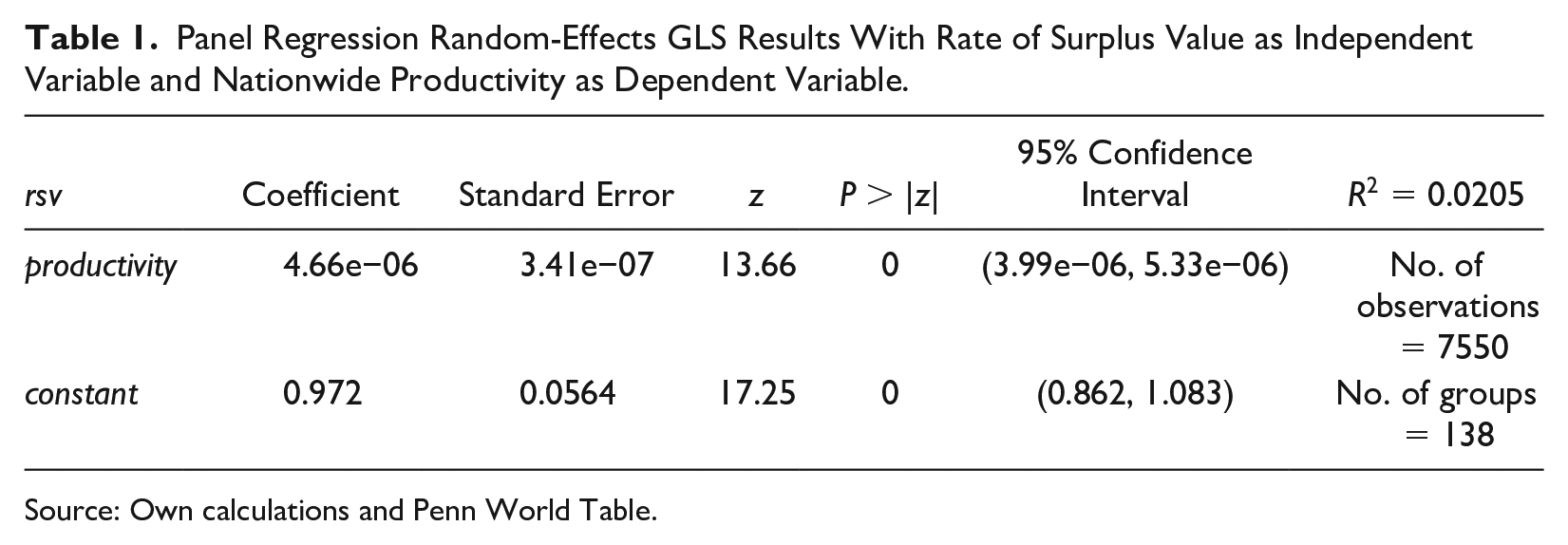
Source: Own calculations and Penn World Table.
In this article, we cannot explore the possible explanations for the general cross-country stability of the rate of exploitation because, on the one hand, the explanation would require extending the discussion of the determination of cross-country differences in real wages, which, as noted above, by definition goes beyond the basic Marxian wage theory, since real wages are not its direct object. On the other hand, as explored by Farjoun and Machover (1983), there are broad macroeconomic dynamics that can only be analyzed at the nondeterministic statistical level and that could play an important role in the phenomenon of long-run stability of the rate of surplus value. Therefore, in our further study of the uneven development and application of the proposed generalized value theory, we take into account the empirically and statistically studied fact that the rate of surplus value is stable on average and does not deviate significantly from 1.
7. Uneven Development and Generalized Law of Value
7.1 Commodity chain expansion and integrated periphery
The generalized law of value can be used to explain the expansion of the commodity chain. If we assume that the production of a given commodity is initially fully nationally integrated, a single firm that reallocates part of its production to a country with a lower level of development can earn surplus profits. Regardless of whether the most developed technology is used, wages in the less developed country are still determined by its national market equilibrium, and since the rate of exploitation between countries are similar and stable, wages in less developed countries are endogenously lower. Thus, in the short run, firms that choose to develop an international commodity chain earn additional profits. However, the long-run equilibrium of such a transition does not allow all firms to earn surplus profits in the long run, because if gradually all firms choose to internationalize the commodity chain, the competitive mechanism leads to lower prices for the components produced or work performed by the workers of the less developed country.
While various Marxian approaches and critical economic geography already examine these mechanisms in detail (Harvey 2005, 2017; Pavlínek 2020), the core difference relevant to us is the following. Because the unmodified law of value cannot be a basis for conceptual understanding of such internationalization dynamics, current analyses are forced to resort to extra-economic assumed differences in the rate of surplus value and wage differentials as a source of extra profits, while at the same time they lack a conceptualization of the competitive mechanism that leads back to long-term stable valorization.
Conversely, the generalized law of value infers both the short-term benefits of commodity chain internationalization from the perspective of multinationals and the simultaneous enforcement of equilibrium in national markets, while providing an understanding of the competitive pressures that lead to stable equilibrium with falling prices in the long run. Such an explanation has a better empirical basis, as it does not require that the rate of surplus value deviates significantly in time and space, since such deviations are not empirically detectable.
7.2 Persistence of uneven development due to unfavorable specialization
The most important contribution of the use of the generalized law of value is its ability to provide a dynamic explanation for the structurally driven unfavorable pattern of specialization among differently developed countries.
While both Marxian (Mavroudeas and Seretis 2018; Seretis and Tsaliki 2016; Shaikh 2006, 2016) and non-Marxian heterodox approaches to technology diffusion (Dosi, Pavitt, and Soete 1990; Fagerberg and Verspagen 2002; Knez 2023) and development theory (Findlay 1980; Findlay and Södersten 1981; Lewis 1954) have examined various economic and extraeconomic mechanisms that block the technological progress of less developed countries, our approach offers a unique perspective that differs from them by focusing entirely on the endogenous operation of competitive market mechanism, as it is operationalized by our generalized global law of value. The derivation offers a complementary perspective and does not depend on any a priori assumed extraeconomic differences, but is an internal property of the international valorization process, derived exclusively by application of the generalized law of value.
We examine the following example. There are two differently developed countries (c = 1, 2) that have an average productivity ratio of 1:4:

This leads to long-run differences in the average abstract national labor time required to produce international value in the same proportion. We analyze the production of two commodities, a and b, that are complementary and consumed in the ratio 1:2. In this case, we are interested in the two industries (i = a, b) that have country-specific productivity different from the average productivity gap. The production technology of the industrialized country is more productive for both commodities, although to different degrees. The production of commodity b leads to six times higher output per worker in a developed country, while the output of commodity a is only twice as high as in the less developed country:

We begin by examining an international economy in which both countries distribute labor equally between the production of the two commodities:

Let us examine the application of the generalized law of value in this case:




We are primarily interested in the existence of surplus profits or below-average profits, that is, deviations of the concrete rate of surplus value from the national average rate of surplus value. If these deviations are generated by the national and international market equilibria governed by the generalized law of value, then ceteris paribus they are the source of an endogenous dynamic toward specialization. We disregard any complications with the organic composition of capital, which would only complicate the calculation without changing the implications of our example—the differences in concrete returns arise solely because of relative productivity differences and have a structural effect on specialization, independent of relative capital intensities, which would affect both developed and less developed countries similarly. Therefore, we examine the concrete rate of surplus value for both countries and both commodities.
We are interested in the concrete rate of surplus value for each country and commodity. Wages (w) are determined by the national average rate of surplus value and the national equilibrium of value produced per labor, which is determined by the average national abstract labor time:
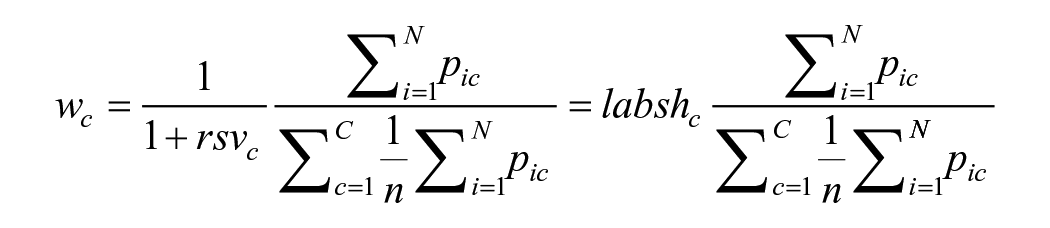
We use the average labor share (

We can examine the results for the concrete surplus value for production in each country and each branch in table 2.
Concrete Rate of Surplus Value.
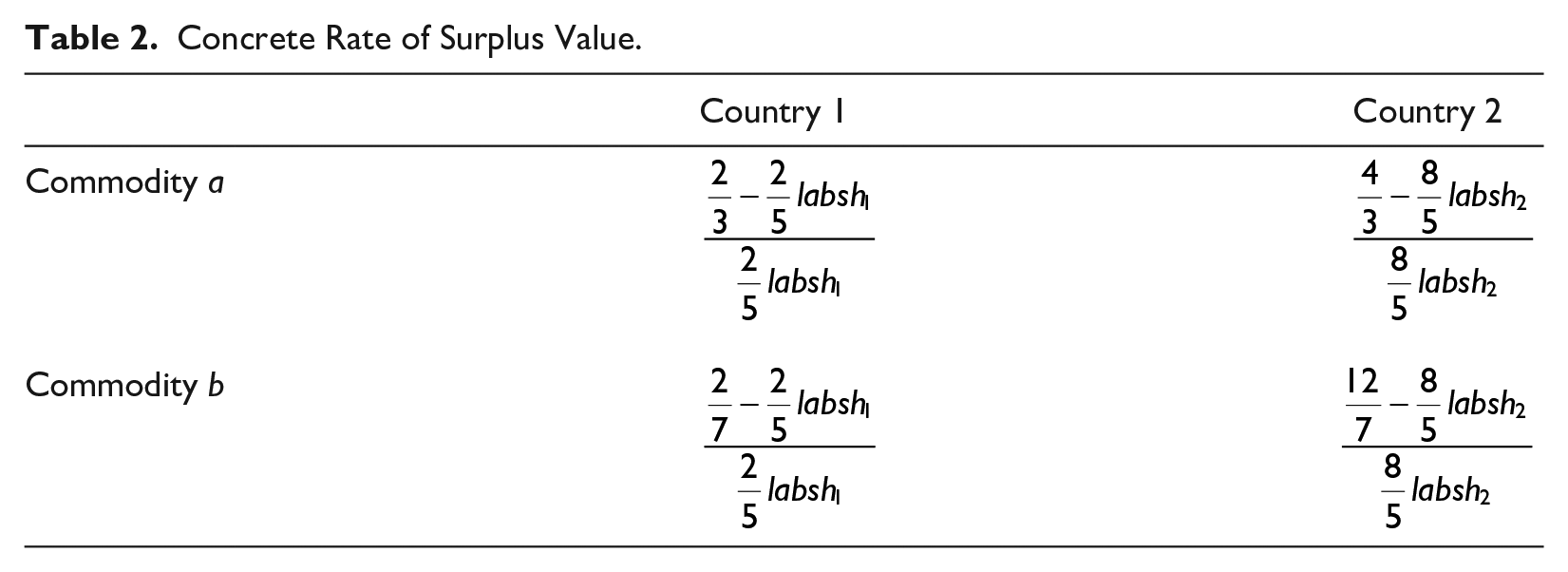
We study the differences in surplus value per unit of labor as a basis for constructing new dynamic equilibria of specialization. We can view table 2 as a simple game-theoretic model in which the concrete rate of surplus value represents the relative gains of the capitalist class. There are two levels of potential specialization forces. At the domestic level, domestic capitalists can choose to invest in the production of commodity a or b, comparing concrete rate of surplus value and choosing the branch that offers a higher return (comparing the rows in table 2). At the international level, global capitalists producing one of the commodities can choose whether to invest accumulated capital in country 1 or 2 by comparing the rate surplus value (comparing the columns in table 2).
If we assume that the average rate of surplus value is the same in both countries
However, no such restricting assumption is required to show that such specialization dynamics is taking place. The same Nash equilibrium arises if:

We can simplify these equations to a simple conditional that refers only to the average national labor shares and the average national rate of surplus value in each country:

As discussed in the previous section, the labor share and the surplus value rate are empirically and theoretically very stable across countries. Our empirical evidence shows that the vast majority of all countries have a rate of surplus value around 1 and that substantial variations in the labor share that would exceed 50 percent are statistically very unlikely (figure 1). Therefore, we can plausibly assert that the pattern of specialization endogenously induced by the operation of national and international competition is a comprehensive mechanism that acts as one of the fundamental laws of development and international specialization.
A more general conclusion from this example is the following: When aggregate productivity differences and other additional economic factors lead to persistent differences in valorization levels, the relative difference in national average abstract labor time required to produce global value determines the tendency to specialize as a function of the relative productivity of the technology used in production. If the relative productivity difference in performing a particular task is higher than the relative average productivity difference in the globally tradable part of the economy, then such a task tends to be performed in a more developed country. If the relative productivity difference is lower than the relative average productivity difference in the globally tradable part of the economy, then such a good or production task tends to be produced in a less developed country.
The result of the dynamic adjustment is the following full specialization pattern (we use ′ to denote the after-specialization period values):

A new equilibrium is formed in the markets; the valuation is adjusted accordingly and no longer leads to additional gains or losses compared to the average production sector in each country. We can see that the value of both goods has decreased in the new equilibrium of complete specialization:


We see that the decline in global value due to international specialization hits the less developed country much harder, as the international price decline for commodity a is 40 percent and for commodity b only 6.7 percent. In order to produce the same amount of complementary goods a and b, labor input must change according to the productivity differences of the specific industry:


In the new equilibrium, the less developed country must perform 50 percent more labor than before the internally induced specialization, while the more developed country performs 42 percent less labor than before for the same aggregate output. The internal law of capitalist development thus creates such a pattern of specialization that reduces the total labor time in the developed country and increases the labor requirement in the underdeveloped country to produce the same total international output.
The average aggregate valorization per unit of labor in country 1 before specialization was
We can further generalize this discovery by examining two countries and two industries in a general framework, where X represents the overall average productivity gap and α represents a deviation in the productivity gap in industry a (downward deviation) and industry b (upward deviation):


In such a general case, the specialization Nash equilibrium, which drives the production of commodity with a greater productivity differential than the average in a less developed country and the production of commodity with a smaller productivity differential than the average in a more developed country, has the following condition:

We see that if the relative deviations from the average productivity differential are small, the differences in the rate of exploitation, and hence the labor share, might prevent the pattern of specialization from emerging endogenously. However, if there are certain industries whose productivity differences are larger than the differences in labor shares, the internal structure of the valorization process pushes the international economy toward the specialization pattern discussed. Since cross-country labor shares are much more stable than productivity differences between industries and countries, we argue that one of the fundamental laws of uneven development lies precisely in the internal mechanisms that drive specialization and endogenously contribute to uneven development.
The new, fully specialized Nash equilibrium is always less favorable for the less developed country under general conditions, as the valorization per unit of labor decreases from its pre-specialization period:

Conversely, the new full specialization valorization per unit of labor is generally always more favorable for the more developed country compared to its pre-specialization valorization per unit of labor:
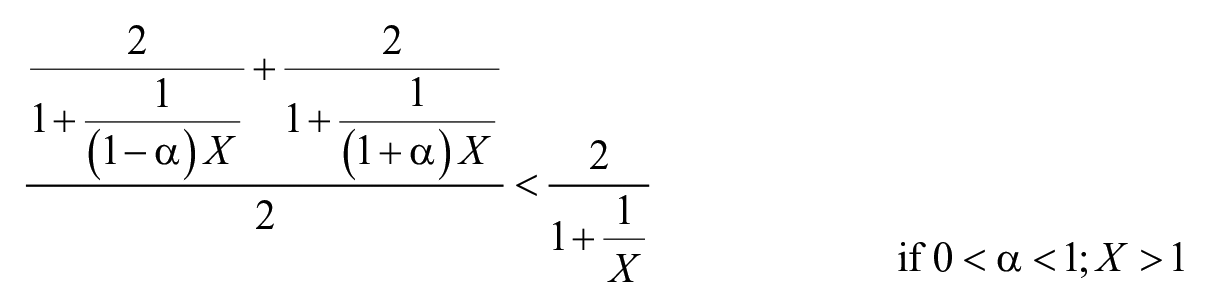
The total relative benefit of endogenously induced specialization is thus asymmetrically appropriated by the more developed country. Because of the way national and international markets work, labor-intensive components and tasks tend to be produced in the less developed regions. Such international specialization frees up labor from the more developed regions for other tasks, benefiting from specialization in the most productive and technologically advanced production, allowing further spillover effects from the additional available labor, while preventing labor from the less developed regions from being used in more productive industries, thus blocking development and reducing its global valorization. However, there is more at stake than just a static asymmetry in relative gains, as the dynamics that create specialization also affect long-term development.
Absolute productivity differences between countries in a given sector or task indicate the potential for cost-effective technological improvements. Since higher wages in industrialized countries create significant pressure for innovations and technological changes that would replace labor with advanced machinery, the lower productivity differential in a sector implies a lower potential for productivity improvements in that specific task for a given level of overall technological and scientific development. Conversely, product- or task-specific productivity gaps that are larger than the average national abstract labor time differences, and thus larger on average than the average nationwide productivity gap, indicate greater potential for technological improvements and productivity growth. Thus, not only are specialization gains highly unevenly distributed in the asymmetric environment of heterogeneous productivity gaps, but the dynamic future prospects for productivity growth and technological progress within production are also highly asymmetric. The pattern of international specialization and global division of labor, continuously created and reinforced by the operation of the internal laws of capitalist development and the generalized global law of value, thus leads to a global division of labor that endogenously perpetuates uneven development. This perpetuation is not the result of value transfers or inequalities in exchange, but of international competition, international price formation, and the determinants of local and global productivity within the sphere of production. The tendency toward increasing fragmentation of the production process is only the most far-reaching aspect of such a process of global specialization, because the increasing fragmentation of the production process leads to a fragmentation of the production process that previously took place within a single firm. This allows for an even more fragmented global division of labor that exploits very heterogeneous productivity differences as well as different potential for technological improvement between specific tasks in the production process.
Conclusion
In this article, we present the generalized law of global value, which aims to better capture the static and dynamic effects of the operation of the competitive process at the national and international levels, while retaining the explanatory power of its unmodified version when applied to a homogeneous, closed economy. On the one hand, we retain the main theoretical link between the socially necessary labor time required for production and price formation. On the other hand, we introduce the influence of national abstract labor, which captures the impact of national markets on global value, especially country-specific productivity differences—a link missing in the unmodified implementation of the law of value.
Using the proposed generalized law of global value, we examine one of the main topics of research on uneven development—the choice of technology determination within the international capitalist mode of production. The main result is that international competition between countries with very different aggregate productivities and average wages leads to a specific division of labor—tasks and production processes for which the productivity differential is larger than the nationwide productivity differential tend to be produced in more developed countries and vice versa. Statically, such specialization confers greater relative advantages on the more developed country, and the gains from specialization are heavily skewed in favor of the more developed country. Moreover, the distribution of the dynamic potential for technological improvement and productivity gains associated with such specialization in the global division of labor perpetuates uneven development and blocks technological progress in underdeveloped countries.
Footnotes
Acknowledgements
I would like to thank three reviewers of this journal for their detailed reading of the manuscript and their extensive comments, which have contributed significantly to the production of the article in its present form. I would also like to thank Enid Arvidson for managing the editorial process.
Declaration of Conflicting Interests
The author declared no potential conflicts of interest with respect to the research, authorship, and/or publication of this article.
Funding
The author disclosed receipt of the following financial support for the research, authorship, and/or publication of this article: The author of this article acknowledges the financial support received from the Slovenian Research Agency (research core funding No. 52075).
