



Abstract
Herbert Malena Gintis was born on February 11, 1940, in Philadelphia, PA, to Gerson and Shirley (Malena) Gintis. He graduated with a bachelor’s degree in mathematics from the University of Pennsylvania and attended Harvard University for graduate school in mathematics, receiving a master’s degree. Disillusioned with mathematics, however, he became a sandal maker at Harvard Square and active in student protests, including in Students for a Democratic Society. He also became interested in Marxism and economics. Thus, in 1963, he switched his PhD program at Harvard to economics. He met Sam Bowles in this PhD program, with whom he would work his entire career.
Herb was one of the founders of the Union for Radical Political Economics (URPE) in 1968. As the contributions to this series of tributes attest, he was an inspiring teacher and a prolific, engaging, innovative, and brilliant scholar (see Jayadev and Naidu’s and Weiskopf’s contributions). He contributed much to the canon today, including truly revolutionary ideas that even neoclassical economists thank him for and that today are taken for granted, over fifty years later, when at the time, these ideas were clearly radical, even heresy (see Samuel Bowles’s contribution in this issue).
He retired from the University of Massachusetts-Amherst in 2003 as professor emeritus and had been external professor at the Santa Fe Institute. Herb died at age 82 in Northampton, MA, on January 5, 2023, following an illness.
I met Herb Gintis only once, at an unsuccessful job interview at UMass-Amherst. I felt intimidated by him, cowed. In undergraduate economic classes taught by Marxists, I read Gintis’s and his colleagues’ work, including Schooling in Capitalist America (Bowles and Gintis 1976). I felt I knew his steely mind. Maybe that’s why I felt intimidated. Decades later I would interview him for the 50th anniversary issue of URPE (Kim 2018). He was generous in his stories and scathing in his criticism of economics, still, including heterodox economics—still—which he said was an incorrect concept, because heterodox meant multiple truths. “Are there multiple truths?” he asked. “There’s only one truth.”
Herb was a giant in radical political economics, and with his colleagues and contemporaries—Samuel Bowles, Rick Edwards, David Gordon, Michael Reich, Tom Weiskopf, and others, they were a creative and influential team—and their ideas live on. To this day, I teach concepts from Schooling in Capitalist America (Bowles and Gintis 1976) and from his contemporaries. My uncle, a chemist turned stockbroker turned amateur economist (all the economics he knows he learned from YouTube videos), lectured me about long wave economic cycles. He seems to have lectured my father as well (or sent him a YouTube video on the subject), because my retired artist dad also lectured me about long waves in economic history and how the US economy will crash (in 2022), and all the markets will fall by 50 percent and remain there for ten years (apparently as a result of a change in the world economic hegemonic order). I didn’t tell them they were Marxists. They would have pooped in their pants.
Many were influenced by Gintis’s ideas and work. We are fortunate to have contributions in this tribute to him from those who worked with him intimately and knew him well. We had hoped to include the famous blank verse poem he composed in the early days of URPE that critiqued neoclassical economics. Former and long-term RRPE Board member Shaianne Osterreich scoured the URPE archives in Ithaca, NY, for this and found the essay “Three Critiques in the Form of a Chair” instead (Gintis 1968). We feel this is a nice display of Herb’s creativity, playfulness, breadth of knowledge (using Italian, French, and scientific words), and vocabulariousness, 1 and thus are republishing this here with permission (see figure 1). The famous blank verse poem may remain, unfortunately, only in memory. In his acceptance speech for the Nobel Prize in economics in 1970, Paul Samuelson criticized this now-vanished blank verse poem because it was “scathing on the notion of Pareto-optimality” (Samuelson 1970: 76). Yes, Paul, you had that right. It was.
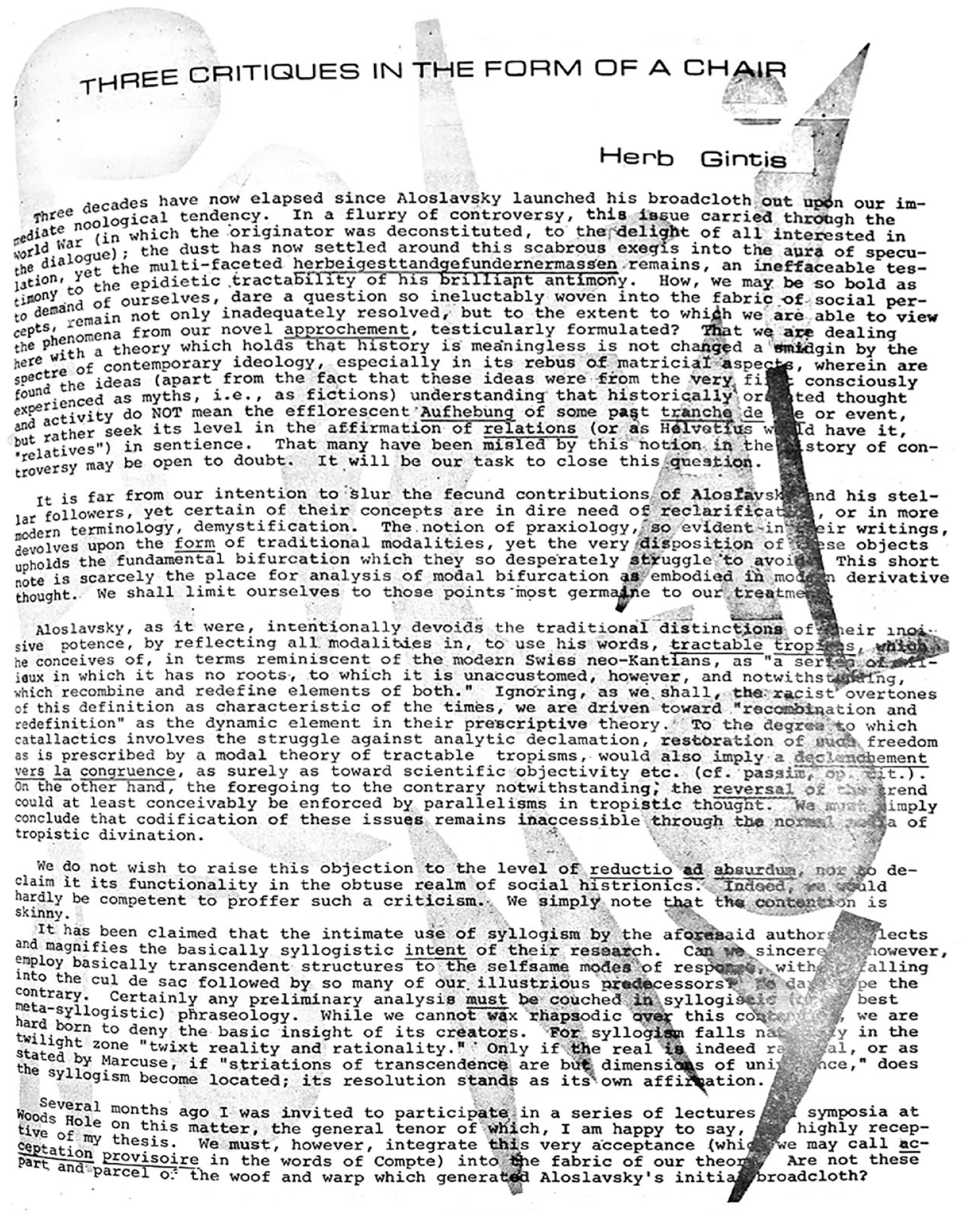
Herb Gintis’s 1968 essay “Three Critiques in the Form of a Chair.”
Thank you, Herb. You made a better economics.
Footnotes
Acknowledgements
Many thanks to Marlene Kim whose indefatigable work in initiating, organizing, and following up on these tributes enabled them to be written and published.
Thanks to Sam Bowles, Arjun Jayadev, Suresh Naidu, and Tom Weiskopf for their contributions to this tribute. Thanks to Shaianne Osterreich for her heroic effort to find Herb’s lost blank verse poem “scathing on the notion of Pareto-optimality,” and to the New England Free Press for permission to reproduce Gintis’ essay, “Three Critiques in the Form of a Chair,” in figure 1. And thanks Herb, for your tremendous, creative, amazing, prescient, and influential work that continues its impact on economics today and on the world.
1
Yes, I made up this word, after reading this essay, “Three Critiques in the Form of a Chair,” looking up many of the words, and realizing what Sam Bowles (in his contribution here) meant about Herb’s playful vocabulary. “Vocabularious” and “vocabulariousness” (delirious with vocabulary) should be words and are needed to describe the work of Herb (and probably others,’ most obviously for Lewis Caroll in “Jabberwocky”).