



Abstract
Does the intensification of labor increase the rate of exploitation? Does it produce absolute surplus value or relative surplus value? This article develops a framework to answer these questions by incorporating intensity of labor in the widely used linear model of production, both in its one- and two-department forms. We show that (a) an intensification of labor always leads to an increase in the rate of exploitation, and (b) the increase in the rate of exploitation takes the form of the production of absolute surplus value in all realistic situations. We also highlight, in the case of any model with more than one industry or sector, an interesting difference in short- and long-run changes in the rate and form of surplus value.
1. Introduction
In Marxist economics, the rate of exploitation occupies a central place. It is a quantitative expression of the exploitation of labor by capital. The rate of exploitation is defined as the ratio of surplus labor and necessary labor, or equivalently as the ratio of surplus labor-time and necessary labor-time. Converted to value-theoretic terms, the rate of exploitation is equal to the ratio of surplus value generated in production per day (or hour) and the variable capital advanced per day (or hour) of work to purchase labor power. Surplus value, in turn, is the difference between the value added per hour by the use of labor power and the value of labor power.
The value of labor power is the value of the means of subsistence necessary for the maintenance of the worker, where necessity is determined not biologically but historically, morally and politically (Marx 1992: ch. 6). In the normal functioning of capitalism, the worker is able to earn a nominal wage income that allows her, on average, to purchase the means of subsistence necessary for her maintenance. Thus, the value of labor power per hour of work, for instance, is equal to the value of the real wage bundle that the worker earns, on average, per hour of work (Morishima 1973: 50). Once the necessary means of subsistence and the daily real wage bundle is fixed, the rate of exploitation depends on the interaction of three variables: the length of the working day, the productivity of labor, and the intensity of labor.
In volume 1 of Capital, Marx discussed two different methods available to capitalism to increase the rate of exploitation: (a) the production of “absolute surplus value” and (b) the production of “relative surplus value”: I call the surplus-value which is produced by the lengthening of the working day, absolute surplus-value. In contrast to this, I call that surplus-value which arises from the curtailment of the necessary labor-time, and from the corresponding alteration in the respective lengths of the two components of the working day, relative surplus-value. (Marx 1992: 432)
In this article, we call these two methods of increasing the rate of exploitation as forms of surplus value.
Among the three variables that interact to determine the rate of exploitation, the impact of changes in the length of the working day and the productivity of labor are easy to see. If there is an increase in the length of the working day, holding the daily real wage bundle, the productivity of labor and the intensity of labor fixed, that is by definition the production of absolute surplus value—because it is the “lengthening of the working day.” On the other hand, if the productivity of labor increases because of technical change, holding the length of the working day, the daily real wage bundle, and the intensity of labor fixed, then this leads to a production of relative surplus value. This can be seen easily by considering the case of a pure labor-saving technical change, which increases labor productivity. The increase in the productivity of labor reduces the unit value of commodities, which, in turn, reduces the value of labor power per day (or hour) of work as the daily real wage bundle is held constant at the level of the necessary means of subsistence. Since the length of the working day is held constant, this is clearly an instance of the production of relative surplus value—because this is the “curtailment of the necessary labor-time,” as the labor-time required to produce the necessary means of subsistence falls.
In contrast to this, the effect of changes in the intensity of labor on the production of absolute or relative surplus value is less obvious. This is because an increase in the intensity of labor has two distinct effects. On the one hand, it increases labor’s capacity to process inputs into output (CPIO) per unit of time, which is akin to an increase in the productivity of labor due to technical change. On the other hand, an intensification of labor also implies a larger expenditure of labor power per unit of time, which is like an increase in the length of the working day, albeit in an intensive sense (Marx 1992: 534), and hence increases labor’s capacity to create value (CCV) per unit of time. The overall impact of the intensification of labor, being the result of these two effects, is not immediately obvious. The CPIO effect tends to indicate toward the production of relative surplus value; the CCV effect points in the direction of the production of absolute surplus value. This might be the reason behind the disagreement in the extant Marxist literature about the effect of the intensification of labor. While some scholars argue that an increase in the intensity of labor produces absolute surplus value (Foley 1986; Catephores 1989; Sekine 1997; Joosung 1999; Hudson 2001; Heinrich 2012), others claim that an intensification of labor leads to a production of relative surplus value (Philp, Slater, and Harvie 2005; Mavroudeas and Ioannides 2011).
Our aim in this article is to provide a theoretical framework to think about the value dimensions of the intensification of labor. This framework allows us to clearly address the question of the form of surplus value, that is, whether intensification leads to the production of absolute or relative surplus value. In concrete terms, our article makes two important contributions. First, we offer a simple way of incorporating the intensity of labor in the linear model of production that is widely used in classical and Marxian economics. Our proposed method rests on clearly and quantitatively separating out labor’s CPIO and CCV, so far as they are related to the intensity of labor. While most scholars have associated with intensification of labor what we have called labor’s CCV, there is far less attention devoted to labor’s CPIO. Second, using our model, we draw out the implications of an intensification of labor on the rate and form of surplus value in a variety of linear production models of the capitalist economy.
With regard to the rate of surplus value, we demonstrate the intuitive result that an intensification of labor always leads to an increase in the rate of surplus value. Hence, it is always in the interest of the capitalist class and always against the interest of the working class to increase the intensity of labor. 1 We can therefore expect a pronounced class struggle over the intensity of labor in capitalist economies, much like the struggle in mid-nineteenth-century England over the length of the working day.
Our results about the form of surplus value are more complex because they depend on the relative magnitudes of labor’s CPIO and CCV. We show that (a) if labor’s CPIO and CCV are impacted equally by the intensification of labor, then there is production of only absolute surplus value; (b) if, with the intensification of labor, labor’s CPIO rises less than its CCV, even then there is production of only absolute surplus value; and (c) if the intensification of labor is associated with labor’s CPIO rising more than its CCV, then the rise in the rate of surplus value can be decomposed into the sum of two components, one associated with the production of absolute surplus value and the other associated with the production of relative surplus value.
The first case, where labor’s CPIO and CCV are impacted equally by the intensification of labor, seems most common and would arise when intensification of labor does not exceed the normal limits of work and effort. The second case, where labor’s CPIO rises less than its CCV by the intensification of labor, would occur when intensification of labor breaches normal working conditions and leads to exhaustion of workers. The third case, where labor’s CPIO rises more than its CCV by the intensification of labor, seems unlikely to occur in any realistic scenario. Hence, we conclude that an intensification of labor leads to the production of only absolute surplus value in all realistic scenarios.
Our analysis has important political implications. It has been common in the Marxist tradition to associate the production of absolute surplus value primarily with the early stages of capitalism. In early capitalism, capitalist relations of production are imposed with little technical change, resulting in a longer working day and an intensification of labor. Marx refers to this as the formal subsumption of labor (Marx 1992: 1020). Once the length of the working day has been more or less determined by the struggle of the working class, the main method of raising the rate of surplus value is through the production of relative surplus value—this is what Marx calls the real subsumption of labor, where the capitalist mode of production entrenches itself through the division of labor and the use of machinery (Marx 1992: 1024). Our analysis highlights that the production of absolute surplus value remains important in later stages of capitalism, much as Marx had pointed out in his analysis of the formal and real subsumption of labor by capital.
The final point that we would like to highlight in this introductory section relates to empirical evidence about the rising intensity of labor. There is a large literature in sociology and labor studies that has documented the rising intensity of work in advanced capitalist countries since the early 1980s. A conference on this issue was held in Paris, France, in November 2002. The papers presented in this conference have been published in the Eastern Economic Journal, volume 30, number 4 (Fall 2004). These papers present various types of empirical evidence on work intensification since the early 1980s. Social scientists in the United Kingdom have been studying this issue for many years. Using data from the British Skills and Employment Survey for the years 2001–2007, a group of scholars have presented evidence about work intensification in the United Kingdom (Green et al. 2021). The evidence presented in these studies clearly establish the rising intensity of work over the past few decades in advanced capitalist countries. This empirical evidence increases the relevance of the theoretical analysis developed in this article.
The rest of the article is organized as follows. In section 2, we use a one-commodity model of production with linear technology, that is, a corn model, to study the impact of an intensification of labor on the rate and form of exploitation. In section 3, we analyze the same set of issues in the simplest two-department model, where department I produces the single means of consumption and department II produces the single means of production. The final section concludes the discussion with some thoughts about the broader implications of our research. The main points of our analysis can be fully conveyed with the one-commodity model and the simple two-department model, but for completeness, we also present all the results in general linear settings in the appendix: appendix A (
2. One-Commodity Linear Model
2.1. Technology and value
Consider a capitalist economy that produces one commodity, called “corn,” and assume that it can be both consumed and invested. Production of corn requires both a nonlabor input, corn itself, and labor. Consider a benchmark case where it takes
Given this technological relationship, we can determine the value of a unit of corn. If we denote by

where

For the technology represented by
2.2. Intensity of labor
We would now like to define two important aspects of labor that allow us to make precise the notion of the intensification of labor. By labor’s capacity to process inputs into output (CPIO), we refer to the physical amount of inputs converted into output per unit of time. By labor’s capacity to create value (CCV), we refer to the magnitude of expenditure of labor power per unit of time. With these two notions in place, we can now define the intensity of labor by following Steedman (1977: ch. 6).
1.
2. each hour of labor creates µ2 units of value.
In this definition, µ1 captures labor’s CPIO and µ2 captures labor’s CCV. The fact that µ1 > 1 implies that compared to the situation before intensification, each hour of labor now converts a larger physical magnitude of inputs into output. In a similar way, the assumption that µ2 > 1 captures the fact that when workers work with higher intensity, there is larger expenditure of labor power per unit of time, compared to the situation before intensification. Since expenditure of labor power creates value, intensification of labor increases labor’s CCV, and this is captured by µ2 > 1. 3
To analyze the impact of intensification of labor on the value of corn, let

where, like before, the first term on the right-hand side (RHS),

Using (1), we get:

Here we see an interesting result. When there is an increase in the intensity of labor, the change in the unit value of corn depends on the relative magnitude of µ1 and µ2. If
Note that the notion of intensification of labor can only be defined in relative terms, that is, in comparison to a situation before intensification occurred. The magnitude of labor value of a commodity is the amount of socially necessary labor time necessary to produce a commodity “under the conditions of production normal for a given society and with the average degree of skill and intensity of labor prevalent in that society” (Marx 1992: 129). After intensification has occurred and has become the new norm, one can recalibrate value definitions using the new level of labor intensity as defining the “normal conditions of production.” It is equally meaningful to keep the previous intensity of labor as the definition of “normal conditions of production.” We choose to adopt the second strategy. That is why we include µ2 > 1 in our definition of intensification (definition 1). If, instead, one chooses to adopt the first strategy, then one would specify
2.3. Rate of exploitation
In the benchmark situation, let the working day be
In the benchmark situation, workers earn a real wage bundle

so that:

Now suppose there is an intensification of labor, where the latter is captured by the two real numbers µ1 and µ2, as specified in definition 1. In this case, if

so that:

We can now combine (3) and (4) to get:

Using (2), we get:

Our first result can be stated as:
Proof. This can be seen immediately from (5) by noting that µ1 > 1 whenever there is an intensification of labor (definition 1).
The intuition for this result is straightforward. Since the intensity of labor rises, each hour of labor produces a larger magnitude of corn, captured by the real number µ1 > 1. But the magnitude of corn that the worker gets back in her real wage bundle remains unchanged at
2.4. Form of exploitation
In volume 1 of Capital, Marx discusses two methods to increase the rate of exploitation: the production of absolute surplus value and the production of relative surplus value. We refer to these as forms of exploitation (or forms of surplus value). The key difference between these two forms of exploitation is whether they involve what Marx calls the “curtailment of the necessary labor-time,” that is, whether there is a decline in the value of labor power per hour or per day of work. Following Marx (1992: 432), we use the following rule: If the value of labor power does not decline, that is, it either stays constant or rises, then any increase in the rate of exploitation necessarily takes the form of the production of absolute surplus value (ASV); on the other hand, if there is a decline in the value of labor power per hour or per day of work, then an increase in the rate of exploitation can take the form of the production of relative surplus value (RSV). We have noted earlier that the form of exploitation is determined by the interaction of three factors: length of the working day, productivity of labor, and intensity of labor. While the main purpose of this article is to study changes in the intensity of labor, we would like to first comment briefly on the other two factors.
2.4.1. Length of working day
Suppose the length of the working day increases, holding everything else, including the daily real wage bundle,
Would we arrive at a different conclusion if we took an hourly, rather than a daily, perspective? When the length of the working day rises from
To see why this is production of ASV, recall that the necessary means of subsistence per hour of work is
2.4.2. Productivity of labor due to technical change
We can capture the increase in labor productivity due to technical change by positing a new technique of production,

Since the daily (and hourly) real wage bundle remains fixed at the necessary means of subsistence, that is,

and this is production of RSV (because the value of labor-power per hour of work has declined with the rise in the productivity of labor), but the total value produced per hour of work has not changed.
2.4.3 Intensity of labor
If the intensity of labor rises, as specified in definition 1, holding the hourly real wage bundle fixed at
Case 1:
Case 2: µ1 < µ2. Consider the case when µ1 < µ2. This condition means that an increase in the intensity of labor leads to a lower increase in its CPIO, captured by µ1, than in its CCV, captured by µ2. From (2), we see if µ1 < µ2, then
Case 3:µ1 > µ2. Consider the case when µ1 > µ2.This condition means that an increase in the intensity of labor leads to a higher increase in its CPIO, captured by µ1, than in its CCV, captured by µ2. From (2), we see that if µ1 > µ2, then
Using (3) and (4), we see that:

This shows that the change in the rate of surplus value comes from a combination of both absolute surplus value (the first term on the RHS) and relative surplus value (the second term on the RHS). The first term represents absolute surplus value because it captures an increase in labor’s CCV, that is, µ2 > 1, which increases the value added in an hour’s work from
2.5. Which case is relevant?
At some places in volume 1 of Capital, Marx argued that an intensification of labor would keep the unit value of commodities unchanged: Increased intensity of labor means increased expenditure of labor in a given time. Hence a working day of more intense labor is embodied in more products than is one of less intense labor, the length of each working day being the same. Admittedly, an increase in the productivity of labor will also supply more products in a given working day. But in that case the value of each single product falls, for it costs less labor than before, whereas in the case mentioned here that value remains unchanged, because each article costs the same amount of labor as before. (Marx 1992: 660–61, emphasis added)
This understanding of the effect of an intensification of labor can be captured by case 1. This is because, only in this case, that is, when
We might also entertain another possibility, that is, when intensification of labor leads to a relatively lower increase in its CPIO than in its CCV. This can happen, for instance, when the intensification of labor leads to exhaustion of the workers beyond normal levels. In such a situation, their ability to handle inputs and convert them into output might be impaired. Thus, for every hour of time, workers might be expending a larger magnitude of labor power—reflecting an intensification of labor—but because of sheer exhaustion, their ability to convert input into output might have declined. Marx indirectly discusses this in volume 1 of Capital: Up to a certain point, the increased deterioration of labour-power is inseparable from a lengthening of the working day and may be compensated for by making amends in the form of higher wages. But beyond this point deterioration increases in geometrical progression, and all the requirements for the normal reproduction and functioning of labour-power cease to be fulfilled. The price of labour-power and the degree of its exploitation cease to be commensurable quantities. (Marx 1992: 664)
In this quote, Marx speaks of how increasing the payment for workers’ labor may in fact not compensate for the rapid deterioration of the value of labor power. This is only possible when the value of labor power increases by more than the increase of their payment. Since, in this example, the value of labor power increases, this is clearly case 2. To see this, note that, since the real wage bundle is fixed at
The third case, that is, where µ1 > µ2, seems to us to be unrealistic and unlikely. We cannot conceive of any situation in which an intensification of labor leads to a larger increase in its CPIO than in its CCV. Intuitively, when the intensity of work rises, workers are able to increase the rate at which inputs are converted into output. This also implies an increase in the rate at which labor power is used. We do not see how the first effect can be quantitatively larger than the second. Hence, we think, while case 3 is a logical possibility, it is unlikely to be of any interest when we are studying a real capitalist economy. It is difficult to conceive of situations when an intensification of labor leads to a relatively larger increase in labor’s CPIO than in its CCV. This means that an intensification of labor, in all realistic scenarios, leads only to the production of absolute surplus value.
3. Simple Two-Department Model
So far, the analysis has been conducted in the context of a one-commodity model. This is decidedly simple and unrealistic. Hence, we would now like to extend the analysis to more realistic and also more complicated setups. The first step in this direction is to consider an economy with two commodities, one a capital good and the other a wage good. We can think of this as a simplified version of Morishima’s representation of the Marxian two department model (Morishima 1973). The simplification we introduce at this point is that each department produces only one commodity. 7
Let us denote commodity
3.1. Baseline scenario
In the baseline scenario, technology of production in the two departments are specified by

and the value determination equation in department II can be written as

Let

3.2. Intensification of labor in department I
Suppose there is an intensification of labor in department I that is captured by two constants µ1 > 1 and µ2 > 1, as specified in definition 1. Here µ1 captures labor’s CPIO and µ2 captures labor’s CCV.
3.2.1. Rate of exploitation
Let us denote by

Value determination in department II is given by

Let

The intensity of labor does not change in department II. Hence, the change in the rate of exploitation in department II is driven only by the change in the unit value of the consumption good. In fact, we have:

Hence, using the expressions for the rate of exploitation in both departments, before and after intensification of labor in department I, we have:

and:

Claim 2. If there is an intensification of labor in department I, then:
(a) the rate of exploitation in department I rises unambiguously, that is,
(b) the change in the rate of exploitation in department II depends on the relative magnitudes of µ1 and µ2, that is:

Proof. For the first part, that is, change in the rate of exploitation in department I, we have to consider three cases. Case 1: If µ1 > µ2, then a comparison of (7) and (9) shows that

where the inequality follows because µ1, µ2 > 1. Hence,
For the second part, that is, change in the rate of exploitation in department II, note that:

and recall that:

and:

If
Proof. Note that:

because µ2 > 1. Since the rate of exploitation in both departments were the same before the increase in the intensity of labor in department I, that is,
3.2.2. Forms of exploitation
Let us start by investigating the question of the form of exploitation, that is, relative and absolute surplus value, in department I. We have the same three cases to consider that we had encountered in the one-commodity model. If

Thus, in this case, we see a combination of the production of absolute surplus value (first term on the RHS) and the production of relative surplus value (second term on the RHS) in department I.
What about the form of exploitation in department II? Note that:

If
Rate and Form of Exploitation in the Two Departments after an Increase in the Intensity of Labor in Department I.
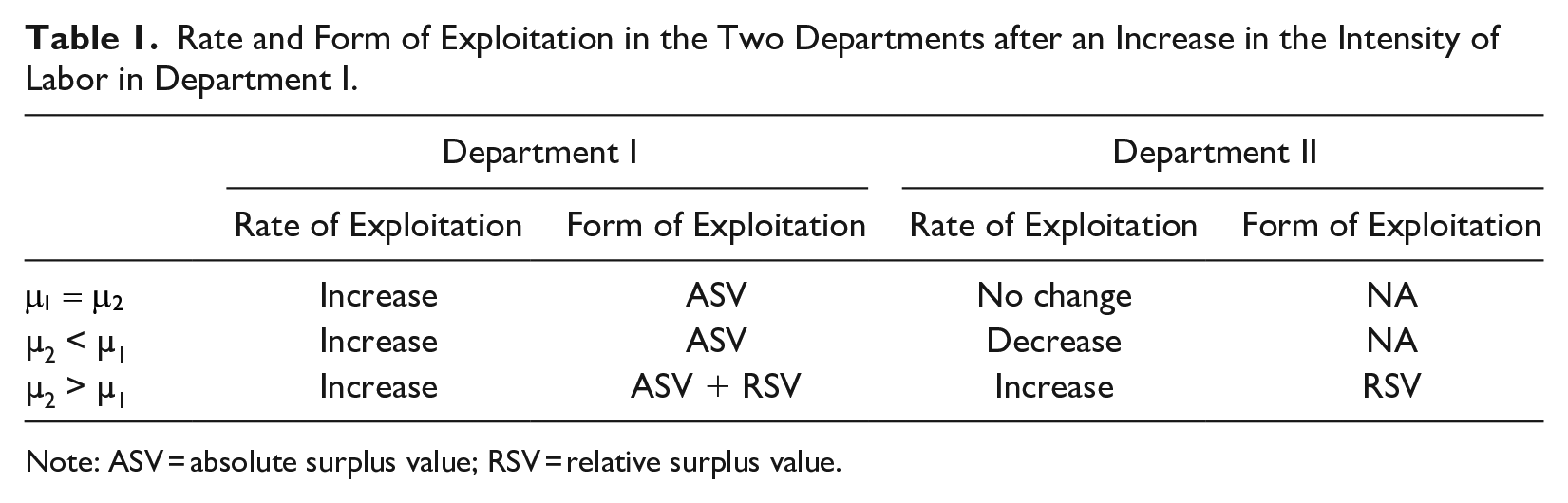
Note: ASV = absolute surplus value; RSV = relative surplus value.
3.2.3. Short run versus long run
As soon as we introduce more than one sectors (or industries) in the analysis, we face the following question: how does the intensity of labor compare across sectors? In any model with more than one sector, including the simple two-department model being discussed in this section, we cannot have different intensities of labor across departments if, at the same time, we have the same real wage bundle and the same rate of exploitation across sectors. If intensities differ across sectors, then the rate of exploitation will also differ. For instance, we know from claim 3 that the rate of exploitation in department I will be higher than the rate of exploitation in department II, after department I witnesses an intensification of labor. This means that the analysis we have presented so far should be understood as a short run exercise. While we might have different intensities of labor across departments in the short run, class struggle, and/or mobility of labor, ensures that every sector has the same intensity of labor in the long run, given that the hourly real wage bundle and the rate of exploitation are same across sectors. 9 There are many long run configurations that can emerge. To consider all the possibilities, let us consider two extreme cases.
The first extreme scenario occurs if the relative class power of labor is higher. In this scenario, labor forces the intensity to go down in department I. Thus, in the long run both departments will have the original intensity. The (common) rate of exploitation will fall back to the original level,
3.3. Intensification of labor in department II
Suppose there is an intensification of labor in department II that is captured by two constants µ1 > 1 and µ2 > 1, as specified in definition 1. Just like before, µ1 captures labor’s CPIO and µ2 captures labor’s CCV. The analysis of this case is symmetric to the analysis of an increase in the intensity of labor in department I that we have presented above.
Value determination in department I, before and after intensification of labor in department II, are captured by:

and:

which shows that

Determination of unit value in department II, before and after intensification of labor in this department are given by:

and:

The rate of exploitation in department II, before and after intensification of labor in department II, are related to each other as:

It is straightforward to then derive the analogues of claim 2 and claim 3. The analysis of the short deviations in the rates of exploitation in the two-department and the long run adjustment to equality is also similar to the case when the intensification of labor occurs in department I.
4. Conclusion
As a system of social production built on exploitation, capitalism is driven by the need to continuously generate, realize, and accumulate surplus value, the ultimate source of which is the unpaid labor of the working class. Competitive pressures in capitalism enforce the systemic need to keep increasing the rate of exploitation. Capitalism has two broad methods to increase the rate of exploitation: the production of absolute surplus value, and the production of relative surplus value.
The production of absolute surplus value can happen when the length of the working day increases, holding the productivity and intensity of labor fixed. By most historical accounts, the production of absolute surplus value was the main way of increasing the rate of exploitation during the early phases of capitalism. What happens when the struggle of the working class manages to force the State to regulate the length of the working day? Does capitalism then abandon the production of surplus value and focus solely on the production of relative surplus value?
When class struggle by the workers has forced the State to put a limit on the length of the working day, the capitalist system does not lose its ability to produce absolute surplus value. While production of relative surplus value, and therefore growth of labor productivity, becomes the most important way of increasing the rate of surplus value, simultaneously the system uses intensification of labor—which is a reliable way to produce absolute surplus value.
In this article, we have developed a simple framework to incorporate intensification of labor into the widely used linear model of production. Using this model, we have demonstrated that an intensification of labor always increases the rate of exploitation. Hence, it is in the interest of the capitalist class, and against the interest of the working class, to increase the intensity of labor. We have also demonstrated, in various versions of the linear model of production, that an intensification of labor can, in most realistic situations, only increase the rate of exploitation in the form of the production of absolute surplus value.
Footnotes
Appendix
Acknowledgements
We would like to thank Debrshi Das, David Kotz, Hyun Woong Park, Naoki Yoshihara, and three referees of this journal for helpful comments on earlier versions of this paper. We would also like to thank Enid Arvidson for excellent copy editing work on the paper. All remaining errors are ours.
Declaration of Conflicting Interests
The author(s) declared no potential conflicts of interest with respect to the research, authorship, and/or publication of this article.
Funding
The author(s) received no financial support for the research, authorship, and/or publication of this article.

1
In section 5.6, we also show that an intensification of labor increases the general rate of profit.
2
In appendix A, we present results in a general
3
4
We abstract from issues of aggregate demand in this analysis.
5
In appendix A.6, we show that, in an
6
Note that as long as the length of the working day is held constant, the value of the real wage bundle is exactly equal to the value of labor power, considered either per hour of work or per day of work. Hence, in our analysis of changes in the productivity of labor or in the intensity of work, since we assume that the length of the working day is fixed, we use the phrase “value of labor power” and the phrase “value of the real wage bundle” interchangeably.
7
In appendix B, we relax this assumption and present results in a general two-department model which produces
8
Throughout the analysis in this section, we assume that the hourly real wage bundle is equal to the necessary means of subsistence per hour. Hence, the value of labor power is given by the value of the real wage bundle.
9
It is a standard assumption in classical economics, coming down all the way from Adam Smith, that mobility of labor across sectors will equalize the rate of exploitation in the long run. If we give up this assumption in our analysis, then we can allow for different intensities of labor across sectors even in the long run.
10
Recall that, in this article, we abstract from fixed capital, joint products, choice of technique, and heterogeneous labor.