




Abstract
Even though the initial treatment of carpal tunnel syndrome (CTS) is conservative, knowledge of the clinical effects of supplements and of some methods of physiotherapy is still preliminary. Many biological mechanisms can support the administration of shock wave therapy (ESWT) or of alpha lipoic acid (ALA) based nutraceutical, conjugated linoleic acid (GLA), anti-oxidants and Echinacea angustifolia for CTS. The shock waves reduce the nerve compression, produce an anti-inflammatory action, and accelerate the regeneration of neuropathy. ALA and GLA induce antioxidant protective actions, reduce inflammation, promote neuroregeneration, and decrease pain. The Echinacea modulates the endogenous cannabinoid system.
The aim of study is to verify the efficiency of shock wave therapy versus nutraceutical composed of ALA, GLA, and Echinacea in CTS. Sixty patients were enrolled in this study and they were randomly assigned to one of two treatments. Both groups showed significant improvements in pain, symptoms’ severity and functional scores, and electrodiagnostic results until the sixth month. We verified a trend to a better pain regression in the nutraceutical group. The presence of the medicinal Echinacea represents an added value to the antioxidant effect in ALA and GLA, which can justify this result. ESWT or the association of ALA, GLA, and Echinacea proved to be two effective treatments for controlling symptoms and improving the evolution of CTS.
Introduction
Carpal tunnel syndrome (CTS), caused by compression of the median nerve at the wrist, is considered the most common and frequent cause of neuropathic disability in adults. 1 Non-surgical treatment of CTS is frequently offered to those with mild to moderate symptoms. 2 Conservative treatment options include splinting the wrist in a neutral position, neutraceuticals, non-steroidal anti-inflammatory drugs (NSAIDs), oral intake or local injection of corticosteroids (CS), exercises, activity modification, and laser and ultrasound (US) therapy.
Shock wave (SW) treatment is widely used in treating various musculoskeletal diseases. 3 It has anti-inflammatory, neo-angiogenesis, analgesic (pain relieving), and proliferative effects. 4 In literature, the use of shock wave therapy (ESWT) in treating CTS is still in the preliminary stage. In two case reports on patients treated with SW for CTS, the authors found a clinical and electromyographic improvement. 5 A clinical trial on 36 patients affected with CTS 6 verified that ESWT can be as useful as a CS injection for relieving symptoms of CTS. Furthermore, in contrast to the CS injection, it has the merit of being non-invasive. Another clinical trial evaluated the effect of SW on CTS surgical complications (“pillar sindrome”), looking at pain regression and the improvement of surgical scarring. 3
Treatment using alpha lipoic acid (ALA) based nutraceuticals, conjugated linoleic acid (GLA), and multivitamins is used in treating compressive neuropathies.7,8 These have anti-oxidant, anti-inflammatory, and repairing properties for the myelin sheath. Echinacea may give added value to the treatments to the nutraceuticals due to the modulation effect on the endogenous cannabinoid system.9,10 N-alkyl amides from Echinacea constitute a new class of cannabino-mimetics, which specifically engage and activate the corresponding receptors after an insult to the nerve.
The aim of study is to verify the efficiency of ESWT versus ALA based nutraceutical, GLA, anti-oxidants, and Echinacea angustifolia, in patients with CTS.
Materials and methods
The study was an open, prospective, randomized, clinical trial with a 6-month follow-up. In the period between June 2013 and January 2014, we recruited 60 patients who had been diagnosed with CTS more than 6 months previously. The study was approved by the Local Ethics Committee. The patients were informed and gave their written consent to be involved in the study. The clinical diagnosis of CTS was based on characteristics symptoms such as: pain day and night; the presence of paresthesia; and physical examination including functional tests such as Phalen’s and Tinel’s test. 11 Criteria for electrodiagnostic evidence of CTS were based on the practice guidelines issued by the American Association of Electrodiagnostic Medicine, the American Academy of Neurology, and the American Academy of Physical Medicine and Rehabilitation, 12 which consisted of a median motor nerve distal latency of more than 4.20 m/s. Exclusion criteria were: corticosteroid injection before the study; physical or medical therapy in the previous 3 months; muscle atrophy due to CTS; evidence of obvious underlying causes of CTS such as hypothyroidism, diabetes mellitus, inflammatory rheumatic diseases, arthritis of wrist, acute trauma, or pregnancy; medical problems that would have been contraindicated for ESWT or oral neutraceutical therapy; clinical or electrophysiological evidence of accompanying conditions that could mimic CTS or interfere with its evaluation such as cervical radiculopathy; or polyneuropathy.
Collected data incorporated age, gender, employment, smokers, and side of involvement. The Visual Analogue Scale (VAS) and the Boston questionnaire were performed pre-treatment (T0) and at 1 (T1), 2 (T2), 4 (T3), and 6 months (T4) post recruitment. VAS is a 10 cm horizontal line, where the 0 cm represents no pain, and 10 cm maximum possible pain or unbearable pain. A two-point change was considered clinically relevant. 13 The Boston questionnaire 14 evaluates the severity of symptoms (symptoms severity scale, SSS, 11 questions) and the functional status (functional status scale (FSS), 8 questions) of patients with CTS. For each question, patients’ responses were scored in the range of 1–5 in terms of severity of clinical symptoms. At the last follow-up (T4), the patient is asked to indicate his/her perception of improvement by Roles and Maudsley score (score in the range of 1–4, where 1 corresponds to excellent result and 4 to poor or worse than pre-treatment). 15 At T0 and T4, electroneurographic measurements were performed with a portable Dantec electromyography device (Keypoint Portable, Dantec Dynamics Ltd., Bristol, UK). Briefly, median motor nerve conduction and distal motor latency were measured with a bipolar stimulating electrode at the wrist and a bipolar surface recording electrode placed on the abductor policis muscle 7 cm from the stimulus electrodes at the wrist. The active electrode was placed halfway between the metacarpophalangeal joint of the thumb and the midpoint of the distal wrist crease, so the recorded site was the same for all recording sessions. Antidromic sensory nerve action potentials evoked at the wrist were recorded from the thumb and index finger with ring electrodes placed around the thumb proximal and distal interphalangeal joints. A standard distance (14 cm) was maintained between the stimulator and recording electrodes. At least 20 sensory nerve action potentials were averaged and antidromic sensory nerve latencies were calculated as appropriate. Measures were obtained of peak to peak amplitude of compound muscle action potentials and sensory action potential. The skin temperature of the forearm and wrist were kept at 32–33°C during all measurements. The median sensory velocity (SNCV) (ms) and the median distal motor latency (MDL) (m/s) were used as outcome parameters. Participants were randomized to the ESWT group or nutraceutical group. Splinting, nerve and tendon-gliding exercises, and activity modification were performed as usual. 16 The patients were asked not to use other medication during the treatment.
The ESWT group was treated with extracorporeal shock wave therapy. They underwent three treatments of ESWT, performed at weekly intervals using an electromagnetic device (Minilith, Storz Medical, Tagerwilen, Switzerland), with an average of 1600 shocks at Energy Flux Density (EFD) of 0.03 mJ/mm2. The shock wave probe was placed using ultrasound as a guide on the carpal tunnel and the pulses were divided medially (800 impulses) and laterally (800 impulses) compared to the median nerve. The pulse repetition frequency was 4 Hz.
The nutraceutical group was treated with a diet supplementary composed mainly of ALA, GLA, and Echinacea (full composition in detail: ALA 300 mg, Echinacea 250 mg, GLA 180 mg, Selenium 55 µg, Vitamin E 5 mg, Vitamin B6 2 mg, Vitamin B1 1.4 mg, Vitamin B12 1 µg, Selenium 55 µg, quercitin 49,50 mg, gluconate zinc 105 mg, zinc 14 mg, Vitamin C 60 mg, folic acid 200 µg, Polyphenols 10 mg) (Perinerv LT, IT Farm SRL, Italy, C.da Carnevale, Villa Castelli, BR, Italy) at the dose of one capsule twice a day for 40 days, following one capsule a day for 80 days.
Power analysis and statistical analysis
The sample analysis of the study was conducted on the pain, expressed as VAS, given the presence of several studies on the effects of physiotherapy or nutraceuticals on CTS in literature. 2 Starting from two homogeneous groups determined by the mean value of VAS at baseline, we hypothesized a difference of two units, with ± standard deviation (SD) of two units, in the mean VAS value between the two groups, as from the first month of therapy. We established a margin of error of 5% and confidence intervals (CIs) of 95%; power calculation was carried out with the Raosoft sample size calculator. This yielded a minimum number of 26 participants.
For each patient recruited, we filled in a data form with personal information and clinical and electromyographic evaluations at the time of the study. These forms were inserted into a database built using File Maker Pro software and analyzed using STATA MP11 software (StataCorp LP, College Station, TX, USA). To compare the proportions we used the chi-square test; to compare the averages between the two groups (ESWT and nutraceutical) we used the t-student test for independent samples. To evaluate the differences between the averages of the two groups at the various times studied we used an ANOVA model for repeated measurements. To evaluate any possible confusion over measurements at T4 linked to gender, age, side (right or left), job, measurements at T0, T1, T2, T3, and T4 were built using multiple regression models. For each test a value of P <0.05 was considered to be significant.
Results
The samples under observation were made up of 60 subjects. Thirty-four of which were in the shock wave group and 26 of which were in the nutraceutical group. All patients completed the study to the end of the 6-month follow-up period. The average age was 58.5 ± 8.4 years, with no significantly statistical differences between the groups ESWT (57.1 ± 9.5 years) and nutraceutical (60.2 ± 6.6 years; t = 1.0; P = 0.16). There was no difference between the two groups for the beginning of the symptomatology (nutraceutical group: 11.92 ± 1.83 months; ESWT group: 12.05 ± 1.43 months; P = 0.37). For no patient it was the first diagnosis of CTS. The assignment to the two groups was homogeneous by demographic characteristics (chi-square = 4.58; P = 0.205). Four subjects in the nutraceutical group and two in the ESWT group were smokers (chi-square = 0.74; P = 0.39). All subjects belonging to the nutraceutical group reported right wrist dominance as well as 30 from the ESWT group (chi-square = 1.63; P = 0.201). Eight of the nutraceutical group and eight from the ESWT group carried out manual labor (chi-square = 0.19; P = 0.65). No significant difference was found for affected side between two groups (chi-square = 0.36; P >0.05).
Both ESWT group and natriuretic group showed improvements in pain (Table 1), symptom severity (Table 2), and functional scores (Table 3) compared to the baselines values at the first month and these improvements remained until the end of the study. For each of these rating scale there were no significant differences between the two groups at each time.
Pain intensity according to the Visual Analogue Scale (VAS) in CTS patients treated by ESWT (ESWT group) or nutraceutical (nutraceutical group). Data are expressed as mean (± SD, standard deviation) in the two groups at recruitment (T0) and at 1 (T1), 2 (T2), 4 (T3), and 6 months (T4) post recruitment. Significance of difference between two groups is expressed as P <0.05.

The severity of symptoms according to the symptoms severity scale (SSS) of the Boston questionnaire in CTS patients treated by ESWT (ESWT group) or nutraceutical (nutraceutical group). Data are expressed as mean (± SD, standard deviation) in the two groups at recruitment (T0) and at 1 (T1), 2 (T2), 4 (T3), and 6 months (T4) post recruitment. Significance of difference between two groups is expressed as P <0.05.

The functional status according to functional status scale (FSS) of the Boston questionnaire in CTS patients treated by ESWT (ESWT group) or nutraceutical (nutraceutical group). Data are expressed as mean (± SD, standard deviation) in the two groups at recruitment (T0) and at 1 (T1), 2 (T2), 4 (T3), and 6 months (T4) post recruitment. Significance of difference between two groups is expressed as P <0.05.

The ANOVA model for repeated measurements highlighted that the VAS, SSS, and FSS Boston score values were modified by time (F = 34.3; P <0.0001) (F = 28.1; P <0.0001) (F = 15.1; P <0.0001), while independent from the treatment (F = 0.17; P = 0.69) (F = 0.01; P = 0.93) (F = 0.16; P = 0.69). The multivariate analysis highlighted that the VAS, SSS, and FSS scores at T4 are influenced by the respective values at T3 (t = 5.16; P <0.0001) (t = 5.11; P <0.0001) (t = 4.99; P <0.0001).
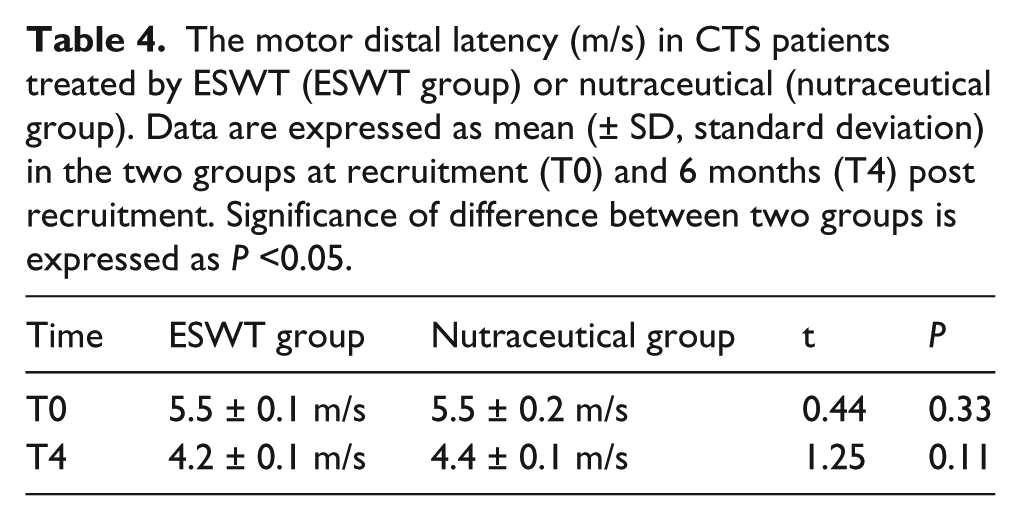
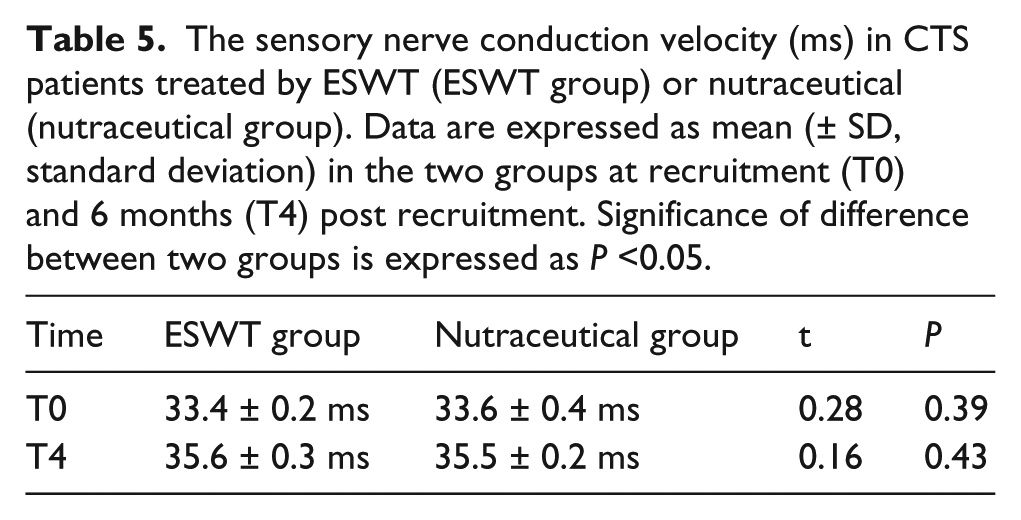
The motor distal latency and the sensory nerve conduction velocity of the median nerve showed an improvement at the sixth month when compared to the baselines values in both groups (Tables 4 and 5). The ANOVA model for repeated measurements highlighted that average Motor Distal Latency and Sensory Nerve Conduction values were modified by time (respectively, F = 458.8, P <0.0001; F = 431.9, P <0.0001) while independent from treatment (respectively, F = 1.51, P = 0.23; F = 0.09, P = 0.76).
The motor distal latency (m/s) in CTS patients treated by ESWT (ESWT group) or nutraceutical (nutraceutical group). Data are expressed as mean (± SD, standard deviation) in the two groups at recruitment (T0) and 6 months (T4) post recruitment. Significance of difference between two groups is expressed as P <0.05.
The sensory nerve conduction velocity (ms) in CTS patients treated by ESWT (ESWT group) or nutraceutical (nutraceutical group). Data are expressed as mean (± SD, standard deviation) in the two groups at recruitment (T0) and 6 months (T4) post recruitment. Significance of difference between two groups is expressed as P <0.05.
At T4 the mean value for the Roles and Maudsley score for all patients was higher (1.4 ± 0.6) in the ESWT group (1.5 ± 0.7) than in the nutraceutical group (1.3 ± 0.5) (t = 1.1; P = 0.29). No statistical difference was found for distribution in each score (chi-square = 1.7; P = 0.42) (Table 6).
Perception of improvement according to Roles and Maudsley scores in CTS patients at 6 months (T4) post recruitment. Data are expressed as distribution of subjects (n) for each score in ESWT and nutraceutical groups (Chi-square = 1.7; P = 0.42).

Discussion
This study examined the results of SW treatment and dietary supplement in patients who had CTS. Both chosen treatments were proved to be effective, already causing a regression in the symptomatology and a functional recovery within the first month and improving over 6 months. The concordance on the trend of the results for clinical, functional, and instrumental evaluations reinforces the quality of the final results.
At recruitment the subjects in the ESWT group had a medium pain value, evaluated using the VAS scale, which was less than the supplement group, although not statistically significant. At the first clinical checkup after 1 month both groups showed a clinically significant improvement in pain regression of 2 points on the VAS scale. The trend at the further follow-ups showed an improvement in pain for both groups, except for the ESWT group who at T3 actually showed a worsening of pain, which then improved by the final follow-up. These data can be justified considering that the pain relieving effect of SW is immediate and tends to run out in the following weeks. 17 The anti-inflammatory effects, both trophic and metabolic rise subsequently and induce a more stable therapeutic effect.4,18 The subjects in the supplement group showed better pain regression in the later follow-ups even though there were no significant differences between the two groups. This result can be understood considering that neurotrophics need more time to optimize therapeutic effects.7,19
As far as the two scales on the Boston Questionnaire are concerned, the patients in the supplement group started with worse values, although these were not significant. These data shown on the VAS scale confirm that the supplement group’s initial pain was more severe. In both groups at later evaluations we recorded a significant improvement in pain regression without much difference between the two groups. We noticed that the ESWT group tended to have an earlier clinical and functional recovery already during the first month, monitored using the Boston questionnaire. This confirms that SW cause a faster recovery than the supplement. For both treatments we found that the result in the fourth month influenced the clinical picture at 6 months. This shows that at 4 months there was stabilization after therapy. The clinical and functional results were also confirmed using instrumental evaluation with electromyography. At T4 both treatments guaranteed a fully functional motor and sensory recovery. At 6 months using the Roles and Maudlsey score, the percentages of excellent and good results were, respectively, 64.7% and 23.5% in the ESWT group and 69.2% and 30.8% in the nutraceutical group. The fair score was found only in the ESWT group at 11.8%. These results show greater satisfaction among subjects who took the supplement, even though the differences between the groups were not statistically significant. The results of our study are consistent with those found in literature which supports the efficiency of SW and dietary supplements in treating CTS. We noticed that the effects of the dietary supplement in CTS are similar to those of instrumental physiotherapy. Unlike the previous trials we found a persistent clinical improvement at a further follow-up. The originality of our study is to verify the efficacy of Echinacea in CTS. The administration of N-alkylamides to modulate the endocannabinoid system could thus be a fortunate evolutionary cross point with as yet unexplored therapeutic potential in carpal tunnel syndrome, characterized by painful symptomatology and neuro-functional alterations.
This study had some limitations. First limitation is the obviously “non-blinded” design of the study. The second limitation is the absence of the assessment of a group without treatment to detect the efficiency of the two treatment options in our trials. There no further group treated by steroidal or NSAIDs. Pharmacological treatments include either local steroid infiltrations or systemic administration of CS or NSAIDs. These drugs can reduce the inflammation of the compressed nerve within 3 months, although recent meta-analyses have not confirmed their efficacy.20,21 Further studies with a larger group of patients are warranted. It could be interesting to consider the correlation among ultrasound imaging features and the results of both shock waves and nutraceutical. A strong point of this work is that they verified the efficiency of two conservative therapies.
In conclusion, this study showed that ESWT provided an improvement comparable to nutraceutical on pain and functional ability in patients with CTS. The good results found in both treatment methods analyzed in the study allows us to adapt treatment protocol based on the needs of the patient. In the study the subjects were allocated randomly into treatment groups and no drop-outs were recorded. In clinical practice, however, we need to satisfy some legitimate patient demands such as reducing time commitment or pain during treatment. On one hand, shock wave treatment wastes little time; on the other hand some patients may not be able to tolerate the pain caused by this therapy. In these cases the nutraceuticals would be a valid and effective alternative. Alpha-lipoic acid and conjugated linoleic acid guarantee an anti-oxidant effect while cannabino-mimmentic molecules modulate pain perception in a more selective manner. According to the results obtained from this study, we think that both ESWT and the association of ALA, GLA, and Echinacea can be comfortably used in the management of CTS.
Footnotes
Acknowledgements
The authors thank Catriona Macleod for language revision and IT Farm SRL for the financial support for costs of publication of the article.
Declaration of conflicting interests
The author(s) declared no potential conflicts of interest with respect to the research, authorship, and/or publication of this article.
Funding
This research received no specific grant from any funding agency in the public, commercial, or not-for-profit sectors.