




Abstract
We previously found that ziram, a carbamate pesticide, significantly reduced perforin, granzyme A (GrA), granzyme B (GrB), granzyme 3/K (Gr3/K), and granulysin (GRN) levels in NK-92MI cells, a human natural killer (NK) cell line. To investigate whether other carbamate pesticides also show similar toxicity on human NK cells, we conducted further experiments with NK-92CI cells, a human NK cell line, using a more sensitive assay. We previously confirmed that NK-92CI cells express CD56, perforin, GrA, GrB, Gr3/K, and GRN and are highly cytotoxic to K562 cells in a chromium release assay, which are more sensitive to organophosphorus pesticides and ziram than the NK-92MI cell line. NK-92CI cells were treated with ziram, thiram, maneb, or carbaryl at various concentrations for 4–24 h at 37°C in vitro. Thereafter, intracellular levels of perforin, GrA, GrB, Gr3/K, and GRN were determined by flow cytometry. It was found that all carbamate pesticides significantly reduced the intracellular levels of perforin, GrA, GrB, Gr3/K, and GRN in NK-92CI cells in a dose-dependent manner. However, the strength of the effect differed among the pesticides, and the order was thiram > ziram > maneb > carbaryl. In addition, it was also found that the degree of the reductions differed among the five proteins, with perforin more sensitive to pesticides than GRN, GrA, GrB, and Gr3/K, and the order was perforin > GRN > Gr3/K ≒ GrA ≒ GrB.
Introduction
Carbamate pesticides are widely used throughout the world in agriculture as fungicides and insecticides.1–4 It has been reported that exposure to carbamate pesticides statistically significantly increased risk of non-Hodgkin’s lymphoma in humans 5 suggesting that carbamate pesticides may cause impairments of human immune system because natural killer (NK) cells provide host defense against tumors. Based on the above background, we previously investigated the effect of carbamate pesticides on NK cells and found that ziram, a carbamate pesticide, significantly inhibited human NK activity by reductions of intracellular perforin, granzyme A (GrA), granzyme B (GrB), granzyme 3/K (Gr3/K), and granulysin (GRN) levels in NK cells. 6 However, it is not clear whether other carbamate pesticides also can reduce perforin, GrA, GrB, Gr3/K, and GRN levels in human NK cells. Thus, in the present study, we selected carbaryl (insecticide), maneb (fungicide), and thiram (fungicide),1–3 which are used now in Japan as pesticides and investigated their effects on the levels of those anti-cancer proteins in human NK cells. NK-92CI cells, another human natural killer cell line, are more sensitive to organophosphorus pesticides and ziram than the NK-92MI cell line.7,8 We previously confirmed that NK-92CI cells express CD56, perforin, GrA, GrB, Gr3/K, and GRN and are highly cytotoxic to K562 cells in a chromium release assay.9,10 Thus, in the present study, we used the NK-92CI cell line as human NK cells to investigate the effects of carbaryl (insecticide), maneb (fungicide), thiram (fungicide), and ziram (fungicide) on the intracellular levels of perforin, GRN, GrA, GrB, and Gr3/K in human NK cells.
Materials and methods
Reagents
Alpha minimum essential medium (α-MEM) without ribonucleosides and deoxyribonucleosides, inositol, 2-mercaptoethanol (2-ME), folic acid, glutamine, and gentamicin were obtained from Sigma (St. Louis, MO, USA). Fetal bovine serum (FBS) was purchased from JRH Biosciences (Lenexa, KS, USA), and heat-inactivated at 56°C for 30 min prior to use. Fluorescein isothiocynate (FITC)-mouse anti-human perforin (IgG2b), GrA (IgG1), GrB (IgG1), FITC/PE-negative isotypic control antibodies, and Cytofix/Cytoperm and Perm/Wash solutions were purchased from BD PharMingen (San Diego, CA, USA). Mouse anti-human Gr3/K (IgG2b) monoclonal antibody and mouse IgG2b as an isotypic control were purchased from Abcom (Cambridge, UK). PE goat anti-mouse IgG was purchased from Vector Laboratories Inc. (Burlingame, CA, USA). Rabbit anti-human GRN polyclonal antibody was described previously.9,11 Carbaryl, maneb, thiram, and ziram were obtained from Wako Pure Chemical Industries (Osaka, Japan) and prepared as stock solutions in DMSO.
Cell line
The NK-92CI and NK-92MI cell lines were obtained from ATCC (Manassas, VA, USA) and were maintained in α-MEM without ribonucleosides and deoxyribonucleosides with 2 mM L-glutamine adjusted to contain 1.5 g/L sodium bicarbonate and supplemented with 0.2 mM inositol, 0.1 mM 2-ME, 0.02 mM folic acid, and 10% FBS at 37°C in a 5% CO2 incubator.5,6,8,10 NK-92CI and NK-92MI cells are IL-2 independent NK cell lines derived from NK-92 cell line by transfection of human IL-2 cDNA. 12 NK-92 is an interleukin-2 (IL-2) dependent human NK cell line derived from peripheral blood mononuclear cells from a 50-year old Caucasian man with rapidly progressive non-Hodgkin’s lymphoma. 13 Both NK-92CI and NK-92MI cells are cytotoxic to a wide range of malignant cells, killing both K562 and Daudi cells in chromium release assays. NK-92 (and derivative cell lines) have the following characteristics: surface marker positive for CD2, CD7, CD11a, CD28, CD45, CD54, and CD56 bright; surface marker negative for CD1, CD3, CD4, CD5, CD8, CD10, CD14, CD16, CD19, CD20, CD23, CD34, and HLA-DR. 12 In addition, NK-92CI is more sensitive to pesticides than NK-92MI.7,8
Treatment with carbaryl, maneb, thiram, and ziram
The NK-92CI and NK-92MI cells at 1×10⁵/mL were treated with thiram or ziram at 0 (0.1% DMSO), 0.0625, 0.125, 0.25, 0.5, 1, 2, or 4 µM for 4, 8, or 16 h, with maneb at 0, 2, 4, 8, 20, or 40 µM for 16 h, and with carbaryl at 0, 1, 5, 10, 20, 40, 80, or 160 µM for 16 h, at 37°C in a 5% CO2 incubator, and then harvested and washed twice with PBS for subsequent flow cytometry analysis.
Cell staining and flow cytometry analysis
The NK-92CI and NK-92MI cells were fixed and permeabilized with the Cytofix/Cytoperm solution for 20 min at 4°C, and then intracellular perforin, GrA, and GrB were stained with FITC anti-human perforin, GrA, and GrB for 30 min at 4°C according to the manufacturer’s instructions (BD PharMingen, San Diego, CA, USA). Intracellular GRN was stained with a rabbit anti-human GRN polyclonal antibody after fixation/permeabilization with the Cytofix/cytoperm solution, then stained with FITC-goat anti-rabbit IgG for 30 min at 4°C in the dark. Intracellular Gr3/K was stained with a mouse anti-human Gr3/K monoclonal antibody after fixation and permeabilization with the Cytofix/cytoperm solution, and then stained with PE-goat anti-mouse IgG for 30 min at 4°C in the dark. After staining, the cells were washed twice with the cytoperm solution and once with PBS containing 1% FBS. Flow cytometry analysis was performed with a FACScan flow cytometer (Becton Dickinson, San Jose, CA, USA) as described previously.9–11 NK-92CI and NK-92MI cells were identified by their characteristic appearance on a dot plot of FSC versus SSC and electronically gated to exclude dead cells and debris. 9 The percentages of protein expressions for each graph were calculated by subtracting the each isotype control.
Statistical analyses
Statistical analyses were performed using a one-way ANOVA followed by a post hoc test, Tukey’s test, with SPSS 16.0J software for Windows. Linear correlation analysis and unpaired t-test were also used. The significance level for P values was set at <0.05.
Results
Difference in sensitivity to ziram between NK-92CI and NK-92MI cells
We used the reductions in percentages of perforin-, GrA-, GrB-, Gr3/K-, and GRN-positive cells among NK-92CI and NK-92MI cells to evaluate the effect of carbamate pesticides.
As shown in Figure 1, the reduction in percentage of perforin induced by ziram in NK-92CI cells was significantly greater than that in NK-92MI cells, suggesting that NK-92CI cells are more sensitive to ziram than NK-92MI cells. Thus, we conducted further experiments with NK-92CI cells using a more sensitive assay.

Difference in sensitivity to ziram between NK-92CI and NK-92MI in perforin expression. NK-92CI and NK-92MI cells were treated with ziram at 0, 2, or 4 µM for 16 h. Data are presented as the mean + SD (n = 3). **P <0.01, significantly different from NK-92MI cells by t-test.
Effects of thiram on the intracellular levels of perforin, GrA, GrB, Gr3/K, and GRN in NK-92CI cells
As shown in Figure 2a, thiram induced a marked shift in the peak of FITC anti-perforin to the left, which means that the fluorescent intensity became weaker after the treatment. As shown in Figures 2b and 2f, the percentages of perforin- (b) and GRN- (f) positive cells significantly decreased in a dose- and time-dependent manner. As shown in Figures 2c, d, and e, the percentages of Gr3/K-, GrA-, and GrB-positive cells also significantly decreased in a dose-dependent manner; however, there were no significant differences between 16 h and 24 h. There were significant inverse correlations between the concentrations of pesticides and the positive rates of perforin (b), GrA (c), GrB (d), Gr3/K (e), and GRN (f). As shown in Figure 2g, the extent of the decrease differed among the five proteins and the order was perforin > GRN > Gr3/K ≒ GrA ≒ GrB.

Effect of thiram treatment on the intracellular level of perforin (a, b), GrA (c), GrB (d), Gr3/K (e), and GRN (f). (a) The solid histogram shows the control cells (thiram at 0 µM) and the blank histogram shows the cells treated with thiram at 2 µM. (g) Differences in sensitivity to thiram with 16 h treatment among the five anti-cancer proteins. All experiments were repeated at least three times with similar results. One-way ANOVAs indicated that the concentration of thiram significantly affected the intracellular level of perforin, GrA, GrB, Gr3/K, and GRN (all P <0.01). *P <0.05, **P <0.01, significantly different from 0 µM by Tukey’s test.
Effect of maneb on the intracellular levels of perforin, GrA, GrB, Gr3/K, and GRN in NK-92CI cells
As shown in Figure 3, maneb significantly reduced the intracellular levels of perforin (a), GrA (b), GrB (c), Gr3/K (d), and GRN (e) in NK-92CI cells in a dose-dependent manner. There were significant inverse correlations between the concentrations of pesticides and the positive rates of perforin (a), GrA (b), GrB (c), Gr3/K (d), and GRN (e). The extent of the decrease differed among the five proteins and the order was perforin > GRN > GrB ≒ GrA ≒ Gr3/K (Figure 3f).

Effect of maneb treatment for 16 h on the intracellular level of perforin (a), GrA (b), GrB (c), Gr3/K (d), and GRN (e). Data are presented as the mean ± SD (n = 3). (f) Differences in sensitivity to maneb among the five anti-cancer proteins. One-way ANOVAs indicated that the concentration of maneb significantly affected the intracellular level of perforin, GrA, GrB, Gr3/K, and GRN (all P <0.01). *P <0.05, **P <0.01, significantly different from 0 µM by Tukey’s test.
Effect of carbaryl on the intracellular levels of perforin, GrA, GrB, Gr3/K, and GRN in NK-92CI cells
As shown in Figure 4, carbaryl significantly reduced the intracellular levels of perforin (a), GrA (b), GrB (c), Gr3/K (d), and GRN (e) in NK-92CI cells in a dose-dependent manner. There were significant inverse correlations between the concentrations of pesticides and the positive rates of perforin (a), GrA (b), GrB (c), Gr3/K (d), and GRN (e). The extent of the decrease differed among the five proteins and the order was perforin > GrA ≒ GRN ≒ GrB ≒ Gr3/K (Figure 4f).

Effect of carbaryl treatment for 16 h on the intracellular level of perforin (a), GrA (b), GrB (c), Gr3/K (d), and GRN (e). Data are presented as the mean ± SD (n = 3). (f) Differences in sensitivity to carbaryl among the five anti-cancer proteins. One-way ANOVAs indicated that the concentration of carbaryl significantly affected the intracellular level of perforin, GrA, GrB, Gr3/K, and GRN (all P <0.01). *P <0.05, **P <0.01, significantly different from 0 µM by Tukey’s test.
Difference in the ability to reduce the intracellular levels of perforin among the four pesticides
As shown in Figure 5, the positive rates of perforin differed among the pesticides, suggesting that the effect on perforin differed among the pesticides, and the order was thiram > ziram > maneb > carbaryl. We also confirmed that the effect on GrA, GrB, Gr3/K, and GRN differed among these pesticides, and the order was thiram > maneb > carbaryl (data not shown).
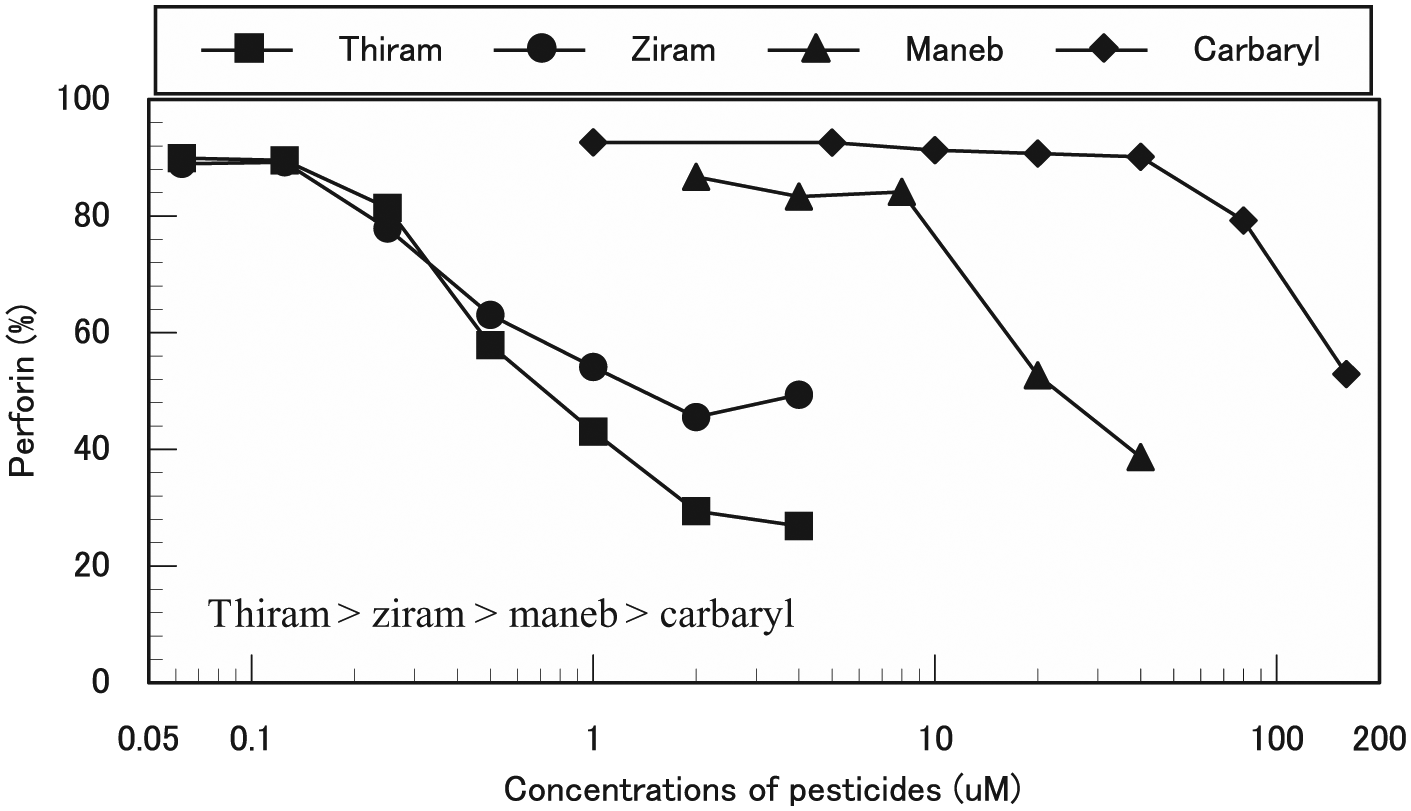
Differences in the effect on perforin among the four pesticides treated for 16 h. The order was thiram > ziram > maneb > carbaryl.
Discussion
Human exposure to carbamate pesticides may occur by coming into contact with latex rubber, ingesting treated crops, or via inhalation. 14 In Japan, the residual standards for carbamate pesticides in rice and potatoes are 0.3 and 0.2 ppm, calculated as carbon disulfide, respectively. 15 Thus, 0.063–4 µM of thiram (approximately 0.015–0.96 ppm) and ziram (approximately 0.0195–1.25 ppm) were applied in vitro in the present study, which are reasonably related to the possible human exposure. Because maneb and carbaryl showed weaker toxicity than thiram and ziram in NK-92CI cells higher concentrations of maneb and carbaryl were used in the present study.
Exposure to carbamate pesticides statistically significantly increased risk of non-Hodgkin’s lymphoma in humans 5 suggesting that carbamate pesticides may cause impairments of human immune system because NK cells provide host defense against tumors. Based on the above background, we investigated the effects of carbamate pesticides on human NK cells and found that ziram, a carbamate pesticide, significantly inhibited human NK activity. 6
It has been reported that NK cells kill target cells through the directed release of cytolytic granules containing perforin, GRN, and granzymes, including GrA, GrB, and Gr3/K,9,10,16–20 a process known as granule exocytosis. We found that there was a significant positive relationship between NK activity and the expression of perforin, GrA, GrB, or GRN in human peripheral lymphocytes in both male and female subjects. 21 These results suggest that determining the expressions of perforin, GrA, GrB, and GRN in NK cells by flow cytometry can be an alternative method to measure NK activity in a chromium release assay.6,21–26 Moreover, we previously found that ziram, a carbamate fungicide, significantly inhibited human NK activity by reducing the intracellular levels of perforin, GrA, GrB, Gr3/K, and GRN in human NK-92MI cells. 6 However, it is not clear whether other carbamate pesticides also show similar toxicity on human NK cells. In addition, we also found that human NK-92CI cells were more sensitive to organophosphorus pesticides and ziram than human NK-92MI cells,7,8 suggesting that NK-92CI cells are more susceptible to the effect of chemicals. Based on the above background, in the present study, we used NK-92CI cells as human NK cells to investigate effects of carbaryl (carbamate insecticide), maneb (carbamate fungicide), thiram (carbamate fungicide), and ziram (carbamate fungicide) on the intracellular levels of perforin, GRN, GrA, GrB, and Gr3/K. The present study demonstrated that the four carbamate pesticides significantly reduced the intracellular levels of perforin, GrA, GrB, Gr3/K, and GRN in human NK-92CI cells in a dose-dependent manner, that the strength of the effect differed among the four pesticides investigated, and the order was thiram > ziram > maneb > carbaryl. Why did the strength of the immunotoxic effect differ among the pesticides? We speculate that the different general toxicity of these chemicals may have contributed to the difference in the induced immunotoxic effect. We compared their ability to reduce the intracellular levels of perforin, GrA, GrB, Gr3/K, and GRN with LD50 level. The oral LD50 of carbaryl, thiram, ziram, and maneb in rats is 250 mg/kg, 27 640 mg/kg, 3 1400 mg/kg, 4 and 2600–5500 mg/kg, 2 respectively. Carbaryl shows the strongest acute toxicity but the weakest immunotoxic effect of these chemicals, suggesting that the two factors are not related. Solubility in water may have contributed to the difference. The solubility of carbaryl, thiram, ziram, and maneb in water is 120 mg/L (120 ppm), 1 30 mg/L (30 ppm), 3 65 mg/L (65 ppm), 4 and 20 mg/L (20 ppm), 2 respectively. The highest concentrations of carbaryl, thiram, ziram, and maneb used in the present study were 160 μM (32 ppm), 4 μM (0.96 ppm), 4 μM (1.25 ppm), and 40 μM (13.27 ppm), respectively. Thus, all the chemicals should have dissolved in the culture medium, suggesting that solubility did not contribute to the difference. The mechanism involved should be explored in a future study. Although these chemicals are rapidly metabolized within several days in animals,1–4 it is difficult to account for their metabolism in vitro, where they may bind to the membrane of cells or enter the cells.
Although several studies have reported that ziram inhibits NK activity,6,14,28–30 the present study is the first to investigate the effect of carbaryl (insecticide), maneb (fungicide), and thiram (fungicide) on the intracellular levels of perforin, GRN, GrA, GrB, and Gr3/K in human NK cells.
We also found that the degree of the decrease differed among the five proteins, with perforin more sensitive to pesticides than GRN, GrA, GrB, and Gr3/K, and the order was perforin > GRN > Gr3/K ≒ GrA ≒ GrB in NK-92CI cells. Whereas, in NK-92MI cells, ziram also significantly reduced the intracellular levels of GrA, GrB, Gr3/K, perforin, and GRN in a dose-dependent manner and the extent of the decrease also differed among the five proteins; however, the order was Gr3/K > GRN > perforin ≒ GrA ≒ GrB, 6 showing a different response pattern compared with NK-92CI cells. On the other hand, the reductions of GrA, GrB and Gr3/K in NK-92CI cells were smaller. The clinical meaningful of these smaller reductions is needed to explore in a future study.
Conclusions
The present findings suggest that carbamate pesticides significantly reduce the intracellular levels of perforin, GrA, GrB, Gr3/K, and GRN in human NK cells. In addition, these findings also suggest that determining the effect of chemicals on the levels of perforin in NK cells by flow cytometry can assist in the evaluation of the immunotoxicity of the chemicals.
Footnotes
Acknowledgements
We are grateful to the staff at the Department of Hygiene and Public Health, Nippon Medical School, for their assistance.
Declaration of conflicting interests
The author(s) declared no potential conflicts of interest with respect to the research, authorship, and/or publication of this article.
Funding
This work was supported by a grant from the Ministry of Education, Culture, Sports, Science and Technology of Japan.