



Abstract
Background
On 6 February 2023, 2 major and aftershock earthquakes occurred in Türkiye. These earthquakes caused disasters in Kahramanmaraş, Hatay, and its surroundings. More than 50 000 people lost their lives. The day after the earthquakes, disaster/emergency kitchens were established in these cities with the initiatives of various institutions and organisations. One of these kitchens is the ‘Anadolu Mutfağı’, which was established by Anadolu University in 2023. Approximately 15 000 people benefited from the emergency kitchen in Belen district of Hatay every day.
Objective
In this study, the daily needs of adults eating in this kitchen were evaluated. Additionally, the basic problems and requirements encountered during the operation of nutrition services are included.
Methods
Breakfast, lunch, and dinner menus served in the emergency kitchen were monitored on-site by the researcher for a week and the amounts served to 1 person were recorded. Daily energy and nutrient values were calculated. These values were evaluated using Türkiye Nutrition Guide 2022 reference values.
Results
It was determined that the energy intake of adults fed from the disaster/emergency kitchen was sufficient; however, the daily recommended intake of important minerals and vitamins such as calcium and vitamins E and C was not met. In addition, it was observed that daily water consumption of individuals was insufficient. In addition, it was also observed that those with chronic diseases had difficulty in accessing the special diet products they needed.
Conclusion
In such crisis, it is recommended that strategies for community nutrition should be developed, updated, coordinated, and implemented immediately.
Plain language summary
On 6 February 2023, 2 major earthquakes with horribly destructive consequences occurred in Türkiye. Thousands of lives were lost, with many more injured and missing in 10 cities. It is possible to say that these effects of the earthquake are still continuing more than 2 years later, many people continue their lives in containers or temporary houses, and there is a long period of uncertainty and mourning. When the disaster first occurred, millions of volunteers travelled to the region to support search and rescue operations as well as the provision of daily basic needs. One of them was Anadolu Mutfağı and its volunteers. In this study, the one-week menu prepared at the Anadolu Mutfağı soup kitchen and its impact on meeting nutritional needs were evaluated. From this point of view, it is suggested that there is insufficiency in providing diversity in the menu due to problems in food supply and storage, and that basic issues such as drinking water supply and distribution should still be more prepared in major disasters.
Introduction
As of February 6, 2023, Türkiye experienced 2 major earthquakes centred in Kahramanmaraş followed by aftershocks. These earthquakes caused disasters in Kahramanmaraş, Hatay, Gaziantep, Osmaniye, Malatya, Adana, Diyarbakır, Şanlıurfa, Adıyaman, and Kilis provinces. More than 50 000 people lost their lives. 1 As of the day after the earthquakes, disaster kitchens were established in these cities with the initiatives of various institutions and organisations. One of these kitchens is the Anadolu Mutfağı (Anatolian Kitchen), which continued its activities continuously until the last week of June 2023. Approximately 15 000 people benefited from this disaster/emergency kitchen, which operates as a soup kitchen in the Belen district of Hatay every day.2,3
Disasters can be defined as events that occur due to natural or human-induced causes and as a result, situations such as loss of life and property, the need for environmental aid, and difficulties in adapting to life can occur. 4 In order to eliminate these negative effects and sustain human life, there are some needs such as shelter, clothing, security, medical care, and nutrition is the main one of these needs. 5
Since disasters are sudden crisis situations, it is important to be able to provide conclusions and recommendations related to nutrition and cuisine for similar situations that may occur in the future. Starting from kitchen planning, menu planning and crisis management skills are important in this context.6–8 Therefore, it is vital to develop strategies for community nutrition in crisis situations and to ensure immediate coordination and implementation.9,10 A number of national and international guidelines have been prepared on the subject, which serve as a guide for coordinating what to do in the event of a disaster. However, there have been discrepancies between the information in the guidelines and the coordination on the field. One of the main contributions of this article is to highlight the mismatch between the expectations of the guidelines and the challenges actually encountered. In fact, the guidelines used comprehensively address the actions to be taken and the practices to be carried out in the event of such disaster, but some operational problems such as logistical difficulties, problems in the supply chain, the time it takes until healthy storage and transportation areas are established have revealed possible discrepancies between the theoretical knowledge in the guidelines and the practices in the field.
There are some issues that the nutrition officer should plan in the short and/or long term for the organisation of nutrition services in disaster situations. 11 Short-term nutrition organisation starts before reconstruction and rehabilitation and lasts for a total of a few weeks or less. At this stage, it is very important to provide ready-to-serve meals and healthy water. Especially in the short term, which is the most difficult and intensive period following the disaster, the psychological and physical effects of the disaster are still continuing. For this reason, providing access to a hot soup, tea, etc, at the first stage may provide psychological support to the people. At the same time, foods that are easy to obtain, resistant to spoilage, and high in calorie content should be distributed at this stage.5,12 As another contribution, in this article, the observations and data from this disaster kitchen experience have been analysed more concretely in terms of the advantageous aspects of the assistance provided in emergencies. In addition, it opens up some new questions on chronic noncommunicable diseases.
The aim of this study is to determine whether the menus offered by the Anadolu Mutfağı soup kitchen, which is coordinated by Anadolu University, meet the daily needs of an adult during a disaster. In addition, nutrition-related problems observed in this disaster situation are included.
Method
The Anadolu Mutfağı, which was established by Anadolu University in February 2023 in Hatay Belen, continued until July 2023 with the efforts of volunteers from Eskişehir every Saturday and the facilities provided by the university. Within the scope of the research, energy, and nutrient analyses of the contents of 1-week morning, lunch and evening menus between March 3 and 12, 2023, which were within the scope of the short-term nutrition support service of the Anadolu Mutfağı disaster/emergency kitchen operating in Hatay Belen, were made. The researcher, who was on official duty in Hatay/Belen on the specified dates, managed the activities of the Anadolu Mutfağı with the coordination of the Crisis Desk. The menu was prepared on a daily basis with the opinions of the researcher and the kitchen team within the possibilities and the impossibilities in the food supply. The quantities of breakfast, lunch, and dinner menus served at the soup kitchen for 1 person were monitored and recorded by the researcher on site for 1 week in order to determine and evaluate the situation of meeting the daily needs. The amounts served were converted into grams according to standardised recipes. 13 Then, the energy and nutrient contents of the menus were calculated with the Nutrition Information System (BeBiS) (Ebispro for Windows, 2021). The obtained values were compared with the gender-specific reference values in the Türkiye Nutrition Guide (TÜBER) 2022 and the rates of meeting the requirement were determined. 14
In addition, daily water consumption of individuals and access to special foods required by those with chronic diseases were also observed. This information and observations on problems in the field, such as logistics, coordination difficulties, etc, were compiled from daily notes taken by the researcher in the field during the week. In Anadolu Mutfağı, an average of 15 people worked voluntarily on a weekly basis in 1-week rotations. This operation continued to serve with a total of over 400 volunteer people until July 7, 2023. 15
Results
Table 1 shows the 1-week menu served in Anadolu Mutfağı between March 3 to 12, 2023 (25th day after the earthquake). The first day is listed as Saturday since the fieldwork and observation of the researcher started on Saturday and ended on the following Saturday.
A Weekly Menu Served in the Anadolu Mutfağı Disaster/Emergency Kitchen (March 03 to 12, 2023).
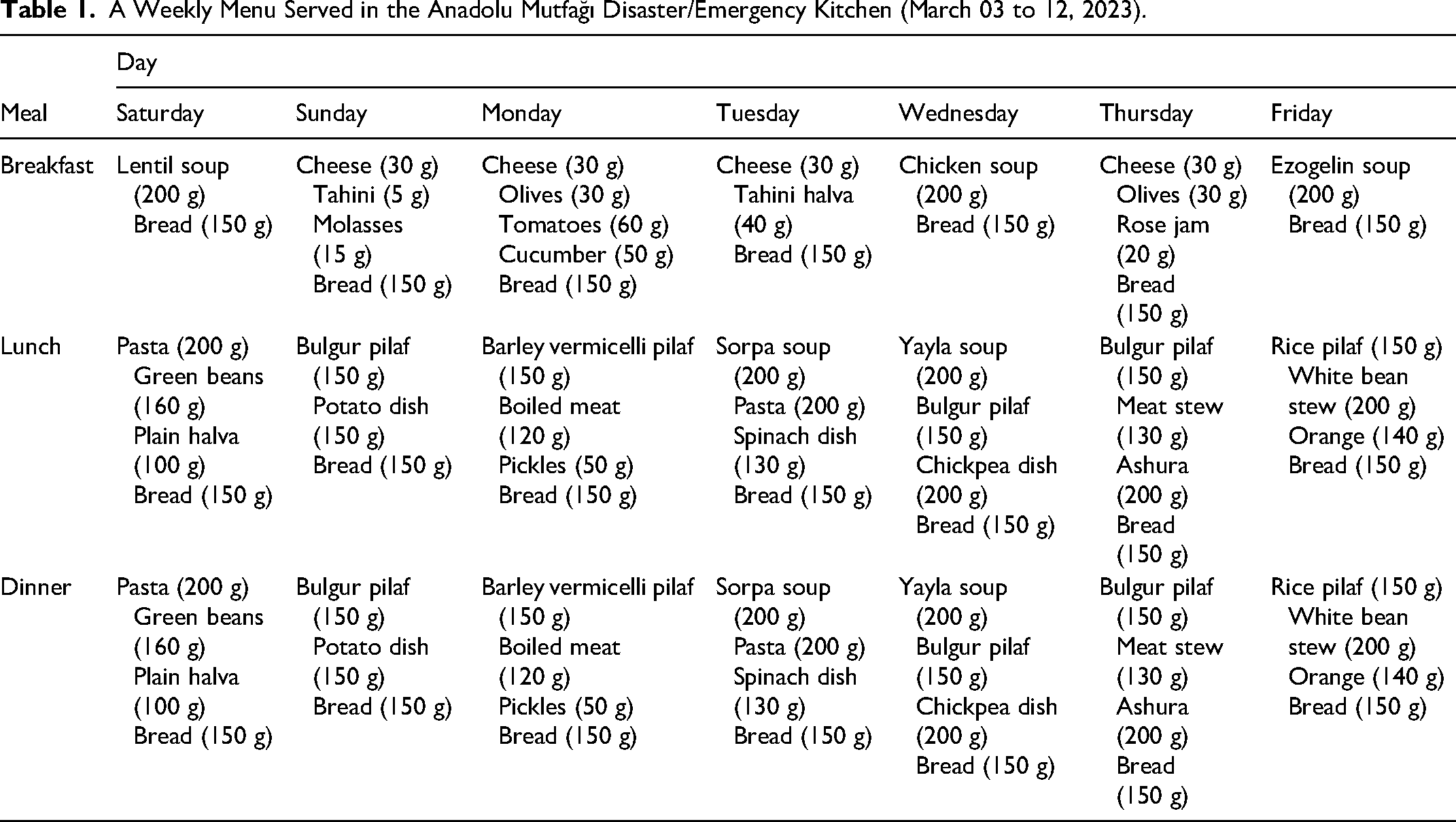
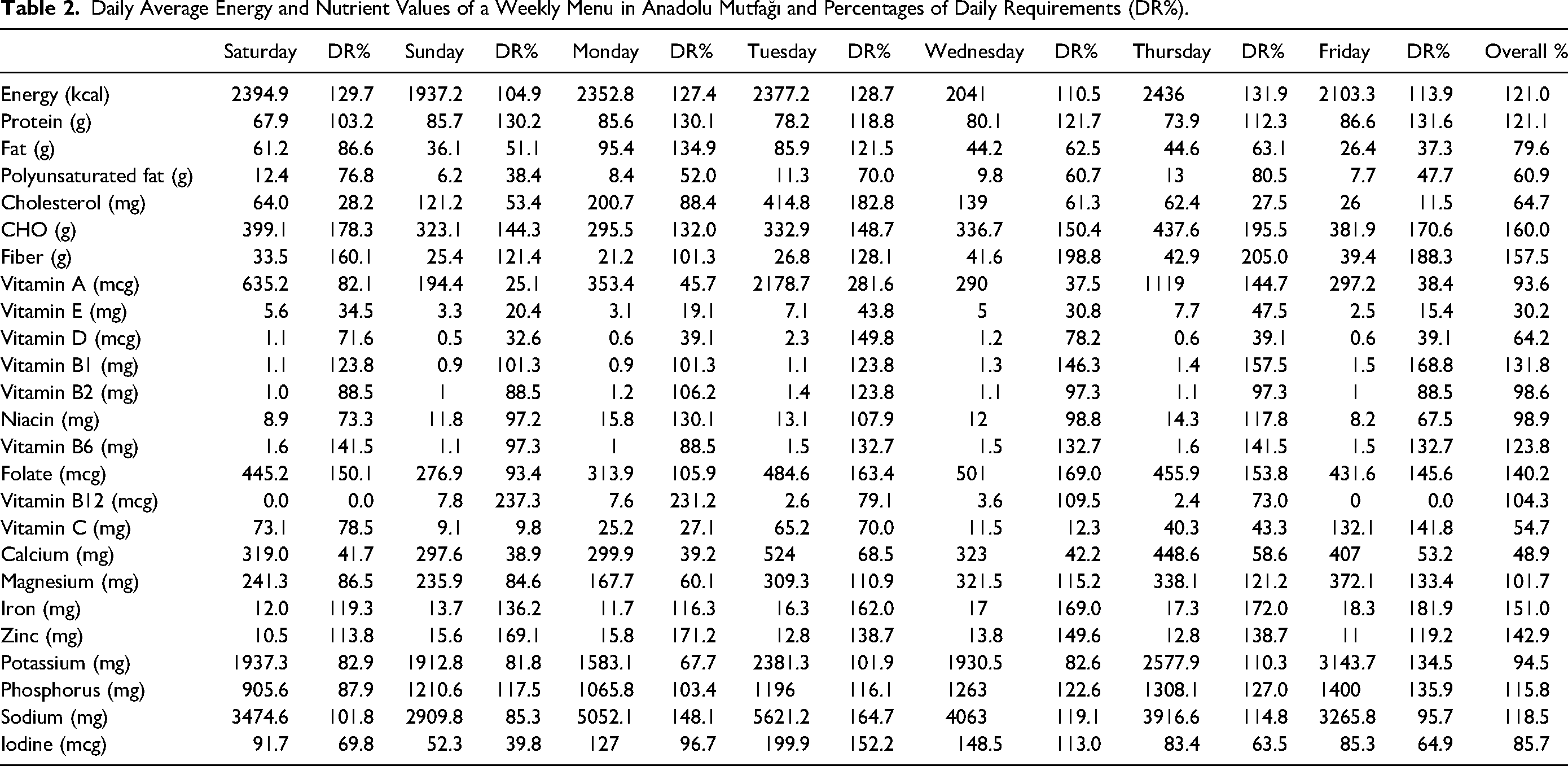
Table 2 shows the average daily energy and nutritional values of a 1-week menu served at the Anadolu Mutfağı soup kitchen. While daily energy was generally above 2000 kcal, there are variations in macronutrients due to the raw materials available. Similarly, the fibre content was below the recommendations on some days and well above on others. Among the micronutrients, especially vitamins E and C and calcium values were well below the daily intake recommendations. Another point is that individuals with noncommunicable chronic diseases and individuals with special nutritional product requirements may not be able to access the foods they need immediately during the short-term intervention period. Special nutrition products for diabetic, gluten-free or phenylketonuric individuals are not readily available in initial rations outside health centres such as hospitals. In a short time, as communication networks and transfers between health centres in different cities accelerated, the availability of these products in the region increased.
Daily Average Energy and Nutrient Values of a Weekly Menu in Anadolu Mutfağı and Percentages of Daily Requirements (DR%).
In the organisation of short-term interventions following the occurrence of a disaster, the need to establish a fast and healthy supply chain, especially in terms of nutrition, comes to the fore. In addition to the rapid access of public institutions and NGOs to the region and rescue interventions, food supply was required for the injured, uninjured, staff and volunteers. Due to the destruction of transport lines and closed spaces, it is very difficult to ensure the supply of fresh food without spoilage in the short-term response. At the same time, interregional imbalances in food supply may occur until interinstitutional communication channels are established. Once the organisations reached the region and established a certain order, they were able to communicate with each other about the available rations, enabling a rapid development in the food supply and logistics chain as time progressed.
At this point, providing meal from the disaster kitchen has advantages such as providing ready-to-consume meals under appropriate conditions in terms of food safety, and not requiring the earthquake victims to remove the leftovers. However, aid such as dry rations and canned food may be more advantageous for disaster-affected people coming from regions far from central points. As for water, the prominent point is that all earthquake victims, whether they are close to central areas or not, exhibit stockpiling behaviour due to their fear and hesitation about its availability. Due to shelter problems and uncertainty caused by the severe destruction after the earthquake, there is also a tendency to store dry and canned food.
Discussion
Looking at the menu offered to the earthquake victims, it has been experienced those legumes, cereals, and pastas can be used intensively, while varieties such as salads made from raw vegetables cannot be offered due to inappropriate hygiene conditions and problems in supply. It is also observed that there is a lack of dairy products such as milk and yoghurt due to problems in food supply. As a result, it was determined that the energy intake of adults fed from this kitchen was sufficient; however, the daily intake of important minerals and vitamins such as calcium and vitamins E and C could not be met. It was also observed that the daily water consumption of individuals was insufficient. In addition to all these, it was observed that those with chronic diseases had difficulty in accessing the special nutrients they needed. As it can be seen from the menu, the food diversity could not be provided in the desired direction since ideal nutrition could not be provided in and around the city after the disaster.
Other studies in the literature based on the data and experiences in the region after this disaster also emphasise the importance of fast and effective coordination of nutrition services after disasters. As a matter of fact, in times of disasters, the access of organisations to adequate amounts of food and the provision of food by the community with their own means differ from ordinary times. Therefore, establishing strong links between food production potential and food logistics before the disaster is important for effective intervention in the crisis management process. 16 In particular, the risk of energy and nutrient deficiency is higher in infants, children, pregnant women, nursing mothers, and the elderly and disaster victims with chronic diseases, who are among the disadvantaged individuals. In studies on the evaluation of nutrition and nutritional support after disasters, in the absence of a nutritionist during the first 10 days, it has been found that there are problems in determining the nutritional status and distributing the necessary nutrients in adequate and balanced quantities. 17 At this point, disaster/emergency kitchens can be defined as the first nutritional aid in emergency situations, consisting of mobilised and disassembled food production equipment. It differs from a fixed kitchen in that it can be adjusted according to unforeseen conditions such as facilities or needs. Therefore, the planning of disaster/emergency kitchens requires flexible assessments, professional approaches, and strong preparations based on recorded past experiences. 8 In times of natural disasters, access to safe and nutritious food becomes a major concern. While ready-to-eat food may be a short-term solution in the first moments of a natural disaster, long-term action plans are essential, especially in the case of large-scale events. Mobile kitchens and units should be strategically planned and positioned to provide meals to displaced individuals and communities who have lost their habitats, demonstrating the importance of catering in times of crisis. 7 It is also vital that the service provided here is coordinated or supported by a nutritionist in order to maintain adequate and balanced nutrition. In order to provide adequate and balanced nutrition service in a fast and healthy way, it is suggested that specific planning should be made by the authorities on these issues such as how the food supply chain will be provided immediately after the disaster, how storage areas of different sizes for different food groups will be positioned, where and in what size emergency kitchens will serve, how individuals will be directed to these kitchens, how the services and distributions related to emergency kitchens and other materials provided by public institutions and NGOs will be in communication with each other. In addition to all these, it is recommended that the special nutritional needs of people with noncommunicable chronic diseases should not be ignored, and it is recommended to plan how the coordination of specific products such as gluten-free, lactose-free, low-calorie products or special nutrition products for individuals with phenylketonuria will be carried out quickly during short-term disaster response.
While evaluating all these results, it should be kept in mind that this disaster affected a large surface area, 10 cities and thousands of people, and different observations and experiences may have been encountered in different cities and regions.
This study has some limitations. One of them is that it is based on a short-term observation due to voluntary presence in the disaster area in 1-week rotations. In addition, the food consumption status of individuals from sources/providers other than Anadolu Mutfağı is not known. On the other hand, the strengths of the study include the fact that it is one of the few studies in the literature on this subject that includes on-site observation and analysis, and that it is based on a current and real event.
Conclusion
In conclusion, it was noted that there were inadequacies in the amount of some nutrients in the nutritional services provided in the short term during the disaster, there may be problems in the supply of special dietary products for people with some chronic nutritional diseases, and logistical problems in the supply of food. It is also recognised that international and national guidelines are useful, but that there are significant challenges in their practical implementation and that the recommendations presented here are an important contribution to addressing these challenges. Academic studies related to disaster kitchens can contribute to country policies as they prepare the ground for optimal practices in possible crisis situations. It is recommended to develop strategies for community nutrition in such crisis situations and to implement them with immediate coordination. It is thought that the information revealed as a result of the research may have widespread effects on gastronomy, nutrition and dietetics and other related academic fields; national strategies and policies, and community nutrition.
Footnotes
Acknowledgements
We would like to thank Anadolu University, local government, regional sponsors, and volunteers who supported the operation of Anadolu Mutfağı. Our deep condolences to those who lost their lives. You will always be remembered.
Authorship
HHG and OG conceptualised the study, collected, and analysed the data. HHG drafted the manuscript and all authors critically revised the paper for important intellectual content. All authors agree to be accountable for all aspects of this study and approve the final manuscript.
Data Availability Statement
The data that support the findings of this study are available from the corresponding author, (HHG), upon reasonable request.
Declaration of Conflicting Interests
The authors declared no potential conflicts of interest with respect to the research, authorship, and/or publication of this article.
Funding
This research was funded by Scientific Research Coordination Unit of Anadolu University (Grant No. YTS-2023-1884).
Research Ethics
Ethical permission was not required for this study.
