




Abstract
Background
Water and food security in Israel and the Palestinian Authority are deeply interconnected due to the region's arid climate and water scarcity, shared water resources, and interrelated agricultural sectors. Therefore, jointly addressing water reuse is vital to supporting sustainable agricultural production and ensuring food safety.
Objectives
This paper examines the food safety implications of the cross-border trade of fresh fruits and vegetables between the Palestinian Authority and Israel, with an emphasis on the influence of, water technologies, agricultural practices, and environmental health.
Methods
This paper provides a comprehensive review of existing data to assess water irrigation quality, food safety, and water reuse regulations in the Palestinian Authority and Israel.
Results
Significant discrepancies in food safety, food quality, and exposure to contaminants from fresh produce result from different water reuse regulations, practices, and socioeconomic conditions. Given the volume of trade, consumer mobility, and environmental sustainability, coupled with geopolitical limitations between the Palestinian Authority and Israel, there is an urgent need for a unified regulatory strategy for wastewater reuse ensuring food safety and security. We propose a single, coordinated approach to overseeing wastewater reuse to enhance public health and address contaminants of emerging concern that are not currently regulated. Navigating the political and legislative complexities in a proactive stance requires both Israeli and Palestinian decision-makers to address the matter conscientiously. Existing data and the precautionary principle are sufficient to propose an interim prohibition on treated wastewater irrigation for leafy vegetables to mitigate pollution risks and act as a catalyst for improving irrigation water quality.
Conclusions
Our proposed strategy for a unified water reuse regulation emphasizes the necessary steps for its implementation and addresses potential obstacles. This strategy underscores the importance of responsible wastewater management in advancing common goals of environmental sustainability, food safety, and human health.
Short Synopsis
We propose a coordinated Israeli-Palestinian approach to wastewater reuse to ensure food safety based on shared environmental and health concerns, economic considerations, and the precautionary principle.
Plain language title
A Call for Joint Israeli-Palestinian Guidelines for Water Recycling to Improve Food Security and Safety
Plain language summary
The Palestinian Authority and Israel share a common ecosystem and closely interrelated water supply, agriculture, and food markets. Differences in economic conditions, water use, and farming methods in each society affect the safety and quality of traded food. Because of varying regulations on how wastewater is reused for irrigation, there are noticeable differences in the food safety, exposing both populations to harmful contaminants. To address this concern, there is a pressing need to unify the regulation of wastewater reuse. We suggest that both Israeli and Palestinian authorities should work together on a coordinated plan to oversee wastewater reuse, which would improve public and environmental health and address contaminants that are not currently regulated. In the interim, an immediate temporary ban on using treated wastewater for irrigating leafy vegetables could reduce pollution risks, and encourage improvements in the quality of water used for irrigation. The responsible management of wastewater is a common Palestinian and Israeli interest for sustaining water and food security, to protect both the environment and the health of all people in the region.
Keywords
Introduction
Water and food security in Israel and the Palestinian Authority are deeply interconnected due to the region's arid climate and water scarcity, shared water resources, and interrelated agricultural sectors (a regional map is presented in Figure 1). Jointly addressing water reuse is vital to support sustainable agricultural production and ensure that produced food is safe to consume. In 2021, more than 90 000 tons of fresh produce (mostly fruits) were exported from Israel to the Palestinian Authority; roughly a third of that amount (mostly vegetables) was shipped from Palestinian farmers to Israeli markets. According to the Israeli Ministry of Agriculture and Food Security (2024), 1 the total Israeli import of fresh produce accounts for ∼5% of the total agriculture production in Israel, while the Israeli export of fresh produce accounts for ∼12%. According to The Portland Trust, Israel accounts for 55% of Palestinian imports and 81.3% of exports. Palestine's primary agricultural export market is Israel, with smaller volumes going to Jordan and Gulf Cooperation Council countries. Agricultural exports from Palestine are dominated by olives and olive oil (∼31.9% of total agricultural exports), followed by fruits (mainly citrus and dates, 23.8%), and vegetables (20.0%). In 2019, Palestine's agricultural exports totaled $165.6 million, accounting for 15.0% of overall exports, while imports reached $956.3 million, representing 14.4% of total imports. 2 Israelis and Palestinians, in fact, share a common agroecosystem from geographical and environmental perspectives, sharing environments and pollution. Thus, the notion of 2 separate produce markets is misleading, and a single, unified regulation approach would ensure food safety and food security for all.
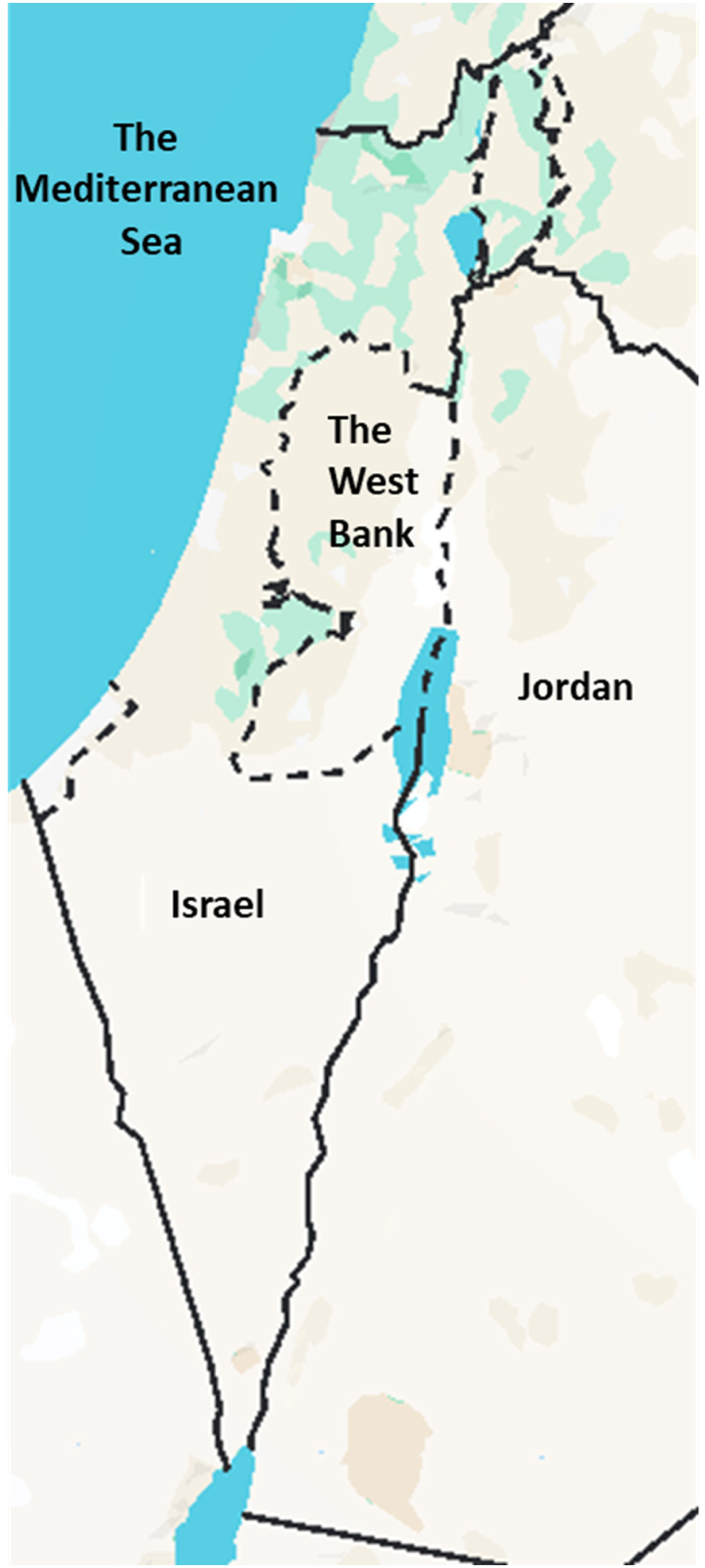
A regional map of Israel and the Palestinian Authority.
Establishing a single regional standard of wastewater reuse is challenging due to differing socioeconomic conditions and significant gaps in wastewater treatment infrastructures and wastewater irrigation regulation between the Palestinian Authority and Israel. In 2022, Israel had an annual per capita GDP of $54 659, while the Palestinian per capita GDP in the West Bank was $4458, and in Gaza, it averaged only $3789.3,4 There is a concomitant disparity in sewage infrastructure capacity: currently, Israel produces approximately 620 million m3 of wastewater annually. Of these, more than 95% undergo treatment in 87 major wastewater treatment plants. 5 In contrast, in the West Bank, the majority of wastewater is neither treated nor reused. Only 9.2 million m³ of raw sewage is treated in 15 Palestinian wastewater treatment plants, while roughly 1 million m³ is discharged untreated into the environment. Moreover, these numbers do not reflect the level of treatment: Israel's sewage typically undergoes tertiary treatment, which is far more efficient at removing organic load and eliminating a range of contaminants of emerging concern such as pharmaceuticals, personal care products, hormones, etc than the secondary treatment infrastructure that exists in the Palestinian Authority. 6 Establishing and implementing a unified wastewater reuse standard will become increasingly significant as Palestinian sewage infrastructure expands and wastewater reuse increases so that Palestinian farmers can expand their exports to Israel and Europe. At present, differences in food quality resulting from water reuse regulations, along with disparities in dietary habits lead to different profiles of exposure to contaminants that are an emerging concern among Israeli and Palestinian consumers. We propose a single and unified regulatory strategy for overseeing wastewater reuse to enhance Israeli and Palestinian water safety, food safety, and public health in general.
Wastewater Reuse: A Global Perspective
Over the last century, global freshwater withdrawals for agriculture, industry, and domestic uses increased from about 500 billion in 1900 to approximately 4 trillion m3 per year in 2014. 7 The surge in water usage is primarily due to rapid population growth, urbanization, and agricultural expansion. In addition, extreme rain events, prolonged droughts, and rising temperatures associated with climate change have led to a global decrease in water availability and increased strain on freshwater sources. 8 Particularly, regions like the Near East, North Africa, Sub-Saharan Africa, South Africa, China, and India face escalating water scarcity challenges due to the impacts of climate change.9,10 In 2022, moderate to severe food insecurity affected an estimated 30% of the global population. The ongoing and widespread challenge of global food insecurity, along with the urgent need for improved agricultural strategies, is highlighted by estimates suggesting that nearly 600 million more people could be chronically undernourished by 2030.11,12 As agriculture is the primary water consumer, “new” water resources for irrigation, such as treated wastewater, are being implemented globally. 13
On a global scale, approximately 70% of water withdrawals (∼2.8 trillion m3 annually) are used for agricultural purposes, mainly (∼85%) for crop irrigation.7,14 In addition, irrigated agriculture provides approximately 40% of the world's consumed food, and utilizes only 20% of the total cultivated land.15,16 However, these figures mask significant variances between countries with contrasting economic capacities. Generally, developing countries use around 90% of available water for irrigation, in contrast to approximately 60% in developed countries. 17 For example, UNESCO's 2022, Water Development Report, 18 indicates that only 5% of agriculture in Sub-Saharan Africa is equipped for irrigation based on groundwater extraction. In addition to water quality and availability, agricultural practices such as drip irrigation and/or accurate fertilization can increase food security, reduce poverty, and promote development.
As the world moves towards a circular economy model, it will be possible to increase the amount of water available for agricultural purposes by including treated wastewater as a major water resource in the modern water cycle. 19 In most developed countries, there is generally an ample supply of treated wastewater available for farmers. It is estimated that 360 to 380 billion m3 of urban wastewater is produced annually worldwide, this is predicted to increase by at least 50% by 2050 due to population growth and urbanization.20,21 Of it, 11.4% is treated in wastewater treatment plants and then reused; 41.4% is treated and subsequently discharged, and the remaining 47.2% is not treated and is released directly into the environment. 22 Thus, it is clear that a large amount of treated wastewater is either discharged into aquatic environments or used for purposes other than agriculture, such as landscape irrigation, recreation, and industrial processes. Additionally, while the need for improved water treatment for future food security is evident, it is also clear that using wastewater that has not undergone proper treatment for crop irrigation can be hazardous. It is important to note in this context that conventional wastewater treatments cannot remove all contaminants. Contaminants such as pharmaceuticals, PFAS, personal care products, endocrine-disrupting chemicals, and others are ubiquitous in treated wastewater that is subsequently used for irrigation23–25. Untreated or inadequately treated wastewater, mishandled wastewater, and its reuse in unfitted environmental settings, can lead to contamination, waterborne diseases, environmental degradation, and an elevated risk to human health. 26 These potential health hazards highlight the urgency of implementing efficient wastewater collection, treatment, and reuse strategies based on agreed-upon regulations to ensure safe usable water for all.
International Water Reuse Guidelines for Crop Irrigation
Wastewater was often viewed as a nuisance and a liability for farmers—and not without reason.26,27 Yet, as treatment quality and water reliability improve, treated wastewater is increasingly recognized as a valuable resource with untapped potential to provide both the water and nutrients needed by the agricultural sector. Once treated, effluents can contribute to sustainable development as part of a circular economy.20,28 Advanced technologies developed in recent decades make it feasible and cost-effective to produce high-quality treated wastewater for a variety of purposes, particularly for irrigation purposes. Yet despite advancements, the overall figure for global use of treated wastewater for crop irrigation remains low at about ∼5.5 billion m3 a year. 29 In addition, economic disparities persist. Wealthier countries not only generate more wastewater per capita but also treat a higher percentage of it, resulting in a greater proportion of treated wastewater being intentionally reused in high-income countries. 30 In other words, international guidelines on wastewater treatment and use in agriculture are needed to increase food security and safety.
Between 1989 and 2006, the World Health Organization (WHO) published a compendium of wastewater reuse standards for the Eastern Mediterranean region, which reviewed irrigation criteria for 12 Middle Eastern countries.31,32 These guidelines, based on recently recommended international standards, played a crucial role in discussions on establishing coordinated wastewater standards for the Palestinian Authority and Israel and also influenced the Food and Agriculture Organization (FAO) in formulating its early guidelines for the reuse of treated water in agriculture. 33 By 2015, the International Organization for Standardization (ISO) published its guidelines. 34 These were based on an integrative approach, seeking to mitigate the risk of pathogen transmission in irrigation water by considering multiple factors, including water quality, crop requirements, regional climate, and soil conditions. To broaden the range of crops irrigated with lower water qualities, the guidelines introduce a series of “barriers” to allow for the usage of lower-quality treated wastewater, such as drip irrigation, supplementary disinfection in the field, pathogen die-off, and washing produce, each contributing to pathogen reduction. The US EPA established its guidelines for American farmers based on crop purposes. 35 Nevertheless, some states apply stricter regulations. 36 In Florida, Nevada, and Virginia, for example, the use of treated wastewater for irrigation is permitted only if the crop undergoes peeling or processing before consumption. These states also prohibit direct contact between irrigation water and crops intended for raw consumption. 37 In addition, in California, irrigation of crops in direct contact with the irrigation water is allowed only when turbidity is ≤2 NTU. 38
In recent years, the European Union (EU) also harmonized irrigation standards across the continent. 39 These guidelines primarily relied on the adoption of WHO and ISO guidelines, and categorized water quality into 4 subgroups. These recommendations are based on commonly used parameters such as treatment type, E. coli count, BOD5, TSS, and turbidity. Effective from June 2023, the EU mandates further wastewater treatment to meet updated quality parameters for agricultural use. 40 These guidelines outline several key elements for a robust risk management plan, covering system description, identification of involved parties, hazard recognition, risk assessments, water quality needs, preventive measures, quality control, environmental monitoring, emergency protocols, and stakeholder coordination. This comprehensive regulation plan aims to regulate the entire risk management process to establish uniform minimum water quality requirements for safe wastewater reuse in the agricultural sector and ensure a cohesive market for safe agricultural produce.
The above-mentioned regulatory systems provide a general indication of minimum water quality but all lack sensitivity in the case of higher effluent quality. Moreover, none takes account of emerging contaminants such as PFAS, pharmaceuticals, etc. To date, some countries and entities regulate emerging contaminants in potable and surface water but not in effluents. The European Union 41 has established minimum requirements for evaluating the quality of potable water for human consumption, concentrating on surface water and groundwater. It encompasses 53 contaminants, primarily pesticides, along with industrial chemicals, PFAS, naphthalene, and benzene. In California, groundwater recharge requires monitoring of specific substances, such as caffeine and triclosan. California is likely to introduce additional monitoring as high-quality treated wastewater is planned for use in drinking water treatment plants.36,42 In Switzerland, for example, 13 pharmaceuticals routinely monitor water resources in potable water, emphasizing groundwater protection; over the next 2 decades, new regulations are to be implemented as wastewater treatment plants are upgraded to remove emerging contaminants. 43 Singapore and Australia monitor contaminants of emerging concern in treated wastewater though they are not legally required to do so.36,44,45
Wastewater Treatment and Reuse in Israel and the Palestinian Authority
As of 2022, Israel uses about 2370 million m3 of water annually. Of this, ∼65% is allocated for agricultural uses and roughly 32% is allocated for domestic uses (∼750 million m3) which produces ∼620 million m3 of wastewater. 46 More than 95% of the country's sewage undergoes treatment in 173 wastewater treatment plants of different scales. Most wastewater treatment plants apply an activated sludge system, followed by sand filtration and disinfection, mainly chlorination. 47 Irrigation of crops using treated wastewater in Israel is based on ISO regulations, 34 with local alterations (Table 1), 48 and requires governmental approval from the Ministry of Health and a connection to a separate pipeline, independent of the freshwater system. The country's largest wastewater treatment plant is the Shafdan, which serves 16 cities and towns across the Tel-Aviv region and treats ∼120 million m3 of wastewater annually (∼20% of the total wastewater produced). The Shafdan uses activated sludge followed by soil-aquifer treatment with a residence time ranging from a few months to a year to achieve exceptionally high-quality treated wastewater.49,50 The prolonged residence time combined with the filtration in the aquifer significantly reduces the concentration of organic load and emerging contaminants51–53. Of the produced effluent volume, approximately 87% is utilized for irrigation (ie, direct water reuse), accounting for roughly half of the country's total irrigation volume. According to the treatment level and the effluent quality, treated wastewater in Israel can be utilized for all types of crops from leafy vegetables to no edible crops.
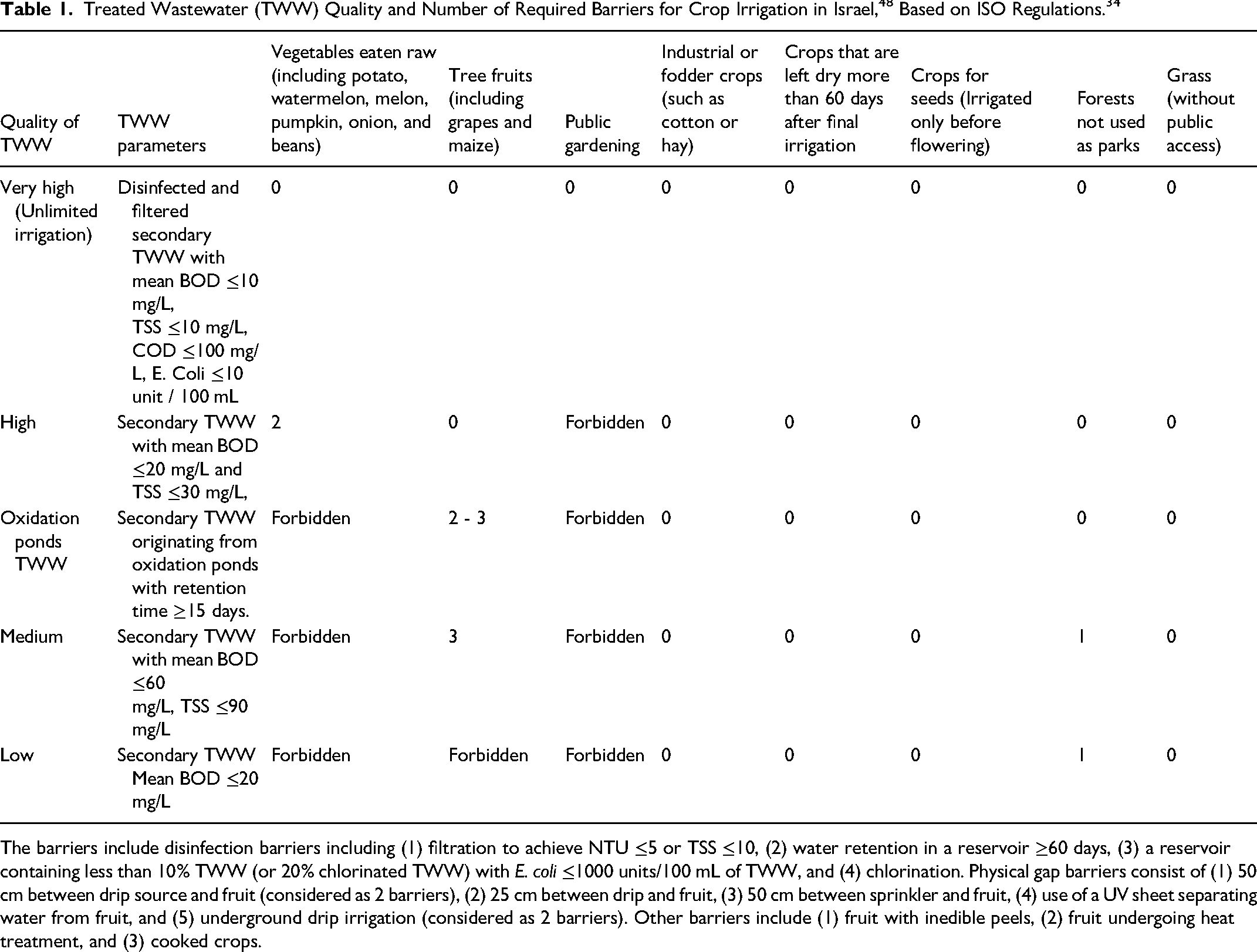
The barriers include disinfection barriers including (1) filtration to achieve NTU ≤5 or TSS ≤10, (2) water retention in a reservoir ≥60 days, (3) a reservoir containing less than 10% TWW (or 20% chlorinated TWW) with E. coli ≤1000 units/100 mL of TWW, and (4) chlorination. Physical gap barriers consist of (1) 50 cm between drip source and fruit (considered as 2 barriers), (2) 25 cm between drip and fruit, (3) 50 cm between sprinkler and fruit, (4) use of a UV sheet separating water from fruit, and (5) underground drip irrigation (considered as 2 barriers). Other barriers include (1) fruit with inedible peels, (2) fruit undergoing heat treatment, and (3) cooked crops.
The total available water in the West Bank and Gaza Strip is about 450 million m3. 54 Groundwater, springs, and desalinated water constitute about 68%, 11.5%, and 0.5%, respectively, and roughly 20% is purchased from Israel. Remarkably, in 1967, just 10% of Palestinian households had water infrastructure, a value that surged to 95% at present55–57. Even so, the water supply remains inadequate for both domestic and agricultural uses.54,58 Currently, about 180 million m3 of water is utilized for domestic usage in the Palestinian Authority, equivalent to 88 L per capita per day. The current Palestinian population depends on 20 operational wastewater treatment plants, and an additional 5 are in the planning stages, which together have a capacity of approximately 35 million m3 of sewage annually. As of 2016, the West Bank generated ∼95 million m3 of sewage originating from roughly 41% of the population that are connected to sewage systems. However, more than half of it remains untreated and flows into streams, groundwater, and agricultural fields; the rest undergo treatment in Israeli and Palestinian wastewater treatment plants.59–61 As streams typically flow toward Israel and the Mediterranean Sea, pollution in these areas is well-documented54,62–66. Between 2016 and 2018 for example, approximately 36 to 40 million m3 per year of wastewater were discharged into the Mediterranean Sea, resulting in an environmental crisis for marine life, the coastal aquifer system, and the surrounding areas. 61 The fact that Israel and the Palestinian Authority not only share water and produce but also pollution highlights their critical need for a single and unified water reuse strategy.
Due to the lack of future water projects and a decentralized irrigation system in the West Bank, irrigation has consistently been around 90 million m3 in recent decades. 57 This volume sustains irrigation of approximately 13 690 hectares of cultivated land in the region. 57 Nevertheless, although this constitutes just 6% of the total cultivated area in the West Bank, it makes up more than half of the agricultural production that requires high-quality irrigation water. Furthermore, while wastewater usage for agricultural purposes has expanded to around 2.34 million m3 in the West Bank, 67 the water supply for farmers is of inadequate quality and insufficient. 54 In past years, Palestinian water policy experts expressed concerns regarding the vast reliance on wastewater reuse referring to differences noted above in treatment infrastructure, sanitation services, and cultural and environmental factors in the Palestinian Authority. To elevate water quality, in 2003 the Palestinian Authority published wastewater reuse standards, which generally rely on the WHO (1989) guidelines (Table 2).31,68 These standards were updated in 2012 to include specific chemical, biological, and physical quality parameters in the classifications of treated wastewater. 69 Notably, the Palestinian guidelines prohibit the irrigation of vegetables using treated wastewater.70,71 Though the new standards were not officially adopted, substantial progress in expanding Palestinian wastewater infrastructure and public recognition is apparent.72,73
Treated Wastewater (TWW) Quality and the Number of Required Barriers for Irrigation in the Palestinian Authority, Modified Table From the Palestinian Water Reuse Standards (PSI 742-2003). 71
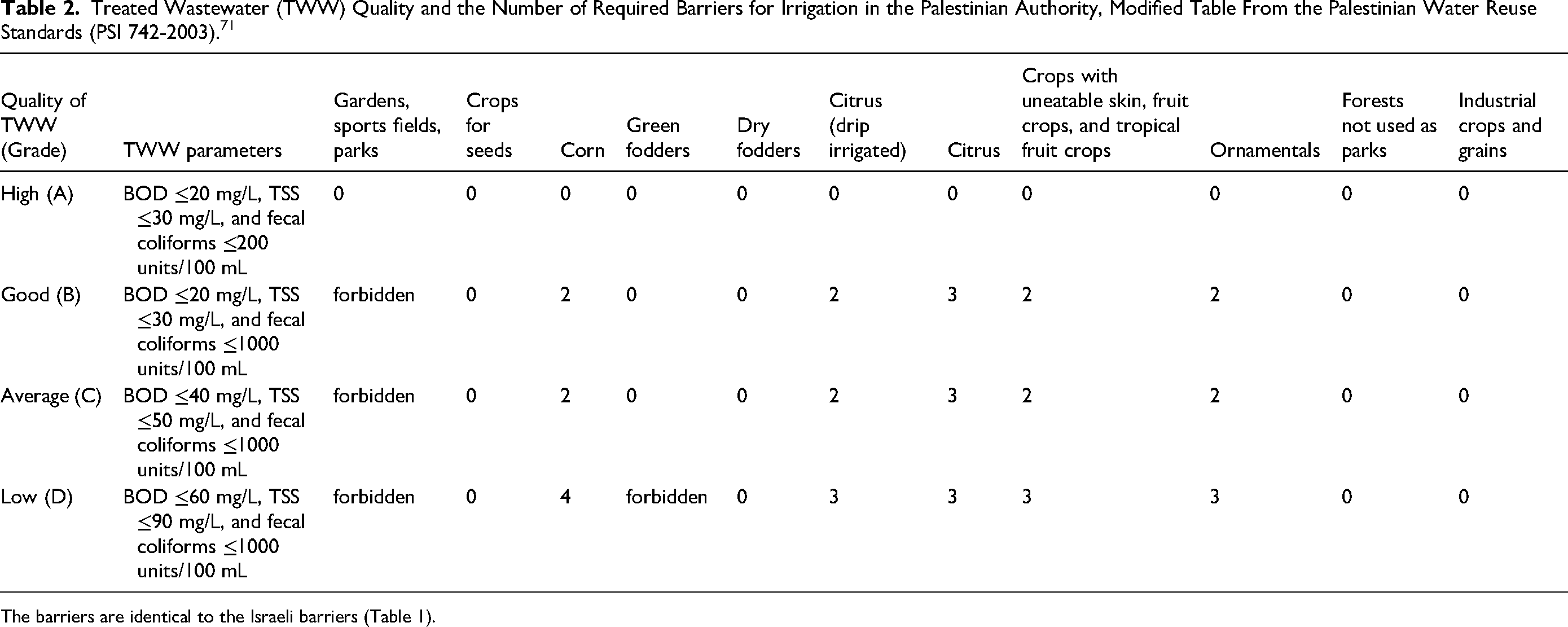
The barriers are identical to the Israeli barriers (Table 1).
Contaminants in Fresh Produce: Data From Israel and the Palestinian Authority
Since a main concern regarding water reuse practices is food safety, the focus traditionally was on microbial contamination (human pathogens). However, in recent years contaminants of emerging concern, such as pharmaceuticals, personal care products, PFAS, pesticides, etc have been detected in treated wastewater.13,74 When this is used for irrigation, some of these contaminants are taken up by crops and introduced into the food chain affecting food quality and safety.25,75,76 In 2021, a national survey analyzing contaminants of emerging concern in commercial crops, including fruits, roots, tubers, and leafy vegetables, obtained from more than 450 fields irrigated with treated wastewater was conducted in Israel.24,53,76 The findings revealed that nearly all crops (98%) were contaminated with at least one contaminant of emerging concern. Concentrations of contaminants of emerging concern reached levels of tens of thousands of ng per kg of fresh weight produce. The most frequently detected contaminants were the pharmaceuticals venlafaxine, lamotrigine, and carbamazepine including its metabolites (epoxide-carbamazepine and dihydroxy-carbamazepine). Leaves were identified as the most contaminated plant organ, attributed to the uptake process and translocation mechanisms within the plants.24,53 This was further corroborated in a subsequent publication 76 showing that consumption of leafy vegetables irrigated with treated wastewater was primarily associated with higher exposure levels to wastewater-derived contaminants of emerging concern. Exposure assessment based on the subpopulation indicated that Arab-Israelis experience higher exposure to wastewater-derived contaminants of emerging concern due to their leaf-rich dietary habits that, in extreme conditions, may reach 140 µg per person per day for all compounds combined. 76
Palestinian data on contaminants of emerging concern in fresh produce are less available than Israeli data. Recently collected data by Al-Quds Public Health Society, The Hebrew University of Jerusalem, and Tel Aviv University (unpublished preliminary data from a USAID Middle East Regional Cooperation (MERC) collaboration between co-authors EBM, ZA, BC, AMA, SS, AT) suggest that 98% of the treated wastewater samples exhibited concentrations of at least one of the following contaminants of emerging concern: carbamazepine and its metabolites, lamotrigine, and gabapentin. In addition, 90% of the crops sampled from fields irrigated with effluents (ie, roots, leaves, and fruit crops) were contaminated with at least one contaminant of emerging concern that was detected in the effluents. Similar to the Israeli data, leafy vegetables exhibited the highest concentration and array of contaminants of emerging concern, with 23 compounds detected. Other crops sampled were cucumber (19 analytes detected), carrot (18 analytes detected), tomato (16 analytes detected), and potato (12 analytes detected). In comparison, Riemenschneider et al (2016) 77 examined traces of treated wastewater-derived pharmaceuticals in 10 types of crops in Jordan, identifying more than 10 different pharmaceuticals reaching hundreds of ng/g dry weight. Similar to the Israeli and Palestinian data, carbamazepine had the highest detection frequency in the examined crops. We recently examined the occurrence of PFAS and carbamazepine in the Alexander stream, receiving most of its pollutants from the Palestinian Authority territory (ie, West Bank) and agricultural and industrial zones in the Israeli territory. 66 Ten PFAS analytes (out of 12) were detected in the Alexander stream, with their cumulative concentrations ranging between <100 and >1000 ng/L. This paper is not the first to highlight the significant pollution of contaminants of emerging concern in the Alexander Stream. 62 Another recent study that analyzed water samples from 258 rivers worldwide, representing 137 geographic regions, 65 indicates that the most contaminated rivers were located in low- to middle-income countries, often linked to areas lacking proper wastewater management and/or wastewater treatment infrastructure. A recent report from the Israeli Water Authority 78 indicated the presence of carbamazepine in production wells and half of the sampled springs along the Israeli-Palestinian border. In about a third of the samples, its concentration exceeded the drinking water threshold level of 0.05 µg/L. It is evident that improper use and handling of wastewater on one side of the border impacts both sides. These findings highlight the need for a systematic and in-depth evaluation of emerging contaminants in the Israeli and Palestinian water and food supply, along with a unified set of wastewater reuse standards, emphasizing the need for a collaborative water reuse strategy to ensure environmental health and food safety.
A Call for Joint Israeli-Palestinian Water Strategy
The wastewater data from the Palestinian Authority presented here clearly indicate that treating all generated wastewater (∼95 million m3) and implementing it effectively as irrigation water, accounting for water loss, has the potential to conserve over half of the irrigation water needed by the agricultural sector. This approach could significantly enhance environmental health, food security, water security, economic conditions, and standard of living for all parties involved. 13 Upgrading and expanding wastewater treatment is an area where both Israeli and Palestinian leadership can find common ground. Aligning guidelines and regulations for agricultural water reuse, could enhance collective environmental well-being, food stability, and water sustainability in the Palestinian Authority and Israel, and simultaneously signal positive momentum and goodwill in regional water dynamics. Harmonizing the existing regulations for reusing wastewater is likely to benefit the markets shared by Israel and the Palestinian Authority. To ensure sustainable practices, these guidelines must be based on empirical findings and modeling. This is especially important with regard to contaminants of emerging concern whose threat to human and environmental health has recently been recognized.76,79 Although the Israeli water reuse regulations have effectively reduced most of the environmental and health consequences of sewage recycling and dramatically expanded the available water supply affecting both food security and food safety, 80 Israeli regulators must revise present standards to address the mounting evidence of traditional and emerging contaminants in local wastewater. Israeli wastewater criteria can then serve as an aspirational target for joint standards, although initially, the unified wastewater reuse standards for Palestinian effluents may not be as stringent.
In light of the above, we propose including selected contaminants of emerging concern in the regulation system to serve as markers for contamination based on empirical evidence. 81 Each marker would designate an appropriate threshold based on occurrence, environmental persistency, and/or toxicity. The list of analytes should include commonly detected contaminants from various groups, including pharmaceuticals (eg, carbamazepine, lamotrigine, thiabendazole), PFAS, and pesticides. The water sample will be analyzed in a joint Israeli-Palestinian lab which will receive samples from the Palestinian Authority and Israel every week. Currently, several advanced wastewater treatments are considered effective in removing emerging contaminants (mainly soil-aquifer treatment, reverse osmosis, ozonation, and ultrafiltration). However, since these treatments entail high costs and require skilled personnel, we recommend additional and breakthrough regulations along with routine monitoring. Data already available suggests an interim exclusion on using treated wastewater to irrigate leafy vegetables, at least until the outcome of advanced wastewater treatments is demonstrated. In compliance with ISO regulations, high-level quality treated wastewater could be used to irrigate fruit crops, while lower-quality treated wastewater could be utilized for non-edible crops or recreational fields. The new EU regulation system 40 could serve as a holistic standard for both sides on top of the regulations that exist in Israel today. 34
An agreed timeline for achieving a unified and harmonized regulatory system is crucial. Additionally, each side should designate agreed timelines for joint implementation, that is, the development of necessary infrastructure and enforcement of the regulatory system. Since Israel already has established infrastructure and regulations, its timeline can be relatively short. In contrast, the Palestinian Authority may wish to adopt a 10-year plan, with specific steps toward effective implementation. The Jordan Valley may serve as a natural starting point for the phased introduction of collaborative guidelines, given its shared usage by both Israeli and Palestinian farmers. 82
The Jericho wastewater treatment plant serves as a noteworthy case study for successful and effective water reuse within the Palestinian Authority. 83 This facility primarily receives domestic wastewater originating from Jericho and sells the treated wastewater to local farmers, particularly those cultivating dates in the region. By doing so, the Jericho wastewater treatment plant not only conserves freshwater resources but also supports local agriculture. In comparison, Israel often produces higher-quality treated wastewater and has more widespread treatment systems, setting a benchmark that Palestinian projects like Jericho aspire to. This example demonstrates how localized solutions may prove more successful than broader regional approaches within the Palestinian Authority context. Such an approach can lead to effective water management and reuse, resulting in positive impacts on natural resources while improving food safety and food quality.
To facilitate the implementation of the new regulation strategy, scientific, legal, social, and economic challenges need to be addressed.
Future Perspectives
Achieving uniform wastewater quality standards between Israel and the Palestinian Authority is likely to pose numerous challenges. The need to reach a consensus regarding wastewater irrigation standards is only one side of the challenge. Socioeconomic, political, and cultural differences, regulatory hurdles, the multifaceted nature of decision-making involving numerous sectors, and disparities in investments concerning water and sewage treatment as well as piping systems are at least some of the significant issues that will need to be broached. Yet the needs are pressing. As a result, we advocate a novel approach that circumvents these intricate issues and leverages existing data and the precautionary principle. We urge regulators in both Israel and the Palestinian Authority to adopt a proactive stance and address the problems earnestly. To mitigate the risk of pollution and potential harm to consumers and to ensure food safety, we recommend initially implementing a prohibition on wastewater irrigation for leafy vegetables. This proactive preliminary measure would not only significantly reduce exposure but could serve as a persuasive catalyst for water authorities in both nations to acknowledge that enhancing the quality of wastewater effluents is an imperative that they can and must address jointly.
Footnotes
Acknowledgments
We want to express our gratitude to Mr Omer Meyer, Mr Rotem David, and Ms. Ella Faruchi for helping with the project.
Author Contributions
Conceptualization: Alon Tal, Ziad Abdeen, Benny Chefetz, Aron Troen, and Evyatar Ben Mordechay. Methodology: Alon Tal, Benny Chefetz, Aron Troen, and Evyatar Ben Mordechay; Validation: Alon Tal, Ziad Abdeen, Benny Chefetz, and Evyatar Ben Mordechay. Investigation: Evyatar Ben Mordechay, Snir Schwartz, Abdul Mohsen Abdeen, Vered Mordehay, and Sobhi A. Robeen. Data curation: Evyatar Ben Mordechay, Snir Schwartz, Vered Mordehay, Abdul Mohsen Abdeen, and Sobhi A. Robeen. Writing—original draft preparation: Evyatar Ben Mordechay, Benny Chefetz and Alon Tal. Writing—review and editing: Alon Tal, Benny Chefetz, Aron Troen, and Evyatar Ben Mordechay. Supervision: Alon Tal, Benny Chefetz, Aron Troen, and Evyatar Ben Mordechay. Funding acquisition: Alon Tal, Ziad Abdeen, and Benny Chefetz.
Declaration of Conflicting Interests
The author declared no potential conflicts of interest with respect to the research, authorship, and/or publication of this article.
Funding
The authors disclosed receipt of the following financial support for the research, authorship, and/or publication of this article: This work was financially supported by the USAID: Middle East Regional Cooperation (MERC) Program (M35-018)..
