



Abstract
Background:
Governments have a central role to play in creating a food environment that will enable people to have and maintain healthy eating practices.
Objectives:
This study analyzes public policies and government actions related to creating healthy food environments in Burkina Faso.
Methods:
The Healthy Food Environment Policy Index tool used for this study has 2 components, 13 domains, and 56 indicators of good practice adapted to the Burkina Faso context. Official policy documents collected from data sources such as government and nongovernment websites, and through interviews with government and nongovernment resource persons, provided evidence of considerations of food environment in public policy documents in Burkina Faso.
Results:
Policies documents show a lack of revision of old texts and administrative processes for new policies and government practices are very slow. Added to this is the absence of a regulatory document for some implemented actions. The analysis of the documents collected in relation to the indicators of Food-EPI tool shows that there is no evidence of consideration of food environments for the indicators concerning the regulation of nutrition and health claims, labeling, taxes on healthy and unhealthy foods, support systems for training for private structures on healthy diets, implementation of food guidelines, and food trade and investment.
Conclusion:
This study permits a review of public policies that take into account food environments through the various indicators and constitutes a starting point from which improvements can be made by the government.
Plain language title
Overview of Nutrition Policies, Taking Into Account All the Dimensions That Can Influence People’s Food Choices Across Government, the Food Industry and Society
Plain language summary
To achieve healthy eating habits, governments need to be involved in creating a healthy food environment. This study analyzes public policies and government actions related to the creation of healthy food environments in Burkina Faso. The Healthy Food Environment Policy Index tool was used to carry out this study. Policy documents collected from data sources such as governmental and nongovernmental websites, and through interviews with governmental and nongovernmental resource persons, provided evidence of the consideration given to the food environment in Burkina Faso. Thus, policy documents show a lack of revision of older documents and a very slow administrative process. Added to this is the lack of regulatory documentation on concrete measures taken. An analysis of the documents collected according to the Food-EPI Tool indicators shows that food environments are not taken into account for indicators relating to nutrition and health claims, labeling and taxation of healthy and unhealthy foods, support systems for training private structures on healthy diets, implementation of food guidelines, and food trade and investment. In short, this research provides a starting point for evaluating and improving food-friendly public policies through a series of indicators.
Introduction
For almost a quarter of a century, sub-Saharan African countries have been confronted with the triple burden of malnutrition—undernutrition, micronutrient deficiency, overweight and obesity—characterized by epidemics of noncommunicable diseases (NCDs) and chronic malnutrition. 1 These countries are at different stages of change in their food environments, encouraged by public policies and trade agreements. In Burkina Faso, data from the 2022 National Nutrition Survey, based on Standardized Monitoring and Assessment on Relief and Transitions (SMART) methodology, show that the nutritional situation is characterized by persistent malnutrition in all its forms. The highest prevalence of acute malnutrition, chronic malnutrition, and underweight were 10.6%, 37.7%, and 20.3%, respectively. The prevalence of overweight in children under 5 varied regionally from 0.6% in the Centre Ouest to 2% in the Hauts-Bassins region of Burkina Faso. Among adolescents and women of childbearing age, according to Body Mass Index (BMI), the highest prevalence of underweight was observed among women aged 15-49 in Sanguié (25.4%), followed by Mouhoun (13.2%). 2 However, prevalence in the infant population (0-59 months) showed that undernutrition in all its forms coexists with overnutrition in Burkina Faso, with regional disparities. 2
The triple burden of malnutrition is a major public health problem. This finding is largely associated with the exposure of populations to unhealthy food environments and the nutritional transition underway in these countries. 3 Indeed, food environments perceived as “physical (availability, quality, and promotion), economic (cost), political (rules) and socio-cultural (norms and beliefs) dimensions,” each have a significant impact on the food choices and nutritional status of populations. 4 -6
Different actors can affect the food environment: government, industry, and society. The food industry through food supply, availability, quality, and price; government through laws and regulations; and society through the establishment of cultural norms based on traditions, cultural, and religious practices. Effective government policies and actions are essential to make food environments conducive to health and to contribute in the fight against malnutrition in all its forms and diet-related NCDs and their inequalities. 7,8
Adopting a healthy diet throughout life helps prevent all forms of malnutrition, as well as a large number of NCDs and pathologies. To overcome malnutrition in all its forms, and achieve the World Health Organization’s (WHO) goal of halting the rise in the global prevalence of nutrition-related chronic diseases by 2025, comprehensive measures must be taken by governments and the food industry to develop health-promoting environments. 9
To promote a healthier worldwide diet, the International Food Policy Research Institute recommends to all countries to support changes in the food environment that encourage consumers to make healthy choices. Policies and programs that promote healthy food environments improve the quality of food environments and have an impact on the quality of food. 10,11
One of the most important ways of promoting nutrition through food systems policies is to improve the food environment. This includes increasing the year-round availability and affordability of a variety of nutritious foods and reducing the cost and increasing the convenience and marketability of healthy foods. 3
In Burkina Faso, the government’s commitment to improving the nutritional status of the population through diverse governmental measures is an indication of its interest in creating a healthy food environment. This article, which is part of a more global study on food systems, takes an overview of public nutrition policies and government actions and their potential contributions to combating the triple burden of malnutrition linked to the food environment in Burkina Faso, using the Food Environment Policy Index (Food-EPI) tool.
Methodology
Food-EPI is an instrument for monitoring and evaluating public-sector policies and actions to create a healthy food environment, based on a tool and a process. 3 It is a methodological framework developed by the International Network for Research, Monitoring and Action Support (INFORMAS) on NCDs and food. This study mainly used Food-EPI tool to analyze food environment policies in Burkina Faso. 7,12 It consisted in 2 essential aspects: the collection of official government policy and action documents, and the matching of Food-EPI indicators with Burkina Faso’s public policy and government action documents. The information collected was then qualitatively analyzed to determine whether it reflected the information received, and validated by all the ministries and actors intervening in nutrition in Burkina Faso.
Food-EPI Tool and Adaptation to Burkina Faso
The Food-EPI tool is made up of a “policy” component with domains that address specific aspects of food environments, and an “infrastructure support” component with domains that address the strengthening of obesity and NCD prevention systems (Figures 1 and 2). The good practice indicators contained in these domains cover the policies and infrastructure support needed to improve the healthiness of food environments in order to prevent malnutrition in all its forms and diet-related NCDs. 3
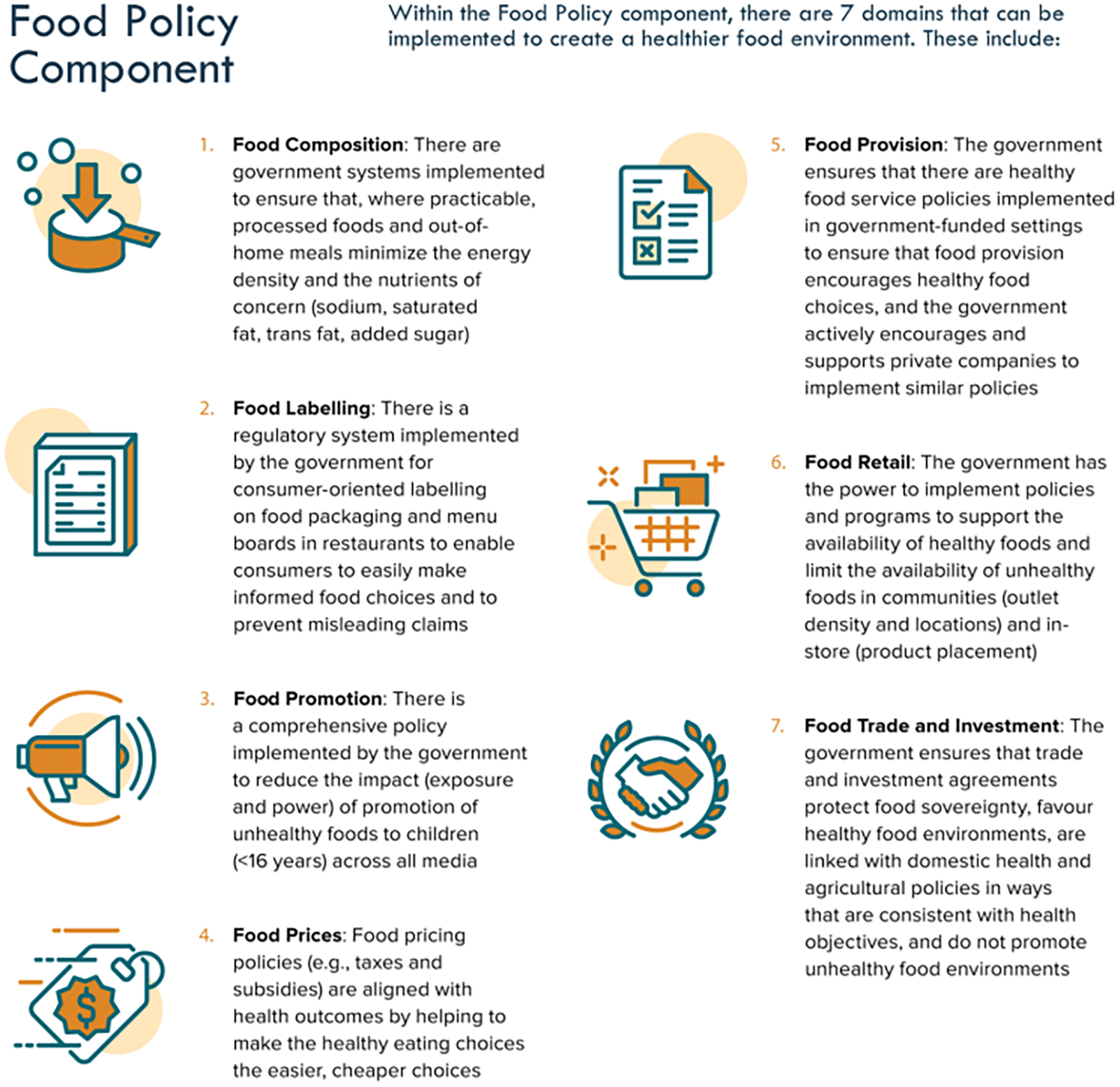
Descriptive figure of the 7 domains of the Food-EPI tool’s policy components. 3
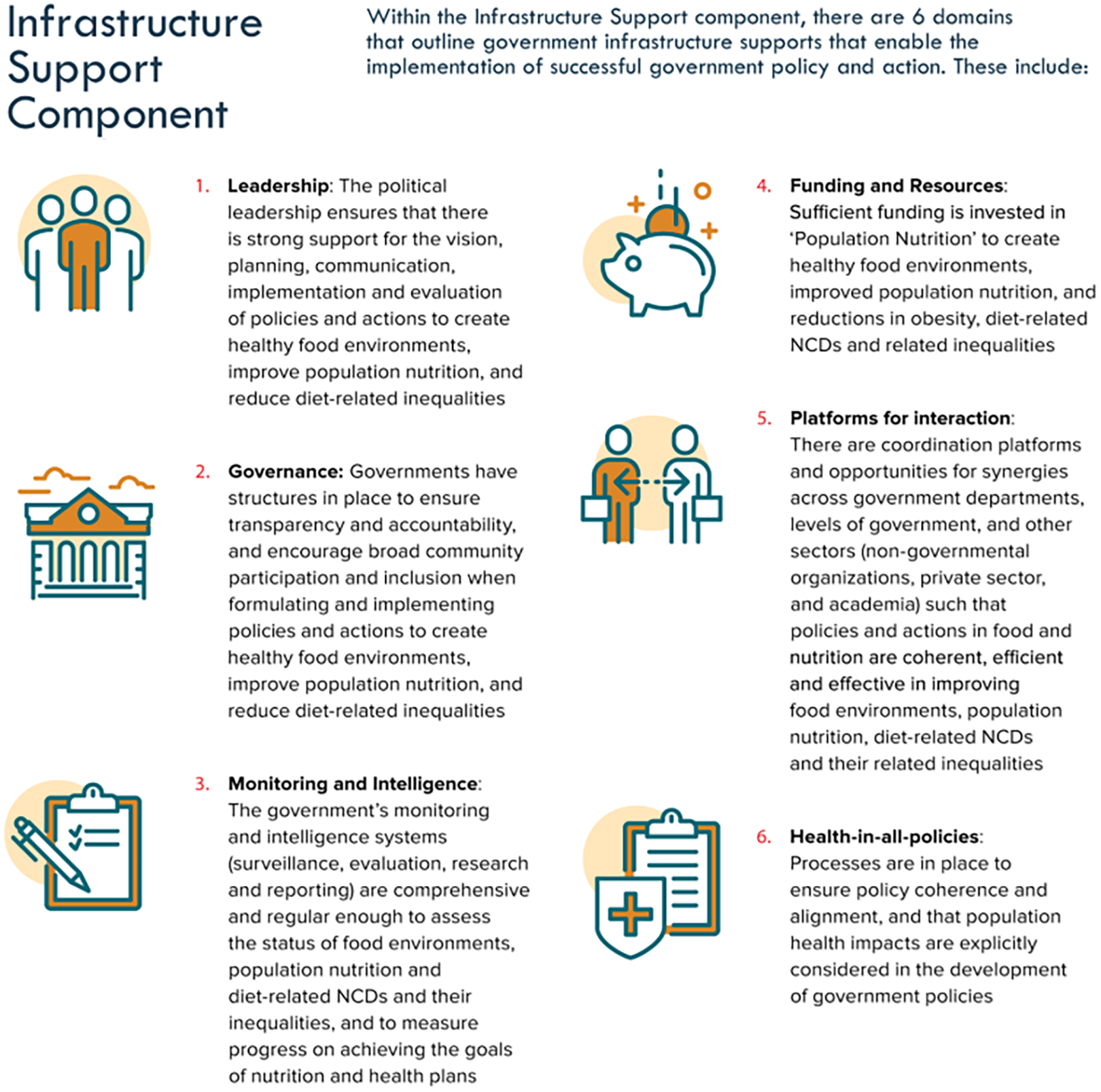
Descriptive figure of the 6 domains of the Food-EPI tool’s policy components. 3
The “food policy” section comprises 7 domains that can be implemented to create a healthier food environment. These domains are as detailed below:
1. Food composition domain (COMP)
Food-EPI vision statement: There are government systems implemented to ensure that, wherever practicable, processed foods energy and out-of-home meals minimize the energy density and the nutrients of concern (sodium, total fat, saturated fat, trans fat, added sugar).
This domain has 3 good practice indicators: COMP 1: Targets/standards/restrictions on the composition of processed foods, COMP 2: Targets/standards/restrictions on the composition of foods eaten outside of the home, and COMP 3: Fortification programs.
2. Food labeling domain (LABEL)
Food-EPI vision statement: There is a regulatory system implemented by the government consumer-oriented labeling on food packaging and menu boards in restaurants to enable consumers to easily make informed food choices and prevent misleading claims.
This domain has 4 good practice indicators: LABEL 1: Ingredient lists/nutrient declarations, LABEL 2: Regulation of health and nutrition claims, LABEL 3: Front of pack labeling, and LABEL 4: Menu labeling.
3. Food promotion domain (PROMO)
Food-EPI vision statement/food promotion: There is a comprehensive policy implemented by the government to reduce the impact (exposure and power) of unhealthy food promotion to children across all media.
This domain has 3 good practice indicators: PROMO 1: Restricting the promotion of unhealthy foods: broadcast media, PROMO 2: Restricting the promotion of unhealthy foods: nonbroadcast media, PROMO 3: Restricting the promotion of unhealthy foods: Children’s living environment, and PROMO 4: Policies to restrict the marketing of Breast-milk Substitutes (BMS)/broadcast and nonbroadcast media.
4. Food prices domain (PRICE)
Food-EPI/Food Price Statement: Food pricing policies (eg, taxes and subsidies) are aligned with health outcomes by helping to make the healthy food choices the easier and cheaper choices.
This domain has 4 good practice indicators: PRICE 1: Reduce taxes on healthy foods, PRICE 2: Increase rates on unhealthy foods, PRICE 3: Existing food subsidies favor healthy foods, and PRICE 4: Food-related income support is targeted at healthy foods.
5. Food provision domain (PROV)
Food-EPI vision statement: The government ensures that healthy food service policies implemented in government-funded settings to ensure that food provision encourages healthy food choices, and the government actively encourages and supports private companies to implement similar policies.
This domain has 6 good practice indicators: PROV 1: Policies in educational structures encourage healthy food choices, PROV 2: Public policies promote healthy food choices, PROV 3: Support and training systems (public sector managers), PROV 4: Support and training systems (private companies), PROV 5: Policies and/or regulations facilitating breastfeeding, and PROV 6: National policies to promote access to WASH.
6. Food retail domain (RETAIL)
Food-EPI vision statement: The government has the power to implement policies and programs to support the availability of healthy foods and limit the availability of unhealthy foods in communities (outlet density and locations) and in stores (product placement).
This domain has 3 good practice indicators: RETAIL 1: Robust government policies and zoning laws: unhealthy foods, RETAIL 2: Robust Government policies and zoning laws: healthy foods, and RETAIL 3: Incentive policies and rules/regulations to clean up the informal sector food environment.
7. Food trade and investment domain (TRADE)
Food-EPI vision statement: The government ensures that trade and investment agreements protect food sovereignty, favor healthy food environments, are linked with domestic health and agricultural policies in ways that are consistent with health objectives, and do not promote unhealthy foods.
This domain has 2 good practice indicators: TRADE 1: Impact of trade agreements assessed and TRADE 2: Protecting regulatory capacity—nutrition.
Within the “infrastructure support” component, there are 6 domains that describe support for the government infrastructure that enables the implementation of successful government policy and action. They are as detailed below:
1. Leadership domain (LEAD)
Food-EPI vision statement/Leadership: Political leadership ensures that there is strong support for the vision, planning, communication, implementation, and evaluation of policies and actions to create healthy food environments, improve population nutrition and reduce diet-related inequalities.
This domain has 9 good practice indicators: LEAD 1: Strong and visible political support, LEAD 2: Population food intake targets are defined, LEAD 3: Food guidelines implemented, LEAD 4: Comprehensive implementation plan linked to state/national needs, LEAD 5: Priorities for reducing inequalities, LEAD 6: National breastfeeding policy, LEAD 7: National complementary feeding policy, LEAD 8: Exclusive breastfeeding and complementary feeding targets, and LEAD 9: Strong and visible political support for reducing undernutrition.
2. Governance domain (GOVER)
Food-EPI/vision statement: Governments have structures in place to ensure transparency and accountability and encourage broad community participation and inclusion when formulating and implementing policies and actions to create healthy food environments, improve population nutrition, and reduce diet-related inequalities.
This domain has 4 good practice indicators: GOVER 1: Restriction of commercial influence on policymaking, GOVER 2: Use of evidence in food policies, GOVER 3: Transparency for the public in food policymaking, GOVER 4: Access to government information.
3. Monitoring and evaluation domain (MONIT)
Food-EPI vision statement: The government’s monitoring and intelligence systems (surveillance, evaluation, research, and reporting) are comprehensive and regular enough to assess the status of food environments, population nutrition and diet-related NCDs and their inequalities, and to measure progress on achieving the goals of nutrition and health plans.
This domain has 9 good practice indicators: MONIT 1: Monitoring food environments, MONIT 2: Monitoring nutritional status and dietary intake, MONIT 3: Monitoring BMI, MONIT 4: Monitoring risk factors and prevalence of NCDs, MONIT 5: Evaluation of major programs, MONIT 6: Monitoring progress in reducing health inequalities, MONIT 7: Breastfeeding indicators and complementary monitoring, MONIT 8: Growth promotion surveillance programs monitored, and MONIT 9: Food Safety indicators and standards are defined and monitored.
4. Funding and resources domain (FUND)
Food-EPI vision statement: Sufficient funding is invested in “Population Nutrition” (estimated from investments in the promotion of healthy eating and healthy food environments for the prevention of obesity and NCDs) to create healthy food environments, improved population nutrition and reductions in obesity, diet-related NCDs and their associated inequalities.
This excludes funding investments in individual promotion (eg, primary care, prenatal services, maternal and child nursing services, etc), food security, micronutrient deficiencies (eg, folate fortification), and undernutrition.
This domain has 3 good practice indicators: FUND 1: Population nutrition budget, FUND 2: Funding for research into obesity and prevention of NCDs, FUND 3: Health promotion agency.
5. Platforms for interaction domain (PLATF)
Food-EPI vision statement: There are platforms for coordination and opportunities for synergies between departments or ministries, levels of government and other sectors (nongovernmental organizations, private sector, and academia) so that food and nutrition policies and actions are coherent, efficient and effective in improving food environments, population nutrition, diet-related NCDs, and their related inequalities.
This domain has 4 good practice indicators: PLATF 1: Coordination mechanisms (national, state, and local government), PLATF 2: Platforms for interaction between government and the food sector, PLATF 3: Interaction platforms between government and civil society, and PLATF 4: Integrated and sustainable systems approach with local organizations.
6. Health-in-all-policies domain (HIAP)
Food-EPI vision statement: Processes are in place to ensure policy coherence and alignment, and that population health impacts are explicitly considered in government policymaking.
This domain has one good practice indicator: HIAP 1: Assessing the health impacts of food policies.
The Food-EPI tool was adapted to the context of Burkina Faso by the research team in charge of implementing Food-EPI in the country, by consulting the original Food-EPI protocol document. 7 A few minor changes have been made to the original tool of 13 policy and infrastructure support domains and 47 indicators: 2 existing indicators associated with food retailing in the policy component and 1 indicator from the domain concerning the integration of health in all policies in the infrastructure support component have been removed; 12 new indicators relating to breastfeeding and complementary feeding, regulations on the marketing of BMS, national policies to combat overweight, NCDs and undernutrition, health systems (growth monitoring), water, sanitation and hygiene (WASH) indicators, food retailers and traders (hygiene and sanitation), and health safety (microbial and chemical contamination) have been added. 6,13 As a result, the final Food-EPI tool in Burkina Faso still included the 13 domains, but with 56 indicators after adaptation. The figure above shows the different components, domains, and indicators (Figure 3).
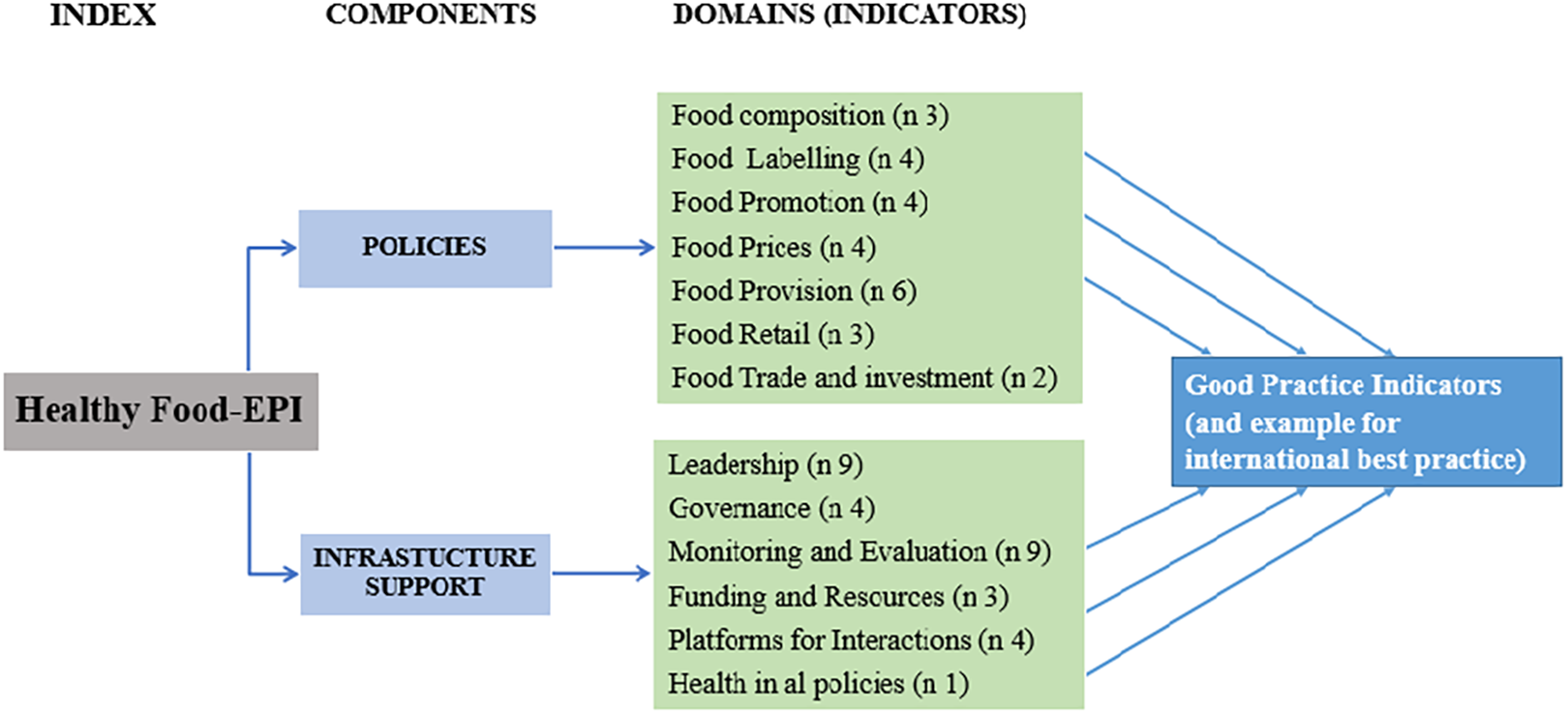
Components and domains of the Food-EPI adapted to the Burkina Faso context. 3
Policy Documents Collection
The collection of public policy documents and government actions in Burkina Faso was done on the basis of 56 good practice indicators on food environments. The collection phase for these documents ran from May to July 2021 and was updated according to the new information available until December 2022. The regulatory documents collected came from several sectors: nutrition, health, education, environment, water, trade, food safety, agriculture, social action, and protection.
Document collection from data sources such as governmental and nongovernmental websites, and interviews with governmental and nongovernmental resource persons, provided evidence that the food environment is taken into account in Burkina Faso’s public policy documents. The inclusion criteria were the presence of a nutritional objective, a nutrition budget, and nutrition-sensitive or nutrition-specific indicators similar to those in the Food-EPI tool. Objectives, strategic axes, intentions, visions, and any documents providing information on indicators were included. These documents also had to be in force or at an advanced stage of development up to December 2022. The exclusion criteria concerned nonaccessible national nutrition framework documents and any documents published or updated after December 2022.
The documents have been classified into 3 frameworks: (1) Political: these are policy guidelines on nutrition or health, or legislation (law or decree) in the field of nutrition; (2) Strategic: these are documents that outline political or strategic axes, or operationalize policy guidelines; and (3) Operational: these are (a) activity reports from various nutrition-sensitive or nutrition-specific sectors, (b) reports from national nutrition or health surveys, and (c) nutrition programs and diet-related guides.
Fill in the Indicators With Policy Documents via the Food-EPI Tool and Check the Evidence
For each of the 56 indicators on food environments in the Food-EPI tool, documents that take into account the objectives of each Faso indicator have been selected.
Thus, all government policies and actions identified in Burkina Faso as having a potential influence on the food environments described by the Food-EPI tool were summarized in the “evidence document.” The evidence identified for each indicator was collated and sent back to all ministries and actors involved in nutrition in Burkina Faso to check its completeness and accuracy. They provided feedback on the policy documents for each indicator, incorporating new policy documents, suggesting other websites to research and adding recommendations to ensure the accuracy of the evidence for each indicator.
Ethical Considerations
This study was reviewed and approved by the Burkina Faso Health Research Ethics Committee under deliberation no. 2021-04-112. In order to facilitate data collection, an administrative letter was introduced by the Ministry of Health through the Technical Secretariat in charge of multisectoral nutrition to all the ministries concerned. All ministries and stakeholders involved in nutrition were informed of the purpose of the study. The ethical consideration was taken into account by respecting the anonymity of the actors who provided documents on nutrition policies.
Results
The Identification of Policy Documents Corresponding to Each Indicator
A total of 63 nutrition policy documents were collected as part of this study, 34 from the policy framework, 16 from the strategic framework, and 53 from the operational framework. These policy documents and governmental actions were identified for each indicator of the Food-EPI tool and are presented in Tables 1 and 2.
Table of Main Policy Documents Collected by Indicator for the Policy Component in Burkina Faso, 2023.
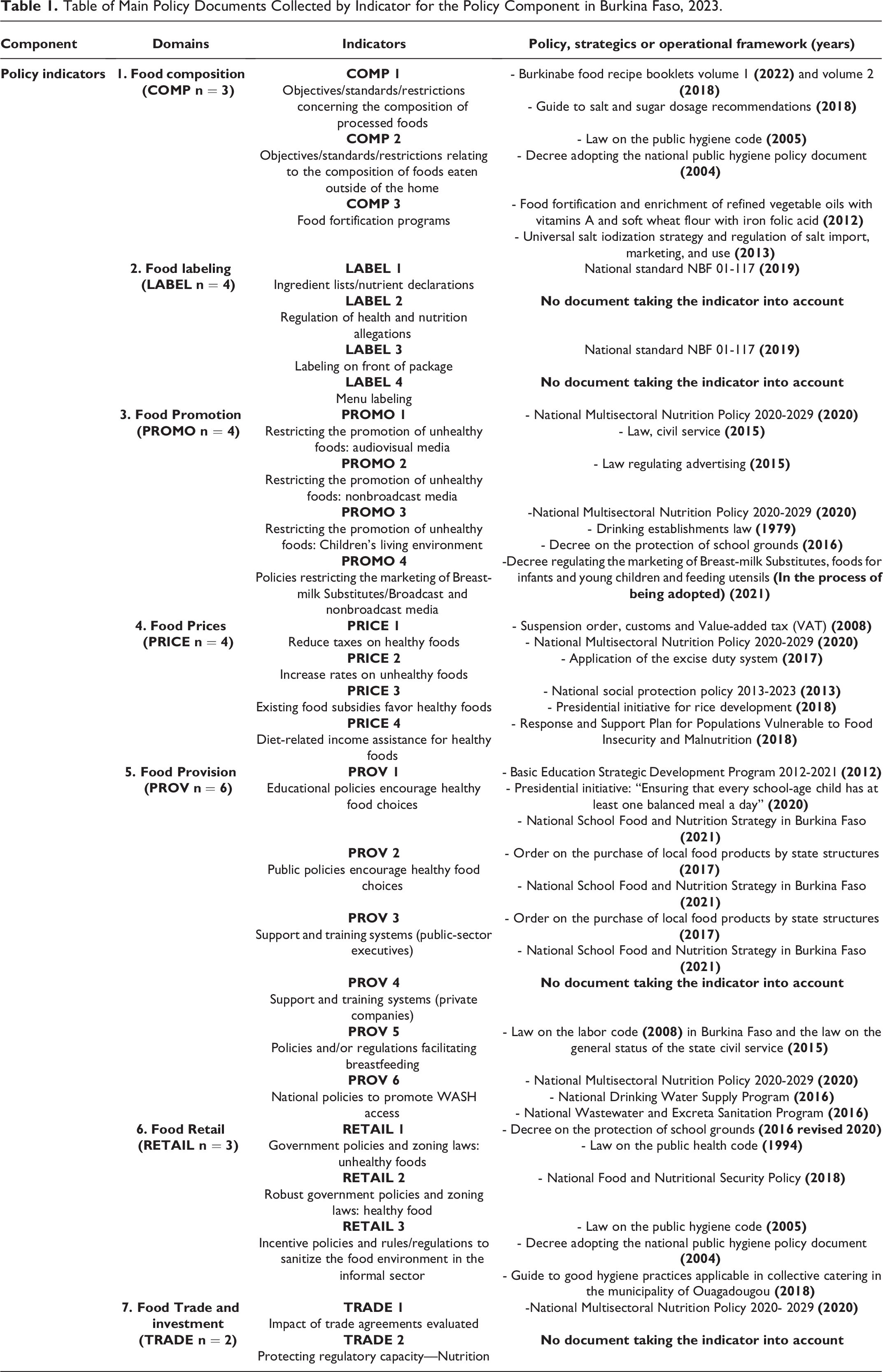
Table of Main Policy Documents Collected by Indicator for the Infrastructure Support Component in Burkina Faso, 2023.
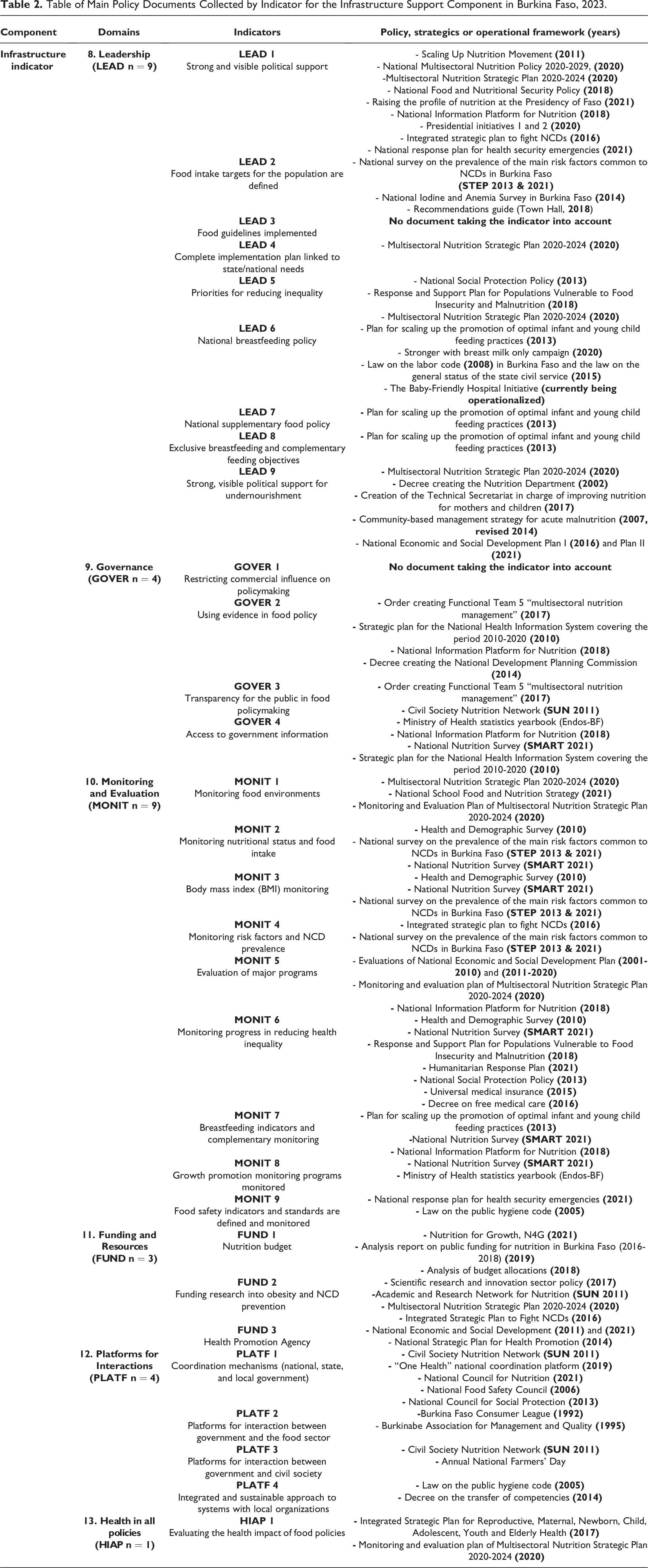
The results show that for 50 of 56, that is, 89.3% of indicators, there are government documents and actions in line with the corresponding indicators. These indicators correspond to 22/26 of the policy component and 28/30 of the infrastructure support component. And 6 of 56, that is, 10.7% of the indicators could not be completed due to the absence of a policy document relating to these indicators; there were 4/26 of the policy component and 2/30 of the infrastructure support component.
Policy component
In the policy component, there are 7 domains and 26 indicators.
Food composition domain (COMP): This domain is made up of 3 indicators. For all 3 indicators, there are 7 identified policy documents and government action addressing these indicators.
Indicator COMP 1 and COMP 2: The policy documents identified for these indicators did not allow us to answer specifically about the existence of targets, standards, or restrictions relating to the composition of processed foods and foods eaten away from home, as Burkina Faso does not have a food composition table to regulate the nutrient content of foods. According to the Food and Agriculture Organization of the United Nations (UN), a food composition table generally consists of a list of foods for which the respective contents of certain nutrients are indicated. 14 However, the Ministry of Agriculture has begun the process of developing a food composition table based on the foods and products listed in Burkina Faso.
Indicator COMP 3: In terms of fortification programs, several efforts are being made in Burkina Faso to advance food fortification. There are the interministerial order concerning obligatory fortification and enrichment of refined vegetable oils with vitamin A and soft wheat flour with iron and folic acid (2012), and regulation of the import, marketing, and use of salt in Burkina Faso (2013). However, in spite of these measures implemented by the state concerning the fortification of foodstuffs, more can be done.
Food labeling domain (LABEL): This domain contains 4 indicators. For 2 of these indicators, relating respectively to the list of ingredients/nutrient declarations and front-of-pack labeling, only the Burkinabe Standards Catalogue 2019 issued by the Burkinabe Agency for Standardization, Metrology, and Quality can be used. There are no corresponding policy documents for the other 2 indicators, namely the regulation of health and nutrition claims and menu labeling.
Indicator LABEL 1: Burkina Faso has standards and directives governing the principles of packaged food labeling, 15 but it is uncertain whether all packaged foods in the country meet these conditions. However, the national agency for environmental, food, labor, and health product safety, through the food control and applied nutrition department, has the essential mission of contributing to health protection and safety through controls and monitoring, observation, information, education, and alert actions in the food and nutrition fields. In the case of food products, prior inspection is compulsory, and sanctions are provided for in the event of failure to comply with the national standard for the labeling of packaged foods.
Indicator LABEL 2: In Burkina Faso, no evidence was found of the existence of regulatory systems (strategies and actions) to review food claims to ensure consumers are protected against unsubstantiated and misleading health and nutrition claims. This could be justified by the absence of a public regulatory structure for food products.
Indicator LABEL 3: Burkina Faso has texts governing the control of products intended for human and animal consumption. However, these texts do not specifically include labeling provisions that take into account nutrients of concern, let alone a complementary labeling system to ensure the quality of packaged food. 16
Indicator LABEL 4: There are no policy documents attesting to the implementation of regulatory policies applied to fast-food restaurants to enable consumers to interpret the nutritional quality and energy content of the food and meals on sale. Menu labels are designed to display nutritional information on food and beverages to enable consumers to make informed choices when eating out. 17
Food promotion domain (PROMO): This domain contains 4 indicators. For the 4 indicators in this domain, there are 6 policy documents that take these indicators into account. However, among these policy documents are the law still in force on pubs dating from 1979 and the decree regulating the marketing of BMS, food for infants and young children and feeding utensils dating from 2021, currently in the process of being adopted.
Indicator PROMO 1 and PROMO 2: Even if advertising regulations exist in Burkina Faso, they only outline general provisions. Indeed, there is no specific evidence of the existence of policies that clearly define which foods are not allowed to be advertised in audiovisual and nonbroadcast media.
Indicator PROMO 3: Concerning the restriction of the promotion of unhealthy foods in the living environment of children; in the multisectoral strategic plan for nutrition 2020-2024, we note the intentions of the agriculture sector to control food prices to promote a healthy and balanced diet and, the restriction of advertising and promotion of foods high in fat, salt, and sugar-rich drinks to children and adolescents. The effective implementation of this point would contribute to a healthier living environment.
Indicator PROMO 4: As a policy to restrict the marketing of BMS in relation to broadcast and nonbroadcast media, in 2021, the decree regulating the marketing of BMS, foods for infants and young children and feeding utensils has been adopted. The implementation of this decree requires coordination of actors in order to be effective.
Food prices domain (PRICE): this domain is composed of 4 indicators. For the 4 indicators in the domain, there are 6 policy documents that address each of them. In policy documents that taking into account indicators, the policy document on the suspension order, customs duties and Value-added tax (VAT) still in force dates from 2008.
Indicator PRICE 1: There is no specific evidence for reducing taxes or levies on healthy foods to encourage healthy food choices wherever possible. However, there has been some relief on mass-market products. However, the government’s intentions as expressed in the Multisectoral Nutrition Strategic Plan 2020-2024 are to ensure the production of a wide range of nutritious, culturally adapted, healthy, good-quality foods, in sufficient quantity and at affordable prices. To achieve this, the agricultural sector is developing several nutrition-sensitive interventions, including controlling food prices to promote a healthy, balanced diet. 18
Indicator PRICE 2: Regarding the increase in taxes on unhealthy foods, the policy document on excise duties is not specific to unhealthy foods and only concerns alcoholic beverages, tobacco, cigars, and cigarettes.
Indicator PRICE 3: Concerning existing food subsidies favoring healthy foods; in Burkina Faso, there is the food security support program executed by the National Food Security Stock Management Society. However, there seems to be a lack of specific, well-defined food policy actions aimed at promoting healthy food on a national scale through subsidies.
Indicator PRICE 4: For income support linked to healthy food, in Burkina there is the response and support plan for vulnerable populations to food insecurity and malnutrition, elaborated in 2012 and allowing a response to specific needs of households at risk of food insecurity, malnutrition, and to reduce the effects of crises on populations and livestock by protecting livelihoods. However, it should be noted that in the implementation of this plan, the food distributed concerns primary products, without any particular emphasis on healthy or unhealthy foods.
Food provision domain (PROV): This domain is made up of 6 indicators and 9 policy documents addressing these indicators. Of the 6 indicators in this domain only one indicator could not be filled in as no policy document took the indicator into account. Among the documents taking into account, the other indicators include the 2012-2021 basic education strategic development program, the 2008 labor code law and the 2019-2021 “Stronger with Breastmilk Only” National advocacy and communication strategy for social and food change, which was still under development during the data collection.
Indicator PROV 1: Concerning policies in educational structures that encourage healthy food choices, there is the Presidential initiative, a commitment whose objective is to improve the diet of school-age children, which is an important instrument in social protection and the fight against malnutrition for better school performance. 19
Indicator PROV 2: In terms of public policies promoting healthy food choices in Burkina Faso, a number of initiatives have been implemented in school canteens. However, collective catering services exist in other public sectors: military services, universities, prisons, and correctional facilities. In addition, the recruitment of nutrition specialists by the Ministry of Health for University and Regional Hospitals will help to improve the nutritional quality of meals provided in health facilities.
Indicator PROV 3: In relation to the support and training system set up by the government to help schools and other public sector organizations and their caterers comply with healthy food service policies and guidelines in Burkina Faso, there are, among others, university courses in human nutrition, agri-food, toxicology, microbiology, and quality. These courses provide knowledge about healthy eating.
Indicator PROV 4: There is no evidence of policies and actions that encourage the private sector to provide and promote healthy food and meals for their employees in the workplace.
Indicator PROV 5: Burkina Faso’s ratification in 2013 of the International Labor Organization’s Convention 183 on Maternity Protection in the Workplace guarantees benefits for pregnant and breastfeeding women in the workplace, although revisions will need to be made to take into account, for example, the university setting, increase the number of months of maternity leave and create spaces in workplaces to facilitate infant care.
Indicator PROV 6: In Burkina Faso, under the multisectoral nutrition strategic plan, several nutrition-sensitive interventions have been developed by the WASH sectors. However, although there is scientific evidence of the impact of these interventions on nutritional status, major difficulties remain in scaling them up, linked to the lack of qualified human, material, and financial resources.
Food retail domain (RETAIL): This domain has 3 indicators. For all the 3 indicators in the domain, there are 6 policy documents. Of these, 3 policy documents still in use date back more than 10 years: the law on the public health code (1994), the law on the public hygiene code (2005), and the decree adopting the national public hygiene policy document (2004).
Indicator RETAIL 1: As government policy and zoning laws regarding unhealthy food, in Burkina Faso the 1994 law on the public health code is applied. The 2004 national public hygiene policy, the 2005 public hygiene code, and the 2016 decree on the protection of school property, although obsolete documents, are still in force in the country and need to be revised. This will better serve to regulate the density or placement of fast-food restaurants or other outlets selling mainly unhealthy foods in communities and encourage the availability of outlets selling healthy options such as fruit and vegetables.
Indicator RETAIL 2: There is no specific evidence from public policy documents showing the existence of actions to favor, encourage food stores and catering outlets to promote the availability of healthy foods and limit the promotion and availability of unhealthy foods. However, the emergence of modern private marketing structures with departments dedicated to fruit and vegetables is taking place in the country. Added to this is the existence of fruit and vegetable markets in certain towns in Burkina Faso, namely Ouagadougou, Bobo Dioulasso, and Loumbila, which have been specially built by the government to organize and structure fruit and vegetable marketing activities. However, this policy of promoting fruit and vegetable markets does not cover all the country’s regions and towns. There are no public policy documents on the existence of these markets.
Indicator RETAIL3: As incentives and rules/regulations for retailers and informal traders to guarantee a safer local food environment, several documents address this indicator. These guides focus on local initiatives to help the population reduce sodium intake and control sugar consumption. However, this measure only concerns the Ouagadougou municipalities, and should be initiated by other municipalities. 20,21
Food trade and investment domain (TRADE): This domain has 2 indicators. For the indicator on the impact of trade agreements, only the document on Burkina Faso’s multisectoral national nutrition policy could be taken into account. For the indicator relating to the protection of regulatory capacity in the field of nutrition, no policy document was sufficient to take it into account.
Indicator TRADE 1: Concerning the assessment of the impact of trade agreements in Burkina Faso, the country is increasingly faced with the establishment of new trading companies in the country’s food environment. For this reason, in the multisectoral strategic plan for nutrition, the government, through strategic axis 4, intends to “proceed with the revision of texts, standards and directives relating to food safety, including marketing”. 18 Apart from that, there is no policy document assessing the impact of trade agreements on food environments, nutrition, and people’s health. Also, nutrition is not integrated into Ministry of trade policy documents.
Indicator TRADE 2: In Burkina Faso, no evidence was found through available and accessible policy documents that investment contracts are not likely to harm public health. For this indicator, it should be noted that many countries have sanitary and phytosanitary clauses included in World Trade Organization agreements. However, this does not generally apply to public health nutrition. In Burkina Faso, laws, reforms, and investment contracts encouraging the entry of foreign capital on the basis of freedom of investment could compromise public health by making unhealthy products more affordable. However, Burkina Faso’s landlocked position and high customs charges at the various borders and airports constitute a natural barrier to international trade.
Infrastructure support component
In the infrastructure support component, there are 6 domains and 30 indicators.
Leadership domain (LEAD): There are 9 indicators in this domain. Twenty-five policy documents have taken 8 indicators into account in this domain. Only one indicator could not be filled in, as no policy document took the indicator into account. Among the policy documents selected, the 2008 labor code law still in use dates back more than 10 years, and the policy document on the Baby-Friendly Hospital Initiative was being written during data collection.
Indicator LEAD1: Burkina Faso’s membership of the UN Scaling Up Nutrition movement in 2011, the adoption of the Multisectoral National Nutrition Policy 2020-2029 and the decision by decree in 2021 to elevate nutrition to the Presidency of Faso all show the political support expressed both nationally and internationally for improving the food environment and population nutrition. Taking into account the multisectoral nature of nutrition in Burkina Faso remains a major asset for the effective functioning of the food environment, population nutrition, and diet-related NCDs in Burkina Faso.
Indicator LEAD 2: Burkina Faso has not established clear dietary intake targets for its population in terms of the nutritional elements of concern, in order to meet WHO-recommended dietary intake levels. Indeed, the nonconstant frequency of population surveys is not conducive to an understanding of consumption levels of nutritional elements of concern. However, Burkina Faso does have a protocol for conducting food consumption surveys.
Indicator LEAD 3: To date, there are no clear, interpretative, evidence-based national dietary guidelines established and implemented in Burkina Faso.
Indicator LEAD 4: With regard to an implementation plan linked to national needs and priorities, to improve food environments, reduce the intake of nutrients of concern to meet WHO and national recommended dietary intake levels, and reduce diet-related NCDs; the Multisectoral National Nutrition Policy 2020-2029 identifies several intentions. However, the issue of improving food environments is not specifically addressed, but rather some components taken separately.
Indicator LEAD 5: To reduce inequalities and protect vulnerable populations in terms of diet, nutrition, obesity, and NCDs, Burkina Faso has made nutrition one of the government’s priorities, and is seeking to integrate nutrition into local development sectors, projects, and programs. Indeed, the mechanisms and tools for implementing the national nutrition policy mainly comprise the national multisector nutrition strategic plan, the sector plans of sectors implementing nutrition-sensitive interventions and whose implementation contributes significantly to improving the nutritional status of populations, and ongoing nutrition projects and programs. The priority targets in the strategic plan are essentially vulnerable populations, namely children under 5 and women of childbearing age, including pregnant and breastfeeding women. 18
Indicator LEAD 6 and LEAD 7: Burkina Faso, like most countries in the world, has adopted the WHO’s global strategy for infant and young child feeding, which includes exclusive breastfeeding and complementary feeding. There is therefore no specific national strategy or policy for exclusive breastfeeding and complementary feeding.
Indicator LEAD 8: The plan for scaling up the promotion of optimal infant and young child feeding practices (2013-2025) remains the only document that sets out country-level targets, including specific periods, for exclusive breastfeeding and complementary feeding.
Indicator LEAD 9: Many initiatives have been taken to provide strong, visible political support for the fight against undernourishment. This political will to support the field of nutrition has also materialized through the creation of a budget line in favor of “specific” nutrition (purchase of inputs, etc). In addition, nutrition-sensitive activities are financed through the budgets of key ministerial departments. However, this budget line is essentially dedicated to the fight against undernutrition and does not take into account overnutrition. 22
Governance domain (GOVER): There are 4 indicators in this domain, and 8 policy documents address the indicators in this domain. Only 1 of the 4 indicators for this domain could not be filled in, as there was no policy document to take it into account. Among the 8 policy documents that take into account the indicators in this domain, there's the strategic plan for the National health information system covering the period 2010-2020, dating more than 10 years old.
Indicator GOVER 1: No evidence of available and accessible policies has been identified concerning the existence of regulatory provisions (standards of integrity and conduct) that should enable state actors to sign a conflict-of-interest declaration to indicate whether or not they have actual or potential financial, professional, or personal conflicts of interest are not specified in policy texts.
Indicator GOVER 2: In Burkina Faso, available and accessible policy documents do not systematically promote the use of evidence to support food policy development. Neither are there any mechanisms put in place by the state (eg, government website) to gather opinions from the scientific community during a national food policy development process. In practice, however, the documents identified in the results provide accurate data and information.
Indicator GOVER 3: In the policy documents identified, there are no documented and inclusive actions that value the use of community opinions in food policy development. No policy documents also address the existence of clear government action or procedures for transparency in any food policy development process. However, to ensure transparency in food policy development, several approaches are being implemented in Burkina Faso. The food standards development process in Burkina Faso calls on the contribution of communities (scientists, users, etc) who have 1 month to give their opinion before the standards are validated, and these standards are published in the official gazette of Faso. However, this practice is not regulated in any document. Civil society, through the civil society platform of the UN Scaling Up Nutrition movement, is also very much involved in the political debates surrounding nutrition in Burkina Faso.
Indicator GOVER 4: In regard to access to government information in Burkina Faso, several documents and platforms provide access to health and nutrition data indicators. However, with the national nutrition surveys, it is difficult to access disaggregated data (by region, for example). In addition, very few data are available on dietary habits (fat, salt, etc), the type of alcohol consumed, and so on. Efforts to support decision-making in the fight against NCDs are highly inadequate and lack coordination and capitalization.
Monitoring and evaluation domain (MONIT): This domain has 9 indicators. For the 9 indicators in the domain, 20 policy documents and government action allowed the indicators to be taken into account. Among these policy documents, the most recent demographic and health survey in force is from 2010, and the law on the public health code still in use dates from 2005.
Indicator MONIT 1: In Burkina Faso, several surveillance systems are implemented by the government to regularly monitor food environments.
Indicator MONIT 2: Several systems are used to monitor nutritional status. In terms of regular monitoring of the population’s food intake in relation to specified intake targets or recommended daily intake levels is not possible due to the absence of national food surveys on the population’s food consumption.
Indicator MONIT 3: There are regular monitoring systems for the prevalence of overweight and obesity in adults and children, using anthropometric measurements. However, there is a lack of regular national monitoring data, as the National Nutrition Survey focuses mainly on children under 5 and women, excluding data on obesity in school-age children (6-9 years). In addition, the national survey on the prevalence of the main risk factors common to NCDs in Burkina Faso (2013 and 2021), which enables regular monitoring of the prevalence of overweight and obesity among adults and is scheduled to be carried out every 5 years, is struggling to be implemented in practice.
Indicator MONIT 4: The implementation of national surveys on the prevalence of the main risk factors common to NCDs in Burkina Faso (2013 and 2021) is not systematically effective. As a result, Burkina Faso lacks specific data on the prevalence, incidence, and mortality of diet-related NCDs.
Indicator MONIT 5: In Burkina Faso, there is a lack of development and strengthening of an organizational culture conducive to the systematic evaluation of all health or nutrition programs.
Indicator MONIT 6: While Burkina Faso has a range of policies or programs targeting vulnerable populations, it should be noted that these health policies often encounter difficulties in their implementation (targeting, communication, financial compensation, etc).
Indicator MONIT 7: Based on the results of the nutritional indicators, we can see that public policies on exclusive breastfeeding and complementary feeding are effective in Burkina Faso.
Indicator MONIT 8: Monitoring the promotion of child growth and development is a routine activity in the country’s health facilities.
Indicator MONIT 9: The existence of the national food safety emergency response plan reflects the country’s strong political will to strengthen and improve the state of food safety. However, there are no specific targets set for food safety indicators and standards in Burkina Faso. Consequently, the country aligns itself with Codex-alimentarus standards for maximum pesticide residue limits.
Financing and resources domain (FUND): This domain has 3 indicators. For the 3 indicators, 10 policy documents and government actions were selected to address the objectives of the indicators.
Indicator FUND1: Efforts have been made by the Burkina Faso government to finance nutrition. However, there is a difficulty in collecting budgetary information on projects and programs carried out in the ministries and financed by external resources. Indeed, the execution of most external funding is not centralized either in the computerized expenditure chain, or with the general directorate for cooperation. As a result, some actual budget expenditure may have been underestimated.
Indicator FUND 2: In terms of research, the government aims to improve eating environments, reduce obesity, NCDs, and related inequalities. However, there are no policy documents to show that there is dedicated funding for this. However, Burkina Faso does have the National Fund for Research and Innovation for Development, a structure attached to the Ministry of scientific research and innovation that funds research projects. It funds research projects, but rarely issues call for proposals dedicated to nutrition. Faced with this situation, university researchers are organizing themselves to find funding for their research projects through international organizations.
Indicator FUND 3: The documents identified lack specific health promotion objectives, strategies, and actions that address the promotion of population health through the practice of public health nutrition. Indeed, the document identified addresses health promotion in a broad sense. However, it is uncertain whether the Ministry of health, through the technical secretariat in charge of multisectoral nutrition or the nutrition directorate, has a sufficient and dedicated budget to ensure the promotion of nutrition in the service of public health.
Platforms for interaction domain (PLATF): This domain includes 4 indicators. For all of these indicators, 10 policy documents and government actions were used to take them into account. Among these documents selected, the one relating to the law on the public hygiene code currently in force dates from 2005 and has been in existence for almost 20 years.
Indicator PLATF 1: In Burkina Faso, various platforms exist to facilitate the coordination of nutrition-specific and/or nutrition-sensitive interventions in the policies, plans, and programs of different ministerial departments and non-state actors. All the different existing and functional platforms facilitate the coordination of nutrition-specific and/or nutrition-sensitive interventions in the policies, plans, and programs of different ministerial departments and non-state actors. However, strengthening the coordination of these platforms would enable them to be implemented more effectively.
Indicator PLATF 2: There is no evidence of the existence of formal platforms between the government and the food trade sector to implement healthy food policies contributing to the fight against NCDs. However, there is Burkina consumers’ league, an association which activity serves a common interest and that defends the interests of consumers nationwide.
Indicator PLATF 3: In addition to the civil society nutrition network, which has been identified as a formal platform for regular interaction between government and civil society, there is also the national farmers’ day, which is fundamentally linked to the desire of Burkina Faso’s highest authorities to build bold agricultural policies and implement consensual rural development actions based on ongoing dialogue with farmers.
Indicator PLATF 4: The documents identified attest that the government is taking an integrated and sustainable approach to systems with local organizations to improve the safety of food environments at nationwide.
Health-in-all-policies domain (HIAP): There is only one indicator in this domain. For this one, there are 2 policies documents that address the indicator.
Indicator HIAP 1: For this indicator in Burkina Faso, it is unsure whether the government or, in particular, the Ministry of Health is carrying out impact assessments on health, population nutrition, and the reduction of health inequalities in vulnerable populations in the development of all government policies relating to food. However, implementation of the health investment dossier, integrated strategic plan for Reproductive, Maternal, Neonatal, Infant, Adolescent, Youth, and Elderly Health, will require a health impact assessment. However, the midterm evaluation of Burkina Faso’s Multisectoral Nutrition Strategic Plan, scheduled for the end of 2022, has not yet taken place.
Discussion
Comprehensive policies are needed to address food supply and demand, as well as the food environment where consumers engage with a food system to make diet-related decisions. In Burkina Faso, the high level of nutrition leadership provides a framework favorable to the creation of a healthy food environment. However, the government policy and action documents relating to nutrition used in this study show that there are public policies and government actions dating back more than 10 years that are still in use but need to be updated to take into account today’s new challenges. There have also been delays in developing, revising, or adopting certain policies. This could be due to the unstable political situation in the country over the past 10 years, resulting in perpetual change in human resources management and the conduct of day-to-day business in government. This can also be attributed to the lack of stability due to staff assignments and changes in government officials, as observed in many African countries. 23 Added to this is the difficulty of accessing certain information, such as budgetary data due to the confidential nature of this information in the different institutions.
Review of Indicators and Their Corresponding Policy Documents in Burkina Faso
Many policies have an impact on food systems, which in turn determine which foods are accessible, affordable, convenient, and attractive to consumers—in other words, the food environment. This environment, coupled with individual factors such as income, knowledge, time, and preferences, has an impact on food consumption. And diet, in turn, influences nutritional status through malnutrition in all its forms and the risk of NCDs. 3
This study used the Food-EPI tool to review and summarize the literature on the food environment in Burkina Faso. The policy documents and government action collected allowed 50 indicators on food environments to be taken into account, however, for the remaining 6 indicators, no policy document allowed these indicators on food environments to be taken into account.
However, for the 50 indicators for which there are policy documents that take these food environment indicators into account, some of these policy documents or identified government action sometimes failed to respond specifically to the objectives of the Food-EPI tool indicators. In fact, some of these contained mainly intentions, and in other cases some of the actions implemented were not regulated by any formal documents. Various policy documents or government actions, not specific to nutrition but sensitive to nutrition, were also used to respond to the objectives of some of these indicators.
In order to assess whether Burkina Faso’s nutrition policy framework is conducive to a healthy food environment, it should be noted that there are no public policy documents or government actions that take into account the regulation of health and nutrition claims, menu labeling, support and training systems for private companies, implemented food guidelines and restrictions on commercial influence on policy development. For these indicators, recommendations will be made to the government to improve these shortcomings. However, for those indicators for which there were documents taking into account aspects of food environments, these policy documents were not always specifically designed to address food environments.
This study will better inform the government and enhance its commitment to shaping healthier food environments in Burkina Faso and reducing the burden of diet-related NCDs. For this reason, regarding the indicator on the regulation of health and nutrition claims (LABEL2), with the government having authority to allow or prohibit voluntary claims on nutrients and nutritional functions of packaging, carefully designed claim regulation policies can have a positive impact on the food environment by encouraging the promotion of foods with proven nutritious and healthy claims to consumers. The supervision and monitoring of stakeholders (eg, consumers and industry associations) can also subsequently help to guarantee these claims. For the menu label indicator (LABEL4), several African countries, such as Benin, Ghana, and Kenya, have their own national dietary recommendations. Brazil’s minister of health has shown leadership in developing new dietary recommendations, radically different from most of those developed to date by any country, and aligned with the most widely cited recommendations for healthy eating. 24 Considering the impact of the presence of menu labels on food choice, the government of Burkina Faso could draw up regulations on menu labeling for fast-food outlets. Concerning support and training systems for private companies (PROV 4), several actions are implemented to support and encourage healthy eating in Burkina Faso. But in the private sector, there are currently no policies or actions to encourage this sector to provide and promote healthy food and meals for their employees in the workplace. However, some private-sector structures are independently and individually aligning themselves with the promotion of local food within their structures. By consuming local produce, consumers may enjoy fresher, healthier products, since fruit and vegetables or other local, seasonal produce are often harvested when ripe. The nutrient content is therefore higher than that of produce harvested too young from outside the country and then brought into the country but this would depend in part on the stages in the supply chain. In order to encourage private companies to consume and promote healthy foods, the national government could lighten the tax burden on private companies that promote healthy foods and encourage the promotion of nutrition education in private companies. For the protection of regulatory capacity in relation to nutrition (TRADE 2), in order to protect regulatory capacity in nutrition and public health, the State could first specify measures in policy documents to manage investments and protect its regulatory capacity in nutrition and public health, then strengthen existing regulatory structures and finally carry out systematic control (sanitary parameters) of stocks of foodstuffs of animal origin entering the territory. To implement the food guidelines (LEAD 3), the Burkinabe government should follow the lead of certain African countries and draw up its own national food recommendations and a guide based on food consumption surveys, which should also be implemented. For the indicator relating to restricting commercial influence on policymaking (GOVER 1), the government could first restrict commercial influence on policymaking, then set up a mandatory, publicly accessible lobbying register, and finally develop a reference document on conflicts of interest.
Conclusion
In conclusion, the healthy food environment policy index provides a theoretical overview of government policies and actions that take into account food environments in the country. Indeed, this study reviewing public policy and government action on nutrition in Burkina Faso aimed to improve knowledge of the nutrition policies in place in the country in relation to indicators for the creation of a healthy food environment. However, a number of gaps were identified in policy documents and government actions in the field of nutrition in Burkina Faso. These gaps related to the lack of revision of old texts and administrative slowness in adopting new public policy texts and government actions. Added to this was the absence of regulatory source documents for some of the actions implemented.
Supplemental Material
Supplemental Material, sj-docx-1-fnb-10.1177_03795721241248214 - Food Environment in Burkina Faso: Review of Public Policies and Government Actions Using the Food-EPI Tool
Supplemental Material, sj-docx-1-fnb-10.1177_03795721241248214 for Food Environment in Burkina Faso: Review of Public Policies and Government Actions Using the Food-EPI Tool by Viviane Aurelie Tapsoba, Ella W. R. Compaore, Augustin Nawidimbasba Zeba, Jerome Winbetourefa Some, Inoussa Ky, Julien Soliba Manga, Adama Diouf, Jean-Claude Moubarac, Stefanie Vandevijvere and Mamoudou H. Dicko in Food and Nutrition Bulletin
Footnotes
Acknowledgments
The implementation of this research project is the result of a collaborative effort between the Universite Joseph Ki Zerbo (UJK), the Health Science Research Institute (IRSS), the Universite Cheick Anta Diop de Dakar (UCAD), the Department of Nutrition at the Universite de Montréal (UdeM), the Ministry of health and public hygiene of Burkina Faso, and SCIENSANO in Belgium the INFORMAS network. Many thanks to the national panel of experts from governmental and nongovernmental organizations who took part in the evaluation.
Author Contributions
AD, JCM, SV, JSM, ANZ, and EWRC designed the research project. VAT, ANZ, EWRC, AD, JCM, SV, JSM, JWS, and MHD contributed to the implementation of the research project. VAT collected and analyzed the data. VAT, AD, JCM, SV, JSM, EWRC, ANZ, JWS, MHD, and IK directed the writing of this manuscript. All authors read and approved the final manuscript. This study was reviewed and approved by the Burkina Faso Health Research Ethics Committee by deliberation no. 2021-04-112. Informed consent was obtained from all.
Declaration of Conflicting Interests
The author(s) declared no potential conflicts of interest with respect to the research, authorship, and/or publication of this article.
Funding
The author(s) disclosed receipt of the following financial support for the research, authorship, and/or publication of this article: The project was funded by the International Development Research Centre (IDRC). Grant numbers:109416.

References
Supplementary Material
Please find the following supplemental material available below.
For Open Access articles published under a Creative Commons License, all supplemental material carries the same license as the article it is associated with.
For non-Open Access articles published, all supplemental material carries a non-exclusive license, and permission requests for re-use of supplemental material or any part of supplemental material shall be sent directly to the copyright owner as specified in the copyright notice associated with the article.
