



Abstract

Introduction
Child acute malnutrition continues to be an ongoing threat in Africa’s dryland regions despite considerable humanitarian aid, and development and peace actors’ continued efforts. We now have a window of opportunity to address child acute malnutrition as intergovernmental organizations align their priorities to meet the second sustainable development goal of zero hunger by 2030. 1 Following the reframing of the basic drivers of malnutrition (Figure 1), in 2020, the Food and Agriculture Organization of the United Nations and the Feinstein International Center at Tufts University convened a group of researchers and specialists to discuss the drivers of acute malnutrition in Africa’s drylands. We use the term drivers rather than causes of malnutrition to differentiate between a specific cause-and-effect relationship and a more complex multicausal and multiscalar relationship that considers how the basic causes influence the underlying and immediate causes of malnutrition. These experts reflected on the basic drivers and underlying, and immediate causes of malnutrition and how they could be analyzed and addressed more effectively.
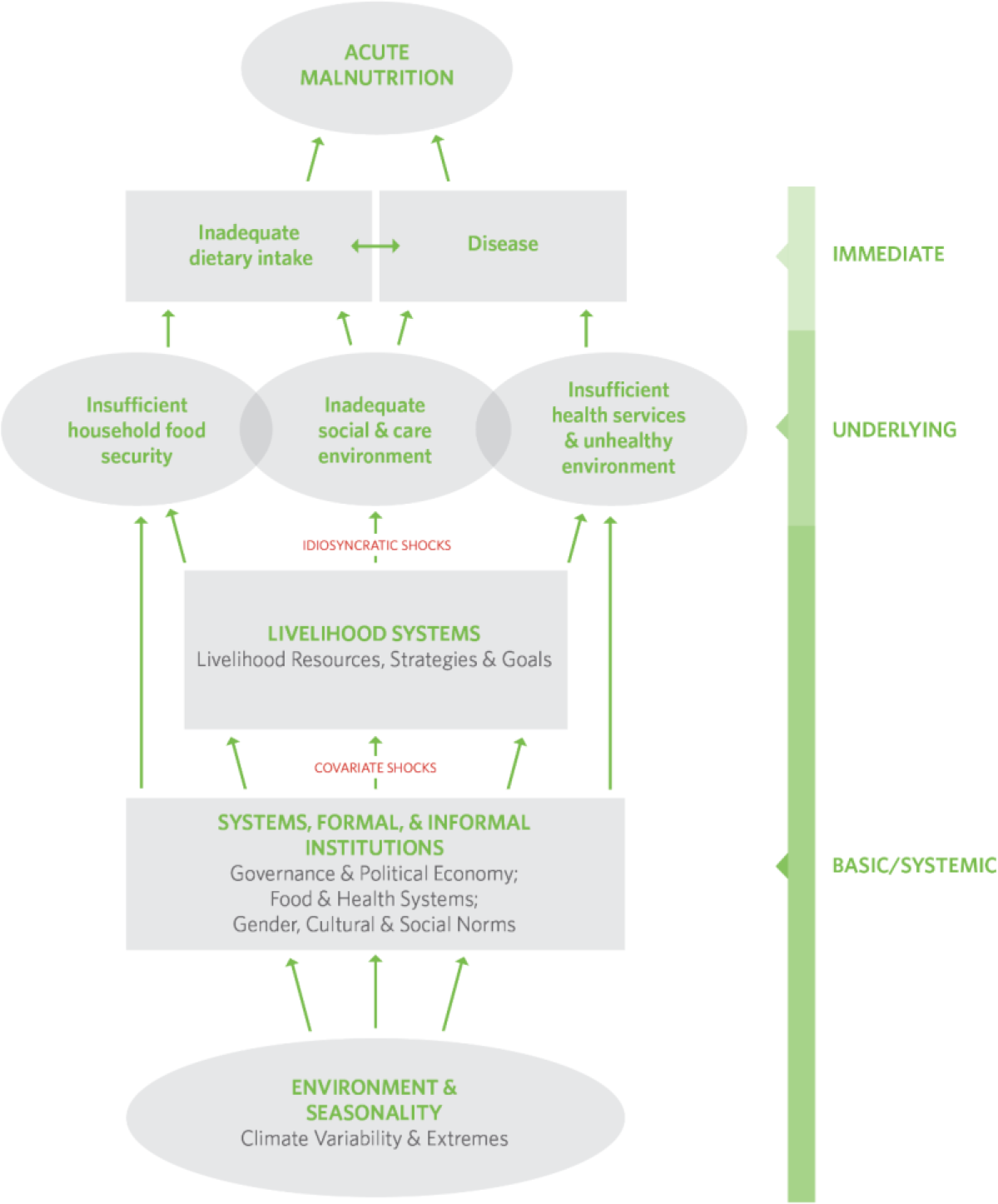
The adapted conceptual framework of drivers of acute malnutrition in Africa’s drylands.
This Food and Nutrition Bulletin Supplement includes 9 research articles authored by some members of this expert group. The impetus for this research lies in the limited and inadequate analysis of the perennial problem of child acute malnutrition, the subsequent imbalance in investments, and the focus on treatment over prevention. The articles examine these drivers across scales from local, national to international level and through a systems lens. They range from multicountry studies of systems and institutions to location-specific primary research on the drivers of malnutrition. These studies adopt a variety of approaches to analyzing the drivers of malnutrition identified in the framework (Figure 1).
The orthodox approach to malnutrition causal analysis focuses on the discrete role of a limited set of immediate and underlying factors and their association with child anthropometric status. As Figure 1 shows, these underlying causes are not independent, as they are contingent upon the basic drivers. Therefore, response strategies must account for these basic drivers to effectively address child acute malnutrition. 2 Establishing the evidence for basic drivers requires analysis of the systems, processes, and institutions that shape the relationship between people and their environment. Paramount are the institutional structures and livelihood resource governance systems that lie at the heart of the basic driver’s framework, including the social institutions related to ethnicity, gender, social norms, and values. These multiscalar systems and institutions influence entitlements (access) to livelihood resources, social relations, and power dynamics, which in turn affect the underlying causes of malnutrition related to food, health, and care (food insecurity, the social and care environment, and the health environment and access to health care). Effective risk mitigation systems that address climate change, promote public health, and maintain peaceful coexistence and security are also part of good governance. Young et al (this issue) propose a new relational approach for understanding the basic drivers of malnutrition by examining the institutional structures and processes that shape the interactions between people and their environment.
Systems and Institutions
Systems and institutions lie at the heart of the basic drivers, reflecting their critical role in relation to all forms of governance and their importance in mediating the effect of environment and seasonality on livelihoods. The effect of environment is thus not independent and fixed, as it is always mediated by people, and myriad systems and institutions.
Jaspars argues for the importance of examining political systems and institutions, as they influence the distribution of resources in society, and as such affect livelihoods, food security, and nutrition. She draws on research on the political economy of food in the context of Sudan and Somalia and illustrates how in situations of crisis, the manipulation of institutions can create power for some and make others vulnerable to malnutrition. Young et al similarly conclude that the relative vulnerability of some communities, versus others, is strongly influenced by their political, social, and economic relationships, which is reflected in their shifting power relations and uneven control over livelihood resources.
Fracassi et al and Hobbs et al examine food systems. Fracassi et al address the shift toward aligning food systems and nutrition on a global stage through the UN Food Systems Summit and the Nutrition for Growth Summit in 2021. They assess the road maps developed in 8 sub-Saharan countries as part of the UN-joint Global Action Plan on Child Wasting and highlight the necessity of considering context-specific risks and vulnerabilities during the implementation in order to ensure a sustained impact in drylands. Hobbs et al apply the “Fill the Nutrient Gap” framework and process to examine the high nonaffordability of nutrient-rich diets in 7 sub-Saharan African countries. This framework relies on local evidence to address systemic bottlenecks and adapt a global framework into an effective set of interventions on a small scale. Hobbs et al argue that there are particular areas of these food systems that require attention in order to transform the drylands.
Livelihoods
Several authors examine the relationship between livelihoods and malnutrition. Jaspars explains that during times of humanitarian crisis, people’s livelihoods and ability to control their land, livestock, and labor is limited resulting in a lack of autonomy and a threat to nutrition.
In the Darfur region of Sudan, Young et al discuss how a governance gap, protracted conflicts, and processes of privatization have weakened local institutions and undermined peoples’ social relations and environmental entitlements. A livelihoods analysis shows how this context has played out in 2 communities, contrasting their livelihood specializations, conflict-related losses, and livelihood diversification over time. Despite the transformation in livelihoods and maladaptive nature of some diversification strategies, specialist production systems continue to show signs of resilience and are vital to nutrition.
Luc et al discuss how child acute malnutrition (specifically child wasting) and food insecurity are each concentrated in specific survey clusters but not necessarily connected. They conclude that child wasting and food insecurity result from different causal pathways and suggest that community-level factors (rather than household or individual indicators) have a major influence on food insecurity and malnutrition. These community-level factors are systemic and relate to a community’s history and experience of basic drivers, for example, its livelihood systems, gendered social norms, management of natural resources and environmental health, and so on.
Food production in Africa’s drylands is dominated by small-scale farming, pastoralist, and agropastoralists systems that are historically adapted to the variable climate and ecology. Sacande and Muir highlight the importance of plant biodiversity for nutrition and explain that a wide variety of wild plant species have been regularly gathered for household consumption and used for livelihoods; for example, as livestock grazing or fodder. Sacande and Muir propose an approach that builds climate nutrition resilience into landscape restoration initiatives as a preventative approach that improves livelihoods, food security, and nutrition.
Environment and Seasonality
Many authors analyze more deeply the relationship between environmental seasonality and child acute malnutrition. In Eastern Chad, Marshak et al identify two seasonal peaks of child acute malnutrition, with the first peak at the end of the hot dry season (April to May), followed by a smaller peak at the start of the harvest period (September to October). This more complex seasonal pattern contrasts with the general assumption that malnutrition coincides with the “hunger” or “lean” season corresponding with the rainy season and is synonymous with food insecurity. Marshak et al highlight the importance of different climate regimes, livelihood systems, and disease patterns, among other drivers, in generating these seasonal trends and suggests that community-level differences are possibly more important than individual or household-level effects.
Venkat et al extend this analysis of seasonality geographically and over time by presenting a robust secondary analysis of child wasting in dryland regions in 19 African countries based on 15 years of SMART survey data. The regions that the authors analyze are climatologically similar and have unimodal rainfall patterns. The authors confirm that there are 2 seasonal peaks of wasting and emphasize the link between these seasonal patterns and dryland production systems that depend on environmental resources that are seasonally distributed.
Naumova uses disease seasonality modeling techniques to expand the ways in which we are able to detect unusual temporal variations in the predicted patterns of child acute malnutrition. Her paper provides an overview of concepts and strategies for and the value of seasonal child acute malnutrition forecasting, which she combines with a discussion of the practicalities of making forecasting of seasonal acute malnutrition actionable.
The above papers on the seasonality of acute malnutrition emphasize the need to interpret prevalence estimates of child acute malnutrition (particularly from cross-sectional surveys) within the context of their seasonal patterns and the associated basic drivers. This latter point is crucial, as the authors explain these spatiotemporal patterns of child acute malnutrition are the result of a wider set of conditions linked with environmental, social, economic, and political systems, which influence livelihood systems and the community-level conditions related to food, health, and care (the underlying drivers of malnutrition). Naumova advocates systems thinking and a systems approach to this understanding and sees forecasting as an important supplement to existing early warning systems and humanitarian decision-making.
Different Approaches for Analyzing the Drivers of Malnutrition
The reconceptualization of the basic drivers of child acute malnutrition calls for new mixed methods approaches and methodologies that can account for the spatial and temporal trends in nutritional outcomes and the interconnected and multiscale nature of the basic drivers.
This supplement includes various methodological approaches for analyzing the drivers of child acute malnutrition, including quantitative methods (Mwangi et al; Luc et al; Marshak et al), qualitative studies (Young et al; Luc et al; Jaspars), geospatial analysis of remote sensing data (Venkat et al, Marshak et al, Luc et al), desk reviews of secondary data and archival evidence (Fracassi et al; Hobbs et al; Jaspars; Sacande and Muir, Young et al), as well as combinations of the these.
While traditional methods remain important, novel and exploratory approaches are needed to elucidate the power and dynamics shaped by the systems and institutions that lie at the heart of the basic drivers. Several papers identify the need to find new ways to build upon our understanding of complex interactions between systems, institutions, the environment, and livelihoods. Quantitative survey methods remain relevant, but the analysis needs to be taken further to account for the geospatial and temporal granularity, and disaggregation across communities and livelihood systems (see, eg, Luc et al, Young et al, and Naumova).
Concepts and analytical approaches matter. Young et al contrast the orthodox approach to malnutrition analysis with a relational approach to the drivers of acute malnutrition. A relational approach to analyzing the drivers of acute malnutrition considers not only the ends (nutritional outcomes and associated symptoms) but also investigates the means—the dynamic processes of change and institutions in which these drivers are embedded.
Several articles have highlighted the need to make better use of available data and information on basic drivers in ways that provide spatial, temporal, and systemic depth. A more dynamic analytical approach is needed to increase understanding of processes of change in the basic drivers and how communities anticipate, react and adjust to them.
Implications for Policies, Programs, and Systems Strengthening
The findings and conclusions of the research included in this supplement give directionality to future research, policies, programs, and systems strengthening.
The research herein suggests that design should look beyond the essential package of interventions and take account of the complementarity between humanitarian, development, and peacebuilding programs and in relation to nutrition ensure strategies maintain a balance between treatment, prevention, and longer term systemic change. However, when humanitarian crises become protracted or recurring, the disaster narrative predominates, and humanitarian action can monopolize resources that might otherwise be used to identify and address the basic drivers through systems strengthening.
Throughout this special issue, authors underscore the importance of resilient and sustainable livelihood systems considering the interplay between livelihood strategies and animal health, environmental health, and human health.
Prevention must be a priority and it requires a multisystems strategy (not just a multisectoral strategy). If preventative approaches are neglected or fail, rates of acute malnutrition will spiral, treatment capacities will be overwhelmed, and the likelihood of relapse after recovery will increase. Hobbs et al expound upon the need to enhance systems thinking for nutrition in drylands. Consensus building across stakeholders and encouraging further stakeholder engagement supports more robust and appropriate intervention design in local contexts. Fracassi et al focus on a food systems lens as an opportunity to open up a policy window and promote an enabling environment. They highlight important areas such as natural resource management, which have hitherto received little attention from nutritionists, and yet are critical to nutrition, because of their relationship with livelihoods, and the food, health, and social environment. Young et al contrast targeting and intervention strategies associated with the substantive approach compared to the relational approach, which highlights that the orthodox substantive approach is mainly concerned with the immediate and underlying drivers while the relational approach is addressing the basic drivers.
Conclusions
The papers in this special issue contribute novel research on understanding and addressing the basic drivers of acute malnutrition. Collectively and individually, the papers call for a paradigm shift in our understanding of child malnutrition and highlight the importance of systems and institutions for addressing the burden of acute malnutrition.
Footnotes
Acknowledgments
This work was supported by the Food and Agriculture Organization of the United Nations. Thanks are also due to Professor Elena N. Naumova, Friedman School of Nutrition Science and Policy for the contribution from her research grant to publication costs. Special thanks are due to the many authors who contributed their original research and also their time and expertise in engaging with this project. The authors would also like to thank the many independent external reviewers who contributed to the process including Mohammed Abdinoor, Myriam Ait Aissa, Mohammed Mukhtar Ballal, Ravinder Bhavnani, Elizabeth Bontrager, Molly Brown, Adrian Cullis, Katherine Curi Quinto, Trenton Dailey-Chwalibóg, Agnes Dhur, Gretta Fitzgerald, Merry Fitzpatrick, Achiba Gargule, Peter Hailey, Manal Hamid, Paul Howe, Gwenaelle Luc, Amin Malik, Suad Musa, Magda Nassef, Nick Nisbett, Rebecca Pietrelli, Ivy Pike, Nina Sophia Schlager, Victoria Sibson, Zeituna Roba, and Tullu.