




Abstract
Background:
The study aimed to identify 2 beta-carotene 15,15′-monooxygenase (BCMO1) mutations, namely R267S and A379V, and determine their association with vitamin A status among Filipinos 6 to 19 years old respondents of the 2013 Philippine National Nutrition Survey living in the National Capital Region.
Materials and Methods:
This study followed cross-sectional design. Whole blood specimen was collected in the morning and was used as source of genomic DNA and serum for retinol concentration determination. Fisher exact test was performed to determine whether genotype frequencies were associated to retinol concentrations/vitamin A deficiency status. A level of P < .05 was identified as significant.
Results:
A total of 693 Filipino children and adolescents were included. Of the 693, there were at least 7.6% who bear the combined mutations for R267S + A379V. Association analysis showed that an inverse relationship exists between the A379V TT variant and vitamin A status, although the exact role of these identified polymorphisms on retinol/carotenoid metabolism need to be confirmed in dedicated functional studies.
Conclusion:
This study has identified for the first time the presence of 2 nonsynonymous genetic variants/mutations in the coding region of BCMO1 gene. Interestingly, one of these 2 variants, the A379V T, was found to be associated with vitamin A status. It is, therefore, warranted to investigate the role of BCMO1 variants for the success of supplementation programs and fortification efforts among vulnerable populations in this region. Genetic variability should be considered for future provitamin A supplementation recommendations among children and adolescents in the Philippines.
Introduction
Vitamin A is required for normal organogenesis, immune competence, tissue differentiation, and the visual cycle. Its deficiency is responsible for at least a million instances of death and blindness each year, especially among at-risk groups. 1 Moreover, serum retinol levels, an indicator used for determining the prevalence of vitamin A deficiency (VAD) in populations, were found to be low among severe COVID-19 patients. 2 Vitamin A deficiency is a public health problem in many low-income and developing countries. Worldwide, the prevalence of VAD is estimated to be 190 million in preschool-age children. 3 In the Philippines, the 2013 National Nutrition Survey (NNS) conducted by the Food and Nutrition Research Institute found that VAD among 6 to 12 years old school children is 10.7%, which is of moderate severity. 4
Vitamin A deficiency has largely disappeared in wealthy populations, where preformed vitamin A is acquired from costly animal products and supplements. In poor and developing nations, however, vitamin A is mainly obtained from its precursor, β-carotene, by eating plants. Beta-carotene is the most abundant among naturally occurring carotenoids synthesized in plants and microorganisms. Consumption of β-carotene-rich foods has been shown to increase low serum retinol concentrations in children and to alleviate signs of VAD. 5 However, the amount of vitamin A derived from carotenoids depends mainly on 2 factors, namely: the bioavailability of the ingested carotenoid and its metabolism by endogenous enzymes.
In humans, between 35% and 88% of absorbed β-carotene is oxidatively cleaved by the enzyme β-carotene 15,15′-monooxygenase (BCMO1; EC 1.14.99.36) into 2 molecules of all-transretinal, which subsequently can be oxidized irreversibly into retinoic acid by retinal dehydrogenase or reduced reversibly into retinol by a retinal reductase. 6 The other carotenoid cleavage enzyme β-carotene 9′,10′-dioxygenase (BCDO2; EC 1.14.99.) cleaves β-carotene at the 9′,10′ double bonds forming β-apo-10′-carotenal and β-ionone. 7 However, BCMO1 knock-out mice become vitamin A deficient despite expressing BCDO2. In fact, studies in mouse models show that a single copy of BCDO2 also does not suffice to maintain carotenoid homeostasis. 8 Thus, in agreement with earlier findings, BCMO1 is currently considered the key enzyme for beta-carotene conversion into vitamin A.
The gene encoding BCMO1 was cloned from different species, including Drosophila, chicken, mouse, and humans. The monomeric state of BCMO1 has implications for rare and more common genetic polymorphisms in the human BCMO1 gene. 9 Lindqvist and Andersson have proposed that the enzyme exists in this form and showed that haploinsufficiency of BCMO1 is associated with β-carotene accumulation and hypovitaminosis in a human subject. 10 Leung and coworkers in 2009 reported 2 common nonsynonymous single nucleotide polymorphisms (SNPs) in the BCMO1 gene that led to impaired function of the BCMO1 enzyme in vitro and in vivo. 11 Further studies of individuals with adequate dietary β-carotene intake and hypovitaminosis A may be necessary to assess the correlation of genetic polymorphisms in BCMO1 with disease phenotypes.
Leung and coworkers reported that 2 common nonsynonymous SNPs, rs12934922 (R267S) and rs7501331 (A379V), in the BCMO1 gene occur at frequencies similar to those of the poor converter trait observed in human intervention studies. These SNPs were shown to produce impaired function of the BCMO1 enzyme in vitro and in vivo. The 267S +379V double mutation indicated a reduced catalytic activity of BCMO1 in vitro by 57%. The in vivo results from this intervention trial are consistent with the biochemical characterization of the 267S + 379V double mutant and indicated that female volunteers carrying the combined 267S + 379V variant alleles showed a 69% lower ability to convert β-carotene into retinyl esters. Although in vitro results did not indicate that the 379V mutant would affect the catalytic activity of BCMO1, female volunteers carrying the 379V variant allele showed a reduced ability to convert beta-carotene by 32%. As expected, this phenotype was accompanied by higher fasting β-carotene concentration, with 1.6 and 2.4 times higher β-carotene concentrations in female 379V and 267S + 379V variant allele carriers, respectively, compared with wild-type R267/A379 allele carriers. 11
Similar frequencies in a Caucasian population were observed in the International HapMap Project (http://www.hapmap.org/), with 48% and 26% for the R267S and A379V variant alleles, respectively. The HapMap database also shows both the 379V and 267S variant alleles to be present in Han Chinese and Japanese populations but indicates large differences in frequencies between ethnic groups. The A379V variant allele was found at a frequency of 31% and 24% in the Han Chinese and Japanese population, whereas the combined 267S + 379V variant alleles were observed in 9% and 2% of the Han Chinese and Japanese population, respectively. There are no available data about the frequencies of the 2 genotypes among Filipinos, so the possible relationship of these genotypes with VAD in the Philippines is unknown.
Hence, the study aimed to identify genetic variants in the BCMO1 gene among Filipinos from the National Capital Region (NCR) respondents of the 2013 NNS. Specifically, the study determined BCMO1 SNP frequency of Filipinos (6-19 years old), particularly R267S and A379V; and determined correlation among genotype in both rs7501331 and rs12934922 with VAD status.
Materials and Methods
Study Subject Ascertainment
This study followed cross-sectional research design. Anonymized DNA of Filipino respondents from the NCR of the 2013 NNS, aged 6 to 19 years old, were included in the study. Only those children and adolescents respondents of the survey with complete serum retinol and genotype data were analyzed. Prior to recruitment, interview and blood/DNA collection, the study protocol was approved for implementation by the Institutional Ethics Review Committee of Department of Science and Technology-Food and Nutrition Research Institute (DOST-FNRI). Written informed consent was obtained from either of the parents before enrolling the child in the study, approving general/anonymous research use of their respective specimens for genetic studies. The informed consent was translated into dialects that are most commonly spoken in the Philippines; it explained the background and objectives of the survey, the data collection procedures, involved risks (any undesirable effect that may result or invasion circumstances, e.g., expected duration of the interview with respondent) and benefits of participation, confidentiality of information, option to withdraw without penalty or consequences. Respondents were excluded if they did not have complete data on the study variables of interests.
Determination of VAD Status
Individual blood specimen was collected among 6 to 19 years old study subjects by venous blood collection in the morning. About 400 µL of anticoagulated whole blood was allocated for genotyping/DNA analysis. Remaining serum samples were used for the determination of retinol levels. Briefly, serum was separated from the red cells within 2 hours after blood collection and transferred to a trace element free blue top tube (BD tube #369737). All blood collections were done inside rooms to avoid exposure to direct sunlight. In the field, serum was kept frozen in freezers or in ice chests with dry ice. Blood samples were transported to the Biochemical Assessment Service Laboratory (BASL) of DOST-FNRI in the frozen state. These were kept in −80 °C freezers until laboratory analysis was conducted.
Retinol determination was conducted at the BASL, DOST-FNRI. Retinol was measured in serum using an isocratic elution high-performance liquid chromatography method. Sample concentration was calculated from a regression equation derived from different levels of all-trans retinol. To establish accuracy of the procedure, a standard reference material was also analyzed together with the samples. Vitamin A deficiency classification was based on retinol concentration (in µg/dL) where Low: 10 to 19; Acceptable: 20 to 49; and High:
Primer Design and In Silico Test for Specificity
The nucleotide sequence of BCMO1 was accessed from Ensembl (Gene ID ENSG00000135697). Primers were designed in silico to span SNPs rs12934922 (R267S) and rs7501331 (A379V) within the BCMO1 gene. Querying BLAST database was done to ensure the specificity of primer set sequences. The oligonucleotide sequences were submitted to Integrated DNA Technologies, supplier of high-quality oligo primers, for synthesis using standard cyano-ethyl phosphoramidite chemistry. Primer sequences used in the study are shown below:
rs12934922_Forward: GATATTCTCAAGATGGCAACCGCATACATCCGG
rs12934922_Reverse: CTTCTCCTCCCTGTGGAAAGCCAGGCAGG
rs7501331_Forward: CACTAAAGCAAATGTTTGCTCTGG
rs7501331_Reverse: CTGTGAAAATCTGCCCCTTTCCT
Genotyping DNA Samples for rs12934922 (R267S) and rs7501331 (A379V) Using High Resolution Melt Analysis
Another 400 µL of anticoagulated whole blood from the collected blood specimen were put in a 0.6 mL microcentrifuge tube. DNA was extracted from whole blood using the QIAamp DNA Blood Mini Kit (Qiagen), according to manufacturer’s instructions. Extracted genomic DNA concentration was determined spectrophotometrically and visually after electrophoresis in 1% agarose gel. After determination of DNA quality, DNA was stored in Tris-EDTA buffer solution and kept frozen at −40 °C until further use. DNA samples were genotyped for rs12934922 (R267S) and rs7501331 (A379V) using the High Resolution Melt (HRM) SNP Analysis adapted from Biorad Precision Melt Supermix Application Note No. 10022094 with minor modification. Briefly, the real-time polymerase chain reaction (PCR; 20 µL) was composed of 10 µL 2X SsoFast EvaGreen Supermixes (Bio-Rad Laboratories), forward and reverse primer solution (3 µL), nuclease-free water (3 µL), and DNA extracted from samples or DNA positive control (4 µL). The reactions were set up in triplicates, in 96 well PCR plate and run on a CFX96 Real-Time PCR system (Bio-Rad). The CFX Manager software (Bio-Rad) was used to set up the sample arrangement on the PCR plate, to define PCR conditions, to monitor the amplification in real time, and to view melting curves. The cycling parameters of PCR were optimized per SNP. After the PCR amplification steps, melt curves for the products were generated by heating in 0.2 °C increments at a rate of 10 s/step for temperature range 65 °C to 95 °C.
Post-PCR HRM Analyses
Analysis of melt curves was performed using Precision Melt Analysis software (Bio-Rad) by normalization and temperature-shifting of fluorescence data, followed by plotting of the difference in fluorescence. Data that are similar to each other were “clustered” by the software and assigned a cluster number. The melt curves corresponding to each cluster were color coded for easy visualization. The cluster detection settings included melt curve shape sensitivity (default value of 50% clustering) and melting temperature (Tm) difference threshold (default of 0.15 degrees). To confirm BCMO1 SNPs generated from HRM analyses, PCR products were purified, coded, and submitted to a third-party DNA sequencing service laboratory for single pass DNA sequencing (AITbiotech Pte Ltd).
Statistical Analysis
Statistical analyses were performed by using the Stata software package version 15.1 (StataCorp LLC). Results were expressed as mean
Results
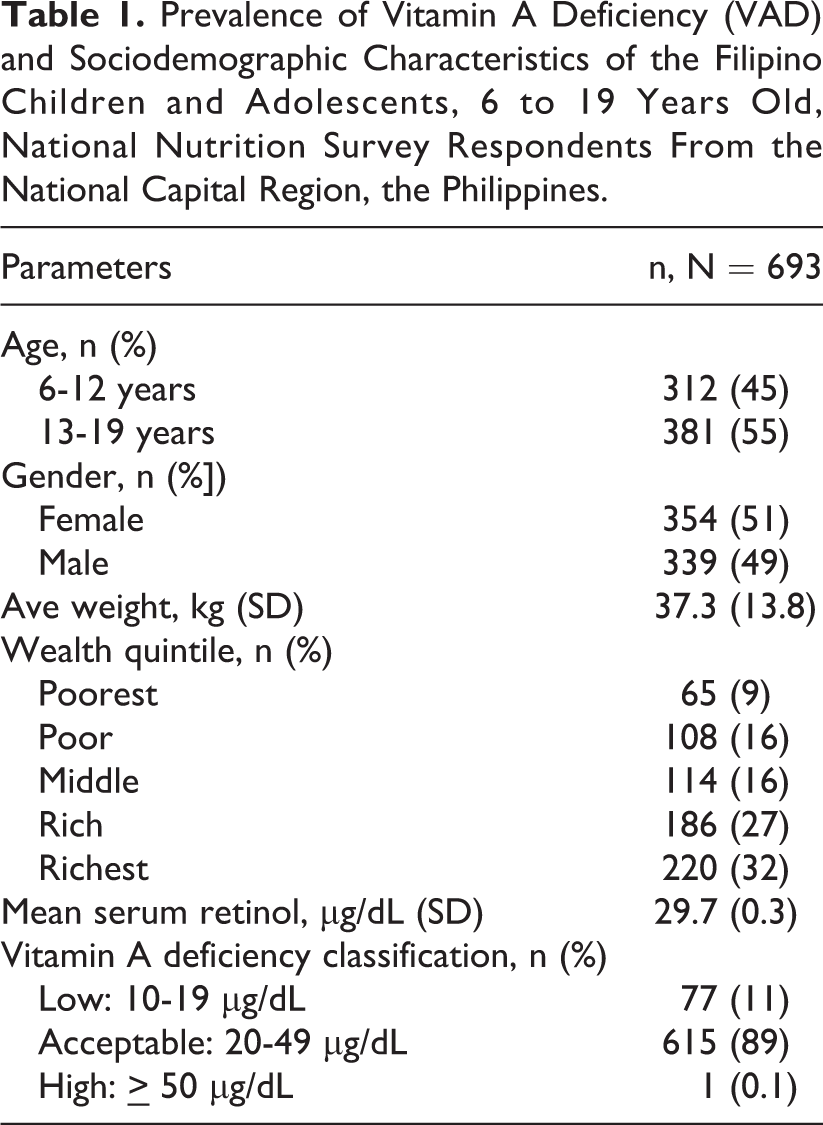
A total of 693 Filipino children and adolescents, 6 to 19 years old, were included in the study. The sociodemographic characteristics and prevalence of VAD status of the study population are shown in Table 1. Mean serum retinol levels in this group of Filipino children was 29.7 µg/dL (SD: 0.3). Overall, VAD prevalence was 11%, based on the more widely adopted biochemical indicator for VAD, serum (plasma) retinol concentration, indicating moderate degree of public health significance. 3
Prevalence of Vitamin A Deficiency (VAD) and Sociodemographic Characteristics of the Filipino Children and Adolescents, 6 to 19 Years Old, National Nutrition Survey Respondents From the National Capital Region, the Philippines.
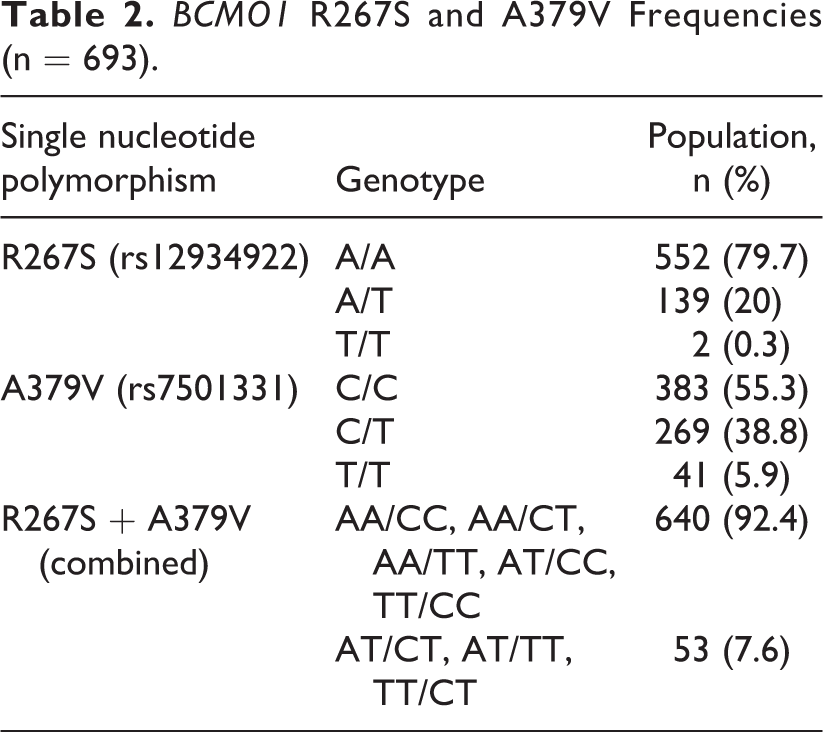
Clinical studies suggest that genetic variations in the BCMO1 gene may contribute to the large interindividual differences in efficiency of provitamin A carotenoid conversion to vitamin A. Table 2 shows frequency of known BCMO1 variants, R267S, A379V, and R267S + A379V (combined), in Filipino children and adolescents, 6 to 19 years old. There were at least 7.6% who bears the combined mutations for R267S + A379V in this group of Filipino study subjects.
BCMO1 R267S and A379V Frequencies (n = 693).
In order to determine the relationship of the individual Filipino BCMO1 genetic variants and their combination to prevalence of VAD among children and adolescents, Table 3 presents association analysis of selected BCMO1 genetic variants (dominant and recessive models) and VAD classification (World Health Organization classification) by Fisher exact test. Our results have confirmed, consistent with existing literature, that an inverse relationship exists between the A379V TT variant and VAD in Filipino children and adolescents. Although the exact role of these identified polymorphisms on retinol/carotenoid metabolism need to be confirmed in dedicated functional studies.
BCMO1 Genotypes Association With Vitamin A Deficiency Classification (Dominant vs Recessive Model) by Fisher Exact Test.
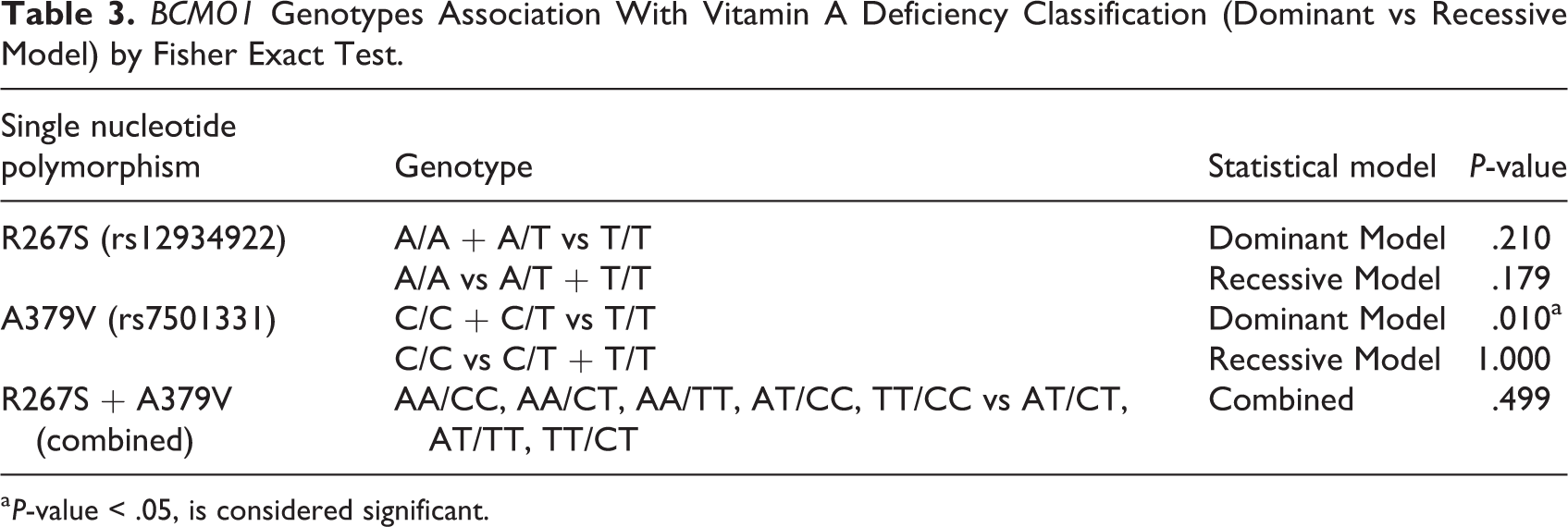
a P-value < .05, is considered significant.
Discussion
A huge interindividual variability in blood and tissue concentrations of carotenoids and retinol is consistently observed in healthy subjects in diverse population groups. 12 This variability is partly due to differences in intake of these micronutrients, vitamin A absorption efficiency, as well as efficiency of provitamin A carotenoid conversion to vitamin A. This preliminary study tackled the putative relationship between genetic variation in the human BCMO1 on the efficiency at which Filipinos convert β-carotene to maintain a normal vitamin A status. The requirements for vitamin A can be satisfied either by consumption of animal foods containing preformed vitamin A, that is, retinyl esters or by plant foods containing provitamin A. 13 According to DOST-FNRI’s NNS, plant-based commodities remained to be the major food source among Filipino households. In fact, throughout the years, food consumption from plants has increased where the highest plant source consumption was noted in 1978 with almost 77.5% of total food intake by food source. In 2013, an increase was noted from 70% in 2008 to 72.3% in 2013. However, the increase in the consumption of food from plant sources was coupled with a decrease in consumption of foods from animal sources. 14 The most common provitamin A substrate for BCMO1 is β-carotene, which is cleaved by the enzyme to form 2 molecules of retinal. The retinal formed is further converted to retinol and subsequently to retinol esters in the epithelial cells of the intestinal mucosa and then transported in chylomicrons to the liver, the main organ for vitamin A storage. The hypothesis that BCMO1 genotype affects β-carotene conversion to vitamin A is supported by several studies which have shown associations between genetic variants in the genes involved, or suspected to be involved, in carotenoid metabolism and blood and tissue concentrations of retinol. There is no available data on the frequency of these genetic variants among Filipino children and adolescents, 6 to 19 years old.
Genotype Frequencies of BCMO1 Coding Region SNPs in the Filipino Children and Adolescents Are Ethnic-Specific
Leung et al identified 2 nonsynonymous SNPs (A379V, rs7501331 and R267S, rs12934922) in the coding region of BCMO1 gene that when studied as recombinant proteins showed reduced catalytic activity toward β-carotene. The frequencies of these variants R267S and A379V with at least one T allele were identified in this group of Filipino children and adolescents living in the NCR and found to have as high as 20.3% and 44.7%, respectively. These genotypic frequencies were discovered to be distinct (ethnicity-specific) when compared with other population groups such as: European ancestry, 63.0% and 44.0%, respectively, African ancestry, 48.0% and 18.0%, respectively, and Japanese ancestry, 21.0% and 27.0%, respectively. 15 Consistent with the report from the International HapMap Project, these particular BCMO1 SNPs exhibit highly different genotype frequencies in diverse populations, possibly pointing to selection pressure related to vitamin A status. 16 It is important to note as well that one of these SNPs, the A379V variant allele, was never found in the Yoruba population in Nigeria. In addition, of the 693 participants, there were at least 7.6% who bears the combined mutations for R267S + A379V. Carriers of combined 267S + 379V variant alleles displayed reduced ability to convert β-carotene, having at least 69% reduction rate, based on reduced retinyl palmitate: β-carotene ratios in the triglyceride-rich lipoprotein fraction and increased fasting plasma β-carotene concentrations.
Collectively, these preliminary data provide that between 20.3% and 44.7% of the Filipino population may be deprived of vitamin A requirements due to presence of one of these 2 variant genotypes. Nevertheless, these results might be important especially for the Filipino population since individuals with polymorphisms in the BCMO1 gene may also have a higher requirement for preformed vitamin A to address VAD, which is still a relatively frequently occurring state in developing countries, such as the Philippines. 17
The A379V TT Variant Was Found to Be Significantly Associated With VAD Among Filipino Children and Adolescents
Retinol is one of the 2 most concentrated vitamin A forms found in the human fasting blood. Although its usefulness for assessing individual vitamin A status seeks further investigation, retinol levels are still acknowledged to provide valuable information on the VAD of a population. 3 Blood retinol levels have also been successfully used as primary outcome indicator to determine level of association between BCMO1 SNPs and vitamin A. 18 Several other studies have determined the effects of genetic variations on vitamin A metabolism, and most of them are dedicated to correlations with blood concentrations of retinol. Since it has been established that this group of Filipino NCR residents has unique BCMO1 genotype frequencies as compared to other population groups, possibly due to adaptation and evolution, it is relevant to study the contribution of these genetic variations to retinol/vitamin A status in the population. 12
Interestingly, the variant R267S, both in dominant and recessive models, as well as the combined R267S + A379V, did not seem to influence the vitamin A status. It is probable that other factors could have modified their relationship, including high miscegenation of the Filipino population. However, a significant association (P < .01) by Fisher exact test, in the A379V variant, was identified. The inverse association between the A379V T allele and vitamin A status, however, was opposite from that expected based on the positive association reported previously. 18 Liver retinol stores may be more affected by BCMO1 variation, as suggested by the reduced liver vitamin A concentrations in β-carotene-fed BCMO1 (Bcmo1-/-) knockout mice. There were some interesting, unexpected changes in β-carotene metabolite levels upon β-carotene supplementation in Bcmo1-/- mice. Firstly, there was an increase in retinol in the lung upon supplementation in Bcmo1-/- mice. Liver stores must be mobilized in times of dietary retinoid-insufficiency to supply peripheral tissues with retinoid needed for maintaining various essential biological functions. Mobilization requires that the retinyl ester first be hydrolyzed back to retinol. Upon hydrolysis, retinol is thought to be transferred back to the hepatocyte, where it is bound by its specific transport protein, RBP. Once bound by RBP, the retinol-RBP complex enters the bloodstream for transport to peripheral tissues. A changed RBP-retinol complex has been associated with an increased delivery of retinol to different tissues and might possibly explain our retinol plasma and lung tissue concentrations in Bcmo1-/- mice. 19 The surprising findings in retinol levels in Bcmo1-/- mice and the understanding of these differences are especially important in understanding the effects of β-carotene in humans, in particular since downstream β-carotene metabolism is different between mice and humans, and also between humans. 17
It is currently not known to what extent provitamin A carotenoid bioconversion is affected by liver vitamin A reserves. A study by Moran et al, discovered that the BCMO1 rs7501331 genotype was a determinant of end-of-study prostate β-carotene, with the T-allele being associated with lower prostate β-carotene and baseline plasma phytoene, therefore higher retinol concentration. 20 Another study in Zambian children with hypervitaminosis A supports this regulation. Indeed, these children had high serum carotenoid concentrations, and many of them experienced hypercarotenodermia during mango season, a period of high carotenoid intake. 12 Ribaya-Mercado et al 21 study on Filipino school-aged children showed retinol and serum carotenoids increased during the intervention, indicating that, conversion of plant carotenoids to vitamin A may vary inversely with vitamin A status. Another kind of genetic variation that could modulate the association between A379V (rs7501331) and vitamin A status is epigenetic modification. Epigenetic modification would add another level of complexity to the genetic regulation of vitamin A metabolism as SNPs that are involved in biological processing of carotenoids in one individual might have no effect in another person due to epigenetic modifications that switch off genetic variations. 16
Although statistically significant relationship was found, a polymorphism associated with a higher vitamin A status only explained small portion of the variance at the population level, and other variations in genes related to the absorption, transport, and cleavage of carotenoids are likely involved in the individual variation in response to dietary carotenoids, as well as their transcription factors. 22,23 Concerning retinol concentration as primary basis of vitamin A status, it is actually the measurement of liver stores of vitamin A that is considered the gold standard to assess an individual’s VA status. However, there is no noninvasive method to date, and thus, the use of alternative biomarker was maximized. There is also no adjustment performed on P values for multiple testing, particularly (eg, gene-diet interaction tests). The knowledge of a genotype associated with low fasting blood retinol or vitamin A status only provides little information regarding the best nutritional strategy to adopt to avoid VAD, and it is thus more relevant to search for genetic variations associated with postprandial blood vitamin A concentrations, a marker of the preformed vitamin A/provitamin A carotenoid responder phenotype. 12 Possible association between the BCMO1 SNP genotypes and carotenoid intake was not determined because potential over- or underreporting in dietary data was not formally analyzed, which may be considered as a further limitation. Despite limitations, the association may still be useful in epidemiologic analyses because still the distributions of genetic variants in different population groups are random and independent from dietary intakes, according to Mendel’s rules of inheritance. 18 Moreover, establishment of the association using data from a NNS may be particularly important in persons who are at high risk of VAD to reduce prevalence of VAD. 24 Yet, the potential usefulness of this area of research is exciting regarding personalized nutrition and the fight against VAD.
The results of this study shall inform research on reducing VAD among Filipino children, since it may be basis in testing future researches that shall explore interindividual variable responses to the addition of β-carotene-rich foods in the diet. In the end, the association of genotypes with indicators of VAD will lead to the formulation of appropriate recommendations such as increased β-carotene or preformed vitamin A intake or the use of vitamin A supplements. For example, an individual or a group of individuals exhibiting VAD (or at risk) with low capacity convert provitamin A carotenoids should be given preformed vitamin A supplements.
Conclusion
In summary, this study has identified for the first time the presence of 2 nonsynonymous genetic variants in the coding region of BCMO1 gene among Filipino children and adolescents living in the NCR, Philippines. Interestingly, only one of these 2 variants, the A379V T, was found to be significantly associated with vitamin A status. Nevertheless, it should be reminded that genetics only represents one of the factors that affect vitamin A status, albeit stable over the lifespan, since other factors, such as provitamin A and vitamin A dietary intake and factors that affect their bioavailability (eg, cooking practice) also affect this status. Still, much work remains to be done to identify all of the SNPs involved in vitamin status and bioconversion and to assess the possible involvement of other kinds of genetic variations, for example, copy number variants, epigenetic modifications, and insertions/deletions in these phenotypes. Yet, the potential usefulness of this area of research is exciting regarding the proposition of more personalized dietary recommendations for vitamin A, particularly in populations at risk of VAD, such as the Philippines. 12 It is, therefore, warranted to investigate the role of BCMO1 variants for the success of supplementation programs and fortification efforts among vulnerable populations in this region. Genetic variability should be considered for future provitamin A supplementation recommendations among children and adolescents in the Philippines.
Footnotes
Authors Note
Jose Maria Reynaldo Apollo Arquiza is also affiliated with the School of Biological and Health Systems Engineering, Arizona State University, Tempe, AZ, USA. Ma. Neda Alcudia-Catalma is also affiliated with the Science Education Institute DOST, Taguig City, Metro Manila, Philippines.
Declaration of Conflicting Interests
The author(s) declared no potential conflicts of interest with respect to the research, authorship, and/or publication of this article.
Funding
The author(s) received no financial support for the research, authorship, and/or publication of this article.
