




Abstract
Purpose:
This study aimed to translate and test the content validity and reliability of an English questionnaire used in the American food and health survey.
Methods:
The questionnaire was developed using 6 stages, then examined for test–retest. A total of 672 participants were recruited for validation and reliability. Validity test was performed using a correlation coefficient to measures the linear correlation between 2 questions at one given time. Moreover, the Kaiser-Meyer-Olkin, Measure of Sampling Adequacy, and Bartlett’s Test of Sphericity were performed to statistically determine the suitability for conducting exploratory factor analysis. Furthermore, reliability tests using Cronbach α was used to estimate the reliability coefficient properties of the translated scale. Finally, the most important correlated questions was plotted using a color-coded correlogram.
Results:
The test–retest reliability of all tested items was significantly correlated. The reliability test for all questions was 0.9. The cross-correlation test showed that all questions of the translated questionnaire were correlated significantly (P < .05) indicating reliability of the questionnaire.
Conclusion:
The tested questionnaire is applicable and may be used in population-based studies to raise awareness regarding health, food consumption, nutrition, and food safety among people in Jordan and/or other Arab countries.
Introduction
Adequate nutrition knowledge, optimal dietary behaviors, and the maintenance of a healthy weight are now recognized as key modifiable factors in health promotion and chronic disease prevention.
1
Spreading awareness has become a critical factor in changing the attitude and behavior of people.
2
Health awareness is defined as educating individuals and increasing their knowledge to change their behaviors and habits into healthy behavioral patterns. The World Health Organization (WHO) defined health as
Questionnaires are considered a simple way of collecting useful comparable data from a large number of individuals that can be used to assess either broad or particular dimensions of health.
5
In addition, a questionnaire is a good tool for collecting data about people
Pilot studies refer to initial small versions of full-scale studies that are carried out to test the possible effects and associations or for helping to design further confirmatory studies. 7 It is important that the questions asked any questionnaire to be carefully piloted. Pilot studies also represent a pretest of a particular research tool such as a questionnaire. Additionally, a pilot study is an important element for good study design and increasing the probability (but not guarantee) the success of the main study. 8 The target of piloting is to take the problems that participants face while filling forms into consideration, so it provides guides to make necessary changes in questions and minimizes the bias of response. 5
Studies in the Middle East show that adolescents
Jordan is one of many countries globally that has been moving through a nutrition transition. 10 More specifically, the changes in lifestyle due to globalization, rapid urbanization, and the evolution of technology. These changes greatly impacted dietary patterns, making food less diverse, less healthy, and less sustainable. 10,12 As a result, people tend to replace traditional diets of varying nutritional quality with modern diets, mainly processed and convenient. 13 The nutrition transition has been linked to the elevating burden of overweight, obesity, and chronic metabolic diseases in the Eastern Mediterranean Region. 12
The Food and Health Survey was distributed online from March 13 to March 26, 2015, for the US population. The survey was entitled:
To validate a questionnaire, the content of a question is assumed to be well understood by the participants/subjects. 5 The pilot study tests the validity of questions to check whether all participants understand questions the same way or not. 15,5 A validated survey means that it “measures what is intended to be measured.” 16 Validity explains how the collected data covers the real area of study. 17 The original English survey intended to measure how extent Americans take care of their health and nutrition, and it contained questions about health and diet, sustainability, and food safety questions. There are different types of validity, including content validity, that was used in this study. Content validity means “the degree to which items in a survey reflect the content universe to which the survey will be generalized.” 18
Reproducibility or reliability evaluates the agreement between 2 readings from the same sample, while validity refers to the accuracy of a method or instrument to measure what is supposed to measure. This study aimed to translate and test the content validity and reliability of an English questionnaire used in the American food and health survey.
Materials and Methods
Translation and Validation
The English version of the Food and Health Survey was translated into the Arabic language. The Arabic version of the survey was then back-translated into English. The translation and back-translation were performed and checked by independent linguistic professionals who are acquainted with food and nutrition sciences and have experience in research.
Characteristics of the Study Participants
We estimated the sample size for our survey to be around 400 to 450 participants using a factor analysis design, assuming a confidence level of 95% (95% CI) that the real value of the mean knowledge score is within 5.0% (α level) and type II error of about 20% of the surveyed values for an infinite Jordanian population (10,832,645) according to the latest Jordanian statistics. 19 In the final analysis, we planned to add around 700 individuals to raise statistical power to 90%. 20 Participants aged between 18 and 80 years were involved in this study by which 70.5% were female and 29.5% male, 26.16% married, 30% smoker, 74.6% have bachelor and postgraduate degrees. Participation was voluntary, with no monetary or nonmonetary incentives offered. The participants were invited to fill the questionnaire using social media until the target participants were achieved. This questionnaire was approved by the Research Ethics Committee of Faculty of Pharmacy and Medical Sciences, University of Petra, Amman, Jordan (REC: 7Q/1/2020). Participants were not requested to provide verbal or written consent to approve enrollment in this study due to the electronic nature of the distribution and administration of the questionnaire. Therefore, reading the introduction, completing, and sending questionnaires were considered approval for participation in this study. The importance of online questionnaires in health research has several advantages and received great acceptance, and broader application use than paper questionnaires, whereas no statistically significant difference, was found between the online and paper-based methods compared with a greater than 97% agreement with a face-to-face structured interview. 21
Questionnaire Development
The development of the questionnaire was a 6-stage process according to the method described by Byrd-Bredbenner et al. 22 The first stage involved using published reports and papers related to the research 5,6,14 and input from a panel composed of experts in food and nutrition to identify health concepts that are key to protecting consumer health.
The second stage was to construct a bank of objective questions to assess knowledge of health and nutrition. All items measuring the same category concepts were grouped to identify the specific knowledge targeted later in educational interventions. The questions were designed to be multiple choice with 2 to 20 answer choices, true/false items, or dichotomous answer series items, which have questions followed by a series of answers requiring a response. Some multiple-choice questions had more than one answer, and some had only one choice, while true/false items had one correct answer.
The third stage was to review the initial question bank by the panel of experts in health, food, and nutrition at the University of Petra to select the most important questions related to local Jordanian culture and identify improvements needed in question phrasing. Furthermore, questions were assessed to check the suitability for the subjects and determine the completeness of the questions in measuring the depth of food and nutrition knowledge and removing unnecessary items because they present the same content of other items or were seemed to be outside the field of the study. Items with the same content were removed to reduce the length of the questionnaire. Improvements were made to item distracters, correct answers, and question body in cases where removing the question would diminish the benignity of the scale. The distractor analysis calculates how much each wrong option contributes to the overall quality of a multiple-choice item. 23
The fourth stage was to translate the original questionnaire from English to Arabic and modify the questions to meet the local culture incorporation with experts in the field of study. The tool was back-translated to the English language for validation purposes.
In fifth stage, the questionnaire was converted into an online survey and was distributed by the students of second, third, and senior classes of bachelor
Before the administration, the online survey was examined comprehensively to ensure no technical errors in working or recording of responses. The type of questions was close-ended questions that are quick to answer and completely do not require much thinking process; in contrast, they do not allow subjects to expand the answer or offer alternative views. Moreover, subjects may tick at random to answer the close-ended questionnaire. 9 The participants were asked to add notes related to the questionnaire for development purposes; all notes were taken into consideration.
The sixth stage was like the final review by the expert panel to identify any other needed refinements and verify the accuracy of the answer key after the respondents
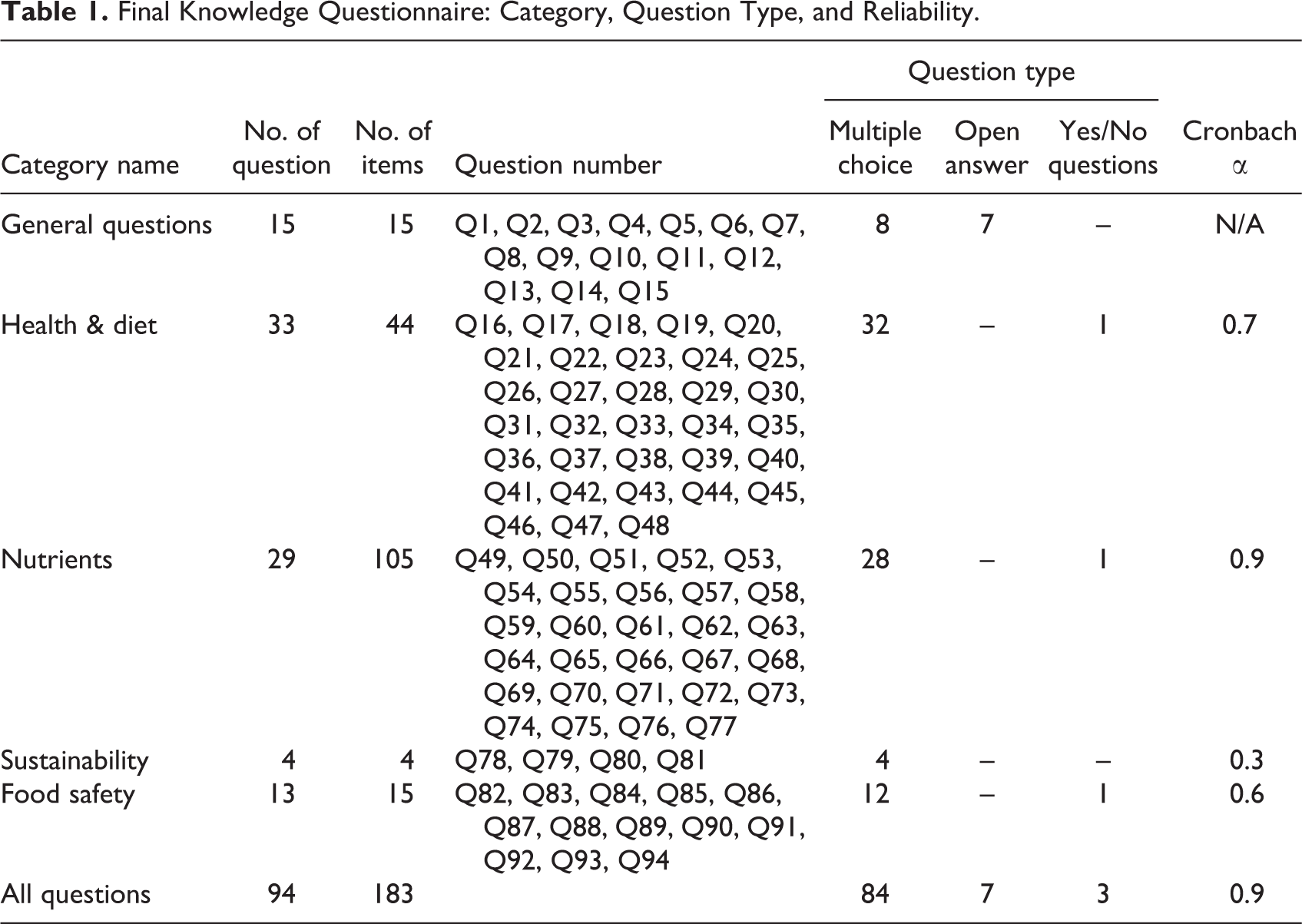
Final Knowledge Questionnaire: Category, Question Type, and Reliability.
Test–Retest and Data Analysis
Test–retest was conducted using 50 participants aged between 18 and 80 years from both genders with different levels of education. Participants were initially asked to fill the questionnaire twice. The first time was in October 2018 then the second was in December 2018. An 8-week time frame between the 2 tests was found enough to avoid participants from recalling their former responses. All participant comments for improving the survey were taken into consideration. Data of the participant answers (first and second-time answers) were handled using excel sheets. The demographic data were excluded from similarity checking. The first author cleaned repeated data before analysis to ensure data quality. Answers to all questions were coded for statistical analysis. Data coding for the main items of the questionnaire followed an ordinal (Likert-like) scale with options that included strongly agreed = 5, agree = 4, neutral = 3, disagree = 2, and strongly disagree = 1. This approach was suggested by the original developers and was maintained in the Arabic translation.
Validity test
For the validity procedure, cross-correlation was performed to assess the validity by creating a correlation matrix of all questions involved in the questionnaire. Pearson product-moment correlation coefficient was used as a bivariate correlation to measures the linear correlation between 2 questions at one given time. Statistically significant correlation indicates that the 2 questions are related to the same concept/construct. The results of cross-correlations are shown visually in a cross-correlogram. Multivariate statistical technique exploratory factor analysis was used to examine discriminant and convergent validity and identify a relatively small number of factors that can represent the relationship among sets of larger interrelated variables. We used maximum likelihood extraction and ProMax rotation. Before running the “factor analytic” procedure, the Kaiser-Meyer-Olkin (KMO), Measure of Sampling Adequacy (MSA), and Bartlett
Reliability tests
Internal consistency
For the reliability (internal consistency) procedure, Cronbach α was used to estimate the reliability coefficient properties of the translated scale and the 5 categories of the scale. Such a procedure was performed to assess the internal consistency which is typically measured based on the correlations between different items on the same scale category. The following guide was made to interpretation: Excellent = 0.9 ≤ α; Good = 0.8 ≤ α < 0.9; Acceptable = 0.7 ≤ α < 0.8; Questionable = 0.6 ≤ α < 0.7; Poor = 0.5 ≤ α < 0.6; Unacceptable = α < 0.5. Using a subsample test–retest data were obtained and analyzed.
Cross-correlation test and correlogram
The correlation coefficient between all questions and their significance levels were calculated via cross-correlation test 24 using the Statistical Package for Social Sciences (SPSS, version 26). To highlight the most important correlated questions in terms of their values, strengths, and signs without visual load, a color-coded correlogram (with circle shape) was plotted using R foundation for Statistical Computing software (R version 3.5.3 [2019-03-11]) copyright 2019 where red color was used to indicate negative correlations and blue color was used to indicate positive ones. The color shade and circle size indicate the correlation coefficient value 25 as shown in Figure 1.
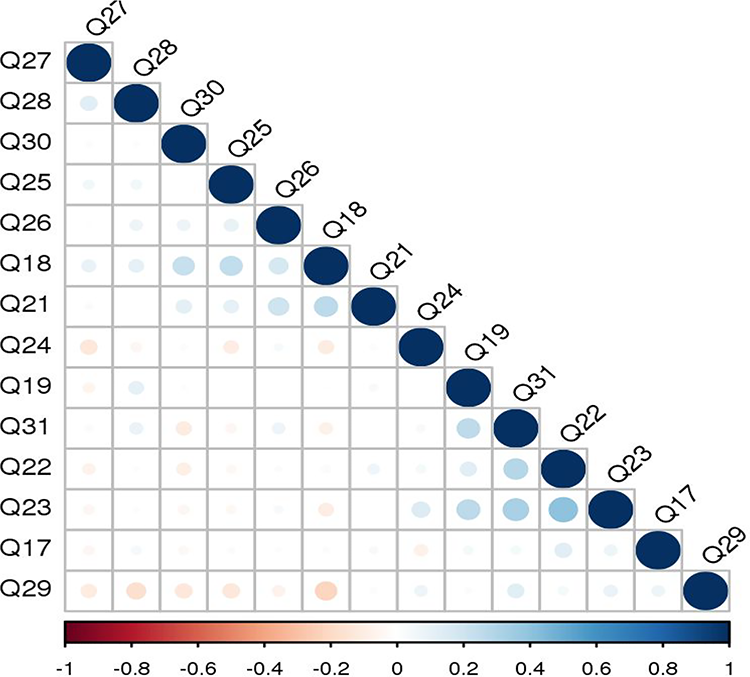
Correlogram of a sample of significant correlations among (diet and health) questions of the translated questionnaire.
Exploratory factor analysis
Results from the KMO measure of sampling adequacy (=0.90) and Bartlett
Factor Correlation Matrix.a
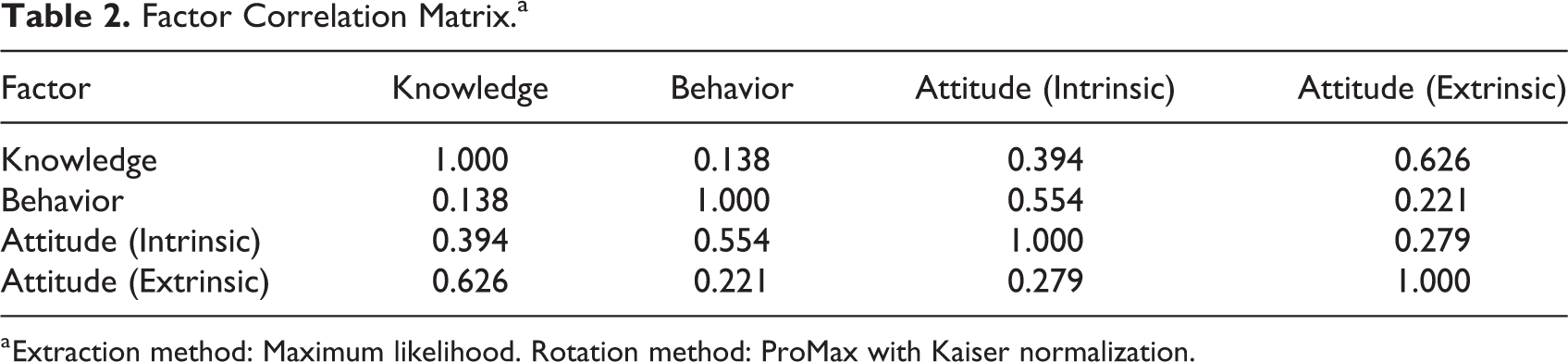
a Extraction method: Maximum likelihood. Rotation method: ProMax with Kaiser normalization.
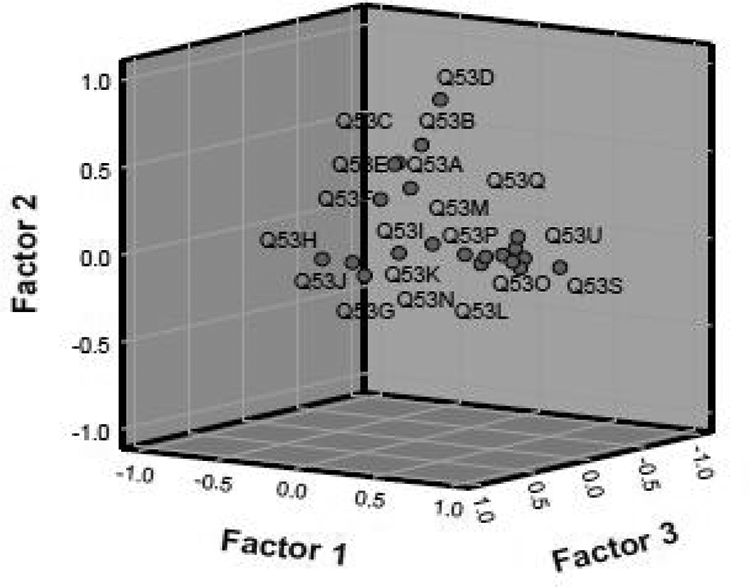
Factor plot in rotated factor space.
Results
The number of questions became 94 structured in 5 sections: 15 general questions about demographics and socioeconomic status including age, gender, marital status, education level, income, residency place, and anthropometrics (weight and height), 33 health and diet-related questions, 29 questions about nutrients, 4 questions about sustainability, and 13 questions related to food safety. Cross-correlation was high, suggesting construct validity. The reliability test (Cronbach α) for all questions was 0.9; moreover, the reliability score for each category ranged from 0.3 to 0.9, whereas nutrients 0.9, health and diet 0.7, food safety 0.6, and sustainability 0.3. On the other hand, the reliability test (Cronbach α) for the sustainability questions was 0.3, indicating poor reliability of coefficient properties and poor relationships with other categories. These questions cannot be used independently by participants if the questionnaire focuses on sustainability rather than conducting a comprehensive evaluation. This is due to participants’ unfamiliarity with this type of question, hence removed from the questionnaire. Researchers recommend improving awareness and knowledge of Jordanian society in this regard.
Discussion
In this research, a pilot study was carried out to test the content validity and reliability of a questionnaire. In addition, the authors piloted a translated questionnaire to test its validity and reliability in a sample of 672 adult participants.
Validity
Validation includes evaluating a new survey tool to ensure that it involves all the important items and remove unfavorable items to a particular contrast domain. 26,27 The questionnaire was modified according to the participants’ notes which were related to some concepts and the name as well as the availability of some food items in the Jordanian market.
Reliability Tests
In this research, the reproducibility was evaluated by administering the questionnaire on 2 occasions, 1 month apart, to minimize potential temporal changes in participants’ answers. The answers of the participants were checked for similarity. A validated tool to assess health and nutrition awareness is essential to provide reliable data and develop effective evidence-based strategies and programs to address health-related problems. 28 The response and compliance rate were high; 50 respondents voluntarily and conveniently filled the questionnaire twice, showing the same perceptions about the questions. The test–retest reliability of all tested items was significantly correlated. A strong correlation was found between both questionnaires, indicating that the questionnaire in this study is a reliable tool for future studies.
Valid questionnaires to assess health and nutrition status in Jordan are lacking. To the best of the authors’ knowledge, the present study is one of the scarce studies conducted in Jordan. This study evaluated a translated questionnaire adopted from an American questionnaire used in the 2015 food and health survey. Translation from English to Arabic was completed to ensure that the translation is related to local literary forms and appropriate for Arab culture. The Back-translation of the proofed version of the questionnaire was done to ensure accuracy. The translation and back-translation of the questionnaire showed that the questionnaire is a valid tool to be used in further studies. The back-translation technique used in this study is a way of translating a questionnaire into the target language by a translator and then translated it back into the original language by an independent translator who does not know about the original questionnaire to ensure that the tool is appropriately adapted for the local culture and meets the specification which is needed invalidation. 29 Many factors that affect the quality of translation in research include the linguistic qualification of the translator and the translator’s knowledge of the participants. 30 Therefore, the translation must be conducted by a truly bilingual translator (who can speak the original and target languages equally well) and who is sufficiently educated to have familiarity with the concepts and have experience in the field of the study. 31 The translator of the questionnaire was familiar with the area under study. The back-translation method is preferred even though it is expensive and time-consuming. 9
When used with calibration factors, the developed questionnaire is useful in estimating health and nutrition awareness in different populations that speak Arabic as their primary language. In addition, this questionnaire may also be used in population-based studies to monitor dietary intakes and food consumption patterns. Thus, this questionnaire can be used as a valid and reproducible Arabic questionnaire to assess health and nutrition knowledge among the Jordanian population and be used in other related studies in different Arabic-speaking countries.
The tested questionnaire has proven relative content validity and reproducibility. Therefore, it is applicable and may be used in population-based studies to raise awareness regarding health, food consumption, and nutrition among Jordan and/or other Arab countries.
Cross-Correlation Test and Correlogram
A cross-correlation test is a test that is used to assess the correlation between a set of data. 25 The cross-correlation test output showed that all questions of the translated questionnaire were correlated significantly (P < .05). The correlogram displayed in Figure 1 shows a sample of these significant correlations. The displayed correlated questions are those of (Health and diet) category. Nonetheless, we have found significant correlations among all other categories (data are not shown to avoid visual overload). The displayed correlated questions, their answer formulas, and classification in terms of knowledge, attitudes, and behavior questions are shown in Table 3. The significant (P < .05) correlations between the questions of the whole questionnaire indicate the questionnaire reliability. The reliability of this questionnaire was tested by 2 methods, that is, test–retest reliability and cross-correlation test to assess question correlation. Both ways indicated excellent reproducibility of the translated questionnaire.
The Formula of a Sample Correlated (Health and Diet) Questions.
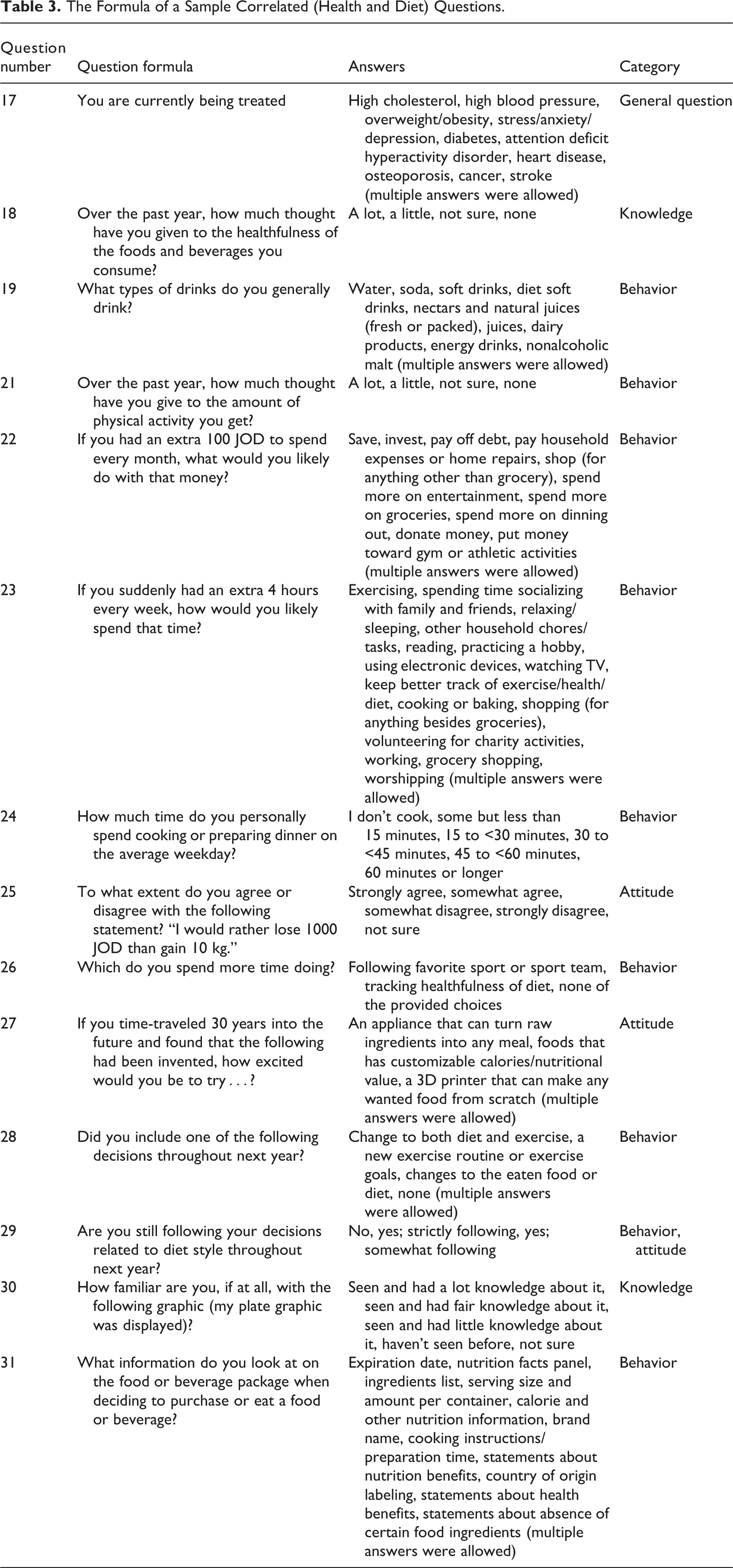
The significant correlation coefficients among different questions are not surprising. Previous reports have supported the relationship between knowledge of nutrition and health, attitude, behavior (in terms of food choices and food intake quantity and quality), and health outcome in Jordan 32 and worldwide. 33
Conclusions
This pilot study of a questionnaire was designed to assess health and nutrition knowledge among the Jordanian population. The pilot study demonstrated that the tested questionnaire had proven relative content validity and reproducibility. Therefore, it is applicable and may be used in population-based studies to raise awareness regarding health, food consumption, nutrition, and food safety among people in Jordan and/or other Arab countries.
Footnotes
Acknowledgments
The authors would like to acknowledge Miss Nour Hamed for her assistance throughout this research.
Declaration of Conflicting Interests
The author(s) declared no potential conflicts of interest with respect to the research, authorship, and/or publication of this article.
Funding
The author(s) disclosed receipt of the following financial support for the research, authorship, and/or publication of this article: This research was funded by the Dean of Scientific Research and Graduate Studies at the University of Petra/Amman/Jordan, grant number 18/4/2020. The funders had no role in designing the study, collection, analyses, or interpretation of data, nor in the writing of the manuscript or in the decision to publish the results.
