




Abstract
Background:
The ability for women to operate as food entrepreneurs presents opportunities to leverage at-home production technologies that not only support family nutrition but also generate income. To these ends, the Feed the Future Malawi Agriculture Diversification Activity recently launched a development project involving a new technology, the Soy Kit. The Activity, a USAID (United States Agency for International Development) funded effort, sought to improve nutrition utilizing an underutilized local and highly nutritious feedstuff, soybean, through a woman’s entrepreneurship scheme.
Objective:
The USAID funded effort provides the overarching research question, whether the Soy Kit is a sustainable technology for delivering nutrition and income through a women’s entrepreneurship scheme. If true, then development practitioners will have a valuable tool, and the associated evidence, to address the important crosscutting themes, of nutrition, poverty, entrepreneurship, and women’s empowerment. To answer this research question, the research team first evaluates the underlying production economics of the kit to measure profitability, return on investment, and operational performance. Second, the team qualitatively and quantitatively assesses the kit’s overall appropriateness as a technology for the developing world.
Methods:
The team follows the schema of Bower and Brown and utilizes descriptive statistics, and financial techniques to conduct an assessment of the economics and technical appropriateness of the Soy Kit technology.
Results:
The results show a high level of appropriateness across a number of metrics. For example, the payback period from cash flow is under 6 months and the annual return on capital is 163% when entrepreneurs utilize a domestically sourced kit valued at US$80.
Conclusion:
The technology matches well with the rhythm of household economy, in particular women’s labor availability and resource base. Businesses earn significant returns on capital thus appear to be sustainable without donor subsidy. At the same time, available capital to finance kit entrepreneurs appears to be scarce. More research needs to take place to address the credit access question, in order to make small-scale kit entrepreneur truly self-reliant; the effects on poverty reduction at the household and village level; and nutrition improvement among the consumers.
Introduction
There historically has been strong interest in value-adding technologies appropriate for households and small farmers operating in the developing world. For example, food technologies that increase nutrient density of weaning porridges while being easy to integrate into the household can be effective elevating the health status of children. 1,2 Additionally, the ability for women to operate as food entrepreneurs presents opportunities to leverage at-home production technologies to not only support family nutrition and generate income but provide consumers with nutritious foods. 3,4 To these ends, the Feed the Future Malawi Agriculture Diversification Activity recently launched a new technology, the Soy Kit, to improve household nutrition and support female entrepreneurship.
The business model entails a simple technology to produce soy milk that incorporates a series of components often found in the household and familiar to women (Figure 1). The kit developed by the nongovernmental organization (NGO) Malnutrition Matters contains the following: (1) a heat-retention cooking bag, (2) lined rubber gloves, (3) a food-grade plastic pail, (4) 3 nylon filter bags and cheese cloth, (5) a mixing spoon, (6) a tofu ladle, (7) a users’ manual, (8) a scale, (9) a small brush, (10) an 8-liter cook pot, (11) a thermometer, (12) a mill/grinder, (13) a colander, (14) a large plastic bin, and (15) a wooden spoon.
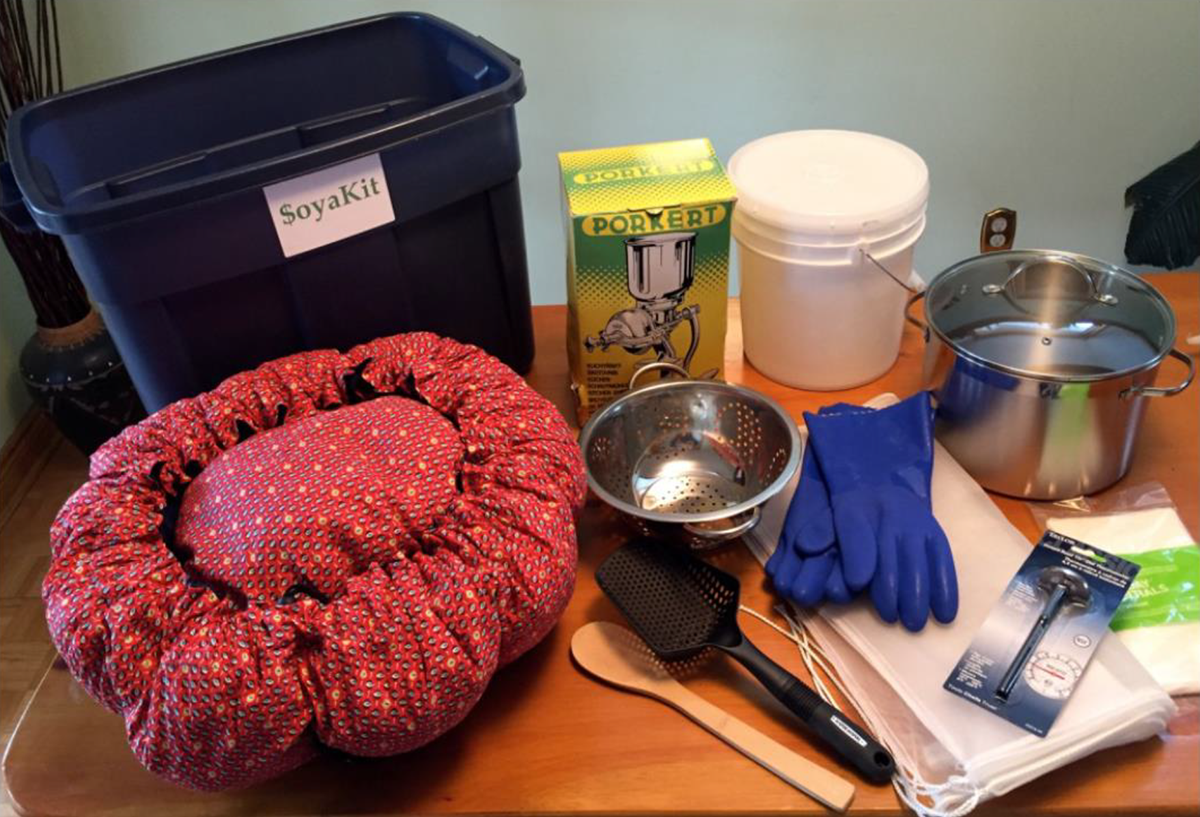
The Soy Kit. Source: Malnutrition Matters. 5
The soy cow dominates the small enterprise space for converting soybean into soy dairy products. 6 However, the soy cow serves the commercial sector with a capacity of 1560 liters of milk output per month and a capital investment of US$10 000. 6 Alternatively, the Soy Kit fills the niche of the household enterprise and the woman entrepreneur producing and selling less than 150 liters per month. Investment requires US$80 (domestic version) or US$200 (imported version) of capital. The kit yields 3.5 liters of soymilk and 1 kg of okara, a high protein–high fiber liquid by-product per batch from 600 grams of soybean. 5 The operator completes each batch in 30 minutes, though some entrepreneurs adopt longer cooking times of 45 to 60 minutes, depending on their heat source or taste preferences. 7 Entrepreneurs can further process the milk into yogurts, cheeses, and tofu, while the okara when dried becomes a baking ingredient, or in raw form, serves as a porridge ingredient and animal feed.
Development practitioners seek to use the Kit to reduce poverty and malnutrition by involving women as food entrepreneurs and leveraging an at-home production technology. The specific development project in Malawi that introduced the Kit sought to improve nutrition utilizing an underutilized local and highly nutritious feedstuff, soybean, through a woman’s entrepreneurship scheme.
The USAID funded effort in Malawi creates the overarching general research question for this article, which had yet to be answered: whether the Soy Kit is a sustainable technology for delivering nutrition and income through a women’s entrepreneurship scheme. If true, then development practitioners will have a valuable tool, and the associated evidence, to address the important crosscutting themes, of nutrition, poverty, entrepreneurship, and women’s empowerment.
This article presents the first analysis of its kind on the Kit by answering 2 research questions; whether the kit is economically sustainable and whether the Kit is an appropriate technology. Specifically, the research team evaluates the underlying production economics of the Kit to measure profitability, return on investment, and operational performance. Second, the team follows the schema of Bower and Brown and qualitatively and quantitatively assesses the kit’s overall appropriateness as a technology for the developing world. Understanding the technology’s appropriateness will allow policy-makers and donors to assess the kit’s viability, or sustainability at scale, without donor funding.
Literature Review
The adoption of new technology is essential for businesses to reduce cost, improve productivity, and spur economic growth. 8 Unfortunately there is very little research on the role of African women entrepreneurs in general and even less on food technology adoption among women entrepreneurs. Olaoye, for example, makes a compelling argument for value-added food processing in Nigeria to enhance food security, but neglected to analyze the role of women entrepreneurs might play. The literature though clearly identifies that women entrepreneurs face significant barriers to entry when adding value to raw commodities through processing enterprises. For example, financing and accessing a production site or operating a facility within food safety standards present significant challenges to women entrepreneurs. 9 This explains why home-based businesses dominate the food processing space for women entrepreneurs. Additionally, women are critical to the application of indigenous knowledge within the food processing space, 10 which too often falls outside the formal food sector. Indigenous practices, by definition, reflect a preference for known, as opposed to the adoption of unknown or new, technologies. The lack of integration into the formal food economy therefore may explain the paucity of literature or evidence as women food entrepreneurs operate in the informal sector. 11 Researchers may more easily miss these secondary activities, or be unable to access formal data sets associated these economic activities because in fact the data aren’t collected. Other than the small literature on commercial soy milk production, 6 no study on the operations of women led food processing businesses exist. Thus, this article presents some of the first evidence of business performance of women entrepreneurs in the food processing sector by using a unique data set comprised of their own business records.
Productivity growth in particular in the developing world requires the availability of technological innovations for agriculture and adoption of these innovations by the local community. 12 Sustained adoption though only takes place under conditions of technology appropriateness (Tamimie and Goldsmith, 2019).
The appropriate technology movement began in the 1970s to create novel technologies or identify existing technologies for small-scale and labor-intensive farm production systems. 13 -15 A mismatch occurs when less developed countries attempt to adopt capital-intensive technologies that require robust market linkages, scarce critical inputs and parts, and uniquely skilled workers. 14
Many economists, using a capital intensity index that measures the ratio of capital to labor, argue that high-intensity technologies are inappropriate to settings with low capital: labor ratios (Alauddin and Tisdell, 1988). 15 -17 For example, Alauddin and Tisdell analyze various Bangladeshi industries and determine agricultural technologies to be labor-intensive, thus appropriate. Basu and Weil 15 and Los and Timmer 16 generate patterns of productivity convergence and divergence across countries considering the concept of appropriate technology. Tendencies toward divergence in levels of productivity gain result from new knowledge emerging from one country not matching an appropriate capital: labor ratio in a second country. Countries diverge positively (negatively) in the rate of productivity gain when they can (not) assimilate the technology due to an appropriate (inappropriate) matching of capital and labor. The productivity gains readily materialize when the technology is appropriate. 15
Assessing the appropriateness of technology is an essential but complex process as it not only involves economic aspects but also social, environmental, and ethical considerations as well. 8,18 Interestingly, appropriate technologies in developing countries will be “labor-intensive” and “small-scale” but neither of the terms necessarily implies an “appropriate technology.” 14 Agricultural technologies and practices can only be expected to be adopted when farmers attain higher and more stable income opportunities and profitability within an environment of functioning markets and favorable output/input price ratios. 8 Cost–benefit analyses measure profitability levels associated with a new technology, which is a necessary condition for adoption. 19 Finally, any definition of appropriate technology that discounts “localness” would be deemed inappropriate. 13 Therefore, an assessment of the technology is subjective and seeks to be compatible with local environments. 8,13,20,21 The context, that is, economic, social needs, and environmental risks, establishes the level of technical appropriateness. 21
Bowonder 20 suggests possible sets of criteria for identifying technology appropriateness such as; labor intensity, productivity improvement, ecological stability, and energy use intensity. USAID defines appropriate technology for developing countries as technologies which are intensive in the use of the abundant (local) factor and domestically produced inputs. 22 In terms of small production units, appropriate technologies are small scale but efficient, readily operated and maintained, and low in cost so that they are accessible to low-income people. 22
Bauer and Brown 13 develop a quantitative assessment tool with 49 indicators of technology appropriateness using a literature meta-analysis that reflect the contextual characteristics (Table 1). The authors rank an indicator’s level of importance by counting its prevalence in the literature. So indicator #1, community input sits as the most important feature of appropriateness, while #49, reusability, becomes the least. They then use these ranked indicators as a tool for “scoring” appropriateness of a technology.
Bauer and Brown (B&B)’s Indicators of Appropriateness.
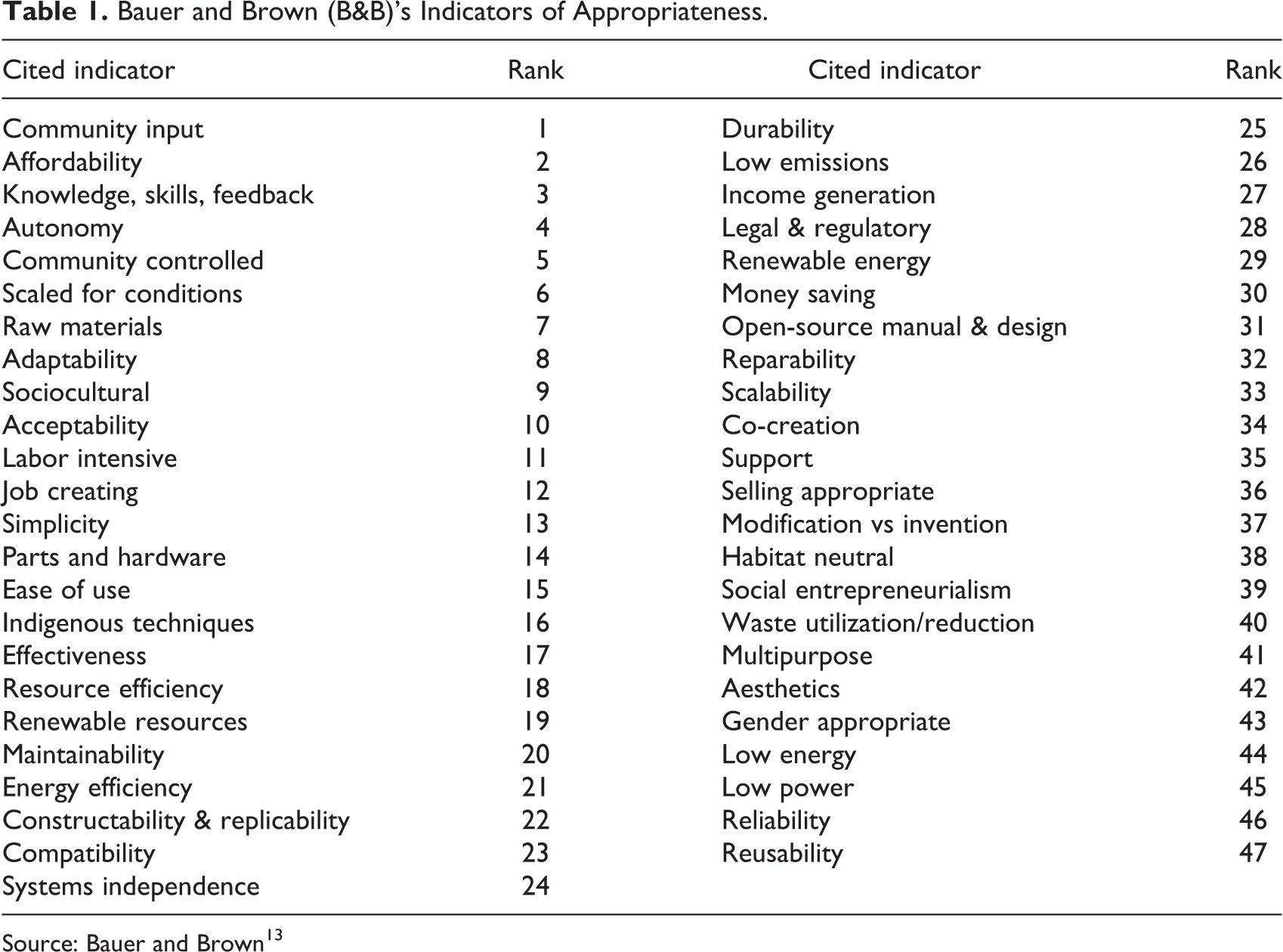
Source: Bauer and Brown 13
Methodology
The research team applies Bauer and Brown’s (B&B) schema to evaluate the Soy Kit’s level of technical appropriateness. This study makes use of both qualitative and quantitative data to conduct the assessment. Data originate from the SoyaKit Trainer Guide 5 and monthly business records provided by each Soy Kit entrepreneurs to USAID’s Agriculture Diversification Project in Lilongwe, Malawi. Each new household given a Soy Kit received training in financial bookkeeping and kept records on every day of production. Women volunteer to receive the kits via an interview and training process the scores women who would likely use the kit as intended. Additional criteria for receipt of the kits involves the spatial location so as not to compete among the recipients, nearness to consumers to assure sufficient sales, accessibility for further training and support, and the capacity within the household to keep business records.
Palladium, the contractor for the Agriculture Diversification Project, collects the data each month from each household in paper form. Data collection began in April 2018 with 4 households (Table 2). Additional houses came into the program each month as the project rolled out. In total, 224 household-led entrepreneurs participated in the activity over the 18 months. Of those 190 were female entrepreneurs and 34 were male. The program grew to 197 households, or women, by September 2019. The raw number of observations totals 1157 household months. The trimmed data set amounts to 1026 observations (89% of the total), when eliminating observations missing data or attaining extraordinarily high (100%) gross margins.
Monthly Household Observation.a
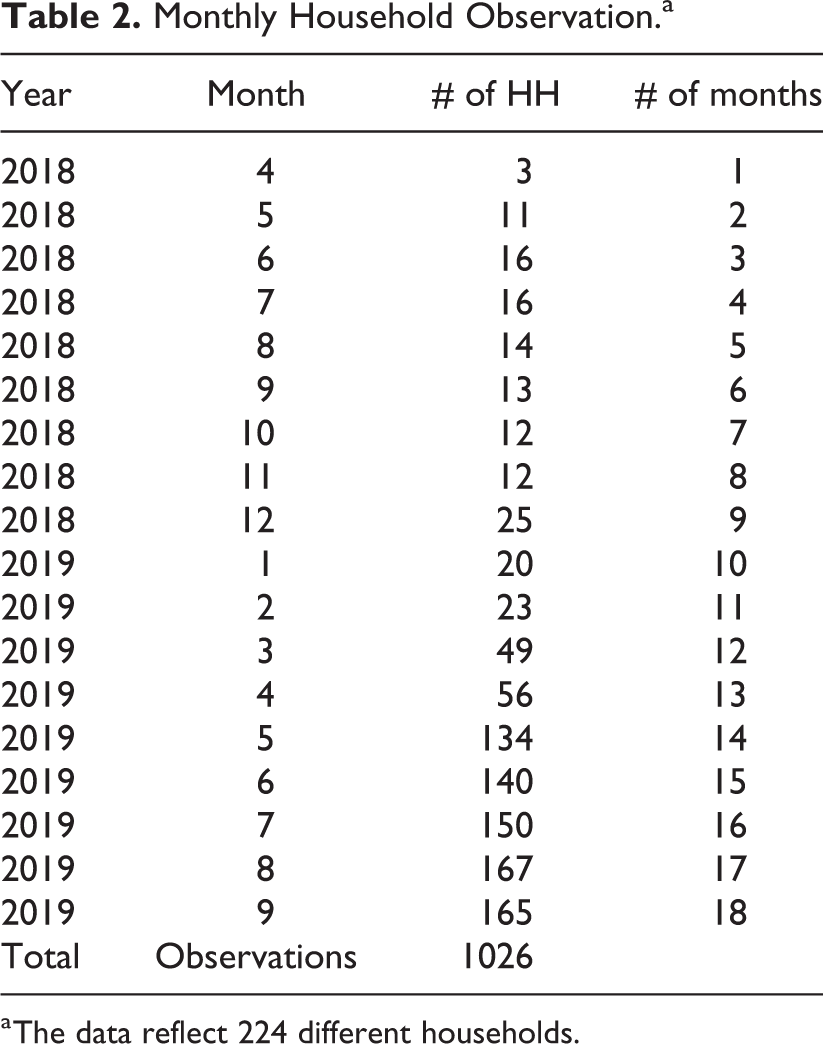
a The data reflect 224 different households.
The Agricultural Diversification project trained the recipients in bookkeeping and asked all recipients to collect daily the production, cost, and sales data associated with their operations. Project managers kept data collection requirements limited to match the bookkeeping inexperience the entrepreneurs possessed. The data collection training too focused on measureable metrics directly associated with their operations, too both center the activity on business-relevant aspects, as well as to allow easier data triangulation and validation. So the research data set only contains business operations.
Specifically, the Agricultural Diversification project collected daily milk quantity, cost totals, and profit totals that each entrepreneur kept track of for herself. Revenue and milk price data result from calculations using the profit, cost, and quantity data. Labor cost data, which are not collected by the entrepreneurs, result from using standard Malawian labor cost tables for day labor and the manufacturer’s recommend time need to process a batch of soy milk. Capital costs are the actual cost of the imported and locally assembled kits.
Results
Descriptive Statistics
The average household produces 58 liters per month and has sales of US$26 (Table 3). Nonlabor expenditures amount to US$10 per month, which on average generates a gross margin of US$16, or 56%, for each household per month. Households sell their milk for about US$0.50 per liter, which generates on average a gross margin of US$0.30 per liter. Sales per hour of labor amount to US$3.50 when using the standard output value of 7 liters of milk produced per hour. 5 Gross margins amount to US$2.12 per labor hour.
Descriptive Statistics.
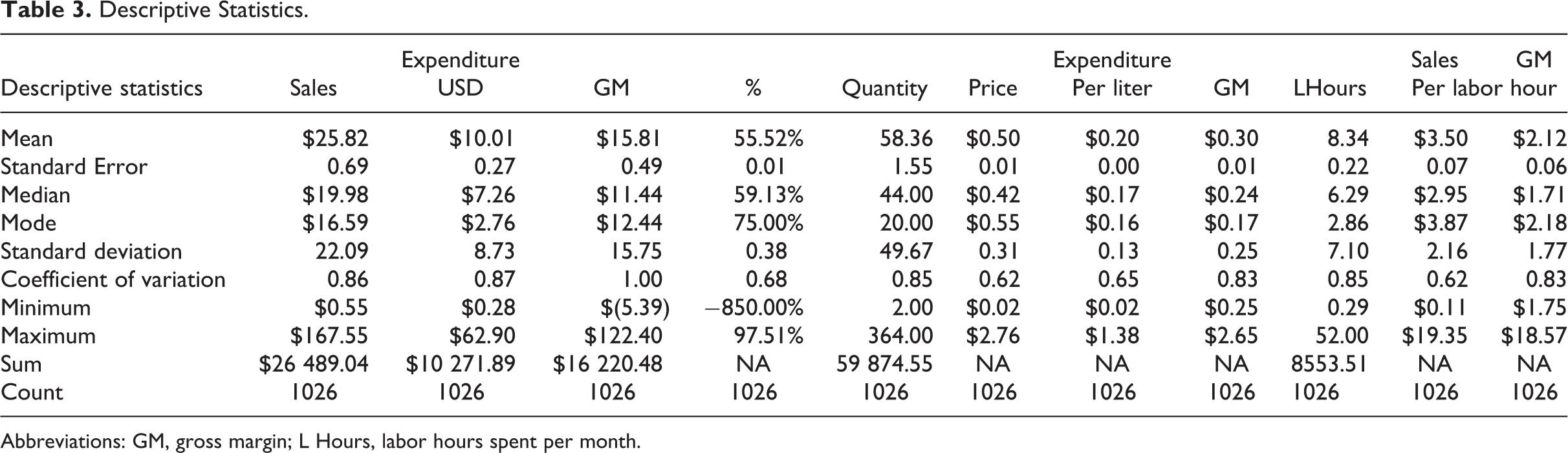
Abbreviations: GM, gross margin; L Hours, labor hours spent per month.
The Soy Kit costs US$200 when imported or US$80 went purchased locally. Monthly depreciation expenses would then range from US$5.55 to US$2.22 assuming a 3-year life for the Soy Kit. The nonlabor margin including depreciation would fall from $0.30 per liter to between US$0.21 and US$0.27, respectively, for the imported and domestic kits.
Finally, the Agriculture Diversification project provides the entrepreneurs with the Soy Kits free of charge (The Agriculture Diversification team expects recipients to pay back the cost of the kit to their village savings and loan group in order to finance the next kit entrepreneur. 7 ) Assuming entrepreneurs would normally borrow capital to purchase a kit, the monthly amortization cost would be US$6.92 or US$2.75, respectively, for a US$200 imported kit or an US$80 domestic kit, based on a 36-month payback and a 15% interest rate. Amortization expenses elevate nonlabor costs on average US$0.12 and US$0.05 per liter, respectively, for the imported and domestic kits.
Nonlabor costs rise from US$0.20 per liter to US$0.41 and US$0.34 for the imported and local kits, respectively. Average nonlabor margins fall from 56% to between 18% and 32%. The implicit wage rate would be US$0.63 per hour when operating an imported kit, compared with US$1.13 when operating the domestic kit.
Qualitative Assessment of Appropriateness
Following Bauer and Brown (B&B), the Soy Kit appears to be an appropriate technology using a cursory qualitative assessment of the technology. For example, B&B score “autonomy” as the fourth most important measure as to whether a technology is appropriate. In the case of the Soy Kit, once users receive training over a ½ day they no longer need support, operate freely, and source all the raw materials they need locally, such as soybean, sachets (for packaging), sugar, and flavoring, to produce soy milk. Similar to #4, raw material availability, which is # 7 on the B&B list, scores highly with respect to the kit, as soybean is readily available in Malawi, as are water, sugar, firewood, and flavorings.
Items 20, 31, and 32 reflect technical accessibility, specifically; the ability to be maintained and serviced, the availability of open-source technical materials, and the feasibility or ease of repairs. Currently all training guides and technical materials that support the imported kit are available in English for users, though are highly pictorial. The domestic kit, when available, will include nonliterate and local language guides. The kits are not mechanical and utilize equipment common to kitchens, which makes maintenance and repairs easy.
The kit appears to be gender appropriate (#43) as women in rural Malawi have multiple, seasonal, and varied responsibilities in the household and on the farm hours. Using the kit requires no specific time during the day or during the month. All of the raw materials are storable and shelf-stable. Thus, each entrepreneur produces milk when she has the time and she sees a demand opportunity.
Environmentally, the kit scores well for appropriateness, items 21 (fuel efficient), 26 (low emissions), 44 (low power), and 45 (low energy). The system operates without electricity, utilizes a heat-retention bag to reduce energy usage and air pollutants, and leverages the same heat source as for cooking.
Finally, the kit scores well with respect to waste management (#40) and multifunctionality (#41). Operators may grind and cook other raw materials in the kit, such as nuts, fruits, vegetables and other legumes, in addition to soybean. Entrepreneurs can convert the soymilk into multiple products such as yogurt and tofu as well as shelf-stable products such as cheese. Okara is a fibrous by-product from soymilk production that is also high in protein. Entrepreneurs can directly feed the okara to livestock or they can dry the okara for use as an ingredient in baked goods.
Quantitative Assessment of Appropriateness
The entrepreneur data set allows a quantitative assessment of appropriateness across 4 of the B&B metrics; affordability (#2), labor intensity (#11), income generation (#27), and selling appropriate (#36).
Affordability (#2) refers simultaneously to both the cost of the investment and the return on the capital. The idea being that not only does the technology provide an appropriate return on invested capital but also do entrepreneurs have access to sufficient capital to acquire the technology. There certainly exist commercial agricultural and food processing technologies that provide excellent returns on capital, but small-scale entrepreneurs cannot access sufficient financial, human, or organizational capital to acquire the technology. Appropriate technologies must be affordable and more decentralized, helping to bridge that last mile of distribution. 23 B&B score “affordability” as the second most important measure as to whether a technology is appropriate.
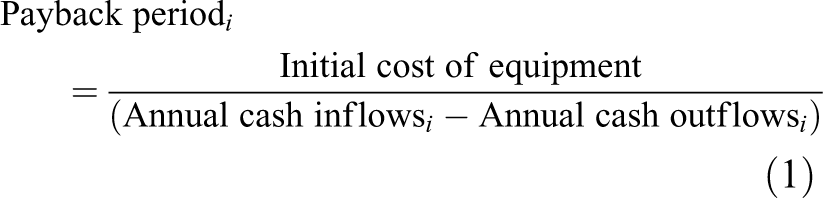
The payback method is a common approach for determining the acceptability of a project (Equation 1). The longer the length of time for an investor to achieve sufficient cash flows to recoup the investment, the less acceptable is the project for adoption. 24 Payback period estimation involves several key metrics; the cost to acquire a piece of equipment, the life span of the equipment, and the net cash flow derived from using the piece of equipment.
The Soy Kit presents 2 alternatives, one where the entrepreneur imports the kit for US$200 and a second where the entrepreneur acquires the equipment domestically for US$80. The average kit operator generates about US$16.00 net cash flow a month, thus the payback period for the imported kit would be about 12.5 months, while the domestic kit would be about 5 months. Both are well short of the 3-year life span for the equipment, thus using the payback period, the kit is affordable and appropriate.
A second measure of affordability is the return on capital for the investor. Return on capital involves net income, not simply cash flow, as was done to estimate the payback period. Return on capital indicates how effective a company or individual turns the invested capital into profits, where the equation is:

The estimated annual net income involves 3 components. The first uses the net cash flow of US$15.81 per month or US$189.71 per year. The second component entails the annual depreciation charge described earlier of US$66.67 and US$26.67 for the imported and domestic kits, respectively. Finally, net income includes the amortization costs associated with the capital of US$83.00 and US$33.00, respectively, for the imported and domestic kits. Annual net income, which does not include a labor expense, thus amounts to US$40.05 and US$130.05, respectively, for the imported and domestic kits. Return on capital then equals 20% per year when using an imported kit and 163% per year when using a domestic kit. It is important to note that the calculation makes the implicit assumption that a domestic and imported kit are direct substitutes and that equal levels of net incomes result. In either case, returns on capital are positive and significant, again supporting the assessment that the kit is an appropriate technology under the affordability criterion.
Labor intensity (#11) refers to the capital: labor ratio when deploying the technology. Economists historically argue that appropriate technologies for low-income countries will more likely meet the needs of the poor when relatively being more labor-intensive. 14,25 -27 Such technologies not only leverage the local supply of labor and the relatively low wage rates but also such technologies will be less complicated, rely less on specialized components, and will generally be lower cost. 18 Recent research on gender roles though rejects the “cheap or available labor” thesis with respect to women laborers. 28 For example, women actively participate in agricultural production and postharvest soybean threshing, which competes with the high demands on their time to operate the household, prepare food, and care for children. 28 Thus, a technology such as the USAID Soybean Innovation Lab Multi-Crop Thresher substitutes capital for labor and by doing so reduces women’s labor demands and the drudgery of hand threshing.
Labor comprises a significant cost category for producing soymilk. The businesses operate as sole entrepreneurs, where they mostly use their own labor complemented by a limited amount of family labor. 29 Rarely will they hire labor. The businesses do not estimate or include labor in their record-keeping. The following formula provides a measure of appropriateness with respect to the kit’s labor intensity:

where t = the monthly costs.
The minimum wage rate for Malawi is US$1.33 per day or US$0.17 per hour. 30 Labor costs per month average $1.39 when using the estimated product guidelines of 7 liters of milk production per hour 5 and the estimated average labor used per month of 8.34 hours across the sample of kit operators.
Capital costs include depreciation and amortization, which total US$0.21 and US$0.14, respectively, for the imported and domestic kits. A low capital: labor results of 15% and 10% for the imported and domestic kits, respectively, which connotes high labor intensity and a technology that is appropriate.
Income generation (#27) from a certain practice can be sustainable only when entrepreneurs gain higher and stable income opportunities. 8 Various forms of margin analysis, such as cash flow, operating margin, and earnings after depreciation and amortization, characterize the income generation capacity of the Soy Kit. The kit generates cash flows on average of US$15.81 per month or 56% of average sales of US$25.82. On average, entrepreneurs operate their kits about 8 hours per month. Labor costs amount to US$1.39 per month using the above wage rates of US$0.17 per hour. Monthly operating margins then become US$14.42 or 56% of sales when accounting for labor. Finally, additional monthly noncash costs are depreciation and amortization, which total US$12.47 and US$4.97 per month, respectively, for the imported and domestic kits. Monthly earnings after including labor, depreciation and amortization become US$3.34 and US$10.84, or 13% and 42% net on sales, respectively, for the imported and domestic kits. Positive margins persist across all 3 metrics reflecting that the kits are effective generating income, thus are appropriate. However, the imported kit at US$200 generates only moderate levels of income of 13% on gross sales, when accounting for noncash costs.
Selling Appropriate (#36) refers to the price of the products resulting from the technology, and consumer’s ability to afford and demand the product. Previous work discusses the limited pricing power for soymilk entrepreneurs. 6 Soymilk is a novel beverage and average consumer income is low, and the rural settings are spatially disperse. Packaging too challenges small food entrepreneurs, especially when selling a perishable product like milk. The Soy Kit entrepreneurs principally use generic plastic 50 cc sachets that are single use, provide minimal protection of the product, and contain no nutrition or brand information. Plastic or glass bottles are too expensive, though some entrepreneurs experiment with recycled bottles. 29
The entrepreneurs report monthly monetary sales and monthly production quantities, from which emerge the price estimates. The businesses do not report actual prices, own use, donations, or spoilage. Therefore, the price estimates serve as a lower bound as actual sales volumes will be less than production levels. The data for this study also do not allow an analysis of consumer willingness to pay or the relative price of the soymilk compared with other beverages. The data though do allow an estimation of prices charged by the entrepreneurs, and the behavior of price across the small panel, both which can help determine the degree of selling appropriateness of the kit technology.
The average quantity-weighted price for soymilk is US$0.48 per liter, which compares favorably with Conté (2008) at US$0.50, but as a lower bound estimate falls about half the price found by Krause et al 6 at US$0.93. The individual monthly household price estimates show that 74% of the observations fall between US$0.26 and US$0.75 per liter (Figure 2). As a note, assuming that entrepreneurs fail to sell 25% of their production marginally raises the weighted average sales price to US$0.53 per liter.
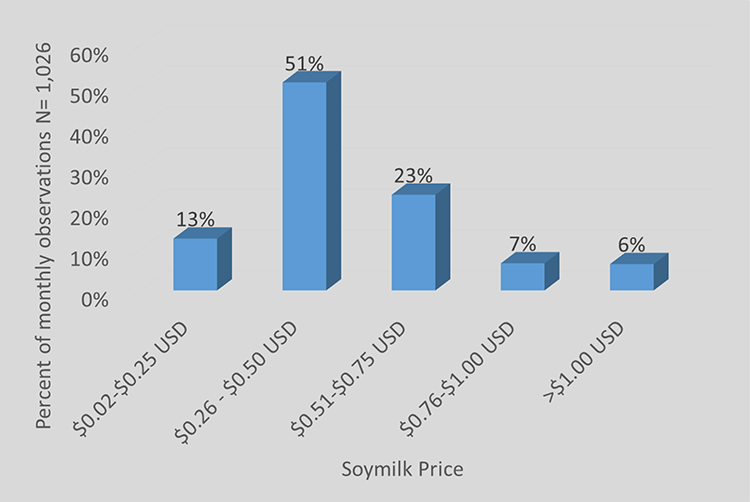
Soymilk price distribution across monthly household observations.
Data only reflect an 18-month period thus drawing inferences about the temporal characteristics of kit businesses needs to take place cautiously. Price falls about US$0.01 per month, or 34% over the 18-month data collection period (Figure 3), which is good for consumers. The Kit Activity expands its gross production output about 270 liters per month, which may cause of the price decline as entrepreneurs compete for limited demand. Part of the expansion results from the Agriculture Diversification project increasing the participation numbers. Additional increased supply occurs as individual firms also expand their output at a rate of about 6 liters or 11% per month, which too might contribute to a supply effect on price.
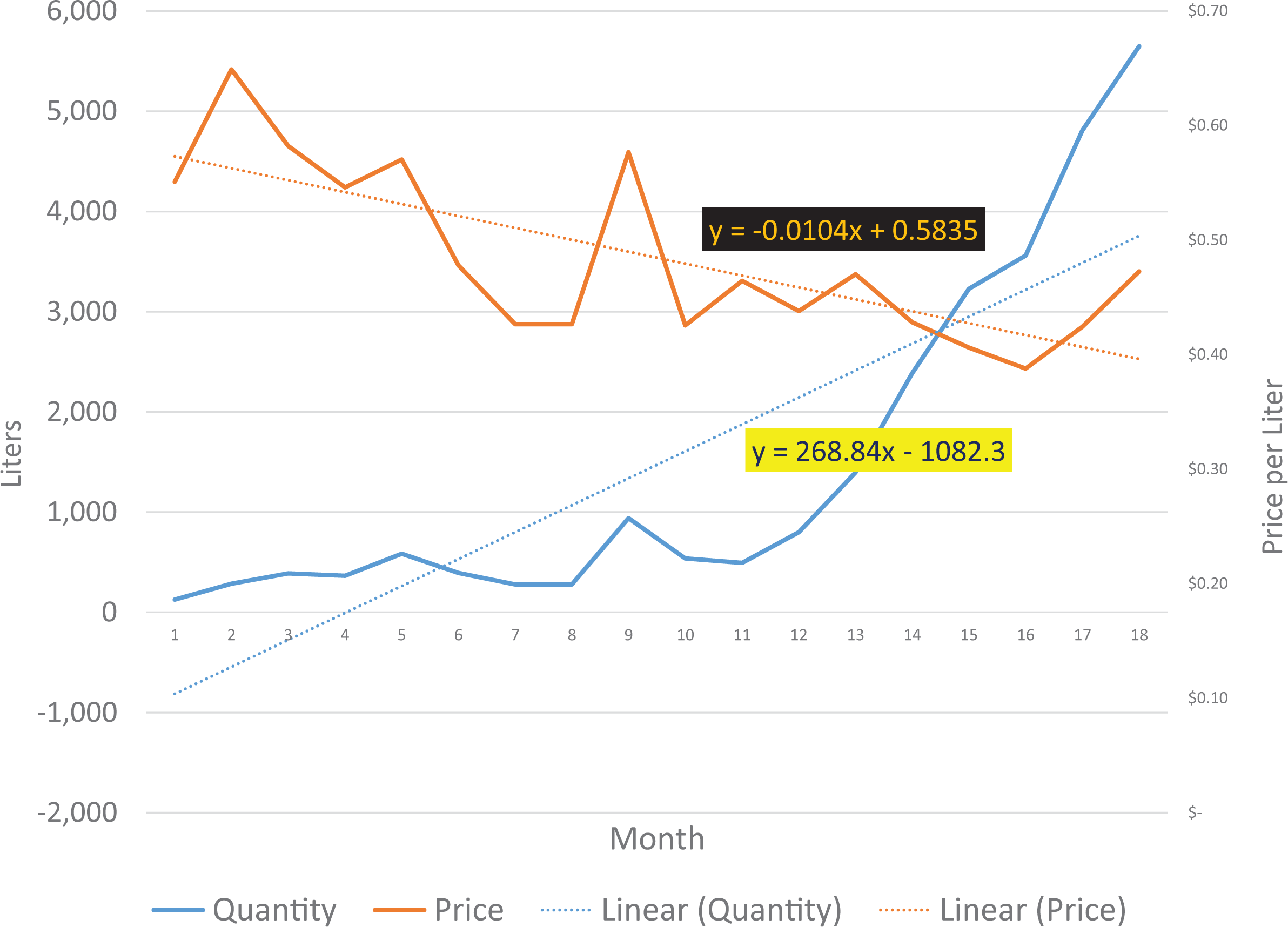
Total monthly production quantity and weighted soymilk price across all observations (N = 1026).
The data do not contain spatial information, so it is impossible to determine whether a supply expansion causes the decline in price due to greater competition for a limited number of consumers. The Agriculture Diversification did attempt to disperse program participants and reduce competition by specially targeting entrepreneurs close to a trading or business center or nearby a school, and limiting participation to one member of a savings and loan group. 7
However, there do not appear to be economies of scale or economies derived from experience over the short term where data are available. Monthly average expenditures actually rise (0.74% per month) over time, in addition to the falling prices received, which in turn results in a fall of gross margins from over 70% in the first 3 months of the program to about 60% during the last 3 months. Such gross margins levels appear though to be sufficiently high as to support both a moderate rise in expenditures and a moderate fall in the retail price for soymilk.
In sum, the retail selling price at about US$0.48 per liter appears to be appropriate for the low-income communities in which the entrepreneurs operate, and as the product is novel. The kit business model involves a direct selling process from the kitchen that effectively leverages personal reputation capital of the entrepreneurs and assures consumers as to the quality of the product. Consumer confidence is essential when selling a novel product that is fresh, local, and healthy, but uncertified, and presented informally in unlabeled sachets.
Conclusion
This article presents novel research on 2 fronts, first it is the first to provide an economic assessment of the new food technology, the Soy Kit. Second, the research introduces and applies the measurement of technical appropriateness in the context of food entrepreneurship among household firms.
The Soy Kit achieves a high level of appropriateness across a number of measures. The product is low cost and healthy, thus effectively competes against traditionally consumed beverages. However, it is important to note that the product is novel and not part of the cuisine traditions of Malawi, so demand takes time to build. The raw materials are storable at the household level, thus entrepreneurs lose little in storage and allows entrepreneurs a level of flexibility when preparing batches of product for sale. The batch size is small (3.5 liters) and takes only 30 minutes of production time, thus is manageable for women with many demands on their time. Capital and other fixed costs are sufficiently low as to match the small scale and episodic flow of a household enterprise where key inputs such as labor, fuel, soybean, and sugar can be intermittently available. The small batch nature of the production system allows entrepreneurs to leverage their tacit knowledge of the local market and be opportunistic when demand presents itself and they have available time. The technology also appears well matched to the needs and competencies of women entrepreneurs, as uptake after training is quick because of the high level of familiarity with the kitchen-based tasks. Finally, not discussed in the B&B metrics of appropriateness, the kit is appropriate because it may generate positive spillovers for children, nursing mothers, and the elderly. Those at risk can directly access the highly nutritious milk the women entrepreneurs control directly within the household.
Although the technology appears appropriate across a number of metrics, the question remains as to whether credit markets exist to finance an entrepreneur’s access to the US$80 needed to purchase a kit. We model terms of 36 months at an annual interest rate of 15%. Anecdotal evidence though shows that actual interest rates and terms would be much less favorable to the asset poor of Malawi. 7 On the other hand, the Kit technology generates a payback period of less than a year, thus entrepreneurs can easily afford the debt necessary to acquire a kit. Credits markets appear to perform inefficiently in settings where kits may offer significant benefits. Donors and NGO’s appear to provide a necessary financial bridge. More work needs to take place to address the challenge for food entrepreneurs accessing the capital they need to finance their businesses, and by doing so achieve true self-reliance.
Footnotes
Acknowledgments
The authors give special thanks to Maggie Mzungu, Charity Kambani, & Elizabeth Venable of the Feed the Future Malawi Agricultural Diversification project for their herculean effort on data collection and their keen insights in reviewing this manuscript.
Declaration of Conflicting Interests
The author(s) declared no potential conflicts of interest with respect to the research, authorship, and/or publication of this article.
Funding
The author(s) disclosed receipt of the following financial support for the research, authorship, and/or publication of this article: The U.S. Government’s global hunger and food security initiative, Feed the Future. USAID award no. AID-OAA-L-14-00001 supports this research through funding to the Feed the Future Innovation Lab for Soybean Value Chain Research (Soybean Innovation Lab (SIL)).
