



Abstract
Background:
Investing in maternity protection for working women is an important social equity mechanism. Addressing the maternity leave needs of women employed in the informal sector economy should be a priority as more than half of women in Latin America, South Asia, and sub-Saharan Africa are employed in this sector.
Objective:
To develop a costing methodology framework to assess the financial feasibility, at the national level, of implementing a maternity cash transfer for informally employed women.
Methods:
A World Bank costing methodology was adapted for estimating the financial need to establish a maternity cash transfer benefit. The methodology estimates the cash transfer’s unitary cost, the incremental coverage of the policy in terms of time, the weighted population to be covered, and the administrative costs. The 6-step methodology uses employment and sociodemographic data that are available in many countries through employment and demographic surveys and the population census. The methodology was tested with data for Mexico assuming different cash transfer unitary costs and the benefit’s time coverage.
Results:
The methodological framework estimated that the annual financial needs of setting up a maternity cash transfer for informally working women in Mexico ranges between US$87 million and US$280 million.
Conclusions:
A pragmatic methodology for assessing the costs of maternity cash transfer for informally employed women was developed. In the case of Mexico, the maternity cash transfer for women in the informal sector is financially feasible.
Introduction
Women’s participation in the labor force has increased in most countries during the past few decades. It is an important driver, as well as an outcome, of development and economic growth. However, the settings and benefits attached to labor vary widely across nations. 1 In many low- and middle-income countries, women earn less compared to men and are more likely to be engaged in unprotected jobs in the informal sector, which do not have maternity leave benefits. This lack of social protection has been described as one of the structural and societal barriers that interfere with women’s ability to breastfeed optimally, which includes exclusive breastfeeding (EBF) for about 6 months. 2,3 Exclusive breastfeeding has well-established health benefits for infants and mothers, and adequate maternity protection can impact breastfeeding rates. 4
Maternity leave mandates have been shown to effectively increase EBF. 3,5,6 Hence, investing in maternity protection for working women in the informal sector can be considered a mechanism of social justice that creates better conditions for women in more vulnerable sectors to exercise their choice and protect their right to breastfeed. 7,8 In addition, maternity leave can protect women from economic losses and gender discrimination. 9 Among the informally employed, maternity leave may be a mechanism to reduce structural inequities. Therefore, maternity protection contributes to the fulfillment of several sustainable development goals (ie, SDG 1, SDG 3, SDG 5, SDG 8, and SDG 10). 10
Two common problems with maternity protection have been that maternity leave mandates are not long enough to protect EBF and/or have incomplete coverage for all working women in the labor force. Exclusion of employed women in the informal sector is an example of the latter, and it is especially worrisome, considering that a large proportion of reproductive-age women are informally employed in low- and middle-income countries. Among employed women, 54% of them in Latin America and the Caribbean are employed in the informal sector; the corresponding figures for South Asia and sub-Saharan Africa are 74% and 83%, respectively. 11 Unless coverage of maternity benefit schemes is extended to women working in the informal economy, a large majority of women workers will continue to not have access to maternity care and income security during and after pregnancy 10 and hence be less likely to breastfeed optimally.
Therefore, there is an urgent need to improve and advocate for maternity protection, designing and implementing maternity leave mandates for informally employed women. This will require developing innovative policy options appropriate for the particular needs of employment in the informal sector that go beyond conventional social security models intended for formal, long-term employment. 12 The International Labor Organization (ILO) has compiled case studies to illustrate how countries have implemented diverse policy mechanisms to ensure at least a basic level of income security. 10 Noncontributory cash transfer (CT) schemes for women employed in the informal economy can be considered as one of those mechanisms.
Financial incentives have been used to encourage a range of behaviors to promote health. 13 The rationale from an economic perspective is that financial incentives improve the value of the target behavior or remove barriers to healthier lifestyles. 14 Hence, incentives for breastfeeding seek to increase the perceived value of breastfeeding and change attitudes and behaviors at social and individual levels. 13 Prior interventions have seen improvements in breastfeeding outcomes through gifts or vouchers. 14,15 Similarly, extra financial payments among low-income women who were enrolled in the US Special Supplemental Nutrition Program for Women, Infants, and Children suggested that incentives worked in promoting breastfeeding outcomes. 16,17 A systematic literature review on incentives to promote breastfeeding noted that incentives are very heterogeneous (ie, access to breast pumps, gifts, vouchers, money, food packages, household task support); hence, there is no consensus on better incentive options, and further evidence is needed. 18
The systematic review examined did not include prior studies about noncontributory CT. 18 Such a policy instrument would be different in nature to financial incentives previously examined, as it would seek to “level the playing field” among women employed in the informal sector, when compared to formally employed women. Therefore, it should not be perceived as a gift, a voucher, or simply “extra money,” but rather as a stipend to compensate for the lack of such labor right. 19 Although there is limited research examining financial incentives from the CT program perspective, there is evidence about positive health outcomes of CTs on maternal health, 20 as well as about the role of maternity leave mandates in promoting EBF and breastfeeding maintenance. 2,4,21 -24 Therefore, estimating the costs of and identifying affordable policy options among women employed is key for strengthening political and financial commitments for multisectorial investments (eg, social protection and health) to bolster an enabling breastfeeding environment. 3,25
Recently, a breastfeeding expert committee in Mexico assessed the breastfeeding-friendly environment in Mexico and provided several recommendations to protect, promote, and support optimal breastfeeding practices. 26 Indeed, Mexico has one of the lowest prevalences of EBF among infants younger than 6 months (14%) in Latin America and Caribbean, 27 far below the World Health Assembly (WHA) global nutrition target for 2025 of 50%. 28 This is particularly worrisome, as breastfeeding deterioration has been striking among those in the lowest socioeconomic level and indigenous people, who are more likely to be informally employed. According to data from the Mexican National Health and Nutrition Survey 2012 (ENSANUT for its acronym in Spanish), the main reasons provided by mothers explaining why they stopped breastfeeding were perceptions of insufficient milk, health-related issues of the mother, and the baby rejecting to breastfeed. 27 Thus, maternity leave among informally employed women emerged as a recommendation recently proposed by a breastfeeding expert committee in Mexico. 26 The recommendation was to increase coverage of maternity leave benefits to working mothers in the informal sector, as they represent 52.28% of the women in the labor force in Mexico. 29 -32
In Mexico, social security benefits are only provided to men and women employed in the formal sector. All organizations employing salaried workers by law need to enroll them in social security regardless of their income level, and women have access to paid maternity leave benefits. Nonsalaried workers (ie, self-employed or those in a nonwage contractual arrangement) do not have access to social security and are considered to be in the informal sector, meaning nonsalaried women do not have the right to a paid maternity leave. 33 Hence, implementing a maternity CT for informally employed women would extend a social right to informal sector workers, many of whom are highly vulnerable from the socioeconomic perspective. Thus, breastfeeding is in need of strong support in Mexico where maternity protection is only available for women working in the formal sector. Our study proposes to develop a costing methodology framework to assess the financial feasibility at the local level of the implementation of a maternity CT program for informally employed women of reproductive age (18-49 years of age). Our methodology was developed with data from Mexico, a country that is facing a dire breastfeeding situation.
Methods
Study Design
We estimated the costs of establishing a maternity CT for working mothers in the informal sector, through nationally representative cross-sectional data.
Costing Methodology
To estimate the annual costs of implementing a maternity CT for informal workers, we adapted a costing methodology from the World Bank, 34,35 which estimates the financial needs of scaling up nutrition interventions to achieve WHA global nutrition targets. The World Bank costing methodology proposes the following approach, FNy = UC × ICy × Popy, where FNy is the annual financing need (FN) for a given intervention in year y, UC is the unit cost, ICy is the incremental coverage (IC) assumed for year y, and Popy is the target population (Pop) in year y. 28
We modified the World Bank costing approach in 2 aspects. First, we weighted the population by α, which is the probability of having a baby and working in the informal sector given women’s age, marital status educational level, and type of locality. Second, as this would be a new program in Mexico, we added administrative costs of implementing the maternity CT in year y, AdmCy. Hence, the cost of the maternity CT for women working in the informal sector was estimated as MatCTy = UCCT × ICy × (α × Popy)+AdmCy, where MatCTy is the maternity CT annual FN for a given year of intervention; UCCT is the unit cost of the CT; ICy is the IC of maternity CT in weeks assumed for year y; α × Popy refers to the population of women in reproductive ages (ie, 18-49 years of age) in year y weighted by α; and AdmCy are the administrative costs in year y.
Modeling
A key aspect behind this modeling approach for costing the maternity CT is that it is based on 6 clearly delineated steps that could easily be replicated in other countries (Figure 1). The estimations use the following data that are commonly available across countries: employment and fertility survey data, census data to adequately calibrate for population estimates, and information about the daily minimum wage and/or income poverty lines (as defined in each country).
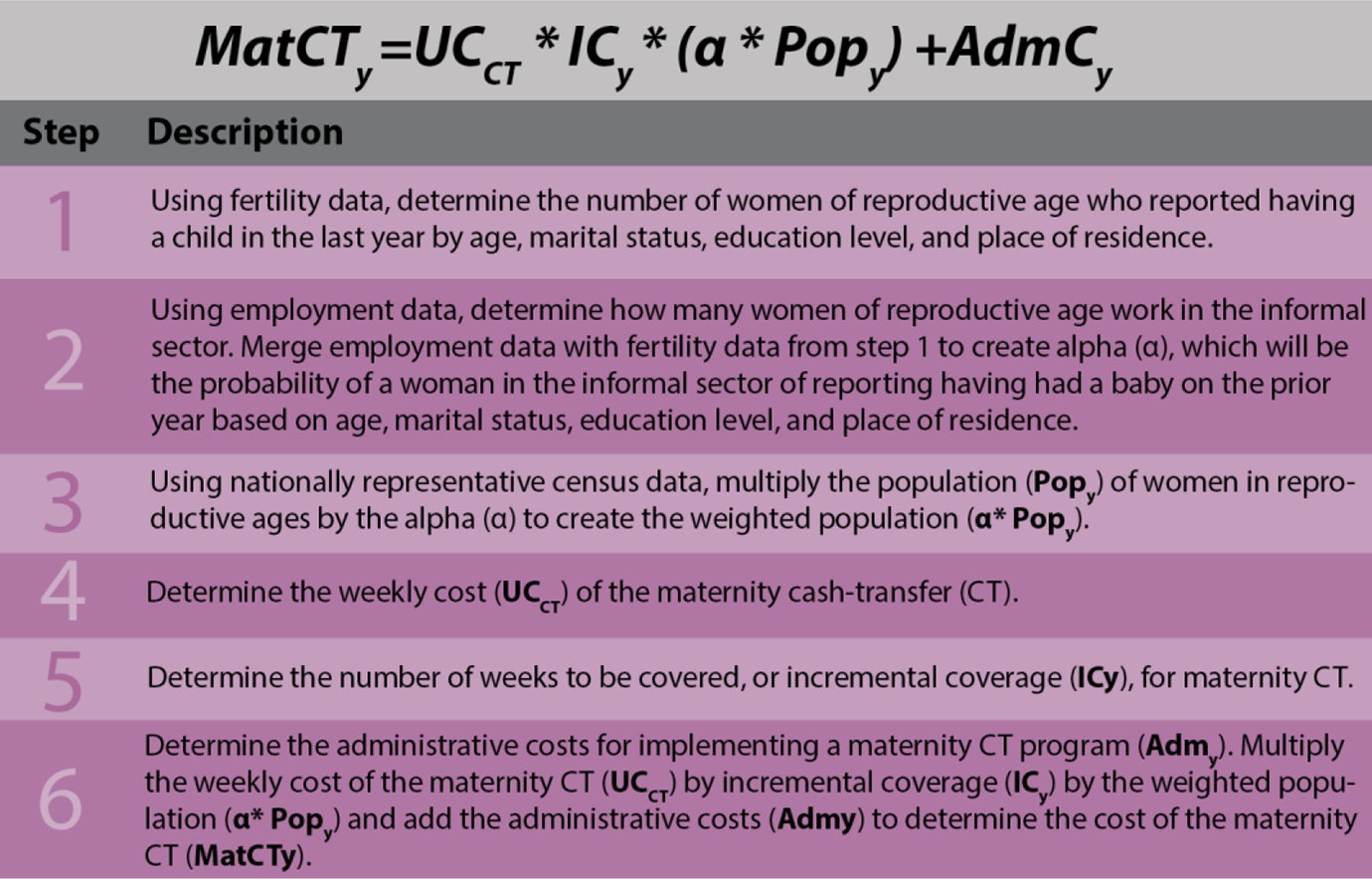
Six steps for modeling the cost of maternity cash transfer (CT) in a country.
The aim of the first 2 steps is to compute α Step 1 involved working with the fertility data; in the specific case of Mexico, we used the National Survey of Demographic Dynamics 2014 (ENADID for its acronym in Spanish). 36 Women of reproductive age were kept for analysis and categorized according to their age bracket (18-24, 25-29, 30-34, 35-39, or 40-49 years of age); marital status (single, married, or divorced); educational level (incomplete primary school or less, primary school completed or some secondary school, secondary school completed or some high school, high school completed, technical training or incomplete professional education, or university degree); and type of locality (rural, semi-urban, or urban). This led to generating 270 different combinations, and for each, we assessed the proportion of women who had actually reported giving birth in the prior year. For example, the proportion of women 30 to 34 years old with no education, living in rural a locality, and married who reported having a baby in the prior year was 5.56%.
In step 2, we merged the estimated fertility data with employment information. Specifically, we merged fertility data of women in reproductive ages, according to 270 different combinations, to employment data of women on this same age brackets using the Mexican National Employment Survey 2013-2014 (ENOE for its acronym in Spanish). 29 -32 Based on this step, we were able to create a variable differentiating women working in the formal versus the informal sector. This led to estimating the probability of a woman in the informal sector of reporting having had a baby in the prior year based on the characteristics specified in step 1 that is expressed in the model through α.
Step 3 weighted the population of women in reproductive ages through the α’s. To do so, we used data from the nationally representative intercensus Mexican survey, taking into account its population expansion factors. 37 We multiplied the estimates of women in reproductive ages by the α’s obtained through steps 1 and 2. This weighting process allowed for a more realistic estimation of the CT cost as it took into account that women with different characteristics (ie, age, education, marital status, and type of locality) have diverse chances of getting pregnant and consequently of needing the maternity CT.
In step 4, the outcomes of the weighted population were multiplied by the weekly cost (UCCT) of the maternity CT. The CT was defined through 2 common welfare-related measures widely used in Mexico and internationally: the minimum wage and the income poverty line. The former is guaranteed in the Mexican Constitution (Article 123) and the amount is established by the National Commission of Minimum Wages. Its amount was expected to be enough to provide for the social, cultural, and economic necessities of a head of a household and the education of its offspring. 38 In reality, the minimum wage has lost its value over the years and it is only used as a reference price. 39 The income poverty line, on the other hand, is reported by the National Council for the Evaluation of Social Policy (CONEVAL for its acronym in Spanish). 40 The income poverty line is equivalent to the value of a food and nonfood basket, per person per month. We use it as a reference because it is well accepted as the minimum amount a person needs to satisfy their basic necessities. 41 Hence, the intervention scenarios for the CT were defined as follows: (a) the minimum wage, which would lead to a weekly CT of US$30.05 (setting was based on the fact that the minimum wage is a household measure and the maternity CT would be delivered to an individual, so we weighted such difference), (b) two-thirds of the income poverty line, leading to a weekly CT of US$23.99, and (c) the full income poverty line that would lead to a weekly CT of US$35.81 (Table 1).
Different Maternity Cash Transfer Operationalization Based on Welfare Measures.a
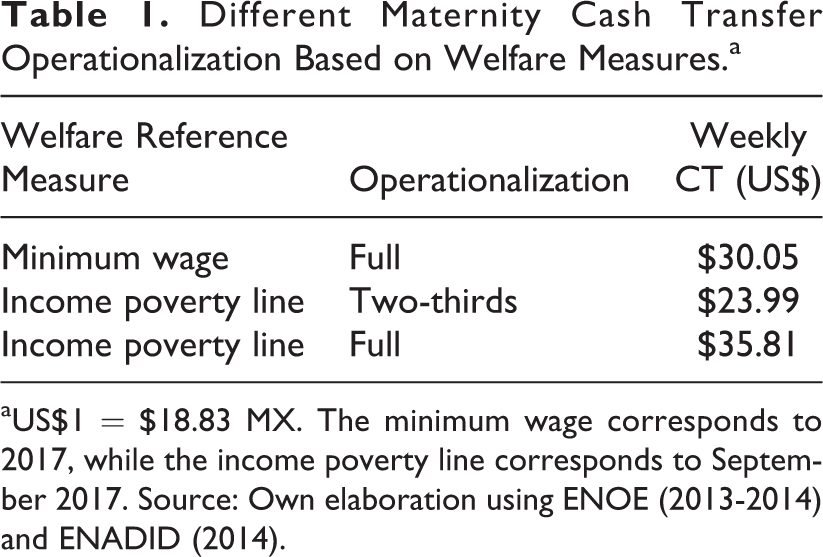
aUS$1 = $18.83 MX. The minimum wage corresponds to 2017, while the income poverty line corresponds to September 2017. Source: Own elaboration using ENOE (2013-2014) and ENADID (2014).
Step 5 added to the model the number of weeks (or IC to be covered by the maternity CT). In the Mexican case, we assessed 4 cutoff points that are of particular interest: (1) 12 weeks, which is currently the number of weeks covered by the maternity leave for formally employed women, as established by law 42 ; (2) 14 weeks, which is the minimum recommended by the ILO 10 ; (3) 16 weeks, which is the length of maternity leave coverage currently being discussed by local stakeholders for formally employed women 43 ; and (4) 26 weeks, which is consistent with the recommendations of the World Health Organization regarding EBF. 28 Estimations are presented for these specific periods in Mexico, but the methodology can be used for any number of weeks that different countries may want to consider.
Finally, the administrative costs were estimated in step 6 based on the annual administrative costs of similar programs, such as a CT to working mothers to support childcare, a life insurance for single mothers, and a subsidy for temporary employment. For programs to be considered similar, they needed to have a clear objective, have a one-time short CT or subsidy, and be designed by the federal government to have national coverage. For each of these programs, records for which administrative costs are publicly available every year were retrieved from the Ministry of Finance 44 : (1) a subsidy for temporary works employment program (US$929 597), (2) a CT to working mothers to support childcare (US$1 035 833), and (3) a life insurance for single mothers (US$711 708). A proxy of the administrative costs for the maternity CT was estimated based on an average of the administrative costs of these 3 programs.
All costing calculations were estimated in US dollars using 2017 as the reference year. All estimations were computed in STATA 15. 45
Results
Table 2 presents the characteristics of economically productive (ie, employed) Mexican women of reproductive ages, computed using the ENOE, as well as the probability of a woman having a child based on the ENADID. Based on the estimations of (α × Popy), 300 959 women were expected to be eligible for the maternity CT in 2015.
Characteristics of Economically Productive Women of Reproductive Age Employed in the Informal Economy Sector.a
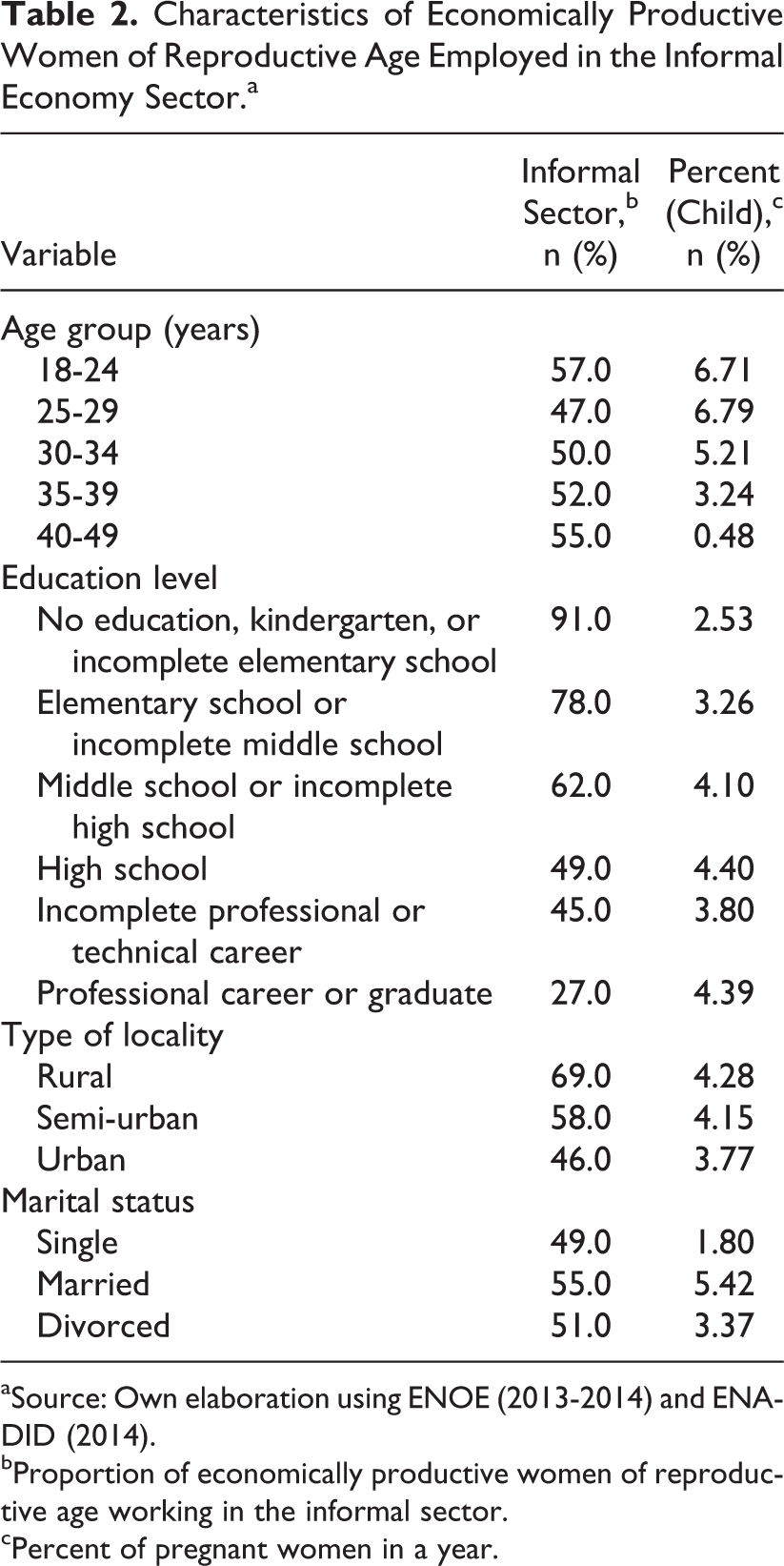
aSource: Own elaboration using ENOE (2013-2014) and ENADID (2014).
bProportion of economically productive women of reproductive age working in the informal sector.
cPercent of pregnant women in a year.
Tables 3 and 4 summarize UC, IC, , and the weighted population using the formula MatCTy= UCCT × IC y × (α × Pop y , considering a different unitary costs of the CT (ie, based on the minimum wage and the income poverty line), as well as the different IC (ie, 12, 14, 16, and 26 weeks). The incremental cost per week is fixed; hence, Table 3 also provides the incremental weekly cost per type of CT. Establishing the CT equivalent to minimum wage, the incremental weekly cost would be of US$9 044 181. However, if the CT is set at two-thirds of the income poverty line, the incremental weekly cost would be of US$7 221 058. Finally, if the CT is computed using the full income poverty line, the incremental weekly cost would be of US$10 777 698. Tables 3 and 4 show the cost for each CT across different maternity leave extents.
Maternity Leave Cash Transfer (CT) Costs per Extent in Weeks.a
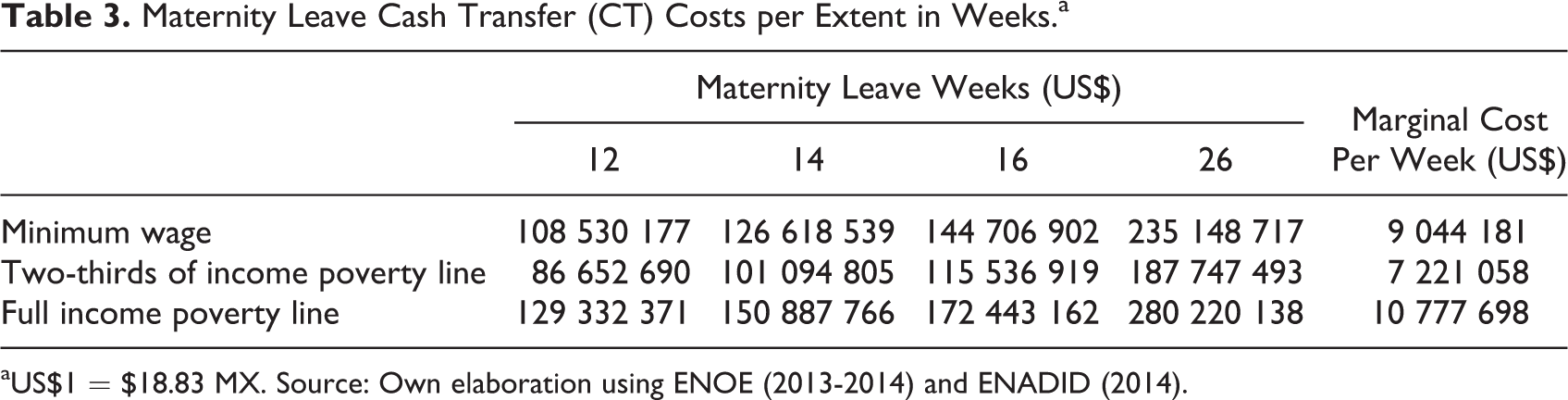
aUS$1 = $18.83 MX. Source: Own elaboration using ENOE (2013-2014) and ENADID (2014).
Total Cost of the Maternity Leave Cash Transfer per Year.a
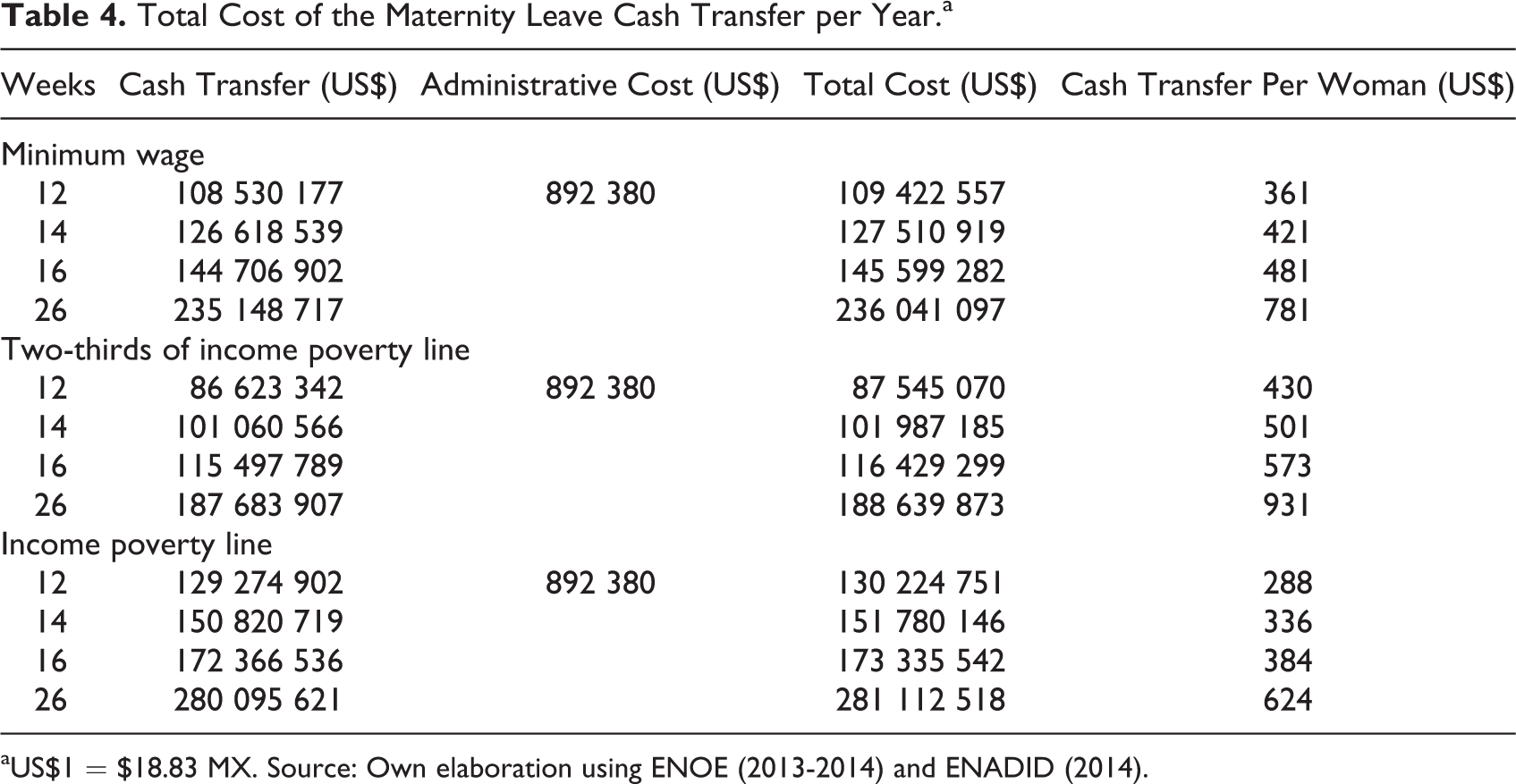
aUS$1 = $18.83 MX. Source: Own elaboration using ENOE (2013-2014) and ENADID (2014).
We then added the administrative costs, MatCT y = UCCT × IC y × (α × Pop y ) + AdmCy, considering the average of the yearly administrative costs 3 similar programs (previously discussed), leading to an estimate of yearly administrative cost of US$892 380. Table 4 summarizes the costs of a maternity CT adding these administrative costs.
Discussion
We developed an innovative and transferable costing framework using a CT for women employed in the informal economy. The findings from the application of our costing methodology to Mexico showed that the CT approach is feasible and affordable. These findings have major policy implications as they would guarantee at least a basic level of income security for women working in the informal sector while they are on maternity leave. Considering that women’s participation in the labor force is an important driver for development and economic growth, maternity protections for working women, regardless if they work in the formal versus informal sector, is an unquestionable social right. 10 More specifically, if we are not able to push such social justice mechanisms, it will be difficult to improve breastfeeding rates, as unprotected work is a known structural barrier to breastfeeding. 3
We have put forward a costing methodology that can be replicated across countries to aid governments and agencies with the design of feasible policies to offer maternity protection to women working in the informal sector through a CT. Noncontributory CT schemes for women employed in the informal economy have been previously proposed by the ILO 10 seeking to ensure at least a basic level of income security since old maternity benefits mandates, such as social security, do not seem to be the solution in the short run. Our methodology is described step by step so that it can be replicated in any setting where fertility, employment, and population data are available. Similarly, we propose diverse ways of operationalizing the maternity CT (in terms of the dollar amount) based on common welfare-related measures, such as the minimum wage and the poverty lines, which may be accessible in many contexts. Likewise, the methodology allows to compute the length for which the maternity CT ought to be available, which depends upon the political and financial feasibility of each country but should ideally cover the period linked to EBF, thus reducing breastfeeding disparities. 7
The application of this costing methodology to Mexico shows that in a country where more than half of the employed women of reproductive age are in the informal sector, the cost of a maternity CT would be equivalent to similar social protection policies already implemented. These include the program to support childcare for working mothers, which has an annual expenditure of US$216 million 44 and would be higher than most costed alternatives for a maternity CT. Therefore, a maternity CT would be financially feasible in Mexico. This costing approach should aid policymakers to address income security as essential to enable family social protection before and after childbirth, and despite many programs focusing in nutrition and health during the first 1000 days, often households’ incomes are not sufficient to ensure adequate protection linked to the financial hardships of women employed in the informal sector. While there is evidence about the positive effects of maternity leave in EBF among formally employed women, as far as we know our study is the first one to examine the possibility of increasing maternity leave benefits for women working in the informal sector in the context of improving breastfeeding outcomes. Hence, monitoring how such innovation affects women’s breastfeeding choices is a highly relevant question for future research.
Although the primary aim of this research was to provide a costing methodology to aid decision makers on maternity leave policies, several implementation issues should be considered as well. Our costing methodology is innovative because it includes estimates of administrative costs, which, to our knowledge, no prior research on maternity leave protection among informally employed women has incorporated. Moving forward, studies need to address policy implementation and evaluation issues. Formative research and engaging stakeholders will indeed be central to the success in the rollout of the maternity benefit proposed in our study. 46,47
As documented in research centered in financial incentives in the United Kingdom, it is important to describe to society that a key rationale for the additional CT is to improve breastfeeding outcomes. 15 Another aspect that is worth noting from prior studies 13,15 is that despite the fact that financial incentives have been used to encourage other health behaviors, there has been a lack of effort toward linking financial incentives to breastfeeding. 16
Cash transfers can have potential unexpected effects such as labor market alterations, family structure, fertility, and other supply side market distortions. To detect the specific side effects in using CTs to increase maternity leave protection among informally employed women, it will be important to closely monitor and evaluate the implementation process. From a policymaking perspective, it is also crucial to estimate the monetary costs of not implementing maternity leave protection in the context of a growing share of the female population many of which work in the informal sector in low- and middle-income countries.
International evidence highlights that too few women are appropriately supported through adequate maternity leave mandates to be able to work and still breastfeed, 3 despite their increased contribution to the workforce and economic development. According to our estimates, the annual cost of the maternity leave CT would be in a range between 0.0078% and 0.025% of Mexico’s growth domestic product. The range depends on if the estimation is performed based on the minimum wage or the income poverty line, as well as the length of the maternity leave. Considering the reported economic benefits form breastfeeding including improved cognition, and the potential effects in reduced child morbidity and mortality, 3 the cash benefit deserves consideration.
The current research helps to inform nutrition policy by providing a costing methodology to identify affordable policy options. In addition, it addresses policy recommendations from key international and local documents. First, it follows the components of an enabling environment for breastfeeding published in the Lancet Breastfeeding Series, 3 in which maternity leave protection for working mothers is a “settings determinant.” Second, it resonates with the SDGs, 10 as maternity leave is linked to poverty reduction, improved nutrition, and gender issues. And third, our focus on maternity leave for informally employed women in Mexico emerged as a recommendation from a national breastfeeding expert committee in Mexico. 26
As posed in the Breastfeeding Gear Model, 48 8 “gears” (advocacy, political will, legislation, funding and resources, training and program delivery, promotion, research and evaluation, and coordination and monitoring) must work in harmony to generate a breastfeeding-friendly environment to protect, promote, and support optimal breastfeeding practices. Maternity leave protection for informally employed women is understood as one of the policies to protect, promote, and support breastfeeding that should be addressed in liaison with other polices and “gears” to achieve better breastfeeding outcomes.
Footnotes
Acknowledgments
The authors thank Meztli Moncada and Luis Jacome for their support in data management and data coding.
Declaration of Conflicting Interests
The author(s) declared no potential conflicts of interest with respect to the research, authorship, and/or publication of this article.
Funding
The author(s) disclosed receipt of the following financial support for the research, authorship, and/or publication of this article: This work was supported by the Family Larsson-Rosenquist Foundation through an unrestricted grant to Yale University (PI Rafael Pérez-Escamilla; Grant Number R14001).