



Abstract
Background:
The Becoming Breastfeeding Friendly (BBF) initiative includes a guide that helps countries worldwide assess their readiness to scale up national breastfeeding programs. Country committees of breastfeeding experts across government, academia, and civil society engage with BBF by applying the BBF toolbox that includes (1) the BBF Index (BBFI) to measure and score a country’s breastfeeding environment, (2) case studies that illustrate how countries have created enabling environments for breastfeeding, and (3) a 5-meeting process, during which country committees develop policy recommendations intended to improve breastfeeding outcomes based on the BBFI scores.
Objective:
This study seeks to understand how the application of the BBF toolbox impacted plans to improve the enabling environment for breastfeeding in Mexico.
Methods:
Semi-structured interviews were conducted with Mexico’s 11 BBF country committee members about the 5-meeting process between May and June 2017. Audio recordings were transcribed and were coded and analyzed using a grounded theory approach.
Results:
Three major themes emerged: (1) the unique enabling environment for breastfeeding consisted of obstacles and opportunities for improvement, (2) favorable country committee member dynamics positively affected the utility of the BBF toolbox, and (3) BBF revealed and shaped country committee members’ shared vision of change that laid the foundation for a shared public policy agenda.
Conclusions:
Becoming Breastfeeding Friendly can generate multisectoral breastfeeding champions who can advance the public policy agenda to improve breastfeeding outcomes at the national level both in Mexico and elsewhere.
Keywords
Introduction
Breastfeeding is a feasible and cost-effective intervention to improve child and maternal health. 1 -5 These benefits improve human capital and national development in low-, middle-, and high-income countries. 3 However, breastfeeding rates remain low globally, 4,6 with Mexico demonstrating particular low rates of exclusive breastfeeding: Between 2006 and 2012, exclusive breastfeeding prevalence decreased from 22.3% to 14.5%. 7
Due to an urgent need to create an enabling environment for breastfeeding protection, promotion, and support, 3,4,8 Mexico’s National Academy of Medicine called for government commitment to improve breastfeeding outcomes. 9 The Academy based its recommendations on the Breastfeeding Gear Model (BFGM), a framework describing how national breastfeeding programs can improve breastfeeding outcomes. 10 It underscores that evidence-based advocacy, along with 7 other gears—political will, legislation and policies, funding and resources, training and program delivery, promotion, research and evaluation, and coordination—must work harmoniously for large-scale improvement in a country’s national breastfeeding program to occur. While advocacy serves as the principal “gear” for initiating scaling up of breastfeeding activities in a given country, 10 breastfeeding advocates in Mexico have neither historically nor since the introduction of the BFGM shared a common vision of change, 11 limiting their ability to influence policymakers.
Becoming Breastfeeding Friendly (BBF) is a global initiative that includes a guide that helps countries assess their readiness to scale up national breastfeeding programs based on the BFGM. The guide is designed to empower countries to measure their readiness for scale-up, develop a quality improvement plan accordingly, and track progress of their breastfeeding programs. 8,12 The initiative is relevant, since evidence suggests that countries that plan and document activities to improve infant and young child feeding practices more successfully implement those activities. 13
The BBF comprises a team of 7 researchers led by Dr Rafael Pérez-Escamilla, trained nutritionist and global breastfeeding expert, at the Yale School of Public Health. Advised by a 14-member technical advisory group, the team builds capacity among BBF countries by providing support tools and trainings, partnering with country-level BBF staff on research studies, and coordinating with country committees. At the country level, BBF is run by a multisectoral country committee of breastfeeding experts tasked with systematically applying the BBF toolbox. The BBF toolbox includes (1) the BBF Index (BBFI), which measures and scores a country’s enabling environment for breastfeeding; (2) case studies, which illustrate how countries have created enabling environments for breastfeeding; and (3) a 5-meeting process, 8,12 during which country committees utilize the BBFI to assign their own countries a readiness “score” and develop policy recommendations intended to scale up breastfeeding protection, promotion, and support activities effectively (Figure 1). After the BBF toolbox is applied, country committees disseminate these policy recommendations, calling on decision makers to implement them. 8,12
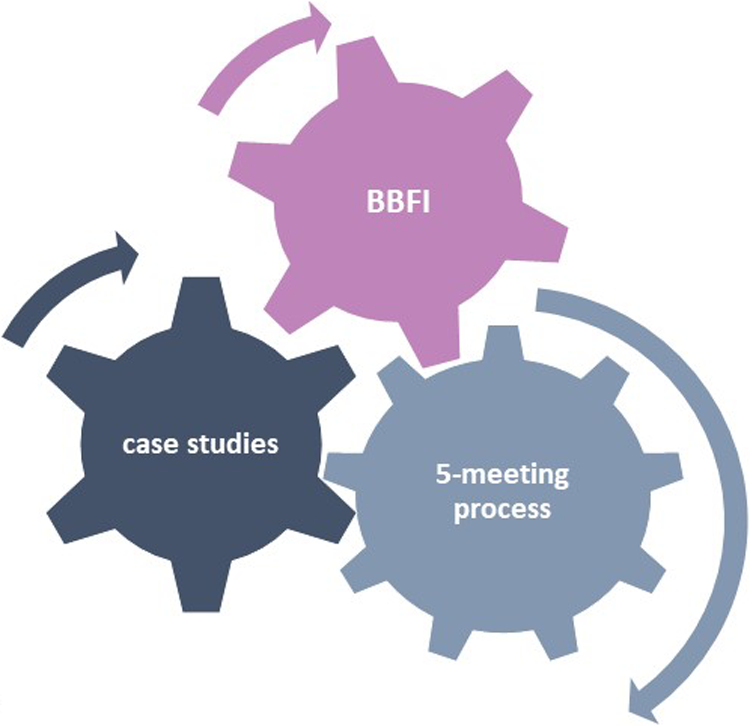
BBF toolbox, consisting of the BBF Index (BBFI), case studies, and 5-meeting process. BBF indicates Becoming Breastfeeding Friendly.
Beginning in 2016, the 11-member, multisectoral country committee (ie, “committee”) of breastfeeding experts in Mexico, whose institutional affiliations include government (4 members), civil society (3 members), and academia (4 members) and who are committed to improving breastfeeding outcomes in Mexico, applied the BBF toolbox over 9 months. 12 However, case studies were not discussed during the interviews and are excluded from the application of the toolbox in this article. Based on Mexico’s breastfeeding program scale-up “readiness” score of 1.4 out of 3.0, 14 the country committee developed evidence-based policy recommendations to strengthen breastfeeding protection, promotion, and support. 8,12
This study aims to understand the experiences of, lessons learned by, and key recommendations for decision makers developed by country committee members (CMs) in order to evaluate and improve breastfeeding outcomes. The research question being answered is, How did the application of the BBF toolbox impact plans to improve the enabling environment for breastfeeding in Mexico?
Methods
This research was approved by the Ethics Committee in Research at the Universidad Iberoamericana in Mexico City (Reg No. CONBIOÉTICA-0—CEI-008-20160601). We conducted a qualitative study involving semistructured interviews with CMs in Mexico. We describe the methodology below.
Interview Guide Development
We developed a preliminary interview guide (Supplemental Material 1) based on early conversations with CMs about their experiences applying the BBF toolbox. The multidisciplinary team involved in the toolbox application in Mexico reviewed and provided feedback on the preliminary English version. After reaching consensus on modifications to be made, we revised the guide before translating it into Spanish.
Participant Selection and Setting
All CMs were eligible to participate in the interviews. The in-country BBF coordinator contacted CMs to solicit their participation in and schedule the interviews. All 11 BBF CMs agreed to participate and were included in the interviews.
Data Collection and Management
We conducted the interviews, which lasted between 40 and 60 minutes each, between May and June 2017 at each participant’s place of work. All participants provided written consent following a description of the study’s purpose and design. Before initiating the interviews, we requested permission to audio record the interviews, which all participants granted. The primary author, who conducted all interviews, wrote field notes immediately after each interview.
A Spanish-speaking 5-member research team transcribed the interviews verbatim. We compared the original interview audio recordings to the final interview transcripts to ensure accuracy.
Data Analysis
We conducted a thematic analysis using a grounded theory approach 15 involving a 7-step coding process adapted from Bradley and colleagues 16 and utilizing a 2-phase qualitative analysis method (Figure 2).
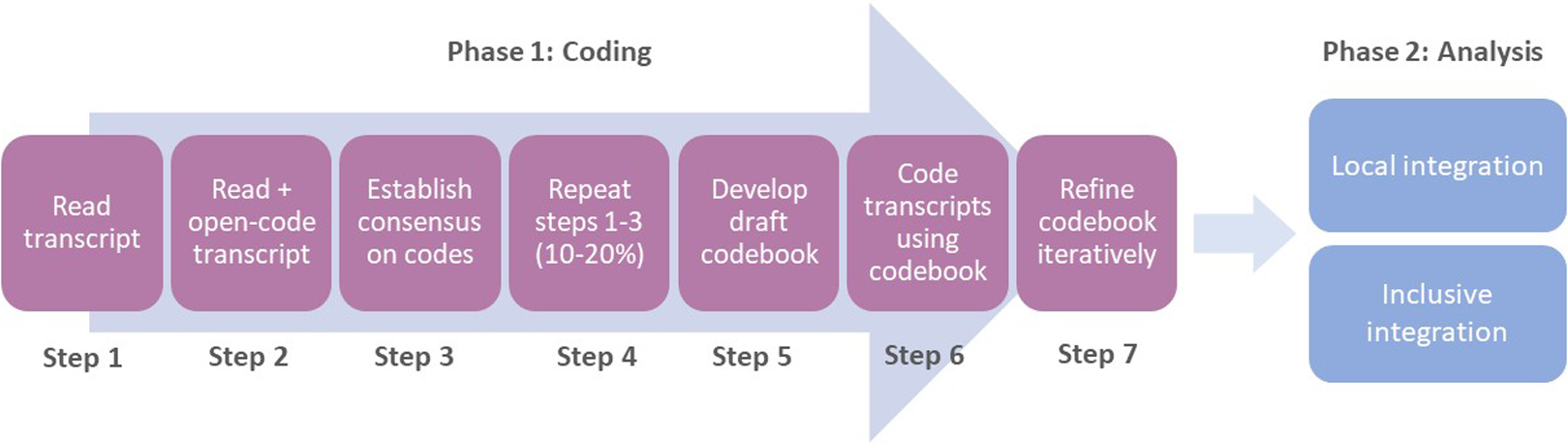
Illustration of qualitative coding and analysis approach applied to the present study.
In phase 1, coding, we followed 7 steps. First, 3 team members independently read 1 transcript (step 1). Second, we individually used an open-coding process 15 to code that transcript, assigning labels representing ideas in the text (step 2). Third, we developed a draft codebook based on consensus established on code usage and structure (step 3). Fourth, to define additional codes that represent a wider range of ideas discussed in the interviews, we repeated steps 1 through 3 for 2 additional transcripts (step 4). Fifth, we drafted a new codebook based on the codes applied to the first 3 independently coded transcripts (step 5). Sixth, the primary author coded and classified the first 3 transcripts again using the newer version of the codebook (step 6). Finally, while beginning to identify themes, she coded the rest of the transcripts using that codebook, which she refined iteratively and vetted with coauthors continually to ensure agreement (step 7). The primary author coded and classified the transcripts using Dedoose v. 8 computer software.
In phase 2, analysis, we developed themes. This phase consisted of 2 steps: “local integration” and “inclusive integration”. Weiss 17 describes local integration as assigning significance to transcript excerpts, or participant quotes, and inclusive integration as connecting transcript excerpts together via a “coherent story.” 17 Together, these steps formed the foundation for theory development and our conceptual model (Figure 3). Finally, we identified quotes that most strongly represented themes to be included and translated quotations into English. As no new themes emerged after having coded and discussed the first 4 transcripts, we reached thematic saturation in the data.
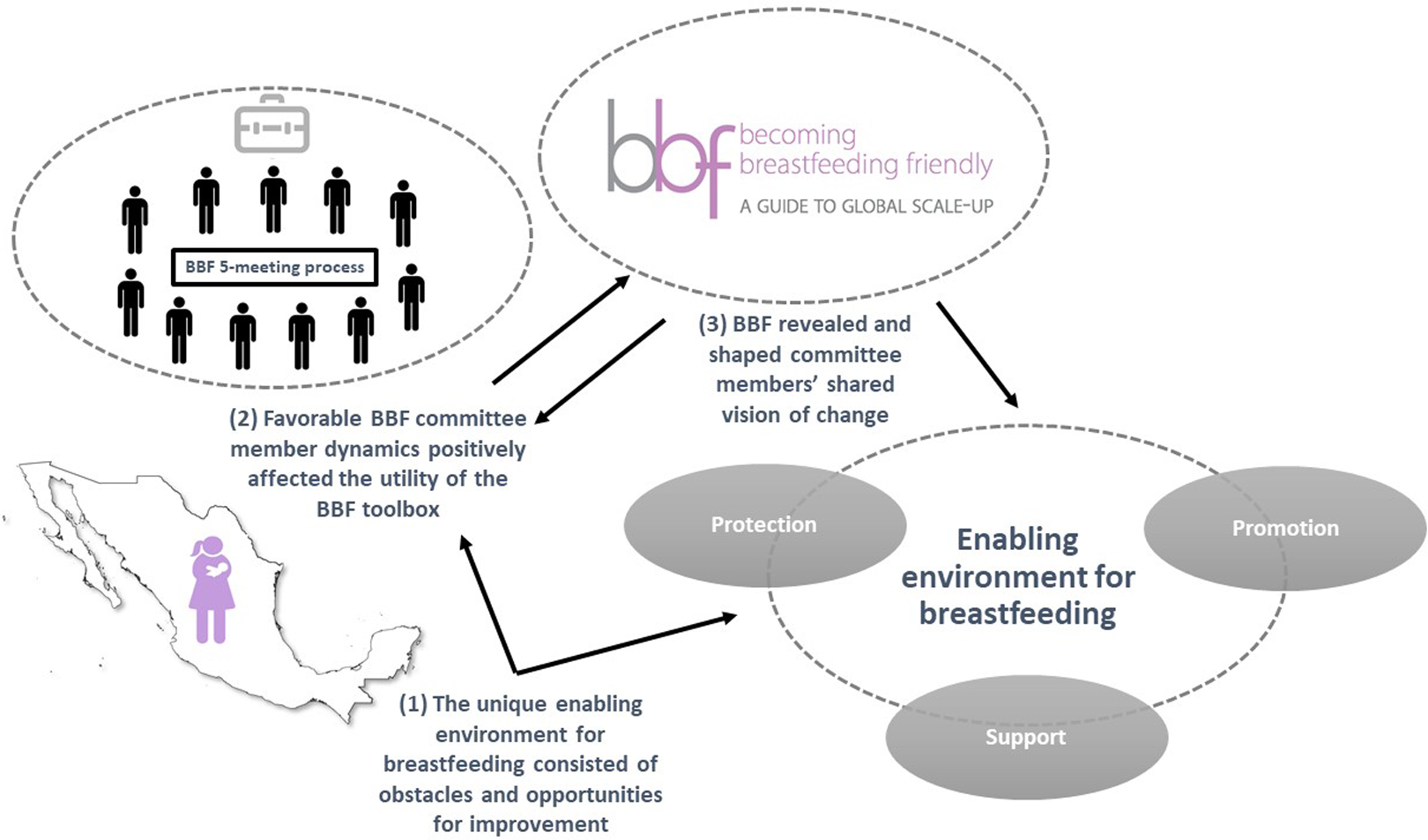
Conceptual model illustrating the relationship between themes found in the interview data.
Results
The committee comprised 11 individuals who worked in government, civil society, and academia. Considering the breastfeeding expertise of the individuals, each CM was assigned to focus on a specific BFGM gear (Figure 4).
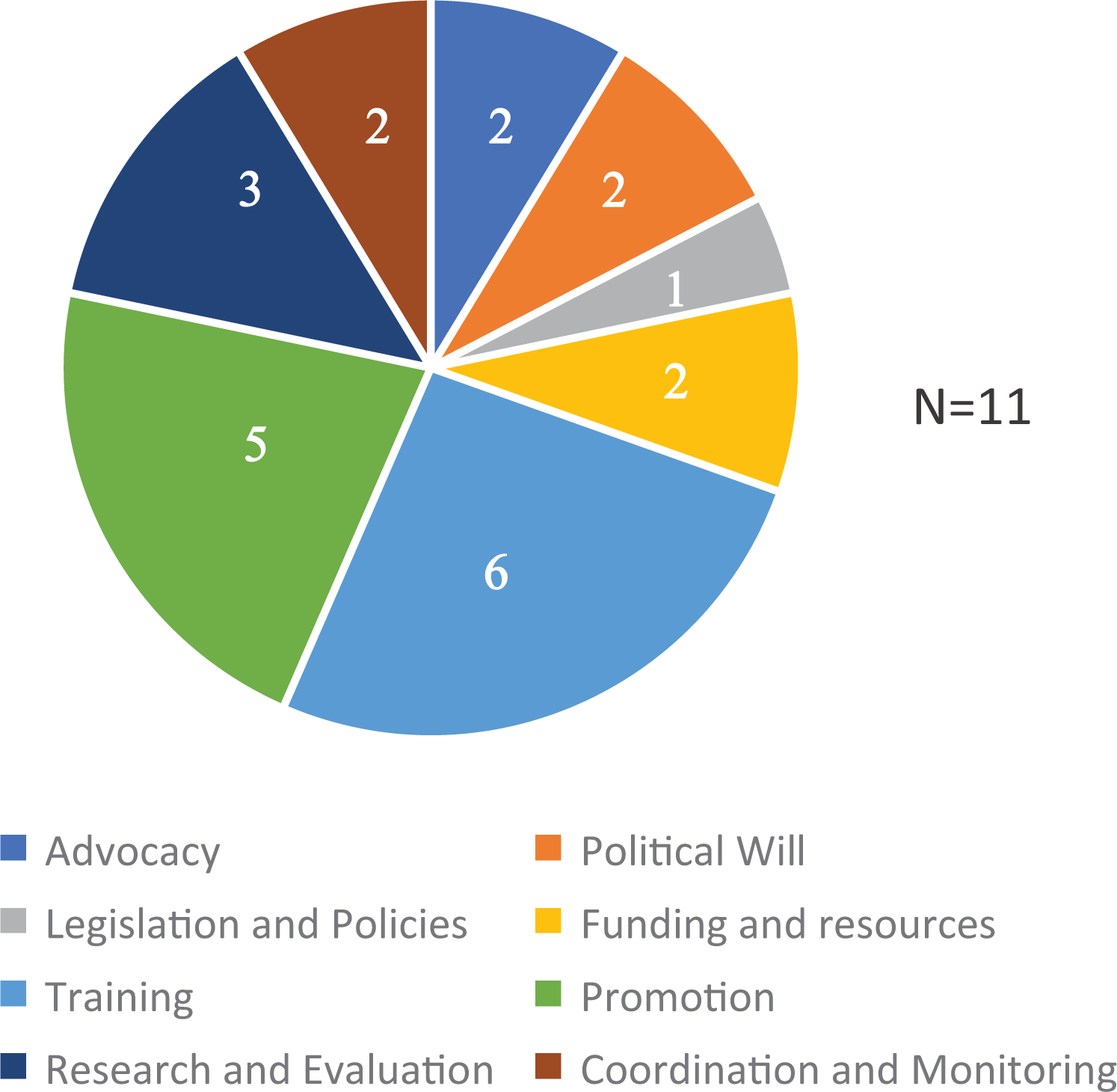
Depiction of distribution of Breastfeeding Gear Model gears assigned to country committee members in Mexico. Country committee members were assigned to 2 to 3 gears each.
Due to the multifaceted nature of the 5-meeting process, many different “stories” can be told from the interviews. However, given our research question of interest—How did the application of the toolbox impact plans to improve the enabling environment for breastfeeding in Mexico?—we explain CMs’ collective experience via a conceptual model describing the 3 major themes that emerged (Figure 3). First, Mexico’s enabling environment for breastfeeding protection, promotion, and support posed unique challenges to the committee that fostered opportunities for improvement as BBF advances. Second, dynamics that cultivated rapport among CMs helped address obstacles faced throughout the 5-meeting process. Third, BBF revealed and shaped CMs’ shared vision of change. We describe these themes below.
Theme 1. The Unique Enabling Environment for Breastfeeding Consisted of Obstacles and Opportunities for Improvement
Participants (ie, country CMs) depicted the enabling environment for breastfeeding in Mexico as consisting of obstacles and opportunities for improvement related to breastfeeding both outside of and within BBF (Figure 3). Theme 1 emphasizes challenges involving legislative barriers to successful breastfeeding in Mexico; the immediate need to allocate resources for breastfeeding protection, promotion, and support; and the relevance of BBF in placing breastfeeding on the public policy agenda.
Legislative barriers to successful breastfeeding in Mexico
A particular set of breastfeeding interventions, described elsewhere as those related to legislation, policy, financing, monitoring, and enforcement,
3
proved challenging for some CMs. In describing the state of breastfeeding interventions in Mexico, some CMs cited employers’ misunderstanding of or lack of information about mothers’ breastfeeding needs. One participant described that ambiguities in breastfeeding legislation, such as gaps in workplace accommodations for breastfeeding mothers, can cause confusion that weakens effective implementation: …the employer will give an hour to the woman, right? for breastfeeding…one hour of breastfeeding doesn’t help for breastfeeding. It doesn’t help because the mother arrives an hour later or she leaves one hour early, but that doesn’t work, so we have to raise awareness about what really works, right? That they give 20-min or ½-hour periods …to get the milk, but that’s what the company designates it and after this 6 months the lactation time is over, you have to arrive on time. (CM 10) …so that they don’t, so that they don’t become, don’t become victims of workplace discrimination. (CM 2)
Requirement of resources for breastfeeding protection, promotion, and support
A lack of adequate funding for breastfeeding protection, promotion, and support in Mexico represented another challenge to the enabling environment. Various CMs discussed the way that, before anything else can be accomplished, resources are needed: There are recommendations that are very specific for eh, the legislative groups: the chamber of deputies, the chamber of senators that, I think that it is important to have an impact because it has to do with legislation and budgets. (CM 9) Who can become a champion to push this? (CM 7).
Breastfeeding on the public policy agenda
The advancement of a breastfeeding public policy agenda represents a collective committee ambition. In delineating the impact that BBF had had in Mexico so far, several participants said it could help place the “problem” of breastfeeding on the public policy agenda. One participant said: I think…helped to position the problem on the public agenda…I do not think we can change public policy at this time, but if we can get the issue on the public policy agenda in view of a new administration…that’s what called attention to this issue right? Now, I think we have to learn from other public health policies that have had the ability to move not only the agenda, but from the agenda to the action, right? Pushing key actors, doing social lobbying, etc. Well, I think it’s also an area of opportunity. (CM 7)
Theme 2. Favorable CM Dynamics Positively Affected the Utility of the Toolbox
Committee members referenced meeting-related logistical barriers—and facilitators—to the improvement of the BBF logistical process. For example, participants often described the 5-meeting process as “intense.” Given the vehicular congestion of Mexico City, some discussed the importance of having a central meeting location for all meetings so that more members could join in person rather than virtually. Virtual participation in meetings was described as a virtue of the committee by some and a downfall by others, who cited technical difficulties as a barrier to a seamless 5-meeting process. In spite of this logistical barrier, Theme 2 explains the ways in which CMs perceived how both personal satisfaction with the 5-meeting process and a fruitful dynamic among CMs contributed to the BBF serving as a learning opportunity (Figure 3). These dynamics fostered trust among them. Interactions among CMs reflect the importance of interinstitutional work, the ability of the committee to highlight an integral concept of breastfeeding challenges and their solutions, and a belief in the mission of BBF.
Importance of inter-institutional work
Committee members generally enjoyed participating in the 5-meeting process. In addition to expressing fulfillment from participating in BBF, participants discussed the value they placed on the inter-institutional nature of the committee. One participant said: I think it was a pleasant experience especially because of the fact that there were so many organizations and institutions gathered, all with the same goal of…the same purpose and at the same time all passionate about breastfeeding. (CM 11) each one of the members contributes with something different or of an added value, right? to, to the discussion because, although we could all be involved in the [same] sector, not necessarily all of us have the same level of specialization or knowledge about the nuances of the topic of breastfeeding. (CM 1)
Integral concept of breastfeeding challenges and their solutions
Involvement in the multisectoral committee helped many CMs comprehend country progress in breastfeeding policy and the importance of disseminating information about the current status of breastfeeding in Mexico. Participants related how the BBFI aided in assessing Mexico’s progress toward achieving goals for breastfeeding protection, promotion, and support delineated in the National Breastfeeding Strategy, which describes national breastfeeding objectives to promote, protect, and support breastfeeding
18
and which compiled evidence-based benefits of breastfeeding:
9
it is evident that we need to spread this information; then we go to that point, disseminate information about what is being worked on and the progress we have in the National Breastfeeding Strategy. (CM 9)
Belief in the BBF mission
Finally, a shared confidence in BBF’s evidence-based framework, the BFGM, seemed to strengthen the committee. In assessing how well the BBFI was able to evaluate the breastfeeding environment in Mexico, CMs generally rated the process highly. One participant said: what we graded in each of the gears and the recommendations we made, are, believe me, totally grounded because there it took us a lot of discussion time. (CM 3) Years ago, since it was published…the article of the Breastfeeding Gear Model, it is an article that impressed me; I knew from that moment that it was something seminal…let’s say since then I use it as my guide to act and make decisions. (CM 6)
Theme 3. BBF Revealed and Shaped CMs’ Shared Vision of Change
Theme 3 focuses on the way BBF contributed to CMs’ individual and institutional leadership, as well as their professional relationships with one another, and helped deconstruct the complex breastfeeding governance system in Mexico. These factors contributed to a shared vision of change. Participants discussed their views on the impact of BBF, challenges in BBF policy recommendation development, a lack of participation of key actors in the 5-meeting process, and an absence of commitment from decision makers in advance of the BBF assessment. Finally, CMs proposed suggestions for future directions for the BBF country committee based on lessons learned thus far (Figure 3).
Views on BBF impact
Even if the issue of a lack of resources is documented by way of the BBFI, the index may or may not represent the true state of breastfeeding in a given country. When asked how well the BBFI reflects reality, one participant suggested that some scores reflect a better current situation than previously imagined: there are indicators that if you applied them or rigorously interpreted them [such as political will], they would be very badly scored, and others that if you did it rigorously, they would be scored better than your perception, I could say. (CM 8)
Finally, in discussing how BBF helped one participant understand what should be done to address poor breastfeeding outcomes in Mexico, the same participant said: We have shared interests, but not a shared agenda. We haven’t known, for example: [how to] cultivate champions so that you have true presence and true influence. (CM 8)
Challenges to BBF policy recommendation development
CMs expressed mixed feelings about the development and execution of the policy recommendations resulting from the 5-meeting process, discussing the value of identifying recommendations that can be feasibly implemented in the near future. In addition to reasons related to feasibility, perhaps one of the most important reasons why some CMs believed in the prudent selection of recommendations was the fact that many key actors were absent throughout the 5-meeting process. According to many participants, one of the biggest challenges they faced in the delivery and hopeful implementation of the recommendations was a lack of participation of key actors. In recalling the absence of the Ministry of Health at the fifth committee meeting, during which the key policy recommendations were delivered, one participant said: Actually, the Minister of Health himself was not represented in the whole group, so I think that was a, a weakness…it is important to have the main actor at the table. (CM 11)
Absence of BBF decision maker commitments
In addition to the absence of key actors, CMs discussed the relevance of decision makers’ acceptance of policy recommendations without having established commitments to back them up. Portraying this lack of commitment as an aspect that could be strengthened in the future, one participant related: …the fact that [politicians] say: ‘I support breastfeeding’ does not necessarily mean that there is a willingness to move the institutional machinery to carry out actions in favor of breastfeeding. I think it goes further, such as, generating commitments or getting people to sign letters. (CM 1)
Proposal of future directions for the committee
Given the various challenges posed to both the committee and breastfeeding policy in general, some participants were emphatic about ideas for next steps for the committee. With a then-upcoming presidential election taking place in July 2018, some participants related the importance of packaging a compelling case for breastfeeding to new political candidates. In fact, a time of political uncertainty fueled some participants’ motivation for considering next steps for BBF: In the medium term…we have to get them to put it on their political platforms from before the election…we have to approach the aspirants, explain the importance, be very convincing and give them a package, a little plan like this: this is what you have to do. (CM 8) I understand, as [Mexico] was the first pilot country, well it was, with Ghana, well we were seeing what [worked] and what did not, right? I mean, they cannot have all [worked out] the first, the first test, because surely when we do the second index we will already have many things clear and it will be much easier, right?. (CM 4) Another recommendation is…broadening the participation of civil society organizations…even some grassroots [organizations]. (CM 4)
Discussion
This study describes the experiences of breastfeeding experts serving on the committee involved in the application of the BBF toolbox in Mexico. As part of the BBF 5-meeting process, breastfeeding experts convened regularly to assign Mexico a “readiness” score to scale up breastfeeding programs and develop policy recommendations to call decision makers to action.
Interviews with CMs highlight 3 themes that explain the way the toolbox impacted plans to improve the enabling environment for breastfeeding in Mexico. First, participants indicated that committee membership shed light on Mexico’s unique enabling environment for breastfeeding, which consisted of barriers and facilitators to breastfeeding policy improvement (theme 1). Second, favorable CM dynamics turned the toolbox into a useful instrument for CMs (theme 2). Third, BBF helped uncover and shape a shared vision of change among CMs, making them uniquely suited to prioritize breastfeeding on a common public policy agenda (theme 3).
Our findings suggest that the enabling environment for breastfeeding involves challenges to breastfeeding protection, promotion, and support in Mexico. Conflicting ideas about existing breastfeeding legislation can be challenging for all parties affected by such legislation, influencing its enforcement and, ultimately, breastfeeding outcomes. This problem constrains decision makers’ ability to establish an imperative for change, decreasing their investment in an enabling environment for breastfeeding. 11,19 Moreover, an absence of political commitment can limit country-level adoption, implementation, and sustainability of policies, programs, and resources. 20 Two ideas emphasized in the interviews related to the allocation of resources for breastfeeding—social lobbying and advocacy—indicate that the toolbox not only illuminated a newfound comprehension of breastfeeding in Mexico but also inspired CMs’ desire to lobby and advocate for breastfeeding. This suggests that employing tactics such as social lobbying could help establish a shared agenda among both CMs and key actors who should participate in BBF from the beginning. Although this finding describes the enabling environment in Mexico, it can be assumed that other countries could experience similar barriers and facilitators, thus benefitting from the proposed solutions.
The interviews also reveal that favorable CM dynamics positively affected the utility of the toolbox. This is important because research shows that team dynamics can influence the effectiveness of research implementation strategies. 19 Further, the successful exchange of ideas that occurred throughout the application of the toolbox required effective communication skills; we argue that it is this communication 19 that fostered trust among members. Moreover, recent evidence has highlighted a need for strong individual and institutional leadership—qualities well represented in the interviews—to increase political commitment to breastfeeding. 11,21 This notion suggests that BBF—and specifically, the 5-meeting process—could help propagate this commitment. The BBF countries should continue to identify CMs who hold high-level positions within their respective and diverse institutions and whose leadership is valued both within and outside of them.
As recommended in the BBF operational manual, the committee consisted of 10 to 12 members; the role of the size of the 11-member committee did not arise as a theme in the data. However, based on members’ responses to other questions posed during the interviews, we hypothesize that members felt that the size was sufficient in order to achieve committee goals. Because members encouraged engaging decision makers not included in Mexico’s initial BBF assessment in future reassessments, it is important to consider implications of including more members with respect to committee size, availability of high-level actors to participate in in-person versus virtual meetings, and balancing the perspectives of members with visions of change that differ from those of the rest of the committee. Such considerations could affect group dynamics, a frequently cited committee virtue. For example, a committee considered too big, too diverse, or with too many unable to participate regularly could pose challenges to reaching consensus on policy recommendations. Strong leadership from countries’ committee coordinators could help address such difficulties.
Through the application of the toolbox, CMs came to understand desired breastfeeding outcomes in Mexico better and established a call to action for decision makers. Despite decision makers not historically sharing a vision of change, 11 CMs did express that vision. A common vision of change has been described as a driver of implementation that helps transform health practice by translating ideas into action. 21 -23 This is important because policy formation, adoption, implementation, and evaluation can only occur after problem identification and agenda setting take place, 24 —something that happens after a shared vision of change is established. 11,19
A shared vision of change culminated in the first BBF assessment in Mexico and inspired CMs to champion the theme of breastfeeding in their country even after the assessment. In March 2018, CMs initiated the BBF reassessment. Although efforts such as these lend plausibility to BBF, it is still unclear if the CMs were ready to share an agenda by the time of initiation of Mexico’s reassessment—which began in 2018—especially given that CMs frequently cited the 18-month time frame between the first and second assessments as “short” to expect to see major changes in the breastfeeding environment and outcomes. Still, these interviews informed improvement efforts related to the BBFI to support the application of the toolbox. 8,12
Additional implementation science work accounting for many CMs’ suggestions for the future of BBF, including stakeholder analyses and media and policy reviews, have been and are planned to be conducted in Mexico to understand and document the policymaking process and potential changes in the breastfeeding environment in Mexico over time. These activities, largely grounded in evidence-informed research implementation strategies, 19 currently focus on 2 specific recommendations: the extension of paid maternity leave 25 and full implementation of the International Code of Marketing of Breastmilk Substitutes (the Code). 26 Paid maternity leave—in addition to other maternity protections, such as breastfeeding breaks and availability of spaces to extract and store breast milk in the workplace—offers mothers the opportunity to reach their breastfeeding goals. 27,28 In fact, the absence of maternity leave policy has shown to increase the rate of interruption of exclusive breastfeeding among infants 6 months of age or younger by 23%. 29 Gaps between breastfeeding policy and practice compromise effective breastfeeding policy implementation in Mexico, where mothers are legally guaranteed full-paid maternity leave benefits for 12 weeks 25,30 ; this leave involves 6 weeks of leave each before and after the birth of a baby, though the duration of each can be modified. 31 If understood and enforced, however, similar legislation, including paid maternity leave for women working in the informal sector and full enforcement of the Code, could influence breastfeeding outcomes as well.
As discussed in the interviews, engagement with key actors (ie, stakeholders and high-level decision makers) is an important aspect of implementing policy change. Because further research was required to understand the breastfeeding governance system and other upstream factors that support the policy development process and effective implementation of the committee’s policy recommendations, these activities were utilized to identify organizations, actors, and processes involved in the translation of policy recommendations into action. Although these activities can inform and improve the BBF reassessment, evidence shows that involving and engaging these actors in the research process (ie, in the 5-meeting process) can yield results that are more likely to be practically applied. 32 Committee members indicated that the influence of decision makers could prove especially important given the presidential election held in July 2018. Political transitions such as presidential elections and other policy windows have been described as agenda-setting conditions that underscore issues in nutrition. 33,34
Despite challenges faced throughout the 5-meeting process, BBF helped inform not only the development of benchmarks used by the breastfeeding experts who served on the committee, but also ways to become advocates, or champions—experts who push for the advancement and prioritization of specific policy—of breastfeeding in their country. Although CMs did not necessarily self-identify as breastfeeding champions in the interviews, the data suggest that their expertise in breastfeeding, individual and institutional leadership, and motivation to help guide breastfeeding program scale-up contributed to their becoming champions.
Since the next step toward implementing change after establishing a shared vision of change involves the sharing of policy agendas, 19 engagement of key actors could help improve the next stage of BBF. While we acknowledge that such individuals often lack the time or availability to participate actively in a technical group like the country committee, the exclusion of key actors involved in breastfeeding policy external to the committee may have limited the generalizability and perhaps richness of the interview data. Still, we believe the interviews successfully captured the perspectives of the CMs, helping to inform the recent BBF reassessment in Mexico as well as assessments to be conducted in other BBF countries. While it is important that every BBF country considers its own context in acknowledging the experiences of CMs, in future BBF and other breastfeeding initiatives, key actors should be engaged from beginning to end in order to ensure the sharing and advancement of policy agendas.
Conclusions
Becoming Breastfeeding Friendly impacted plans to improve the enabling environment for breastfeeding in Mexico by encouraging the examination of the country’s unique enabling environment for breastfeeding, the formation of a BBF country committee of experts and the existence of positive CM dynamics, and the value of the toolbox. BBF holds the potential to generate multisectoral breastfeeding champions who can advance the public policy agenda and ultimately improve breastfeeding outcomes in Mexico and elsewhere.
Supplemental Material
Supplementary_Material - Can “Becoming Breastfeeding Friendly” Impact Breastfeeding Protection, Promotion, and Support in Mexico? A Qualitative Study
Supplementary_Material for Can “Becoming Breastfeeding Friendly” Impact Breastfeeding Protection, Promotion, and Support in Mexico? A Qualitative Study by Cara Safon, Gabriela Buccini, Isabel Ferré, Teresita González de Cosío, and Rafael Pérez-Escamilla in Food and Nutrition Bulletin
Footnotes
Authors’ Note
C.S., G.B., I.F.E., T.G.d.C., and R.P.-E. developed the original study idea and drafted the interview guide. C.S. collected the data. C.S., G.B., and I.F.E. coded and analyzed the data. C.S. wrote the first draft of the article with continual input from G.B. and I.F.E. Several drafts were developed, with edits suggested by T.G.d.C. and R.P.-E. All authors have read and agreed to the final draft of the manuscript.
Acknowledgments
The authors would like to thank all BBF country committee members in Mexico: L. E. Cauich, A. Alonso Cuevas, A. Bonvecchio Arenas, M. Colmenares Castaño, P. Gris Legorreta, S. Hernández-Cordero, N. Herrera Maldonado, K. Mendiola Ramírez, I. Piedras Jiménez, M. Vilar Compte, and A. Villa de la Vega. The authors would also like to thank the BBF team members at Yale University for their unwavering and continual support with this work.
Declaration of Conflicting Interests
The author(s) declared the following potential conflicts of interest with respect to the research, authorship, and/or publication of this article.
Funding
The author(s) received no financial support for the research, authorship, and/or publication of this article: This study was funded through an unrestricted grant from the Family Larsson-Rosenquist Foundation to Yale University (PI Rafael Pérez-Escamilla). The Larsson-Rosenquist Foundation had no role in the design, analysis, or writing of this article.
Supplemental Material
Supplemental material for this article is available online.
References
Supplementary Material
Please find the following supplemental material available below.
For Open Access articles published under a Creative Commons License, all supplemental material carries the same license as the article it is associated with.
For non-Open Access articles published, all supplemental material carries a non-exclusive license, and permission requests for re-use of supplemental material or any part of supplemental material shall be sent directly to the copyright owner as specified in the copyright notice associated with the article.
