




Abstract
The objective of the article is to look at the formation of identities, as their cultural forms and practices grew with multiple and diverse tendencies. This led to the occurrence of different trends of thought that were seen to bring together different traditions. These came with their own string of tensions and accommodations. This becomes important as we understand a region’s history and culture. These multiple cultural tendencies and communities can be looked at in terms of cultural categories and, therefore, the concept of a ‘cultural fault line’ between the two religious communities. These could also be looked at as processes of ‘exchange’ ‘sharing’ ‘borrowing’ or processes connected to liminality and ‘liminal’ traditions, as has been noted by scholars. One such community is the Jasnathi Sampraday, which belonged to the remote region of the Thar Desert. Guru Jasnath, the founder of the Jasnath Sampraday, belonged to the peasant community of the Jat cultivators. The article looks at the hagiography, the devotional literature, the teachings that emphasised environmental concerns and the practice of Ratri Jagran (night vigil), whereby the Jasnathi Siddhs explain the Jasnath banis to their followers of the Jasnathi Sampraday.
Judge Muhammad al-Ashmawy presumes that Muslims and Hindus have always been seen as oppositional groups, but for Gilmartin and Lawrence, the actual history of religious exchange suggests that there have never been clearly fixed groups. 1 As Gilmartin and Lawrence point out, ‘focusing on the contexts that produced articulations of identity is critical to historicizing the vocabulary of religious identity and understanding how it may have changed over time’. 2 They write that all meanings attached to the categories Hindu and Muslim need to be understood in relation to the historical circumstances in which they have existed and include ‘context-specific interests’ with ‘which the particular identities have interacted as well as the larger Islamicate and the Indic contexts that framed all categories of identity’. 3 A number of writers believe that there existed a composite culture and positive interactions took place out of these long-term frequent and multiple exchanges, and certain features that were representative of Islam and Hinduism were never lost, while others are of the opinion that the two communities have always been separate religious and cultural ‘enclosures’. There is also anecdotal reference to the confrontations of the Sufis with their opponents, and the miracles performed by the Sufis at this time would tend to subdue the opponent. For Simon Digby, the Shaikh and his wilayat influenced political events as the Shaikh had the power to give kingship, protect the people and cure the sick from illnesses, and all of this would make him popular. 4 For K. A. Nizami, it was the Sufis who were responsible for building syncretic tendencies between the Hindus and the Muslims. 5 The study of social change and concepts of ‘acculturation’ and ‘inculturation’ has been the focus of most anthropological works, but an understanding of Indian social change may however entail a different focus with its different historical settings. 6 The aspect of Muslim religious men and the large number of Muslim population in the subcontinent that has descended from those who have converted to Islam under their influences have been mentioned by scholars. Dominique-Sila Khan, in her work centred on Rajasthan (1997), seeks to address this while writing about the Ismaili missionaries known as Nizaris who were active in the fourteenth and fifteenth centuries. Her work has brought forth the idea that the devotional literature among some local Panths of Rajasthan, Gujarat and Sindh is similar to the Ginans of the Satpanth Ismailis and contain Nizari concepts. 7
This was a period of diverse religious tendencies, both indigenous and Islamic. The thirteenth century saw the emergence of the wandering mystic or dervishes, who were originally from Iran, Syria and Anatolia and were known as Qalandars, Haydaris and Jwalqis and spread throughout North India from the thirteenth century onwards. 8 They were seen to resemble the Yogis and performed miracles like walking on burning coals or breaking a wall in a blow. They were also seen wearing necklaces and iron chains, and they would ignore prayers or the law of the Sharia and indulged mainly in group music and singing. 9 Contests between Sufis and Yogis were often followed by the conversion of the Yogis and often had a territorial significance in imposing the superiority of the saint in the territory over the Sufi. 10 The hagiographical tradition records cases of ‘competitive spirituality’ with the Hindu Yogis. Miracles of proselytisation and contests of spiritual strength have been recorded since the eighteenth century. 11 It was in the fourteenth and fifteenth centuries, as Sufism penetrated into the masses of converts and semi-converts from Hinduism, the Bhakti movement was seen as a Hindu counter-challenge to the Sufi pull of proselytisation. 12 Seventeen Sufi orders were prevalent in India by the sixteenth century, and the only Sufi order that borrowed yogic elements and other Hindu mystic elements was the Shattari order, whose followers lived on herbs and fruits and practiced Yogic asanas and samadhi. 13 This order had gained prominence in the Gwalior region, the home of Muhammad Ghaus, and he wrote the first treatise, Bahr al-hayat, on the practice of Yogis. 14 A rare case of Ahmad is also made a reference to, in the seventeenth century, who wrote on Hindu themes in Hindi. 15 Aziz Ahmad writes that all major Sufi orders in India show a similar approach to Hinduism, which begins with hostility, passes through a period of co-existence and finally culminates in an understanding. 16
The process of initiating non-Muslims into their fold had begun in the Deccan, Rajasthan, Bengal, Gujarat and Kashmir. Richard Eaton writes that there are several Muslim groups in the district of Bijapur whose ancestors have been converted to Islam by one or the other medieval Sufi. 17 However, this process of conversion did not occur all of a sudden; this process of conversion was gradual, as the ethnographic evidence suggests. 18
Recent scholarship has brought out the issues in the discussion on conversion to Islam. The arguments chiefly being of the ‘religion of the sword’, that of ‘social liberation’ and of the ‘Sufi as a missionary’. 19 The folk literature, Dakani, which had been composed by the Sufis, had employed ‘indigenous themes and imagery’. 20 These are popular both in written and oral traditions as proverbs and are referred to as Chakki-nama (grinding stone) and Charkah-nama (spinning wheel-song) as they are sung while performing these daily chores. 21 The same process of Islamic acculturation was to be seen in other regions as well. Most of the secondary sources also depict the Sufis as being a link between Hindus and Muslims and have put forward arguments that portray the Sufis as agents in the conversion of many Hindus to Islam. 22 Spencer Trimingham writes that Indian Islam is a ‘holyman–Islam’. 23 The worship of the saints as elect of the Muslims as Pirs (a Persian word denoting a spiritual guide), and their veneration of Muslim saints often got interlinked with terms like Auliya/singular Wali, Sufis or mystics. Asim Roy looks into the social contexts of these ‘cultural mediators’ as some held religious offices or were Pirs disseminating ‘Islamic knowledge’ among co-religionists, and by moving away from the Asharf, ‘exogenous great tradition’, which, as he writes, was beyond the reach of the masses of Bengal as the medium of communication was Arabic, Persian and Urdu. Roys, ‘cultural mediators’ thus communicated Islam to the Bengali masses, and they did so by an adaption of Islamic history, myths and cosmology to the Bengal milieu, which was already steeped in goddess cults, Vaishnava devotionalism and various yogic and tantric cults. 24 The Sufi Khanqahs were established in the cities and villages and were open to all. The Chisti Sufis held discourses with the Siddhas and the Yogis, who made frequent contact visits to the Jamat Khana at Multan and Delhi. 25 Khaliq Ahmad Nizami writes that the comparative study of Hindu and Muslim mystic practices could fill the gap in evaluating the nature and extent of Hindu mystic ideas on Muslim mystics and vice versa. 26
The Ismaili tradition followed the policy of concealing one’s true faith due to the fear of the Sunni persecution. A number of different groups with their own beliefs and practices flourished in the times. These groups would at times drift apart with time, and since religious or spiritual authority were embodied in an individual, the religious and cultural identity was defined in relation to the individual teachers, or Pirs. Satish Saberwal writes that these groups were seen drifting into three different channels: the erstwhile Ismaili would leave their Sunni traditions; some preserved their Ismaili elements while appropriating Hindu ways and while some, like the Khojas, were seen to observe their faith in secrecy and come into openness after secrecy was no longer required. 27 The Khojas were the Hindu converts, the Shiate Ismaili Nizari Muslims now, who developed an indigenous tradition known as Satpanthis (true path), which was an acculturated form of Nizari Ismailism. Ginans is referred to as the literature of the Nizari Khojas.
The Nizari Ismaili Satpanth tradition evolved in many cultural areas beyond the Indian subcontinent, and the institutions of the dawa (mission), the Imamate, and the Ismailis of South Asia were connected by the fourth or tenth century to the centres of Ismaili strongholds in Egypt and Iran later, where their Imams had resided. 28 The term used regularly in Arabic for missionary activity is dawa (Persian, dawat), which means ‘calling/inviting’, and the only group that has systematically employed da’vat to reach outsiders and non-Muslims is the Ismaili sect. 29
The Ismaili Dais had always preached to their converts in a way that would be in conformity with the local environment, so it would never make them feel alien. 30 The Imam was to appoint a local Pir in the area, who would then be in charge of the dawa. 31 The Ismaili lived in scattered pockets and concealed themselves under different ‘labels’ of the Satpanthis or Piranapanthis, Khojas, Shamsis, Guptis, Maulais and as Prahladpanthis, Aipanthis, Nizarpanthis, Barmatis, Mahamargis, Lalbegis, Laldasis and Jasnathis, writes Khan. 32 They never came openly and were seen to practice Taqiya (precautionary dissimulation). They would operate in different guises, assimilating, integrating and not negating the beliefs of the people they had wished to convert. As the purpose of the Dai was to convert the Hindus, they took the themes prominent among the population they intended to convert; they were fully conversant with the local condition and language of the area in which they were to operate.
The pedagogy being very similar to their former beliefs, not only limited to the points of the doctrine but even the literary forms and metaphors, the dais thereby adopted images and concepts similar to those of the Hindu population as a method towards conversion. 33 As the practice of taqiya was resorted to in order to avoid the persecution of the Sunni rulers or the mainstream Muslim communities, even when it had spread in the subcontinent, and acculturation may have taken this form and been used by the Shias at this time. 34 In accordance with the pedagogy of the Dai’s conversions, they were focused on some influential person in the area, chosen for the Dawa, so that they would have an effective impact on the region. Wladimir Ivanow dismisses this method as being impractical in the context of the society in India at that time. 35 This strategy, however, was known to be particularly successful in the case of a local chieftain, for he would easily convert most of his subjects. 36 Ismaili Pirs appear to have adopted the guise of Sufi teachers, and with time, the non-Ismaili population began to regard them as holy men of the Sufi tradition and not the Ismaili one. 37
Asani writes of three overlapping cultural contexts of the Satpanth Ismaili tradition, the third context being Indic as the Satpanthi Ismaili tradition interacted at different levels with the local cultures, folk traditions and indigenous religious groups such as the Bhaktas, Sants and the Shavaite ascetics, particularly the Nath Yogis. 38 The religious ideas, symbols and concepts from the Indic contexts entered the tradition, although in reformulated form. 39 This process resulted in an interaction between the two cultures, a phenomenon that Maclean would refer to as an ‘innovative dynamic synthesis’. 40 However, in the perception of the dais, it seemed not to be either a ‘synthesis’ or an attempt at any form of ‘syncretism’. 41 The Dais were seen to use the local vernacular to compose the hymns so that they would be able to communicate with the populace, and these texts survive in Gujarati, Hindi, Urdu, Punjabis and Sindhi with loan words from Persian, Arabic and Sanskrit. This, according to Tazim Kassam, was a pedagogic method; as she writes, the purpose of the dai was to win converts. She insists on the phenomenon as conveying the message of the image of the chalice and two faces, and her definition fits into the kind of study that has been done by Dominique-Sila Khan, who refers to the Janus Bifrons to illustrate the Hindu–Muslim interface through the image of an open doorway.
Dominique-Sila Khan argues groups with liminal religious identity at some points in their history are subjected to re-Islamisation or re-Hinduisation. This is a slow and gradual process by which the Nizari Ismaili community in the Indian subcontinent redefined its identity in the face of changing contexts. Bhagwan Josh and Joshi, however, argue that the issue should be looked at in terms of cultural categories and introduce a concept of a ‘cultural fault line’ between the two religious communities. 42
Dominique-Sila Khan writes that if one does not have a better understanding of the phenomenon, ‘syncretism’ becomes a convenient term. 43 She even suggests that there might have existed an Ismaili Dawa in Kashmir. 44 She quotes M. I. Khan’s work on Islam in Kashmir and remarks that one should not attempt to analyse a tradition as the Satpanthi by ‘cramping it into pigeonholes of cultural synthesis’, ‘syncretism’, orthodoxy versus ‘popular religion’. 45 An examination of Persian and Sanskrit chronicles of the fifteenth century, according to Mohammad Ishaq Khan, is pertinent to the understanding of Kashmir’s transition to Islam. The author argues that Kashmir’s transition to Islam was not sudden but gradual; we see the survival of pre-Islamic names. Among these names are Lacham Rishi, Diti Rishi, Sanga Baba, Lankak Mal, Nimi Rishi, Jog Rishi Nuni Rishi and more. 46 Aziz Ahmad ascribes the conversion to Islam in Kashmir to the ‘Great Tradition’, which was represented by the historic mosque and the Khanqah in Srinagar dedicated to Mir Sayyid Ali Hamadani (1314–1385), popularly known as Shah-i-Hamadan. 47 He is said to have spread Nurbakhism in Baltistan, even converted the Buddhists in Baltistan, especially in Khaplu and the Shigar valleys.
The medieval hagiographies depict Sufis as ‘leaving their homes in Iran or Central Asia as a result of their dream, in which they were commanded to go to India to preach the heathen.’ 48 The advent of Mir Sayyid Ali Hamadani in Kashmir was an event of far reaching significance for the Hindus of Kashmir. The beginning of this conversion was made with the conversion of Rinchana, a Buddhist prince, after his encounter with Bulbul Shah. 49 Baharistan-i-shahi records that Mir Sayyid Ali Hamadani was accompanied by a large number of Sayyids when he arrived in Kashmir in the reign of Sultan Qutbu’d-Din.
The hagiographic tales of saints or their biographies of Muslim Sufi saints or the Ismaili Pirs and the life stories of the Vaishnav saints, whether bhakta or sant, will show the amount of exchanges that took place in the times. 50 A mention of Baba Ratan, who is known both as a Sufi (Hajji Ratan) and a Nath Yogi (Ratannath), is made at this point. Baba Ratan has been mentioned in G. W. Briggs, Gorakhnath and the Kanphata Yogis (1938) and A. A. A. Rizvi, History of Sufism in India (1978). 51 The Sufi saint Hajji Ratan was thus an exemplar of fluid identity of the Nath Yogis, as he was able to inhabit both the Hindu and Islamic cultural universes, and at the same time be a part of a distinct religious group. 52
Sabad
118. Om! The pir is the iron; his instructions is the copper Muhammad is silver, God is gold. In between them, the world is drowning Only we sit and watch, like this, without support This is the true saying of baba Ratanhaji
53
In the same vein, Ramdevji is regarded by Hindus as ‘Dev’ and by Muslims as ‘Pir’. Ramdevji is one of the Panch Pir of Rajasthan, which include Pabuji Rathor, Harbhuji Sakala, Ramdevji Tanwan, Mahoji Mangaliaya and Gogaji Chauhan. Rajshree Dhali writes on how Goga is considered to have a strong influence on the Gorakhpanthis and thus was considered as a Nath. 54 Dominique-Sila Khan suggests the names of saints who might have had a dual identity as those of Baba Ratan Haji/Ratan Nath ji and GugaPir/Goga Dev/Shaikh Tahir/Uderolal (KhajaKhizr/Jhulelal). 55
In the folklore of Rajasthan, Gujarat and Sindh, we have saints who would perform miracles, and help the devotees, and appear as Hindu figures, serving as saviours and protectors of Hindus; however, all traces of their former tradition are not wiped out totally. The religious past of the Indian subcontinent revolved around the religious policies of the rulers, and less attention has been paid to the smaller cults of remote areas in the interiors of the Thar Desert. 56 In the domain of folk religion, we come across a number of saints who might have a close relationship with the local populace. The religious figures of the fourteenth and fifteenth centuries in Rajasthan can be classified locally as Lok Devata (folk deities), Sant (saint-poets) or an avatar. 57
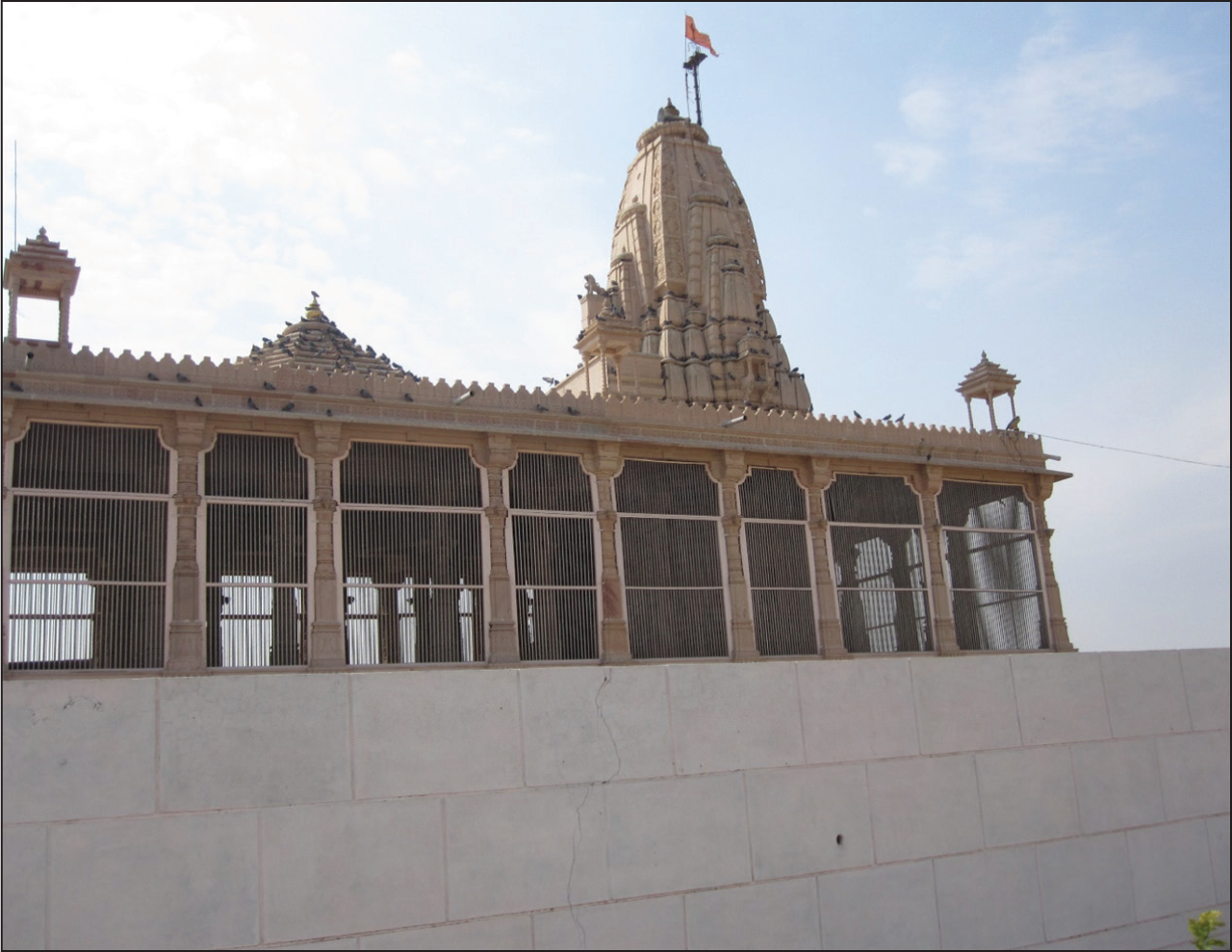
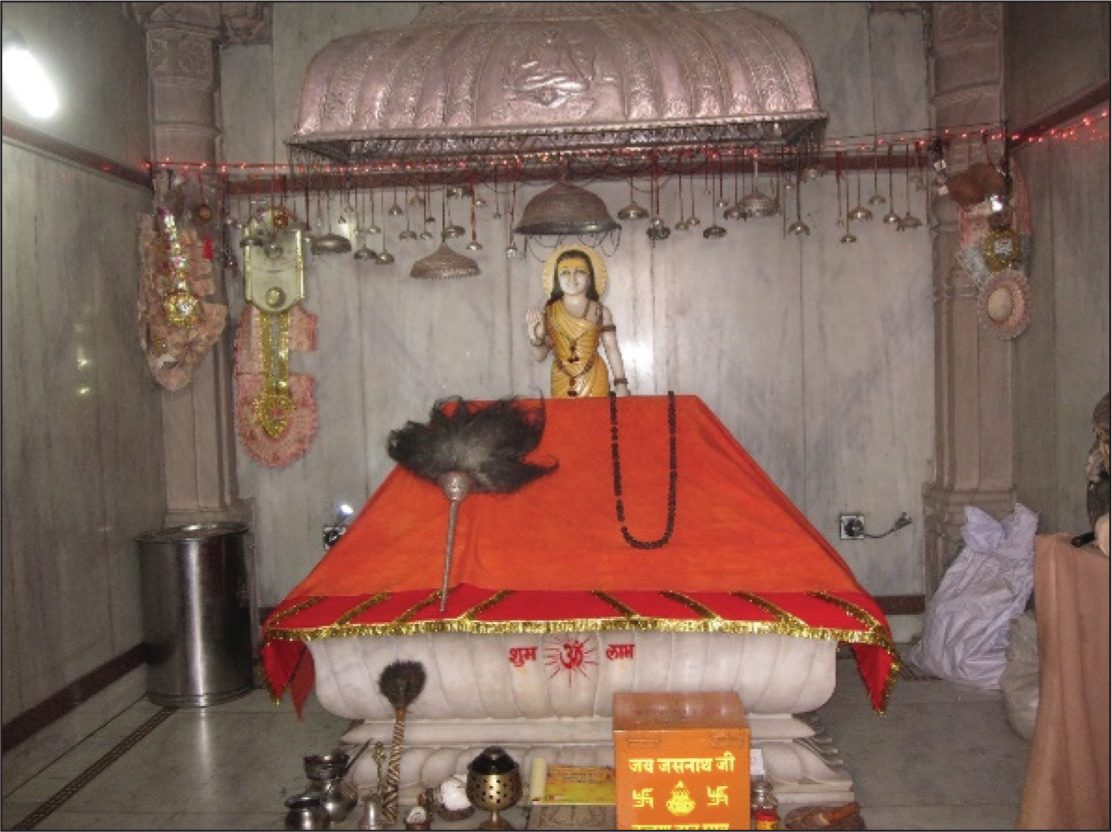
Guru Jasnath (1482–1506) identified with the peasant, as he himself belonged to the peasant community of the Jat cultivators. The Parwanas, Rukkas and Sanads that were issued by the state of Bikaner refer to the Jasnthis. 58 A visit to the main shrine, which is located at Kathriarsar, by the author in 2018 shows that an idol is placed at the main shrine (Figures 1–3).
The Jasnath Bari (Temple) at Kathriarsar.
The Staircase to the Main Shrine.
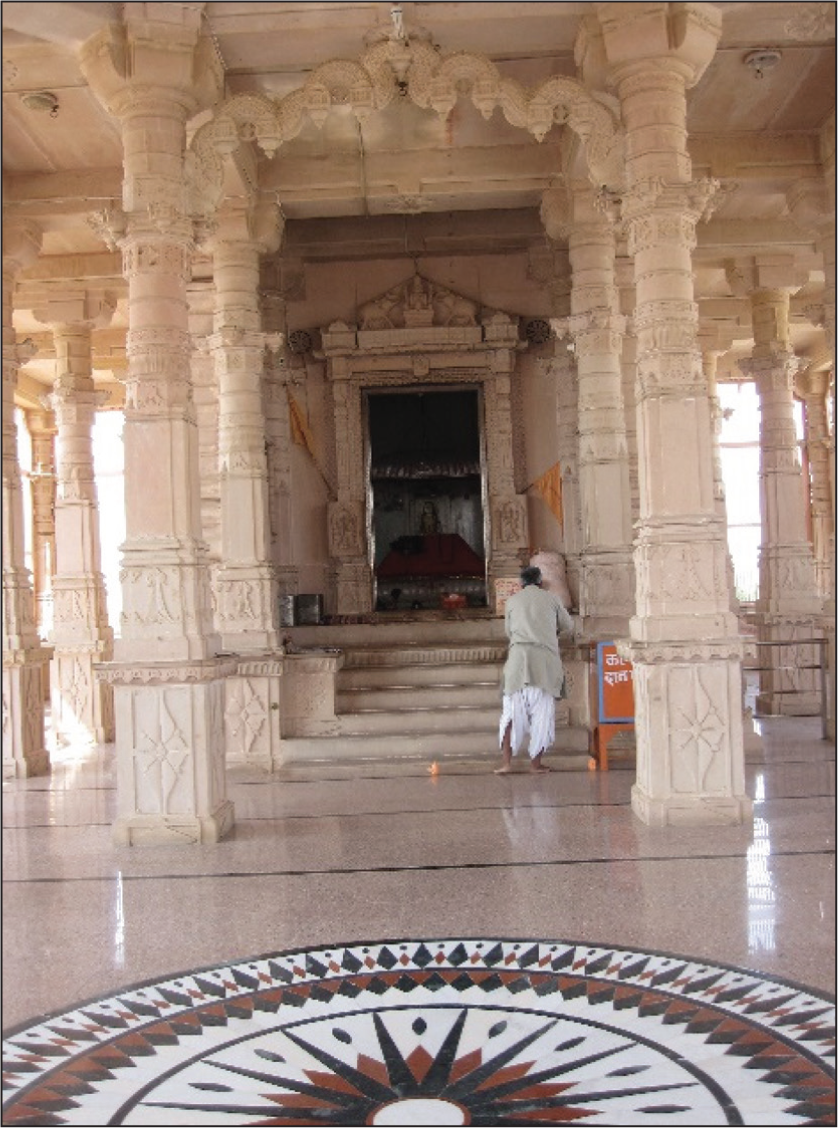
The Main Shrine at the Temple, Kathriarsar.
Report Mardum Shumari Raj Marwar mentions that the Jats worship Jasnathji and have no other devta.
59
They do not make an idol of Jasnathji, as the teachings of Siddh Jasnath taught people to revere God as nirgun. The same characteristics have been observed by Dominique-Sila Khan while writing about the Kamads and Meghvals, as they had been nirgun earlier. If we look at the lives and main episodes of each saints, they closely resemble those of other saints, whether narrated by a Nirgun or a Sagun. The major elements, as mentioned by Lorenzen are:
The saints will have an unusual birth. The saint displays his religious vocation, supernatural power/divinity at a young age. He will have a life-changing encounter with his first guru/or vision, and this will happen when he receives some sort of initiation from the guru, and he may either be a child or a mature adult when this encounter takes place. He may either be a celibate ascetic or a married person. The saint will have a number of encounters during his travels to the towns and villages with others who belong to a variety of different categories, which may include his mother, his wife, yogis, qazis, mullahs, Brahmins and Pandits, Baniyas wild animals (elephants, lions and snakes), kings, sultans, gods, ghosts, nymphs and devotees. In the case of the saints whose followers sooner or later organised themselves into a sect, the legends may tell how the saint named his successor and instructed his followers to carry on the tradition after his death. Saints have an unusual death at an advanced age.
60
John Stratton Hawley writes that to investigate this idea and to draw this distinction between the Nirgun and the Sagun paths in the Bhakti kal, the internal evidence in the form of the compositions of the Bhaktas, the hagiography and the anthologies (pad, the early utterances of the sants and Bhaktas) need to be explored. 61 He remarks, after having visited the leading manuscript libraries in North India, that a low priority is given to collecting anthologies of Pads, spanning the Nirgun/Sagun gap. 62
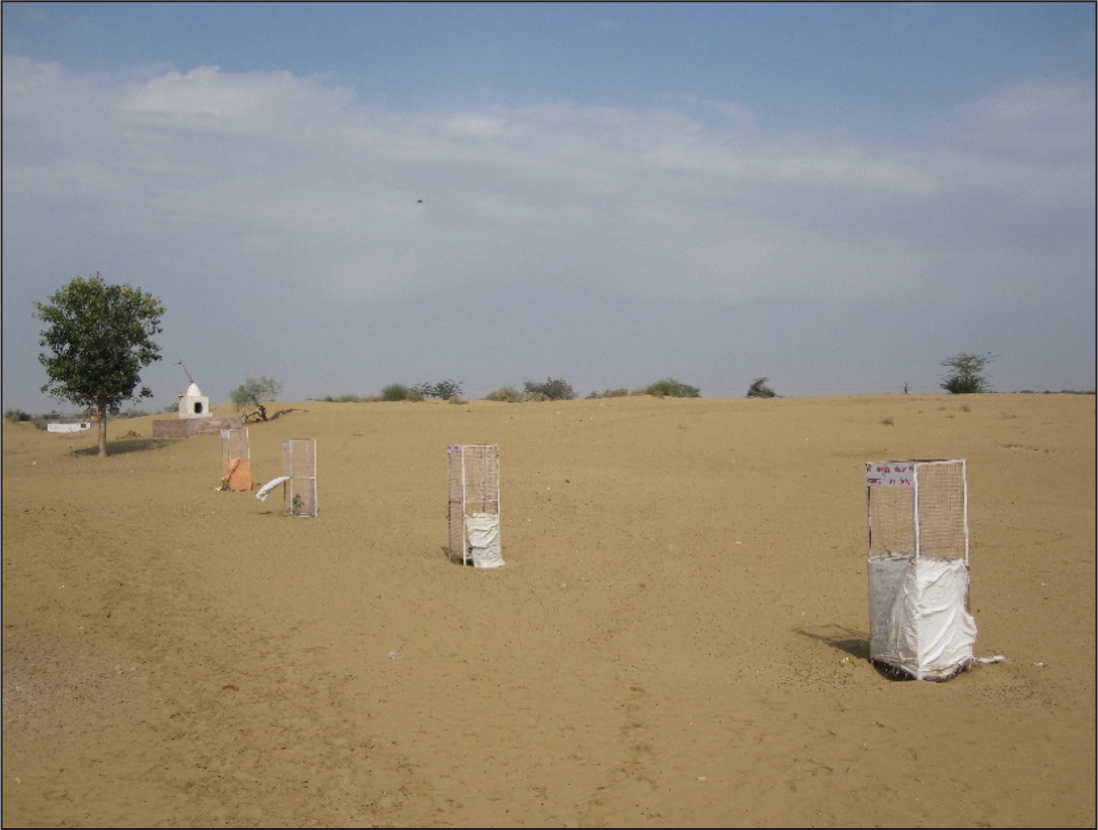
The author has been able to find two Jasnathi texts, namely the Sabdh Grath (Samarga Jasnathi Sahitya Ki Shodhpurana Pastuti) and Jasnath Ji lo Sri Loko (Bikaner State Archives Office). A non-archival source, Siddh Raj by S. S. Pareek, has also been mentioned by Rawat Saraswat, which is a versified story of Saint Rustamji, an ascetic of the Jasnathi sect. 63 Apart from the devotional literature, the author was able to get books on Jasnath Darshan, Shri Jasnath Darshan Shamarika—2013 at the village of Kathriarsar. The village can be reached by road from Bikaner, though it is a stony drive till one reaches the Dharmsala amidst the sand dunes in the village (Figures 4 and 5). The Dharmsala is a term used for the resting place for the pilgrims.
The Kathriarsar Village and its Surrounding Area.
A Picture of Children Selling Prasad, Religious Literature and Cassette Tape at the Village Kathriarsar.
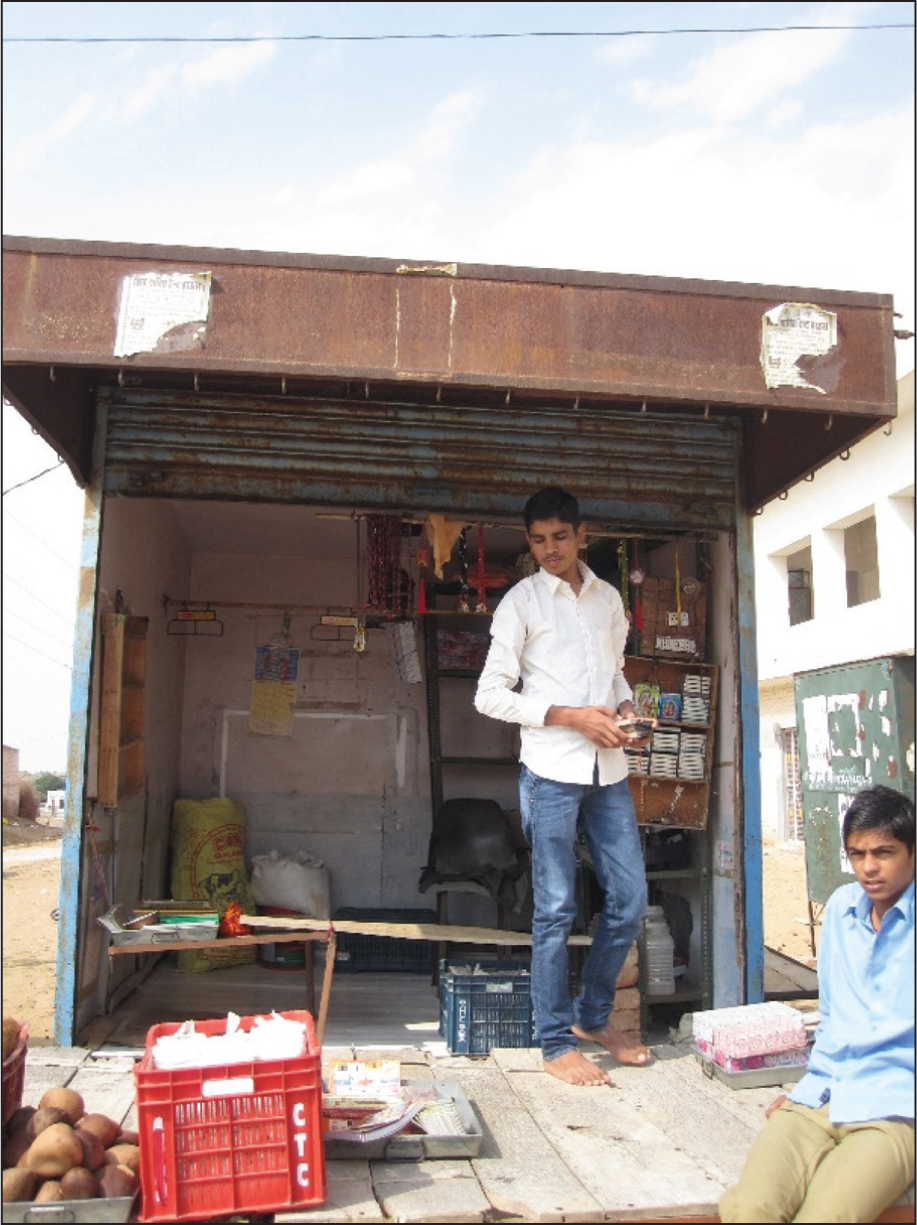
Traditional hagiography tells us that Jat Hamir of Jani Khap and Rupand (Jatni), who lived in Kathriasar, were childless. The Jat Hamir dreamt of the Guru Gorakhnath (one of the founders of the Nath Sampardaya), who told him to visit the jungle at a place near a water tank where he would find a child to adopt. 64 Their hagiography tells us that the Guru of Jasnath, the founder of the Jasnathi Sampardaya, was given the name Jasnath after being initiated by Gorakhnath. 65 The legendary life of Jaswantas an infant, as mentioned in the Sabd Granth, is divided into phases, for he had been taken out of the burning coals of fire without any traces of burns on the child’s body. 66 He was engaged at the age of ten with the daughter of a Jat from village Malash, but had taken the Samadhi before the completion of the nuptial ceremony. Kalal De, his fiancé, also took to living ‘Samadhi’ after she got to know of his decision. Her sister, Pyare De, also performed the same sacrifice. 67 Kalal de as a manifestation of Goddess Parvati and the way in which Parvati is with Shiva in the same way Sati Kallde is with Sri Jasnathji. 68 Jasnath as the incarnation of Vishnu Goga as the incarnation of Bhagwan Shiva. 69 References are also made to Sati Kalade and Pyarlde in the oral tradition, as they became a Sati of the tradition. 70 The Jasnathi festivals, the mela (fair), and other events fall on Saptami (the seventh day), including the day when Kalal De and Pyar De became satis, as a sati ka mela brings lots of devotees to Bhamblu and Kathriarsar. 71 The traditional hagiography also tells us that Lunkaran Rathore was blessed by Guru Jasnath, so he succeeded to the throne after the death of the issueless Rao Neorji instead of his elder brother. Lunkaran Rathore, it is said, would rule as long as the preaching of Guru Jasnath was followed in the region.
The gaddis of the Jasnathis are located at Bhamblu, Likhmadesar, Pundasar and Panchla, while the main seat of the Jasnathi Sampraday is at Kathriasar, which is a village located close to Bikaner. According to Jasnathisaying: ‘Five Dhams, twelve Dhams, eighty–four Baris, hundred and eight sthapnas and the rest are Bhavnas’. The twelve dhams are sacred places located in Bikaner, Nagaur, Haryana, Punjan and Uttar Pradesh and are said to have been established by the twelve disciples of Siddh Rustam. The eighty-four baris are places where the Jasnathi sadhu or sevak or sati have undertaken the Samadhi under the Pilu tree (Jal), which is a tree sacred to the Jasnathis. The Baris, which are eighty-four in number, are sacred places where a Jasnathi Sadhu, Sevak (disciples) or Sati have taken a living Samadhi under a Jal (Pilu tree). 72 The Jasnathji Bari is synonymous with the Pilu tree, as it is revered by the Jasnthis. 73 The Jasnath Bari located at Bikaner, includes Bhamblu, Toliyasar, Punasar, Napasar, Tejrasar, Likmisar, Shri Dungargar, Bana, Bajagsar, Dhaneru, Soniasar, Kakra, Nokhashehr, Hiyadesar, Pachu, Nathusar, Kakku, Sadura, Lunkaransar, Dhani and the number of villages of the Siddh Samaj located at Bikaner (Tehsil, Nokha and Lunkaransar) include Bikaner, Kathraiarsar, Bhamblu, RuniyaBada Bas, Hamera, Naurangdesar, Malasar, Napasar, Tejrasar, Shri Dungargarh, Benisar, Likmadesar, Upni, Ridi, Bana, AbhaysinghPura, Punasar, Saruna, Barajasar, Dusarana, Satasar, Ttkhriyasar, Jhjuhu, Rajpura, Lakansar, Mankasar, Udrasar, Lunkaransar, Hassera, Malkhisar, Aadsar, Nakhodesar, Manohariya, DhaniPadusar, Khodhola, Dholmara, Kallu, Sajrasar, Jaitpura, Nokha, Chitana, Kaira, Saduna, Nathusar, Solamsar, Beasu, Sajannwasi, Sadasar, Bilniyasar, Sadhura and Thavariya. 74 Bikaner has the maximum number of Gaddis of the Jasnathis, and according to the hagiography, it is stated that the rule of the raja of Bikaner and the fame of the Gaddi of Jasnathji would be a constant, which is why the Siddhs of Bikaner are most prominent. 75
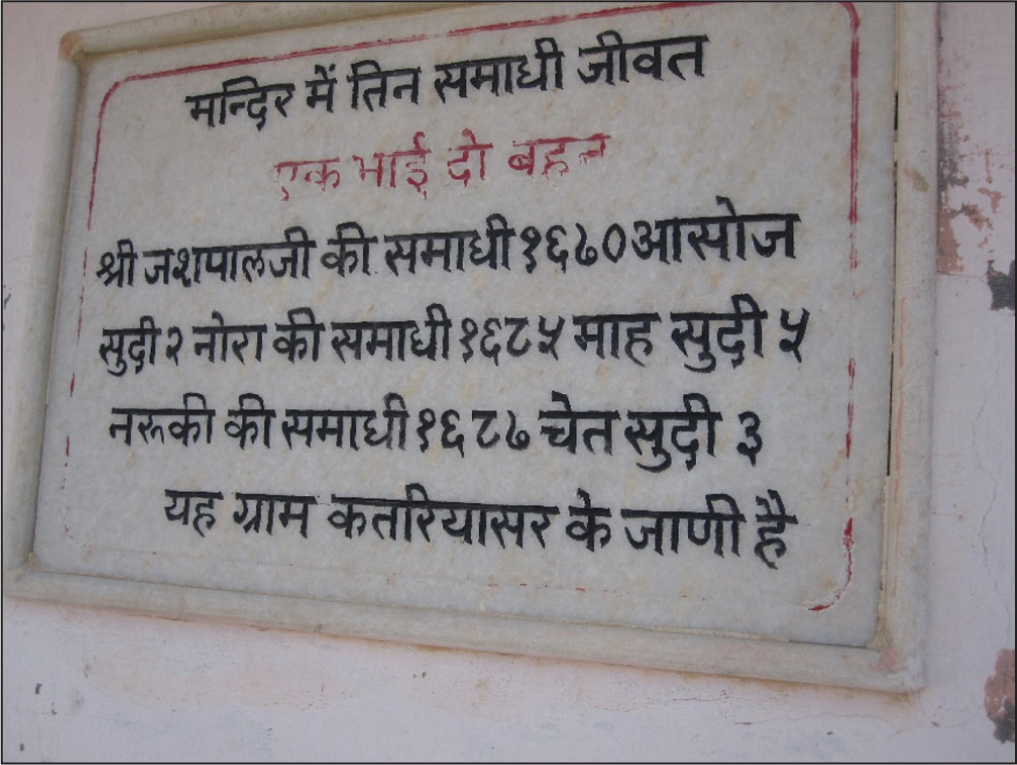
Report Mardum Shumari classifies the social categories into classes, and the Jats, including the Qanungo Jat, the TejajatJuhar, the Jasnathi/Siddh Jat and the Saddh Jat, are kept under Class A, the ‘Siapahiaur Raj karnewali Kaume’; Class B includes the ‘Mazabhi Kaume’, which is inclusive of the Brahmin, Shrimali, Jogis, Nath, Kalbeliya among others; Class C includes communities who are into trade; Class D is inclusive of the sonar (goldsmith), the nai (barber), the Khati; the Bhangi and Sasi fall into Class E, while Class F is inclusive of communities that include outsiders, like the Muslim Kaume (communities), the Sheikh Mughal, the Paths, the Afghans and more. 76 It states that a total of fifty-two villages belong to the Siddhs. The Mardum Shumari states that this oral tradition was transmitted from one generation to the next by the Jasnathi Siddh, 77 Siddh Haroji (the Bari of Haroji Siddh at Bamblu, which is close to the Kathriasar village, is of equal importance to a pilgrim), Siddh Dhanoji, Siddh Paloji, Siddh Samsoji, Siddh Rustamji and many more Siddh of the Jasanth Sampraday, whose verses are mentioned in the Sabad Granth, deal mainly with duties and preaching. 78 Among the thirty-six teachings (Niyams/asul) of Jasnath mentioned in the Mardum Shumari are ideas when not to castrate a bull and the protection of animals, as selling of goats and the calves of cows and buffalos is not allowed, and for this reason, they were instructed to keep the goats in the ‘thath’ (protected forests where the sheep and the goats would graze). The devotees were to keep grains and water (chugga and pani) for the birds at the Bari of Jasnathji (Dev Mandir). 79 The Orans, protected forests, were to be maintained where no would be allowed to kill animals or cut trees. They were to keep a pot of water for twelve days in the name of the dead person; to take food only after bathing; to keep a dhoop in the name of Jasnath; to refrain from cutting trees and practicing agriculture on the seventh of every month and on amasvasya. 80 The disciples gave a tithe called dasvandh (a tenth of their income), which was a variant of the Nizari word dassondh. 81 The importance of keeping dhoop (incense) in the name of Guru Jasnath is a practice that is even acknowledged by the state, as we find a reference in the Kagad Bahi of the state granting remission to the Jasanthi Siddh for continuing the practice of lighting the dhoop. 82 This practice of lighting the dhoop before sunset has been used to ward off snakes in the cult of the Goga. 83 Bhu Sammadi, or burial, was to be performed instead of the cremation ritual, and the devotees were not encouraged to go on pilgrimages (Figures 6 and 7). 84 Jasnath, like Pir Shams in other hagiographical traditions, writes that Sila Khan caused the Ganga to flow in the desert that it was ‘useless to go far’ to dispose of the ashes, since the deceased were buried in the Kabristans in the villages. 85
Samadhi.
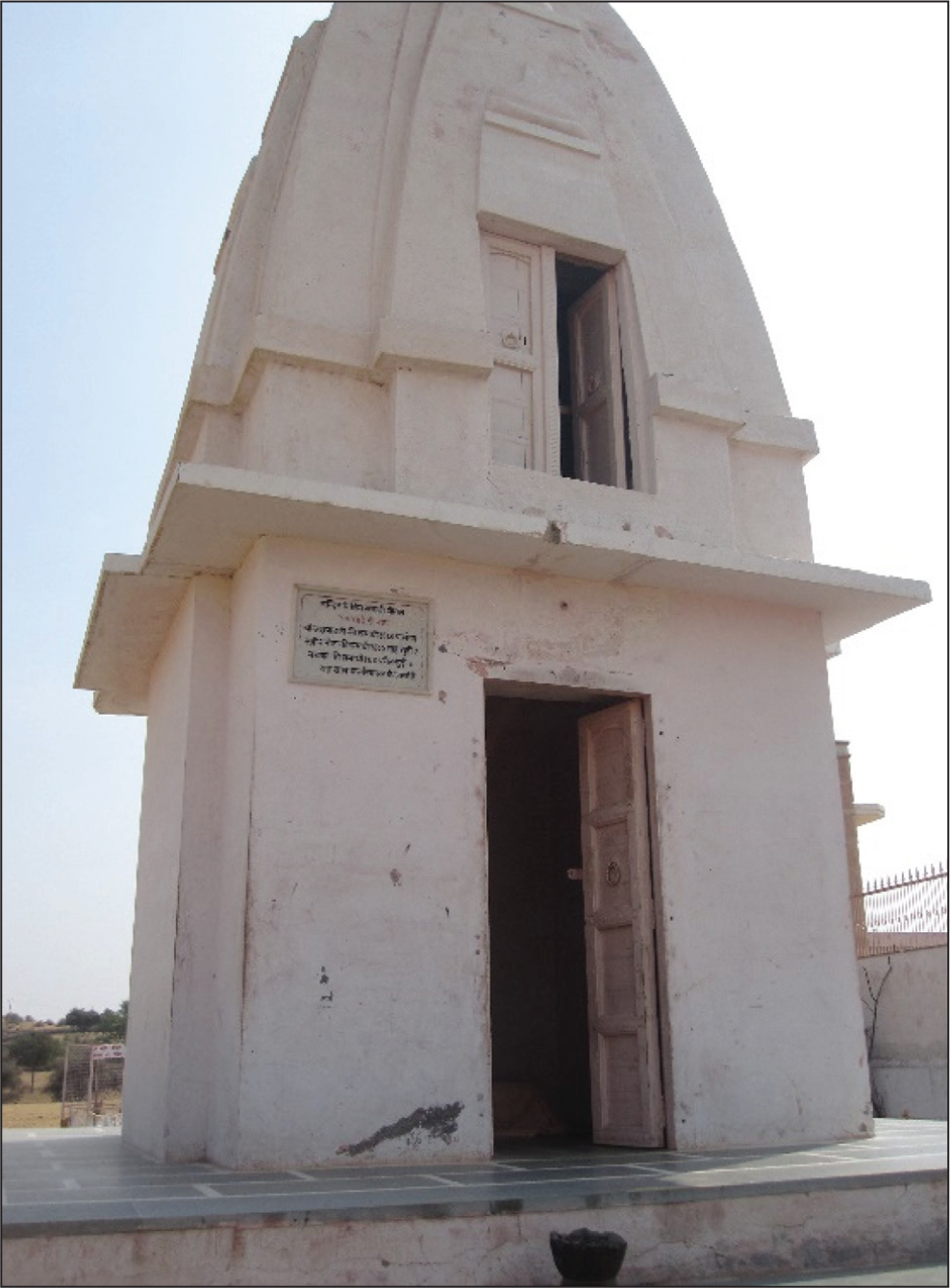
The Picture Indicates that Three Samadhi’s Took Place at the Temple.
The temples of the Siddhs are known as ‘Jasnathiki Bari’ and are located in a chain of Siddh villages. Each gaddi has its own mahant as its head, who is a Siddh. They are all householders. The Jats who were Siddhs were to wear Bhagwa clothing, do agriculture, be householders, although the Siddhs who belonged to Panchala were to remain unmarried. 86 The Saddh Jats belong to Chapasar and Chauri Pargana Jodhpur and are referred to as ‘Sant’. They tie a Bhagwa turban and are exempt from paying the Hasil, and their land is known as the Doli. 87 They are known to marry Jats and also worship thakurji and Hanumanji, and the hagiography tells us that either Shri Viajay Singh or Bhim Singh had given the difficult task of procuring a melon (in the summer season) to a Sadd of the village Chapasra, and this is what had made the Sadd prominent. 88
Ratri Jagran (night vigil) is among the main characteristics of the Jasnathi Sampraday. 89 Jammo is another word used for the Ratri-Jagran. It is this practice of Jagran whereby the Jasnathi Siddhas explained the Jasnath banis to their followers. 90 The agninrtya is performed by the Jasnathi Siddhs. 91 The fire-dance (agninrtya) of the Siddhs takes place only at night. Around 10–12 members of the Jasnathi Panth are seated at the Chauki, and a symbolic Nishan is placed next to the main singer, which is a piece of wood covered with an ochre-coloured cloth (bhagwa) and a peacock-feather (mokpankh) placed on the top. 92 The night vigil (agnijagran) of the Jasnathis and the fire dance (agninrtya) with the rest of the people begin with the Ratri Jagran, the havan-jyot, the singing and the aginnrtya. 93 The singing includes a pad by the Guru Jasnanth himself, a pad by Shamsoji (Shamsuddin/Pir Shams Sabzwari, who was a leading figure of Nizari Ismailism) and a third pad by any of the Jasnathi saints. This fourth Pad is known as the Nachya Pad (dance poem), which begins with the order of the Mahant. 94 The male devotees collect a lot of wood from the shami tree, and when the wood lights up well, the Siddhs dance and jump into the embers and shout ‘fateh fateh’, sometimes playing with the embers and at times throwing them and putting them in the mouth and blowing them out of the mouth, or else accumulating them in their clothes. 95 This is known as Matira Khana. As Siddh Rustamji, the seventeenth-century Siddh, had entered the fire and had emerged out of it with millet (bajra) and a melon, he obtained a boon, which gave the Jasnathi Siddh the power to dance on burning embers. 96 The Mardum Shumari states under the subtitle, Jasnathi Jats, that the Siddh Jats are most well-known for this feat. 97
The Jagrans are organised at the dhams of Kathriarsar (Bikaner), Bhamblu (Bikaner), Likmadesar (Bikaner) and Puransar (Churu) and Panchla (Nagaur), twelve dhams and the eighty-four baris on three main occasions which are held in (asvin, magh and Chaitra shukl and chaurthi). Apart from these, the Jasnathi Jagran is held in each of the villages on the punyatithi of the mahapurush.
98
Ordinary Jagrans are held on five occasions:
Asvin Shukl, Magh Shukl, and Chaitra Shukl Saptami for the Guru Jasnath, and a Kalal De Jagran on Asvin Shukl, Magh Shukl and Chitra Shukl Chaturthi. These Jagarans are organised only at the Jasnath Bari/Asan. The mahant, or the Siddh Samaj, can also organise a Jagran at the bari on the punyathithi of a sevak, sadhu, siddh or sati. These Jagrans are known as ‘Varsaudhi’, since they are held annually, and as ‘Gavau’ in case they are organised by the village. Jagrans are even organised on special occasions as Jivan-Jivni (Bhoj given in one’s lifetime), Ganga Prasadi (Bhoj given after a holy dip in the river Ganga), Putra- Janamustav (the birth of a son), gram shanti (traditionally this should be held at the well in the village each year), construction work for the bhavan and Grihapravesha (solemn entrance into the house). Apart from theses occasions Jagrans are also organised on Gangaur, Holi, Deepawali and solar and lunar eclipses. Jagrans can be organised by sending invitations to the Siddh singers. A certain amount of money is given either to the mahant or to the bari by the villagers, with which a Nagara can be purchased by the singer. The mahant of the main dham of the Jasnathi Sampraday also visited the houses of the sevaks with the group of singers. This is also known as ‘Phere’ and Jagrans are held by sevaks once they learn that the Phere is visiting the village (Phereaaei).
99
The Jasnathi literary compositions show the usual Ismaili motifs. The compositions associated with the Jasnathi have been classified as ‘sant poetry’ by the Rajasthani authors. Dominique-Sila Khan has demonstrated connections between the Jasnath Sampradaya and the Bishnoi Panth with the Nizari dawa and has also drawn parallels between the Gorakhvani and the devotional compositions of Jambha and Jasnath.
100
Dominique-Sila Khan writes of their being in the Jasnathi literature, a criticism of the Muslim and the Nath Yogis, as quotes the bhajan staring with: mahmad, mahmad mat karkazi (O Qazi, do not repeat the name of Muhammad).
101
This bears resemblance, she writes to a sabd ascribed to Jambha. Jasnath is identified with the peasant, as he himself belonged to the Jat community of the Jat cultivators. Efforts were made to protect the forests (oans) and the grazing grounds. It is in this context that it is stated in the Sabd Granth:
O Kazi, do not recite the name of Muhammad as he was a unique being. Muhammad was a true spiritual preceptor, but you are dead as a judge. The knife in Muhammad hand is not made of steel. If Muhammad ate meat after the ritual sacrifice, he has also revived the animal who is grazing.
102
(Translation)
We find the same criticism in Gorakh Bani collection, the translation of which was done in Benaras (Varanasi)
103
O priest [Kazi], don’t say ‘Muhammad Muhammad’! Muhammad’s thought is difficult The essence of the dagger in Muhammed’s hand Was neither of made of steel or iron.
104
The sabad is critical of the authority of the priest, as a Kazi is a judge who is proficient in the Islamic jurisprudence. 105
Jasnath is identified with the Nikalank Avatar and is called Kayam Raja (the king who is eternal, i.e., God). Guru Jasnath is revered as the Guru/Sant by the Hindus; however, his disciples would view gun as a god. 106 Vishnu’s avatars and the stories related to them played an important part in the transformation of the Hindu folklore created by the Ismaili missionaries. The soteriological themes in the Nizari religions were popular and expressed in the Bhakti stories in which the gods fight with the demons (asuras/rakshas). The tenth incarnation of Vishnu plays a key role in the Ismaili tradition. These eschatological themes focus on and describe the end of the world at the end of the fourth cosmic age, Kaliyug, since Vishnu’s tenth avatar was expected only at the end of the era (Kali Yuga). Jasnath was regarded as an avatar of God Vishnu (identified with Krishna and with the tenth avatar of Nikalank) and also as an incarnation of Shiva. 107 The Jat community reveres him as Bhagwan Krishna, for all his activities signified that he would kill the demon Kalangi, as stated in the Sabd Granth. 108 In the Sabd Granth, it is stated that he would be born as avatar in Kaliyuga as ‘Nikalanki’. 109 The advent of a saviour and a restorer of justice in the form of Vishnu’s tenth incarnation is referred to as the Nikalank avatar, not Kalki. 110
The role of avatars during the different yugas was interpreted to ensure the continuity of the religious message from Hinduism to Ismailism. Nizari Ismailism claims that Vishnu in his Narasimha incarnation had told devotee Parhlad that he would save thirty-three crore of souls, five crores were saved by Prahlad himself, seven crores in the following yuga and nine in the third yuga. In the Kali Yuga, according to the Nizari Ismaili, it would be the Nizari Pir Sadruddin who would grant liberation to the remaining twelve crores. This motif might help us to trace the hidden Ismaili influence in different contexts. The twelve dhams among the organisational structure of the Jasnath Sampraday located at Bikaner, Nagaur, Haryana, modern Punjab and Uttar Pradesh might have this hidden Ismaili influence [emphasis mine], since twelve is a key figure of Ismaili symbolism. These are said to have been established by the twelve disciples of Siddh Rustam, a seventeenth-century Siddh of the tradition. Other terms that belonged to the Islamic world were given indigenous meanings by the re-Hinduised communities, creating a ‘Hinduised Ismaili pattern’; however, whether it was an Ismialised Hindu pattern or an Islamic concept, when found in certain traditions bear vestiges of missionary activity. 111 Ali Asani groups the texts 200 Ginans thematically. 112
The Ginans thus represent Ismaili themes in an unusual guise of Hinduism with its mythological forms. Thus, there was a similarity between the Vaishnava Hindu concept of avatara and the Ismaili concept of the Imam. The messianic tenth incarnation (dasaavatara) of Vishnu, Kalki, known as the Nikalank avatar in the Satpanth, was identified with Ali, the first Shi’i Imam. 113 A similarity between the hagiography in the Ginans and the Sufi writings is noticed by Azim Nanji in his book. 114 The terms are equivalent in some Ginan and in some pada of the poet of Vaishnava bhakti in Gujarat, Narasinha Mehta (ca.1414–1480). He is regarded as the first poet (adikavi) of the Guajrati language and an important Bhakti figure among the saint–poets of medieval north India (fourteenth–eighteenth centuries). A survey of the names of God in the Ginan illustrates the attitude of the authors towards Hinduism, for they are indebted to the Bhakti in the Sants. We find the names of Nirimjana, Alakha, Gura, Gura Nara and Sami (Svami) Nathji. The interests of the Ginan is not restricted to their links with Hinduism; they are permeated with Sufi concepts and Islamic thought. Not only did the Ismaili dai draw from Hinduism, but the Jains also tapped into Krishna-Bhakti. Mallison writes that the brand of Hinduism developed in the Ginan literature appears to be endowed with all the characteristics of the religion of the Vaishanavasants of northern India. The process of acculturation is striking in the literature of the Nizari Khojas, as the literature in the vernacular form was explained in a manner to make the Islamic concepts accessible to the population. They indegenised the Ismaili tradition to the local cultural milieu. These compositions, which are of the Pir, can be regarded as signatures (Chhap) and are the same as Bhajans, which are ascribed to the sants. 115 The Nizaris therefore transformed the indigenous terminologies and concepts to fit into their own ideology, and these recast models have been referred to as ‘Ismailised Hindu patterns’. 116
The motif of the thirty-three crores is an example of this, as Hindu elements were taken and redefined and put up in different patterns, which were Ismailised and thus changed the content of the Bhajans of the indigenous tradition. Other elements that were Islamic would be given indigenous etymologies and meanings by re-Hinduised communities, creating a Hinduised Ismaili pattern. Dominique-Sila Khan terms the motif as Ismailised Hindu Patterns. It is this ‘Ismailised Hindu’ pattern, writes Dominique-Sila Khan, that are to be found in the devotional songs. According to her, the Nizari Pirs have borrowed freely from the Nath and the tantric traditions, as well as from the Jain and the Vaishnav traditions. 117 Nikalang Puran of Saint Lanath (eighteenth-century Jasnathi saint) describes the Kalki incarnation; the poem relates to similar prophecies as were made in the agamvanis, which were associated with the Nizar Panth, the Bishnoi and the Jasnathi Sampraday. 118 The agamvani (poems of the time to come) are still sung in sacred vigils of the Nizarpanth, who accept Ramadev Pir as their guru. 119
The Jasnath Banis, the Sabd Granth, the reverence of the community to the Samadhi of the Sant, and the shrine located at the Gaddis of the sect, with time, defined the cultural identity of a community.
Footnotes
Declaration of Conflicting Interests
The author declared no potential conflicts of interest with respect to the research, authorship and/or publication of this article.
Funding
The author received no financial support for the research, authorship and/or publication of this article.