




Abstract
Jute is a significant fibre found in India, particularly grown in the provinces of Bengal and Assam. The increasing demand for jute fibre in international markets encouraged the peasants of Bengal to grow jute for commercial purposes. Therefore, Bengal became a centre for globally recognised jute production and supplied to European nations. The discussion of jute trade in India would be lacking without referring to the Goalpara district of Assam, which shares a close flank with Bengal, where a plethora of jute had been grown. The damp alluvial soil of the Goalpara district became favourable for growing extensive jute. The affordable and cheap price of high-quality jute attracted many traders from Bengal and Central India. Besides, the Goalpara district had access to waterways in every nook and cranny, and the district’s administrative centre had inland transportation connections to Bengal. The jute trade was extensively carried out in the Goalpara district, and all the jute fibre was transported to Bengal and then to European countries. The demand for jute in the international markets caused a huge number of peasants to migrate to Goalpara district from East Bengal to cultivate jute.
The use of jute fibre for domestic purposes has been commonly found in India since ancient times. The ancient Sanskrit socio-religious text ‘Manu’ mentions that the Indian people used a particular type of fibre cloth made from patta bark. 1 In Bengali verse, jute was called pat or kostha, denoting both the plant and jute fibre. 2 According to Buchanan-Hamilton, ‘pat’ is a Bengali term which denotes jute plant and jute fibre. Besides, jute was known as Jhat; this term probably derived from the phonetic rendition of the Cuttack vernacular. 3 Generally, jute was called ‘pat’ or ‘patta’ throughout India which became an important fibre next to silk. 4 Over the years, jute was grown in the swampy areas of Eastern Bengal and was commonly used as rope for domestic work. 5 Dr. Roxburg, a botanist of the Royal Botanical Garden of Calcutta, observed the locally used jute fibre which was available in Bengal. Thereafter, he grew jute plants in the Calcutta botanical garden to conduct a preliminary study. 6 In 1795, he for the first time used a specific name for the fibre plant as ‘jute’ after a successful examination. 7 Dr. Roxburgh emphasised the commercial value of jute fibre to the directors of the East India Company as to the extensive use of jute fibre in Bengal. 8 Undoubtedly, the cultivation of jute intensified in Bengal, Eastern Bengal and Assam following the jute exports to Europe that began in 1828. 9
The ‘golden jute’ became a lucrative cash crop in Bengal as well as an important raw material next to cotton in the British market. 10 Until the late nineteenth century, there was limited jute cultivation in India, but by the turn of the twentieth century, jute cultivation had rapidly expanded due to effective trading policies initiated by the British and making it an important component of the country’s economy. 11 One of the most significant textile industries in the world was built on the jute. 12 The demand for jute fibre in Europe contributed to a higher economic standard across Bengal. 13
Before the nineteenth century, the Bengali handloom weavers had a monopoly on the trade of jute fabric and gunny bags. The Bengali villages and ethnic communities tended to utilise jute cloths and gunny bags. 14 With the availability of jute fibre, the cottage industries became a reliable source of economy in Bengal. Therefore, there were huge cottage industries sprung up on both the banks of the Hooghly river. 15
Undoubtedly, jute dominated British as well as the European markets. 16 Due to the British East India Company’s active commercial operation, jute cultivation rapidly grew in the twentieth century. 17 In 1791, the East India Company’s Board of Trade dispatched a consignment to England to carry out experimentation to produce spinning yarn. 18 In 1832, a new chapter in the history of jute production began in Dundee after the introduction of machine-made spinning yarn from traditional processing of jute fibre. After years of struggle, Dundee established a monopoly on the manufacturing of jute products and also dominated a lucrative export of jute products. 19 Over the years, the demand for jute fibre was very significant in Germany for manufacturing blankets and carpets, of which the Dundee merchants kept an eye on jute fibre of India. 20 As a result, the demand for jute fibre in overseas trade led to extensive jute cultivation in Bengal. 21
W. W. Hunter said that jute fibre was almost unknown at the time of the London exhibition of 1851. However, the British as well as European manufacturers had to purchase Rhea and China grasses at relatively higher prices than jute. 22 Now, the British East India Company came to realise the possibility of making huge profits by exporting jute fibre to Dundee (Scotland) industrial sectors rather than doing handloom business. 23 In 1855, the first jute mill was founded at Rishra of Bengal by George Auckland. The demand for jute fibre in Europe grew momentum owing to its increasing use in carpet and rug manufacturing at a cheap rate, in addition to its traditional use as packing materials and bags. Consequently, jute prices continued to rise due to competition between Indian and European mills. 24
During the 1850s to the 1860s, jute handloom products were the principal source of income for the bulk of the population in Bengal. However, the growth of the Dundee-sourced power loom materials and the introduction of the power loom industry in Calcutta significantly increased the demand for handloom materials in Bengal. Although there was a rapid expansion of power-operated mills that produced jute fabrics and bags at high speed, the demand for machine-made products was moderate in the markets as compared to the locally made handloom products which were superior in quality and more durable than machine made. 25 From the middle of the nineteenth century to the middle of the twentieth century, jute fabrics such as gunnies, hessians and burlap dominated as premier packaging materials in international trade. Jute sacks were used to pack the commodities for instance grains, cotton, sugar, coffee, guano, bacon and other materials that were transported from farms to the centre of consumption. 26 By the 1870s, Bengal had a strong foundation in jute cultivation due to the encouragement of British jute industrialists. The jute-growing region of India was mostly situated in the northeastern part of Bengal province and western part of Assam. According to H. C. Carter, ‘the Bengal province of the Indian Empire was broadly speaking that one and only part of the world where jute is grown’. 27 The extensive jute cultivation was done on a vast delta of the Ganges and the banks of the Brahmaputra river due to its warm, humid weather and availability of river water that produces a plethora of crops with little labour. 28 By and large, jute grows on river banks and other low-lying lands, where the young plants sustain in partially submerged areas for some days. Additionally, on higher lands, it required lots of manuring and irrigation during the entire period of its growth. 29 However, a high quality of jute can be grown on fairly high land in Bengal and Assam, if sufficient water or moisture is maintained throughout the growing period. 30 The seeds are normally sown in April on the soil of chars and alluvial sandbanks deposited by the strong current of great rivers and the plant is ready for the harvest in August. When jute first rose above the ground, it required lots of water to withstand heavy inundation. After cutting the matured jute plants, the stalks are tied up in bundles and thrown into a body of water to steep. When it is decomposed to such a degree, the bundles are taken out from the water and the fibre is extracted and carefully washed. It now appears as a long, soft and silky thread that is rolled into balls for transporting to the markets. 31
By 1885, twenty jute mills had been set up in Bengal, where jute industries acquired much importance. All jute mills were owned by Englishmen who had established jute mills on either side of the Ganga river ranging from Calcutta to Chinsurah, which is known as the ‘Dundee of Bengal’. Therefore, jute production grown in the western part of Assam eventually benefited the jute mills of Bengal.
32
According to Tariq Omar Ali, ‘The Crimean War inaugurated the large-scale production and trade of jute as it interrupted Britain’s supplies of Russian flax and hemp and led textile mills in Dundee (Scotland) to switch en masse to jute’.
33
Although the initial concentration of jute mills was made in Dundee, jute mills were established in continental Europe, the United States and Bengal in the late nineteenth and early twentieth centuries.
34
According to Jadunath Sarkar:
Jute is a monopoly of India and its price in the world markets ought to depend mainly on the outturn in India. But the area under this fiber varies greatly in different years according to the prices realized, because when jute prices are low and rice is dear, the Indian cultivator will place more land under rice than under jute and vice versa.
35
Every year, the cost of jute fibre fluctuated. When the price of rice decreased, the cost of jute became expensive. Therefore, the Indian farmers brought more land under rice cultivation than jute. 36 Hence, since 1903, the price of jute has generally been determined by global demand rather than Indian supply. 37
By 1910, about half of the world’s jute manufacturing capacity was located along the banks of the Hooghly, to the north of Calcutta. 38 Between the two great world wars, the jute industries were sustained steady growth in Europe (mostly Scotland). 39 With the outbreak of the First World War, a long era of growing extensive jute production and prosperity in Bengal came to an end. The value of raw and manufactured jute fibre for export came down to 25% of all the export value of Indian goods at the end of 1917. 40 Following the First World War, the cultivation of jute remained intact in domestic markets in Bengal, Assam and Bihar. 41 Though, after the World War, the jute cultivators revived jute cultivation, it could not regain a good market that turned them impoverished. 42
No doubt, the jute industry had a late start in Assam, and the importance of jute as a cash crop appeared in the market in the last quarter of the nineteenth century. 43 In Assam, jute fibre was used for domestic tasks such as making rope, twine and other materials which contained no market value. With growing facilities of river-borne trade, the Marwari traders took interest in the jute trade. 44 The jute plant grew extensively on the banks of the Brahmaputra river of western districts of Assam. 45 Among the districts, Goalpara emerged as the largest producer of jute. 46
The Brahmaputra river flows through the heart of the jute-growing districts where water communications are so pervasive and accessible for jute that is easily and affordably transported to the markets. 47 The jute cultivated tracts extended from Purniah to Goalpara mostly located on the northern part of the Ganges and on both the banks of the Brahmaputra River.
The extension of its cultivation has been equally rapid, but it is more limited in area, being practically confined to Northern and Eastern Bengal. In this tract, which extends from Purniah to Goalpara, for the most part north of the Ganges and along both banks of the Brahmaputra, jute is grown on almost every variety of soil. 48
The peasant proprietors can increase or decrease the jute cultivation depending on the position of the market. 49 The Brahmaputra valley occupied a suitable area for jute farming with good qualities, which is classified as a special category in the market. 50 However, the quality of jute fibre of the Brahmaputra valley is relatively not as good as in Bengal. In other respects, it is a long, strong and healthy class of jute. 51
Over two and half million acres of land was being brought under jute cultivation. The jute-growing areas were practically confined to the warm and humid parts of the northern, eastern and southern districts of Bengal and Assam. 52 The cultivation of jute is carried out in Bengal and Assam, but the mills for manufacturing jute fibre are only located along the Hooghly river near Calcutta. 53 The jute cultivation expanded in many areas of districts in Assam and the plains of the Garo Hills, but due to a lack of market facilities for jute, it was transported to Goalpara district for commercial purposes. Jute became a highly profitable cash crop as compared to Ahu rice that provided almost double income to the riots in Assam. 54 Arupjyoti Saikia wrote: ‘By the end of the nineteenth century, the Assam administration became confident that riverine and char areas of Brahmaputra were suitable for jute cultivation.’ 55 With lucrative jute cultivation and the growing number of jute factories in Bengal, the vast riverine areas of western Assam were exposed to landless peasants of Eastern Bengal, eventually creating a new phase of rapid land reclamation. 56 Such areas were located in Nowgaon, Lakhimpur, the eastern Darrang and Eastern Duars, Goalpara and the Barpeta subdivision of Kamrup. 57
The jute cultivation in the western part of Goalpara district mostly resembled adjacent districts of the northern part of Bengal than Assam. 58 H. R. Carter mentioned that over 444,761 people of Goalpara were engaged in jute cultivation in both the char areas of Brahmaputra as well as plain areas of Eastern Duars. Therefore, Goalpara became the main area of jute production along with the jute-producing district of Bengal. The Uttariya or Northern jute from Goalpara, Rangpur and Siraganj maintained its popularity in the Calcutta market due to its length, colour and fineness. 59 Almost all jute products of Goalpara district were carried away to Sirajganj. 60 Therefore, Sirajganj became a principal market of jute for jute traders of western parts of Mymensingh, Pabna, Bogra, Cooch Behar, Rangpur and Goalpara. About 30% of the jute falls under hessian. 61 Besides, Goalpara district became the centre of Kakaya Bombai category of jute fibre which was supplied to Serajgunj. 62
In Goalpara, jute was cultivated in permanently settled tracts.
63
The Zamindars of Goalpara encouraged the peasants coming from East Bengal to settle and cultivate jute in char areas.
64
According to F. C. Manahan, the then director of Land Record and Agriculture:
Jute was grown primarily between the Lakhipur and the Mankachar area of Goalpara: On both the south and the north banks of the Brahmaputra, in the tract of the country to the north Dhubri, lying west of straight line drawn from station to the eastern boundary of the Guma Forest reserve.
65
Goalpara was the only district in Assam where jute was cultivated extensively. 66 Very good jute was grown in Jamadhar Hat and Manikachar, which attracted many traders. 67 According to British India official report of the nineteenth century, jute was cultivated by several communities of the region in the pre-migration period, particularly by the Hajongs, the Rabhas and the Kacharis, who had knowledge of the perfect technique of cultivating jute plants that produced a good quality of jute in small quantities for domestic use. 68 Since the 1880s, the cultivation and production of jute had rapidly expanded in the western portions of the Goalpara district and adjacent areas of the northern part of Bengal. 69 No doubt, jute cultivation in the Goalpara district became more profitable because it was easier to grow and gave a quicker return that replaced sugarcane cultivation. 70
In the Goalpara district, 35,022 acres of land was under jute cultivation, which yielded more than 348,332 mounds in 1897. 71 Rajen Saikia stated, ‘in 1897, the area of jute cultivation in the Goalpara district was 35,000 acres’. 72 During 1903–1904, the area of jute cultivation in Goalpara district was 41 square miles 73 and 28,000 acres in 1906. 74 Therefore, the cultivation of jute is extensively carried out in the Assam Valley due to the prevalence of fertile soil and suitable climate. 75 In 1914–1915, total jute cultivation of Goalpara was 45,904 acres. 76 By 1921, jute became the second-largest cash crop in the Goalpara district. 77 Therefore, the peasants of East Bengal bought huge acres of land from the local peasants for jute cultivation. 78 Thereafter, Goalpara became the principal jute-growing district of Assam. 79
Table 1 shows the estimated area under jute cultivation of Goalpara district. 80
The percentage of the jute cultivated area of Goalpara district was 10.4% out of a total of 2.5% of Assam during 1919–1920. 81 The land under jute cultivation of Goalpara district was 59,300 acres during 1937–1938. 82
Estimated Area under Jute Cultivation in the Goalpara District.

Jute trade was carried by local beparis or travelling hucksters who visited several remote places by using boats and bullock carts. 83 There were three stages of jute traffic. First, jute traffic was started from the villages to the primary assembling markets and jute farmers disposed of only three-fourths of marketable surplus at their own home, whereas they sold one-fifth at the primary markets and hats. 84 Second, it was from the rural areas to the secondary markets, that is, baling centres, both kutcha and pucca. Third, from baling centres to jute markets and jute mills of Calcutta. 85
Native markets or hats were scattered in different parts of the Goalpara district. So, jute was sold in large quantities in the trade fair which was held in the month of October or November. 86 Jute fibre was passed through four stages of markets from producers to consumers as follows: (i) primary or village markets known as hats, (ii) muffassil markets or secondary markets, (iii) Calcutta terminal markets and (iv) the Calcutta market for overseas.
The jute markets came down in the late nineteenth century due to poor transport networks. The Hajong and Rabha communities brought small quantities of fine jute on their backs to the hats of Gossaigonj, Salamara and Lakhipur for selling. So, all fine jute did not reach Serajgunj as it was handled by the local traders. 87 Jute was sold at ₹2, 5 annas, 6 pies per mound in the market of Dhubri. 88 Places like Patamari and Agamani were the old jute trade centres of the Goalpara district from where jute was transported to Serajgunj. 89 Jute fibre was brought by boats and carts in small bundles called paties and moras, and later it was rolled into a bundle of 10 lb weight. 90 Several itinerant traders who were locally called Bhasania beparis made annual trips to Goalpara from Serajgunj in the month Aughan, Pous and Magh for purchasing jute. 91 The Faria or Paikars, the small travelling traders, frequently visited many villages through the river route to purchase jute from the cultivators. 92 They transported jute through rivers to main trade centres like Goalpara, Gauripur, Dhubri, Manikachar and Bilasipara. 93 Jute was disposed of to wholesale dealers from whom they received advance money. 94
Jute sold by cultivators at various points of Goalpara district as per the record of the Report on the Marketing of Jute, and Jute Products, 1940 is given in Table 2. 95
Record of Jute Sold by Cultivators at Various Points of Goalpara District.

As per the Report on the Marketing of Jute and Jute Products, the surplus of jute handled by freelance beparis is given in Table 3. 96
Handling of Surplus Jute by Freelance Beparis.

According to Sarah Hilaly, jute fibre was pressed into balling blocks at the balling factories of Narayanganj and shipped to Calcutta in large drums of loosely twisted fibre. 97 Few great trade centres had been seen in the adjacent Goalpara district. They were in Sirajganj and Narayanganj where jute was transported to Calcutta by steamer or large native boats. 98 The traders sold jute to the merchants at secondary markets situated near trunk road, steamer ghat and railway station. The merchants disposed of their purchase to the baling centre of the Calcutta terminal market and then baling jute was exported to foreign countries.
Whole jute of the Brahmaputra valley was deposited to Goalpara for export to Calcutta. 99 All jute-carrying boats were usually registered at Sukchar and Manikchar. Some of the boats left via the Gangadhar and Sonkosh rivers to avoid registration. 100
In 1828, the total export of jute was 364 cwts, which earned £62. 101 A. J. M. Mills’s Report on the Province of Assam mentioned that 20,000 mounds of jute were exported from Goalpara to Calcutta in 1853 and earned ₹20,000. 102 In 1848, 234,055 cwts were exported to European markets. 103 The Crimean War cut off all the supplies of Russian flax and hemp to the Forfarshire weavers of Dundee. As a result, the textile industries of Dundee inclined on Bengal jute, which became very popular in European markets. Jute companies of Dundee immediately adopted a new policy to bring special fibre from Bengal. 104 Bengal cultivators also set themselves ready to meet the demand of Dundee. 105 The quantity of jute exported from Gossaigonj was 5,000 mounds of fine quality. 106
Table 4 shows the quantity of jute exported from Goalpara district to Calcutta. 107
Quantity of Jute Exported from Goalpara District to Calcutta.

The quantity of jute exported from Goalpara to Calcutta during six months of 1876 is given Table 5. 108
Jute Exported from Goalpara District to Calcutta in 1876.

Table 6 shows the quantity of jute imported from various places to Goalpara in six months of 1876 as per the record of W. W. Hunter A Statistical Account of Assam, Vol. II. 109
Jute Imported from Various Places to Goalpara in 1876.

In 1876–1877, 28,900 mounds of jute fibre were exported to Sirajganj of Pabna district from Gauripur of Goalpara district. 110 In 1876–1877, the jute register indicated export of 26,977 mounds, which was valued at £8,093. 111
The year-wise export of jute from Goalpara district to Calcutta as per the record of is given Table 7. 112
Year-wise Export of Jute from Goalpara District to Calcutta.
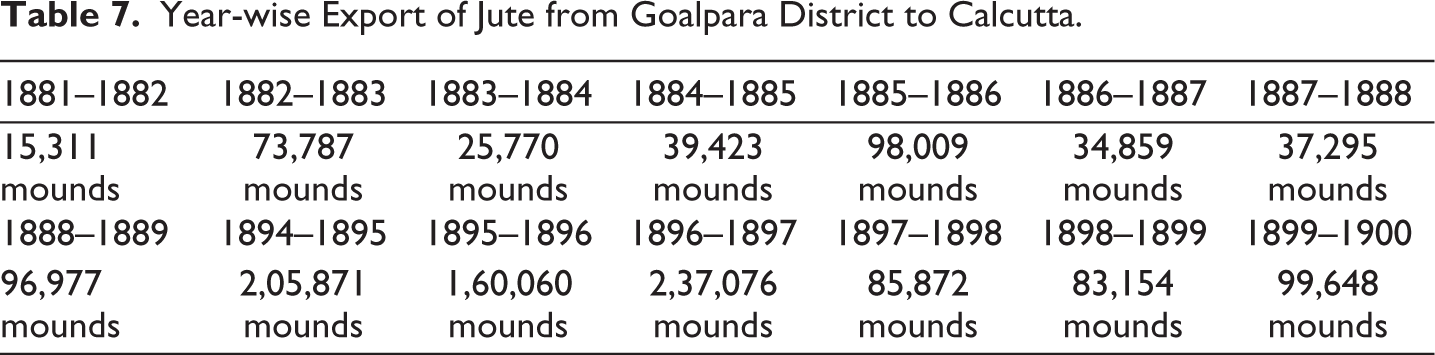
Table 8 shows the import of jute from various markets of Goalpara district to Dhubri. 113
Import of Jute from Goalpara District to Dhubri.

About 17,964 mounds of jute were exported to Calcutta from Goalpara district during 1893–1894. Around 342,342 mounds of jute were exported from the Goalpara district to Calcutta during 1894–1895. 114 In 1896–1897, the quantity of jute exported from Brahmaputra Valley to Calcutta accounted for 348,332 mounds. In 1899–1900, a total of 159,537 mounds of jute were transported to Calcutta. 115
Table 9 presents jute sales by the cultivators of Goalpara district during 1937–1938. 116
Jute Sales by the Cultivators of Goalpara District During 1937–1938 in Percentage.

Many traders and trading enterprises arrived to do jute trade in the Goalpara district. The arrival of Marwari traders, who purchased jute at a reasonable price, encouraged the cultivators for extensive cultivation in the region. In 1792, Sevairam Singhi, who came from Jodhpur of Rajasthan to Azimganj of Bengal, then moved to Goalpara, where he established a jute firm. 117 According to H. C. Kerr, Jyth Mull Dhunraj, Oswal firm of Gauripur of Goalpara district bought and sold around 4,000 to 6,000 maunds annually. This firm purchased the jute fibre directly from the jute growers at the Gauripur Hat and half the amount of jute from shopkeepers. 118 The price of the jute was ₹2–4 to 2–6 per maund. 119 Three Oswal trading firms came up in Goalpara district to do jute trade.
The demand for jute from the outside world invited foreigners from the neighbouring district of Bengal to cultivate jute in the Goalpara district. In the twentieth century, the colonial rulers pursued the policy of raising revenue collection by encouraging more cultivation of commercial crops on wastelands. British authorities came to know that if the vast tracts of wasteland were brought under tillage, it would benefit not only the government but also improve the economic condition of the people. 120 So, East Bengal peasant immigrants were allowed to enhance the commercial crops in the district. 121
The immigrants of Eastern Bengal introduced jute cultivation in the Brahmaputra valley during the colonial period. In Goalpara, Zamindars had encouraged the East Bengal peasants to settle down on char land of the Brahmaputra river basin to cultivate jute. The peasants who migrated from the district of East Bengal were subjected to an oppressive tenure system which guaranteed them little security of occupation. 122 The Goalpara district became the main jute-growing area in the western part of Assam owing to the settlement of immigrants in the district. 123 East Bengal cultivators had carried out jute cultivation on the Chapori land which was sold by local people to them. 124
Footnotes
Declaration of Conflicting Interests
The author declared no potential conflicts of interest with respect to the research, authorship and/or publication of this article.
Funding
The author received no financial support for the research, authorship and/or publication of this article