




Abstract
The development of the engineering profession in colonial Madras did not originate from metropolitan models or indigenous precedents, but it was the result of the exigencies of running the empire. The Civil Engineering College, Guindy, was established in the year 1859 to supply the wants of the Public Works Department. Unlike the professions of law and medicine, the students of engineering completely relied on the state for their job, and the prospect of employment was not optimistic. By the 1930s, the problem of unemployment was apparent among engineering graduates, and a Madras Unemployment Committee was formed to examine the matter. However, the writings on the engineering profession have mainly dealt with the origin and growth of the institutes. The historiography is silent on the question of unemployment among emerging graduates. Viewed in this context, the article explores the progress of the profession of engineering and tries to locate the issue of unemployment among engineering students in colonial Madras.
The Silence of Historiography
The development of the engineering profession in colonial Madras did not originate from metropolitan models or indigenous precedents, but it was the result of the exigencies of running the empire. The establishment of an engineering institution was intended principally to meet the needs and requirements of the activities of the Public Works Department, the construction of roads, railways, canals, civil and military buildings, and irrigation works and to bring administrative efficiency. 1 The historiography on the development of the engineering profession in colonial India has mainly focussed on the process of institutionalisation of knowledge, especially the genesis, nature and objectives of engineering education. However, the question of employment/unemployment among emerging graduates has largely been ignored. 2 The evidence of unemployment among engineering students manifested in reports of the Madras Unemployment Committee, Census reports, writings by Dadabhai Naoroji, M. Visvesvaraya and others, has largely been not consulted. 3 In this regard, Dharma Kumar rightly pointed out that the services have been a forgotten sector. 4 Against the backdrop of the inattention of historiography, the article explores the progress of the profession of engineering and tries to locate the issue of unemployment among engineering students in the Madras Presidency. 5
Historical Development of the Engineering Profession
The development of the engineering profession started with the idea of surveying and making maps and plans for colonial expansionist motives. In this regard, the Madras Survey School was started in 1794 by Michael Topping, the Company Astronomer and Geographical and Marine Surveyor, to meet the want of draftsmen and to supply surveyors. 6 However, the school was closed in 1810 on financial grounds. Thereafter, a Government Survey School was established in 1834 with the view of training men for service in the Revenue Department. 7 George Norton, the President of the University Board, ‘Madras University’ (High School), urged the government in 1842 to open an engineering collegiate class to extend the scope of the institution. However, it was disallowed by the Court of Directors in their despatch sent on 18 October 1843. 8 Meanwhile, a School of Ordnance Artificers at Madras was opened in 1840 by Major Maitland, the Superintendent of the Gun Carriage Manufactory. The school was started with a view to inducing ordnance artificers and pupils at manufactory to study and improve themselves as mechanics and artisans. 9 Later, the school was taken over by the government in 1855. Subsequently, after the establishment of the Public Works Department, a Civil Engineering College was opened in 1859 at Guindy in order to supply the wants of the department and the old Survey School was adopted as its basis. 10
The Public Works Department, which consisted of three branches—roads and buildings, irrigation and railway—had three categories of services—the engineering ranks and two subordinate categories—the upper subordinate and lower subordinate. The engineering cadre included the ranks of engineers, sub-engineers and assistant engineers. The upper subordinate services comprised supervisors and overseers, while the lower subordinate consisted of surveyors, draftsmen and estimators. 11 The army officers trained in England occupied the rank of engineer and Indians were recruited at subordinate posts. In fact, in the official circles, it was stated that the highest grade must be confined to the Europeans only. 12
The original plan behind the Civil Engineering College was to provide instruction for all grades of the Public Works Department, except officers of the corps of engineers and civil engineers. However, the original plan was abandoned on financial grounds and the institute confined itself to the training of the candidates for the grades of sub-overseers and assistant engineers. 13 In 1861, a special class for surveying, drawing and estimating was formed, and in the following year, the institution added a senior department for the supply of engineers. Overall, the Civil Engineering College consisted of a Collegiate Branch or First Department and a School Branch. 14
The Collegiate Branch or First Department of the College educated commissioned officers of the army and civil students who had passed the First Arts Examination. It trained students to the standard required for Assistant Engineers in the Public Works Department and the course was also adapted to meet the demands of the degree of Bachelor of Civil Engineering (BCE) conferred by the University of Madras. 15 The course of study to the First Department/Collegiate Branch extended over a period of two years from the time of passing the First Examination in Arts. Candidates were examined in mathematics, natural philosophy, mensuration and estimate-making, surveying and levelling, constructive engineering, architectural and topographical drawing, mechanical engineering and machine drawing. 16 Passing in mathematics, natural philosophy, mensuration and estimate-making was imperative, while the students had the option to choose between surveying and levelling, constructive engineering and architectural and topographical drawing or mechanical engineering and machine drawing. 17 The examinations were conducted partly by means of printed papers and partly by viva voce. In the case of surveying and levelling, the examinations were conducted to examine the theoretical as well as practical knowledge of the candidates. In order to qualify for the degree of BCE, the students had to attain one-third of the total marks assigned to each branch and one-half of the aggregate number. 18
The School Branch trained students of all classes for the various grades of the upper and lower subordinate and of the office establishments of the Public Works Department. This branch comprised three classes: (a) Second Department, which educated European non-commissioned officers and soldiers and civilians of all races to the standard required for the grades of supervisor and overseer in the Public Works Department. University matriculates were eligible for admission without examination, but all other candidates had to undergo an entrance examination in English and arithmetic; (b) Special Surveying Class, which fitted men to become practical surveyors and (c) Special Drawing Class, which trained to the standards required for draftsmen and estimators in the Public Works Department. 19 Admissions to these special classes were like that of the Second Department. The course was of about a year and ten months and it embraced the subject taught to the engineer class with vernacular added, but the standard was of a more elementary character. Amidst the development of these classes, the advancement of engineering education took place. Furthermore, the extension of railways, irrigation works, modern factories and the exploration of minerals and other products encouraged the development of technical and engineering education in India.
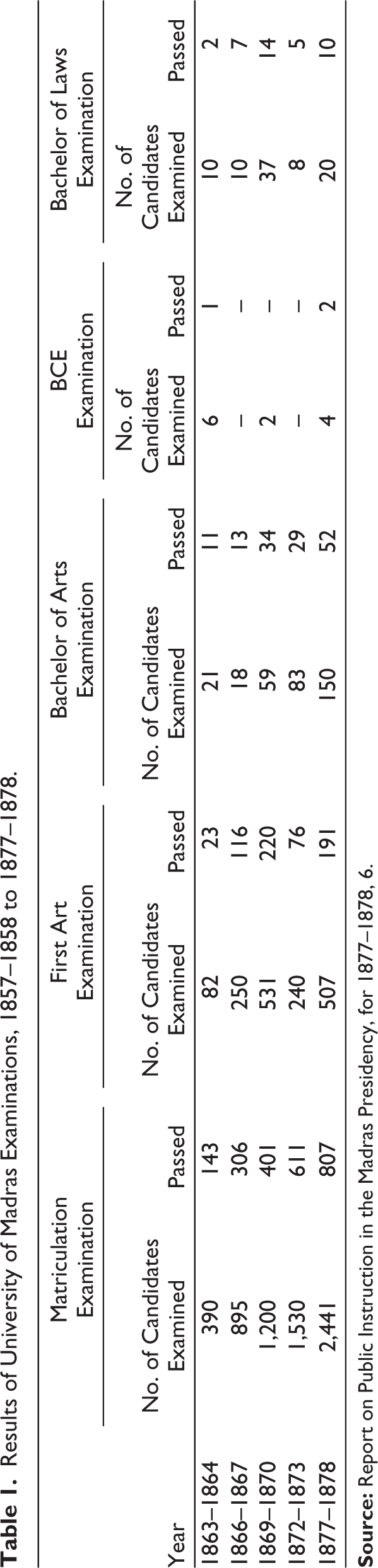
The number of students studying at Civil Engineering College rose from 46 in 1859 to 152 at the close of 1875–1876. However, the number of graduates in engineering was not much. In 1863–1864, six students appeared for the BCE exam, but only one could pass. In 1877–1878, only four students appeared for the BCE exam and two passed (Table 1). Meanwhile, the establishment of the Royal Indian Engineering College at Cooper’s Hill in England brought misfortune to the development of the engineering profession in India. The college was established under the orders of the Secretary of State for India in Council with a view to the education of civil engineers for the service of government in the Indian Public Works Department. 20 Subsequently, Fort St. George proposed to downgrade the Civil Engineering College by abolishing the First Department. However, after the resistance of the Director of Public Instruction, the idea was given up and the progress of Civil Engineering College continued. 21
Results of University of Madras Examinations, 1857–1858 to 1877–1878.
In the year 1886, a practical course, lasting two years to be undergone by all students of the engineer and engineer-subordinate classes, was also included. For this course, the students were attached to the Public Works Workshops. 22 In 1894, the University of Madras conducted the degree examination for mechanical engineering, and thereafter, the degree of BCE was changed to the Bachelor of Engineering (BE). By the first decade of the twentieth century, the classes for assistant overseers, sub-overseers, surveyors and draftsmen were substituted by the upper subordinate and lower subordinate classes. 23
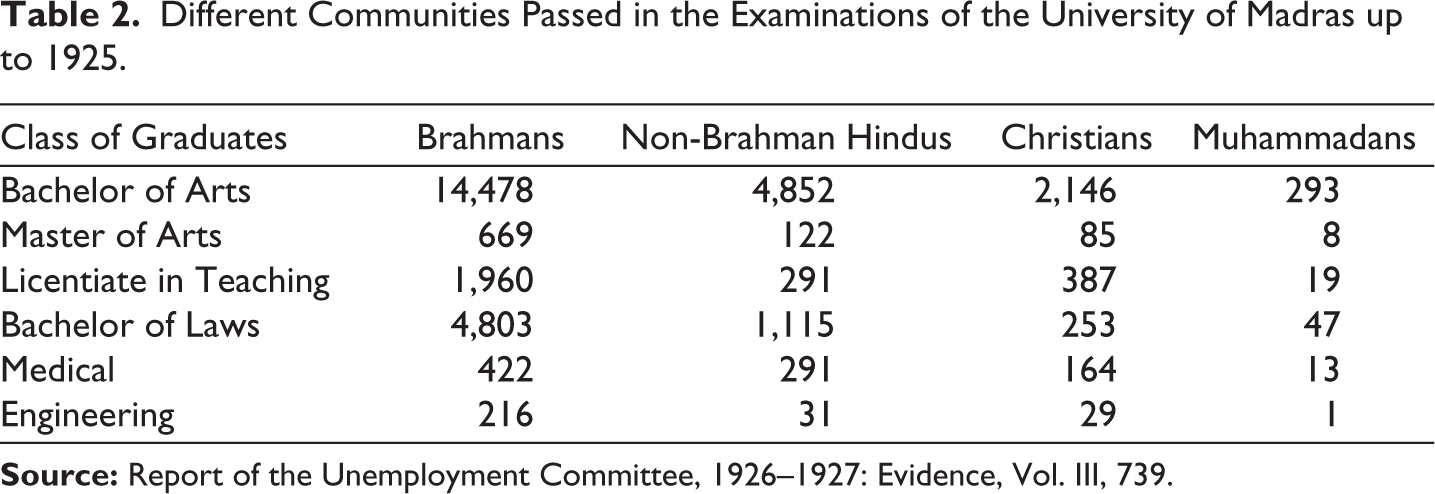
As per the requirement of the Public Works Department, municipalities and local boards, the engineering students were placed. 24 Engineering establishment, consisting of the posts of chief engineers, superintending engineers, executive engineers and assistant engineers, were filed by the candidates from Royal Indian Engineering College, Coopers Hill. In fact, the Royal College was established to supply men for superior engineer posts whereas successful students of the College of Engineering were appointed as assistant engineers, but only one such appointment was guaranteed each year, and others were appointed in the Upper Subordinate Establishment (sub-engineers, supervisors, overseers) and Lower Subordinate Establishment (sub-overseers). As per the availability, the vacancies in the overseers as a rule were filled by passed students of the College of Engineering on the basis of a competition. For appointment as draftsmen, candidates were required to pass an examination after producing the certificate from the College of Engineering. Amidst these paradigms of engineering education and employment opportunities, a total number of 277 students, 216 Brahmans, 31 non-Brahmans, 29 Christians passed, as graduates in engineering from the University of Madras by the first quarter of the twentieth century (Table 2). In these ways, the engineering profession advanced as one of the key professions in colonial Madras.
Different Communities Passed in the Examinations of the University of Madras up to 1925.
Unemployment in the Engineering Profession
Unlike the law and medicine profession, engineering graduates were solely dependent on the government for their employment after their degree. There was no scope for private practice for them and the students hoped to be placed in the Public Works Department according to their qualifications. By 1866, only two of the thirteen passed students were appointed as assistant engineers. Both of them were of British origin. By the 1870s, the prospect of employment of engineering graduates seemed to be a subject of discussion though only two students had appeared for the BCE degree examination in 1869–1870 (see Table 1). The small number of students in engineering courses was attributed to the difficulty in getting employment.
Based on the Public Instruction report for the year 1870–1871, Dadabhai Naoroji quoted the remarks of Captain Rogers, the Acting Principal of the Civil Engineering College, Madras, which stated that in the case of native Indians, the difficulty of obtaining employment after completing the course deterred them from entering the institution.
25
Further, the Annual Report of the Civil Engineering College for the year 1872–1873 recorded that the small number of students (five in first division and two in second division) was owing to the uncertainty which existed as to the obtainment of employment in the grade for which the students had qualified.
26
The students were uncertain about their prospect of employment after the opening of Royal Indian Engineering College at Cooper’s Hill. As discussed, the superior positions, such as chief engineers, superintending engineers, executive engineers and assistant engineers, were filled by the candidates from the Royal College.
27
Amidst this development, W. Mair, the Lieutenant-Governor of North Western Provinces, had to assure the students in November 1872 that the Royal College would in no degree affect the prospect of employment of Indian engineering students and there would be no opposition or antagonism between the two seminaries since the requirement of the country was ample for both institutes.
28
In this situation, the Madras government guaranteed one employment annually to the most deserving student of the BCE degree.
29
However, it was also made clear that the superior post would not be given to the students of Indian engineering colleges. The government in an order, dated 14 May 1872, stated that they would not guarantee immediate employment to all who passed a higher grade than that of overseer.
30
Viewed in this context, the Director of Public Instruction, E. B. Powell, remarked:
Owing to the absence of encouragement the first department exists rather in name than in reality…in the present state of things, when almost all works are executed by Government, Hindus of the higher classes cannot be expected to study Civil Engineering without having a fair prospect of being employed in the superior grades of the Public Works Department.
31
Further, Colonel Rogers discussed the difficulties faced by successful students in getting employment. 32 One of the BCE passed students of the 1876–1877 session, who was working in famine relief, had to subside into the rank of a third-class overseer, owing to the closing of the work. 33 The reorganisation of the Public Works Department took place in 1878, and the operations of the Department were curtailed and a portion of its duties was transferred to Local Fund Boards. Although the Local Boards had to also recruit engineering graduates for their engineering establishment and other works, doubt on the prospect of employment among candidates emerged. As Lieutenant Love, the Principal of Civil Engineering College, reported to the Director of Public Instruction that the reorganisation of the Public Works Department left ‘an impression that the engineering classes will be abolished’. 34 As a result, the 1879–1880 session of the college opened with eight students in the First Department and closed with four. 35 Further, 17 students of 1880–1881 session of the Second Department of college, who had undergone examination for certificates of qualification as Supervisor and Overseer of Public Works Department, faced difficulty in getting employment as the government had stopped new appointment to reabsorb the previously dismissed students owning to the reorganisation of the Public Works Department. 36 In this regard, the heads of the department and other bodies requiring the services of engineers and engineering subordinates were asked to communicate with the Principal of the Engineering College, who recommended the candidates with a preference to those who stood ‘highest on the unemployed list’. 37
Lieutenant Love in his address delivered at the Madras University Convocation focussed on the need for employment for the engineering students and opposed the stress laid on acquiring knowledge. He raised the question of employment as per the educational training. Love pointed out that education was more or less wasted unless the subsequent employment utilises students’ knowledge.
38
Subsequently, the question of racial discrimination was also one of the reasons behind the lack of opportunity for Indians. Only three students were nominated to the engineering establishments of the Madras Public Works Department till 1884.
39
It was not before 1880 when Mir Sadr-ud-din Sahib became the first Muslim student to qualify as an assistant engineer in the Public Works Department.
40
Amidst the inability of the Public Works Department to employ the successful candidates in a time-bound manner, the graduates still looked forward to the department as there was not much scope for private practices in the engineering profession. In this regard, M. Parthasardhy, a resident of Masulipattam region of the Presidency, noted that:
As for the engineers, unhappy is the man who is unable to get any Government appointment. He can do no private practice but should sit at home with folded hands. It is for this reason that…several persons are not going to the Engineering College to qualify themselves for the B.C.E. degree, for there is no guarantee of Government appointment and by private enterprise the man, however rich and capable he may be, can do nothing and earn nothing.
41
In a reply to the query by the Education Commission, 1882, the Principal of the Civil Engineering College mentioned that no graduate in engineering who had passed from the college joined the profession in a strictly private capacity between 1871 and 1882. 42 Two or three students attached themselves to Local Fund Boards for a few months, but waited for the appointments to the Public Works Department. Further, the Principal mentioned that one graduate, Hormersgi Naoroji, BCE, who was entertained by the Madras Municipal Commission, ‘will probably throw up the post if offered the Government service’. 43 As there was no scope for setting private practice, the engineering profession developed with the graduates’ rush for the employment by the state. Alfred Chatterton, a professor of engineering, also emphasised on developing industries to accommodate professionals. 44 Subsequently, a resolution was moved by T. V. Seshagiri Ayyar in the Legislative Council in 1913 to employ more men, having BE from the College of Engineering to the post of sub-engineers with an initial salary of ₹100 per mensem. 45
After the First World War, the situation became more acute as the large number of engineers who were on military duty returned to civil employment. As a result, the livelihood of the family supported by engineering and related avenues came down by 4,000 persons in the census of 1921 compared to a total of 27,200 persons in 1911. 46
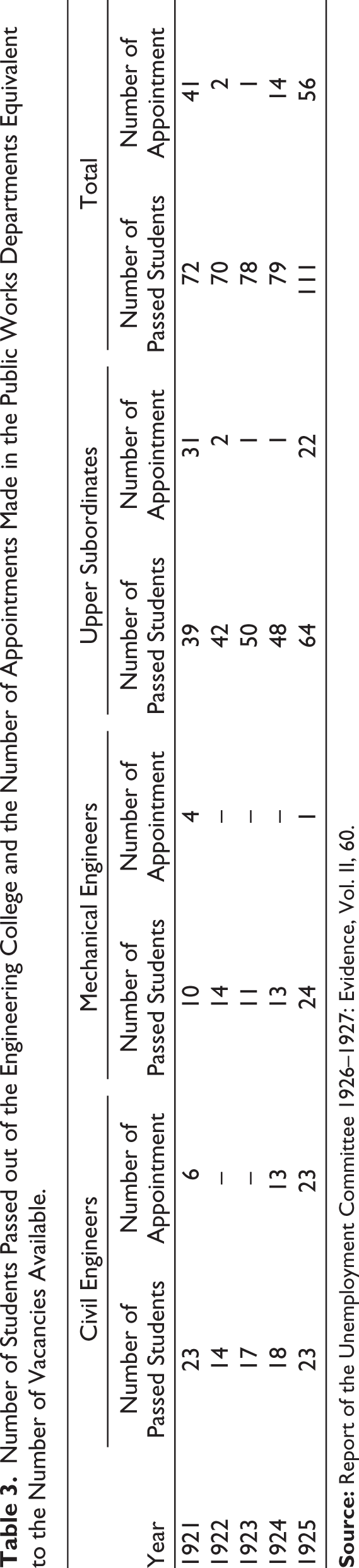
Against the backdrop of the increasing cases of difficulty in attaining a job, a Madras Unemployment Committee was formed in 1926 under the chairmanship of G. F. Paddision, the Commissioner of Labour, Government of Madras. 47 The committee enquired regarding unemployment among engineering students in detail. To collect the evidence and extent of unemployment, the committee examined the proportion between the number of vacancies available in the government departments and boards and the number of passed students. Upon calculation, the committee found that during 1921–1926, the number of engineers turned out by the engineering institutions was 547. However, the number of appointments made during the same period in the Public Works Department was only 115 (Table 3). 48 In 1922, 70 students passed from the Engineering College; however, only two were appointed in the Public Works Department, and in 1925, 56 were appointed out of 111 passed students (Table 3). The Madras Unemployment Committee admitted that some of the contenders might have been employed outside the Department, but the data explained the lack of opportunities. As the Chief Engineer, Public Works Department (General, Buildings and Roads), Madras, in his written evidence to the Unemployment Committee observed that unemployment existed among the engineering students as the number of appointments made each year was less than the qualified candidates available for employment. 49 Subsequently, the Collector of East Godavari remarked that the supply of engineering subordinates appeared to be in excess of the demand. 50
Number of Students Passed out of the Engineering College and the Number of Appointments Made in the Public Works Departments Equivalent to the Number of Vacancies Available.
The Collector of Vizagapatam, in his evidence submitted to the Unemployment Committee on 25 August 1926, noted that the technical and professional students also found great difficulty in getting employment, which was apparent from the fact that when he advertised for one minor irrigation sub-overseer post, more than half-a-dozen applications were received within a short time.
51
Further, V. K. Krishna Menon, who was a Headmaster at the High School, Ponnani, reported that in the profession of engineering, unemployment existed to a very large extent. Citing an example faced by his own family member, Menon wrote:
In the profession of engineering, unemployment exists to a very large extent and qualified persons are finding it extremely difficult to get themselves employed. This is within my personal knowledge, as a cousin of mine who had a very brilliant career at the Guindy Engineering College and topped the list of successful candidates in mechanical engineering had to rot for a year before he could get a job even in the lower grades.
52
The Great Depression brought merciless retrenchment in every department, and the fresh engineering graduates were disappointed. The retrenchment in expenditure due to financial stringency created hardship among the educated class.
53
Between 1930 and 1935, there were roughly 1,000 passouts from all engineering classes who were idle.
54
As T. S. Gangadhara Avvar, a pleader and publicist from Kumbakonam region, noted that:
Owing to the scheme of merciless retrenchment carried. on by the Government. The dread of the engineering profession was so great that the Engineering College at Guindy was deserted.
55
Subsequently, the Madras Engineering College Magazine highlighted that the ‘dejected, pessimistic army of engineering unemployed’ had become a phenomenon. 56 Students with higher qualifications like BE were taking up subordinate class jobs and few of them were employed as maistris under contractors for a pittance. 57 Thus, it can be concluded that unemployment prevailed among engineering students.
Debates in the Public Sphere
Apart from unemployment in engineering profession, the issue was also prevalent in other professions, and the situation was so pathetic that the problem of unemployment was characterised as a ‘national crisis’.
58
The unemployment problem was widely discussed, especially in legislative debates and at political forums. Native Indians raised the question of unemployment in the Madras Legislative Council and Imperial Assembly. R. Veerian in the Council on 25 August 1925 said:
There is so much unrest in this country because this unemployment question stands at the top…don’t we see that there is danger in not providing employment to those who are not employed…in olden days, kings were able to provide work for unemployed men … now it’s the duty of the State to come forward to solve this problem.
59
The colonial state neither accepted the accountability for unemployment nor was ready to form a central committee to examine the various issues pertaining to the educated unemployed class. As, the spokesman of the government in the Council of State, Arthur McWatters, noted:
the detailed enquiry is, in the first instance at any rate, a problem for the Provincial Governments and we are satisfied that they are very much alive to it and are dealing with it. So, for the present we do not see any need for a central Committee. No Local Government has asked for a central Committee. If they do so, the matter would of course be considered, but for the moment we think that it is a matter which is primarily for the Provincial Governments to deal with.
60
A. H. Ley tried to mould the argument that the Government of India was fully recognising the seriousness of middle-class unemployment, but was virtually restricted by the Devolution Rules to legislative remedies, which had put education on the provincial transferred list.
61
Subsequently, the Government of India in its letter to the provincial governments, dated 26 May 1926, asked the transferred side of the provincial government to look after this problem. The letter noted that because of the complex:
nature of unemployment problem no Government can find a panacea. Further it was written that the people alone can produce a change, and the change must necessarily take time to accomplish…remedies as may be found practicable are remedies which local Governments and more particularly the Transferred sides of local Governments can apply.
62
It was argued that the unemployed were out of work because they were ‘bad workman—lazy or incompetent or both and a time of straitened circumstances would teach them a lesson’. 63 Amidst the colonial government’s passive approach, Indian legislatures opposed the retrenchment in various departments which had caused unemployment. They criticised that persons were asked to quit the service after putting up service of 20–30 years in various firms and establishments, and the government did not have jurisdiction over them. C. Natesa Mudaliyar told the Legislative Council that the government ought to protect the employees by passing an Act, and instead of retrenchment, developing the establishment and lowering the salary of higher appointments can be viable options. 64 Pointing to the government’s double standard, Yuvabharatam, a local newspaper, reported that, on the one hand, the government was carrying retrenchment and, on the other, it appointed Royal Commission on the Services to attend the cry of English officers for more pay. 65 Government officials were also not convinced with the irrational retrenchment. In fact, F. Sayers, the Superintendent of the Government Railway Police at Trichinopoly, in a letter addressed to the Chief Secretary to the Government of Madras, highlighted that the retrenchment must be reasonable. 66
Amidst the increasing debate in the public sphere on unemployment among the educated class, an attempt was made in the 1931 Census to collect statistics on the educated unemployed. As the general schedule of the census was inconveniently crowded, the calculation of the educated unemployed was intended to cover only those who were fully literate and, for this purpose, a separate schedule was prepared to be filled in by the enumerated himself and not by the enumerator. The filling of the return was voluntary and was not made a statutory obligation under the Census Act. In this context, the precise calculation of educated unemployed could not take place; however, the collected data offered an idea about the extent of unemployment. The Census of the Madras Presidency reported 2,463 persons, including engineering graduates, as the educated unemployed. 67 Of these, 1,171 were Brahmans, 1,095 non-Brahmans, 76 Muslims, 13 Anglo-Indians, 9 depressed classes and 99 belonged to other social categories. On examining the regional distribution, it was found that the educated unemployed were thoroughly spread out in the Presidency, but the main concentration was in Malabar (395), Tanjore (324), Madras (250) and Guntur (163) districts. 68
C. Natesa Mudaliyar reported to the Legislative Council in 1935 that nearly 40 or 50 people from various professions, including engineering, came to him every day and were requesting him to give some employment. He gave an example that people came from distant places like Tindivanam, and he had to reply that youths of Madras were not able to find employment; why did he come from such a distance? 69 Various groups started to protest in public spaces. A group/jatha of the unemployed advanced to Madras from Malabar as a demonstration against unemployment. As V. P. Narayanan Nambiyar put it in the Legislative Council hunger-marchers came to Madras after walking 700 miles to present a written memorandum to the Legislative Council on the subject of unemployment. 70 By the end of the 1930s, unemployment had become a phenomenon.
Parents also realised that the possession of a degree was not a sure road to employment and a successful career in life. 71 Kumarswami Reddiar, addressing the tenth convocation of Andhra University on 24 August 1936, quoted the different statements of economists, politicians and educationists, stating how the educational institutes were condemned for being operative causes of unemployment and how the system had rebuked the graduates for having wasted their parents substance and their own time and energy in pursuit of the ignis fatuus of a degree. 72 At the Faizpur session of the Indian National Congress in 1936, Jawaharlal Nehru highlighted that the urgent problem of the country was the appalling poverty, unemployment and indebtedness. 73
Conclusion
The engineering profession in colonial Madras developed in order to fulfil the requirements of the Public Works Department. Centred around the growth of Civil Engineering College, Guindy, engineering remained one of the most sought-after professions. However, the prospect of employment was not bright. The colonial government remained passive in its response to relieve the problem of educated unemployment. The growing number of educated graduates, limited demand in the Public Works Department, lack of private services and retrenchment measures during the Depression days affected the prospect of engineering students. The Madras Unemployment Committee in its report highlighted the existence of unemployment in the engineering profession and meticulously gathered evidence about the same. By the end of the third decade of the twentieth century, unemployment was evident in the engineering profession and had become a subject of discourse in the public sphere.
Footnotes
Acknowledgements
We are grateful to Venkata Raghotham and Dhrub Kumar Singh for their insightful comments on an earlier draft of this article. We would also like to thank Ashok Aounshuman, Prashant Upadhyay and Rupkanti Sinha for many helpful suggestions and support.
Declaration of Conflicting Interests
The authors declared no potential conflicts of interest with respect to the research, authorship and/or publication of this article.
Funding
The authors received no financial support for the research, authorship and/or publication of this article.