




Abstract
This paper examines household compositions of older men and women in mid-Victorian England and Wales, using Integrated Census Microdata. First, in five counties between 1851 and 1911, the proportion living in nuclear households with offspring increased by 1911, while the share of those living in complex households declined. Second, a national sample for 1891 shows that complex household formation occurred in textile and mining regions, reasserting its regional importance. Conversely, older women in agricultural eastern and southern England (especially London), where specialized industry was lacking, were more likely to live without offspring or kin.
Introduction
It has been over 50 years since Peter Laslett and Richard Wall published their pioneering Household and Family in Past Time in 1972, and one of the most intriguing developments in the study of household structure since then regards the living arrangements of older people. On these themes, the Cambridge Group for the History of Population and Social Structure (CAMPOP) has proved highly influential. For example, Laslett's ‘nuclear hardship’ hypothesis has argued that, based on the social customs of north-western Europe, offspring would leave the parental home at a crucial stage when their parents approached old age. 1 Most crucially, Laslett first established that not all people in the past lived among extended families. Nuclear households, so far from being the outcome of industrialization, or modernization, had a pre-industrial history. Laslett also argued that the ‘large, extended, kin-enfolding, multi-generational, welfare- and support-providing household in the world we have lost seems to be exceedingly difficult to expose to critical evaluation’. 2 This is arguably CAMPOP's raison d’être: over 60 years since its formation, it has promoted, among other things, a more refined and accurate understanding of the social structures of the past.
Within and beyond CAMPOP, alongside a developing scholarship on household structure concerns that of old age. Inspired by Pat Thane's research, historians have paid particular attention to poverty among older people in nineteenth- and early twentieth-century England. 3 Examples involve Samantha Williams’ study of old age in the Victorian and Edwardian workhouse, and George Boyer and Timothy P. Schmidle's examination of poor relief returns procured from the House of Commons Parliamentary Papers archive and by Victorian contemporaries. 4 Literary and cultural perspectives by Karen Chase and Lauren Palmor have explored through novels and paintings how relationships between older people and their wider families were conceptualized by the Victorians. 5 The Victorian ideal of strong extended family units within the domestic sphere, as explored by Palmor and Steven Ruggles, reflected the actual experiences of older people documented by Michael Anderson and Marguerite Dupree for Preston and in Stoke Upon Trent, respectively. 6 There, the degree of extended co-residential ties was higher than expected.
It remains to be seen if these Victorian ideals reflected the wider reality in the domestic households of older people across mid-Victorian England and Wales. Despite the growth in both old age and household structure scholarship, an updated article that fully integrates old age with household structure using the ‘big data’ of recent times is lacking. Indeed, Laslett's arguments regarding the limited extent of extended family ties across three centuries, notwithstanding Anderson and Dupree's mid-Victorian studies, are irrefutable. However, do they fail to account for regional variations and temporal circumstances that made the formation of complex households (that is, extended and multiple households) in old age one of necessity, compassion, or both? Specifically, where did relatives defy ‘nuclear hardship’ to provide for their older kin? Where was it reinforced? Furthermore, is Laslett right to argue that hardly any geographical variation in the household structure of England existed? 7 Despite the recent initial findings on household structure in England and Wales, scholarship on these matters is limited. 8 This is compared with developments over the last decade among European researchers investigating the continent. 9 It is important to consider the extent to which older people, experiencing the dissolution of the nuclear family through the death of a spouse and the exit of their offspring from the parental household, relied on complex households when they reportedly peaked alongside the industrialization that facilitated them. With individual-level census materials available from the mid-nineteenth to early twentieth centuries, we can effectively assess whether broader aspects of modernization (for example, the decline of industry, the development of old age pensions, and urbanization), altered the composition of complex households over time. Its spatial implications are especially important for giving rise to regional trends first posed in the wider literature on household structure: by Anderson and Dupree on strong intergenerational ties in the north and midland industrial heartlands, the limited ties found by David Thomson in mainly agricultural southern England, and how these interrelate with regional economies. 10 However, our understanding of mid-Victorian England and Wales has been transformed by the release of Integrated Census Microdata datasets (I-CeM). They provide 100 per cent coverage of nearly all those ever transcribed in the census enumerators’ books, and an opportunity to test these arguments, accounting for two narratives: in the first half of this article, on changes over time, and in the second half, on geographical variations nationally. First, variations are examined over time (1851, 1891 and 1911) in the general household composition of men and women aged 60 years and over in five geographically distinct selected counties in England and Wales. Second, selected household arrangements are examined nationally for 630 registration districts (RDs) in England and Wales in the 1891 census. Consequently, changes in 1851 are compared with that of 1891 and 1911; this article also provides underexplored comparisons between England and Wales. It will further show that, when five selected counties are concerned, household structures of older people generally changed between 1851 and 1911, when extended households declined and nuclear households increased owing to economic change. Nonetheless, the national data for 1891 reinforces the regional importance of complex household residence among older women, especially in the textile districts of Lancashire and the mining districts of South Wales and Durham. By also considering the regional clusters where older women lacked ties with offspring and kin, such as in south-eastern England and in London, this article will demonstrate how geographical diversity underpinned the household structures of older people. This article concludes by providing pointers towards the more fully integrated use of census data across time, or 1851–1921, and space, specifically the whole of England and Wales.
Literature Review
The information on geographical variations in the relationship between old age and household structure is somewhat limited. When Household and Family in Past Time was prepared, Laslett and Wall were bound by parish-level records on mean household size recorded between 1564 and 1821. Wall's attempt to construct regional variations from published sources of population and household numbers proved futile due to the limited number of settlements for each region. 11 Also, Laslett's enquiry as to whether an English familial individualism interrelated with the country's economic liberalism meant that priorities were taken to study England nationally, rather than consider any regional differences. 12
Originally, it was difficult to analyze regional variations in the nineteenth-century censuses due to the inaccessibility of large-scale census data prior to I-CeM. Nonetheless, the 1 in 10 sample of Preston in 1851 produced by Michael Anderson shows strong familial ties with the older population in an urbanized and industrialized town. For example, 67 per cent of those aged 65 years and over co-resided with at least one offspring, a figure slightly higher than Marguerite Dupree's 57 per cent for Stoke Upon Trent in 1861. 13 Also, households with children under 10 years old where the wife worked were three times more likely to have a co-residing grandmother. 14 Steven Ruggles has even noted a rise in the extended family by the end of the nineteenth century owing to demographic characteristics and ‘Victorian’ cultural values. 15
However, evidence elsewhere has pointed to how a minority of older people co-resided with offspring. Although not directly relating to complex households per se, clues are provided as to their probable extent. David Thomson at CAMPOP challenged past assumptions made about the importance of familial provision for older people in the nineteenth century. He instead pointed to the community, particularly the New Poor Law, as a main provider of welfare. The New Poor Law particularly provided for older people, as they comprised the ‘aged and infirm’ subcategory of the ‘non-able-bodied’ pauper population. They were viewed by the elite Poor Law Commissioners and local Boards of Guardians as more deserving of poor relief than ‘able-bodied’ or ‘working-age’ individuals. Although most poor relief given to older people was paid outdoors, or in their own homes, compared with a minority receiving indoor relief, or workhouse accommodation, allowances for outdoor relief were relatively meagre, at between two to four shillings weekly. Thus, co-residence with adult offspring and kin would offer older people additional security. 16 However, Thomson's study of mainly rural southern communities in England found that only 40 per cent of those aged 65 years and over lived with at least one offspring, although slightly higher percentages of 42–46 per cent are found for Hertfordshire in 1851 and 1891. 17 Nonetheless, extended household provision for older people was uncommon in north-west Europe and England. The more dominant the concentration of nuclear family households, the more likely that people relied on a ‘collectivity’ of resources. 18 Popularized as the ‘economy of makeshifts’ in the Poor Law scholarship by Steven King and Alannah Tomkins from an original study of eighteenth-century France by Olwen Hufton, poor people, especially those older and retired, relied on various, and oftentimes temporary, informal practices and formal state and private provisions to make ends meet. 19 This would include poor relief, almshouse residency, charity, and neighbourly support, although familial support was a ‘shifting and variable’ part of 'the “economy of makeshifts” in which poor old people had long struggled'. 20 The benefits of such strategies depended on one's life course and household structure. For older people that experienced the dissolution of the family through the death of a spouse, or the exit of offspring from the parental household through marriage or out-migration, poor relief became a crucial lifeline. However, following King and Tomkins’ argument that poor relief was ‘resourced by a finite line of supply in the face of potentially infinite demand’, older people would have thus especially welcomed co-residential ties to maximize the household budget, and take whatever resources they could get. 21
The closest to a ‘big data’ analysis on household structure pre-I-CeM is Anderson's 2 Per Cent National Sample of Great Britain in 1851, encompassing nearly 400,000 individuals. However, technical constraints meant that readers were treated to a 1 in 2,000 household subsample comprising 10,000 individuals. 22 In the sample, around 45–46 per cent of those aged 65 years and over co-resided with at least one offspring. 23 A study of 13 English and Welsh communities from 1891 to 1921 produced slightly higher figures of between 48–52 per cent, and co-residence rates were above the average in the northern communities of Stoke, Bolton and Earsdon. 24
Overall, although the samples and parish-based studies appear disparate, they form a cohesive pattern, hence Wall's conclusion that ‘some account be taken of the degree of spatial variation’. 25 First, familial ties, especially complex formations, appear greatest in northern rather than in southern England. They interrelate with a recent exploration of a ‘north-south’ divide when it comes to assistance given by the New Poor Law to the older-age poor. 26 Using GIS systems to link individual-level poor relief and township-aggregated expenditure data with the township populations of the 1801 and 1811 censuses, John Broad found that, in the early 1800s, the share of relief recipients as a percentage of the township populations was highest in southern and eastern England, with pauperism more marked in the early 1800s owing to inflation and food prices. The restrictive nature of poor relief recipience may have compelled older people and their families to pursue intergenerational links in early nineteenth-century England. 27 Nearly a century later, Victorian philanthropist Charles Booth argued that the proportion receiving assistance from relatives rather than from the parish was higher in the north and the midlands than in the south. 28 Furthermore, the regional European dichotomy of household structures, where the mainly nuclear-based households in north-western Europe differ from the complex households characterizing the south-east, has recently been questioned. For example, Magnuson's study of early twentieth-century rural Sweden shows that the north-western model does not represent ‘the variation found among elderly people’. 29 Second, the lower the degree of state assistance, the higher the presence of familial ties, although the complementary nature of both resources has been stressed. 30 Finally, data reveal the decline of extended households, followed by the nuclearization of households by 1921. 31 A study by Chris Gilleard covering Ireland under the Union has also noted a decline in the classic ‘stem’ family structure, where the firstborn offspring continued to live with their parents while their spouse moved in, and a strengthening of immediate families containing adult offspring. 32 With those in mind, how far are these conclusions confirmed when we deploy a greater sample size of older individuals from I-CeM?
Data and Methods
First, data on 63 RDs that make up five selected counties in England and Wales in the 1851, 1891, and 1911 censuses are consulted, amounting to 587,826 entries aged 60 years and over that were recorded outside workhouses. 33 These periods are chosen to reflect three key events over the mid-Victorian and Edwardian era: 1851, being the first detailed and reliable census year, was characterized by higher fertility and mortality rates, compared with 1891, when fertility and mortality had declined since the 1870s, and when changes to agriculture and to industry were marked. The year 1911 represents the changes wrought by the Old Age Pensions Act of 1908 in terms of co-residential ties. 34 As the data were analyzed prior to the updated I-CeM.2, the results are based on the first version. 35 Five counties were selected, one for each region mentioned by Charles Booth. 36 They comprise all RDs in Cheshire (midlands); Hampshire (south); Hertfordshire (east); Glamorganshire (Wales); and 10 RDs from the Yorkshire West Riding (north), and were chosen for their distinct economic characteristics. Cheshire and the Yorkshire West Riding were at the heart of industrialization, from the silk and cotton manufacturing trades in Macclesfield and Stockport RDs, Cheshire, to Keighley RD's worsted (lighter weight) cloths in the Yorkshire West Riding. 37 Coal mining predominated in Glamorganshire. 38 In contrast, Hertfordshire was a classic agrarian county that lacked industrial diversification, although benefitting from the straw plait and hat making cottage industry, suburbanization, and railway development. 39 Hampshire was also mainly agricultural, boosted by naval developments and the maritime economy. 40 Economic growth and population increase were intertwined in all counties except for Hampshire and Hertfordshire where the rural economy and the population declined. 41 The five counties selected were decided upon by Booth's limited methodology, may not represent additional counties nearby or regions themselves, and may convey an atypical picture. However, they were chosen to offer a more local and regional perspective, complementing the national conclusions made in the second half of this article. The living arrangements of older men and women are broken down into eight distinct groups, and the proportion of individuals in these households are examined.
Second, a transcribed dataset containing 2,015,049 older people extracted from the 1891 census for all 630 RDs in England and Wales is consulted, using the updated I-CeM.2 provided by CAMPOP. 42 Unfortunately, they do not include their intra-household relatives at the individual level, although the numbers of offspring and other relatives belonging to each older person are included as an additional variable. While not all household structures are covered in depth, attention is paid to the share of females in complex households (HHD 410–599), and in the share of females recorded living without offspring and kin, composed of solitary (HHD 110–120) and ‘married, no children’ (HHD 310) householders. Covering additional household types on a similar scale, such as ‘nuclear family’ (HHD 320–350) householders, or ‘non-conjugal’ (HHD 210–220) householders, would be counterproductive. The priority is to compare the share of older females recorded without offspring or kin, as examined closely by Thomson, with those living with both in complex households, explored by Anderson and Dupree, and link this conflicting scholarship towards a geographical analysis of familial ties among older females in the mid-Victorian period. Consequently, one considers whether the Victorian cultural ideals of the family reflected the reality of older people's experiences. The primary focus is on females rather than males, since females made up the greater share of those in solitary and complex households. Nonetheless, attention is paid to the percentage of men by household structure nationally. Also, as this article stresses the family unit to account for how complex households were shaped, and why there were geographical variations in the share of those living without offspring or kin, those individuals that were servants, lodgers, and visitors are not discussed in depth. With servants and visitors, it is difficult to infer from a snapshot glance whether older females had maintained contact with their offspring and kin. For lodgers in unrelated households, it implies that the accommodation of older people as co-residents, especially older men, was too great a financial and emotional burden for families. In any case, since the share of older females as non-kin, either as lodgers, servants and visitors, was significantly lower than the combined share of those in domestic households living alone by themselves (HHD 110–120), or as a married couple (HHD 310), exploring older females in their domestic households is more credible. Household structure patterns are presented on a base map of all RDs in 1891. Further context is provided through biographical case histories of older women and their families, although their atypicality may lack the wider representation of family histories. 43 Despite this, case histories can humanize quantitative findings and illuminate local and regional contexts.
Certain points need clarification. First, both the samples from the five counties and the 1891 national data exclude, where possible, workhouses and other institutionalized populations. 44 Simply put, workhouses were institutions rather than domestically run households, and thus one is not comparing like-with-like. As will be explored, the inclusion of workhouse inmates would artificially reduce the share of domestically based older people in the additional household categories. While there is a gender imbalance in the skew towards males in workhouses, their exclusion does not affect the gender imbalance that also applies to the domestically run households. However, the conflation of lodgers, servants, and visitors with the institutionalized meant that some non-workhouse inmates, such as patients, may creep into the five selected counties data for 1891 and 1911. Second, RDs are examined rather than more refined subdistrict data, or RSDs. 45 Regardless, findings will be touched upon at RSD level. Finally, the minimum age threshold of old age emphasizes those aged 60 years and over, rather than 65 years. 46 Again, comparisons will be provided with the population aged 65, 70, and 75 years and over.
Older People's Household Living Arrangements in Five Selected Counties, 1851–1911
Table 1 shows the changing proportion of older males and females in eight household structures in 1851, 1891, and 1911. In terms of solitary, no CFU and ‘married couple, no children’ householders, a rise is generally met by 1891, mostly for females, only to fall by 1911. By county, 24 per cent of males in both Hampshire and Hertfordshire were recorded as ‘married, no children’ householders, compared with 21 per cent overall. This would suggest that agricultural depression partially governed household structure between 1851 and 1891, arising from cheap imports from the 1870s. 47 In turn, younger populations out-migrated from the parish for better fortunes elsewhere, which may account for the rising share of solitary and ‘married, no children’ householders. Between 1891 and 1911, there was an increase in the proportion of males ‘living outside the family group’. This is particularly evident in Glamorganshire and Yorkshire's mining districts, which were characterized by high in-migration. There, housing supply outstripped demand, and lodgers and boarders working in the mines supplemented the incomes of the household head. In Pontypridd RD, Glamorganshire, where the population grew from 146,812 in 1891 to 288,564 in 1911, 11.8 per cent of men were enumerated as boarders or lodgers. However, the share of married couples and widowed populations living with offspring in the five counties slowly increased by 1911, especially for males. Interestingly, Stockbridge RD, Hampshire, which experienced the largest increase in males living in ‘married, no children’ households by 1891, also noted the largest growth in the share of widowers co-residing with their offspring by 1911. It is unclear if the Old Age Pensions Act of 1908 made older relatives more favourable as co-residents by providing the household with additional income. 48 Nonetheless, the data confirm Wall's findings on the increasing nuclearization of the household by 1911.
Percentage of males and females aged 60 years and over by household composition, Five Counties combined (Cheshire, Glamorganshire, Hampshire, Hertfordshire, parts of Yorkshire West Riding), 1851–1911.
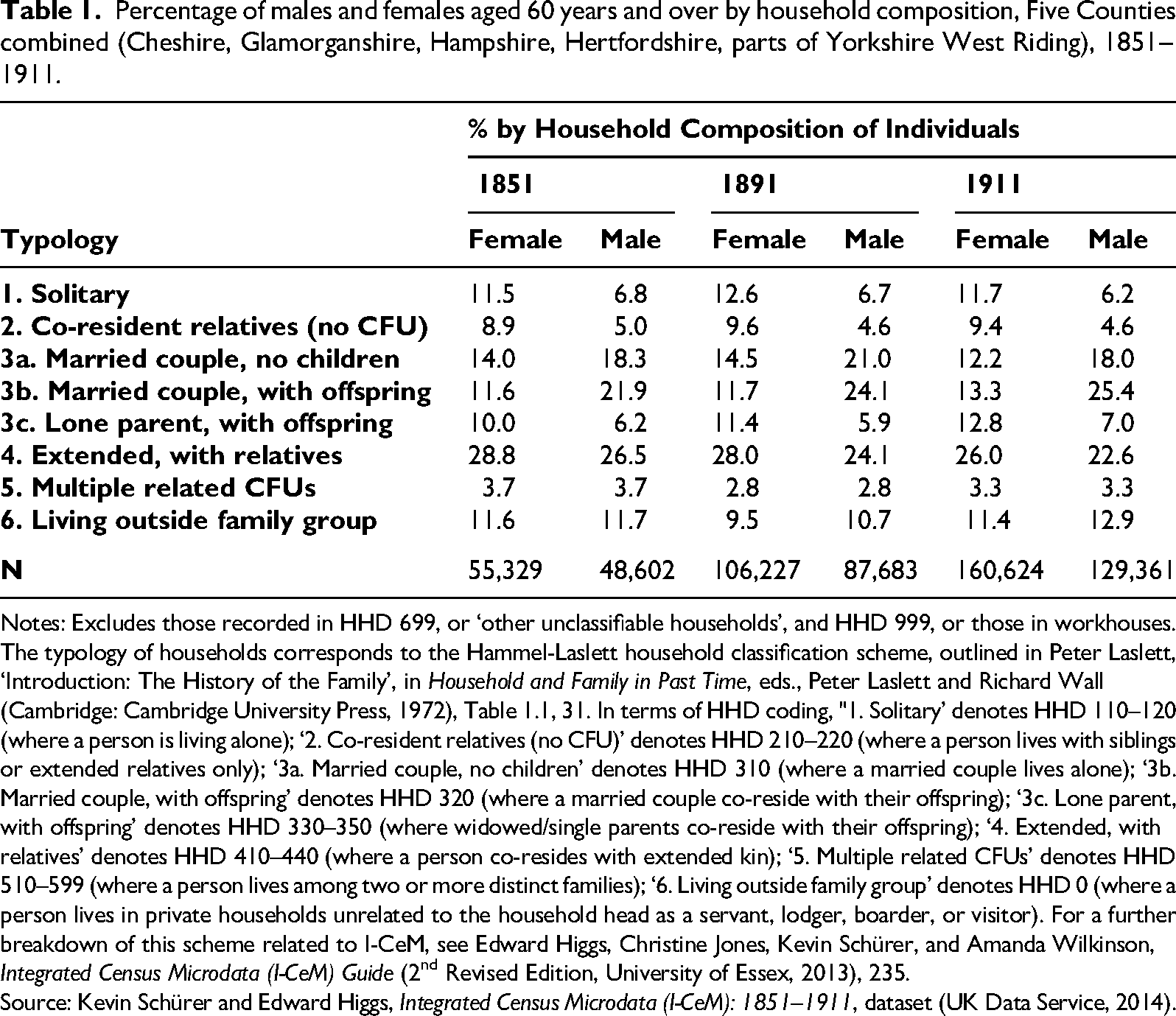
Notes: Excludes those recorded in HHD 699, or ‘other unclassifiable households’, and HHD 999, or those in workhouses. The typology of households corresponds to the Hammel-Laslett household classification scheme, outlined in Peter Laslett, ‘Introduction: The History of the Family’, in Household and Family in Past Time, eds., Peter Laslett and Richard Wall (Cambridge: Cambridge University Press, 1972), Table 1.1, 31. In terms of HHD coding, "1. Solitary’ denotes HHD 110–120 (where a person is living alone); ‘2. Co-resident relatives (no CFU)’ denotes HHD 210–220 (where a person lives with siblings or extended relatives only); ‘3a. Married couple, no children’ denotes HHD 310 (where a married couple lives alone); ‘3b. Married couple, with offspring’ denotes HHD 320 (where a married couple co-reside with their offspring); ‘3c. Lone parent, with offspring’ denotes HHD 330–350 (where widowed/single parents co-reside with their offspring); ‘4. Extended, with relatives’ denotes HHD 410–440 (where a person co-resides with extended kin); ‘5. Multiple related CFUs’ denotes HHD 510–599 (where a person lives among two or more distinct families); ‘6. Living outside family group’ denotes HHD 0 (where a person lives in private households unrelated to the household head as a servant, lodger, boarder, or visitor). For a further breakdown of this scheme related to I-CeM, see Edward Higgs, Christine Jones, Kevin Schürer, and Amanda Wilkinson, Integrated Census Microdata (I-CeM) Guide (2nd Revised Edition, University of Essex, 2013), 235.
Source: Kevin Schürer and Edward Higgs, Integrated Census Microdata (I-CeM): 1851–1911, dataset (UK Data Service, 2014).
Concurrently, there was a fall in those living in complex households by 1911, particularly in RDs based on the declining textile trades, such as in Macclesfield and Stockport RDs, Cheshire, owing to increased imports of textiles from France. 49 This would further confirm Anderson's association of complex household structures with the textile industries first encountered in 1851 Preston. 50 Alternatively, the share increases in the mining districts of Glamorganshire. Consequently, once the textile industry began declining in Cheshire, the households specifically arranged to accommodate the industry collapsed. Mining in Glamorganshire persisted, and with that, the reinforcement of complex household formations. Older people thus maintained their intra-household links with their offspring and their relatives, although their household structures differed in 1911 from 1851, with an increasing tendency towards nuclear family households. The impetus behind an extended household in Cheshire, being the accommodation of grandparents to look after their grandchildren while their offspring worked, was broken.
Table 2 shows that, when compared with the national household structure data produced by Schürer et al., the shares of older people in our five selected counties that lived in the eight household structures listed in Table 1 were more evenly distributed. 51 In 1891 and 1911, most of the wider population lived in the ‘married couple, with offspring’ arrangement. The increase in the share of all individuals living in this arrangement was consistent with that of older people in our five selected counties. Although our sample contrasts Schürer et al. by excluding the numbers of older people in workhouses, there are hardly any differences between the older population in the five counties and that of the wider national population ‘living outside the family group’, such as lodgers, servants, and visitors. However, those individuals that lived alone and as a married couple without their offspring were comparatively much older. This denotes how familial ties within the household could weaken as one became older. Despite this, those in non-conjugal households (for example, with a grandchild or a sibling), and those in extended households were skewed towards the older population. Although the share in extended households fell in line with the wider population, the proportions are roughly consistent across 1851–1911 and reinforce the importance of familial co-residence as one aged. In fact, most older people co-resided with at least one offspring, at 56 per cent in 1851, 53.9 per cent in 1891, and 56.7 per cent in 1911, again excluding older workhouse inmates.
Percentage of the wider population by household composition, England and Wales, compared with those aged 60 years and over by household composition in the Five Counties combined (Cheshire, Glamorganshire, Hampshire, Hertfordshire, parts of Yorkshire West Riding), 1851–1911.
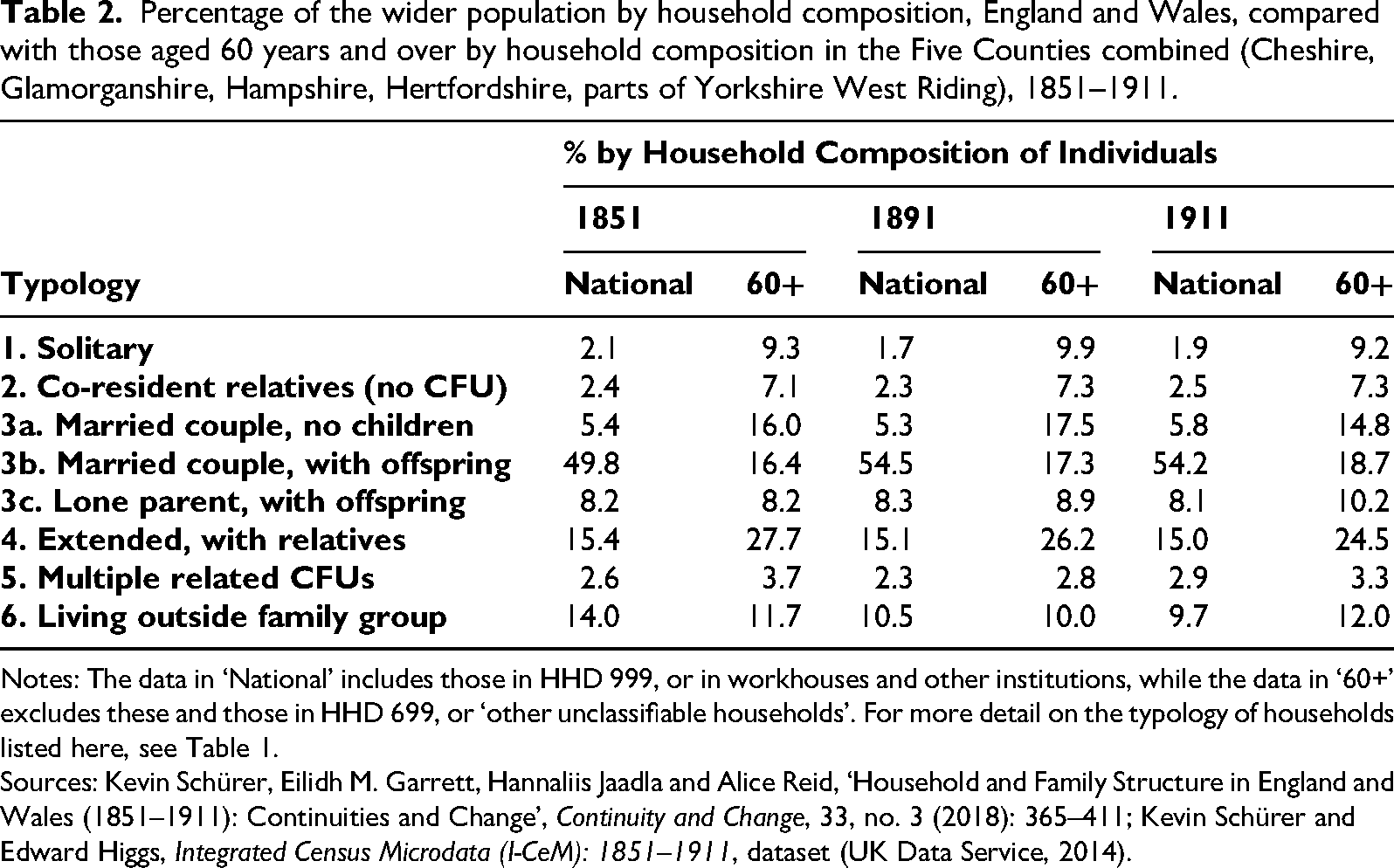
Notes: The data in ‘National’ includes those in HHD 999, or in workhouses and other institutions, while the data in ‘60+’ excludes these and those in HHD 699, or ‘other unclassifiable households’. For more detail on the typology of households listed here, see Table 1.
Sources: Kevin Schürer, Eilidh M. Garrett, Hannaliis Jaadla and Alice Reid, ‘Household and Family Structure in England and Wales (1851–1911): Continuities and Change’, Continuity and Change, 33, no. 3 (2018): 365–411; Kevin Schürer and Edward Higgs, Integrated Census Microdata (I-CeM): 1851–1911, dataset (UK Data Service, 2014).
Figure 1 presents males and females recorded in complex (or, extended and multiple, coded HHD 410–440, 520–599) households, and nuclear (those either married alone, or married/widowed with offspring, coded HHD 310–350) households in 1851. There are stark regional differences, as complex household residence is higher among older men and women in Cheshire and Yorkshire West Riding. In Cheshire, there is a greater proportion of older women in complex households (37.8 per cent) than in nuclear households (33.5 per cent). The proportions in both categories for Yorkshire West Riding are almost evenly distributed. The gender differences are driven by the greater number of widows than widowers, especially in ‘extended downward’ household types. 52 In Cheshire, 19.6 per cent of older women lived in ‘extended downward’ household types in 1851, compared with 14.4 per cent for those in Hertfordshire. Of course, if the share of those living in ‘solitary’ households and those outside the family group is stacked, the share in complex households is further marginalized. However, the disparity between older people in complex households with the remainder of household types varies regionally, especially in the northern English counties (and later, Glamorganshire). This would support Thomson's stance on Anderson's work, noting that Preston in 1851 ‘belongs to a peculiar time and place located within […] spatial and temporal variations’. 53
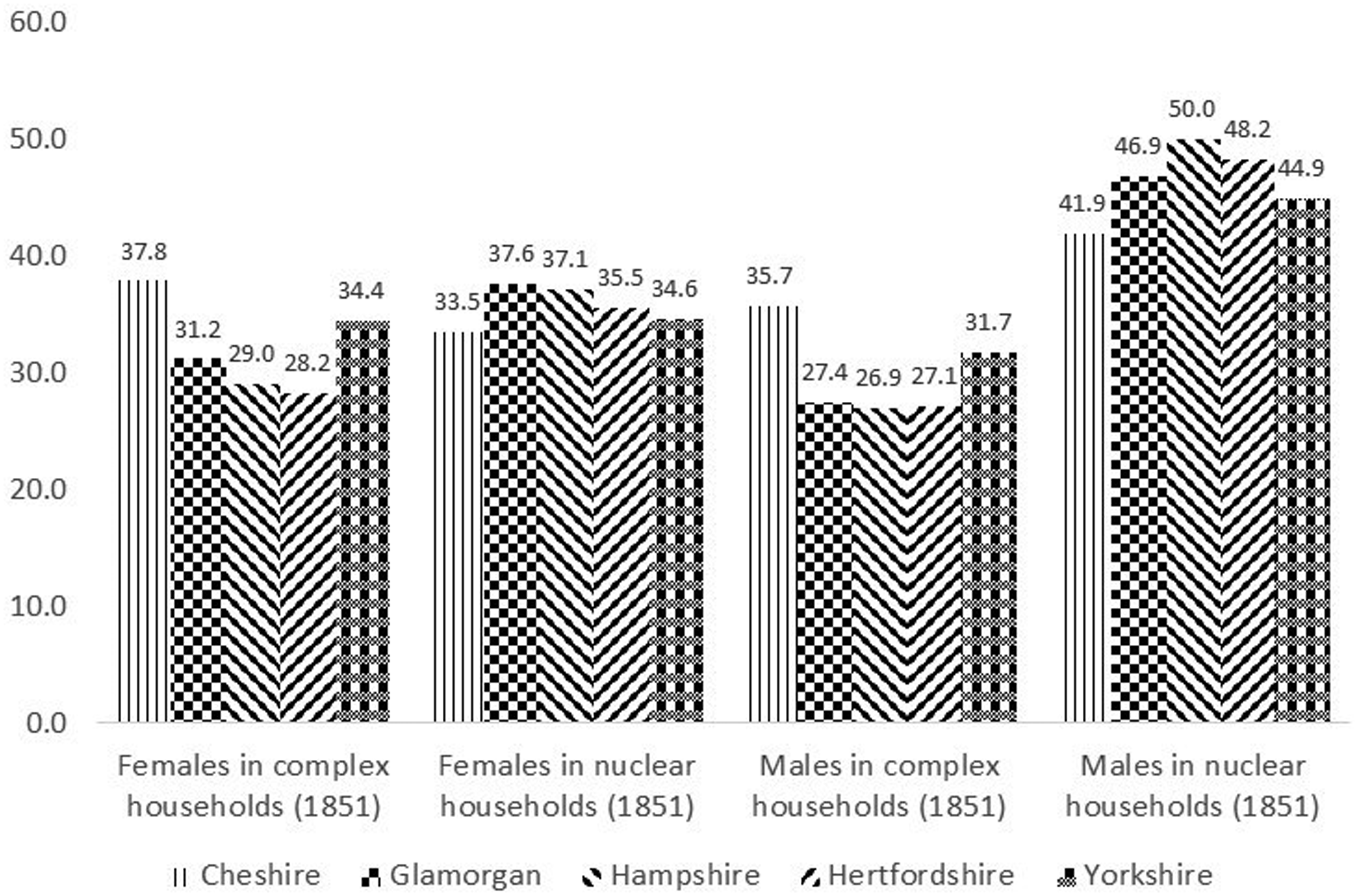
Percentage of males and females aged 60 years and over in selected household compositions by Five Counties combined (Cheshire, Glamorgan, Hampshire, Hertfordshire, parts of Yorkshire West Riding), 1851. Notes: ‘Complex’ households mean those in HHD 410–599 (extended/multiple household structures); ‘nuclear’ households mean those in HHD 310–350, comprising those either living with a spouse only or with offspring. Source: See Table 1.
However, Thomson's stance is also questionable. At least in 1851, differing household arrangements could be regionally, not just locally, characteristic. The strictly agrarian RDs of Cheshire and the Yorkshire West Riding also contained a higher share of older women living in complex households than in nuclear households. In Cheshire, a greater proportion of older women in agrarian RDs such as Altrincham, Northwich, and Nantwich were in complex households than in nuclear households. While 376 older women in ruralized Skipton RD, Yorkshire West Riding lived in nuclear households in 1851, 439 older women resided in complex households. Although four of the seven Skipton RSDs in 1851 are classed as ‘textile’ districts by the CAMPOP-produced website Populations Past, a quarter of older men participated in agricultural work. 54 Related to the pasture-based smallholding economy, many older male agrarian workers were farmers, compared with agricultural labourers. Because most farms there were family run, this was favourable to the formation of complex households. 55 Nonetheless, with Skipton's connections to the Leeds and Liverpool Canal, it was an established mill town hosting the woollen and worsted industries. The higher presence of older women in complex households than in nuclear households was also noted in the ‘textile’ RDs of Macclesfield, Stockport, and Congleton, Cheshire. A clearer focus on the RDs of Cheshire and the Yorkshire West Riding confirms Anderson's original sample-based findings of the importance of complex households in early-Victorian England, not only in industrialized districts but also in agrarian areas. Also, they show how the Victorian ideals of the domestically run extended family unit have a concrete reality in the experiences of older people, at least in the 1850s before their noted decline towards the early twentieth century.
Household Living Arrangements of Older Women: England and Wales, 1891
Despite the decline in complex household formations over time, they were still geographically concentrated by 1891. Figure 2 shows a circular cluster in the north-west in terms of the proportion of females in complex households. In fact, the cluster contains districts that most identified with specialized heavy industry. One detects the influence of the coal mining industries in the north-eastern English counties of Durham and Northumberland, as well as in South Wales and the tin mining area of Redruth RD, Cornwall. Out of all England and Wales RDs, Barrow-in-Furness, Lancashire, contained the highest share of older females in complex households, at 47.5 per cent. 56 This was followed by the two Staffordshire RDs of Stoke Upon Trent (examined previously by Dupree) and Wolstanton at 46.6 per cent and 46.5 per cent, respectively. Nationally, it was 30.4 per cent. In those three RDs, older women outside of workhouses mainly resided in an extended upward household (HHD 410), at 21 per cent, 19 per cent, and 17.5 per cent respectively, compared with 10.9 per cent nationally.
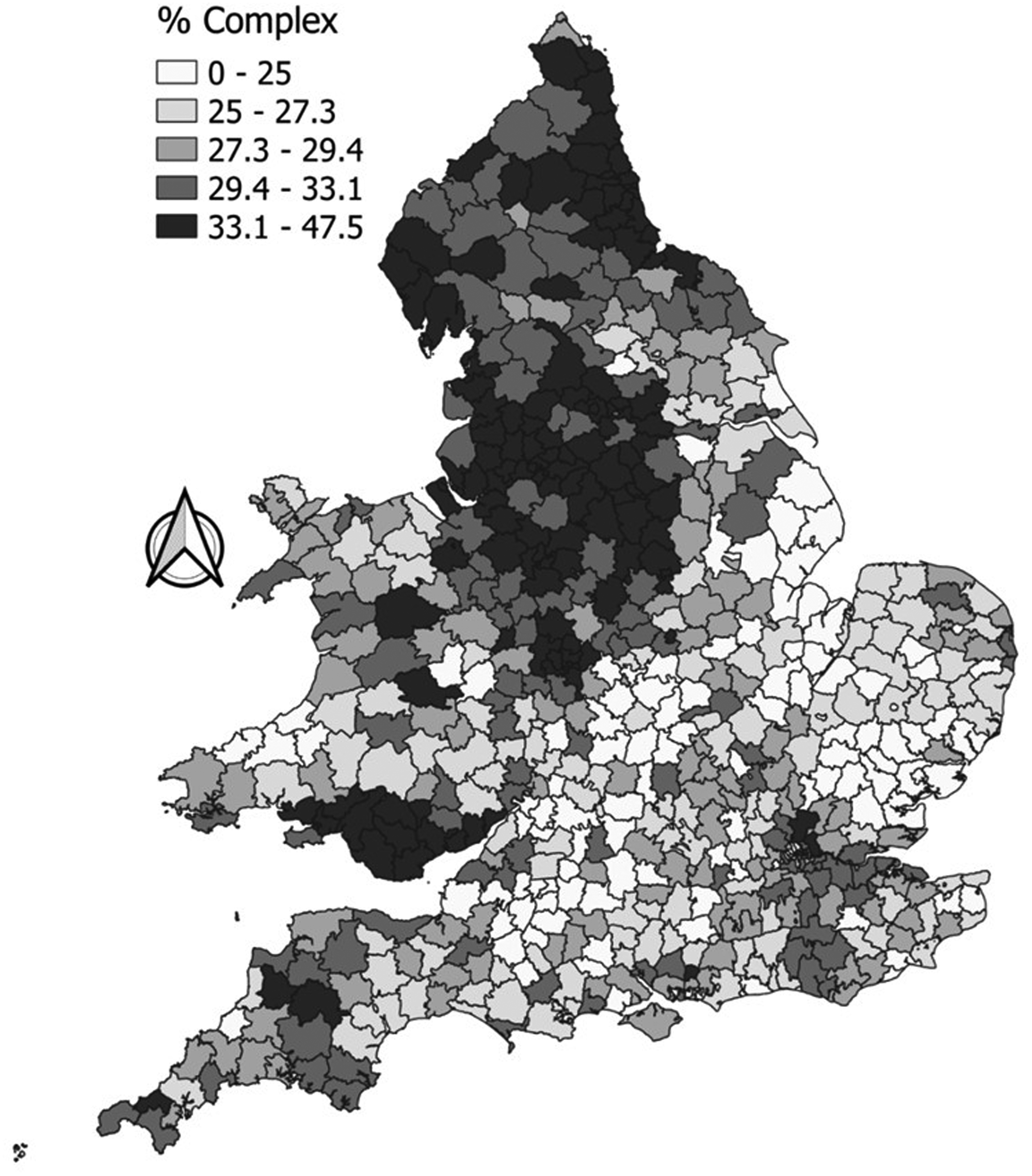
Proportion of the female population aged 60 years and over recorded in complex households (HHD 410–599), England and Wales RDs, 1891. Notes: The clusters in the darkest areas refer to these regions – to the west: Redruth RD, Cornwall, Holsworthy RD and Okehampton RD, Devonshire, and mainly the county of Glamorganshire in South Wales; in the north-west: the counties of Cheshire, Cumberland, Lancashire, and parts of Yorkshire and Westmoreland; in the north-east: mainly the counties of Durham and Northumberland. Source: Kevin Schürer and Edward Higgs, Integrated Census Microdata, 1851–1911, version V. 2 (I-CeM.2), dataset (UK Data Service, 2020).
The findings for Barrow-in-Furness RD are striking, given that it contained the lowest proportion of older females nationally in 1891, at 3.9 per cent. As the 1871 Census Abstracts for Barrow-in-Furness reports: "The demand for houses has drawn together a large population connected with the building trade[.]' 57 Barrow-in-Furness was a planned nineteenth-century town specializing in iron and steel production and mining iron ore; its population grew exponentially from 200 in 1841 to 51,712 in 1891. 58 This transformative rate suggests that the few older females present there had a greater number of relations participating in these industries that were readily available for co-residence. There in 1891, Sarah Parish, born in Old Hill parish, Staffordshire, was aged 73 years old and a mother-in-law to 41-year-old James Mercer, a blast furnace helper. 59 In 1881, aged 66 years old, she is again enumerated as a mother-in-law to James, then described as an ironworks labourer, in Barrow-in-Furness. 60 However, in 1871, James is designated a ‘furnace labourer’, while Sarah is termed a ‘chain maker’, and both were living together in Rowley Regis parish, Staffordshire, with James’ brother-in-law, Samuel Parish. 61 Sarah's migration to Barrow-in-Furness by 1881 thus sprang from her son-in-law's suitable occupation as a ‘furnace labourer’, joined by Samuel who in 1881 also participated as a ‘labourer [in the] ironworks’. 62 Sarah may have moved in with James’ family to provide domestic help while James and Samuel worked. This case example reflects a wider analysis by Martin B. White of family migration from Staffordshire to the more prosperous iron manufacturing county of Lincolnshire. 63 Sarah's backstory extends Thane's argument that the integration of relatives into the household was most likely towards the end of a relative's life. 64 Rather, integration was also realized through the migration of extended families from counties that went through periods of contraction to those that were currently economically prospering.
In Hanley RSD, Stoke Upon Trent RD, Staffordshire, 22.3 per cent of the 830 older women resided in ‘extended upward’ households, and 50.4 per cent were recorded overall in extended and multiple households. The higher instance of older women in Hanley RSD in ‘extended upward’ households infers that their offspring, having settled in Hanley, invited their parents to co-reside, possibly after widowhood. If one takes the 521 older women in Hanley RSD with information on the occupation of a male household head, 25.5 per cent belonged to a household head who worked in the local pottery industry. Further breaking the sample down, of 303 older women that were living in complex households, 29.7 per cent of male household heads (N = 90) worked in pottery. Of these, 56.7 per cent of the 90 were more likely to be aged in their thirties and forties. In this case, ties to the local pottery industry could partly explain the strong concentration of complex households across the districts of Stoke Upon Trent, and older relatives could be accommodated as additional domestic help, while their offspring worked.
For example, Catherine Bloor, a 69-year-old widow from Hanley RSD ‘living on own means’, was erroneously enumerated in 1891 as ‘grandmother’ to 33-year-old Ellis Bloor, a ‘potter's fireman’, who lived with his wife Ellen and seven offspring, two of whom were stepchildren. 65 She is correctly enumerated as Ellis’ mother in 1861 where they both lived in Newcastle-in-Lyme parish, Staffordshire. 66 Ellis originally married Harriet Elizabeth Bloor who died in March 1888. 67 He subsequently remarried on 19 January 1890 to Ellen Bloor (née Bruce), and his two stepchildren, Martha and William R. Bruce, were brought into his household. 68 Ellis and Ellen welcomed their son, Richard, eight months prior to the 1891 census. The addition of two stepchildren, along with a newly born child, meant that Catherine may have been accommodated into Ellis’ household to assist Ellen. Close proximal ties between birthplace and current residence in Ellis’ case, the high mortality rates in Stoke Upon Trent resulting in Harriet's death, and local employment ties to the pottery industry may have reinforced relationships beyond a simple nuclear household structure.
Intriguingly, Figure 2 presents further clusters in the Lancashire, Cheshire, and Yorkshire textile districts. Anderson's findings for Preston that complex household formation occurred when the offspring of female textile workers were childminded by a grandparent may be reflected in other Lancashire textile districts. 69 In Burnley, Blackburn, and Oldham RDs, over 40 per cent of older women lived in complex households. In Burnley RD, among the 4,269 non-workhouse females aged 60 years and over, 17.5 per cent were recorded in an ‘extended upward’ type. Among 463 non-workhouse females aged 75 years and over, 30.7 per cent were in ‘extended upward’ households, compared with 19.4 per cent nationally. In Burnley, it was not until the age of 75 years did the share of ‘mothers’ and ‘mothers-in-law’ begin to eclipse those of ‘wives’. Interestingly, 21.1 per cent of women aged over 75 years in Burnley lived with a household head whose occupation was based in cotton weaving and winding, compared with 16.8 per cent of women over 60 years. Tentatively, this is Anderson's findings writ large: older women were accommodated into the household of their relatives to provide for their grandchildren while their offspring worked in the factories.
Figure 3 demonstrates, in England and Wales nationally, a greater share of older women from over 70 years living in a complex household (HHD 410–599) than in a strictly nuclear household (HHD 310–350). Men over 75 years were also more likely to appear in complex households, although they were eclipsed by those in nuclear households. Again, complex household residents were in a minority. However, not accounting for Sarah Parish's backstory earlier, the national trend supports Thane's hypothesis that relatives were integrated into the household towards the end of their lives. 70 They also show that the fall in complex household residence over time, as noted in Table 1, might be based on an increase in the absolute numbers aged 60–74 years in 1891 from 1851. In other words, those who were more likely to live in nuclear households in their old age increased over time. The data also confirm that older women were more likely to live in a solitary household than older men, which accords with the former's greater life expectancy, which would have left many older women widowed and alone. The share of older women living as solitaries is significantly greater than that given for the general population by Snell with nearly a quarter of women aged over 75 years in that household position. 71 Without delving into each experience of female widowhood, it is unclear if widows were living in financial insecurity, nor whether their arrangements signify lack of contact and loneliness, or a wish for independent living. Geographical analysis points to a high concentration of widowed solitary residents (HHD 110) in inner London RDs and Bristol RD, which may reflect Nigel Goose's analysis of older women on ‘independent means’, pertaining to dowries, or annuities, acquiring the capacity to independently run their homes without familial assistance. 72 The co-residence of older relatives with grandchildren only, or a non-conjugal household type, and its increase as one aged, is another example of older people increasingly living outside of the nuclear household. Again, there were more older women than older men in non-conjugal households, particularly grandmothers living with their grandchildren, and aunts living with nieces and nephews. If one combines the share of older women in both non-conjugal households (HHD 220 only, or living with extended relatives only) and complex households, where logically grandparents would have figured, older women were more likely to assume these roles in the household, and this likelihood increased with age. Although this should only be taken as an upper estimate of intra-household grandparenthood, nearly half, or 46.7 per cent, of women aged 75 years lived in non-conjugal and complex households combined, compared with 38.9 per cent of men in the same age category. This reflects previous research where a gender bias towards women was noted among those enumerated as parents/parents-in-law and aunts/uncles to the household head. 73 Overall, as women became older, their household structures increasingly accorded with the documented ideals of the Victorian extended family.
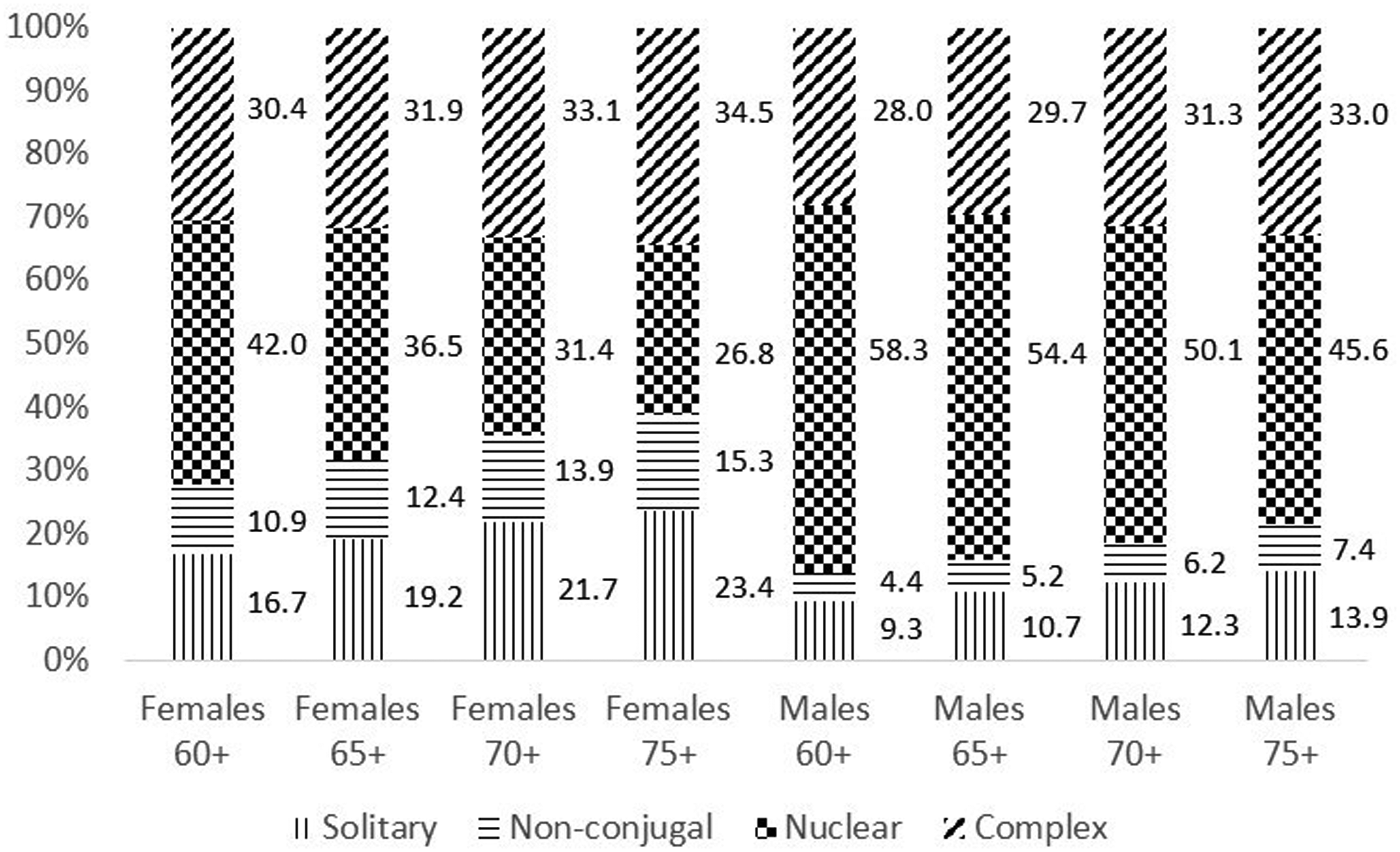
Proportion of the older male and female population recorded in solitary (HHD 110–120), non-conjugal (HHD 210–220), nuclear (HHD 310–350) and complex living arrangements (HHD 410–599) by age group, England and Wales RDs, 1891. Notes: ‘Solitary’ households denote a person that is living alone; ‘non-conjugal’ households denote those living with siblings or extended relatives only; ‘nuclear’ households denote a married couple living alone or an immediate family; ‘complex’ households comprise extended and multiple structures, where a person is living with both their immediate family and their extended relatives. A more detailed explanation is in Peter Laslett, ‘Introduction: the History of the Family’, in Household and Family in Past Time, eds., Peter Laslett and Richard Wall (Cambridge: Cambridge University Press, 1972), 1–90. The data are from I-CeM.2, so the figures may differ from that presented for 1891 in Tables 1 and 2, which use I-CeM.1. Excludes HHD 999 (mainly workhouse populations). Includes Scilly Islands RD. Source: See Figure 2.
Additionally, older people in Lancashire and Cheshire were less likely to rely upon state-sanctioned welfare allowances, or poor relief, granted by the local Board of Guardians as part of the New Poor Law welfare regime in England and Wales. 74 Ecological fallacy may question the robust relationship between the household patterns of older people and their reliance on poor relief at the aggregated spatial level. Complex household ties may nonetheless have depressed the need for state-funded assistance. The share of older women nationally who were estimated to have received poor relief on January 1, 1891 was 16 per cent. However, Burnley, Blackburn, and Oldham RDs contained few older men and women on poor relief, at between 7.2 per cent and 11.2 per cent. This further indicates the cost-cutting benefits of managing a complex household. Whether this relationship is based on its economic benefits, whereby a larger pool of family members could help support their older relatives, or the more stringent enforcement of the Poor Law by the Board of Guardians, one cannot say. 75 This does not suggest that all extended household formations directly shielded families against pauperism, especially after the ‘crusade against out-relief’ of the 1870s encouraged more familial links. 76 However, as Anderson rightly argues, ‘an additional potent force encouraging actors to adopt a fairly calculative and short-run orientation in their relationship with kin was the extreme poverty which prevailed’. 77 Extended familial ties may have thus limited the number of times that one felt compelled to visit the local Board of Guardians, whereupon they might have been refused outdoor relief, or offered workhouse accommodation.
Furthermore, the greater demographic availability of younger populations in these districts enabled intergenerational co-residential ties. Between 4.6 per cent to 4.8 per cent of men and between 5.1 per cent and 5.7 per cent of women in Burnley, Blackburn and Oldham RDs were over 60 years of age. This compares with 7.2 per cent of the national population in 1891. 78 The household patterns seen in Stoke Upon Trent RD, and the subsequent low share of those over 60 years of age demographically (4.4 per cent for men and 5.6 per cent for women) may also explain why Dupree found lower rates of older people on poor relief in 1861. 79 This may suggest that the treatment of older people through state-sanctioned welfare was not a priority in certain districts characterized by their demographic marginality. 80 Strong co-residential ties in the examined RDs might have been formed from the expectations that the Board of Guardians would not treat older people sympathetically.
The clusters in north-east England and in South Wales are explained by the mining industry. If we take the share of males aged 15–64 years by social class, as defined by the Registrar General in 1911, between 60 to 67 per cent of this group in the RSDs of Houghton-Le-Spring RD, Durham, were miners. 81 There, 41 per cent of older women lived in complex households. The hazardous and dangerous conditions associated with mining may have increased widowhood among older females, and thus the numbers accommodated into the household of their relatives. Also, the average age at marriage for females in the RSD of Hetton-Le-Hole in Houghton-Le-Spring RD was only 22.9 years. 82 Although the correlation may be spurious, a low marriage age would prolong fertility and would thus increase the likelihood of extended household formations in the future. 83 Finally, high fertility rates would further contribute to the demographic marginality of older women in the population, as this would increase the availability of younger populations to co-reside. This would contradict the idea that ‘densely populated regions’ were ‘less conducive to the formation of very complex family structures’. 84 However, our data indicate that the greater presence of complex households in urbanized districts is specified by their proximity to certain types of industry.
The relationship between the share of older women on poor relief and their presence in a complex household is made complicated. In South Wales, 21.4 per cent of older women in Glamorganshire received poor relief, above the national average. By Poor Law Union, 23.1 per cent and 26.1 per cent of older women in Pontypridd and Neath, respectively, were on relief, while 35.8 per cent and 39.5 per cent of older women in these two Unions lived in extended households. 85 The physical disability of women, which would arise from servicing the mines, may have provided a compelling case for the Board of Guardians to prescribe welfare to older women. 86 The Poor Law thus formed a more significant part of older women's experiences in Glamorganshire than in northern England, and the resources of familial provision with poor relief were complementary. 87
Figure 4 shows that, based on the share of older females recorded in households where they lived without offspring or extended kin, there is an entrenched cluster in the Norfolk region of eastern England, and in south-west England. Warminster RD, Wiltshire contains the highest share of older women living without offspring or extended kin, at 48.3 per cent, followed by Huntingdon RD, Huntingdonshire, at 48 per cent, then Westbury RD, Wiltshire, at 47.5 per cent. In Warminster RD, Wiltshire, 10 of the 13 older women living in the parish of Bishopstrow had no co-residential offspring or kin. Jane Haines, aged 75 years and a retired general servant, lived with lodger Sarah Shergold in 1891, and in 1881. 88 Originally living with her husband John and raising five children in 1851, by 1871 she is widowed and living with her son, Francis. 89 The family collapsed when Francis migrated to Trecynon, near Aberdare, Glamorganshire, marrying Mary Jane Haddrell on 18 March 1872, although it is uncertain whether Francis, Mary, and Jane ever co-resided as Francis died in Merthyr Tydfil in 1873. 90 Fate also befell Francis’ sister, Ellen, in 1863. 91 Jane's eldest son, William, migrated to Aberdare by 1861, and in 1871 was joined by his brothers, Stephen and Frederick, recorded as ‘boarders’. All three brothers are described as labourers and may have been participating in coal mining, as William's 1861 entry makes explicit. 92 Only Frederick is recorded as having returned to Bishopstrow in 1891, although he raised his family independently and did not ever co-reside with Jane, as far as we know. 93 The early mortality of Francis and Ellen lessened the potential for future familial ties, and there was little incentive to form an extended family unit in a location that lacked the heavy industry that characterized Lancashire or Staffordshire, nor contained the degree of family farm smallholdings noted in Cheshire, as the prosperity of coal mining lured her children to Glamorganshire. Jane's story is consistent with data on the five selected counties mentioned earlier: the out-migration of younger populations in districts characterized by agricultural labouring would speed up the ‘nuclear hardship’ process. The greater reliance on the New Poor Law among older people in southern and eastern England was predicated on the ‘married, no offspring’ household structure (HHD 310). Studies have noted a higher-than-usual concentration of the ‘able-bodied’ and older-age populations on relief in those regions. 94 Nationally, there may be a positive relationship between the share of older women on poor relief, and the percentages living without offspring and extended kin. This would demonstrate that pauperism would arise by the lack of intra-household assistance from their relatives.
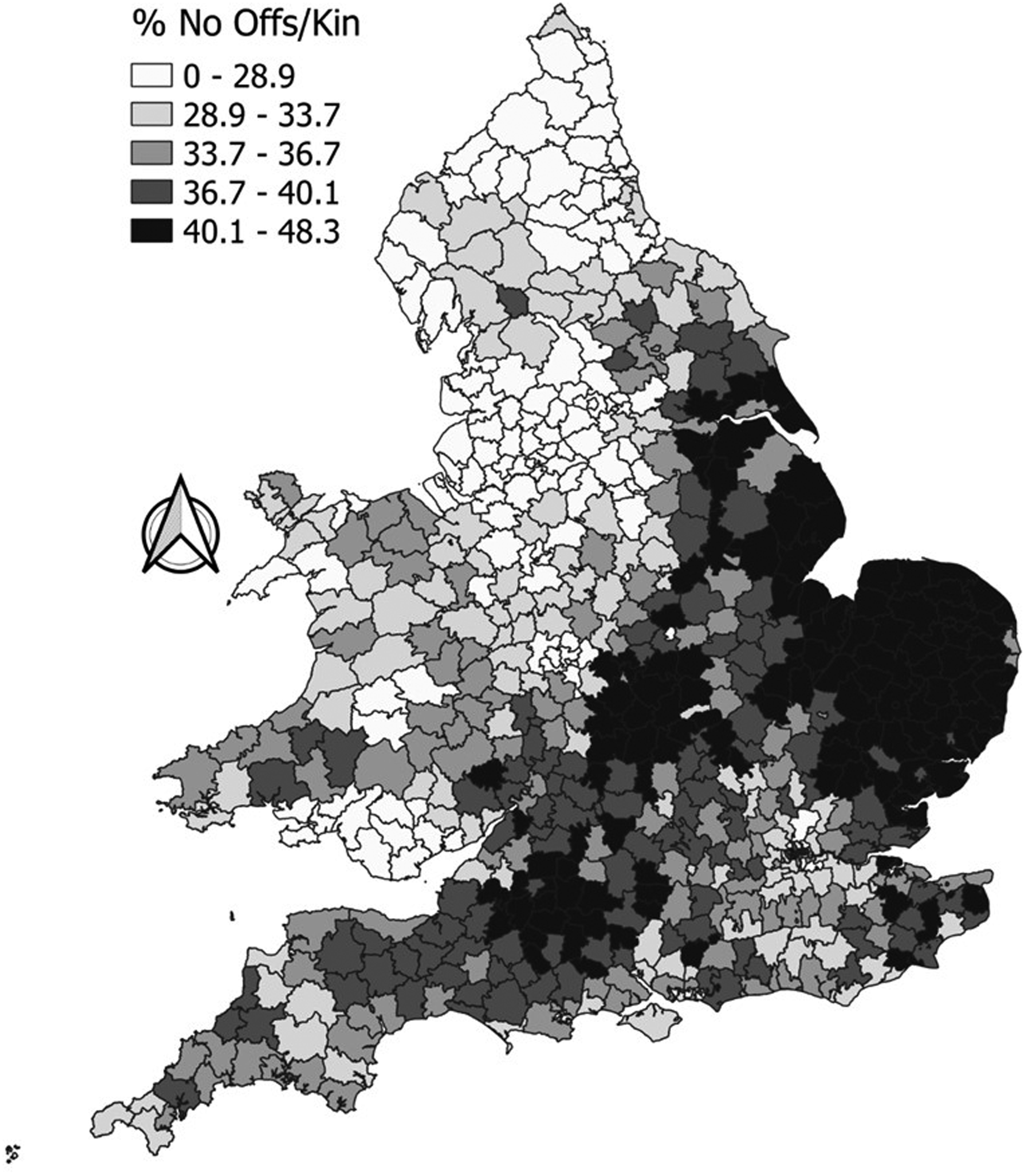
Proportion of the female population aged 60 years and over recorded in households with no offspring/kin (HHD 110–120, 310), England and Wales RDs, 1891. Notes: The clusters in the darkest areas refer to these regions – to the east: the East Anglian region of the counties of Norfolk, Suffolk, and Essex; above the East Anglian region: mainly the county of Lincolnshire; to the south-west: mainly the RDs of the county of Wiltshire; in the south midlands: mainly the RDs of the counties of Cambridgeshire, Huntingdonshire, and Warwickshire; to the south-east: parts of east Kent. Source: See Figure 2.
Figure 5 shows that, across the London RDs of Marylebone, St George Hanover Square, London City, and Strand, 40–48 per cent of older females were noted without any intra-household co-residential ties. The national comparison is 32.4 per cent. Although relatives may have been living close by, Marylebone and St George Hanover Square RDs had the lowest share of females in complex households nationally. Some of the demographic characteristics in London contrast heavily with Durham's Houghton-Le-Spring. The mean age of marriage in the RSDs of the four London RDs was one of the highest nationally, at between 28–32 years, and the share of never-married women as a percentage of all women aged 45–54 years was also markedly high. 95 As a result of lower fertility, this would intensify the share without any available offspring and kin in the household. By contrast, Houghton-Le-Spring RD, Durham, with its low marriage age and high fertility, meant parents of the household head could receive accommodation in return for caring for the many children in the household.
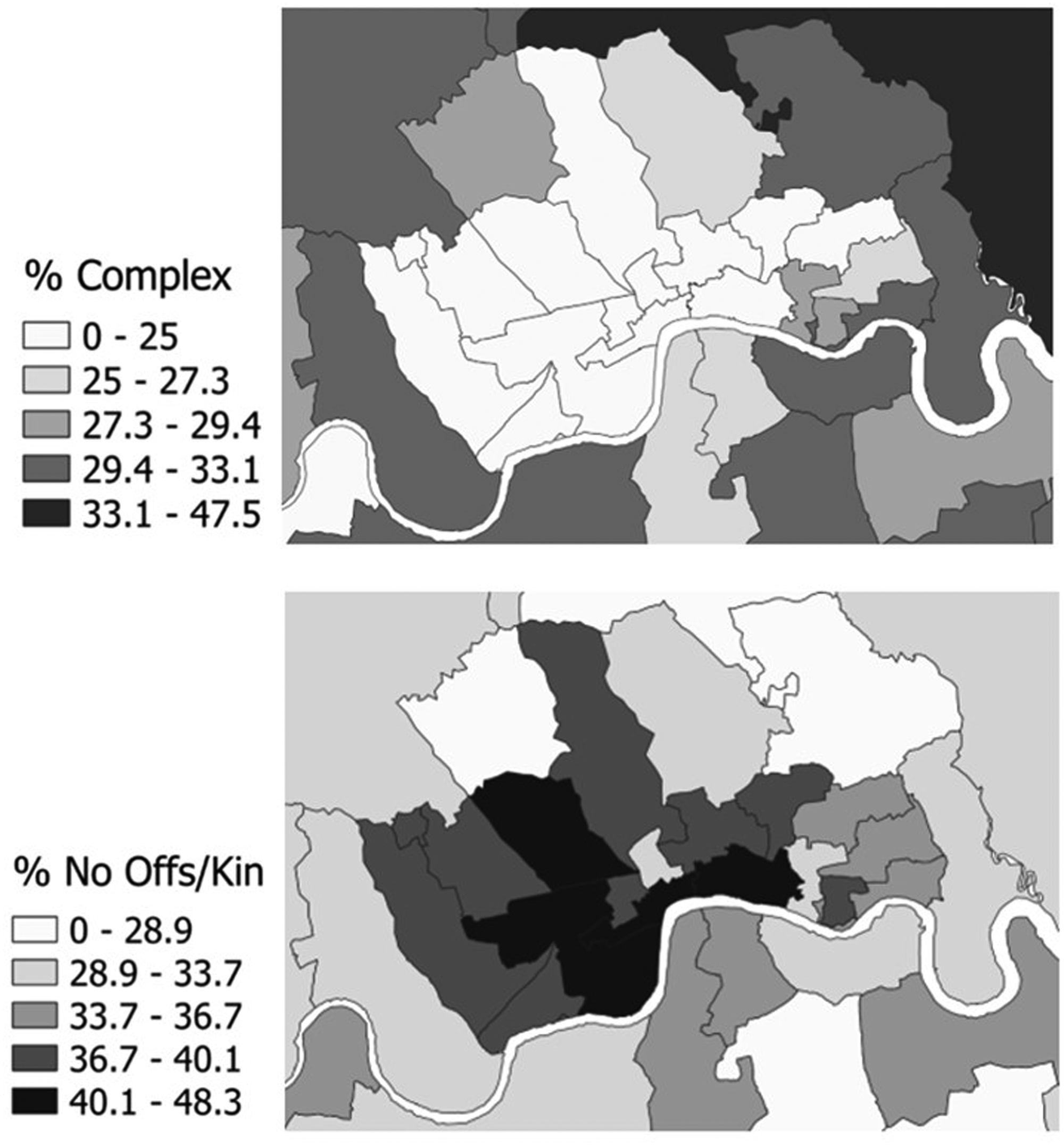
Proportion of the female population aged 60 years and over recorded in complex households (HHD 410–599) and in households with no offspring/kin (HHD 110–120, 310), London RDs, 1891. Source: See Figure 2.
London's service economy may have accounted for the lack of co-residential ties among older women. 96 In fact, London City RD had the highest share of older women recorded in domestic service out of the 630 RDs of England and Wales, with Strand RD and St George Hanover Square RD in the 10 highest. Of all older women in London City RD (including workhouse residents), 14.4 per cent worked in domestic service; in Strand RD and St George Hanover Square RD, it was 9.7 per cent and 8.4 per cent, respectively. The average for England and Wales was 3.7 per cent. 97 Outside of domestic service, London was a diverse economy which, although flexible in its array of industries, lacked the core ‘specialization’ of the industrial northern districts, such as pottery in Staffordshire, or iron manufacturing in Barrow-in-Furness RD. 98 Consequently, the retention of offspring and the childminding roles of older women that facilitated complex households in specialized industrial towns was lacking in London.
Conclusion: The Importance of Complex Households in the Nineteenth Century
First, by 1911 there was an increasing nuclearization of household structures, coupled with a fall in those living in extended households, which was partially based on the decline in the share of textile workers. 99 The national data from 1891 shows the extent of textile work in Lancashire's RDs, and thus defined how households were structured locally, confirming Anderson. 100 As older women aged, they received accommodation in a relative's household as ‘mother’ or ‘mother-in-law’, assisting their offspring working in the factories in cotton weaving. Mining districts also contained similar complex living arrangements. While the share of older men in nuclear households was greater than that seen for older women, older men in 1851 were more likely to live in complex households in Cheshire and the Yorkshire West Riding than in Hampshire, Hertfordshire, and Glamorganshire. The regional skew in complex household residence thus transcended gender. Marked changes in household structure were noted in 1891 from 1851, such as the slight increase in ‘solitary’ (females only) and ‘married, no offspring’ (males and females) householders. It is unclear if the increasing share of ‘lone parent, with offspring’ households by 1911 was explained by the introduction of old age pensions in 1908. With a focus on five selected counties across three census periods, and a national emphasis on one period, one acknowledges the limitations of this study. The counties selected in the first half of this paper might not be representative, and a national focus on the late-Victorian period cannot adequately cover relationships between older people and wider society beforehand. Despite this, while preliminary, these findings are still significant in the local and regional context, extending the original conclusions made by Anderson, Dupree, and Thomson. The biographical case studies elucidate and contextualize these conclusions, and one gains a greater understanding beyond the original sample-based approaches to household structure. The next stage of this research will examine how representative these initial findings are, and the clusters at RD level will inspire 100 per cent coverage of RSD- and parish-level studies in all available census years.
Second, complex household ties were strongest in northern England and in South Wales and weakest in south-western and eastern England (except for Cornwall). This extends our understanding of a regional New Poor Law divide, at least in the context of a general north-west and south-east divide if one compares Figures 2 with 4. 101 If one follows Broad's argument that poor relief recipience in the early nineteenth century was higher in southern and eastern England, then the complex household formations in 1891 may have been a long-term response to the limited distribution of poor relief in the north, as has been demonstrated for Burnley, Blackburn, and Oldham RDs. 102 Despite this, we must consider the temporal circumstances where poor relief applications soared in heavily industrialized areas, such as Lancashire in the depression of the early 1860s, which may have relieved intergenerational family members from the pressures of co-residence. 103 Nevertheless, when the economy was more buoyant in 1851 Cheshire, the share of older women in complex households was slightly greater than that of older women in nuclear households. This may be based on a ‘north-south’ agrarian divide, where the smallholding family run farming economies reinforced complex household structures in northern districts. 104 Contrastingly, the large-scale proletarianized farming economies that mainly characterized southern England enabled more nuclear family structures. Alternatively, heavy industrialized districts reinforced complex household ties. In 1891, this was seen in the Lancashire RDs of Barrow-in-Furness, Blackburn, Burnley, and Oldham, and the Staffordshire RDs of Stoke Upon Trent and Wolstanton. Compared with the national share, the proportions of older women in these RDs were significantly fewer owing to the migration of younger adults to industrializing districts. Complex household residence was also noted in the coal mining districts of South Wales, in north-east England, and in the tin mining district of Redruth RD, Cornwall. With adult offspring working in nearby industries, this would have facilitated strong intergenerational links. As demonstrated by Sarah Parish's backstory, some of these complex household ties were also characterized by the migration of extended families. By contrast, London contained limited extended intra-household relationships, owing partly to the service economy and the lack of specialized industry. Overall, how older women lived, and the experiences they shared with their extended kin, was geographically diverse.
Third, the integration of older relatives occurred at much older ages, such as when one became between 70 and 75 years of age. This was reinforced more strongly in the textile economy of Burnley RD, near Anderson's Preston. Nationally, the share of older women over 70 years and over in complex households eclipsed those in nuclear households, although this did not apply to older men. This would confirm Thane's argument that the integration of older women into a relative's household occurred nearer the end of one's life, although the selected biographies in this article have demonstrated regional exceptions. 105 There, older women in their sixties were enumerated in an ‘extended upward’ type; in the case of Sarah Parish from Barrow-in-Furness, one that started in her fifties. Clearly, the share of older female and male solitaries were eclipsed by those recorded in complex households; at least in the regional context and depending on age, more older women lived in complex households than without offspring and kin. The Victorian demographic regime of high fertility, combined with urban population growth, enabled such household arrangements. Seen within the wider history of family and household structure in England and Wales, and when compared with the intense nuclearization and solitariness of households from the mid-twentieth century, complex households aligned themselves with the peak of the industrial revolution. 106
Overall, has this article rejected Laslett's null hypothesis regarding the dominance of the nuclear family? In terms of the wider older-age population, no. Despite this, an historiographical tendency to stress the importance of the nuclear household means that one ignores the many examples where older people resided in complex households in the nineteenth century. There appears to be characteristics of the south-eastern European household system within the overall Western framework of England and Wales, and these are more pronounced in terms of the experiences of older people. At least in the context of old age, there was a middle ground related to the geography of regions between the original assumption that in the past it was common for people to live in extended households, and CAMPOP's formative counterarguments reasserting the importance of the nuclear family. With the arrival of a ‘big data’ analysis of historical living arrangements, Anderson's conclusions, first held over 50 years ago for early-Victorian Preston, Lancashire, maintain credibility when compared with the other industrialized and smallholding districts of northern England and beyond.
Footnotes
Acknowledgements
I am wholly indebted to the Economic and Social Research Council, United Kingdom, for granting a Postdoctoral Fellowship at the University of Cambridge between 2021 and 2022 which made this article come to fruition. I would like to thank Professor Alice Reid at the Cambridge Group for the History of Population and Social Structure, University of Cambridge, for her guidance as mentor during my Fellowship and for supplying an early version of the I-CeM.2 dataset. I am also thankful to Professor Kevin Schürer, also at Cambridge, for inviting me to speak at the Local Population Studies Society Conference, November 12, 2022, University of Cambridge, on an early version of this paper, and for additional comments from the audience, particularly Professor Michael Anderson. I am also grateful to Dr Joe Day of the University of Bristol for supplying the base map of the 1891 registration districts of England and Wales, and to the anonymous referees for their feedback which significantly enhanced this article.

Ethical Approval and Informed Consent Statements
This study was approved by the Departmental Research Ethics Committee of Cambridge University (no. 2406) on 6/29/2022.
Funding
The author disclosed receipt of the following financial support for the research, authorship, and/or publication of this article: This work was supported by the Economic and Social Research Council, United Kingdom [grant number ES/W006383/1].
Declaration of Conflicting Interests
The author declared no potential conflicts of interest with respect to the research, authorship, and/or publication of this article.
Data Availability Statement
The I-CeM.1 data supporting the findings of this article were provided by Kevin Schürer and Edward Higgs, Integrated Census Microdata (I-CeM): 1851–1911, dataset (UK Data Service, 2014).
Professor Alice Reid, Cambridge Group for the History of Population and Social Structure, University of Cambridge, supplied an earlier version of the enhanced Integrated Census Microdata dataset, or I-CeM.2, see Kevin Schürer and Edward Higgs, Integrated Census Microdata, 1851–1911, version V. 2 (I-CeM.2), dataset (UK Data Service, 2020). A completed version is available for academic consultation at the UK Data Service under Kevin Schürer, Edward Higgs, and FINDMYPAST LIMITED, Integrated Census Microdata (I-CeM), 1851–1911, dataset (UK Data Service, 2024).
The author's data preparation for this paper cannot be shared directly as researchers are encouraged to visit the UK Data Service to consult the original I-CeM.1 and I-CeM.2 data. However, a copy of the author's data preparation is available upon request.