




Abstract
The aim of this article is to analyze the presence of widows in trade and crafts in early- and mid-nineteenth century Helsinki, while the guilds were still operational, and around the time they were abolished. With the aid of tax records, municipal council minutes, and guild records widows engaged in economic activity have been located. The intention of this study is to demonstrate that widow headship and commercial engagement in this pre-industrial town was neither rare nor brief.
Keywords
Introduction
When the widow and innkeeper Eva Sophia Ahrstedt agreed to the marriage between her daughter Carolina and the well-connected but penniless university lecturer Carl Crusell in 1847, a prenuptial contract was set up. The contract made sure that the contents of their home in Helsinki (all provided by the mother in law), including expensive furniture, chandeliers, textiles, household utensils, china, glass, silver, paintings and musical instruments, plus clothes and jewelry for the bride, was to remain the sole property of the young wife. 1 This is only one example of the actions of a strong and independent woman in nineteenth century urban society.
Since the publication of Family Fortunes by Davidoff and Hall purporting the theory that middle class women in the eighteenth and nineteenth century withdrew from the public into the domestic sphere, a discussion was spawned, occasionally gaining more, sometimes less vigor. The theory gained some support among scholars taking the view that women in the past suffered from lack of agency and economic power and could, if working, only be engaged in menial tasks, or among those claiming that women, having the choice, prefer the domestic role. 2
On the other hand, the theory has also met with swathes of criticism. Many books and articles have been written demonstrating that women were working in the eighteenth and the nineteenth century. Although much of the information is related to rural societies, urban communities have also been in focus. 3 The question of whether female work in earlier times can be quantified or valued is affected by the problem of finding suitable records. This is the legacy of an attitude to women historically, but also to the nature of many tasks performed by them. 4
However, the past twenty years have seen numerous studies tackling the question by gathering information not about women in general, but specifically the middle and commercial classes that were the subject of the 1987 study. Beatrice Craig has provided a wealth of examples from nineteenth century France, Europe, and the USA of women engaged in business on small and large scale in their own right. Hannah Barker has studied women and business in England and Laurence, Maltby and Rutterford have shown that not only did women understand economic matters but they were also trained in things like accountancy if they were born in a family or married to a man engaged in business. Most recently a study by Le Chapelain has evidenced women engaging in business activities in various countries the eighteenth and the nineteenth century. 5
Because of the inability for women to enroll in schools and lack of formal training in crafts and trade, doubts have been cast on female capacity to run a craft business and the idea of remarriage has been introduced as the remedy. It is, however, not meaningful to view women as isolated from economic life. Just like the daughter of a farmer was trained in everything regarding the farm so was the daughter of a craftsman or a merchant. Because of this she could be valuable participant in a family enterprise, particularly the commercial side, as demonstrated by Lanza. 6
It is important to make the distinction between being a woman and being a widow, the guilds did not restrict the right of widows of artisans to continue the work of their husbands’. Most Parisian guilds affirmed the right of widows to retain and continue the work in their late husband's shop and workshop. Although the widow had to keep on the journeymen engaged by her husband and stood to lose her privileges if she remarried, the statutes secured her right to the workshop. 7 The fact that wives worked closely with their husbands during the marriage prepared them for activity in widowhood. In certain parts of France like the towns of Brittany around 10 percent of commercial enterprises were in the hands of widows, in addition some also invested in ship-building. 8 In the 1760s, 16 percent of the widows in Senlis continued the occupation of their late husband. They were bakers, butchers, carpenters, coopers, saddlers, rope makers, smiths, etc. While certain textile guilds like those manufacturing and selling garments for women and children allowed female apprenticeship from the seventeenth century, the eighteenth century saw the increase in free occupations and the 1770s opened crafts for women. In the town of Chatellereault 43 percent of all new enterprises were headed by a woman after the liberation. In Northern Netherlands widows and spinsters over 25 had the legal right to run a business. Particularly in the food and drinks trade we find a considerable widow presence. Some German towns could see one-third of the widowed household heads engaged in crafts, trade or the civil service in the 1780s. 9
Therefore the question arises. What can be gleaned about widow activity in crafts and trade in the Nordic countries? Widows can be found as taxpayers in these groups both in urban Sweden and Norway. However, in nineteenth century small town Sweden trade and inn keeping tended to be more popular among widows than crafts. Among the merchants in eighteenth century Finnish towns there was a wide spread custom of wives and daughters running shops in the absence of fathers and husbands. In eighteenth century Stockholm with a large population and market opportunities there was a common presence of widows in crafts. Evidence has also been unearthed of how the manufacturing side and that of economy and accountancy could be divided, with the widow in charge of the latter, for example in the building sector. 10
Hence the aim of this study is to analyze the engagement of widows, in crafts and trade in nineteenth century Helsinki. These women represented a specific socioeconomic group, the middle class, engendered by pre-industrial society. To what extent were their economic opportunities restricted by the guilds, legislation or the local administration? Were they obliged to remarry to continue functioning economically? What was the socio economic background of the widow of a merchant or craftsman? For how long did they operate after the death of a husband? When they did continue a business, did they do so with the assistance of family members? What were their households like? Can we find evidence of agency among these widows rather than withdrawal into the domestic sphere while letting male family members control the economy?
Data, Methods
As the aim of this article is not only to gather instances of information about female economic engagement, but to follow women in a longer time perspective, data linkage has been central to the study. Helsinki tax records from 1811, 1821, 1830, 1840, 1841, and 1860 have been used to identify women, particularly widows, who were engaged in business activities. The presence of apprentices and trainee boys in the household has been used as an identifier for engagement in crafts and other employees for engagement in trade. The municipal council minutes between 1809 and 1874 have been used to find information about applications submitted by women for the right to engage in economic activity. In addition the dates when widows gave up the business have been extracted from the minutes. The accounts of the guilds have been examined to determine the timing and duration of payments by widows to retain their membership. The accounts included in the study are those of the guild of blacksmiths 1806–1867, the guild of bakers 1839–1880, the guild of tanners 1806–1854, the guild of housepainters 1821–1870, the guild of tailors 1821–1864, the guild of bricklayers 1823–1848, the guild of hatters 1807–1834, the guild of tailors 1821–1864, the guild of shoemakers 1796–1834 and the guild of bookbinders 1837–1856. Some account books have not been preserved. The trade registers of 1859 and 1862 have also been used for the purpose of timing widow presence in economic life. Using parish registration of births deaths and marriages and communion books for Helsinki from the 1780s to the 1860s, the life-course of the widows has been reconstructed.
Legislation and the Urban Economy in Sweden and Finland — The Guilds and the State
The guild system was a relatively late phenomenon in the Nordic countries compared with continental Europe. While some guilds existed in late medieval times in urban centers like Stockholm most towns were far too small and seldom had enough craftsmen to form a corporation. Even in Stockholm some guilds were started as late as in the eighteenth century and in Helsinki as late as the nineteenth century. However, for example tailors and shoemakers tended to be organized fairly early. By the second half of the seventeenth century the government saw it as a priority to set up rules that would be applicable to all guilds. Thereby the National Ordinance for the Guilds of 1669 consolidated the various guild rules to a uniform system. One of the rules included in the ordinance was the right for a widow to continue the business of her husband. The second ordinance, that of 1720, confirmed the right of the widow to continue the trade or craft of her husband as long as she did not remarry and lived a respectable life. It also introduced the rule that women could gain the right to engage in craft under a master or with the permission of the urban council. In addition it laid down the rule that from this time on apprentices had the right to marry. The state Board of trade (kommerscollegium) became the highest authority in matters of trade and commerce and this was also the body to which applications to start a factory or factory like enterprise had to be submitted. 11 While married and unmarried women could apply for a license to engage in petty trade or nonguild regulated activity, widows did not need a permit if their activity was a continuation of that of the late husband. On the other had if they wanted to opt into a different sector, an application was necessary. Inn-keeping was never subject to guild regulations, but the male restaurant keepers formed corporations and retained the right to more sophisticated hospitality activities. The division was basically that the taverns run by men held the privilege of serving imported drinks like wine while the more modest cafes run by women had to keep to serving food, beer and domestic distilled spirits. From 1741 inn and café keeping, with a license, was explicitly opened to women and by the nineteenth century the field had become female dominated. From 1798 married women were given the economic authority over their business and became able to write contracts in their own name. One should also keep in mind that the law code of 1734 confirmed the dual property system in marriage. While all property gained during the marriage was joint and subject to specific rules of division, real property inherited from the family of the parties was subject to different rules and premarital debts were individual. Therefore a woman could hold property separate from her husband while under his tutelage as a wife. 12
Since 1668 separate rules for factories and similar bodies placed these outside the guilds and subject to state authority rather than municipal. Through the eighteenth century the balance swung in different directions between the urban councils and the guilds. The power struggle between the King and parliament in the 1780s resulted in royal support for the guilds. However, the overall trend was toward more economic rights for other urban groups to participate in economic life. In Sweden the guilds were abolished in the 1840s, all crafts were opened to women in 1846 and from 1864 any woman could engage in shop keeping or other economic activity. 13
Some guilds in eighteenth century Stockholm, like shoemakers and the tailors, were keen to maintain a rule of no more than four apprentices per master. The building sector, however, had never been able to run such systems, as the apprentices did not live with their masters among builders, bricklayers, and stonemasons. Learning the trade was done in the workplace and the apprentices often lived with their parents when young and later with their own families. Brewers, bakers, and tanners needed many hands, all of which did not need to be skilled. A study of their households in the eighteenth century reveals a multitude of “hands” or maids or workers and very few apprentices. Stockholm was the largest town with the oldest and most well developed guild system. However, even there the system began to unravel in the eighteenth century. The municipality and the Crown were not too enthusiastic about the constant objections by the guilds to people wanting to engage in productive work. The blocking of apprentices from mastership and keeping trainee boys on overlong contracts with no wages was not ideal. By the early nineteenth century it was clear that economic life could not be kept within existing restrictions. The separation of factories from the guild system created some chances for economic development, but even so the guilds objected to manufacture encroaching on their privileges. Once the guilds were abolished some small towns were still dragging their feet but generally speaking a new system came into being. 14
Economic Life in Finland After the Separation From Sweden
When Finland was separated from Sweden and attached to the Russian Empire as the Grand Duchy of Finland in 1809 the peace treaty contained a clause promising that the country was to retain its Protestant religion and religious bodies. It also stated that the legislation current in the Swedish realm at the time of the separation was to be maintained. In addition existing legal and administrative bodies were to continue their activity. This meant that the economic legislation of the eighteenth century was retained and in urban areas, that the guilds held their position. In addition, political turbulence in the Russian Empire during the early years of Nicolas I resulted in a tendency to view all aspects of change with suspicion. Parliament was not called in Finland in the 1830s and 1840s and therefore Swedish eighteenth century economic legislation persisted until the reforms brought in during the parliament sessions of the 1860s. However, female economic activity was subject to a municipal license unless she was the widow of a craftsman. A more recent issue was the fact that Russian economic legislation, and rules about separate property, made it possible for married women to engage in business pursuits, if Russian. The nineteenth century saw the emergence of Russian entrepreneurs into Finnish urban areas and the existence of different norms side by side. While the guilds in Helsinki were highly restrictive about allowing entrance of foreigners into their midst, the old manufacture legislation clearly stated that large enterprises like factories were not subject to urban authorities, but state bodies like the industrial board. In cases of disagreements it was also possible to write a petition to the governor. 15
Although economic life was tightly regulated and the guilds had a strong position, persons with urban citizenship were in principle allowed to pursue economic activities, if it did not intrude on the guilds. Indeed the code of 1734 for Sweden and Finland echoed the guild ordinance in that widows had the right to continue running the business of a late husband and poor women could be allowed licenses for petty trade. Even daughters could inherit and run the shop of the late father if they managed to get permission from the town council or the King. The right to run a shop or craft shop with the rights of a burgher meant the widow was also subject to urban taxation, as any man who was a member of the trading part of urban society. 16
Before 1869 applications had to be submitted to the town council to start a business of any kind. However, already in 1859 the necessity of serving an apprenticeship to be able to engage in craft or shop keeping was deregulated. Bookbinders, hatters, printers, tanners, saddlers, shoemakers, tailors, blacksmiths, coppersmiths, carpenters, and potters still had to serve as apprentices while others were relived from the duty. Any food and drink related activity like baking, brewing, sausage and candle making, etc. was free, if conducted with the assistance of family members. Those who wanted to employ people for the work needed a license from the town council. If a person wanted to engage in the building of houses or in shipbuilding, he had the right to employ whoever and with whatever training he deemed necessary. In 1868 all the guilds were abolished and in 1879 full economic freedom was achieved. After this a notification to the authorities was enough for running an enterprise. 17
Helsinki in the Nineteenth Century
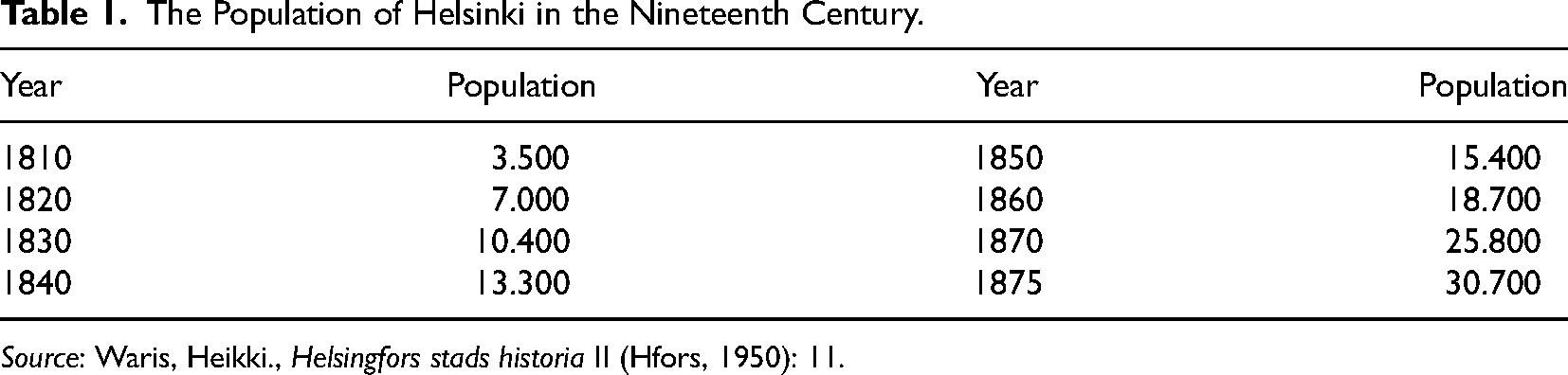
While the late nineteenth century was a time of population explosion the early part saw a steady increase from a modest 3500 in 1810 to 15,000 in 1850. The transfer of the university and the central administration, in conjunction with large building projects to house these institutions in the 1830s and 1840s, vitalized the urban economy and provided ample work opportunities for in migrants. Investment was centered in the town itself unlike at the fortress of Sveaborg under Swedish rule. Between 1810 and 1850 the craft masters doubled, as did the number of apprentices and trainee boys. On the other hand we also see a considerable increase in the employing of workers without apprenticeships in the 1840s, particularly in the building sector. While some factories were operating already in the 1820s, the 1840s saw a drastic increase. These units were often headed by a “master” but only within the book printing sector was an apprenticeship scheme in operation. Other factories tended to employ “workers” including the breweries, alcohol factories, and tobacco factories. The last of these was a considerable employer of women. 18
Helsinki of the 1830s and 1840s was also a holiday resort for the Russian nobility. The emperor Nikolai introduced some restrictions on foreign travel to prevent the spreading of revolutionary ideas into the Empire. However, as Finland was now Russia and Helsinki sported spas and wells where supposedly health giving evil smelling water could be consumed, it attracted tourists in the summer. Restaurants and guest houses increased. Private individuals would take in paying guests and earn a welcome addition to their economy. This activity was considered respectable and persons of diverse social groups were engaged in it, particularly widows. In some cases rooms were rented out, in other cases whole houses. 19 The international nature of this tourism was documented in a newspaper article from 1845 where the author had observed a family where the father spoke German, the mother Swedish, the governess French, and the nurse maid Russian. When seeing a little beggar boy asking in Finnish for a silver penny, the young girl of the family said: “Ma bonne, ge dem kleinen maltschik en hopea ayri” (Table 1). 20
The Population of Helsinki in the Nineteenth Century.
Source: Waris, Heikki., Helsingfors stads historia II (Hfors, 1950): 11.
Women and Economic Activity in Preindustrial Urban Finland
The active widow of the merchant class has mostly been ignored by male scholars of Finnish urban history. While discussing at length on the active burghers, their wives have been of interest only as links between families and mothers of active sons. When efforts have been made to identify women as actors, their engagement in economic life has been evident. The studies of Aunola revealed that among the trading burghers in the eighteenth century town of Oulu, no less than one-third were widows. These women did not only leave large properties when they died, but were during their lifetime actively engaged in trade with Stockholm representing considerable cash flows. Equally the small town of Raahe demonstrated a high proportion of trading widows in the late eighteenth century. Even for the previous century evidence has been revealed of female economic activity in the merchant class. Wives and widows were crossing the Baltic or traveling to towns along the coast with merchandise, money, or credit notes in their own right or for family members. 21
The seventeenth century Helsinki was small town but one that held the right to foreign trade. In the absence of the husband, wives of merchants and shopkeepers ran the business, replenished stocks, and sold goods. When there was a need to acquire export certificates and toll payment documents to be able to send cargo to Germany and Amsterdam, the wives handled the issue. One has to remember that it was legal for married women to sign contracts. As widows they continued the business until remarriage or sons and sons in law could assist. Such periods of widow management could last for ten to twenty years. When the husband left less than he owed the widows declared bankruptcy and let the creditors divide the spoils, thereby relieving themselves and their children of further claims. After this the widow could set up a business and start anew. Sometimes the property of children was also invested at a good interest with other merchants. Finding widows engaged in lending and borrowing was far from unusual. 22 By the eighteenth century widows in Helsinki were active in business including trade, inn-keeping, and transport. The widows who held burghers rights, and therefore economic privileges, were obliged to pay municipal tax. However, a national rule was passed in the 1760s that deprived them of the right to vote in municipal elections. This became the custom in the majority of urban councils in Sweden in the late eighteenth century. Despite the consensus it would seem that particularly able, wealthy and economically active widows could be allowed to vote in late eighteenth century Helsinki. 23
Widows, the Guilds and the Town Council in the Nineteenth Century
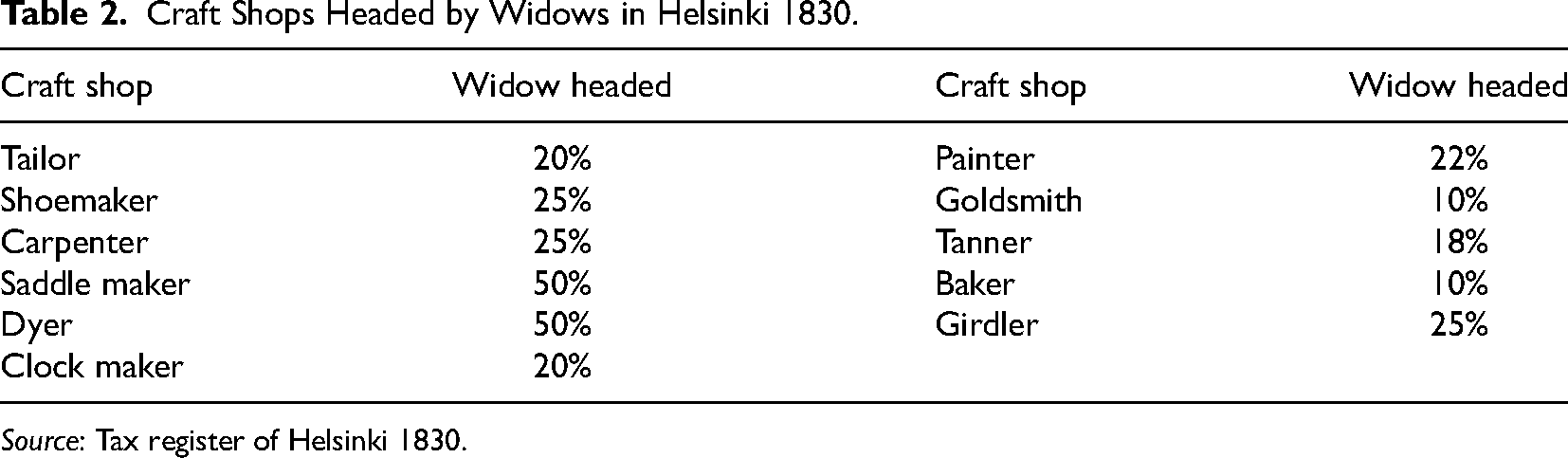
The early nineteenth century Helsinki was still craft dominated. However, even during the times of guild monopoly the widow of a craftsman had the right to continue her husband's business and we find that this was not only theory but also practice. The tax register of 1830 reveals a considerable amount of widows heading households containing apprentices and trainees. While well populated crafts like tailoring saw 20 percent of the shops run by widows and shoemaking had 25 percent widow control, some other branches had even greater female presence (see Table 2). Some sectors were also outside guild control and the mid-nineteenth century displays examples of widows controlling large scale enterprises. In 1853 when Hans Johan Falkman died his widow Sofia took over the ownership and running of the family alcohol factory, two years later the family oil lamp factory. From the 1860s until after 1874 she also controlled a factory for the manufacture of liqueur, and other alcoholic beverages, nominally her son, still a student was registered as co-owner. Similarly the Wecksell hat factory was owned by the widow Sofia Wecksell even though her son acted as director. On the other hand, the widow Elisabeth Norstrom owned and ran a factory making hats, baskets, and other plaited goods in her own right. 24
Craft Shops Headed by Widows in Helsinki 1830.
Source: Tax register of Helsinki 1830.
The situation for unmarried women was of course more difficult, but every field of the economy was not under guild control. The restaurant business displayed in many towns female innkeepers, this was also the case in Helsinki where almost half of the inns were run by women and of those some by widows, others by spinsters. 25 We also find that by the 1870s a bread factory was run by Maria Lindqvist, a factory for everyday apparel was owned by Maria Holmgren and a shirt factory by Hanna Wiklander. All these enterprises were started by the women themselves. 26
When a woman was not a widow of a craftsman or she wanted to diversify her activity it was necessary to apply for a license or permit to start up in business. The nineteenth century applications by women are very variable from an application to make and sell alcohol (14.2 1827) to the right to start a shop for fashionable clothes (6.6 1832), the right to run an inn (5.10 1822), and the right to run classes in textile work for women (3.11 1821). A scrutiny of the applications reveal that the 1820s and 1830s mainly saw applications for the right to run inns, cafes or restaurants or keep a shop or a market stall. In the late 1860s when the guilds were dismantled a flood of applications came from women who wanted to run a bakery or engage in previously guild controlled manufacture or sales. However, the 1860s and 1870s also saw an increase in the desire for shop and restaurant keeping, selling new products like sewing machines (24.9 1873) and instances of capital intensive proposals like starting a varnish factory (31.8 1874) or a textile factory (4.6 1873). The trade license applications were at this point submitted not only by widows but also by spinsters and married women. 27
Sometimes the women of a family found it necessary to take the initiative. In 1842 the Gottberg family (Johan and Helena) started the first match stick factory in Helsinki. For ten years it was successful and was continued by the widow in 1852. However, in the 1850s the widow Gottberg and her daughter commissioned the construction of a bath house on their factory plot in a central part of the town. While the match stick factory (run by the second husband of the widow Gotteberg) failed under the pressure of competition in the 1860s, the bath house run by the women thrived. At the death of Mrs Helena Gottberg in 1877 the bath house was taken over by the youngest daughter Teresia. The stepfather remarried and died and the whole plot was sold by the daughter to the town for the expansion of the railway station 1898. However, already earlier in the 1890s, after the death of her husband, she invested in another bath house, the at the time famous Marie spa. Although owned by Teresia Gottberg this was run by her widowed stepmother Wilhelmina and stayed in family ownership until the twentieth century. 28
Marriage and Remarriage
While the guilds still had the power of control over economic life one way into the helm of a shop or crafts shop was through marriage with a widow of a late master. Such a strategy has been commented on repeatedly and is by some viewed as some kind of self-evident mechanism. 29 In this connection the part that has often been overlooked is whether the prospect was as attractive for the widow as it was for the apprentice. One should not forget that the widow had gained economic and social freedom and control over the business she owned. While it was necessary to employ men for the actual work, particularly in heavy trades like bricklaying or blacksmithing, nothing stopped the widow from controlling the economic side. If the business was trade oriented running it was even easier.
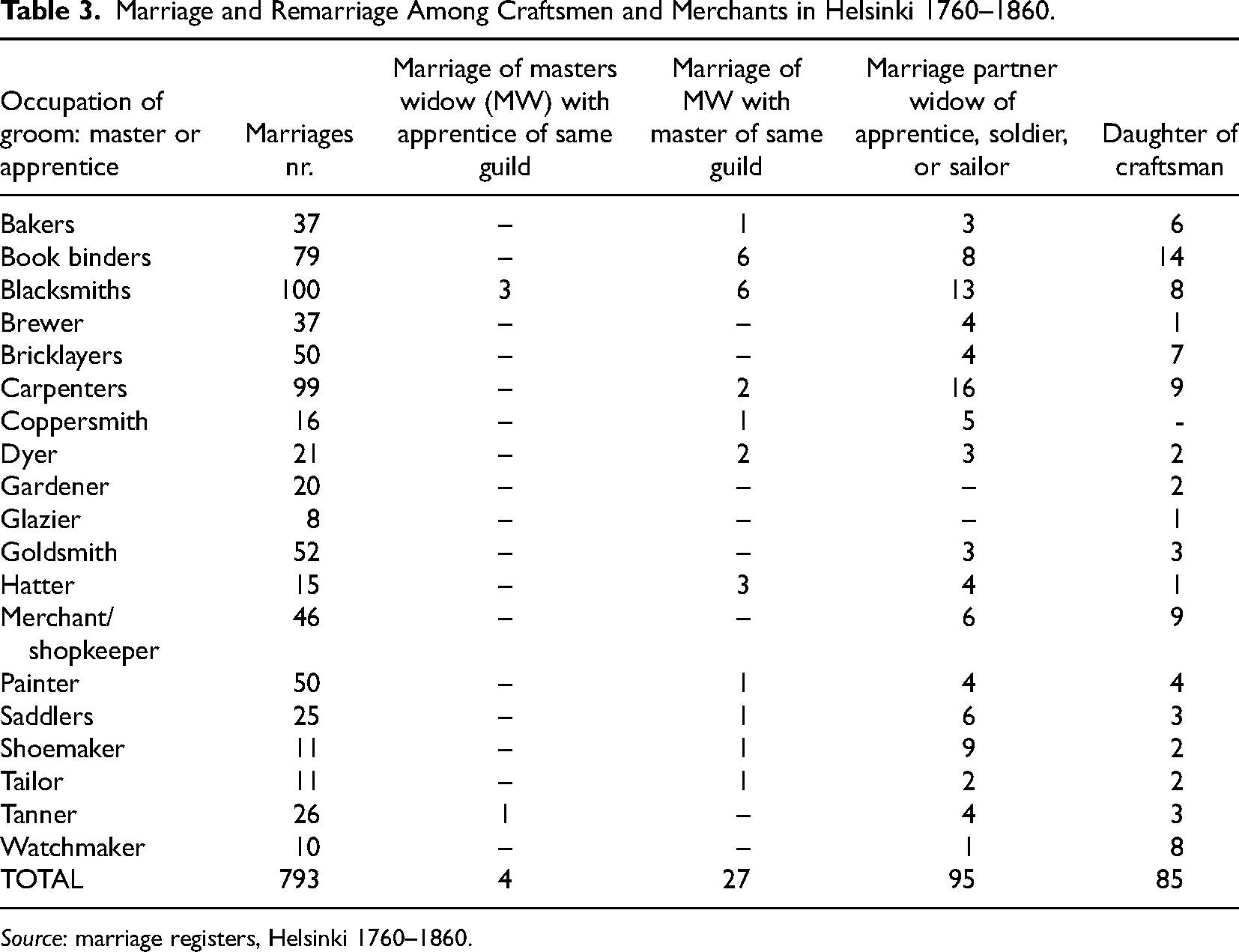
To test if the hypothesis about the propensity of masters widows to remarry, information from the marriage registers of the town of Helsinki between 1760 and 1860 have been collected. The marriage and remarriage of persons in most of the crafts are listed in Table 3. The result of the exercise was that the majority of the women embarking on marriage did so for the first time. The more important result, however is that even though there were masters widows who did remarry, very few of them married an apprentice of the same guild. This contradicts the idea that a standard way for an apprentice to enter into business was by marrying a widow. Where remarriages did occur the partner was mostly a widowed master from the same guild or somebody in a different trade altogether (see Table 3).
Marriage and Remarriage Among Craftsmen and Merchants in Helsinki 1760–1860.
Source: marriage registers, Helsinki 1760–1860.
The group with the most examples of finding the way to being a master through marriage with the widow was that of the blacksmiths. Nine widows of masters remarried and of these three married an apprentice. Helena Sofia Lindros was widowed at the age of 31. She had five children of whom the youngest was born four months after the death of the father. She ran the smithy for five years before she married the apprentice Anders Kindstrom in 1814. Maria Elisabeth Kullberg was 27 and childless when her husband died. She only headed the works for four years before she married the apprentice Gustaf Nummelin in 1822. Finally, the widow Eva Catharina Stahl who was in her early 30 s and the mother of two remarried in 1854, after five years of widowhood and running the craft shop. 30 The only other case of marriage between an apprentice and the widow of a master was Anna Lovisa Gestrin, the widow of tanner Carenius marrying two years after the death of her husband in 1849. Anna Lovisa was 28 years old and had three children under the age of 10 when she married the apprentice Anton Soderstrom who was in charge of her husbands’ workshop.
Many of the widows were older than Anna Lovisa, and it was much more common to find a widow who chose not to remarry but was running the business with apprentices and trainee boys. Gustava Lovisa Engberg was housekeeper for Nataniel Pousette who ran a dyeing business at the edge of town. They married in April 1824 and their son Gustaf Nataniel was born in September. Nataniel Pousette died early of chest trouble, at the age of 37, a year and a half after the marriage. Gustava headed the business with apprentices and trainee boys for seven years, including defending her business interests in the town council. In 1832 she married the master dyer Simon Lundgren and he joined her in running the business that she had inherited. After three years of marriage, however, Simon Lundgren succumbed to an inflammation of the lungs and died, only 35 years old. The twice widowed Gustava, now called widow of master Lundgren, continued to run the business. In the 1840s her household contained two apprentices, some trainee boys and maids. She brought her son into the business but stayed at the head of the enterprise until old age. In 1862 she was registered in the trade directory as widow of dyer, owner of the property at Liisankatu, that she had bought after the death of her first husband. This was where her business had been for decades. She died at the age of 81. 31
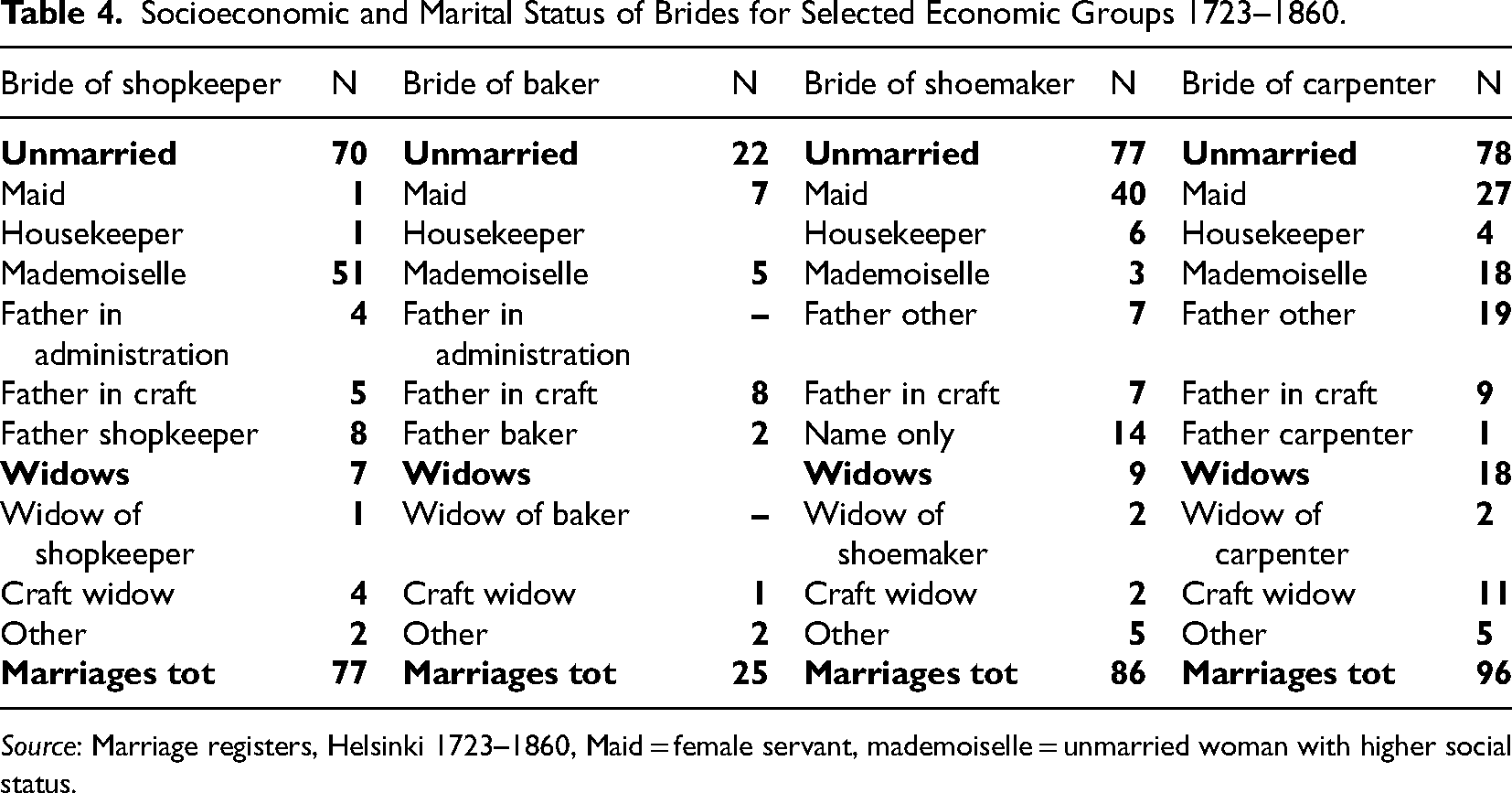
It is therefore fairly clear that an apprentice marrying the widow of a master was unusual. However, there are indications that the craftsmen and merchants formed a fairly tight knit group and intermarriage was common between daughters of one craft and masters of another. Likewise apprentices did not only look to the daughters of the house but the daughter of a shoemaker could easily marry the apprentice of a baker or carpenter (see Table 4). While the widows of masters often sought another master if they remarried, the widows of apprentices and soldiers and sailors were less choosy. Although many craftsmen married the daughters of craftsmen, in a small town like Helsinki the number of masters was restricted. The vast majority of the grooms were apprentices and their share increased over time. Another question is also that while the occupation of the late husband of a widow was nearly always recorded in the marriage register, the fact that the woman was a spinster was often seen as sufficient. The title “maid”(piga) was a generic for young woman but it could also indicate that the woman worked as a servant. In the eighteenth and nineteenth century we see the influx of the title “mademoiselle.” Unlike in Britain where this was a description of an in living governess, in Sweden and Finland a “mademoiselle” or “mamsell” was a young woman whose father was not a farmer or part of the urban working class, but something socially more advanced. While generally speaking the daughter from an administrative family or the higher bourgeoisie would be awarded such a title, those of the more opulent part of the merchant class could also fall into this category. In addition daughters from respected families would sometimes also have the title “jungfru” (maid) which earlier on would have been the privilege of the daughters of the nobility. 32 Therefore the social classification of young women in the marriage register comes with some question marks. In some cases exact information about the occupation of the father of the bride is included in the marriage register. In such cases the father is invariably a resident of the town.
Socioeconomic and Marital Status of Brides for Selected Economic Groups 1723–1860.
Source: Marriage registers, Helsinki 1723–1860, Maid = female servant, mademoiselle = unmarried woman with higher social status.
Craft apprenticeships could be of long duration and even in shop keeping a period of training lasting several years was obligatory. Where it has been possible to reconstruct the age at marriage of the widows of craftsmen and shopkeepers in the study we find a gap in age between the spouses. The mean age at first marriage for women was 24 years while the husbands marrying for the first time were on average 30 years old. Women who remarried often did so in their 30 s or 40 s and the mean age at second marriage was 44 for women and 45 for men. Males remarried more frequently than females and young people more often than those of more mature years. 33
Widows, Activity and the Household
To gather more information about the activity of widows in craft and trade in nineteenth century Helsinki, data have been extracted from the tax registers about any widow in this group that would seem to have actively engaged in economic pursuits (Table 5). As the time before the late 1850s does not offer the aid of trade directories, it has been necessary to restrict data collection to tax registers, parish registers, the town council minutes, and guild records. The tax records allow an insight into whether the household contained apprentices, trainee boys and other male employees plus the number of maids. The parish registers give in most cases information about the death of the husband making it possible to calculate the duration of widow headship. The town council minutes contain information about any widow resigning from the trade of her late husband. Such a resignation had to be handed in for the purpose of being relieved from guild dues and the urban tax levied on persons in craft and trade, therefore the absence of such a statement indicates that the widow was still in business.
Widows in Trade and Craft in the Tax Registers.
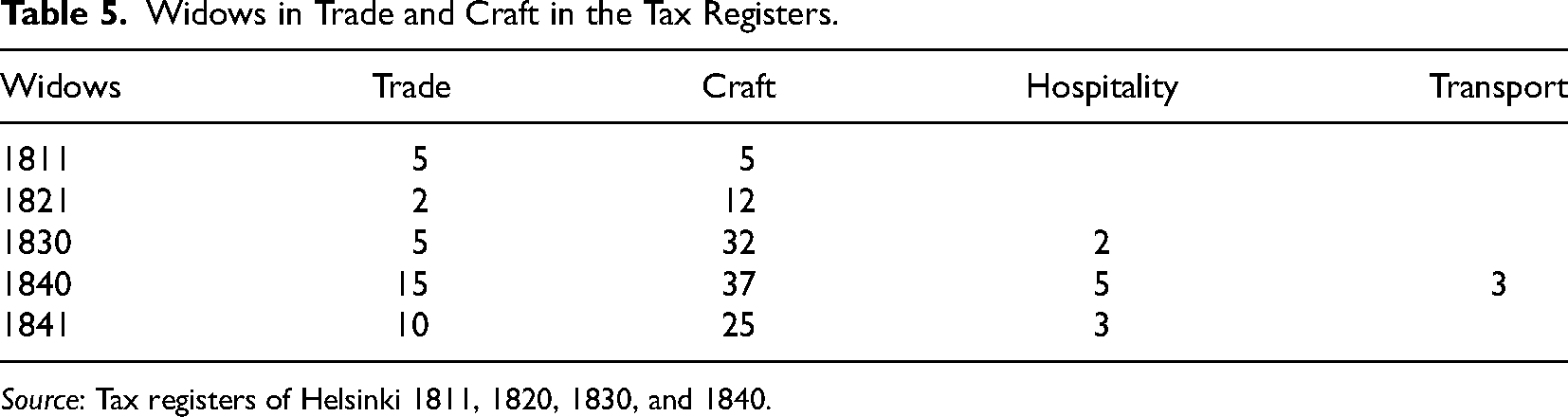
Source: Tax registers of Helsinki 1811, 1820, 1830, and 1840.
The tax burden connected to urban trading privileges meant that in times of economic hardship it was not unknown for persons to resign and give up the privileges. By such an act the right to guild organized activity and political rights ceased, but at the same time the burden of taxation was lifted. From that moment only economic activity outside the guilds was possible. However, since the seventeenth century large scale manufacturing was outside guild power, and privileges were generally handed out by state bodies. In this, certain tensions could arise between the local administration and the industrial board and the governors. In early nineteenth century Helsinki the guild masters and merchants often dominated the urban council and therefore restrictive policies to new establishments or persons from the outside were not unusual. On the other hand, it would seem that there was no problem in accepting widows of local masters to continue the business. There are no examples showing that the town council would have expected applications from the widow. What was expected, however was a notification of finishing operations, as this would create a slot for new recruitment. 34 Resigning from the trade did occur, although not frequently. In addition it would seem that a number of the resignations were by elderly widows shortly before they died. All the cases where it has been possible to trace information about this process can be found in Table 6.
Widow Giving Up the Business 1808–1869.
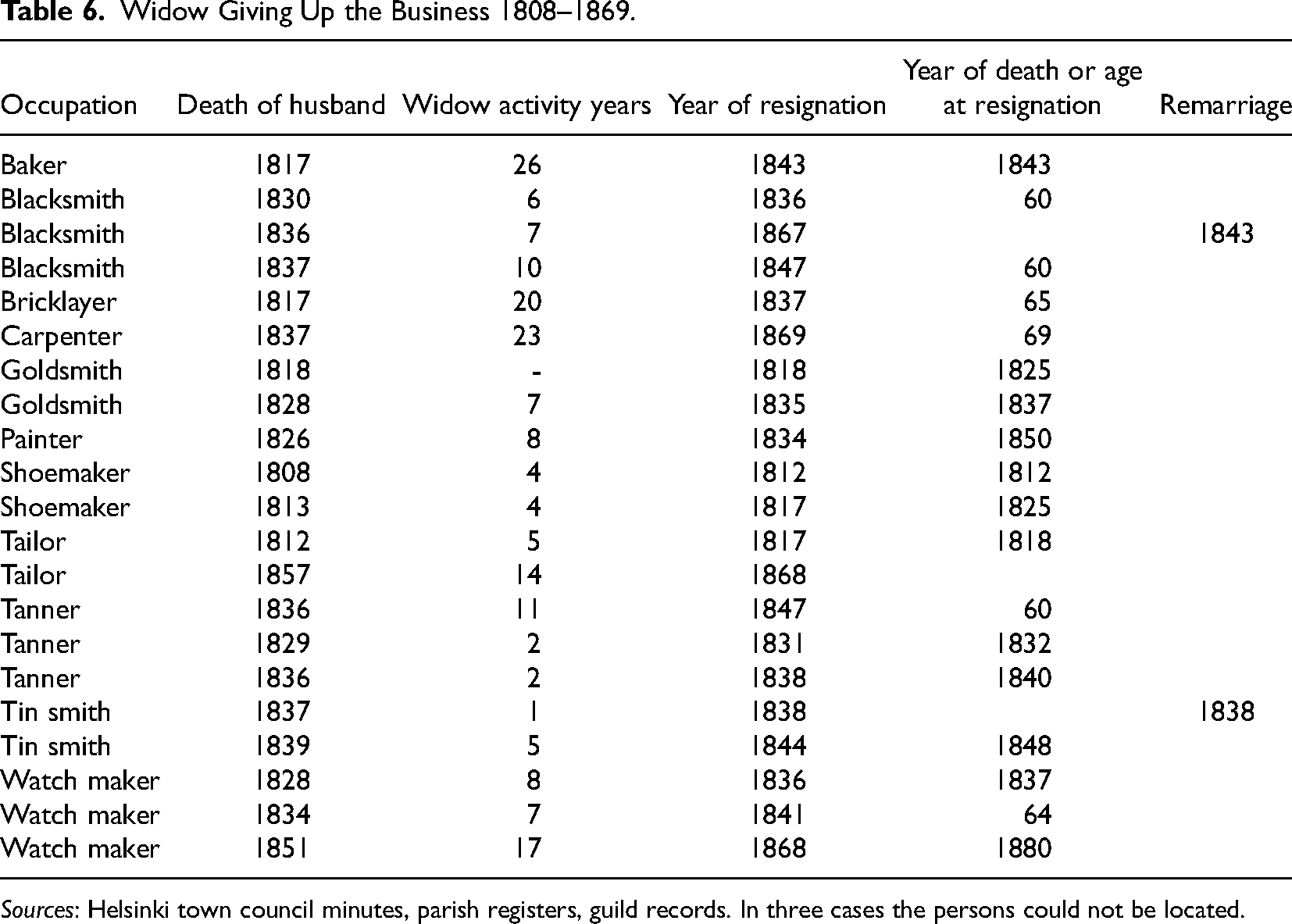
Sources: Helsinki town council minutes, parish registers, guild records. In three cases the persons could not be located.
At the top of Table 6 we find the dates for the baker's widow Hedvig Lovisa Soderstedt. She was born in Esbo (a neighboring parish) 1773, and married the master baker Johan Gustaf Palm in 1810. The first wife of Palm, Christina had died in 1809. Hedvig Lovisa was 33 years old when she married, while Johan Gustaf was 48. Two years after the marriage they had their first and only child, a daughter called Gustava Lovisa. The marriage lasted seven years and Johan Palm died 1817 at the age of 55. Hedvig Lovisa, from now on, the widow Palm, took over the bakery and ran it for 26 years. She was for a number of years the only woman paying membership to the Baker's guild. On the other hand, as many of the guild members were running businesses in other towns she was a presence in Helsinki. Her desire to expand into sugar bakery (a privilege held by her husband) and to extend her activity into the selling of alcohol did not go uncontested. She and her apprentice Joerg defended their position in 1839 and the town council minutes verify that her detractors were defeated. She continued her activity until her death at the age of 70 in 1843. At this point the minutes state that her activity as a baker is terminated because of her death. The apprentice then applied for the right to continue the work at her bakery for six months. Lovisa's household included apprentices in the 1820s, family members and maids in the 1830s. The guild records reveal that she was active and the town council minutes that she had an apprentice in 1839 and at the time of her death.
A calculation of how long widows stayed in business shows considerable variation. Some of the widows were not much younger than their husbands and left trading and life a year or two after his departure (see Table 7). When choosing the tax registers of 1830 and 1840 no attention was paid to the fact that the town was hit by cholera epidemics during these decades. 35 In a number of cases the widow running a business in 1830 was swept away by the epidemic.
Duration of Widowhood and Time in Charge of Business.
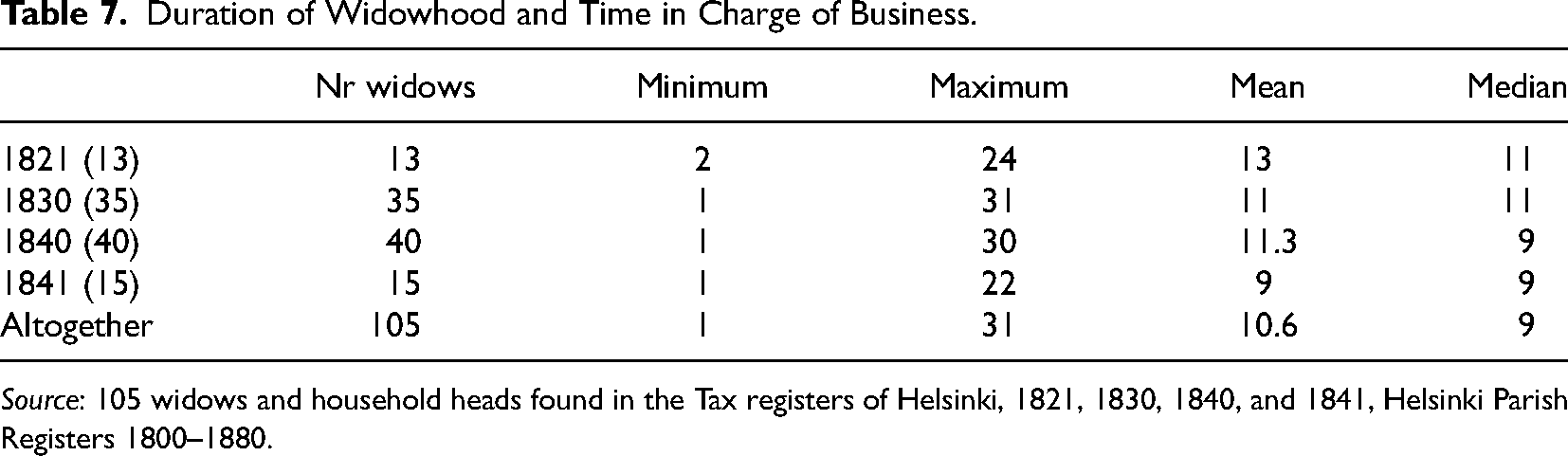
Source: 105 widows and household heads found in the Tax registers of Helsinki, 1821, 1830, 1840, and 1841, Helsinki Parish Registers 1800–1880.
Those that did not succumb tended to hold on to the business and it was not out of the question that the time at the head of the shop or craft shop lasted ten years. One-third of the widows under observation stayed in business for 15 years or more. Where guild records, tax records and parish registers can be combined we find a mean of eleven years of activity with a minimum of one year and a maximum of 31. The guild records also include information about 54 widows that do not appear in the tax records. However as some activities became free in 1859 and the guilds were abolished in 1867 no membership was paid after these years. In addition all guild accounts have not survived. The additional 54 widows extracted from the guild records demonstrate an activity period of 8.3 years on average, with a minimum of one year and a maximum of 25.
While the start could be complicated some widows made sure to keep the position they had attained. In December 1818 the merchant Jacob Reinhold Tujulin married the craftsman’s daughter Elisabeth Rosenberg, the bride was 32 years old and the groom 53. Tujulin died in May the following year and two months later their daughter Johanna was born (7 months after the wedding). The story had however even another twist. Johanna was not their first child. In 1812 Elisabeth had given birth to a girl Amalia about whom the church register has the note that she is said to be fathered by a male servant called Wagerbom. In 1814 Gustaf Reinhold was born and labeled as the illegitimate son of Elisabeth. However, when the couple finally decided to marry Jacob Reinhold Tujulin acknowledged the paternity of all the children, paid a fine to the church and the two older ones became legitimate through the marriage. We do not know why the marriage had been delayed in such a manner. The wedding, however, made Elisabeth a respectable woman and in widowhood she took over the trade of her husband which she ran for 30 years. From then and always she was called the widow Tujulin. In the 1830s and 1840s her household included, in addition to her children, servants, bookkeepers, and persons busy in the shop. She petitioned in the town council in the 1820s for the right to extend her business to include the sale of hats and was generally active until her death at the age of 71. 36
Anna Catharina Berggren and the shoemaker Gustaf Ehrman married outside Helsinki in the 1790s but by 1798 they were in town and their son Carl Gustaf was born. The mother was 21 and the father 28. In 1804 and 1809 two more sons arrived. When Anna Caisa was 39 Gustaf died and left her in charge of the children and the shoemaking craft shop. And 1821 she employed one apprentice and one trainee boy, 1830 her son could already participate but she kept on the apprentices and trainee boys through the 1830s and 1840s. We find that her payments to the guild were diligently kept up until 1850 when she died at the age of 73.
Maria Lovisa, Wikstrom and master tanner Jacob Johan Ofverstrom married in 1814. The next year the first son Johannes was born, but he died at the age of two months. In 1816 came a daughter Anna, in 1819 Maria, in 1821 Seraphina (who died 2 years old), 1825 Carolina and 1834 the last child Jacob Ferdinand. Jacob Johan died at the age of 49 in 1836 followed by the daughter Maria. The widow continued the tanning business and kept up the payments to the guild. In 1842 she had to deal with complaints in the town council about her tannery. At this point it is revealed that the unit is located on the edge of town as was generally the rule for establishments that produced stinks, refuse or dirty water. The town was in the process of cleaning up its image. Gleaming new buildings were being built in the town center and new rules were introduced to remove eyesores and smells out to the suburbs in the north, as the wind usually blew from the sea. Despite the problems she continued the business and remained a member of the tanner's guild until 1847 when she gave up the business. At this point she was in her 50s. 37
In 1809 the bricklayer Ephraim Salin applied for urban citizenship and was awarded it in 1810. By 1817 he was registered as master and burgher. Master bricklayer Ephraim Salin and the widow Anna Christina Andersson nee Sundgren married in August 1817, in October 1818 Salin died, in June 1818, eight months after his death, their daughter Maria Charlotta was born. The widow Salin took charge of the business and employed apprentices and trainee boys, in the 1820s and 1830s having no less than thirteen persons on the books. She paid her membership to the guild promptly through the 1820s and early 1830s. The last payment was made in 1834 and the same year she submitted an application to the town council to be relieved of her burgher rights and municipal taxation. At this point she was 61 years old. 38
Household and Family
An analysis of the composition of the households headed by widows engaged in crafts and trade demonstrates the presence of adult or semi adult children, and interestingly enough more often daughters than sons. Female servants were frequently found and where the business was craft oriented, apprentices, and trainee boys. Over time the number of trainee boys increased radically, particularly in the building sector, while for example the shops and restaurants were well stocked with female “servants.”
The building trade had always had a different profile from other crafts. Already in the eighteenth century the builders and bricklayers of Stockholm engaged specialist workers, called bricklayer's apprentices or assistants, for the season. While they had served a period of apprenticeship at some point, becoming a master was highly unlikely. However, some had the qualification of a master. These people lived in various locations, not with the master builder, and often had families of their own. The tax register, however, included information about which master or masters widow they worked for. 39 In Helsinki the builders had never formed a proper guild although training in the profession took place. The bricklayers had a guild, but we often find that they had people on the books that were not apprentices. In addition newcomers and entrepreneurs did sometimes engage craftsmen for projects of a fringe nature. By 1859 new rules had been introduced and the building sector released from guild control. The entry of Russian businessmen and traders was fought, in the end unsuccessfully, by the trade corporations. Trade became a more and more elastic concept. By 1840 the bricklayers’ widow Nikander ran a business with thirty-two employees, the size of the enterprise was however the same as during the life of her husband before 1831. The bricklayers widow Engberg had fifty-four persons on the books. For nearly thirty years the builders widow Lundstrom ran a business counting twenty-eight persons, some called apprentices and some trainee boys. 40
Classic crafts like shoemaking or tailoring could display households with one or two apprentices and the same number of trainee boys, whether run by the masters themselves or their widows. Blacksmiths might run more extensive operations and so did their widows. Maria Kullberg, blacksmiths widow, had three apprentices and eight trainee boys, plus two maids in her craft shop in 1821. Ulrika Forsstom, blacksmiths widow, had a head of work, four apprentices, four trainee boys and a maid in 1840. On the other hand a small shop could be run with family members only, and the few wig makers still active in the nineteenth century ran small family based units whether headed by a man or a woman. In some cases family replaced hired hands over time, as in the case of the carpenters widow Dannholm. In 1821 she had four apprentices and two trainee boys but by 1830 when her two sons had grown up she had only one apprentice and one male worker. 41
While there were examples of semi-adult sons remaining in the parental household after the death of the father this was by no means an automatic procedure (see Table 8). When the son was trained for the business like in the case of the shoemaker Soren Langhoff, the widow could still remain in charge. The eldest son Otto Alexander was apprenticed to the trade but remained an apprentice as long as his mother was alive. She paid the guild dues and headed the workshop even though he was in charge of the work and the trainees. He married during the lifetime of his mother, but only after her death did he appear with the title shoemaker. 42
Household Composition of Widows in Trade and Crafts in Helsinki 1830 and 1840.
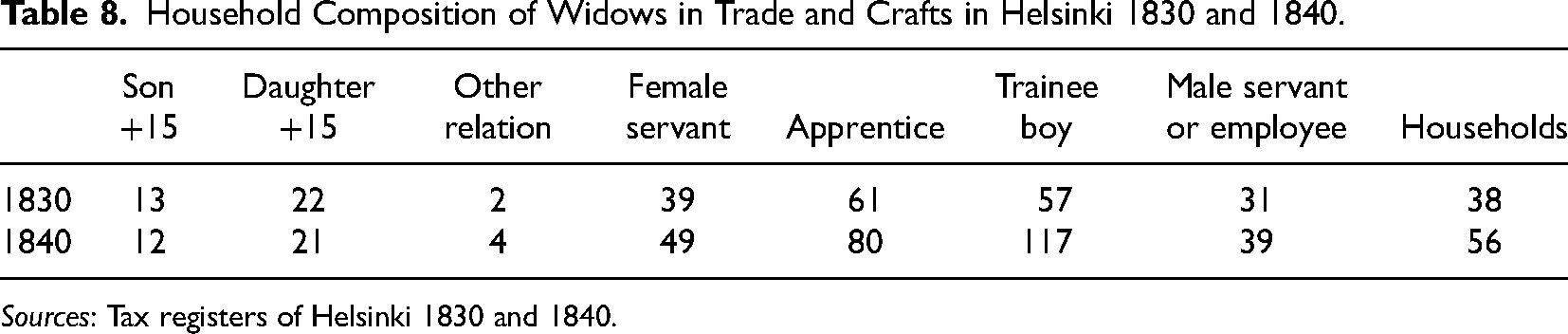
Sources: Tax registers of Helsinki 1830 and 1840.
The Russians are Coming
The town council minutes reveal an increasing inclination among Russians to settle in Helsinki in the nineteenth century. This inclination is visible among those with considerable means as well as those in more reduced circumstances. The town council minutes evidence Russian soldiers applying for the right to sell cakes in small scale and the soldiers and their wives being engaged in trade without a permit. Persons of other occupational groups also made efforts to penetrate the economy, like in metal work. The Guilds were however generally wary of outsiders and we find examples of Finns using the fact that they were of domestic origin as a point in their favor when seeking entry to a trade. 43 While the crafts were quite securely guarded, trading was a more complicated issue. The number of Russians, legally, engaging as merchants increased from twelve in 1820 to thirty-five in 1840 and forty-five in 1860, however, with the expansion of the town the Russian part of merchants had decreased to one in four by the late 1870s. The names Gratschoff and Kavaleff clearly indicate the origin of these merchants. 44
When the Russians were part of the superstructure and well equipped with money the entry was fairly simple. For example, the merchant Kiseleff bought the sugar refinery from the family of the merchant Manecke in 1812. He moved it to a new plot where it could be expanded in 1823. He also set up in other fields of high commerce. His “household” contained no less than twenty-four male workers and nine maids in 1830. Incidentally his widow Louise came to own, although not personally run, the sugar refinery from 1849 to 1864. By the 1830s the merchant Uschakoff owned brickworks and a tile company and employed four book keepers, three shop assistants, twenty-four male workers and four maids. 45 The most prominent families united themselves with local gentry and the second generation was firmly integrated into Helsinki society. In 1849 the son of the above mentioned Kiseleff, Feodor, titled merchant in export and import, married Amalia Matilda Gustava Matheitzen, daughter of a landowner, the groom was orthodox and the bride Lutheran. 46
According to Russian mercantile legislation spouses could hold separate property and a widow had the right to continue the business of her husband. 47 By 1840 the number of widows engaged in shop keeping in Helsinki had expanded with a set of Russian ladies, the widows Klementjeff, Forashoff, Komaroff, and Korostileff. While the three first ones ran relatively small shops with the aid of family members and one or two employees, the widow Maria Korostileff operated on a larger scale. Although describing herself a merchant, her “trading household” of 1840 included, in addition to “servants,” a number of stone masons, assorted male workers and their family members (twenty-nine persons). 48 Her husband, although registered as a merchant, had been engaged in a number of large building projects in the town. When he died the business was not in order and the widow had to declare it bankrupt and sell house property in the central part of town to satisfy the creditors. After this, she conducted her business on a more moderate scale and concentrated on running a shop. In the 1860s she applied to the town council for the restitution of the burghers’ rights that had lapsed at the death of her husband in the late 1830s. Her application was successful as she continued trading until 1874. 49
One of the most famous Russian families that became an integrated part of town life was the Sinebrychoff. In 1812 a brewery was started on the fortress island of Sveaborg to cater for the needs of the garrison and the people working there. The project was a success and the activity was soon expanded into the town proper. By the time when the son Paul took over, the Sinebrychoff brewery and alcohol factory had a considerable presence in the south west. Paul Sinebrychoff expanded the factory area and came to own a sizeable part of the town. When he died in 1883 he willed the whole property to his widow Anna. She took control of the business comprising a brewery and a factory of spirits with about 1500 employees. The company also controlled not only the area where the factory was situated, but also a series of properties with company housing. She saw to the creation of a limited company of which she held the absolute majority of shares. She collaborated with one of her sons and her son in law successfully for thirty years. She also outmaneuvered her older son and ended up paying him an allowance while gradually taking over all his shares and still remained a creditor for his family after his death. During her time as chair on the company board the beer production expanded with a million liters per year. Deals were struck with restaurants in town for the exclusive serving of Sinebrychoff beer. The factory for strong spirits was sold as the political climate shifted against hard drink. New machines were bought for the brewery, the company prospered and profits tripled. Her personal assets also doubled. All the while the company still maintained the company pension system and the company hospital. When she died she left one of the largest property, business and private asset portfolios that the town of Helsinki had ever seen. 50
While the Kiseleffs and the Sinebrychoffs were visible examples of successful entrepreneurship by persons of external origin, the economic life never became dominated by Russian families or money. The factory owners and owners of big or middle sized businesses were mainly of domestic origin with a variable proportion of persons from Sweden and some from German speaking parts of Europe. 51
Conclusion
While the issue of whether women were actually working in the past has been fairly conclusively proved, the question whether a woman had to function in the background or if she could hold a position of authority, have agency and impact as a business owner in the local economy is still to some extent up for debate.
Although undoubtedly the ideologies presented by Davidoff and Hall were correct as to middle class nineteenth century attitudes. We are left with the question of theory and practice.
Issues like restricting female work and going as far as banning the work of married women in late nineteenth century Europe, almost exactly when they finally had gained access to education, enhanced the view that role of a woman was domestic. 52 Despite this, the past twenty years have seen an increasing number of studies demonstrating female business activity in the nineteenth century.
The Nordic countries have had a tendency of attempting to profile themselves as a region belonging to the avant-garde of female emancipation. In Finland the fact of being the first country in Europe where women gained the vote has been a source of pride.
Although it was the case, that while a husband was alive the productive input of the wife in towns as in the countryside remained mainly in the background, the widow emerged on the arena openly and in her own right.
As the administrative system in the town of Helsinki required a person to renounce trading rights officially, it has been possible to verify that the widows in this study were actually trading. The study has also demonstrated that at the death of a craftsman or a merchant, the widow took the business in hand. While some, for reasons of health and age, did not continue the management for long, those who did not suffer from these problems tended to run the business for ten years or more. When examining the life course of these widows, examples have been found of women being active in their 70s and even 80s. Occasionally family members assisted in the work and there are examples of gradual easing in of sons, but this was far from the standard development. In actual fact we find more adult and semi-adult daughters than sons in the households.
The businesses of widows varied from craft shops to retail of various types, and even to running factories. Running meant having functioning economic enterprises. Depending on the work in hand, the people in their employ could be male or female, young or older. However, the fact that widows not only employed workmen, apprentices and trainee boys, ran brickworks and building sites, but also petitioned in the town council, is clear evidence that their role was far from domestic. The idea that a widow would quickly marry an apprentice who would take over the work has been proved false. The majority did not remarry. Remarriage would have affected their position of economic independence and authority.
Agency is perhaps not a matter easily measured in historical populations. However, it is possible, as this article has demonstrated, to measure engagement in commerce. Data recording the holding of trading rights, guild membership, and information showing that these widows were employers clearly demonstrate that they did not operate in the domestic but the public sphere.
Footnotes
Consent for Publication
All the tables etc. have been generated by the author based on data available in public archives. No material subject to copyright has been included.
Declaration of Conflicting Interests
The author declared no potential conflicts of interest with respect to the research, authorship, and/or publication of this article.
Ethical Considerations
The study is purely historical and does not involve any person that has been dead less than 100 years.
Funding
The author received no financial support for the research, authorship, and/or publication of this article.
