




Abstract
This paper uses convent archive sources from five Irish Sisters of Mercy run industrial schools to examine the role of children's families at committal to the schools and explore how the sociocultural climate of Ireland at the time formed this experience. Such an analysis sheds light on the system's operation ‘from below’ and the variety of reasons, motivations, and emotions surrounding the committal process. It reveals the complicated nature of familial relations and facilitates a greater understanding of the behaviours, responses and protocols that arose from poverty and dependency. In doing so, it also progresses understandings of the power of those in control to influence such decisions as well as families' attempts to use the system as a strategy for survival.
Introduction
In 1903, six-year-old Arthur L was committed from the workhouse to Cappoquin industrial school in Co Waterford. 1 According to the workhouse official, he was illegitimate, and his mother's people were ‘very respectable and when they found out about the boy she was ordered away’. 2 Illegitimate pregnancy within a family could present a serious challenge to both economic safety and aspirations towards the respectability of the middle classes. 3 Ten years after her banishment Arthur's mother wrote from the County Asylum in Lancaster, the prospect of Arthur's release from the industrial school, now that he was approaching the age of sixteen, apparently weighing heavily on her mind. ‘I have nowhere for him and nothing for him … it is such a trouble on my mind that sometimes I do not know what I shall do’. 4 Despite the length of children's committal to the schools and the obstacles to family bonds that could exist, the surviving archives frequently demonstrate that connection with family could be maintained. Although the voices of those who used such institutions are frequently recounted through the lens of those in positions of power, such accounts still provide us with rare access to the families perspectives on, and responses to, both poverty and separation. Even in the absence of contact and after many years of separation mothers could still attempt to oversee the welfare of their children and the feelings and emotions for them could remain strong.
Shared responsibilities and obligations also frequently persisted however and Arthur's years of training within the industrial school meant that on his release from the institution, he would be in a position to enter waged employment. If a suitable position could be found for him, he could then support his mother who claimed she had ‘always paid for him’ despite her strained circumstances. Recognition by the family of a young person's potential to earn and support needy or ageing relatives upon leaving the institution highlights the braided connection that could exist between attachment and economy. The relinquishing of a child to an institution under familial and societal pressure was frequently understood as an act of love and sacrifice and could be driven by a belief that it would offer the child a better, happier, and more advantageous upbringing. Even so, parents were often unwilling to give up their children forever and the economic responsibilities and obligations that could be passed to children when they became old enough to earn could also continue to act as a bond of attachment with family.
The introduction of the industrial school system to Ireland in 1868 had marked an amalgamation of state and charitable funding for destitute and orphaned children and the schools were run by both Catholic and Protestant religious orders. The growth in power of the Catholic church during that time and its increasing role in institutional welfare placed it in a prominent role for the establishment of Catholic-run schools. Children between the ages of 6 and 14 years of age were accepted, and they could be detained up to the age of 16 years. Initially, the system had two main aims. Firstly, it was to provide skills and training to enable children to be self-sufficient on leaving the school and to provide them with the means of making an honest living. Secondly, it was to mould the characters of the children ensuring that they became law-abiding citizens protected from poverty and crime. 5 They were to be ‘rendered self-reliant, laborious and capable of self-control’. 6 Thus, as well as providing humanitarian relief an important aim of the industrial school system was the attempt to achieve a process of socialisation and moral regeneration of the children.
From the beginning, the trend of admissions to the schools ensured that they did not evolve as penal or corrective institutions for children of doubtful or criminal character but instead became a refuge for destitute and deserted children from mainly respectable, if poverty-stricken, backgrounds. 7 Many existing Catholic orphanages applied to be certified as industrial schools and the number grew rapidly with a total of sixty-two Catholic and seven Protestant industrial schools in existence by 1902. 8 . By the end of the century, the schools had surpassed the Irish poor law workhouse system as the main repository for orphaned and destitute children. 9 They continued as the chief form of state childcare until the Kennedy Report of 1970 which recommended an end to the system, and there followed a gradual reduction and transition to the system of group homes until their final closure in 1984. 10
Although there may have been both similarities and differences in the experiences of Protestant children within the system this paper focuses on Catholic-run schools, in particular those run by the order of the Sisters of Mercy. It analyses the convent archive sources from five Sister of Mercy-run industrial schools between 1868 and 1936, allowing us to look more closely at the role and agency of the family at the committal of their children to the schools. 11 It is an intimate and focused case study which allows for a rich seam of exploration. 12 Such an analysis facilitates a greater understanding of the behaviours, responses and protocols that arose from poverty and dependency and reveals the often complicated nature of familial relations.
The order of the Sisters of Mercy was founded in the 1830s by Catherine McAuley, a woman committed to the service of the poor, and the order also undertook to work for the care of the sick and the education of poor girls. They became one of the largest and most prominent administrators of industrial schools in Ireland running two-thirds of all schools and consistently accommodating about sixty per cent of girls and forty per cent of all residents, while at its height they operated over thirty schools. 13 Within the system as a whole by 1902, forty-eight of the sixty-nine industrial schools established in Ireland catered for girls, 14 and it was the determined efforts by religious orders of nuns, in particular the Sisters of Mercy, that resulted in their domination in establishing the schools. 15 Their main preference was to run girls’ schools but they also ran four schools for junior boys, and so this research includes four schools for girls and one for junior boys with the schools being located in Kinsale, Dundalk, Newtownforbes, Ennis and Cappoquin. The schools have been chosen for their geographical, gender and archival content spread and are a good example of those with relatively substantial surviving sources while also including a spread of different geographical locations (Figure 1). 16
Narrowing the exploratory frame to these five schools allows a particular exploration of the evidence of experience along the grain 17 and an interpretation of what it was like in context. 18 This study uses a combination of sources including personal correspondence and institutional school managers’ diaries, along with school registers, parliamentary records, newspapers and contemporary reports to illuminate the lived experience of the schools. The use of such qualitative convent sources provides an in-depth analysis of the workings of the schools as well as revealing the interaction of family and society with these institutions. The five schools therefore act as a prism that opens up a better understanding of the workings within the institutional system of the schools as well as experiences of and responses to poverty and attempts at reform.
Despite the frequent survival of children's relatives, their involvement within the system at this time have been little discussed. The families of industrial school children have been described by Caitríona Clear as ‘the hidden half of the history of nineteenth-century children's institutions’, which she notes were often ‘a lot less shadowy and passive than the official reports implied’. 19 Sources related to parents within the archives offers a valuable and nuanced narrative of the reasons behind the surrender or removal of a child from the family, and although there were few typical circumstances of children's committal, it is possible to show how representative individual stories were. The interactions with family at children's committal to the schools allow an analysis of, as Peter Mandler has termed, the ‘site of encounter’, and can reveal how such events were negotiated and contested at a local level, the nature of family relationships, and how power was exercised within the system. 20 An examination of family backgrounds also allows a deeper understanding of how and why the schools were used and the social, class and gender influences that affected their operation. Placing children in care could frequently be crucial in enabling families to survive during times of economic hardship and this article uncovers the narratives embedded in internal institutional records that represent the previously unheard voices of poor parents. In doing so it reveals valuable insights into the negotiations, motivations, and feelings that surrounded the committal process as well as the lives of the poor and the challenges they faced.
Committal Process
The official reason which qualified a child for committal by a magistrate's court to an industrial school was included in their court order form, and usually confirmed their destitute and needy status. It could include being ‘found wandering without any home or settled place of abode, or proper guardianship, or visible means of subsistence’, for being ‘found destitute, being an orphan’ or ‘being found residing with prostitutes or thieves’. A common reason for committal was also the act of begging and from the initial establishment of the schools the highest proportion of children were committed for this crime. 21 As the industrial schools were aligned with the prison system mere destitution did not suffice, and instead, a child had to be charged with a specified offence. 22 In the nineteenth century such ‘valid reasons’ for committal often merely served to facilitate the bureaucratic requirements of the penal courts and prison system. The true factors influencing committals were often numerous, complex, and multi-layered, and a charge of begging or lack of guardianship only touched the surface of the myriad of deeper reasons why parents felt either compelled to give up their children or why society felt it beneficial or necessary to commit children to industrial schools. Reflecting the changing nature of childhood and the growing intervention of the state in family life, the 1908 Children Act, and later the 1926 Schools Attendance Act and the 1929 Children Act, saw an expansion in the categories of children who could be committed to industrial schools and strengthened the grounds for committal. There were now numerous situations in which children could be sent to industrial schools including destitution, children whose parents were unable to control them, children who gave trouble in workhouses and children who were persistent truants and in general there were, over time, very few instances in which a child could not be sent to an industrial school. 23
The actual process involved an application to the local magistrates’ petty sessions court. Children would usually appear before a judge, and a witness who had made the application for committal would give evidence. 24 The witness for the case could be a local parish priest or constable, or later the local inspector from the NSPCC. 25 Although a parent (or guardian) was required by law to be present, and mothers frequently appeared before the court, with no legal representation for the children themselves the evidence given to commit a child was rarely contested. If a vacancy was available a sentence would be handed down (usually until a child's sixteenth birthday) and an order would be made to commit the child to an industrial school. 26 Advance preparations were usually required to secure an available place – ‘settling it all beforehand’, often petitioned by a local priest or other interested individuals, or sometimes directly by a parent. 27 Agnes H wrote a pleading letter from inside the workhouse to the Reverend Mother of Cappoquin, ‘my little boys ages are Martin 6 years and John 7 years and they have a very bad father. I trust in God and your holy mother to do something for them’. 28 Other requests could be confirmed at the last minute – ‘The magistrates will decide the case tomorrow and hence I have enclosed six stamps that you may send a reply by telegram’ wrote Fr James O’Leary from Kinsale in Co Cork to the Reverend Mother – his anxiety apparently fuelled by an offer of local Protestants to take the child in question. 29
The early years of the system saw many attempts at illegal committals, instigated by the religious orders as well as by the magistrates and the public, where cases did not meet the criteria laid down by the industrial school legislation. 30 Often this would result in the committal process having to be repeated and the committal error ‘corrected’ in order to ensure access. ‘The order of detention must show on its face a valid reason’ wrote the schools’ inspector John Lentaigne on his refusal to admit the two daughters of a destitute widow to Kinsale industrial school. 31 He complained how both magistrates and school managers failed to understand that ‘destitution, no matter how great, is not sufficient reason for the admission of the child’. 32 The Cussen Report was produced in 1936 as a result of the first investigative commission into the industrial school system. It stated that the system had initially been ‘imperfectly understood’ but those on the ground soon became attuned to the state processes. 33 A close analysis of the system in Ireland reveals that ways were often found to circumvent the committal requirements and enable the system to be used as a means of poverty relief and assistance rather than of crime prevention.
In reality, the charge stated on a court order form and the official statistics gathered regarding committals barely scratched the surface of the complex motivations, emotions and variety of circumstances that accompanied each sentence to an industrial school. A division of such circumstances can be attempted between family trauma – which included parental death and desertion, unemployment, sickness, imprisonment, and violence – and family strategy which included emigration, training and temporal relief. However, in many cases, these categories bleed into one another and were affected by exogenous pressures, so that it was not usually one cause but an overlapping multitude of the above which determined if a child would be sent to an industrial school. The influence of other people also greatly impacted the decision, both the intervention of local clergy and other religious workers, philanthropic gentry, social workers, and also wider family and relations. By attempting to reconstruct the backgrounds of institutionalised children and the survival strategies of their families as well as how poor families interacted with those in power, we can gain insights into the lived experiences that led to the committal of their children to the schools.
Parental Death and Desertion
During the late nineteenth century, many middle-class philanthropists and reformers portrayed destitute children within the public and private institutional systems as being either orphaned or deserted by their families.
34
The misconception that the majority of children in industrial schools were orphans persisted, but although many schools had origins as orphanages and often continued to be referred to as such, a study of the records demonstrates this was not the case. According to the Register for Children in Ennis industrial school in Co Clare only one in five of the children who entered the school between 1880 and 1911 were in fact orphans.
35
It must be taken into account that at that time children were often considered ‘orphans’ if they had one surviving parent or had been abandoned by their family or were forced out into the world because of overcrowding in the home.
36
Despite this, on the introduction of the industrial school system, the destitute orphan was viewed as a most deserving and beneficial recipient of the care and training such a system provided and being a destitute orphan without adult supervision automatically qualified a child for committal. Often a child who had lost both parents would be sent to live with extended family or friends, but where this proved unsustainable an intervention could be made. An orphan in Cappoquin had previously been under the care of his Aunt and Uncle although as his interventionist wrote ‘they had several children of their own, therefore this poor child was half starved – not through unkindness but through want’.
37
A network of philanthropic religious communities provided highly regarded local contacts and a means of identifying children that were judged to be in particular need. A convent in Westport wrote to request that the industrial school in Cappoquin admit a young orphan boy from a local family: … I have seen these creatures in their saddest plights and at the death of both father and mother and truly indeed these were scenes I hope never to witness again … the poor sister said to me today ‘if we knew were the nuns in Cappoquin nice we’d be satisfied’. Well I said are the nuns here nice? ‘Yes’ she said – then the Sisters there are nicer I replied, and she was content.
38
Although relayed through the lens of those in a position of power, the preservation of the dialogue that took place between the children and the nuns demonstrates the protective role the religious orders could play in certain situations. But it also highlights the uncertain relationship that could exist between ‘victim’ and ‘rescuer’ as well as the vulnerability and fears of orphaned children.
An orphan could have extended family who were not responsible under law for maintenance and more complex family reasons often accompanied a committal. Four-year-old Newry R and his seven-year-old sister were orphaned in 1895 and committed to industrial schools. Their father had been a prominent solicitor from Charleville in Cork who had given up his business to his older son and had gone to live in Dublin where ‘to the great amazement of everyone he married someone far beneath him in position’. The mortgaging of his assets had meant that on his death his two young children from his second marriage had been left ‘utterly unprovided for’ with many of his first family believing that their ‘their poor little step relations [had] no right almost to be in the world at all’. Although they complained that he was ‘a great expense’ to them, his relations paid for Newry until he reached the age of 6, after which he was eligible for the state capitation.
39
The Reverend Mother of Cappoquin industrial school received many requests, such as the following, for the committal of underage orphans: I am writing because a very respectable women called in yesterday asking me to know could you receive two little boys aged 3 and 4. Very healthy and strong, orphans both parents’ dead. Her husband is their uncle – she would get them committed and also pay £1 monthly for both until they are 6 years of age (10/s each monthly) – in the meantime you will get 2/ Co Council grant now for underage children.
40
Relations were not under an obligation to keep orphaned children, and many believed that to be in an industrial school under the care of the religious orders was the best place for them. For children aged six and over, financial responsibility for their maintenance was the responsibility of the treasury, with an additional optional contribution from the local authorities, and a legally liable contribution from parents ‘if of sufficient ability’ to a maximum of five shillings a week. 41 Parental contributions were to remain very low throughout the nineteenth century and accounted for only a very small proportion of the total costs of the schools. 42 Many parents did not pay any contribution simply because they did not have the means to do so. The first mention of parental contributions in the account books for Ennis Industrial School are in 1912 when a total of £0.7 s.7d and £0.17 s.1d was paid. 43 Nevertheless, the requirement of the parental contribution, except in cases of extreme poverty, remained vital as a symbol of parents’ responsibility and a means of control, as well as an attempt to prevent what was sometimes viewed as state dependency and child abandonment.
Although orphans made up a significant proportion of the industrial school population the largest classification was of children who had one parent only, often a widow or widower, and the death of a parent was certainly a common cause of hardship. The 1835 Poor Inquiry Report noted that: it was only necessary that the father of a family among the labouring classes should die, in order that his children should be reduced to a state of destitution fully equal to that of an infant deserted by its parents; so much so, that children whose mothers alone survive, are always considered and styled orphans.
44
The absence of a comprehensive state or church-organised relief system in pre-Famine Ireland meant that in situations where a parent had died or was ill, it was to family and neighbours that people traditional turned. The introduction of the poor law system in 1834 and the provision of a network of workhouses provided an alternative to the dependency on extended family. The previous introduction of a nationwide asylum system in Ireland from 1817, and the later 1845 Lunacy Act, had also established a culture of public asylum confinement which made it easier to commit family members. 45 However complex family forms remained better equipped to shield their members from hardship than was the nuclear family that depended more over time on the collectivity such as charitable church organisations and the state. 46 It appears from the registers that among the families that used the industrial schools there was a high proportion residing in simple family households, mainly widows and widowers with children. An examination of the Register of Children for Ennis industrial school reveals that 58% of the girls committed to the school between 1880 and 1907 had one parent only. 47
The most common trajectory evident within the industrial school registers was of a single mother turning to welfare services as the result of extreme poverty, illness or the death of a spouse, and while people could be more susceptible to poverty at certain vulnerable phases of their life cycle this was also highly gendered. 48 Throughout the nineteenth and into the twentieth century, widows, who made up on average ten per cent of the adult female population, received particular attention from philanthropists. 49 The Sisters of Mercy in their work as parish sisters involved in schooling and visitations would have been aware of and in contact with many of those in particular need of assistance. Widows, particularly if they had dependent children, were especially at risk of destitution compared to married women and without the possibility of a spouse's income and with children to care for, they were at a particular disadvantage. 50 Valerie Fildes has demonstrated how an examination of English parish registers reveals that the most common reasons for relinquishing a child were widowhood and desertion by the husband, both resulting in a mother's poverty and inability to support the child. 51 On the death (or desertion) of their husband, working-class women could find themselves in a precarious financial situation which drove many into working life and low-paid employment. 52 Such employment could usually not, on its own, provide sufficient income for the breadwinner of a family 53 and would have to be supplemented with assistance from charity and the Poor Law Union. 54
Although by the 1850s, widows with small children could apply for relief in their own homes and attempt to avoid entering the workhouse, outdoor relief was considered to be against the spirit of the Poor Law 55 and a reading of the industrial school registers demonstrates that economic reasons were paramount in the decision of parents (if indeed it was their decision) to give up their children. Where an occupation is recorded for widows within the industrial schools’ registers, a high proportion are listed in occupations such as washing, needleworking or street selling, or as charwomen which Ciarán McCabe has demonstrated was the most poorly paid occupation among the unskilled labouring classes. 56 In order to char, for example, women were required to leave their home, often being gone from early in the morning until the evening. If they had young children, they might be left with family members or with neighbours.
The widowed mother of Aileen M was described by the manager of Dundalk industrial school in Co Louth as ‘a fragile little creature out every day trying to earn a living whilst the poor little children were left utterly neglected’. 57 The McGuire family in Cork lasted twelve months after the death of their father before it was reported that ‘suddenly the mother had to give up her little plot of land and is now very poor’, and the two McGuire girls, aged 10 and 8, were forced to enter Kinsale industrial school. 58 Crossman has emphasised the reluctance of families to enter the workhouse – such an action being seen within the Catholic culture as an admission of failure but also of unworthiness, while the industrial schools under the control of the religious orders offered an alternative solution. 59 Such a solution however was often a substitution for adequate financial assistance and could result in the long-term splitting up of families and the institutionalisation of children.
Sometimes following the death of a husband, a family's situation would come to the attention of a local priest or another prominent figure, and they would be reported as having ‘assisted’ in arranging a child's committal. Determining the agency of the family in such a situation is difficult. 60 Industrial school places were hard to come by in the early decades of the system and while poor parents in the desperation of poverty may have acceded to and even welcomed such intervention it must also be viewed in light of the lack of other viable welfare options and the imbalance of power, and in many cases gender differentials, which existed between the giver and receiver of assistance. 61 In September of 1893 Father Fox carried out what was reported as ‘a real act of charity’ in Dundalk courthouse by getting two sets of sisters, Kath and Ellen M and Mary and Ellen D, all described as being ‘in a terrible way’, committed to the local industrial school. 62 Twelve and six-year-old Kate and Ellen's widowed mother had worked as a charwoman – she was described as being of ‘very indifferent character’ and allowing her children to ‘wander about’ while eight and six-year-old Mary and Ellen's mother and deserted father had a character description in the school register of ‘could not be worse’. 63 The not uncommon depiction and view of destitute families as ‘bad’ justified and aided the committal of their children to industrial schools and evidence given to the Aberdare Commission of enquiry into the schools in 1884 demonstrates that school managers saw the committal of destitute children as a means of saving them from lives of poverty and, in some cases, immorality. 64
During the nineteenth and into the twentieth century ‘the cruel contamination of relentless proselytism’ 65 was also seen as a very real threat and charitable agencies were in fierce competition for saving the souls of children. Maria Luddy in her work on women and philanthropy in nineteenth-century Ireland has discussed how sectarianism dominated women's philanthropic activity and Catholics sought to create a network of charitable services, in part to counter Protestant proselytisation. 66 Margaret H, possibly under the prompting of her parish priest Fr Columba, wrote in 1879 to thank the sisters in Newtownforbes in Co Longford for accepting her five-year-old daughter Mary Bridget following the death of her husband. The child was under the normal age of admission so would have had to be either privately funded or taken on as a charity case. The original plea had included the added urgency of the risk of proselytisation of the child which no doubt was a factor in a committal. Margaret wrote how, ‘It gives great relief to my mind as I had no other option only to go to the workhouse or to go home and that was all that was on her poor dying fathers mind for he knew that if I had to go home with the child she would be brought up a protestant’. 67
Poorer families were most in need when burdened with small children and recipients of charity would need to work themselves into the positions desired by those in power. Although we cannot know all the details of her circumstances, or the extent of forceful persuasion exerted by her parish priest, by casting herself in the role of protector of the faith of her child Mrs H ensured the sympathy of the sisters and the committal of her child to the school. In addition, the threat of a destitute child being ‘taken up by the Protestant sector’ or ‘given to some Protestant House’ by a mother who appeared ‘anxious to get rid of it’ was a sure way of adding urgency to a case and ensuring that a place could be secured before it was finalised by the magistrates. 68 As Earner-Byrne has explored in her study of letters of the Catholic poor, the understanding and negotiation of the existing power structures that confined people are visible in the ways in which they were forced to beg and bargain both their lives and those of their children. 69
Remarriage could change the dynamic of the family and lead to new priorities and loyalties. There were allegations in society that some parents were anxious to get rid of their children so that they might be free to marry again. Although female rates of remarriage in Ireland were lower than that of male, for a poor widow whose only recourse was to enter the workhouse with her children, remarriage could be an attractive option for survival. A new stepparent might not always be accommodating towards existing offspring however and if resources were stretched support for stepchildren might be grudging at best and non-existent at worst. Four and six-year-old Thomas and David C, described by the nuns as ‘great pets’ were committed to Cappoquin industrial school when their father died, and their mother remarried and left the country. 70 Although remarriage may have led to the dissolution of the existing family in some instances, in others remarriage was used as a way of reuniting parents with their offspring, and children could be reclaimed from the schools on proof that a house and support had been provided. 71
Towards the end of the nineteenth century, there was increased recognition of the necessity for widowed mothers with little support to leave their homes to work in order to provide for their families
72
and this led to a change in attitude among middle-class social reformers.
73
Following the refusal of a number of committals due to incorrect wording on the court order forms, the manager of Kinsale industrial school wrote a long and pleading letter to the inspector John Lentaigne in which she argued that: It frequently happens that a widow left quite destitute with young children must go to service at a distance from them, her small wages will not enable her to provide safe or ‘proper guardianship’ for them, they will not be admitted even into the workhouse without her, they are left to their own resources perhaps half starving – what is likely to follow but that they will supply their wants by begging or stealing or both.
74
Despite the class-power relations that existed within the schools and the relatively privileged backgrounds from which the female religious orders were drawn, their subordinate gender in society could mean that they would possess a certain sympathy for the lives and circumstances of poor women. 75 After the War of Independence between Irish and British forces, and the creation of the Irish Free State in 1922, outdoor relief for widows was changed to Home Assistance. 76 As poor relief by another name however, it continued to be inadequate and could only be looked upon ‘as a supplement to other means or to what can be got by begging and from charitable sources … and that in many cases it is altogether inadequate to provide the necessaries of life’. 77 Widows were still frequently faced with using the institutional system as a backup and a drastic form of childcare. It was eventually the institutionalisation of fatherless children that prompted the outcry for some form of assistance for poor widows and ultimately meant the pension introduced in 1933 would be dependent on a widow's motherhood. 78
Although the chief breadwinner in the family was frequently male, death of a mother could also result in the committal of children to an industrial school. Early maternal death could often leave a husband as the sole guardian of several small children. In many cases, the undocumented result of this would be the distribution of children to other family members and there is ample evidence to indicate that in times of need people did form surrogate families through a network of aunts, uncles, celibate siblings and fosterage. 79 In cases where family care was not possible then motherless children, if they were poor and left without any obvious supervision, were viewed as appropriate cases for committal. The parish priest from Gorey in Co Wexford wrote to the Rev. Mother in Cappoquin industrial school looking to secure places in the school in advance of the local petty sessions. He notified her how, ‘We have in this parish three motherless children in a very destitute state, their father having only 4 s per week and his support … they are poorly clad – running about barefoot without any teaching or supervision’. 80 As was often the case when the upper or middle classes interpreted the lives of the poor their plight was deduced not by listening to voices but by observing bodies. Clothing was a critical indicator of poverty and judgements based on appearance and how children were dressed played a vital role in determining the need for their relief. 81 Also, the introduction of compulsory schooling in 1892 meant that children who did not attend would come to the attention of the public and could be viewed as objects of neglect. 82
There was an expectation in society that widowed men would be unable to mind children and if they were employed would not be available to care for young children. The desire to get motherless children into charitable institutions like industrial schools could often be shared by the father who would then justifiably be removed from the burden of caring for them. The widowed father of Elizabeth and Bridget M had paid 2/6 for a committal order for the girls and was described as ‘most unhappy for fear there would be any hitch’. It was claimed that ‘the poor man is most anxious to get them settled’ and his daughters were described as also ‘most anxious to go’ and ‘delighted at the idea’ of entering the industrial school. Although difficult from a modern standpoint, it is worth considering such emotional declarations at face value – the archived correspondence surrounding the case also documents how the girls’ mother on her death bed extracted a promise from her husband's employer that she would get the girls into a convent. 83 For some, there was great value and comfort in knowing that their children would be cared for by the religious orders who ran the schools. The parental feelings of relief and gratitude on securing a valued place in what were often full or oversubscribed industrial schools could also be passed on to their children. Destitute families could welcome and accept such intervention as an immediate form of charity and an acceptable form of family survival where their children would be under the ‘kind care’ and training of the nuns although parents, including fathers, could feel the parting very much. Brothers Mick, Pa and four-year-old Syd D lost their mother suddenly in June of 1903. On their voluntary committal to Cappoquin two months later it was reported that ‘their poor father seemed very sad and broken-hearted at the heavy trial and felt very much parting with the boys’. 84
While fathers could be viewed with sympathy, more often destitute widowed fathers were portrayed as ‘wretched’ and ‘savage’ and their children as ‘sadly neglected’. 85 The treatment of widowers or deserted fathers reflected dominant gender assumptions of the time and men were often treated with suspicion. Buckley when looking at cases in the files of the NSPCC involving widowers has noted two apparent issues: ‘a mistrust of fathers being left with daughters, and the related problematisation of the absence of a woman in the home’. 86 In some cases neglect of children, no doubt took place although such a portrayal also served to justify what was seen as the charitable removal of children to the safety of an industrial school. The fear of incest, especially in families where a mother had died or deserted, although not spoken of directly in the convent archive sources, was nonetheless a hidden issue.
It was not only death that deprived children of parental support. Often one or both parents were reported as having deserted their children. The word desertion conjures up the image of a heartless parent leaving their child although in many cases desertion was not dissimilar to the seemingly more controlled emigration. Family dissolution was a survival strategy and, as Crossman has attested to, couples frequently split up, and split their children up.
87
A deserted wife would be in a better position to receive assistance, and her children would be more readily accepted into an industrial school. This was also the case with the workhouse system as Crossman has pointed out: women with young children were rarely refused admission to the workhouse unless they were married, and their husband was known to be living locally. However, they had to be careful about the reason they gave for needing relief. It was necessary to present as deserted, even if this was not strictly true. Marriage breakdown was not an adequate reason and was likely to prompt a refusal.
88
Although children were not strictly supposed to be kept in the workhouse if a parent would not go in with them, within the industrial school system parents could leave their children while they attempted to find work outside. Often a father would be reported as having deserted his children following the death of his wife, such as in the case of one young boy admitted to Cappoquin after it was reported that his ‘uncivilised’ father had ‘fled at the hour of midnight to a foreign land’. 89 This would qualify the children more readily for committal to an industrial school as they would be classified as being without guardianship.
But reasons for desertion were not always self-sacrificing and could be complex. The exclusion of Ireland from the 1857 Divorce and Matrimonial Causes Act as well as restrictions related to class and gender often led to divorce in practice rather than in law, whereby desertion or agreed separation by means of migration could provide a solution of sorts to the problem of unhappy marriages.
90
The connection between desertion and domestic child abuse and neglect also existed although this was often viewed as a problem associated only with the poor.
91
As shown desertion was not just the prerogative of fathers but could also apply to mothers. Katie Barclay has explored how a mother's abandonment of her child should not be viewed as proof of an absence of love. She proffers that it: might be more fruitful to think of love as something offered in degrees, as a social and cultural practice that was highly contextual and situational, and that its situatedness meant that the experience of love could vary enormously across individuals, shaped by their social, cultural and temporal positioning.
92
Love and concern for children's well-being could act as a basis for committal to the schools. Margaret C was widowed and reported as deserted to America in 1907 leaving her five young daughters ranging in age from 2 to 13 to be committed to Dundalk industrial school. The girls stayed in the school until they each reached the age of 16 – the eldest joining her mother in America and the others entering domestic service positions locally. Surviving correspondence in the convent archives related to the girls includes the revelation that in 1915 their uncle James M, then a prosperous flour, seed and corn merchant in Dundalk, sent £50 as ‘a small token of gratitude and respect towards yourself personally and the other good nuns for the great kindness in taking charge of the little girls of the C family’. 93 The nuns were keen to accept children from ‘respectable’ backgrounds into their institutions and such children could come from families that were often deeply integrated into their local communities and in such cases surviving relatives could continue to feel responsible for children both emotionally and financially. Correspondence such as this hints at the underlying web of family connections and involvement that could persist, and the high esteem of religious orders seen as entrusted with the care of children.
Unemployment, Sickness, Imprisonment and Violence
Outside of, or in addition to parental death and desertion, the factors influencing committals were many – unemployment, sickness and mental illness, imprisonment, alcoholism and family violence could all push a family over the thin line that separated the ordinary poor from the destitute. Such circumstances as the inability to find available land or affordable housing suitable for the entire family, the strains of young children on the family economy and the absence of help from neighbours and relatives could also have a detrimental effect. 94
Unemployment was at the root of many families’ difficulties, and it was the lack of employment, amongst women as well as men, which was one of the main causes of destitution. Prunty has argued that the problem of the ‘grossly inadequate and insecure incomes, at the heart of the grinding slum problem’ confounded contemporaries, 95 while Mary Daly has also demonstrated how in Dublin in the early twentieth century casual labour was an increasing problem. 96 Within the industrial school registers, the majority of parents do not have an occupation listed – pointing to unemployment as being one of the main influencers on their destitute circumstances and the reason for the institutionalisation of their children. 97 A lack of industrial employment in the country as well as the gradual changes in farming methods from tillage to pastoral farming had also meant a drop in these employment occupations and women were particularly affected. The health of men and women to procure such employment as was available was a major factor in determining the difference between the poor and the destitute, and the quiet desperation is often evident such as in the case of widower John M of Ennis who in 1904 was unemployed while ‘depending on a chance at the railway station’ or John C a servant and his wife who in 1892 was described as ‘father in hospital, mother has nothing’. 98 Under such circumstances families could find themselves on the wrong side of the law and imprisonment of a parent would mark them out as ‘bad’ and leave their children without parental guardianship and therefore vulnerable for committal to an industrial school. The mother and sister of six-year-old Robert S were in Limerick jail for vagrancy and his father was in America when a local priest ‘took an interest’ in him and had him certified. 99 An increase in vagrancy, and a moral panic around the rise in juvenile crime following the Famine, had resulted in the introduction of the Poor Law Extension Act of 1847 which made vagrancy punishable by imprisonment – a change that particularly affected women and children. 100 Prisoners could attempt to maintain contact with their children and petition to have them admitted to or released from industrial schools. 101 Even so, the stigma of imprisonment and the criminal parent, separation from which formed the basis of the original aim of the industrial school system, made it next to impossible to reclaim children and efforts were made on the part of both the state and the religious orders to keep such parents away from their children.
A failure in the mental health of a parent and committal to an asylum was also a frequent cause for temporary family breakdown and could further exacerbate existing circumstances. There was an added urgency to attempts to commit four sisters to Kinsale industrial school in 1872 as their mother was awaiting committal to an asylum. It was reported how ‘their father is gone away to America or some such place and the poor things are in great danger of being taken up by the Protestant sector … the mother grows worse and the children were in danger of being burnt with her last week’.
102
The high prevalence of alcoholism in Irish society was also a contributing factor and was a cause of much violence that affected children.
103
Conor Reidy in his study of the Inebriate Reformatory System in Ireland has shown how although commonly seen as a male problem nearly two-thirds of the reformatory's inmates were female.
104
The label of the alcoholic mother is not an uncommon occurrence in the industrial school records – for example, an entry in the Dundalk manager's diary describes the mother of four-year-old Alice R as ‘an awful drunkard and rearing her children very badly, she is now in prison and Father Lyons in whose district they live got the child committed in her absence’.
105
Whether all those accused of such were actually alcoholics is questionable, and the ‘intemperate mother’ was frequently a trope used to attack many women. It remained the case however that families could be greatly affected by alcohol. In 1906 five sisters ranging in age from five to thirteen were committed to Dundalk. It was reported that the eldest girl had found her mother dead from the effects of drink a fortnight previous and the father had died from the same cause some months before.
106
The misery, hardship, and neglect that children were forced to endure when under the guardianship of addicted and potentially abusive parents could mean that committal to an industrial school could be lifesaving. As well as alcoholism the neglect of children could be compounded by the absence of a primary caregiver such as the five sisters admitted to Dundalk in January of 1903 ‘the last a baby 2 years of age, such an object, can neither walk nor speak, dreadfully neglected, the poor mother dead and the father a great savage’.
107
The inspector John Lentaigne frequently made note of the appearance of the children during his inspection of the schools: Taken from the streets without friends the great majority of these children have suffered great hardships and their constitutions are poisoned by scrofula which is mainly caused by a coarse diet in the first years of life which containing little nutriment in comparison with its bulk and stops the normal growth of the boys and creates an impoverished and (poor) circulation.
108
On entry to the school, the nuns would record the general state of health of each child and in some destitute cases, poor health was evident on entry. If multiple siblings were being committed there was often a tendency for the youngest to be classified as ‘delicate’. 109 It was claimed that certain children entered the schools in such a destitute state that for some time after their arrival they were unable to speak or communicate effectively. Although this could also have been caused by the trauma of admission to the institution and separation from family, such children would then be recorded as being of ‘very dull’ mental capacity in the schools’ register. Although there was some sympathy for ‘respectable’ parents whose poor circumstances led to their children's committal there was also the view that some parents were ‘bad’ especially if they had a reputation for what was considered improper behaviour or had been in jail. As the manager of Dundalk industrial school remarked ‘if only some of the poor children who have such bad parents could be taken from them … they must be inhumane to treat their innocent little children in such a way’. 110
Sometimes a child could be committed in order to provide protection from an abusive parent. Mary O’C was committed to Newtownforbes in December of 1892 at the age of 6. A letter sent by her mother the following March gives us some insight into the reasons behind her daughter's committal and hints at the desperation that sometimes led to parents giving up their children to the industrial school. Tell [Mary] I saw her father on last wed and he is quite well but he has not changed to me as yet. His sister is keeping him up in the Union … I would like very much if you would let me know if her father or aunt would want to take her out of the school for it would drive me to the madhouse to think my child would be knocked about for she would be nothing but a public house messenger for them. Tell Mary I am better since the last time she heard from me. I sent you a small parcel. I hope you got it safe. I hope Mary is very good and obedient. I am sending her a little toy. I would be thankful to hear how she is going on as I am very uneasy.
111
Neglect and violence were certainly part of some family's lives but an analysis of this must be balanced with the growing differences in what society saw as acceptable family behaviour and the division of class values. What was normal and acceptable to the poor could be deemed neglect by the middle and upper classes. Lydia Murdoch has explored how beginning with the New Poor Law of 1834, nineteenth-century state welfare policies addressed poverty by attacking the rights of poor parents. 112 This was a trend that accelerated over the century with changes in standards being imposed on lower classes, especially from the 1880s. From this time society became increasingly concerned with the welfare of children including the dangers posed to them by their parents and this coincided with the increased physical separation of children from their actual parents, as well as a broader attack on parental rights. The following decades saw the introduction of several acts relating to child welfare and protection, the most significant of which was the Prevention of Cruelty to, and Protection of, Children Act (1889) and the consolidating Children Act (1908). Between the end of the nineteenth century and into the first half of the twentieth century there was a shift in focus, evident from cases categorised in NSPCC records, from child cruelty to child neglect – in particular, neglect to provide which could take a variety of forms, including neglect and desertion, physical neglect and poverty and moral neglect. 113 Although little emphasis is given to the role of organisations like the NSPCC within the convent archives, an examination of the public court order books can reveal the prominence over time of the society's involvement in the committal of children. Buckley has noted how the changing notions regarding child neglect manifested fears about unacceptable family structures and how the way in which parenting was evaluated in Ireland after independence was affected by the recategorisation of child neglect. 114 She describes neglect as a large, vague and expanding category which frequently involved people living in poverty – a focus that served to perpetuate class and gender inequalities. 115 During this time the NSPCC had also veered away from its primary policy of protecting children within the home and many of its investigations involved a committal to an industrial school often for poverty, neglect, or non-attendance at school. 116
Family Survival Strategies
In using the industrial school system families could also attempt to employ a family strategy approach in order to seek to maximise their economic well-being. 117 The word ‘strategy’ implies that these families had information provided to them and the power to make rational decisions about their lives. In many cases, the lives of the poor were too precarious to allow orderly decision making and there were few alternatives open to them. The reality that children were a burden on the family economy helps to explain why relinquishing children to institutions could be a means of survival for poor families. 118 Olwen Purdue has previously explored the institutionalisation of children and the use of Irish workhouses as a survival strategy for families in nineteenth century Belfast. 119 As Peter Mandler has shown, the uses of charity could be different from its purposes and often the task of the recipients was to fit themselves into the positions required by those in power and apply the available charity, as far as they were able, to their own real needs. 120 Although parents could feel compelled to leave their children in industrial schools while they sought better opportunities elsewhere, this situation was not always permanent and there were many cases of ‘desertion’ where parents returned as well as many incidents where, after years of separation, children also emigrated to re-join their family.
Desertion was also closely linked to the concept of assisted emigration with individual case histories from the schools demonstrating that families at times used the schools as a temporary depository for children. In the second half of the nineteenth century, the rate of emigration from Ireland as a proportion of the population was more than double that of any other European country. 121 The temporary care provided by industrial schools could enable parents and other family members to emigrate and then be reunited with their children, even many years later. Stella, Mary, and Gertrude S were aged ten, eight and five from Kilrush and entered Ennis industrial school in 1899 when their parents, who were recorded as being of indifferent character and having ‘deserted their children’, moved to Connecticut. The girls’ stay in the school was brief however and less than a year later they were discharged by order of the chief secretary and went to join their parents in America. The 1900 United States Federal Census shows the three girls living with their parents and other siblings and reveals that they were in fact the three youngest daughters of a family of nine children ranging in age from five to sixteen. 122 The policy of institutionalisation consciously designed by authorities to break up families could be manipulated by the poor in the short term to keep families together in the long term. At times, a change or improvement in family circumstances meant that ‘deserting’ or emigrating parents could apply for, and be granted, early release of their children. In this way, poor families, including widows and stepparents, could use state facilities to provide shelter and education for some of their children while they attempted to re-establish their households.
In many cases, there is evidence that families viewed the committal of their children to the schools as a short-term solution. Lynn Hollen Lees has argued how poor parents in London often resorted to the short-term separation of their families to institutions to rebuild their households in the long term. 123 Although this appears to have been less common within the Irish system it could also be used as a strategy here. Eileen M. was originally committed to Dundalk industrial school when her father deserted the family. On his return, he petitioned for and achieved the release of his daughter on licence but when he then subsequently died in 1910 Mrs M asked that Eileen return to the school. ‘Would it be possible to get her into the convent again’, she enquired, ‘I will have to go out to work again and I would like her to be where she will be well looked after and I know there is no place better than under your charge’. 124 Using the system of temporary release on licence to family meant avoiding the regulations of full early release and allowing the return of the child to the school if required. The use of the system in this way however was frequently complicated by the fact that the majority of children, no matter how young on entry, were committed to and stayed in the industrial school system until they reached the age of sixteen. In many cases, economic instability had driven parents to either apply, or agree, to children's temporary admission to care under a mixed economy of welfare. Parents could attempt to reclaim their children or request for them to be licensed out to them but, perhaps initially unknown to them, there was no guarantee that such requests would be approved, and many were refused. The end result was that the majority of children committed to the schools spent the greater part of their childhood and youth in incarceration which could put enormous strain on parent-child relations.
In addition, the poverty that families experienced did not just affect their income threshold or wages but could also affect their time horizons. The anxiety of daily life and lack of certainty meant that they worried about their immediate existence and did not have the resources that would allow them to make long term plans. Poverty could have the effect of obliterating the future. In such uncertain circumstances, the industrial school system could be viewed as a safer option. Within such an institution it was trusted that, possibly until changing circumstances allowed reclaim, children would be physically and morally safe and would be clothed, fed, and trained by religious women whose main interest was seen to be the spiritual and temporal good of their charges. Emma Griffin has highlighted, in her work on Victorian motherhood and parent–child relationships, how the connection between love and care evolved over time and place and how the priority of material care for children and family conformed to the gendered expectations of the time. 125 For the poorer classes, a good mother was ‘mainly a good worker’, and this could involve temporarily relinquishing children to charitable care. 126 As Ellen Ross has noted poorer mothers, unlike those of the middle classes, also viewed their children from the perspective of the economic and human resources they either contributed or required and children frequently made a domestic or economic contribution to the family economy. 127 Although the schools sometimes expressed concern that relatives of disrepute only requested children return home when they became old enough to earn and become a useful commodity, it was also acknowledged that the industrial training that children received in the schools was a valuable form of charitable assistance that could in the future be used to contribute towards the family economy. The principle of such training was to make children self-supporting on leaving the schools but the skills that were taught could also be seen as valuable by the family. The roles of those that made up the family household could be diverse and could vary and adapt depending on the stage of individuals within their life-cycle. 128
Barnes argues that the industrial school system itself had achieved a very respectable image in the nineteenth century and by 1884 the schools had become model training institutions. 129 In most of the senior schools’ boys were taught agricultural work, tailoring, shoemaking and carpentry while the girls’ schools taught housework, cookery, needlework and laundry skills. 130 The value of youth employment to household survival has been examined by Breathnach and Buckley who have explored the relationship between household economics and life stage and the necessity for children to be indentured by their families. 131 The economic necessity of sending children as young as ten out to hire to wealthier families – often arranged by kin and dependent on the hard-working reputation of the child's family – was not dissimilar to the arrangements made by the nuns to licence out the children of industrial schools. Such arrangements frequently suited the employer as the cost of labour of a young person doing such manual or domestic labour was far cheaper than employing an adult to do the same work. Workhouses also operated boarding-out schemes for children which could incite specific concerns for girls’ moral welfare. 132 Nevertheless, the training and subsequent opportunities for work that the industrial schools provided could be invaluable to families that were caught in circumstances of cyclical poverty or were judged as lacking in ‘respectability’. Mrs K. was a widow who supported herself by begging alms. On a visit to her young son in Cappoquin industrial school, she brought with her a ‘respectable farmer and his wife, who had often given to herself and her son the necessities of life’. They were said to have ‘expressed their delight at seeing the child now in a position which would be the means of obtaining at some future time a respectable livelihood both for himself and his mother’. 133 There were many ways in which class distinctions were experienced and conveyed and the notion of ‘respectability’ was profoundly important and often associated with employment. 134
Conclusion
An analysis of the family backgrounds of institutionalised children and the reasons behind committal has helped us to develop an understanding of how both families and their children could be at once victims and survivors. It advances understandings of the families of industrial school children beyond the institutional space and reveals the many reasons for committal. While this was frequently the result of family trauma such as parental death and desertion, unemployment, sickness, imprisonment, and violence, it could also include the fact that families could be active participants in the process and attempt to use the system as a form of relief, depending on their current circumstances. Getting at this experience for the children and families affected by the industrial school system is not without its challenges and constraints. The families that used the schools did not usually leave a personal record behind. However, their correspondence and interactions with the schools can aid in reconstructing the ‘contexts of possibilities’ in which their understanding of the industrial school system was grounded in the late nineteenth and early twentieth century. 135 What was known at the time of the role, merits, and difficulties of the schools can be weighed alongside both the modes of expression available to the poor and an analysis of their encounters with the religious orders and state authorities, to make sense of the situated reality of the schools as they were experienced at that time.
By the end of the nineteenth century, the shortcomings in institutional care for children would become more widely known and many influential campaigners advocated the use of boarding-out or an increase in outdoor relief in line with Great Britain as a substitute for an institutional upbringing for children. 136 However, well into the twentieth century institutionalisation was seen as a solution to perceived social problems in Ireland and was chosen by the State over support for the family. In an effort to retain control and authority over the poor in society this method was also favoured by the Catholic Church over any alternatives that existed, and the schools continued to develop under Church and State control. Over time there was a broadening of the definition of what constituted destitution and criminality, as well as what constituted neglect and cruelty to children. This together with the state's lack of planning and initiative in reducing poverty, including restrictions on outdoor relief and options to maintain family unity, meant that despite declining numbers in the schools by the turn of the century the very poor and marginalised of society continued to be targeted for the committal of their children to industrial schools. The system persisted, and those within it became increasingly outcast from society which further affected their care and experience. 137
When examining the process of committal, it is important not to lose sight of the child itself. Although coming from backgrounds of poverty many may have been happy within the companionship and affection of the family home and unaware of the particular circumstances that led to their admission to the schools. This lack of information could have extended to not knowing ‘who their mothers and their fathers were, whether they had siblings, why their parents were unable to care for them and who decided they would be admitted to the industrial school system’. 138 Some who had suffered neglect and cruelty may have experienced relief and a feeling of safety in the refuge of the schools while others may have felt a deep loss for family and their primary caregiver, that affected them into the future. An examination of the circumstances behind committals to the schools, and the role that family played, has also revealed the emotional tensions involved and shed light on the cultural influences that affected the poor. The surviving convent sources and correspondence between families and institutions serves as valuable evidence that provides new dimensions and narratives of experiences of poverty, welfare and parents love for their children. Such sources offer a rare insight into industrial school practices, interactions with family, conflicts over religion and the extensive challenges that faced poor parents, while also progressing our understanding of the power of those in control to influence such experiences.
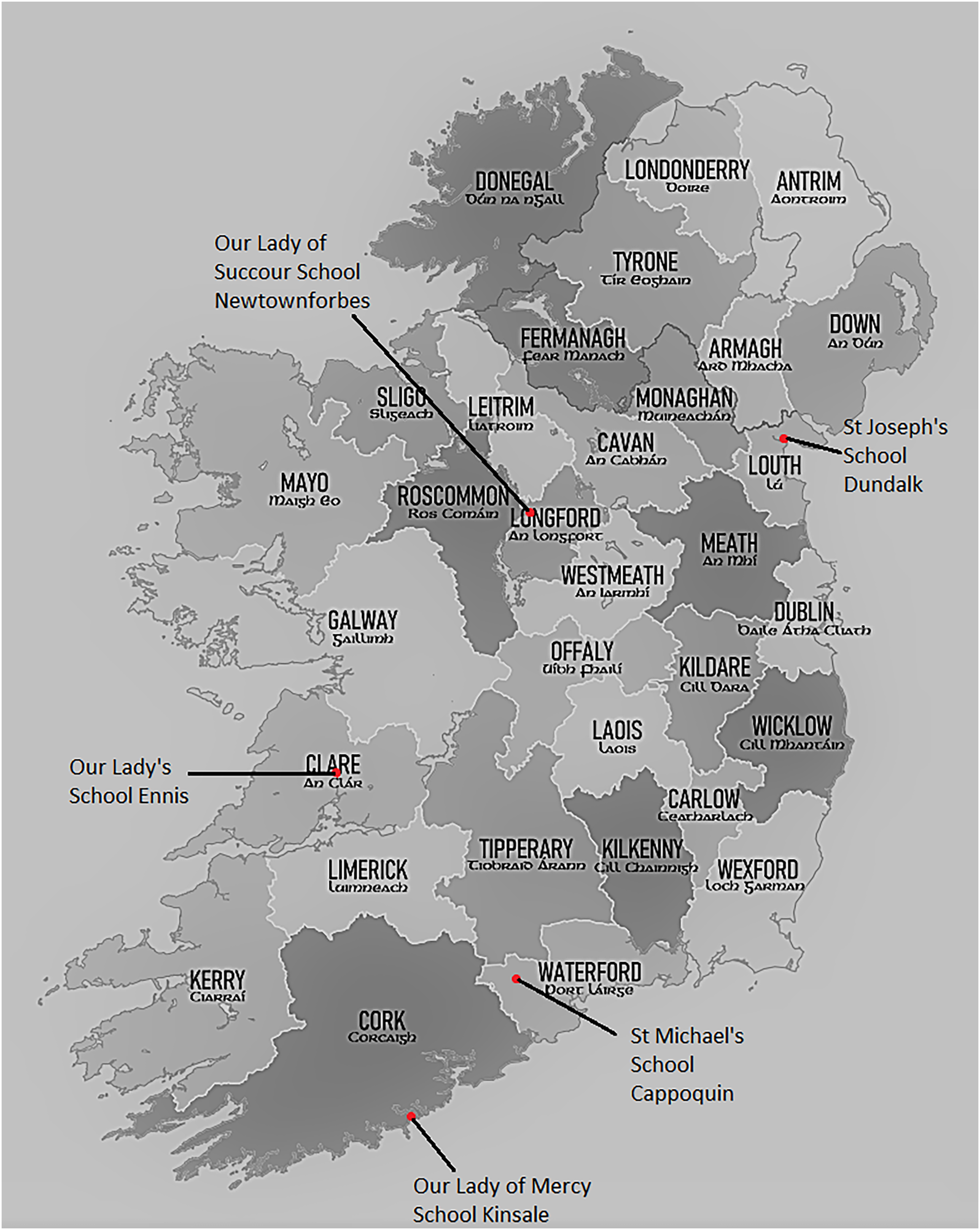
Map of Ireland showing location of industrial schools used in this study.
Footnotes
Declaration of Conflicting Interests
The author declared no potential conflicts of interest with respect to the research, authorship, and/or publication of this article.
Funding
The author received no financial support for the research, authorship, and/or publication of this article.
