




Abstract
Genealogy necessitates historical records, the majority of which derive from government sources, despite families’ “private” lives. State records weren’t intended to service future family historians, but were a means to state-formation and power. Consequently, records used by family historians reflect statist concerns, not state subjects’. Genealogy databases and censuses were analyzed to determine how many derive from state sources. An individual, anecdotal example focused upon a US Census record illuminates genealogical insight and misunderstanding; despite relevance, interpretation problems confront family historians. Genealogical research is limited by modernity's governmentality and the state gaze, impacts generally under-acknowledged by the average family historian.
Introduction
Interest is flourishing among people from affluent countries in their ancestral histories; the genealogy and family history industry is also flourishing. Genealogy websites are the second most popular category on the Internet. 1 For example, nearly half of all Black Americans have actively researched their family histories. 2 Much of such genealogical research relies upon historical documents to construct compelling narratives of ancestors’ past lives. The state is a common source of such documents. While many presume such data sources to be neutral, state documents’ original purposes are less benign than merely informing later generations of descendants about the people those documents describe.
A wide range of government documents and archival materials are created by states to accomplish state-making objectives. After formation, states continue to create new records about their expanding populations to continue statecraft's primary functions. Yet, genealogy enthusiasts frequently utilize state-serving documents for divergent purposes, usually without reflecting upon the documents’ original intents. Genealogists endeavor to understand the lives of long-deceased individuals as family ancestors, while such documents originated as part of a state apparatus, and were designed to extend the state's gaze over territory and populations that often unwillingly provided the initial information. Consequently, it is impossible to assert that state documents are neutral “data” when used by family historians. This article considers how genealogists’ post-hoc utilization of state documents influences people's perceptions of their forebearers in ways that can be both unintended and inaccurate. 3
Even though genealogical research is a growing endeavor—that may be innocently attempting to take advantage of existing records—those records can mislead family members and serve the continued interests of states, especially by contributing to past mythologizing about the state's origins. This dynamic can be shown via an assessment of some of the many document collections that include a high percentage of government-authored records, such as those available for no-cost from the world's largest genealogical research company, Ancestry.com. 4
Various theoretical insights, drawn from across the social sciences, are of key importance in this analysis; in particular, the ideas of Michel Foucault, James C. Scott, and Charles Tilly offer insight into the operation of states vis-a-vis their subject populations, especially through bureaucratic document creation (e.g., census-taking). In particular, Foucault's concept of governmentality described organized practices which assist in the governance of subjects—the techniques and procedures useful for directing human behavior. 5 Everything that makes it possible to allow a certain type of power to function—particularly state power over all others—is the foundation of the administrative state. 6 Extending this idea, Scott argues that “legibility” has been a key means of governmentality; thus, to establish practical control over claimed territories and subject populations, incipient states had to first understand the land and people which states claimed as theirs, requiring many forms of standardization (of measurements or land-rights), customs (like the use of surnames), and tools (e.g., cadastral maps). 7 Finally, according to Tilly, the building of the state was fundamentally driven by military preparation, requiring “extraction” from state subjects, in the form of taxation and conscription of people. 8
This paper will describe genealogy and family history research practices of the past and present, to contextualize the nature of these concerns about states and documents. Next, using a variety of prominent theories of statecraft drawn from political sociology, the formation and extension of the state over previously private lives is explored. In particular, the documents used by states to gain legibility—primarily birth, marriage, and death records, along with censuses—have assumed a central role in framing contemporary genealogical practice. This study relies upon genealogical metadata to construct its argument; the analysis focuses upon major censuses and the databases publicly available via the popular website Ancestry.com. These metadata confirm the tight proximity of census collection to state formation and the preponderance of state-derived records commonly available to family historians. While this paper's author is based in the United States and the latter analysis is largely US centric, there is much to potentially generalize from this analysis, at a minimum the numerous international examples used throughout. And, lastly, a practical example is offered, drawn from the author's own ancestors in Minnesota, to show how standard genealogical records drawn from the state—such as a national census freely accessible online—present, at best, an opaque picture of family history. The significance of a single case, while not necessarily representative, suggests the potential magnitude of contested analyses faced by an uncritical family historian.
Genealogical Practices
Varied reasons exist for the increased popularity of family history—explanations describe individual motivations and larger, macro trends. Notably, individuals are often motivated by intrinsic and personal reasons. For example, genealogists are motivated as “seekers”: people who have either a general or specific interest in their ancestry and origins, are interested in family stories (and possibly “myth-busting” those stories), as well as key historical events and their own personal identities. Other motivations include interest in inheritances, a general interest or curiosity in history, and recreation. 9 Family historians interact with the past, but in the context of their own kin; thus genealogy is a popular historical method, an evaluation of history, and a way of writing history. 10 Based on survey responses and diary entries from American genealogists, they seek to gather information and then assume the role of narrator in their own stories. They tend to wield a sense of familial responsibility, are excited to answer practical questions about their family's past, are curious about ordinary people (such as their family members) rather than the famous, want to place their research in a wider context, and emphasize conveying the stories they learn to their families. 11
Beyond the individual level, structural forces have propelled family history research, too. Indeed, genealogies—whether written or oral—are key features in most societies, especially among elite classes; thus family history is a way of evaluating social structure and the status quo. 12 Many have assumed that episodic upswings in genealogical interest in recent centuries correlate with rapid social changes, which instigate concerted reflection on familial roots. Despite this macro-level argument, evidence among individual family historians is scant: in one study such individuals did not themselves belong to groups experiencing social dislocation—that is, urban, occupational, or inter-generational class mobility was un-associated with genealogical interest. Instead, traditionality was more commonplace among genealogists, suggesting that their discomfort with changes or modernization in the world around them may be a motivation. 13 Threats to families’ generational continuity (e.g., geographical mobility, demographic changes, and abandonment of traditional beliefs) are deliberately countered by asserting a lineage identity, especially via genealogy and family reunions. 14 Dominant groups with historical social privileges may use genealogy as a way of finding a past to feel good about—this may be most true in settler colonial countries like Australia and the United States, where white people with the luxury of middle-class leisure engage in myth-making about their countries by researching their families. 15 Increased access to digital records has widened the range of people who can participate in family history research, making it easier for the curious to search online for family members. 16
While the hobby of genealogy has grown in popularity since the late twentieth century, a corresponding growth has occurred in the “family history industry,” too. The world's largest genealogy company, Ancestry.com, began trading on the stock market in 2009 (as “ACOM”) and was sold in 2020 to the private equity firm Blackstone for $4.7 billion. 17 Much of its value presumably resides in its DNA database 18 —for example, Ancestry.com's well-known subsidiary called “23 and Me” does genetic testing for customers. The wider industry is worth more still; the “genealogy products and services market” is projected to exceed $8.5 billion and its compound annual growth rate is 11.2 percent. 19 As much focus has shifted to online researchers, it is easy to overlook the traditional organizational models used by family historians, such as the National Genealogical Society, which boasts 9,500 members. 20 Governments have also tried to attract tourists from countries whose residents are highly interested in genealogy, and then present a modernized society to such tourists. 21
Family history hobbyists now enjoy “speed-relating” via access to lightning-fast, searchable electronic databases. This is enabled and dominated by large Internet companies (such as Ancestry.com, hereafter simply “Ancestry”). While liberating to family historians—who can now more easily avoid long, laborious visits to reference libraries—hazards await. For example, personal privacy is threatened by user-contributed information that over-reveals details about the living. Additionally, the instantaneous access offered by companies is often not much broader than what was previously available, since the records that genealogy companies can most easily make accessible are already publicly accessible and in the public domain (especially government records). The originally bureaucratic nature of such records means that they contain consistent fields and variables which computers can process quickly and efficiently, and thus import into genealogy companies’ databases, 22 which thus over-prioritizes access to state-created documents. This under-ambitious approach taken by genealogy companies raises the question of whether states are able to deliberately record relevant information on people in ways that encourages serendipity and curious attention to detail—for example, in ways that descendants of those people would find interesting—beyond just birth, marriage, and death (BMD) facts? Presumably not, as states are formal-rational institutions, state agents check relevant boxes on government documents (and no more, usually), and what interests individuals about people they are distantly related to is not what interests states seeking to govern.
Consequently, in the absence of family authored histories, the biggest data source for long-deceased ancestors is state sources. And family changes have further amplified the need to rely upon such state sources. Due to the accelerated conditions of late-capitalist life in wealthy countries, families have increasingly de-emphasized deep, multi-generational living arrangements and connections, in favor of disjointed and geographically dispersed lives. 23 The extent to which people know less about their parents, spend less time living with all family members, and have only limited interaction with those possessing ancestral information, strongly impacts what people know about their family histories. The proliferation of divorce and divided families in wealthy countries commonly limits access to entire branches of children's family trees, wherein they would be able to learn about their ancestors.
Certain ancestor's lives become more central for family historians because they are more “storyable” than others. 24 The storyability of some ancestors is often simply the result of what documents have survived in historical archives. But, just because records exist doesn’t make them important—whether in an objective sense or from the subjective perspective of family historians. Nor is the content contained in surviving records necessarily correct or compelling. The limited amount of surviving records mandates family historians to search through large numbers of records, many of which are fragmentary or only tangentially relevant, to build stories about ancestors. And for many ancestors, little information is ultimately available. 25 While any details are usually desirable, the most important thing of note is BMD information, which helps to extend family trees deeper into the past. Thus, regardless of the reasons for the modern spike in genealogical interest, these forces have turned archives into a primary means of production for family historians.
In the pre-modern European state, only aristocrats and other royalty enjoyed family documentation. The nobility had a vested interest in their lineages being recorded—in written form—so as to preserve access to aristocratic power. Consequently, people claiming aristocratic lineage had to prove their ancestry using written records. Others sought genealogical information, too, such as diplomats seeking to assess and predict power relationships they would encounter and to better understand future conflicts among the nobility. 26
In settler-colonial societies, there's a strong desire among white populations to make ancestral connections with state “founders”. In the United States, this includes Pilgrims and Revolutionaries, while in Australia, it is convicts. 27 Settler-colonialism persists due to a lack of official acknowledgment and the absence of redress (e.g., returning land to Indigenous or Aboriginal people). Efforts to deal with the legacy of Australia's settler-colonialism have emphasized education via school curricula or museum exhibits, but not via where most white Australians learn about Aboriginal people and their country's mythologized origins: in their own families. Thus, family histories can either reinforce or challenge settler-colonialism, perhaps more potently than other educational approaches. 28
The US's earliest genealogical studies utilized historical records of and focused upon prominent colonial families (e.g., George Washington). When early hereditary societies were formed, they required documented, written records to prove lineage lines for membership eligibility. 29 The genealogical method is akin to the turn-of-the-last-century British social anthropology, where the most important goal was to map “pedigrees.” This approach rests on the still-popular notion that kinship is more biological than social, 30 wherein people seek to connect with blood relatives. 31
Since the early, initial emphasis upon the descendants of dynastic elites, there has been a re-democratization in the modern era. The new approach is less concerned with the social standing of who was one's ancestors, instead prioritizing “rules associated with historical, legal, and social science research,” wherein documented relations require triangulating data sources (i.e., multiple such documents). 32 As such, the prevalence of government documents is paramount in an empirical enterprise that necessitates such replication support.
Family historians believe their work humanizes the past, providing not just BMD dates, but details about people's lives. 33 They tend to express frustration about how little is known about “ordinary” people via historical documentation. 34 In addition to documents historically omitting the lives and names of enslaved and poor people, women's lives are also concealed by the predominance of their fathers and husbands in documents; females were less apt to be recorded as property owners, residents, laborers, and even in marriage documents (where husbands’ names were required, but not always wives). This written absence of female ancestors thus over-emphasizes the role of male ancestors, for whom the documentary record is much clearer and detailed.
The past—and perceptions of it—are influenced by popular culture, such as popular genealogy television series, including Finding Your Roots, Who Do You Think You Are? (WDYTYA?), and Faces of America. 35 Guests on these shows regularly express a fascination with their ancestral pasts, while the surrounding narratives about their families often “neglect current controversies and [affirm] post-racial, post-class, and post-feminist orientations.” 36 The popularity of these shows points to a deep reservoir of genealogical interest, especially in the English-speaking countries that shows like WDYTYA? are based in (i.e., Australia, the United Kingdom, and the United States), a popularity that is propelled by various historical institutional hierarchies, while also sometimes grappling with certain limited features of those histories.
This paper engages in “critical family history,” 37 by investigating the wider context of genealogical records, and what those records reveal or conceal about national mythologies and state-building. For example, social dynamics like immigration, xenophobia, exploitation, and colonialism are crucial institutional processes that play an important role in the recording and re-telling of critical family history. Thus, instead of just considering the de-contextualized, narrowly interesting lives of individuals, it's important to challenge mainstream narratives drawn from bureaucratic documents. Critical family history places individuals’ lives within the histories of capitalism, white supremacy, and patriarchy, and—particularly in the case of this article—demands consideration of how state domination influences ancestral narratives.
State-Formation and Private Lives: Power and Legibility
This article emphasizes the ways in which states form—namely by first establishing legibility to extend their power and bureaucratic structures to accomplish tasks that states do, all of which enable governmentality (i.e., the things that states continue to do to wield power). The state is the societal actor who was initially most interested in mass data collection and had the resources to initiate such collection. Statistics (literally meaning information from or for states) facilitates state formation and governmentality. Government records are not themselves statistics—although they can include statistics. Rather, statistics facilitate state formation via legibility and continue to acquire the necessary power for governmentality. Statistical analysis is thus the primary goal served by the collection of census records, and BMD information—these state goals are self-consciously not to provide resources for genealogical family history research. These dimensions of state formation, legibility, and governmentality—which help to frame the purposes, processes, and risks associated with state documents and their use—are described in greater detail below.
Modern European states began forming in the 1600s. 38 At the time, the state's main activities included war-making, protection, and extraction. 39 Extraction was required to acquire the resources necessary for military preparation and security. Specifically, extraction involved taxation upon residents and erstwhile “subjects,” as well as the conscription of young men into the military. These forms of extraction were complicated enough to warrant the creation of bureaucracies and a centralized state. 40 Thus, these European states were often founded explicitly for the purposes of waging war—either against external enemies or upon dissent from within—a motivation that Tilly equates with the gangsterism of organized crime. 41 In addition, the militarization of society also led to a “civilianization,” too, where civilians became counterweights to the military and ran the state's bureaucracies. 42 Indeed, states created “imagined communities,” where no community existed previously, which involved creating a mythos of a united people made of many (e.g., “e pluribus unum”), which necessitated data and state policy. 43
State formation required the establishment of “legibility.” 44 Centers of power strive to understand (to make “legible”) the populations living within their claimed territories. During the primary period of European state formation, this involved regional power-holders attempting to acquire such legibility for increasingly larger areas in order to extend their control and influence. States took a variety of seemingly non-aggressive actions to acquire legibility (for purposes noted by Tilly, including taxation, conscription, and social control), such as promoting common measurement units and land ownership rules (which facilitated easier taxation), and the creation of inheritable family surnames and cadastral maps (which aided the tracking of who lived where). 45 Legibility is thus a state tool that established “an efficient social order.” 46
For instance, before and after its Revolution, the Mexican state sought to better understand the country's climate, natural resources, and agricultural labor—all for the purpose of increasing economic productivity and modernizing the country to entice foreign investment. The state standardized agricultural measurements, language distinctions (i.e., to translate Indigenous languages into Spanish), and to better comprehend place-name changes. These efforts aided the building of Mexican nationalism and nation-building, as well as to (post-revolution) redistribute land to the communal ejido. 47
From the state's perspective, legibility acquires ethnic statistics, for various purposes, including “counting to dominate.” 48 For example, the British used a census in colonial Mauritius to “ensure control and for economic and political purposes.” 49 Legibility played an important role in other colonizations, such as US efforts to eliminate its “frontier”. US officials (especially Charles Eastman of the Office of Indian Affairs) renamed Great Plains-dwelling Indigenous people, imposing permanent Native or English/French surnames, for the ostensible purpose of assimilation and land allotment. However, such surnames supported US state legibility—to enforce European-style property transfer within families, as well as to monitor, control, and dominate Lakotans. Despite the declared goal of maintaining Indigenous names, two-thirds of Lakotans had their surnames translated into English (e.g., “Taken Alive” or “Iron Eyes”) or were given Euro-American surnames, usually English or French. 50 In order for colonizers to absorb people and territory, on-the-ground knowledge was necessary, not just military force. More generally, legibility in the early US involved determining how best to exploit new, seized land when establishing the frontier—including new frontiers after previous incursions westward—and understanding the nature of threats posed by African slaves to the plantation system.
Weitzberg claims that colonial officials (especially the British) were uninterested in doing good census collections in Africa, particularly in Eastern Africa. 51 Officials attempted to make it appear that colonies were efficient bureaucracies and panoptic states, but did not seek to assess residents in Kenya, especially Somali immigrants along the border. A major reason for not seeking legibility here was likely that the British were rarely interested in “producing citizens” in their colonies. 52 For similar reasons, the United States did not record the names of enslaved Africans on its 1850 and 1860 slave census schedules.
An important and helpful tool that has supported the process of legibility is statistics, which emerged as a form of statecraft, using numbers to make sense of a state's claimed population. Indeed, the term “statistics” derives from “state-istics.” 53 According to Desrosières, statistics arose across Western European countries for different reasons, but always in service of statecraft. For example, statistics were used to consolidate the German nation from various historical, political, and spatial iterations overtime, including the Kingdom of Prussia, the Bismarckian Empire, the Weimar Republic, the Nazi Third Reich, East, and West Germany, and finally unified Germany after the Cold War. 54 Statistics have helped to shape social laws and social facts, and are thus “part of the technology of power in a modern state.” 55 Statistics and state administration are intimately tied and their emergence coincides with the same time period. This is particularly true in France's modern history, although France aimed to limit data from wider public visibility, in contrast to the English and US tendency to reveal their governmental data. Woolf argues that by collecting data, states can reinforce their central authority; thus, statistics serve the state by supplying “knowledge as the basis for action.” 56 Data collection also occurred to encourage state collaboration with “private initiative,” by revealing profitable opportunities to entrepreneurs. 57 Statistics have been used since the United States's origins, for counting representative-allocation in the lower house of Congress (associated with the “three-fifths” enslaved human rule). But, it also has been used to assess the nature of racial population disparities on a county-by-county basis, how to tax land owners, and other reasons.
The use of statistical techniques (e.g., the central limit theorem), can help construct estimates of when to search for BMD dates within genealogical data, thereby speeding-up the time necessary to establish basic life history details. 58 Yet, when data is taken out of context, it loses meaning. In the search for more information, genealogists often scramble for any available records, despite unforeseen consequences; big data influences how we think about information and research, numbers overwhelm other data, and researchers take advantage of and reuse data for purposes that people can’t opt-out of. For example, earlier generations surely didn’t expect that the information they provided to census-takers to track their lives in the present moment, would be used much later for other reasons. 59 The genealogical importance of written documents may be only discovered later-on, by people seeking to take advantage of historical insights into lineage. 60 Thus, the state does not have the foresight to be useful to family historians, as it is prioritizing certain records for its own power and legibility.
Recording-keeping is a key dimension or trait of bureaucracies. 61 Written records serve the purposes of institutional memory and institutional power, referred to by Weber as the “documents.” Bureaucracies don’t usually gather such documents for the purpose of remembering details for future generations of curious descendants to explore their family trees. Bureaucracies have their own institutional logics and purposes, which now have the latent consequence of servicing family historians’ genealogical pursuits. However, bureaucracies have used genealogical records (like kinship charts) for mundane forms of statecraft. According to Chelcea, bureaucracies also disconnect “people from people” and extract individuals from “the everyday intricacies and flux of kinship,” locating them as “simply nodes in the genealogical grid.” 62
With the rare exception of royal ancestors, European family histories in Europe can usually only be dated back to the start of the state-making period (sixteenth century). Few written records pre-date this period, indicating that the majority of the genealogical evidence relied upon by family historians stems from records accumulated in tandem with state extraction, which itself required legibility and governmentality.
Local, non-royal family histories often must heavily rely upon oral-story telling, across generations. 63 Thus, absent state-based histories of populations, genealogists must use means that have endured for longer periods of human history, but that also require intact family structures to convey such stories (lest they be lost to time). Scott refers to the intimate, textured knowledge of populations that are impervious to the state's gaze of legibility as “mētis”—that which was known only to locals. 64 However, inter-generational poverty, violence, and chaos have disrupted long-term family stability, making it difficult and less likely for ancestors to convey their family histories to the next generations, especially in those cultures for which impoverishment and other hardships are avoided in conversations or meant to be quietly transcended. For example, military veterans and Holocaust survivors have displayed a significant disinterest in and unwillingness to discuss wartime experiences. 65 This can be contrasted against the cultural lives of many Indigenous groups, where vibrant oral traditions prevail, which can be resilient against both deliberate family forgetting and the state's efforts at unhelpful legibility.
Genealogical Data Types: Records of State
The earliest data collection tasks in genealogical research often involve gathering BMD and census records, particularly during the “easy tree-building” phase of family historians. 66 Family historians’ starting location is typically within “the records” that document the “interaction with government,” 67 but their search eventually broadens to place ancestors in a historical context. Such records are helpful for substantiating facts (although records can and often do have errors); however, oral history and family stories are preferred since records can be found lacking. 68 Genealogists surveyed by Darby and Clough reported relying disproportionately upon government sources during the easy, medium, and even hard “tree-building” phases of their research. 69 Indeed, most data for such “distant” genealogical research focused on multiple generations prior to the present comes from official state sources. One primary source is BMD records, which often originate from government sources. In the United States, these are usually county-level records that help to track the life cycles of social reproduction and social lineages—specifically connections to parents, spouses, and children.
Censuses are state-led efforts to document their subject populations. The first modern European censuses coincided with the mercantilist expansion and the state’s need for enhanced taxation power. 70 Earlier, the Romans attempted to conduct censuses upon specific areas within their Empire; for example, the Census of Quirinius focused upon Judea (a site of anti-imperialist, Jewish nationalism), as documented in the Bible. Imperial China conducted censuses—or at least variants of the modern variety—starting during the Han dynasty two millennia ago, tracking harvest data and basic demographics.
In addition to extending legibility, censuses have been used for the purposes of direct repression: the US Census was used to track and arrest (and subsequently intern) people of Japanese descent following the Japanese Empire's aerial attack upon the US's Hawaiian territorial military base at Pearl Harbor. 71 Nazis used Dutch maps depicting the locations of Jewish residents (gathered via census) during their occupation. 72 The 1951 South African population register was used to construct official racial categories that became the basis for the white supremacist apartheid system. 73 Census can thus be understood as a technology of power—akin to other legibility technologies, like the standardization of house addresses and street names, 74 offering the state an ability to extend their influence. In between the US Civil War and the Gilded Age, the US pursued territorial mastery, epitomized by Francis Amasa Walker's leadership at the US Census. Walker helped the United States to spatially construct governmentality, while authorities grappled with how much prying and regulating they had to do to accomplish such governmentality. 75
The history of censuses overlaps with that of colonialism, used as “the instrument for enumerating peoples inherited through conquest.” 76 According to Anderson, the colonial state imagined its dominion via the census (i.e., the nature of the humans it ruled), which it combined with the map (depicting the geography of its domain) and the museum (which legitimized the state's ancestry). 77 While censuses were created by states for particular purposes, they have not always been administered as intended, often due to forms of subject resistance. 78 British census-takers were frustrated by the changing racial and ethnic identities they encountered in rural areas. 79 The Ottomans were limited in their ability to conduct censuses in Kurdistan, 80 and similar problems have emerged in Palestine 81 and Egypt. 82 Additionally, censuses have also facilitated bottom-up nation-building, as in Spain. 83 Despite their origins, intentions, or actual impacts, historical censuses have been utilized by genealogists during the “breaking-in” phase (the initial research step); the use of eighteenth and nineteenth-century censuses are primary recommendations in these efforts. 84
Despite states being central actors in the creation of such records, the neo-liberal turn of recent decades has transformed states, as well as their documentary output. State-collected records have been placed on sale via private websites, thus privatizing the “public historical space.” 85 Incidentally, the database style of genealogical record-keeping implies a particular epistemological approach that varies from past historical research; thus, people from the past can be and have been colonized (i.e., owned and configured) by this new corporate framework. 86
Religious documents, especially church records in modern Europe, mirrored those eventually gathered by states. In pre-modern European countries, Christian churches gathered most of the very documents that states would eventually collect, and that later genealogists would seek to fill-in family trees of long-lost ancestors. Religious institutions often kept baptism, marriage banns, and burial records, loosely reflecting BMD characteristics and timing: baptisms closely following births, marriage banns preceding marriages, and burials immediately following deaths. Sometimes powerful political actors dictated to the church the need for collecting these records. For example, the Swedish king Charles XI declared in the Church Law of 1686 that all parishes were required to document baptisms and burials, as well as conduct a survey of all parishioners—such actions surely aided in the rise of state formation in modern Sweden. 87
In the analysis that follows, data from state censuses and from a premiere privatized genealogical collection is used. They are used to assess the confluence between state-based data and genealogical pursuits.
Analysis: Family History via the State Gaze
Two separate analyses were conducted on different data. For each, I first describe the methodological approach for investigating state data, then present applicable research questions, and finally describe the analysis on each separate dataset. These analyses focus on the principal records that family historians utilize and investigate the original sources of those records. This approach facilitates an approximation of amateur family historians’ reliance upon state data. In a subsequent section, an applied example illustrates how uncritical reliance upon such sources can quickly lead to misleading conclusions and can thus fail to answer primary questions that genealogists have about their family histories. The two primary analyses here center on (1) general national censuses and (2) free databases of genealogical records from Ancestry.
Analysis 1: Censuses and State Formation
Information about country censuses come from the three-volume work entitled The Handbook of National Population Censuses, edited by Elaine Domschke, Gera E. Draaijer, and Doreen S. Goyer. 88 The year of each country's first census that met specific criteria was extracted from The Handbook and recorded. The census needed to cover the entire territory (not just prominent regions or cities), and include the entire population (not just non-Indigenous residents, as some early colonialist censuses tended to by only collecting information on Europeans or other dominant racial/ethnic groups only), distinct from other forms of enumeration (e.g., population estimates or administrative censuses), and that were, ideally, both de jure and de facto censuses. 89 For a few countries, the very first census listed in The Handbook met this criteria, but often many “censuses” occurred prior to a general, national census. Given the age of the source, former Soviet Union countries have been excluded, as well as many island nations with very small populations. This source also provided the year that each state was originally formed—either as a republic or via a constitution—or became independent from an external authority. Based on these two years—the first general census collected and state formation—the gap size between was calculated. With this data two closely related research questions can be addressed: (1) When were censuses gathered and did they occur close to the time of state formation? and (2) Did censuses occur prior to the independence of soon-to-be-liberated colonies?
Of the 135 countries with clearly identifiable first general censuses, half (n = 67) were collected prior to state formation, while the other half (n = 68) were collected the year of or following state formation. While some older countries (e.g., China) have had many population counts dating back far prior to the modern era, most were first collected in the eighteenth and nineteenth centuries—the median year was 1920. 90 Younger and authoritarian states were likely to have fewer censuses conducted (and sometimes zero and thus omitted from this analysis). Nearly one-quarter of all first censuses occurred within ten years of state formation and 50 percent occurred within twenty years. Unsurprisingly, censuses prior to independence or state formation were often collected by colonial powers. For the heavily colonized Africa, censuses were conducted on average fifteen years prior to independence, and twenty-one years prior for Asian countries. The most influential colonial states for these countries were Britain, France, and Spain—each with nearly twenty or more colonies in this data); British colonies had their first general national censuses a median thirty years prior to independence, French colonies a median nine years after independence, while former Spanish colonies had their first censuses a median forty-three years after independence. Britain held on to their protectorates long into the mid-twentieth century, while almost all Latin American countries became independent far earlier. For censuses conducted after state establishment, these were official national censuses coordinated by the state itself. While always administered by states, censuses administered by colonial powers emphasize rather different concerns than states conducting censuses upon their own populations during state formation. See Table 1 for more details.
Mean (and Median) Year of State Formation and Censuses.
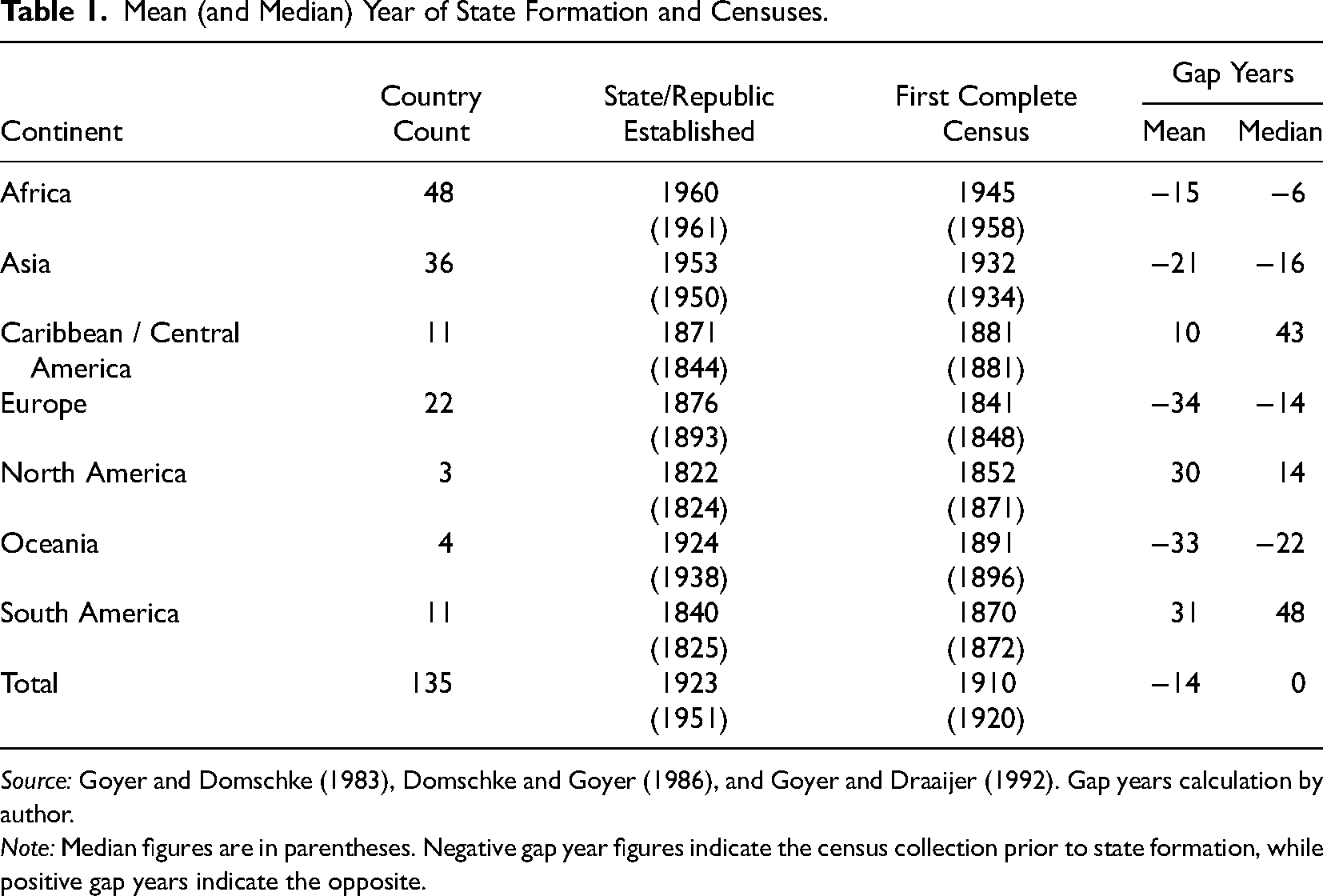
Source: Goyer and Domschke (1983), Domschke and Goyer (1986), and Goyer and Draaijer (1992). Gap years calculation by author.
Note: Median figures are in parentheses. Negative gap year figures indicate the census collection prior to state formation, while positive gap years indicate the opposite.
Analysis 2: Free Ancestry Databases
Ancestry's “Free Index Collection” was auto-downloaded via an American IP address on May 8, 2022, totaling 1,174 collections. 91 While free to search these databases, account registration is required; they are thus nominally publicly accessible. From these databases, specific data was compiled: record type (primarily based on Ancestry's classification), country of focus, and size of record collection. 92 These characteristics are assessed below. These Ancestry databases are used to answer the following research questions: (1) How many of these databases are derived from state sources? and (2) What is the overall size of these databases, on the whole?
Just over 90 percent of all databases available from Ancestry (N = 1,174) were assigned a category or could be easily placed in a predefined category (see Table 2). Of this majority, some categories were from government sources, while others were not, and still others were a mixture. Government sources include “census and voter lists,” “military,” and “wills, probate, tax, and criminal.” The non-governmental sources were mostly “stories, memories, and histories.” The mixture categories include “birth, marriage, and death” records, which were largely derived from government sources, although some were from religious sources; the same is true for the “schools, directories, and church histories” category. Over one-quarter of all databases were from government sources, and another 46 percent were partly (although likely largely) drawn from government sources. Only 17 percent of the databases were strictly non-governmental. This crude categorization strongly indicates the statist nature of these records—not only in their origination, but also in the methods used to preserve records overtime, as most were saved via government policy or practice.
Free Ancestry Databases by Source.
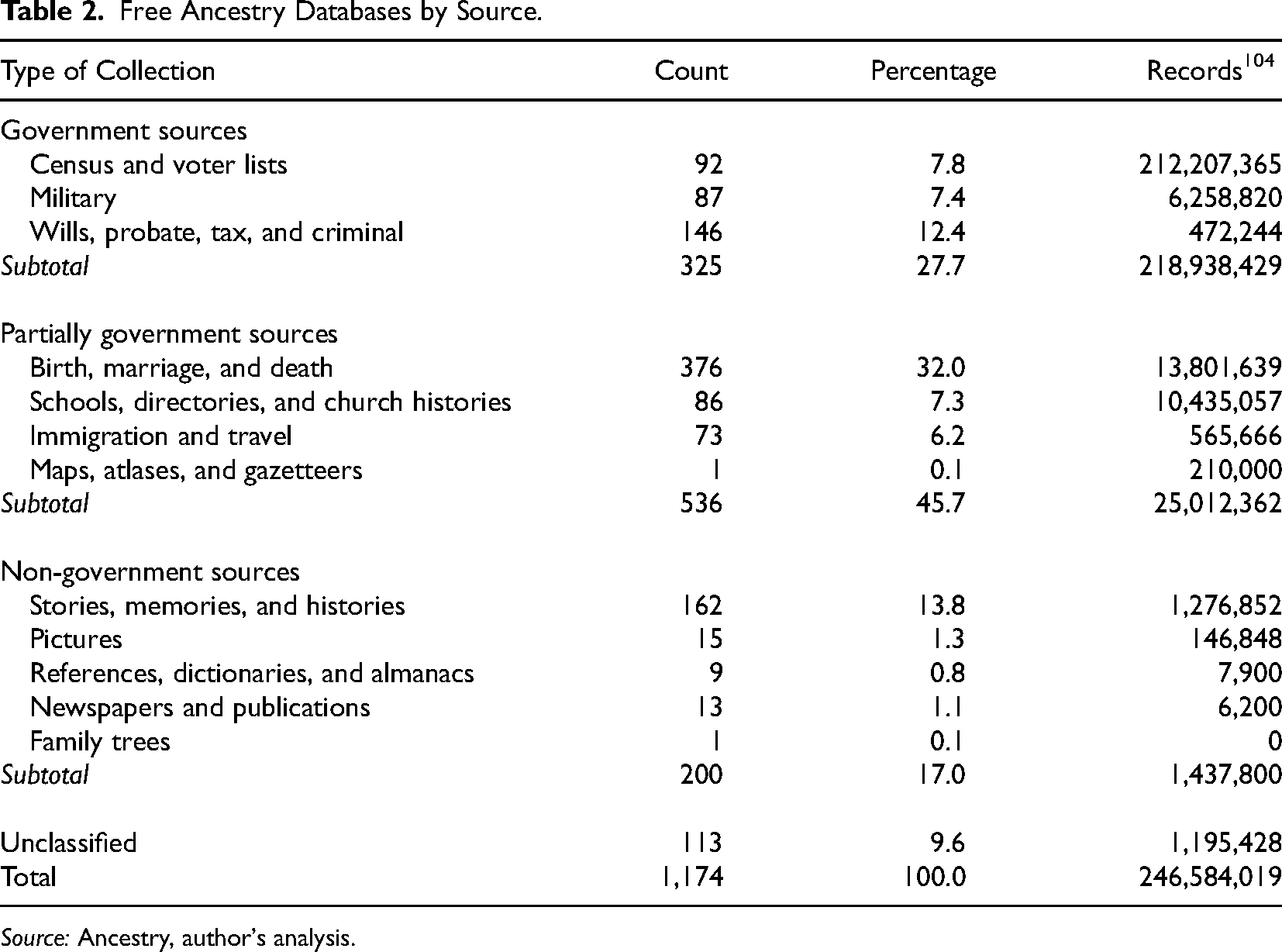
Source: Ancestry, author's analysis.
The size of these databases ranges wildly, but it is clear that at least hundreds of millions of individuals are listed in these free databases—nearly one-quarter billion entries. Twenty-five percent of the databases specified the size of the collection; the other three-quarters did not specify, although it is plausible that a proportionate amount is contained with them. The size of these collections ranges from a mere three individuals (in a UK sample WWI soldier collection) to over 131 million (for the 1940 US Census). 93 Given these extreme sizes, a database mean size would be deceptive. The best way to assess the general size of these collections is via its median: 7,169. The majority of these cases are found in the “census and voter lists” and “birth, marriage, and death” categories, which are heavily reliant upon government sources. These two categories alone constitute over 91 percent of all individual records counted by Ancestry in these free databases. Incidentally, the largess of Ancestry's census collections only serves to highlight the importance of such records generally, thus reinforcing the importance of the previous analysis.
Other notable census records are from Denmark (1787–1850), Iceland (1870–1890), and Ireland (1901–1911). While relatively limited, these records overlap with the type of census databases discussed in the prior analysis, which include far more countries (and years). Large BMD collections include records from US states Massachusetts, Missouri, and Washington (each over one million records); grave indexes from Canada, Ireland, the United Kingdom, and the United States; and somewhat smaller collections of Jewish names from places as diverse as Boston, Philadelphia, Hungary, and Latvia.
Additionally, the United States (n = 478) and the United Kingdom (n = 148) predominated as the focus of these databases, constituting over half of all those available for free from Ancestry. Most of the remainder came from Europe or other Western countries. Many of the databases pertained to a major geopolitical event: the Holocaust during WWII (mostly associated with the JewishGen project); many of these collections contain residential records from prior to the war, governmental-recorded information during the war, and then post-war documents (including those seized by foreign powers). Much of the Global South is absent in these collections: Algeria (n = 1) and South Africa (n = 1) were the only African countries with a database, Brazil (n = 1) and Mexico (n = 3) were the only Latin American countries, and the Philippines (n = 1) was the only East Asian country. Consequently, most records had a focus on the Anglo world and the wealthier (and whiter) Europe. This selective collection reduces applicability for those whose families originate outside of the Global North, thereby limiting the potential for their research. These descendants will be less able to extend their family trees using record-based genealogical techniques.
Failures to Acquire Genealogical Legibility From State Records: An Example
To illustrate the dangers of over-reliance upon state-based records in family history research, the following case study—an example drawn from the author's ancestors—may be helpful. The discussion below uses the 1900 US Census schedule for the Steinberg family of south-central Minnesota. US Census records contain basic demographic information; here, this includes names, residence, race, sex, age, marital status, parental origins, citizenship, occupation, education, and home ownership information. Diagram 1 image of the 1900 US Census.
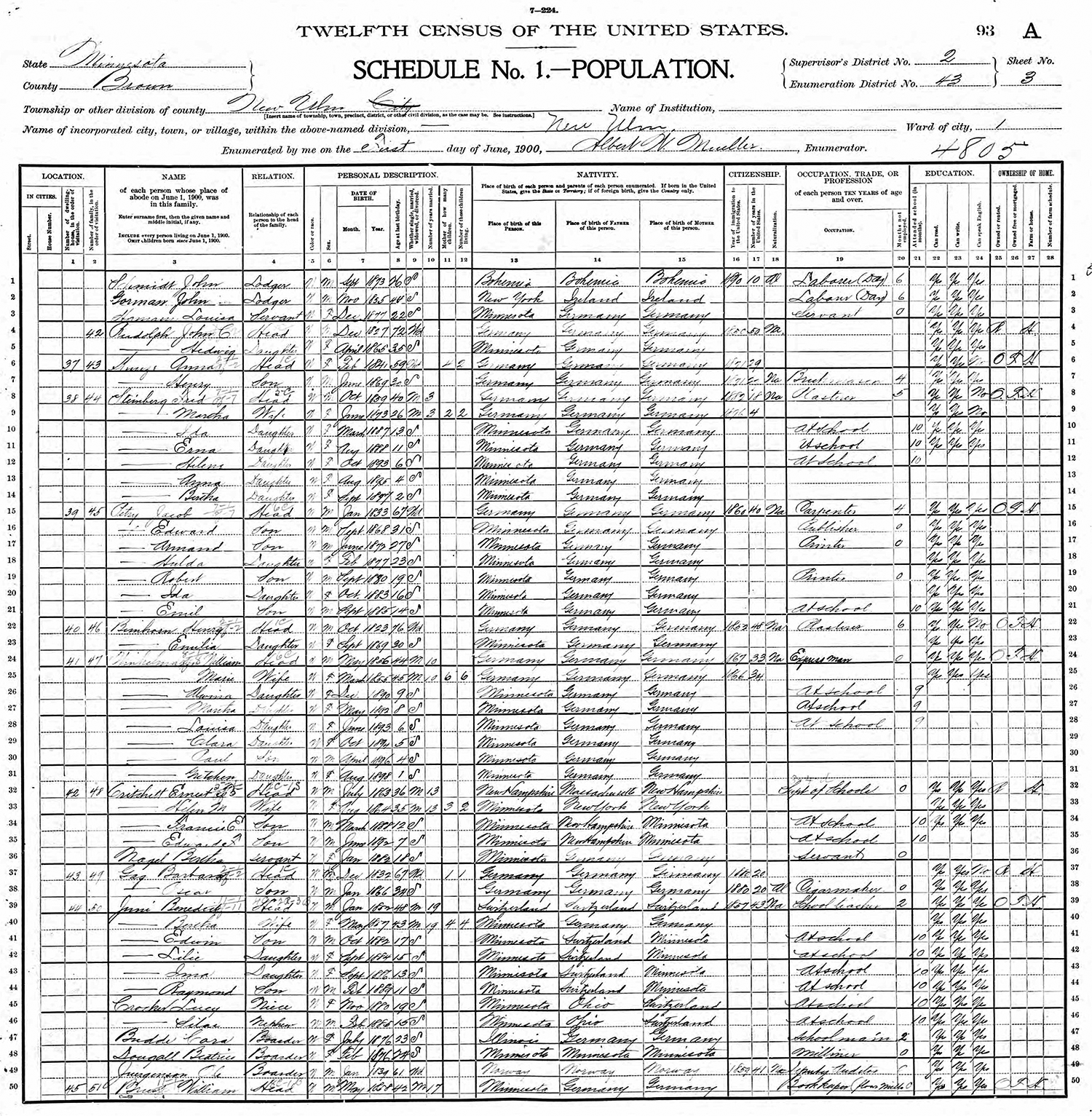
1900 United States Census for Steinberg Family.
Omissions, misleads, and errors are often found in state documents. For example, Steinberg’s entry (Diagram 1) doesn’t explain the motivations for Fred and Martha's recent marriage (of three years), what their original lives were like in Germany (or where in “Germany” they lived), what they did on a daily basis in Minnesota (except that Fred was a plasterer), nor their nicknames for each other. Indeed, Fred's documented name changed from “Fritz” to “Fred” during this time period. Their marriage was arranged, and initiated due to the death of Fred's prior wife. Despite being arranged, they had both lived within 10 km of each other back in the town of Posen, then part of the German Empire—but now part of Poland (called Poznańska). The census also suggests that Anna was Fred's biological daughter (but she wasn’t).
As we’ve seen, the state simply wasn’t interested in memorializing the Steinberg's lives for future genealogy enthusiasts, and thus it only made the family legible for its own purposes. The 1900 Census was gathered during the Spanish-American War and makes clear which males were of draft age, an important fact since conscription had occurred in the previous US Civil War and would also be of great importance in a few years when the First World War arrived. The census established their general level of income (for estimating taxes), and their ancestral origins (and thus whether they were “dangerous” immigrants, who could speak English or not). This census schedule showed that Fred was still of military draft age (but that all other family members were female), the state now knew how much it could tax the family, and that if trouble began (or if the Steinbergs started trouble), the state would know where to look for them. As foreign-born residents, the state learned that Fred and Martha Steinberg were literate, but not in English, a key fact when two subsequent wars with Germany occurred during the first half of the twentieth century—Martha naturalized following WWII.
For genealogists to place the details from this census record in context, requires sociological knowledge and insight (“critical family history” according to Sleeter 94 ): information about German immigration patterns, working-class communities in rural Minnesota, and laboring occupations common at the turn-of-the-twentieth-century. Arithmetic is necessary to determine that Martha was unlikely the parent of Ida, Erna, and Helena (thirteen, eleven, and six years old, respectively)—since she and Fred had only been married three years and she’d only lived in the United States for four years (him for eighteen years). The mētis of their lives had to be told by actual family members, such as a Steinberg family history published by family members in the early 1980s. When contrasted with the census, this family history sharply illustrates how poorly the state serves as a surrogate for conveying genealogical nuance or carrying family legend. The actual complexities of family life thus limit the usefulness of BMD and census data to only offering early, first steps for family history research. This 1900 schedule helps to accomplish state efforts of legibility, but fails to offer much that family historians typically desire.
Consequences of Statist Genealogy
Family historians conducting their research seek meaning, not just information 95 ; however, government records are rarely able to provide meaning. Government records are typically cold, bureaucratic, and circumscribed, and thus can only really offer limited information. Genealogists usually desire to make connections within the family trees they are researching—government records can assist with this task, but only by offering functional, networked connections devoid of texture.
Everyday people pursuing genealogy have their understanding of their families funneled through the disinterested gaze of the state's lens. But, sanitization is rarely an important objective for family historians. Historical evidence that supports genealogists’ conclusions about ancestors’ lives is usually neither neutral nor passionately concerned with the truth. Instead, government documents have integral biases, while also being incredibly dry and mundane. Amateur genealogists ought to be encouraged—or at least not discouraged—from thinking critically about the nature of “data” coming from these sources, which were not intended to serve as genealogical data to later generations. A significant portion (albeit an unknown number) of family historians already apply such critical thinking. The nature of BMD and census data is so hegemonic to modern genealogists (and now immediately available via the Internet) that few are forced to consider what genealogical research would be like in the absence of states and their documents—indeed, such research might not even be possible in its current form. But in a non-state society, reliance upon such records would not really be necessary, as people would likely have a stronger connection to their familial past, its details, and stories—and the meaning that goes with this.
In view of genealogical practices, Scott's legibility, Foucault's governmentality, and Tilly's state formation theories take on a stark, personalized quality, manifesting in everyday people's families. As per Scott's observations about state efforts to extend legibility over its claimed territories and subjects, it's clear that censuses and BMD records make populations and land understandable and thus rule-able for the state. Genealogists viewing these documents get to see what the state originally saw for itself, but they may uncritically adopt that perception as mere family history. Censuses offer the state insight and thus control it would otherwise lack. For example, knowing where racial minority populations and the poor reside—and thus where the disadvantaged and potentially restive can be found if necessary. Legibility facilitates state understanding, while not offering anything comparable to residents, citizens, or subjects (variously articulated) who lack access to state power. Free Blacks in 1850 and 1860 appeared by name on the US census, but Black slaves—the majority of Black residents—appeared anonymously on slave census schedules. Thus, modern-day Black Americans researching their families are more likely to find their “free” ancestors and get a distorted (and possibly rose-colored) view of their family lineages, since their enslaved ancestors are un-locatable. Thus, state records afford legibility to the state (and subtly advocate for its merits), not non-state others.
Foucault's insights into the rise of state power via governmentality also reflect upon genealogy: the state used censuses and BMD records to its benefit, as a means to rule. While family historians benefit (after the fact) from previous generations of governmentality, the primary beneficiaries have been states themselves. The US state still extends governmentality, by deciding which censuses to release to the public and at what rate. It used the 1940 census to arrest residents of Japanese descent—to control and racially dominate a population it considered a threat to its order. Viewed via Foucault, such census records are the akin to society's DNA, reflecting the characteristics of the state's subjects. Any particular detail or dimension—such as Japanese ethnicity—can be highlighted to achieve governmentality.
And, censuses and BMD records helped to facilitate the war-making that is so central to Tilly's understandings of state formation. By knowing who to conscript and what land (and workers) were available for extraction purposes, the state was able to do that which epitomized its uniqueness: plan for and wage war. 96 Genealogists, in the midst of their hunt for elusive details, may not always reflect upon the fact that states had to be formed in the past. Thus, their families are represented in state data as part of the state's history, not just their own family's history. States are usually rather good at record-keeping (as noted by Weber), for war-making purposes and otherwise. To overlook the processes that helped communities become states is to omit the legacy of violence that states created amidst family histories.
Details in state documents that are relevant to capitalist exploitation—occupation, language spoken, marital status, and others—are retained, as are other details that states tend to care about, such as draft age, gender, and naturalization and citizenship status. But, key things about ancestors’ lives, that descendants themselves care so much about, are lost. Absent are their nicknames, joking names, and even preferred names, as well as details of their self-identifications and lifestyles. Instead, most documents only retain a shadow of basic demographics (i.e., BMD information). Elements of social interests are also overlooked and thus lost when genealogists uncritically rely upon state records; such documents rarely convey food customs, family rituals, pastimes, or what offered individuals joy or frustration in their daily lives. It might be unreasonable to assume that states ought to care about (and thus record) such details, but it's clear that family historians desire to learn these dimensions of their ancestors’ lives.
Family histories have the potential to address historic injustices—and to aid in reconciliations, 97 but state records omit all such context and meaning, thus failing genealogists who don’t track down contextual details. 98 Unsurprisingly, government documents are wholly disinterested in rectifying injustices. Indeed, government records typically have helped to create and perpetuate such inequalities. Notably and predictably, colonial documents were created to facilitate colonization, not decolonization.
Instead of statist genealogies, an alternative approach would be to take the lead from Indigenous genealogies, 99 which are “kept and practiced as performed, living narratives” (p. 2). 100 Lomawaima highlights the Indigenous “principle of relativity,” which considers biographical “silences,” and the presence of Indigenous people in unexpected, mundane, and meaningful places. 101 Finding ways to connect more intimately with the past as embodied in living people, rather than sterile government records, changes not only the information written down, but the nature of the conclusions drawn. Consequently, Indigenous genealogy is very political and is “often a tool to revitalize, empower, heal, and decolonize,” 102 tasks that are necessary to pursue justice in settler-colonial societies, but considerably difficult to accomplish due to the reliance upon state-framed genealogical sources. For example, the Māori pedagogical tradition of Wāgana can also be understood as a research practice that interacts with local knowledge, language, places, people, and law. 103
It is unclear how Indigenous or anti-colonialist genealogies could be useful or political ethical for dominant groups’ use, especially in settler-colonial societies. For example, white Americans are more apt to have reassuring myths reinforced through standard genealogical methods, but can decolonized approaches help overcome such tendencies? Additionally, to simply advocate for a reliance upon oral tradition over statist documents may simply substitute one myth-making source for another. Oral histories may be susceptible to distortion and fiction, too, although less likely funneled through the state's gaze. Written records authored by states introduce certain dominating logics, but it's unknown if their consequences render objectively better or worse genealogical evidence than oral techniques.
State records may offer many contemporary individuals and families an opportunity to reach-back further into the past than possible using any other strategy, which likely has empowering consequences for such individuals, regardless of its accuracy. Those relying upon state records are seeking, in part, to build or reconstruct their own and their families’ identities, but are likely unknowingly entrusting that transformation to incidental collected errata that served state legibility objectives. To understand this dynamic can help family historians to properly contextualize such records and employ appropriate critical consideration to their veracity.
Footnotes
Acknowledgements
Stefani Baldivia, Danielle Hidalgo, Nik Janos, Suzanne Slusser, and Tony Waters provided thoughtful conversation and detailed feedback. Any errors remain the author's.
Declaration of Conflicting Interests
The author(s) declared no potential conflicts of interest with respect to the research, authorship, and/or publication of this article.
Funding
The author(s) received no financial support for the research, authorship, and/or publication of this article.
