




Abstract

The Deeply Painful Weirdness of Irish Family History, 1860–1960
A long-standing piece of wisdom among comparative and global historians of political systems, sociological formations, and, indeed, most wide-lens observers of modern European history has been this: when you are done framing your hypotheses, paradigms, and generalizations, always add the footnote, ‘except in Ireland’.
Two extraordinarily compelling recent publications have brought into public conversation a matter that historians of family formations have long known as a peripheral fact, namely that Irish family history from the Great Famine until relatively recently has been strange to the point of weirdness. Each of these items is framed outside the pattern of usual academic discourse; each is brilliant in its own singular fashion, and each can be read with fascination by anyone interested in Western family systems. One of these is the Final Report of the Commission of Investigation into Mother and Baby Homes, delivered to the government of the Republic of Ireland in January 2021. It is easily available via a simple search on Google or Bing. The second is Fintan O’Toole's We Don’t Know Ourselves: A Personal History of Ireland since 1958. Both of these are written by observers who are within present day Irish society and who are talking primarily to an audience that has experienced at least some of the lingering effects of the post-Famine social system. A baseline of common experience is assumed. Both of these discussions are strikingly candid at the level of personal experience, but, necessarily, they do not dwell on the place of Ireland within the spectrum of Western family structures in the last two centuries. When reading these two works, we are in the position of overhearing a family conversation, and thus we need to grasp and articulate the foundational facts that the participants do not spell out because, in one form or another, everybody in the clan knows them.
**********
The massive ‘big-fact’ about Irish family history since the end of the Great Famine (1850–52, depending on the metric employed), is that alone among western nations, Ireland for more than a century practiced a form of population reduction. This was after the terrible mortality of the Famine was over, and the continuing reduction involved neither the winnowing of war nor the adoption of scientific methods of birth control. It all had to do with family structure.
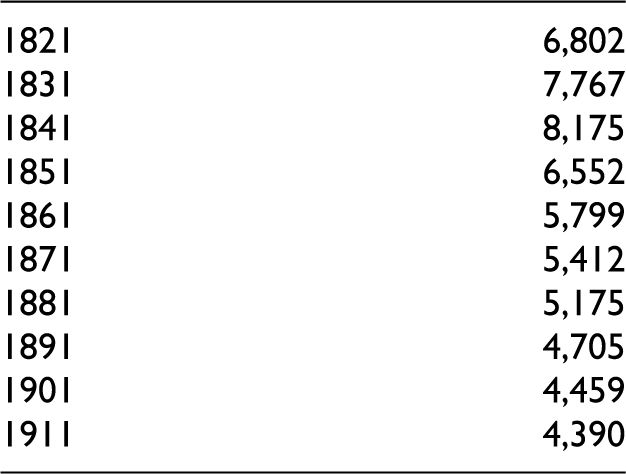
The framework data are clear. 1 The following are the 32-county population totals (in thousands), up to the eve of Irish political independence:
After independence, the population of Northern Ireland stabilized and grew somewhat, but that of the 26-counties continued to decline until the early 1960s. This (expressed in thousands), was as follows:
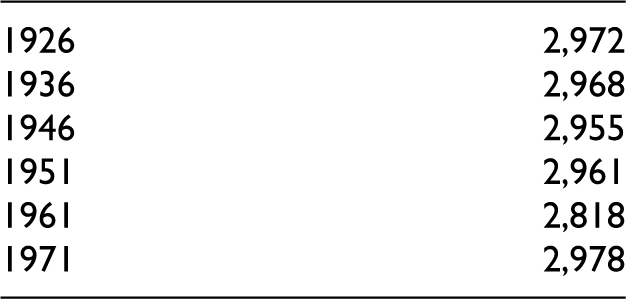
As late as 1961, only 49.2% of the Republic's population lived in towns of more than 2000 persons. This rurality lies behind the singular Irish family pattern. It relates directly to the pained realism of the econometrician Cormac Ó Gráda's observation in the mid-1990s that ‘The Great Irish Famine set off a population decline unmatched in any other European country in the 19th century, a decline that has lasted in Ireland as a whole into the 1900s, and has continued in some rural areas until this day’. 2
The simplest explanation of the population decline – too simple, but causally important, nonetheless – is that an awful lot of people left. For many reasons, emigration to various new worlds was relatively easy for the Irish as compared to other migrants from the ‘poor European periphery’, though far from simple and painless. Most leavers had acquired knowledge of English before emigrating and were functionally literate; they were experienced in a culture that understood how systems of representative government worked, and the Irish had strong tendrils of chain migration. Thus, we note the startling proportions of those individuals who had been born in Ireland (that is, a ‘world total’ of the native-born Irish), but were living in the main countries of Anglo colonialism: the United States, Canada, Australia, and Great Britain itself.
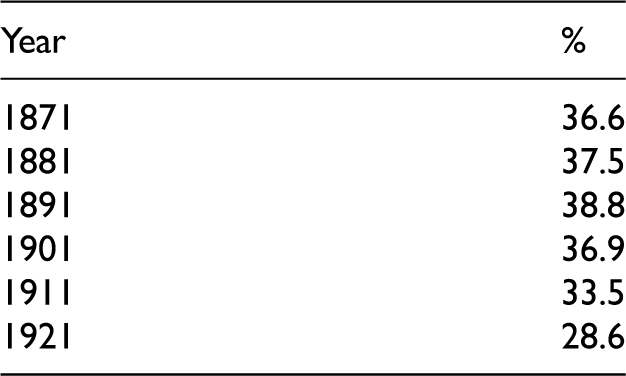
The percentage dropped gradually thereafter, but not sharply. The biggest shift after Irish independence was that Great Britain replaced the USA as the primary destination-of-choice (the exact numbers are not available as the citizens of the 26-counties were not treated as aliens in the UK and the borders were porous. From the 1930s onwards about three-quarters of emigrants from the 26-counties chose Great Britain, one-eighth the USA, with Canada, Australia and New Zealand taking the other one-eighth). The sum of the out-flood of Irish migrants was that from 1861 to 1911 in pre-partitioned Ireland, and from thence onward in the 26-counties (until 1961), net emigration exceeded the natural increase of the population in almost every year.
A lot of subtraction, certainly: but simply doing the arithmetic would lose the point that emigration was part of a radical change in Irish family structure. If one asks, ‘who left?’ the answer is that from 1861 to 1961, the largest exiting cohort was 15- to 24-year olds, and, indeed, from 1881 onwards an absolute majority was in that age group. The second largest category was 25- to 34-year olds. Obviously, this out-movement of the younger men and women altered the age structure of the remaining population. To take, for example, the year 1926, the Irish Free State had the second oldest population in Western Europe – 9.2% over age 65 – second only to France which had lost a massive number of young men in World War I. Crucially, from the immediate post-Famine period onwards, young Irish women made up very close to half the emigrant stream. This contrasts sharply with other European nations of heavy out-migration, which were loaded toward men leaving and women staying behind. So, the effect of Irish emigration was coincident with a basic change in the basic post-Famine family structure: the home population, while remaining reasonably gender-balanced, became older, with fewer younger couples and with a diminishing number of reproductive family units.
That does not explain, however, a pivotal characteristic of those who did not migrate. They became increasingly unlikely to marry. Below are the data for adult men and women who can be considered to have spent their lives ‘never married’ (the data were collected as of age 54):
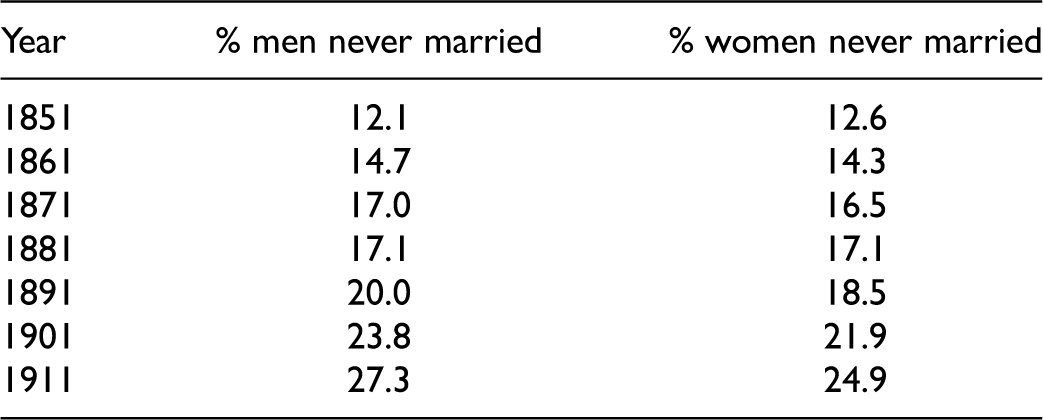
These data are for 32-county Ireland; the trends continued in the 26-counties after independence. This was celibacy in the technical sense that demographers use the term. The increasing wariness of marriage from the Great Famine onward was also indicated by the average age for Irish women who did marry (which, romantic novels aside, was generally not at a very young age), having risen from 24 to 25 years of age in 1841 to 28 in 1911.
And then there is the wild card: a trend, from the Famine onward, to strikingly large families among those who did marry and this at a time when family size in most of the rest of Europe was dropping. The European Fertility Project of the 1980s (usually called the Princeton Project) showed that by 1911 Ireland had the highest marital fertility of any European country. A special survey as part of the 1911 all-Ireland census revealed that of women who had been married 20 years or more (and, hence, were likely to have completed the full cycle of childbearing), roughly 50% had born five to nine children and an additional 30% had given birth to 10 or more. The trend towards ever-larger families continued unabated in the 26-counties after Partition. It has no rational explanation, save, first, that if contraception is denied (as it was, both by the state and the Church) and, second, if the transcendental and the temporal value of large families is accepted as it was (by both the Church and the state), then large families within marriages are inevitable. As the Irish government's Commission on Emigration and other Population Problems asserted in 1954, ‘The primary purpose of marriage, in the natural order of things, is the birth and bringing up of children. The principle which rightly guides the normal Christian married couple in this matter is to have as many children as they can reasonably hope to bring up properly’. 3
Thus, the deep strangeness of southern-Irish family patterns from the cessation of the Great Famine until at least 1961, with residual contrails into the 21st century: heavy emigration, an increasingly gerontic age structure, a high degree of avoidance of marriage by contemporary European standards, and a late marriage age – all combined with very large average family size. ‘What makes the depopulation seem more exotic’, observed the authoritative demographer, Timothy Guinnane, ‘is that the Irish arrived at unremarkable birthrates through a combination of large families but low marriage rates’. 4
**********
Into the present century, the most generally accepted explanation for this tangle of Irish family practices was as follows: first, that the heavy emigration was not an autonomous variable, but was an intermediate element that was almost entirely derived from massive economic and social changes in Irish rural society and, second, that, indeed, every major element of the Irish family pattern was a result of a post-Famine revolution in the rural Irish economy. The first assertion undoubtedly was accurate, the second, while very compelling, was not quite as omni-explanatory as it was believed to be.
The classic model rested on an observation that was rarely expressed in the following manner: ‘The Irish responded to the Great Famine by collectively deciding to produce less food’. That is my formulation, and it is put in a face-slapping paradox because that gets to the heart of what is usually described as a trauma-induced collective reshaping of Irish agriculture so as to lessen the risk of future famines. Really, did the Irish farm family, considered collectively, produce less and less food each year? From 1860 onwards to the eve World War I (the last good data-point for the full 32-counties), the answer is yes. From 1860, the amount of land given over to grain production dropped virtually every year, as did the acreage given to root crops (including potatoes). Conversely, pasture farming rose. Taken together the Irish family farm moved away from the business of directly feeding people and towards feeding animals that eventually were sold in the market economy. As compared to high-intensive tillage (such as root crops), the new animal-based farm was inefficient: it yielded fewer calories per acre and it could support fewer persons.
The story of Irish agriculture from the mid-19th century until nearly the end of the 20th is the gradual inter-generational lumping together of pasture farms. The goal of each family was to gain more land, the overall result being fewer holdings and thus fewer family farms. At the local level, the aggregation of land was almost as slow as the formation of a coral reef. Sometimes, it involved the patient acquisition of one small field after another from faltering neighbouring families. Mostly, it was inter-generational. But note: aggregation of family lands, generation by generation, worked only because partible inheritance, the pre-Famine pattern that implied easy sub-division of family lands, was replaced among rising families by impartible inheritance. For the aspiring rural bourgeoisie, family land now went to one son – not necessarily the oldest (and only in very unusual cases to a daughter).
The classic explanation of the post-Famine Irish family configuration was purely economic in its causal modelling and was so strong that it operated as an academic Ideal Type, virtually beyond challenge. As expressed in historical terms by Kenneth Connell 5 and in ethnographic terms by Solon Kimball and Conrad Arensberg, 6 inter-generational land transfer could happen at any point, but most commonly occurred at the time of marriage. In the Ideal Type, a woman from a strong farming family joined that of a land-inheriting male, her future husband. Usually, the woman brought with her some form of dowry and that was used to pay exit money for the brothers and sisters of the new husband to go away. If they remained, the non-inheriting children had to remain as unmarried second-class semi-dependents on the family farm. Very clearly this system pressed the entire society toward a pattern of forced emigration, postponed marriages, and an unusually high degree of celibacy.
There: everything was explained with elegant simplicity. Notice, however, what was deemed unnecessary in the Ideal Type: recognition of culture as having any causative power. Such things as communally accepted ‘moral standards’ (meaning in practice sexual mores) were viewed as derivative from economically determined processes. And any mention of possible dysfunction and pain in the economically dictated system was blanketed in silence.
These lacunae, though not admirable, are understandable. A tacit concordat of Todschweigen predominated in the Irish academic community at least until the beginning of the 21st century. This implicit agreement stemmed from methodological asceticism among economic and social historians and from functionalist-derived romanticism among ethnographers (one might add the unspoken recognition among Irish scholars that suggesting that some influences of Holy Mother Church were less than perfect was apt to short circuit an academic career). On the first matter, Timothy Guinnane's lapidary summary in 1997 was that ‘few academic historians credit the Church with any ability to influence the demographic behaviour of Irish Catholics’. 7 In the matter of family structure, the Church was depicted as merely following economic dictates.
Second, in the classic model of Irish inter-generational relations, the transfer of economic power from the older generation to the younger was romanticized as ‘the Match’. This was presented as a small folk drama involving a benign, potentially slightly comic, set of negotiations between two ageing male heads-of-household. They pasted together a tiny, complicated treaty, a wee Treaty of Vienna, that usually required a ‘matchmaker’ and an awful lot of to-and-fro about the size of pastures and the niceties of household furniture. In the end, two younger persons were licensed to reproduce and the other children of the two families had to stay unmarried and unsexualized (if they remained in the countryside) or, if they wished to follow a life cycle that involved having a family, to emigrate.
From a purely academic point of view, the greatest flaw in the Ideal Type was that it accurately described only the behaviour of the top half, or so, of the Irish rural population. This was comprised of ‘strong farmers’ (a term in Irish vocabulary for holders in the 19th century of 30 acres, or so, and above) and smaller landholders who were just on the edge of making it into the lower agricultural bourgeoisie. The pattern of slow inter-generational land aggregation made no sense for most smallholders and farm labourers as they did not have sufficient resources to play the long game. For them, the pre-Famine pattern of short-term maximization of rewards by sub-division of whatever holdings they had and by engaging in projects such as potato plots still was the best route to survival. A specific and very strong cultural instrumentality was required to impose upon these lower orders (an ugly term, but one well understood by contemporaries), the behavioural code of reproductive self-suppression that was embraced by the rising strong farmers. That this cultural force was the Church and that its victory involved a terrible cost is something that has to be faced.
The macro-level pain caused by the combination of economic forces, institutional religion, and, after 1922, state articulation and enforcement of these forces, was expressed by the ranking Irish student of Irish folklore, Kevin Danaher. He was aware of the high level of emigration and the severe limits on family formation (and, if one adds together those who were extruded by emigration and those who stayed at home but were not able to marry, only half of the men and women who came of age in Ireland were permitted to form an intimate physical and emotional relationship with a person of the opposite sex). In 1985, Danaher wrote: Irish tradition did not regard the attainment of a particular age by an individual as conferring any particular status on that individual… On the other hand, marriage brought an important change of status. On marriage both the man and the woman reached full status, irrespective of age, while the unmarried person, of any age, was still regarded as a lesser being.
8
Take, first, the Final Report of the Commission of Investigation into Mother and Baby Homes which was published in January 2021. It was the result of a commission created by the government of the Republic of Ireland in February 2015 and was in constant action for 6 years, with considerable legal powers under the Irish Republic's Investigation's Act of 2004. The immediate case that caught the public eye was the Tuam Children's Home run on behalf of the
Galway County Council by the Sisters of Bon Secours, from 1925 until it closed in 1961. There a disused septic tank was eventually found to contain the remains of over 800 babies. This was not unique except in its scale of discovery: Bessborough home in County Cork had 923 infant deaths in approximately the same period, but the burial places could not be fully found; the ad hoc network of homes where unmarried pregnant women were sent was a spartan world and throughout the 26-counties their infant death rate was high, at least twice the national level and often more: Bessborough, the worst home, had infant deaths of approximately 75% in 1943. 9
Except for the unusual cases where Irish families acknowledged and took care of the unwed mothers-to-be and their future offspring, there were three basic alternatives. The pregnant woman could accept the rules of the mother-and-baby homes, have the baby, and give it up. The moral regeneration of the girls by the various religiously animated orders was rigorous and often physically brutal. Second, there were some homes run by the various counties and these were similar, but not under direct religious control (the report I am here discussing dealt only with the first category). Their actual operation, however, was not much different. Like the homes run directly by religious orders, their managers worked hard to maintain secrecy concerning their inmates as any knowledge that a daughter had strayed was a social stain on the family that took more than a single generation to expunge. Most of county homes had ceased admissions by the 1960s, but some of the mother-and-baby homes went on in attenuated form until 1998. In the middle of the 20th century, it appears that about 70% of the out-of-wed births were in the mother-and-baby homes. 10 A third alternative was for a pregnant woman to go to England, have the child and, usually, give it up and often return to Ireland with a story about having been in employment in England. The number of unmarried women fleeing to England in the years from 1922 until the early 1970s was large enough that ‘PFI’ – meaning Pregnant from Ireland – became a standard category in English social work (the Mother and Baby Report devoted an entire chapter to the subject). Again, keeping everything secret was crucial.
The public report on the mother-and-baby homes can be considered the most recent confessional exercise about the failings of the Irish family system. This governmental document focused on the homes, but it also was an historical and forensic examination of the architecture and resident gargoyles of the Irish family system. That one is encountering something rare in policy documents becomes clear on the first page of the Executive Summary. Referring to the post-colonial 26-counties in the years 1922–1960 the report said: Ireland was a cold harsh climate for many, probably the majority, of its residents… It was especially cold and harsh for women.
This was a national pattern: All women suffered serious discrimination. Women who gave birth outside marriage were subject to particularly harsh treatment.
Why? Responsibility for that harsh treatment rests mainly with the fathers of their children and their own immediate families. It was supported by, contributed to, and condoned by, the institutions of the State and the Churches. However, it must be acknowledged that the institutions under investigation provided a refuge—a harsh refuge in some cases— when the families provided no refuge at all.
Of course, the investigation was not perfect, but it was massively revealing. There is no argument that the homes (mostly run by Catholic religious orders with financial support of local county councils) were diagnostic of a carcinogen in the Irish family system. Up to the closure of the last mother-and-baby home in 1998, the collective number of infant deaths was about 9000, about 15% of total births in the homes and markedly higher than the national level of infant mortality. ‘In the years before 1960 the mother-and-baby homes did not save the lives of “illegitimate” children; in fact, they appear to have significantly reduced their prospects of survival’. 11
In assessing causality for southern-Irish society's singular family code, the commission pointed to the matters we mentioned earlier: the predominantly agrarian culture in which ‘marriages were few and late because of a wish to preserve the farm/family business and pass it intact to the next generation’, thus implying prolonged parental control of men and women, often into middle age. 12 It was, however, the Church that received the most comment; fair enough in a state that was 93% Catholic after independence. In a waspish synecdoche the report noted that ‘in the decades between the end of the Great Famine and Irish independence the overall population almost halved; the number of Catholic clergy doubled and the number of religious sisters quadrupled’. 13 The trends continued into the mid-1960s. The commission pointed to something everyone knew but rarely voiced: that at the local level in the countryside, the parish priest usually was the best-educated person, a member of the rural elite, and that usually the priest was manager of the local primary school, sat on civic committees of importance, and was the person who gave out authoritative moral advice on all matters and most especially on sensitive family matters. At the top end, the state took its advice from Church teaching, and there was a quite successful attempt to create the first modern democracy that was also a Catholic state. ‘Morality’ had many meanings, but always it related to preserving the Irish family system and, hence, morality meant severe limits on sexual activity. Thus, in 1935, one finds a major amendment to the criminal law that banned virtually anything related to contraception, manufacture or distribution of contraceptives, and all information or instruction on contraception. ‘No country complied with Catholic teaching on birth control in as dedicated a fashion as Ireland’. 14 In 1937, a new national constitution, framed under Church influence by Eamon deValera, defined the family (rather than the individual) as the fundamental unit of society. ‘This constitutional protection given to the family based on marriage was copper-fastened by a constitutional prohibition of divorce’. 15 It precluded not only civil divorce but also Church annulments, a case of Dublin being more Catholic than Rome. In 1951, the Catholic hierarchy formally condemned a plan to provide free medical care for women before, during, and after childbirth and free medical care for children up to age sixteen. The objections were that such a plan was in direct opposition to the fundamental rights of parents, that the teaching of hygiene to children belonged to the family, not to the state, and that there was a danger that gynaecological care might somehow lead to provision for birth limitation and abortion. Not surprisingly, the government of the Republic caved. 16
To a remarkable degree the Church was successful in articulating and enforcing cultural definitions that were approved by the population – a case study in democracy and Catholic culture melding smoothly. At the adult level, a strict censorship system of books and periodical was initiated in 1929 (revised in 1946, and finally loosened in 1967). Not only were pornographic books and pictures to be prohibited, but no book or periodical was allowed in the country if it advocated the use of contraceptives or graphically depicted loose sexual morals. Among the banned were novels by Sinclair Lewis, William Faulkner, Somerset Maugham, Ernest Hemingway and Thomas Mann. ‘Any representation of the reality of sexual and reproductive life was understood as a foreign assault… and the Register of Prohibited Books became, as one wit put it, the Everyman's Guide to Modern Classics’. 17
Film censorship was equally strict. Under Acts of 1923 and 1925, every film shown in the 26-counties had to be viewed and passed by the governmental film censor who had the power to demand cuts as well as to ban films entirely. A predictable result was that the films made outside the 26-counties (which is to say, almost all movies) were noticeably shorter in southern Ireland than in their original form: romances moved from preliminary kisses to family life in one swift sequence.
Those were instances of the state control of the culture for adults. Massively more pervasive was the state-and-Church alliance in the education of the young. 18 Virtually all primary and secondary educational institutions in southern Ireland were controlled by denominational authorities, meaning overwhelmingly the Catholic church. The state paid the greatest share of the capital and running costs and had a say in the secular aspects of schooling, but the Church ruled. The primary schools (termed ‘national schools’) were managed locally by clergy and provided the entire formal education of most of the population. The secondary schools (termed ‘intermediate schools’) were not free and were selective. For the most part, they were managed by religious congregations. A fair statement of the purposes of the secondary schools is found in the 1960 report of the Council of Education. ‘The dominant purpose of their existence is the inculcation of religious ideals and values. This central influence, which gives unity and harmony to all the subjects of the curriculum, is outside the purview of the state which supervises the secular subjects only’. 19 Taken together, the primary and secondary systems produced successive generations of laity imbued with a loyalty to the Church, a respect for the supernatural, and a deferential attitude towards the clergy.
That the educational system provided virtually no education in how the human body worked, or, heaven-forefend, anything about intimate physical relations comes as no surprise. What is especially revealing, however, was an administrative matter: the Church's fear of co-education at any level, from infant classes onwards. The episcopal hierarchy in 1910 set down the judgement in the ‘Statements and Resolutions of the Irish Hierarchy at Maynooth Meeting June 21’ that, ‘apart altogether from moral considerations, we believe that the mixing of boys and girls in the same school is injurious to the delicacy of feeling, reserve, and modesty of demeanor which should characterize young girls’. 20 Pressure for gender segregation was strongly continued after Independence. Keeping boys and girls apart and leaving them in nearly complete ignorance of human physical sexuality was all in the cause of ‘morality’.
**********
Here we are at an inflection point in modern Irish social history. At an indeterminant date – say the early 1970s – students of Irish society, both citizens and outsiders, began to infer that the family system, as it had evolved from the 1850s onward, was not entirely healthy. Granted, it was realistic to observe that the Irish theological-moral-family system was a thorough and efficient blend of religion, definitions of family life, sexual regulations, political and legal controls, and economic configurations. For those of us who were outsiders (such as myself), we looked at it as something strange, but, after all, it was their system and who were we to cast shade on something so admirably coherent and apparently harmonious? The license for all observers, domestic and foreign, to think empathetically about the costs of the Irish family system was granted slowly and indirectly by Irish scholars, social scientists, and medical professionals who gradually began to accept that whatever the benefits of the system, there were costs. A series of seemingly unrelated occasions of awareness, often in the policy arena, ratified a slow change in the mindset of the Irish body politic. One such early point was the 1961 Irish government's Commission of Inquiry on Mental Illness. There were 7.3 persons in psychiatric beds per 1000 citizens, most likely the highest rate in the world. In comparison, England and Wales had 4.6 and Scotland 4.3. 21 If anything, those numbers probably underestimated the high comparative incidence in the Republic as its health system was markedly less developed than that of Great Britain. A 1972 follow-up by the Republic's medico-social research board published in The Guardian found that most of the schizophrenic patients in the Republic were single. Unmarried farm labourers had the highest rate of treatment, widows much less, and married persons the least. 22 The unmarried male farm labourers were the second-class males of the society, neither inheriting land nor having the resources and resolve to emigrate, unable to marry, spending their lives on the edge of a system that had no secure place for them.
I surmise that most of us missed the import of an earlier moment – really the first civic moment of awareness of big holes in the classic Irish family system: we should have backfilled our knowledge with an awareness of the reasons for the 1952 the Adoption Act (it became operational at the beginning of 1953). Previously there was no provision for legal adoption. Instead, reaching back well into the Victorian era, the most common fate of ‘illegitimate children’ (an ugly term, but well understood within Ireland) was to be shuffled into various forms of ‘putting at nurse’, of ‘boarding out’, or of ‘fostering’ depending on the age of the child and the resources and preferences of the surrogate care givers. None of these forms had legal status and there was no oversight or standards of care. Because a woman becoming pregnant while unmarried was a familial disgrace, overwhelmingly the child was given up and, if possible, the entire episode was kept secret on all sides. Protection of the family name was paramount. The number of these arrangements is impossible to determine: an upper boundary figure for 1938 was that there were approximately 1800 ‘illegitimate’ births in that year. 23 Often the informal adoptions were successful, as was indirectly confirmed by many of the first formal legal adoptions being for children who previously had been informally adopted. Mind you, many of the old informal arrangements were not beneficent, with older children sometimes being fostered out as cheap labour or as low-cost companions for older folk. In any case, a large part of the story was that in the century following the Famine an unknown number – but certainly a total that ran into the tens of thousands of infants and young children – had gone missing in the Irish family system. They had been removed in shame and secrecy and turned over to guardians, with no records, no safeguards, and little for their legal protection.
At minimum, a patch had to be placed over this big failing and that was the 1952 Adoption Act. The new system had the adhesion of the Church and involved a national adoption board, but it was based on the old reality that it was extremely difficult for an unmarried woman to raise a child in the economy and ethos of the Republic. Neither the material economy nor the moral economy had space for such. Legal adoption, with the child and the adoptive parents assuming the same rights and duties as in biological relationship and requiring the mother of the child to relinquish all rights, was one way to make the problem of ‘illegitimacy’ go away: or at least to smooth over the situation. Both the Church and the state agreed on this, and crucially so did the families of the unmarried women. Beginning in 1953, ‘adoption was undoubtedly promoted as the best option by the families of unmarried mothers, by the mother and baby homes and by religious and civil authorities’. Thus, ‘for a time, particularly in the 1960s, virtually all “illegitimate” children born in Ireland were adopted’. 24
A telling set of footnotes to this effort at abbreviating the out-of-wedlock problem is, first, that in the negotiations with the Church about the provisions of the Adoption Act, ‘while the welfare of the children was considered, the debate was dominated by the issue of their religious upbringing’. 25 Specifically, the Church feared that a pregnant Catholic girl might go to a Protestant mother-and-baby home and that the children would be brought up non-Catholic. The unarticulated, but clear, assumption was that from the moment of conception onward, the child of a Catholic mother-to-be was a Catholic. Thus, by law, adoptions could only be within the tramlines of the existing major faiths (this ‘uniformity-of-religion’ requirement was struck down by the High Court in 1975 on the grounds that it amounted to discrimination on the basis of religious belief). A second footnote relates to the Adoption Act's not including anything regulating the foreign adoption of the infants that Irish women gave up. Whether this was merely an oversight or was intentional is unclear. It left untouched a grey market wherein the religious orders exported babies to ethnically Irish families overseas, mostly in the United States.
The Adoption Act of 1952 was a brilliant success – if one views its being intended to be not only a reduction in scandalous abuse of children that had occurred in too many informal adoptions, but also was to place a covering of regularity over a highly irregular situation that had been common in Ireland since the second half of the 19th century. Like the work of a jerry-builder parging over a wall to cover up the gaps and unsound bits, the legal adoption system somewhat improved the situation, but chiefly made things look better. The new adoption practices of the third quarter of the 20th century did little to relieve the pressure on unmarried women to give up their children and to undergo penitential moral reform; nor were the conditions of the infants in mother-and-baby homes directly improved; and the definition of the out-of-wedlock children as tainted and as something that had to be kept secret within each family changed not at all. ‘By the 1960s most women placed their child for adoption and left a mother-and-baby home within a few months of giving birth. In 1967, the number of babies adopted was 97% of the number of “illegitimate” babies’. 26 Neat solution that did not, however, in any way address the fundamental dysfunctions of the Republic's family system.
**********
When the report of the commission on the mother-and-baby homes was released to the public in January 2021, it marked a half-century of soul-searching, recalibration, and argument within southern Ireland concerning issues that were at once moral, theological, economic, and governmental. The changes of attitudes and judgements from the 1970s onward were neither linear in pattern nor eirenic in tone. The discussion was messy, often ill-tempered, embittered, and vengeful. That is why Fintan O’Toole's We Don‘t Know Ourselves is so valuable. It provides the big picture of interacting monumental changes in the Republic of Ireland in the last fifty to 60 years: economic, political, religious and, invaluably from the viewpoint of family history, in the socio-sexual-familial landscape. At the same time, it provides an appreciation from within southern-Irish society of the pain, bewilderment, exhilaration of those transformations and an awareness of the fully tectonic character of what was occurring. In any society, there can be few more consequential changes than family changes.
Because this book was so successful in the home country and abroad, 27 it is the nature of the academy to let it slip by as being a lightweight effort by a journalist. That would be a mistake. Granted, O’Toole is a journalist, a notably hard-working one, but that misses the point that he is the closest thing Ireland has had to an internationally recognized public intellectual since the days of Conor Cruise O’Brien in the last third of the 20th century. O’Toole is a serious scholar. He has published historical works on North American colonial history and critical volumes on Richard Brinsley Sheridan, and G. B. Shaw, and frequent provocative essays in high-end periodicals. A good indication of his presence is an endowed lectureship at Princeton, a handful of honorary degrees, and election to the Royal Irish Academy. All this without his showing any inclination to shrug off his Dublin working class roots.
When O’Toole provides a script that is his equivalent of having a quiet talk with his fellow Irish citizens, we should listen. For our purposes (assessing the nature of the now-gone era in Irish family history, 1860–1960), his conversational accounting of what happened more recently is unrivalled. He identifies the basic causal agents as the replacement of the old rural world with a European-style urban, high-knowledge economy and the breaking down of the perimeter fence that had enclosed Irish culture. The pivotal date is 1973 when the Republic of Ireland joined the European Economic Community, an event that was both a signal of developments in Irish society that had been in train and itself a gateway to accelerated social transformations. Among cultural changes was the abandonment of old-school Irish nationalism (witness the Republic's adhesion to the Good Friday agreement of 1998) and the dissolution of the arc-welded bond between the secular state and traditional Irish Catholicism. O’Toole sees the half-decade of 2008–2013 as the period when ‘the final collapse’ of Catholic Ireland was sealed. 28
The reagent in the dissolution of the church-state axis was knowledge: that is, public knowledge provided by the legal system (often the criminal law) and by governmental investigations of clerical sexual corruption and child abuse, and separately, by a series of public investigations of various identifiable aspects of the Irish family system that had been protected by the church-state relationship. The full body of knowledge that incrementally emerged from 1960 onwards concerning the human costs of the classic Irish family system is historically rich. It is much too extensive to engage here, but it is easily available on Irish governmental sites and historians of the Irish family will find that the resultant body of data can be used to perform an audit of the traditional post-Famine system. 29
The cumulative results of the Republic's collective reassessment of family life were that by 2020, southern Ireland in law and everyday practice was just another European country, not perfect, but not unusual. The details of this revolution (for such it was) are too complex to discuss here, but one overarching fact is clear: it all happened so fast.
That is why one reads O’Toole. He is trying to understand the lineaments of radical change, and he talks about it in a way that is so unthreatening and undogmatic that it is easy to miss the superb sensitivity of his creation. He knows his audience, his people, and that they are willing to talk endlessly about family and even sex, but only up to a point. In his semi-memoir, he talks about his own life, but is always careful not to be too revealing. Reticence about family matters still is a shared characteristic of his Irish readers: voluble chat about the nature of family and memorable anecdotes are fine, but one leaves out the moist and messy parts.
When O’Toole's book – and, equally, the report on the mother-and-baby system – are read in, say, 2050, they will be seen not just as authorial reflections on Irish family history, but in themselves as major historical documents: primary evidence. And they will be read as much for what they do not say as what they do. The mother-and-baby investigators knew the limits of what they could say aloud about the Church: that it was institutionally callous, but they dared not articulate the possibility that its abuses stemmed from a morally bankrupt theology founded on the belief that human nature was inherently corrupt and had to be suppressed. Similarly, Fintan O’Toole knows full well that there are some things that one does not talk about in public, particularly the full corporeal details of family dysfunction. These two documents will be read as palimpsests, reliably revealing a world that will be forever gone, cruelly mediaeval.