




Abstract
In the postmodern 1990s, LGBT families were portrayed as pioneers for new family forms and processes of individualization. The queer viewpoint was that of a socially beneficial vanguard that could help liberate everyone from stale heteronormativity and dysfunctional socialites. The Icelandic queer dramedy 101 Reykjavík (2000) lets its slacker protagonist reinvent himself through the mentorship of his mother's Spanish partner. His renegotiation of family can be read as analogous to the way in which Nordic social democracies countered the threat of neoliberal globalization. How the film ends with queer assimilation points to our era's challenges of cultural renewal.
Writer-director Baltasar Kormákur applied a queer approach when he adapted Hallgrímur Helgason's 1996 novel, 101 Reykjavík. 1 By queer, I mean an understanding of sexuality, gender, and family that goes against that of the mainstream. More broadly, queer denotes a nonnormative attitude that seeks to subvert hegemonic ways of thinking. The Icelandic director, whose father was Spanish, offered perspectives on Nordic normativity at a time when neoliberal globalization threatened their envied social democracies. Helgason's novel had used a postmodern approach to undermine the social narrative that united his Icelandic community. Kormákur went further, adding additional queer perspectives not only to deconstruct, but offer a vision for a more inclusive Iceland better adapted to the twenty-first century. In this article, I analyze Kormákur queer dramedy to engender insights that illuminate our present era's challenges of adapting to the Fourth Industrial Revolution.
As the past decade built toward today's cultural-political crisis, the Nordic Model was frequently suggested as an alternative that could reform liberal democracies. Income equality, gender equality, low-conflict politics, and prosperous economies with generous benefits contribute to high well-being. When Bernie Sanders and Alexandria Ocasio-Cortez speak of radical reform, they denounce Soviet or Cuban socialisms, emphasizing their preference for Scandinavian welfare. Such attention is mostly flattering for Nordics, but foreign notions can border on the utopian, so that the region appears like a myth “of the liberal-left imagination, in which happy, smiling children are polite to each other as they grow up to be pacifist social democrats eager to pay more taxes.” 2
The Nordic Model originated from the social breakthroughs of the 1930s. In response to modernity's industrialization, urbanization, and inequalities, countries across the world experimented with new social models. Humanism's three main competing creeds—liberalism, socialism, and fascism—offered distinct solutions meant to bring societies toward these creeds’ utopian visions for the future. 3 The Nordic countries embraced their own “middle way,” rejecting ideological purity for incremental, pragmatic progress toward a non-utopian—merely better—future. Liberal emphasis on free markets benefited Nordic productivity, socialist redistribution reduced inequalities, and fascist corporatism forged close collaboration between governments, employers, and employees, increasing the competitiveness of Nordic exports and compressing the nations’ wage structures. 4
After the energy crises of the 1970s and the neoliberal turn, ambitions for further redistribution were stifled. Political, economic, and cultural globalization after the Cold War was perceived as an existential threat to social democratic egalitarianism. 5 In a world of dog-eat-dog competition, how could any nation afford generous benefits for its less productive citizens? Not only did Nordic social safety nets appear unsustainable, but their conformist cultures were challenged by cultural Americanization and political Europeanization.
By the time Kormákur's adaptation premiered, the Nordic countries had mostly absorbed the neoliberal turn. Social democracies had proved remarkably adaptive. 6 The Nordic Model has since gained in international esteem as an alternative that could reform global capitalism, in particular after the Great Recession and the political despondency of the past decade. 7 A similar revaluation has befallen 101 Reykjavík, the novel, whose queering of identity and tradition convinced few in 1996. Today, the work is broadly praised as the “ultimate ‘90s literary statement” of Iceland. 8 In this article, I will show how a queer perspective suggests an analogous relationship between the protagonist's journey toward a new masculinity and the 1990s cultural-political journey of the Nordic countries. These social democracies’ subversion of ideological purity and Hlynur's intervention vis-à-vis tradition are both processes of radical rethinking. When challenged by disruption, queer irreverence for old truths and master-narratives offers tools for pragmatic maneuvering among possibilities—both for individuals and communities.
During the queer and postmodern 1990s, such analytical tools empowered its users by providing cultural influence that nudged societies in a more progressive direction. In response to queer theory's purported stagnation in the 2000s, and the field's “anti-social turn,” 9 David Ruffolo advocates a post-queer renaissance. 10 From 1990 on, the field's contribution to social adjustment relied on queer examination of possibilities, mostly pointing to what others had overlooked or taken for granted. A post-queer approach, argues Ruffolo, would bring our attention to the potentialities that a more radically different future could entail. The present era's Fourth Industrial Revolution is expected to bring enormous technological disruption with hard-to-predict consequences. If we are able to adapt effectively, the result could be a golden age of social and economic equality, and self-fulfillment through abundant leisure. We also could create for ourselves an inhumane hellscape of totalitarian surveillance and rigid class structure. 11
To influence a future with such stakes, Ruffolo views traditional queer theory to be too dull of a tool, as it has “become limited by its incessant investment in identity politics and its political outlook has in many ways attained dormant status due to its narrowed interest in heteronormativity.” 12 The field's commitment to subjectivity has become “limiting because it reiterates the past and can only imagine a future through prior emergences.” 13 Ruffolo's argument evokes how post-humanist theory rejects humanism's privileged subject position. Judging the world from our own limited perspectives will appear increasingly reductive if, for instance, artificial super-intelligence takes over as our planet's progenitor of progress. To engage this tension between the limitations of subjectivity and those potentialities that arise with disruption, I analyze 101 Reykjavík to illustrate how a queer perspective was useful for maneuvering the 1990s. How the film's ending promotes what Nick Ellison refers to as “reflexive citizenship” points to limitations of queer intervention. 14 Neither Hlynur's ironic recommitment to established patterns of belonging—nor social democracy's incremental pragmatism—appear as viable strategies for those more fundamental disruptions that many experts believe humanity must adapt to over the next decades. 15 Ruffolo encourages queer scholars to make a “critical shift from subjugated bodies of possibility that work within the realm of the real to post-queer bodies of potentiality working in the realm of the virtual.” 16
Searching for the New Icelandic Man
Audiences are brought into a reality of familiar masculinity with the opening sequence of Kormákur's film. The first frames show Hlynur (Hilmir Snær Guðnason) having drunken sex with Hófí (Þrúður Vilhjálmsdóttir), a physically attractive blonde. We later learn that she “lives alone in a three-room apartment and dreams of filling up the other two.” 17 Hófí represents Hlynur's possibility for stepping into a traditional male role. He is as unconvinced of the benefit of dyadic relationships as he is by most tenets of the Icelandic social contract. In the 1990s, after decades of rapid growth and urbanization, young Icelanders found themselves in a reality for which old truths did not necessarily feel relevant. Exposed to cultural plurality through visiting bodies and new media, Hlynur is unable simply to accept tradition as the best recipe for a good life. He declines Hófí's offer of heteronormativity and embarks on a suicidal journey through which he seeks meaning or death. His mentor is his mother's friend, Lola (Victoria Abril), a Spanish flamenco instructor who teaches Icelanders how to dance to a new rhythm. Lola is the lover of Hlynur's mother, Berglind (Hanna María Karlsdóttir), although Hlynur is unaware of his aging mother's lesbian awakening until the film's mid-point (Figure 1).
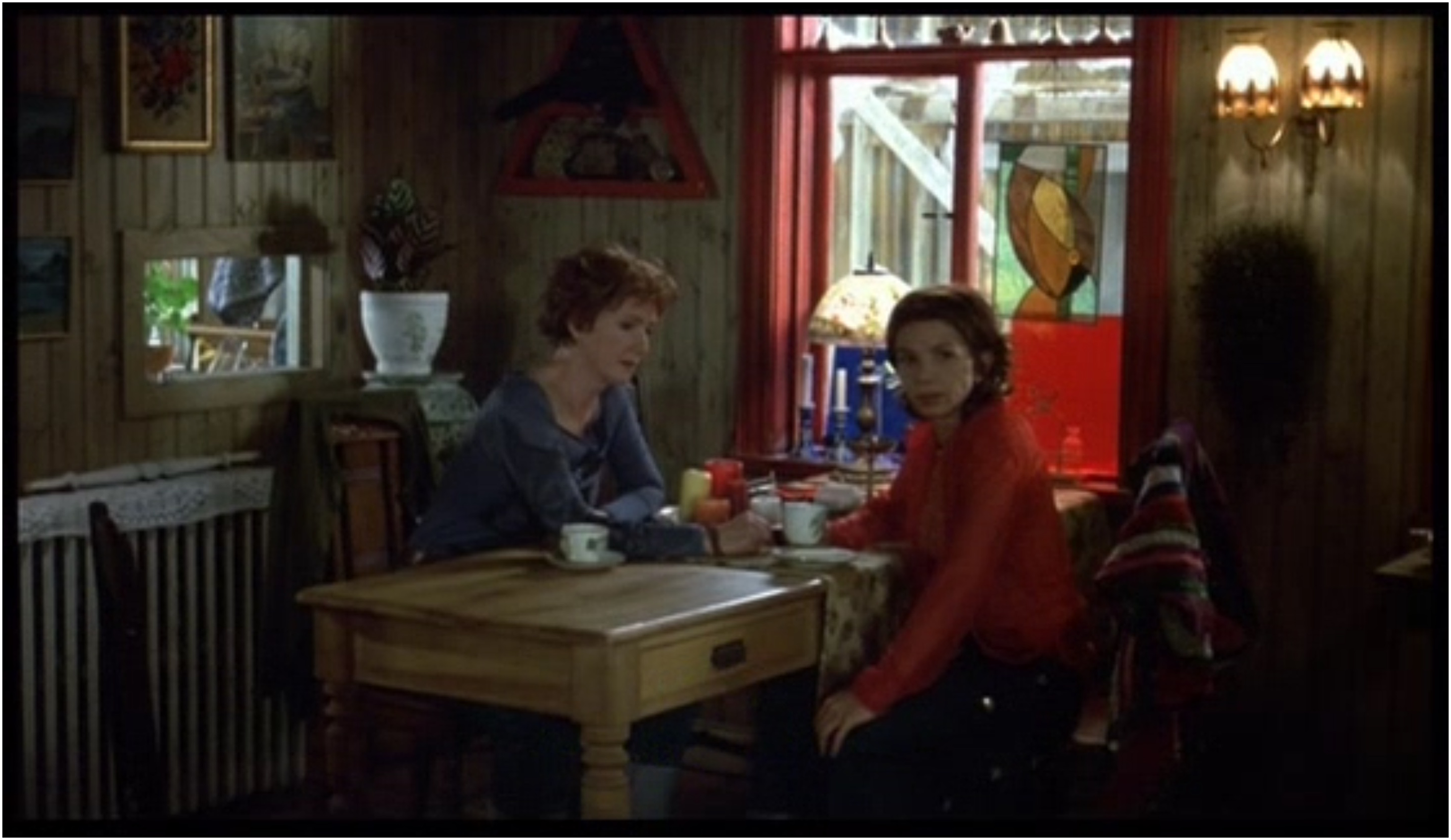
Hlynur's mother (left) gets ready to tell her son that she is in love with Lola (right). Courtesy of Sögn ehf/Blueeyes Productions.
Queer theory was a response to the same “exponential growth of neoliberal capitalism and globalization” that Hlynur's reality arose from. 18 Using Lee Edelman's framework, his death drive can be read to name “what the queer, in the order of the social, is called forth to figure: the negativity opposed to every form of social viability.” 19 Hlynur's anti-social desperation resulted from him seeing through the relativity of his own culture, a consequence of him having been deprived the comfort that buying into the illusion that a firm cultural foundation can provide. His dark desire can be read as a creative force. Dana Seitler writes that in fictionalized suicide plots the risk of dying often “does not function as a moral fiat on bad behavior or indicate a need to make sense of one's existing life world as much as it performs a fantastic desire to live in a different one. [The suicide plot] manifests a particularly queer form of resistance to the constraining narratives of life itself, one in which death is . . . an aesthetic model of political possibility.” 20
Whether putting one's own future at risk, or that of one's society, the suicidal queer is willing to raise stakes in order to contribute to a more transformative change. If status quo is experienced as unacceptable, its extrapolation into the future can appear politically untenable. Shannon Winnubst writes, “Several recent works by queer theorists have argued that we must somehow disavow the future if we are to resist the normalizing politics of domination that follow in its wake.” 21 Hlynur does not voice such an agenda; he seeks not to change the world. In the transnational tradition of “the 1990s slacker,” 22 Kormákur's Icelandic man-child worries only about how to find his own way within an alienating reality for which he sees no societal solutions. Fighting for a better—even utopian—world was the struggle to which many of the previous generations committed. His Generation X is left with a liberal humanism whose monopoly on ideology can only be queered, as competing fascist and socialist creeds had been bankrupted by history. Hlynur can only criticize, expose, and challenge the incoherencies that he encounters in his community. His emerging queer subject position, however, appears about as near-sighted as his original nihilism. Hlynur embodies the postmodern perspectives of the queer agent, but never becomes a force for social change, nor does he consider the potentialities of a radically different future. Through his rejection of social norms, he becomes so much of an outsider that he has little influence on his community. What remains of his agency is mostly to choose whether or not to exist.
The Nordic 1990s Slacker
Hlynur's nihilism—his embrace of nothingness—is emphasized in the film's inciting incident, its queer call to action. When he first meets Lola, she asks, “So, tell me, Hlynur, what is it you do in life?” He replies, “Nothing,” to which she responds, “But what kind of nothing?” Hlynur ends the exchange, “The nothing kind of nothing.” At this structural turning point, he rejects the challenge of committing to more than hedonistic nihilism. He dresses up in a shirt and tie to party with friends. Seeing him wear the uniform of the productive male middle-class worker makes his pot-smoking mom and Lola break out in coughing laughter. Although Hlynur continues down his slacker path, audiences understand that also he knows that his lifestyle is unsustainable. Hlynur asks the women why they laugh at him. Lola grins: “Nothing. Nothing—nothing kind of nothing.” 23
The film's opening portrays Hlynur's life and masculinity as pathetic. Still, the lifestyles and gender roles of those he opposes come across as worse. Urban slackers may be contemptible and risk Kurt Cobainian exits, but suburban repro-sexuality would be far more unbearable. The first act establishes the film's agonistic structure as one between two worldviews, both of which appear to produce lives not worth living. When Hlynur travels with his mother to their extended family's yearly get-together outside of Reykjavik, he lets audiences know via voice-over that “Christmas Day is the most difficult day of the year.” 24 Kormákur's indictment of suburbia could hardly be crasser. In his sister's snow-covered house, decorated with American-style Christmas lights, Hlynur's relatives chuckle at his relationship status, ridicule his domestic skills, and mock his living arrangement and lack of purchasing power. Mostly they talk about the weather. Over a dozen people cram around a table, clinking utensils, looking miserable. No musical score suggests positive interiority. Kormákur dramatizes suburban suffocation with Nordic kitsch aesthetics and asinine conversations. The director emphasizes Hlynur's outsider status by letting him wear shades inside the house and by having him light a cigarette for a small child (Figure 2). Hlynur turns the family's get-together into a Hollywood-inspired gore fest. In a dream sequence, he shotguns his relatives to death in a parodically masculine outlaw manner, with a cigarette protruding from his confident smirk.

Hlynur protests suburban lethargy by giving cigarettes to a child. Courtesy of Sögn ehf/Blueeyes Productions.
The depressed, nihilistic, anti-family 1990s slacker was an international phenomenon, inaugurated in 1991 by novels like Coupland's Generation X, films like Linklater's Slacker, and music like Nirvana's “Smells Like Teen Spirit.” Hlynur is an Icelandic version of this pop-culture character for whom neoliberal threats to the social democratic ethos brings unique challenges. Tight-knit Nordic cultures allowed generous benefits partially because social conformity was sufficiently effective in discouraging widespread welfare abuse. 25 This was unsettled when global influence convinced Hlynur's generation of the relativity of their community's work obligation. Kormákur's protagonist cannot find meaning in giving up 40 hours of leisure for a moderate increase in purchasing power. He shares the nihilism of his American and global slacker contemporaries, but is better able to afford its consequences. On a list of seemingly enviable first-world problems, those faced by the Nordic slacker would rank near the top. Lacking the ability to sense-make can still be experienced as insurmountable for those it affects. Hlynur is socially debilitated from his inability to make sense of his community's affluence and many opportunities without having any prosocial values to guide his behavior. This challenge drives him toward suicide in the film's first two acts. No solution is presented that would let him rejoin the Icelandic fold, while at the same time letting him stay true to himself, and live what the film would condone as a worthy life.
Making Lesbianism Count
In Hlynur's postmodern reality of relativity, Lola's queer mentorship empowers him. She helps him see possibilities from the first act break on. His mother travels away for Christmas, letting Lola spend the holiday with Hlynur who is still unaware of the women's romantic relationship. Kormákur employs this foreign queer agent to make a case for globalization's positive potentialities—for those willing to open themselves up to other cultures. In the first act, Hlynur eats American Cheerios for breakfast, but expresses immigrant-skeptical sentiments. The Icelandic director of partial Spanish heritage critiques the racist notions that define local belonging. Hlynur's friend has an immigrant brother-in-law whose darker ethnicity and foreign culture set him apart. The friend protests the immigrant label, since the man “has lived here for ages.” Hlynur quips, “He's still an immigrant.” Another friend adds, “Fancy letting an immigrant fuck your sister.” 26
Kormákur stages how Icelandic identity is racialized and that miscegenation can be mocked. Such discrimination becomes tied to a cultural inflexibility that prevents Icelanders from crucial renewal in a changing world. Early in the film, Hlynur's experiences with foreignness restricts itself to the corrupting influence of animal porn and singing Christmas trees sold at a flea market. Lola motivates him to open up his horizons. She represents the outsider's common sense in the face of Nordic dysfunction. She can be read as what Frédéric Martel calls the “global gay” who leads straight culture out of the darkness of tradition. 27 Engaging the contemporary Nordic discourse on young men having been left effeminate and paralyzed by feminist progress, Lola grabs a hold of Hlynur, using her more southern European perspective to challenge his masculinity: “You know there is more to the universe than 101 Reykjavik . . . You are kind of a hermit, huh, living in your mommy's cozy monastery? There is nothing cute about that. You are such a boy.” 28
This more traditional gender view is perhaps not what one would expect from a queer mentor. Kormákur uses Lola to make an argument that goes beyond the binaries of straight and queer, man and woman, man and boy. She promotes individualization based on whichever choices are right for the person in question. Being lesbian is no better than being straight, being woman no more fortuitous than being man—or vice versa. Lola argues for letting go of what other people want to impose on you so that you can find your own true self. Such a philosophy is little more than a liberal-humanist trope, common in much Hollywood and other mainstream fare. Yet Kormákur builds toward a resolution that takes the content of this trope seriously. He connects such a journey of individualization to nonnormative sexuality. He argues for the necessity of a queer outlook to an extent that many contemporary directors with queer credentials did not. An Icelandic film scholar notes how “101 Reykjavík is indebted to the queer aesthetics of Spanish auteur Pedro Almodóvar.”
29
Casting Almodóvar favorite Victoria Abril attests to the connection. Although “Kormákur is popularly credited with being Iceland's Almodóvar,” Chris Perriam writes that, unlike the Spanish auteur, Kormákur makes lesbianism count. He uses the strange mix of far Northern angst, youth disenchantment, and an Abril coded both as typically Spanish and—in look—typically lesbian to present a challenging narrative of two women, one man, and a baby; but the film also goes beyond plot to rethink affectivity in a context of a critique of identity and of heterosexuality, participating, albeit in comic mode, in that wider Queer project.
30
Hlynur's journey toward his own hyper-specific individualization—his queer mastery of reality—begins when Lola reveals her lesbian identity to him on New Year's Eve. Seated between Lola and Hófí at a party, Hlynur is asked what his New Year's resolution will be (Figure 3). He suggests, “Same as usual, be out of bed by noon.” Lola offers a grander vision, “Maybe one day he will venture out into the big, wide world and find a place of his own.” Hlynur and Hófí laugh. Hlynur replies with a simple “no,” then hints to Lola about the cause of his unwillingness, or inability, to conform, “You know all about the great divide between the sexes.” When Lola replies, “You say that because I’m a lesbian,” Hlynur's world takes a turn for the queerer. 31

Lola (left) tells Hófí that there is only one way to find out what it is like to be lesbian. Courtesy of Sögn ehf/Blueeyes Productions.
His referring to the debilitating consequences of gender relations is another trope of the 1990s, a decade when masculinist responses to feminist progress gained some traction in academia and popular culture. 32 In respect to women, some queer theorists, like Monique Wittig, argue that “only by running away from their class can women achieve the social contract (that is, a new one) . . . Lesbians are runaways, fugitive slaves; runaway wives are the same case.” 33 Similarly, some men felt that structural gender oppression went both ways, and that also men would have to find their true selves in a gender-segregated context. In popular media, this was often portrayed as “naked men drumming in the woods and turning themselves into macho savages.” 34 Kormákur uses such a mythopoetic journey as a flash-forward that runs through the film. Right after Hlynur's opening tryst with Hófí, we see him stagger up a local glacier on which in the film's climax he will put his suicidal will to the test.
Just Doing his Job
In Queer Lovers and Hateful Others, Jin Haritaworn identifies as the main subject matter for queer investigation the “long globalized, ingredients of the moral panic [from] failed heterosexuality, a disordered family tree, failed impulse control, and proneness to violence.” 35 Kormákur elevates hetero-family dysfunction to be Hlynur's main motivation for change. The audience's first introduction to his father is as a drunk pissing on the street. In a flashback to a childhood New Year's Eve, a sad Hlynur watches his pathetically drunk father suffer alone in the living room. In bed lies his distressed mother with whom the young Hlynur seeks comfort. She turns away from him with tear-filled eyes. War-like sounds from the fireworks outside dominate the scene; the heterosexual marriage is a warzone of emotional carnage and intra-family harm. With this scene, which is without parallel in the novel, Kormákur seems to ascribe a different importance to questions of masculinity than what Helgason did. The pathetic father figure makes Hlynur appear as if he primarily suffers from a lack of male role models. When he later decides to change his life, his motivation can be read as wanting not to end up as his alcoholic father. Kormákur prepares for an ending in which Hlynur breaks the chain of Icelandic hetero-masculinity.
Historically, the isolated island's precarious communities valued stoic men who embodied independence, strength, and resourcefulness. 36 In the nineteenth century, Icelandic “Viking masculinity” became connected to nation-building, then a gradual shift occurred toward more bourgeois values. In addition to being physically strong and good providers for their family, men were expected to be rational and self-disciplined. 37 Throughout most of the twentieth century, this combination of Viking and bourgeois masculinities was hegemonic. 38 The new gender expectations that Hlynur had to navigate evolved alongside feminist victories, one of which manifested itself in 2000 with the introduction of universal three-month, non-transferable paternity leave. Icelandic males who grew up in the 1980s and 1990s had to develop more progressive approaches to household activities, fatherhood, and childrearing. 39 Until the film's final act, Hlynur is unable to find his own role within this new reality of empowered women and a state that provides for anyone in need. In the opening sequence he expresses, “I’ve never had much luck with the opposite sex. Maybe I’m just sexually retarded.” 40
This listlessness ends when Hlynur wakes up after New Year's Eve. He lies not next to his mother with whom he lay in the preceding flashback, but with Lola whose nakedness attests to what later flashbacks will reveal was life-transforming sex for Hlynur. Similar to the way in which the kiss of a prince can awaken a sleeping beauty, the queer mentor's sexuality opens the protagonist up to perspectives hitherto unseen. Hlynur wakes up to a phone call from his mother, throws on her pink nightgown, and tries to clean up the mess from last night (Figure 4). Hlynur is unsure of how to deal with the awkward situation. His Spanish mentor remains calm, “Is that [your mother's] nightie you’re wearing? Very fetching.” Hlynur retracts to familiar surroundings, drinking beer with old men in a bar while he ponders his experience, “She was almost possessed. Is that what being bisexual is like? Was that the man in her? Compared to her, that trance she was in, I was just a sperm donor. Maybe sex wasn’t meant for men.” 41

Hlynur wears his mother's nightie on the first day of the new year. Courtesy of Sögn ehf / Blueeyes Productions.
Even if that were the case, his status quo is not bearable. The four other men around the bar counter are portrayed as depressing. They hardly acknowledge each other's existence, reading newspapers, drinking coffee, and suffocating in solitariness. They are Hlynur's future if he continues sacralizing singledom. Sex with Lola had awakened something in him. He is no longer content with being his old, passive self, having experienced a different approach to life that appears attractive to him, that of the fully individualized and self-assertive Lola. At first, he assumes that her mastery of life is due to her gender and sexuality, saying, “Even I’d be a lesbian, if I only could.” 42 He construes nonnormative sexuality to be an escape from what society expects from men. As audiences, we are encouraged to recognize that, within the film, such sexuality is merely a catalyst and not a cure-all for Hlynur's challenges.
With his new queer eye, Hlynur cannot stop himself from testing society's boundaries. He challenges a traffic warden by putting coins on expired meters, saving car owners from being ticketed. “Why are you filling up the meter?” asks the warden before alerting authorities: “Right away. There's a lunatic here.” The public employee tries physically to prevent Hlynur from inserting coins, insisting, “You can’t do that!” Hlynur asks, “You mean it's illegal to pay for someone else's meter?” The warden resigns, “I’m just trying to do my job.” 43 A policeman grabs Hlynur and drives him away.
The Postmodernist's Catharsis
From that point on, Hlynur is propelled to discover, or create, his own identity and purpose in postmodern Iceland. Like Helgason does in the novel, Kormákur sets up traps of repro-sexuality that threaten Hlynur's project of radical self-definition. Hófí claims that she is pregnant with his child. Lola divulges her pregnancy, but claims that the father is “a friend. Your mother and I want to have a baby and bring it up together.” 44 At this turning point of impending obligation, Hlynur tries to ignore his own rebellious instinct in order to mold himself to social expectations. He attempts to make amends with Hófí, but her upper-middle-class family's traditional mores appall him as much as those of his own extended family. Intellectually, he thinks he knows what the right thing to do is, yet his strong anti-establishment feelings prevent him from conforming. Having been reduced to being Lola's sperm donor infuriates him so much that he moves out of his mother's apartment. Living on his friends’ couch—listening to their immature comments while they watch porn and drink beer—has become a poor alternative for his now torn self. Late one night, Hlynur goes back to Hófí's apartment, only to learn that she has had an abortion, that he had not been the father, and that she now lives with his friend Þröstur (played by Kormákur himself). With this triple whammy, Kormákur makes clear his reluctancy to let the film narrative reward Hlynur's last-minute attempt at heteronormative masculinity.
As Lola is taken to the hospital to give birth, Hlynur returns to his old party environment. He brings with him a newfound queer distance to the mating games people play. He observes a man and a woman have sex as if they were a different species, “This is great material for a documentary. The Icelandic Intercourse.” He consoles the woman whose boyfriend cheated on her with the intercourse. Lola had accused Hlynur of not being able to “handle human relations.” He now sells his new self convincingly, “I handle cases like this all the time. Human relations and crying women.” While he strokes the woman's cheek, she compliments him, “You’re special.” 45 Knowing that he has acquired the skill set to fit in, and that it can be possible to define one's own role beyond what society expects, Hlynur must answer his original question: whether or not to exist. His dilemma can be read as queer, as Seitler writes, “if we understand dominant heterosexualized forms as the limiting norm for what gets to count as a livable life story . . . Suicide acts as a narratological strategy for enabling a queer pleasure that conventional, which is to say heterosexualized, narratives otherwise refuse.” 46
Hlynur is still unsure of what a livable life would look like for him in particular. He goes to the hospital to visit “our little boy, all of ours. Lola will be his mom and my mom will be his dad. And I’ll be his brother but his father too. And the son of his dad and of his grandmother and his mother's ex-lover.”
47
Holding his child, Hlynur's facial expression suggests an interior transformation, one quite aligned with cultural expectations: he looks ready to be a dad (Figure 5). Haritaworn points to how such assimilation into mainstream repro-culture is typical of the neoliberal embrace of gayness and queer lifestyles. In the past decades, Western cultures have become increasingly gay- and queer-friendly, at least in some respects. Yet such inclusion has not been allowed to undermine the hegemonic thought structures with regard to family, capitalism, et cetera. From this perspective, 101 Reykjavik exemplifies how queer inclusion requires assimilation within only slightly expanded limits for behavior. Writing about Nordic gay surrogacy, Michael Nebeling Petersen, Charlotte Kroløkke, and Lene Myong conclude that neoliberal sexual politics is framed as a new homonormativity [situating] gay culture in the realm of domesticity and consumption, as well as within conservatizing institutions and corporate culture such as the institution of the family . . . The neoliberal and homonormative logics work by making the family and, most notably, the child a symbol of inclusion into mainstream (heterosexual) culture.
48

Hlynur must decide what to do with the responsibility that comes with his genetic contribution to a baby. Courtesy of Sögn ehf/Blueeyes Productions.
When Kormákur further queers Helgason's story, he does so in this tradition. No longer is the mother-father model of parenting universal. The film's mom-mommy-dad model is symbolically condoned by their community as the baby is baptized in traditional, rural surroundings. Petersen et al. interpret such legitimization to be part of what Jasbir Puar termed homonationalism, the practice of making homotolerance a self-congratulatory part of the national identity. 49 Hlynur began the film by rejecting Nordic exceptionalism, revealing its welfare state to undermine people's ability to meaning-make. He used queer tools to deconstruct what older generations believed to be unquestioningly good and true. As the film ends, Nordic exceptionalism is reestablished through the self-praising of how tolerant and accepting these communities are toward minorities who in other nations are still marginalized and persecuted. Such a process, write Petersen et al., “on the one hand, ascribes a place for the homosexual subject in the nation and, on the other hand, reestablishes the nation as exceptional in terms of gay rights, gender equality, and concern for the welfare of children.” Hlynur has not subverted the Nordic Model, but strengthened it through turning himself and his queer family into “an emblem of social democratic tolerance and equality.” 50
As the baby—his ticket to normalcy and acceptance—gets baptized, Hlynur climbs the towering glacier we were introduced to through several flash-forwards. He lets himself be cocooned by sleet, with a cigarette in his mouth and a suicide note by his side. Eventually, Hlynur sits back up, choosing life. The protagonist arrives at the postmodernist's catharsis, “It's no longer a question of either-or. Darkness or light, right or wrong, good or evil. Everything is right and wrong. Everything is good and evil. Everything just is.” 51
The camera pans through their apartment, stopping at Hlynur who plays with his son in his mother's bath tub. The boy confirms Hlynur's status by uttering “daddy” to everyone's joy (Figure 6). Hlynur's mother hurries off to work; Lola takes care of the baby. The final plot twist is that also Hlynur must hurry not to be late. The film's resolution sequence does not exist in the novel. Helgason had solved little for Hlynur; the novel's ending offers readers a miniscule interior transformation. Kormákur lets cinema audiences know that social reunification is possible—a common message in Nordic film 52 —that even male slackers can find a prosocial role for themselves in the twenty-first century. The film ends with Hlynur sauntering downtown in his new traffic warden uniform, whistling with a smirk. He has just slapped a ticket on the car that Hófí and Þröstur exited, both miserable-looking in their heteronormative relationship. As Hlynur continues his leisurely patrol, the camera pans up. The film ends with a view of Reykjavik's modern cityscape. Coincidentally, the crane shot lingers on a large advertisement for “Íslandsbanki,” a key player in the next chapter of Iceland's cultural evolution, in which a reembrace of Viking masculinity, in a financial context, led to a spectacular economic crash in 2008. 53

Postmodern family idyll before Hlynur and his mother must hurry off to work. Courtesy of Sögn ehf/Blueeyes Productions.
Shortcomings of Queer Assimilation
101 Reykjavík crafts its thematic argument in the tradition of what Cathy Cohen refers to as “politics where the nonnormative and marginal position of punks, bulldaggers, and welfare queens, for example, is the basis for progressive transformative coalition work.” 54 More recent queer scholarship questions the efficacy of such work. Queer agents, like Lola, are only accepted if what they represent contributes “toward the population's optimization of life,” writes Puar in Terrorist Assemblages: Homonationalism in Queer Times. 55 Spanish Lola livens up the stiff Icelanders through teaching them flamenco dance in the evenings. The immigrant salesman at the flea market, who is in a relationship with the sister of Hlynur's friend, admittedly dilutes local culture through selling white Christmas trees that speak American. His ethnicity and clothes seem to code him to be Muslim, yet he too contributes to communal well-being through his selling of appreciated exotic wares. Through labelling him an immigrant, Hlynur and his friends get to use him as what Fatima El-Tayeb refers to as “an outside threat helping to create the coveted European identity.” She points to how southern Europeans like Lola have been made more acceptable through Muslims replacing them as “Europe's internal Others.” 56
Kormákur's treatment of such otherness aligns with what these scholars claim with regard to homonationalism's exclusionary mechanisms. The salesman is not a foreign male of the unacceptable kind who despises gays and oppresses women. He drives a harder bargain than what Icelanders are used to, but comes across as harmless, bumping his curly head into a decoration and clumsily kissing his brother-in-law on the cheeks. Importantly, he submits to strong Icelandic women. When he agrees to a lower price, he jokes, “But don’t tell my wife or she’ll beat me up.” Neither is Lola's lesbianism allowed to threaten Icelandic heteronormativity. She reveals her sexuality to Hófí who expresses with great enthusiasm that she “has always been curious about that, you know, to know what it's like” (Figure 3). 57 At the very moment the women kiss, a man pulls Hófí away, demanding that she dance with him. Queerness, whether in the form of sexuality or foreignness, is only allowed to exist as long as it contributes to better lives for the local population—as defined by their own culture. Primarily, such impulses derive their value from facilitating cultural renewal, but only to the extent that such is required.
Kormákur seems cognizant of the limitations of what Cohen refers to as “progressive transformative coalition work.” Queerness in the neoliberal context expands the Western understanding of what a family can be. Queer tools can help individuals find new ways of being. Yet in the case of Hlynur, his queer intervention has no wider social effect. In symbolic terms, the film is successful in disturbing what Perriam refers to as “the neat patterns of couples, Northern and Southern characteristics, hot and cold, Icelandic and English, English and Spanish [thus sending] the dominant culture flying off into the snow.” 58 In practical terms, the dominant culture is barely nudged. Kormákur's film embodies the insight that neoliberal individualism does not lend itself to major social renewal. For Hlynur himself, his identity is, in Ruffolo's words, “no longer determined by the Other but is discursively negotiated through others.” 59 With regard to Ruffolo's post-queer dialectic between possibilities and potentialities, Hlynur never goes beyond exploring existing structures. He uses his new queer powers to find and take advantage of new possibilities, but it never crosses his mind to challenge the structure itself. Nick Ellison terms such a condition “reflexive citizenship.” By reflexivity, Ellison means “the general process, driven by social, political and economic change, by which social actors, confronted with the erosion, or transformation, of established patterns of belonging, readjust existing notions of rights and membership to new conceptions of identity, solidarity and the institutional foci of redress.” 60
Newer queer scholarship emphasizes the exclusionary aspects of this process. While those Others who contribute to local well-being are accepted, writes Puar, those deemed not to do so are “expendable as human waste and shunted to the spaces of deferred death.” 61 The 1990s’ neoliberal globalization made Lola a welcome part of the previously homogenous Icelandic community. Yet local notions of the requirements for Nordic flourishing have since become increasingly dependent on a more targeted inclusivity, restricting immigration to enhance the future viability of their exceptional welfare states. Reflexive citizenship has entailed a sharpening of lines between in-group members, writes El-Tayeb, and those deemed “incompatible with the very nature of Europeanness.” 62
From this perspective, Hlynur's journey toward self-determination appears in a more narcissistic light. His queer rebellion aims at nothing greater than him feeling better about himself. He is a reflexive citizen who—instead of acting to overthrow what has been in order to make room for something more just—acts defensively “to retain a sense of integration in an increasingly complex world.” 63 As such a citizen, Hlynur makes the compromises necessary for him to take part in those pleasures that our present era, after all, offers to those who are able—and permitted—to fit in. He accepts the social democratic contract with respect to work obligation, and also those parking regulations he previously found incoherent. He accepts that he must provide for his family, and also that biological and social bonds matter. Admittedly, he does so with queer irreverence for heteronormative expectations of not fathering a child with the girlfriend of one's mother, and also of not living in your childhood home past the age of thirty. He discards Viking-bourgeois masculinity, and also his era's feminist notions of how a man should behave. Importantly, he chooses not to care too much about what other citizens think of his choices. Instead, Hlynur “just is.” But he does this to assimilate, not to explore the potentialities of an increasingly complex world.
Without a Political Narrative for the Future
My reading of Hlynur personal journey lends itself to analogizing the Nordic political journey of the same period. I argue not that Kormákur intended to draw a parallel between the evolution of the Nordic family and the region's social democracies under neoliberal threat. Still, social orders are underpinned by family structures, which are influenced by cultural evolution; all is intertwined. How Kormákur connects Hlynur's crisis of identity to his reliance on Nordic welfare suggests that the director wanted audiences to view the individual and social as interconnected.
Hlynur had to find a new way of being and living that transcended the roles offered to him by cultural tradition. Similarly, the Nordic countries had to evolve beyond their own contemporary understanding of “the middle way.” Neoliberal globalization threatened to standardize every country's political model once the Cold War no longer stood in the way of the West's Kantian expectations for global convergence. If such political uniformity would come to be, social democratic welfare was predicted to make the Nordic countries uncompetitive, leaving them no choice but to conform to international standards for economic redistribution, or lack thereof. Experts and citizens worried that the social democratic era was over, that the Nordic Model—which had produced uniquely egalitarian societies with some of the most prosperous and happy people on earth—had run its course. 64
Around the turn of the millennium, Nordic social democracies had found new solutions using the same approach to political ideology as they had done since the 1930s. Their influence on the world's cultural-political imagination only grew, as Nordic success and well-being was confirmed in a series of international rankings. Norway led the United Nation's Human Development Index from 2001 to 2019, with the exception of 2007 and 2008, when Iceland had placed first. 65 Instead of surrendering to neoliberal doctrine, these countries continued to seek pragmatic solutions. Control regimes were somewhat tightened to discourage welfare abuse, but the economic safety net itself remained mostly intact. At a time when nations thought that stringent neoliberal reform was inevitable, Nordic social democracies continued their eclectic cherry picking of political means. Although economic inequalities did increase some—as they have across the world in this period—the Nordic countries retained their egalitarian ethos, creatively adjusting policies to fit their globalized reality. 66
Such social democratic transgressing against established ideas can profitably be viewed as a queer practice. Liberal, socialist, and fascist orthodoxies prescribe how the logics of these ideologies must be followed in order to bring forth certain outcomes. For example, if the liberal market becomes too burdened by public intervention, productivity is expected to suffer. Or, unless socialist redistributive efforts include taking control of the means of production, capitalists will inevitably squeeze the working class. With similar conviction, fascists ground corporatist cooperation in exaggerated notions of national exceptionalism. Assumptions like these were broadly embraced in the twentieth century. The Nordic countries proved many of them wrong. Meanwhile, history bankrupted those three ideologies’ utopian aspirations. No major humanist creed is left to seduce the world with prescriptive orthodoxy. The social democratic creed has become its own master-narrative, but its political means are so firmly rooted in the Nordics’ Lutheran past that the model is a poor fit for export. 67 Historian Yuval Harari has sold over 40 million books telling readers that we are the first humans in history without a convincing narrative for the future.
This weakening of the West's master-narrative explains much of our present era's political despondency. Young people have spiraled from democratic apathy to an antipathy that makes them embrace illiberalism. 68 At the same time, Nordic social democracies flourish relatively unchallenged, continuously seeking novel solutions from those possibilities that the twenty-first century affords. Similar to the way in which Hlynur found a life worth living by exploring what worked precisely for him, the Nordic countries made their political fortunes by experimenting with a variety of doctrines, and choosing those solutions that worked best within the Nordic context. The result appears so enviable that more than half of young Americans express that they would prefer to live in a society of the social democratic kind. 69
Conclusion
If Harari is correct in that humanism has run its course—that a new master-narrative is needed for humanity to adapt to the disruptions from the Fourth Industrial Revolution—simply queering humanist creeds is likely to be insufficient. Hlynur's approach helped him find those possibilities that were best suited at the time. Similarly, when the Nordic countries were threatened by neoliberalism, they took advantage of what the international marketplace of political ideas had to offer. For what lies ahead for humanity, greater creativity seems necessary in order to craft and scrutinize those ideological narratives by which tomorrow's societies will be informed.
Queer theory evolved precisely for such a purpose. Its main concern has been to deconstruct the liberal humanism of the West. Since its originating decade, the 1990s, queer efforts have resulted in little more than expanding assimilation. 101 Reykjavik dramatizes how queer otherness was drawn into the fold—depoliticized and domesticated—under the neoliberal regime. This has been the comparative advantage of liberal universalism, to make room for ever-more assimilated subjects, what Leanne Simpson terms an extraction-assimilation system.
70
El-Tayeb believes queer practices lend themself particularly well to forging more pluralistic communities, undergirded by narratives that spring not only from the Western tradition: I use “queer” here as a verb rather than an adjective, describing a practice of identity (de)construction that results in a new type of diasporic consciousness neither grounded in ethnic identifications nor referencing a however mythical homeland, instead using the tension of living supposedly exclusive identities and transforming it into a creative potential, building a community based on the shared experience of multiple, contradictory positionalities.
71
Her position evokes that of Zakiyyah Iman Jackson who sees a similar potential in African diasporic cultural production with regard to transcending the liberal humanist narrative. These newer queer perspectives can be read both to respond to and undermine Ruffolo's call for a post-queer approach. To what extent the works of Jackson, El-Tayeb, Haritaworn, Puar, and Petersen et al. should be viewed as queer or post-queer amounts mostly to semantics. Ruffolo encourages queer theorists to see beyond what is on offer, beyond those so-called patriarchal structures of domination and patterns of thought that have shaped our modern world. Only with such ambitions would queer scholars and activists be able to deliver on their field's original promise.
Whichever post-humanist creeds we come up with, these beliefs could be so fundamentally different from those we currently profess that a backward-looking approach seems unworkable. Such radical rethinking is no small order. Ruffolo points to how freeing our imaginations from the reality that surrounds us can help us envision “post-queer bodies of potentiality working in the realm of the virtual.” 72 Precisely what such a realm could offer is hard to imagine. For the queer and postmodern 1990s, a focus on heteronormativity and identity politics nudged societies in progressive directions. For our era—one of emerging automation, artificial intelligence, killer robots, and biological enhancement of humans—problematics and stakes are likely to be very different. Queer expertise with respect to thinking differently and challenging long-held truths could make the field's practitioners particularly suited for the ideological labor that the Fourth Industrial Revolution is expected to require.
Such a contribution would require that the field get past what Michael Warner refers to as its “retrospective mood.” 73 While Edelman's influential No Future can be read as a counterargument to this, also he emphasizes the queer position as one that embraces the impossible and inhuman. This perspective could prove useful if our ideologies take the post-humanist turn that Harari and other experts predict. José Esteban Muñoz expresses the field's obligation more clearly, as for him “queerness is primarily about futurity and hope.” 74 If we believe, as some experts do, that the next decades will be about maneuvering between a dystopia of surveillance capitalism and deepening inequalities and a tech-driven utopia of equality and abundant leisure, Ruffolo's post-queer challenge seems well worth entertaining.
Footnotes
Declaration of Conflicting Interests
The author declared no potential conflicts of interest with respect to the research, authorship, and/or publication of this article.
Funding
The author received no financial support for the research, authorship, and/or publication of this article.
