




Abstract
Finding out about misattributed parentage experiences often leads to identity shock and new medical histories. Many individuals learn about new genetic family members through direct-to-consumer DNA tests. These individuals’ relationships with their raising families are often upended, while new ones are formed with biological families. The paper reports findings from a survey of 605 individuals from Facebook misattributed parentage experience (MPE) support groups broken down into three communities (Adoptees, Assisted Conception, Nonpaternal Event (NPE), and Rape/Assault (a subgroup of NPE)). Findings reveal significant differences among MPE communities in terms of relationships with raising and newly discovered biological families, medical histories, identity impacts, attitudes, and resource use.
Keywords
In 2018, the MIT Technology Review 1 reported that more than 26 million consumers had added their DNA to four leading commercial ancestry and health databases. A 2019 Pew Research Center Study 2 found that 1 in 7 Americans have taken a direct-to-consumer (DTC) DNA test and a quarter of those discovered close relatives. The swift rise of the availability and interest in these tests has had effects no one imagined.
The impact on identity in terms of health and race narratives were two of the earliest areas of revelation related to DTC DNA testing. 3 But as the databases for these DTC DNA companies grew, another effect relevant to the evolution of family history came into focus. There were countless people discovering unknown relatives 4 , with the most impactful relationship revelations being unexpected parents. Although the phenomenon of discovering unexpected parents is not new, DTC DNA tests have led to an explosion in the number of discoveries, marking a significant shift in the historical study of what makes a family. These discoveries are identified as a misattributed parentage experience (MPE), which occurs when someone discovers that one, or both, of their parents are not genetically related to them. The number of MPEs arising from DTC DNA tests has raised social debates regarding individuals’ right to know their genetic kin, leading to continuing policy debates across the United States.
There are other ways of discovering an MPE, such as when adoptive parents tell an individual of their adoption. Either way, an MPE occurs, with similar impacts on identity, medical histories, and counseling needs. An MPE occurs because someone learns they were adopted either formally or informally; donor-conceived (DC) from either sperm and/or egg provision or embryo donation; or they were conceived from a nonpaternal event (NPE), which can also be referred to as not parent expected (NPE). An NPE can occur from an extramarital affair, tryst, or other sexual encounter including rape or assault, resulting in paternity that is unknown or undisclosed. These MPEs represent a new direction in the study of what constitutes a family and the impacts these have on an individual's life course. For instance, individuals have had to deal with changes in family composition, repercussions on the family dynamics of their raising families and genetic families, and surprises in their medical histories.
Previous studies on MPE have examined topics including the extent to which new DNA tests have led to MPE discovery, identity shifts, emotional responses, ethical considerations and rights to know, and counseling perspectives. 5 However, to our knowledge, none of these works have compared the three MPE communities (Adoptees, Assisted Conception, and NPE) in terms of their family relationships, impact on identity, medical history, attitudes, and methods of coping. NPE can further be divided into two subgroups, namely: NPE from a tryst/affair/other encounter, and Rape/Assault (a subcategory) that were analyzed to see whether responses differed. These groups are defined later in this section. This work examines differences and similarities among these MPE communities and explicates how individuals are affected by the revelation of an unexpected parent. Specifically, it explores how family relations are reevaluated in this context, emotional responses when unexpected parentage is discovered, how this discovery impacts one's medical history, and what resources are utilized to assist people in processing the jolt arising from an MPE discovery.
Literature Review
History of the Terminology of Misattributed Parentage
As with any community, people with an MPE use abbreviations and terms the general population may not be familiar with. This is a nascent area where the MPE community, genetic counselors, and mental health professionals are just beginning to coalesce on terminology and what they mean. It was not until the late twelfth century that illegitimate children began to be treated differently in society due to inheritance and succession disputes. 6 At that time, children born out of wedlock or whose parents were not married were referred to as illegitimate.
Beginning in the 1920s, with the use of blood testing “disputed paternity” or illegitimacy could sometimes be ascertained, or at minimum, a man could conclusively be found not to be the genetic father of a child. 7 In the early 1930s, the term “non-paternity” is used to establish when a man is not the genetic father of a child. 8 This term is used for decades and continues to be used.
In 1966, the genetic code was cracked and genetic techniques began to be used in prenatal care 9 resulting in the creation of the genetic counselor profession. 10 By 1980, genetic counselors adopted the term “misattributed paternity” to describe cases when the person believed to be the father was discovered not to be the genetic father of a child. The legal profession began to utilize the term as well during the 1980s.
In 1993, the term “misattributed parentage” was used in genetic counseling, 11 and by 2010, it was used in the field about a quarter of the time. The growing use of “parentage” corresponds with the increased use of egg provision which doubled from 2000 to 2010. 12 Nonprofit organizations such as Right to Know use “parentage” due to the possibility that it could be a mother or a father that is “misattributed.” By 2019, genealogists are using “Misattributed Parentage Event.” 13 The word “experience” is often substituted to denote acknowledgment by the person that this is not an event, but something someone will experience for the remainder of their life.
People with an MPE must distinguish between genetic family and the family that raised them. The term “raising/supporting/social mother or father” is used to differentiate between “genetic/biological/birth” mother and father. These terms are used so people may talk about their expanding family and in no way is meant to diminish any person's role in the family.
Over time, stakeholders may develop more and better language to describe DNA surprises and terms for referring to relations such as siblings discovered late in life. Perhaps, we will “look back at this time as the liminal moment, the point when commercial genetic databases reached a saturation point and reconfigured how Americans understand kinship and identity, not to mention how we think about truth and the past.” 14
Three communities under consideration. Individuals who discover an MPE are not homogenous; the process of conception and family membership differs significantly among MPE communities and it is important to compare them to see the specific impacts an MPE might have for each group. The term “community” is used to refer to groups because it allows individuals to reclaim a sense of belonging that is often upended with an MPE discovery. We define the three MPE communities as follows:
“Adoptees” include newborn placement, orphans, foundlings, children from foster care, late discovery adoptees, or stepchildren. This can include a situation in which a parent remarries, the new spouse adopts the child, and a new birth certificate is issued which may obscure the person's genetic identity. Adoption can also include informal arrangements where grandparents raise a child as their own and the genetic parent is presented as a sister or brother, or when friends or other family raise a child but never legally go through the adoption process. Adoptees may be raised with knowledge of their adoption or may discover they were adopted later in life through other means such as DTC DNA testing. Regardless, many often discover the identity of their genetic parents, which lead to an MPE.
“Assisted Conception” includes donor-conceived people (DCP) as well as anyone born from embryo donation or surrogacy. A surrogate can be traditional (where the surrogate uses her own egg) or gestational (where the surrogate is not genetically related to the baby). We did not distinguish which type of assisted reproduction was used in the respondents’ conception.
“NPE—nonpaternal event” includes people conceived from a tryst, affair, or other sexual encounter that involves the birth of a child and unknown or undisclosed paternity—this group is referred to as NPE. We separate a subgroup from the NPE community to include those conceived from rape or assault; this group is referred to as “Rape/Assault.”
The Rise in the Availability of New Genetic Data
Estimates of misattributed parentage vary widely. From 1 to 10 percent is a typical range with 10 percent often used as the standard. 15 Scholars have made the point that advances in genetic technology are changing the nature of discovery of these experiences, with impacts on family composition and dynamics. 16 In the past, the incidental identification of misattributed parentage was mostly in the hands of medical professionals who had to make decisions about who the client was (mother, misattributed father, and the child) and if and to whom to reveal information regarding a different genetic parent. 17 With the rise of DTC DNA testing and ancestry tracing, access to information is more widespread and now influences decisions of medical professionals about revealing knowledge about different genetic parents 18 as well as allows people to make discoveries on their own. The practice of gamete provision, whose modern era began in the 1970s, created a new category of MPE that has grown along with DNA testing. Even family historians are retooling to address new emerging information. 19 There is a growing consensus that, at the very least, professionals delving into individuals’ backgrounds need to alert test-takers that misattributed parentage is a possible outcome. 20
Impact on Relationships, Identity, and Emotional Response
Many DNA test takers do not consider the possibility of what they might uncover when taking a DTC DNA test. 21 Individuals who find out about MPEs in other ways share many of the same impacts arising from the discovery. Revelations brought about by MPEs can lead to the loss of family relationships that create a sense of belonging. Relational identities formed out of familial relationships that provide support and influence one's values can get dismantled, which causes grief and loss. 22 In addition, discoveries can lead to complex reunions between relatives who were previously unaware of each other's existence, and such revelations can sometimes result in emotional turmoil and cause rifts within raising families and newly identified biological family. Many individuals report feeling unmoored and disoriented. 23 Some express feelings of anger or betrayal and discoveries may also serve as a moment of reckoning for those who have been keeping secrets. 24
Before DTC DNA testing, there appears to be variation among groups in terms of when revelation occurred. Offspring conceived through assisted reproduction with lesbian parents, for example, tended to learn of their origins at earlier ages than offspring of heterosexual parents. Disclosure tended to occur earlier in single-parent than in dual-parent families. Disclosure was most likely to be confusing to offspring of heterosexual parents, particularly when it occurred at an older age. Disclosure at a young age minimizes identity confusion. Most DCP in all types of families desired contact with their gamete provider. New connections tended to be hardest for the nonbiological father. 25 Children of adopted families are likely to have been told at a younger age about their adoption, minimizing identity issues and anger toward adoptive parents. 26
Despite complexities, research suggests that some groups such as DC individuals felt the negative impacts on themselves or on existing relationships that could arise from being linked in a voluntary DNA register were low. 27 Researchers have documented negative effects that result from lack of information about genetic parenthood. Although many people strive to be connected to newly identified genetic parents and extended family, the outcome is not always positive. 28 There is evidence that the earlier the revelation the less negative the impact 29 and greater openness and honesty in adoptive families led to more positive effects on identity and relationships. 30
An MPE can have a strong impact on identity. One study 31 found that an MPE was crucial to individuals’ identities and sense of feeling more, or less, connected to their perceived social groups such as their raising family. These feelings of belonging (or not) resulted in disturbances to their sense of self, which required them to realign their group and personal identities, including their family, biological, social, ethnic, and cultural identities.
Given all these considerations, this study had the following research questions:
What family relationship impacts resulted from an MPE for the different communities? What were the identity impacts and attitudes of the different communities from an MPE? What impacts did a change in medical history create and what resources were helpful for support?
Method
Participants
Participants (n = 605) were recruited through Facebook support groups for individuals with an MPE. To participate, respondents had to be at least 18 years of age and were required to sign an informed consent form. Although we expected that most individuals in the Facebook groups discovered their MPE through DTC DNA tests, all individuals who consented to participate in the survey were included since the impacts discussed in the literature are similar regardless of how an MPE is discovered.
Procedure
The study received Institutional Review Board approval prior to being conducted. Data were collected using a survey developed by the authors, who included two faculty members of a university and an individual with an MPE. Questions were tested for face validity among 18 individuals (four of whom were also licensed mental health professionals and the rest were members of private Facebook support groups) who represented the different MPE communities before it was sent out to the respondents. The survey was administered using an anonymous Qualtrics link posted in 11 private Facebook groups for people with an MPE. Participants were recruited through an invitation post in the Facebook support groups with permission from the site administrators. Data collection occurred over 9 months from mid-2021 to early 2022. Fourteen participants took the survey more than once; the most recent response was used in the analysis. Participants were not given any payment for answering the survey.
Measures
The survey was composed mostly of closed-ended questions that also allowed for open-ended responses for respondents to elaborate on their experiences. This paper not only presents quantitative results but also uses some quotes to illustrate and provide more insight into the numbers presented. The survey contained several sections. After signing the informed consent, respondents were asked demographic questions related to age, gender, household income, educational level, and MPE community. The second section covered how they found out about their MPE, how long ago it happened, their self-identified race before and after a DTC DNA test, whether they would change their name as a result of their MPE, and whether they would prefer not to have known about their MPE. The survey used the US Census racial categories, which reflect a social rather than a biological definition of race. The third section covered relationships, specifically, whether their MPE affected relationships with the parents who raised them, siblings, children, significant others, and biological parents. The fourth section delved into the impact on identity and feelings about their MPE discovery, as well as what impact new medical histories had and their experiences working with health professionals to deal with their MPE. The last section asked about resources used to discover and process their MPE, such as Facebook support groups, podcasts, genetic counselors, and search angels.
Both quantitative and qualitative data are presented. Quantitative comparisons were done among MPE communities using different statistical tests depending on the variable's level of measurement. A chi-square test of independence was used to test the significance of the association of two categorical variables. The effect sizes of significant associations were measured using Cramér's V. An effect size value less than or equal to 0.2 indicates a weak association, while a value greater than or equal to 0.6 indicates a strong association. For noncategorical variables, the Kruskal–Wallis test was used to test the differences. Participants who did not specify their MPE community were not included in the analysis. Respondents were able to share qualitative comments for several questions, and some of these are used to illustrate or support numerical findings so that a richer picture is created of MPE experiences.
Results and Discussion
Almost all (92 percent) of respondents identified as female, which aligns with literature that shows that females tend to use Facebook in general and as an integral part of life compared to men, 32 tend to be more active in maintaining family relations on Facebook, 33 tend to show more emotions in their profiles, 34 and use Facebook for information purposes more than men. 35 Participants tended to be older with those 36 and up making up 85 percent of the sample. A significant majority (67 percent) discovered their MPE through DTC DNA tests and more than half (56 percent) made the discovery less than 2 years ago. In terms of race, 88 percent identified as only White prior to taking the DNA test, which dropped to 80 percent after the DTC DNA test. The largest MPE community respondents belonged to was NPE (63 percent), followed by Assisted Conception (24 percent), Adoptee (10 percent), and Rape/Assault (3 percent).
Overall, slightly more than half (54 percent) of respondents are public and open about their MPE, with almost everyone else stating that only their immediate family or inner circle knows. Almost half (43 percent) also found out about another MPE in their family following their discovery and only 8 percent said they wish they never knew.
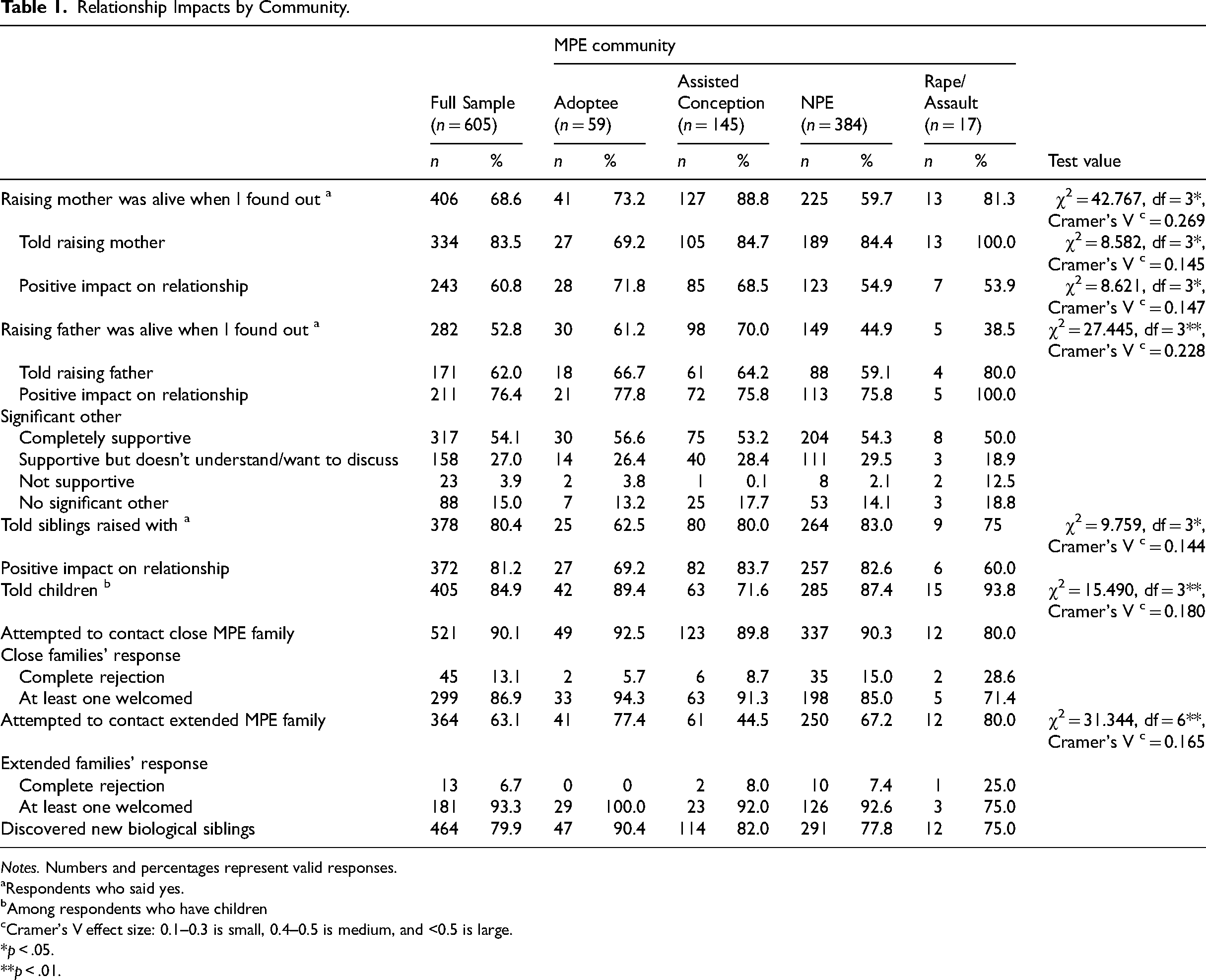
Table 1 provides an overview of family relationship impacts (Research Question 1) resulting from an MPE by community. Many people consider the family relationships they have nurtured from childhood to be the bedrock of their identity. MPEs can upend these family relationships and generate new ones. One interesting finding is that Adoptees were less likely to tell the mothers who raised them about their MPE discovery compared to other communities, and for Adoptees and Assisted Conception respondents, sharing their MPE news did not impact their relationships as much. There were some noteworthy differences in how an MPE impacted respondents’ relationships with the mother compared to the father who raised them. All groups were more likely to share their MPE with their raising mothers, but there were more positive impacts on their relationships with the fathers who raised them. About 40 percent of the respondents overall said their relationship with their raising mother was different or strained after sharing their news. Almost half of respondents (46 percent) were asked to keep their MPE a secret, with the mother who raised them making up the biggest proportion of those who asked them not to share (63 percent). There are two probable reasons for this finding. First, people conceived through assisted reproduction were asked at a much higher rate to keep the discovery a secret by their raising mothers (48 percent). This is likely due to the stigma surrounding male infertility. 36 Among Assisted Conception respondents, 89 percent of raising mothers were alive at the time of their discovery while only 70 percent of raising fathers were. A mother is likely honoring their deceased husband's wish not to tell and his reputation. NPEs were the next largest group whose raising mothers requested secrecy (25 percent). This is likely due to the manner of conception for many people with NPEs who are often the product of an affair. Women tend to feel more shame 37 and believe they will be more harshly judged for having an affair than men and therefore request secrecy.
Relationship Impacts by Community.
Notes. Numbers and percentages represent valid responses.
Respondents who said yes.
Among respondents who have children
Cramer's V effect size: 0.1–0.3 is small, 0.4–0.5 is medium, and <0.5 is large.
*p < .05.
**p < .01.
In terms of secrecy, the NPE and Assisted Conception communities were more likely to have been asked by someone to keep their MPE a secret. This harkens back to the literature that states that adoption practices are more open and carry less stigma than donor conception.
40
Men associate infertility with impotency and decreased masculinity, and therefore, may desire to hide the use of sperm provision due to stigmatization. However, infertility is still considered a “woman's issue” that tends to exclude men and burden women with the need to hide the family infertility.
41
One respondent shared that: (My) social parents carry significant shame and had planned to never reveal my and my twin brother's donor conceptions. They have asked us to not publicly share this information. My twin brother has no interest in our donor conceived status, and he has complied with my parents’ request. While I do not feel the need to be public about my identity, I am bothered that I am prevented to do so by others.
Respondents were much more likely to have a closer relationship with their raising fathers after sharing about their misattributed parentage. Some felt different from their father growing up but did not understand why. Knowing they were not genetically related to their raising father answered a lot of questions about why they felt this difference. The introduction of fertility issues into the relationship between DCP and raising fathers may be a reason why these respondents stated their relationship as different, but they still got along.
Sixteen percent of all respondents no longer speak with their raising mother and 14 percent with their raising father after learning about their misattributed parentage. The likely reason for people with an MPE to no longer speak to their raising parents varies, but a common explanation is that it is difficult to forgive the lie. This lie held by parents, sometimes for decades, can fester in a family. The parent–child relationship is based on trust and some with an MPE cannot forgive, or need time to forgive, their parents for lying about something so fundamental as who they are. Lie was a common word used when people narrated about their MPE journey. I felt anger, towards parents that raised me, for making me feel like my entire life was a lie.
This has been terrible. Tired of all the lies. I am finally in the early stages of accepting that my mom is a liar and moving on past that relationship.
About half (45 percent) of respondents were raised with people they believed to be full siblings and 80 percent told their siblings about their discovery; however, Adoptees were less likely to tell the siblings they were raised with. Although 10 percent no longer speak to the siblings they grew up with, a majority of people with an MPE experienced a positive or neutral impact on their relationships with siblings. Finding out I was conceived with donor sperm was a shock, but extremely validating. I have so much in common with my donor and donor siblings.
Just one respondent said they did not plan on telling their children about their MPE (85 percent had already told their children) and only a small minority of their children do not understand or were unhappy with the information (18 percent). One positive result relates to respondents’ relationships with their significant other, with very high percentages reporting that they felt supported. However, even when respondents indicated they felt supported by their significant other, about 20–30 percent reported their significant other did not want to discuss or did not seem to understand the MPE. Counseling for couples should be explored when one party has an MPE to help increase understanding surrounding the experience.
Interestingly, 43 percent of respondents said they had discovered another MPE in their family since their discovery. People with misattributed parentage often become quite familiar with building family trees and researching genealogy. When attempting to identify new genetic family, they use DNA matches. These matches can lead to discovering other instances of misattribute parentage. DTC DNA testing has blown open the closet of family secrets. I grew up with two siblings: we believed we were all full siblings even though my family was quite dysfunctional. As it turned out: l was “donor” conceived, one sibling was adopted and the other, a now half sibling with me, was the result of an affair. This news tore my family apart and l do not believe it will ever be repaired.
Almost all respondents attempted to contact their close biological relatives, and a large majority felt welcomed by at least one member; only 13 percent were fully rejected. Lower numbers of respondents attempted to contact extended biological relatives, and this was especially true for Assisted Conception individuals. Many sperm providers do not share with their families they provided sperm at some point in their life. The outdated societal idea that men can be “just a sperm donor” is reflected in extended family not showing an interest to interact with people conceived through assisted reproduction. People with an MPE often attempt to reach out to close relatives. If that does not prove successful, they then reach out to extended family; only 7 percent of extended family fully rejected the person with an MPE. Often extended family can be more comfortable speaking to a new family member because they are not close to the situation that created the unique circumstances of the person not knowing who their biological family is. Similar to close biological relatives, extended families had very high levels of acceptance (93 percent).
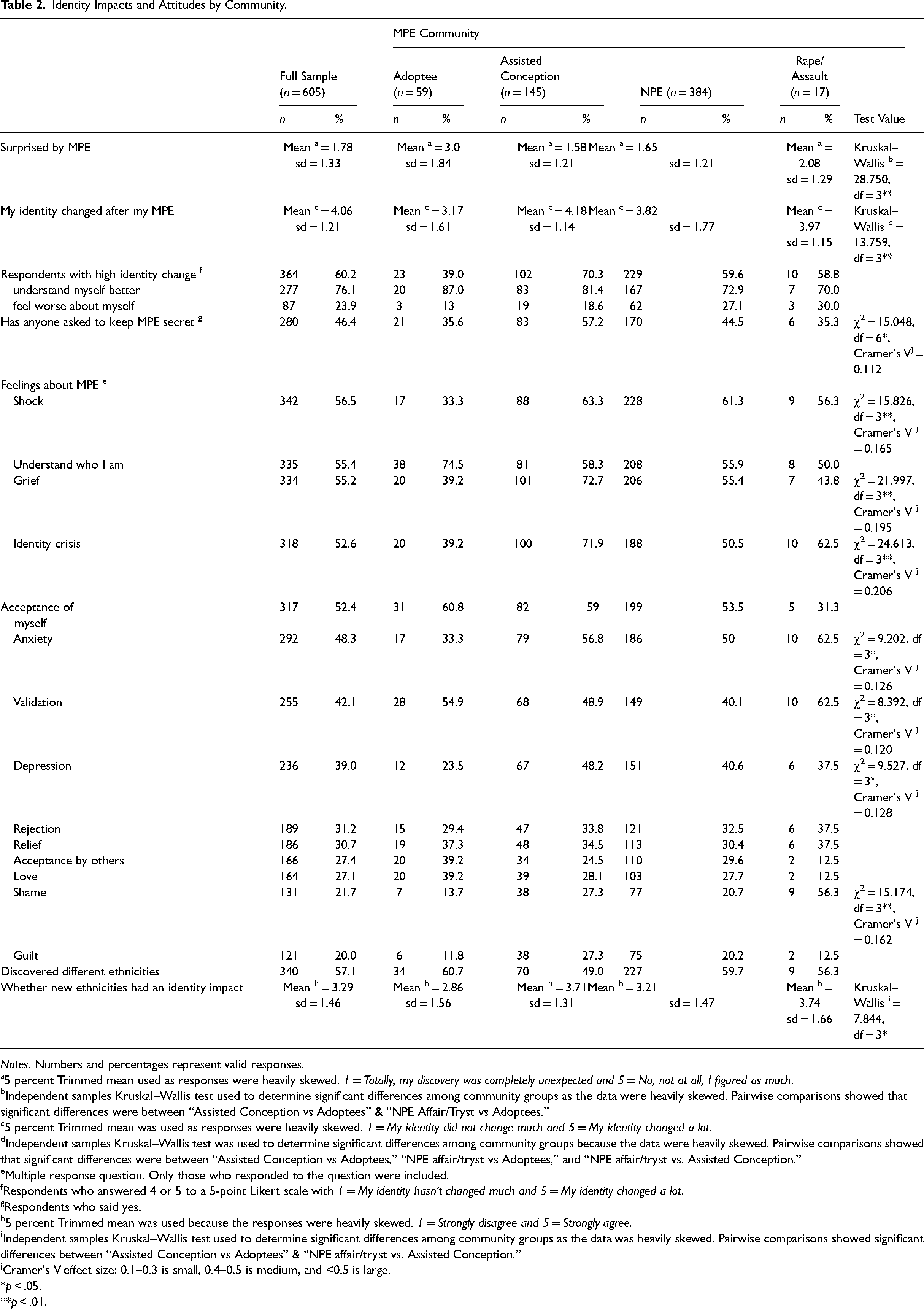
Table 2 sheds light on Research Question 2, which asks about identity impacts and attitudes arising from an MPE. There were significant differences among MPE groups in terms of whether their identity changed a lot, with Adoptees less likely to state that their identities were impacted. Among all respondents who answered that their identities changed a lot (responding 4 or 5 on a Likert scale with 5 = identity changed a lot), 76 percent felt that they understand themselves better. I am adopted and always wondered who I look like and if I had any siblings. Now I know I am one of four. It's been nice to put the pieces together and finally figure out a deeper understanding of myself. It's like they were missing puzzle pieces and now it all fits and makes sense. It's so nice to find people I share looks with and it's amazing how many similarities we all share!
Identity Impacts and Attitudes by Community.
Notes. Numbers and percentages represent valid responses.
5 percent Trimmed mean used as responses were heavily skewed. 1 = Totally, my discovery was completely unexpected and 5 = No, not at all, I figured as much.
Independent samples Kruskal–Wallis test used to determine significant differences among community groups as the data were heavily skewed. Pairwise comparisons showed that significant differences were between “Assisted Conception vs Adoptees” & “NPE Affair/Tryst vs Adoptees.”
5 percent Trimmed mean was used as responses were heavily skewed. 1 = My identity did not change much and 5 = My identity changed a lot.
Independent samples Kruskal–Wallis test was used to determine significant differences among community groups because the data were heavily skewed. Pairwise comparisons showed that significant differences were between “Assisted Conception vs Adoptees,” “NPE affair/tryst vs Adoptees,” and “NPE affair/tryst vs. Assisted Conception.”
Multiple response question. Only those who responded to the question were included.
Respondents who answered 4 or 5 to a 5-point Likert scale with 1 = My identity hasn’t changed much and 5 = My identity changed a lot.
Respondents who said yes.
5 percent Trimmed mean was used because the responses were heavily skewed. 1 = Strongly disagree and 5 = Strongly agree.
Independent samples Kruskal–Wallis test used to determine significant differences among community groups as the data was heavily skewed. Pairwise comparisons showed significant differences between “Assisted Conception vs Adoptees” & “NPE affair/tryst vs. Assisted Conception.”
Cramer's V effect size: 0.1–0.3 is small, 0.4–0.5 is medium, and <0.5 is large.
*p < .05.
**p < .01.
However, about a fourth (24 percent) felt that the discovery made them feel worse about themselves. Within a few minutes my whole identity as I knew it was swept away in a sea of lies and deception that had lasted 59 years. I was shattered, I didn’t want to believe it, but the evidence was there.
Adolescence is a critical time during identity formation; five of Erickson's eight stages of identity development occur before we reach adulthood.
38
Childhood lays the groundwork for identity formation in adolescence and early adulthood and by the end of early adulthood, when we can answer the questions of “Who am I” and “What is my place in this world,” we have formed our first sense of self, our identity. Our identity is therefore all our “successive identifications” from childhood and the impact of our relationships. When one has a DNA surprise, the “Who am I” portion of the identity one has formed is no longer valid. Identity does evolve throughout adulthood; however, learning that the information upon which one based the answers to what one's place in the world is not true can lead to an identity crisis. My health has definitely suffered with anxiety/panic attacks, depression and weight gain though these could also be partly due to the pandemic. The identity crisis is the hardest to deal with and my confidence and self-esteem have plummeted, and I feel alone more than ever.
Names are an important part of our identity because they provide us with cultural, familial, and historical connections. Many who have an MPE need to know the name of their genetic family to start to rebuild their sense of self. And some change or add to their name to solidify their new identity—6 percent of respondents changed their name after their discovery, and 20 percent said they were thinking about it. My family (husband, kids) wants to understand but doesn’t. They try to sympathize but just ask why are you looking further into it and torturing yourself? They don’t understand that not knowing things is the torture, the identity crisis part. I want to know where I come from now that it's different. Also want to know what my real last name should be.
Adoptees were more likely to not be surprised by their MPE compared to Assisted Conception and NPE groups. This is also reflected by the fact that Adoptees were much more likely to figure out they were adopted on their own (14 percent compared to 6 percent for Assisted Conception and 7 percent for people with an NPE) or their raising parent was more likely to tell them about their birth story. These results are likely due to more Adoptees knowing about their adoption at a younger age, which significantly reduced identity crises surrounding their adoption.
39
Being told about being adopted later in life is linked with increased psychological distress. As one respondent pointed out, Accidentally discovering my adoptee status in my thirties was shattering. I had always felt extremely out of place in my adoptive family but forced myself to ignore my misgivings and accept the lies. To do otherwise felt unsafe. The lack of authenticity in my relationships with myself and others negatively impacted my life in a devastating manner. I would not wish this on anyone.
Overall, there was a mix of emotions that arose from an MPE discovery, from negative ones (shock = 57 percent, grief = 55 percent, identity crisis = 53 percent, anxiety = 48 percent, depression = 39 percent) to positive ones (understanding of who I am = 55 percent acceptance of myself = 52 percent, validation = 42 percent, relief = 31 percent). Broken down by community, an interesting pattern emerges. There were several emotions that had significant differences among communities; however, even for those that were not significant, a general pattern exists. For negative emotions with the significant difference among groups—shock, grief, identity crisis, anxiety, and shame—there were lower percentages of Adoptees expressing these emotions compared to other groups. The Assisted Conception community, on the other hand, registered the highest proportion of people expressing negative emotions. I feel like I question my identity more and more every day and the older I get the more I wonder about my medical background. I feel lost and have a lot of grief. I wish I wasn’t DC even though I know it makes me who I am. I also wish I had known when I was younger. I feel like a lot of my childhood was a lie and it's hard to reconcile things I experienced with what I know to be true now.
Many negative feelings can be the result of genetic bewilderment arising from a questioned identity, a feeling of alienation, and a break in the parent–child relationship due to secrecy and lies. Lack of genetic mirroring in the childhood of a person with an MPE can lead to lower self-esteem and a feeling of disconnectedness from their raising family.
42
Often children can sense when something is being kept from them.
43
This can create a sense of self-doubt, fear, and anxiety and may lead to negative psychological issues as an adult.
44
People with an MPE may also feel a sense of betrayal by their raising parents who kept this secret from them.
45
Nothing has ever tested me as much as this journey. My relationships with my mother and father (who isn’t my biological father) have suffered immensely. They do not understand my pain or identity crisis. I have so much pain and anxiety surrounding my new biological father. My biological father knows about me but hasn’t told his wife or my half siblings because he fears she will leave him. I am stuck in the middle of everyone else's mistakes and shame. I simply want to be recognized as me, my true biological identity.
Conversely, Adoptees were more likely to express positive feelings such as understanding of who I am, acceptance of myself, acceptance by others, and love, while the NPE group reported the lowest incidence of positive feelings. For the past decade, 95 percent of adoptions have involved some level of openness. 46 This is reflected in the data showing that only 35 percent of Adoptees discovered they were adopted through a DTC DNA test, while 51 percent of those conceived through Assisted Conception and 79 percent of NPEs learned of their MPE through such tests. Further, more than half of the Adoptees indicated they knew about their birth story for more than 10 years or for their entire life; this was less than 30 percent for Assisted Conception and 11 percent for people with an NPE. This means that Adoptees have less of a shock because they have often had more time to process their MPE. Hedonic adaptation indicates that over time reactions to negative life events tend to even out, even though at a slower rate than to positive events. 47
Discovering one is the product of an affair, tryst, or other sexual encounter that resulted in hidden or unknown paternity can be difficult to process due to the stigma surrounding illegitimacy and extramarital affairs which still persists today. The majority (63 percent) of people with an NPE reported learning of their birth story within the past two years. The fact that these discoveries are so new for people with an NPE indicates they are still processing their discovery, which is likely why the data show lower incidences of positive feelings.
Positive feelings are likely the result of people with an MPE finally understanding why they did not quite fit in their raising family. Genealogical bewilderment, the feeling of not understanding why you differ from your raising family, is central to the development of a child's sense of self.
48
People who feel they do not fit in wonder why they are different from their raising family and often conclude something is wrong with them. Discovery of an MPE helps people understand why they felt they did not belong with their raising family and their personality traits, mannerisms, and abilities begin to make sense. As one respondent explained, “I would have not been so hard on myself for not fitting in if I had known it was just different DNA.” Another states, My biological father never knew about me and accepted me unconditionally from day one. My biological father's wife whom I call my bonus mom has also loved and accepted me unconditionally from day one. I am glad that I know my truth. My biological father was my missing puzzle piece and answered why I never fit in with my maternal siblings growing up and as adults. I finally have closure and understanding.
Because a DTC DNA test often includes race/ethnicity information, many (57 percent) respondents discovered ethnicities that were different from what they were raised to believe, with Adoptees reporting less impact from this information compared to the other groups. Our ethnicity is a significant aspect of what shapes our sense of identity,
49
and discovering different ethnicities can impact one's identity. I am now Irish, rather than Scots and Swedish. This may not seem like much, but for me it has been a big deal. It has affected how I see myself, what holidays I notice and authentically celebrate, how I view my talents, and how I view my family.
An analysis was done comparing those who identified as “White only” before they took the DNA test to those to who found an unexpected race/ethnicity and added to their racial identification after the test results came back. Individuals who changed identification to White plus another category were significantly more likely to feel accepted by others than those who remained White only (42 percent vs 28 percent, χ2 = 3.560, df = 1, p < .05). They were also significantly more likely to feel validated (61 percent vs 43 percent, χ2 = 4.442, df = 1, p < .05). I have lived only one side of myself culturally my whole life and missed out on another culture, that was huge! I still don't know how to process living the other culture. (From a person who was raised ethnically European and discovered she was half Black.)
This feeling of validation likely stems from the fact that people with large ethnicity shifts spent their life trying to fit into a family identity that felt out of place. Although within the family unit, they felt like they belonged; their difference in appearance often explained as taking after a great-grandparent who had a different ethnicity. However, once the person stepped outside their protected family unit, they were often not accepted by society as the ethnicity they claimed to be. This led to confusion and lack of understanding about their treatment and furthered their sense of not belonging in their family unit. 50 Once a DTC DNA test confirmed they were of a different ethnicity than they were raised to believe, this helped them understand the treatment they received and validated their feelings of not belonging.
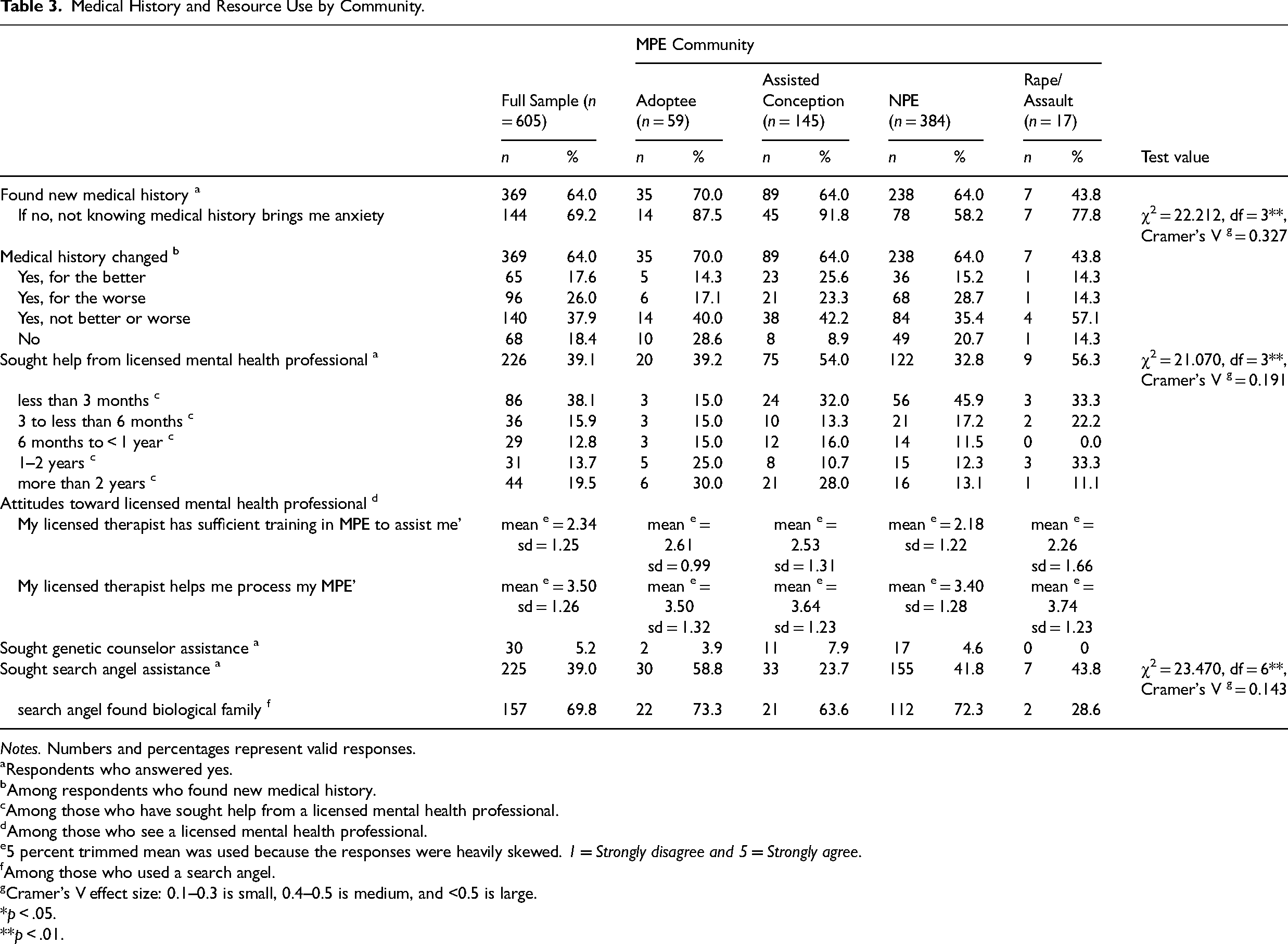
Table 3 sheds light on Research Question 3, which focuses on medical history and resource use. Family history is usually the source of one's medical history. An MPE calls all this into question. Not knowing about their medical history was a source of anxiety for a substantial majority of respondents, and about a quarter of those who learned something new medically said their medical history changed for the worse. It can be a difficult conversation with one's physician when you tell them half of your medical history is no longer valid and you are not sure what it is. Medical forms often do not have means of relaying an MPE to your doctor's office and should be updated. It continues to be very devastating, but I am learning to accept it. It's embarrassing to have to correct my medical records with “unknown” and try to explain why the change is happening now.
Medical History and Resource Use by Community.
Notes. Numbers and percentages represent valid responses.
aRespondents who answered yes.
bAmong respondents who found new medical history.
cAmong those who have sought help from a licensed mental health professional.
dAmong those who see a licensed mental health professional.
e5 percent trimmed mean was used because the responses were heavily skewed. 1 = Strongly disagree and 5 = Strongly agree.
fAmong those who used a search angel.
gCramer's V effect size: 0.1–0.3 is small, 0.4–0.5 is medium, and <0.5 is large.
*p < .05.
**p < .01.
I learned my biological father died from kidney disease, which I have since found he passed on to me and one of my children. The severity of it in me could have been slowed down by different medical treatments if I’d have known earlier.
One finding that has major implications for coping with MPE is that only 39 percent sought help from a licensed mental health professional, with more Assisted Conception and Rape/Assault groups seeking help compared to other groups. Those who sought help gave their therapist an average score (M = 3.50, SD = 1.26) for helping them process their MPE, but evaluated therapists lower (M = 2.34, SD = 1.25) when asked if they felt their therapists had sufficient training to help them. Additional training for therapists in how to treat people with an MPE is required.
A little less than half of participants (39 percent) used a Search Angel to find their genetic family, with Adoptees more likely to use the resource. A Search Angel is someone who helps an individual identify their genetic family for free. This is useful for someone with an MPE because it can be a steep learning curve to understand one's DNA matches to identify genetic family.
Only 5 percent had sought the assistance of a genetic counselor; 17 percent indicated they wanted to but had not, were not sure where to start, or it was not covered by their insurance. Since not knowing one's medical history caused a vast majority anxiety, more needs to be done to make genetic counseling available.
Other resources that could be useful to individuals with MPE are technology-based, such as peer-led support groups usually found on Facebook and information sources like podcasts. Respondents rely heavily on their Facebook support groups, with 66 percent stating that they access their group at least once a day. Respondents felt strongly that Facebook groups help them process their MPE (M = 4.22, SD = 1.13).
Use of the digital tools to address mental health concerns has grown rapidly over the Covid-19 pandemic due to the temporary waiving of U.S. regulations 51 and easy access and lower costs as well as fear of medication/hospitalization. An online support group connects people to others with a similar experience. People with mental health issues benefit from participating in these groups due to increased feelings of social connectedness and benefit from sharing their stories and learning coping strategies from others with a similar issue. 52 Risks associated with online peer groups include privacy concerns, receipt of misleading or inaccurate information, and exposure to possibly hostile interactions. Although more research needs to be done on the effectiveness of peer-led groups versus traditional therapy, some studies concerning therapist-led groups versus peer-led groups indicate comparable outcomes. 53
About a third (33 percent) of respondents listen to podcasts to help process their MPE and those who did felt strongly (M = 4.65, SD = 0.91) that listening to other people's stories helped them process their MPE. The top podcasts were: NPE Stories; Family Secrets; Sex, Lies, and the Truth; Everything's Relative with Eve; Cutoff Genes; and Half of Me. People are turning to podcasts to help with mental health issues, especially young adults. 54 Listening to podcasts on a topic relevant to the listener can help to gain knowledge and understanding as well as reduce stigmatization and increase a sense of belonging. 55 Podcasts also help listeners to find a greater sense of meaning and social gratification. 56
Conclusion
Direct-to-consumer DNA tests have led to new directions in how family is defined. The phenomenon of MPEs arising from DTC DNA tests has raised social debates regarding individuals’ right to know their genetic kin, leading to ongoing policy debates. For many who discover MPEs, these have significant effects on their relationships with raising families and create new possibilities with biological families. Their life course is also often renegotiated due to identity shock and revelations about their medical histories. The goal of this paper was to shed light on the experiences of different MPE communities who belong to Facebook support groups. Overall, our findings reveal significant differences among MPE communities. Adoptees were more likely to have positive feelings and experienced less identity shock than other communities. The Assisted Conception community, on the other hand, registered the highest proportion of people expressing negative emotions. MPE and Rape/assault groups were less likely to have had positive relationships with their raising mothers after an MPE. Even though the sample was heavily skewed toward Whites and females, this study underscores how different communities experience an MPE. The differences and similarities are important to consider as social policy on MPEs is being negotiated so that more targeted and appropriate counseling can be offered to individuals who have been affected by an MPE discovery.
Limitations
The first limitation of the study is it is not representative of the entire MPE community. Because the study sample was recruited through Facebook support groups, it is not generalizable to those who are not part of this social media platform. This is reflected in our sample which is predominantly White and female, which means that more purposive sampling might be needed for future studies to capture the experiences of male/nonbinary individuals and people of color. The second limitation is the small sample size of the Rape/Assault community. This community will also need to be recruited more strategically for future studies. The third limitation is the nature of sampling implies that our respondents could be more technologically savvy compared to individuals who do not have social media accounts. Specifically, there may be individuals who use face-to-face support groups to cope with an MPE. This population could be different from those who use mediated online support groups.
Footnotes
Data availability statement
The data that support the findings of this study are available on request from the corresponding author, BL. The data are not publicly available because they contain sensitive information that could compromise the privacy of research participants. West Chester University Institutional Review Board Approval #: IRB-FY2021-153.
Declaration of Conflicting Interests
The author(s) declared no potential conflicts of interest with respect to the research, authorship, and/or publication of this article.
Funding
The author(s) received no financial support for the research, authorship, and/or publication of this article.
