



Abstract
Large stockpiles of unsubmitted sexual assault kits have been discovered across the United States and are disproportionately concentrated in predominantly Black communities. Recent testing of stockpiled sexual assault kits and reopening sexual assault “cold cases” for reinvestigation and prosecution created a second opportunity for justice through the criminal legal system for some sexual assault survivors. This study explored survivors’ decision-making regarding re-engagement with the criminal legal system. Researchers conducted qualitative semi-structured interviews with 32 sexual assault survivors who chose to participate in the reinvestigation and prosecution of their case following a victim notification. Most participants were Black or African American women (88%). Motivations for re-engagement included a desire to prevent future harm, seek personal justice, and find closure. Concerns about re-engagement included fears about safety and the potential emotional toll of the reinvestigation and prosecution. These findings hold implications for how jurisdictions conduct victim notifications and the need for confidential, community-based advocacy to help survivors navigate the decision to re-engage. Police jurisdictions should prioritize testing both current and previously unsubmitted sexual assault kits and ensure that survivors are empowered to make informed decisions regarding their re-engagement in the legal process.
Sexual assault is a serious form of interpersonal violence that often results in significant negative effects to the health and well-being of those who have been assaulted (Dworkin et al., 2017; Jina & Thomas, 2013). To address these negative consequences, survivors may turn to multiple systems for support in their communities, including the police. Survivors may report to police for a number of reasons, including pursuing redress through the criminal legal system, keeping oneself or others safe, or simply seeking help in an emergency (Brooks-Hay, 2020).
Although police are expected to address these needs, survivors who report to police are often met with a retraumatizing process (Lorenz et al., 2019). Police not only tend to discredit and disbelieve sexual assault survivors (Campbell, 2008), but also routinely invest minimal investigatory effort into sexual assault cases (Jurek et al., 2021; Shaw et al., 2016). Less than 25% of all sexual assault cases reported to police result in an arrest (Morabito et al., 2019; Richards et al., 2019). Furthermore, even if an arrest is made, police refer very few sexual assault cases to the prosecutor's office (Lonsway & Archambault, 2012; Spohn & Tellis, 2014). A key reason for this precipitous case attrition is that police close cases without conducting a full investigation or using all available evidence (Jurek et al., 2021; Morabito et al., 2019; Shaw et al., 2016; Spohn & Tellis, 2014). As a result of these investigative choices, sexual assault is one of the most underprosecuted crimes in the United States (Lonsway & Archambault, 2012).
In recent years, the persistent efforts of sexual assault survivors, activists, and advocates have led to the reopening of sexual assault “cold cases” for reinvestigation and prosecution, giving some survivors a second chance to seek justice through the criminal legal system (Campbell & Feeney, 2023). However, there has been little research on why survivors would choose to re-engage with the criminal legal system after it failed to provide safety, accountability, or justice. In the current study, we explored survivors’ decisions to re-engage with the criminal legal system through the reopening, investigation, and prosecution of sexual assault cold cases.
An Intersectional Feminist Analysis of Police Responses to Sexual Assault
During the investigation of a sexual assault, there are multiple investigatory steps a detective can take, such as sending evidence technicians to the crime scene, taking victim and witness statements, and conducting suspect lineups or interviews. However, police often take few of these actions—an average of 3–10 possible investigatory steps according to one study (Shaw et al., 2016). In most sexual assault cases, no sworn statement was taken from the victim (70%), no physical evidence was collected from the crime scene (83%), and no suspect was investigated (61%; Jurek et al., 2021). Even in cases where survivors have gone through the highly invasive process of having forensic evidence collected through a medical forensic exam, police frequently do not submit the completed sexual assault evidence kit to a forensic laboratory for analysis (Valentine et al., 2019). In most sexual assault investigations, police do not pursue all possible investigatory steps prior to “clearing” a case (i.e., closing the case or referring it for prosecution; Shaw et al., 2016).
Feminist scholars have long attributed these patterns of minimal investigatory effort by police in sexual assault cases to the pervasiveness of societal stereotypes and myths regarding what constitutes a “real rape”—typically a sudden, violent attack by an unknown man (Estrich, 1987; Lonsway & Fitzgerald, 1994). The extent to which police see a victim as credible and sympathetic is also based on racist, sexist, and classist stereotypes, such that police action may be reserved for White, middle- or upper-class women who are perceived as morally upstanding (Estrich, 1987; Lonsway & Fitzgerald, 1994). For example, in interviews with detectives, Spohn and Tellis (2014) noted that detectives described some survivors as “righteous victims” (p. 54) who deserved legal protection and a full investigation; however, detectives viewed many women who reported sexual assault as being less deserving of their time and investigatory efforts because they engaged in behaviors like alcohol use at the time of the assault.
Black feminist scholars in the United States have emphasized that Black women and other women of color face particular mistreatment and delegitimization in their interactions with the legal system because they embody the intersections of multiple systems of oppression (i.e., they experience racism, sexism, and classism simultaneously; Crenshaw, 1989; Wallace et al., 2024). The historical context of slavery and anti-Blackness in the United States has contributed to Black women's uniquely racialized experiences of rape (Crenshaw, 1989). For much of US history, Black women were considered “unrapeable” by White society, which viewed them as inherently unchaste and sexually promiscuous (Collins, 2014; Crenshaw, 1989). Black feminists posit that the criminal legal system's treatment of Black women reflects longstanding racist, sexist, and classist policies and societal beliefs about who can be a “real victim” of rape (Collins, 2014; Crenshaw, 1989). Indeed, a study of police justifications for inaction during sexual assault investigations found that police were more likely to label Black victims as “uncooperative” compared with White victims, which then resulted in police taking fewer investigative steps in their case (Shaw et al., 2016). An intersectional reading of these findings suggests that Black women are uniquely likely to have no further action taken on their cases.
Sexual Assault Survivors’ Experiences During Police Investigations
Not only are sexual assault cases typically closed with minimal investigatory effort, but the reporting and investigation processes are retraumatizing for survivors (e.g., Campbell, 2008). Survivors must recount what happened to them multiple times and are asked numerous and invasive questions (Campbell, 2008; Lorenz et al., 2019). During this process, police often express disbelief the assault occurred, question whether the assault was nonconsensual, and blame the assault on the survivor (Campbell, 2008; Lorenz et al., 2019). For example, in a qualitative study of 28 survivors’ experiences with police, survivors described dismissive statements from police about lacking evidence to pursue the investigation or asking victim-blaming questions such as why they accepted alcohol from the perpetrator prior to the assault (Lorenz et al., 2019). Police also commonly discourage the survivor from making a report or are reluctant to take a report (Campbell, 2008).
Negative interpersonal interactions with police may be exacerbated for survivors who are marginalized based on race, class, and engagement in criminalized behaviors like sex work or substance use (Campbell & Fehler-Cabral, 2018; Lorenz et al., 2019; Spohn & Tellis, 2014). For example, in a qualitative study of survivors’ and their informal support networks’ experiences with police, participants described police treating survivors in a discriminatory manner based on classist and racist biases (Lorenz et al., 2019). One participant attributed the lack of police assistance to their socioeconomic status (“they felt these people deserved less police attention than other people do,” Lorenz et al., 2019, p. 276). Another participant attributed the dismissive response she received to the racial biases of the criminal legal system (Lorenz et al., 2019). Survivors who engaged in sex work and/or drug use at the time of a sexual assault were particularly likely to face disbelief from police (Shaw et al., 2016). In sum, most survivors characterize their experiences during sexual assault investigations as negative and retraumatizing, and this is particularly the case for survivors who are multiply marginalized.
Betrayal, Untested Sexual Assault Kits, and the Reopening of Sexual Assault Cold Cases
When police treat survivors in a victim-blaming and retraumatizing manner and fail to fully investigate their cases, survivors may feel deeply betrayed by the criminal legal system (Smith et al., 2014). This sense of betrayal is particularly acute when they later learn that police never submitted their sexual assault kit for forensic testing (Bach et al., 2022; Campbell et al., 2018). Police routinely shelve sexual assault kits without testing them, resulting in an estimated 300,000–400,000 unsubmitted kits stockpiled across the United States (Strom et al., 2021; Strom & Hickman, 2010). When survivors learn years later that their sexual assault kit remains untested, many feel that the trust they had placed in the system has been broken (Bach et al., 2022; Campbell et al., 2018).
This pattern of judicial betrayal disproportionately affects Black women. Some of the largest stockpiles of sexual assault kits have been found in major urban centers in which large proportions of the population face systemic disinvestment and socioeconomic marginalization, such as New York, Detroit, Houston, Cleveland, and Los Angeles (Campbell & Fehler-Cabral, 2018; Lovell et al., 2023; Strom et al., 2021). In these cities, most survivors with untested sexual assault kits are economically marginalized women, a substantial proportion of whom are Black (Lovell et al., 2023). In other words, the burden of “justice denied” (Strom & Hickman, 2010, p. 382) due to untested kits largely falls on Black women. The disproportionate concentration of these stockpiles in predominantly Black communities aligns with Black feminist theories of Black women being disregarded as legitimate victims of sexual violence (Crenshaw, 1989; Wallace et al., 2024).
In recent years, some survivors have been offered a second chance to seek justice through the criminal legal system in the form of reopened sexual assault “cold cases” that have resulted from national and state initiatives to address the problem of untested sexual assault kits (Campbell & Feeney, 2023). In testing previously submitted sexual assault kits, jurisdictions nationwide have found that numerous closed sexual assault criminal cases could potentially be reopened for reinvestigation and prosecution due to new forensic evidence from these kits (Campbell & Feeney, 2023). Given survivors’ prior betrayal by the criminal legal system, it is important to understand how they respond to the reopening of their cases and opportunity to re-engage with the criminal legal system years or decades later.
Research examining survivors’ responses to the choice to re-engage with the criminal legal system is minimal. Preliminary studies of victim notification, or the process of notifying survivors that their sexual assault kits had not previously been tested, suggest that survivors’ decisions about participating in the reopening of their sexual assault cases are emotionally fraught (Busch-Armendariz et al., 2015; Regoeczi & Wright, 2016). In one early study in Houston, Texas, survivors described facing a moral dilemma of weighing their reluctance to revisit the trauma of their assault against wanting to protect others who could be harmed by their perpetrator (Busch-Armendariz et al., 2015). These survivors ultimately chose to move forward with the reinvestigation to seek justice and protect others from experiencing similar harm.
In another study in Cleveland, Ohio, victim advocates indicated the decision to re-engage was similarly difficult for survivors. They reported that some survivors chose not to re-engage because they did not want to bring up their past trauma, were afraid of retaliation from the perpetrator, or felt shame and self-blame about the assault (Regoeczi & Wright, 2016). Victim advocates also stated survivors who participated in the reinvestigation of their case did so to hold the perpetrator responsible, seek justice, speak their truth about the assault, gain closure, or access counseling and advocacy services as part of the reinvestigation process.
To date, research on survivors’ choices to re-engage in sexual assault cold cases has lacked specificity regarding the racial composition of participants. In one exception, a study of survivors’ responses to victim notification was conducted in Detroit, Michigan with a predominantly African American sample (77% of participants; Campbell et al., 2018). This study relied on proxy data collected from detectives who recorded detailed information about survivors’ emotional reactions to the notification and decisions about participating in the case. Out of 33 survivors, over half (57%) decided to re-engage with the criminal legal system and pursue the investigation and prosecution of their case. However, detectives did not record information about survivors’ stated reasons for re-engaging or choosing not to re-engage.
Thus, early studies of victim notification have suggested the decision to re-engage with the legal system is a complicated and emotionally laden one. Survivors must weigh the potential personal costs of re-engagement with their desires to prevent future harm and achieve justice for what happened to them. However, extant research has frequently relied on proxy data from advocates, law enforcement, or prosecutors (Campbell et al., 2018; Regoeczi & Wright, 2016). Furthermore, in the only known study to report the race of participants who were notified about an untested sexual assault kit (i.e., Campbell et al., 2018), a sociocultural analysis of survivors’ decision-making was lacking. Given that many police jurisdictions have begun attempting to remedy kit backlogs and reopen sexual assault cold cases (Campbell & Feeney, 2023), more robust research on survivors’ decisions regarding re-engagement in sexual assault cold cases is warranted to generate knowledge that can inform practice and policy.
Current Study
We used a qualitative research design to explore survivors’ decisions to re-engage with the criminal legal system after being notified that their untested sexual assault kit had finally been tested and their case was eligible for reinvestigation. We collected data in a large, urban, predominantly Black community that has faced decades of disinvestment and resource depletion (Campbell et al., 2015). In 2009, over 11,000 untested sexual assault kits were discovered in police evidence storage facilities in this jurisdiction, including cases dating back to the 1980s (Campbell et al., 2018). Information about the victims was not available for all kits; however, in studies of subsamples of 1,600 and 400 kits from this backlog, approximately 80.6% and 81.4%, respectively, were collected from Black women (Campbell et al., 2015; Michigan Domestic and Sexual Violence Prevention and Treatment Board, 2012).
We sought to center the experiences of these women who had been subjected to disbelief and betrayal by the criminal legal system through an in-depth exploration of their decision-making related to re-engaging with the criminal legal system. This is particularly valuable because the perspectives of Black women are often subject to epistemic exclusion in research, including in literature on sexual violence (Kelley, 2023). Because Black women face unique oppression by the criminal legal system and have been disproportionately represented among women with untested sexual assault kits, this study offered an opportunity to understand why survivors re-engaged with the legal system from the perspective of those most affected.
We examined both motivations and hesitations surrounding re-engaging among survivors who chose to move forward with the reinvestigation and prosecution of their case. We also explored whether aspects of the assault and information shared with the survivor during the notification may have affected survivors’ decisions to re-engage. We sought to answer two exploratory research questions:
What were survivors’ motivations for re-engaging with the investigation and prosecution of their case after being notified about their previously untested sexual assault kit? How did assault and notification characteristics influence these motivations? What were survivors’ concerns about re-engaging with the investigation and prosecution? How did assault and notification characteristics influence these concerns?
Method
Research Design
The research design for this study involved a secondary analysis of qualitative interviews conducted as part of a larger study with N = 32 sexual assault survivors who were assaulted in Detroit. The purpose of the original study was to examine survivors’ experiences with victim notification and subsequent experiences during the reinvestigation and prosecution of their cold cases (see Campbell et al., 2022). This project was a continuation of our research team's decade-long partnership with law enforcement, victim advocates, and other practitioners in Detroit as they have tested the city's previously unsubmitted sexual assault kits and notified victims about the possibility of reopening their sexual assault cases. Detectives from the prosecutor's office attempt to locate the survivor and make initial contact, during which they are instructed to explain that the survivor's kit was not originally tested, that it has now been tested, and that there is a possibility of reopening the case for reinvestigation and prosecution. Shortly after detectives conduct this victim notification, community-based advocates from a local sexual assault organization call the survivor to see if they want to schedule a follow-up meeting, during which detectives take a new statement from the survivor and provide information about the case. Our research team worked closely with this sexual assault organization as our community partner throughout the current study.
Recruitment
For the original study from which these data were drawn, our research team created a set of eligibility criteria based on the focal research questions regarding experiences with victim notification, reinvestigation, and prosecution of sexual assault cold cases. The survivors’ names and contact information could not be shared with the research team because of our community partner's confidentiality requirements. Instead, given that advocates employed by our community partner had already worked closely with these survivors, the research team contracted with these advocates to conduct all outreach and recruitment for this study. Survivors were eligible to participate in an interview if: (1) they were 18 or older at the time of the interview; (2) they were sexually assaulted in Detroit, filed a police report, and had a sexual assault kit collected; (3) the kit was part of the backlog of untested kits that were eventually submitted for testing; (4) following testing, their case was eligible for reinvestigation and prosecution; (5) the survivor had agreed to participate in the reinvestigation and prosecution of their legal case; and (6) their case had been adjudicated and closed at the time of the interview. Recruitment for this study took place over 20 months from 2019 to 2020, prior to the outbreak of the COVID-19 pandemic. One hundred twelve survivors met the eligibility criteria. The research team developed a detailed recruitment protocol for advocates to follow, in which advocates contacted survivors, explained the study details, and scheduled an interview if the survivor was interested.
The group of eligible study participants was hard to reach due to factors such as phone number changes and inconsistent phone service. Despite multiple attempts at contacting survivors, advocates were unable to contact 68 survivors (60.7% of all eligible survivors). There was a significant difference in advocates’ ability to contact survivors depending on the outcome of the survivor's legal case. Survivors whose cases ended in an acquittal/not guilty verdict were significantly less likely to be reachable than those whose cases ended in a conviction or guilty plea, χ2(2, 112) = 7.85, p = .020. Specifically, 12.5% of the eligible survivors whose cases ended in an acquittal were reached, as compared with 44.3% of the eligible survivors whose cases ended in a conviction or plea. Of the 44 survivors who advocates successfully contacted, N = 32 agreed to participate and completed an interview (28.6% of all eligible survivors). Of these 32 participants, only one (3.1%) had a case that resulted in acquittal; the cases of all other participants (96.9%) ended in a conviction or guilty plea.
Participants and Procedures
The final group of participants consisted of 32 sexual assault survivors (see Table 1 for detailed participant demographics). All participants identified as women, including one transgender woman. Most participants were Black or African American (n = 28, 87.5%); three participants were White (9.4%), and one participant identified as multiracial (3.1%). Participants’ ages ranged from 25 to 60 years old (Mdnage = 40.50 years old). Most participants had some college or trade school education (37.5%) or had a high school diploma or less (31.3%). Information regarding participants’ income was not collected in the original study. Because the focal population was survivors with previously untested sexual assault kits, on average, participants had been assaulted 18.50 years prior to recruitment for the study (SD = 6.36, range: 6–28 years). Most participants (87.5%) were adults at the time of the assault; four were assaulted when they were adolescents.
Participant Demographics and Case Disposition.
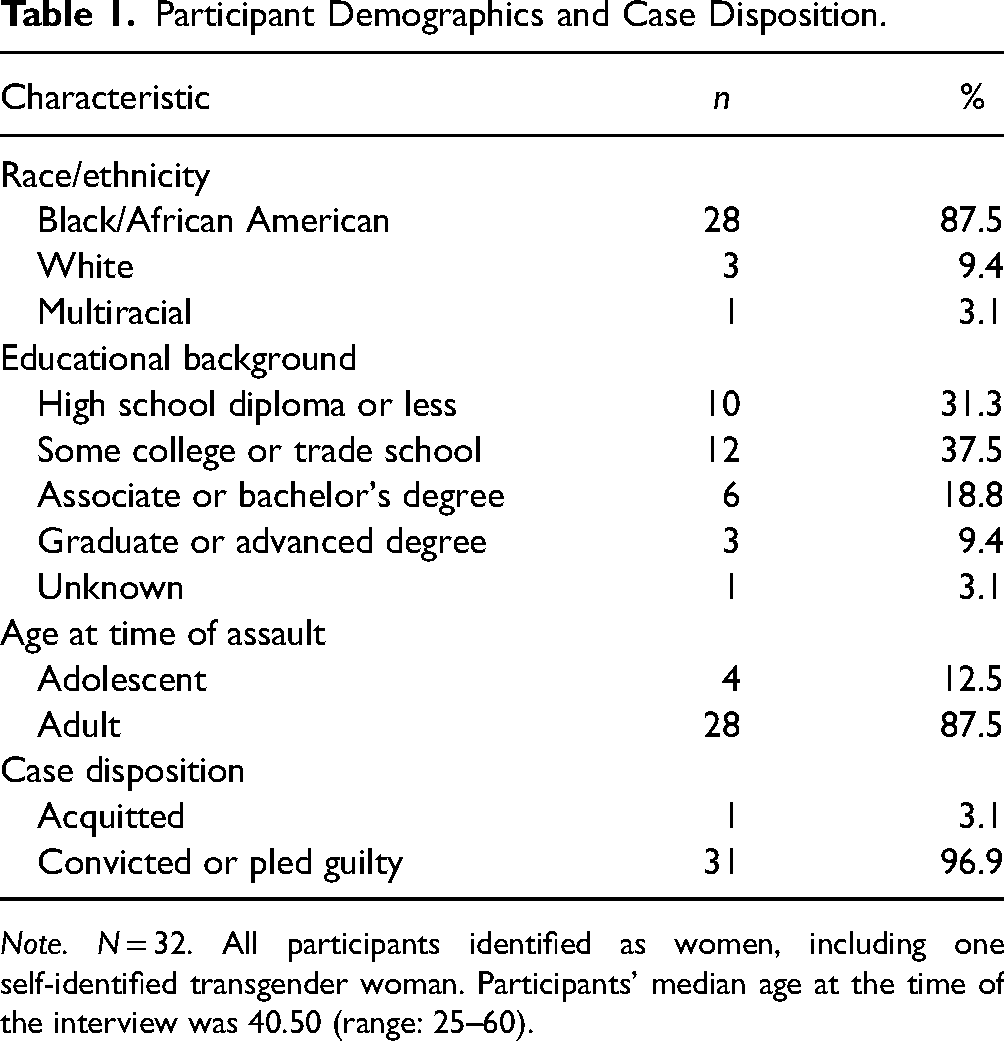
Note. N = 32. All participants identified as women, including one self-identified transgender woman. Participants’ median age at the time of the interview was 40.50 (range: 25–60).
All study procedures were reviewed and approved by the IRB of Michigan State University. All interviews were conducted by advanced graduate research assistants (including the lead author and analyst of the current study) who had been trained by the principal investigator in trauma-informed and culturally competent qualitative interviewing, as well as the history of sexual assault kits and police responses to sexual assault in Detroit. Interviewers included three White women and one African American woman (see Campbell, Goodman-Williams, et al., 2023 for our research team's full positionality statement). We conducted mock interviews with one another and with advocates from our community partner prior to conducting study interviews. The research team met weekly throughout the data collection period to review interview transcripts, receive interviewing feedback from the principal investigator, and debrief on emotional responses to interviews as well as emerging topics for analysis.
Survivors who agreed to participate were scheduled for a phone or in-person interview; in-person interviews were held at our community partner's main office. Advocates informed participants that they would receive $50 in compensation and that the interview would last approximately 1–2 hr. At the beginning of the interview appointment, the interviewer reviewed the study's informed consent document and obtained the participant's verbal consent. All participants consented to audio recording. Compensation was provided prior to starting the interview for in-person interviews or immediately following the interview for phone interviews via the participant's payment method of choice. All participants were also offered a community resource guide and advocates were available in person or via phone if participants became distressed during the interview; however, no participant requested to talk with an advocate during or after their interview. Research assistants audio-recorded the interviews and uploaded the audio files to Rev.com, an online transcription service, for transcription. Interviews lasted 79.84 min on average (SD = 30.78; range 36–171 min). Interviewers reviewed all transcripts for accuracy and redacted personal identifying information prior to analysis.
Interview Guide
We used a semi-structured qualitative interview protocol to guide the interviews with participants. Sections of the protocol included information about the sexual assault, disclosure, and help-seeking experiences immediately after the assault, experiences with victim notification after the kit was finally tested, participants’ decisions to re-engage with the criminal legal system, and participants’ experiences with reinvestigation and prosecution (see Campbell et al., 2022 for the full interview protocol). For the current study, we focused on participants’ responses related to their decisions to re-engage with the criminal legal system. Open-ended interview questions used in this study's analysis included “How did you feel about moving forward with an investigation right after you were notified?” “What factors helped you to decide to re-engage in the investigation and prosecution?” and “What were your concerns about participating? How were those concerns addressed?” We used additional unstructured probes to understand participants’ feelings, motivations, and concerns regarding their decision to re-engage. Data from these interview questions and probes that formed the data corpus for this manuscript have not been included in any other published analyses (Campbell, Gregory, et al., 2023; Campbell, Engleton, et al., 2024; Campbell, Gregory, Engleton, et al., 2024; Campbell, Gregory, Goodman-Williams, et al., 2024; Engleton et al., 2024).
In addition to data segments related to these focal questions, we also examined sections of the interview pertaining to the assault and victim notifications. We extracted and dichotomized key characteristics that prior literature has suggested may influence survivors’ reactions to victim notification: victim–offender relationship (i.e., whether the assailant was a stranger or was known by the survivor) and time since the assault (whether less than 10 years vs. 10 or more years had passed between the assault and notification). This time cutoff was selected because prior research has found that survivors’ emotional responses to victim notifications varied depending on whether the assault was relatively recent (i.e., less than a decade prior; Campbell et al., 2018). In this state, the statute of limitations for most criminal sexual conduct (i.e., sexual assault) cases is set at 10 years (Michigan Code of Criminal Procedure, 1927/2018), making cases more than 10 years old more complex to prosecute. It stands to reason that this increased complexity may have influenced how police and prosecutors discussed the case with survivors during the notification, and thus may have impacted survivors’ decision-making.
In this group of participants, 23 survivors (71.8%) were assaulted by strangers and nine survivors (28.1%) were assaulted by someone they knew. Nine survivors (28.1%) were notified within 10 years of the assault, whereas 23 survivors (71.8%) were notified 10 years or more after the assault. Based on our initial review of the data for other potentially salient factors, we also explored whether the survivor was told the assailant was a serial sexual assailant (yes/no) and whether the assailant was already incarcerated at the time of the notification (yes/no). Twenty-five survivors (78.1%) were assaulted by a serial sexual assailant. Fifteen survivors’ assailants (46.9%) were already incarcerated at the time of the notification.
Data Analysis
Our analysis was rooted in a pragmatic but constructivist-inclined epistemological approach. This meant that we assumed participants’ interview responses reflected their lived experiences of the assault and their post-assault help-seeking interactions with the criminal legal and medical systems. We used an inductive qualitative approach, drawing on Miles et al.'s (2020) set of detailed analytic practices. Miles et al. (2020) outline a pragmatic and technical approach to qualitative analysis in which a consistent set of analytic steps can be applied to a range of qualitative research designs. The first phase of this process is data condensation, which involves selecting, focusing, and synthesizing the data through iterative coding processes (Miles et al., 2020). In this phase, we identified all data that pertained to decision-making about re-engagement. We then applied inductive descriptive codes (i.e., codes that briefly summarize the basic content of a data segment) across all text segments. We synthesized these descriptive codes into explanatory pattern codes. Pattern codes focused on motivating factors and concerns in survivors’ decisions to re-engage. For example, the descriptive codes, “hesitant about seeing assailant” and “having to relive the assault” became part of a larger pattern code, “concerns about emotional distress of re-engaging.”
Data display, the second phase of Miles et al.'s (2020) analytic framework, involves comparing the data in visual displays that allow for more nuanced analysis. We used data displays to explore how key characteristics of the assault and victim notification influenced survivors’ decision-making. Specifically, we used data matrices to “see differences that might otherwise be blurred or buried” (Miles et al., 2020, p. 281) by separating and comparing descriptive and pattern codes as a function of these variables. For example, to explore the influence of characteristics of the assault, we partitioned the data according to these characteristics (e.g., whether the perpetrator of the assault was a stranger vs. known to the victim) and used data matrices to determine whether patterns in survivors’ reasons for re-engaging varied as a function of the characteristic. If a data matrix showed a difference in the frequency of a given pattern code as a function of victim–offender relationship, we conducted further analysis by going back to the data segments to understand qualitative differences in the meaning of the pattern code among cases involving strangers versus known perpetrators.
The third phase of Miles et al.'s (2020) analytic framework, drawing and verifying conclusions, involves “generating meaning from the data [and] testing or confirming findings” (Miles et al., 2020, p. 273). This phase corresponds with Lincoln and Guba's (1985) concept of trustworthiness, or the extent to which the researcher can be confident in the analysis and findings. Miles et al. (2020) provided numerous tactics that may be used for testing or confirming findings by evaluating the quality of the data itself, looking at exceptions or outliers to patterns, and testing the researchers’ explanations and analysis. We used several of these tactics to review our preliminary conclusions and assess the trustworthiness of the analysis.
We also relied on Lincoln and Guba's (1985) four criteria for trustworthiness: credibility, transferability, dependability, and confirmability. To ensure credibility (i.e., accurate representation of the data), for each pattern code, we checked for disconfirming evidence or negative cases that did not support our conclusions about that pattern. We also checked for representativeness of the data in the final analysis to ensure that no one participant was overrepresented in the manuscript. We addressed the criterion of transferability by including a detailed description of the study context and participants, providing the reader with enough detail to assess the extent to which the results may apply in other contexts and to other populations. To ensure dependability (i.e., rigor and reproducibility) of the analysis, we kept thorough documentation of coding procedures, definitions, analytic memos, and audit trails of analytic decisions. Finally, to ensure confirmability, or whether the study's conclusions represent participants’ perspectives without undue researcher bias, we reflected on our positionality by writing reflexive memos throughout this project. In these memos, we noted our emotional reactions to and personal interpretations of the data, considered ways in which our lived experiences differed from those of study participants, and described potential areas of bias. It was not feasible to recontact study participants for member checking due to the hard-to-reach nature of this population and the significant upheaval caused by COVID-19 in this community in the time between data collection and analysis (i.e., advocates from our partner organization indicated that many of their clients had suffered significant losses or were no longer reachable). However, the results of the original project were shared with victim advocates from our community partner organization as a form of member-checking. Advocates who reviewed the results did not note differences in interpretation or request any edits.
Researcher Positionality
In qualitative inquiry, it is important to situate ourselves as researchers in relation to the research topic and participants (O’Brien et al., 2014). The first author, who conducted the primary analyses for this paper, is a White, cisgender woman, and the second author is a White and Native American cisgender woman. We primarily utilize community-engaged modes of scholarship rooted in constructivist and critical epistemologies. We also situate ourselves as feminist researcher-activists, drawing on theories that are explicitly political and action-oriented such as intersectionality theory (Crenshaw, 1989). Our orientation as researcher-activists involves engaging in community action alongside our scholarship, and we both have a history of volunteering as sexual assault victim advocates. We have been involved with research on untested sexual assault kits in Detroit for many years.
Despite our deep knowledge of the issue of untested sexual assault kits in this community, we do not share in our participants’ realities of systemic abandonment, interpersonal violence, racial violence, and state violence, nor in their realities of survival, coping, and attempting to heal. Our positionality as upper middle-class, highly educated women meant that there was a notable incongruence of identities and power between ourselves and the research participants. As a research team, we explicitly discussed these power dynamics as part of our training in feminist, trauma-informed interviewing, and research methods (Campbell et al., 2019). We took steps to provide survivors with as much agency as possible throughout the recruitment and interviewing process, including meeting survivors in locations where they felt comfortable, prompting survivors to share as much or as little as they wanted about their assault, and providing compensation prior to the interview so that survivors would not be pressured to continue the interview to receive financial remuneration.
Results
Research Question 1: Motivations for Re-Engaging With the Criminal Legal System
Participants described a range of motivations for re-engaging with the investigation and prosecution of their cases, which comprised three themes: (1) wanting to protect others from additional harm from the assailant(s); (2) a personal desire for justice; and (3) seeking healing, closure, or to move on from the assault. Most participants described multiple motivations for re-engaging with the criminal legal system.
Theme 1: Protecting Others and Preventing Additional Harm
The most common reason survivors gave for participating in the reinvestigation of their case was to prevent the assailant(s) from causing additional harm or assaulting other women (24 of 32 participants, 75.0%). Participants described wanting to “get [the assailant] off the streets so he can’t hurt nobody else” (Participant 12). The potential for future violence from assailants, especially against a loved one or someone else in their community, weighed heavily on them: I said, okay, do I really want this man to come across someone I love? No, I don’t. One of these days, he's going to go up to somebody at gunpoint and say, hey, I want you, and they’re going to say, no. He's going to use that gun, and I don’t want that on me if I can stop it. (Participant 18)
The sense of protectiveness that survivors felt was often gendered and focused on protecting other women from sexual assault. As one woman explained: “I don’t want him to hurt anybody else like he hurt me… I don’t want that to happen to any other female” (Participant 27). Survivors explicitly mentioned having daughters, nieces, or other girls or women in their family who they wanted to protect or who they cited as motivation for participating. For example, a survivor stated that her primary reason for re-engaging was “mainly, really my daughters because I got young adult daughters… I would hate for that same man to approach them out here on the streets. That was really my only reason” (Participant 16). Another participant named concerns about her family members as her motivation for participating: “I knew that I had nieces and I have little cousins, and I have little sisters out there, and I would hate for, you know?” (Participant 3). For most of these survivors, their concern about potential future violence toward girls and women in their family was their primary reason for re-engaging with the case. A participant explained, “I didn’t know if I wanted to deal with it all, but then I have a daughter and I have cousins and nieces that are of age, and I just didn’t want him on the streets with them” (Participant 18). As seen in this quote, the motivation to protect other women and girls in their family was often enough to overcome survivors’ hesitations about the legal process.
In examining how aspects of the assault and/or the victim notification may have influenced survivors’ motivations for re-engaging, we noted that Theme 1 was more frequently described by participants whose assailants had committed additional sexual assaults than those whose assailants had not committed additional assaults (that the participants were aware of). Specifically, 20 of the 25 participants who were assaulted by known serial sexual assailants described Theme 1, compared with four of the seven who were not assaulted by serial sexual assailants. As part of the notification process, detectives often provided details about the assailants’ additional crimes when explaining that DNA evidence from the survivor's sexual assault kit had matched with DNA from a known offender. Participants stated that learning during the notification that the assailant was a serial rapist (seven participants) or had committed other violent crimes (e.g., homicide; two participants) was a motivating factor in participating in the investigation of their assault. For example, a survivor described feeling more confident participating in the case after learning about additional assaults: “…knowing this person who did this had obviously no remorse, but I wasn’t the only person. He did it to multiple people. I felt like he needed help. He needed to be off the street” (Participant 19). For participants who were initially hesitant about re-engaging with the legal system or prosecuting their case, learning about the assailant's subsequent crimes motivated them to re-engage.
For some survivors who were assaulted by a serial sexual assailant, the sense of wanting to protect others or prevent the assailant from committing more violence was so strong that participating in the case felt like a moral imperative. Eight participants described feeling this sense of “social obligation” (Participant 3) or responsibility to engage in the investigation and prosecution of their case. Some participants explained that they felt an obligation to society, their community, or other survivors to re-engage because “rape is trivialized a lot of times” (Participant 28). Others felt obligated to move forward with their case because the assailant's other victims were unwilling or unable to engage (e.g., their cases were past the statute of limitations). One participant's sense of moral obligation was so strong that she did not feel she could say no to participating: I don’t feel that morally I had a choice. I don’t know that I would do it again knowing what I know, but … just morally I didn’t, especially when I heard that other [survivors] were not willing to go through with it… I just didn’t personally feel that I could let it go … and I also sort of felt like it was my civic duty. (Participant 25) Sorry, I actually never felt like I had a choice. I felt almost obligated, especially when I found out that he was a serial rapist, and I was his only victim that could prosecute him. So I felt put in the position of obligation to try and get justice for not only myself, but for his other victims. And also to get him off the street so he wouldn’t have any more potential victims. So honestly I never felt I had a choice. (Participant 1) But I think I felt like I took one for the team … the ones who didn’t have a voice in this, that I went through it all, and it wasn’t just for me.… My husband and my friend are like, “It's up to you.” And I told myself, I said, “I have to do it. I just have to.” (Participant 13)
Theme 2: Personal Desire for Justice
The second most common reason participants gave for wanting to re-engage in the investigation of their case was to pursue a personal sense of justice for the assault (22 of 32 participants, 68.8%). For these survivors, the prospect of their case finally moving forward in the criminal legal system after so many years was exciting: “I was excited. Yeah, I was very anxious to see him brought to justice” (Participant 9). Survivors described feeling like it was worth “whatever I had to go through” (Participant 2) to ensure the assailant would be incarcerated and to achieve justice via the legal system; as another participant stated, “I was willing to do whatever that they needed me to do, in order to I guess finally get justice for what was done” (Participant 11). The desire for justice was also frequently intermingled with survivors’ desire to protect others (i.e., Theme 1), as this participant summarized: “I wanted to tell my story, get him off the street and to see him not harm nobody else, and have some justice of my own and some peace in my life” (Participant 26). The combination of wanting to seek justice for themselves and wanting to protect others was a strong motivation for many participants.
Survivors who mentioned Theme 2 noted that they were motivated to re-engage with the criminal legal system because they wanted to seek justice, but survivors had somewhat differing views on what “justice” meant to them. Of the 22 participants who described Theme 2, 14 defined justice as wanting the perpetrator to be incarcerated. Many of these participants focused on incarceration as a means of removing a dangerous person from society or as the appropriate consequence for the assailant's actions. Survivors often used phrases like “get him off the streets” and “make sure he went to jail” when describing their motivations for participating in the case. For example, a survivor described her desire for the assailant to be incarcerated: “I just wanted him to get locked up for what he did, so he didn’t think that he can get away with it… That was my factor in [deciding to re-engage], just put him where he needs to be” (Participant 4). She saw prison as where the assailant “needs to be,” both for the sake of accountability (“so he didn’t think he can get away with it”) and to prevent him from “do[ing] it again.” Another woman was excited at the opportunity to engage in the legal case and ensure the assailant's incarceration: Knowing that I could help put his ass away, excuse my French. That was exciting to me. To know that I could be a part of this. And then … that there were other cases. He needed to be locked up. And I hate that he’ll never see the light of day again, but that's his fault. (Participant 32)
In contrast with survivors who seemingly wanted their perpetrator incarcerated as a form of accountability and prevention of further harm, four survivors who mentioned Theme 2 shared an explicitly retributive definition of justice—they wanted the assailants to be punished. All four of these women were assaulted by strangers, and all four of their assailants were already incarcerated at the time of the notification. One of these participants stated matter-of-factly: “You did something to me. I did nothing wrong to you. You need to be punished for what you did” (Participant 5). Another explained that incarceration was what the assailant “deserved”: “Like, let's go get the SOB. Let's get this done, let's get him in jail or prison just so he can serve the time that he deserved” (Participant 21). For these four survivors, the opportunity to punish the assailant for the harm he caused was part of their motivation to re-engage with the criminal legal system. Although a subtle distinction compared with other participants who wanted their perpetrators to be held accountable through incarceration, these four women's focus on retribution was particularly strongly stated.
Survivors’ definitions of “justice” also appeared to vary by how much time had elapsed since the assault. For example, 11 of the 22 participants who described Theme 2 also defined justice as a chance to have the harm they experienced be heard and acknowledged; of those 11 survivors, nine had been assaulted more than 10 years prior to their notification. These participants’ desires for justice were tied to a sense that justice was long overdue: “When they asked me did I want to [participate] I told them yeah, because I felt like justice needed to be done in some way or another. Even though it's 13 years later, it still needed to be done” (Participant 24). Despite assailants being already incarcerated for other crimes, participants still wanted a chance to have their own experience validated and to have time added to the assailant's sentence specifically for their assault: I found out he was incarcerated, but I still wanted him to get time for what he did for me… I wanted to go through this because I wanted to get this person off the street. I wanted justice for me and I wanted to let it be known this happened to me. (Participant 29)
Theme 3: Wanting Closure, Healing, and to Move on
In addition to wanting to protect others from future harm (Theme 1) and wanting to pursue a sense of justice for themselves (Theme 2), some participants were motivated to move forward with the case as a way of seeking closure about the assault and moving on in their lives. This theme was expressed by nine of the 32 participants (28.1%) and was related to, but distinct from, wanting to pursue a sense of justice. Whereas seeking justice involved accountability and formal acknowledgment of harm through the mechanisms of the legal system, participants’ descriptions of closure and moving on from the assault focused on how they would feel during and after the prosecution. Some women had worked for years to cope with the assault by avoiding thinking about it; these women simply wanted the process “to get over with” so they could put the assault behind them. As one participant described: When [the detectives] called me, I was happy, I was ready for it to be over with. So it can go back to the back of my mind. I was just happy to go in there and help them and do whatever they needed me to do to make sure he wouldn’t be able to do it. I just wanted to get back to where I was at in my life, trying not to think about it, just leaving it in the back. (Participant 30)
Theme 3 was more salient for survivors who were notified more than 10 years after the assault compared with those for whom less time had passed. In fact, all but one of the participants who described Theme 3 were notified more than 10 years after the assault. Survivors drew a connection between their desire for closure and how much time had passed since the assault. Those who had been assaulted more than a decade before the notification were motivated to re-engage because it might help them leave this trauma in the past and move on in their lives. For example, a participant described her emotions at the time of the notification: I cried, because … I finally had a chance to get closure and a sense of … like, that part of my life has always been open and bothering me, and I’d sit it on my shoulder. I had a chance to finally get over that and move past that and not let it affect me. (Participant 5)
For some survivors, this theme also touched on seeking redemption for their past. Survivors described wanting to heal from self-blame they had internalized or to forgive their younger selves for what they perceived as failures to stand up for themselves. One participant's self-blame had been reinforced by the victim-blaming treatment she received when she first reported the assault to police. The opportunity to move forward with her legal case felt like a chance to try to forgive herself: I guess this gave me, since my past did come back to haunt me over 20 years ago, I say well this gave me something to maybe forgive myself on something, or to move on.… Because [of] how I was treated with them, with the police.… They said a lot of stuff. The most thing that stuck with me [was] when they told me I deserved it, or I brought it on myself. (Participant 20) Needed a piece of my self-esteem back. That damages your self-esteem, when you let people do things to you or you don’t stick up for yourself. That's something you have to live with yourself every day, that you could have did something different. If I have the opportunity to help myself, I’m going to take it. (Participant 7) I remember thinking back then I was almost glad they didn’t find him, so I didn’t have to go to court. As years went on, I felt bad about that. Like, “So, you rather he’d get away with it? You that scared? You rather him get away with it?” This is my time. I had asked for it, prayed for it…. (Participant 23)
Research Question 2: Concerns About Re-Engaging With the Criminal Legal System
Although all survivors interviewed in this study ultimately chose to re-engage with the criminal legal system, many also had apprehensions about participating in the legal process. In fact, only seven participants (21.9%) did not describe any concerns about re-engaging in their case. Participants’ concerns about re-engaging centered on two key themes: (1) fears for their safety; and (2) concerns about the emotional toll of participating.
Theme 4: Fears About Safety
Survivors’ most common concerns about re-engaging were related to fear for their own safety during the reinvestigation and prosecution; 16 participants (50.0%) indicated they were worried about their safety. Survivors felt that participating in the case was a risk, but one that they needed to take because they were motivated to re-engage by other factors. For example, one survivor felt she could have “been in danger” from the assailant and/or from his family members. However, she said she “just took the risk” despite her concerns and that she was “really too mad to be scared of what could happen… I’m too mad not to have wanted to see it go through” (Participant 9). For her and other survivors who were afraid for their safety, re-engaging with their case meant weighing these concerns against their other motivations for participating.
Survivors highlighted several different concerns about how their safety could be compromised by re-engaging in the investigation and prosecution of their cases. Some survivors feared retaliation from their assailants and were afraid to see them in court. A woman whose assailant had taken her cell phone and stolen her vehicle after the assault described fears that the assailant would find her during the case: “He had my phone, all my personal information in it, where I lived. He had that anyways by the paperwork in the car, my license, and I was worried about it for sure, definitely” (Participant 13). Another survivor was afraid of what might happen to her if her second assailant, who had never been identified by police, found out that she was participating in the case: Like I told [the detectives], … if [the second assailant] walked right past right now, I wouldn’t know him… And if those two people, if they still know each other, however the situation, let him know … I didn’t want all that to occur. (Participant 16)
Some participants were also worried about what might happen if the perpetrator were not convicted and whether they could face retaliation. Likewise, some expressed concerns about whether their safety would be jeopardized once the perpetrator was eventually released from jail. As a participant explained, “I had concerns. I was like, ‘After he get locked up is he going to try to find me and hurt me after he get out? Is they going to notify me?’ Stuff like that” (Participant 20). In addition to fears about retaliation from the assailant(s), several survivors were specifically fearful about the potential for retaliation by the assailant's family members or friends. One woman was so concerned about her safety if the assailant's family members learned her identity that she nearly chose not to continue with the case: I mean, I was relieved [to be notified], but I was still kind of scared, because I’m like, … they got family members… I don’t know who they is. They see who I am in court. That was one thing that did terrify me because I’m like, I have kids now. Because I was going to back out at one point, because that was something that really got to me. (Participant 6)
For survivors who were assaulted by someone known to them (i.e., a friend, intimate partner, or acquaintance), their fears were heightened by the fact that the assailant(s) already knew them and had personal information about them, such as where they lived or how to find them. One survivor was particularly afraid because she lived near her assailant's family: “I was scared. I was very nervous. Always watching over my back… I didn’t stay far from my rapist's family members…” (Participant 24). Another participant who was assaulted by a former intimate partner and his friends described her fears about being followed and retaliated against because of her participation in the case: “They didn’t do anything all this time but, I don’t know. I was just scared. I didn’t want them to follow me. They already knew where I lived, but … I just didn’t want them to follow me back to my house” (Participant 14). Although the assailants had left her alone since the assault, she was afraid that re-engaging with the criminal legal system would cause the assailants to retaliate against her.
Notably, more than half of survivors whose assailants were already incarcerated for another crime described fearing for their safety, even though the assailant potentially had fewer opportunities to harm them. A survivor explained that learning that her assailant was incarcerated assuaged some concerns, but her fears about retaliation remained: I was scared of what's going to happen if he found out and come and get me. Or found where I live and stuff… I found out he was in jail, but I was like, what if he escape[s]?…I was afraid of that, but I still wanted to do it. (Participant 29)
Theme 5: Concerns About Emotional Distress of Participating
Ten survivors (31.3%) were hesitant to re-engage with the criminal legal system because of the potential emotional effects of participating in the investigation and prosecution process. Survivors were concerned that re-engaging would mean reliving the assault when they had already done so much to put that trauma behind them. A survivor explained the hesitation she felt about re-engaging, knowing that this would mean reliving “the worst day of [her] life”: “It was back in my past and I didn’t want to deal with that again … It's like, ‘Do I really want to go through this again? Renumerate it in my mind?” (Participant 26). Another woman echoed these hesitations about having to recount details of the assault again: “I didn’t want to do it. I didn’t want to go. I kind of buried it, to a certain extent, but really I didn’t. And I didn’t want to have to say it verbally all over again” (Participant 13). These survivors had already had to share the sensitive details of their assault when they first reported it to police. Several participants were nervous and hesitant about the prospect of having to “think about everything that had happened and relive it” (Participant 12) because of their re-engagement in the legal process.
Survivors’ concerns about the emotional costs of re-engagement also included resurfacing trauma they had managed to bury as the years passed after the assault. For some women, the victim notification itself brought this trauma back to the forefront and placed them in the difficult position of having to decide what to do, as this participant explained: I didn’t agree to it at first. I had to think about it. I had to do a lot of soul searching and crying before I did it. I wanted to go back to not thinking about it but then I couldn’t. (Participant 18)
The extent to which participants reported that they had concerns about the emotional distress of reengaging was similar regardless of whether the assailant was known or unknown. Specifically, eight of the 23 participants assaulted by a stranger described being concerned about emotional distress, compared with two of the nine participants assaulted by a known assailant. However, survivors who were assaulted by strangers described being worried about the unique emotional effects of seeing and learning the identity of their assailant for the first time since the assault. One survivor said she was “hesitant” and “unsure” about moving forward with her case knowing that she would have to see her assailant again: “Because… when the process came for the court date, I didn’t know how I would respond if I ever saw this person again” (Participant 21). Another woman explained her mixed emotions in response to the victim notification and option to re-engage: It was sort of a relief, but at the same time, it wasn’t because I still didn’t want to look at the person that did this to me. It just felt like he took something from me that I still can’t get back. (Participant 10)
How Were Concerns About Re-Engaging Outweighed by Motivations for Participating?
Because all participants selected for inclusion in this study chose to move forward with the reinvestigation and prosecution of their cases, it is worth considering how survivors’ concerns were ultimately outweighed by their motivations for re-engaging. Women who had fears about their safety (Theme 4) had similar motivations for re-engaging as the overall group of participants. Among these 16 participants, most were motivated to re-engage because they wanted to protect others (Theme 1, 11 participants) or seek justice (Theme 2, 10 participants). In contrast, wanting to protect others was the most compelling motivation for participants who had concerns about experiencing emotional distress (Theme 5), with nine of these 10 participants describing Theme 1. These survivors described weighing their own emotional discomfort against wanting to help other women. Ultimately, they decided that protecting others was more important: To me I was like, it would have been better for [the detectives] to leave me alone. But I did it because … I found out he was in prison out of town and he had raped another female, so I was figuring I can help her. (Participant 20)
Discussion
Victim notification following the testing of unsubmitted sexual assault kits is a relatively new and understudied practice in the criminal legal system. To date, researchers have not examined how survivors weigh the potential benefits and costs of re-engaging following a victim notification. The current study demonstrated that most survivors who opted to participate were motivated to do so because they wanted to protect others from being harmed by their assailant. This further elucidates prior studies’ findings that survivors may face a “moral dilemma” in weighing the potential emotional effects of re-engaging with the criminal legal system against the desire to protect others (Busch-Armendariz et al., 2015; Regoeczi & Wright, 2016). Several participants in the current study were emphatic that wanting to protect others from harm was their sole motivation for re-engaging and undergoing the stress and retraumatization of the legal process. A novel finding from the current study was the pivotal role that knowledge of an assailant's continual pattern of violence may play in survivors’ decision-making. Many survivors who described feeling a sense of moral obligation to re-engage were aware of the serial nature of their assailant's behavior, with several emphasizing that they did not feel they truly had a choice about re-engaging because of the moral imperative this knowledge created for them.
This finding emphasizes the need for multisite, cross-jurisdictional research to understand the effects of victim notification protocols on survivors’ decision-making. Jurisdictions may vary in what information about the assailant is shared with survivors, and at what point (i.e., during the initial notification, reinvestigation, or prosecution and court procedures; Lovell & Langhinrichsen-Rohling, 2023). In the specific jurisdiction studied in this project, police had discretion regarding what information they shared with survivors during the notification regarding the assailant(s) and their additional crimes. This information had a substantial influence on survivors, such that survivors who were told that the assailant had committed other sexual and/or violent crimes described this as a strong motivating factor in participating in the investigation. Because each jurisdiction conducting victim notifications has its own procedures and protocol (Lovell & Langhinrichsen-Rohling, 2023), multisite research would enable examination of the relations between different protocol features and survivors’ decisions.
Many survivors in this study were motivated to re-engage out of a desire for justice. Those who were assaulted more than a decade prior to the notification focused heavily on wanting acknowledgment of the assault, suggesting that formal recognition of the assault was particularly salient to those who had waited the longest for it. Formal acknowledgment of the assault by police and the legal system is a critical component of justice for sexual assault survivors and other victims of crime (Elliott et al., 2014; McGlynn & Westmarland, 2019). As Elliott et al. (2014) explained in their study of crime victims’ interactions with police, “procedures matter as they convey important information to individuals about their value and status in society, and the quality of their relationship with authorities” (p. 589). The opportunity to finally be recognized by the criminal legal system may have been especially compelling to survivors in the current study given that most participants were Black women with histories of systemic marginalization and being delegitimized or deprioritized by local authorities.
Participants’ conceptualizations of justice also suggest new pathways for future research on justice, accountability, and healing for survivors of interpersonal violence. Most described incarceration as a means of achieving personal or public safety, or simply as the appropriate consequence for the assailant's actions. By contrast, only a handful of participants explicitly described a punitive or retributive desire for justice. These findings are of note, as Black feminist scholars and activists of color have pushed for non-carceral alternative responses to violence, such as transformative justice, that prioritize consequences and accountability over punitive approaches (Kaba, 2021; Kim, 2018). However, we acknowledge that the distinction between punitive and non-punitive conceptualizations of justice was blurry because some survivors used terms like “accountability” and “justice” interchangeably, or simply described wanting the assailant “locked up.” Because it was outside of the scope of the original research study, our data did not clarify exactly what participants meant by justice, accountability, punishment, and related concepts. Additional research on survivors’ conceptualizations of justice and healing is warranted, especially among groups who have historically faced marginalization and mistreatment by the criminal legal system and whose perspectives have often been excluded from research on sexual violence.
Participants’ concerns about re-engagement centered on fears for their safety and concerns about the emotional distress of involvement in a police investigation and prosecution. A key reason survivors do not report sexual assaults to the police when they first occur includes concerns about how the legal process will affect their safety and well-being (Zinzow et al., 2021). The current study suggests these common concerns among survivors when they first report the assault to police also extend to survivors considering whether to re-engage in this process many years later. Survivors’ concerns about the emotional effects of re-engaging were also noted in two early evaluations of victim notifications (Busch-Armendariz et al., 2015; Regoeczi & Wright, 2016), and fears about retaliation from assailants were described by advocates as preventing some survivors from moving forward with their case (Regoeczi & Wright, 2016). The current study provides additional evidence that fear and the potential emotional costs of participating in a criminal trial weigh strongly in survivors’ decision-making. However, our findings also suggest that women who are worried about the emotional toll of re-engaging may put aside these concerns for the sake of protecting other women from future harm.
Limitations
There are several limitations regarding the scope of this research and its potential transferability to other contexts. Our study focused on survivors who chose to re-engage with the criminal legal system and who remained engaged in the case to its final disposition (i.e., acquittal, conviction, or plea agreement). Therefore, we did not include the perspectives of survivors who chose not to re-engage, or who may have initially agreed to re-engage but did not remain engaged throughout the entire legal process. The purpose of the original study from which data for this analysis were drawn was to understand the overall victim notification, reinvestigation, and prosecution experiences of survivors in this jurisdiction, which meant the sample was restricted to survivors who had experienced all stages of this process. However, the decision-making of survivors who do not re-engage following victim notification is an important and complementary area for future research. Interviewing survivors who did and did not re-engage with the legal system could allow for comparisons of factors that influence survivors’ decision-making and exploration of reasons that survivors opt out of re-engaging in their cases. Additionally, our study was only successful in recruiting one participant whose case ended in an acquittal (i.e., not guilty verdict). Our quantitative analyses suggested survivors whose cases ended in an acquittal were significantly less likely to be reachable by victim advocates than those whose cases ended in a conviction or guilty plea. This is an important limitation to our study findings, as survivors whose cases resulted in an acquittal may have had differing perspectives on decisions to re-engage.
We investigated the influence of several assault and notification characteristics on survivors’ decision-making. However, it is important to avoid drawing causal conclusions about the relationships between these characteristics and themes, given the qualitative nature of this study. The relative homogeneity of our participants also precluded exploration of how survivors’ motivations and concerns may have varied based on their personal characteristics. Our participants were comprised of nearly all Black or African American women (88%); no men participated in the research project from which the data for this study are drawn, and only four women identified as not Black or African American (three identified as White, and one identified as multi-racial). Therefore, differences by race or gender in survivors’ motivations for or concerns about participating could not be examined.
Practice Implications
Results of the current study hold implications for practice and policy related to victim notifications for other jurisdictions around the country addressing backlogs of untested sexual assault kits. For practitioners, this study indicates that survivors face a complex and difficult decision when determining whether to re-engage with the criminal legal system and may benefit from support in considering their options. Prior research has shown that community-based advocates are well positioned to support survivors to make these complex decisions by providing a confidential, nonjudgmental space for survivors to consider all angles and decide what is right for them (Townsend & Campbell, 2018). Advocates can also help to address survivors’ concerns regarding re-engagement with the criminal legal system by assisting survivors with safety planning (i.e., helping survivors identify feasible ways they can mitigate exposure to potential harm from the assailant or others) and serving as a trusted support person throughout the legal process (Logan & Walker, 2018). Given that survivors in this study had to consider a multitude of factors in the wake of being notified about the testing of their kits, the current study suggests that advocacy services may be a vital component of a trauma-informed victim notification process.
This study also illustrates the importance of police jurisdictions taking steps to formally acknowledge the harms survivors have experienced due to their practice of shelving sexual assault kits, even when that acknowledgment occurs years or decades after the assault and initial police response. In our study, survivors whose kits had gone untested the longest often viewed re-engagement with the criminal legal system as a long-awaited opportunity for formal recognition of the assault and for a sense of closure. Survivors’ desire to investigate and prosecute the assault does not necessarily wane with time; rather, victim notifications and reopening of cold cases have the potential to offer an opportunity for the criminal legal system to address the harms perpetrated against women who it previously ignored, marginalized, and disbelieved.
Footnotes
Author Note
The opinions or points of view expressed in this document are solely those of the authors and do not reflect the official positions of any participating organization or the U.S. Department of Justice. The authors assure that no financial interest or benefit has arisen from the direct applications of this research.
Declaration of Conflicting Interests
The author(s) declared no potential conflicts of interest with respect to the research, authorship, and/or publication of this article.
Funding
The author(s) disclosed receipt of the following financial support for the research, authorship, and/or publication of this article: This work was supported by the Office on Violence Against Women (grant number 2018-SI-AX-0001).
