



Abstract
Working-class women are disadvantaged by unequal classed and gendered power dynamics, which shape their experiences of objectification and affect their relationship with their bodies. However, existing objectification and body image literature has scarcely examined working-class women's experiences. Using interpretative phenomenological analysis, the current research contributes to the literature by examining White working-class women's objectification and appearance-related experiences and sensemaking in the UK. We conducted semi-structured interviews with 10 White heterosexual cisgender working-class women (aged between 21 and 35 years) living in England. We found that working-class women understood their positions within society as one where they are inevitably subjected to objectification, harassment, and violence (Superordinate Theme 1). Their experiences of being stigmatized also led to feelings of internalized shame (Superordinate Theme 2), which engendered a need for self-protection. As such, working-class women were constantly vigilant over the way they appeared to others (Superordinate Theme 3) to avoid “sticking out” (i.e., being singled out), where becoming “unnoticeable” (Superordinate Theme 4) was a strategy to (visually) fit in. Our findings shed light on White working-class women's objectification experiences that are underrepresented in existing research. These findings suggest that differential power and control, as reflected by social class, facilitates different constructions of meanings within objectification experiences, which shape women's body and appearance.
Keywords
Working-class women's experiences of objectification and body image are underrepresented in existing research (see Moradi, 2010). In the UK, the historical classism and oppression of the (White) working-classes continue to permeate contemporary times (Day et al., 2014; Jones, 2011), particularly through classist UK media discourses, which tend to focus on White working-class women's excessive (hetero)sexuality and appearance (Pickering, 2014; Tyler, 2008). These narratives maintain social class distinctions by positioning the White working classes as deviant, disgusting, and/or distasteful (Lawler, 2005; Raisborough et al., 2013). Skeggs (1999, p. 216) wrote that White working-class women spend a substantial amount of time and energy “refusing to be positioned by others as the pathological, hypersexual, contaminating, dangerous, irresponsible, (and) breeding working-class woman.” The embodiment of social class is, in some ways, manifested, observable, and recognizable in women's performance of femininity through implicit ways of knowing to those possessing British cultural capital that may not be universally identifiable in different countries or contexts (see Hanley, 2016); for example, the display of excessive consumption could be read as being vulgar or distasteful in the UK (e.g., branded sports top and Burberry baseball cap among particular White working-class women; Davidson, 2004). Within this sociocultural landscape, White working-class women experience unique socialization processes in how they understand their gendered and cultural selves and bodies (see Moradi, 2010), thereby (re)producing their precarity within heteronormative and patriarchal spaces.
It is important to note the theoretical positioning of social class as a construct (vs. socioeconomic status [SES]) in the current research. Social class refers to a social category that takes into account not just economic resources, but also the social and cultural reproductions that occur as a function of socialization (rather than SES, which refers to people's access to resources at a particular time, such as objective measures of income, education, and/or occupation; Easterbrook et al., 2023). Following this, social class is a social category and context where socialization takes place (Easterbrook et al., 2023). Existing research suggests that individuals within specific social class contexts are socialized to cultivate culture-specific selves as a function of their class-based experiences (e.g., Stephens & Townsend, 2013); for example, individuals within working-class contexts are socialized to prioritize similarities with others, whereas those within middle-class contexts are socialized to prioritize standing out and self-expression (Stephens, Markus, et al., 2014). However, no research thus far has examined how social class, as a context, shapes working-class women's experiences of objectification and body image; this exploration has value, particularly given the historical pathologization of working-class women in the UK. In the current paper, working-class women refer to women within working-class contexts.
A small number of existing studies have discussed some aspects of social class in relation to women's experiences of objectification, including women's social position based on racialized power dynamics (Watson et al., 2012) and appearance-focused waitressing in a sexually objectifying environment (Moffitt & Szymanski, 2011). Although these studies hint at social class as a part of women's intersectional experiences, little is known about how social class acts as a unique context that shapes working-class women's socialization processes and objectification experiences (Stephens, Markus, et al., 2014). This is, in part, because middle-class populations tended to be recruited as a result of convenience sampling (e.g., university students; Calogero & Pina, 2011); this inadvertently centers middle-class experiences. Therefore, there is a gap in giving voice to working-class women's experiences, while contextualizing how they understand these experiences within broader societal systems of oppression.
Our focus in the current study on White working-class women's experiences is rooted in the sociohistorical and political significance of this particular demographic within Britain. For context, class politics are often used in the UK to other the White working classes from their White middle-class counterpart (see Grand, 2015; Jones, 2011), whereas race politics are often used to other people of color from the majoritized White population (Strani & Szczepaniak-Kozak, 2018). For example, the construction and propagation of the term “chav” (i.e., a derogatory term typically used to refer to White working-class individuals) in mainstream media serves to reinforce the perceived lack of morality among the White underclass (see Grand, 2015). As such, British White working-class women experience a unique type of oppression that is rooted in their whiteness and their working-class-ness. However, it is important to note that our focus on White women alone should not dismiss the impact of limited resources—and the associated socialization processes within these contexts—for racially minoritized women in the UK (e.g., Mangalore & Knapp, 2012). By using interpretative phenomenological analysis (IPA; Smith et al., 2009), the present research sought to explore how White working-class women in the UK experience objectification and body image.
Gender and Culture-Specific Manifestations of Objectification
Objectification theory (Fredrickson & Roberts, 1997) offers an integrative framework that situates women's experiences of sexual objectification and psychological risk factors, including body image, within existing sociocultural contexts. As a product of women's socialization within these heteropatriarchal contexts, it was theorized that self-objectification is facilitated by the exposure to and internalization of sexually objectifying experiences, where the external (male) gaze is internalized as a self-evaluative tool (Fredrickson & Roberts, 1997). This manifests in women's everyday lives as habitual body surveillance, which promotes feelings of body shame and appearance anxiety when women fail to achieve these sociocultural appearance ideals (Moradi, 2010); in particular, this type of internalization is rooted in the attainment of sociocultural appearance ideals.
Existing quantitative studies have consistently found links between women's sexual (and self-) objectification, and body surveillance, body shame, appearance anxiety, internalization of sociocultural ideals, and disordered eating (Moradi, 2010). Although quantitative studies shed light on broad trends of correlates between objectification and body image constructs, it is worth noting that the heterogeneity of women's experiences might present challenges when extrapolating findings from one population—for instance, research based on predominantly White women, middle-class women students, and/or women from racially minoritized groups (see Moradi & Huang, 2008)—to explain and understand the experiences of a different population (e.g., White working-class women). Further, when social class data are typically not collected, reported (e.g., Ingram et al., 2023), or foregrounded in research (e.g., Moffitt & Szymanski, 2011), the notion that White women's body image experiences are homogenous might be inadvertently perpetuated. Considering the links between self-objectification and body image disturbances (see Moradi, 2010), the underrepresentation of working-class women's experiences leaves an important gap for research in understanding working-class women's body image and for practitioners utilizing individualized approaches for working-class women. Thus, universal treatment frameworks and interventions are not only less accessible for working-class women (e.g., Sonneville & Lipson, 2018), but may also be less effective when they are not aligned with working-class women's experiences.
To that end, qualitative methods may be particularly useful in allowing for the identification of new experiences that have not been previously defined. Existing qualitative research—albeit limited—on objectification and body image provides an emic perspective on how sexual objectification is experienced by particular groups of women (e.g., women working in sexually objectifying environments, Moffitt & Szymanski, 2011; African American women, Watson et al., 2012). For instance, it was found that women working in a sexually objectifying environment (i.e., hooters) in the USA were motivated by financial needs and flexibility, and responded to gendered power structures within the establishment by perfecting their performance of gender and sexuality (Moffitt & Szymanski, 2011). Although waitressing is typically a working-class occupation, it is noteworthy that only 20% of them identified as working class.
Another study that highlighted the role of social class as part of the interlocking systems of oppression within African American women's social landscape found that African American women's experiences of objectification are shaped by: (1) their historical lack of ownership of their bodies rooted in the slavery era; (2) their lack of power as women in a patriarchal society; and (3) their subordinate racialized social status in the USA (Watson et al., 2012). This highlights how women's embeddedness within broader power systems shapes their personal and context-specific experiences (e.g., sexual objectification; Watson et al., 2012). It is worth noting that social class was explored as a function of women's social position based on societal power structures (Watson et al., 2012), which is deeply enmeshed with their racialized identities, as the embodiment of a (racially) minoritized identity necessarily positions women at a lower social position. Much remains unknown about how women make sense of their bodies as a function of their social class as a sociocultural context shaped by their access to resources (e.g., economic and cultural capital). Considering that the effects of intersectionality are context-dependent (Crenshaw, 2017), a gap still exists in understanding how this intersectionality shapes UK-based White working-class women's objectification and body image experiences.
These qualitative studies offer initial insights into women's social class and objectification experiences, although these findings should not be generalized to a different population in different sociocultural–historical and political contexts. In particular, the UK context within which White working-class women continue to be pathologized in contemporary times may facilitate particular socialization experiences (Jones, 2011). Considering the salience of social class in shaping women's class-specific socializations (Stephens, Markus et al., 2014), and the consistent links found between sociocultural factors and body image (Cafri et al., 2005), there is value in foregrounding social class as a unique sociocultural context which shapes White working-class women's body image experiences.
Discrimination, Dehumanization, and Objectification
As a way to redress intersectional invisibility, Moradi (2013) proposed a pantheoretical framework that extends objectification theory (Fredrickson & Roberts, 1997) and the amended objectification theory framework (Moradi, 2010) by integrating discrimination, objectification, and dehumanization research. This framework outlined the roles of different forms of oppression (e.g., classism, sexism) in shaping physical, mental, and social outcomes through self-surveillance (Moradi, 2013). In particular, experiences of oppression may facilitate different types of self-surveillance; these are cognizance-based and internalization-based self-surveillance (Moradi, 2013). Notably, cognizance-based self-surveillance refers to body surveillance that is rooted in an avoidance of stigma, harassment, and violence, whereas internalization-based self-surveillance refers to the classically theorized body monitoring that is rooted in the attainment of sociocultural appearance ideals (Moradi, 2013). This distinction allows for a broader acknowledgment of objectifying experiences and may be particularly relevant for White working-class women, who are exposed to interlocking systems of oppression.
Although there is an emerging body of literature based on the pantheoretical framework (Moradi, 2013) among individuals from minoritized groups, most of these explored race-based (e.g., Cheng, 2023) and sexual identity-based (e.g., Cascalheira & Choi, 2023) experiences of discrimination and objectification. To date, no research has been conducted exploring class-based discrimination and objectification. Moreover, most of these existing studies (e.g., Cheng, 2023) are focused on how experiences of dehumanization (e.g., racial discrimination) shape people's internalization of these experiences (e.g., internalized racism); little is known about the nuances between internalization-based and cognizance-based self-surveillance that arise from experiences of marginalization, particularly in relation to sexual objectification and body image. We aim to fill these gaps by examining how White working-class women experience dehumanization, including sexual objectification, and how they make sense of their bodies and appearance, by contextualizing their experiences within overarching systems of (class and gender) stratification and centering their voices.
The Current Study
Using a phenomenological approach, the current study aims to address existing gaps by examining the meanings that White working-class women attach to their experiences of dehumanization and how they make sense of their bodies. As such, IPA is used: (a) to center White working-class women's voices through an idiographic understanding of their sensemaking using detailed case-by-case analyses; and (b) to contextualize the embeddedness of their interpretations of their experiences within broader power structures through the hermeneutic commitment in IPA. We aimed to focus on understanding the phenomenon (i.e., participants’ experiences) in terms of how women make sense of it, rather than to uncover any objective truths that reflect the “true” phenomena. By adopting a contextual constructivist standpoint, we recognize that knowledge production is context-dependent and the reflection of the truth in participants’ experiences is mediated by the participants’ and the researchers’ meaning making (Smith et al., 2009).
The themes presented in this paper are a subset of themes that are part of a larger IPA project. These themes reflect two broad research questions: (1) how do White working-class women in the UK ascribe meaning to their experiences of dehumanization, including sexual objectification, in their everyday lives?; and (2) how do these experiences shape their sensemaking of their bodies and appearance? By grounding the analyses in participants’ data, this study seeks to explore participants’ sensemaking as independent from preexisting constructs and frameworks, thus contributing to existing literature by allowing for new experiences to emerge.
Method
Participants
In total, 10 White working-class women based in England (aged between 21 and 35 years) were recruited allowing for the collection of rich enough data to explore convergences and divergences within a particular phenomenon, while maintaining a detailed examination of each case. Eight of the 10 women have attended university, four are mothers, and all 10 women held a range of occupations (see Table 1). Eight participants self-identified as working-class; two were not able to provide definitive answers. It is worth noting that within the context of the UK, existing research suggests an extent of ambivalence around social class identification in comparison to other social identities such as locale and gender (Savage, Bagnall, et al., 2001). For working-class individuals, this is, in part, due to the motivation to distance themselves from pathologization (Skeggs, 1997). However, despite the complexity of social class identification, these challenges should not be taken to mean that social class is negligible, as difficulties in categorizing people within social class groups do not discount their class-based socializations and experiences (Savage et al., 2001; Savage, Silva, et al., 2010). Therefore, given that our research focus was on social class as a context, the two participants who were unable to categorically self-identify their social class were categorized based on their parents’ education and occupation, as parents’ access to resources shape people's social class contexts from a young age (Lareau, 2011).
Participants’ Demographics.
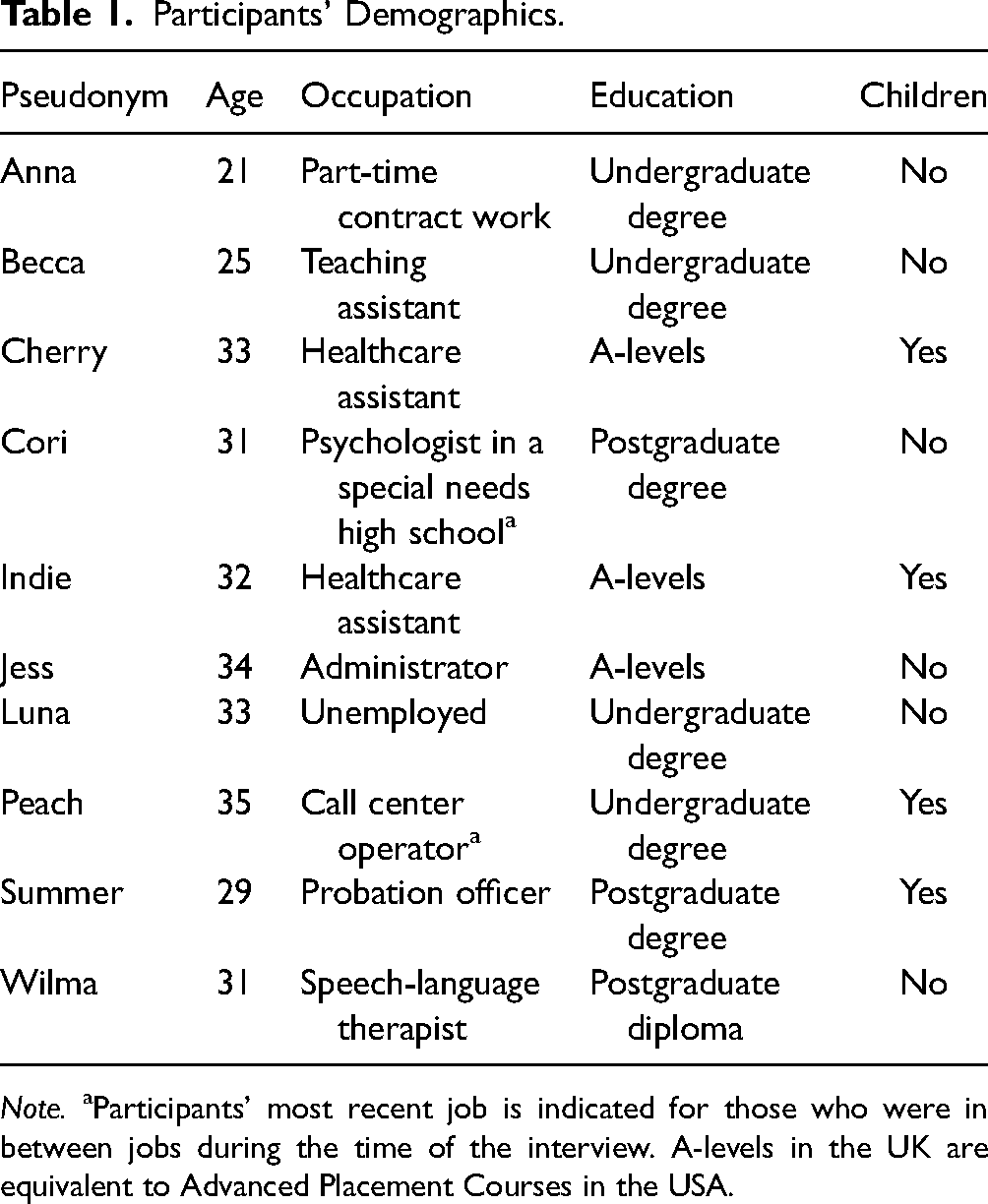
Note. aParticipants’ most recent job is indicated for those who were in between jobs during the time of the interview. A-levels in the UK are equivalent to Advanced Placement Courses in the USA.
Procedure and Sampling
Following ethical approval from the second to fourth authors’ institution, we distributed recruitment materials on social media (i.e., Facebook, Instagram, and Twitter) and to local community groups in the UK; only online means of recruitment were successful. Participants were recruited through word-of-mouth (n = 2), Facebook community groups (n = 2), and paid Facebook advertisements (n = 6) to participate in a study on women's social background and body image with the incentive of a £10 shopping voucher. After an indication of interest, interviews were scheduled with the first author via email.
Although small samples tend to be the norm in IPA research, IPA does not impose any strict sample size limits (see Brocki & Wearden, 2006), as it emphasizes the homogeneity of sampling in order “to ‘represent’ a perspective, rather than a population” (Smith et al., 2009, p. 49). Purposive sampling was conducted to recruit a homogenous sample (Smith et al., 2009). Given importance of context in IPA (Shinebourne, 2011), we identified factors—such as age (Tiggemann, 2004), sex (Strübel et al., 2020), and sexual orientation (Dahlenburg et al., 2020)—that shaped White working-class women's contexts, particularly in relation to their bodies. To maintain homogeneity, we recruited women who were aged between 18 and 35 years, cisgender, and heterosexual. The decision to recruit cisgender and heterosexual women is, in part, due to the prevailing focus on cisgender working-class women's heterosexuality within contemporary mainstream UK discourses (e.g., Tyler, 2008; Williams, 2021). Our subsequent analysis should be considered within the context of these demographics.
Data Collection
Semi-structured interviews were conducted based on an interview schedule that was developed following the guidelines outlined by Smith et al. (e.g., 2009), including narrative, evaluation and circular questions, prompts, and probes. To increase accessibility for our community sample, we revised our initial schedule to ensure that questions were phrased in layperson language, following pilot tests with three independent, nonspecialist individuals prior to collecting data. For example, instead of asking participants if expectations “affect the way you interact with your body?,” we simply asked if expectations “affect you?” The final interview schedule served as a guideline and was focused on three broad areas including participants’ thoughts and feelings about their bodies, appearance-based expectations, and social class; room to follow-up and/or discuss any novel and/or unprompted experiences was crucial in gathering in-depth data from participants (Smith et al., 2009). Participants received information about the interview, provided consent, and answered demographic questions (e.g., social class group identification, parents’ occupation, and parents’ education) on an online form on Qualtrics. The interviews (25–51 min; M = 43 min) were conducted using Zoom and were audio recorded before they were transcribed verbatim. Any identifiable information (e.g., location and shop names) was anonymized. When the analysis was complete, participants were invited to engage in member reflections. Drawing on an interpretivist paradigm, member reflections acted as a way to obtain participants’ perspectives and feedback to enhance the rigor and transparency of the analysis, rather than to confirm or disconfirm any interpretations (Smith & McGannon, 2018); four participants provided their feedback (Cori, Anna, Cherry, and Summer).
Analysis
The first author (JC) was the main interpretative voice in the analysis and the rest of the research team were doctoral supervisors and “critical friends,” who “ask provocative questions, provide data to be examined through another lens and offer a critique of a person's work” in the final stages of analysis (Noor & Shafee, 2021, p. 6). For the remainder of this paper, the term “I” will be used when referring to the first author and the term “we” will be used when referring to the research team. The transcripts were analyzed using IPA as part of a larger study following the six-step process proposed by Smith and colleagues (2009).
The first step of the analysis involved reading and re-reading the transcripts while listening to the audio recording. At this stage, I noted my initial thoughts, notes, and comments on one side of the margin on the transcript. For example, for the quote, “if I walked past a, you know, a set of builders or a little group, congregation of blokes,” I made a linguistic note on the perceived power imbalance between the participant and men in general, and feeling intimidated or threatened. For the quote, “sometimes I’m like ‘yeah, I don’t give a shit about how I look’ because I don’t want to be, uh, that girl, you know,” I made a conceptual note on the perceived stereotype on women who care about their appearance as being shallow or superficial. Then, I identified the essential qualities of these comments and translated them into a higher level of abstraction called “emergent themes” (Smith et al., 2009). I noted the emergent themes on the other side of the margin. Based on the examples above, I identified the emergent themes of “helplessness as a woman in patriarchal society” and “association with identity” respectively. The next step of the analysis involved identifying patterns across emergent themes. I mapped these out graphically on an online visual platform, Miro, and organized them into a table of superordinate themes and themes. The analysis continued to take place when moving from the former to the latter.
I repeated these steps for each of the transcripts. Any interpretations from previous transcripts were “bracketed,” as much as possible, as complete “bracketing” is not possible (Smith et al., 2009), by treating each subsequent transcript on its own terms. For example, whenever a particular comment or emergent theme in a transcript corresponded to or contradicted those from previous transcripts, I noted these thoughts and realigned with the particular transcript by asking myself questions on whether the comments or themes were grounded in the data from the participant. These notes were also helpful in the following iterations of the analysis and the following stages of analysis, where I could (re)evaluate my interpretations based on the reflective notes made. We acknowledge that complete objectivity was impossible moving from one transcript to another; however, making reflective notes throughout the process allowed me to consider and acknowledge the shift in my positions in the hermeneutic circle as I “entered” each round of analysis.
After conducting the analysis for each case, I identified cross-case patterns by noticing how participants’ accounts converged or diverged across and within themes through several iterations. Recurrent themes were identified if they were shared by at least three participants (Smith, 2011a). For example, I identified an initial superordinate theme, “pathologization of excess,” which consisted of five themes. As the analysis progressed, the themes identified became more interpretative and phenomenological in nature. This process led to new configurations of themes that better reflected the overarching ideas across participants and the relabeling of higher-order themes, resulting in a final group-level master table of themes (Smith et al., 2009). For instance, I merged the themes in the “pathologization of excess” superordinate theme to form the current superordinate theme that more succinctly reflected the experiential qualities of the pathologization: “internalized shame.” The final iteration of this process was conducted with the remaining authors acting as “critical friends,” to ensure that the analysis was grounded in data. Throughout the analysis, I checked any interpretations made against the original transcript to ensure that they were representative of participants’ experiences as a measure of good validity (Shinebourne, 2011). For example, I examined the quotes to ensure that they were contextually relevant and reflected the theme.
Due to the large number of themes that were identified in the analysis, subsets of themes that spoke to common phenomena within our main research question were identified. The subset of superordinate themes in the current study reflects participants’ meaning making based on their common experiences of dehumanization. It is worth noting that new configurations of themes continued to develop during the writing process (see Glackin & Beale, 2018). The final table of themes was updated with any new developments. Based on member reflections, I further reflected on my interpretations. For this subset of themes, no changes were made to any interpretations beyond providing evidence of resonance of shared experiences among participants. My reflections are detailed in the Discussion section.
Positionality and Reflexivity
Our positionality statement aims to provide transparency in terms of how our identities, experiences, and backgrounds relate to the current research topic, participants, and interpretations of findings. I am a PhD researcher and a first-generation student. I grew up in Southeast Asia, where social class-based hierarchies are salient in different ways, and I identify as a cisgender, queer woman, who has Chinese ancestry. I conducted all of the interviews and analysis in the current study. At the time of the interviews, I was 26 years old, and had lived in England for approximately 6 years; the analytical process continued for approximately 2 years after the interviews. The second author (MH)—who was my primary doctoral supervisor—was 35 years old at the time of the analysis and identifies as a cisgender, bisexual, middle-class woman. MH had the most involvement in the analyses as a “critical friend.” Given our research background in body image and related areas, we were conscious of any preconceived expectations rooted in our existing knowledge; our partial insider and outsider statuses helped facilitate this.
The additional authors were also involved in the research process as doctoral supervisors and “critical friends.” ME and EM are White, middle-class, cisgender, heterosexual individuals, identifying as a man and a woman respectively; they were 37 years old at the time of the analysis. Being born and raised in the UK, MH, ME, and EM possessed particular British cultural capital, which are unspoken or unwritten in the mainstream discourses (see Hanley, 2016). We recognized this imbalance in cultural capital between the supervisory team and me, as the primary researcher; this was managed by setting clear boundaries. For example, MH was conscious about viewing her role as providing me with contextual information and allowing me the space to contextualize and interpret the data, rather than providing her interpretations of the data. As researchers, we also recognize the power imbalance in our interactions with participants as we occupy a relatively more “superior” position within these interactions and possess more cultural and social capital due to our academic backgrounds (Råheim et al., 2016).
Reflexivity can be described as a process of continual, active and critical reflection, evaluation and attentiveness of researchers in their involvement in the research process (Finlay, 2013, 2014). Gadamer (1990) suggested that we can never fully escape our subjectivities and that our preconceptions will be continually renewed by the interpretative process. Our situatedness as researchers and human beings in the broader sociocultural political landscape affords us particular perspective. Therefore, it is important for us to reflect on our roles when (co)producing knowledge with participants. I approached the research process with “conscious attentiveness” and kept reflective notes (Goldspink & Engward, 2019). I also recognize the significance of my interaction with the participants in co-constructing the current findings, where participants made sense of their experiences as they were describing it to me during the interviews and I formulated the findings by making sense of participants’ sensemaking. I had the privilege to examine and re-examine participants’ experiences at different timepoints during the analytic process whereas the participants may not have (Smith et al., 2009).
Trustworthiness
We followed Smith's (2011a, 2011b) IPA-specific evaluation guide to ensure the quality of our research. For an IPA paper to be deemed sufficiently trustworthy, Smith (2011a) proposed that it must: (a) clearly meet the philosophical underpinnings of IPA (i.e., phenomenological, hermeneutics, and idiography); (b) be transparent enough for the reader to understand what was done; (c) have coherent, persuasive, and interesting analysis; and (d) demonstrate the density of evidence for each theme with adequate sampling.
Our study meets the philosophical underpinnings of IPA. We examined the transcripts case-by-case and created a table of themes for each transcript before moving on to the next; we focused on the experiential elements of participants’ accounts (e.g., by questioning how participants experience and understand the phenomenon); and we engaged in the double hermeneutic by providing interpretative commentaries, beyond descriptions of quotes. I also maintained an audit trail by documenting the evolution of themes for transparency (Creswell & Miller, 2000). Following Smith's (2011b) suggestion, we provided theme summaries and included convergent and divergent perspectives across cases within a theme whenever possible. We also ensured that enough space was given for the elaboration of each theme; this informed our decision to present only a subset of themes to allow sufficient space for an in-depth analysis (Smith, 2011a). To ensure rigor, we made sure that at least three participants’ accounts were illustrated within each theme, in line with Smith's (2011a) recommendation for sample sizes larger than eight. Finally, our interview schedule was accessible as we avoided academic jargon; for instance, we avoided the terms “body image” by asking participants to detail a time when they “felt good/less good” about their bodies.
Results
Participants’ experiences are represented in four main superordinate themes: (1) inevitability of being sexualized, (2) internalized shame, (3) maintaining vigilance, and (4) becoming unnoticeable. These are illustrated with quotes below.
Superordinate Theme 1: Inevitability of Being Sexualized
Four participants discussed how they experienced the inevitability of being sexualized as a woman within a heteropatriarchal society where unequal gendered power dynamics are maintained. Luna grew up in Ireland and has lived in England for most of her adult life. She had stopped working as an occupational therapist since being sexually assaulted. Luna described how she made sense of her position as a woman: “I’m just like existing in my body but I’m just thinking that could be maybe putting me at risk for attracting unwanted attention and then, it's like, I don’t know what to do, you know.” There is an overarching sense of helplessness (“I don’t know what to do, you know”) that underlies the quote above. Luna felt that her passive existence alone (“I’m just like existing in my body”) puts her at risk for sexual harassment and violence; this sense of helplessness was reiterated by Luna throughout the interview. For instance, Luna described her sensemaking of a recent experience of sitting at the beach by herself and being approached by an older man, whom she called a “creeper.” On this occasion, she felt “unsafe in there but also (felt) unsafe about speaking up,” which suggests that the sense of helplessness that she had felt might be due to the inescapability of such situations, where either action or inaction could put her at risk. Luna seemed to view her position as a woman within a heteropatriarchal society as being inherently unsafe, in part, due to the inevitability and inescapability of heterosexual harassment and violence.
Inevitability was experienced by Jess, who regarded herself as quite an anxious and analytical person. She had recently heard about the new law to criminalize street harassment and recounted how her (everyday) experience of passing a group of men on building sites left her feeling self-conscious: For just those brief few moments of going past… I always felt a little bit of anxiety, um, before getting to them obviously, if you see them ahead and know, then you’ve got to go past them. “Oh god, I’ve got to go past them”, you know, what … they’re going to think, see me get past and stuff. I, I think it's just a natural thing. You can't help it because it is what it is but you know, I mean, but then I, you know, just scurry past as quickly as possible and afterwards, you sort of like, suddenly your ears are extra tuned in like, listening like, if there are any comments like behind your back, like are they going to say anything, and stuff and, and then, when you sort of realise the coast is clear and stuff and you’re on, you know, further … down the street kind of thing.
Jess's detailed description of how she made sense of a somewhat brief encounter seems to reflect her heightened senses, as she was attuned to every detail of the experience. Despite this being an everyday experience within her social class context, Jess articulated a particular sense of dread (“Oh god, I’ve got to go past them”) in anticipation of the encounter. This quote highlights Jess’s perception of danger, which echoes Luna's sentiments on how women's gender alone puts them at risk of sexual harassment and violence within a heteropatriarchal society. Moreover, Jess's choice of words (“I think it's just a natural thing. You can’t help it because it is what it is”) reflects how she understood the inevitability of experiencing structural inequalities (i.e., harassment, in this case), where it seemed “natural” a working-class woman like Jess to be subjected to sexual objectification from men. Yet, their position within their intersecting gendered and classed contexts meant that they are powerless against objectifying experiences and are expected to navigate these experiences on their own, given the prevalence of working-class masculinities in heteropatriarchal UK.
Indie, who used to work in objectifying environments (e.g., bars), shed light on how her experiences in the workplace were shaped by heteropatriarchal power relations. She described how she made sense of sexually objectifying comments at work: I’ve always been, you know, always had quite a large bust. So, it’d be “oi, tits McGee” or you know, other horrible, gross, give-you-the-ick kind of comments made. Um, so, it's just sort of expected and, and you know, and knowing that there's such a culture of it, um, you know, it was just, as an 18-year-old, I thought “well, that's just, par for the course really”. It's, it's what's to be expected. I work in a bar. That's what drunk men do.
Indie had learned to expect and accept sexually objectifying comments at work, where women are inevitably sexualized (“that's just par for the course really”), echoing Jess's sentiments. Indie's quote also reflects a sense of fundamentality in her understanding of men's behaviors (“that's what drunk men do”) within the context of an objectifying environment (“I work in a bar”), which seems to absolve the perpetrators by attributing these problematic behaviors to men's gendered nature. It is also interesting to note that the context of work described by Indie is reflective of occupations that are commonly held by people within working-class contexts (e.g., unskilled work, manual work, jobs in the service industry), further highlighting the salience of gendered hierarchies in these occupations. Similar to Luna's experience of being approached by a “creeper,” Indie also seemed to experience a sense of disgust (“horrible, gross, give-you-the-ick kind of comments”) when she was harassed by the men at the bar. Contextualizing Luna's sentiments of inescapability—where either action or inaction would put her at risk—it is possible that this reflects a sense of inescapability within intersecting gendered and classed contexts, as working-class women may be stuck in particular positions of precarity (i.e., sexually objectifying environments) due to economic necessity.
Indie continued to elaborate on how being in a position of submissiveness to men's desires within her social class context had an impact on her self-perception and her “really sexually promiscuous” behaviors in the past: “I think I did see myself as a sexual object that I was being made into in work.” In this sense, her sensemaking around her agentic self seems to have been reduced to an objectified and sexualized body (through the male gaze), which she then internalized. As such, although her behaviors seemed to fit the externally internalized identity, they were not necessarily intrinsically beneficial. These processes of socialization seemed to have limited Indie's space for agentic self-exploration, self-expression, and self-perception.
In contrast to the direct forms of harassment experienced by Indie, Cherry described her sensemaking of an indirect form of sexualization. Cherry works as a nurse in a hospital and had repeatedly described her chest as being too big and looking “a bit pornographic,” especially when she was wearing her work uniform: I’m thinking about getting some baggier ones [uniform], just so it doesn't look so tight on my chest because even at work, you can tell people are a bit like, like, “oh crikey, look at that” as if I’m trying to look like a saucy nurse.
How Cherry made sense of her experience above seems to be rooted in her internalization of a sexualized view of women and her self-sexualization based on this. It is also noteworthy that (a) nursing is a traditionally feminized caring occupation; (b) working-class women are often found in caring jobs in the UK; and (c) images of nurses with large chests are classically stereotyped as sex objects in the media. Taken together, this seemed to have influenced Cherry's position where she felt that she was accused of (and judged for) self-sexualization (“as if I’m trying to look like a saucy nurse”); this reflects mainstream discourses that are propagated around working-class women's perceived hypersexuality. On the one hand, there seems to be an expectation for women to be passively sexualized within a heteropatriarchal society—as in Indie's experiences above—but on the other hand, women are penalized when they are perceived as actively self-sexualizing. This highlights the responsibility for navigating (social and systemic) injustices that often falls on working-class women themselves—for instance, Cherry's effort to get baggier uniform to avoid being misperceived.
Superordinate Theme 2: Internalized Shame
This theme demonstrates participants’ understanding of how bodily and appearance-related excesses are pathologized within society, which may be due to the historical pathologizing of excessive consumption. This theme also illustrates participants’ internalization of a sense of shame surrounding excesses (e.g., fat, cellulite, gaudy clothes). Wilma—who made sense of her appearance-related decisions and behaviors as a function of sociocultural norms throughout the interview—described the role of magazines in propagating appearance ideals. When I was a teenager, you’d see all these magazines like Heat and stuff like that would have the circle of shame around cellulite and people would be being, um, I remember, I was probably about 14 … kind of, Paris Hilton and Lindsay Lohan and, you know, those people were kind of the big celebrities and they were all incredibly skinny.
Wilma learned to interpret the meaning of “‘skinny” in a positive, aspirational way from a young age, as those with cellulite were shamed (“circle of shame around cellulite”). It is worth noting that the circle of shame was often highlighted among thin celebrities, who likely had abundant resources to shape their bodies. This seems to suggest a sense of hopelessness for working-class women, like Wilma—who had comparatively fewer resources—in escaping this sense of shame.
The first extract below illustrates Summer's understanding of the stigma associated with being fat and the associated challenges in reframing the internalized stigma; the second extract illustrates Summer's struggle in recalling a time when she felt less good about her body. The interpretations of these extracts are presented below. I mean I think the easiest one is that with fat people, isn't it? Like, it-, it-, j-, well al-, again, I’ve just said it now, you know, fat is … being fat is so stigmatized these days, it's almost like a dirty word. Oh, you know, I’d say “oh, sh- she’ll be pretty if she wasn't so fat” and stuff like that. Why do we say that? A- and you know, and I know, I know better, um, but it kind still, kind of sometimes it pops in your head and you think that way, so… Do you know what, it is quite hard to… I’m sure … because again, like, I’ve never been a, a bigger girl. I’ve always been sort of very … you know, I’ve had the curves but I’ve never been, you know, fat or whatever.
How Summer evaluates and makes sense of others seems to be influenced by her internalization of the stigma of being fat, despite “knowing better.” In the second extract, Summer's evaluation of how she felt about her own body was based on whether or not she was fat. It is worth noting that Summer might not have been consciously aware of the pervasiveness of this internalized stigma on her self-evaluations and these connections were made by contextualizing one extract within the context of another. Moreover, Summer's expression of being fat as “almost like a dirty word” in the first extract seems to have an undertone that suggests that being fat is vulgar. Within (White) the British society, historically, bodily excess is a particular signifier of the distasteful consumption practices of the devalued (i.e., working) classes, especially for women. Therefore, it is possible that Summer's judgment of others based on fatness might not be solely based on size, but also influenced by classed (and gendered) connotations, as it might be linked with the stigma surrounding bodily excess associated with women's class and gender.
However, despite the negative connotation, Indie described her attempt at being more body positive as an effort to be a good example for her daughter, which she eventually internalized. She chose to embrace her larger body rather than to feel embarrassed about it: I’ve got a five-year-old and she’d say “oh, mummy, you’ve got a really big belly” and I go, “yeah, isn't it wonderful and squishy” and sort of like, trying to, to reinforce to them that, you know, it's not a bad thing. “Fat”, you know, “fat's still a descriptive word, you know. I don't mind if they, if they say or anyone says ‘oh, she's fat” because you know, yeah well, I am. I have, I have more fat on my body than, you know, another person that doesn't…
Indie actively resisted the mainstream stigma surrounding fatness for her daughter and chose to view “fat” as merely a descriptive word without any attached feelings of pride or shame. She embraced the neutral perspective of simply having more fat on her body, as simply one aspect of her, which was not reflective of her whole person.
Jess experienced feeling a sense of shame due to weight gain after the COVID-19 lockdown; this was articulated in relation to class. Jess was “embarrassed to admit” that she was “almost a little bit like the fattest (she's) ever been kind of, in a way, although not really really fat.” Jess’s embarrassment was conveyed in her almost noncommittal admittance of being the fattest she has ever been (“kind of, in a way”) while justifying that she was not “really really fat.” Jess further made sense of a time when she struggled to fit into her jeans: I refer to them as sort of “love handles” at the sides, those, you know, those sort of scenarios, sort of, on the side, you know, it's very, it's not very classy or g-, you know, um, like, very, um (chuckles), good looking. Um, it's like the opposite of flattering.
Jess's sensemaking of “love handles” is particularly noteworthy, as her view of them as being “not very classy” seems to suggest that bodily excess was not perceived as being representative of the higher classes (i.e., middle or upper class), as it indicated excessive consumption. A classy presentation was also deemed attractive and flattering. These seem to reflect the historical pathologizing of excess within the British society and suggest that the prevailing stigma is still being reproduced and experienced in contemporary times. As such, Jess's embarrassment may not have just stemmed from the visibility of her weight gain alone based on existing mainstream sociocultural thin ideals, but perhaps also from the internalized stigma and shame that are deeply rooted in classed dynamics.
Cherry, who seemed attuned to social class dynamics in her everyday life (e.g., describing middle-class “yummy mummies” [mothers who are attractive] at the school run) further demonstrated this in the extract below on her stepmother, whom she thought was “quite sort of, chavvy [a class-based slur typically used to describe the wrong type of working-class; being without taste]”: So, my stepmother for instance, wears a lot of leopard skin and gold. I’m like “oh my god” but then, I’m like “no. It's fine if she wants to wear that”. I’d never say anything but I just … it's the taste that's not so good (laughs).
For context, the historical pathologizing of excesses—rooted in consumption choices and behaviors—continues to prevail in contemporary times beyond the bounds of women's physical bodies including their clothing and adornment. As such, Cherry possibly experienced a sense of vicarious embarrassment (“I’m like ‘oh my god’”), which refers to feelings of embarrassment when observing the embarrassing act of others, from her stepmother's appearance that reflected a lack of taste (“it's the taste that's not so good”). Having a lack of taste could be interpreted as being reflective of the cumulated experiences from one's upbringing and/or socialization processes, as what is considered “tasteful” might come from the implicit knowledge that one has acquired in their lifetime; a lack of taste—signaled through one's appearance—might indicate cultural knowledge that is subpar. As such, it is possible that Cherry had learned that a gaudy appearance (“a lot of leopard skin and gold”) should be shamed as being distasteful. It is also worth noting that this sense of shame was so strongly internalized by Cherry that she had felt it for her stepmother.
Superordinate Theme 3: Maintaining Vigilance
Nine participants described maintaining a sense of vigilance over the way they appear to others in fear of being negatively evaluated and/or judged. This sense of vigilance was discussed as an internal anticipation rather than a reaction to direct comments. Jess, who articulated a stream of consciousness of self-objectification when passing a group of men in building sites (theme 1), further elaborated on her feelings of self-consciousness. I felt really self-conscious at that point walking past. What, what they might be thinking, you know and, I’m, you know, am I being, um, well, are, are they judging me or they’re probably judging me, you know, what I look like, um, you know, and just being judged basically on, on what I look like going past or, um, do I look really scruffy? Do I look silly? Like, am I making a fool of myself? Um, do I look really scatty like, cause I’m rushing?
Jess experienced feelings of self-consciousness with an acute sense of vigilance. Considering the pathologizing of working-class women (theme 2), it is possible that this sense of vigilance has a preventative role for Jess to avoid feelings of shame or embarrassment. Jess seems to do this using her list of internal questions as a way to self-police, particularly in terms of appearing presentable and/or put together at times when she was rushing (“Do I look really scatty like, cause I’m rushing?”).
On the other hand, Cori had a “real movie in (her) head, thinking everyone was looking at (her)” when she was at university. This sense of self-consciousness continued into adulthood, particularly after moving from Spain to England where she “felt a bit observed.” Cori described how her appearance-related choices were shaped by her anticipation of judgments: Sometimes, I want to, I really wanted to wear something but I have these thoughts about … if I wear this, probably they’re going to be commenting this or they’re going to be saying this or that.
It can be interpreted from the quote above that Cori made choices about her appearance based on a fear of being judged by others in case she wore an attire that was deemed ‘incorrect.’ As such, Cori polices her intrinsic desires and choices based on her anticipation of others’ judgments, where she seemed to prioritize the latter over the former.
On the contrary, Summer did not seem to interpret the external gaze negatively. She expressed appreciation when others looked at her, as “getting attention” was a source of validation to her, although she described actively unsubscribing from aesthetic valuations of women at the beginning of the interview. Following this, Summer seemed to be constantly monitoring the amount of attention that she received from others. She noticed the drop in attention that she received when she turned 24 years old: It was just like “oh, you know, like, nobody's like looking at me” like, not that, again, not that I’m particularly interested but it kind of makes you wonder like, what, what's happened? Am I not attractive? It's there … you know, what am I doing wrong? Is there anything I need to do?
Despite her initial tone of nonchalance (“not that I’m particularly interested”), Summer articulated a stream of consciousness, which seems to have an underlying tone of panic; the series of internal questions (“Am I not attractive?,” “What am I doing wrong?,” and “Is there anything I need to do?”) illustrate the extent to which Summer took responsibility for the drop in attention and self-policed to maintain the external (male) gaze. Considering the inevitability of being sexualized as a working-class woman (theme 1), it is possible that Summer had been socialized within intersecting classed and gender contexts to expect the external male gaze. As such, it is possible that the drop in attention was in conflict with this sense of inevitability, thus amplifying Summer's insecurity about what she was doing “wrong,” as she seemed to have escaped the inevitable. Although other participants did not share this particular experience (through their feedback in member reflections), this extract demonstrates Summer's personal sensemaking on the validating power of the male gaze that she had internalized as a function of heteropatriarchal socialization.
Indie—who worked in beauty retail for a period of time—offered another perspective of the motivations underlying the maintenance of a sense of vigilance. She described the importance of avoiding being deemed ugly. So, you know, the thought of someone seeing me when I was having an acne breakout was quite terrifying. Um, but then, it was more, you know… I didn't want, I didn't want them to see me as ugly, even though I knew I wasn't. It was m-… it's, it's, that's a really tricky question. Yeah, so … it was more the fact that I was facing the public and it could be people I know, um, because I think there's still quite a lot of stigma attached to around like, having acne as an adult and, you know, and, and being larger as well, being labeled as that ‘fat spotty girl in [beauty retail shop].
Similar to Summer, Indie highlighted the importance of self-policing in anticipation of the external gaze (“the thought of someone seeing me,” “I was facing the public”) and the meaning attached to being attractive as an appearance ideal (“didn't want them to see me as ugly”), but beyond that, she emphasized the role of “fear” (“quite terrifying”). A similar sense of fear was also articulated by Cherry, who was “frightened to look frumpy” when discussing her desires to wear more athletic clothes in the interview, as she felt that they did not suit her body type. For working-class women, the fear of being judged by others seems to be an important mechanism in the maintenance of vigilance via self-policing thoughts. Further, it is also worth noting the public facing nature of their occupations within their working-class contexts—such as the service industry—inevitably exposed them to the external gaze, which possibly reinforces the need to be vigilant.
Further, Wilma sheds light on how she internalized an awareness and/or self-consciousness about her appearance, as she was exposed to appearance-related comments made by her male friends when she was in school. Hearing them and how they [her male friends] would talk about women or girls, I suppose, but, um, yeah. So, I kind of was like, “well, they say that when I’m there. God knows what they say when I’m not there” like, do you know what I mean? They censor themselves awfully. Um, so yeah, so kind of, I just always felt aware of that maybe in that sense.
From a young age, Wilma was socialized to be vigilant about her appearance, particularly when viewed by and through the male gaze. In this sense, she had also internalized a heightened sense of awareness to anticipate potentially crude judgments that might be made behind her back (“God knows what they say when I’m not there,” “They censor themselves awfully”), which seems to echo Jess’s self-consciousness when she passed groups of men. This suggests that constant monitoring and self-policing—as a function of their gendered and classed experiences—may be necessary for working-class women, such as Wilma and Jess, to avoid being scrutinized.
On the other hand, Wilma also highlighted the influences of her women friends. The following example took place during the time after the COVID-19 lockdown, when Wilma had gained a bit of weight and had been invited to a party that was hosted by a friend, whom she described as being incredibly “glamorous.” I remember trying on all my clothes at about 1am in the morning and just feeling awful because I was like, “oh actually, this doesn't look quite right”, “oh, this doesn't look quite right” or … “oh, this looks okay but then, is it dressy enough?” … just all of that kind of sent me into a bit of a spiral in my head.
The extract above illustrates an extreme form of self-policing that took place at an unreasonable hour of the night (“trying on all my clothes at about 1am”), as Wilma panicked over choosing the right outfit for the occasion, in anticipation for any judgments that might follow if she had not “look(ed) quite right.” Considering her friend's (higher) social class position, the “right” appearance might be reflective of having the “right” (middle-class) cultural capital; this might be to avoid any (gendered) classist stigma. Her fear of getting it wrong also had a negative effect on Wilma (“feeling awful,” “sent me into a bit of a spiral in my head”).
Superordinate Theme 4: Becoming Unnoticeable
All participants described how they have adopted self-protection mechanisms to avoid being sexualized (i.e., their gendered experiences; theme 1) and pathologized (their classed experiences; theme 2). These mechanisms involved becoming unnoticeable; participants described this as a way of “hiding” from the external gaze. However, it is important to note that the purpose of “hiding” in this case is not to disappear completely, but rather to (visually) blend in (i.e., to avoid sticking out).
Below is an extract from Cori, who made sense of appearance ideals based on the influences of media images (e.g., television, magazines) from a young age. I was covering myself with a towel sometimes [at the swimming pool], “oh, oooh, I have hair here or I have…” you know, and I say I have it because you know, the, the women, the girls in magazines, they don't have hairs, you know. So, I think when I was young, I was like, like, yeah, let's try to cover myself.
Similar to Wilma, Cori had learned from magazines that bodily excesses are sources of shame (“I say I have it because you know, the, the women, the girls in magazines, they don't have hairs, you know”). To avoid sticking out as a woman with body hair (i.e., being different from the women in magazines), Cori covered herself up. It is also interesting to note that her strategy was to cover parts of herself that were deviant or different from the mainstream feminine image, rather than to physically change any of these aspects. However, it is possible that this was the only strategy available to her at that age.
Luna—the only participant in our sample who reported experiencing a more extreme form of sexual violence—described a desire to be “invisible.” She acknowledged that this was physically impossible and identified covering herself up as the next best thing: “I’d be thinking, ‘oh, I can see how it’d be to like wear a hijab’ or whatever, um and how I was thinking that must be, that might be nicer or maybe more a lower attraction.” Recounting Luna's feelings of helplessness about being a working-class woman within a heteropatriarchal society (theme 1), Luna might have made sense of the safest way to exist (as a woman) as detaching herself from any gendered physical qualities as much as possible, as it seems that any forms of attention drawn to women's bodies via the external (male) gaze may be inevitably sexualizing. However, it is worth noting that Luna's perspective of wearing a hijab to be “invisible” seems reflective of her position as a White woman, as hijab wearing tends to be hypervisible within Western contexts.
Cherry constantly thought about covering up her large bust to make her breasts unnoticeable to avoid being sexualized. This affected her experience of breastfeeding. I didn't really like breastfeeding because I felt, because they were so big, it looks inappropriate in my mind, that these massive, you know, boobs sticking out in public, but um, so that might have actually stopped me breastfeeding, I reckon.
Just as Cherry had internalized a sexualized view of herself in her work context when she viewed her chest as being “pornographic” and looking like a “saucy nurse” (theme 1), this sexualized self-view also applied to the context of mothering (“it looks inappropriate in my mind”). Considering the historical emphasis of working-class women on their mothering roles in the British context, Cherry's decision to stop breastfeeding in public altogether (to avoid being sexualized) especially highlights the deleterious effects of being passively sexualized as a woman within a heteropatriarchal society.
Indie discussed the importance of make-up as a means to fade into the background: “You know, make up is a wonderful thing. You can hide a, a ton of sins underneath it.” From this, it seems that make-up is deemed “wonderful” because of its ability to hide visible signs of shame (“You can hide a, a ton of sins underneath it”). Interestingly, Indie described the process of becoming unnoticeable as “camouflaging” and elaborated on the meanings attached to it. You know, getting up early to do the make-up and making myself presentable to the world, um, and I think, that again, is to … almost maybe might have been like a camouflaging thing, you know. If I look, you know, like I’ve got my make up on, my hair's, my hair is nice and I’m wearing, you know, just jeans and a t-shirt, I’ll just blend into the background and there won't be focus on me, and people won't, then notice and have a closer look and see that under the make up, there's acne and that actually under the baggy t-shirt, there's a larger body. So, yeah, I think it was more like, a camouflage really than to look beautiful for other people. Maybe it was to hide from other people.
The extract above suggests that there is a façade on the surface that functions not only to hold Indie's appearance together (“have a closer look and see that under the make-up, there's acne and that under the baggy t-shirt, there's a larger body”), but also to shield her from external judgments (“Maybe it was to hide from other people”). One possible interpretation is that her true self lies beneath the façade; as such, her feelings of internalized shame (i.e., the “sins”) might be deeply embedded in and/or tied to her sense of self (theme 2). Further, it could be interpreted that Indie's subtle tone of vulnerability at the end of the extract reflected her attempt to protect herself, where the façade possibly protected Indie from her own feelings of internalized shame. Taken together, this theme highlights how an avoidance of “sticking out” serves as a protective mechanism for working-class women as a function of their intersecting classed and gendered experiences.
Discussion
The current study explored how White working-class women in the UK experienced sexual and self-objectification, and how they made sense of their bodies. Our findings suggest that the women in our study experienced sexual harassment and/or violence as inevitable, especially within (gendered) working-class contexts in a heteropatriarchal society (theme 1). Within these contexts, they also internalized a sense of shame toward bodily excesses that appeared rooted in class distinctions (theme 2). These socialization processes resulted in the adoption of self-surveillance strategies such as maintaining vigilance (theme 3) and becoming unnoticeable (theme 4; i.e., hiding from others and/or covering their body parts).
The White working-class women in our sample felt powerless against experiences of dehumanization, which were characterized by a loss of agency in defining the (gendered) events that occur to them (Baldissarri et al., 2022), such as sexual objectification, harassment, and violence. These experiences must be considered as part of White working-class women's embeddedness with their social class and gendered contexts (Skeggs, 2013), including inequalities in power dynamics that permeate their immediate environments, including their workplace (e.g., Moffitt & Szymanski, 2011). Notably, gender identities and gendered power dynamics were salient for our participants who worked within traditionally classed and gendered occupations (e.g., nursing, working in a pub). Existing social class literature suggests that the working-class workplace tends to foster a culture that requires individuals to cooperate with others, follow the rules, and minimize disruptions (Stephens, Markus, et al., 2014). As such, the women in our sample might have been socialized to accept and normalize experiences of sexual harassment as a way of following the (social) rules and to avoid being disruptive in the workplace due to economic necessity. This suggests that the inescapability of White working-class women's experiences of sexual harassment is rooted in the intersectionality of class and gender.
Our findings suggest that the normalization of passivity and dehumanization, particularly those rooted in sexual experiences, can be understood as the products of gendered norms socialization, as White working-class women's performance of passivity seemed to be expected and legitimated in heterosexual interpersonal relationships. This supports research that found gendered working-class socialization processes led women to internalize a more passive role within heterosexual encounters (Skeggs, 1997) and to view dehumanization (e.g., unwanted sex; Bay-Cheng & Bruns, 2016) in normalized and neutral terms. Although the women in our sample experienced (passive) sexualization and sexual objectification as “normal,” it is interesting to note that self-sexualization and self-objectification that were perceived as active and agentic were deemed inappropriate; this seems to echo mainstream (gendered) class-based stereotypes around working-class women's perceived hypersexuality (Renold & Ringrose, 2011; Tyler, 2008). Further, this suggests that White working-class women are situated in a particularly precarious position within a heteropatriarchal society; the pejorative discourse of working-class sexualities and the socialized normalization of objectification and harassment behaviors may have social and criminal justice implications (see Phipps, 2009), where working-class women might be held responsible for injustices that occur to them.
These socialization processes within participants’ working-class contexts also shape their internalized self-view, as they were socialized to internalize a sexualized (e.g., a saucy nurse) or a dehumanized view of themselves, including a sexually objectified view (e.g., a sex object). Such self-perceptions had consequences including appearance anxiety, body shame, breastfeeding attitudes, and risky sex behaviors (Beech et al., 2020; Calogero et al., 2011; Ingram et al., 2023). On the contrary, it is interesting to note that the perceived positive role of self-objectification was mentioned by one of the participants in our sample, where self-objectification was a mechanism for them to gain self-worth and/or external validation. Calogero's (2013) theorization that linked self-objectification to system justification theory (Jost & Banaji, 1994)—which provides an explanation for why disadvantaged individuals may be more likely to protect existing societal status quo—suggests that self-objectification might be a palliative tool for women to reclaim power, as women's value is emphasized through the objectified lens in the short run. As such, it is possible that self-objectification might have served as a tool to compensate for their marginalized positions (Calogero, 2013), akin to women working in sexually objectifying environments, where beauty served as a tool that allowed women to gain power (Moffitt & Szymanski, 2011). However, for working-class women, their self-objectification behaviors must be considered with the caveat that they are performed in the right way to avoid being pathologized (Frith, 2012; Skeggs, 1997), which reflects the importance of considering the intersectionality of their social class and gender. Despite the short-term gain in power, these behaviors ultimately continue to legitimize and reproduce existing unequal class and gendered power structures.
Hegemonic body image research tends to examine body shame as a function of sociocultural appearance ideal attainment, where feelings of shame motivate behaviors to correct “defective” bodies (Calogero & Pina, 2011). Our novel findings highlight White working-class women's experience of body shame as a function of internalized stigma (Moradi, 2013), beyond their internalization of sociocultural ideals. Unequal classed dynamics are often rooted in the centering of middle-class experiences as universal or the ideal (Stephens, Markus et al., 2014), which inadvertently perpetuates the symbolic violence against working-class women (Bourdieu, 2003). Working-class women have historically been pathologized for their excesses (Pickering, 2014), which typically refers to any deviance from the right kind of femininity, including body size, hairstyles, and clothes (Wood & Skeggs, 2008). As such, working-class women might have learned to internalize a sense of shame as a function of the internalized stigma associated with their “failure” to adopt the right taste or embody the right feminine appearance within the British society (rather than a sense of shame that is rooted in their failure to adopt sociocultural ideals of attractiveness as typically found among middle-class university women samples; e.g., Manago et al., 2015). This sheds light on working-class women's understanding of their bodies, which are not currently captured in extant research, where the appearance ideals imposed on working-class women are not merely unrealistic (e.g., thin ideal), but are inherently unattainable (e.g., middle-class femininity; Skeggs, 1997).
We also found support for the recent theorization of the pantheoretical framework of discrimination, objectification, and dehumanization, which suggests that dehumanization experiences shape different types of self-surveillance (i.e., cognizance-based and internalization-based; Moradi, 2013). Participants in our sample engaged in self-surveillance based on internalized sociocultural ideals, as previously established in research using predominantly middle-class university students (e.g., Moradi et al., 2005); this is likely due to the shared pressures around being a woman within heteropatriarchal societies. However, our novel findings additionally suggest that participants’ engagement in self-surveillance was rooted in cognizance-based motivations to avoid manifestations of oppression that would occur if sociocultural appearance norms were violated (see Moradi, 2013). This was beyond the classic theorization rooted in sociocultural appearance ideals, which are mostly drawn from middle-class samples (see Moradi, 2010). For instance, White working-class women might chronically police their bodies in anticipating the male gaze, as a way to avoid (or rather, minimize) manifestations of sexualization (e.g., sexual harassment), rather than to appease or appeal to the male gaze (e.g., Moffitt & Szymanski, 2011). Similarly, self-consciousness and anxiety surrounding the need to look “right” might be a way to avoid classist stigma (e.g., self-surveillance might be a way to avoid the label of “chav”), rather than to look good (see Vandenbosch & Eggermont, 2012).
Another unique form of self-surveillance that occurred in our sample of working-class women was their self-surveillance to ensure that they were unnoticeable, which seemed to be rooted in both cognizance-based and internalization-based self-surveillance (see Moradi, 2013). For example, some participants described wearing make-up to live up to appearance standards and as a way to avoid stigma by blending in, highlighting participants’ intersectional experiences. These novel findings suggest that women's self-surveillance behaviors are not just influenced by sociocultural factors, but also by sociostructural marginalization.
These self-surveillance strategies further reflect White working-class women's (hyper)awareness of the threats in their sociocultural environments (Kraus et al., 2012), including perceptions of dehumanization (Sainz et al., 2021), thus needing to take preemptive measures. This might present negative implications for working-class women. First, their embodied experiences might be constrained by the constant need to police and regulate their appearance within their social class environments (Piran et al., 2020). Additionally, these surveillance behaviors reinforce historical discourses around structural issues as women's failure to police their own behavior (Walkerdine, 1994). It is worth noting that not all our participants mentioned experiences of sexual harassment, sexual violence, or symbolic violence; however, all of them described adopting forms of cognizance-based surveillance, which seems to suggest that the prevalence of these occurrences within their working-class context itself facilitates socialization processes in the adoption of these self-protection strategies.
Reflexivity
This section demonstrates my reflexivity in the research process, as the interviewer and the main interpretative voice of the analysis. My research background in social psychology and body image facilitated the conceptualization of this project with the assumption that women's meaning making of their bodies and appearance is related to their social class context. This was also evident in my analytical journey, where participants’ sensemaking of their appearance-related feelings (e.g., feeling anxious about not fitting appearance norms), thoughts (e.g., self-policing their appearance), and/or behaviors (e.g., wearing make-up) were immediately noticeable to me; however, as the analysis progressed toward the cross-case analysis, it became increasingly evident that there were common threads underlying participants’ experiences (e.g., self-policing, anxiety, and behaviors their adherence to appearance norms as self-protection) that I was privy to as the researcher, as I had the privilege of zooming out of instances to consider participants’ broader life contexts. I also made specific semantic decisions in the current paper to avoid unintentionally reproducing different variations of existing constructions of body image experiences—for instance, theme 3 was named “maintaining vigilance,” rather than self-surveillance to better represent participants’ anticipation of threat when considering their appearance.
Throughout the research process, I noticed the importance of understanding particular British contexts to fully grasp participants’ experiences and sensemaking. Although I had some contextual understanding (e.g., use of vernaculars), not growing up in the UK did present barriers in terms of fully understanding references to popular culture (e.g., references to models on Heat magazines). In these instances, my “critical friends” provided the relevant contextual information. Feedback from participants was also particularly helpful in supporting my reflections on my interpretations. In particular, participants described empathizing with some of the other participants’ experiences, including a sense of powerlessness associated with experiences of sexual assault and feelings of embarrassment over their “wrong” appearance-related choices. However, participants also articulated points of divergence in their interpretations of other participants’ experiences. For instance, Cherry emphasized her interpretations (as a function of her worldview and subjectivities) on the significance of women's judgments on other women over the influence of the men through the male gaze; this was possibly rooted in her experiences of being judged by other women, which she mentioned during the interview. Following this, I examined and reflected on my interpretations; this led me to further contextualize women's judgments within broader societal structures and to recognize that their judgments are inherently rooted in heteronormative and patriarchal influences regardless of their gender.
Moreover, it is important to acknowledge that the unequal power dynamics between my participants and I—where my identity as a researcher from a higher educational institution positions me as being middle-class—necessarily reproduce structural inequalities, where working-class experiences are iterated through a middle-class voice. Finally, my (racialized and queer-presenting) appearance might have conveyed particular meanings to participants. It is possible that participants might have been more willing to disclose particular experiences to me, as opposed to a White British middle-class researcher who may be more closely situated to the historical and contemporary UK class politics.
Critical Considerations
One of the main strengths of using IPA in our study was its idiographic nature (Smith et al., 2009). This meant that the analyses were conducted entirely inductively, rather than being theory-driven, which has benefits in allowing us the freedom to pursue unique new interpretations, beyond existing conceptualizations in objectification and body image research (e.g., self-surveillance to become unnoticeable). Moreover, our findings also have: (a) transferability, as we provided relevant contextual information for the readers to determine the extent to which our findings resonate with their experiences; (b) theoretical generalizability due to its potential for integration with existing theories (e.g., objectification theory; Fredrickson & Roberts, 1997); and (c) naturalistic generalizability (see Smith, 2018)—in particular, we presented our study at an academic conference and found that our findings resonated with working-class women in academia. Further research would benefit from establishing further resonance beyond highly educated working-class women.
As our sample size was relatively large for an IPA study, we presented a subset of themes in the current paper to allow adequate space for each theme to be explored (Smith, 2011a, 2011b), but it is important to note that this necessarily omits any connections between the current subset of themes and the remaining themes in a larger study. Moreover, we acknowledge that our commitment to homogeneous sampling—which is necessary for IPA studies (Smith et al., 2009)—in some ways, represents a specific majoritized population in the UK (i.e., White, heterosexual, and cisgender women). However, this decision was made purposefully for two reasons: (a) we recognized that women's unique experiences are the product of their multiple and intersecting identities; and (b) we were conscious that recruiting across ethnicity, gender identity, and sexual identity spectrums might risk absorbing unique minoritized experiences into mainstream, heteronormative narratives while giving the illusion of inclusivity. It is crucial that future research into working-class women's experiences extends to other minoritized contexts (e.g., racial and sexual minority) by centering their voices.
The nature of IPA recognizes the plurality of meanings attached to the same phenomenon (Smith et al., 2009). As such, the purpose of our research was not to strive for representativeness, but rather to understand individuals’ sensemaking; we caution against assuming homogeneity in women's experiences by applying our findings to other populations. It is also worth noting that our sample of working-class women had a relatively high level of education, which suggests that our participants’ experiences constituted those of the higher end of the socioeconomic ladder among working-class women. It is possible that working-class women in more precarious positions might experience greater extents of marginalization, thus experiencing unique forms of self-surveillance and internalized stigma (Stephens, Cameron, et al., 2014). For instance, it might be worth exploring experiences of women in poverty, as this extreme lack of resource might create unique experiences that are not simply more extreme versions of those presented here (see Stephens, Cameron, et al., 2014).
Implications and Future Directions
Our study contributes to objectification theory research by moving beyond simply uncovering experiences of sexual and self-objectification to understanding how women make sense of these experiences (e.g., their sense of powerlessness and passivity). We highlighted the value of inductive approaches in objectification research to allow space for the heterogeneity of women's experiences—for instance, White working-class women's engagement in unique forms of self-surveillance (i.e., cognizance) found in the current study. Future research should also contextualize findings within participants’ (intersectional) identities and sociocultural–historical contexts to avoid inadvertently omitting nuanced experiences for theoretical parsimony. Self-objectification (on an individual level) is a phenomenon that is shaped by the internalization of oppressive experiences (on a societal level); as such, we encourage researchers to further explore the different ways that (self-)objectification is reproduced and experienced in society.
We encouraged clinicians to provide more personalized treatments to clients in minoritized groups (see Levinson et al., 2024). Practitioners are encouraged to consider social class as a distinct context that shapes women's experiences and their interpretative frameworks (see Stephens, Markus, et al., 2014), as there may be potential misalignments between a middle-class practitioner's class-based context and a working-class client's contexts. For example, a middle-class clinician might not fully understand he hypervisibility that working-class women experience within their social class contexts. Clinicians should be reflexive of how their class-based positionalities—alongside their other identities—shape their understanding of their clients’ experiences to avoid accidentally imposing middle-class-centric interpretations onto working-class experiences. This individualized approach may be more effective in clinical settings (see Sue et al., 2022).
Further, the recognition that working-class women face distinct pressures in relation to their bodies may be an important step in more inclusive public health strategies. For example, the design of breastfeeding campaigns may be more effective among working-class women if the sexualization and objectification of (working-class) women in public spaces were considered. Our findings also highlighted the need for policies to safeguard women who work in public facing roles beyond objectifying environments (e.g., pubs and bars), such as in healthcare (e.g., nurses). Most existing organizational strategies that tackle sexual harassment are aimed at employees (see McDonald, 2012); however, our findings suggest that strategies aimed at third-party perpetrators (e.g., customers, clients) are equally important. As such, we recommend that institutions provide active bystander training to equip employees with the skills to intervene safely in instances of third-party sexual harassment (McDonald, 2012). By pushing back on the idea that harassment is the norm in any particular workplace (see Good & Cooper, 2016), it is less likely that working-class women working within these environments will experience harassment as inevitable, which may lead to more positive outcomes in their subsequent self-objectification and body image.
On a societal level, our findings have implications in the regulation of mainstream class-making discourses in the UK, which refers to narratives used in the media to construct and reinforce social class hierarchies (Raisborough et al., 2013). Policies should be enacted to regulate classist language, particularly in new outlets, akin to regulations on racist language use. Class-making discourses not only create a sense of internalized shame for working-class women, but also produce middle-class identities that are rooted in feelings of disgust for the “other” (Lawler, 2005). Alongside this, television programs that propagate appearance-related classist discriminations through symbolic violence (e.g., What Not To Wear; see Frith, 2012) should be abolished to avoid furthering discourses that pathologize working-class women. This practice may, in turn, help with women's self-surveillance based on class-based stigma. Further, our findings also have implications in social and criminal justice. For example, statutory support services should be made more accessible to working-class women. Additionally, criminal justice procedures should recognize that the pejorative constructions of working-class women's sexuality are rooted in social class politics (see Phipps, 2009) and must be viewed as separate from the violence or harassment that they experienced. This emphasizes the need to distinguish societal biases from lived experiences of victimization, particularly in judicial proceedings of sexual crimes.
Conclusion
We find that White working-class women experience objectification and body image differently than typical theorizations in existing literature, in that cognizance-based self-surveillance is particularly important for working-class women's physical and psychological well-being. Using IPA, we were able to understand the way that White working-class women made sense of their bodies in relation to their classed and gendered positions within broader societal power structures. By creating space for the representation of White working-class women's experiences in the literature, we demonstrate that White women's body image and objectification experiences are not homogenous. We hope that this representation serves as an initial step in decentering majoritized (e.g., middle-class) perspectives in extant body image and objectification literature and destigmatizes White working-class women's bodies.
Footnotes
Declaration of Conflicting Interests
The author(s) declared no potential conflicts of interest with respect to the research, authorship, and/or publication of this article.
Funding
The author(s) received no financial support for the research, authorship, and/or publication of this article.
