



Abstract
Girls’ interest in physical education declines over adolescence in Western countries (e.g., the United Kingdom). Self-objectification in physical education classes may link girls’ gendered experiences in this environment to their engagement in and enjoyment of physical education. We investigated whether objectifying features of the physical education environment (peer appearance-related commentary, teacher gender bias) are linked to self-objectifying thoughts in this context and thus to engagement in and enjoyment of physical education among a sample of 12- to 14-year-old girls in the United Kingdom (N = 202). We also examined whether body esteem moderates these relations. Results based on conditional process analyses indicated that peer appearance-related commentary (but not teacher gender bias) was positively associated with self-objectifying thoughts in physical education, resulting in an indirect association with physical education enjoyment. Gender bias was directly associated with physical education engagement. These relations were not moderated by body esteem and were significant while controlling for body esteem and positive aspects of physical education (e.g., skill-learning opportunities). These findings suggest that girls’ body concerns specific to physical education classes matter for their enjoyment and that teachers should actively work to reduce appearance-related comments between students in their classes. Additional online materials for this article are available on PWQ's website at http://journals.sagepub.com/doi/suppl/DOI:10.1177/03616843241262692
Physical education (PE) is an important foundation for future physical activity, with motivation in and enjoyment of PE predicting physical activity in adolescence and adulthood (Standage et al., 2012). Physical activity is consistently associated with mental and physical health in adolescence and beyond (Brand et al., 2010; Mandolesi et al., 2018). However, engagement in and enjoyment of PE for girls in Western countries, such as the United States, United Kingdom (UK), and Australia, declines over the course of secondary education (Cairney et al., 2012). Understanding this downward trend in engagement in PE is an important issue for girls’ future health and well-being.
Disengagement from PE has been explored quantitatively from motivational perspectives (see Chen & Ennis, 2009, for a review). However, qualitative research into girls’ experiences of PE suggests that this work fails to account for the importance of gender and gender relations (Azzarito et al., 2006; Scraton, 1992, 2018). Theories that address gender are necessary to fully explain girls’ experiences within the PE environment and the psychological processes associated with them. We applied objectification theory to girls’ experiences of PE, particularly work on sexually objectifying environments (e.g., Moffitt & Szymanski, 2011; Szymanski et al., 2011). We argue that PE classes have the potential to meet Szymanski et al.'s (2011) criteria for objectifying environments, originally developed in appearance-focused restaurants. This extant work highlights a potential process linking girls’ gendered experiences of the PE environment to their engagement in and enjoyment of PE: increased self-objectification in the PE context.
Objectification Theory, Adolescent Girls, and Physical Activity
Objectification theory (Fredrickson & Roberts, 1997) explicitly links women's and girls’ experiences in a patriarchal world with their internal psychological states and the consequences of these. According to this theory, women and girls are routinely sexually objectified and accordingly socialized to view themselves as external observers, prioritizing appearance over other bodily or personal attributes, in a process referred to as self-objectification (Daniels et al., 2020). Self-objectification has wide-ranging consequences for women, from body-related outcomes such as increased body shame and disordered eating, to clinical outcomes such as depression and anxiety (Roberts et al., 2018).
As girls’ bodies develop through puberty, they are subject to increased objectification from peers and adults. These experiences teach girls that their bodies are for the visual entertainment of others, rather than their own use (Lindberg et al., 2007). This objectification results in postpubertal increases in self-objectification among adolescent girls and consequent increases in body image disturbance (Lindberg et al., 2007; Slater & Tiggemann, 2012). A recent review of self-objectification among girls confirms that the classic psychological processes of objectification theory operate among this younger age group (Daniels et al., 2020). That is, media exposure and harassment were associated with increased self-objectification, and self-objectification was associated with a range of outcomes, including negative body image, depression, risky sexual behavior, and preferences for stereotypically feminine careers.
Although little work has examined self-objectification in PE, a number of studies have been conducted in relation to self-objectification and physical activity. Physical activity does not have a simple association with self-objectification. Time spent on aesthetic-focused physical activity (such as gymnastics or cheerleading) during adolescence is associated with greater self-objectification, both concurrently and in women's college years (Parsons & Betz, 2001; Slater & Tiggemann, 2011). Similarly, time spent in fitness centers and on fat-burning activities (e.g., cardio, treadmills) is associated with higher self-objectification among adult women (Prichard & Tiggemann, 2008; Wolfe, 1999). However, time spent on sports participation more generally is associated with decreased self-objectification over time among adolescent girls (Slater & Tiggemann, 2012), and time spent exercising outside fitness centers and on activities such as yoga is associated with lower self-objectification among adult women (Prichard & Tiggemann, 2008). In other words, the context in which activity occurs plays an important role in the association between physical activity and self-objectification.
Sexually Objectifying Environments: From Appearance Restaurants to PE Classes?
Theoretical and empirical work on sexually objectifying environments (Moffitt & Szymanski, 2011; Szymanski et al., 2011) may assist us in understanding why some girls may experience increased self-objectification in the PE context. This work highlights features of environments that represent particularly immersive experiences of objectification, drawing on women's experiences in appearance-focused restaurants in the United States (e.g., Hooters). In such an environment, women's bodies are more salient and more attention is drawn to them, the male gaze is approved or encouraged, there is a high likelihood of male contact, traditional gender roles exist, and there is a power imbalance in favor of males (Szymanski et al., 2011). Within such contexts, sexual objectification has been linked with increased body surveillance, more negative body image and poor mental health outcomes, and disengagement from these environments and activities within them (Moffitt & Szymanski, 2011; Szymanski & Feltman, 2015; Szymanski & Mikorski, 2016, 2017a, 2017b).
Although research has thus far concentrated on restaurants, Szymanski and colleagues have called for extensions to other environments, including appearance-focused settings in physical activity such as gymnastics and cheerleading (Szymanski & Feltman, 2015; Szymanski et al., 2011). Physical activity or sporting contexts are unlikely to directly mimic some key features of sexually objectifying restaurant environments, such as the financial reward from male patrons for self-sexualization and the overtly sexualized environment. Instead, physical activity or sport settings may emphasize appearance over functionality, rather than the sexual elements of this construct (e.g., Prichard & Tiggemann, 2008; Wolfe, 1999). An environment that promotes a focus on appearance and/or weight even without a sexualizing component, as is the case with physical activity and sport settings, elicits increased self-monitoring and body dissatisfaction (e.g., Anderson et al., 2012). Indeed, qualitative reports of girls’ experiences in the feminist PE literature bear striking similarities to the criteria for sexually objectifying environments developed in appearance-focused restaurants. For some girls, the PE class may be experienced as an objectifying environment where appearance is particularly salient; this is likely unintentionally due to the subject norms of PE (i.e., how PE is “typically” or traditionally taught and understood) and the behaviors of teachers and students, rather than intentional sexualization decisions on the part of those in power (e.g., PE teachers), as in sexually objectifying restaurants.
Qualitative and quantitative analyses of appearance-focused restaurants have demonstrated that “bodies on display” are a key feature of such environments (Moffitt & Szymanski, 2011; Szymanski & Feltman, 2015). Although purposeful sexualization is not present in PE, adolescent girls frequently report feeling that their bodies are “on display” in this context to a greater extent than in other educational settings (Beltrán-Carrillo et al., 2018; Cockburn & Clarke, 2002; Scraton, 1992, 2018). The subject and how it is taught may play some role in this: the body is the focus of PE and subject-specific teacher practices (e.g., individual demonstrations in front of the class) appear to heighten adolescent girls’ concerns around being watched and evaluated; these findings are consistent among younger (11–15 years; Hills & Croston, 2012; Wright, 1996) and older girls (15–17 years; Garrett, 2004). The focus on girls’ bodies within PE may be further heightened by appearance commentary from peers. Research with adolescent girls has demonstrated that PE and physical activity are key sites of body-related harassment, particularly for those who do not meet cultural ideals of thinness (Cockburn & Clarke, 2002; Slater & Tiggemann, 2011). These comments are reported by both younger (e.g., 11–13 years; Gibbons & Humbert, 2008) and older (e.g., 15–16 years; Metcalfe, 2018) adolescent girls. These comments are often not prevented or rebuked by teachers (Gibbons & Humbert, 2008), and are thus normalized by both teachers and students as ubiquitous experiences in which girls must contend (Metcalfe, 2018; Wright, 1996). Such inaction from teachers may serve to implicitly condone or approve the male gaze within PE, meeting other criteria of sexually objectifying environments.
The gender-based sexually objectifying environment criteria of traditional gender roles and an imbalance of power are also visible in girls’ and teachers’ discussions of PE. Traditional gender roles are salient in student and teacher discourses in PE, with the role of the talented, engaged, able student for boys, and that of the difficult, disinterested, less talented student for girls. For example, Larsson et al. (2009) observed that by offering the choice of playing football in a mixed or single sex group to the girls in the class (but not the boys), the teacher demonstrated particular assumptions about which gender is good at football and which needs protecting. These gender-based roles are positioned as natural by both students and teachers in secondary education and influence teacher behaviors, with material impacts on girls’ engagement (Azzarito et al., 2006; Garrett, 2004; Larsson et al., 2009; Scraton, 1992; Wright, 1996). Teachers’ choices of activities are swayed by pupils they perceive as “more talented,” but they tend to avoid activities for mixed-gender groups where girls are likely to have greater experience and expertise (Larsson et al., 2009). This allows boys to dominate the games, reducing girls’ engagement (Ennis, 1999; Wright, 1996). Teachers are aware of this domination by the boys, but often frame it as “natural” and thus do not act to stop it (Larsson et al., 2009). Girls consistently identify teachers’ responses and choices as critical in maintaining a gendered power imbalance in PE: dissatisfied girls perceive teachers as treating the boys better by spending more time with them, selecting games the boys have more experience with, and treating girls’ disengagement more heavy handedly than boys’ “messing around” (Garrett, 2004; Gibbons & Humbert, 2008; van Daalen, 2005).
In summary, some PE classes may meet the criteria for a sexually objectifying environment, albeit in different ways than appearance-focused restaurants. Previous work has not examined this possibility, empirically or theoretically: the feminist work on girls’ PE experiences summarized above has not drawn on objectification theory as an explanatory framework and is qualitative in nature (e.g., Garrett, 2004; Scraton, 1992, 2018), whereas Slater and Tiggemann's (2011) quantitative work focuses on the physical activity domain more broadly and is focused on individual experiences of teasing, rather than the broader PE environment.
In work quantifying the features of sexually objectifying restaurants, Szymanski and Feltman (2015) identified two factors of the restaurant environment in their analyses: the extent to which women perceive that (a) their bodies and sexuality are “on display” and (b) the male gaze is present. From the research reviewed above, we anticipate that girls’ perceptions of PE will feature two components relating to the objectifying environment: the extent to which appearance is salient in PE (e.g., appearance comments from peers, teacher behaviors that spotlight students) and the extent to which teachers are biased in favor of their male students (e.g., preferential treatment, a lack of punishment for misbehavior). As with Szymanski and Feltman's (2015) work in restaurants, we suggest that girls’ perceptions of PE may vary across classes and girls, with girls who perceive their class to be at the objectifying end of this continuum experiencing more negative outcomes.
Correlates of an Objectifying PE Environment
Perceiving the PE environment in an objectifying manner is likely associated with a range of negative psychological experiences, both in class and beyond. First, girls with such perceptions may experience increased self-objectification within the PE class itself. Waitresses in appearance-focused restaurants reported that their focus on their appearance intensified as a result of working there, in the restaurant and in everyday life (Moffitt & Szymanski, 2011); however, quantitative research has not found a consistent link between sexually objectifying restaurant environments and self-objectification (Szymanski & Feltman, 2015; Szymanski & Mikorski, 2017a). One possibility is that the association between the objectifying environment and self-objectification is stronger for more proximal measures of self-objectification (i.e., in this environment), as opposed to more distal measures (i.e., trait self-objectification). Although this increased self-objectification within a particular environment may spillover to trait levels in time (as described in Moffitt & Szymanski, 2011), this process may be difficult to capture in cross-sectional research using only trait measures. Thus, it is important to measure girls’ experiences of self-objectifying thoughts during their PE classes to assess the association of this environment with self-objectification.
Increased self-objectification within PE is likely to be linked to girls’ engagement in and enjoyment of PE. Women higher in self-objectification are less aware of how their bodies feel, less responsive to their bodies, and less likely to be absorbed in a physical task (Impett et al., 2006; Tiggemann & Kuring, 2004). As such, disengagement from physical contexts seems to be particularly likely for girls who are experiencing greater levels of self-objectification (Slater & Tiggemann, 2011, 2012). Girls who experience greater self-objectification are also less likely to enjoy PE classes or experience positive emotions within them. Negative mood is a reliable outcome of exposure to objectifying events (see, e.g., Calogero et al., 2009) and women who experienced more self-objectifying thoughts during physical activity also reported more negative affect (Wolfe, 1999). As such, girls who experience greater self-objectification may not only disengage from PE but may also experience a lack of enjoyment in this environment.
However, to be sure of the unique associates of self-objectifying thoughts in a particular context (in this case, the PE environment, PE engagement, and enjoyment), it is also important to consider girls’ broader feelings about their bodies. Without considering these, a girl who experiences more self-objectifying thoughts in PE may appear to enjoy PE less, when in fact it is her chronic negative feelings about her body that results in both a greater focus on her body in any given context and a dislike of physical activity. Likewise, girls with low body esteem may be more sensitive to and notice more appearance-related situations in PE (e.g., comments on the appearance of others) and experience more thoughts about their own body, rather than one of these explaining the other. This distinction is important in a practical sense, as it could influence the conclusions drawn about how to address PE as a potentially objectifying environment. If these thoughts are only predicted by body esteem, rather than the environment, there would be little benefit to working with PE teachers to change the PE environment. Equally, if body esteem is the only unique variable associated with PE engagement and enjoyment, then broader body image programs in schools would be more effective than targeting the PE environment.
Furthermore, trait body esteem may influence how girls respond to the PE environment and to self-objectifying thoughts within it. Girls with particularly high body esteem may be less sensitive to a sexually objectifying PE environment or may experience fewer negative consequences from thinking about their bodies in PE, due to their generally positive feelings about their body. There is some evidence in the broader self-objectification literature to support this conjecture. First, trait body dissatisfaction has been found to moderate the effects of exposure to objectifying media on women's state body image, with those higher in trait dissatisfaction more vulnerable to the negative effects of exposure (Groesz et al., 2002). Second, there is some evidence that high global self-esteem can buffer against the effects of objectification and/or self-objectification in everyday life and in exercise contexts (Breines et al., 2008; Thøgersen-Ntoumani et al., 2011). However, the moderation of objectification theory pathways by self-esteem is inconsistent and not always found (e.g., Holland et al., 2017). Identifying whether body esteem moderates the links between PE environment, self-objectifying thoughts, and PE engagement and enjoyment is therefore an important question to examine.
The Current Study
Previous research has identified a range of negative gendered experiences for girls in the PE environment, including events that increase the salience of the body and gender bias from teachers. Through our novel application of objectification theory and the concept of the objectifying environment (Szymanski et al., 2011) to the PE context, we aimed to elaborate on the intrapsychic processes that stem from girls’ subjective experiences and perceptions of these PE environments. Our focus was on girls’ perceptions of the PE environment, rather than an objective assessment of what occurs within classes, as perception of the environment is likely to be more meaningfully linked to psychological experiences (Szymanski & Feltman, 2015). We posited self-objectification in PE as a critical link between perceptions of the PE environment and a lack of engagement and enjoyment of PE. By extending the concept of sexually objectifying environments to a new context, we aimed to increase understanding of the variety, features, and psychological correlates of objectifying environments experienced by women and girls. In a further extension of work on sexually objectifying environments, we also examined whether girls’ trait body esteem moderated both the association between environmental factors in PE and self-objectifying thoughts in this context and the association between these thoughts and PE engagement and enjoyment.
We used a cross-sectional design and questionnaire with 12–14-year-old girls from four schools in the south of the United Kingdom. Early to mid-adolescence is a critical period for changes in physical activity and body image (Brooks et al., 2011; Bucchianeri et al., 2013), meaning this age is particularly important to examine. We hypothesized that adolescent girls’ perceptions of particular facets of an objectifying PE environment (e.g., a focus on the body from teachers or peers, gender bias from teachers) would be associated with self-objectifying thoughts in PE, beyond their joint association with girls’ trait body esteem (H1). We further hypothesized that these self-objectifying thoughts in PE would be uniquely associated with less PE engagement (H2a) and less PE enjoyment (H2b) and that girls’ perceptions of an objectifying PE environment would be associated with PE engagement (H3a) and PE enjoyment (H3b) via these context-specific self-objectifying thoughts. Finally, we tested the more exploratory question of whether girls’ trait body esteem moderated the associations between (a) perceptions of an objectifying PE environment and self-objectifying thoughts in PE (H4a) and (b) self-objectifying thoughts in PE and PE engagement and enjoyment (H4b).
Method
Participants
At three schools, girls from Years 8 and 9 participated (ages 12–14; n = 33, n = 55, and n = 95); only girls from Year 8 participated at the fourth (ages 12–13; n = 26). The final sample included 209 girls who took part in mixed-gender PE (Year 8 n = 131; Year 9 n = 78). In three schools, most students took part in PE in single-gender groups; the girls in our sample were part of the sole mixed group in each year; girls in these schools had typically opted for the mixed-gender PE class over single gender. In the fourth school, all students took part in both mixed- and single-gender PE lessons once a week.
Participants reported their year group; other demographic data are available only at the school-level (see online Supplemental Materials Table S1). The schools had a large proportion of White British children (82%–95%), with the largest minority group being children from a mixed ethnic background. All schools had few students for whom English was not their first language (<1%–5%). Thus, our sample was relatively ethnically homogenous, although in line with the schools’ local communities. Three schools had similar percentages to the (low) regional average of children receiving free school meals (an indicator of socioeconomic disadvantage in the United Kingdom); one school had over double the regional average.
Procedure
The ethics committee of our University approved all procedures and materials. The data were collected between Autumn 2013 and Spring 2014. Schools near the authors’ institution (South East of England) were invited to participate in research relating to girls’ experiences of PE; three schools were recruited via this method. The head teacher of a fourth school approached the research team directly (South West of England). Head teachers were provided with details of the project and consented for their students to take part (subject to parents not opting out and children's consent). Parents were informed of the research via letters sent home. Children were given their own information sheet at the testing sessions.
In three schools, students completed the questionnaires during class time (PE or personal and social education) supervised by the research team and teachers; teachers were aware that the research was related to PE and body image, but not the specifics of the research questions (e.g., the PE environment). The researchers went through the information sheet verbally with students at these sessions. The questionnaire took approximately 30 minutes to complete. Teachers were present during the completion of the questionnaires but were asked not to attempt to see or influence students’ answers; interactions between teachers and students were minimal, and typically involved brief clarification of questions or word meanings. In the remaining school (in the South West), participants completed the questionnaires at home and returned them to the school within one week; there were no differences in the missing data patterns of these questionnaires.
Measures
Perceptions of the PE Environment
To our knowledge, there are no validated scales of girls’ gendered and/or appearance-related experiences or perceptions in PE. We therefore developed items that would enable us to quantify girls’ experiences in PE that may reflect Szymanski et al.'s (2011) criteria for a sexually objectifying environment. The items were phrased to capture perceptions of the class environment rather than what individual students’ experienced (e.g., comments did not have to be directed at the participants themselves). Participants were asked to indicate how often each type of event happened in their classes; each item was rated on a 5-point scale from 1 (never happens) to 5 (always happens). For each subscale, we calculated a mean score for each participant, with a higher score representing more perceived experiences related to this factor.
For content validity, we developed items based on features of the sexually objectifying environment and from our review of literature relating to girls’ gendered experiences of PE (18 items). As such, we generated items reflecting experiences placing bodies “on display” in PE, such as peers or teachers commenting on students’ appearances and demonstrations in front of the class. We also generated items intended to capture the combination of a perceived power imbalance between boys and girls in the PE class and the links of this with traditional gender roles (e.g., unmotivated girls and “naturally” skilled boys), such as teachers spending more time with boys or boys getting away with “messing around.” In addition to items relating to potentially objectifying experiences, we included four questions about positive experiences in PE (example items: “We get a lot of time to learn new skills in class” and “We do activities in PE that I will keep doing after I finish secondary school,” ω = .78); this was to ensure we could identify the unique contribution of the objectifying features, beyond a general poor quality PE environment.
To assess structural validity, we conducted an exploratory factor analysis (EFA) using principal axis factoring and promax rotation (Field, 2018) with the 14 items relating to potentially objectifying experiences in PE, utilizing listwise deletion (n = 193). The initial Kaiser–Meyer–Olkin measure and Barlett's test of sphericity indicated that factor analysis was appropriate for the data (KMO = .805; χ2 = 670.81, df = 91, p < .001; Field, 2018). We followed iterative procedures for identifying poor items and rerunning the analysis after each stage of removal (Hair et al., 2019). Four items initially had communalities below .30 and thus were dropped from the analysis; these items related to boys commenting on each other's appearance, the boys letting the girls take part, teachers treating the girls better, and the teacher preventing boys from making comments about the girls. Subsequently, an additional item (“the girls get in trouble for not participating enough in PE”) had a communality below .3 and was removed. A final item was removed due to cross-loading (“The teacher points out what we’re doing wrong in front of the whole class”) of .38 and .32 to different factors, breaching Hair et al.'s (2019) cross-loading ratio rule of 1:3.
Due to our sample size and average communalities (n = 193 and mean h2 = .53), Kaiser's rule of eigenvalues-over-one was not appropriate to identify the number of factors (Field, 2018). We instead used the scree plot (Field, 2018), parallel analysis, and Velicer's MAP test (calculated using SPSS macros; O’Connor, 2000). Parallel analysis and the scree plot identified three factors, in line with eigenvalues; Velicer's MAP test suggested two factors. Parallel analysis has been suggested to be more reliable than Velicer's MAP test and less prone to error in circumstances with a smaller number of variables per component (Zwick & Velicer, 1986); as such, we proceeded with three factors for the rest of the analysis.
The three factors explained 52.45% of the variance (where 50% is often a rule of thumb for a useful factor structure; Field, 2018); see Table 1 for item loadings, descriptive statistics, and communalities. The first factor represented gender bias from teachers, with three items related to preferential treatment for boys, unequal time distribution between genders and boys being able to “mess around” (32.63% variance before rotation; ω = .78; McDonald's omega calculated using the Hayes algorithm, Hayes & Coutts, 2020). The second factor included three items that related to peer appearance-related commentary in PE, with comments from boys about girls’ bodies, and comments from girls about both boys and girls (12.69% variance before rotation; ω = .75). The final factor contained the final two items relating to teachers’ behaviors that “spotlight” students (individual demonstrations and comments on student appearance; 7.14% variance before rotation); these items were moderately correlated with one another (r = .42, p < .001; Spearman–Brown r = .59). Due to the mediocre reliability indicated by the Spearman–Brown formula (Eisinga et al., 2013), we excluded this factor from subsequent analyses, proceeding with the gender bias and body commentary factors.
Exploratory Factor Analysis of the PE Environment Measure.
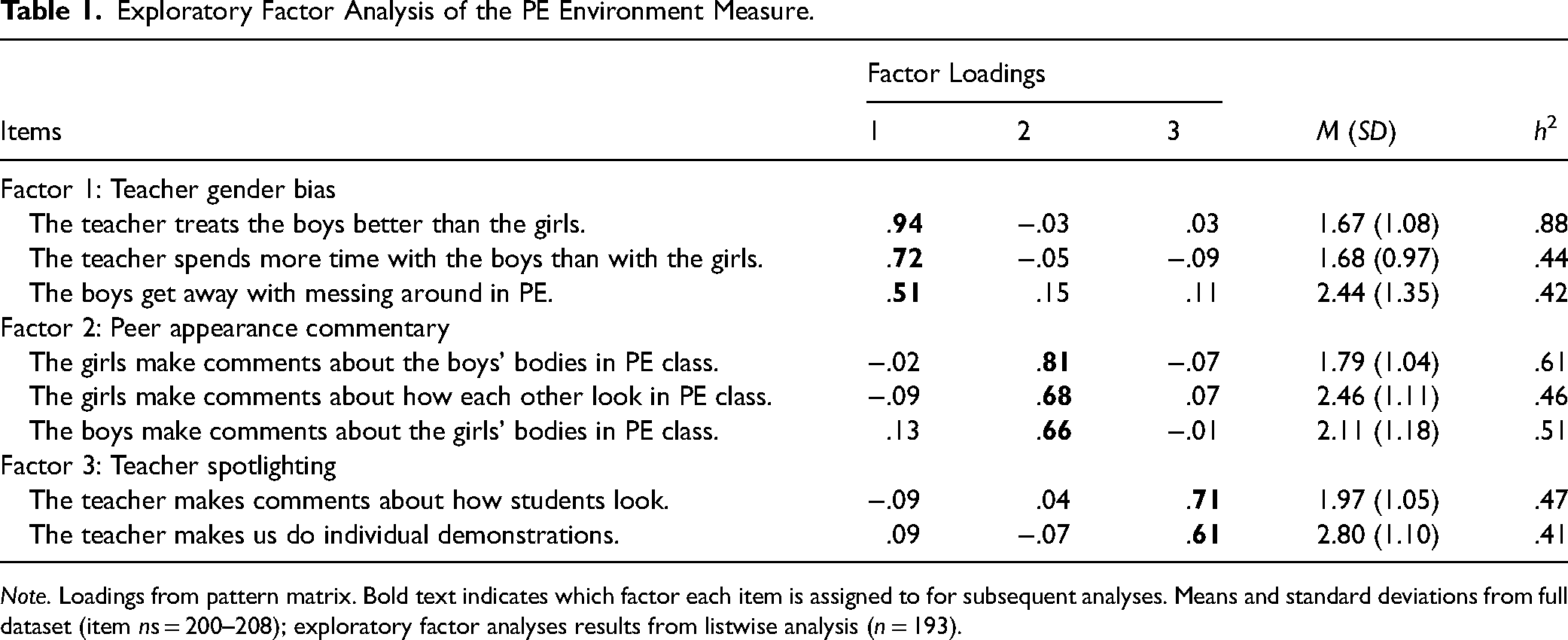
Note. Loadings from pattern matrix. Bold text indicates which factor each item is assigned to for subsequent analyses. Means and standard deviations from full dataset (item ns = 200–208); exploratory factor analyses results from listwise analysis (n = 193).
Self-Objectifying Thoughts in PE
At the time of data collection, there was no published measure that could capture girls’ self-objectifying thoughts in a particular context (vs. at the trait level). We therefore viewed an adaptation of an existing measure, developed for an exercise context, as most appropriate (Wolfe, 1999). The Wolfe (1999) measure assessed self-objectifying thoughts in a sample of exercising young adult women by asking them to indicate how often they thought about different things (including their bodies and appearance) in the exercise context. We adapted it to the PE context by altering filler items and rewording body objectifying thoughts to make them appropriate to a younger age group (e.g., “In PE class, I think about how my body looks”). This resulted in a final measure of eight items relating to self-objectifying thoughts. Participants were asked to indicate how often they thought about each of the things listed during PE class and responded to each statement on a 5-point rating scale from 1 (never think about this) to 5 (always think about this). A mean score was calculated from the eight self-objectifying thoughts items for each participant, with higher scores indicating a greater frequency of self-objectifying thoughts during PE. In the initial development study, Wolfe's (1999) measure of self-objectifying thoughts during exercise had good internal consistency (α = .87) and demonstrated validity from moderate correlations with trait measures of self-objectification and appearance orientation. The self-objectifying thoughts in PE items had good internal consistency in the current sample and emerged as a coherent factor from an EFA of the full set of items (ω = .94; see online Supplemental Materials Table S2 for items).
Trait Body Esteem
Girls’ trait body esteem was measured using the Body Esteem Scale for Adults and Adolescents (BESAA; Mendelson et al., 2001), which consists of 11 items relating to participants’ weight and general appearance (e.g., “I’m pretty happy with the way I look” and “I wish I were thinner” [reverse-coded item]). Participants were asked to indicate how true the statements were about how they think and feel about how they look and responded on a 4-point rating scale from 1 (not at all true for me) to 4 (very true for me). Reverse-coded items were recoded, and an overall mean score was calculated such that higher scores represented higher levels of body esteem. The BESAA (Mendelson et al., 2001) has been used previously in research with adolescent girls and has consistent reliability and validity support with this group, indicated by high internal consistency and consistent associations with appropriate correlates of positive body image (Kling et al., 2019). The items had good internal consistency in the current sample (ω = .92).
PE Engagement and Enjoyment
Ten items were used to assess PE engagement and enjoyment, drawing upon previous work in the area (e.g., Mouratidis et al., 2011). These differentiated between PE engagement (taking part and not engaging in avoidant behaviors; example items: “I always take part in PE class” and “Even if I go to PE class, I won’t put much effort in” [reverse coded]) and PE enjoyment (interest and enjoyment of PE classes; example items: “I have fun in PE class” and “I really enjoy PE”). Participants were asked to indicate how they felt about PE in relation to the statements and responded to these items on a 4-point rating scale from 1 (not at all true for me) to 4 (very true for me). A mean was calculated for each factor (with appropriate items reverse coded), with higher scores representing more engagement or more enjoyment respectively. EFA (principal axis factoring, promax rotation) confirmed that these items assessed engagement and enjoyment as separate constructs. Five items loaded onto the enjoyment factor, and five onto the engagement factor. One item (“I sometimes skip school to avoid PE”) was removed due to its low mean and standard deviation (M = 1.07, SD = 0.35; 95.6% of students responded not at all true). The two subscales had good internal consistency (engagement ω = .80; enjoyment ω = .91) and were positively correlated (r = .63, p < .001).
Data Analysis
Missing Data
For body esteem, objectifying thoughts, and the PE engagement and enjoyment scales, we computed a mean score for participants if they provided responses to ∼75% of the items (8/11 for body esteem, 6/8 for self-objectifying thoughts, 3/4 for PE engagement and PE enjoyment); this resulted in one participant missing one scale (PE engagement). We computed a mean score for participants on the PE environment subscales provided they were missing no items or only one item for positive PE (missing n = 0), appearance commentary (missing n = 7), and gender bias (missing n = 4). At the scale level, 94.7% of participants had complete data, with 3.3% missing one scale and 1.9% missing two. At the item level, most participants had no missing items (n = 170, 81.3%) or one missing item in their data (n = 24, 11.5%). The average missing data per item was 0.9%. Little's MCAR test (Little, 1988) provided evidence that the data were missing completely at random (χ2 = 16.44, df = 13, p = .23). Given the small amounts of missing data and the Little's MCAR test result, we used complete case analysis in our subsequent models (Parent, 2013).
Conditional Process Models
Given our interest in main effects (H1 and H2), mediation (H3), and moderation (H4), we conducted a series of conditional process models (Model 58 in v4.2; Hayes, 2017) in SPSS (version 25). These allowed us to simultaneously examine the mediation of the association between the PE environment and PE engagement and enjoyment by self-objectifying thoughts and the moderation of these associations by body esteem. In each model, we included one of our objectifying PE factors as the focal independent variable (i.e., “X”), body esteem as our moderator (“W”), and either PE engagement or PE enjoyment as our dependent variable (“Y”; see Figure 1). To ensure any associations with experiences of an objectifying PE environment were not due to those indicating poorer quality teaching in general, we also controlled for positive features of PE ostensibly unrelated to objectification, specifically the opportunities to learn skills in PE class and the provision of lifelong activities (e.g., Gibbons & Humbert, 2008). This allowed us to assess the unique associations of girls’ perceptions of the objectifying environment features with their self-objectifying thoughts in PE, PE enjoyment, and PE engagement.
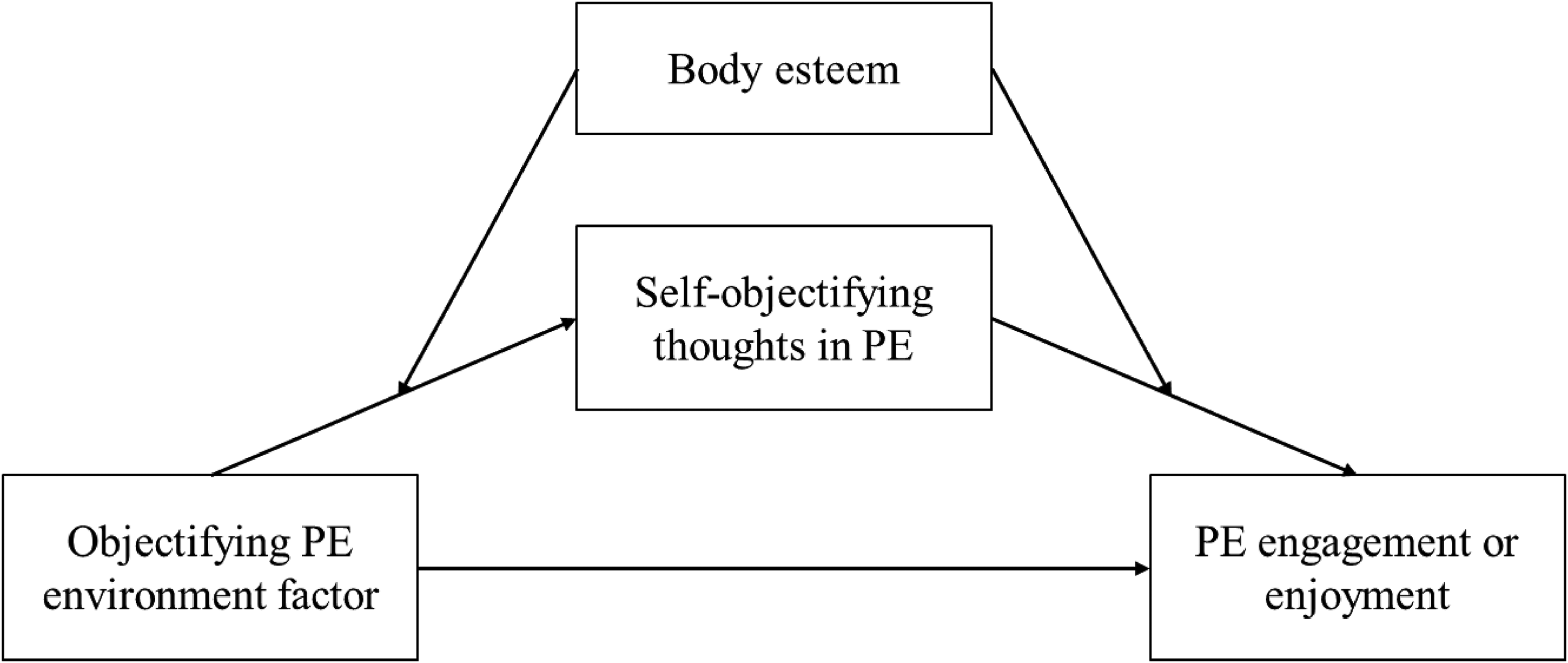
Conditional Process Model Tested for Each Objectifying Physical Education Environment factor and PE Outcome.
Model 58 in Process v4.2 is a combination of mediation and moderation models. First, a model is estimated where the mediator (self-objectifying thoughts) is predicted by the focal independent variable (e.g., gender bias), the moderator (body esteem), any covariates, and an interaction between the moderator and focal independent variable (e.g., gender bias × body esteem). Second, a model is estimated where the dependent variable (e.g., PE enjoyment) is predicted by the focal independent variable (e.g., gender bias), the mediator (self-objectifying thoughts), the moderator (body esteem), any covariates, and an interaction between the moderator and the mediator (i.e., self-objectifying thoughts × body esteem). Third, the results of these models are used to deconstruct the total effect into the direct effect and the indirect effect. Body esteem and the two PE environment variables were mean-centered before analyses (Hayes, 2017). We tested these more complex conditional process models first; where interaction effects were nonsignificant for the mediator model (i.e., where self-objectification was the dependent variable) and for the outcome model (i.e., where PE enjoyment or engagement was the dependent variable), we moved to a simple mediation model (Model 4 from Process v4.2) for two reasons. First, this model is more parsimonious and likely to provide more robust estimates in analysis with smaller samples, and second, standardized estimates are not provided by Process v4.2 for conditional process models but are provided for simple mediation models.
As such, we report the findings from four models in our results (two with body commentary as the focal independent variable, two with gender bias as the focal independent variable). In all models, we included positive PE environment as a covariate, along with the other objectifying environment factor (i.e., in models where gender bias was the focal independent variable, body commentary featured as a covariate, and vice versa). We also included school (dummy-coded with the school with the highest free school meals as the reference category) and year group (Year 8 or 9, coded as 0 and 1) as covariates.
To account for nonnormality in the data and potential heteroscedasticity, we implemented a combination of bootstrapping with 10,000 samples and a heteroscedasticity consistent standard error estimator (HSCE) of ordinary least squares parameter estimates (Hayes & Cai, 2007) and utilized the bootstrapped, bias-corrected 95% confidence intervals to identify significant direct, indirect, and interaction effects between variables, with intervals crossing zero indicating a significant effect. The HCSE we utilized (HC-4) is typically considered superior to other HCSEs across various situations (Hayes & Cai, 2007).
Sensitivity analyses indicated that for both Model 58 and Model 4 we had a sufficient sample size to detect an f2 effect of .039 for any given predictor, including the interaction effects in the moderated models (α = .05, β = .20, n = 201, with eight or nine predictors depending on the model; calculated in GPower 3.1). As such, an individual predictor would need to explain ∼3.8% additional variance in the outcome variable for the model to have the power to detect it (Selya et al., 2012). This value is slightly larger than Cohen's benchmark for a small f2 effect size (0.02; R2 = .02; requires n = 395 at the same alpha and power) but considerably smaller than the benchmark for a medium effect size (.15; R2 = .13).
Results
Zero-order correlations, means, and standard deviations are reported in Table 2. In the conditional process models, none of the interaction terms across all four models were significant (see Table 3); as such, the results reported below are from the simple mediation models. Given that all four models shared the first stage (where self-objectifying is predicted by the PE environment variables, body esteem, and covariates), we report these results first in a combined manner for brevity (using the estimates from the gender bias/PE enjoyment model). We then report the findings of the two models where PE enjoyment served as the dependent variable, followed by the findings where PE engagement served as the dependent variable. In each case, we provide an overview of the findings for the main effects shared between the models (using estimates from the model with gender bias as the focal predictor for each), before reporting the indirect effects which are unique to each model (again, for brevity). Associations of the covariates in each model other than the positive PE environment (i.e., school and year group) are not reported in the text but are provided in Table 4.
Means, Standard Deviations, and Correlations for All Study Variables.
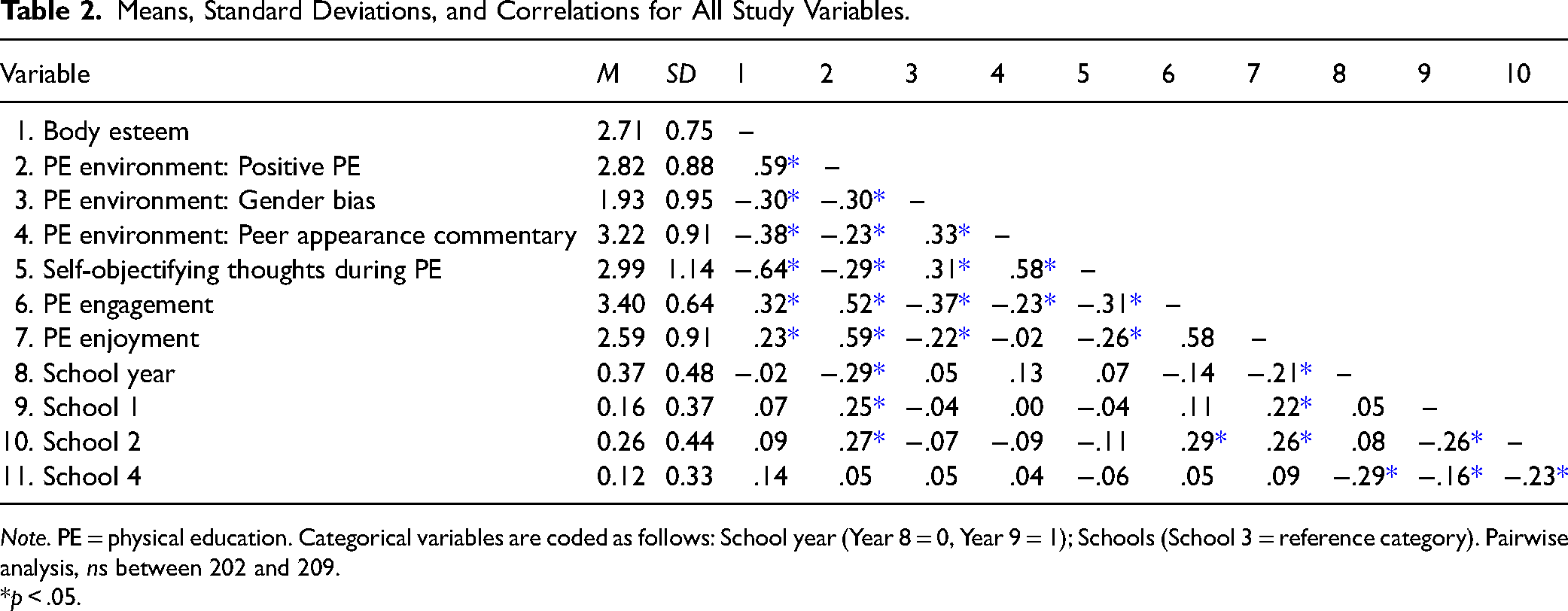
Note. PE = physical education. Categorical variables are coded as follows: School year (Year 8 = 0, Year 9 = 1); Schools (School 3 = reference category). Pairwise analysis, ns between 202 and 209.
p < .05.
Summary of Interaction Effects From the Conditional Process Models.
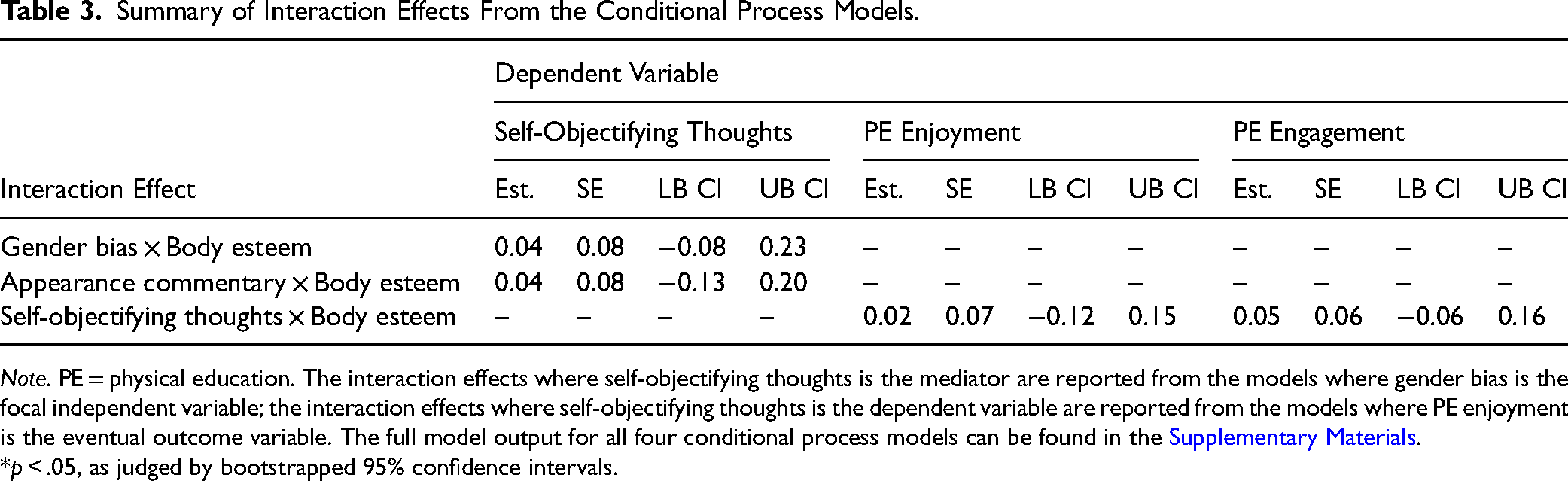
Note. PE = physical education. The interaction effects where self-objectifying thoughts is the mediator are reported from the models where gender bias is the focal independent variable; the interaction effects where self-objectifying thoughts is the dependent variable are reported from the models where PE enjoyment is the eventual outcome variable. The full model output for all four conditional process models can be found in the Supplementary Materials.
p < .05, as judged by bootstrapped 95% confidence intervals.
Summary Parameter Estimates From the Simple Mediation Models.
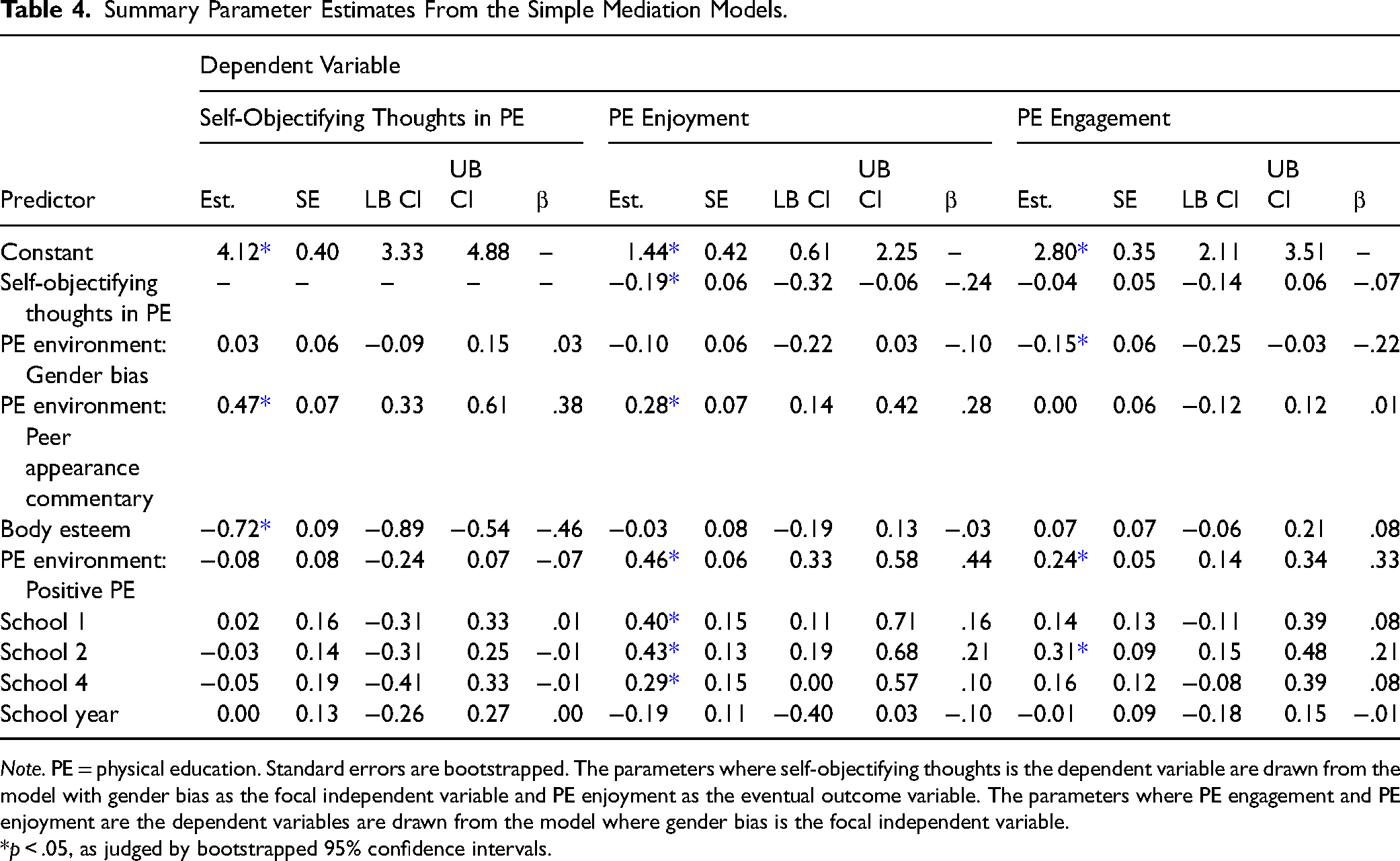
Note. PE = physical education. Standard errors are bootstrapped. The parameters where self-objectifying thoughts is the dependent variable are drawn from the model with gender bias as the focal independent variable and PE enjoyment as the eventual outcome variable. The parameters where PE engagement and PE enjoyment are the dependent variables are drawn from the model where gender bias is the focal independent variable.
p < .05, as judged by bootstrapped 95% confidence intervals.
Correlates of Self-Objectifying Thoughts
Self-objectifying thoughts in PE were significantly predicted by the regression model, F2(8,193) = 50.61, p < .001, with 54% of the variance explained by the included predictors. Neither of the interactions between PE environment variables (gender bias, appearance commentary) and body esteem were significant; girls’ trait body esteem did not moderate the associations of the PE environment variables with self-objectifying thoughts. Body esteem was negatively associated with self-objectifying thoughts; girls who had more positive feelings about their bodies in general thought less about their appearance during PE (Table 4). This association was medium to large in magnitude (β = .46), according to Cohen's (1988) classification of correlational effect sizes. Appearance commentary from peers was positively associated with self-objectifying thoughts; girls who perceived more appearance-related comments from their peers during PE thought more about their appearance in PE. This association was medium in magnitude (β = .38). No other PE environment variables were significantly associated with self-objectifying thoughts.
PE Enjoyment
PE enjoyment was significantly predicted by the regression model, F2(9,192) = 21.48, p < .001, with 47% of the variance explained by the included predictors. The interaction between body esteem and self-objectifying thoughts was not significant; girls’ trait body esteem did not moderate the association of self-objectifying thoughts with PE enjoyment. Self-objectifying thoughts were negatively associated with enjoyment of PE; girls who thought more about their appearance in PE enjoyed it less. This association was small to medium (β = −.24). Appearance commentary from peers was positively associated with enjoyment of PE; controlling for other variables in the model, girls who perceived more appearance commentary from peers in PE enjoyed PE more. This association was small to medium (β = .28). The perception of a positive PE environment (e.g., chances to learn skills, activities that will be continued outside of school) was positively associated with PE enjoyment with a medium effect size (β = .44). Body esteem and gender bias from teachers were not significantly associated with PE enjoyment.
There was a small negative indirect effect of appearance commentary from peers on PE enjoyment via self-objectifying thoughts (B = −0.09, 95% CI [−0.16, −0.03]; β = −.09; Figure 2); girls who perceived more appearance commentary from their peers in PE experienced less PE enjoyment due to greater self-objectifying thoughts. The total effect of appearance commentary from peers on PE enjoyment was, therefore, a small positive effect, due to the combination of this negative indirect effect via self-objectifying thoughts and the positive direct effect (Total effect: B = 0.19, 95% CI [0.06, .31]; β = .19). This unusual combination of direct and indirect effects is indicative of a suppression effect (MacKinnon et al., 2000). There was no indirect effect of gender bias from teachers on PE enjoyment, due to its lack of association with self-objectifying thoughts (B = −0.01, 95% CI [−0.03, −0.02]; β = −.01), and thus no total effect either (B = −0.10, 95% CI [−0.23, −0.02]; β = −.11).
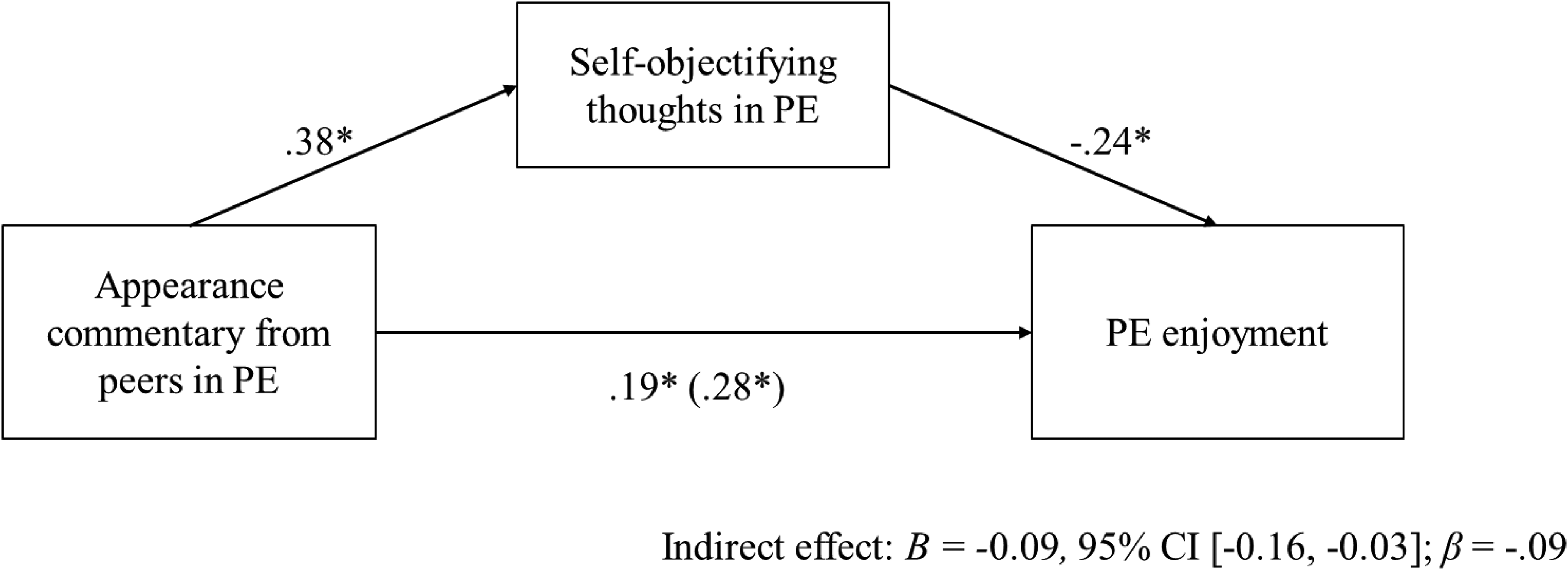
Mediation Model for Peer Appearance Commentary, Self-objectifying Thoughts, and PE Enjoyment.
PE Engagement
PE enjoyment was significantly predicted by the regression model, F2(9,191) = 8.70, p < .001, with 37% of the variance explained by the included predictors. The interaction between body esteem and self-objectifying thoughts was not significant; girls’ trait body esteem did not moderate the association of self-objectifying thoughts with PE engagement. Self-objectifying thoughts were not associated with engagement in PE. Gender bias from teachers in PE was negatively associated with engagement in PE; girls who perceived more gender bias from their teachers engaged less in PE. This association was small (β = −.22). The perception of a positive PE environment (e.g., chances to learn skills, activities that will be continued outside of school) was positively associated with PE engagement; this was a medium association (β = .33). Body esteem and appearance commentary from peers in PE were not significantly associated with PE engagement.
There was no indirect effect of either appearance commentary from peers in PE (B = −0.02, 95% CI [−0.07, 0.03]; β = −.03) or gender bias from teachers in PE (B = 0.00, 95% CI [−0.01, 0.01]; β = .00) on PE engagement via self-objectifying thoughts, due to a lack of association between self-objectifying thoughts and PE engagement. As such, there was no total effect of appearance commentary from peers (B = −0.01, 95% CI [−0.13, 0.10]; β = −.02). There was a small total effect of gender bias from teachers on PE engagement due to the direct effect reported above (B = −0.15, 95% CI [−0.27, −0.03]; β = −.22).
Discussion
In this study, we used objectification theory (Fredrickson & Roberts, 1997) as an explanatory framework, linking girls’ gendered experiences within mixed PE classes to their PE engagement and enjoyment via self-objectifying thoughts in PE. Additionally, we explored the potential for girls’ body esteem to moderate these associations. We identified two clear factors that may indicate an objectifying PE environment: gender bias from teachers and appearance-related commentary from peers. Of these two factors, peer appearance commentary was associated with self-objectifying thoughts in PE, but teacher gender bias was not (H1). Self-objectifying thoughts were associated with PE enjoyment (H2b) but not engagement (H2a), when controlling for body esteem and the direct effects of the PE environment. There was an indirect effect of peer appearance commentary on PE enjoyment via self-objectifying thoughts, but no other indirect effects between PE environment and outcomes (H3a and b); instead, gender bias was directly associated with PE engagement. Body esteem was associated with self-objectifying thoughts in PE, but did not moderate the associations between perceptions of the PE environment, self-objectifying thoughts, and PE outcomes (H4a and b). Our inclusion of positive PE experiences as a control variable in our model increases our confidence that these objectifying events in PE play a role in these processes, rather than poor PE provision in general; our inclusion of body esteem as a control variable increases our confidence in the importance of context-specific appearance-related thoughts. Sensitivity analyses suggested that our models were sufficiently powered to identify relatively small increases in R2 from individual predictors (∼3.8%), allowing more confidence that any nonsignificant findings are not the result of Type II errors.
Our findings suggest that peer appearance commentary in PE and trait body esteem are associated with self-objectifying thoughts in PE. The role of peer appearance-related commentary is consistent with both the PE literature (Metcalfe, 2018; van Daalen, 2005) and previous findings from objectification theory. That is, appearance-related comments are associated with self-objectification among adult women (Calogero et al., 2009), and appearance-related comments, harassment, and teasing are associated with higher self-objectification among adolescents (Slater & Tiggemann, 2011, 2015). Self-objectifying thoughts were associated with less enjoyment of PE, but not less engagement. The significant association with enjoyment is consistent with previous research that has found links between self-objectification during physical activity and negative mood (Wolfe, 1999). The nonsignificant association between self-objectifying thoughts and engagement is more surprising. One potential explanation is that while self-objectifying thoughts do not affect girls’ behavior (e.g., the “engagement” that was assessed in this study), they may instead affect the reasons behind it or girls’ motivation for PE and physical activity more generally (Prichard & Tiggemann, 2008). For example, girls may continue to take part in PE due to a concern over getting in trouble rather than for more positive reasons (e.g., enjoyment or valuing the activity). However, this is not a conclusion that can be drawn directly from this research, and further investigation of this possibility would be beneficial in future research.
Our findings linking the environment directly to self-objectification in the context of PE is of methodological importance for work on sexually objectifying environments. Findings have been mixed regarding a direct association between sexually objectifying environments and self-objectification, with this highlighted as an outcome in qualitative work (Moffitt & Szymanski, 2011) but not quantitative studies (Szymanski & Feltman, 2015; Szymanski & Mikorski, 2017a). The association we found may be due to using a context-specific measure of self-objectification which is more similar to women's qualitative accounts of increased self-surveillance specifically in the restaurant environment (Moffitt & Szymanski, 2011). Future work in sexually objectifying environments may benefit from including context-specific measures of self-objectification. However, we provide a note of caution to this suggestion: our measures did not include an assessment of girls’ experiences of appearance-related commentary directed at them; as such the direct association we found may be due to a missing variable, which is present in other studies of objectifying environments (e.g., sexual harassment in Szymanski & Feltman, 2015). Future research would benefit from including a measure of girls’ experiences of harassment targeted at them in PE.
Teacher gender bias was not associated with self-objectifying thoughts in PE but was directly associated with PE engagement. The practical implications of this are discussed later, but the lack of association between perceptions of teacher gender bias and self-objectifying thoughts provides interesting theoretical insight into Szymanski et al.'s (2011) criteria for sexually objectifying environments, of which gendered power dynamics are significantly featured. Our measurement of teacher gender bias included items that focused on teachers’ gendered treatment of students, which was not related to appearance-related comments or sexualizing behaviors from the boys; as such, we propose that our measure tapped a form of nonsexualized power imbalance, particularly given other items (i.e., peer appearance commentary) included within the same measure. This may suggest that Szymanski et al.'s (2011) criteria cannot be treated as a checklist of separate criteria that each contribute to an environment conducive to self-objectification. In the PE context, the gendered power imbalance created by these teacher behaviors is not sufficient to promote self-objectification; a sexualized element to this power imbalance appears to be required. This proposition could be tested by further exploring teacher behaviors with a more specific sexualized element, such as failure to police sexualized comments from male students or making their own comments about students’ appearances (van Daalen, 2005).
Peer appearance-related commentary had some unexpected associations in our models. The negative indirect effect of peer appearance commentary on PE enjoyment via self-objectifying thoughts in PE was in accordance with our theorizing: girls who perceived more appearance-related comments from peers in PE thought about their bodies more in this context and subsequently enjoyed PE less. However, there was also a positive direct effect of peer appearance commentary on PE enjoyment: accounting for other factors in the model, girls who perceived more appearance-related comments from their peers enjoyed PE more. Statistically, this is referred to as an inconsistent mediation model (MacKinnon et al., 2000): peer appearance commentary had a nonsignificant zero-order correlation with PE enjoyment, but in models including self-objectifying thoughts this became significant and positive. This finding may be specific to the particular group of girls included in our research: in three schools, these girls took part in mixed-gender PE by choice. These girls may therefore be more talented and more invested in PE; peer appearance commentary in this context could be relatively more likely to be of a positive nature and thus associated with more enjoyment of PE (alongside more self-objectifying thoughts). Previous research suggests this is not implausible: receiving more positive appearance comments was associated with better body image, but a greater focus on appearance (Herbozo & Thompson, 2006). Additionally, the highest loading item for the peer appearance commentary factor was that relating to girls commenting on boys’ appearances, which may also complicate the interpretation of this finding. Future research that examines the valence and targets of these peer-related comments could shed further light on this anomalous finding.
Limitations and Directions for Future Research
Although a novel application of objectification theory, our study is not without limitations. The cross-sectional nature of our data restricts our ability to draw causal inferences and to consider reciprocal associations. For example, although body esteem's role as a predictor of self-objectifying thoughts in PE is justifiable, it is also likely the case that experiences within PE influence girls’ feelings about their bodies more broadly over time. Indeed, trait body image constructs have typically been positioned as an outcome in cross-sectional self-objectification research, both generally and in the specific context of sexually objectifying environments (Moradi, 2010; Szymanski & Feltman, 2015; Szymanski & Mikorski, 2017a). In our zero-order correlations, it is also noteworthy that body esteem had moderate associations with all other variables (i.e., PE environment factors, self-objectifying thoughts, and both PE engagement and enjoyment). Subsequent research would benefit from longitudinal designs that are better able to explore the multiple roles of body esteem in this context and whether these appearance-related thoughts in PE spillover to other contexts over time.
A critical point of discussion is our measure of assessing girls’ perceptions of the PE environment. A first point to note is that we identified only two statistically robust and reliable factors from our initial item pool. A potential third factor, teacher spotlighting, was hindered by a lack of items. This was unfortunate because these items related to teacher behaviors that highlighted students’ appearance (e.g., Scraton, 1992), and may align with the “bodies on display” aspect of sexually objectifying environments (Szymanski & Feltman, 2015). We therefore successfully measured some aspects of a lack of power for women (via perceived teacher gender bias) and one particular way that attention can be drawn to the physical attributes of women's bodies (via appearance commentary from peers). However, the items included in our analysis failed to adequately capture the existence, approval, and encouragement of the male gaze specifically (e.g., teachers failing to reprimand male students for comments about girls’ bodies) or to fully capture the sexualized nature of this gaze that is central to the work on sexually objectifying environments thus far (e.g., Moffitt & Szymanski, 2011; Steinfeldt et al., 2013). Thus, although we identified only one PE environment factor that was associated with self-objectifying thoughts in PE, this study by no means provides an exhaustive list of such factors. Future scale development would benefit from a greater pool of initial items to support the robust identification of further key factors.
These data were collected in 2013–14, raising the question of whether the experiences reported by girls in our work have similar relations with the outcomes today. However, academic work on girls’ experiences of PE over more than 25 years identifies consistent themes over this period (i.e., from Scraton, 1992, to Metcalfe, 2018). In England, the most recent PE policy update from the UK government highlights ongoing inequality in the provision of girls’ sports in school (Department for Education, 2023). The PE context for girls in England is therefore arguably still broadly similar to when the data were collected, although further research would be valuable in confirming this.
Finally, schools that volunteered for the research may be different from schools that did not; the findings may not be representative of schools where the Heads of PE were not interested in research relating to girls’ experiences. The teacher gender bias items had low means (i.e., less than 2 on a 5-point scale), indicating a relatively low frequency of these experiences across the girls in our sample. Our results therefore may not hold in schools where gender bias was perceived to be stronger or more widespread among staff. The limited demographic range within and across schools restricts the generalizability of our findings to majority white schools in relatively affluent areas. Furthermore, our data did not include individual students’ demographic details so we could not control for these at the individual level in our analyses. This is important to rectify in future research as students from marginalized identities (e.g., higher BMI or minority racial/ethnic groups) may be most likely to experience appearance-based harassment in PE (e.g., Metcalfe, 2018).
Practical Implications
PE teachers recognize girls’ body image concerns and self-consciousness within PE, but attribute these primarily to forces outside of the classroom, such as society, mainstream or social media, and individual risk factors (Azzarito et al., 2006). However, our findings suggest that training for PE teachers (and sports coaches more broadly) should be strengthened by helping them to recognize factors within PE that influence girls’ experiences of their bodies, such as appearance commentary from peers. The importance of reducing appearance-based harassment for adolescents has been highlighted by previous research (Duncan et al., 2019; Lovegrove & Rumsey, 2005). Our findings suggest that interventions targeting appearance-based bullying may have benefits not just for well-being and body image, but also for girls’ enjoyment of PE. Although “enjoyment” may seem frivolous from a public health perspective, enjoyment of PE predicts physical activity participation both during adolescence and into adulthood (Standage et al., 2012). Positive affective experiences during single exercise sessions are predictive of physical activity participation months later (Williams et al., 2008), and formative affective experiences of exercise, such as those in adolescent PE, may serve as a blueprint for our enduring feelings about exercise (Ekkekakis et al., 2021). As such, self-objectifying thoughts in PE may be a vital target for future interventions to safeguard girls’ enduring enthusiasm for a physically active lifestyle. Finally, the link we identified between perceived teacher gender bias and PE engagement confirms existing qualitative findings: teachers’ failure to manage boys’ behavior is a factor in adolescent girls’ disengagement from PE (Azzarito et al., 2006; Gibbons & Humbert, 2008; Wright, 1996). It is important for teachers to be mindful of these findings and take steps to both provide equal opportunities and be seen to do so by the girls they teach.
Conclusion
This study extends research on objectifying environments beyond the restaurant setting, using objectification theory as a framework to explain why some girls may disengage from PE in early adolescence. In addition, the measures developed for the study and the process behind their development may be of use to future researchers, with additional investigation of their validity and reliability; the context-specific measure of self-objectification could be modified for other contexts, as could our assessment of a new type of sexually objectifying environment.
Physical activity is crucial to girls’ health and well-being; PE is an important environment in which girls form perceptions of and associations with activity that can last a lifetime. Our research suggests the vital importance of addressing objectifying experiences and self-objectifying thoughts in this context, to promote girls’ enjoyment of PE and future participation.
Supplemental Material
sj-docx-1-pwq-10.1177_03616843241262692 - Supplemental material for Applying Objectification Theory to Adolescent Girls’ Gendered Experiences of Physical Education in the United Kingdom
Supplemental material, sj-docx-1-pwq-10.1177_03616843241262692 for Applying Objectification Theory to Adolescent Girls’ Gendered Experiences of Physical Education in the United Kingdom by Megan Hurst, Robin Banerjee and Helga Dittmar in Psychology of Women Quarterly
Footnotes
Author Note
This research was funded by the Economic & Social Research Council, as part of a PhD studentship in the name of the first author (Reference: ES/I900934/1). The authors would like to thank Danielle Gorman-Kiely for her assistance with in-school data collection, the four schools for their support for the research, and, of course, the girls who shared their experiences. Additionally, we thank the associate editor and the anonymous reviewers for their constructive comments on the paper, particularly their insights relating to body esteem's potential role in our analyses.
Data Availability
Participant consent documentation for this study means that the data cannot be made openly available and can only be shared for audit purposes by contacting the first author.
Declaration of Conflicting Interests
The author(s) declared no potential conflicts of interest with respect to the research, authorship, and/or publication of this article.
Funding
The author(s) disclosed receipt of the following financial support for the research, authorship, and/or publication of this article: This work was supported by a PhD Studentship in the name of the first author from the Economic and Social Research Council (grant number ES/I9009341/1).

Supplemental Material
Supplemental material for this article is available online.
References
Supplementary Material
Please find the following supplemental material available below.
For Open Access articles published under a Creative Commons License, all supplemental material carries the same license as the article it is associated with.
For non-Open Access articles published, all supplemental material carries a non-exclusive license, and permission requests for re-use of supplemental material or any part of supplemental material shall be sent directly to the copyright owner as specified in the copyright notice associated with the article.
