




Abstract
A popular form of neoliberal feminism seeks to advance gender equality in leadership and beyond by encouraging women to be resilient as individuals. By locating career advancement as within an individual's control, recent research has shown that this focus subtly shifts the blame for gender inequality onto women and reduces support for needed structural changes to tackle gender discrimination. We extend research into neoliberal feminism by examining anticipated negative effects on women's protest motivation. Across four studies in the United Kingdom (total N = 1,168), undergraduate women students and employed women with university degrees in both the control and resilience conditions first read about gender inequality. Participants in the neoliberal feminist conditions then read messages promoting individual resilience as key to women's advancement (Study 1–3) or participated in activities designed to build their own resilience as individuals to help them advance (Study 4). In Studies 1, 3, and 4, participants in the neoliberal feminist conditions compared to the control had lower collective action intentions – a negative effect that was either indirect, via reduced perceptions of gender discrimination (Studies 1 and 4) and reduced anger over inequality (Study 1), or direct (Study 3). Together, these studies provided partial support for our hypothesis that neoliberal feminism can undermine women's protest motivation. Future research can help establish how contextual and other factors contribute to the strength of these effects and explore how feminists can better harness messages of resilience. To advance gender equality, our findings suggest that advocates should focus less on individualistic solutions and more on addressing structural barriers, laying the groundwork for effective protest action and social change. Additional online materials for this article are available on PWQ's website at http://journals.sagepub.com/doi/suppl/10.1177/03616843241238176.
As a political movement, feminism has historically been successful in challenging gender discriminatory laws and practices through marches, petitions, boycotts, and other types of collective action (Maddison & Sawer, 2013). A popular neoliberal feminism exemplified by former Facebook Chief Operating Officer Sheryl Sandberg's bestselling book Lean In encourages a more individualistic strategy to advance gender equality (Rottenberg, 2014). This form of feminism seeks to progress gender equality by encouraging women to be more confident, strategic, and resilient to setbacks as individuals. Critics of neoliberal feminism have argued that it presents career advancement as largely within an individual's control, sidelining the structural challenges women continue to face, which are particularly acute for multiply marginalized women (Harrison, 2013; Jensen, 2016). Recent experimental research has found that this individualistic focus does increase beliefs that women are responsible for ongoing gender inequality and weakens support for policies to address its social/structural causes (Kim et al., 2018). In the current set of studies, we expanded research into neoliberal feminism by examining its effects on women's protest motivation.
The (Growing) Issue of Gender Inequality and Neoliberal Feminism
Men continue to dominate leadership positions, representing 92% of Chief Executive Officers (CEOs) in the world's 500 largest corporations (Connley, 2021). In addition to low numbers of women in top-level leadership, the majority of women work in low-status, low-paid industries (Francis-Devine et al., 2021) and shoulder the burden of responsibility for unpaid caregiving and domestic work (The Fawcett Society, 2020). The gender-pay gap also persists: full-time working women earn 7.4% less than full-time working men in the United Kingdom, with the gap increasing to 15.5% when considering the median pay for all employees, due to a significantly higher proportion of women than men who work part time (Francis-Devine & Ferguson, 2020). Even greater disparities exist when multiple sources of disadvantage are considered, including for women who are disabled and/or from socio-economically and/or ethnic or racially minoritized backgrounds (Pew Research Center, 2023).
Social and structural remedies to gender inequality include challenging gender stereotypes (Bongiorno et al., 2014; Koch et al., 2015; Pireddu et al., 2022), addressing gender-based violence (Bondestam & Lundqvist, 2020; Evans et al., 2020; Fitzgerald & Cortina, 2018), and ensuring access to vital social services including healthcare, housing, childcare, education, and legal assistance. Yet, in the United Kingdom and elsewhere, governments have been cutting spending to social services designed to address gender inequality, especially in the years since the 2007–2008 Global Financial Crisis (Varoufakis, 2016). These cuts reflect prevailing neoliberal policies and practices whereby social/structural problems are reduced to ones of individual responsibility (Bottrell, 2013). Over the same period, an emphasis on individual resilience, or the ability to cope and even flourish in the face of adversity through being psychologically strong and adaptable, has become more prominent in popular culture and public policy (e.g., welfare, employment, health: see Bottrell, 2013; Bull & Allen, 2018; Neocleous, 2013). Women have been especially targeted by individual resilience messaging, a focus that has been labelled neoliberal feminism because it promotes an individual fix to a social/structural problem (Banet-Weiser et al., 2020; Gill & Orgad, 2018; Rottenberg, 2014).
Neoliberal feminism is considered part of a growing emphasis on character within neoliberalism, whereby members of structurally disadvantaged groups are encouraged to psychologically equip themselves to succeed in the face of (increasingly) adverse social conditions (Bull & Allen, 2018). This focus is said to help deflect criticism of the negative effects that funding cuts to social services are having on the social mobility of the most disadvantaged groups (Bottrell, 2013; Rottenberg, 2014). The typical proponents and targets of neoliberal feminism are also the least disadvantaged women—those who are university educated, White, and middle-to-upper class—and thereby those whose multiple sources of privilege (i.e., racial, socioeconomic) buffer them from the worst effects of neoliberal cuts to public services (Gill & Orgad, 2018). Neoliberal feminism has also been criticized as being ableist, racist, and classist because it sets the stage for women's failures (and particularly multiply marginalized women's failures) to be attributed to a presumed lack of staying power rather than to a lack of social support that remains available to more privileged women (Harrison, 2013; Jensen, 2016).
Notable examples of neoliberal feminism are bestselling self-help books Lean In (Sandberg & Nell, 2013) and The Confidence Code (Kay & Shipman, 2014). In Lean In, women are told that if they adopt the right mindset they can “forge a path through the obstacles, and achieve their full potential” (Sandberg & Nell, 2013, p. 172). The emphasis on individual resilience is also communicated and reinforced in a proliferation of smartphone apps through scheduled positive affirmations and frequently observed in women's magazines (Gill & Orgad, 2015, 2018). In the context of Brexit and high expected layoff/redundancy rates for millennial women, Gill and Orgad (2018) highlight articles in women's magazines that celebrate women who have been able to bounce back from challenges, and advocate the need to “…adopt a resilient attitude…” and “fully embrace a constantly shifting situation and turn it into a positive” (p. 482).
The popularity and pervasiveness of neoliberal feminism has motivated experimental researchers to examine evidence for some of its anticipated negative effects on people's beliefs about the causes of gender inequality. Kim et al. (2018) presented participants with excerpts of the best-selling book Lean In (or related TED talk by Sandberg, 2010) as an exemplary case of the neoliberal feminist focus on promoting individual resilience as the pathway to women's advancement. When compared to a control group, or those who read or listened to messages emphasizing structural causes of gender inequality (e.g., discriminatory treatment), participants in the Lean In conditions were more likely to believe that women are responsible for both causing and solving gender inequality. Lean In messages also increased beliefs that interventions to change women (e.g., assertiveness training), rather than those to change society (e.g., to address gender bias), were the best way to tackle gender inequality, and the effect persisted even when Lean In messages were accompanied by an acknowledgement that social barriers hamper women's advancement.
Neoliberal Feminism and Women's Protest Motivation
In addition to subtly shifting the blame for gender inequality onto women and undermining support for needed social changes (Kim et al., 2018), another way that neoliberal feminism has the potential to undermine progress toward gender equality is by reducing women's protest motivation (Faludi, 2013). Collective action by women to protest gender discriminatory laws and practices, including through petitioning, holding rallies, and letter writing, has historically led to important social reforms that have improved women's lives and opportunities (Maddison & Sawer, 2013). Rights and supports that have historically been won through women's collective action include the right to vote, access education, receive equal pay for equal work, free childcare, maternity leave and pay, and support to escape gender-based violence through the provision of women's refuges (Horning, 2018).
Theory and research into the psychological underpinnings of collective action by disadvantaged groups identify perceptions of injustice as a key driver (Ellemers, 2001; Kelly & Breinlinger, 1995). According to the social identity model of collective action (van Zomeren et al., 2008), perceptions of injustice comprise beliefs that group-based inequality is the outcome of unfair treatment (rather than some other cause, such as different preferences or abilities) and the corresponding action-oriented emotion of anger. Applied to women and the gender equality cause, the social identity model of collective action would thereby predict that women's collective action to protest gender discrimination will be preceded by beliefs that gender inequality stems from unfair treatment and accompanying feelings of anger about that unfair treatment (Becker & Wright, 2011; Iyer & Ryan, 2009).
As neoliberal feminism subtly promotes beliefs that gender inequality stems from causes that are internal to women (Kim et al., 2018), women exposed to such messages may be less likely consider unfair treatment as the cause of gender inequality or feel anger about that unfair treatment, thereby reducing their collective action intentions to protest gender inequality. No prior research has examined the effect of individual resilience messages on women's protest motivation. However, related research has shown that the more people endorse status-legitimizing ideologies that, like neoliberal feminism, focus on internal explanations for group-based inequality, the less likely they are to consider gender inequality to be an outcome of unfair treatment. Such beliefs include a belief in a meritocracy, whereby unequal group outcomes are considered reflective of different abilities and/or propensities (Major et al., 2002), and choice ideology (Connor & Fiske, 2019), whereby unequal group outcomes are considered reflective of different (and freely made) life choices (Stephens & Levine, 2011).
Research by Becker and Wright (2011) has also shown that women's protest motivation can be undermined by benevolent (but not hostile) sexism that, like neoliberal feminism, appears positive and affirming, but helps to maintain the gender status quo by promoting beliefs in inherent differences between women and men. In the case of benevolent sexism, this is done through influencing women to believe that differences in the social positions of women and men reflect women's special qualities (e.g., to be caring). Exposing women to hostile sexism, which portrays women in an overtly negative light (e.g., as easily offended), was shown to motivate women's collective action because it increased their beliefs that the gender system is unfair, along with their related feelings of anger about gender inequality.
In sum, we contend that women's protest motivation will be undermined by neoliberal feminism because, as with other status-legitimizing ideologies (e.g., merit, choice, benevolent sexism), by focusing on internal explanations for group-based inequity, it will undermine recognition of its external causes (i.e., unfair treatment). Further, because individual resilience messages are explicitly (and likely genuinely) communicated with the goal of empowering women (Banet-Weiser et al., 2020), the negative implications for positive social change are easier to obscure. Thus, unlike hostile sexism, which reflects overtly antagonistic attitudes towards women that motivates collective protest, the perceived positivity of neoliberal feminism is likely to help mask its negative message that for gender equality to be achieved, it is women, not society, that need to change.
Overview of the Current Research
Our primary aim was to examine whether the neoliberal feminist focus on individual resilience undermines women's protest motivation. We conducted four studies in the United Kingdom to examine our aims. In all studies, participants were first presented with gender-inequality statistics, including the high percentages of women in higher education relative to the low percentages of women in top-level professional positions. Participants in the control condition then completed study measures related to protest motivation (perceived gender discrimination, anger about inequality, and collective action intentions), while participants in neoliberal feminist conditions then either read messages promoting the importance of individual resilience to career advancement (Studies 1–3) or participated in activities to facilitate their development of individual resilience (Study 4), before completing study measures related to protest motivation. Our study samples included British women enrolled in tertiary education (Study 1 & 2) and women university graduates employed in the United Kingdom (Study 3 & 4). These samples allowed us to target the aspirational women who, by virtue of their current professional employment and/or the career advancement opportunities university qualifications (should) afford, are the main targets and consumers of the popular neoliberal feminist messages we were interested to examine here (Gill & Orgad, 2015, 2018).
An additional aim for the current research was to examine evidence for a psychological boost arising from the individual resilience messages. As neoliberal feminism is popular and considered by some to be an important inspiration for women struggling with career setbacks (Gill & Orgad, 2018; Metz & Kumra, 2019), we wanted to examine evidence for this type of potential benefit. To do this, we examined potential positive effects on women relating to: perceived control over their life outcomes, which has been linked to health, well-being, and life satisfaction (Lachman & Weaver, 1998; Prenda & Lachman, 2001); career ambition, which has been linked to career advancement (Fernandez-Mateo & Fernandez, 2016); and intentions to use individualistic self-help interventions, such as networking and assertiveness training, which may be useful for helping (some) women navigate a pathway to advancement (Metz & Kumra, 2019).
Study 1
Design and Hypotheses
In Study 1, we used a between-participant design. The independent variable had three levels, one of which was the no-resilience control. Two individual resilience conditions comprised the remaining levels: a “part” condition, that included a description of a woman who achieves career success despite exceptionally difficult personal circumstances (Successful Resilient Woman), and a “combined” description, where the same businesswoman provides individual resilience advice aimed at helping other women advance (Successful Resilient Woman + Resilience Advice). Using these two individual resilience conditions allowed us to examine the effect of explicit resilience advice in addition to a description of a woman who achieves career success against the odds (i.e., an individual woman who embodies resilience, without also providing advice about how to be resilient). The dependent variables relating to our protest motivation hypotheses were anticipated gender discrimination, anger about gender inequality (as the belief and emotion components of perceived injustice), and collective action intentions. The dependent variables relating to our research questions for the psychological boost measures were perceived control and career ambition. Our hypotheses were:
H1: When compared to the control condition, participants in the resilience conditions (with or without resilience advice) would report less anger about ongoing inequality, less anticipated gender discrimination, and have lower collective action intentions. H2: The relation between condition and collective action intentions would be mediated by reduced levels of anger about gender inequality and anticipated future gender discrimination for women in the resilience conditions.
We did not have hypotheses about whether participants in the two resilience conditions would differ on collective action intentions, anger about inequality, and anticipated future gender discrimination. It was possible that the resilience advice would further undermine collective action by making the importance of individual resilience more explicit. However, the description of the woman achieving outstanding career success despite very difficult personal circumstances strongly implies that individual resilience was relevant to her advancement. Thus, it was also possible that additional resilience advice would not meaningfully add to the anticipated (undermining) effect of the individual resilient exemplar on women's protest motivation. Similarly, we did not make predictions about the effects of resilience conditions compared to the control condition on participants’ perceived control and career ambition.
Method
Sample Size Determination
Using an effect size (d = .46) for a similar manipulation in prior research (see Kim et al., 2018; Study 2), we used G*Power (Faul et al., 2007) to determine the sample size required to detect a similar effect size for this study with adequate power (.80). The analysis indicated we needed a minimum of 59 participants per cell. With a three-condition design, the minimum target to achieve adequate power for Study 1 was 177. We aimed to recruit a sample at least 30% higher than this to account for potential comprehension and suspicion check failures and for participants who did not meet the inclusion criteria.
Participants
For our target population of British women currently enrolled in higher education, we retained 219 participants, exceeding our minimum target of 177 to achieve adequate power (Mage = 20.05, SD = 1.57; 3.7% Asian, 2.3% Black, 1.8% mixed ethnicity, 92.2% White; see online Supplementary Materials for full details of exclusions based on completion, gender, nationality, student status, and the suspicion check and Supplementary Table S1 for full demographics). Participants were recruited to a study on “gender and society” from the first-year psychology participant pool at a university in England and received course credit. Additional participants were recruited by being approached on campus or via links posted on student-facing online sites.
Materials and Procedure
The study was conducted in compliance with approval from the University of Exeter, College of Life and Environmental Science – Psychology Ethics Committee (eCLESPsy000393). The questionnaire was administered online using Qualtrics survey software. The first page contained background information about the research, followed by a page where participants provided informed consent by clicking several checkboxes. We provided participants with a cover story about the research aims to reduce suspicion. In Part A, participants received instructions indicating that we were interested in how people process and recall information about gender in society, and that they would be asked to read and recall information about gender before being asked some questions to examine their recollection. In Part B, instructions informed participants that they would be asked questions about their own futures and beliefs about how society functions.
Information About Gender Inequality
All participants were then directed to a page with societal-level information about gender. They read that despite the United Kingdom outlawing gender discrimination over 40 years ago, in virtually every profession, men continue to outnumber women at the top, and gender statistics in the fields of law, business, politics, and medicine were presented (e.g., “Medicine: 55% of medical students and 52% of GPs are women, yet only 34% of those on the Specialist Register and 11% of consultant surgeons are women”). On the next page, we used four multiple-choice questions to test participants attention to the materials and recollection (e.g., “What percentage of consultant surgeons are women? ‘11%’, ‘22%’, ‘40%’”). Participants in the control condition were then directed to Part B.
Individual Resilience Manipulations
Participants in the two resilience conditions were then directed to a page informing them that they would now be asked to read individual-level information about gender before answering questions to test their recollection. To maximize external validity, we adapted text for the resilience manipulations from a genuine communication in a university setting about an inspiring women speaker series. The description was similar in tone and content to the individual resilience messages described by Gill and Orgad (2018), whereby a business woman is profiled who has achieved career success despite exceptionally difficult circumstances. This businesswoman worked outside the United Kingdom and is not a high-profile figure, making it highly unlikely that participants knew about her prior to the study.
On the next page, we informed participants in the resilience conditions that they were randomly selected to read about a businesswoman. Although we based the description on a real businesswoman, we use the pseudonym “Kathleen Roberts” to protect the woman's identity (see online Supplementary Materials for the full description). In both resilience conditions, participants read a paragraph that described the career of a highly successful businesswoman who had delivered outstanding results leading a team in the “hard-nosed investment banking and private equity worlds.” She had been celebrated as a “standout performer” and recognized as a “Rising Star.” The description stated that she achieved this career success “all whilst being a single mother of twin girls, one of whom has a disability.” In the “combined” resilience condition, participants read a second paragraph describing how the businesswoman subsequently founded a women's empowerment consultancy company that provides “advice to women about how to achieve career success through adopting the right attitudes and approaches to their careers.” The businesswoman was also described as having written a bestselling book “Grit” to help women overcome career limiting “self-doubts” and “inspiring them to believe they can achieve whatever they put their minds to.” The title for this book was chosen without knowledge of Duckworth's (2016) popular book of the same name on a similar topic.
Following this information, participants responded to three multiple-choice questions, identical across the resilience conditions, to examine their recollection and attention to the materials (e.g., “Was Kathleen Roberts named a ‘Rising Star’ by Business Review Weekly? ‘Yes,’ ‘No’”). Participants in the “combined” condition answered a fourth question on information specific to this condition (i.e., “Kathleen Robert's book ‘Grit’ was first released in 2008. True or false? ‘True,’ ‘False’”). Participants then completed Part B of the study.
Measures
In Part B, participants answered measures relating to their protest motivation and the items to examine whether they experienced a psychological boost after reading about the successful resilient woman, namely personal control, and career ambition. These measures were interspersed with others that we included for descriptive and exploratory purposes. We used multiple items for all measures and composite scores were calculated as means (see online Supplementary Materials for full details of all measures and to access the Open Science Framework (OSF) link where questionnaires and order of measures are detailed).
Protest Motivation Measures
Collective Action Intentions
We used 12 items to measure intentions to engage in collective actions to promote gender equality from Kelly and Breinlinger's (1995) research on women's activism in the United Kingdom. We asked participants, “How likely is it that you will engage in the following actions to progress the cause for gender equality?” Items related to different types of actions women can take to progress the gender-equality cause, including participation in women's groups (four items, e.g., “act as a spokesperson for a particular women's issue”), collective protest (three items, e.g., “take part in a rally or demonstration”), informal participation (two items, e.g., “discuss women's issues with friends or colleagues”); and individual protest (three items, e.g., “sign a petition”). Participants responded on a 7-point scale, ranging from 1 (not at all likely) to 7 (very likely). Although Kelly and Breinlinger (1995) reported four factors based on their sample of women in the United Kingdom, we conducted a factor analysis (principal axis factoring) on this sample which identified a single factor explaining 53.7% of the variance. All items loaded above .5 on this factor. A parallel analysis also identified a single factor as indicated by an eigenvalue exceeding the top 95th percentile of eigenvalues from randomized data sets with an identical number of items and cases (Raw data = 6.58; 95th percentile = 1.49). We combined the 12 collective action-intention items into a single scale, with higher scores indicating greater collective action intentions. For this sample, Cronbach's α was .92 and McDonald's ꞷ was .93.
Anticipated Gender Discrimination
We used five items from Begeny and Huo (2018) to measure participants’ expectations that they would face gender discrimination in the future (e.g., “Thinking about your future, do you think you will be discriminated against because of your gender?”). We considered this scale appropriate for capturing participants’ recognition that their outcomes were likely to be affected by gender discrimination, relevant to their motivation to take (related) collective action. We also oriented the scale towards the future because it was a student sample who were yet to start their professional careers so may have limited experiences of discrimination. Participants responded on a 5-point scale, ranging from 1 (never) to 5 (very often), with higher scores representing greater expectations of facing gender discrimination in the future. McDonald's ꞷ for this sample was .87 and Cronbach's α was .87, similar to the Cronbach's α of ≥ .90 reported in Begeny and Huo's (2018) research using samples from three minoritized racial/ethnic groups (Black, Asian, Latinx) in the United States.
Anger About Gender Inequality
To measure anger about gender inequality, we used four items from van Zomeren et al. (2004): “angry,” “irritated,” “furious,” and “displeased.” We asked participants, “When you consider that there are continuing gender-based inequalities, to what extent do you feel…” Participants responded on a 7-point scale, ranging from 1 (not at all) to 7 (very much), with higher scores representing greater anger about gender inequality. McDonald's ꞷ for this sample was .91 and Cronbach's α was .91, similar to the Cronbach's α of .86 in the van Zomeren et al. (2004) research using a sample of 1st year psychology students in the Netherlands.
Psychological Boost Measures
To examine our research questions about a psychological boost after hearing messages promoting individual resilience, we included the following scales relating to perceived control and career ambition.
Perceived Control
To examine perceived control over life outcomes, we averaged two control subscales (personal mastery, perceived constraints), following Prenda and Lachman's (2001) use of items from Lachman and Weaver (1998). Three items related to the mastery subscale (e.g., “I can do just about anything I set my mind to”) and three items related to the constraints subscale (e.g., “I have little control over the things that happen to me”). Participants responded to all items on a 7-point scale, ranging from 1 (strongly disagree) to 7 (strongly agree). The three constraints items were reverse scored so that higher scores indicated greater control over one's life outcomes. McDonald's ꞷ for this sample was .70 and Cronbach's α was .75. Although the Cronbach's α is lower in our sample than that obtained by Prenda and Lachman (2001) in a U.S. sample (α = .85), it is still within the acceptable range for reliability coefficients.
Career Ambition
We examined participants’ career ambition using five items to measures ambition following Moore et al.'s (2018) use of items developed (but not validated) by Duckworth et al. (2007; e.g., “I aim to be the best in the world at what I do”). Participants responded to all items on a 7-point scale, ranging from 1 (strongly disagree) to 7 (strongly agree) with higher scores indicating greater career ambition. McDonald's ꞷ for this sample was .78 and Cronbach's α was .78. Previous research using this measure of ambition (Moore et al., 2018) did not provide McDonald's ꞷ or Cronbach's α for comparison.
Demographics and Additional Measures
At the end of the questionnaire, participants completed demographic items, including their gender, age, British citizenship, ethnic background, student status, and employment status. Finally, we asked participants a suspicion check question (“What do you think the purpose of this study was?”) and provided a space for any additional comments about the study. Upon completion of the questionnaire, participants were taken to the debriefing page. Other measures included in the questionnaire were about past action in support of feminism and feminist identification (Leach et al., 2008), modern sexism (Swim et al., 1995), and belief in a meritocracy (Garcia, 2001).
Results
Preliminary Analyses of Manipulations and Measures
We first examined participants’ responses to the memory questions about the gender inequality statistics. Aside from Question 1, the majority of participants answered each question correctly (47%; 76%; 66%; and 66%, Questions 1–4 respectively). The relatively lower proportion of correct answers to Question 1 is likely to be a result of a list of very similar percentages of women in various levels of government being presented close together. We found no significant difference in the average number of correct responses to these four questions (around 2.5) across the three conditions, F(216) = 0.17, p = .85 (Control: M = 2.61 SD = .95; SRW: M = 2.51, SD = 1.17; SRW + RA, M = 2.54, SD = 1.04).
We then assessed responses to the questions about the resilience information. For the three questions common to both conditions, the majority of participants answered correctly (SRW: 75%, 85%, 73%; SRW + RA: 69%, 78%, 62%, Questions 1–3 respectively). There were no significant differences across conditions in the number of correct responses (around 2 out of a possible 3 answers were correct on average), t(141) = 1.72, p = .09: SRW: M = 2.33, SD = .74; SRW + RA: M = 2.09, SD = .96). For participants in the “combined” resilience condition, 85% correctly answered the fourth question specific to this condition.
Correlations
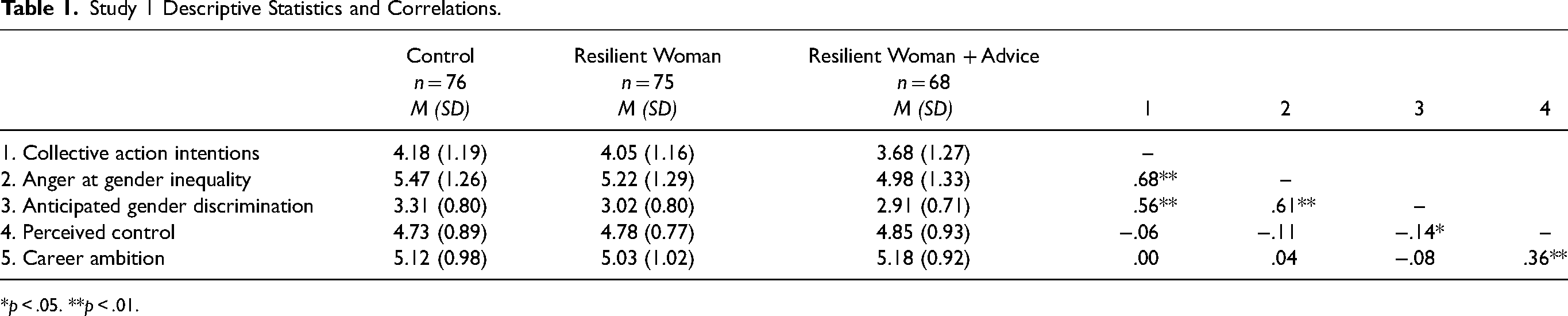
Table 1 shows the correlations among measures used in Study 1. Collective action intentions were positively correlated with anticipated gender discrimination and anger at gender inequality. Perceived control and career ambition were also positively correlated, such that women with higher perceived control also reported higher career ambition. There was a small negative correlation between perceived control and anticipated gender discrimination. The measures with the highest correlation were collective action intentions and anger about gender inequality (r = .68).
Study 1 Descriptive Statistics and Correlations.
*p < .05. **p < .01.
Tests of Hypotheses
Hypothesis 1
To examine Hypothesis 1 (i.e., that exposure to either resilience condition would lead to less anger about gender inequity, less perceived gender discrimination, and lower collective action intentions), we conducted planned comparisons between the control and resilience conditions combined for collective action intentions, anticipated gender discrimination, and anger about gender inequality (see Table 1 for means and standard deviations). Inconsistent with predictions, collective action intentions for participants in resilience compared to control conditions were not significantly lower, t(216) = −1.83, p = .068, 95% CI [−1.30, .05], d = .52. Consistent with predictions, participants in the resilience conditions compared to control condition anticipated significantly less gender discrimination, t(216) = −3.18, p = .002, 95% CI [−1.47, −.34], d = .90, and were significantly less angry about gender inequality t(216) = −2.02, p = .044, 95% CI [−1.13, −.01], d = .57.
Hypothesis 2
To examine Hypothesis 2 (i.e., that anger at inequities and anticipated gender discrimination would function as mediators between the effect of exposure to the resilience message and collective action intentions), we used multiple mediation with Hayes’ (2013) PROCESS macro for SPSS (with 5000 bootstrap samples), including anger at inequality and anticipated gender discrimination as parallel mediators. As shown in Figure 1, and consistent with predictions, when both mediators were entered into the model there was a negative indirect effect of the resilience messages (compared to control) on participants’ collective action intentions via lower anticipated gender discrimination 95% CI [−.26, −.04] and lower anger at gender inequality 95% CI [−.38, −.01].
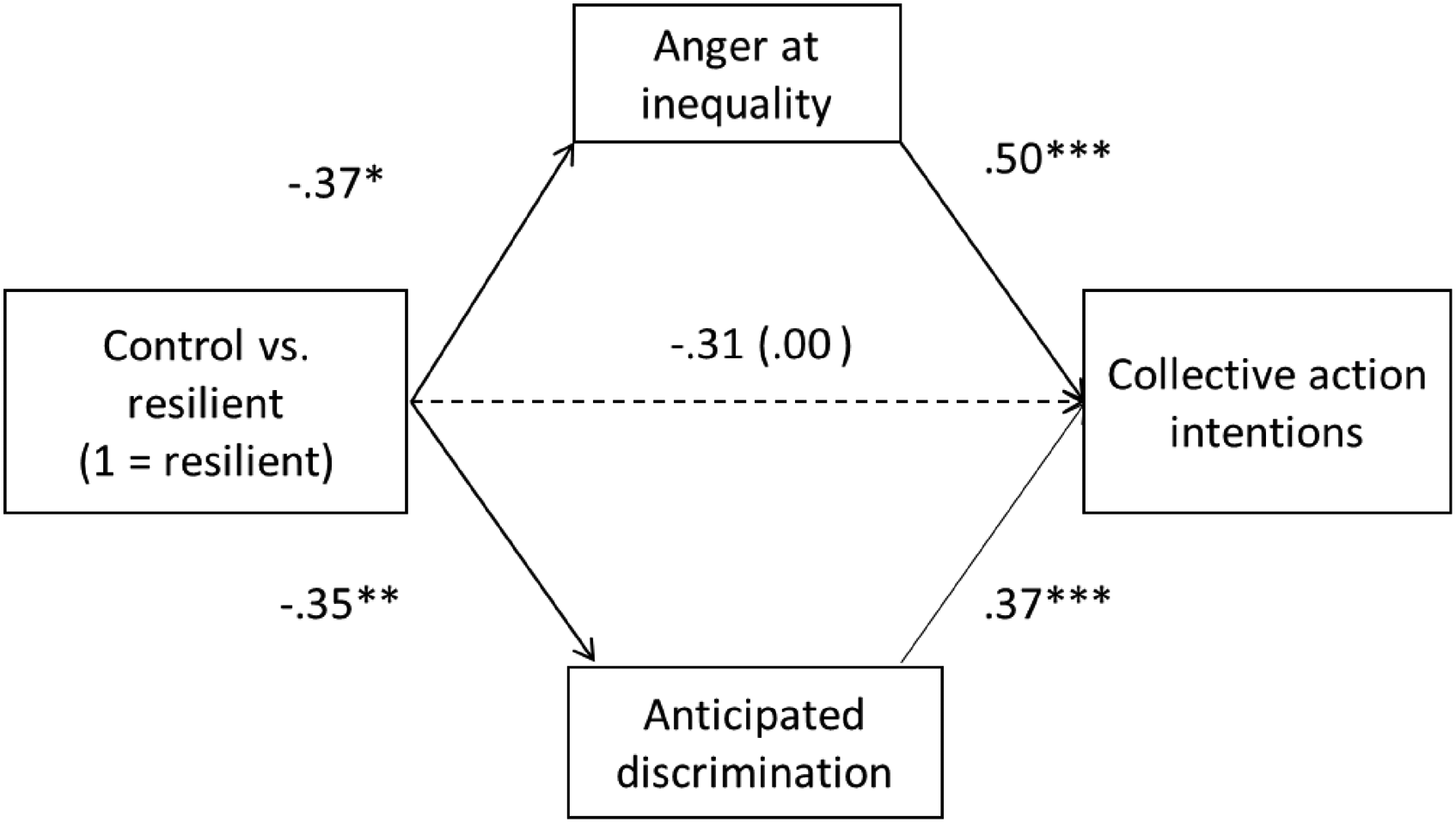
Mediation Model Study 1 Showing the Effect of Resilience Messages (Compared to Control) on Collective Action Intentions Mediated by Anticipated Gender Discrimination and Anger at Inequality.
Exploratory Analyses
We compared the two resilience conditions on the three collective action measures (see Table 1 for Ms [SDs]) to examine greater negative effects of the “combined” (Successful Resilient Woman + Resilience Advice) compared to the “part” (Successful Resilient Woman) resilience condition. We did not find significant differences for collective action intentions, t(216) = −1.85, p = .065, 95% CI [−.64, .02], d = .31; anticipated gender discrimination, t(216) = −0.87, p = .380, 95% CI [−.48, .18], d = .15; or anger about gender inequality, t(216) = −1.12, p = .265, 95% CI [−.52, .14], d = .19.
As our study design could be construed as presenting resilience information along a continuum from none to strongly implied to very explicit, we also examined possible linear effects of the resilience information via polynomial (linear) analysis of variance, which revealed that as information about resilience increased from “none” (Control), to “part” (Successful Resilient Woman) to “combined” (Successful Resilient Woman + Resilience Advice), there was a proportionate reduction in participants collective action intentions, F(1, 216) = 6.20, p = .014, est ꞷ2 = .02; anticipated gender discrimination, F(1, 216) = 9.89, p = .002, est ꞷ2 = .04; and anger about gender inequality, F(1, 216) = 5.21, p = .024, est ꞷ2 = .01.
We then examined possible positive effects (psychological boost) of the resilience conditions compared to the control for perceived control and career ambition (see Table 1 for Ms [SDs]). We compared the control condition to the two resilience conditions combined, finding no significant differences for perceived control, t(216) = 0.70, p = .480, 95% CI [−.36, .76], d = .20, or career ambition, t(216) = −0.06, p = .950, 95% CI [−.58, .54], d = .02. We also compared the two resilience conditions, finding no significant difference for perceived control, t(216) = 0.44, p = .660, 95% CI [−.26, .40], d = .07, or career ambition, t(216) = 0.92, p = .361, 95% CI [−.18, .48], d = .15. Nor were there linear effects, with linear trend analyses showing that as information about resilience increased from none (Control), to “part” (Successful Resilient Woman) to “combined” (Successful Resilient Woman + Resilience Advice), there was no significant proportionate increase in participants sense of perceived control, F(1, 216) = 0.67, p = .410, est ꞷ2 = −.01, or career ambition, F(1, 216) = 0.16, p = .690 est ꞷ2 = −.01.
Discussion
In Study 1, we found partial support for our hypotheses that messages promoting individual resilience would lower women's protest motivation. In support of Hypothesis 1, we found that participants in the individual resilience conditions were less angry about gender inequality and expected less gender discrimination in their future compared to participants who saw information about gender inequality but did not read the resilience messages. Although the expected difference for collective action intentions was not significant, when examining support for the hypothesized mediation model (Hypothesis 2), we found that there was a negative indirect effect, as expected—participants in the resilience conditions, compared to control, showed less anger about gender inequality and less anticipation of gender discrimination in their future, which in turn were both associated with lower collective action intentions.
In exploratory analyses comparing the two resilience conditions directly, we did not find significant differences for the collective action measures. However, linear analyses revealed that as information about resilience increased, there was a proportionate reduction in participants’ anticipated gender discrimination, anger about gender inequality, and collective action intentions. One interpretation of this finding is that resilience advice, when coupled with information about a successful resilient woman, is additionally undermining of women's protest motivation. We sought to replicate this exploratory finding in Study 2 and 3, using it as the basis for Hypothesis 2 in these studies. As it was also possible that extra information about the career success of the businesswoman in the combined condition accounted for these findings (i.e., because extra information was introduced about her achievements), we also addressed this design shortcoming in Studies 2 and 3.
Results from the exploratory analyses relating to a psychological boost, namely perceived control, and career ambition, found no differences across conditions. Thus, we did not find that individual resilience messages had significant positive effects for women by increasing their sense of perceived control or career ambition. In sum, our results showed that individual resilience messages can undermine women's collective action intentions, but did not provide a positive compensatory psychological boost, including greater perceived control or career ambition.
Studies 2 and 3
In Studies 2 and 3, we sought to replicate and extend Study 1. We added a new hypothesis (Hypothesis 2 for these two studies) based on exploratory findings in Study 1 of linear effects associated with increasing information about resilience. We also addressed design shortcoming from Study 1 and included an additional individual resilience message condition. To address design shortcomings, we designed the “combined” condition (Successful Resilient Woman + Resilience Advice) so that it only conveyed resilience advice, not additional information about the career success of the resilient woman. We also included an additional resilience condition that only included resilience advice. Messages promoting women's individual resilience are often, but not always, accompanied by information about a successful resilient woman (Gill & Orgad, 2018). By including the resilience advice only condition, we could examine potential effects relating to different forms of presentation. We did not make specific predictions about the effect of resilience messages that are not accompanied by information about a successful resilient woman.
In Study 2, we again sampled from undergraduate women, but in Study 3, we sampled from currently employed women living in the United Kingdom who were university graduates. Employed professional woman are arguably the most relevant sample to examine our collective action hypotheses. In this sample, we could ask about actual (rather than anticipated) workplace gender discrimination. This would provide a more realistic test of potentially negative effects of individual resilience messages to women's protest motivation via reduced perceptions of gender discrimination. Before Study 3, we also conducted a pilot test which confirmed that the resilience descriptions (both with and without mention of a Successful Resilient Woman) conveyed the intended message that if women are resilient, they can be successful. The pilot test also confirmed that each of these descriptions were seen as “feminist,” “positive,” and “inspiring’ (see online Supplementary Materials for analyses).
In Study 3, we included a new scale of “self-help” interventions, reflecting programs women are offered in the workplace to assist their career advancement. We also used the pilot test to provide support for validity and reliability for scores on this scale with professional women (see online Supplementary Materials for pilot study details). This additional measure was to supplement the perceived control and career ambition items used in Studies 1 and 2. We included it because it was more relevant to working women and consistent with the kinds of behaviors that are encouraged by the individual resilience messages. Thus, we could examine potential effects of the resilience messages on women's intentions to engage with these (individualistic) programs, that were relevant for a working sample.
Design and Hypotheses
We used the same between-participant design across studies. The independent variable had four levels: (1) a no-resilience control, whereby participants only received information about gender inequality, and three additional resilience conditions, two “part” conditions, with a description of either, (2) a successful resilient woman (Successful Resilient Woman), (3) a women's empowerment company that teaches resilience (Resilience Advice), and (4) a “combined” condition, with a description of a successful resilient woman who endorses the women's empowerment company (Successful Resilient Woman + Resilience Advice). Our hypotheses for Study 2 and 3 were:
H1: Compared to the control condition, participants in the resilience conditions would report lower collective action intentions, less anticipated (Study 2) or perceived (Study 3) gender discrimination, and less anger about inequality. H2: There would be a significant linear relationship across conditions, such that collective action intentions, anticipated/perceived gender discrimination, and anger about gender inequality would reduce proportionately as information about resilience increases from no information (control) to part information (Successful Resilient Woman or Resilience Advice) to combined information (Successful Resilient Woman + Resilience Advice). H3: The relation between condition and collective action intentions would be mediated by reduced levels of anger about gender inequality and anticipated future/perceived gender discrimination for women in the resilience conditions.
We did not make hypotheses about the effects of the individual resilience information on perceived control or career ambition, or for the additional measure of self-help interventions used in Study 3.
Method
Sample Size Determination
Using the Study 1 effect size for collective action from our first Study 1 (Partial eta squared = .03), we used G*Power (Faul et al., 2007) to determine the sample size required to detect a similar effect size using adequate power (.80) in Study 2, and used increased power (.90) in Study 3. For Study 2, this indicated 75 participants per condition and for Study 3, 116 participants per condition. With a four-condition design, our Study 2 target sample was 300 and our Study 3 target sample was 464. For Study 2, we aimed to recruit a sample 30% higher (390 participants) to account for potential comprehension and suspicion check failures and for participants who did not meet the inclusion criteria. For Study 3 we aimed to recruit a sample 10% higher (510 participants), as we expected fewer participants would need to be excluded because we were only using Prolific to recruit participants and could therefore apply screening criteria prior to participation.
Participants
Study 2
Five-hundred and one participants completed this study. After applying our pre-registered inclusion criteria for survey completion, demographics, comprehension checks and a suspicion check, we retained 309 participants (Mage = 21.46, SD = 6.13; 5.2% Asian, 1.9% Black, 2.6% mixed ethnicity, 90% White; see online Supplementary Materials for full details of pre-registered exclusions based on completion, gender, nationality, student status, comprehension and suspicion checks and Supplementary Table S2 for full demographics). We recruited participants in two ways: (1) from the first-year psychology participant pools at two British universities (in exchange for course credit); and (2) via Prolific (reimbursed at a rate equivalent to the living wage in the United Kingdom of £9 per hour, US$11).
Study 3
Five-hundred and nineteen participants completed this research, exceeding our recruitment target of 510. After applying our pre-registered inclusion criteria for survey completion, demographics, comprehension checks and a suspicion check, we retained 421 participants (413 women, 8 non-binary; Mage = 32.75, SD = 7.61; 5.2% Asian, 2.6% Black, 4.3% mixed ethnicity, 86.7% White; see online Supplementary Materials for full details of pre-registered exclusions based on completion, gender, university graduate status, age, UK residing, employment status, comprehension and suspicion checks. and Supplementary Table S3 for full demographics). Although our sample was short of our target of 461 to achieve increased power of .90 for this study, with 421 participants, the sample was still substantially higher than a sample size of 300 needed to achieve adequate power (.80), so we considered it an acceptable sample size for this study. We recruited participants from Prolific and provided reimbursement equivalent to living wage in the United Kingdom of £9 (US$11) per hour.
Materials and Procedure
Studies 2 and 3 were preregistered (https://osf.io/5hspn/?view_only=cbb7fe36e0494dc5a805c83fcd086c41) and conducted in compliance with approval from the University of Exeter, College of Life and Environmental Science – Psychology Ethics Committee (eCLESPsy000159). The materials and procedure were like Study 1, except for the following changes. For each study, we updated information about gender inequality to ensure it was accurate at the time of the study (e.g., to reflect changes in proportions of women cabinet ministers). We also removed one of the four memory questions used in Study 1 because results suggested it was too difficult to be a good reflection of participants having read the information.
In the new Resilience Advice condition, we adapted information about resilience in Study 1 by removing information that linked this advice to a successful resilient woman. Thus, we only included information about a women's empowerment consultancy company that provides “advice to women about how to achieve career success through adopting the right attitudes and approaches to their careers” with staff described as recently endorsing the guidebook “Grit” to help women overcome career-limiting “self-doubts” by “inspiring them to believe they can achieve whatever they put their minds to.”
For the Successful Resilient Woman condition, we included a new final sentence about her current professional role heading up the “risk strategy for a major UK insurance company” and being “one of the few women board members in the industry.” This was to ensure equivalent career information (i.e., including her current role) was presented across this and the combined condition. In Study 1, current career information had been missing from this condition, as it was intertwined with the resilience advice presented in the combined condition.
In the Combined condition (i.e., Successful Resilient Woman + Resilience Advice), participants received the same information provided to participants in the Successful Resilient Woman condition, along with the information in the Resilience Advice condition that we adapted to show the business woman's association with this company and endorsement of its approach (e.g., “Kathleen Roberts is also associated with Emberin, a woman's empowerment consultancy company…”). Thus, we ensured that the resilience advice information was not simultaneously communicating information about the businesswoman's career success, as it had in Study 1.
To check participants’ recollection of the resilience information, two questions were used in the single Successful Resilient Woman condition (i.e., “Was Kathleen Roberts named a ‘Rising Star’ by Business Review Weekly? ‘Definitely yes,’ ‘Probably yes,’ ‘Probably not,’ Definitely not;’” “Kathleen Roberts was described as: ‘Married with one child,’ ‘A single mother of twin girls, one of whom has a disability,’ ‘Single with no children’”) and two questions were used in the single Resilience Advice condition (i.e., “Was an aim of Emberin's ‘My Mentor’ advancement programs to provide women with insights about how to achieve career success? ‘Definitely yes,’ ‘Probably yes,’ ‘Probably not,’ Definitely not;’” “Emberin endorsed a guidebook to help women identify and overcome self-doubts that might be holding them back. What was the guidebook called? ‘Anticipation,’ ‘Grit,’ ‘Foresight’”), adapting questions from Study 1 where appropriate. Participants in the Successful Resilient Woman + Resilience Advice condition received both sets of questions (four in total).
Measures
Following the first part of the questionnaire, participants completed the same measures relating to protest motivation and psychological boost used in Study 1 as well as the same additional measures, demographics, and suspicion check items, prior to the debriefing page. We detail additional measures and any necessary adjustments to measures across studies below.
Study 2
Participants completed the same items as Study 1. For each measure used for this sample, McDonald's ꞷ and Cronbach's α were similar to Study 1 (see online Supplementary Materials). For the demographic question about gender identity, we updated it to include additional response options of “Trans” and “Genderqueer/Non-binary.”
Study 3
The items participants completed for Study 3 were, in most cases, identical to those used in Study 1 and 2. For the items that were identical, McDonald's ꞷ and Cronbach's α for this sample were similar to those achieved in the samples of the previous two studies (see online Supplementary Materials). For this working sample, the anticipated gender discrimination question that we used for the student samples was adjusted to examine perceived gender discrimination. We adjusted it because unlike a student sample, a working sample would have relevant professional experiences to draw on when answering this question, (e.g., “Thinking about your working life, how often have you felt that you were deprived of certain opportunities (available to others) because of your gender?”). For this sample, McDonald's ꞷ was .92 and Cronbach's α was .89, similar to McDonald's ꞷ and Cronbach's α for Study 1 and 2 samples.
The new measure of self-help strategies included seven items (e.g., “To assist you in your career goals, how likely would you be to engage in the following actions? Attend a training course on building self-confidence in the workplace”). Participants responded on a 7-point scale, ranging from 1 (very unlikely) to 7 (very likely), with higher scores representing greater intentions to engage in self-help interventions. Items were high in face validity and McDonald's ꞷ for this sample was .90 and Cronbach's α was .93.
A range of additional demographic and workplace items were also included to appropriately describe this sample (i.e., parental status, relationship status, primary caregiving, years in the workplace, managerial status, percentage women employees in their industry, how far they have come towards achieving their career goals; see online Supplementary Materials for full details of all measures included).
Results
Preliminary Analyses of Manipulations and Measures
Study 2
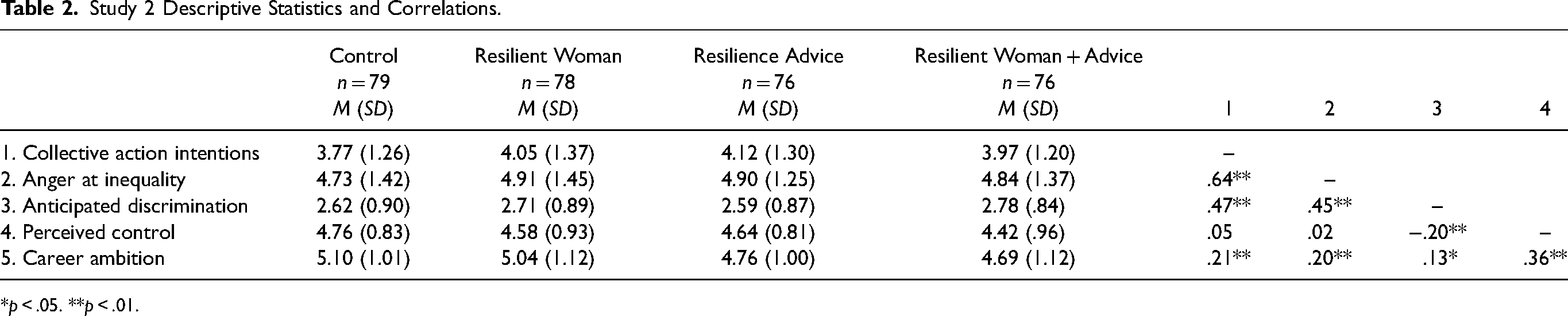
Of the 309 participants we retained (139 course credit; 170 Prolific), we had similar numbers of participants across conditions (see Table 2) and for two recruitment methods (control: 42 course credit, 37 Prolific; SRW: 32 course credit, 46 Prolific; RA: 31 course credit, 45 Prolific; SRW + RA: 34 course, 42 Prolific). There were no effects associated with the recruitment method.
Study 2 Descriptive Statistics and Correlations.
*p < .05. **p < .01.
Study 3
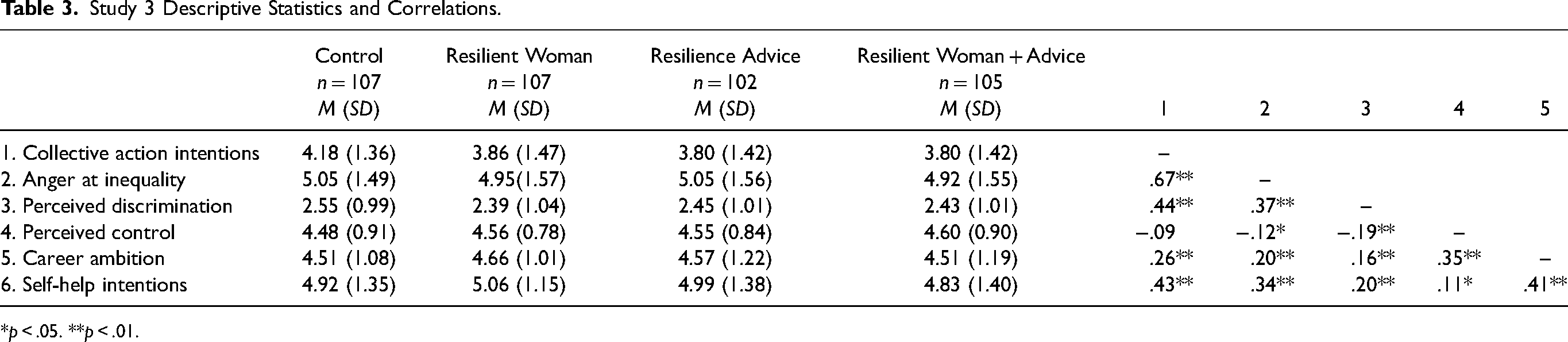
Of the 421 participants we retained, there were similar numbers of participants across conditions (see Table 3).
Study 3 Descriptive Statistics and Correlations.
*p < .05. **p < .01.
Correlations
Correlations among measures used in Study 2 (Table 2) and 3 (Table 3) show that collective action intentions were positively correlated with anger at inequality, anticipated (Study 2) and perceived (Study 3) gender discrimination, career ambition, and self-help intentions (Study 3). Perceived control and career ambition were positively correlated in both studies. There was a negative correlation between perceived control and anticipated gender discrimination (Study 2) and perceived gender discrimination (Study 3). In Study 3, there was also a negative correlation between perceived control and anger at gender inequality. The measures with the highest correlations across studies were collective action intentions and anger about gender inequality (Study 2, r = .64; Study 3, r = .67).
Tests of Hypotheses
Hypothesis 1
In both studies, we conducted planned comparisons between the control and resilience conditions combined for the measures of anticipated gender discrimination, anger about gender inequality, and collective action intentions (see Table 2 and Table 3 for Ms and SDs).
Study 2
Inconsistent with predictions, participants in the resilience conditions did not differ significantly from those in the control in their ratings of collective action intentions, t(305) = 1.65, p = .100, 95% CI [−.41, .86], d = .23; anticipated gender discrimination, t(305) = 0.62, p = .536, 95% CI [−.53, .75], d = .11; or anger about inequality, t(305) = 0.84, p = .403, 95% CI [−.41, .87], d = .23.
Study 3
Consistent with predictions, collective action intentions were lower in the resilience conditions compared to the control: t(417) = −2.16, p = .031, 95% CI [−1.39, −.07], d = .73. Inconsistent with predictions, the resilience conditions did not differ significantly to the control for perceived gender discrimination, t(417) = −1.12, p = .263, 95% CI [−1.04, .28], d = .38, or anger about inequality, t(417) = −0.46, p = .644, 95% CI [−.81, .50], d = .16.
Hypothesis 2
To examine Hypothesis 2, we conducted two linear trend analyses in both studies, examining whether a proportionate increase in information about resilience led to a proportionate decrease in collective action intentions, anticipated gender discrimination, and anger at inequality. The first, mirroring Study 1, involved participants in the Control (none), Successful Resilient Woman (part), and Successful Resilient Woman + Resilience Advice (combined) resilience conditions. The second involved participants in the Control (none), Resilience Advice (part), and Successful Resilient Woman + Resilience Advice (combined) conditions.
Study 2
Results from first linear trend analyses (i.e., using the Successful Resilient Woman as the “part” condition) did not support predictions. As information about resilience increased there was not a proportionate reduction in: collective action intentions, F(1, 230) = 0.99, p = .323, est ꞷ2 = .00; anticipated gender discrimination, F(1, 230) = 1.22, p = .270, est ꞷ2 = −.00; or anger about inequality, F(1, 230) = 0.23, p = .635, est ꞷ2 = −.01. This was also the finding for the second linear trend analyses (i.e., using Resilience Advice as the “part” condition); collective action intentions, F(1, 228) = 1.02, p = .313, est ꞷ2 = −.01; anticipated gender discrimination, F (1, 228) = 1.25, p = .266, est ꞷ2 = .00; anger about inequality, F(1, 228) = 0.25, p = .619, est ꞷ2 = .00.
Study 3
Results from first linear trend analyses (i.e., using the Successful Resilient Woman as the “part” condition) did not support predictions. As information about resilience increased there was not a proportionate reduction in collective action intentions, F(1, 316) = 3.73, p = .054, est ꞷ2 = .01; anticipated gender discrimination, F(1, 316) = 0.78, p = .377, est ꞷ2 = −.00; or anger about inequality, F(1, 316) = 0.38, p = .539, est ꞷ2 = −.01. This was also the finding for the second linear trend analyses (i.e., using Resilience Advice as the “part” condition): collective action intentions, F(1, 311) = 3.81, p = .052, est ꞷ2 = .01; anticipated gender discrimination, F (1, 311) = 0.80, p = .372, est ꞷ2 = −.00; and anger about inequality, F(1, 311) = 0.38, p = .538, est ꞷ2 = −.01.
Hypothesis 3
To examine Hypothesis 3, we used multiple mediation with Hayes’ (2013) PROCESS macro for SPSS (with 5000 bootstrap samples), including anger at inequality and anticipated (Study 2) or perceived (Study 3) gender discrimination as parallel mediators.
Study 2
As shown in Figure 2, our mediation predictions were not supported: anger at gender inequality and anticipated gender inequality were significant predictors of collective action intentions but did not mediate a negative predicted effect of the resilience conditions compared to the control on participants collective action intentions. This was indicated by 95% confidence intervals that included zero (anger at inequality [−.09, .27]; anticipated gender discrimination [−.06, .10]).
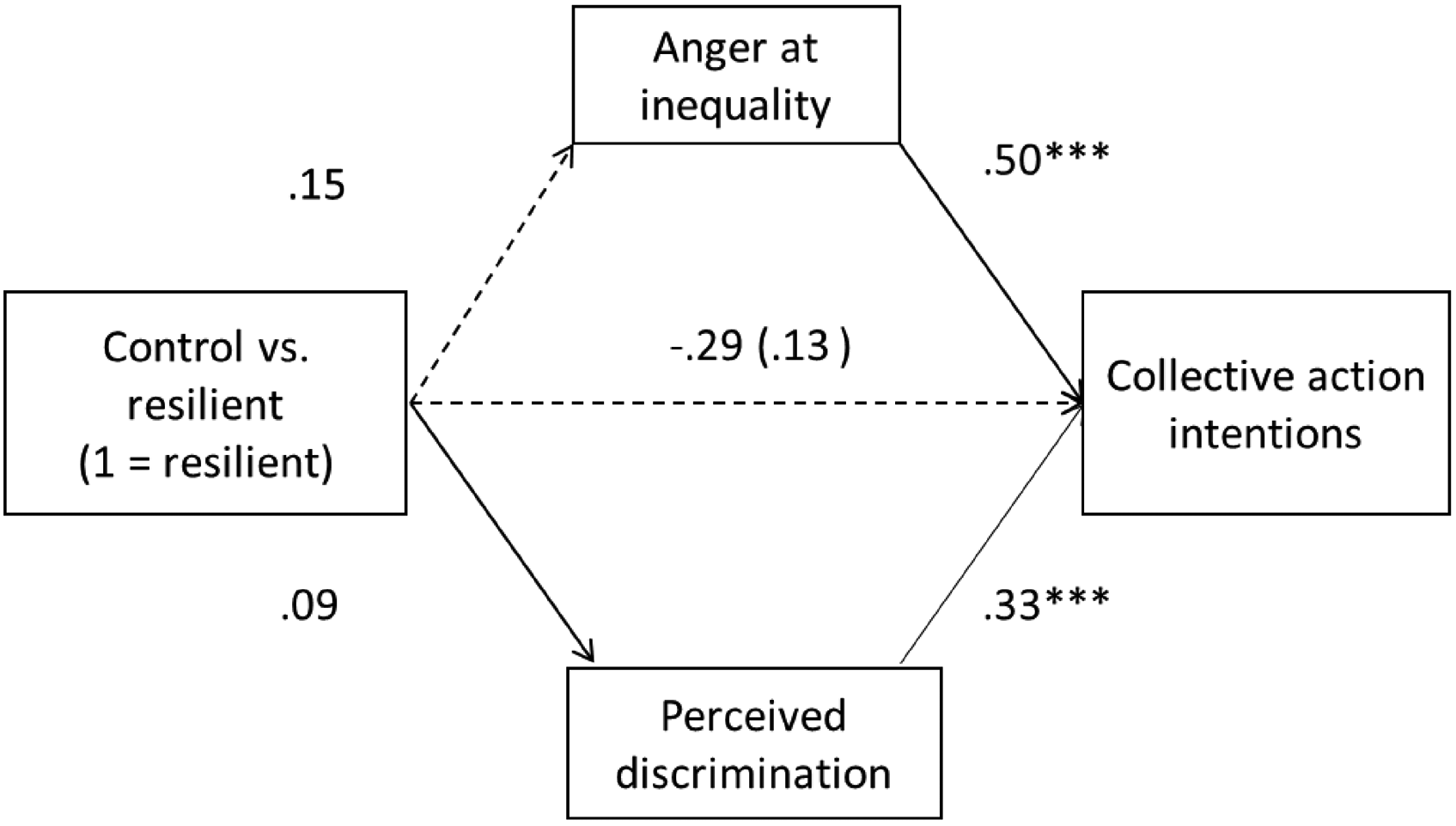
Mediation Model Study 2 Showing the Effect of the Resilience Messages (Compared to Control) on Collective Action Intentions Mediated by Anticipated Gender Discrimination and Anger at Inequality.
Study 3
As shown in Figure 3, our mediation predictions were not supported. The resilience messages (compared to control) had a negative effect on collective action intentions (mirroring the results from the planned contrasts) that was not mediated by less perceived gender discrimination or less anger about gender inequality, as indicated by 95% confidence intervals for these measures that included zero (anger at inequality [−.24, .11]; anticipated gender discrimination [−.12, .02]).
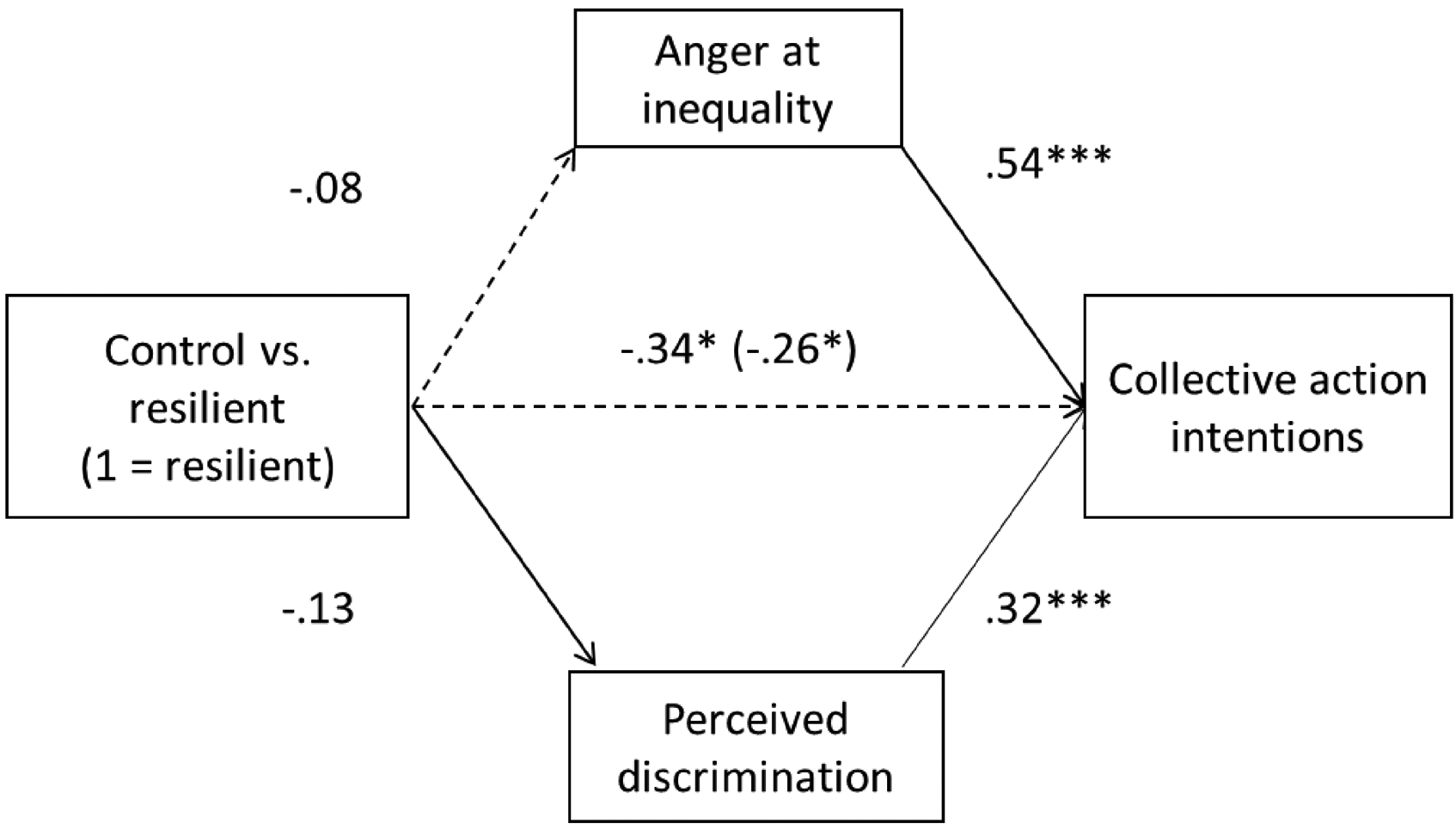
Mediation Model Study 3 Showing the Effect of the Resilience Messages (Compared to Control) on Collective Action Intentions Mediated by Perceived Gender Discrimination and Anger at Inequality.
Exploratory Analyses
For both studies, we also made comparisons between the resilience conditions on the three measures relating to collective action and found no significant differences (see online Supplementary Materials for analyses).
We then examined potential positive effects of individual resilience messages to participants’ sense of perceived control and career ambition for Studies 2 and 3 and using the additional measures of self-help interventions for Study 3 (see Table 2 and Table 3 for Ms and SDs). First, we examined the results for all measures through comparing the control to the resilience conditions combined. Then we examined whether there were linear effects through linear trend analyses (for additional analyses making direct comparisons between the resilience conditions; see online Supplementary Materials).
Study 2
For both perceived control and career ambition, comparisons between the control and combined resilience conditions were not significant; perceived control: t(305) = −1.84, p = .067, 95% CI [−1.25, .03], d = .61; career ambition: t(299) = −1.91, p = .058, 95% CI [−1.06, .21], d = .42. We then conducted two sets of linear trend analyses. The first set used the Successful Resilient Woman condition as the “part” resilience information condition, the second set used the Resilience Advice condition as the “part” resilience information condition (in comparison to the Control “none” and the Successful Resilient Woman + Resilience Advice “combined” resilience information conditions). Results from the first analyses showed that as information about resilience increased, there was a proportionate decrease in participants reported perceived control, F(1, 230) = 5.33 p = .022, est ꞷ2 = .01 and career ambition, F(1, 230) = 5.27, p = .023, est ꞷ2 = .02. The same finding was observed for the second set of analyses for perceived control, F (1, 228) = 5.80, p = .017, est ꞷ2 = .02, and career ambition, F(1, 228) = 5.73, p = .017, est ꞷ2 = .02 (see Table 2 for Ms [SDs]).
Study 3
For perceived control, career ambition, and self-help interventions, comparisons between the control and combined resilience conditions were not significant; perceived control: t(417) = 0.90, p = .364, 95% CI [−.35, .96], d = .31; career ambition: t(417) = 0.57, p = .573, 95% CI [−.47, .85], d = .19; self-help intentions: (417) = .26, p = .793, 95% CI [−.57, .75 ], d = .09. We then conducted two sets of linear trend analyses. The first used the Successful Resilient Woman condition as the “part” resilience information condition, the second set used the Resilience Advice condition as the “part” resilience information condition (in comparison to the Control “none” and the Successful Resilient Woman + Resilience Advice “combined” resilience information conditions). Results from the first analyses showed that as information about resilience increased, there was no significant proportionate decrease in participants reported perceived control, F(1, 316) = 1.00 p = .319, est ꞷ2 = −.00, career ambition, F(1, 316) = < .01, p = .979, est ꞷ2 = −.00, or self-help intentions, F(1, 316) = 0.28 p = .597, est ꞷ2 = −.00. The same finding was observed for the second set of analyses for perceived control, F(1, 311) = 0.95, p = .330, est ꞷ2 = −.00, career ambition, F(1, 311) = <0.01, p = .980, est ꞷ2 = −.01 and self-help intentions, F(1, 311) = 0.25 p = .620, est ꞷ2 = −.00 (see Table 3 for Ms and SDs).
It was possible that participants with fewer years in the workplace or who reported having made less progress towards their career goals would be most likely to derive a psychological boost from the individual resilience messages. We examined this using moderation analyses with Hayes’ (2013) PROCESS macro for SPSS (with 5000 bootstrap samples). As shown in Table 4, we found that neither years in the workforce or participants’ reported progress towards achieving their career goals were significant moderators of effects of the individual resilience conditions (combined), compared to the control condition, on participants’ perceived control, career ambition, or intentions to use self-help interventions.
Study 3 Moderation Analysis for Perceived Control, Career Ambition and Self-Help Intentions With Career Goals Progress and Years Employed as Moderators.
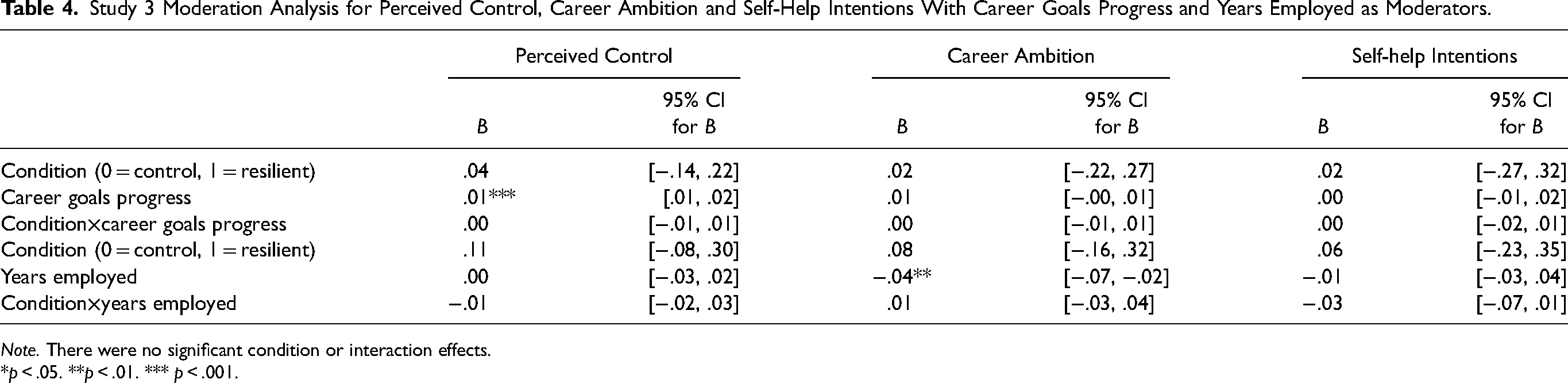
Note. There were no significant condition or interaction effects.
*p < .05. **p < .01. *** p < .001.
Discussion
Results from Study 2 and 3 provide modest support for our hypothesis of negative effects of individual resilience messages on measures relating to women's collective action. In Study 3, but not Study 2, there was a direct negative effect of individual resilience messages on participant's collective action intentions, supporting Hypothesis 1. However, across studies 2 and 3, and inconsistent with Hypothesis 1 for anticipated (Study 2) or actual (Study 3) gender discrimination and anger about gender inequality, there were no significant negative effects of individual resilience messages nor was the predicted mediation model supported (Hypothesis 3).
Inconsistent with Hypothesis 2 and Study 1 findings, we did not find that as information about resilience increased from none (control) to part (Successful Resilient Woman or Resilience Advice) to combined (Successful Resilient Woman + Resilience Advice), there was a proportionate reduction in anger at inequality, anticipated discrimination, or collective action intentions. This suggests that negative linear effects found in Study 1 were a chance finding or occurred due to greater information about the career success of the resilient woman (a confound), which was removed from the combined condition in Studies 2 and 3.
Results from Study 2 and 3 also provide mixed evidence of negative effects of individual resilience messages providing a psychological boost for women. In Study 2, but not Study 3, exploratory analyses revealed that as information about resilience increased, there was a proportionate reduction in participants’ sense of perceived control and career ambition. Thus, rather than leading women to feel more individually empowered, our findings suggest that messages invoking the importance of individual resilience to women's career success may be de-motivating to women, potentially because they convey the sense that success is only possible for women who are capable of being particularly resilient to adversity.
Study 4
Two of our first three studies provided evidence that after women read messages advocating the importance of individual resilience to women's career success, they may be less likely to engage in collective action to protest gender inequality. Women are not only exposed to these types of messages but also participate in workshops and/or use apps designed to help them apply this advice to increase their own resilience to setbacks (Gill & Orgad, 2018). Thus, in a fourth study, we wanted to extend our research by using a new resilience manipulation that was akin to participating in a resilience workshop to examine whether such activities are also undermining of women's protest motivation.
For our new manipulation, we adapted an online article on building resilience and created two related activities to help participants apply the advice to their own lives. The article we adapted reflected the neoliberal focus on what individuals can do to psychologically equip themselves to be successful against the odds, including maintaining perspective, being flexible with goals, and building self-confidence. A pilot test that we conducted prior to administering Study 4 confirmed that the article and activities were viewed positively (e.g., as “inspiring” and “helpful”) and that responses to the resilience activities were likely to be engaged with as expected (e.g., participants wrote about how they could act differently to a setback in the future to be more resilient; see online Supplementary Materials for pilot study details). As with the resilience messages used in the first three studies, we expected that participating in an individual resilience building workshop would reduce women's collective action intentions (when compared to a control condition) via effects on the perceived injustice pathway to collective action: namely, they would be less likely to attribute career setbacks to gender discrimination and feel less anger about gender inequality.
Unlike studies 1–3, this new resilience manipulation did not just imply that resilience was the key ingredient to women's career success but provided participants with the opportunity to find ways to develop their own resilience. As such, it could have a positive effect on the psychological boost measures of perceived control, career ambition, and intentions to engage in self-help interventions not found in prior studies. However, because these women were university educated, employed, and were likely to have had prior experience of similar workshops and/or techniques (ubiquitous in the workplace and media more generally), it was also possible that we would not observe positive effects. This demographic was also likely to have existing high levels of perceived control, career ambition, and intentions to engage in self-help interventions (found across conditions in a similar sample of university educated employed women in Study 3), further reducing the likelihood that the resilience manipulation would meaningfully increase their responses on the psychological boost measures.
Design and Hypotheses
This study had two levels: (1) a no-resilience control, whereby participants only received information about gender inequality, and (2) a resilience condition, whereby participants received information about gender inequality, followed by an article and activities to build their own resilience to setbacks. Our hypotheses for Study 4 were:
H1: When compared to baseline, participants in the resilience condition would report less anger about ongoing inequality, less gender discrimination, and have lower collective action intentions. H2: The effect of the resilience condition on collective action intentions would be mediated by less perceived gender discrimination and less anger about gender inequality among those exposed to the resilience workshop condition.
As an additional test of the effects of engaging in individual resilience building activities on collective action intentions, we incorporated a repeated measures component for control participants. These participants were given the opportunity to do the resilience activities after completing the study measures before again being asked to complete measures of their collective action intentions.
H3: For the repeated measure component, participants in the baseline condition who complete the resilience exercises at the end of the survey would subsequently show lower collective action intentions in comparison to their initial responses on the same measures.
As in previous studies, we did not make predictions about the effects of the resilience condition on measures of perceived control, personal ambition, and intentions to engage with individual self-help interventions to advance one's career.
Method
Sample Size Determination
Using the effect size for collective action intentions from our first study (partial eta squared = .03), we used G*Power (Faul et al., 2007) to determine the sample size required to detect the same effect size with power set to .90. The result indicated that we needed 116 participants per condition, so our target sample was 232 participants for a two-condition design. We aimed to recruit a sample 20% higher than this (278 participants) to account for potential comprehension and suspicion check failures and for participants who would not meet the inclusion criteria.
Participants
Two hundred and seventy-eight participants completed this study, and after applying our pre-registered inclusion criteria for survey completion, demographics, comprehension, suspicion, and engagement with the resilience exercises checks, we retained 228 participants (226 women, 2 non-binary; Mage = 33.94, SD = 7.17; 8.3% Asian, 6.6% Black, 3.9% mixed ethnicity, 80.7% White; see online Supplementary Materials for full details of pre-registered exclusions based on gender, university graduate status, age, UK residing, employment status, comprehension and suspicion checks and Supplementary Table S4 for full demographics). This sample was four participants short of our target to achieve increased power of .90 for this study but still substantially higher than a sample of 150 needed to achieve adequate power (i.e., .80). Thus, we considered this sample size acceptable. We recruited participants from Prolific and provided reimbursement equivalent to the living wage in the United Kingdom of £9 (US$11) per hour.
Materials and Procedure
Study 4 was preregistered (https://osf.io/5hspn/?view_only=cbb7fe36e0494dc5a805c83fcd086c41) and conducted in compliance with approval from the University of Exeter, College of Life and Environmental Science – Psychology Ethics Committee (eCLESPsy000159). We used the same sampling strategy as Study 3, recruiting currently employed women living in the United Kingdom who were university graduates. We applied screening criteria to ensure those who had participated in Study 3 would not be invited to participate in Study 4.
This questionnaire consisted of three sections. In Section 1, all participants were presented with information about continuing gender inequality in the United Kingdom and asked to answer three questions to test their memory for the information presented. Participants in the baseline condition were then taken to Section 2 to complete the study measures while participants in the resilience condition were presented with a two-page resilience advice article and two resilience activities to help them become more resilient, prior to completing study measures in Section 2. For the repeated measures component incorporated in this study, participants in the baseline condition were presented with the two-page resilience advice article and two resilience activities to help them become more resilient following their responses to the study measures in Section 2, after which they were asked to complete the collective action intentions measures for a second time. In the third and final section, participants were asked to complete demographic and other descriptive items.
In the new resilience condition, we told participants that we were interested in understanding how people build resilience and that they would be asked to read an article on resilience and complete some activities to help them apply the advice in the article to their own lives. The resilience article was 860 words in total and titled “Developing Resilience: Overcoming and Growing from Setbacks.” It started with the statement, “Success is rarely achieved without struggle and setbacks,” followed by information that developing resilience is important to “keep moving forward towards our dreams and goals.” The article outlined three key psychological elements to being resilient, which included viewing difficulty as a challenge, being committed, and focusing on things within one's control. On a second page titled “7 Ways to Build your Resilience,” the article outlined seven strategies including learning to relax, practicing thought awareness, learning from mistakes and failures, choosing your response, maintaining perspective, setting flexible goals, and building self-confidence.
At the end of the article, participants were presented with two activities relevant to applying the resilience advice from the article to their own lives. The first activity asked participants to select up to seven strategies mentioned by the article that they believed would be most beneficial to building their own resilience. The second activity involved participants writing about how they could have responded differently to a past setback to be more resilient by applying one or more strategies from the article (see online Supplementary Materials for the full details of the article and activities).
Measures
Following the first part of the questionnaire, participants completed the same measures as Study 3. For each measure used for this sample, McDonald's ꞷ and Cronbach's α was similar to Study 3 and our earlier studies using the same measures (see online Supplementary Materials). Participants also completed all the same demographic and workplace items as Study 3 to appropriately describe the working sample (see online Supplementary Materials for full details of all measures included).
Results
Preliminary Analyses of Manipulations and Measures
Of the 228 participants we retained, we had similar numbers of participants across conditions (see Table 5).
Study 4 Descriptive Statistics and Correlations for Collective Action Intentions, Anger at Inequality, Anticipated Gender Discrimination, Perceived Control, Career Ambition, and Self-Help Intentions.
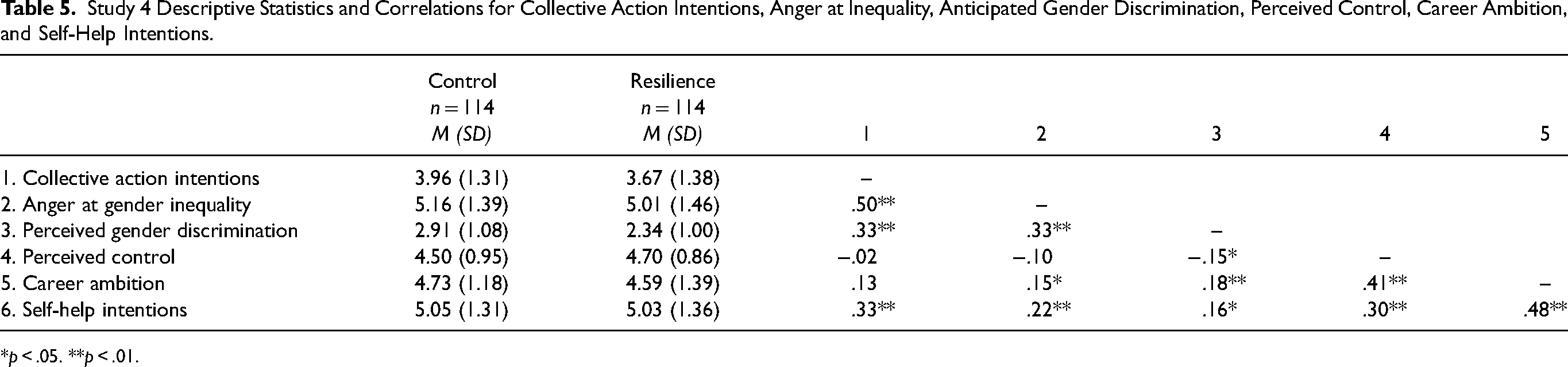
*p < .05. **p < .01.
Correlations
Table 5 shows the correlations among measures used in Study 4. Collective action intentions were positively correlated with anger at inequality, perceived gender discrimination, and self-help intentions. Perceived control was negatively correlated with perceived gender discrimination and positively correlated with career ambition and self-help intentions. Self-help intentions were positively correlated with all measures. The measures with the highest correlations were collective action intentions and anger about gender inequality (r = .50).
Tests of Hypotheses
Hypothesis 1
We conducted planned comparisons between the control and resilience condition for the measures of perceived gender discrimination, anger about gender inequality, and collective action intentions (see Table 5 for Ms [SDs]). Consistent with predictions, participants in the resilience condition perceived less gender discrimination than those in the control condition, t(226) = 4.15, p < .001, 95% CI [.30, .83], d = .55. However, inconsistent with predictions, differences in anger about gender inequality, t(226) = 0.79, p = .431, 95% CI [−.22, .52], d = .11, and collective action intentions, t(226) = 1.60, p = .110, 95% CI [−.07, .64], d = .22 were not significant.
Hypothesis 2
To examine hypothesis 2, we used multiple mediation with Hayes’ (2013) PROCESS macro for SPSS (with 5000 bootstrap samples), including anger at inequality and perceived gender discrimination as parallel mediators. As shown in Figure 4, when both mediators were entered into the model there was a negative indirect effect of the resilience condition (compared to control) on participants’ collective action intentions via less perceived gender discrimination, 95% CI [−.27, −.03], but not via less anger at gender inequality, 95% CI [−.24, .09].
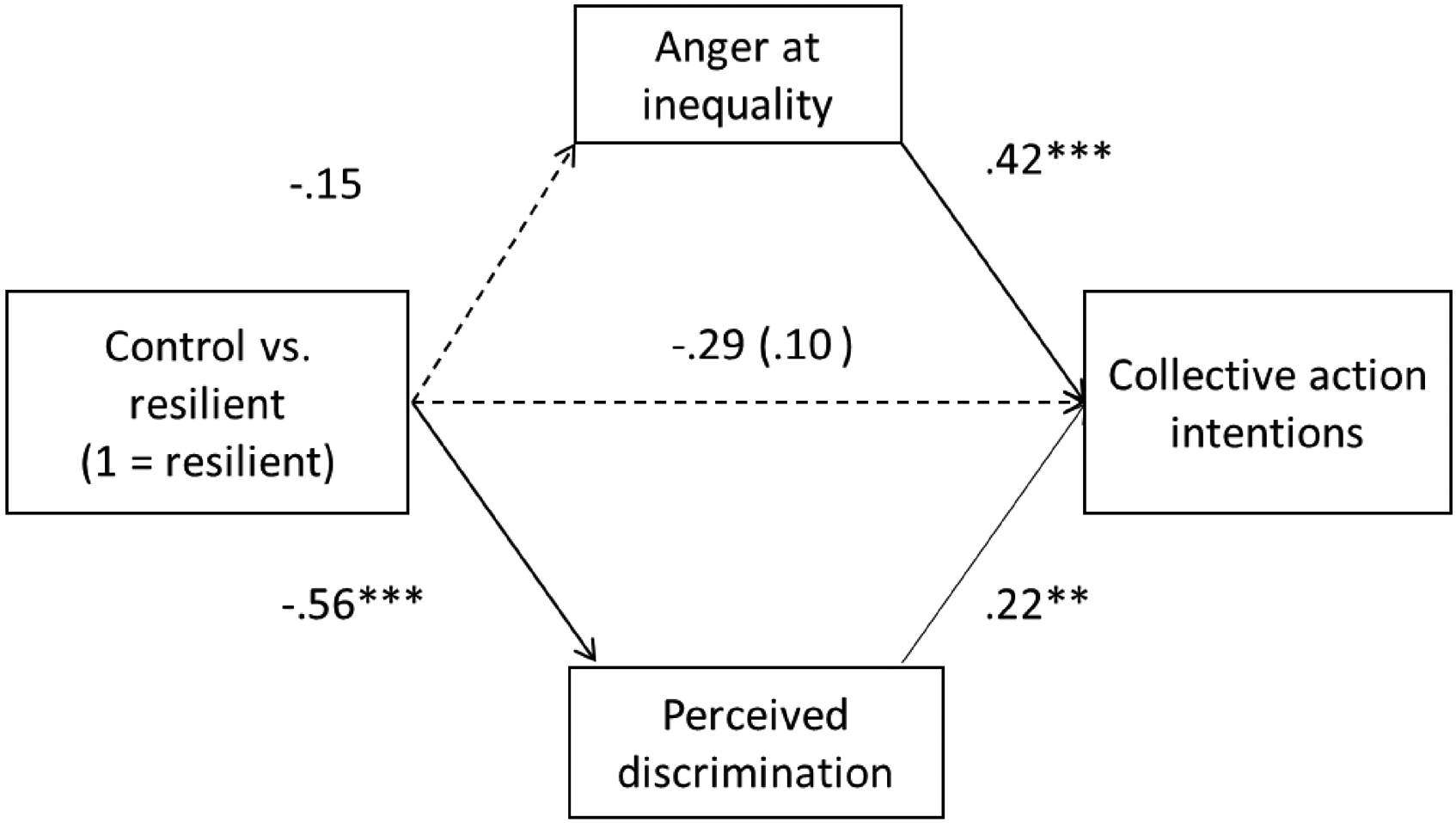
Mediation Model Study 4 Showing the Effect of the Resilience Activities (Compared to Control) on Collective Action Intentions Mediated by Perceived Gender Discrimination and Anger at Inequality.
Hypothesis 3
To examine hypothesis 3, we conducted a paired samples t-test for collective action intentions after excluding one participant who did not engage with the resilience activities. Inconsistent with predictions, control participants’ collective action intentions were not significantly lower after (M = 3.96, SD = 1.32) as compared to before (M = 4.01, SD = 1.35) completing the resilience activities, t(226) = −1.14, p = .257, 95% CI [−.14, .04], d = .11. As we did not measure perceived discrimination or anger at Time 2 for these participants, we could not examine indirect effects on collective action intentions via reduced anger at inequality or perceived gender discrimination.
Exploratory Analyses
We examined potential positive effects of the individual resilience condition to perceived control, career ambition, and intentions to use self-help interventions (see Table 5 for Ms [SDs]). Differences between the control and resilience condition were not significant for any of these psychological boost measures: perceived control, t(226) = −1.67, p = .096, 95% CI [−.44, .04], d = .22; career ambition, t(226) = 0.92, p = .360, 95% CI [−.16, .45], d = .11; nor self-help interventions, t(226) = 0.14, p = .890, 95% CI [−.32, .37], d = .01.
As in Study 3, we reasoned that it was possible that participants who had fewer years in the workplace or who reported having made less progress towards their career goals would be most likely to derive benefits from the individual resilience condition. To examine this, we used moderation analyses with Hayes’ (2013) PROCESS macro for SPSS (with 5000 bootstrap samples). As shown in Table 6, we found that neither years in the workforce nor participants’ reported progress towards achieving their career goals were significant moderators of effects of the individual resilience condition (compared to control) on participants’ perceived control, career ambition, or intentions to use self-help interventions.
Study 4 Moderation Analysis for Perceived Control, Career Ambition and Self-Help Intentions With Career Goals Progress and Years Employed as Moderators.
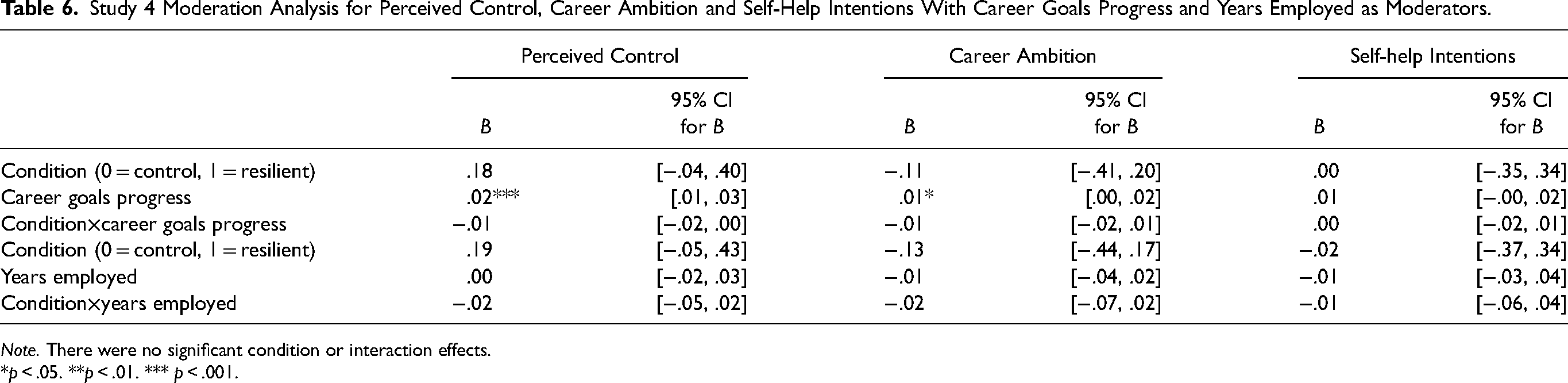
Note. There were no significant condition or interaction effects.
*p < .05. **p < .01. *** p < .001.
Discussion
In Study 4, we found modest support for our hypothesis that activities promoting individual resilience would lower women's protest motivation. In support of Hypothesis 1, we found that participants in the resilience condition perceived less gender discrimination compared to participants in the control. However, differences in anger about gender inequality and collective action intentions were not significant. When we examined support for the hypothesized mediation model (Hypothesis 2), we found that there was a negative indirect effect for collective action intentions. Specifically, participants in the resilience conditions, compared to control, had lower collective action intentions due to lower beliefs that gender discrimination had affected their outcomes.
To further examine the effects of the resilience message on collective action intentions, we built in a repeated measures component for participants in the control condition, who we asked to complete the resilience activities after they completed the main survey before again completing the collective action intentions measure. Inconsistent with Hypothesis 3, there was no difference in control participants’ Time 1 and Time 2 collective action intentions. It is possible that participants prior responses on the collective action items provided some buffer to the dampening effects of the resilience activities. We did not measure perceived gender discrimination (or anger at gender inequality) at Time 2 for control participants, so we were unable to examine indirect effects.
For the exploratory psychological boost items of control, ambition, and intentions to engage in self-help interventions, we did not find any positive effects of the resilience condition compared to control, nor moderation when we examined potential effects of years in the workplace or the progress participants had already made towards their career goals. However, mean levels for these measures were high overall, so there may not have been a lot of room for movement for these participants. Many may have already been exposed to such messages and programs in their workplaces, or due to being from relatively privileged backgrounds (in being employed university graduates and predominately White), had high levels of ambition and control.
General Discussion
The aim of our research was to examine whether neoliberal feminism, which promotes individual resilience as the pathway to career advancement, undermines women's protest motivation. In three of our four studies, we found direct or indirect relationships between neoliberal feminism and (reduced) collective action intentions. Our studies sampled undergraduate women students (Study 1 and 2) and employed women graduates (Study 3 and 4), because these samples represent women with professional opportunities who are the main targets and consumers of neoliberal feminism (Gill & Orgad, 2015, 2018). We used two types of resilience manipulations; one that involved reading messages promoting the importance of individual resilience to career advancement (Studies 1–3) and another that involved participating in activities to boost individual resilience (Study 4). We predicted negative direct and indirect effects (via lesser perceived gender discrimination and lesser anger over inequality) of neoliberal feminism on women's collective action intentions. We pre-registered three of our four studies (Studies 2–4).
In Studies 1, 3, and 4, we found partial support for our hypotheses as there were either indirect or direct negative effects of the individual resilience messages on women's collective action intentions, while in Study 2, there were no direct or indirect effects. For Studies 1, 3, and 4 where our hypotheses were partially supported, specific findings were as follows: In Study 3, there was a direct negative effect of neoliberal feminism on women's collective action intentions that was not mediated by less perceived gender discrimination and less anger about gender inequality. By contrast, in Study 1 and 4, we found an indirect negative effect of neoliberal feminism on women's collective action intentions via less perceived gender discrimination (and less anger in Study 1). As Studies 1 and 4 involved different samples (undergraduate and graduate employed women) and different individual resilience manipulations (messages versus activities), and Study 4 was also pre-registered, the similar pattern of findings is less likely to be due to chance, though the inconsistent findings limit the confidence we can have in the effect.
Considering the findings of all four studies, the most consistent explanation for the negative effect of neoliberal feminism on women's collective action intentions was that it lowers perceived gender discrimination (Study 1 and 4). As it can be difficult for women to see or admit that gender discrimination will affect their own outcomes (Gill et al., 2017), we tested two alternative explanations using measures to tap more general beliefs related to gender discrimination (i.e., endorsement of items related to modern sexism) and an unfair system (i.e., belief in a meritocracy). However, across studies, neither of these alternative measures were significant mediators (see online Supplementary Materials for details of the analyses). It is also unclear why less perceived anger was a mediator alongside less perceived gender discrimination in Study 1 (undergraduate women) but not in Study 4 (graduate employed women), as the belief and emotion components of perceived injustice typically co-occur (van Zomeren et al., 2008). It could be that norms against women (and particularly professional women) expressing the level of anger they feel contributed to this inconsistency (see Brescoll & Uhlmann, 2008; Radke et al., 2016).
As neoliberal feminism aims to inspire women to believe they can succeed despite setbacks if they are psychologically strong and adaptable, we also examined evidence for a psychological boost in the form of an increased sense of perceived control, career ambition, and, in Study 3 and 4, increased intentions to engage in self-help interventions offered in the workplace (i.e., assertiveness training). We did not find evidence for positive effects on any of these measures in the neoliberal feminist conditions compared to the control condition. This was true regardless of whether participants were exposed to messages promoting the importance of resilience (Study 1–3) or engaged in activities to help them build their own resilience (Study 4). Nor did we find evidence to support a moderated effect of a psychological boost, including for women with fewer years in the workplace, or who had made less progress towards their career goals. Due to the nature of hypothesis testing with a null hypothesis, the lack of findings cannot be taken to indicate that there is no effect; however, we could not find evidence of a boost based on exposure to resilience messaging and activities. In one study, we found the resilience messaging related to a decreased sense of control for participants.
Theoretical Implications
The popularity of the neoliberal feminist focus to advance gender equality by promoting individual resilience (Gill & Orgad, 2018) underscores the importance of examining both its assumed positive effects as well as its downsides. Research by Kim et al. (2018) found that similar individual resilience messages (those found in the book Lean In) to those used in the current research increased people's perceptions that women are responsible for gender inequality and increased support for interventions to change women, not society. Our findings provide empirical evidence that individual resilience messages may directly or indirectly (via less perceived gender discrimination) undermine collective action intentions for some women as well. As collective action to protest gender inequality is a key driver of social change, our results hint at another way that neoliberal feminism may be harmful to the gender equality cause.
As a political movement, neoliberal feminism promotes the (false) belief that individual resilience is key to women's empowerment (Kim et al., 2018; Rottenberg, 2014). Yet, critique of the individualistic focus of neoliberal feminism and evidence that it can undermine women's protest motivation should not be considered as evidence that individually focused interventions to help women develop leadership, communication, or other workplace skills, or receive psychological support to deal with (often chronic) disadvantage, are harmful or should be stopped. Such programs can provide a valuable way to support women in ways that are similar to the support men receive to advance in the workplace (Ely et al., 2011), or to cope with ongoing exclusion or missed opportunities (for related research, see Becker et al., 2015). Moreover, the professional women sampled in Study 3 and 4 were positively oriented to such programs and being in the neoliberal feminist (compared to control) conditions did not increase or decrease their intentions to engage with them. The issues with neoliberal feminism are theorized to come primarily from presenting individualistic interventions as the solution to gender inequality and the potentially negative effect that framing has on women's protest motivation.
Limitations and Future Directions
Our hypotheses that neoliberal feminism undermines women's protest motivation were only partially supported. Additional research is needed to understand factors that can explain why neoliberal feminism may not undermine women's protest motivation (as occurred in Study 2), or how it may dampen women's collective action intentions without affecting the perceived injustice pathway (as occurred in Study 3). One alternative explanation could relate to collective efficacy beliefs. Collective efficacy, defined as a perception amongst supporters of a cause that their collective action will achieve cause goals (Bandura, 1997), is a separate pathway to collective action from the perceived injustice pathway that we explored (van Zomeren et al., 2008). Indeed, it is possible that because individual resilience messages send the signal that women need to solve the problem of gender inequality by working on themselves, they undermine the perceived efficacy of women working collectively to advocate for social/structural changes to progress gender equality.
In addition to collective efficacy, another mediator that would be worthwhile exploring is collective responsibility. Feeling responsible for helping to address a social issue can motivate action (Auhagen & Bierhoffet al., 2002). As neoliberal feminism promotes individual responsibility for gender equality through increasing women's individual resilience, it may undermine a sense of collective responsibility (especially amongst the more privileged women it targets) and thereby undermine advocacy for needed structural changes to promote opportunities for all women. Future research is also needed to examine additional outcomes to the collective action intentions that we explored, including: behavioral measures (e.g., signing a petition, donating to charities supporting women); and additional behavioral intention measures, such as a willingness to advocate for other women and non-binary people in the workplace whose outcomes continue to be negatively affected by gender discriminatory practices and policies.
Our findings are limited to the United Kingdom and to samples of relatively privileged women (and a small number who identified as non-binary), specifically those either enrolled in university or employed university graduates who mostly identified their ethnic background as White. Our rationale for targeting undergraduate students and university graduate employed women was that these samples fit the typically middle-to-upper-class “aspirational” women to whom neoliberal feminist messages of individual resilience are marketed (see Banet-Weiser et al., 2020). At the same time, examining the effects of neoliberal feminism on women from poorer, more marginalized communities will also be critical for gaining a more complete understanding of its impact. For instance, it is possible that less privileged women, in the face of their greater hardships and relatively fewer advancement opportunities, are less prone to the negative effects of individual resilience messages on their protest motivation (for related research, see Liao et al., 2020). In addition, the small numbers of marginalized women in our samples prohibited exploring whether any psychological boost effects might occur among multiply marginalized women.
Future research is also needed to establish how resilience messages can be better harnessed by feminism to promote collective action to challenge gender inequality. This is especially important given that the interventions we used in this research are similar (but not identical) to other interventions to help women and other marginalized groups, such as those that focus on exposure to role models from similar backgrounds working in desired positions/fields to facilitate aspiration (Morgenroth et al., 2015); and positive psychology interventions to facilitate wellbeing and perseverance in the face of setbacks (van Agteren et al., 2021). Working alongside such interventions, it may be more productive for feminism to embrace resilience messages that focus on collective (rather than individual) resilience. This could be done through emphasizing women's collective resilience and successes in fighting oppression over the centuries. Research examining if such messages enhance protest motivation in the present is one potential future direction for this line of inquiry with important real-world applications. Such effects may be especially relevant to mobilizing women from marginalized communities (e.g., Black women in the U.S.), where historical representations of their group encompass and celebrate collective resilience in response to longstanding forms of oppression (e.g., Selvanathan et al., 2022; also see Leach & Bou Zeineddine, 2021).
It would also be beneficial for future research to examine men's support for the neoliberal feminist focus on building women's individual resilience to advance gender equality. Due to increasing recognition that the gender system cannot change without men's acceptance of and participation in change efforts (Connell, 2005), men's support for gender equality efforts are receiving more attention (e.g., Drury & Kaiser, 2014; Kutlaca et al., 2020). Yet for some men, appearing to support change may be more attractive than actually supporting change (for related theorizing, see Radke et al., 2020). It is therefore possible that the neoliberal feminist focus is more popular than other versions of feminism because it provides a way for men to appear to be pro-feminism without being required to change their behavior or support change to social structures that currently benefit men.
Practice Implications
Our findings, though somewhat inconsistent, raise several implications for practice. For activists, they underscore a need to challenge the popular form of neoliberal feminism that is heavily centered on how gender equality can be advanced by women changing themselves (e.g., becoming more resilient, more confident). As our findings show that such messaging may be undermining of women's collective action, activists need to reorient women towards the possibility of collective empowerment via mobilizing to challenge the structural barriers to their advancement, including cuts to public services heavily relied on by women (e.g., childcare, legal services).
For therapists and counselors who may be seeking to help women find ways of coping with disadvantage, the findings suggest that a focus on building individual resilience to promote wellbeing and perseverance (Padesky & Mooney, 2012) may also foster a perception that structural barriers are not the primary cause of gender inequality. To help ensure that women are not set up for disappointment down the road, finding a balance between being positive and understanding the limits of positivity for changing one's life outcomes (e.g., job selection, promotion), is likely to be especially important for preventing women from undue self-blame if they are not able to achieve what they hope to in their careers due to gender discrimination.
Concluding Comment
Advancing gender equality requires sustained collective efforts. A current popular neoliberal feminist message focuses on building women's individual resilience to setbacks as an alternative pathway to advance gender equality. Although these messages may appear subjectively positive and may be an important part of coping with disadvantage for some women, they do not promote women's recognition of and challenge to the root causes of gender inequality. Our findings suggest greater critique and caution of this popular form of neoliberal feminism is thereby warranted, especially considering that erosion of structural supports wrought by the prevailing neoliberal policies and practices has made collective action in support of their reinstatement and expansion to support gender equality goals ever more urgent.
Supplemental Material
sj-docx-1-pwq-10.1177_03616843241238176 - Supplemental material for Neoliberal Feminism and Women's Protest Motivation
Supplemental material, sj-docx-1-pwq-10.1177_03616843241238176 for Neoliberal Feminism and Women's Protest Motivation by Renata Bongiorno, Michelle K. Ryan, Olivier Gibson and Hannah Joyce in Psychology of Women Quarterly
Footnotes
Acknowledgments
We thank Paul Bain for providing feedback on study design and for help with data collection for Study 2. We also thank Madeline Heilman, Chris Begeny, Thekla Morgenroth, and Alex Fisher for their helpful feedback on the findings.
Declaration of Conflicting Interests
The author(s) declared no potential conflicts of interest with respect to the research, authorship, and/or publication of this article.
Funding
The author(s) disclosed receipt of the following financial support for the research, authorship, and/or publication of this article: This work was supported by the European Research Council Consolidator Grant (grant number ERC-2016-COG Grant 725128).

Supplemental Material
Supplemental material for this article is available online.
References
Supplementary Material
Please find the following supplemental material available below.
For Open Access articles published under a Creative Commons License, all supplemental material carries the same license as the article it is associated with.
For non-Open Access articles published, all supplemental material carries a non-exclusive license, and permission requests for re-use of supplemental material or any part of supplemental material shall be sent directly to the copyright owner as specified in the copyright notice associated with the article.
