



Abstract
In six studies, we examined the accuracy and underpinnings of the damaging stereotype that feminists harbor negative attitudes toward men. In Study 1 (n = 1,664), feminist and nonfeminist women displayed similarly positive attitudes toward men. Study 2 (n = 3,892) replicated these results in non-WEIRD countries and among male participants. Study 3 (n = 198) extended them to implicit attitudes. Investigating the mechanisms underlying feminists’ actual and perceived attitudes, Studies 4 (n = 2,092) and 5 (nationally representative UK sample, n = 1,953) showed that feminists (vs. nonfeminists) perceived men as more threatening, but also more similar, to women. Participants also underestimated feminists’ warmth toward men, an error associated with hostile sexism and a misperception that feminists see men and women as dissimilar. Random-effects meta-analyses of all data (Study 6, n = 9,799) showed that feminists’ attitudes toward men were positive in absolute terms and did not differ significantly from nonfeminists'. An important comparative benchmark was established in Study 6, which showed that feminist women's attitudes toward men were no more negative than men's attitudes toward men. We term the focal stereotype the misandry myth in light of the evidence that it is false and widespread, and discuss its implications for the movement.
Feminism has achieved many impressive advances for women and girls as well as men and boys (Gamble, 2004; Javaid, 2016). At the same time, it has been dogged, since at least the 19th century, by the perception that it is motivated by antimale sentiment, or misandry (Oxford English Dictionary, 2019). This trope has been used to delegitimize and discredit the movement, has deterred women from joining it, and motivated men to oppose it, sometimes with violence (Anderson, 2015; Ging, 2017; Roy et al., 2007). Despite its longevity and impact, the misandry stereotype has not received much research attention. In this article, we subject the stereotype to direct and sustained empirical scrutiny. We examine whether the stereotype is accurate. We ask why feminists may harbor negative (or positive) attitudes toward men. We consider the implications of our results for theories of stereotyping and the social and cognitive mechanisms underpinning the dynamics of collective action.
The Meaning and Demeaning of Feminism
Historically, women of color and other marginalized groups were excluded, and their concerns ignored, by the feminist movement (hooks, 1981, 1984; Kruks, 2005). These important concerns notwithstanding, the feminist movement 1 is widely credited with bringing many benefits to women including voting, property, and marital rights, reproductive autonomy, and the criminalization of rape within marriage (Gamble, 2004; LeGates, 2001). Despite these gains, only a minority of US women have identified as feminists (Huddy et al., 2000; Schnittker et al., 2003). Polling data do suggest increases in feminist identity among US women pre #MeToo (up 9% between 1995 and 2015; Hamel et al., 2016) and post #MeToo (up 4% between 2016 and 2018; Ballard, 2018). In recent surveys, a majority of 18- to 24-year-old UK women identified as feminist (Young Women's Trust, 2019), and a majority of US women agreed that the term “feminist” applied to them very well, or somewhat well (Barroso, 2020). Despite this surge in feminist identity, US polls show feminism is still seen by 45% of women and 46% of men as polarizing (Barroso, 2020) and as unfairly blaming men for women's challenges (Hamel et al., 2016).
A key factor in the continued derision of feminism is the widely endorsed stereotype that feminists are man-haters. Qualitative investigations show that feminists are seen as unfeminine, man-haters, and lesbians (Scharff, 2010; Swirsky & Angelone, 2014). Likewise, quantitative evidence suggests feminists are negatively stereotyped as disliking men or “antimale” (Robnett et al., 2012; Twenge & Zucker, 1999). Many studies including those with diverse samples (i.e., ethnicity and sexuality) show that this stereotype deters women from identifying as feminist (Liss et al., 2001; Moore & Stathi, 2020; Roy et al., 2007). The stereotype has also been used to delegitimize feminism and to call into question the extent to which its grievances are genuine and its goals truly egalitarian (Cataldi, 1995; Marwick & Caplan, 2018).
Feminists’ Attitudes Toward Men: Theory and Research
Though the stereotype that feminists are man-haters is clearly used as a political weapon against the movement, there are well-established theoretical grounds to suppose that feminists may in fact, harbor negative attitudes toward men. First, despite the political uses of the misandry stereotype, it may nonetheless capture an important reality. The stereotype accuracy hypothesis suggests that stereotypes, like other social perceptions, are sustained by inductive learning of objective regularities in the environment (Dawtry et al., 2015; Kelley & Michela, 1980), and therefore often contain kernels of truth (Campbell, 1967; Jussim et al., 2015). There is little doubt, of course, that some feminists are misandrists, just as some nonfeminists are also likely to harbor negative attitudes toward men. Further, some feminists have claimed that misandry is a legitimate, even necessary aspect of the movement. Their argument is that bad feelings toward men are rational responses to men's hatred and mistreatment of women and that more positive or dispassionate responses would only undermine women's motivation to bring about social change (Harmange, 2020; Morgan, 2014).
Second, consistent with this line of thought, social psychological theories of collective action suggest that positive attitudes and emotions to perpetrator groups may dampen the motivation to strive for just and equitable intergroup relations (Cakal et al., 2011; Saguy et al., 2009; Sobol-Sarag et al., 2022). The aversive emotional experience of injustice, manifested as anger on behalf of the ingroup toward perpetrator groups or unjust systems (Judge et al., 2022; Leonard et al., 2011; van Zomeren et al., 2008) has been found to be a major predictor (and also an outcome: Becker et al., 2011) of politicized identity and collective action (for a meta-analysis, see Agostini & van Zomeren, 2021). However, though specific intergroup emotions such as anger have been studied extensively, relatively few studies have examined the role of broad affective attitudes such as prejudice toward society's powerful and perpetrator groups (cf. Crandall et al., 2002). According to intergroup emotions theory, collective emotions like anger rather than prejudice toward other groups motivate collective action (Mackie et al., 2000). Thus, it appears that social movements may be characterized by negatively valenced emotions and attitudes toward majority groups and that further research is needed to clarify whether these are only specific (e.g., anger) or also more general (e.g., prejudice) in nature (see also Urbiola et al., 2022).
A third reason that feminists may hold negative attitudes toward men is that they may be inclined to perceive men as a threat to women. A common theme of feminist thinking is awareness that women collectively are oppressed and disrespected by men (Gamble, 2004). According to integrated threat theory (Stephan et al., 2016), prejudice toward an outgroup is heightened when it is seen as presenting realistic threats to the material welfare of the ingroup and symbolic threats to its values, standing, and dignity. Realistic and symbolic threat perceptions have been shown empirically to relate to negative intergroup attitudes to majority groups (Riek et al., 2006), including women's attitudes toward men (Alt et al., 2019; Stephan et al., 2000). In gender relations, specific perceptions of realistic threats include sexual misconduct, violence, and discrimination (Alt et al., 2019; Tjaden & Thoennes, 2000), and perceptions of symbolic threats include the objectification of women and devaluation of their domestic labor (Sears, 1988; Stephan et al., 2000). An implication of integrated threat theory is therefore that feminists’ attitudes toward men may be more negative than nonfeminists’ to the extent that they are more aware of such symbolic and realistic threats.
On the other hand, there are reasons to think that feminists may harbor positive attitudes toward men. Many feminists disown misandry and even advocate for men and boys. hooks (2000) rejects the idea that feminism is antimale. hooks defines feminism as “a movement to end sexism, sexist exploitation, and oppression” (p. 1) and acknowledges men's suffering under patriarchy—especially men of color and men from other marginalized groups. Feminists have driven forward significant changes in men's favor (Courtenay, 2000) including the repeal of sexist drinking laws (Plank, 2019) and laws that define rape in terms that exclude assaults in which men are victims (Cohen, 2014; Javaid, 2016). Feminists have also advocated for reforms that mean the burden of front-line combat duties and dangerous occupations are now open to women and therefore no longer borne alone by men (Soules, 2020). These phenomena weigh against the conclusion that in general, feminists are motivated by negative attitudes toward men.
This strain of positivity toward men is not surprising when considered in light of another fundamental feature of social attitudes—despite meaningful variations, they tend to be positive. Thus, most summary evaluations of people and groups tend toward the positive end of response scales (Brewer & Silver, 1978; Sears, 1983). This suggests that though feminists are widely caricatured as “man-haters” (Ging, 2017), their attitudes are likely to be positive in absolute terms, even if they turn out to be less positive than nonfeminists. Some evidence for this comes from Henderson-King and Stewart (1997) who used a feeling thermometer measure, which crucially includes a neutral midpoint (i.e., 50, on a scale ranging from 0 = very cold to 100 = very warm). In their study, feminists’ mean response was strongly positive (71.4) and the reported beta weight in regression implies that participants’ feminist identification would have needed to be many standard deviations above the mean for their attitudes toward men to fall below the midpoint. Since there are important functional differences between positively and negatively valenced attitudes (Alves et al., 2017; Fazio et al., 2004), such findings matter, and are in need of replication and extension.
Going further, feminists’ beliefs about gender similarity (vs. difference) also give reason to believe that their attitudes toward men may even be more positive than nonfeminist women's. In general, feminists have resisted, challenged, and rejected traditional notions of gender difference, seeing them as mythical justifications of gender inequality. Feminist scholars have dismantled popular, religious, and scientific claims of gender differences in reasoning abilities, neuroanatomy, and personality (Fine, 2012; Hyde, 2005). Their critiques are consistent with the popular liberal-feminist perspective that emphasizes gender similarity as a basis for equality of the sexes (Mill, 1869/1980; Wollstonecraft, 1792). Because perceived similarity to the ingroup is a powerful determinant of positive outgroup attitudes (Brown & Abrams, 1986; Hornsey & Hogg, 2000), we propose that it should lead women feminists (compared to nonfeminist women) to have more positive attitudes toward men.
Thus far, we have reviewed theoretical perspectives that point to opposing possibilities: That regardless of its political uses and motivations, the stereotype that feminists harbor relatively negative attitudes toward men is accurate, and also that it is inaccurate. There are also grounds to think that feminists’ attitudes toward men may depend on moderating factors. For example, theoretical analyses of feminist consciousness offer a nuanced account of feminists’ attitudes toward men. Downing and Roush's (1985) stage theory of the development of feminist consciousness proposed that personalized negative feelings toward men may develop in the early stages of feminist consciousness (i.e., revelation stage). They argued that this negativity is transformed into a system-blaming, rather than a person-blaming, orientation as women progress to a deeper, more integrated feminist consciousness (i.e., synthesis and collective action stages). Models developed for women of color, likewise, suggest stages of consciousness raising and rejection of patriarchy followed by awareness of individual men's separation from the system (Ossana et al., 1992).
However, both models have been subject to criticism, and there is mixed evidence that women actually experience these phases distinctly (Moradi, Subich et al., 2002; Moradi, Yoder et al., 2004). Alternatively, women may develop distinct types of feminist consciousness that vary in underlying ideological beliefs (e.g., radical, liberal, and cultural). Distinct types of feminism define the locus of oppression differently. For some, it lays with men as a group; for others, it lays with political systems and patriarchal institutions (Henley et al., 1998). Therefore, feminists, depending on the type or stage of their consciousness, may view men's role in gender inequality differently.
Indeed, some varieties of feminist thinking—notably cultural feminism—have, over the decades, emphasized gender differences in order to construct a positive, distinct identity for women (Branscombe et al., 1999; Donovan, 2012). In contrast, the most popular forms of feminist thinking (i.e., liberal feminism) tend to deny gender differences and can be expected to promote the belief that men are essentially similar to women. These opposing implications for the perceived similarity of men and women could, in turn, affect how different feminists feel about men in overall evaluative terms.
In sum, despite the social, political, and theoretical importance of the stereotype that feminists dislike men, there is no singular theory to guide research on the veracity and sources of this stereotype. Relatively few studies have attempted to investigate this stereotype, and the studies that exist have mixed findings. Some studies on feminists’ attitudes toward men are at least partly consistent with the view that the misandry stereotype may be accurate. For example, one study by Iazzo (1983) compared 28 members of the National Organization of Women (NOW)—defined as feminists—to a control group of 104 local Californian women. NOW members reported less favorable attitudes toward men than controls. A clear limitation of this study is that women who did not belong to NOW may well have been feminists. Another study, this time with 234 US undergraduate women, using a self-report measure of feminist identification, returned similar results: feminist identification was negatively associated with warmth toward men (Henderson-King & Stewart, 1997). However, taking a different methodological approach again, a later study of 62 US women's studies students showed that completing the course did not affect graduates’ feelings toward men, though it did increase feminist identification and consciousness (Henderson-King & Stewart, 1999).
Another study also returned mixed results. Anderson et al. (2009) administered the Ambivalence to Men Inventory (Glick & Fiske, 1999) to a sample of US undergraduates that included 41 feminists and 167 nonfeminists. The Ambivalence to Men Inventory includes a negatively valenced subscale, Hostility to Men (e.g., “Men act like babies when they are sick”), and a positively valenced subscale, Benevolence to Men (e.g., “Every woman needs a male partner who will cherish her”). Results showed feminists scored lower than nonfeminists on both the hostility to men and benevolence to men subscales. Since the Ambivalence to Men Inventory is by definition a scale of ambivalence toward men, low scores on both subscales are not suggestive of an overall positivity toward men, but reduced ambivalence. Further, like the Attitudes to Men Scale used in earlier work (Iazzo, 1983), the Ambivalence to Men Inventory includes specific stereotypes and ideological statements that may be accepted or rejected for reasons apart from their valence. Therefore, lower scores on hostility to men and benevolence to men indicate rejection of sexist stereotypes and ideological statements more clearly than they indicate the overall valence of attitudes to men.
In sum, previous studies paint an unclear picture of feminists’ attitudes toward men. Samples are often small, operationalizations of feminism have varied from study to study, and measures of attitudes toward men have often confounded the valence of perceptions of men with specific stereotypical and ideological content. Further, studies have been concentrated in just one national setting (the US). Global variations in evaluations of men (Glick et al., 2004; Krys et al., 2018) and in the cultural currency and meaning of feminism itself (Kruks, 2005), mean that it is important to extend the research with larger, more geographically diverse samples as well as more robust operationalizations of attitudes toward men and of feminism itself. It is also important to determine the accuracy of perceptions of feminists’ attitudes by testing them against feminists’ actual attitudes—something that no study thus far has attempted.
Metaperceptions of Feminists’ Attitudes Toward Men
In studying the accuracy of people's beliefs about feminists’ attitudes, it is important to consider why they may depart from reality. Stereotypes, like other social perceptions, diverge from reality under the influence of ideologically motivated reasoning. Negative views of feminists are associated with ideological attachment to social hierarchy and authority (Haddock & Zanna, 1994) and with hostile sexism, which portrays women as trying to usurp men by weaponizing feminine sexuality and feminist ideology (Glick & Fiske, 2001). This suggests that the misandry stereotype is an example of stereotyping functioning as a motivated distortion of reality (Fiske, 1993), which forms part of the backlash that perennially confronts feminism (Faludi, 2006; Jordan, 2016).
Even in the absence of ideological motivations, stereotypes may distort reality as a result of faulty and heuristic thinking (Bodenhausen, 1993; Hopkins-Doyle et al., 2019). In general, people struggle to understand that criticism of social groups (e.g., of men) from the outside (e.g., by feminist women) may be intended constructively and does not necessarily stem from prejudice (Adelman & Verkuyten, 2020; Sutton et al. 2006). Similarly, people may struggle to understand that when members of social movements (e.g., feminists) point to important differences in the experiences and interests of their group (e.g., women) from a majority group (e.g., men), they may not be repudiating the important traits and interests that the groups have in common. This kind of heuristic thinking leaves feminism, like other forms of so-called “identity politics,” vulnerable to being perceived as divisive (Bernstein, 2005). Feminism's supposed emphasis on gender differences is evident in media representations of feminism (i.e., Digby, 1998). There is work showing that even feminists see “typical” feminists as endorsing ideological perspectives that emphasize difference between men and women (Liss et al., 2000; see also Home et al., 2001). Thus, people may think that feminists, compared to nonfeminists, perceive men and women as more different, and therefore that they dislike men, insofar as people intuitively understand the link between liking and perceived similarity. In sum, a combination of ideologically motivated and heuristic thinking may lead to systematic distortions in people's beliefs about feminists’ attitudes.
The Present Research
In the present studies, we tested the accuracy of the misandry stereotype across five studies and 9,799 participants in nine nations, including two nationally representative samples. Across these studies, we operationalized feminism as strength of identification, ideology, and collective action. These diverse measures captured the multifaceted nature of feminism outlined in the literature (Siegel & Calogero, 2021; Zucker, 2004) and enabled our studies to directly inform ongoing theoretical debates about the role of positive and negative attitudes in suppressing, or motivating, collective action. We operationalized attitudes toward men with a variety of explicit and implicit measures, most featuring a meaningful neutral or midpoint value, which allows the absolute as well as relative valence of these attitudes to be examined. We also measured metaperceptions of feminists’ attitudes toward men.
Establishing the truth or falsity of the misandry stereotype is very important for public debate and to inform major theoretical perspectives in social, feminist, and political psychology. Because there are several theoretical perspectives with a stake in this issue, and because different predictions may be derived from them, we did not attempt a critical test of any one theory. Rather, our main aim was to provide a critical test of the misandry stereotype itself. We therefore predicted that feminists would have less positive attitudes toward men, compared to nonfeminists. Though the misandry myth is often asserted in absolute terms (e.g., describing feminists as “man-haters”), we took into account theory and evidence suggesting that social attitudes generally, and feminists’ attitudes toward men specifically, are positive in absolute terms. We therefore predicted that feminists’ attitudes toward men would be positive in absolute terms, when compared to meaningful neutral or midpoint values. We also hypothesized that metaperceptions of feminists’ attitudes to men would be negative in (a) absolute terms and (b) relative to feminists’ actual attitudes. We also tested an alternative hypothesis derived from intergroup emotions theory (Mackie et al., 2009), which is that feminists’ attitudes toward men would be characterized by higher levels of the specific emotion of collective anger. All of our statistical procedures employed two-tailed significance testing, which means that we were able, while testing the critical hypotheses, to also test opposing hypotheses (e.g., that feminists’ attitudes to men are more positive than nonfeminists).
Turning to the bases of feminists’ attitudes toward men, we also predicted that that feminists’ attitudes toward men would differ from nonfeminists’ attitudes through indirect pathways representing two opposing processes: feminists at once tend to see men as more threatening and more similar to women. Regarding the factors that inform metaperceptions of feminists’ attitudes toward men, we predicted that participants would accurately perceive that feminists see men as a threat, but underestimate the extent to which feminists see men and women as similar. We propose that this inaccurate metaperception, in addition to ideological motivations such as hostile sexism, may be associated with endorsement of the misandry stereotype.
In Study 1, we asked women in five cross-national samples to report their feminist identity and explicit attitudes toward men. In Study 2, women and men in five non-WEIRD (i.e., Western, educated, industrialized, rich, democratic; Henrich et al., 2010) countries completed the same measures. Study 3 introduced an implicit measure of attitudes toward men. Study 4 included metaperceptions of feminists’ attitudes toward men, and we examined mechanisms (i.e., threat and gender similarity) that may underlie feminists’ attitudes toward men. We also tested participants’ metaperceptions to check their understanding of these mechanisms. In Study 5, we replicated these findings in a nationally representative sample of UK adults. Finally, to provide the most reliable and generalizable findings we estimated the overall trends, both within and across studies, by conducting random-effects meta-analyses (Study 6). In some studies, we also measured attitudes to women, and present aggregate analyses in Study 6 (see Supplement A, Table S1 for details).
Study 1: Feminists’ Explicit Attitudes Toward Men in WEIRD Countries
In Study 1, we conducted an initial examination of feminists’ attitudes toward men across five convenience samples of women in Italy, Poland, the US, and the UK. Country choice was based on practical concerns (i.e., authors’ ability to collect data). However, these countries also represented different cultural contexts with varying degrees of gender equality on factors such as labor force participation, reproductive rights, and political empowerment (World Economic Forum, 2022), and are therefore interesting sites of investigation. Further, some of these countries, such as Poland, feature both visible and well-organized feminist movements, and mainstream critiques of feminism in politics and popular media are commonplace (Gwiazda, 2020; Hall, 2019). Participants completed measures of feminism including identification, ideology, and actions, as well as attitudes toward men on explicit measures including warmth toward men, liking and trust, emotional reactions, ambivalence toward men, and collective anger. We expected that in absolute terms, feminists’ (and nonfeminists’) attitudes toward men would be positive (H1), but that feminists’ attitudes would be less positive than nonfeminists’(H2). We also expected that feminist identity (continuous measure), ideology, and action would be negatively associated with attitudes toward men (H3). Finally, we conducted exploratory tests for possible nonlinear relations between feminist identity (continuous) and attitudes toward men. We did not make any explicit predictions about the nature of this association, but one possibility is that misandry would only emerge among the most highly identified feminists.
Method
Participants, Data Collection, and Power Analysis
All relevant information on participants, data sources, and recruitment are included in Table 1. The data for Study 1 came from five different samples (labeled samples 1.1–1.5) of women from Italy (sample 1.1), Poland (sample 1.2), the UK (samples 1.3 and 1.5), and the US (sample 1.4). Sample 1.5 was first chronologically. We then sought to replicate these investigations in different samples and national contexts. Data were collected separately by different members of the research team but given the similarities in design and methods across samples we decided to combine them to increase power and statistical inference. Country choice was driven by practical decisions about the research team's ability to recruit participants via convenience sampling, rather than a priori expectations.
Participant Demographics by Study and Separately by Individual Sample.
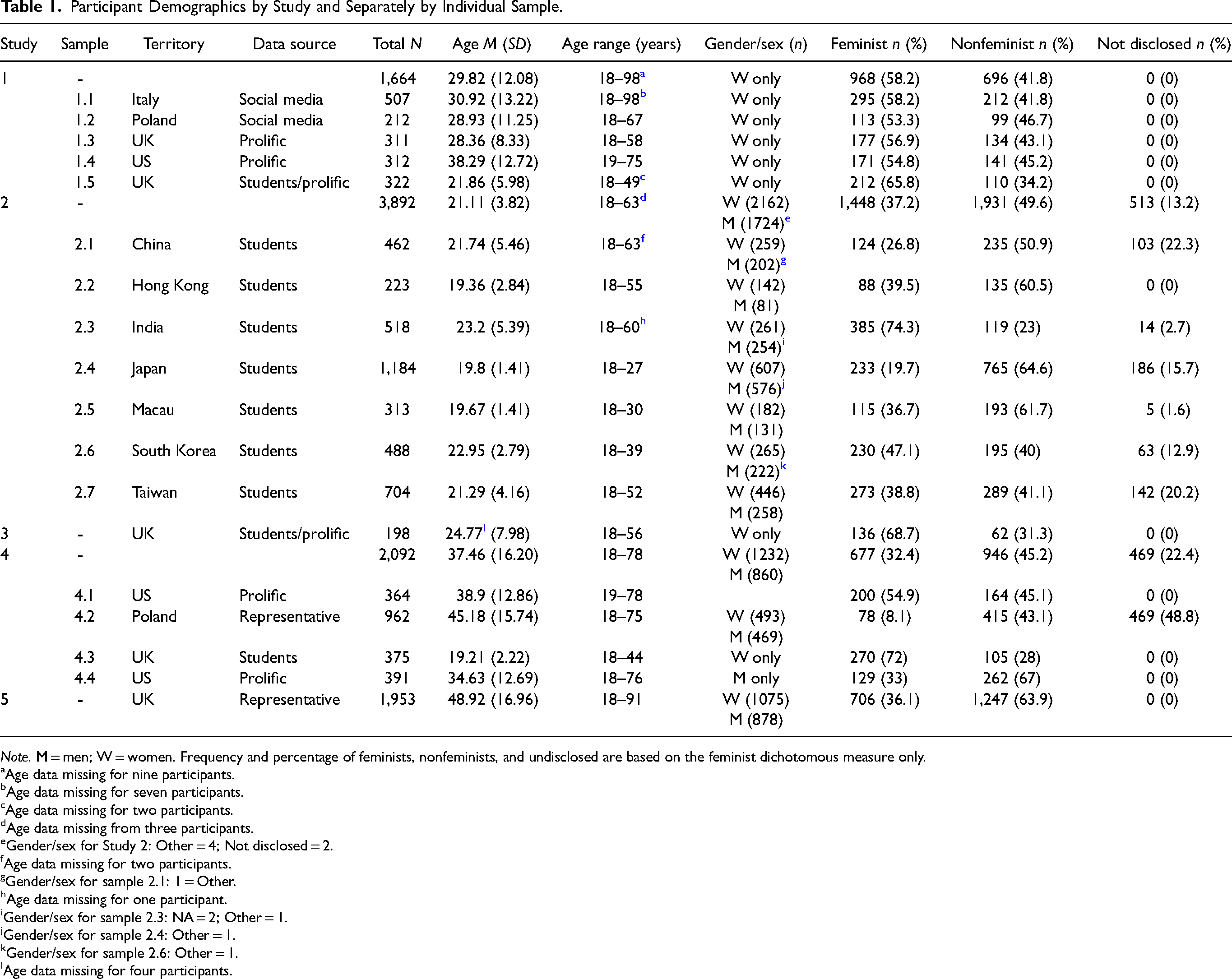
Note. M = men; W = women. Frequency and percentage of feminists, nonfeminists, and undisclosed are based on the feminist dichotomous measure only.
Age data missing for nine participants.
Age data missing for seven participants.
Age data missing for two participants.
Age data missing from three participants.
Gender/sex for Study 2: Other = 4; Not disclosed = 2.
Age data missing for two participants.
Gender/sex for sample 2.1: 1 = Other.
Age data missing for one participant.
Gender/sex for sample 2.3: NA = 2; Other = 1.
Gender/sex for sample 2.4: Other = 1.
Gender/sex for sample 2.6: Other = 1.
Age data missing for four participants.
Participants were entered into a raffle or were paid for participation. Materials were presented to participants in Italian (sample 1.1), Polish (sample 1.2), or English (samples 1.3–1.5). Materials were translated to Italian and Polish by two of the authors who are native speakers and were back translated by separate academic colleagues, who were also native speakers. The majority of participants identified as feminist. Hypotheses and methods were pre-registered for sample 1.5, which was chronologically our first investigation of the misandry stereotype 2 : https://osf.io/7pzaj. Samples 1.3 and 1.4 were part of a larger survey which included questions regarding the #MeToo movement.
A sensitivity power analysis conducted via the pwr package for R (Version 1.3-0; Champely, 2020) suggested that each of the samples afforded greater than 80% power (a = .05, two-tailed) to detect a difference in attitudes between feminists and nonfeminists of the following magnitudes: d = 0.25–0.39. Assuming moderate variance across samples (I = 50%), a sensitivity power analysis for a random-effects meta-analysis via the metapower package for R (Version 0.2.2; Griffin, 2021) suggested that the combined sample (nstudy1 = 1,664) afforded greater than 80% power (a = .05, two-tailed) to detect a difference in attitudes between feminist and nonfeminist of the following magnitude: d = 0.21. This is considered a small-to-medium effect size, given the typical effect sizes reported in social psychology (Lovakov & Agadullina, 2021).
Materials and Procedure
Detailed information including number of items, response scales, reliability, and example items about all feminism (feminist identity, ideology, and collective action) measures and outcome measures are presented in Tables 2 and 3, respectively. Although internal reliability was acceptable for most of the scales, it fell below the conventional .70 threshold in a few instances (e.g., emotional reactions in samples 1.1 and 1.2).
Measures of Feminism Across All Studies.
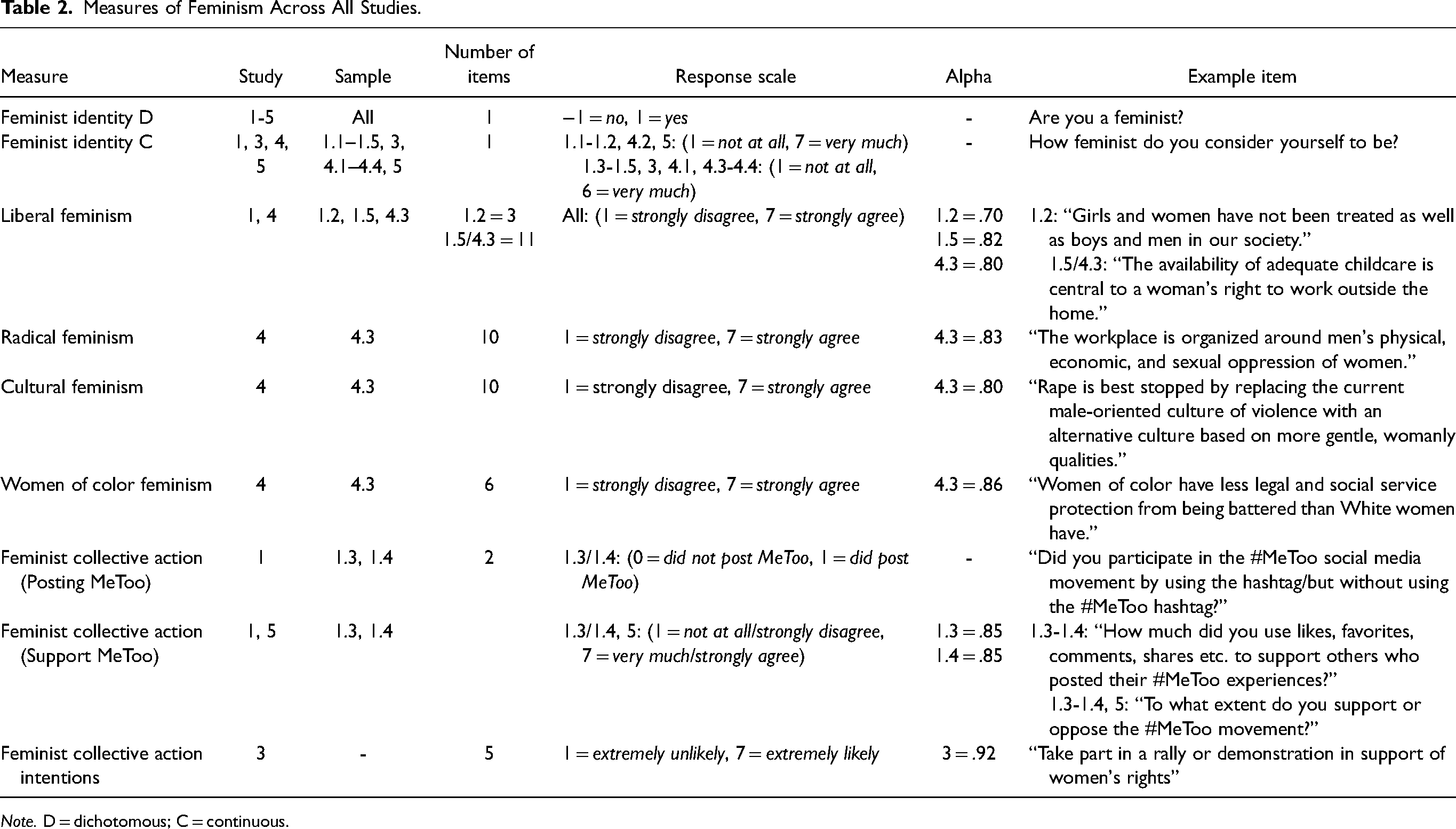
Note. D = dichotomous; C = continuous.
Outcome Measures Across All Studies.
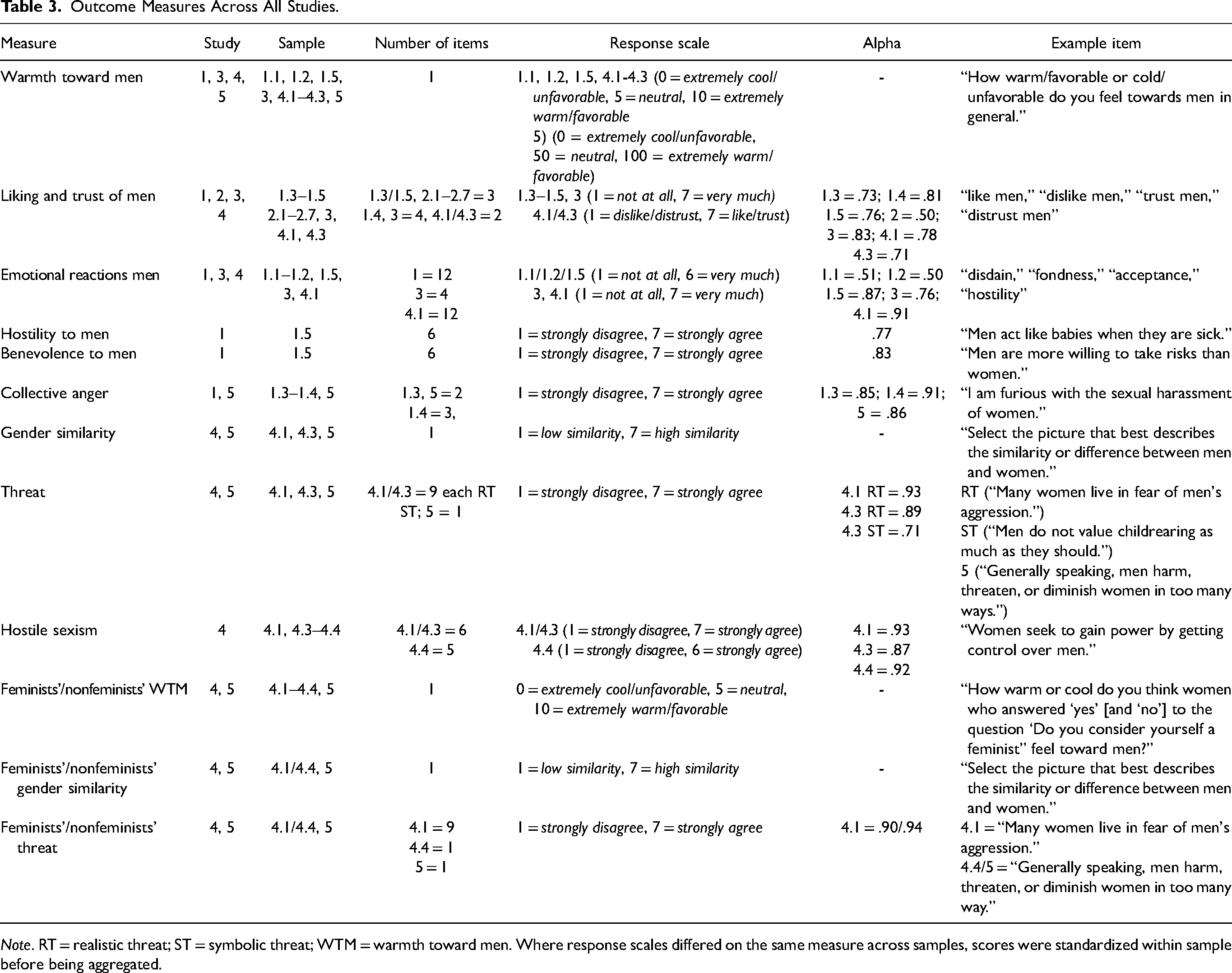
Note. RT = realistic threat; ST = symbolic threat; WTM = warmth toward men. Where response scales differed on the same measure across samples, scores were standardized within sample before being aggregated.
Feminist Identity. In all samples, participants indicated feminist identity on a dichotomous and continuous measure. Previous research indicates these two methods produce similar but not identical results (Bay-Cheng & Zucker, 2007; Liss et al., 2000).
Feminist Ideology. Some samples indicated their agreement with core tenets of feminism. In sample 1.2, participants completed the three-item cardinal feminist beliefs scale only (Zucker, 2004). In sample 1.5, participants also completed eight items from the liberal feminism subscale of the Feminist Perspectives Scale (Henley et al., 1998).
Feminist Collective Action. Measures of posting and support for #MeToo were operationalized as separate measures of feminist collective action. To assess posting to MeToo, participants (samples 1.3–1.4) indicated whether they had participated in MeToo by answering two binary questions. A scale total was calculated such that if a participant answered yes to either item they were coded as having posted MeToo. To assess support for MeToo, participants (samples 1.3–1.4) indicated their attitudinal and behavioral engagement with MeToo. A scale total was calculated.
Explicit Attitudes Toward Men. Participants indicated their attitudes toward men on measures of warmth toward men, liking and trust of men, and emotional reactions to men. All individual measures were positively correlated (r = .230–.716, all p < .001). See Table 3 for details. These indices were centered around their scale midpoints, standardized, and averaged to derive a composite score. For a given measure, let x i be an observed score, m the scale midpoint, and s the standard deviation. Then the midpoint centered and standardized score is given: Zm = (x i −m)/s. Hereafter, we will refer to these midpoint standardized scores as Zm whenever they are used.
Ambivalence Toward Men. Sample 1.5 included the Ambivalence to Men Inventory (Glick & Fiske, 1999), which included subscales for hostility to men and benevolence to men. 3
Collective Anger. Participants indicated their group-based anger in the context of MeToo in samples 1.3 and 1.4.
Results
Feminist Identification and Attitudes Toward Men
See Table 4 for all means, standard deviations, and test coefficients. Here we report analyses using the composite measure of explicit attitudes toward men. See Supplement B for analyses with each individual measure. As predicted (H1), both feminists and nonfeminists (using the dichotomous measure) held positive (above midpoint) explicit attitudes toward men. Inconsistent with predictions and shown in Table 4 (H2), feminists’ and nonfeminists’ explicit attitudes toward men were not significantly different. There was likewise no significant difference between feminists (M = 3.40, SD = 1.26) and nonfeminists (M = 3.53, SD = 1.14) on hostility toward men t(320) = −0.93, p = .352, d = −0.11, 95% CI [−0.34, 0.12], but feminists (M = 2.43, SD = 1.16) were less benevolent toward men than nonfeminists (M = 3.23, SD = 1.13) t(320) = −5.86, p < .001, d = −0.69, 95% CI [−0.92, −0.45].
One-Sample and Between-Sample Tests of Explicit Attitudes to Men (Composite Measure), Perceived Threat, and Perceived Similarity, for Each Individual Study.
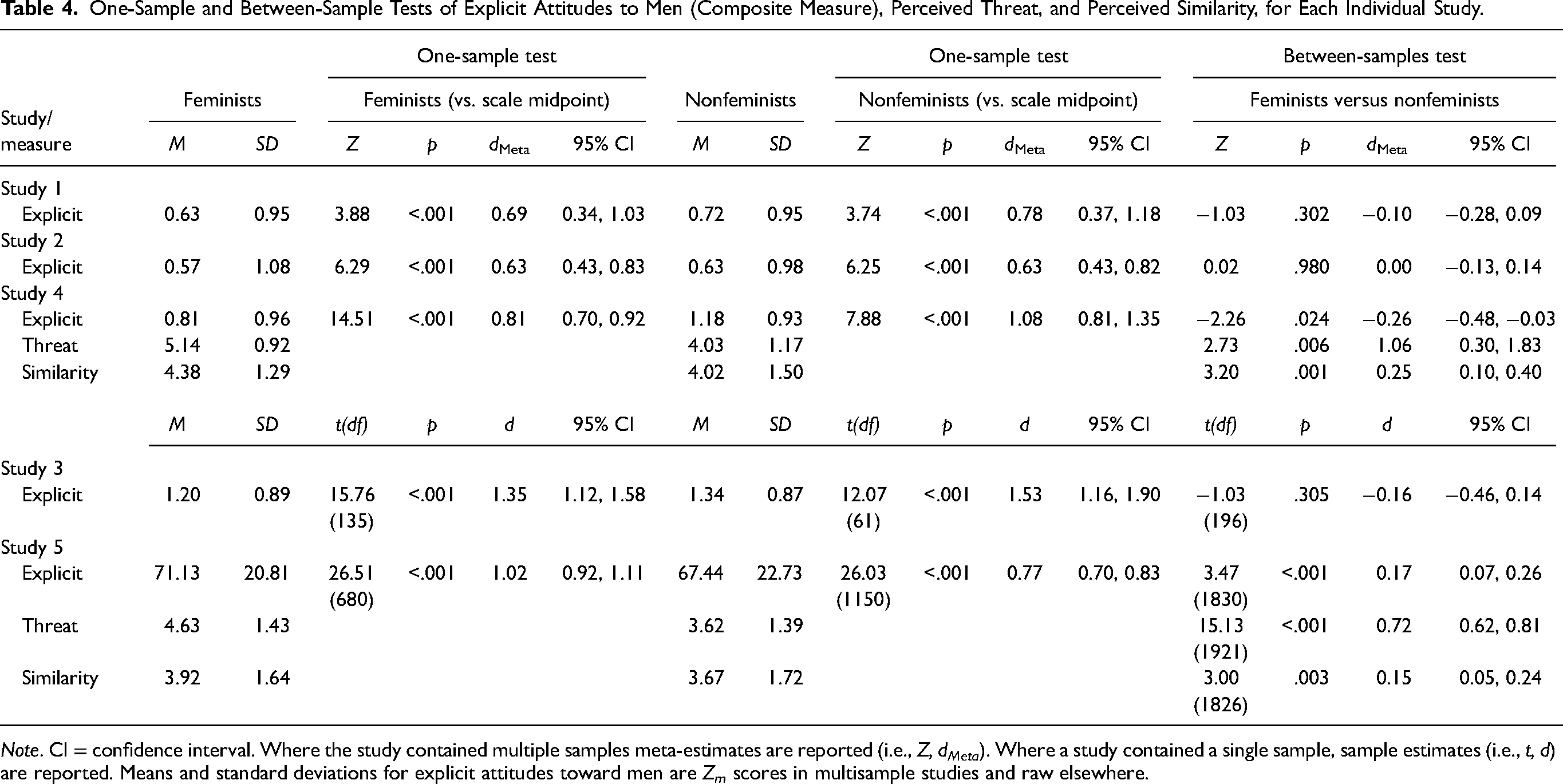
Note. CI = confidence interval. Where the study contained multiple samples meta-estimates are reported (i.e., Z, dMeta). Where a study contained a single sample, sample estimates (i.e., t, d) are reported. Means and standard deviations for explicit attitudes toward men are Zm scores in multisample studies and raw elsewhere.
Correlational analyses of the continuous measure of feminist identification produced largely the same patterns. Inconsistent with prediction (H3), this measure was unrelated to participants’ explicit attitudes toward men, rMeta = −0.04, 95% CI [−0.14, 0.05], Z = −0.88, p = .377, and hostility to men, rMeta = −0.05, 95% CI [−0.16, 0.06], Z = −0.86, p = .390; but it was predictive of lower benevolence to men, rMeta = −0.39, 95% CI [−0.47, −0.29], Z = −7.26, p < .001. Adding the quadratic term (feminist identification squared) to a mixed-effects model predicting variations at the meta-level did not improve the fit compared to the simpler model, χ2s < 0.54, Δdf = 1, p > .462, producing no evidence of a nonlinear relation between feminist identity and attitudes toward men. This result tends to disconfirm any notion that misandrist attitudes may emerge distinctively among the most highly identifying feminists.
Feminist Ideology and Attitudes Toward Men
Inconsistent with expectation (H3), correlational analyses of feminist ideology showed that it was not significantly related to explicit attitudes toward men, rMeta = 0.03, 95% CI [−0.23, 0.29], Z = 0.20, p = .840, nor hostility to men, r(319) = .00, 95% CI [−0.11, 0.11], p = .990. Feminist ideology was negatively associated with benevolence to men, r(319) = −.36, 95% CI [−0.45, −0.26], p < .001.
Feminist Collective Action and Attitudes Toward Men
To further test the misandry myth, we ran correlational analyses with feminist collective action (i.e., participation in, and support for, #MeToo), explicit attitudes toward men, and collective anger (regarding women's experiences of sexual misconduct). Contrary to predictions (H3), participation in and support for MeToo were unrelated to explicit attitudes toward men (rsMeta < ± .08, ps > .047). However, they were positively associated with collective anger (MeToo participation: rMeta = .15, 95% CI [0.08, 0.13], Z = 3.86, p < .001; MeToo support: rMeta = .38, 95% CI [0.31, 0.44], Z = 9.86, p < .001). See Table S3 (Supplement B) for additional correlations between feminist identity and these variables.
Study 2: Feminists’ Explicit Attitudes Toward Men in Non-WEIRD Countries
Our initial investigation with women in WEIRD (Western, educated, industrialized, rich, and democratic; Henrich et al., 2010) countries yielded little support for the misandry stereotype. However, given the importance of the feminist movement globally, and criticism of its narrow focus on the interests of Western women (Kruks, 2005), in Study 2 we extended our investigation to feminists in five non-WEIRD countries in Asia: China (Mainland China, Hong Kong, and Macau 4 ), India, Japan, South Korea, and Taiwan. All countries (except India) are also Confucian cultures which are explicitly patriarchal and represent an important context in which to study feminism (Rosenlee, 2012). Recently, there have been some psychological investigations into feminist identity development and activism in Asian countries. For example, researchers in China examined how feminist identity (using Feminist Identity Composite; Fischer et al., 2000) is positively related to activism and sexual harassment awareness (Liu & Zheng, 2019; Shi & Zheng, 2021). Elsewhere, qualitative interviews of feminist activists in India and China identified social relationships and experiences of gender inequality and violence as key factors in feminist identity development (Frederick & Stewart, 2018). Notwithstanding these findings, there remains a dearth of research examining levels of feminist identification in Asian countries and how feminists feel toward men.
We expected that consistent with our theorizing, feminists’ attitudes toward men would be positive in absolute terms (H1), but less positive relative to nonfeminists’ (H2). For the first time, we also recruited male participants. We expected the same pattern to emerge for female and male participants, since previous research has shown that predictors of feminist attitudes are largely similar between men and women (Bolzendahl & Myers, 2004). Relatedly, men are not precluded from the feminist movement and also suffer under sexist systems (hooks, 2000), and other studies on feminist attitudes have included both men and women (e.g., Henley et al., 1998). We did not make any specific predictions by country, but we do report country-level analyses in Supplement C.
Method
Participants, Data Collection, and Power Analysis
See Table 1 for information on participants and recruitment overall and split by sample. The data for Study 2 came from seven different samples (labeled samples 2.1–2.7) of women and men from Mainland China (sample 2.1), Hong Kong (sample 2.2), India (sample 2.3), Japan (sample 2.4), Macau (sample 2.5), South Korea (sample 2.6), and Taiwan (sample 2.7). Four participants were removed as their responses indicated inattentiveness. Participants reported identifying as feminist (nWomen = 1,000; nMen = 444, nOther = 3, nDid not disclose = 1), nonfeminist (nWomen = 906; nMen = 1,023, nOther = 1, nDid not disclose = 1), or did not disclose their feminist identity (nWomen = 256, nMen = 257). Only participants who had lived in each respective country since birth were recruited to take part. 5 Participants were undergraduate students recruited in class or through research participation programs. Participation was voluntary but those who took part via research participation programs received course credit.
A sensitivity power analysis conducted (pwr for R v1.3-0; Champely, 2020) suggested the samples afforded greater than 80% power (a = .05, two-tailed) to detect a difference in attitudes between feminists and nonfeminists of the following magnitudes: d = 0.17 to 0.38. Assuming similar variance across samples as we observed in Study 1 (I = 90%), a sensitivity power analysis for a random-effects meta-analysis (metapower for R v0.2.2; Griffin, 2021) suggested that the combined sample (nstudy2 = 3,892) afforded greater than 80% power (a = .05, two-tailed) to detect a difference in attitudes between feminists and nonfeminists of magnitude d = 0.20. The magnitude of this effect could be considered small-to-medium (Lovakov & Agadullina, 2021).
Materials, Measures, and Procedure
Data were collected through a large-scale collaboration of 28 researchers from 24 universities across countries. Participants were presented with the materials in their native language, except in Hong Kong and India where materials were in English. Materials were translated and back translated by co-authors and their teams in each country, except in Japan where all Japanese co-authors worked together on translation and validation. Our items were included as part of a larger cross-cultural questionnaire examining social justice beliefs in South and East Asia. Countries were included based on availability of collaborators. Given the methodological similarity across countries the samples were combined to increase power.
Feminist Identity. Participants indicated their feminist identity using the dichotomous measure (see Table 2). A continuous measure of feminist identity was dropped due to inconsistencies in how it was measured across countries.
Liking and Trust of Men. See Table 3 for details. Negatively worded items were reverse scored so that higher scores reflected greater positivity. Internal reliability fell below the conventional .70 threshold for this scale. Therefore, we replicated all analyses with each item individually. The pattern was the same (see Supplement C for details).
Results
Unlike in Study 1, the present study contained male participants (and a small number of gender/sex 6 variant identified people). For this reason, we first tested for differences between the two largest gender/sex subgroups (female vs. male participants) when comparing feminists’ and nonfeminists’ liking and trust of men. There was no strong evidence to suggest that gender/sex moderated the differences between feminists and nonfeminists on liking and trust of men, Q(1) = 3.42, p = .064. As shown in Table 4, and consistent with our predictions (H1), both feminists’ and nonfeminists’ liking and trust were positive in absolute terms. However, inconsistent with predictions (H2), feminists reported no less liking and trust of men than nonfeminists. The same pattern was observed for each individual item (see Supplement C for details).
Study 3: Feminists’ Implicit Attitudes Toward Men
In Study 3, we extended our investigation of feminists’ attitudes toward men to include implicit attitudes. Participants took part in a single-category implicit association test (SC-IAT; Karpinski & Steinman 2006), which asks participants to categorize “male” words to either a good or bad category depending on which rule is active. Response latencies for categorizing male words with good or bad are calculated. A positive (negative) d-score indicates a positive (negative) implicit association with the category male. We expected that participants would demonstrate a positive association with the category male in absolute terms (H1). Our key prediction, based on the theoretical reasons to suppose that the misandry stereotype contains a grain of truth, was that feminists would demonstrate a less positive association with the category male than nonfeminists (H2). We also expected that feminist collective action would be negatively related to explicit and implicit attitudes (H3). Hypotheses and methods were pre-registered: https://osf.io/fwqgk
Methods
Participants, Data Collection, and Power Analysis
See Table 1 for participant details. Participants were undergraduate women from a UK university, who took part for course credits. Initial data collection in the lab was slow (n = 97) owing to mid-semester breaks during testing; therefore, we also collected data online (n = 101) to maximize recruitment. Results did not differ between lab and online participants. 7 Most participants in the sample identified as feminists. Details of data processing and exclusions are available on the OSF project page (see author note for link). A sensitivity power analysis conducted (pwr for R v1.3-0; Champely, 2020) suggested that the sample (n = 198) afforded greater than 80% power (a = .05, two-tailed) to detect a difference in attitudes between feminists and nonfeminists of the following magnitude: d = 0.40 (i.e., average effect size reported in social psychology, Lovakov & Agadullina, 2021).
Materials and Procedure
Feminism. Participants completed measures of feminist identity (dichotomous and continuous) and feminist collective action intentions (multi-item measure; Kelly & Breinlinger, 1995). See Table 2 for detailed information.
Implicit Attitudes Toward Men. Participants completed the SC-IAT (Karpinski & Steinman, 2006), which measures evaluative associations with a single category or attitude object. We presented seven target words associated with the object category Male (e.g., He, Mister, Kevin), and 21 target words for the evaluative dimension, labeled Good (e.g., wonderful and celebrating) and Bad (e.g., terrible, horrible; adapted from Rudman et al., 2001). A d-score was calculated from responses such that a positive score (i.e., > 0) indicated positive associations between Male and Good. This number was calculated by subtracting mean reaction times in Block 2 (where Male and Good were paired) from those in Block 4 (where Male and Bad were paired). Zero is the neutral midpoint at which associations change from negative to positive. In line with previous SC-IAT studies, responses were winsored above 1500 ms and counted as missing values if less than 350 ms. Incorrect responses were replaced by the block mean of correct trials plus 400 ms (for details see Karpinski & Steinman, 2006).
Explicit Attitudes Toward Men. A composite (Zm score) was created as in Study 1 (see Table 3 for details of individual measures). All individual measures which comprise the composite were positively correlated (r = .613–.747, all p < .001).
Results
Feminists’ Implicit and Explicit Attitudes Toward Men
As in Studies 1 and 2, we first examined feminists’ absolute (using one-sample t-tests against midpoint = 0) and then relative (compared to nonfeminists’) attitudes toward men.
As predicted (H1) and shown in Figure 1, both feminists (M = 0.23, SD = 0.33) and nonfeminists (M = 0.19, SD = 0.32) showed positive implicit attitudes toward men in absolute terms (feminists: d = 0.71, 95% CI [0.52, 0.90], t(135) = 8.28, p < .001; nonfeminists: d = 0.59, 95% CI [0.31, 0.85], t(61) = 4.61, p < .001). Inconsistent with predictions (H2), the between-participants comparison showed no differences between feminists’ and nonfeminists’ implicit attitudes toward men, d = −0.13, 95% CI [−0.40, 0.16], t(196) = −0.86, p = .391. Similarly, analyses using the continuous measure of feminist identity showed it was unrelated to implicit attitudes toward men r(197) = .02, 95% CI [−.12, .16], p = .752. As shown in Table 4, explicit attitudes toward men were similar to Study 1, indicating positivity in absolute terms, and no difference between feminists’ and nonfeminists’ attitudes toward men in relative terms. Likewise, correlational analyses using the continuous measure showed no relation with implicit or explicit attitudes toward men (rs < .09, ps > .198). See Supplement D for tests with individual measures of attitudes toward men.
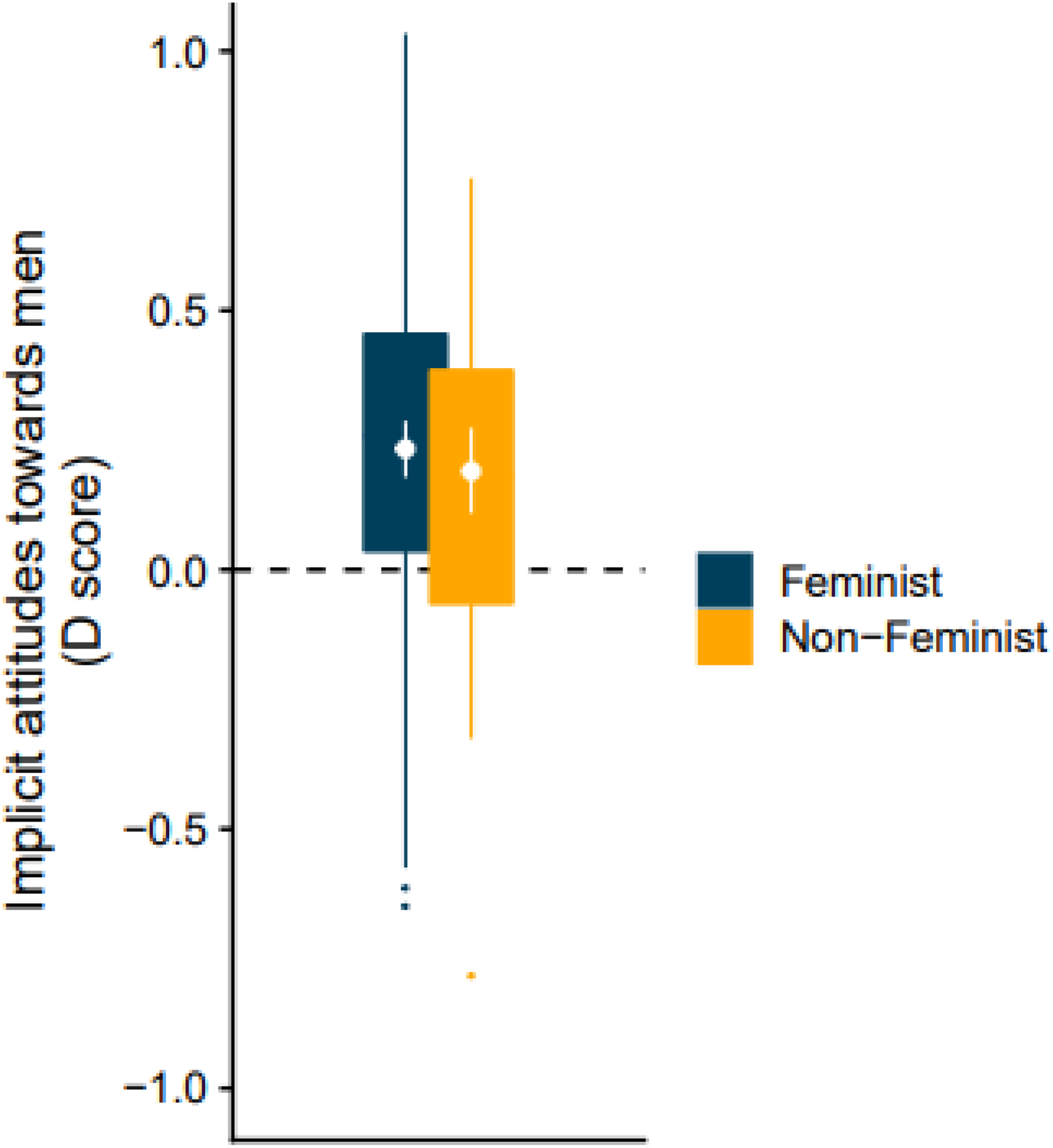
Implicit Attitudes Toward Men Among Feminists and Non Feminists (Study 3).
Feminist Collective Action and Attitudes Toward Men
Inconsistent with prediction (H3), feminist collective action was unrelated to all measures of implicit and explicit attitudes toward men (all rs < .12, all ps > .071), except for a negative relation with emotional reactions toward men, r(196) = −.15, 95% CI [−.29, −.01], p = .031. Feminist collective action did correlate positively with feminist identity, r(196) = .65, 95% CI [.56, .72], p < .001, but in regression analyses predicted neither implicit or explicit attitudes toward men (all ps > .14). In concert, these findings indicate that even when operationalized as action, feminism is largely unrelated to attitudes toward men.
Study 4: Mechanisms and Metaperceptions of (Non-)Feminists’ Attitudes Toward Men
Thus far our studies show little support for the accuracy of the misandry stereotype: across national contexts and using a variety of measures, feminists are largely positive in their attitudes toward men and no different from nonfeminists. However, these findings do not tell us anything about the processes shaping feminists’ attitudes toward men, nor can they shed light on why previous investigations of the misandry stereotype have been inconsistent in their conclusions. To address this, in Study 4 we tested, for the first time, our full path model of feminists’ attitudes toward men via gender similarity and threat (i.e., realistic and symbolic). We also tested directly comparable stereotypes (metaperceptions) of feminists’ attitudes toward men, gender similarity, and threat. This means for the first time we were able to compare feminists’ attitudes toward men, gender similarity, and threat to metaperceptions of those attitudes, thus testing stereotype accuracy in a novel way (Judd & Park, 1993).
Our investigations so far have also been constrained to measuring only mainstream feminists’ thinking (i.e., liberal feminism). Therefore, in Study 4 we extended our investigation to include different types of feminist ideology. Feminism is a heterogenous movement with many varieties of thinking that conceptualize oppression and its sources in distinct ways (Donovan, 2012). We chose to focus on ideologies (liberal, radical, cultural, women of color) that represented a breadth of beliefs but which could be measured using a validated tool (i.e., Henley et al., 1998). Liberal feminism emphasizes the notion that women and men are essentially the same, and thus should have equal rights and opportunities. Cultural feminism distinguishes women from men by advocating for positive so-called feminine values concerning gentleness and peace. Radical feminism views men as a group that oppresses women. Women of color feminism criticize the exclusion of women of color from the feminist movement and emphasize intersectional issues of racism and poverty.
As in Studies 1 to 3, we predicted that feminists’ attitudes to men would be positive in absolute terms though less positive than nonfeminists’ (H1 and H2), and predicted negative associations between feminist ideology (liberal, radical, cultural, and women of color) and attitudes toward men (H3). Guided by our theoretical model of feminists’ attitudes toward men, we predicted that feminists (relative to nonfeminists) would report greater threat from men (H4a), but also greater similarity between men and women (H5a). We expected these factors to have opposing evaluative indirect effects on attitudes toward men: negative via threat (H4b) and positive via similarity (H5b).
Turning to people's understanding of those mechanisms, we expected that feminists’ metaperceived attitudes toward men would be inaccurately stereotyped as negative in absolute terms (H6a), and underestimated relative to feminists’ actual mean (H6b). We predicted that this stereotype would be associated with a faulty understanding of the factors underlying feminists’ attitudes. Specifically, we expected that feminists (relative to nonfeminists) would be perceived as believing men to be a stronger threat (H7), and also would be stereotyped as perceiving men and women as less similar (H8). We expected these metaperceived differences to mediate the relation between (non-)feminists and their metaperceived attitudes toward men (H9–H10). Finally, we expected that ideological motivations (i.e., hostile sexism) would be associated with participants’ tendency to endorse the misandry stereotype (H11).
Method
Participants, Data Collection, and Power Analysis
See Table 1 for overall participant details, and broken down by sample. Participants from the US (samples 4.1 and 4.4), Poland (sample 4.2), and the UK (sample 4.3) took part. Data were collected separately by different members of the research team, and in one case (sample 4.2) a contracted research company, but were later merged to increase statistical power and inference. Samples were merged in this way because all included measures of metaperceptions of feminists’ and nonfeminists’ attitudes. Sample 4.2 (Poland) was a nationally representative sample of adults (by age, gender/sex, and education) recruited via a Polish research company. Our items were part of a larger omnibus survey conducted using a Computer Assisted Personal Interviewing (CAPI) technique (i.e., respondents were interviewed in their homes by an interviewer with a laptop). Materials were translated and back translated by separate native Polish speakers. They were also reviewed by the Polish research company for clarity and accuracy.
Hypotheses and methods 8 were pre-registered for sample 4.2 (see https://osf.io/u584r). Participants completed the study in person (sample 4.2) or online (samples 4.1, 4.3, and 4.4). Participants identified as feminists (nWomen = 548, nMen = 129; note that only n = 391 men completed the dichotomous measure of feminist identification 9 ) or nonfeminist (nWomen = 684; nMen = 262).
A sensitivity power analysis (pwr for R v1.3-0; Champely, 2020) suggested the samples afforded greater than 80% power (a = .05, two-tailed) to detect a difference in attitudes between feminists and nonfeminists of the following magnitudes: d = 0.18 to 0.29. Given the variance across samples in our prior studies (I ≈ 90%), a sensitivity power analysis for a random-effects meta-analysis (metapower for R v0.2.2; Griffin, 2021) suggested the combined sample (nstudy4 = 2,092) afforded greater than 80% power (a = 0.05, two-tailed) to detect a difference in attitudes between feminists and nonfeminists of: d = 0.35 (i.e., close to the average size reported in social psychology; Lovakov & Agadullina, 2021).
Materials and Procedure
Detailed information about measures of feminist identity and ideology are presented in Table 2. Detailed information about all other measures are presented in Table 3.
Feminist Identity. Participants completed both a dichotomous and a continuous measure. In sample 4.2, male participants completed the continuous measure only, due to financial constraints.
Feminist Ideology. Sample 4.3 included the same measure of liberal feminism as in Study 1 and three subscales (i.e., cultural, radical, 10 and women of color) from the Feminist Perspectives Scale (Henley et al., 1998). We chose not to include the conservative and socialist feminist subscales because the former does not measure feminist ideology, and we felt the latter was dated and was likely to yield little variance in responses.
Explicit Attitudes Toward Men. A composite was created as in Studies 1 and 3. All individual measures which make up this composite were positively correlated (r = .639–.720, all p < .001).
Gender Similarity. Participants (samples 4.1 and 4.3) completed a scale of similarity using the adapted Inclusion of Others in Self (IOS) Scale (Aron et al., 1992).
Threat. Participants completed a measure of realistic threat (samples 4.1 and 4.3; Stephan et al., 2000) and symbolic threat (sample 4.3; Stephan et al., 2000). In sample 4.3, symbolic and realistic threat were aggregated.
Hostile Sexism. Participants (sample 4.1, 4.3, and 4.4) completed the hostile sexism subscale from the Ambivalent Sexism Inventory (Glick & Fiske, 1996). Hostile sexism is conceptualized as mistrust of women who are seen as trying to usurp male authority through feminism. In this way it is explicitly antifeminist and likely to be associated with distrust and disliking of feminists.
Metaperceptions of (Non-)Feminists’ Attitudes. Participants completed the measures of attitudes toward men as they believed other participants (i.e., feminists and nonfeminists) in the study would have. We asked participants to specifically consider women feminists (and nonfeminists), since the misandry stereotype is largely, if not exclusively, concerned with women feminists. Since samples 4.1, 4.3, and 4.4 were nonrepresentative, care was taken to word these questions such that metaperceptions were directly comparable to feminists’ and nonfeminists’ reported attitudes (e.g., “We are asking women Prolific workers based in the US to answer similar questions”). In counterbalanced order, participants indicated how warm they thought feminist and nonfeminist women felt toward men. In addition, samples 4.1 and 4.4 completed measures of metaperceptions of gender similarity and threat (see Table 3 for details). Note reliability was not calculated for metaperceived warmth and gender similarity because these were single item measures. In some samples (5.1 and 5.4) participants also completed metaperception measures of warmth toward women, but these are only analyzed in our meta-analysis (see Study 6).
Results
Feminists’ Attitudes Toward Men
For brevity we only report results of the composite here. For full results (i.e., tests of individual measures, and continuous feminist identity measure) please see Supplement E. As predicted (H1), and shown in Table 4, both feminists’ and nonfeminists’ explicit attitudes toward men were positive in absolute terms, and feminists were slightly less positive toward men relative to nonfeminists (H2). As expected (H3), all types of feminist ideology, except liberal feminism (p = .217), were negatively related to explicit attitudes toward men (all rs between −.31 and −.11; all ps < .041). A multiple regression showed that radical (β = −.24, p < .001) and cultural (β = −.18, p = .003) feminism, but not liberal (β = .06, p = .330) or women of color (β = .01, p = .910) feminism, were uniquely associated with less positive explicit attitudes toward men, overall model: R2 = .12, F(4, 370) = 12.89, p < .001. These findings indicate that nonmainstream feminist ideologies may be associated with less positive attitudes toward men.
The Role of Gender Similarity and Threat in Feminists’ Attitudes Toward Men
Next, we tested our focal hypotheses about mechanisms shaping feminists’ and nonfeminists’ relative positivity toward men. As predicted (H4a) and shown in Table 4, women feminists (vs. nonfeminists) perceived men as a greater threat, 11 but also more similar to women (H5a). Next, we ran indirect effects analyses using Hayes (2017) SPSS Process macro v.4.1, Model 4, with 5,000 resamples and standardized scores (see Figure 2, Panel A). As predicted (H4b and H5b), dichotomous feminist identification was negatively related to warmth toward men via threat, but positively related via gender similarity. The direct effect was nonsignificant. Note that male participants in Study 4 did not complete all of the measures needed in order to conduct this mediation analysis. In any case, the roles of gender similarity and threat to women may only be relevant to female feminists, for whom women are the gender ingroup. See Supplement E for additional analyses with explicit attitudes toward men as the outcome variable and the continuous feminist identity as the predictor.
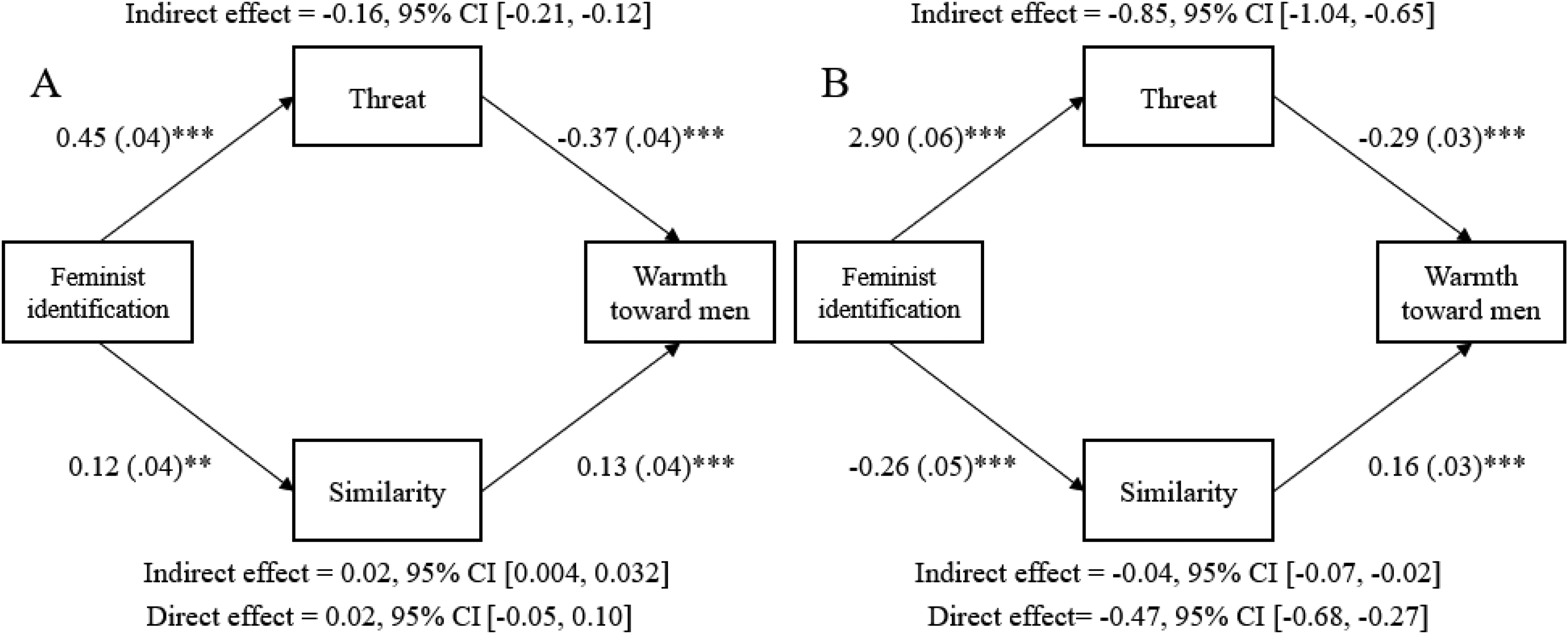
Indirect Paths Between Feminist Identification and Warmth Toward Men via Threat and Gender Similarity, in Reality (Panel A) and Metaperceptions (Panel B; Study 4).
Metaperceptions of Feminists’ Attitudes Toward Men
Means and inferential statistics are shown in Table 5. As expected (H6), feminists’ attitudes were perceived as below midpoint: that is, negative in absolute terms, dMeta = −0.15, 95% CI [−0.22, −0.07], Z = −3.91, p < .001. Further, relative to feminists’ actual warmth toward men participants as whole substantially underestimated women feminists’ warmth toward men. This error was committed by feminists and nonfeminists alike. We then examined, for the first time, participants’ understanding of the mechanisms underlying women feminists’ attitudes toward men. As predicted (H7 and H8), and shown in Table 5, participants overestimated women feminists’ perceptions of threat and underestimated their perceptions of gender similarity. This pattern was evident even among feminist participants for threat. See Supplement E for analyses of the accuracy of nonfeminists’ attitudes toward men, and for female and male participants separately.
Tests Comparing Metaperceptions Against the Actual Mean of Feminists’ Warmth Toward Men, Threat, and Similarity for the Whole Sample, Feminists, and Nonfeminists in Studies 4 and 5.
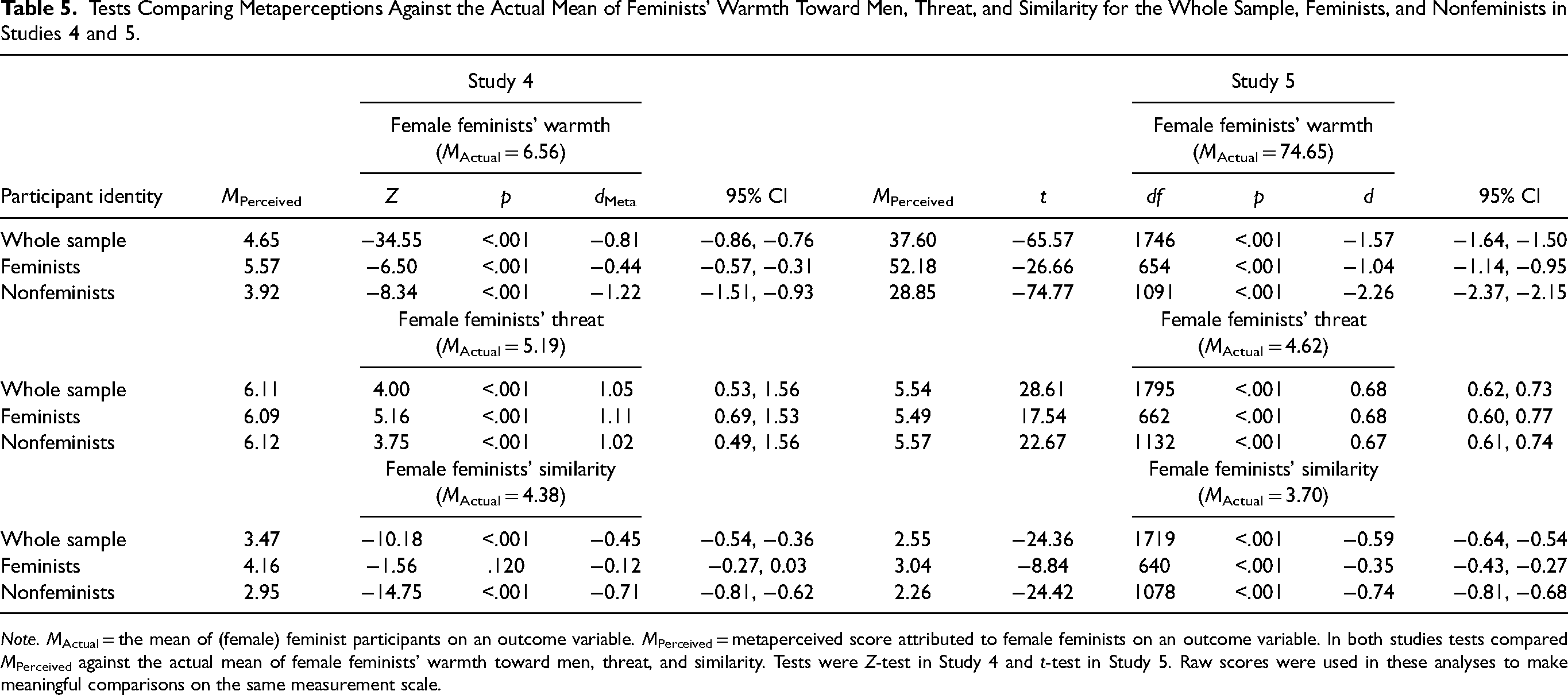
Note. MActual = the mean of (female) feminist participants on an outcome variable. MPerceived = metaperceived score attributed to female feminists on an outcome variable. In both studies tests compared MPerceived against the actual mean of female feminists’ warmth toward men, threat, and similarity. Tests were Z-test in Study 4 and t-test in Study 5. Raw scores were used in these analyses to make meaningful comparisons on the same measurement scale.
To examine the accuracy of participants’ understanding of mechanisms connecting feminism and warmth toward men, we analyzed repeated-measures mediation using Memore for SPSS v2.1 (Model 1 with 5,000 resamples, 95% bootstrapped confidence intervals; Montoya & Hayes, 2017). Zm scores 12 were used for this analysis. 13 Results are presented in Figure 2 (Panel B). As predicted (H9), participants were accurate regarding the role of threat perceptions: feminists were rated as higher in perceived threat, and subsequently lower in warmth toward men. In contrast, participants were, as expected (H10), inaccurate regarding the role of gender similarity perceptions, which they erroneously perceived to be lower among feminists. The direct effect was significant. See Supplement E for additional indirect effects investigated separately among female and male participants, and feminist and nonfeminist participants.
Finally, indicating the importance of faulty mental models over and above ideological factors multiple regression analyses showed that, as predicted (H11), metaperceptions of feminists’ warmth toward men (criterion variable) were associated with metaperceptions of similarity (β = .16) and threat (β = −.25) after adjusting for participants’ own feminist identification (continuous, β = .26) and hostile sexism (β = −.15, ps < .001; samples 4.1 and 4.4). The beta-weights for similarity and threat were not moderated by gender/sex (ps = .855 and .417, respectively 14 ). See Supplement E Tables S12 for full model statistics.
Study 5: Nationally Representative Investigation of (Non-)Feminists’ Attitudes Toward Men
Thus far, our previous samples, while diverse, have been largely student or convenience samples or where they were representative (sample 4.2), were conducted in a non-English speaking national context. To generalize and extend previous findings, in Study 5 we sought to replicate key effects in a nationally representative sample of UK adults. Participants completed the same measures as in Study 4 and two additional measures of feminist collective action (i.e., support for MeToo) and collective anger (specifically about sexual misconduct). As in previous studies, we expected that in absolute terms, feminists’ attitudes toward men would be positive (H1), but less positive than nonfeminists’ (H2). Likewise, we expected feminist collective action and anger would be negatively related to attitudes toward men (H3). We expected that feminists (compared to nonfeminists) would report greater threat from men (H4a), but greater gender similarity (H5a), and these beliefs would indirectly predict attitudes toward men—negative (H4b) and positive (H5b), respectively. Regarding metaperceptions, we expected feminists to be perceived as having negative attitudes toward men in absolute terms (H6a) and relative to the feminists’ actual mean (H6b). We predicted that feminists would be perceived as believing men to be a greater threat (H7), but also to be inaccurately stereotyped as perceiving men and women as dissimilar (H8). We predicted that these metaperceived differences in threat and gender similarity would mediate the metaperceived relation between feminism and attitudes toward men (H9 and H10). Finally, we expected that ideological factors (i.e., own feminist identification and feminist collective action) would be associated with participants’ endorsement of the misandry stereotype (H11). 15
Method
Participants, Data Collection, and Power Analysis
Participant details are displayed in Table 1. Participants were UK adults recruited via YouGov and were nationally representative by age, gender/sex, social grade and voting behavior. Our measures were included as part of a larger omnibus survey and administered online. More participants identified as not feminist (nWomen = 610; nMen = 637) than feminist (nWomen = 465; nMen = 241). A sensitivity power analysis (pwr for R v1.3-0; Champely, 2020) suggested the sample (n = 1,953) afforded greater than 80% power (a = .05, two-tailed) to detect a difference in attitudes between feminist and nonfeminist participants of d = 0.12. This magnitude could be considered small—that is, >75% of effect sizes typically reported in social psychology (Lovakov & Agadullina, 2021).
Measures
Feminism. Participants completed measures of feminist identity (dichotomous and continuous) and feminist collective action (i.e., support for MeToo). Detailed information is presented in Table 2. See Table 3 for details of all other measures.
Warmth Toward Men. Participants indicated the warmth of their feeling toward men using the same feeling thermometer as in previous studies.
Gender Similarity. Participants rated their perceived similarity between men and women as in Study 4 (i.e., IOS Scale; Aron et al., 1992).
Threat. Participants completed a single item that expressed both symbolic and realistic threat.
Metaperceptions of (Non-)Feminists’ Attitudes. In a counterbalanced order, participants completed the same measures of warmth toward men, gender similarity, and threat as they thought feminist and nonfeminist UK women would.
Collective Anger. Participants reported their anger at the sexual harassment of women.
Results
Analyses were conducted in line with Study 4, using standardized Zm scores for comparisons with midpoint. For all other analyses regular standardized scores were used (i.e., M = 0, SD = 1). Here we report analyses using unweighted estimates. We chose to do this because we wanted to maintain consistency in our analytic approach across studies, and because some outputs (i.e., the reporting of effect sizes and related confidence intervals in R) and analytic approaches (i.e., using the Process and Memore macros to test indirect effects analyses in SPSS) are not possible using weighted estimates. We also considered this approach appropriate because the differences between analyses using weighted and unweighted estimates were negligible. For replicated analyses using the weighted estimates see the project page on OSF (see author note for link). Note that YouGov data collection policy allowed participants to select a “don’t know” option in the omnibus survey that our questions were part of. This means a small number of participants responded outside of the scale on some questions. 16 However, to avoid problems with interpreting or imputing don’t know responses (Manisera & Zuccolotto, 2014), we have employed listwise deletion. 17 For this reason, reported sample size and degrees of freedom vary across measures and analyses.
Feminists’ Attitudes Toward Men
Analyses of feminists’ attitudes toward men were largely consistent with expectations and findings from Studies 1 to 4. As shown in Table 4 (H1), feminists’ and nonfeminists’ warmth toward men was positive in absolute terms, but unexpectedly feminists reported slightly warmer attitudes than nonfeminists (H2). Further exploration of a gender/sex interaction F(1, 1828) = 13.58, p < .001, η2p = .01 showed differences between feminists and nonfeminists were only significant for male participants (see Supplement F for details). Contrary to expectation, (H3), feminist collective action and collective anger were unrelated to warmth toward men (all rs = −.01, all ps > .685). In contrast, consistent with intergroup emotions theory, collective anger was related to feminist identity, r(1830) = .28, 95% CI [0.24, 0.32], p < .001, and feminist collective action, r(1598) = .42, 95% CI [0.38, 0.46], p < .001. See Supplement F for the results in full, including investigation of gender/sex effects.
The Role of Gender Similarity and Threat in Feminists’ Attitudes Toward Men
Next, we tested our proposed model of feminists’ and nonfeminists’ attitudes toward men. Independent t-tests showed that as predicted (H4a and H5a), and shown in Table 4, feminists (vs. nonfeminists) perceived men as a greater threat, but also more similar to women. As predicted (H4b and H5b), analysis of indirect effects using Process macro v4.1 for SPSS (using Z scores, Model 4 with 5,000 resamples; Hayes, 2017) for female participants revealed that dichotomous feminist identification was negatively related to warmth toward men via threat, but was positively associated via similarity. The direct effect of feminist identity was nonsignificant. See Figure 3 Panel A for coefficients. Here, we report the results only for female participants for consistency with Study 4 and with the metaperception questions that asked specifically about the attitudes of women; theoretically, also, threat and similarity to women can be expected to be more relevant to female than male participants. In Supplement F, moderated mediation results are presented which show that the indirect effects hold for both female and male participants, and that the indirect effect for threat (but not similarity) was significantly stronger for female participants.
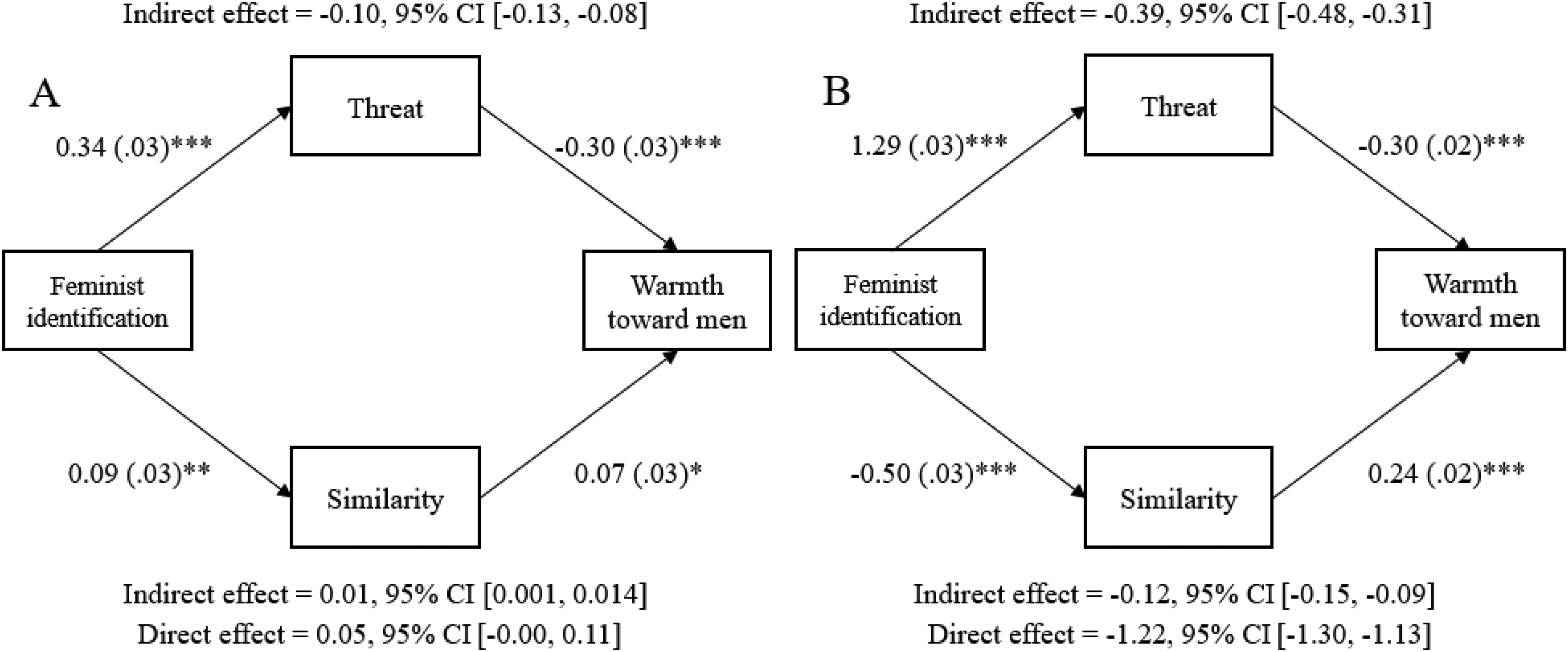
Indirect Paths Between Feminist Identification and Warmth Toward Men via Threat and Gender Similarity, in Reality (Panel A) and Metaperceptions (Panel B; Study 5).
Metaperceptions of Feminists’ Attitudes Toward Men
Consistent with expectations (H6a), one-sample t-tests showed female feminists’ attitudes were inaccurately perceived as below midpoint (i.e., 50): that is, negative in absolute terms, d = −0.53, 95% CI [−0.58, −0.47], t(1746) = −21.95, p < .001. Also consistent with expectations (H6b), and shown in Table 5, one-sample t-tests against the mean of female feminists’ attitudes showed that participants as a whole strongly underestimated their warmth toward men. This error was committed by feminist and nonfeminist participants alike. See Supplement F for analyses of feminists’ and nonfeminists’ metaperceived attitudes split by participant gender/sex.
Next, we examined participants’ understanding of the mechanisms underlying feminists’ attitudes toward men using one-sample t-tests against the mean of female feminists’ threat and similarity. As predicted (H7) and shown in Table 5, participants overestimated feminists’ perceptions of threat and (H8) underestimated feminists’ perceptions of gender similarity. This pattern was evident even among feminists for threat and gender similarity, and also among nonfeminists. Likewise, these patterns were the same for female and male participants (see Supplement F, Table S16 for details).
As in Study 4, we conducted repeated-measures mediation (using Memore v2.1 for SPSS; Model 1 with 5,000 resamples) to examine our focal hypothesis about participants’ understanding of mechanisms connecting feminism and warmth toward men. Zm scores were used for these analyses to make comparison with mediation models of feminists’ own attitudes easier, but the pattern was the same using raw scores (see Supplement F). As expected (H9), and shown in Figure 3 (Panel B), participants were accurate regarding the role of threat perceptions: feminists were rated as higher in threat, and subsequently lower in warmth toward men. In contrast (H10), participants were inaccurate regarding the role of gender similarity perceptions, which they erroneously perceived to be lower among feminists. Further analyses confirmed the indirect effects were equivalent when investigated separately amongst female and male participants, and feminists and nonfeminists (see Supplement F for details).
Finally, consistent with predictions (H11) hierarchal multiple regressions showed that metaperceptions of feminists’ warmth toward men (criterion variable) were associated with metaperceptions of similarity (β = .14) and threat (β = −.26) after controlling for participants’ own feminist identification (β = .38), collective action (β = .16), and gender/sex, β = .09, ps < .001; step 2: R2 = .39, F(3, 1353) = 170.74, p < .001. The beta-weights for metaperceived similarity and feminist collective action were moderated by gender/sex (p < .001, i.e., effect stronger for women; p = .01, effect stronger for men, respectively). See Supplement F Table S18 for full models for women and men separately. These results also held after controlling for relevant demographic variables (see Supplement F Table S19 for details).
Study 6: Meta-Analyses of Key Effects
To provide the most reliable and generalizable estimates of our key effects we conducted a final set of analyses to examine the overall trends across all samples by conducting random-effects meta-analyses (Cumming, 2014). Effect sizes are presented in terms of standardized mean differences (Cohen's d) and are weighted via an inverse-variance method (Schwarzer et al., 2015). A sensitivity power analysis for a random-effects meta-analysis (metapower for R v0.2.2; Griffin, 2021) suggested that the combined sample (ntotal = 9,799, nfeminists = 3,935, nnonfeminists = 4,882 18 ) afforded greater than 80% power (a = .05, two-tailed; I = 90%) to detect a difference in attitudes between feminist and nonfeminist of the following magnitude: d = 0.18 (i.e., considered small-to-medium in size; Lovakov & Agadullina, 2021).
Method
Measures
To provide a broad and parsimonious overview of how feminists and nonfeminists perceive men and women, we present the results using the feminist identity (dichotomous and continuous) measures only and two composite outcome measures, capturing explicit attitudes toward men and explicit attitudes toward women. The former is an aggregated index of attitudes toward men composed of warmth toward men (n = 4,295; Studies 1 and 3–5), liking and trust of men (n = 5,215; Studies 1–4), and emotional reactions toward men (n = 1,602; Studies 1, 3, and 4). The latter is an aggregated index of attitudes toward women composed of warmth toward women (n = 3,667; Studies 1 and 4–5) and liking and trust of women (n = 4,707; Studies 1–2 and 4). As in previous studies, these measures were centered around their scale midpoints, standardized, and averaged to derive each index using the formula: Zm = (x i −m)/s. In addition, we also present results from two measures of metaperceptions of feminists’ attitudes: metaperceptions of feminists’ warmth toward men (n = 3,839; Studies 4 and 5) and metaperceptions of feminists’ warmth toward women (n = 755; Study 4 only). Important inferences that can be drawn from our data in their entirety are outlined below. Note that findings pertain to mixed gender/sex samples unless otherwise stated.
Results
Feminists’ Attitudes Toward Men and Women
In line with our key prediction, feminists and nonfeminists were, in largely equal measure, positive toward men. Both feminists and nonfeminists reported attitudes toward men that were consistently above the scale midpoint (feminists: dMeta = 0.73, 95% CI [0.58, 0.89], Z = 9.44, p < .001; nonfeminists: dMeta = 0.80, 95% CI [0.64, 0.96], Z = 9.89, p < .001). There was no strong evidence to suggest that feminists’ attitudes toward men were any less positive than nonfeminists’, dMeta = −0.07, 95% CI [−0.17, 0.04], Z = −1.27, p = .204. To provide some useful context to this finding, we note that women feminists were no more negative toward men than men in general were, dMeta = 0.19, 95% CI [−0.10, 0.49], Z = 1.30, p = .194. In this sense, feminists are no more guilty of the charge of misandry than men are themselves. The continuous measure of feminist identification was also largely unrelated to explicit attitudes toward men, rMeta = −0.04, 95% CI [−0.11, 0.02], Z = −1.28, p = .199. There was also no evidence that this relation was nonlinear. Adding the quadratic term (feminist identification squared) to a mixed-effects model predicting variations at the meta-level did not improve the fit compared to the simpler model, χ2 = 1.29, Δdf = 1, p = .255.
Thus far we have focused on attitudes toward men. However, feminism is conceived primarily as a movement for women and can be expected to be characterized by ingroup love in the form of positive attitudes toward women (hooks, 1986). Examination of attitudes toward women showed that while both groups displayed attitudes toward women that were positive in absolute terms (feminists: dMeta = 1.11, 95% CI [0.93, 1.29], Z = 12.27, p < .001; nonfeminists: dMeta = 0.88, 95% CI [0.75, 1.01], Z = 13.28, p < .001), feminists’ attitudes toward women were more positive than nonfeminists’, dMeta = 0.25, 95% CI [0.15, 0.34], Z = 5.17, p < .001. Importantly, feminists’ positivity toward women and men were positively correlated: the warmer they felt toward women, the warmer they also felt toward men, rMeta = .46, 95% CI [.40, .52], Z = 12.62, p < .001, contradicting any notion that feminists’ ingroup love for women translates to outgroup hate for men (Brewer, 1999).
Metaperceptions of Feminists’ Attitudes Toward Men and Women
Feminists’ attitudes toward men were perceived as negative in absolute terms, dMeta = −0.22, 95% CI [−0.42, −0.02], Z = −2.16, p = .031. Participants also underestimated feminists’ warmth toward men relative to feminists’ actual score, dMeta = −0.95, 95% CI [−1.35, −0.55], Z = −4.65, p < .001. Exploratory analyses showed that metaperceptions of feminists’ warmth toward women and men were not significantly correlated, rMeta = −.00, 95% CI [−.21, .20], Z = −0.03, p = .978. This result suggests that while participants did not erroneously infer that feminists’ ingroup love for women translates to outgroup hate toward men, they were unaware of the positive correlation between feminists’ attitudes to men and women—an awareness that might help dispel the misandry myth.
General Discussion
The present studies comprise the most systematic examination yet of feminists’ actual and perceived attitudes toward men. They yielded key findings that inform public debate as well as social psychological theories of stereotyping, metastereotyping, and intergroup processes. First, across several measures and nine national contexts, feminists displayed strongly positive attitudes toward men when compared to meaningful neutral benchmarks, and there was little-to-no evidence that these attitudes differed from nonfeminists’ (Studies 1–3) or even men's own attitudes toward men (Study 6). Second, participants—including feminist participants—incorrectly perceived feminists to hold negative attitudes toward men (Studies 4–6). Third, mediational analyses suggested that the closeness between feminists’ and nonfeminists’ attitudes toward men might be explained by two opposing forces: feminists at once perceived men as a greater threat to women (associated with less favorable evaluations), and also more similar to women (associated with more favorable evaluations; Studies 4–5). Fourth, turning to the mechanisms that cause myth and reality to diverge, the widespread misunderstanding of feminists’ attitudes toward men was associated not only with ideological antipathy to feminism but also a false belief that feminists see men and women as especially dissimilar (Studies 4 and 5). We discuss the implications of each of these findings in turn.
Feminists’ Positive Attitudes Toward Men
Feminists’ overall warmth toward men implies that a general antipathy is not necessary for this politicized identification—and is not even substantially associated with it. Neither were overall evaluative attitudes toward men associated reliably with feminist collective action intentions. These results suggest that positive intergroup attitudes do not necessarily stifle disadvantaged groups’ motivation to agitate collectively for social change (cf. Cakal et al., 2011; Saguy et al., 2009; for relevant recent findings see Sobol-Sarag et al., 2022). In contrast, the more specific intergroup emotion of anger was reliably associated with feminist identification and action intentions. Together, these findings are consistent with the view that antipathy to structural inequalities (e.g., injustice, violence, and discrimination) rather than majority or perpetrator groups (e.g., men) mobilizes disadvantaged groups to fight for social change (Cohen-Chen et al., 2014; van Zomeren et al., 2008). The so-called “irony of harmony” and “sedative” effects of positive intergroup emotions may therefore be associated with more specific intergroup perceptions, such as expectations of favorable treatment by the majority group, rather than any overall positive affective evaluation (Cakal et al., 2011; Saguy et al., 2009). Further research is required however to determine whether this pattern generalizes to other intergroup contexts.
These conclusions are given some nuance by subtly different patterns for different varieties of feminist ideology. Radical and cultural feminism were associated with reduced positivity toward men. There is pronounced ideological and demographic heterogeneity within the feminist movement. Further research is needed to determine which of the many varieties that can be identified are associated with different overall evaluations of men, and with what consequences for our model of feminists’ attitudes. For example, it is possible that cultural and radical feminism differentially predict the similarity and threat pathways in our model. We note, however, that the magnitude of the cultural and radical feminism effects (from β = −.18 to β = −.24; Study 4) suggests that women would need to be three to four standard deviations over the mean of radical or cultural feminism to overcome the overall, absolute positivity toward men that participants displayed. We also note that the nuance suggested by these findings is decidedly absent from the misandry myth itself, which is seldom couched in these conditional terms. Thus, these findings do not undermine the falsification of the misandry myth provided by the present studies.
In the meta-analysis (Study 6) we were also able to contextualize our findings on feminists’ attitudes toward men by comparing them directly with men's attitudes to their ingroup. We found that feminist women's attitudes toward men were no more negative than men's. Thus, the label “man-hater” is at least as accurate if attached to men themselves. This finding may reflect intragroup competition among men (e.g., Buunk & Massar, 2012; Hojjat et al., 2022). Further research should examine this possibility to assess to what extent these variables might account for the less positive attitudes toward men among men.
Misperceptions of Feminists’ Attitudes Toward Men
The present findings indicate that people are grossly inaccurate in their understanding of feminists’ attitudes toward men. Across measures and studies, participants consistently perceived feminists’ attitudes to be negative in absolute terms and less positive relative to feminists’ actual attitudes toward men. Even feminists themselves failed to accurately recognize the overall positivity of their peers’ attitudes. The size of these effects—averaging d = −0.95 in our meta-analysis—suggest stereotype inaccuracy. The present findings thus contribute to the literature on stereotype accuracy by providing a clear exception to this phenomenon (Campbell, 1967; Jussim et al., 2015). Specifically, it appears the misandrist stereotype does not originate from unbiased learning from observations of feminists’ actual attitudes (Dawtry et al., 2015; Kelley & Michela, 1980). We turn now to other factors that might account for the development and maintenance of this mistaken stereotype.
Opposing Mechanisms Through Perceived Intergroup Threat and Similarity
The present studies provide the first evidence of social-cognitive processes that shape feminists’ attitudes toward men. In support of theories of intergroup attitudes that emphasize the importance of intergroup threat (Stephan et al., 2016), the perception that men pose threats to women featured in a pathway connecting feminism to less favorable attitudes toward men. This finding is consistent with experimental research showing that manipulations of threat—either realistic or symbolic—can lead to more negative outgroup attitudes (see Rios et al., 2018). Also, in the present studies, feminism overlapped with more favorable attitudes toward men through the perception that they are similar to women (at least among participants who were themselves female). This finding supports theories of intergroup attitudes that emphasize perceived intergroup similarity (Brown & Abrams, 1986; Hornsey & Hogg, 2000). The balance of these opposing forces (perceived threat and similarity) meant that feminists’ attitudes toward men, though strongly positive, were not reliably different from nonfeminists’ attitudes. That said, these factors may be related to each other in ways not addressed in the current investigation. For example, recent research shows greater perceived similarity is associated with lower threat perceptions in other intergroup contexts (Yitmen et al., 2022). Future research should establish the causal directions of our model of feminists’ attitudes toward men. False polarization—the tendency to overestimate the extent to which an outgroup member endorses a certain ideology—may also factor into the perception of what feminists believe (Blatz & Mercier, 2018; Moore-Berg et al., 2020). Further research should investigate this possibility.
Mechanisms Underlying Misperception
As well as the mechanisms underlying feminists’ attitudes toward men, the present studies cast some first light on why perceivers are wrong about these attitudes. As we expected, one source of error was ideological: Participants who were higher in hostile sexism, or who disidentified with feminism, were more likely to believe that feminists dislike men. Over and above these associations, endorsement of the misandry myth was associated with a social-cognitive error. On one hand, participants tacitly and accurately appreciated that feminists, compared to nonfeminists, tend to perceive men as a threat to women, and that this is associated with less positive attitudes toward men. However, they erred in assuming that feminists see men as highly dissimilar to women. This error was committed even by those who identified as feminists, consistent with earlier findings that feminists view their peers as more like cultural feminists who emphasize gender differences, compared to liberal feminists who deemphasize them (Liss et al., 2000). Further research could explore metaperceptions of feminists’ ideological beliefs (e.g., cultural, radical, and liberal feminism) and how these affect metaperceptions of their attitudes toward men.
One reason for this heuristic misunderstanding may rest in a misinterpretation of feminist discourses. Since feminists must invoke women's distinct identity to mobilize and raise consciousness, observers may infer that they see men and women as essentially different. This perception may contribute to the tendency for people to view feminism, like other forms of so-called identity politics, as “divisive” (Bernstein, 2005), and to interpret their criticism of men as hostility rather than a genuine effort to improve intergroup relations (Hornsey et al., 2002; Sutton et al., 2006; Thürmer & McCrea 2021).
One clear finding obtained also sheds some preliminary light on the possibility of a further mechanism: feminists, to a greater degree than nonfeminists, showed strong positivity toward women (Study 6). It is worth pausing to reflect on this finding, which indicates that feminism is distinctive in its ingroup love for women, rather than its outgroup hate for men (Brewer, 1999; hooks, 1986). Another important exploratory finding is feminists’ attitudes toward men and women were positively correlated: the warmer they were to women, the warmer they also were to men. In contrast, metaperceptions of feminists’ attitudes to men and women were uncorrelated. This indicates that though participants did not assume that ingroup love and outgroup hate go hand in hand (cf. Brewer, 1999), they did not appreciate that ingroup and outgroup love are actually positively related. If people were to appreciate this, they might be less inclined to endorse the misandry myth. Further research is needed to uncover the perceived relation between ingroup love and outgroup hate, which may underpin understandings of feminism and other social movements (Waytz et al., 2014).
Limitations and Future Directions
A limitation of the present work is that it relies, for the most part, on self-reported attitudes. This leaves open the possibility that feminists denied their prejudice toward men for strategic reasons. However, their positivity toward men was also evident using an implicit measure of attitudes toward men. In Study 3, we found no evidence that feminist women hold negative implicit beliefs about men. Also, explicit attitudes were the same regardless of whether participants had earlier disclosed their feminist identity or not (see Supplement G, Table S20). Nonfeminist women may also deny prejudice or exaggerate their positivity toward men, for example to discredit feminists by implication, or to justify their disidentification with the movement (Christiansen & Høyer, 2015). Further research is needed to examine whether, how, and when these performative dynamics play out in the laboratory and in everyday life.
Across studies, we measured feminism and attitudes toward men in a variety of ways. While the consistency in our findings across such heterogenous measures is a strength, our findings are also limited by this variance. In Studies 1 and 4, we chose to aggregate a number of smaller samples to maximize the power of our investigations. That meant that scale points were not always consistent across measures in a study. We addressed this by standardizing measures within samples before aggregating. Our measurement of feminism included self-reported identity, endorsement of different feminist ideologies, and feminist collective action. Many of our decisions regarding measure choice were made prior to the publication of reviews on the measurement of feminism and therefore could not be informed by these insights (see Siegel & Calogero, 2021). For example, the different feminist ideology subscales used in Studies 1 and 4 have been criticized for poor psychometric properties by Siegel and Calogero (albeit reliability was good in our studies). Further, there is some recent evidence suggesting that people used the MeToo hashtag to show solidarity without having to detail traumatic experiences (e.g., Clark-Parsons, 2021) suggesting that this index of collective action, used in Study 1 could be problematic (though this was complemented by a more general index of collective action intention in Study 3). Nevertheless, we believe it is worthwhile for future research to investigate nuanced relations between different forms of feminism, attitudes to men, and collective action.
In particular, our operationalization of feminist collective action is limited by the use of only one, quite dated, behavioral intentions measure (Study 3) and a support for feminist collective actions (i.e., MeToo; Studies 1 and 5). Despite these limitations patterns of findings were similar across studies, except a negative relation with emotional reactions to men in Study 3, but not in Study 1. This inconsistency is likely explained by differences in how feminist collective action was operationalized. It is possible that the type of action (online vs. offline) and the context (broad vs. specific goals) are differentially associated with attitudes toward men. Further research is needed to examine the link between feminist action and attitudes toward men.
A strength of the present investigation is that it operationalized feminism in various ways—as feminist identification, ideology, and action, and obtained similar results for each operationalization. However, it should also be noted that in its approach to feminist identification, the present investigation relied primarily on the measurement of just one facet of this multidimensional construct. Specifically, the use of a more straightforward dichotomous feminist self-identification measure and a continuous measure of strength of feminist identification allowed us to measure self-categorization with emphasis on self-labeling and perceived certainty of self-identification (Ashmore et al., 2004). Future research should include measures that capture other aspects of feminist collective identity such as the attachment, importance, and meaning of the identity to address this ambiguity (Ashmore et al., 2004).
By extension, future research should investigate the relation between different feminist beliefs and attitudes toward men. The current findings indicate that there might be some differences in terms of the association of different kinds of feminist beliefs such as liberal, cultural, and radical with attitudes toward men. This is particularly important in light of ongoing discussions about feminist identity and postfeminism, where feminist self-dentification in some circumstances may go together with the endorsement of neoliberal attitudes and rejection of key feminist beliefs for instance relating to reproductive justice (Gill, 2019; Siegel & Calogero, 2021).
The present findings are also limited by the correlational nature of the designs. Future research should seek to causally test the paths in our model of feminists’ attitudes toward men. For example, by exposing feminists and nonfeminists to realistic and symbolic threats and measuring their attitudes toward men. Research has shown that exposure to both realistic and symbolic threats can increase outgroup prejudice (Maddux et al., 2008; Moss et al., 2019). Further still, future research should focus on how to experimentally manipulate the paths in our model of metaperceptions of feminists’ beliefs as a means of correcting the faulty beliefs that underpin the misandry myth.
Finally, our findings may be limited to the experiences of only some women. Except in Study 5, we did not collect information from all participants about demographic characteristics such as ethnicity, educational or socioeconomic status (SES) background that could influence our findings. In Study 5, ethnicity was not associated with feminism (see Supplement F), but we did find some evidence that those lower in formal education or SES were less likely to identify as feminist. There are also other factors such as sexual orientation that may be important to consider. For example, heterosexual and bisexual women might report less negative attitudes toward men than lesbians owing to greater investment in forming intimate relations with men (e.g., Kántás & Kovacs, 2022; Kruk & Matsick, 2022). On the other hand, lesbian women might be more motivated than heterosexual and bisexual women to deny negative feelings toward men and avoid confirming widespread tropes (Scharff, 2010). Future research should investigate whether our findings extend to different groups of women, and if some feminists have more or less negative attitudes toward men and why this might be.
Concluding Remarks
The present findings reveal that feminists’ attitudes toward men are broadly positive and broadly similar to other people's attitudes toward men. They also reveal that people generally perceive the opposite to be true. In so doing, the present findings disconfirm a trope that deters women from feminism, and which is widely used to delegitimize it. This trope, which we have called the misandry myth, is deserving of the name insofar as a myth is defined as a false but widespread belief (Oxford English Dictionary, 2019). A disconcerting implication of the present findings is therefore that gender relations are being conducted in the shadow of a falsehood. Since feminists may be under no obligation to hold positive attitudes toward men (Cataldi, 1995), we do not claim that feminists’ liking of men gives the movement any normative legitimacy. However, by showing that people are wrong to think that feminists dislike men, the present findings indicate that people are wrong to dismiss feminism on these grounds. We hope (cf. Pennycook et al., 2019) that by shedding light on false notions about feminists’ attitudes toward men and the specific mechanisms that may produce them, the present results contribute to theory, research, and public debates that put gender relations on a more rational and informed setting.
Supplemental Material
sj-docx-1-pwq-10.1177_03616843231202708 - Supplemental material for The Misandry Myth: An Inaccurate Stereotype About Feminists’ Attitudes Toward Men
Supplemental material, sj-docx-1-pwq-10.1177_03616843231202708 for The Misandry Myth: An Inaccurate Stereotype About Feminists’ Attitudes Toward Men by Aífe Hopkins-Doyle, Aino L. Petterson, Stefan Leach, Hannah Zibell, Phatthanakit Chobthamkit, Sharmaine Binti Abdul Rahim, Jemima Blake, Cristina Bosco, Kimberley Cherrie-Rees, Ami Beadle, Victoria Cock, Hazel Greer, Antonina Jankowska, Kaitlin Macdonald, Alexander Scott English, Victoria Wai Lan YEUNG, Ryosuke Asano, Peter Beattie, Allan B. I. Bernardo, Chinun Boonroungrut, Anindita Chaudhuri, Chin-Lung Chien, Hoon-Seok Choi, Lixian Cui, Hongfei Du, Kei Fuji, Hidefumi Hitokoto, Junko Iida, Keiko Ishii, Ding-Yu Jiang, Yashpal Jogdand, Hyejoo J. Lee, Nobuhiro Mifune, Chanki Moon, Aya Murayama, Jinkyung Na, Kim One, Joonha Park, Kosuke Sato, Suryodaya Sharma, Eunkook M. Suh, Arun Tipandjan and Robbie M. Sutton in Psychology of Women Quarterly
Footnotes
Author Note
Chanki Moon is currently affiliated with Royal Holloway, University of London, UK. Aífe Hopkins-Doyle, Aino Petterson, and Robbie M Sutton contributed equally, and are joint first authors. We would like to thank the reviewers for taking the time and effort to review this manuscript. Their comments were valuable and greatly improved this manuscript. We would like to thank members of the Political Psychology Lab at University of Kent and Dr. Chris Jones for their thoughtful feedback on earlier drafts. We thank Frank Gasking for invaluable help with programming.
Author Contributions
A.H-D, A.P., R.M.S. contributed equally. Conceptualization: R.M.S., A.H-D, A.P; Data Curation: A.H-D, S.L, R.M.S; Formal Analysis: A.H-D, S.L, A.P, R.M.S.; Funding Acquisition: R.M.S; Investigation: all authors conducted research; Methodology/Resources: A.H-D, A.P., R.M.S.; Project Administration: A.H-D.; Supervision: R.M.S.; Validation: A.H-D, A.P., S.L., H.Z.; Visualizations: S.L., A.H-D.; Writing - original draft: R.M.S., A.H-D, A.P; Writing - review and editing: R.M.S., A.H-D., A.P., S.L., H.Z, P.C., all authors.
Transparency and Openness
In each study we report all measures, data transformations and exclusions (if any), and sensitivity analyses of our sample size. We have no conflicts of interest to disclose. For some studies, materials and hypotheses were pre-registered. Links to view these pre-registrations are provided in the method section for each study. The anonymized summary data file, individual study files, and analysis code are available on the project page of the OSF: https://osf.io/7ub2e/. Data were analyzed using R (version 4.0.2) for the main analyses, and SPSS (version 27-28) for regression-based analyses including between-subjects and within-subjects mediation analyses and some supplementary analyses (i.e., some reported in the  ). Ethical approval and data collection dates for each sample are available on the OSF project page.
Declaration of Conflicting Interests
The author(s) declared no potential conflicts of interest with respect to the research, authorship, and/or publication of this article.
Funding
The author(s) disclosed receipt of the following financial support for the research, authorship, and/or publication of this article: Study 5 was funded by a University of Kent Research Enhancement award to R.M. Sutton.
Supplemental Material
Supplemental material for this article is available online.
Correction (November 2023):
Article updated to correct affiliation of author Kosuke Sato from “Kochi University of Technology” to “Kochi University” since its original publication.
Notes
References
Supplementary Material
Please find the following supplemental material available below.
For Open Access articles published under a Creative Commons License, all supplemental material carries the same license as the article it is associated with.
For non-Open Access articles published, all supplemental material carries a non-exclusive license, and permission requests for re-use of supplemental material or any part of supplemental material shall be sent directly to the copyright owner as specified in the copyright notice associated with the article.
