




Abstract
Black young adult women's stress experiences are shaped by intersecting racism and sexism. To respond to this stress, some Black young adult women engage in emotional eating, which may threaten their health. Yet processes in the association between gendered racial microaggressions and emotional eating for Black young adult women remain unclear. In the current study, we used cross-sectional online survey data from a 2021 national investigation of 504 United States Black young adult (18–35 years old) women (98.4% cisgender) to test if the superwoman schema and self-compassion mediated the link between gendered racial microaggressions and emotional eating. Employing a serial mediation model in which we controlled for sociodemographic and health covariates, we found support for the hypothesized mediation: more gendered racial microaggressions were associated with greater endorsement of the superwoman schema; greater endorsement of the superwoman schema was associated with less self-compassion; and less self-compassion was associated with more emotional eating. Results provide cross-sectional evidence of theorized processes between gendered racial microaggressions and emotional eating for Black young adult women and point to self-compassion as one potentially important component of health behavior interventions to reduce emotional eating for Black young adult women who take on a superwoman role.
Keywords
Nearly 80% of Black women are affected by overweight or obesity (U.S. Department of Health and Human Services, 2020). One stress-related health behavior that increases obesity risk for Black women is emotional eating, defined as eating in response to negative emotional states (Arnow et al., 1995). Although emotional eating affects Black women across the lifespan, young adulthood (ages 18–35 years) is a particularly impactful time to study emotional eating because individuals gain the most weight per year during young adulthood (Lazarevich et al., 2016; Lytle et al., 2017). Obesity risk and weight-related behaviors, like consuming high-fat high-calorie foods in response to stress, are often formed during this period (Nelson et al., 2008). In this study, we examined the role of stress for Black women's emotional eating during young adulthood.
Stress is a clear predictor of emotional eating (e.g., Diggins et al., 2015), and Black women encounter unique stressors at the intersection of racism and sexism due to their marginalized racial and gender identities (e.g., Bowleg, 2012; Collins, 2000; Combahee River Collective, 1995; Crenshaw, 1989; 1991). The term contextualized stress was coined to capture these intersectional stressors (Diggins et al., 2015; Jackson et al., 2005; Woods Giscombé & Lobel, 2008). One type of interpersonal contextualized stress is gendered racial microaggressions, defined as subtle expressions of oppression based on one's intersecting race and gender identity (Lewis et al., 2013; Lewis & Neville, 2015). Black young adult women report exposure to gendered racial microaggressions and engage in emotional eating in response (Diggins et al., 2015; Longmire-Avital et al., 2019). Yet, the associations between gendered racial microaggressions and emotional eating for Black young adult women, and the processes in this link, are unclear.
The proportion of Black women with obesity remains high and health-focused interventions are not always designed or effective for this group (Goode et al., 2017). Therefore, research on processes that link gendered racial microaggressions to emotional eating for Black young adult women is needed as to elucidate areas for intervention. In this study, we examined two potential mediators in this link - high endorsement of superwoman schema and subsequent reductions in self-compassion. The superwoman schema encourages Black women to present an image of strength by suppressing their emotions, resisting vulnerability, taking on multiple responsibilities, demonstrating self-reliance, and prioritizing others’ needs over one's own (Woods Giscombé, 2010; Woods Giscombé et al., 2019). This focus on being strong in response to gendered racial microaggressions may lead to lower levels of self-compassion, or kindness toward oneself in the face of pain (Neff, 2003), which could be associated with more emotional eating. Therefore, in this study, we tested the serial mediational path from gendered racial microaggressions to endorsement of superwoman schema to self-compassion to emotional eating for Black young adult women (see Figure 1).
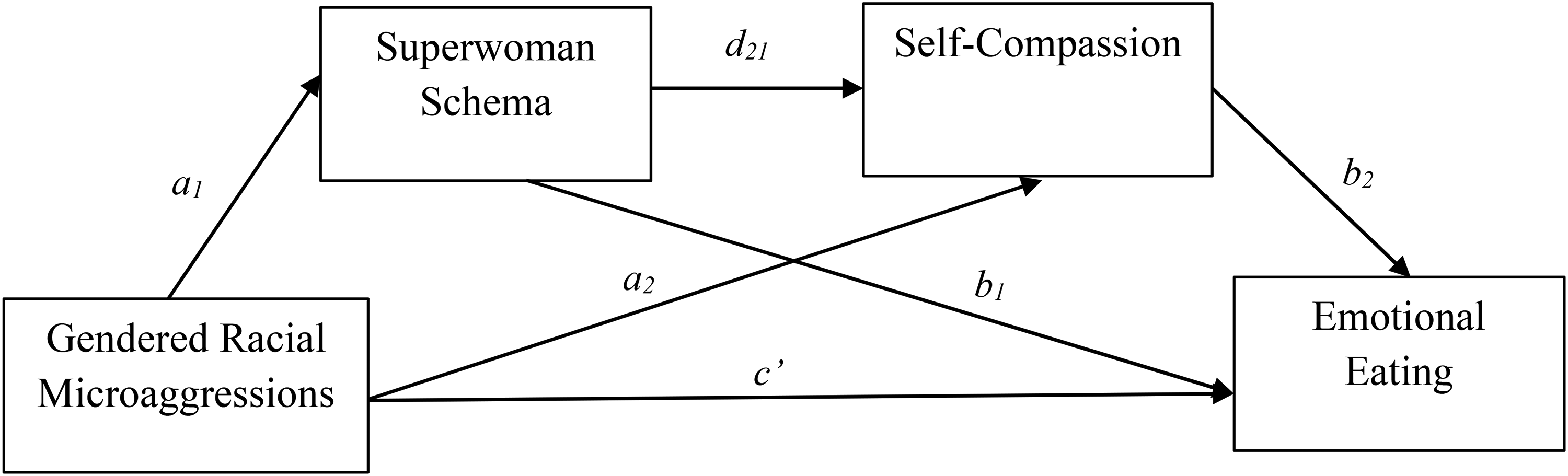
Conceptual Serial Mediation Model of Associations Between Gendered Racial Microaggressions and Emotional Eating.
Intersectionality and Gendered Racial Microaggressions in the Lives of Black Women
According to Black feminist scholars, intersecting systems of oppression (e.g., racism, sexism) render differential patterns of (in)visibility, protection, access, and resources for Black women (e.g., Cole, 2009; Collins, 2000; Combahee River Collective, 1995/2005; Crenshaw, 1989, 1991; hooks, 1981; King, 1988). Legal scholar Crenshaw (1989) coined the term intersectionality to describe Black women's unique marginalization at the intersection of racism and sexism. Several terms have been used to describe exposure to this marginalization (Essed, 1991; Jackson et al., 2005; Woods Giscombé & Lobel, 2008). One such term, contextualized stress, details a range of experiences distinctly encountered by Black women, such as racialized sexual harassment (experiencing harassment because of stereotypic notions that Black women are more sexually promiscuous or have looser sexual boundaries; Buchanan & Ormerod, 2002), identity shifting (altering self-presentation across professional and interpersonal contexts; Dickens & Chavez, 2018; Dickens et al., 2022), and gendered racial microaggressions (Lewis et al., 2013; Lewis & Neville, 2015). Gendered racial microaggressions are defined as “subtle and everyday verbal, behavioral, and environmental expressions of oppression based on the intersection of one's race and gender” (Lewis et al., 2013, p. 51). These microaggressions are based on several controlling images of Black women, such as the “angry Black woman” and the hypersexualized “Jezebel,” as well as stereotypes about Black women's beauty and performance in professional environments (Lewis et al., 2016).
To date, exposure to gendered racial microaggressions have been significantly associated with a variety of negative mental health outcomes (Lewis & Neville, 2015; Lewis et al., 2017; Moody & Lewis, 2019; Williams & Lewis, 2019). For instance, Black women who report more gendered racial microaggressions also report greater anxious arousal (Wright & Lewis, 2020), depressive symptoms (Williams & Lewis, 2019), and decreased body satisfaction (Dunn et al., 2019). However, the link between gendered racial microaggressions and health behaviors, such as emotional eating, requires further attention.
Gendered Racial Microaggressions and Emotional Eating
One way in which exposure to gendered racial microaggressions may manifest as a threat to Black women's health is by increasing engagement in emotional eating (Hoggard et al., 2019; Hoggard et al., 2023). Not to be confused with eating disorders (e.g., anorexia nervosa, bulimia nervosa, binge eating disorder), emotional eating is not a clinical diagnosis, nor does it have specific symptom criteria in the Diagnostic and Statistical Manual of Mental Disorders (DSM-5; American Psychiatric Association, 2013; Black & Grant, 2014; Reichenberger et al., 2021). As a health behavior rather than a disorder, emotional eating in response to stress is self-regulatory; the consumption of high-sugar, high-fat, energy-rich foods physiologically dampens the negative mood that often accompanies stress (Kazmierski et al., 2021). However, to date, few studies have assessed the connection between gendered racial microaggressions and emotional eating. Most of the work has examined racial discrimination as a risk factor for emotional eating (Pickett et al., 2020; Rodrigues et al., 2022), with more frequent exposure to racial discrimination associated with more emotional eating in Black young adults generally (Hoggard et al., 2019) and Black young adult women specifically (Longmire-Avital & Finklestein, 2022; Longmire-Avital & McQueen, 2019). Yet, this sole focus on race-based discrimination obscures Black women's unique stress-related experiences.
Some studies have attempted to address this limitation. For instance, Lee et al. (2022) adapted a measure to examine associations between racist and sexist interactions and emotional eating. However, this measure separated experiences of racism and sexism and the sample was mostly White, thus, not capturing the unique intersectional stressors faced by Black women. In another investigation with Black adult women, race-related and gender-related stressors were evaluated as separate variables alongside emotional eating (Woods Giscombé et al., 2021). This approach also limits our understanding of how intersectional stressors influence eating behavior. In one of the few studies of stress at the intersection of racism and sexism and eating, Black young adults who reported more stress and more emotional eating had higher body mass index, suggesting that gendered racial microaggressions are important for eating-related obesity outcomes (Diggins et al., 2015). However, the direct association between gendered racial microaggressions and emotional eating was not explored. In other studies with Black women, overall trauma and stress were associated with binge eating symptoms (e.g., Goode et al., 2020; Harrington et al., 2010), supporting the notion that Black women's stress may be associated with emotional eating. Our study builds on this work by using an intersectional measure of gendered racial microaggressions to study processes that may explain emotional eating for Black young adult women. We hypothesized that more exposure to gendered racial microaggressions would be associated with emotional eating.
Gendered Racial Microaggressions and the Superwoman Schema
More exposure to gendered racial microaggressions has been theorized to predict women's greater endorsement of a superwoman schema. According to the superwoman schema conceptual framework, Black women experience pervasive gendered microaggressions and subsequently may enact a “superwoman” role to attempt to cope with and transcend these experiences (Woods Giscombé, 2010). Similar to the strong Black woman role (Beauboeuf-LaFontant, 2003; Davis & Jones, 2021), the superwoman schema role is characterized by self-efficacy, and it defines Black women by their ability to be strong, resilient, independent, and self-sacrificing (Woods Giscombé, 2010). This role is often seen as a culturally familiar way to deal with gendered racial microaggressions, because it has been passed down intergenerationally as a way to regain a positive sense of self and feel powerful and efficacious despite mistreatment and denigration. In this way, Black women may feel compelled to be superwomen in the face of stress from gendered racial microaggressions in order to manage the demands of living in a racist and sexist society (Woods Giscombé, 2010). For instance, being a superwoman - striving for perfectionism, putting extra pressure on themselves to succeed, and resisting vulnerability that comes with negative emotions - is how some Black women may feel they must act in order to combat stereotypes about what it means to be a Black woman and to protect themselves in a society that is hostile to Black women. Qualitative research with Black women affirms that exposure to stress at the intersection of racism and sexism engenders the endorsement of this schema (Woods Giscombé & Black, 2010). Therefore, we hypothesized that Black young adult women who experience more frequent gendered racial microaggressions would be more likely to endorse a superwoman schema (Figure 1; path a1).
Although greater endorsement of the superwoman schema can be adaptive for Black women and has some benefits for Black women's positive self-concept in the face of gendered racial microaggressions (e.g., promotes strength, self-efficacy, and resilience; Watson & Hunter, 2016), it simultaneously poses risks for health. Endorsement of this schema can create additional strain and stress, and can lead some Black women to neglect health-promoting activities and to adopt unhealthy behaviors to cope (Abrams et al., 2014; Allen et al., 2019; Sheffield-Abdullah & Woods Giscombé, 2021). For instance, greater endorsement of this schema has been associated with less healthy eating patterns for Black women, including using food to cope with stress (Harrington et al., 2010; Woods Giscombé et al., 2019). In one qualitative investigation, Black young adult women described overeating when feeling emotional strain and stress from the burden of needing to be strong (Godbolt et al., 2022). Therefore, we hypothesized that greater endorsement of superwoman schema would also be directly associated with more engagement in emotional eating (i.e., Figure 1; path b1).
The Superwoman Schema and Self-Compassion
The superwoman schema may also be associated with reductions in self-compassion. A part of the Four Noble Truths in the Buddhist spiritual tradition, self-compassion is defined as being aware, kind, and understanding towards oneself during instances of pain or failure (Neff, 2003). It entails comforting oneself when experiencing hardship (i.e., self-kindness), recognizing that one's negative experiences are part of what it means to be human (i.e., common humanity) and being nonjudgmentally aware of unpleasant thoughts and feelings (i.e., mindfulness; Neff, 2003). According to the superwoman schema conceptual framework, endorsement of this schema can encourage women to present an image of strength, suppress their emotions, achieve success, resist vulnerability, and prioritize others over themselves (Woods Giscombé, 2010; Woods Giscombé et al., 2019). In this way, greater endorsement of the superwoman schema may be associated with being harder on oneself when experiencing negative or unpleasant feelings, reducing self-compassion.
Empirical evidence supports the proposition that endorsement of superwoman schema and self-compassion are related for Black women. Self-compassion requires sitting with unpleasant emotions rather than seeking to suppress or minimize them. However, in a qualitative study with Black women, women desired to suppress their emotions, to appear unaffected by stress, and to present an image of strength to disprove negative stereotypes (Watson & Hunter, 2016). Second, self-compassion entails making space for one's needs with kindness and then radiating this kindness outward to others. However, the superwoman schema requires women to deny their own needs in order to provide for the needs of others (Abrams et al., 2014; Carter & Rossi, 2019; Woods Giscombé, 2010). Third, whereas self-compassion acknowledges inadequacies, failure, and pain as part of the human experience, the superwoman schema views these phenomena as intolerable signs of weakness that should be avoided. Yet greater endorsement of superwoman schema has been associated with negative mental health symptoms for Black women via lower self-compassion (Liao et al., 2020). Therefore, we hypothesized that greater endorsement of a superwoman schema would be associated with less self-compassion for Black young adult women (Figure 1, path d21).
Self-Compassion and Emotional Eating
There has been less research on associations between self-compassion and emotional eating specifically for Black young adult women. However, it is likely that less self-compassion would be associated with greater engagement in unhealthy behaviors. Particularly, less self-compassion may be associated with more emotional eating, as a means to physiologically regulate distress from negative emotions without having to directly engage with them psychologically. In support of this proposition, more self-compassion has been found to be psychologically protective for Black individuals’ emotional well-being (e.g., Johnson et al., 2018; Zhang et al., 2018). Findings also show that, in the context of racism, Black young adults are more likely to experience psychological distress in part because of more self-judgement, which is the opposite of self-compassion (Watson-Singleton et al., 2022). Although scarce, some of the few studies on self-compassion and eating with Black women find that higher levels of self-compassion are associated with less emotional eating and lower levels of self-compassion have been associated with disordered eating (Fekete et al., 2021; Palmeira et al., 2019). Therefore, we hypothesized that less self-compassion would be associated with more engagement in emotional eating for Black young adult women (Figure 1, path b2).
The Current Study
In the current study, we used an intersectionality lens to examine processes in the associations between gendered racial microaggressions and emotional eating for Black young adult women. Employing a serial mediation model, we tested several hypotheses. First, we hypothesized two overall associations. We predicted that more frequent exposure to gendered racial microaggressions would be associated with more emotional eating. However, we did not have sufficient evidence to hypothesize if this path would be fully or partially mediated, resulting in either a significant c path (i.e., total effect) or c' path (i.e., direct effect). We also predicted that greater endorsement of the superwoman schema would be associated with more emotional eating (path b1). Second, we hypothesized an indirect effect such that gendered racial microaggressions would be associated with emotional eating via an ordered serial pathway through superwoman schema and then self-compassion (see Figure 1). We hypothesized that: (a) more frequent exposure to gendered racial microaggressions would be associated with greater endorsement of the superwoman schema (path a1); (b) greater endorsement of the superwoman schema would be associated with less self-compassion (path d21); and (c) less self-compassion would be associated with more emotional eating (path b2). As this was the main mediated pathway of interest in the study and the one that was best supported by the existing theoretical and empirical literature, we did not have sufficient evidence to make additional a priori hypotheses about the other indirect pathways. Findings from this study can help to identify mechanisms, such as the superwoman schema and self-compassion, that can be targeted in future interventions designed to bolster the health of Black young adult women.
Method
Participants
Our sample consisted of 504 Black young adult women (Mage = 24.72 years, SDage = 4.89). Eligible participants were restricted to Black (inclusive of identities across the African diaspora) women (inclusive of transgender and non-binary women), between the ages of 18 and 35 years who currently resided in the United States. Table 1 presents detailed sample characteristics. A majority of participants resided in the southern region of the United States (60.9%), were cisgender (98.4%), identified as African American (75.2%), and were born in the United States (96.4%). The median highest level of education achieved by participants’ parents or caregivers was a Bachelor's degree. The median total annual household income was $45,000–$54,999. Nearly 90% of participants indicated that they had never been diagnosed with an eating disorder, and 60.3% reported not being diagnosed with overweight or obesity.
Sample Characteristics (N = 504).
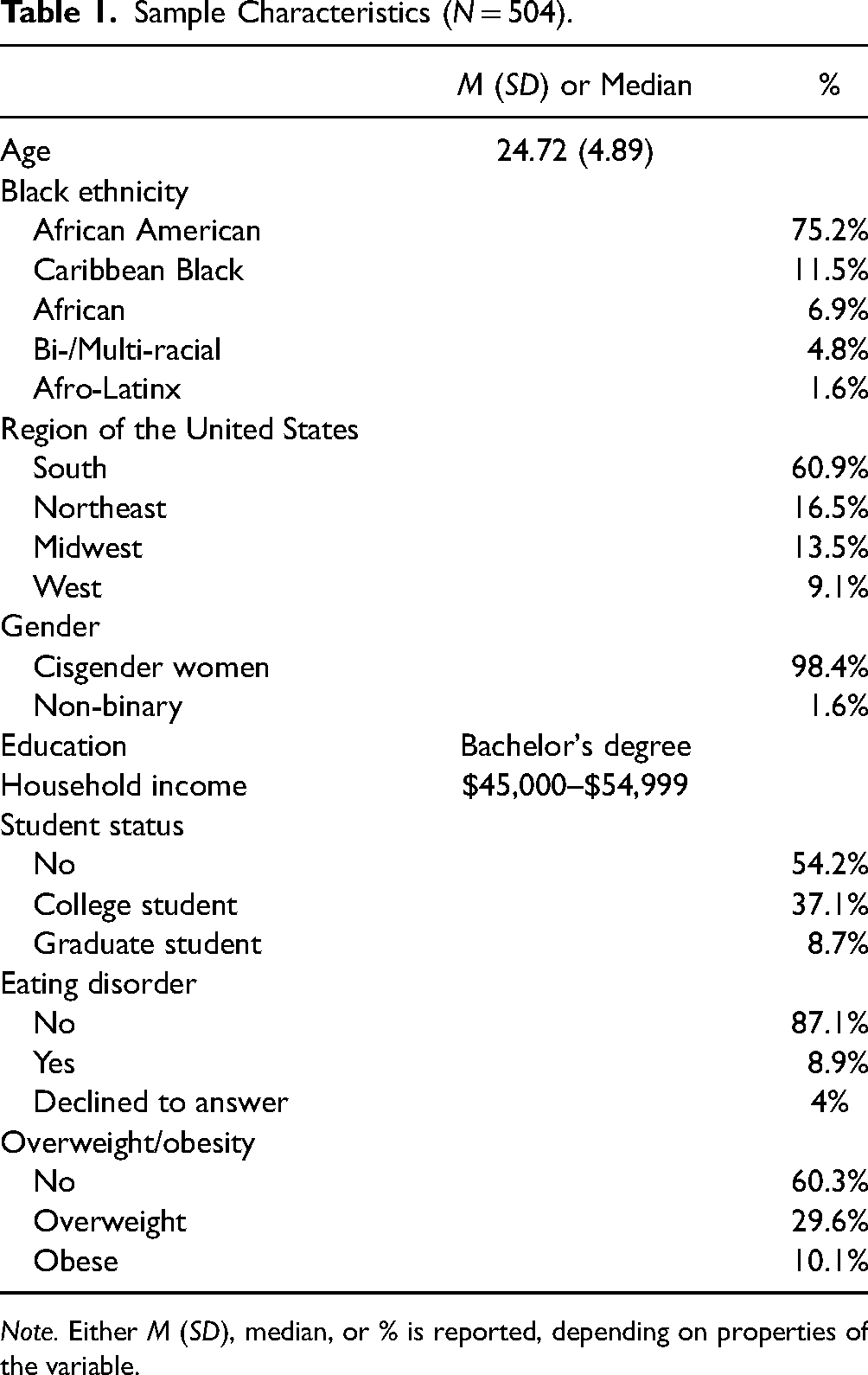
Note. Either M (SD), median, or % is reported, depending on properties of the variable.
Procedure
This study was approved by North Carolina State University's Institutional Review Board. We recruited Black young adult women from across the United States via the online research crowdsourcing platform Prolific from September to November of 2021. We used Prolific to expand our sample beyond higher education settings, thus enhancing the generalizability of our findings. Eligible participants were directed to a Qualtrics survey. After providing informed consent electronically and completing eligibility screening questions, participants completed questionnaires, the presentation of which was randomized to prevent order effects. Attention check questions were also placed throughout the survey to ensure data quality. Participants were compensated $7.13 U.S. ($9.50 U.S. per hour) and the mean completion time was 67 min (SD = 49 min).
Measures
Gendered Racial Microaggressions
The 26-item frequency subscale of the Gendered Racial Microaggressions Scale (GRMS; Lewis & Neville, 2015) was used to measure the frequency of participants’ experiences of gendered racial microaggressions on a scale from 0 (never) to 5 (once a week or more). The GRMS was developed and validated in samples of Black women (Lewis & Neville, 2015). Example items include: “I have been perceived to be an angry Black woman” and “Someone assumed I speak a certain way because I am a Black woman.” Mean scores are used with higher scores representing more frequent exposure to gendered racial microaggressions. The structural validity of the GRMS total frequency score was supported via both exploratory and confirmatory factor analyses. The validity of scores on the GRMS was supported by (a) its positive correlation with scores on measures of both exposures to racial microaggressions and to sexism, and (b) its positive association with greater levels of psychological distress. The reported internal consistency for the GRMS frequency total scale was 0.92 (Lewis & Neville, 2015). Cronbach's alpha for the current sample was 0.94.
Superwoman Schema
Endorsement of the superwoman schema was assessed using the Giscombé Superwoman Schema Questionnaire (G-SWS-Q; Woods Giscombé et al., 2019), which was developed for Black women. This questionnaire consists of 35 items that encompass obligations to be strong, suppress emotions, resist vulnerability, succeed in the face of adversity, and prioritize others over the self (Woods Giscombé et al., 2019). Participants indicated the degree to which 35 statements were true for them on a scale from 0 (this is not true for me) to 3 (this is true for me all of the time). Example items include: “No matter how hard I work, I feel like I should do more” and “My tears are a sign of weakness.” A total sum score is used with higher scores representing greater endorsement of a superwoman schema. Structural validity of the G-SWS-Q total score was supported via both exploratory and confirmatory factor analyses. Validity of scores on the G-SWS-Q was supported by its positive association with perceived stress, depressive symptoms, using food to cope with stress, poor sleep quality, and physical inactivity. Average reported internal consistency and test–retest reliability for scores on the G-SWS-Q were 0.80 and 0.71, respectively (Woods Giscombé et al., 2019). Cronbach's alpha for the current sample was 0.91.
Self-Compassion
Self-compassion was measured using the 26-item Self-Compassion Scale (SCS; Neff, 2003), which assesses the thoughts, emotions, and behaviors associated with self-compassion (Neff, 2016). Participants were asked how often they typically act compassionately towards themselves in difficult times on a scale of 1 (almost never) to 5 (almost always). Example items include “I’m kind to myself when I’m experiencing suffering” and “When I’m going through a very hard time, I give myself the caring and tenderness I need.” A mean total score is used with higher scores representing more self-compassion. The structural validity of scores on the SCS was supported via both exploratory and confirmatory factor analyses (Neff, 2003). The validity of scores on the SCS was supported by negative associations with mental health symptoms and non-significant associations with social desirability (see Neff, 2016, for a review). Reported internal consistency and test-retest reliability for scores were 0.96 and 0.93, respectively (Neff, 2003). This scale has also been previously used in samples of Black young adults (e.g., Watson-Singleton et al., 2022; average α = 0.60) and Black women (Liao et al., 2020; α = 0.87). Cronbach's alpha for the current sample was 0.92.
Emotional Eating
Emotional eating was measured using the Eating and Appraisal Due to Emotions and Stress (EADES; Ozier et al., 2007) Questionnaire. The EADES was originally developed using a sample of younger adults, but the sample was 86.4% white (Ozier et al., 2007). There is currently no gold-standard measure of emotional eating specifically developed for Black young adult women. The EADES was selected specifically for this study because it was created to capture stress-related emotional eating and one of key theoretically supported assumptions in formulating these research questions is that gendered racial microaggressions are stressors. Participants indicated how much they agreed with 24 statements on a scale from 1 (strongly disagree) to 5 (strongly agree). Example items include: “I overeat when I am stressed” and “I overeat when I socialize.” Structural validity of the scores on the EADES was supported via exploratory factor analysis (Ozier et al., 2007). The validity of scores was supported by its positive associations with overweight and obesity, above and beyond sociodemographic characteristics (Ozier et al., 2008). The reported internal consistency on the emotion and stress-related eating subscale was 0.95 (Ozier et al., 2007). In accordance with scale specifications, we created a sum score for the emotion and stress-related eating subscale. In the original subscale scoring, lower scores indicate higher levels of emotional eating. However, we recoded items used in the sum score to create a more intuitive value system, such that higher scores indicate higher levels of emotional eating. Cronbach's alpha for the current sample was 0.94.
Data Analytic Plan
We performed a power analysis using Monte Carlo simulation for indirect effects for two serial mediators, estimating moderate correlations between variables (Schoemann et al., 2017). Using a confidence level of 95% and 10,000 replications, a sample size of 327 was required for model parameters to be powered at least 80%. There were no missing data.
Preliminary analyses and descriptive statistics were first examined. Bivariate correlations, t-tests, and analyses of variance were calculated to examine potential sociodemographic and health control variables. Sociodemographic factors such as age, gender, ethnicity, and disability can differentially position Black young adult women to experience stress and its health consequences (Jackson et al., 2010; Mezuk et al., 2013). Therefore, we examined the following self-reported sociodemographic covariates in our analysis: Age (i.e., entered number), gender identity (i.e., cisgender female, transgender female/trans woman/male-to-female, non-binary), Black ethnicity (i.e., African American, Caribbean Black, Afro-Latinx, African, or Multiracial), disability (i.e., diagnosed with disability or impairment; no/yes), student status (i.e., currently a student; no/yes), education (i.e., highest level of education completed by parents; categorical), income (i.e., total annual household income; categorical), and region of the United States. (i.e., northeast, midwest, south, west). We also measured self-reported health covariates, including ever being diagnosed with an eating disorder (no/yes) and overweight or obesity (no/yes). These covariates were examined because the current study focused on a non-clinical sample of Black young adult women in order to understand associations that may be important for early prevention. Black young adult women with established mental and physical health conditions that are associated with emotional eating may need separate initiatives tailored to their unique challenges. We also asked participants to report how stressful coronavirus disease 2019 (COVID-19) has been in the past month on a 6-point Likert scale from 1 (not at all stressful) to 6 (extremely stressful), to account for this additional form of stress. In order to be included as a covariate in the final model, the variable had to be associated with both a predictor and an outcome variable (Bernerth & Auginis, 2016).
To address our primary research question, we conducted a serial mediation analysis using Model 6 of PROCESS Macro (Hayes, 2013). We ran 10,000 bootstrapped resamples to generate 95% bias-corrected confidence intervals around the indirect effects. A confidence interval that does not include zero is used to establish significant mediation (Preacher & Hayes, 2008). We report how we determined all data exclusions, sample size, and measures in the study. All data, analysis code, and research materials are available by emailing the corresponding author. Data were analyzed using IBM SPSS v27. The study design and analysis were not pre-registered.
Results
Preliminary Analyses and Descriptive Statistics
Table 2 presents descriptive statistics and bivariate correlations among study variables. Women reported moderate levels of emotional eating, with a mean in the high second quartile (M = 61.47, SD = 19.68). Reports of frequency of exposure to gendered racial microaggressions (M = 1.67, SD = 1.01) were relatively low, but comparable to other samples of Black young adult women (e.g., Szymanski & Lewis, 2016). Participants reported that they adhered to the superwoman role fairly often (M = 99.10, SD = 17.73) and engaged in self-compassion only rarely or sometimes (M = 2.96, SD = .67). Preliminary analyses indicated significant associations between age, ever being diagnosed with an eating disorder and overweight/obesity, and COVID-19 stress and our key variables, so we retained these as covariates in our serial mediation model.
Descriptive Statistics and Intercorrelations Among Study Variables (N = 504).
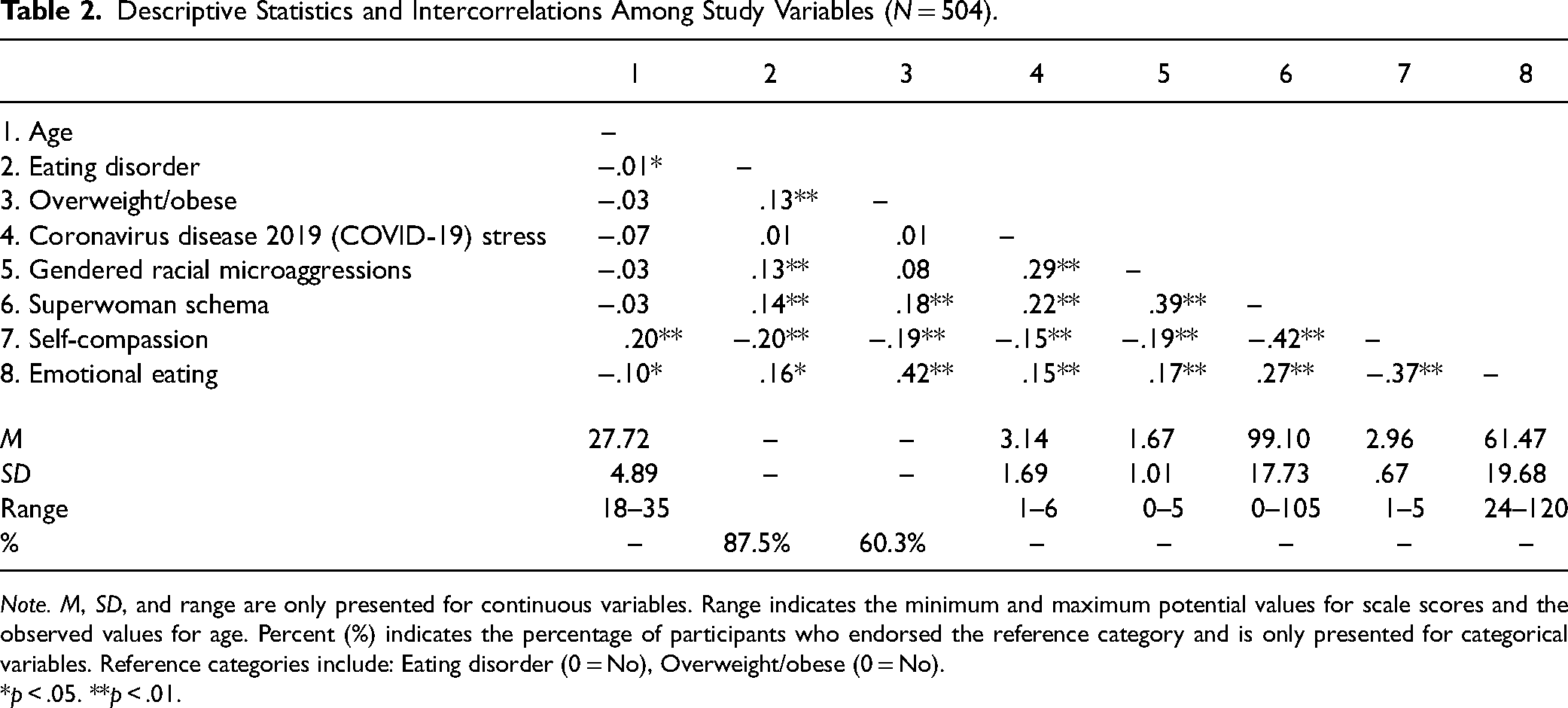
Note. M, SD, and range are only presented for continuous variables. Range indicates the minimum and maximum potential values for scale scores and the observed values for age. Percent (%) indicates the percentage of participants who endorsed the reference category and is only presented for categorical variables. Reference categories include: Eating disorder (0 = No), Overweight/obese (0 = No).
*p < .05. **p < .01.
Serial Mediation
Table 3 reports the direct, indirect, and total effects of both simple and serial mediation in the model. Covariates, gendered racial microaggressions, superwoman schema, and self-compassion together accounted for 28% of the variance in our primary outcome, emotional eating. The direct effects of gendered racial microaggressions on emotional eating (path c') and superwoman schema on emotional eating (path b2) were non-significant. However, the total effect of gendered racial microaggressions on emotional eating (path c) was significant as hypothesized, suggesting that more exposure to gendered racial microaggressions was indeed associated with more emotional eating (path c; β = .09, p = .030, 95% CI [.18, 3.47]), but that this association was fully explained (i.e., reduced to non-significance) by the mediators.
Direct, Indirect, and Total Effects of Gendered Racial Microaggressions on Emotional Eating Through Superwoman Schema and Self-compassion (N = 504).
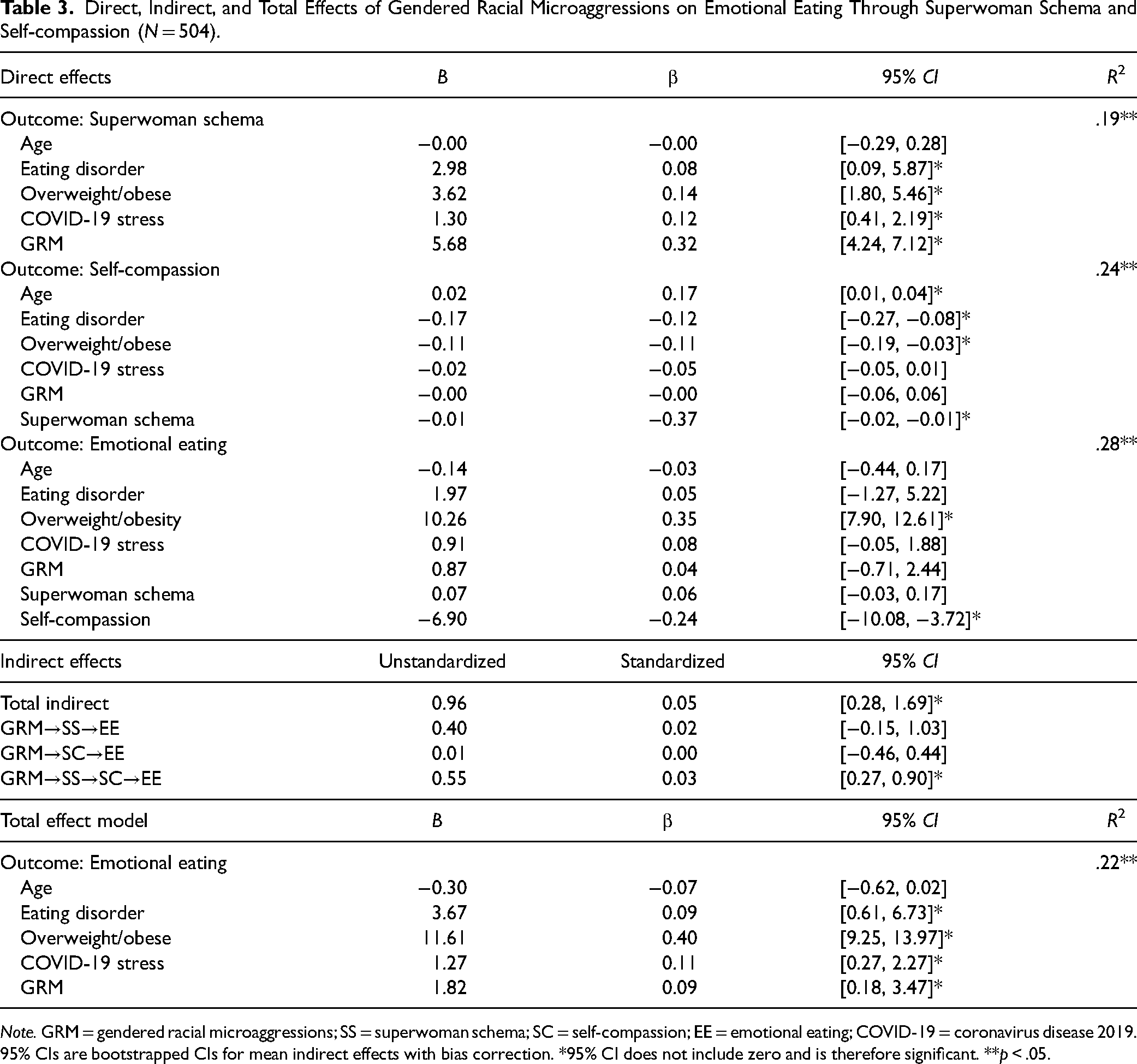
Note. GRM = gendered racial microaggressions; SS = superwoman schema; SC = self-compassion; EE = emotional eating; COVID-19 = coronavirus disease 2019.
95% CIs are bootstrapped CIs for mean indirect effects with bias correction. *95% CI does not include zero and is therefore significant. **p < .05.
The hypothesized specific indirect serial mediation effect of gendered racial microaggressions on emotional eating through superwoman schema and self-compassion was significant (standardized indirect effect = 0.05, bootstrapped 95% CI [0.28, 1.69]). More frequent gendered racial microaggressions were associated with more endorsement of superwoman schema (path a1; β = 0.33, p < .001, 95% CI [4.24, 7.12]). More endorsement of the superwoman schema was associated with less self-compassion (path d21; β = −0.37, p < .001, 95% CI [−0.02, −0.01]). Less self-compassion was associated with more emotional eating (path b2; β = −0.23, p < .001, 95% CI [−10.08, −3.72]). Based on direct effect size benchmarks (Shrout & Bolger, 2002), associations between gendered racial microaggressions and superwoman schema (direct effect = 0.32) and between superwoman schema and self-compassion (direct effect = −0.37) were medium, whereas the association between self-compassion and emotional eating (direct effect =−0.24) was small. No other specific indirect effects in the model were significant.
Discussion
The current study is among the first to examine whether greater endorsement of superwoman schema and lower levels of self-compassion mediate the link between gendered racial microaggressions and emotional eating in Black young adult women. Guided by an intersectionality framework, we used psychometrically validated measures of gendered racial microaggressions and superwoman schema specifically designed for Black women and found evidence for serial mediation of the association between gendered racial microaggressions and emotional eating. Our results substantiate the importance of superwoman schema and self-compassion as potential targets of interventions designed to bolster the health of Black young adult women.
As hypothesized, our first notable finding was an association (i.e., total effect) between gendered racial microaggressions and emotional eating. Gendered racial microaggressions threaten mental health (Moody & Lewis, 2019; Sissoko et al., 2022; Williams & Lewis, 2019), and specifically have been associated with increased anxious arousal (Wright & Lewis, 2020), depressive symptoms (Lewis et al., 2017), and traumatic stress (Moody & Lewis, 2019). Experiencing stress from gendered racial microaggressions may lead to disengaged coping via the consumption of foods high in fat and calories to alleviate negative affect (Diggins et al., 2015; Hoggard et al., 2019). This idea is supported by mental health research which finds that Black women distance themselves from gendered racial stressors by using avoidant coping strategies, the use of which is then associated with more symptoms of depression (Williams & Lewis, 2019). Given this association with coping, it is understandable that exposure to more gendered racial microaggressions were related to increased use of one type of regulatory behavior—emotional eating—in the current study. Engagement in emotional eating may also be related to cultural norms, emotional expression, and socialization. For instance, socialization around restriction of emotions in the face of stress and eating (e.g., eating during celebrations, familial/community influences, food choice; Antin & Hunt, 2012; Hargreaves et al., 2002; Longmire-Avital & Finkelstein, 2021) may influence Black women's desire to emotionally regulate through eating (Godbolt et al., 2022; Hoggard et al., 2019; Longmire-Avital & Finkelstein, 2022). Our study further legitimizes the fact that exposure to gendered racial microaggressions may be associated with detriments to Black women's physical and psychological health.
One of the most novel contributions of the current study is our finding about potential processes linking gendered racial microaggressions with emotional eating. Our hypothesis that greater endorsement of superwoman schema and reduced self-compassion would serially mediate the link between gendered racial microaggressions and emotional eating was supported. Most quantitative studies have examined the superwoman schema as a predictor variable (Abrams et al., 2019; Watson-Singleton, 2017). This is one of the first studies to examine the mediation effect of the superwoman schema, which is consistent with presuppositions that this schema is one vital mechanism between stress and health behaviors in Black women (Woods Giscombé, 2010). Thus, our results lend empirical support to the growing theoretical work that suggests Black women take on a superwoman role in response to frequently experiencing gendered racial microaggressions. Furthermore, our results suggest evidence of full rather than partial mediation, and none of the other indirect effects in the model were significant. In this way, we found support for a series of ordered rather than parallel associations between mediators, such that endorsement of a superwoman schema was in turn associated with reductions in self-compassion, which collectively explained the link between gendered racial microaggressions and emotional eating. Taken together, although the superwoman schema may help combat feelings of helplessness or promote resiliency in the face of gendered racial microaggressions (Watson & Hunter, 2016), it may also be associated with less compassionate ways of relating to oneself during difficult times, which may, in turn, be associated with more emotional eating.
Our study is one of the few investigations to propose how superwoman schema may be indirectly associated with health behaviors (i.e., emotional eating) with physical health consequences. Several scholars have found that the superwoman schema is directly associated with higher levels of depressive symptoms, anxious arousal, and psychological distress (Abrams et al., 2019; Nelson et al., 2022; Watson & Hunter, 2015). As Black women fare worse across most indicators of health generally, newer studies have started to explore relations among the superwoman schema, physical health, and health behaviors. For instance, the superwoman schema has been associated with longer telomeres (i.e., biomarker of cellular ageing associated with chronic stress; Thomas et al., 2022), worse sleep quality, and less physical activity (Woods Giscombé et al., 2019). Our study's inclusion of a health behavior, specifically emotional eating, is in keeping with these new directions in the superwoman schema literature, and further demonstrates that this schema is a culturally relevant part of both psychological and physical health. Therefore, we hypothesized that there would be a direct effect between superwoman schema and emotional eating. However, we did not find evidence of a direct effect, nor did we find evidence of a specific indirect effect from superwoman schema to emotional eating through self-compassion. Instead, we found that associations between superwoman schema and self-compassion were links in a mediational chain between gendered racial microaggressions and emotional eating. Therefore, perhaps superwoman schema may be only particularly harmful for emotional eating specifically when understood in the context of precipitating exposure to gendered racial microaggressions and in the context of associated reductions in self-compassion. Developing interventions that target both of these variables may be especially impactful for Black young adult women's health.
Our finding that less self-compassion was associated with more emotional eating for Black young adult women also contributes to the growing literature on self-compassion. Robust findings connect higher levels of self-compassion to well-being and lower levels of self-compassion to psychopathology (e.g., MacBeth & Gumley, 2012). Yet, there is a dearth of literature on self-compassion in Black samples, despite the fact that self-compassion is relevant to this population (Johnson et al., 2018; Leary et al., 2007; Zhang et al., 2018). The research that does exist is largely focused on psychological health and suggests that more self-compassion is protective for Black individuals’ emotional well-being (e.g., Johnson et al., 2018; Zhang et al., 2018). Findings also show that, in the context of racism, Black young adults are more likely to experience psychological distress in part because of more self-judgment, which is the opposite of self-compassion (Watson-Singleton et al., 2022). Further, although Black women have been found to report higher levels of self-compassion and lower disordered eating cognitions relative to other women of color (Gwira et al., 2021), our findings indicate that Black women are still at risk for endorsing low levels of self-compassion and that such reductions in self-compassion may be associated with greater emotional eating. Therefore, there is a continued need to understand the role of self-compassion in Black women's health behaviors.
Limitations and Future Research Directions
Several limitations should be noted. First, data are from a cross-sectional correlational investigation, thereby preventing us from making causal claims or inferences about directionality. Although some researchers question the use of mediation with cross-sectional data, mediation is appropriate in the current study because theories clearly describe the causal direction of the processes, statistical assumptions hold, and cautions about causality and directionality of effects are clearly specified (Shrout, 2011; Shrout & Bolger, 2002). To address this limitation in future research, follow-up studies should replicate and extend these findings using longitudinal or experimental methods. For instance, charting the course of exposure to gendered racial microaggressions, strength of endorsement of superwoman schema, self-compassion, and emotional eating over weeks (i.e., intensive longitudinal) or years (i.e., longitudinal), could help clarify the directionality of effects and reduce recall bias. Experimental or quasi-experimental methods could also be used to understand eating responses to different forms of stressors, and test ways to intervene on reduced self-compassion in response to superwoman schema for Black young adult women.
Second, there are several constraints on the generality of our findings. Although the socioeconomic breakdown of our sample mirrored the national Black population (Statistica, 2022), Black young adult cisgender women from the south who were born in the U.S. and were current undergraduate or graduate students were over-represented in the sample. It may be that gendered racial microaggressions may be differently applied to those Black young adult women who are gender fluid or transgender women, as gendered racial microaggressions exist because they assume stereotypic racially gendered portrayals of Black women. In this way, we do not assume that our results would generalize to other populations besides cisgender Black young adult women. Although we did not recruit from educational settings, approximately half of our young adult participants were students. However, students and non-students’ emotional eating levels did not differ in our sample. Therefore, we believe that our findings can be generalized to Black young adult women regardless of student status. We used ever being diagnosed with an eating disorder and weight status as covariates in our models, but the degree to which our results generalize to Black young adult women with more severe mental health challenges or women diagnosed with overweight or obesity requires future examination. Approximately 40% of the sample reported being diagnosed with overweight or obesity. Although this is still a large percentage of the sample, it is not as large as rates of overweight and obesity in national samples with Black women. However, many of these national samples often include women above 35 years of age and intentionally sample women already embedded in clinical settings (i.e., doctor's offices, weight loss intervention programs). We assume that our results would generalize to Black young adult women who are diagnosed with overweight or obesity, however, they are likely to be conservative estimates of these associations with emotional eating given the relatively small numbers of women diagnosed with overweight or obesity in the current sample.
Third, on average, the sample reported relatively low frequencies of gendered racial microaggressions, experiencing them between less than once a year and a few times per year. This mean level is comparable to other studies with Black young adults (Szymanski & Lewis, 2016). Although the mean frequency of exposure is low, this does not necessarily mean that experiences of gendered racial microaggressions are not very impactful for Black women. Previous research suggests that experiences of sexism (e.g., Swim et al., 2001; Volpe et al., 2022) and racism (e.g., Volpe et al., 2020) may be underreported due to some participants’ desire to minimize these negative experiences as a means of coping. Similarly, we did not measure aspects of women's gendered racial identity (e.g., the degree to which they believe being a Black woman is an important part of their self-concept; Thomas et al., 2011) despite the fact this could have influenced women's reactions to gendered racial microaggressions or their endorsement of the superwoman schema. Future research on emotional eating should consider (a) not only the frequency but also the stressfulness of gendered racial microaggressions and (b) the role of gendered racial identity in making meaning of these experiences, to help to illuminate the full impact of gendered racial microaggressions on eating.
Practice Implications
The promotion of healthy behaviors in the face of gendered racial microaggressions remains a key goal for interventions focused on improving Black young adult women's health. Young adulthood is a critical period for early prevention—a time when health behaviors are solidified (Nelson et al., 2008). Therefore, intervening upon emotional eating as one such behavior may have long-lasting health benefits. Our findings highlight several timely implications for potential interventions worthy of further investigation. Culturally-responsive interventions may help Black young adult women adaptively respond to gendered racial microaggressions in ways that do not require them to adopt a straining role of strength, de-prioritization of self, and resistance of emotional vulnerability associated with less self-compassion and subsequent emotional eating. Emotional eating is a health behavior rooted in the desire to control negative emotions (Kazmierski et al., 2021). This desire, especially in the context of uncontrollable, chronic gendered racial stressors, is an understandable response. Interventions that provide psychoeducation to validate this response while simultaneously increasing self-awareness of when strength is being engaged at the expense of self-compassion, and how to replace it with other responses (Nelson et al., 2016) may be future avenues for clinical and health psychology research and practice. For instance, existing strategies that have been researched and shown success could be adapted and studied in the context of gendered racial microaggressions for Black young adult women, particularly culturally-responsive mind-body strategies such as appetite awareness (Goode et al., 2020) and compassion-based interventions (Watson-Singleton et al., 2019a; 2019b; Woods Giscombé & Black, 2010). Addressing gendered racial microaggressions, superwoman schema, and self-compassion separately may not reduce emotional eating. A holistic approach that contextualizes the superwoman schema and addresses the sequential consequences together will likely better address this pattern as a system.
Conclusion
Our findings further highlight the health-damaging role of gendered racial microaggressions in the lives of Black young adult women and support the idea that promoting healthy behaviors in the face of these microaggressions is necessary to enhance Black women's health. Yet, we must not lose sight of the real problem: systems of oppression (e.g., intersections of racism and sexism) that expose Black women to gendered racial microaggressions. Therefore, as we find ways to enrich Black women's lives in the face of these microaggressions, we must simultaneously fight for systemic equity via anti-racist feminist interventions that target community, government, policy, and cultural levels.
Footnotes
Acknowledgments
The authors thank participants for sharing their experiences with us. We acknowledge the long history and present activities of Black feminist and intersectionality scholars and activists who pave the way for this research and fight for Black women to be seen, heard, and understood in their full humanity.
Author Note
This study was funded by a Grant-in-Aid from the Society for the Psychological Study of Social Issues (SPSSI) awarded to the PI (Vanessa V. Volpe).
Declaration of Conflicting Interests
The author(s) declared no potential conflicts of interest with respect to the research, authorship, and/or publication of this article.
Funding
The author(s) received no financial support for the research, authorship, and/or publication of this article.
