



Abstract
Why do women sometimes support systems of male privilege that clearly undercut the interests of their gender group? According to some explanations from the social identity model of system attitudes, they do so: (a) due to a preference for their country's ways of doing things (i.e., a bias in favor of their superordinate ingroup) and (b) because the incontrovertible reality of gender inequality in their society makes it difficult to challenge it (i.e., social reality constraint). Using a nationally representative dataset of 157,019 women from 91 nations that spanned close to four decades, we found supportive evidence for these two propositions. Moreover, both explanations interact, in that the superordinate ingroup bias explanation was visible only when social reality constraints were weak. Additionally, even women with nontraditional worldviews increased their support for male privilege when the constraint imposed by the gender reality in their society was high. In short, women support male privilege to the extent that (a) they feel proud of their society's traditions, and (b) it is the reality in their country. These findings are useful for activists because they shed important light on the psychological and systemic barriers to overcome when seeking women's participation in rallies against gender inequality. Additional online materials for this article are available on PWQ's website at http://journals.sagepub.com/doi/suppl/10.1177/03616843231176222.
Keywords
Historical and contemporaneous research on gender outcomes consistently reveals widespread inequality, with men being more likely to hold greater access to material and symbolic resources than women (Bem, 1993; Ridgeway & Correll, 2004). Some have argued that such inequality is, in part at least, due to entrenched gender socialization patterns across societies, which encourage stereotypical views that dominance, agency, and power are reserved for men, while portraying women as the “weaker” and “dependent” kind, primarily drawn towards nurturing the needs of others (e.g., Baker et al., 2016; Liben & Bigler, 2002; Wood & Eagly, 2012). For women, these societal representations have dire consequences. For example, a 2012 World Bank report revealed that men tend to have higher salaries and greater representation at the top of the income distribution than women, whereas women tend to be represented more in low-paying jobs and have weaker control in household decisions, even on how to spend their own income (World Bank, 2012). Although some societies (e.g., Scandinavian nations) appear to fare better than others in addressing some of the numerous manifestations of this systemic male privilege, such realities are still far from being entirely expunged, even in progressive societies (Givord, 2020). For example, while Nordic people occupy a higher position in recognition and support of women's rights, their gender pay gap is still similar to that of other European Union nations (Eurostat, 2018; Sanandaji, 2018). In addition, the proportion of girls and women in science, technology, engineering, and mathematics (STEM) in these countries is even lower than in nations underperforming on women's rights (Stoet & Geary, 2018). Here, therefore, we consider the question of why systems of male privilege persist (on average), despite decades of robust feminist opposition and policies aiming to reduce gender disparities.
One possible answer to this question—beyond political, economic, and legislative reasons—is that women themselves sometimes hold attitudes and/or engage in behaviors that inadvertently bolster the male privilege status quo—a phenomenon that has been termed system justification (Jost, 2020; Jost & Banaji, 1994). For example, studies have shown that women sometimes prefer to choose stereotypically female-oriented occupations and training (e.g., Stoet & Geary, 2018) and perceive themselves to be less entitled to stereotypically male-dominated positions (e.g., managers and politicians). Some women also tend to support the claim that it is men's right (a) to earn more than women (Major, 1987, 1994), (b) to engage in more productive work, (c) to do less housework relative to women (Monacelli & Caricati, 2010), and even (d) for women to replace their surnames with their husband's upon marriage (Chayinska et al., 2021). Although there is consensus that people tend to support the prevailing realities in their societies, there is much less agreement on why the disadvantaged sometimes do so, given that it ostensibly undercuts their interests (e.g., the case of women supporting male privilege; for related discussions on the “why” debate see Jost, 2019; Owuamalam et al., 2019a, 2019b; Owuamalam & Spears, 2020; see also Rubin et al., 2023a, 2023b).
One existing explanation for why women might support male privilege is gender socialization (Eagly, 1987; Eagly & Wood, 2016), which assumes that such a tendency could be due to the type of gender training that women have received and/or cultural practices/roles with which they have become accustomed. In other words, during socialization, women and men learn what is considered appropriate in terms of gender behaviors and attitudes in a given social situation. While empirical support exists for the socialization account (Eagly, 1987; Eagly & Wood, 2016; Ridgeway, 2011), there are compelling reasons to suppose that this explanation may be limited in its ability to fully account for women's support for male privilege. For example, although gender socialization should be similar for everyone in a given context, not every person may develop the same pattern of gender attitudes. Indeed, some strongly identifying women (e.g., women with conservative gender attitudes) may be more likely to support disadvantageous gender roles to the extent that it represents the customs that have served their society for so long (Chen et al., 2004; Eagly & Steffen, 1984; van Breen et al., 2017). However, other progressive women who are similarly invested in their gender identity (e.g., feminist women) may challenge those arrangements (e.g., Bashi et al., 2018; Hercus, 1999; Radke et al., 2016). 1 So, while gender socialization could account for some instances of gender system justification (Chayinska et al., 2021; Jost & Kay, 2005), it seems insufficient to fully explain why women who are strongly invested in their gender identity (both traditional and feminist women) do not uniformly support a system of gender inequality. Some do, such as women who subscribe to traditional roles, and some do not, such as feminist women who challenge such roles. We will revisit this discussion later in our summary of hypotheses, but first, we consider two complementary explanations from the social identity tradition (Tajfel & Turner, 1979).
Explaining Women's Gender System Justification From the Perspective of Social Identity Model of System Attitudes (SIMSAs)
A series of explanations inspired by the social identity theory (SIT; Tajfel & Turner, 1979) have been put forward to explain the paradoxical tendency to support systems of inequality (e.g., male privilege) sometimes seen amongst society's disadvantaged (e.g., women). These explanations have been grouped together under the umbrella of the social identity model of system attitudes (SIMSAs; Owuamalam et al., 2018, 2019a, 2019b; Rubin et al., 2023a, 2023b). According to SIMSA, the support for male privilege sometimes seen among women could be explained via the lens of social identity needs (e.g., superordinate ingroup bias, Caricati et al., 2021; Jaśko & Kossowska, 2013; van der Toorn et al., 2014, 2015) and the need for social accuracy (e.g., the passive acquiescence to an incontrovertible social reality, Doosje et al., 1995; Spears et al., 2001).
Superordinate Ingroup Bias Explanation
The idea here is that an inclusive identity (e.g., one's nationality) may sometimes become salient or important in a given context, consequently allowing women to express support for the gender roles/arrangements in their country merely as a bias in favor of systems in their country. Although gender identity transcends national borders and can sometimes function as a superordinate identity, we assumed that nationality is superordinate to gender in the context of this research for one reason. One would expect women in a nation (e.g., the United States of America) to consider their outcomes relative to men in the same nation (but not men in another nation, e.g., Tunisia). Hence, in this case, the two gender groups (men and women) are framed with respect to a common ingroup (as Americans), that determines the rules/norms and roles of (wo)men within it. In other words, nationality, in this instance, is the “superordinate” identity because it supplies the norms about the roles of men and women in it. In short, our point is that some women might sometimes support disadvantageous gender hierarchies if their self-awareness is drawn away from their identity as women, to their superordinate identity as, for example, Americans.
SIMSA's superordinate ingroup bias explanation is also consistent with the notion that the different social identities that people belong to tend to alter the manner in which they perceive and evaluate groups in society when the relevant group membership is made salient (e.g., Gaertner & Dovidio, 2000; Stone & Crisp, 2007). That is, increasing the salience/importance of a shared superordinate identity (e.g., as Americans) could deemphasize subgroup identities (e.g., as women) and the needs associated with them, causing people to act in ways that favor their superordinate national ingroup (and it’s systems). For example, research has shown that when a superordinate group identity is made salient, members of low-status groups are less likely to pay attention to inequality and more likely to perceive the status quo as being fair (e.g., Mähönen & Jasinskaja-Lahti, 2015; Owuamalam et al., 2023; Saguy et al., 2008, 2009, 2010). These results, however, come primarily from studies investigating inter-ethnic/racial or inter-faith relations and, to our knowledge, this superordinate ingroup bias account has not been tested in a nationally representative sample of women (but see Caricati et al., 2022). It is entirely possible to expect too that identification with a superordinate identity such as women's nationality could cause women to support disadvantageous realities embedded within this inclusive entity. Hence, one aim of the present research was to establish whether this expectation could be verified among nationally representative samples of women from several nations worldwide.
Social Reality Constraint Explanation
This second SIMSA account refers to the motivation to accurately report the conventions in one's society that prescribe/describe consensually accepted roles and conduct between groups, which is assumed to be in operation for strong and weak group identifiers. That is, the social reality constraint account is different from the superordinate ingroup bias explanation, because the latter reflects a motivation to actively bolster systems within a “common” ingroup in the service of social identity needs and, therefore, mostly seen among strong (superordinate) group identifiers. In the case of gender groups, this social reality constraint could manifest inter alia via (1) gender norms like women adopting the surnames of their husbands upon marriage, including rewards and punishments for those who do not adhere to these norms, (2) gender's beliefs, including stereotypes about the nature of relations between men and women (e.g., men should care for women), and, (3) gendered power differentials when it comes to status, in terms of who should or should not be at the top (e.g., men are seen as the head of households in traditional patriarchal societies). At the individual level, an awareness of these social constraints can result in submission to consensual standards or conventions in a nation. Thus, the reality of gender roles may constrain women from having to oppose the abandonment of their surnames or to claim that they are the head of the household. In short, women's support for and/or justification of unequal gender arrangements in their society could merely reflect acquiescence to the unequal stable social reality in which they find themselves.
Objections to SIMSA's Social Reality Explanation
The social reality constraint explanation has often been illustrated with a football/soccer league analogy in which different teams play each other in a season and are then ranked by the total points that they have achieved in that season (Owuamalam et al., 2019a, 2019b). The higher the number of points a team achieves, the higher their position on the league table will be relative to competing teams with lower points. Here, the social reality explanation assumes that members of teams toward the bottom of the league table should admit their disadvantaged position in relation to teams that are higher-up in the league table, simply because they accept the rules that produced this outcome. Here, the rules could be perceived as legitimate because they have seldom been challenged, and stable because they have been adhered to, without consensual opposition, for so long (Tajfel & Turner, 1979). We note that this analogy has been criticized ostensibly because, according to Jost (2019, p. 279), “poor people, women, and sexual minorities, among others, do not feel as if they ‘played’ and ‘lost’” and because it “trivializes (and therefore seriously mischaracterizes) problems of social and economic inequality—and ignores the many ways in which inequality is legitimated in society.” It is important to note that the football/soccer league analogy has never been intended to characterize every instance of social inequality as a kind of game between cheerful groups and sore losers. Rather, the attempt has been to highlight in a broader, more simplified sense that, when a system of rules is socially shared and perceived as secure to the extent that it has been stable over time, even those who meet undesired outcomes can be compelled to accept their position based on the “rules of the game” (i.e., social constraints; see also Tajfel and Turner's [1979, p. 45] seminal use of this analogy to describe the foundational processes underlying the reality constraint argument).
It is important to also note that for a football/soccer team to oppose its low-ranked outcome in the league table, it would first need to de-legitimize the rules and procedures that generated this outcome. A de-legitimation attempt, however, would be successful if all the other teams (or the majority of them) are persuaded that the rules are actually unjust and this is potentially an uphill task. Indeed, such lower-ranked teams may be accused of being disingenuous, because they are retroactively attempting to upend a system of rules that they agreed to prior to their poorer outcome, and this perception of unfairness may cause the other teams to resist attempts to change positions that were achieved fair-and-square. Similarly, some women who perceive the position of fellow women in their nation as unjust might nonetheless be dissuaded from challenging it, to the extent that gender differences in their nation are seen by the majority of people in that society as accurately representing the customs of their society (i.e., social constraints are high). Thus, a reluctance to change the prevailing rules (or system), especially when these rules have been stable over time, reflects the social reality constraints that compel people to accurately represent and/or report their society's customs.
Classic experimental evidence supports the view that the disadvantaged can (and do) sometimes accurately represent their group's disadvantage. In such experiments, the tendency often is for members of artificially created groups to acquiesce to unfavorable characterizations of their ingroup under conditions that constrained their ability to contest their group's disadvantage (e.g., Doosje et al., 1995). While there is some evidence suggesting that real-life group members can also passively accept stereotypical negative characterizations of their groups when social constraints are high (Degner et al., 2021; Ellemers et al., 1997; Spears & Manstead, 1989), whether such a tendency can be observed (a) on a direct measure of system justification and (b) in nationally representative samples of women, is yet unclear. Hence, a second aim of the current investigation was to test SIMSA's social reality constraint explanation for system justification in the ostensibly consequential context of gender inequality, with a specific focus on women drawn from different regions of the world.
The Current Research and Hypotheses
We investigated women's support for male privilege grounded in SIMSA's prediction about the role of social reality constraints and superordinate ingroup bias and adopted a cross-national approach. We also considered the potential role of socialization, operationalized in terms of adherence to political conservatism that is often linked to traditional views of gender relations, and used the largest dataset so far compiled on the topic of system justification among women worldwide (spanning close to four decades) to examine the relevant associations.
Social reality constraint was operationalized as the objective level of national gender inequality as expressed in two ways: the gender development index (GDI) and the gender inequality index (GII). The GDI captures gender gaps in human development achievements by accounting for disparities between genders in three basic dimensions of human development such as health, knowledge, and living standards (UNDP, 2023). Hence, the GDI can reliably indicate “overall” social reality constraints because it is a consensually agreed metric for determining the winners (sometimes men) and losers (at times women) when it comes to gendered outcomes in health, education, and living standards in a nation. Operationally, the GDI is calculated as the ratio of outcomes for women relative to men with regard to health, knowledge, and living standards, so that 1 (one) represents perfect parity between both gender groups, while values lower than 1 indicate inequality favoring men. For our purposes, we assume that social constraints are higher when GDI is lower because larger gender differences make it more likely for people to perceive that the gender traditions that have served their nation for so long are legitimate and stable. That is, they might/should come to accept that the rules/traditions are in place “for a reason.” It is this perceived legitimacy/stability of men's privilege and women's disadvantage in a society that could make it difficult for women to argue against the norm when it comes to gender outcomes. Hence, women should be more supportive of male privilege, when GDI is low (Hypothesis 1a, see Figure 1a).
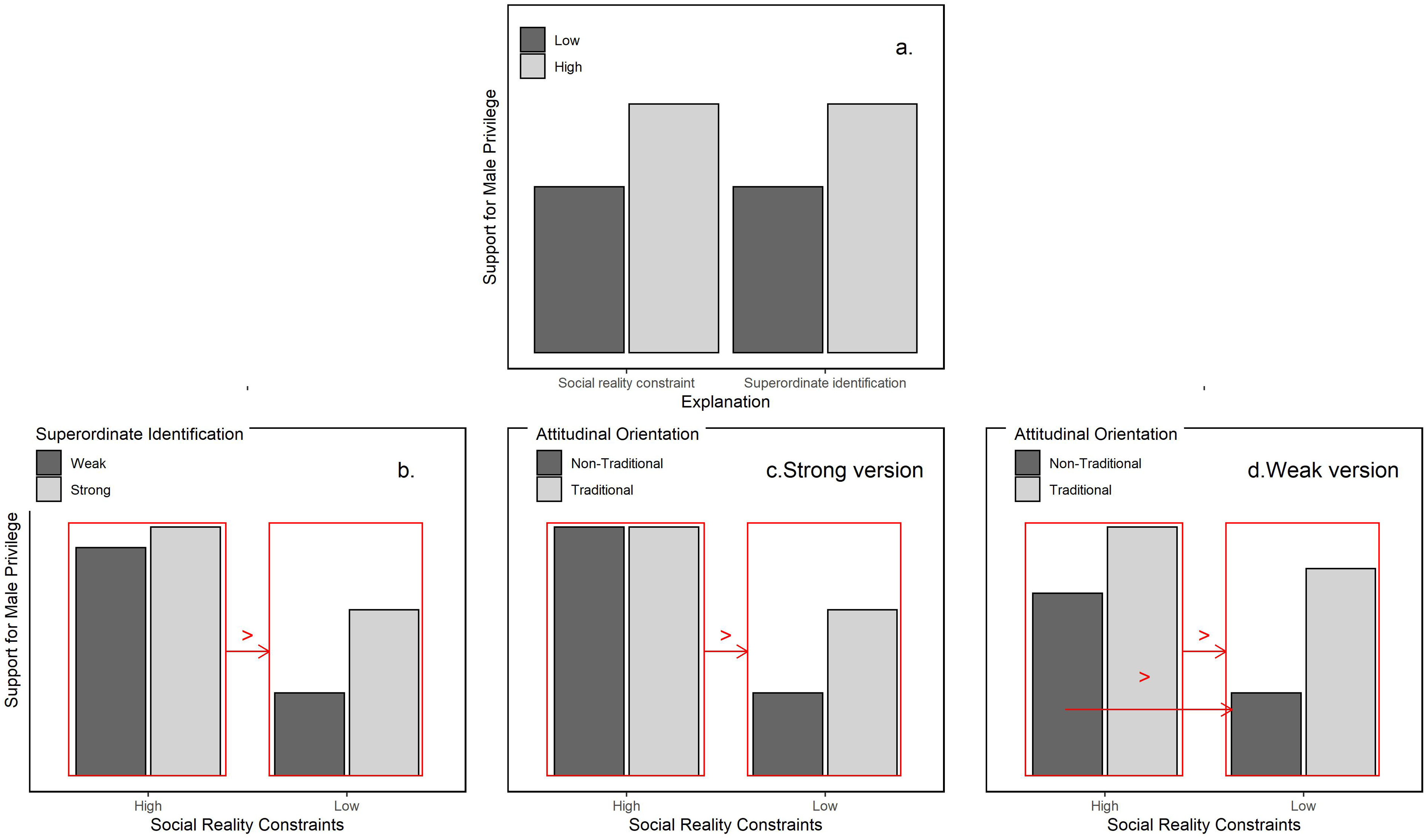
Conceptual Pattern of Results for the Predicted (a) Main Effects Based on the Social Identity Model of System Attitude (SIMSA), (b) the Interaction Between SIMSA's Social Reality Constraint Explanation and its Superordinate Ingroup Bias Thesis, (c) the Strong Version of the Interaction Between Social Reality Constraint and the Standard Socialization Caveat, and (d) the Weaker Version of Model ‘c’.
With respect to the GII, this measure captures disparities in achievement among men and women in the area of health, empowerment, and labor market outcomes. Because this index also captures the extent of women's relative disadvantage within a nation, we reasoned that it should serve as a convergent validation of the trends that we anticipated with regard to the GDI. In this case, however, higher values of GII indicate a greater advantage for men compared to women across the three indicators that comprise this index. Hence, we expected, based on the social reality constraint explanation, that women should justify the gender status quo the higher the GII is because the objective gender inequality in such conditions makes it easier to perceive gender differences as legitimate and stable (e.g., unchangeable) and then to succumb/acquiesce to the gender reality in their society (Hypothesis 1b, see Figure 1a)
A second, more established SIMSA hypothesis in contexts other than gender, is that system justification increases as a function of the degree of attachment to one's superordinate (national) identity (Caricati et al., 2021; Owuamalam et al., 2022). Hence, we expected too that in the current gender context, women should also support the prevailing gender arrangements when they are strongly invested in their superordinate (national) identity (Hypothesis 2, see Figure 1a).
However, given that social constraints reflect consensually accepted ways of being for a given society, we anticipated that its influence on women's support for the male privilege—in terms of accurately representing this reality—ought to have different effects depending on the level of women's national identification. Put differently, we speculated that the predicted differences in support for male privilege between highly and weakly identified female nationals would be amplified when social reality constraints are somewhat weakened (i.e., when GDI is high and GII is low). In such situations, women may feel freer to contest existing realities, and this is when a strong attachment to their superordinate (national) identity should be most influential in allowing women to support their country's way of doing things (including a system of male privilege). When social constraints are strong, women ought to be mostly hard-pressed to represent the incontrovertible reality of the gender system the way that it is, regardless of their level of national identification. Stated differently, women who are weakly identified with their nation should be somewhat compelled to acknowledge the reality of the gender status quo in their society, up to (or nearly close to) a level that matches those of their strongly identifying counterparts. Thus, we expected that superordinate identification would have a stronger effect on women's support for male privilege mostly when social reality constraints are low (Hypothesis 3, see Figure 1b).
Finally, we took the opportunity to also explore the gender socialization thesis in the context of SIMSA's social reality explanation. Accordingly, women's support for male privilege could also reflect the traditional gender attitudes that they have learned. In this case, we considered the conservative versus liberal continuum as a proxy of the socialization process in the sense that it speaks to the holding of traditional worldviews that often enable attitudes toward gender relations (Lye & Waldron, 1997; Mendoza & DiMaria, 2019). We proxied gender socialization via political orientation also because it has been shown:
to have a strong intergenerational transmissibility of ideological preferences—including those related to gender relations (Rico & Jennings, 2016; Van Ditmars, 2022), and that conservatives, compared to their liberal counterpart, are more likely to hold traditional male-dominant beliefs (Lye & Waldron, 1997) and gender stereotypes (Jost et al., 2003; Matthews et al., 2009).
These connections informed our assumption that right-leaning women may be more likely than their progressive counterparts to adhere to the traditional gender roles (Jost, 2017; Mendoza & DiMaria, 2019; Osawa, 2015). Thus, we expected that conservative women who normally hold a traditional attitudinal orientation with respect to gender relations should be more likely to support male privilege, at least relative to their nontraditional counterparts (Hypothesis 4). Furthermore, we reasoned that although the forces of social reality should constrain both left-leaning (i.e., nontraditional) and right-leaning (i.e., traditional) women's ability to contest the gender status quo in their societies—leading to increased support for the male privilege—the easing of these forces should prompt nontraditional women to become visibly less supportive of male privilege relative to traditional women (Hypothesis 5). This is because, under this condition of low social reality constraint, nontraditional women should be unconstrained by a relatively more diffuse gender hierarchy in their society to express their dissatisfaction with the gender status quo. Assuming a more stringent interpretation of SIMSA's reality constraint caveat, then one might expect traditional women to be more supportive of male privilege than women with nontraditional views when social reality constraints are low, whereas this gap should be absent when reality constraints are high (Hypothesis 5a, see Figure 1c). A weaker prediction based on SIMSA, concerning the interaction between traditional gender attitudes and social reality constraints, is that although nontraditional women should support male privilege more when social reality constraints are high, they may do so less enthusiastically relative to traditional women (Hypothesis 5b, see Figure 1d).
Method
Participants
We used all the rounds of the World Value Survey (WVS—v.1.6 released in 2021, Haerpfer et al., 2022), dating all the way back to 1981 from the most recent installment in 2020, which contained seven rounds in total. We did so to be more confident that the evidence we uncover for the proposed mechanisms is consistent across this period (especially considering the modest triumphs of the feminist movement over time that could make it easier for women to justify the gender system in some epochs compared to others). The WVS involves an international network of social scientists devoted to the quantitative study of values, beliefs, and norms from longitudinal and cross-national perspectives, analyzing their impact on a wide range of issues such as socio-political choices, economics, public health, and well-being. The WVS uses a common questionnaire administered to a nationally representative sample in more than 100 countries worldwide, accounting for almost 90% of the global population. WVS time-series database is about how the responses to questions about people's social and political values change over time in the countries included in the survey, and not about the change shown by a selected group of people (panel). Thus, the dataset is a time-series but it is not a panel database and there is no continuity between the samples across waves. The database contained 218,817 responses from women from 105 nations and 293 country-year units. We excluded country-year units in which we were unable to find both GDI and GII (k = 27, N = 16,053) referring at least to 5 years before or after the year in which the survey was done. Furthermore, we also excluded country-year units in which the relevant variables were not administered (k = 57, N = 45,233). Finally, we excluded one further country-year unit that we were unable to find a GDP (N = 512).
The resulting dataset comprised 157,019 women from 91 different countries worldwide and 208 country-year units (Mage = 41.67, SD = 16.44, range = 13–103; 257 participants did not report their age). This database contained 69,422 missing values corresponding to 6.31% of the total individual responses to the seven variables that we considered. Given the relatively small amount of missing data and the large sample size (Andridge & Little, 2010; Bennett, 2001; Valdiviezo & Van Aelst, 2015), we imputed data with single imputation using the predictive mean matching method and 50 iterations, taking into account the nested structure of the database (i.e., country and country-year) with mice package (van Buuren & Groothuis-Oudshoorn, 2011) in R (R Core Team, 2022). Descriptive statistics of the relevant variable for each country and each survey year are reported in Table S1 in the online Supplemental Material.
Outcome Variable
One primary manifestation of system justification is outgroup favoritism amongst members of disadvantaged groups (Jost, 2019, 2020; Jost et al., 2004; Jost & Hunyady, 2003). Hence, we closely followed this standard operationalization to measure gender system justification with three items that tapped women's support for the male privilege (i.e., an unambiguous instance of outgroup favoritism): “Men make better political leaders than women do” and “University is more important for a boy than for a girl” (1 = agree strongly, 4 = disagree strongly, reverse scored). The third item was “When jobs are scarce, men should have more right to a job than women” (1 = agree, 2 = disagree, 3 = neither which were rescored so that 1 = disagree, 2 = neither, and 3 = agree). We chose these items based on two other criteria: (a) because they were administered in as many country-year units as possible and (b) because they were based on their obvious relevance to the indicators of social reality constraints (i.e., GDI and GII; cf. Sengupta et al., 2015). This relevance allows for the examination of women's support for systemic male privilege when the prevailing reality strongly favors men (i.e., low GDI; high GII) compared to more gender-equal situations in which men's privilege may be more contestable (i.e., high GDI; low GII). We preliminarily checked whether the three items showed a consistent pattern of relations across country-year units and discovered that items had no consistent relations in two country-year units (e.g., they shared both negative and positive correlations in Haiti and Pakistan in the 2012 round of the survey). We then excluded these clusters from the final analysis (N = 1,567) to restrict our analysis to the instances where all three items were equivalently perceived across societies.
We also investigated the factor structure of the 3-item male privilege scale through a three-level confirmatory factor analysis considering both country and country-year as the nesting variables in Mplus 8.1 (Muthén & Muthén, 2017). We then assessed the reliability of the scale following the approach suggested by Lai (2021). Results revealed that these items measured a single dimension, χ 2 (4) = 79.529, p < .001, CFI = .981, TLI = .957, SRMR = .001, and the between-level reliability was good for both country and country-years (α = .89 and .85 respectively), while the overall reliability was also acceptable (α = .64 for both nesting levels). We then verified items’ invariance across country-level units. Given that in large samples measurement invariance based on chi-squared distribution risks being too restrictive (Van de Vijveri et al., 2018), we used an alignment procedure recommended by Asparouhov and Muthén (2014) to explore loadings and intercepts invariance across country-year units (see also Magraw-Mickelson et al., 2020). The alignment procedure requires that configural invariance is met, and so we tested it for country-year levels and obtained an acceptable fit, CFI = 1.000, TLI = 1.000, SRMR = .002. We then used sirt package (Robitzsch, 2022) to run an alignment procedure considering Robitzsch's (2022) stricter criterion of tolerance for loading (0.20) and intercepts (0.40) compare to those suggested by Asparouhov and Muthén (2014). Results revealed that the proportion of non-invariant item parameters was 6.8% and 10% for intercepts and loadings, respectively, which are below the cut-off of 25% of non-invariant parameters which has been suggested as a criterion to affirm that scales are likely to be invariant (Asparouhov & Muthén, 2014). Moreover, alignment analysis yielded an R2 of 0.93 and 0.99 for intercepts and loadings respectively (where 1 indicates complete invariance): suggesting that variability across items is explainable by country-year unit differences. Overall, these analyses suggested that the three items considered would form a reliable indicator of support for the male privilege that seems relatively stable across countries. So, the three items were first rescaled to range from 0 to 1 and then averaged to form a composite measure of gender system justification (i.e., male privilege).
Predictors
Superordinate ingroup identification was operationalized as the extent to which women took pride in their nation, and was assessed with the item: “How proud are you to be [country's nationality inserted here]?” (see also Owuamalam et al., 2022). It is important to note that pride is one of the dimensions of group identification, specifically tapping its affective component (Ellemers et al., 1999; Leach et al., 2008). This item was administered on a 4-point Likert-type scale (1 = very proud, 4 = not at all proud, reversed).
Social reality constraints concerning the gender status quo were operationalized as the national score on the GDI and GII indices in each country and for each year represented in our WVS dataset (i.e., from 1981 to 2020). Both indicators were taken from the United Nations database (UNDP, 2021). On these measures, we accommodated SIMSA's system stability caveat for its social reality constraint explanation, by computing a non-time-varying version of the GDI/GII for each nation. To illustrate, suppose that Italy's GDI score in 2001, 2005, and 2010 were, respectively, .70, .75, and .80, then a stable indicator of the positioning of women relative to men on this index is computed as (.70 + .75 + .80)/3 = .75. This average allowed us to capture largely “stable” positioning of women relative to men during the period under consideration. Additionally, we computed a time-varying version (see Fairbrother, 2014), which allowed us to estimate gains (or positive fluctuations) in GDI/GII within the nations represented in the dataset during the period under consideration. That is, at the country-level, we generated a time-varying version of these two indices by subtracting the GDI/GII for a given year from the stable national average. So, for instance, in the previous illustration, a time-varying GDI in Italy for 2001 will be, a country-year score (0.70) minus the country-average .75 = −.05. On this latter measure, negative scores indicate that, in the year in question, GDI/GII was lower than the stable national average, while positive scores indicate the opposite. With this calculation, we were able to isolate both a stable/durable indicator of the social positioning of women relative to men as indicated by the national average over the survey period, and a time-varying within-nation alternative that accommodates gains and losses on the GDI/GII compared to the stable national average.
At the individual level, we reasoned that women on the right of the political spectrum are usually more supportive of traditional ways of doing things in their society, including those that entrench male-privilege (or dominance, see Monteith & Hildebrand, 2020) compared to their counterparts on the left of the political divide. In particular, left-leaning women tend to be more often opposed to those traditions that support societal inequalities (McCabe, 2005; Schreiber, 2018). Hence, we proxied women's nontraditional versus traditional gender attitudes using their self-positioning on the political orientation continuum (1 = Left, 10 = Right).
Control Variables
Given that the evaluation of system legitimacy may be linked not only to people's mind-set (or psychology) but also to several other contextual characteristics, we considered a number of control variables at both individual and national levels. More precisely, we controlled for perceived household income, which was assessed by asking participants to self-position their household on a scale ranking ten groups of income in their country, from 1 (lowest income group in the country) to 10 (highest income group in the country). Because income/wealth is a marker of elevated status, and based on numerous suggestions that income is positively associated with system justification (Brandt, 2013; Brandt et al., 2020; Caricati, 2017; Caricati & Lorenzi-Cioldi, 2012), it was necessary to rule this out as an alternative interest-based explanation.
At the national level, we again considered wealth (as expressed by the national per-capita gross domestic product based on purchasing power parity [GDP PPP]), so that our multi-society analysis is uncontaminated by the fact that women in wealthier nations may be more open to supporting their gender system simply due to the obvious material benefits that they obtain in such locations. Again, we retrieved the most recent data on this index from the International Monetary Fund (International Monetary Fund, 2021) and the World Bank (World Bank, 2021).
Analytical Approach
The present dataset has a nesting structure comprising three levels. Level 1 is represented by individual scores that are nested in the country and, in the specific year in which the survey was administered (country-year level 2). Level 2, in turn, is nested in countries (level 3). So, our hypotheses were tested with two 3-level random-effect mixed linear models (for GDI and GII separately) in which individual scores were nested in country-year, which was, in turn, nested within countries. Each model comprised level-1, -2, and -3 variables at the same time. In order to increase the readability of estimates we rescaled level-1 predictors to be on the same metric (i.e., political orientation, superordinate group identification, and personal income and GDP) ranging from 0 to 1 (note that GDI and GII were already on a similar metric). Because we were interested in the main effects of level-1 predictors as well as their interactions with higher-order predictors, we grouped mean-centered level-1 predictors, while allowing their slopes to vary across both levels 2 and 3 (Bauer & Curran, 2005; Enders & Tofighi, 2007). For each of the primary national-level variables (i.e., GDI and GII), we computed an average score at the national level as a level-3 predictor. These scores were then grand-mean centered before being entered into the analysis to reduce the correlation between product terms. This approach ensures that the resulting coefficients are much easier to interpret (e.g., Aguinis et al., 2013) We also added GDI/GII scores at the country-year level (level 2) which represent time-varying values of GDI/GII with respect to the national average. Note that, due to the way that these indices were calculated (see above), the resulting scores are equivalent to scores centered at the national level-3 (Fairbrother, 2014). Finally, GDP was added as a level-2 variable and centered at the grand mean before being entered into the model so as to retain information at both country-year and national levels since we were not interested in disentangling the effect of this potential covariate at levels 2 and 3. Each model was tested with slightly different datasets which was necessitated by the exclusion of country/year in which we were unable to collect all the relevant national indicators. These analyses were performed using maximum likelihood estimation with the glmmTMB package (Brooks et al., 2017) in R (R Core Team., 2022), and were not pre-registered, although they relied on predictions that were already in the public domain (e.g., Owuamalam et al., 2018, 2019a, 2019b).
Results
Preliminary Analysis
Descriptive statistics and zero-order correlations at individual, country-year, and national levels are shown in Table 1. At the individual level, support for male privilege increased as superordinate (national) identification increased and self-positioning moved to the right side of the political continuum (i.e., towards traditional women). However, this support decreased as personal income increased (i.e., low-income earning women supported male-privilege more than their higher-income earning counterparts). Correlations at the country-year and national levels were similar and indicated that support for male privilege increased when GDI and GDP decreased, and when GII increased so that gender system justification was lower in wealthier and more gender-equal nations. This suggests that support for male privilege decreased in contexts where women are subjected to lower social constraints, as anticipated. It is worth noting that scores of GII and GDP were strongly negatively correlated to one another (indicating that wealthier nations are also more equal with respect to gender inequality) as well as with the national score of gender system justification. Hence, we checked for multicollinearity by examining the variance inflation factor in both models and in both gender inequality indices and found that there were no concerns in this regard (for the GDI, max VIF = 1.201 and, for the GII, max VIF = 2.048).
Zero-Order Correlations Among Variables at Level 3 (Above the Diagonal) and at Country-Year Level 2 (Below the Diagonal).
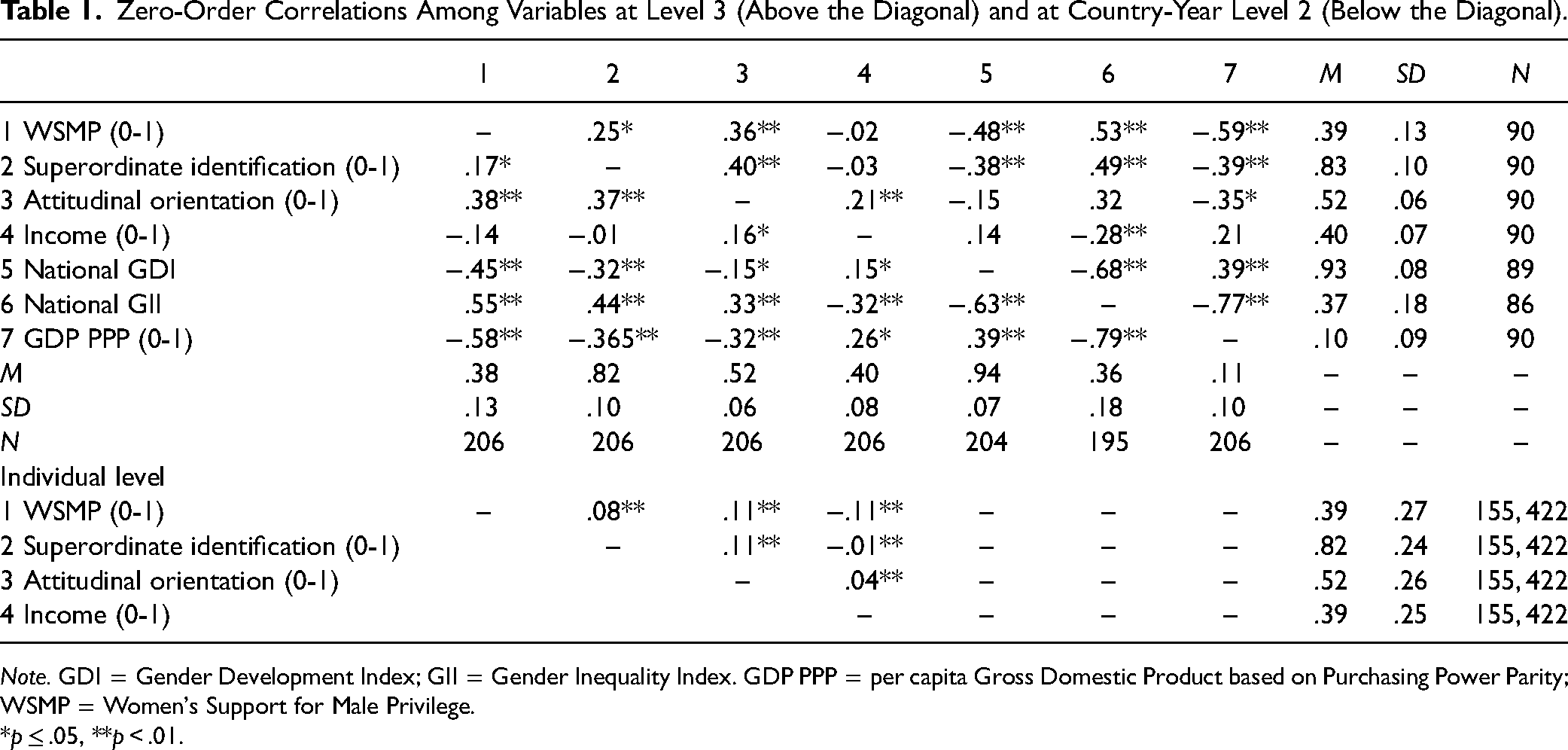
Note. GDI = Gender Development Index; GII = Gender Inequality Index. GDP PPP = per capita Gross Domestic Product based on Purchasing Power Parity; WSMP = Women's Support for Male Privilege.
*p ≤ .05, **p < .01.
We then ran two 3-level hierarchical mixed models considering only the variance of women's support for male privilege across countries and across country-years (i.e., null model). For both GDI and GII models, results indicated that the nesting structure explained about 23% of the variance in support for the male privilege (ICC = .230 and .236, respectively), most of which was due to country (level 3, ICC = .189 and .194, respectively). On the whole, these results suggest that a non-trivial portion of the variance in women's support for male privilege could be explained by the different countries that were sampled, although the year of the survey had a more modest impact on women's support for male privilege. This outcome questions the robustness of the zero-order correlations that seem to support our key hypotheses but confirms the need for a hierarchical linear modeling. That is, the non-trivial variance associated with the theory-irrelevant variables raises the question of whether the processes envisaged by SIMSA could explain a meaningful variance in women's support for male privilege beyond the contributions of national wealth, country, country-year, and the other controls.
Hypothesis Testing
Results from both hierarchical linear models are reported in Table 2.
HLM Estimates of the Effect of Level 1, 2, and 3 Variables on Women's Support for Male Privilege.
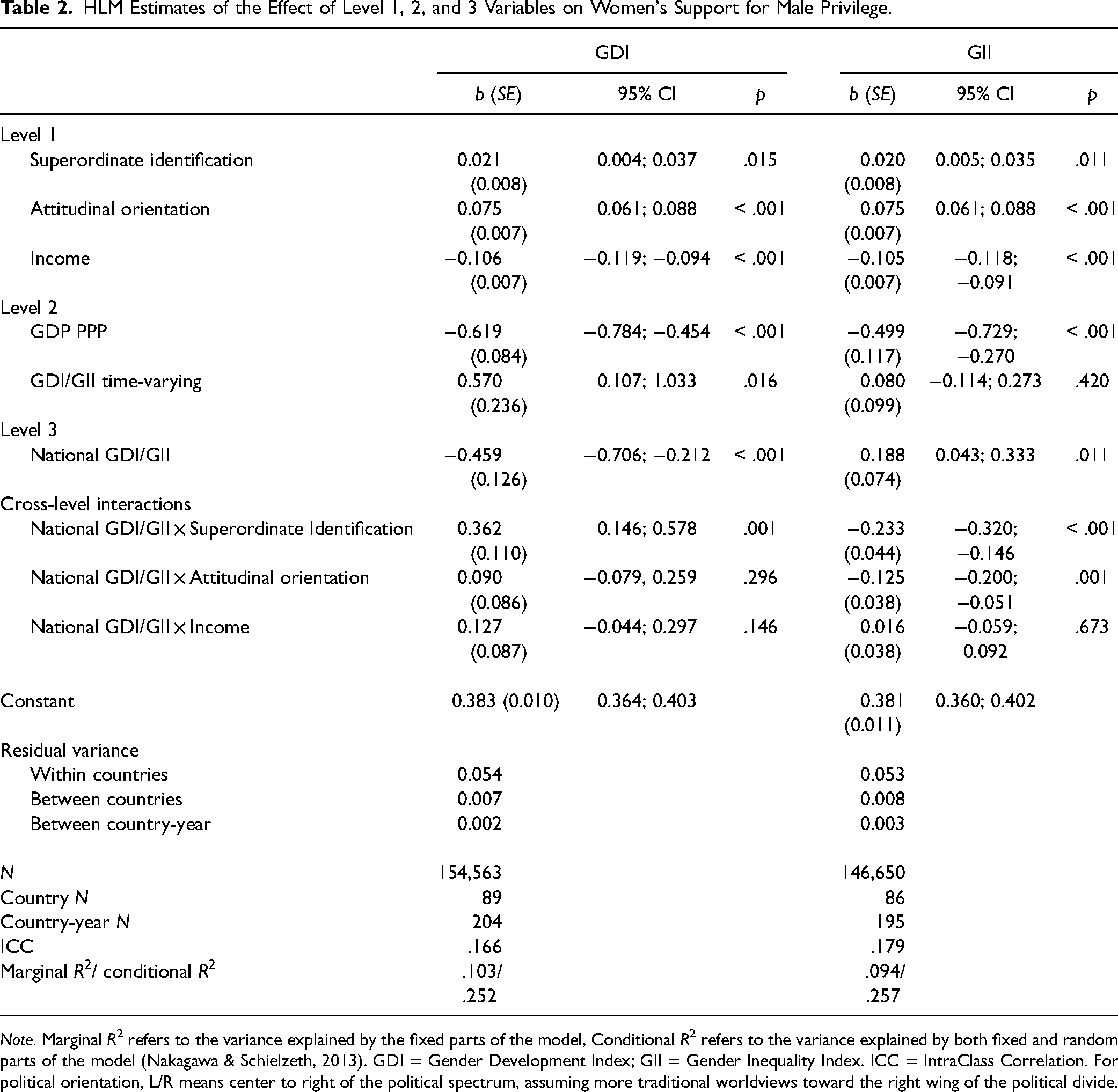
Note. Marginal R2 refers to the variance explained by the fixed parts of the model, Conditional R2 refers to the variance explained by both fixed and random parts of the model (Nakagawa & Schielzeth, 2013). GDI = Gender Development Index; GII = Gender Inequality Index. ICC = IntraClass Correlation. For political orientation, L/R means center to right of the political spectrum, assuming more traditional worldviews toward the right wing of the political divide.
Hypotheses 1a and 1b: The Social Reality Constraint Explanation
Recall that our predictions regarding the social reality constraint hypothesis were that women ought to support male privilege more strongly when (a) non-time varying GDI is low and (b) non-time varying GII is high. Results showed that net of the effect of political orientation and, national and individual wealth, women's support for the male privilege was significantly stronger when social reality constraints became stronger (i.e., lower GDI and higher GII), and these outcomes support Hypotheses 1a and 1b.
Is SIMSA's social reality constraint explanation falsifiable? Recall that SIMSA's prediction with regard to social reality constraints was that it should be visible when differences on the gendered league table (i.e., GDI and GII) are sufficiently large and stable. Hence, outside of this condition, possibilities other than the patterns predicted by this explanation should occur. Consistent with this reasoning, we found the opposite of the result for the non-time-varying GDI when we investigated the effect of the time-varying GDI on women's support for male privilege. Here, women actually supported the existing male privilege in their society the better their outcomes became over time (see Table 2, level 2 analysis). The time-varying GII did not reliably predict a decrease in women's support for male privilege. In short, neither the GDI nor the GII produced the pattern of associations predicted by the social reality constraint hypothesis when we accounted for the within-country variability of positioning in the gendered GDI/GII league tables over-time. Hence, according to SIMSA, social reality constraints appeared to work only for the relatively stable part of gendered positioning on the GDI/GII league tables, but were absent when the time-varying component of national gender inequality was considered.
Hypothesis 2: The Superordinate (National) Identification Explanation
We expected that support for systemic male privilege across societies would be stronger for women who strongly identify with their nation. Results revealed that this was the case for both the GDI and GII models (see Table 2). This outcome is not only supportive of Hypothesis 2, but also in line with other recent demonstrations (e.g., Caricati et al., 2021; Owuamalam et al., 2022, Study 2).
Hypothesis 3: The Interaction Between Social Constraints and Superordinate Ingroup Bias Explanations
We had anticipated that the effect of superordinate (national) identification would be more visible when social constraints are low (i.e., high GDI [M + 1SD] and low GII [M − 1SD]) because the reduced reality constraints create the space for women who are weakly invested in their nation to be less supportive of male privilege. This trend for weak superordinate ingroup identifying women should reverse somewhat when social reality constraints are high so that their support for male privilege shifts closer to (or even match) that of women who are highly identified with their nation. We tested this prediction by interacting GDI and GII with superordinate (national) identification, expecting the superordinate ingroup bias explanation to manifest most strongly when social reality constraints are low (M + 1SD for GDI and M − 1SD for GII), while this alternative SIMSA explanation for system justification should be less evident when reality constraints are high (M − 1SD for GDI and M + 1SD for GII). In both the GDI and GII models, we observed a significant social reality constraint × superordinate identification interaction. In line with Hypothesis 3, a simple slope contrast for both interactions revealed that women's support for the male privilege was a positive function of their superordinate identification when social reality constraints were low. That is, in both the GDI (Δb = |0.021|, SE = 0. 005, Z = 4.125, p < .001) and GII (Δb = |0.026|, SE = 0. 005, Z = 5.670, p < .0001) models, women who were strongly invested in their nation (M + 1SD) supported male privilege to a greater extent compared to their weakly identifying counterparts (M − 1SD) when social reality constraints were low (see Figure 2a and b). Importantly, support for the male privilege that was tied to women's superordinate identification disappeared when social reality constraints were high (for GDI: Δb = |0.003|, SE = 0.005, Z = 0.506, p = .958; for GII: Δb = |0. 009|, SE = 0. 00, Z = 1.789, p = .279, see Figures 2a and b).
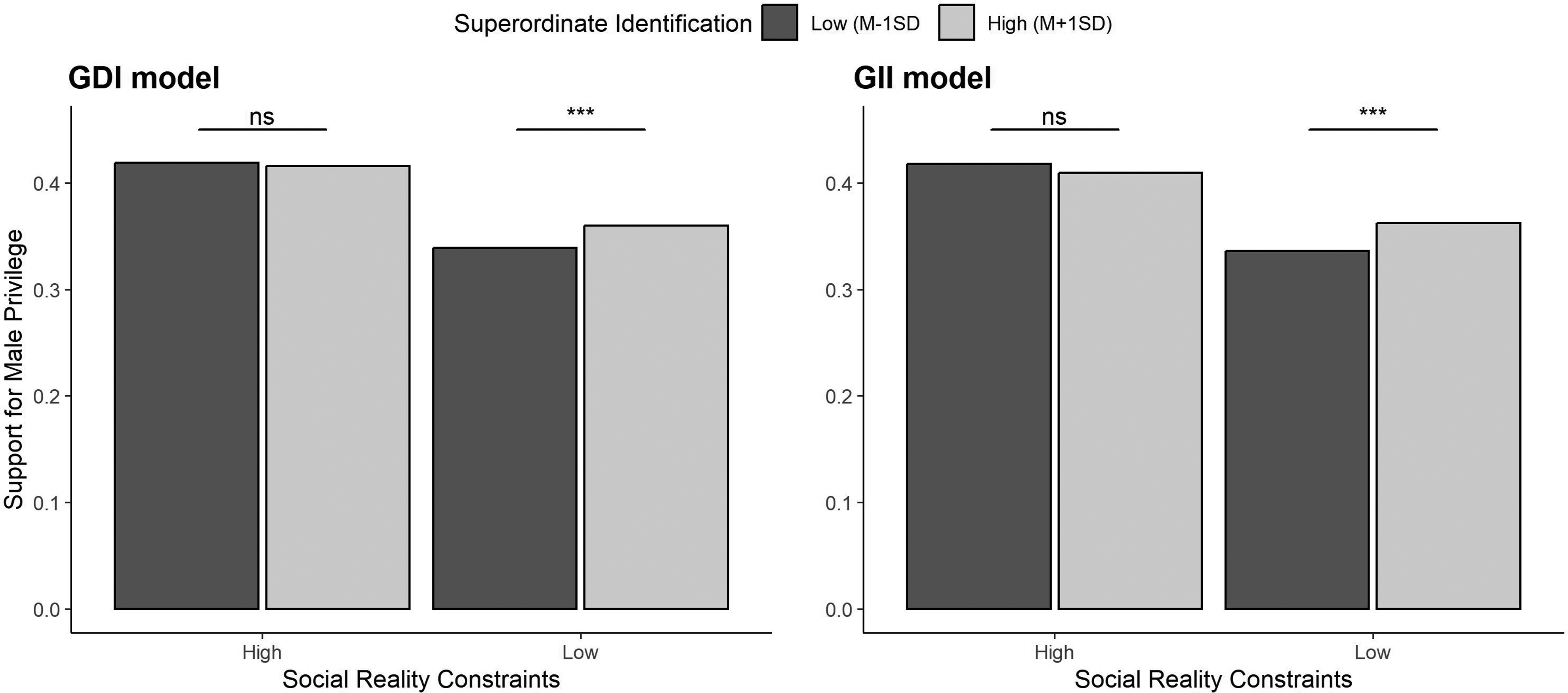
The Interaction Between Superodinate Identification and Indicators of Social Reality Constraints, GDI (Left) and GII (Right) in Predicting Support for Male Privilege (i.e., Gender System Justification).
Hypotheses 4 and 5: Women's Attitudinal Orientation and its Interaction With Social Reality Constraints
Consistent with Hypothesis 4, both the GDI and GII models revealed a significant positive effect of gender attitudinal orientation: women with a traditional (gender) attitudinal orientation were more supportive of male privilege compared to those with a nontraditional attitudinal orientation. Furthermore, we observed a social reality constraints × attitudinal orientation interaction effect on women's support for the male privilege (although this was only statistically significant in the GII model, p = .001, but not in the GDI model, p = .296, see Table 2). When we probed the statistically reliable 2-way effect in the GII model, results from a simple slope contrast revealed that women with a more traditional gender attitudinal orientation (M + 1SD) supported male privilege to a greater degree than their more progressive counterparts (M − 1SD) when the constraints imposed by social reality were low, Δb = |0. 049|, SE = 0.005, Z = 10.150, p < .001. However, the foregoing trend was significantly reduced in size when social reality constraints were high, Δb = |0.027|, SE = 0.005, Z = 5.706, p < .001 (see Figure 3). Importantly, and consistent with the weaker version of the socialization caveat for SIMSA's social reality explanation, we found that amongst women with weaker traditional attitudinal orientation, GII was positively associated with support for the male privilege (b = 0.220, SE = 0.075, 95% CI [0.073; 0.367]), while this trend was reliably less visible amongst their more traditional counterparts, (b = 0.156, SE = 0.074, 95% CI [0.010; 0.302]) (Δb = |0.064|, SE = 0.019, Z = 3.290, p = .001).
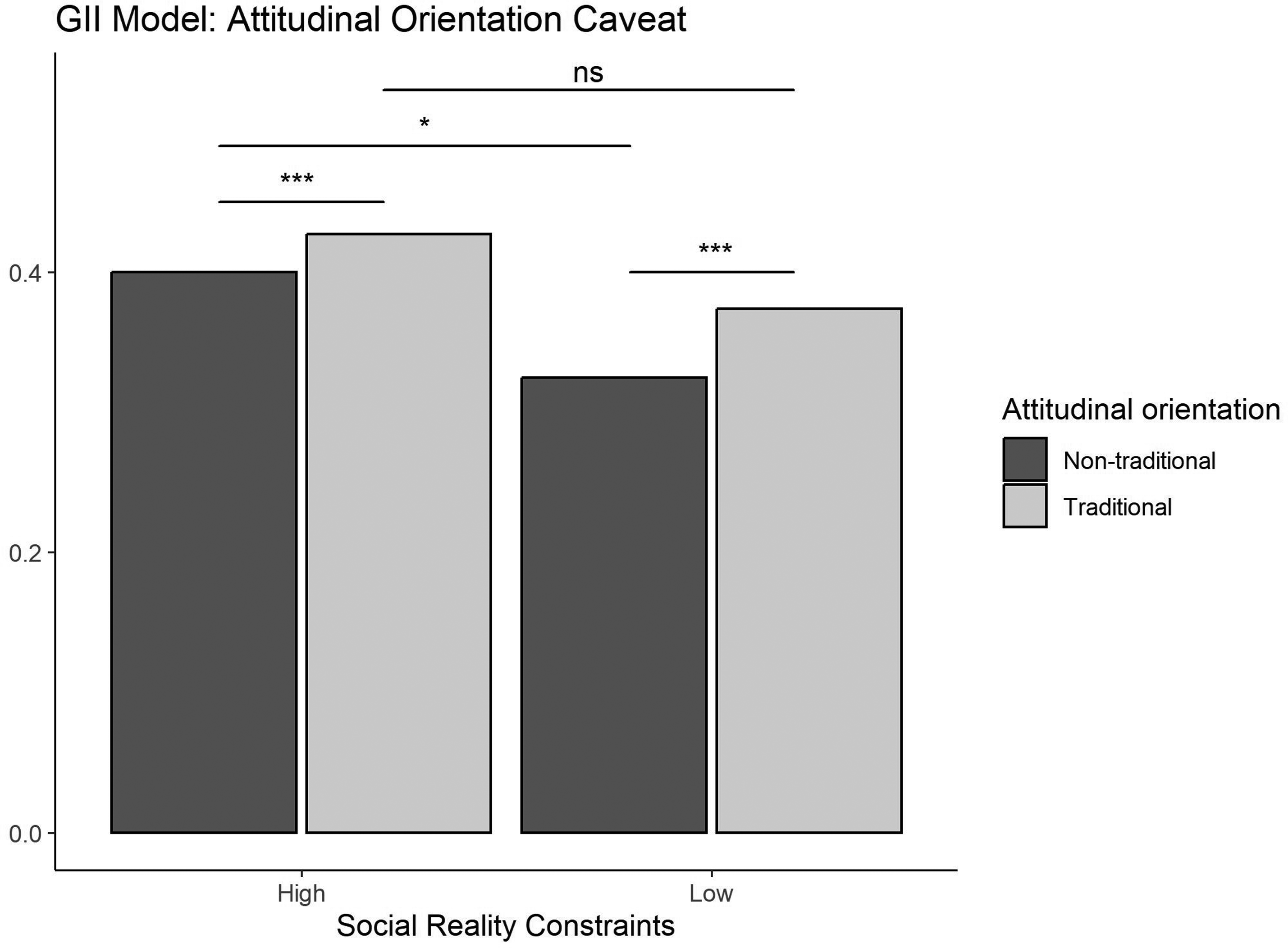
The Interaction Between Attitudinal Orientation and Indicators of Social Reality Constraints in Predicting Support for Male Privilege.
Testing Exploratory Assumptions Tied to Personal Income
It is possible to speculate that women who are well-off in terms of household income might support the existing reality of gender inequality (even if it overwhelmingly favors men) simply because it was possible for them to accrue material benefits from it. The flip-side of this coin, however, is that women with access to high income ought to have the power to challenge (with less fear of retribution) the gendered obstacles that they encountered on their way up, whereas their counterparts with lower household income, may embrace male privilege because they lack access to the power and education needed to overcome social reality constraints. Operationally, this latter speculation implies a negative association between women's income and support for male privilege, which, as some might anticipate, may be stronger when the constraints imposed by reality are sufficiently strong/entrenched to allow low-income earners to support a system that permits the sustenance it provides for some women at least. Although results provided a tentative support for this speculation (in the shape of a negative association between income and male privilege), it is important to note that this trend was not reliably qualified by social reality constraints in neither the GDI nor the GII models (see Table 2).
Discussion
Amidst the debate over why the counterintuitive system-justifying support for male privilege may occur amongst women, we tested a series of explanations drawn from the social identity model of system attitudes (SIMSA, Owuamalam et al., 2018, 2019a, 2019b; see also Rubin et al., 2023a). According to SIMSA, the paradoxical support for male privilege sometimes seen amongst women could be due to (1) a bias expressed at a superordinate level of identification, and (2) constraints imposed by the social reality to accurately represent the status quo with which they are confronted. Although SIMSA's superordinate identification explanation has received support in numerous contexts (e.g., Caricati et al., 2021, 2022; Jaśko & Kossowska, 2013; Owuamalam et al., 2023; van der Toorn et al., 2015), the adequacy of the social reality constraint explanation has not been thoroughly tested. One way of testing whether SIMSA's social reality constraint account helps to explain women's support for systemic male privilege is to look at their stable outcomes in the gendered league table relative to men, and to then determine whether support for male privilege is stronger/weaker when the margins between women and men are wide apart versus narrow.
Based on the responses of over 150,000 women spread across 90 different countries worldwide, we found that the forces of social reality constrained women to support a system of male privilege. That is, women's justification of the gender system was stronger, and the worse their outcomes on the gendered league table across numerous performance indicators were relative to men's (i.e., with respect to income, health, etc.). To the best of our knowledge, this is the first evidence for the viability of SIMSA's social reality constraint explanation at scale, showing that women are more likely to support a system of male privilege when social reality constraints are sufficiently robust and stable (low GDI/high GII).
However, our results also suggest that when the gains that women have made with regard to their outcomes in the league tables were considered, this situation seemed to allow women in nations in which gender inequality has narrowed to increase their support for male privilege. That is, women living in a nation in which improvements to their position were possible might think that their national gender system is just, precisely because it permitted this improvement. This finding also sits well with the triadic social stratification theory (Caricati, 2018; Caricati & Owuamalam, 2020; Caricati et al., 2021) because it highlights that favorable temporal comparisons can motivate members of disadvantaged groups to justify a status quo that allowed for such gains (see also Rubin et al., 2023a). Indeed, comparing the present improvement in their gender outcomes with a worse period for women in the past may enhance the experience of collective worth for women (i.e., “our situation is not as bad as it was in the past”; Tajfel & Turner, 1979) that should permit system-justifying attitudes to take root. The idea that temporal gains can induce support for the male privilege is also consistent with another explanation under the SIMSA umbrella—the hope for future ingroup status account (Owuamalam et al., 2018, 2019a; Rubin et al., 2023a). According to this hope explanation, the prospects of an improvement in women's outcomes over time should cause them to justify or tolerate the prevailing male privilege due to a realistic optimism that the system will eventually narrow the gender gap (Owuamalam et al., 2021). That said, we encourage an appropriate level of caution on these speculations, especially because this result was only obtained in one out of two tests (i.e., the GII but not the GDI model).
Also, we note a potential reservation with regard to SIMSA's stability-based argument, especially when compared with the entrenched interpretation of the traditional SIT explanation that an unstable social stratification causes a system-challenge, not justification of the status-quo. It is worth noting that Tajfel and Turner (1979, p. 45) explicitly stressed the possibility that temporal dimension at the system level (e.g., stability and legitimacy) would impact the behavior of members of low-status groups. However, subsequent works have mainly operationalized instability as short-term instability, focusing on the estimation of the feasibility of a more immediate improvement to ingroup status. Taking the seminal suggestion by Tajfel and Turner (1979) into account, SIMSA additionally assumes that a hope-induced system justification should manifest when the system is currently stable but foreseeably unstable in the long-run. The idea of future malleability in the system therefore permits the estimation that although there are little chances of an immediate robust improvement to ingroup status (making a system-challenge futile), the little wins/gains over time should encourage women to be hopeful that the system will eventually correct itself (leading to system justification at present; see also Hur & Ruttan, 2023 for evidence that people perceive system to linearly increase toward social justice and that this reduces the beliefs that further efforts to make progress are needed). Hence, SIT's and SIMSA's system stability caveats are not in opposition because the SIT-inspired work has typically dealt with long-term system stability and short-term system instability, while SIMSA accounts for short-term system stability and long-term system instability.
We also found a direct effect of national identification on women's support for a system of male privilege when social reality constraints were incorporated into the model. We found, for the first time, that the effect of superordinate group identification on system justification is qualified by social reality forces that compels people to represent the status quo as it is. Specifically, women who were both strongly and weakly identified with their nation equivalently supported male privilege when social constraints were high. However, when these constraints were low, women who were more invested in their superordinate (national) ingroup were able to maintain a strong support for the prevailing system of male privilege in their society compared to their weakly identified counterparts.
We also aimed to accommodate the potential role that women's ideological socialization might play when it comes to SIMSA's social reality explanation. We had anticipated that support for male privilege will be higher amongst women with more traditional ideologies (i.e., those on the right of the political spectrum), but more importantly, that nontraditional women's support for this gender inequality should be less apparent when reality does not constrain their ability to represent the status quo the way that it is. Our data support the weaker version of this socialization caveat for SIMSA's social reality constraint explanation because it shows that women with nontraditional worldviews were less supportive of male privilege when the forces of social reality were low (vs. high). However, it is worth noting too that the gender socialization account does provide a satisfactory explanation for women's support for male privilege. Indeed, women with ostensible traditional worldviews consistently supported the prevailing system of male privilege more than nontraditional women, regardless of the extremity of the constraint imposed by social reality. That is, in traditional/patriarchal societies where male privilege is likely more visible (e.g., in nations with low GDI and high GII), support for this reality strengthened simply as a function of the traditional gender attitudes that women may have learned.
Practice Implications
Despite the foregoing caveats, it is nonetheless useful to contemplate the practice implications of the trends that we found in the current study. Our results show that the powerful forces of socially shared realities can sometime compel women to passively support societal traditions that inadvertently place their gender group at a disadvantage relative to men. Beyond the constraints imposed by the reality in which women operate, our results also indicate that a conservative political orientation and/or positive attachment to the wider society could also undermine women's capacity to challenge traditions that enable male privilege. In particular, the evidence that right-leaning attitudes could play a more visible role in the justification of disadvantageous systems suggest that programs designed to enable the unlearning of traditional gender training could help to dampen women's support for gender inequality. Hence, for gender-equity activists, it may be effective to target the unlearning of certain right-leaning political myths which might, in turn, dampen women's support for male privilege. Finally, because exposure to a highly gender-unequal society produces a strong reality constraint that sustains the male privilege status quo, it might be useful for activists seeking to engage women in their change efforts (e.g., in rallies against inequality) to emphasize the progress that is possible in the here-and-now, rather than in the distant future. Indeed, appeals to progress in the distant future may ironically activate a hope-induced support for a male privilege status quo (Owuamalam et al., 2021).
Limitations
We should acknowledge some limitations connected with the present research. Firstly, the gender socialization explanation assumes that support for male privilege represents an acknowledgment of the training that women have received, while SIMSA's social reality explanation assumes the need for social accuracy to be the driver of women's support for male privilege. Neither of these two motives was directly tested in the current correlational investigation and future experimental work could aim to unpack them more systematically. We also proxied traditional versus nontraditional gender socialization using the bipolar right–left political orientation scale, when the ideal could have been to directly measure this construct. A further limitation, one could argue, might be the use of single-item measurements to tap some of the variables relevant to our key tests. Although the use of single-item measures has been shown to be relatively reliable and useful (e.g., Christophersen & Konradt, 2011; Hoeppner et al., 2011) especially when constructs are well established (e.g., ingroup identification, Postmes et al., 2012), we acknowledge that the numerous facets of group identification, may not be fully captured by a single item. Lastly, the usual interpretational caveats—with regards to claims about causality—also apply given the correlational nature of the current investigation. On the whole, these shortcomings could have affected the precision, robustness, and claims about the directionality of the results that we observed. Consequently, we recommend an appropriate level of caution when interpreting and/or applying the current findings.
Conclusion
Why might women support a system of male privilege? In this study, we tested two complementary explanations derived from the SIMSA. We found, consistent with SIMSA that such an orientation could come about when the incontrovertible reality in the society compels women to adjust their attitudes in ways that accurately reflect this status quo. We also found that when social constraints are low, women's support for male privilege is positively associated with their national identification, which ostensibly reflects a bias in favor of the customary ways of doing things in their society. Lastly, we unite SIMSA's explanations with the more entrenched gender socialization account by showing that support for the male privilege is more visible amongst women with traditional worldviews (i.e., those on the right), and that this accentuation is starker when the constraints imposed by social reality is low. For nontraditional women, our data suggest the potential to resist male privilege, but mostly when the forces of social reality constraints are sufficiently low. These findings are sobering because they show that the systemic positioning of women below men could help to perpetuate women's acceptance of male privilege—even for progressives and even among those with weak attachment to one's country. This occurrence may, in turn, undermine gender equity advocacy in societies where such campaigns may be needed the most (i.e., in societies where women's outcomes on the gender development league table are direr).
Supplemental Material
sj-docx-1-pwq-10.1177_03616843231176222 - Supplemental material for A Large-Scale Test of the Reality Constraint and Ingroup Bias Accounts of Women's Support for Male Privilege
Supplemental material, sj-docx-1-pwq-10.1177_03616843231176222 for A Large-Scale Test of the Reality Constraint and Ingroup Bias Accounts of Women's Support for Male Privilege by Chuma Kevin Owuamalam, Luca Caricati and Chiara Bonetti in Psychology of Women Quarterly
Footnotes
Acknowledgments
We thank anonymous reviewers for their valuable comments on an earlier draft of this manuscript. We also thank Mark Rubin for his precious and helpful comments on the revised version of the manuscript.
Author Contribution
CO and LC contributed equally to drafting and revising the manuscript, data analysis, and data interpretation. CB was involved in collecting national data, and drafting and revising the manuscript. All authors contributed to the article and approved the submitted version.

Declaration of Conflicting Interests
The author(s) declared no potential conflicts of interest with respect to the research, authorship, and/or publication of this article.
Funding
The author(s) received no financial support for the research, authorship, and/or publication of this article.
Supplemental Material
Supplemental material for this article is available online.
Notes
References
Supplementary Material
Please find the following supplemental material available below.
For Open Access articles published under a Creative Commons License, all supplemental material carries the same license as the article it is associated with.
For non-Open Access articles published, all supplemental material carries a non-exclusive license, and permission requests for re-use of supplemental material or any part of supplemental material shall be sent directly to the copyright owner as specified in the copyright notice associated with the article.
