



Abstract
Individuals who are sexually harassed often do not formally report their experience. Current understandings of this focus on the procedural barriers to reporting rather than examining whether and how reporting meets the needs of those who experience harassment. We document the repertoire of needs experienced by those who are sexually harassed and the actions they take to meet them. In two quasi-experimental studies (Ns = 415 and 589), we compared the needs and actions described by those who experience sexual harassment with those anticipated by others who have not encountered sexual harassment (Study 1 also compares across gender identities). Results of multivariate analyses of variance and general linear mixed models revealed a persistent gap between perspectives. People who have experienced sexual harassment reported a range of needs and engaged in a variety of actions to meet these needs. Safety and social support were prioritized over formal actions. Those who had not encountered sexual harassment anticipated having stronger needs and taking more actions—especially formal ones. The results encourage those who seek to support individuals who are sexually harassed to address a wider variety of needs than is typically considered. Additional online materials for this article are available on PWQ's website at http://journals.sagepub.com/doi/suppl/10.1177/03616843231170761.
One of the most frequently asked questions about sexual harassment, both in academic inquiry (e.g., Fitzgerald et al., 1995; Kelly et al., 2005) and media reporting (e.g., Engel, 2017), is why people who experience harassment do not formally report it. Although this is a valid question, it also implies that quick and formal reporting is the “right” response to sexual harassment. Yet, most individuals who are sexually harassed do not formally report their experiences. For example, the 2017 Crime Survey England and Wales found that approximately five in six people who are targeted by sexual offenses did not report their experiences to the police (Flatley, 2018; see also Rape Crisis England & Wales headline statistics 2017-18, n.d.; Trades Union Congress, 2016). If people do come forward, this might be long after the incident took place (e.g., McGoogan, 2017; Perraudin, 2016).
Such observations point to a discrepancy between what people expect from those who are sexually harassed and the way individuals actually respond to this experience (Woodzicka & LaFrance, 2001). This discrepancy is likely to be consequential, given that perceptions of what a “reasonable person” (or a “reasonable woman;” Shoenfelt et al., 2002) would do are the standard against which the credibility of complaints is assessed in the legal domain (Recupero, 2018). Assumptions about what is reasonable also underscore public opinions about high-profile cases. For example, in response to Dr. Christine Blasey Ford's allegations of sexual assault by U.S. Supreme Court nominee Brett Kavanaugh, then President Donald Trump asked, “Why didn’t someone call the FBI 36 years ago?” Implicit in this type of question is the idea that hesitation in coming forward is diagnostic of unreliable testimony.
In this paper, we provide further insight into the needs experienced by those who are sexually harassed, the actions they take, and the extent to which they feel these actions meet their needs. In a quasi-experimental design, we also compared these needs, actions, and outcomes to those anticipated by people who have not experienced sexual harassment. Study 1 included responses across gender identities; Study 2 focused on the perspective of women, who are overrepresented among those who have experienced sexual harassment.
What Might Those Who Are Sexually Harassed Need?
Sexual harassment can be defined as unwanted sexual behavior (Fitzgerald, 1993). The expectation that individuals who are sexually harassed should quickly and formally report unwanted experiences seems based on an assumption that they are primarily guided by their needs for justice. Heightened needs for justice should indeed propel individuals toward actions that might be expected to satisfy this need, such as reporting to the police. However, a large body of literature attests to the fact that individual needs are multiple and that different needs can guide behavior in different directions (e.g., Deci & Ryan, 2008; Sheldon et al., 2001). In addition to possible needs for justice (which can be partially satisfied through formal reporting), following sexual harassment individuals might experience needs for safety, social support, and understanding (which are satisfied through more informal channels like friendship networks), or simply have a need to forget an experience that was traumatic (which can be satisfied by avoidance of the topic). Although onlookers might have ideas about which needs (and associated responses) are most appropriate, these ideas are outsider perspectives. We need to understand needs (and responses) from the perspective of those who encounter harassment.
Within the social psychological literature, self-determination theory (Deci & Ryan, 2008) is a prevalent model of human needs and their relations to individual behavior and well-being. Central to this perspective is the idea that people have three basic psychological needs: autonomy, competence, and relatedness. Autonomy refers to experiences of volition as opposed to coercion; competence involves feeling effective in interacting with one's environment, contrasted with feeling inferior and inadequate (together these might also be called agency within alternative frameworks; e.g., Bakan, 1966); relatedness refers to feeling genuinely loved and cared for as opposed to feeling ostracized and lonely (also referred to as communion within alternative theoretical frameworks). Deci and Ryan (2008) argue that well-being is maximized when all three basic needs are satisfied; and that when a basic psychological need is not being met, people will become motivated to engage in behaviors that are expected to satisfy the threatened need (Chen et al., 2015; Sheldon & Gunz, 2009).
Other perspectives suggest that while needs may be multiple, certain needs are likely to be prioritized. For example, Maslow's (1943) now famous hierarchy of needs suggests that psychological well-being is not only predicated on fulfilling multiple inherent needs but also doing so in order of importance. Only after the most basic physiological needs are satisfied, such as for food, water, rest, and safety, can people engage with the pursuit of higher-order psychological needs, such as needs for belongingness, esteem, and eventually self-fulfillment. Despite its prominence in the psychological literature, the adequacy of Maslow's hierarchy has been the subject of considerable debate and the specific ordering of priorities is not well-supported empirically (see e.g., Sheldon et al., 2001; Tay & Diener, 2011; Wahba & Bridwell, 1976). Nonetheless, the overall argument that an individual's most deficient need is likely to be prioritized over others is a widely shared theoretical proposition (e.g., Wicker et al., 1993; Wicker & Wiehe, 1999). Irrespective of the specific typology, work in this area converges on the idea that people have multiple (sometimes competing) needs, and that not all needs are equal, or equally salient, at all times.
Recognizing the plurality of human needs can help us to understand why people's behavior and decisions in response to critical situations—like sexual harassment—might diverge from what is expected: Their experienced needs might simply be different from the needs they are presumed to have. In keeping with this, data from a range of sources suggest that the singular need for justice is unlikely to characterize the motivations of those who experience sexual harassment. For example, survivors of sexual offenses often reported having problems trusting people and experiencing difficulties in relationships as a result of the offense (Flatley, 2018). Sexual harassment has also been observed to have negative effects on self-esteem (Gruber & Bjorn, 1982) and on people's sense of control (Thacker, 1992). These patterns all suggest that experiencing sexual harassment can threaten multiple needs for communion/belonging, agency/competence, and autonomy, specified in self-determination theory, as well as additional needs, such as esteem, that are central to other models (e.g., Maslow's hierarchy).
When needs are threatened, people should become motivated to take actions that are expected to satisfy these needs and restore their well-being. To the extent that those who are sexually harassed have multiple threatened needs, they are likely to weigh up the costs and benefits of any given course of action against these salient needs. The most obvious course of action—swift, formal reporting—might satisfy one need (e.g., for autonomy; Van Prooijen & Kerpershoek, 2013), but it might be neutral or even negative with respect to the satisfaction of other needs (e.g., for belonging/relatedness). Indeed, a vast body of research documents negative responses to disclosure and help-seeking by survivors of sexual assault (e.g., Relyea & Ullman, 2015)—even from legal, medical, and mental health professionals (e.g., Campbell, 1998)—and illustrates that survivors often choose not to seek help because they anticipate these negative responses (Patterson et al., 2009).
Research in adjacent areas also suggests that those who encounter unwanted gender-based treatment face difficult dilemmas when they make cost–benefit analyses in the face of multiple competing needs. For example, work on responses to discrimination has shown that the personal benefits of confronting perpetrators are often awkwardly balanced against the social costs anticipated to follow from such action (i.e., hostility, ridicule, or disbelief from others; Czopp & Monteith, 2003; Kaiser & Miller, 2003). Reciprocally, the benefits of not confronting such behavior can sit awkwardly with the costs this has for people's sense of self (e.g., shame and self-directed anger; Shelton & Stewart, 2004). As a result of these competing needs, those who encounter discrimination (and perhaps harassment also) often simply refrain from confrontation (Crosby, 1993).
Of course, there are additional calculations that are likely to affect the actions people take in response to harassment. One important motivator of any kind of action is its perceived effectiveness in addressing the problem at hand (e.g., Bandura, 1989). Irrespective of their own needs, people might not confront those responsible for negative experiences if they believe that such behavior will be ineffective in creating desired change (Rattan & Dweck, 2010). Unfortunately, even the swift reporting of experienced sexual harassment might not be especially effective from the target's perspective. Indicative of this, official statistics suggest that even when sexual offenses are reported to the police, they are less likely to be recorded as a crime relative to alternative reported offenses (HMIC, 2014). Additional data show that, even when they are recorded as crimes, conviction rates for sexual offenses are very low and much lower than the average conviction rate for all offenses (Topping & Barr, 2018). Statistics like these are often accompanied by media reports of “victims” being “let down” by the police (e.g., BBC, 2018; Dearden, 2018; Gray, 2018; Kearny, 2018; Travis, 2014), creating a context in which those who are sexually harassed might not be very confident about the value of reporting their experiences to authorities. As such, regardless of whatever needs they might have, targets of sexual harassment might not feel confident that filing formal complaints would lead to a need-satisfying outcome.
Experienced Versus Anticipated Responses to Sexual Harassment
As has already been pointed out, the expected needs, and therefore responses, of those who anticipate sexual harassment might not match the needs and responses of those who actually experience sexual harassment. Prior research documents similar perspective discrepancies in closely related domains. For example, Woodzicka and LaFrance (2001) found that when asked to imagine a hypothetical interview situation in which a male interviewer asked sexually inappropriate questions, the majority of women reported that they would feel angry (rather than afraid) and would in some way challenge or confront the questions. However, when a separate group of women was placed in the actual situation of being asked these questions by an interviewer, they were more likely to subsequently report feeling afraid (rather than angry) and were inclined to simply answer what they were asked rather than challenge it. This pattern of assumed confrontation versus actual silence, especially when the personal stakes in the interview were high (e.g., a desirable vs. undesirable job), was observed by Shelton and Stewart (2004), drawing on a similar experimental paradigm.
Findings like these underscore the point that what is abstractly imagined—and therefore likely to be perceived to be a reasonable response—is different from what one is confronted with in a concrete situation and the full personal contingencies this situation entails. Generalizing observation to the case of sexual harassment seems plausible, though as-yet remains untested using comparable designs (e.g., to those used by Shelton & Stewart, 2004; Woodzicka & LaFrance, 2001). The reason for this is undoubtedly due to the fact that experimentally varying exposure to sexual harassment is both practically and ethically difficult. Given this challenge, we aimed to generate relevant insights into the presumed discrepancy by comparing retrospective reports of those who have experienced sexual harassment to the imagined needs and actions of individuals who have not had this experience. Hence, in addition to exploring the range of needs, and accompanying actions, of those who have experienced sexual harassment, we also sought to examine discrepancies between this perspective and the perspective of others who have not shared such an experience.
The Present Research
People targeted by sexual harassment are typically assumed to be motivated by the need for justice. But, as we outline above, following an experience of sexual harassment, individuals might experience a variety of needs, including needs for belonging/relatedness, autonomy, and competence. Although some of these needs might be met through formal complaint procedures, the poor record of conviction in sexual harassment cases, coupled with the complicated personal and social consequences of coming forward with one's experiences, might lead targeted individuals to choose other courses of action to meet the needs they have. Acknowledging this point shifts the focus of research away from the question of “Why do people not report sexual harassment?” and toward more open research questions such as “What needs do those who experience sexual harassment have?” (Research Question, RQ, 1), and “What actions do they take?” (RQ2). As a first step toward furnishing these research questions with answers grounded in data, we present two studies that sought to quantify the various responses to sexual harassment. In both studies, we presented people who reported prior experience of sexual harassment with lists of plausible needs and actions and simply asked them which needs they had and which actions they took.
Although it could be anticipated that people will always take actions that satisfy their needs, research suggests that this is not always the case. For example, people may choose to respond to stressors in ways that they believe will benefit them, but this benefit might not materialize (e.g., Newheiser & Barreto, 2014). Similarly, those who are sexually harassed might complain to the police to meet their need for justice, but that action might fail to meet this need. It is, therefore, important to also examine whether people feel their needs have been satisfied. As such, a third exploratory research question was “(How) do the actions taken satisfy the needs that those who are harassed actually have?” (RQ3). To address this question, participants also indicated the extent to which their actions were ultimately effective at satisfying their needs. We also assessed well-being (operationalized as positive and negative affect; supplemented with measures of life satisfaction, personal self-esteem, optimism, and relationship satisfaction) to provide a wider impression of need satisfaction, since theoretical models agree that the latter should support the former.
As anticipated by the above introduction, our research was also motivated by a fourth research question: “(How) do the needs and actions expected by others relate to the needs that those who are sexually harassed actually have and the actions they take?” (RQ4). To address this question, in both studies we included people who had not previously experienced sexual harassment and asked them the same set of questions. Instead of reporting the needs they had (and actions they took), this group instead anticipated their needs, actions, and degree of satisfaction imagining that they had experienced sexual harassment.
To summarize, here we report two studies motivated by a set of exploratory research questions that we sought to answer through a quasi-experimental design comparing the needs, actions, and need satisfaction of those who had, versus those who only imagined having, experienced sexual harassment. We report all data exclusions and have made the full materials and data available at https://osf.io/3bs8d/. The study design and analyses were not preregistered.
Study 1
Method
Participants
Volunteers were sought for an online survey about sexual harassment experiences. The advertisement stated we were interested in the views of people over 18 years old, both those with and without these experiences. Our goal was to recruit as broad a sample as possible rather than one that was representative of any specific society. The survey was conducted between July and November 2016 and advertised through local media outlets, social media, and online fora (e.g., Facebook, Twitter, Netmums) and paid participants were also recruited through Prolific (a crowdsourcing research platform). Volunteers were offered the chance to win Amazon gift cards worth £10 (∼US$12.41), and paid participants received £0.85 (∼US$1.05) in return for their completed survey.
A total of 512 people accessed the survey, but only 450 completed the survey. Of these 35 participants withdrew their consent while completing the survey (an option that was provided on every page of the survey), leaving a sample of 415 participants for analysis. The majority in this sample reported that they had experienced sexual harassment (n = 259; henceforth Experiencers). The remainder reported that they had not experienced this (n = 156; henceforth, Imaginers).
Respondents ranged in age from 18 to 72 years (M = 31.03, SD = 10.16). In response to an open-ended question, almost half of the sample described themselves as being from the UK (49.5%), but the sample also included participants who described themselves as being from Europe (21.6%), Asia (12.6%), and North America (8.5), with smaller numbers from South America, Oceania, and Africa. In response to an open-ended question, the majority of the sample also described their race/ethnicity as White (or some variation thereof, e.g., White, White British, European, White Other; n = 301, 73%). The remainder spanned racial/ethnic categories, including Asian (East Asian, South East Asian, Indian, Pakistani, etc.), Black (African, Black Caribbean, Black British, etc.), Arabic (including Turkish Arabic, Turkish), and various mixed ethnic identities. The sample was composed predominantly of women (250 women, 158 men, 6 other, and 1 unreported). Women were specifically overrepresented in the Experiencer group relative to men (ns = 202 and 48); whereas men were overrepresented in the Imaginer group (ns = 48 and 107). Although this sample was not designed to be representative, it is noteworthy that the percentage of women reporting experience of sexual harassment in our survey corresponds to the estimate from a recent survey with a representative sample of the U.S. population, whereas the percentage of men reporting experience in our survey is slightly lower than estimated in that study (Kearl, 2018).
Given the unequal distribution of genders across Experiencer and Imaginer groups, we included gender as a variable in all analyses and tested for interactions with this. In these analyses, we grouped the small number of participants who identified as “other,” or who did not specify their gender, together with women. In addition to their small number precluding separate analysis, this decision is consistent with data suggesting that, in addition to women being more likely to experience sexual harassment than men (e.g., Kearl, 2018), gender minorities are more likely to experience sexual harassment than their cisgender counterparts (e.g., Kaltiala & Ellonen, 2022). Indeed, of those who identified as “other,” 5 (out of 6) were in the Experiencer group as was the one respondent who did not indicate their gender identity. We nevertheless acknowledge that this decision to group those who identified their gender as “other” with women has limitations, given that sexual harassment might be experienced differently by cisgender women, transwomen, and those outside the gender binary.
Procedure
The study received ethical clearance from the Psychology Ethics Committee of the University of Exeter. On the landing page of the survey, participants read that we were interested in finding out people's thoughts and experiences with sexual harassment. No definition of harassment was given, but it was stated that people did not have to have personal experience with this to participate in the study. Participants also read that the survey was confidential, participation was voluntary, and that consent could be withdrawn at any time. Participants gave their consent to these terms.
The survey opened with a question asking participants to define what sexual harassment means to them. Specifically, participants read: “Please think for a moment about what you consider sexual harassment to be and provide a brief description of your perception of what constitutes sexual harassment.” We followed this procedure because our focus was on people's own understanding of sexual harassment and their own experiences and perceptions of this, which need not align with more specific academic definitions.
After typing their definition into an open-text box, participants were then asked to indicate whether or not they had experienced sexual harassment, as defined by them. Those who reported the experience were then asked a series of further questions (e.g., how long ago it took place and whether it was a single or repeated incident) with the purpose of ensuring that they had a specific event in mind before responding to our key measures.
After this, all participants (both Experiencers and Imaginers) were asked to complete a common set of measures. When completing these measures, Imaginers were asked to respond based on the way they anticipated they would feel if they had been sexually harassed, whereas Experiencers answered with respect to their actual experiences. After completing the measures, participants provided demographic details, including age, gender, nationality, and ethnicity. On submitting their responses, participants were debriefed and given information about sources of support in the event that they felt distressed as a result of taking part in the survey.
Measures
Incident Evaluation
Conceptually, experiences are sexually harassing only when a person evaluates them negatively; uninvited sexual attention that is subjectively positive or neutral is typically not considered sexual harassment (Berdahl & Moore, 2006). From the target's point of view, however, the definition of sexual harassment might not simply reside in the negativity of the experience. We prioritized participants’ own indication of whether they had experienced something that met their definition of sexual harassment. Nonetheless, we measured participants’ evaluations of their experience (or imagined experience) to consider this as a robustness check on any patterns observed in our analyses. As such, participants evaluated how negative or positive the experience was for them at the time when it occurred (or how negative or positive they imagined this experience to be), on a single 5-point scale (1 = very negative, 5 = very positive).
Needs
Next, we asked about participants’ needs (or imagined needs) after experiencing sexual harassment. This involved two steps. First, we asked participants to list their needs in an open-text format. This allowed participants to recall the variety of needs they experienced and to describe them in their own words, without being primed by a preexisting scale. This gave us some insight into respondents’ own needs and informed refinements to our needs scale in Study 2. The insights gained from the open-ended needs listing and how these informed the needs measure in Study 2, are described in online Supplementary Materials (Section 1).
After this, participants were asked to rate the extent to which they experienced a set of 13 needs, devised by the researchers. This set of needs was not intended to be exhaustive, but rather to capture the kind of needs that might be anticipated based on existing models. Specifically, the list included needs inspired by the concepts of autonomy, competence, and relatedness from self-determination theory (Deci & Ryan, 2008), as well as broader needs for self-esteem and meaning in life (loosely based on Maslow's hierarchy), as well as needs for justice (since this seems intuitively relevant to discussions of sexual harassment). Participants rated how much they experienced each need at the time of the incident (or imagined that they would experience such a need after a harassing incident) on a scale ranging from 1 (very untrue) to 7 (very true). The full list of needs, and their rated relevance, is presented in Table 1.
Rated Individual Needs and Factor Loadings for Composite Measures (Study 1).
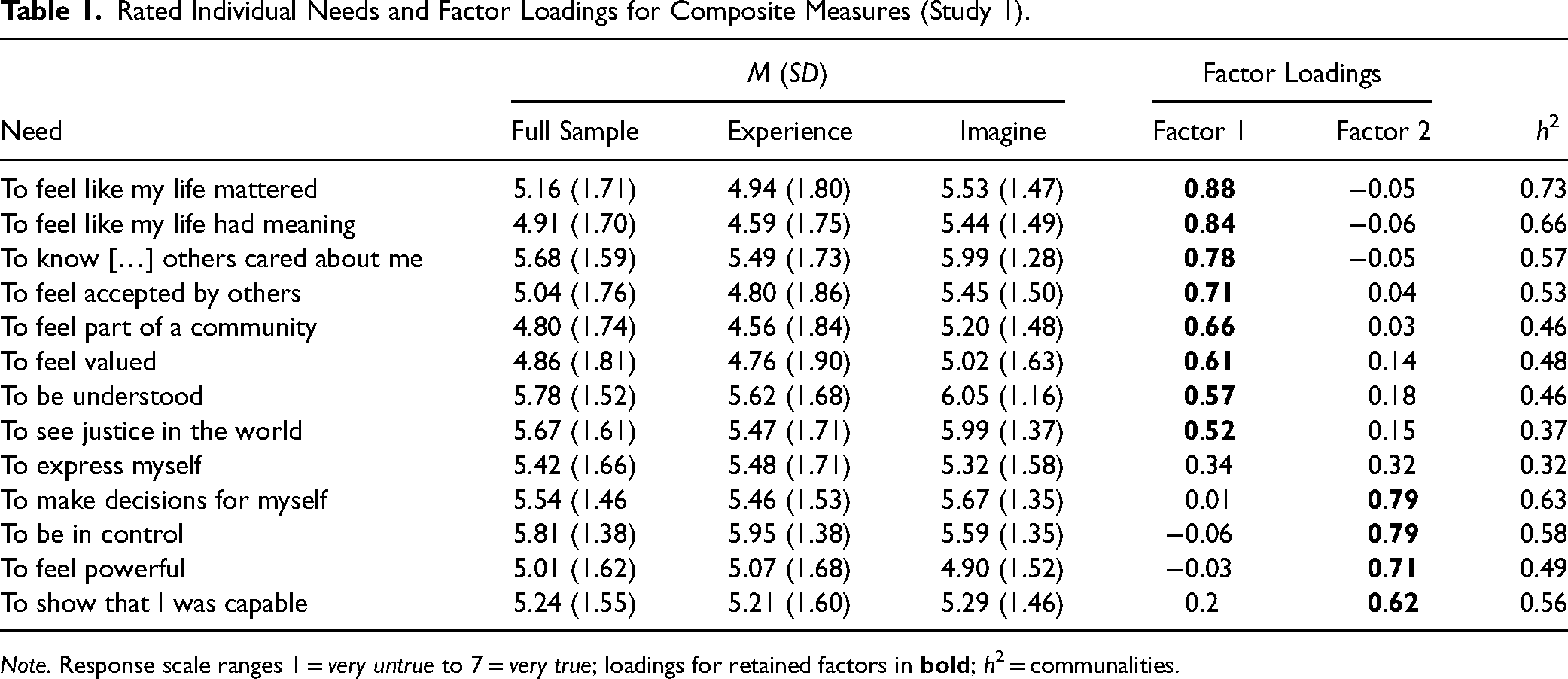
Note. Response scale ranges 1 = very untrue to 7 = very true; loadings for retained factors in
Because this list of needs did not follow an existing scale, we reduced the data prior to analysis via exploratory factor analysis. We used a number of criteria to determine the number of factors to retain, including eigenvalues > 1, parallel analysis, and Velicer's Minimal Average Partial (MAP) test. Where there we disagreements between these, we were also guided by the goal of parsimony and retained the smallest number of interpretable factors.
A MAP test (conducted using O’Connor's, 2000, SPSS macro) suggested 2 factors underlying the 13 researcher-defined needs. Factor analysis performed in JAMOVI using principal axis factoring with oblique (oblimin) rotation also suggested two factors with eigenvalues greater than one, although the parallel test suggested 4 factors. Based on the convergence between the MAP test, the criteria of eigenvalues greater than one and the principle of parsimony, we retained 2 factors, which together explained 52.66% of the variance in individual items. 1 The use of oblique rotation was supported by the high correlation between the two extracted factors, r = .57.
As can be seen in Table 1, all items had primary loadings over .50, except for the item “to express myself,” which had lower loadings that split across factors. For this reason, self-expression was removed and treated as a single-item measure. Of the retained factors, Factor 1 was characterized by (in order) the items: “to feel like my life mattered,” “to feel like my life had meaning,” “to know that there were others who cared about me,” “to feel accepted by others to feel part of a community,” “to feel valued,” “to be understood,” and “to see justice in the world.” We labeled this factor Communal Needs. Factor 2 was characterized by (in order) the items: “to make decisions for myself,” “to be in control,” “to feel powerful,” and “to show that I was capable.” We labeled this factor Agentic Needs. Both factors formed reliable scales and composite measures were calculated by averaging individual items for each factor (αcommunal needs = .87; ωcommunal needs = .89, αagentic needs = .83; ωagentic needs = .83).
Actions
Next, participants were asked what they did (or imagined they would have done) in response to experiences of sexual harassment. For this, participants were presented with a checklist of 17 possible actions. Again, the list was created by the researchers and was not intended to be exhaustive, but rather to cover a wide variety of plausible responses to sexual harassment. The full list of actions, and the degree to which these were endorsed, are presented in Table 2. Participants were allowed to select as many of the actions as were applicable to them (i.e., each action was recorded as either selected or not by the participant).
Percentages and Statistical Comparison of Experiencer and Imaginer Groups (Left Cluster) and Gender Identities (Right Cluster) Endorsing Each Action (Study 1).
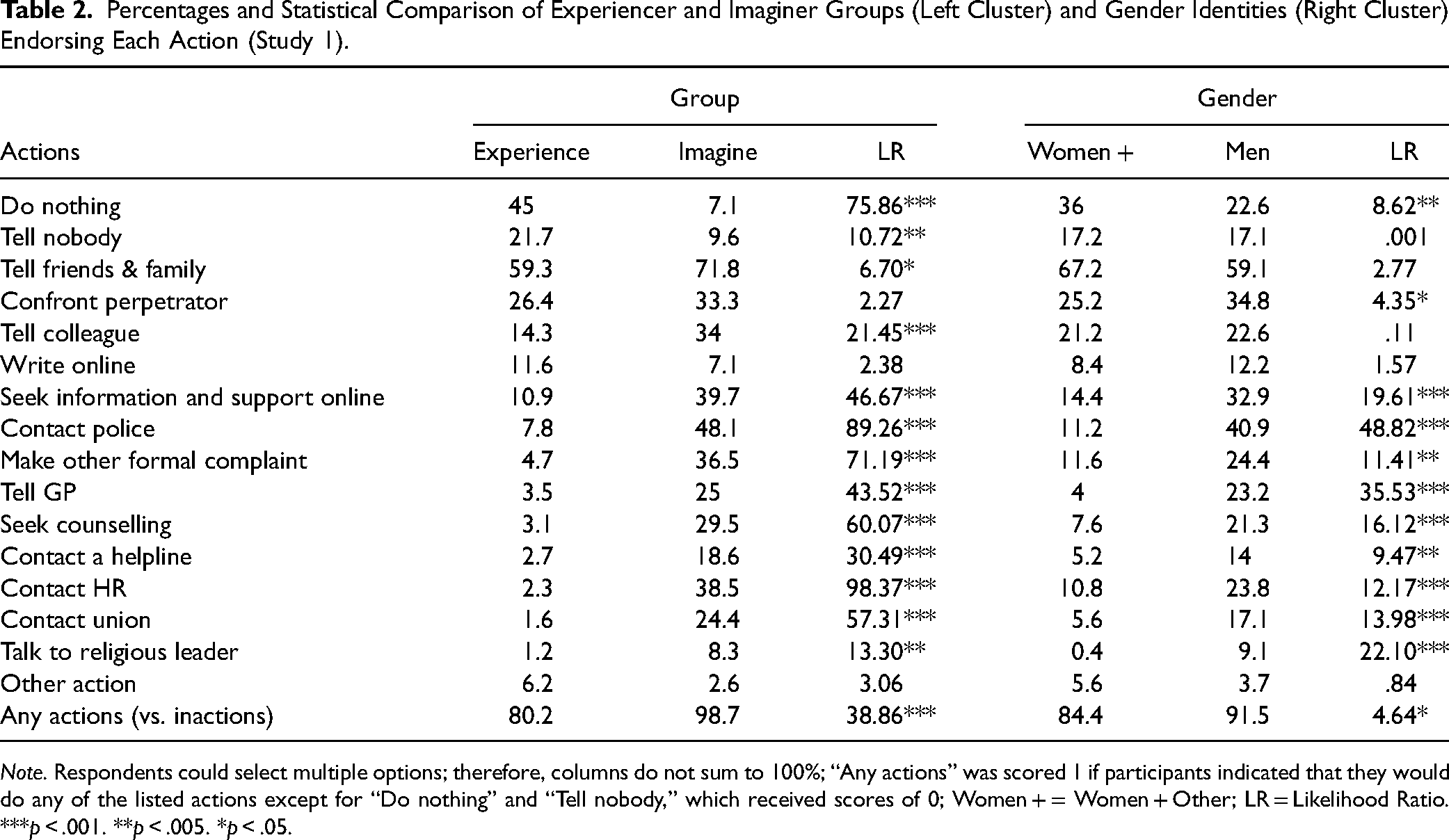
Note. Respondents could select multiple options; therefore, columns do not sum to 100%; “Any actions” was scored 1 if participants indicated that they would do any of the listed actions except for “Do nothing” and “Tell nobody,” which received scores of 0; Women + = Women + Other; LR = Likelihood Ratio. ***p < .001. **p < .005. *p < .05.
Need Satisfaction
After reporting their actions, participants were asked to reflect on the extent to which each of the actions they took (or imagined taking) successfully satisfied (or would have satisfied) their needs. For this, they rated the degree of satisfaction of each of the 13 researcher-generated list of needs, as well as the needs they described themselves in the open question. The degree of need satisfaction was indicated on a scale ranging from 1 (It was not met at all) to 7 (It was met completely). Participants also had the option to indicate N/A: I did not have this need.
To ensure comparability between experienced needs and need satisfaction, we created composite indices following the scale construction previously used for experienced needs. Cronbach's alphas indicated that these composite measures were reliable (αcommunal need satisfaction = .95; ωcommunal need satisfaction = .95; αagentic need satisfaction = .94; ωagentic need satisfaction = .93). Satisfied self-expression needs were again retained as a separate item. 2
Emotions
To provide some index of emotional well-being, participants were first asked to reflect on how they felt (or anticipated feeling) now about the incident via an open-ended question, and then more systematically via the 20-item PANAS scale (Watson et al., 1988). On this scale, Experiencers were asked to rate their current emotions, whereas Imaginers were asked to forecast the extent to which they would feel the emotions on the PANAS scale if they had been sexually harassed in the past. Items included a mix of negative (scared, afraid, tense, nervous, upset, distressed, ashamed, irritable, hostile, guilty) and positive emotions (inspired, enthusiastic, active, proud, strong, excited, determined, interested, attentive, alert). Participants rated how much they felt each emotion on a scale ranging from 1 (strongly disagree) to 7 (strongly agree).
PANAS is typically divided into positive and negative emotion subscales. To check this assumption, we followed the factor analytic procedure outlined above. Here, there was disagreement among criteria: The MAP test suggested three factors, parallel analysis four factors, and principal axis factoring with oblique (oblimin) rotation suggested two factors with eigenvalues greater than one, together explaining 49.63% of variance in emotions. Although the produced factors were not highly correlated, r = −.05, orthogonal rotation (varimax) did not substantively alter the pattern of factor loadings. The two-factor solution produced factor loadings all >.40 and no evidence of cross-loadings. The two factors also mapped onto positive and negative emotion, with the exception that the item alert (typically considered a positive emotion) loaded more strongly with the negative emotion items (loading = .45) than the positive emotion items (loading = .28). In the context of threats to the self, this split loading makes some sense since the meaning of alert is ambiguous: it can mean engaged (positive) or vigilant (negative). The three-factor solution was less interpretable, with the third factor characterized by the single item “alert,” which split between this factor (loading = .47) and the negative emotion factor (loading = .37). Given this is an existing scale, conceived as comprising two dimensions, we prioritized the more easily interpretable two-factor solution. Positive and negative (including alert) emotion scales were reliable (Positive: α = .89; ωs = .83; Negative: α = .89; ω = .90).
Well-Being Measures
We included a number of additional measures to tap participants’ currently experienced (or expected) well-being: life satisfaction, self-esteem, relationship satisfaction, and optimism. Given that these were not central to our study, we describe the measures and patterns of findings in online Supplementary Materials (Section 2).
Analytical Strategy
We first sought to gain a picture of the experiences across the sample by exploring participants’ responses to the open-ended questions. These responses were content coded by the second author to summarize the type of experience reported by participants (e.g., context where it occurred, how many people were involved, whether physical behaviors were present, and who the perpetrator(s) was/were).
We then continued to examine experiences across the sample by computing scores for all measures. Our Research Questions 1 (What do those who are sexually harassed need?) and 3 (Do actions taken satisfy needs?) were first addressed by one sample t-tests comparing rated needs to the scale midpoint (4). Research Question 2 (What actions do those who are sexually harassment take?) was addressed via general linear mixed model (GLMM run in the JAMOVI package via gamlj module), an analysis that treated the 17 possible actions as binary choices nested in individuals. Research Question 4 (How do the needs and actions of those who are sexually harassed relate to the needs and actions perceived by others?) was addressed by analyses that included Group and Gender as factors that might influence reported outcomes. These analyses took the form of 2 (Group: Experiencers, Imaginers) × 2 (Gender: Man, Woman, and Other) multivariate analysis of variance (MANOVA) on the combined measures representing each block of outcomes, that is participants’ needs, need satisfaction, feelings, and well-being. For the analysis of the binary outcome of action taken (or not), the GLMM included Action Type, Group, Gender, and their interactions as fixed factors. For the effect size eta square, arising from the MANOVA analyses, we report 90% confidence intervals, rather than 95%, in keeping with recommendations for F-distributions (Steiger, 2004).
Missing data were minimal (<1.5%) across needs, actions, and emotion measures and were handled through listwise deletion; hence, degrees of freedom vary slightly across analyses. For need satisfaction, missing data were greater (5–11%) since respondents could indicate that they did not have that need (a response that was coded as missing). In response to this, analyses of need satisfaction were checked against analyses using multiply imputed data. The findings reported below remained the same.
Results
Reported actions and significance tests of the differences between these based on Group and Gender Identity are reported in Table 2. Means, standard deviations, and univariate tests of the focal group difference (Experiencers vs. Imaginers) on all other dependent measures are reported in Table 3.
Means (With Standard Deviations) as a Function of Group and Gender, and Univariate ANOVA Statistics for Experience Versus Imagine Comparison (Study 1).
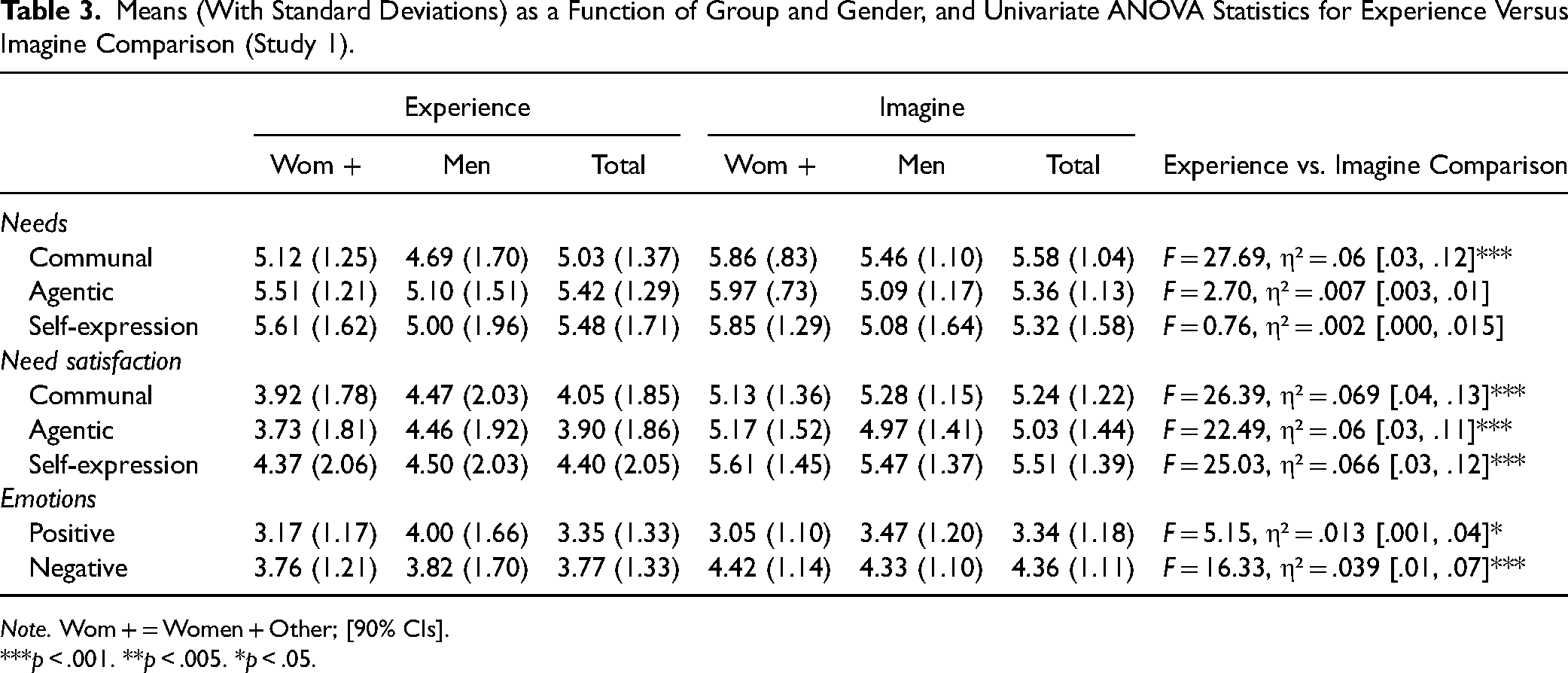
Note. Wom + = Women + Other; [90% CIs]. ***p < .001. **p < .005. *p < .05.
Experiences of Harassment
Participants’ descriptions of harassing experiences revealed that a substantial number of these took place on the street (25.6%) or in workplaces (24%). Only a minority of people (6.6%) reported sexual harassment in the context of a relationship. Reported harassment involved both physical (57.7%) and nonphysical behaviors (28.3%; 14% undisclosed), which were perpetrated equally by strangers (28.7%) and people known to the target (29.8%). The remainder (41.5%) reported multiple perpetrators or did not disclose their relationship to the perpetrator. Although most descriptions consisted of isolated incidents that took place in the past (61.6%), almost a third of respondents reported incidents that were repeated but over by the time of the survey (30.2%), and a small minority reported events that were repeated and still ongoing (8.1%). Although not the focus of our research, these descriptions convey the breadth of sexual harassment as it is experienced—and indicate that our participants were reflecting on a variety of different things when they answered our questions about needs, feelings, and actions taken.
Needs
Regarding what needs those who were sexually harassed indicated (RQ1), single-sample t-tests indicated that all needs were rated significantly above the scale midpoint of 4, both when analyzed as individual items and as scales, and this was the case for both Experiencer and Imaginer groups, all ps < .001. As such, communal, agentic, and self-expressive needs were all (perceived to be) important in response to sexual harassment.
To examine potential differences in experienced versus anticipated needs (RQ4), and to account for the potential effects of gender within this, we conducted a 2 (Group: Experiencers, Imaginers) × 2 (Gender: Men, Women, and Other) MANOVA across communal, agentic, and self-expression needs. This revealed a multivariate effect of Group, F(3, 408) = 10.84, p < .001, η² = .074, 90% CI [.01, .05]. As the univariate tests indicate (see Table 3), Experiencers and Imaginers differed significantly in reported communal needs, but not significantly in agentic needs, or self-expression needs: Experiencers reported less intense communal needs than those who imagined sexual harassment.
The MANOVA also revealed a significant effect of Gender, F(3, 408) = 8.44, p < .001, η² = .058, 90% CI [.01, .04], but no multivariate interaction between these factors, F(3, 408) = 1.33, p = .27, η² = .01, 90% CI [.002, .006]. The gender difference was present on all needs: |Fcommunal (1,410) = 8.42, p = .004, η² = .02, 90% CI [.01, .04], |Fagentic (1,410) = 21.80, p < .001, η² = .05, 90% CI [.03, .10], |Fself−expression (1,410) = 13.36, p < .001, η² = .03, 90% CI [.02, .06]. Relative to men, women (and other) participants reported more communal, more agentic, and more self-expressive needs. There were also no significant univariate interactions involving gender, Fs > .09.
Actions
Examination of the action checklist revealed substantial differences between the Experiencer and Imaginer groups (see Table 2). Regarding what actions those who are sexually harassed take (RQ2), the four most frequently reported actions by Experiencers (in order) were: “discussed the incident with friends and/or family,” “did not do anything about the incident,” “directly confronted the perpetrator(s),” and “told nobody.” The four most frequently selected actions by Imaginers were: “discuss the incident with friends and/or family,” “inform the police,” “search for information and support online,” and “contact HR.” It is noteworthy that only 8% of Imaginers thought that they would not do anything about the incident and that conversely, only 7% of Experiencers reported that they informed the police.
This pattern was explored in more detail via a general linear mixed model, which revealed the main effects of Action Type, χ2(15) = 383.35, p < .001, Group, χ2(1) = 11.41, p < .001, and Gender, χ2(1) = 3.86, p = .049. As is evident in Table 2, the likelihood of taking action depended on the specific action type. Beyond this, Imaginers selected all actions more than Experiencers reported them and men took (or imagined themselves taking) more actions than women (or other) respondents.
These main effects were qualified by significant Group × Action, χ2(15) = 264.12, p < .001, and Gender × Action, χ2(15) = 47.69, p < .001, interactions. The Gender × Group, χ2(1) = 3.52, p = .06, and Gender × Group × Action, χ2(15) = 19.38, p = .197, interactions were not significant. The Action × Group interaction indicates that although Imaginers generally endorsed actions more than Experiencers, this pattern was significantly reversed for the (in)actions of “do nothing” and “tell no one.” Actions of “confront perpetrator,” “write online,” and “other” were endorsed equally across groups. The Action × Gender interaction reflects the fact that while men generally reported that they took (or would take) all actions more than women (and other) participants did (or imagined doing), this pattern was reversed for the (in)action of “do nothing.” Actions of “tell no one,” “discuss with friends and family,” “write online,” “tell a colleague,” and “other” were endorsed equally across gender groups.
To summarize the pattern of actions: Imaginers reported they would engage in more agentic forms of action than Experiencers did; Imaginers were also more likely to report any type of action, and less likely to report inaction, than Experiencers; separately, men reported more actions and less inaction than women (and others).
Need Satisfaction
To examine the extent to which participants felt their needs were satisfied (RQ4), we first compared rated need satisfaction to the scale midpoint (4). This revealed that all needs were rated as being satisfied by the actions taken (i.e., were significantly above the scale midpoint, ps < .001). However, this general pattern was only true for Imaginers (all ps < .001). Experiencers only rated their self-expression needs as being satisfied by the actions taken, p < .001, but not their communal or agentic needs, ps > .21.
To examine the pattern of need satisfaction more systematically we then performed a MANOVA across measures of need satisfaction. This revealed a significant multivariate effect of Group, F(3, 353) = 10.03, p < .001, η² = .079, 90% CI [.01, .05]. Univariate tests (see Table 3) confirmed the presence of significant Group differences across all needs: Relative to Imaginers, Experiencers were less satisfied in all needs.
Beyond the multivariate group effect, there was a weak but not significant multivariate effect of gender, F(3, 353) = 2.56, p = .055, η² = .029, 90% CI [.004, .01] and also no multivariate Group × Gender interaction, F(3, 353) = 2.29, p = .078, η² = .019, 90% CI [.003, .01].
Emotions
To provide some indication of emotional well-being, we explored positive and negative emotions after the (imagined) incident. More elaborated well-being measures are reported in the online Supplementary Materials (Section 2) and revealed the same pattern reported here. MANOVA revealed a significant multivariate effect of Group F(2, 404) = 11.67, p < .001, η² = .055, 90% CI [.02, .09]. As the univariate tests show (see Table 3) this difference was present in both positive and negative emotions. Relative to Imaginers, Experiencers reported less negative emotion and more positive emotion.
In addition to the Group effect, there was also a multivariate effect of Gender, F(2, 404) = 9.44, p < .001, η² = .045, 90% CI [.02, .08], but no multivariate interaction, F(2, 404) = 1.05, p = .35, η² = .005, 90% CI [.00, .02]. At the univariate level, the effect of Gender was evident only on positive emotion, F(1, 405) = 18.65, p < .001, η² = .044, 90% CI [.02, .08], but not on negative emotion, F < 1: Men reported more positive emotions than women (and other) respondents. There were no Gender × Group interactions at the univariate level, ps > .17.
Robustness Checks
When we inspected evaluations of the harassing incident, it was clear that some participants were reporting or imagining events that were positive, neutral, or only somewhat negative to them: only 52% of Imaginers were reflecting on events that were rated as “very negative” compared to 45% of Experiencers, meaning that 48% of Imaginers and 55% of Experiencers were thinking of positive, neutral, or only somewhat negative events. Although the mean difference in incident evaluation between the two groups was not significant, t < 1, there was some evidence that the distribution of responses across the five categories of incident evaluation differed slightly between Imaginers and Experiencers, χ2 = 8.60, p = .07. To ensure that the above-reported differences between Experiencer and Imaginer groups are not simply due to Imaginers having more negative events in mind, we conducted two robustness checks. In the first approach, we simply controlled for incident evaluation in all the analyses reported above. In the second approach, we restricted the sample to include only those who were reporting/ imagining events that were negative (i.e., <3 on the incident evaluation scale).
Although there was variation in the significance of some findings, neither approach led to substantively different conclusions from the analyses reported above (see online Supplementary File for details). With respect to differences between Experiencers and Imaginers, the only effect to become nonsignificant in these analyses was on positive emotion. Given the persistence of a difference in negative emotion, this does not alter the conclusion that Experiencers show a less negative emotion profile than Imaginers. As such, the pattern of reported differences appears relatively robust and is not simply an artifact of differences between type of events that are imagined versus experienced—at least in so far as we can determine this.
Discussion
In this study, we explored real versus imagined needs, actions, needs satisfaction, and positive and negative emotions in response to sexual harassment, and we observed a divergence in perspective across these indicators. In response to our first overarching research question (RQ1), the needs of those who had been sexually harassed were wide ranging, encompassing agentic, communal, and self-expression needs. All need ratings in this subsample were above the scale midpoint. Moreover, the open-ended responses (summarized in the online Supplementary Materials) suggested additional needs that were not captured by those covered in our scale, especially needs for safety. Interestingly, those who had experienced sexual harassment overall reported less intense needs than what others imagined (specifically with respect to communal needs).
In terms of what actions those who have been sexually harassed actually take (RQ2), again a wide range of actions were reported. Among this group, the four most frequently reported actions being to discuss the incident with friends and/or family, not do anything about the incident, directly confront the perpetrator(s), and telling nobody. In comparison, the actions that were anticipated by the Imagination subsample were more focused on formal responses. Indeed, in comparison with Imaginers, those had experienced sexual harassment were less inclined to take any given form of action (and were more inclined to simply “do nothing”). Thus, similar to the multiplicity of needs, our data highlight the multiplicity of actions taken by those who experience sexual harassment, and the low prominence of formal actions among this group compared to what others might expect. Regarding need satisfaction (RQ3), although participants generally expected to be satisfied by whatever actions they took, Experiencers felt less satisfied by the actions they took than was forecast by Imaginers and were overall only satisfied with their need for self-expression.
Speaking to our fourth research question (RQ4), the results, therefore, paint a fairly consistent picture in which those who experience sexual harassment neither need nor do what others might expect if they were in the same situation (with effect sizes ranging from small to medium). Curiously, however, those who had experienced sexual harassment also reported less negative current emotions than those who imagined how they would feel if they had an experience of sexual harassment. This suggestion of enhanced emotional well-being among Experiencers was also reflected in more general measures of well-being (reported in the online Supplementary Materials).
Although there were gender differences across many of our measures, it is important to note that the observed divergence in perspective was not reducible to these: Perspective differences emerged independent of gender differences and were typically not qualified by interactions with gender. Similarly, the divergence in perspective was not reducible to the valence of events that respondents experienced versus imagined: Although people imagined events that were more negative than those experienced by others, differences in perspective persisted when valence was controlled or when analyses were restricted to those recalling/imagining experiences that were exclusively negative.
In summary, then, the findings of this first study highlight two important points: First, people have multiple psychological needs after they have been sexually harassed, needs that might guide their actions in directions that seem surprising to onlookers; second, there are substantive discrepancies between real and anticipated responses to sexual harassment, which are likely to have consequences in contexts where the credibility of those who report these experiences is evaluated.
But the findings also raise interesting further questions. The elevated current feelings and well-being of Experiencers relative to Imaginers are surprising given the psychological, physical, and job-related consequences that sexual harassment is known to have (e.g., Chan et al., 2008). There are many plausible explanations for this particular result. For example, it is possible that people experience emotional numbing as a result of the incident, and therefore, become less reactive to their negative experiences (Feeny et al., 2000). Alternatively, it could be that the incident leads them to adopt a new outlook on life and appreciate their relationships more (i.e., experiencing post-traumatic growth; Tedeschi & Calhoun, 2004). However, the explanation could also be something more banal: In asking questions about these outcomes, Imaginers were reminded to answer with respect to their imagined experience, whereas Experiencers were not prompted in this way and answered more globally. Reminding Imaginers to answer with a past experience of sexual harassment in mind might have created the apparent difference between groups with respect to questions of broader well-being. We follow this up in the next study.
Study 2
The purpose of our second study was three-fold. First, we wanted to replicate the findings of Study 1, and in particular, the observed divergence between those who experience versus imagine sexual harassment. Responsive to the open-ended data (see online Supplementary Materials), we also wanted to refine our measure of needs to ensure that we were capturing the needs that were actually important in the context of sexual harassment. Needs for safety, in particular, were figured in the open-ended responses in Study 1 but were overlooked in the scale we used. Finally, we also wanted to test whether the superior emotional well-being outcomes among Experiencers relative to Imaginers of sexual harassment represented a genuine effect, versus an artifact of how we posed our question to the latter group (i.e., reminding them to answer with the imagined experience of sexual harassment in mind).
Because gender did not qualify any of our previous findings, and because women are overrepresented among those who have experienced sexual harassment, we only recruited women to participate in this second study. Our research questions remained the same as for Study 1: What needs do individuals who are sexually harassed have? (RQ1); What actions do they actually take in response to sexual harassment? (RQ2); To what extent do people feel that the actions they have taken have satisfied their needs? (RQ3), and; How do the needs and actions of those who experience sexual harassment relate to what is expected by others who have not experienced sexual harassment? (RQ4). Although we continue to phrase these as overarching research questions, furnished with the data from Study 1, we clearly also have expectations about the pattern of results. Specifically, we hypothesized that Experiencers would report less intense needs than Imaginers (Hypothesis 1a) and would report engaging in fewer actions (of any kind) than would Imaginers (and be more inclined to report inaction; Hypothesis 1b).
Method
Participants
The study was conducted during September and October 2018. A sample of 600 adult women was requested via Prolific. Inclusion in this study was based only on whether or not the participant identified as a woman in the Prolific database. More detailed information about gender identity was not requested. As such, we do not know how many of these women identified as cisgender or transgender. Participants were paid £1.17 (∼UD$1.52) for completing the survey, which was slightly longer than Study 1. We received 606 responses, of which 589 completed the survey leaving a sample of 589 for analysis. Just over half of this sample reported that they had experienced sexual harassment (51.1%, n = 301; Experiencers). The remainder (48.9%, n = 288; Imaginers) reported that they had not experienced sexual harassment. In this survey, age was assessed in six categories. The largest age group was 25–34 (42% of the sample) followed by 18–24 (22.6%) and 35–44 (21.4%). Over half of our sample was from the UK (54.2%), followed by Europe (28.2%) and North America (9.5%), with very few responses from other regions. Information about race/ethnicity was also not requested from participants in this study.
Procedure
The study was approved by the Psychology Ethics Committee of the University of Exeter. The survey was programmed on Qualtrics and advertised as a study of “Responses to sexual harassment.” Upon clicking on the survey link, participants received the same background information as provided in Study 1. Respondents gave their consent to participate based on those terms.
As in the previous study, participants first answered questions establishing whether they had previously experienced sexual harassment and eliciting details of that experience (or how they imagine such an experience to be if they had no experience). Participants completed a common set of measures on which Experiencers answered with respect to their experience; whereas Imaginers answered with respect to what they anticipated if they had been sexually harassed. Unlike the previous study, a final set of questions about well-being were answered by all participants in relation to how they felt at the time of the survey (i.e., with no prompt to answer in relation to any real or imagined experience of sexual harassment). After completing the measures, participants provided demographic details including age group and nationality. Finally, participants were debriefed and given information about sources of support if they felt distressed as a result of taking part in the survey.
Measures
Incident Description and Evaluation
In this study, we asked participants to describe their real or imagined experience of sexual harassment via four multiple-choice questions rather than an open-ended format. These questions were based on the descriptions that were provided by participants in Study 1 and answers are summarized in Table 4. Following their description, participants rated the valence of their (imagined) experience of sexual harassment on a 5-point scale (1 = very negative, 5 = very positive).
Percentages of Experiencer and Imaginer Groups Describing Different Features of (Imagined) Harassment Experiences (Study 2).
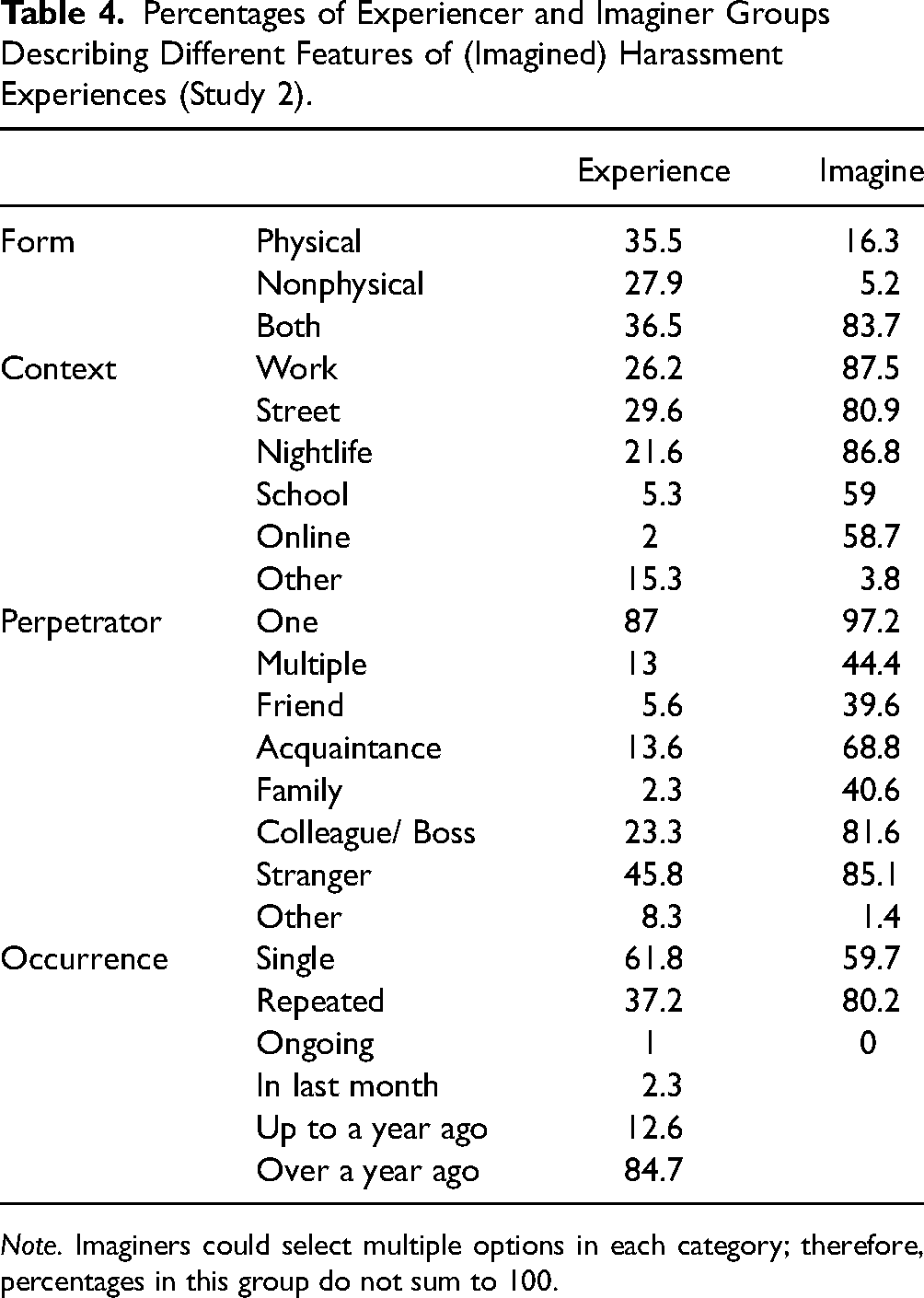
Note. Imaginers could select multiple options in each category; therefore, percentages in this group do not sum to 100.
Needs, Actions, and Need Satisfaction
These measures were all similar to the previous study, with some minor adjustments. Specifically, we added items to the previous need (and need satisfaction) scale to expand existing concepts or to add untapped needs that seem important but missing based on the open-ended responses (see Supplementary Materials). For example, we expanded items tapping need for justice (e.g., to make a formal complaint, to confront the perpetrator, and to get an apology from them), as well as the needs to be believed, to be supported, to talk to someone, and for things to get back to normal (all mentioned in open-ended responses to Study 1). We especially added items to capture needs for safety, which emerged strongly in open-ended responses from Study 1 but were not addressed previously (including to feel safe, to get away from the perpetrator). Finally, we altered the wording of some previous items (e.g., “to feel powerful” was adjusted to “to feel less powerless”; “to feel valued” was replaced with “to feel respected”). The new list covered 22 individual needs (see Table 5 for a full list). From the action checklist we removed from the item “spoke with a religious leader” since this was selected by only 3.8% of participants in Study 1, resulting in a total of 16 actions. See Table 6 for actions.
Rated Individual Needs and Factor Loadings for Composite Measures (Study 2).
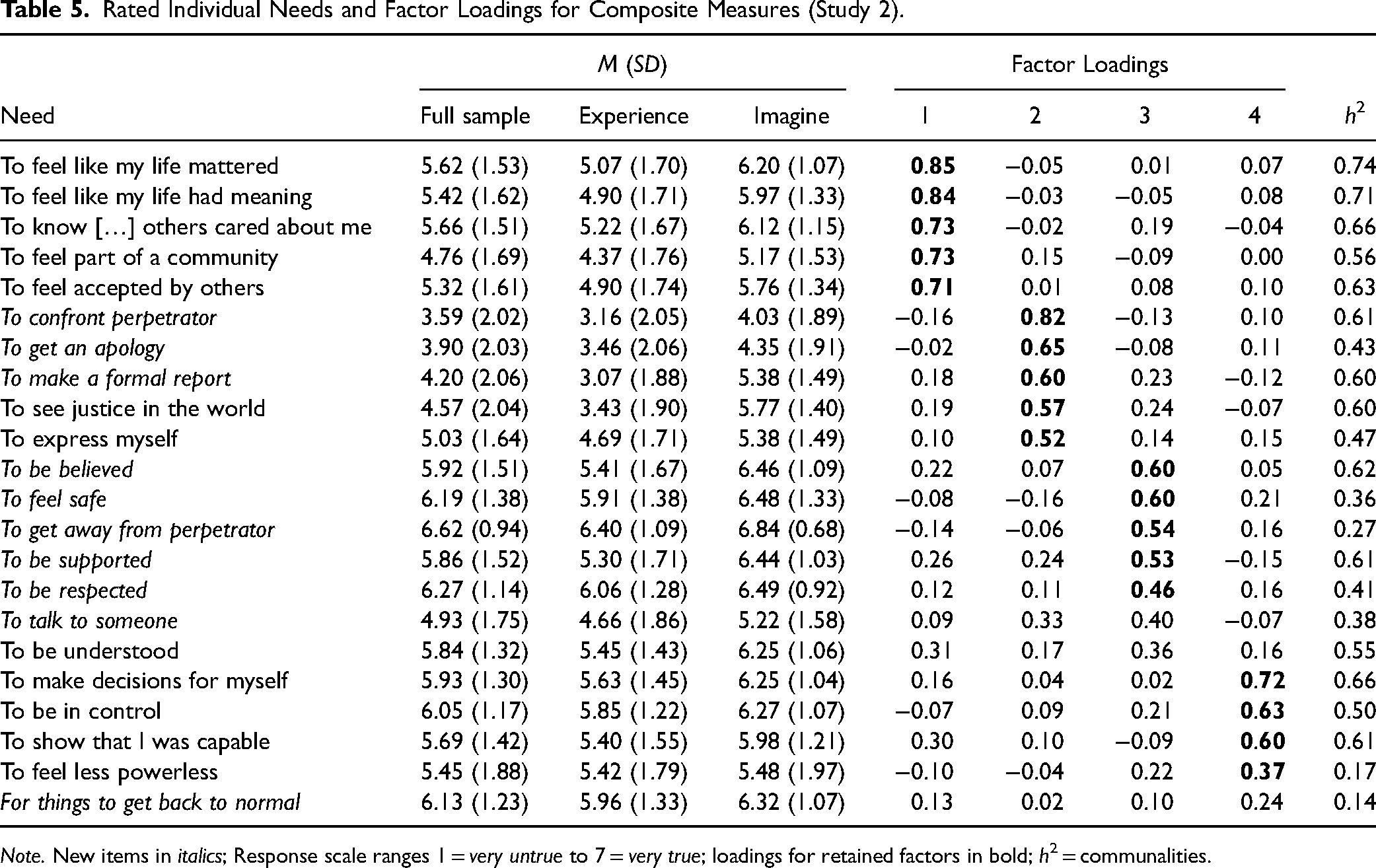
Note. New items in italics; Response scale ranges 1 = very untrue to 7 = very true; loadings for retained factors in bold; h2 = communalities.
Percentages and Statistical Comparison of Experiencer and Imaginer Groups Endorsing Each Action (Study 2).
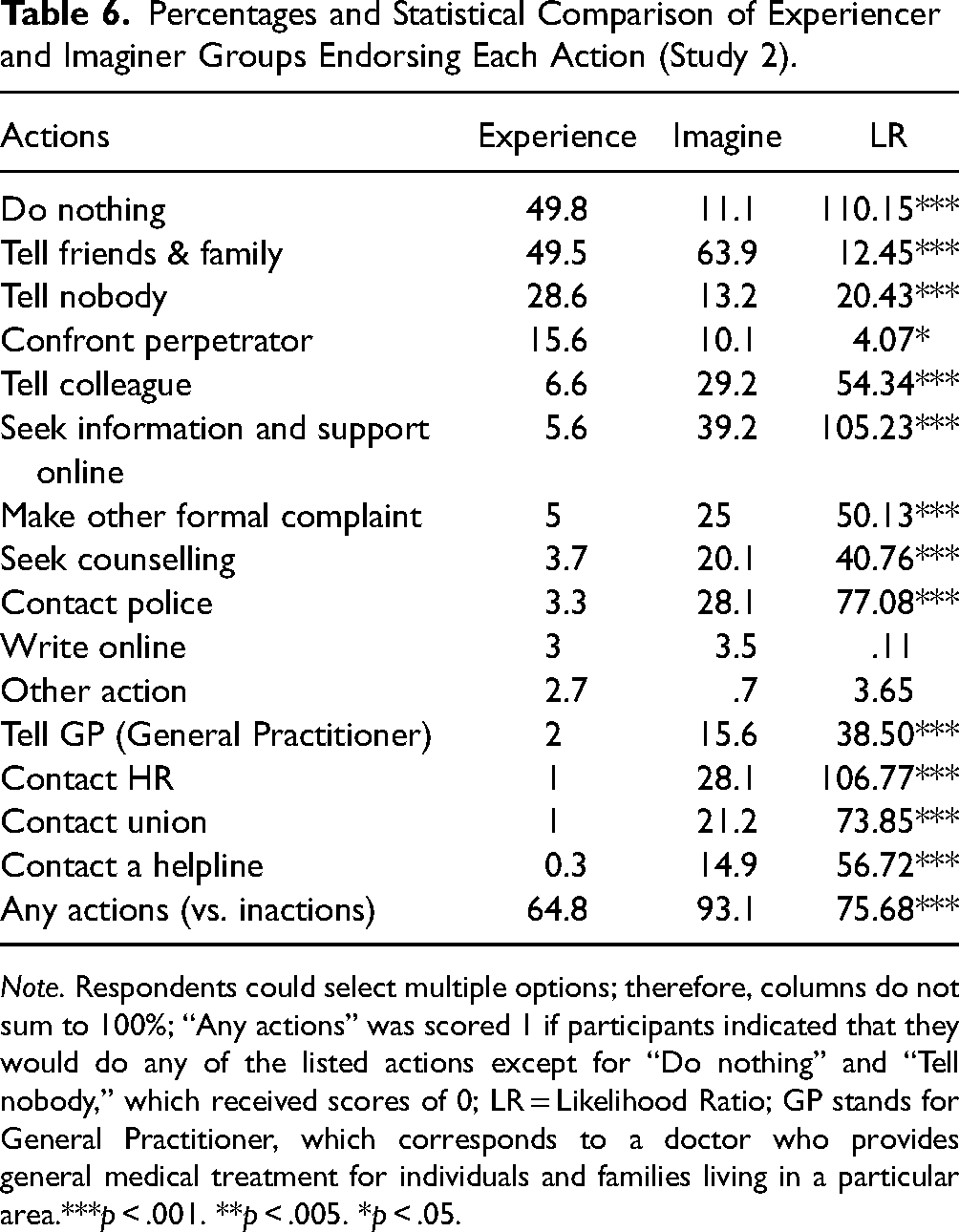
Note. Respondents could select multiple options; therefore, columns do not sum to 100%; “Any actions” was scored 1 if participants indicated that they would do any of the listed actions except for “Do nothing” and “Tell nobody,” which received scores of 0; LR = Likelihood Ratio; GP stands for General Practitioner, which corresponds to a doctor who provides general medical treatment for individuals and families living in a particular area.***p < .001. **p < .005. *p < .05.
Again, we used exploratory factor analysis to reduce the 22 measured needs prior to analysis, guided by a number of criteria to determine the factors to retain: eigenvalues >1, parallel analysis, and Velicer's MAP test. The MAP test suggested four underlying factors, parallel analysis suggested five, whereas there were only two factors with eigenvalues > 1. The five-factor solution, which explained 54.44% of the variance across items, was characterized by a number of items with split loadings across the first and second factors, the item “to express myself” split across two factors (loadings of .38 and .37 on factors 1 and 3, respectively), and the item “for things to return to normal” not loading on any factor. Accordingly, we explored a 4-factor solution suggested by the MAP test. This explained a similar amount of variance across items, 51.34%, and produced a cleaner factor structure, with most items loading >.40 on their primary factor (see Table 5 for factor loadings), with the exception of the items “to be understood” and “to talk to someone,” which showed low and split loadings across factors, and “for things to return to normal” which continued not to load on any factor.
The four factors were also interpretable. The first factor was dominated by the items: “to feel like my life mattered,” “to feel like my life had meaning,” “to feel that there were others who cared about me,” “to feel part of a community,” and “to feel accepted by others.” This factor is similar to the Communal Needs factor in Study 1, and we labeled it accordingly. The second factor was dominated by the items: “to confront the perpetrator,” “to get an apology from the perpetrator,” “to make a formal report,” “to get justice,” and “to express myself.” We labeled this factor Justice Needs. The third factor was dominated by the items: “to be believed,” “to feel safe,” “to get away from the perpetrator,” “to be supported,” “to be respected,” “to talk to someone,” and “to be understood” (although the last two items, respectively, loaded on the Justice and Communal Needs factors). We labeled these Safety Needs. The fourth factor was dominated by the items: “to make decisions for myself,” “to be in control,” “to show that I was capable,” and “to feel less powerless.” This factor was similar to the Agentic Needs factor in Study 1, and we labeled it accordingly. The single item, “for things to return to normal” continued not to load on any factor, and the items “to talk to someone” and “to be understood” from the safety needs factor also respectively loaded on the justice and communal needs factors. Removing these three items improved the clarity of the factors structure, with all items loading >.36 on their primary factor, and no split loadings within a distance of .10. The two-factor solution, suggested under the eigenvalues <1 decision rule, explained less variance (40.82%) and compressed all factors together except the justice factor, which remained separate.
Given the interpretability of the four-factor solution and its superiority in accounting for item variance, we retained these factors and created scales based on the suggested items. Scores on these scales showed good reliability: communal needs (α = .90; ω = .89), justice needs (α = .82; ω = .80), safety needs (α = .76; ω = .77), and agentic needs (α = .71; ω = .71). Given that our focus was not on developing a new “needs” scale but on identifying the multiple needs of our participants, we opted to retain and analyze the items that did not load on any scale. These were the needs for things to return to normal, to talk to someone, and to be understood, which were retained as single items. Higher scores indicated higher agreement with experiencing each need.
To preserve comparability across scales, we clustered the needs satisfaction items together based on the factors we created for the needs scale. Cronbach's alpha reliabilities were high for all factors: communal needs satisfaction (α = 95; ω = 95), agentic needs satisfaction (α = .91; ω = 91), justice needs satisfaction (α = .89; ω = .89), and safety needs satisfaction (α = .87; ω = .89). Satisfaction of the needs for things to return to normal, to talk to someone, and to be understood were again represented by single items. Higher scores indicated higher agreement with experiencing each need.
Emotions
Like Study 1, real and anticipated emotional well-being was assessed using the 20-item PANAS scale (Watson et al., 1988). 3 Unlike the previous study, Experiencers were asked to rate their current feelings, as they recalled the sexually harassing incident (rather than more globally). Imaginers were instead asked to estimate the extent to which they would experience each emotion if they had been sexually harassed in the past.
To check the typical two-factor structure, we followed the same procedure as for needs. The MAP test and parallel analysis both suggested three factors; however, only two factors had eigenvalues > 1. The two-factor solution produced the assumed subscales of positive and negative emotions. All individual items loaded >.40 on their respective factor, except “alert” which loaded across the positive (.41) and negative emotion (.36) factors. The three-factor solution differentiated enthusiasm (enthusiastic, excited, inspired, proud) from attentiveness (attentive, determined, active, alert, strong). Although this was also interpretable, there were split loadings for the items guilty (which loaded on all factors) and interested (which loaded on both positive factors). Accordingly, following the criteria of parsimony, we retained the two factors intended by the original scale. Although the item “alert” loaded slightly higher on the positive factor, since it loaded equally strongly on the negative factor we chose to include it in the latter to maintain consistency with the previous study. Both these scales were reliable (Positive: α = .88; ω = .88; Negative: α = .89; ω = .90).
Well-Being Measures
As in Study 1, we included more elaborated measures of individual well-being, as well as scales indexing post-traumatic growth and emotional reactivity and numbing. These are reported in the online Supplementary Materials (Section 2).
Analytical Strategy
Our analytic strategy was the same as the previous study. First, we examined the type of events participants described. We then compared rated needs and need satisfaction to the scale midpoint to address RQs 1 and 3. More systematic analyses, via MANOVA or GLMM in the case of action, then compared outcomes across groups. These comparisons also address our Hypothesis 1 (a and b).
Missing data were minimal (<.3%) across needs, actions, and emotion measures and were handled through listwise deletion; hence, degrees of freedom vary slightly across analyses. For need satisfaction, missing data were again greater (1–9%) since respondents could indicate that they did not have that need. Analysis of need satisfaction using multiply imputed data confirmed the findings reported below.
Results
Means and standard deviations for all dependent measures and univariate significance tests for the focal group comparison are reported in Table 7.
Means (and Standard Deviations) and Univariate ANOVA Statistics for All Dependent Measures (Study 2).
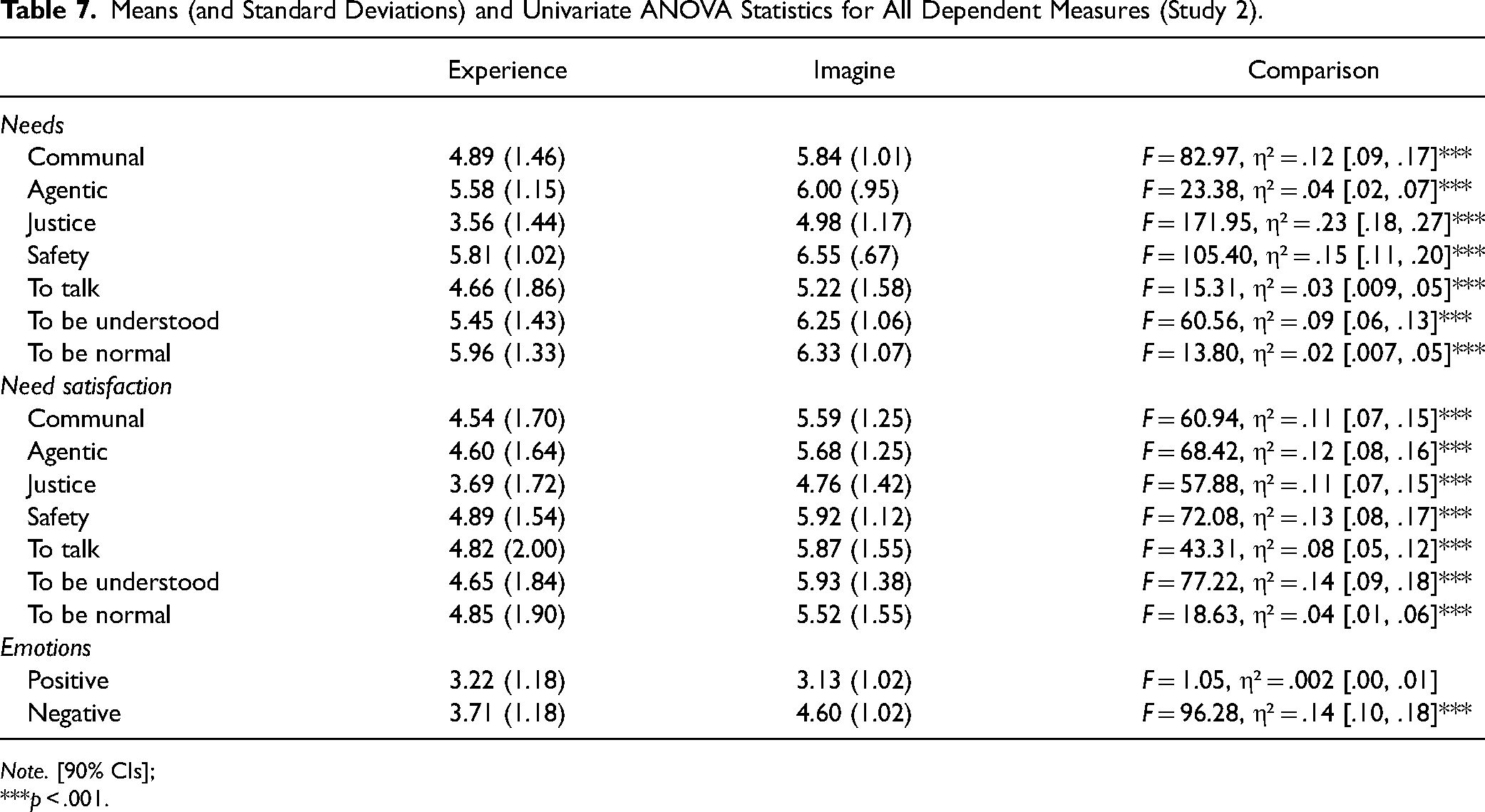
Note. [90% CIs]; ***p < .001.
Experiences (and Expectations) of Harassment
Both Experiencers (M = 1.52, SD = .61) and Imaginers (M = 1.22, SD = .49) described events that were rated as clearly negative. Nonetheless, and as in Study 1, the measure of incident evaluations revealed that Imaginers had in mind more negative incidents than what Experiencers were reporting on, t (587) = 6.58, p < .001. As can be seen in Table 4, Experiencers reported events that mostly involved some kind of physical harassment, that took place in a variety of contexts, that mostly involved one perpetrator who was a stranger, and that were one-off experiences that had taken place over a year before the participants completed the survey. Imaginers also consider harassment to be mostly physical, to take place across contexts, and to be perpetrated by single strangers but were more inclined to imagine these as repeated rather than singular incidents.
Needs
As in Study 1, to gain some insight into the needs of those who have been sexually harassed (RQ 1), we first compared rated needs to the scale midpoint of 4 via single-sample t-tests. Again, all four composite need measures—communal, agentic, safety, and justice needs—and the single item needs to talk, to be understood, and for things to go back to normal—were rated significantly above the scale midpoint of 4, ps < .001. However, this again varied between Imaginer and Experiencer groups: For Imaginers, all needs were significantly above the scale midpoint, ps < .001; For Experiencers, communal, agentic, safety needs, and the single-item needs were also all significantly above the scale midpoint, ps < .001, but the need for justice was significantly below the scale midpoint, p < .001. As such, communal, agentic, and safety needs were all important in response to sexual harassment. However, while the need for justice was perceived to be important by those who only imagined an experience of sexual harassment, for those who actually experienced this justice was distinctly not important.
To further examine support for RQ3, a MANOVA compared groups across the four needs scales and the single-item needs to talk, to be understood, and for things to go back to normal. This revealed a multivariate effect of Group, F(7, 580) = 34.88, p < .001, η² = .30, 90% CI [.24, .34], an effect that was also present in all univariate tests. In all cases, reported needs were lower among Experiencers than Imaginers, an effect that was especially strong in the case of justice needs. This pattern supports Hypothesis 1a.
Actions
Relevant to RQ2, the four most reported actions by Experiencers were: “did not do anything about the incident,” “discussed the incident with friends and/or family,” “did not tell anyone about the incident,” and “directly confronted the perpetrator.” All other forms of action were selected by less than 10% of this group, including formal actions such as filing a complaint, contacting the police, or contacting HR. However, similar to our previous study, and relevant to RQ4, the action checklist revealed discrepancies in perspective (see Table 6) and the anticipated actions of Imaginers look very different. The four most frequently anticipated actions were: “discuss the incident with friends and/or family,” “search for information and support online,” “discuss the incident with a colleague,” and “contact police”/“contact HR” (nominated equally frequently). Only a small minority anticipated that they would tell no one (13.3%) or do nothing (11.3%) about the incident.
To further respond to RQ4, the pattern of actions was explored via a general linear mixed model (GLMM run in the JAMOVI package via gamlj module). This analysis revealed main effects of Action Type, χ2(14) = 737.27, p < .001, and Group, χ2(1) = 100.82, p < .001, as well as a Group × Action Type interaction, χ2(14) = 427.36, p < .001. As is evident in Table 6, the likelihood of taking action depended on the specific action type. Beyond this, Imaginers selected all actions more than Experiencers reported them (i.e., the main effect of Action Type), but this pattern was reversed with respect to the (in)actions of “do nothing” and “tell no one” (as in Study 1) as well as the action of “confront the perpetrator” (new to this study). The actions of “write online” and “other” did not differ between groups. Summed up simply: Imaginers were more likely to think they would do almost anything, whereas experiencers were more likely than imaginers to do nothing (except confront the perpetrator). This pattern generally supports Hypothesis 1b, with the exception of the single action of confrontation.
Needs Satisfaction
RQ3 was again first addressed by comparing rated need satisfaction to the scale midpoint (4). This revealed that all needs were rated as being satisfied by the actions taken (i.e., were significantly above the scale midpoint, ps ≤ .002). Although this general pattern was true for Imaginers (all ps < .001), Experiencers rated all needs as satisfied (i.e., above the scale midpoint, p < .001) except the need for justice, which was significantly below the scale midpoint, p = .003.
Next, addressing RQ4, a MANOVA more systematically compared groups across the need satisfaction indices, which revealed a significant multivariate effect, F(7, 487) = 13.76, p < .001, η² = .17, 90% CI [.11, .20], an effect that was present on all univariate tests. Across all needs, participants who experienced sexual harassment reported less satisfaction than was expected by those who imagined experiencing sexual harassment.
Emotions
As in the previous study, to provide some indication of emotional well-being in response to the (imagined) experience of sexual harassment, we analyzed the PANAS measures. A MANOVA across positive and negative emotion scales revealed a significant multivariate effect of Group, F(2,586) = 49.86, p < .001, η² = .15, 90% CI [.10, .19]. At the univariate level, this effect was present only on negative emotion, but not on positive emotion. As in Study 1, participants who experienced sexual harassment expressed less negative (but not more positive) emotion than participants who only imagined experiencing sexual harassment. Although this suggests that the pattern of enhanced well-being among experiencers observed in Study 1 is not an artifact of the question context, analyses of more general well-being measures (reported in Supplementary Materials Section 2) showed no differences between Experiencers and Imaginers. As such, this finding should be interpreted with caution, and it remains plausible that the observed pattern in Study 1 was a methodological artifact.
Robustness Checks
As noted above, and similar to Study 1, Imaginers were more likely to report on very negative events than Experiencers were, something that could account for their divergent perspective. Again, we addressed this in two ways: (a) controlling for the incident evaluation in the analyses and (b) restricting the analysis to those who were reporting on or imagining events that were exclusively negative. Both methods produced very few differences from the results reported above and did not affect the overall conclusions (see online Supplementary File for details).
Discussion
Study 2 replicated most of the results of Study 1. First, in response to our first two research questions, individuals who were sexually harassed reported a wide variety of needs and actions. However, we again found that these needs and actions differed from those anticipated by Imaginers. In fact, in this study, we see an even more pronounced divergence in the perspective of those who have experienced sexual harassment versus those who imagine themselves in a similar situation, with effect sizes ranging from small to large across the dependent measures (compared to the small to medium effects observed in Study 1). Responding to RQ4, compared to those who imagined their reactions to sexual harassment, experiencers of sexual harassment reported needing less, doing less, feeling less satisfied by the actions they took, but feeling less negative about their experiences. In line with the argument we outlined in the introduction, despite their relative lack of needs (Hypothesis 1a), our data support our general contention that, following an incident of sexual harassment, people are likely to experience a variety of needs, of which the expected need for justice is only one. Reflecting the open-ended needs listed by Study 1 participants, Experiencers in this study rated the need for safety as most important relative to all other needs, and the need for justice as the least important. Despite the discrepancy in intensity of needs, the overall ranking of needs was similar across Imaginer and Experiencer groups: Imaginers also perceived safety to be most important and justice least important. Thus, Imaginers might have a fairly accurate impression of the overall need priorities; they just misperceive the intensity of those needs.
As for Study 1, the more striking discrepancy was between what Experiencers did and what Imaginers thought they would do in the same situation. In contrast to all the actions that Imaginers thought they would take, Experiencers were most likely to report doing nothing. In line with Hypothesis 1b, Experiencers reported fewer actions than did Imaginers. The actions Experiencers were inclined to take were also mostly informal (e.g., talking to friends and family) rather than formal (e.g., filing a complaint or contacting the police). Unsurprisingly, given their expected agency, Imaginers also anticipated that all their needs would be significantly more satisfied than Experiencers themselves felt. It could be suggested that this difference is due to the actions Experiencers engaged in not being the most effective. However, it is noteworthy that safety and the need for things to go back to normal were Experiencers’ two highest needs, and they were also the two most highly satisfied. This suggests that our Experiencers did take actions (or inactions) that were effective for them—that is, actions that satisfied the needs they had (RQ 3).
Although the pattern of heightened emotional well-being observed among Experiencers in Study 1 was replicated in Study 2, at least with respect to negative emotion, a wider set of well-being measures did not reveal this pattern (see online Supplementary Materials Section 2). As such, it remains plausible that this finding is due to an artifact for question wording in Study 1. When Experiencers and Imaginers answer with respect to the here and now (and not explicitly in relation to any real or imagined harassment experience), they displayed overall similar well-being profiles, although they did still appear to differ in the negative mood with Experiencers being less negative than Imaginers. This latter—and the overall pattern of well-being—might still reflect resilience in the experience group, since they have endured a negative experience—something future research might wish to examine.
General Discussion
In this article, we started by asking the following question: What do individuals who are sexually harassed need? (RQ1) In response to this question, across two studies we found that people who have experienced sexual harassment report a variety of needs, not just a need for justice. We also asked what actions those who are sexually harassed actually take in response to their experience (RQ2) and found that they take very few formal actions. Despite taking fewer actions, those who had experienced sexual harassment nonetheless felt that the needs they had were satisfied by those actions that they did (or did not) take (RQ3). Our final research question (RQ4) focused on whether the needs and actions experienced by those who were targeted by sexual harassment differed from what those who did not have these experiences would anticipate. We indeed found that Experiencers’ needs and actions contrasted sharply with what people who have not had this experience imagine they would need and how they imagine they would behave in the same circumstances. Those who imagined themselves having experienced sexual harassment imagined that they would be much more agentic (i.e., take more actions overall), and that they would take formal actions like reporting the incident to employers and the police.
Past research has also compared the perspectives of Experiencers and Imaginers in relation to gender-based treatment (Shelton & Stewart, 2004; Woodzicka & LaFrance, 2001). However, this contrasting of perspectives has been limited to only a small number of responses (e.g., anger and confrontation). This offered some grounding to our expectation of perspective divergence in these studies. But our studies also extended previous insights by demonstrating that Imaginers anticipate taking more action than Experiencers—of any type, not only actions that are relatively assertive—and by widening the focus by considering the underlying needs on which actions are based (c.f., Van Prooijen & Kerpershoek, 2013). Finally, although we did find that Experiencers reported overall less need satisfaction than Imaginers, it is important to again emphasize that the needs Experiencers reported having were the ones that were most satisfied by their (in)actions. The combined insight from these studies is that those who are targeted by sexual harassment might not always need what others expect them to need, and consequently might not behave in the way that they are expected. However, the actions that they do take may be effective for them because they satisfy the needs that they actually have—which are primarily to feel safe and for life to return to normal.
These findings have implications for research in this (and other) areas. Most broadly, our findings clearly point to a need to interrogate the assumptions that underlie the questions typically asked of those who have experienced sexual harassment (both by researchers and in the public domain). Such questions often presume specific and singular needs (e.g., for justice) and ask why specific and singular actions (e.g., reporting) were or were not taken. Yet, multiple models of human needs remind us that these are plural (e.g., Deci & Ryan, 2008; Maslow, 1943; Sheldon et al., 2001) and that different needs imply different courses of action (e.g., Sheldon & Gunz, 2009). Accordingly, instead of asking why those who experience sexual harassment do not come forward more often, we should question the assumption that “coming forward” is necessarily the only, or even the best, action in response to this experience and the variety of individual needs it might generate. Our research also points to the need to continue being open about whether existing theoretical models or scales capture all the needs that are relevant in a specific context or point in time. The inclusion of open-ended questions in Study 1 revealed important needs (specifically for safety) that we had overlooked—and that in Study 2 proved to be important for understanding sexual harassment experiences and responses.
Although we were initially surprised by the degree of overestimation of needs and negative feelings among those who imagined experiences of sexual harassment, these findings tie in with a large body of literature on affective forecasting. In a review of the literature on affective forecasting, Blumenthal (2009) argued that people usually perform accurate predictions about the valence and type of emotions they might experience in some future event. However, people are prone to make substantial errors when predicting the intensity and duration of their emotional experiences, both of which tend to be overestimated. Our results seem congruent with this idea: Imaginers correctly predicted the multiplicity of needs they might have following an experience of sexual harassment, and they prioritized needs similar to those who had this experience; however, they overestimated the intensity of all needs.
The phenomenon of affective forecasting has also been connected to other forms of gender-based treatment, such as sexism and objectification. For example, Bosson and colleagues (2010) found that people mispredict women's emotional responses to sexism—both overestimating the intensity and duration of responses to hostile sexism and underestimating the intensity and duration of responses to benevolent sexism. Similarly, research on sexual objectification has found that those who imagine being sexually objectified estimate its consequences to be more negative than those who have the same experience (Wiener et al., 2013). Such findings do not deny the negativity of these experiences, but instead, speak to the individual's capacity to cope—and to do so more effectively than others might expect.
The results of these studies further highlight that the experience of sexual harassment is not straightforward, and as such that it is unlikely to be captured by one “reasonable response.” What is reasonable and useful for each person depends on a number of factors, including their own psychological needs. Yet, onlookers do seem to have a clear idea about what they would reasonably do if they were in this situation—that is take swift formal action—and that they would expect to feel satisfied by those actions. Given the discrepancies between real and imagined needs and actions, it seems precarious—or perhaps even irresponsible—to allow onlookers to freely imagine what they would do and use that as the yardstick against which reasonableness is assessed. Instead, the reasonability of responses could be informed by the collective reactions of those who have experienced sexual harassment, while also acknowledging that each person and each case are unique and different.
Limitations
There are several limitations to both these studies. First, we accepted Experiencers’ retrospective recollections of their needs after sexual harassment as “reality” and the standard against which we compared Imaginers’ expectations. It is, of course, possible that people's reports of their responses were affected by recall biases or distorted by the emotionally charged nature of their experience. Emotions and memory can interact in complex and nonlinear ways (Christianson & Safer, 1996), and as such there are reasons to doubt whether people can accurately say exactly how they felt in the moment when they recall it from a distance. On the other hand, some studies suggest that emotionally intense experiences are generally well remembered (e.g., McGaugh, 2004; Talarico et al., 2004) and findings around people's ability to accurately remember their emotions are overall mixed. In the absence of clarity around this issue, and of objective indicators, we choose to accept Experiencers recollections and still find these an important standard against which to compare the expectations of others. Experiencers’ self-reported needs also intuitively connect to the actions they reported taking. For example, it makes sense that people who experienced a low need for justice did not take any actions that aimed to achieve justice. Said differently, there is at least an overall coherence to people's reports across multiple indicators.
In these studies, we chose to allow participants to define what qualified as sexual harassment. Although this approach has advantages, it also has drawbacks. For example, it could be that Imaginers considered very different events than those experienced by the other group—and that these differences explain why these two groups reported different needs, actions, and need satisfaction. To a certain degree, we have mitigated against this problem by measuring evaluations of the event and showing that the results remain the same when this is controlled for. However, as long as imagining is unconstrained, there will always be differences between what happened to one person and the events that are anticipated by someone else.
Despite this limitation, a different choice of method would also have had drawbacks. Indeed, if we had chosen to present participants with a specific form of sexual harassment, this would have precluded the experience of those who had endured harassment by their own definition but not according to someone else's (in this scenario, a definition we as researchers would provide). Narrowing the scope of what constitutes sexual harassment would both limit the generalizability of our findings and prioritize externally imposed definitions over subjectively experienced ones. Future research might nevertheless wish to pursue a more constrained approach to demonstrate these differences with greater precision.
Another consequence of our decision to remain open to participants’ subjective definitions of sexual harassment is that we were unable to link specific types of sexual harassment to specific needs and specific responses. Again, our goal in these studies was more general and motivated by a desire to challenge straightforward assumptions about the needs of those who experience sexual harassment and about appropriate responses to this experience. Having made this point, future research might follow up on this work by identifying the specific needs that arise from specific forms of harassment. Needs, actions, and need satisfaction can also differ across populations, since they can be shaped by cultural norms (Hahn & Oishi, 2006; Sheldon et al., 2001) and the type of support that is locally available (e.g., Legate et al., 2012). Unfortunately, our studies did not include sufficient demographic information to start examining these differences, but future research can use our work as a starting point to delve into such differences.
Finally, as open as we tried to be to the variety of possible responses to sexual harassment, our lists of needs and actions could never be exhaustive. Inevitably, there are specific needs and actions we have missed or that might be especially important in specific contexts but that are not acknowledged by the broad view we have taken here. For example, in Study 1, we found few people indicated seeking the help of a religious leader and, therefore, dropped this action from the list used in Study 2. In other contexts, or among specific populations, this action might be especially meaningful and would, therefore, warrant inclusion on a list of plausible actions. Said differently, future research into the needs of those targeted by sexual harassment, and how these needs connect to their actions, should consider the social and cultural specificity of possible needs and likely responses to these.
A wider limitation of this research is that it paints a very static picture of the relation between needs, actions, satisfaction, and well-being after the experience of sexual harassment. However, needs unfold, actions are revised, and satisfaction might rise and fall in response. An interesting avenue for future investigation would be to try to capture the dynamic evolution of needs, actions, and feelings right after sexual harassment and to track these over time. In open-ended responses, some of our participants commented that even though they believed that not reporting was the right thing for them at the time of the incident, years later they felt regretful about that decision and wished they had made a formal report—possibly in part because the passage of time had played its restorative role and maybe also due to other people's downplaying of the seriousness of an event that has not been reported. A longitudinal study could capture the developments and changes in people's feelings and understand how those were affected by their actions and their experiences after the incident. Longitudinal research on this topic is, however, a practical challenge. Especially if most people do not take formal action immediately after the experience of sexual harassment, as suggested by our data, it is difficult to imagine how researchers could access participants swiftly after the point of experience, and how they could do this in a way that draws in the diversity of experiences and responses people might take—and that is experienced as supportive rather than intrusive by those living through a traumatic experience.
Future research should also endeavor to engage with people who do report their experiences formally; and to properly compare the impact of formal and informal actions on people's feelings and needs satisfaction, something that we could not do with the current data. It is crucial to understand how engagement with formal procedures impacts people's feelings and how it interacts with their well-being. The critical question here is: Does formal action facilitate or hinder recovery? As noted in the Introduction, there can be a precarious balance between needs for autonomy, competence, and relatedness, and between the costs and benefits of speaking up about one's experience for the self and for social acceptance. One should not assume that even when people do speak out and take formal actions that this is the best course of action for the individual.
Finally, another useful direction for investigation would be to examine ways to reduce affective forecasting errors in the context of sexual harassment and to examine the consequences of this for judgments of complainant credibility (e.g., in the legal domain). There is literature showing affective forecasting errors can be reduced in various ways, for example by providing information about how other people in the individual's social network reacted to the anticipated experience (e.g., Gilbert et al., 2009). Along with these lines, knowing that people within one's social network have experienced sexual harassment, and hearing their experiences, might reduce the tendency for individuals to rely on their own imagination when judging what is acceptable or reasonable for others to do. This would suggest a general value in normalizing conversations about sexual harassment and listening to those who take the step to share such experiences.
Practice Implications
This research underlines the practical importance of being sensitive to diverse needs when trying to support those who experience sexual harassment. Well-intentioned professionals dealing with harassment complaints might be frustrated that those targeted do not more often come forward to seek justice. But this reaction is based on an assumption that the victim's primary need is one of justice. This is not (always) the case and those who experience harassment have other important needs that must be met in other ways—and perhaps better met through therapy, counseling, or informal support networks than formal channels. Being sensitive to multiple possible needs also means ensuring that diverse sources of support are made available to those who experience harassment—and that survivors of these experiences are supported to make the choices that meet the needs that they have at the moment that they seek help.
Relatedly, our findings also call for a different way of interpreting the time lapse between experiencing harassment and filing a complaint. Larger time lapses between alleged events and reporting actions can raise questions about the experiencers’ credibility, or the seriousness of the harm effected. In reality, however, those who experience harassment often file formal complaints after considerable time has passed, and this might be because they are prioritizing more acute needs over alternative needs that could be addressed through formal actions. For example, individuals might need to first reach a minimum level of psychological security to have the confidence to come forward to complain about harassment.
Enhanced sensitivity to the above issues will come when the professionals who deal with sexual harassment claims (e.g., human resource managers, line managers, legal professionals) are better trained to understand the wider psychological context of sexual harassment and the diversity of human needs more generally.
Conclusion
Our findings demonstrate the importance of contextualizing responses to sexual harassment within a broader repertoire of needs, feelings, and actions that might not be easily understood by those who have not themselves had this experience. Understanding this broader context is essential to develop services and resources to support those who experience sexual harassment in ways that truly meet their needs. But such understanding is perhaps most important to keep in mind when reacting to and evaluating the actions of others in response to their own experience—actions that are likely to be reasonable for them and for satisfying the needs they actually have.
Supplemental Material
sj-pdf-1-pwq-10.1177_03616843231170761 - Supplemental material for What Would a “Reasonable Person” Do? Exploring the Gap Between Experienced and Anticipated Responses to Sexual Harassment
Supplemental material, sj-pdf-1-pwq-10.1177_03616843231170761 for What Would a “Reasonable Person” Do? Exploring the Gap Between Experienced and Anticipated Responses to Sexual Harassment by Thomas A. Morton, Elena Dimitriou and Manuela Barreto in Psychology of Women Quarterly
Footnotes
Author Note
This research was conducted as part of the second author's PhD, funded by the Economic and Social Research Council (ESRC), UK. At the time, the work was carried out; all authors were at the University of Exeter.
Declaration of Conflicting Interests
The author(s) declared no potential conflicts of interest with respect to the research, authorship, and/or publication of this article.
Funding
The author(s) disclosed receipt of the following financial support for the research, authorship, and/or publication of this article: This research was funded by the ESRC, studentship reference 610045524.

Supplemental material
Supplemental material for this article is available online.
Notes
References
Supplementary Material
Please find the following supplemental material available below.
For Open Access articles published under a Creative Commons License, all supplemental material carries the same license as the article it is associated with.
For non-Open Access articles published, all supplemental material carries a non-exclusive license, and permission requests for re-use of supplemental material or any part of supplemental material shall be sent directly to the copyright owner as specified in the copyright notice associated with the article.
