



Abstract
Engaging with the encounters and interactions people have on social media opens the opportunity to think differently about eating disorder (ED) recoveries. We used narrative thematic analysis to explore the experiences of eight participants who regularly use Instagram and who are in recovery from EDs. Our analyses illustrate how participants engaged with Instagram in an active and agentic way, navigating discourses about EDs including who is impacted by EDs and who has access to ED recovery. Participants’ stories illustrate how engaging with Instagram in recovery sometimes meant disengaging from content that was not helpful in their lives and recoveries. They discussed the agency of algorithms and how unexpected content could derail them from using Instagram for connection and community. Participants’ stories also demonstrate how healthist discourses infuse social media content ostensibly about recovery in a way that requires the user to be active in moderating the content they engage with. Grounding our conclusions in work on healthism and biopedagogies, we encourage a systemic approach that focuses on what shifts might be made to reduce the need for people in recovery to be hypervigilant about the content they consume in recovery. Online slides for instructors who want to use this article for teaching are available on PWQ's website at http://journals.sagepub.com/doi/suppl/10.1177/03616843231166378.
Social media and other digital technologies can provide a space for building connections and sharing experiences with like-minded others (Lupton, 2017). For those who are experiencing health challenges, these connections may become particularly important, acting as social support and providing information that people are unable to access elsewhere (Maslen & Lupton, 2019). Increasingly, social media has become a tool for learning about health behaviors and practices (Camacho-Miñano et al., 2019; Fullagar et al., 2017; Lupton, 2017). Through these interactive spaces, people develop knowledge—and teach—how to achieve an “ideal” state of health (Camacho-Miñano et al., 2019; Rich & Miah, 2014). Like other social spaces in the 21st century, online spaces are infused with healthism—that is, the expectation that people will pursue health at all costs and as an individual responsibility (Crawford, 1980, 2006).
For people in recovery from eating disorders (EDs), navigating these spaces can be fraught with confusion, contradictory ideals about health, and comparisons. Messages about and ideals of health can come into conflict with prescriptions for recovery (LaMarre & Rice, 2016). Working toward recovery in a world saturated with food, eating, and body ideals that promote slimness, restriction, and a high degree of engagement with exercise can be incredibly challenging (Hardin, 2003; Malson, Bailey et al., 2011; Malson, Clarke et al., 2008). People in recovery negotiate conflicting cultural norms and explore what it means to be a “recovered self” (Conti, 2018; Shohet, 2018), particularly when their bodies do not align with overly narrow prescriptions for body size. Social media may provide a space to engage in some of the complex identity-work involved in this process.
This identity-work is made necessary in part because recovery itself is complex and ill-defined. Despite years of study, there are still major differences in how different people understand ED recovery, both clinically and popularly (Bardone-Cone et al., 2018). Generally, ED recovery is understood to include some combination of physical, behavioral, cognitive, and socio-relational changes (Bardone-Cone et al., 2010). However, researchers, clinicians, and people in recovery may differ in terms of what they feel constitutes full recovery, whether they believe this is possible, and what terminology they use to describe recovery experiences. People in recovery navigate engagement with recovery and health practices with varying levels of support as they explore these uncertainties (LaMarre & Rice, 2021).
In the context of social media, feminist researchers have explored the embodied, gendered, and situated performances of recovery that people share on image-based platforms like Instagram (LaMarre & Rice, 2017). A feminist framework positions women's EDs in the context of their sociocultural experiences overall, emphasizing the underlying contradictions and pressures in the lives of contemporary women as an important problem (Maine, 2009). It should be noted that people of all genders experience EDs; a feminist framework can be used to explore gendered power as it relates to a wide array of experiences of distress concerning food and in bodies (LaMarre et al., 2022). In this study in particular, our participants identified as women. Building on a rich body of feminist scholarship exploring EDs and social media, we wanted to understand the co-constitutive relationship between their stories of Instagram use in ED recovery and the (conflicting, multiple) contexts of Instagram.
Researchers exploring EDs and social media use have often focused on image-based social media such as Instagram. Instagram is an image-based social media platform with a strong user base; it is estimated that approximately 40% of U.S. adults use the platform (Auxier & Anderson, 2021). Users interact with the app in a few ways. The home feed contains images and captions from people followed by the user, as well as some ads. Users can interact with these images by “liking” or commenting on them. Instagram also has an “explore page,” which is algorithm-based and generates content that artificial intelligence (AI) suggests may be of interest to the user. The app also includes reels (short videos), a search function, and a shop page. Users can post their own images on their “grid” (profile page) with captions, and often use hashtags to categorize this content. Clicking on hashtags takes readers to a set of images categorized in the same way. People curate and construct their content in relation to a perceived audience (French & Bazarova, 2017).
Personal ED recovery Instagram accounts—that is, recovery accounts run by individuals documenting their personal recovery journeys—enable users to share their own ED recovery journeys with other users (as well as to post images for themselves). People may start and maintain recovery accounts to keep themselves motivated, and/or with an aim of helping others (Wenig & Janetzke, 2022). Images on these accounts often include before and after transformation images of a user's weight gain or loss as a token of their recovery progress (Hockin-Boyers et al., 2020a). These accounts also often share images of food or beverages consumed throughout the day (Goh et al., 2022). Images of food and beverage consumption may carry a celebratory connotation of facing previously feared foods, particularly in EDs characterized by restrictive eating. Alternatively, these images can also reflect self-praise of dysfunctional under-eating habits (Eikey & Booth, 2017). While recovery-oriented Instagram communities may provide support, they are not without potential harms, including the potential for them to display “performative recovery,” promote comparison, and contain triggering content (Au & Cosh, 2022). As we will explore, these kinds of accounts represent one of the multiple contexts people in recovery navigate as they use the app.
Social Media, Body Ideals, and Eating Disorders: Theoretical Opportunities
Exploring social media in relation to health and body pressures requires engagement with theories that allow researchers to look at both the identity work involved in social media use and the broader social forces at play in shaping embodied experiences. Researchers have used a range of theories to explore body ideals and pressures more broadly and EDs and recovery in particular. These include biopedagogical theory (Evans et al., 2008; Wright & Harwood, 2009), objectification theory (Fredrickson & Roberts, 1997), and social comparison theory (Festinger, 1954). Here, we explore some of these theories and their use in both of these realms (and at their intersections), with an emphasis on their use in qualitative research.
Biopedagogies are instructions about how to live, typically rooted in ideals of health and beauty (Camacho-Miñano et al., 2019; van Amsterdam & Knoppers, 2018). Bio symbolizes a relationship to bodies (Harwood, 2012), and pedagogy relates to the ways in which people are taught to behave. This theoretical framework offers promise for understanding the complex processes through which people come to navigate and negotiate their health in relation to human and non-human forces, including social media. For instance, Camacho-Miñano et al. (2019) used biopedagogical theory and postfeminism to explore what kinds of messages about how to “be fit” and “be a woman” converge on Instagram. Postfeminism, here, refers to “the cultural conditions that define contemporary gender relations, articulated for young women around empowerment and choice” (Camacho-Miñano et al., 2019, p. 654). Girls and women in Camacho-Miñano et al.'s study engaged with and learned through fitness content illustrating toned, slim bodies that appear to be generated through continual work. While they critiqued body ideals, they still expressed a desire to embody this kind of slimness, associated these kinds of bodies with health and “feeling good,” and resisted sharing fitness content featuring their bodies if they felt they did not fit the ideal. Using biopedagogies and postfeminist theories enabled the authors to show how “Instagram can be a hugely persuasive public pedagogy” (p. 661) and in using it, girls and women may learn to (re)produce particular ways of performing “perfection” in relation to both gender and body size.
In the context of ED recovery in particular, biopedagogies have been used to theorize how recovery from eating disorders takes place within a social nexus that promotes particular ways of being healthy that may conflict with instructions for recovery (LaMarre & Rice, 2016). On Instagram, these biopedagogies may be (re)produced by users sharing their recovery practices that often align with potentially narrow ways of performing recovery (LaMarre & Rice, 2017). For instance, images of food and bodies are both common on Instagram and these can (a) potentially signal continued engagement with practices deemed eating disordered (Au & Cosh, 2022; Goh et al., 2022); and (b) present eating particular foods (often those available to relatively affluent, Western populations) and bodies (often White, thin, and cisgender female bodies) as evidence of recovery (LaMarre & Rice, 2017).
Those using a feminist lens to conduct research on people's gendered experiences of image-based social media in relation to body pressures, disordered eating, and EDs have also worked with theories such as objectification theory (Fredrickson & Roberts, 1997) and social comparison theory (Festinger, 1954). Like biopedagogical theory, these theories allow researchers to take a close look at how broader social pressures can engender distress. Objectification theory focuses on the ways in which, in sexually objectifying societies, women's bodies in particular are subject to scrutiny that may become internalized (Szymanski et al., 2011). Through the lens of objectification theory, platforms like Instagram create ample opportunities for self-objectification by way of “seeing and being seen” on the platform—that is, constructing and consuming images that objectify bodies (Feltman & Szymanski, 2018; Rodgers, 2016).
Avid users of Instagram may find it challenging to resist engaging in a self-perpetuating cycle of surveillance and self-objectification while using the app (Liu, 2018). Researchers have engaged with objectification theory to explore how in using Instagram, users can either reinforce or resist objectification—or both. For instance, Saunders et al. (2020) conducted a content analysis of selfies alongside interviews with content creators, using objectification theory to understand how selfies could be either helpful or harmful in ED recovery. The authors noted that objectifying photographs were largely unhelpful for recovery; however, simply being seen was not necessarily objectifying and could be a way of discovering new ways of presenting oneself to the world in recovery.
Social comparison theory scaffolds explorations of how people may come to develop poor relationships with their bodies in a world saturated with body ideals. This theory is not limited to appearance-based comparisons but focuses broadly on how people come to think about themselves in relation to other people. Festinger (1954) provides a helpful model for exploring the impact of viewing images on one's own body image and psychosocial experiences. Through this lens, people may engage in upward social comparisons with aspirational bodies, particularly those that are shared by peers, and this may lead to body dissatisfaction (Fardouly et al., 2018). In the context of ED recovery, Saunders and Eaton's (2018b) photovoice work surfaced social media as a key site of social comparison. The authors illustrated nuances in the relation between comparison and social media use in ED recovery, suggesting that comparisons could provide inspiration for or detract from recovery. Building on this, Au and Cosh's (2022) mixed methods study on Instagram recovery community users’ engagement with the platform revealed the potential negative impact of comparisons, including a sense of competition and the potential for one's progress to be invalidated. Studies such as these demonstrate the complexity of comparisons in the context of EDs, particularly in relation to social media.
Moving Beyond Risk Toward Complexity
A significant body of research on image-based social media and EDs has focused on the risks associated with engagement—including both posting and viewing (e.g., Brown & Tiggemann, 2016; Mills et al., 2018; Sherlock & Wagstaff, 2018; Tiggemann & Barbato, 2018). These studies and others caution that social media can be a space that entrenches ED thoughts and behavior, encouraging comparison and leading to a worsening of symptoms. For instance, Teo and Collinson (2019) highlight the potential for social media and body image issues to exist in a “reinforcing spiral” that can impact ED symptomatology. Earlier research exploring EDs in relation to websites and social media (both image and text-based) tended to adopt a risk-oriented frame and to explore pro-ana and pro-mia (pro-ED) content, potentially leading to this emphasis. Pro-ED content can have negative impacts on people with EDs, including discouraging help-seeking (Rouleau & von Ranson, 2011). However, simply censoring pro-ED content has not been demonstrated to be an effective solution. Doing so may also take away one community in which people with EDs may feel able to express themselves honestly, something they may not be able to do elsewhere (Dias, 2003; Holland et al., 2018; Williams & Reid, 2007). Censoring pro-ED forums or social media content may simply push behaviors underground (Casilli et al., 2013; Dias, 2003). Indeed, exploring pro-anorexia content in the context of Instagram in particular, Ging and Garvey (2018) note that the visibility of pro-ana on the platform “work[s] to reveal the normality of body dissatisfaction in young women's lives” (p. 1182).
Simply focusing on the risks of image-based social media may close off an opportunity to better understand why engaging with these platforms can be compelling for people with eating disorders—and how distress in bodies and around food interacts with broader social structures (Ging & Garvey, 2018). Social media in general, and image-based social media platforms in particular, may operate as sites of self-construction, as well as social interaction. During this process, Instagram can hinder and/or facilitate trajectories of ED recovery (Au & Cosh, 2022). Like analyses of pro-ana content, analyses of recovery-oriented content on image-based social media reveal a complex web of factors that evade simple categorization into helpful or harmful. However, with a few exceptions (e.g., Au & Cosh, 2022; Saunders et al., 2020) studies focused on image-based social media and ED recovery primarily analyze content on apps like Instagram, rather than stories of use. Exploring the role of Instagram use in recovery from the perspective of Instagram users themselves helps do justice to the complex, multi-directional relations between broader social discourses on health, social media use, and ED recovery.
In this research, we aimed to dig into the dynamics and tensions involved in experiences of Instagram use in ED recovery. Broadly, our research question was: What stories do women in New Zealand recovering from EDs tell about their social media experiences, particularly in using Instagram? Within this broad question, we sought to understand how Instagram use interacts with women's experiences of ED recovery, and what downfalls and/or benefits women see in relation to Instagram use and ED recovery.
Method
We conducted a narrative thematic analysis (Riessman, 1993, 2008) of data from interviews with eight women who use Instagram and self-identify as in recovery from EDs or disordered eating. Our analysis was grounded in a social constructionist paradigm (Allen, 2005; Burr, 2015) and feminist epistemology (Anderson, 2000). In the context of EDs, feminist perspectives seek to challenge understandings of EDs that reduce EDs to their clinical labels (Burns, 2004; Malson, 2002; Malson & Burns, 2009a, 2009b; Squire, 2003). Many different branches of feminist theory have been used in the context of ED research, drawing attention to the layering of gendered power with other forms of social power and control (e.g., racism, ableism, heterosexism), the problematics of surveillance in treatment systems, and the value of listening to lived experience perspectives (LaMarre et al., 2022). In the context of our study, we drew primarily on a feminist lens on biopedagogies, enabling us to specifically explore participants’ stories of navigating Instagram in relation to messages about health as they interact with gendered experiences. We also worked with objectification and social comparison theories to make sense of participants’ stories of social media use. This theoretical framework was particularly relevant for our engagement with participants’ stories, which simultaneously illustrates the agency women have in online spaces while not discounting the systemic pressures and constraints that necessitate and shape their behavior.
Procedures
We received ethics approval for this study through Massey University's Southern A Ethics Board (SOA 20/25). We recruited participants who were over 18 years old, identified as women, lived in New Zealand, used Instagram on a regular basis (defined as a minimum of three times per week), self-identified as having experienced a form of an ED (diagnosis not required), and being on the journey to recovery or being in recovery. We made the choice to not require diagnosis and to use a self-defined approach to recovery (which lacks a consensus definition; Bardone-Cone et al., 2018) in keeping with our feminist and social constructionist orientation to the work. We were interested in how people make sense of their eating, exercise, body, and social media practices situated within the social context, rather than in diagnosing people or deeming them recovered according to particular clinical markers. We did not specify whether Instagram use involved both posting and engaging with others’ content, but all participants engaged in a mix of these. A few participants had or previously had recovery-oriented Instagram accounts while others had engaged with others’ recovery accounts. Participants were recruited from various social media platforms (personal Facebook and Instagram account) and through eating disorder organizations sharing a flyer about the study. Most participants found the study on Facebook or through eating disorder organizations. Of the eight participants that took part in the study, seven were 18–25 years old, and one was in her late 40s. All participants self-identified as Pākeha (New Zealand European). At the time of the research, the first author was conducting her MSc. thesis work, on which this article is based. The second author was her supervisor. Both authors are White, cisgender women who were living in New Zealand at the time of the research. The second author has lived the experience as an ED.
The first author conducted interviews was conducted via Zoom. Interviews ranged from 34 min to 1 h and 20 min (an average of approximately 1 h). The interviews followed a semi-structured interview guide, which focused on: the extent to which participants engaged with Instagram; the perceived significance of particular features of the app including visual content, number of likes and comments, the semantic content of comments, and story content; aspects of participants’ experience of using the app in relation to their ED recovery; and interactions with content from social media influencers or content creators in the broader health and fitness space. The depth of the interviews facilitated the opportunity to conduct a robust, theory-driven analysis with a relatively small sample size. Malterud et al. (2016) propose evaluating sample size in qualitative research in relation to the concept of information power, which includes consideration of study aims, the specificity of the sample, engagement with theory, quality of dialogue, and approach to analysis. In our study, we worked with a specific research question, exploring Instagram use stories of New Zealand women, and had a relatively homogenous sample. We engaged with theory in our analyses of rich interviews and took a narrative approach, which encourages “in-depth analysis of narratives or discourse details from a few, selected participants” (Malterud et al., 2016, p. 1756).
Following the completion of participant interviews, the first author produced a verbatim transcription of each participant's interview through a combination of voice-to-text software (Otter.ai) and typed transcription and reviewed the audio file several times alongside the written transcript. This author then wrote up an interview summary for each participant; the second author reviewed several of these summaries and provided suggestions. Summaries were shared with participants who indicated that they would like to receive them; none requested edits beyond minor spelling errors. Consistent with Riessman's (1993, 2008) approach to analysis, these summaries were written in a narrative style, creating a chronological snapshot of each participant's story. This step assisted us in the development of our analysis, allowing us to situate potential themes and associated quotations in context to understand patterns across the stories in terms of content as well as narrative aspects (e.g., plot, characters, setting).
The first author then coded all transcripts in Nvivo. Codes were derived from the data and were primarily descriptive (e.g., “body image,” “barriers to recovery,” “consumerism culture,” “objectification”). Codes were then collated into coherent patterns of meaning (narrative themes; Riessman, 1993, 2008). The two authors discussed theme development and ways of retaining the unique meanings of individual stories while also generating patterns across the stories (Riessman, 2008). In narrative thematic analysis, each part of the narrative is considered in relation to the broader whole and to wider sociocultural contexts, as well as understood as reflecting unique, situated meanings (Riessman, 1993, 2008; Ross & Green, 2011). While the focus of narrative analysis is to honor each participant's individual story, it also provides a vehicle for exploring other stories that may constitute a larger meta-story (Cooper Berdayes & Berdayes, 1998), creating a more inclusive representation of their lived experiences.
Results
In our results, we position participants’ stories in conversation with broader social narratives about food, eating, bodies, and health, as well as the theories we have described above and other academic literature. We simultaneously explore the “what” in participants’ stories by analyzing their unique stories and the “how” by connecting their stories to the broader sociocultural contexts with which they engage on Instagram. In so doing, we illustrate the multidirectional relation between Instagram users in ED recovery and the wider network of narratives that entwine with their lived experiences. Figure 1 illustrates our analysis, which consists of three key tensions that infuse four narrative themes.
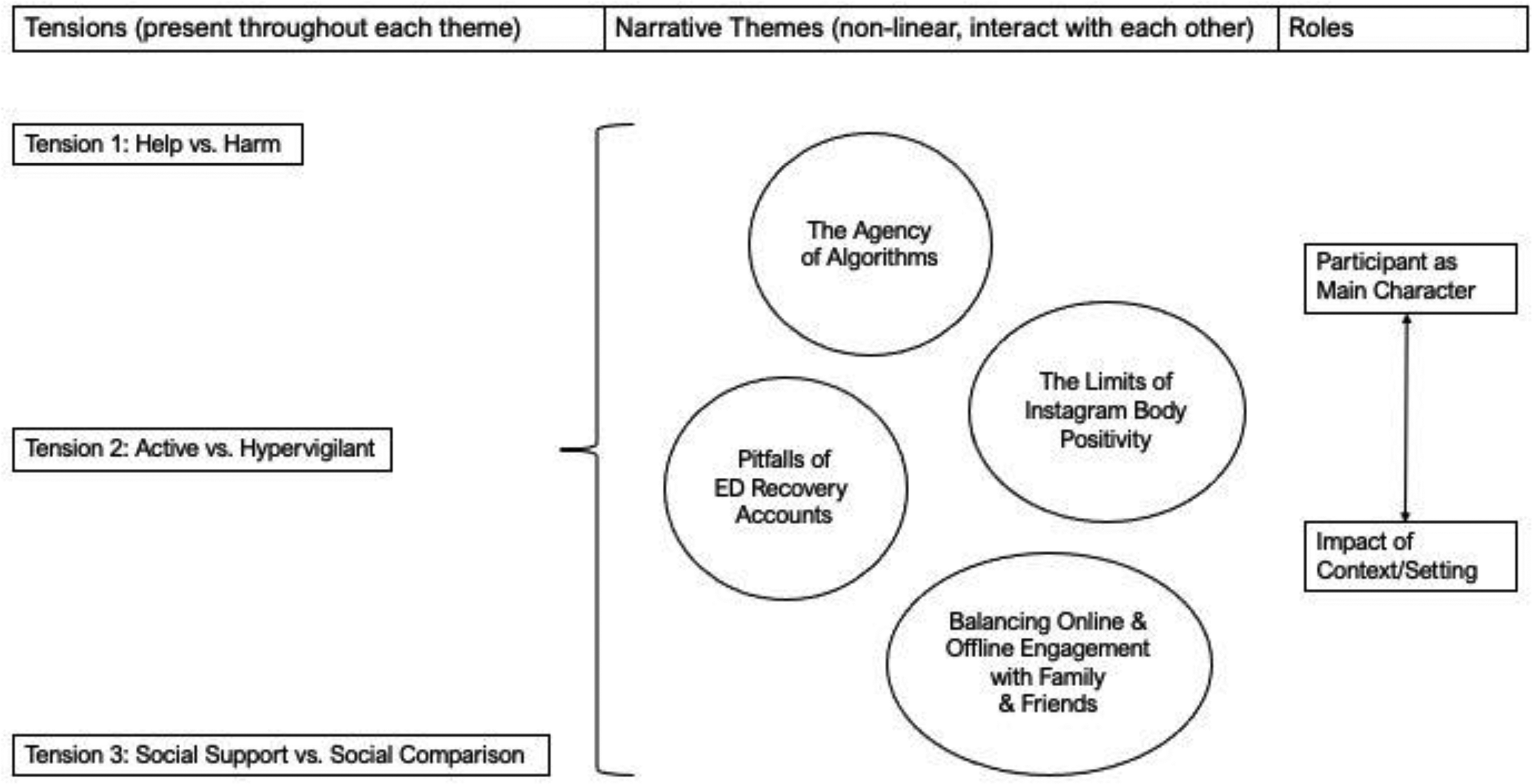
Visualization of Results.
Participants told stories about their personal ED recovery journeys characterized by several tensions. These included feeling like Instagram was a place where they could belong, while also recognizing these spaces as potentially harmful. Their stories touched on the different aspects of Instagram use (both viewing and posting) in ED recovery and wove these into their accounts of the tensions that characterized this social media platform. Participants storied themselves as active in the process of negotiating these tensions; they were the main characters of their narratives. In our analysis below, we focus on themes pertaining to participants’ navigation of Instagram and its key features. We begin by outlining the key tensions that arose in participants’ accounts, to set the stage for an analysis of the narrative themes we developed in this work. All names are pseudonyms.
Setting the Stage: A Snapshot into Instagram Use in ED Recovery
Participants’ stories of using Instagram in eating disorder recovery centered around three key tensions, which arise in relation to the settings, relationships, and material aspects explored below. The first core tension related to the “very fine line between it [Instagram] being helpful and harmful” (Jess) that participants described in their stories. Instagram use can elicit, exacerbate, or ameliorate experiences of EDs (Au & Cosh, 2022; Butkowski et al., 2019; Holland & Tiggemann, 2017; Wick & Keel, 2020)—and for participants in this study, it sometimes served these varied functions simultaneously. As some participants discussed, the role that Instagram played for them varied over time, for instance being harmful in early recovery but becoming more helpful once a participant felt that they were “in a mindset where you’re like, ‘Actually, this is going to trigger me, I’m not going to follow this content on Instagram’” (Caitlin).
Participants associated this active self-positioning with their developing recoveries. However, this positioning gave rise to the second core tension: participants were active users of Instagram, but the fact that they felt the need to curate content and be vigilant about possible triggers speaks to some of the app's potential pitfalls. Alice, for instance, suggested that a user has “to be really specific about what you look at”; here, the onus is placed on the individual to curate a sphere of images that is suited to their individual needs and wants in their ED recovery. Instagram can be a space ripe for social comparison (Au & Cosh, 2022; Saffran et al., 2016; Saunders & Eaton, 2018a, 2018b), requiring users to take control over their feeds to avoid falling into a negative comparison trap. As we will explore, the requirement to be “in control” of the feed places the onus on the user and requires them to self-position as an active, savvy consumer of media, rather than simply consuming content without fear of it becoming problematic for them. The need to control and monitor one's engagement with social media may be theorized as aligning with broader, postfeminist (Riley et al., 2018) and biopedagogical (Camacho-Miñano et al., 2019) pressures on women to take (and retain) control of their body—and body image.
While the social nature of Instagram can breed self-comparison, it also facilitates access to like-minded others in a way that can be helpful; herein lies the third key tension: social comparison versus social support. As Sarah noted: A key positive is connection with other people, like-minded people, so a sense of community … Others who have had a similar experience to me, and whose viewpoint or worldview aligns with mine.
This capacity for a connection could be particularly helpful when finding this community outside of social media was difficult. While in general society holds long-standing prejudice and disapproval against those with body types divergent from conventional (thin, White, cisgender) beauty ideals (Hamid et al., 2018), social media, actively curated, can create a space where these ideas are less prevalent. In turn, social media can shape how users orient to different bodies, on and offline, as Sarah articulated: I do learn through social media how to talk around these issues … What it's done is given me the words to express what I already knew but didn't know how to express … things like “fat just is,” and also things like body neutrality … It's helped to expand how I use language around bodies and with other people who use language that, to me, is problematic and it's given me a whole lot of tools to gently question or guide others, when I hear it.
Sarah's story illustrates how while the person is active in using Instagram—and indeed, participants’ stories illustrate how active engagement helps to generate feeds that help rather than hinder recovery—Instagram is also active in provisioning users with ways of thinking and talking about concepts. Figuring out how to navigate these spaces may also be a part of digital community-building, in that people seek to increase their digital social capital by using specific language and social media practices (Pang, 2020; Seidman, 2013; Wong et al., 2019).
Stories of Using Instagram in Eating Disorder Recovery
In this section, we comment on four key narrative themes, illustrating participants’ stories of Instagram use in recovery—and the tensions therein: the pitfalls of recovery accounts, balancing on and offline engagement with family and friends, the agency of algorithms, and the limits of Instagram body positivity.
The Pitfalls of ED Recovery Accounts. Participants’ stories of engaging with personal recovery accounts positioned the accounts and their content as primarily hindering their own recovery journeys. Generally, participants felt that these types of accounts were a depiction of what many of them termed “pseudo recovery”—that is, not being fully “bought in” or engaging with behaviors participants deemed to represent food and body freedom. They also noted that the content on these pages would often influence them to maintain engagement in disordered thinking and behavior patterns. For instance, Kate reflected on how: It's very unhelpful and it's like, “I haven’t eaten all day, who else hasn’t eaten all day? We’re so strong” … it's very difficult, like I’ve stayed clear of them since realizing at the very start that like, this is not good on any level. (Kate)
Participants’ stories highlighted how personal recovery accounts may sometimes be more closely akin to that of pro-ED online communities (Au & Cosh, 2022; Ging & Garvey, 2018; Juarascio et al., 2010), rather than a community of users who are moving away from their disordered thinking and behaviors and sharing pro-recovery content. It also poses the question of what pro-recovery content really is. For some participants, truly pro-recovery content would revolve less around food and bodies or even the idea of ED recovery itself and instead depict users simply “living life” outside of their EDs. As Kate noted: I think accounts showing people living their lives, outside of their eating disorder can be helpful … because, it's easy to get into a world where you’re just constantly surrounded by eating disorders, whether it's struggling in recovery, being recovered, or helping others recover. It took me a while to realize that I didn’t have to be an advocate when I recovered, and that maybe the best thing you can do is just help your family or kids grow up with a good, healthy relationship with food.
For Kate, the process of realizing that being recovered did not necessarily mean becoming a recovery advocate was an important moment in living her recovery. Another participant experienced destructive competition within the recovery community, speaking about how this shows up as Instagram users work to prove the degree of the severity of their illness, which was often associated with being granted external validation and acceptance into the ED recovery community. Jess said: There are some accounts that I came across that were very open about their eating disorders, and incredibly unhelpful to the point of like, posting body checks of them at the lowest weight or even like, what weight they got to, and all this kind of stuff and that's when that competitive aspect of it came in, because it was like you never felt sick enough to be in this actual community. The only time that you got extra support from the other people in the community was when someone was in hospital and people almost treat it like they’re winning the competition or something … like they’re the sickest of the sickest because they’re in hospital being fed by a nasogastric tube.
Jess's story sheds light on dominant narratives concerning ED recovery; the ED narratives that gain substantial validation on Instagram (in the form of comments, likes, and shares) are those who are perceived as “the sickest of the sickest.” Jess’ mention of a nasogastric tube highlights how an ED—and consequently, a version of recovery—is at times legitimized via its physical manifestation (see also Herrick et al., 2021; Holmes, 2017; LaMarre & Rice, 2017).
Participants’ accounts demonstrated the entwining of social comparison, self-objectification, and biopedagogies of recovery. Jess noted: Those types of posts [showing bodies of people during their EDs] can keep you trapped because you're like, “Oh my gosh, well, I didn't look as sick as she looks, so I need to go back so that I can do recovery kind of, in a proper way” or “If I get sick enough, then I can finally recover, you know?”
Recovery Instagrammers are called to put their bodies on display in the form of before and after photos showing their emaciated bodies, joining the dominant construction of this niche network (Pater et al., 2016). Others engaging with this content may then engage in unhelpful social comparisons (see also Au & Cosh, 2022; Fardouly, Diedrichs et al., 2015; Fardouly, Willburger et al., 2018), whereby they interpret their own embodiment as insufficient to constitute a “legitimate eating disorder.” Consequently, Instagram users learn the “correct” way of doing or performing recovery in and through their bodies (LaMarre & Rice, 2017).
However, participants did not completely buy into this biopedagogy of recovery, resisting it by, for instance, framing these practices as “pseudo-recovery.” Participants also suggested that often when people were recovered, they might actually feel less compelled to perform their recoveries on Instagram, as Anna noted: I mean, when someone was actually recovered, they wouldn’t be in the recovery community, they would say their goodbyes … I guess that's kind of when you’ve hit actual recovery is when you’re out of that community, and out into the real world, and Instagram is just kind of shoved to the side.
While participants noted that they were not completely immune to the negative impacts of these representations, this critique challenges long-standing discourses concerning female audiences of media content as passive and lacking in critical understanding (see also Holmes, 2018). Participants’ stories also represent a distinction between content creators and content absorbers and the intersection between these two positions as an Instagram users. Objectification of bodies in the ED recovery sphere may happen through both posting content and viewing others’ content on Instagram—through joining or contributing to communities that seem to be set up for comparison or through being exposed to these. Participants predominantly spoke to the pseudo-recovery nature of some recovery Instagram accounts; however, they also acknowledged that “there are so many good accounts out there that actually do advocate for pro anorexia recovery … people that have gone through it all and are willing to talk … when you find the right people, it's actually quite a welcoming community” (Alice). Thus, while social comparison and self- (and other) objectification did sustain potentially problematic relationships on Instagram, it could also enable spaces of community support (see also Au & Cosh, 2022).
Balancing On and Offline Engagement With Family and Friends. Participants identified that they used Instagram for social connection and support with family and friends not involved in Instagram recovery spaces. However, when participants’ family and friends posted content related to body image, food and exercise, and EDs, this could pose a challenge to participants’ recovery journeys. Participants told stories of setting boundaries and disengaging with people whose posts were unhelpful: If I unfollow them, it's not a dig at them personally … it's just an acknowledgement of, “What you're posting isn't contributing positively towards my mental health. I like you as a person, I like our conversations and I like spending time with you, just what I see online is just not really … it doesn't fit with me at the moment,” you know, it's that fine tooth comb approach again, where you’re wanting to feel like a part of other people's lives without feeling like it's deterring you from your recovery. (Bianca)
Here, Bianca prioritized her needs and wants for recovery, choosing to engage in person, rather than online, with those who post unhelpful content. She carefully distinguished disliking someone's content from disliking them as a person. Disengaging with unhelpful content was not always easy; as Alice noted, “It took me so long to get rid of people that had toxic behavior, because I felt like I didn’t want to unfriend a friend.”
Some participants suggested that there were other places for engaging with friends and family, like Anna who noted that people could “Stay in contact with friends in other ways, there are much better apps for that.” Here, Anna suggested that other apps—perhaps those that are not primarily image-based—might facilitate the kinds of interactions that can support recovery. This reflects how image-based social media in particular may facilitate social comparisons that were unhelpful for some participants—that is, they made participants feel like they were not achieving health in expected or required ways. Notably, these comparisons were not just with ED recovery content creators, but with friends and family who were engaging with dominant biopedagogies for health.
The Agency of Algorithms. Through curating their feeds and who they followed, participants exercised a good deal of control over their Instagram use. A notable exception was the platform's explore feature, which, as an algorithmically-based part of the app, was less able to be curated. Alice noted how: The hardest thing is when something comes up on your explore page, because there's actually nothing you can do, except for make sure you don't click on it, I think … because that's what I find really difficult is, I don't know how to filter out things that I don’t want to see cause I know on Facebook, I've never really used it but you can say, “I don't want to see more of this,” like a button … I don't think Instagram has one.
Alice's story highlights the challenges that come with navigating unwanted or unanticipated content on the explore page. Alice implicitly posited a suggestion for Instagram to create a similar filter feature to Facebook, to provide an option for users to eliminate harmful content from their feed. Alice's experience with Instagram's explore feature reflects the tensions between individual control and inescapable barriers related to Instagram use during ED recovery. Her story framed this component of the app as an inevitable obstacle to users’ ability to construct a space with content that they found safer. Problematically, as participants reflected, Instagram's algorithm could “misinterpret” what they would like to see, as Kate described: It's interesting because I have my kind of recovery and body positive pages, and so sometimes the algorithm gets confused and on the “suggested posts” it's like talking about diets, so obviously it's just a robot, it doesn’t understand the difference between a post saying that food does not have moral value and a post saying that carbs are bad for you.
The algorithm is active here, but not completely intelligent or intuitive (“it gets confused”). While Kate constructed a helpful and supportive feed for her recovery journey, Instagram's algorithm mistakenly considered body positivity and diet content as synonymous, presenting a barrier to enacting recovery.
The algorithm's choices of content to show on the explore page might also be framed as a litmus test of reverting back to old thinking and behavior patterns, as Alice shared “[the explore page] is a really good indicator if I'm starting to tap back into those tendencies because it instantly recognizes that I'm looking at more food photos and it'll start giving me more.” Thus, while the explore page might lead to problematic encounters with unwelcome content, and the algorithm may make mistakes, the adaptive nature of the algorithm could also give participants insight into their Instagram behavior in relation to their recovery experiences.
The Limits of Instagram Body Positivity. Body positivity is increasingly present on social media, particularly Instagram (Cohen, Irwin et al., 2019; Cohen, Newton-John et al., 2020; Lazuka et al., 2020; Zavattaro, 2021). Body-positive discourses present alternatives to dominant ideals of feminine beauty rooted in socially constructed versions of conventionally attractive, desirable, and longed-for bodies (Cohen et al., 2019; Jafari, 2016; Lazuka et al., 2020). However, many participants described body positivity as only existing to a degree, inviting only some people to feel positive about their bodies. As Bianca shared: I used to follow quite a lot of influencers … they were all promoting holistic health and acceptance of yourself, but still sort of within the parameters of what they're comfortable with, like, “Yeah, I gained a bit of weight” or “Weight doesn't matter,” but then if you ask them, “Okay, you're 55 kilos. Now, if you weighed 70 kilos, would you still be saying the same thing?” I can guarantee you that they would say “No.” They would think it, but they would not be acting it, because if you weigh “too much,” then you’re seen as unhealthy.
Here, Bianca shared how there are limits to body positivity discourse on Instagram, and these limits are often weight based. This limited outlook on body positivity is tethered to capitalism insofar as companies profit from body positivity by inviting influencers to share makeup-free photos, launch plus-size clothing lines, and include various body types in their advertising campaigns (Cwynar-Horta, 2016). Rather than promoting the full spectrum of bodies as valuable in and of themselves, body positivity can become commodified on digital platforms like Instagram (Brathwaite & DeAndrea, 2021), as participants’ accounts attest.
Bianca's story illustrates how the presence of healthist discourses on Instagram may have a negative impact on ED recovery in the ways that they infuse even body positivity discourses. Indeed, as Musolino et al. (2015) suggest, “neoliberalism and healthism represent a constellation of contemporary forces that have created an environment for disordered eating to flourish” (p. 2)—and these forces may, equally, impede recoveries.
A recovered body may only be framed as acceptable when it fits very narrow parameters (LaMarre & Rice, 2016). In the context of EDs, only some bodies (thin ones) tend to be recognized as eating disordered (Harrop et al., 2021), further perpetuating limited perspectives on who might belong to a recovery community. In other words, fat bodies are not presented as “legitimately” eating disordered, thus potentially impeding their access to “recovery.” As Bianca and other participants pointed out, acceptability also hinges on having a “perfect” larger body: I take with a grain of salt companies that attempt to be inclusive … it still doesn't cover the full spectrum of bodies and it still has a type of beauty that is still narrow. It's still a narrow field that not everybody can fit into. Yes, the models are a bigger size, but it's still gotta be a nice, smooth curve and be symmetrical, not lumpy bumpy. It's still very contrived, smoothed out and conventionally beautiful. (Sarah)
As Sarah's story illustrates, women are still expected to self-govern—and to buy into transformation imperatives (Evans et al., 2020) and in so doing enact postfeminist biopedagogies. Choice, in a postfeminist frame, is presented as empowering and liberating when it may in fact be constrained by social context (Musolino et al., 2015). As Sarah pointed out, increased representation has been associated with ideas of inclusivity and choice of content to consume; however, these representations are still limited.
Sarah's discussion about models and representativeness (or lack thereof) on Instagram also draws our attention to the fact that participants are not only navigating Instagram content that overtly pertains to EDs and recovery stories, but broader overarching healthist discourses. They may thus become stuck at the interface between biopedagogies of health in general and recovery biopedagogies (see also LaMarre & Rice, 2016), as these entwine to generate contradictory ideas about health and wellbeing.
Discussion
Active social media use is often defined as actionable habits such as a larger amount of time spent on social media, as well as regularly liking, following, sharing, or commenting on images posted by others, particularly on image-based platforms like Instagram (Escobar-Viera et al., 2018; Feltman & Szymanski, 2018; Frison & Eggermont, 2017). Participants’ stories introduce a nuanced perspective on what it means to be an active Instagram user and the extent to which this active position is made necessary by the potential pitfalls of the medium. Participants shared an array of social media use habits they adopted over the course of their ED recovery journeys as they worked to create more constructive experiences of using Instagram for themselves that were supportive of their recoveries. In line with our theoretical lens of biopedagogies (Camacho-Miñano et al., 2019; van Amsterdam & Knoppers, 2018), participants’ stories provide context for understanding complex processes of navigating and negotiating ED recoveries in relation to Instagram's visual landscape. Participants learned about and took up instructions about how to behave in their recoveries, while also, at times, rejecting or resisting these teachings. In some ways, biopedagogies shaped participants’ engagement in self-comparison and self-objectification as they sought to navigate the “rules of the game” on Instagram.
In their stories, participants continually articulated themselves as active, “main characters,” emphasizing the various strategies they used to combat unhelpful content on Instagram. For instance, they removed unhelpful content from their feed by unfollowing, muting, or blocking particular Instagram users; they also overlooked unhelpful content and adopted new lenses for interpreting unhelpful information. Moreover, they spoke about actively challenging other Instagram users and their unhelpful content, or, alternatively, rejecting and disengaging from this content.
Through active navigation of the sometimes-conflicting biopedagogies present on Instagram, many participants engaged in what Hockin-Boyers et al. (2020b) described as “digital pruning.” In other words, they actively used Instagram features (e.g., unfollowing, muting, blocking) to avoid interactions they anticipated being harmful—including those that they encountered on seemingly recovery-oriented pages. Although these filtering tactics can grant women some control and agency over their experience of using Instagram, the exercise of such strategies may be laborious and ongoing for the user (Toffoletti et al., 2021). In engaging in these strategies, Instagram users may also become hypervigilant about maintaining safety and comfort (Eikey & Booth, 2017).
Participants’ stories illustrate how problematic dialogues about food and bodies continue to infiltrate Instagram; these include dichotomous perspectives of certain foods (Toll, 2019; Walsh & Baker, 2020), as well as the vilifying narrative of fat shaming (Webb et al., 2017). Problematically, as participants’ stories illustrate, these discourses also show up in seemingly body-positive spaces, as well as recovery-oriented ones. By and large, participants disengaged from ED and recovery content, demonstrating strong awareness of their negative impacts, contrary to the framings of people with EDs that present them as passive consumers of content. Further, participants also framed themselves as responsible for speaking back to these problematic messages, contributing to shifts in the narrative.
Instagram and other social media sites have been noted to be rife for social comparison and self-objectification. Yet, many interventions focus on media literacy and increasing awareness of the problematics of these images. Participants in this study were aware of problematics at play—but not immune to them. A focus on individual media literacy may inadvertently reinforce the postfeminist ideal of a media-savvy consumer left to make their own choices without significant cultural shifts (Gill, 2007). This invites us to question whether interventions aiming beyond awareness, toward broader critiques of body and health ideals, and toward social justice would afford greater flourishing (Piran, 2015).
Overall, participants’ stories illustrate some of the contradictions and tensions present in ED recovery communities, as well as how biopedagogies of health and recovery lay the groundwork for the operation of self-objectification and self-comparison in this space. Our findings illustrate the multi-directional interaction of biopedagogical discourses such as body positivity, postfeminism, healthism, and neoliberalism in everyday Instagram use. In particular, the findings demonstrate how stories of ED recovery and Instagram use are largely tied to individuals’ subjective experiences and simultaneously, embedded in and influenced by their sociocultural milieu, specifically broader discourses on health and what “being healthy” and “being recovered” look like. On the one hand, participants’ agency in negotiating these pedagogies is hopeful as it illustrates peoples’ capacity to generate safer spaces supportive of their recoveries. On the other, the need to enact strong safeguards in this context arguably foregrounds the marching on of a postfeminist biopedagogy of the active consumer who is able to enforce strong boundaries in the face of an unchanged and sometimes-insidious operation of limiting perspectives on bodies, health, and recovery itself.
Limitations
Although our study provides several insights that further understandings concerning lived experiences of ED recovery and Instagram use, it should be evaluated in relation to several limitations. First, our sample was relatively homogenous and small. While this was a strength in that it allowed for deep analysis of participants’ stories, the primary limitation in terms of understanding the dynamics of negotiating recoveries on Instagram was that all of our participants were White, cisgender women from New Zealand. It would be important for future research to explore similar questions in a diverse group of individuals, including people of different ethnicities, trans and non-binary people, intersex people, and cis men, particularly as these groups are less often involved in ED research. Our participants also self-selected into the study and self-identified as having experienced an ED. We see this as a strength, as it enabled us to avoid using diagnosis as a barrier to involvement. However, this choice may be seen as a limitation in terms of comparing with clinically diagnosed groups.
Practice Implications
One of the central findings of this work is the degree to which participants actively engaged with and shaped their social media presence in the face of pervasive and potentially harmful ideas about health and “good bodies.” Participants’ stories reveal the importance of considering the content of recovery-oriented accounts as well, suggesting that perhaps a marker of recovery, at least for some, to consider is living life outside of ED recovery communities online. As participants recovered and explored how they wanted to live their lives, they also negotiated social media as a part of the bigger picture of their lives. This may hold implications for clinical practice, where healthcare providers might explore with clients their relationships with social media. For instance, healthcare providers could ask their clients or patients whether they use social media and explore with them how that is impacting their recovery. They may explore ways, together, to maximize the benefits of social media engagement while minimizing negative impact. It may also be helpful to avoid making the assumption that a particular kind of content is helpful (e.g., assuming that content labeled “recovery oriented” is helpful) and instead provide opportunities to engage with the content underneath the label in relation to the person's own situated recovery experience.
Participants’ accounts illustrate how Instagram is not simply positive or negative for ED recovery; it is nuanced and largely determined by the individual's unique, lived experience. Their stories do not suggest that the Instagram community is entirely problematic nor helpful for ED recovery, or that Instagram users should necessarily avoid this image-based app throughout their trajectories of recovery. Rather, the findings gesture at the complex interweaving of this social media platform with the dictates and expectations about bodies that pervade our social worlds.
Supplemental Material
sj-pptx-1-pwq-10.1177_03616843231166378 - Supplemental material for “If I Unfollow Them, It's Not a Dig at Them”: A Narrative Analysis of Instagram Use in Eating Disorder Recovery
Supplemental material, sj-pptx-1-pwq-10.1177_03616843231166378 for “If I Unfollow Them, It's Not a Dig at Them”: A Narrative Analysis of Instagram Use in Eating Disorder Recovery by Ilinka Nikolova and Andrea LaMarre in Psychology of Women Quarterly
Footnotes
Acknowledgments
We wish to thank our participants for their time in participating in this research. We thank the School of Psychology, Massey University, for the postgraduate research funding for this work.
Author Note
This article was developed from Ilinka Nikolova's Master’s thesis for MSc in Psychology at Massey University.
Declaration of Conflicting Interests
The authors declared no potential conflicts of interest with respect to the research, authorship, and/or publication of this article.
Funding
The author(s) disclosed receipt of the following financial support for the research, authorship, and/or publication of this article. This research was funded through the Massey University School of Psychology postgraduate research fund for Ilinka Nikolova's MSc research.

References
Supplementary Material
Please find the following supplemental material available below.
For Open Access articles published under a Creative Commons License, all supplemental material carries the same license as the article it is associated with.
For non-Open Access articles published, all supplemental material carries a non-exclusive license, and permission requests for re-use of supplemental material or any part of supplemental material shall be sent directly to the copyright owner as specified in the copyright notice associated with the article.
